A m x same’ su sa ‘Nawalakw (the supernatural spirit wraps around us): impacts of Kwakw a k a ’wakw regalia making on identity,wellness and belonging in ‘Y a lis,British Columbia
Open accessResearch articleFirst published online December, 2021
A m x same’ su sa ‘Nawalakw (the supernatural spirit wraps around us): impacts of Kwakw a k a ’wakw regalia making on identity,wellness and belonging in ‘Y a lis,British Columbia
In this article, we share findings from a community-based Participatory Action Research project, titled Sanala, which means to be whole in Kwak’wala—the language of the Kwakwaka’wakw (Kwak̓wala-speaking people; a First Nation from what is now called Canada). In response to community priorities, the Sanala team initiated regalia as a weekly programme where people from the ‘Namgis tribe and other surrounding Kwakwaka’wakw Nations on the northwest coast of British Columbia, Canada, come together to create regalia. Participants learn about family crests, design and sew button blankets and dance aprons, and learn oral histories belonging to individuals and families, all within the context of Kwak’wala language revitalization and regalia making. We outline the impacts of this programme on identity, belonging, wholistic health and collective wellbeing, as well as implications for Participatory Action Research and community-led research aimed at strengthening individual and collective health and wellness through Indigenous languages and cultural continuity.
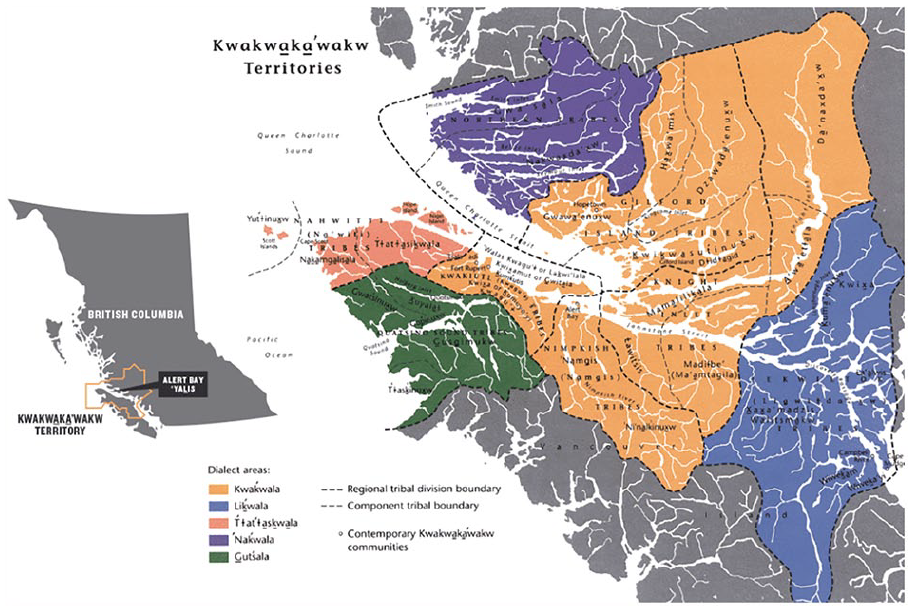
We are the Kwakwaka’wakw, the Kwak̓wala speaking people. We are eighteen tribes whose territory reaches from northern Vancouver Island southeast to the middle of the island, and includes smaller islands and inlets of Smith Sound, Queen Charlotte Strait, and Johnstone Strait.
In this context, a community-based Participatory Action Research (PAR) project, titled Sanala, supported the development of community-based regalia making in ‘Yalis (Alert Bay, BC). Sanala, meaning to be whole in Kwak̓wala—the language of the Kwakwaka’wakw—is a community-based PAR partnership between researchers in the University of British Columbia (UBC), School of Nursing, and the ‘Namgis First Nation. Academics and ‘Namgis Elders, Knowledge Keepers and community members have been collaborating to support health and healing through community-defined, strengths-based and culturally grounded work since 2010, with a specific focus on Kwakwaka’wakw cultural continuity, regalia—for example, traditional button blankets, dance aprons and cedar bark headpieces and neck rings—making and Kwak̓wala language revitalization. In response to community priorities, regalia making was designed as a weekly programme where people from the ‘Namgis First Nation and others Nations from Vancouver North Island came together with non-Indigenous community members from Alert Bay to learn about family crests and design, and sew button blankets and dance aprons, all the while learning oral histories belonging to individuals and families. This knowledge sharing is collective, as participants learn about and discuss ancestral family crests and incorporate them into the design of blankets and aprons while also learning and speaking Kwak̓wala. In the short-term, community members are tasked with sewing, a practice that over time supports (re)connection with their roots through regalia making, a culturally embedded process of strengthening identity. This article outlines the impact of the Sanala regalia-making initiative, including increased pride among participants, supporting each other as a collective, benefits of engaging in culture and language as medicine and identity, and the celebration of identity and ancestry through ceremony. In addition, we explore the implications for PAR and community-led research aimed at strengthening individual and collective health and wellness through Indigenous languages and cultural continuity.
Background
For the Kwakwaka’wakw, the significance of ceremonial regalia has always been important as a means to share and display individual and community identity through connections to ancestral lineage. Much of the knowledge shared here comes from co-author Trevor Isaac, which he gained through ongoing learning and engagement with his culture and heritage. The Kwakwaka’wakw live along the Pacific Northwest Coast in BC, Canada. The Kwakwaka’wakw once had 28 tribes who lived along Northern Vancouver Island and the adjacent mainland. Today, there are 19 tribes left due to the ongoing impacts of disease, dispossession and community amalgamation. The ‘Namgis are one of the tribes, currently based in ‘Yalis after being relocated from their traditional homelands in the Nimpkish Valley on current day Vancouver Island (Figure 1).
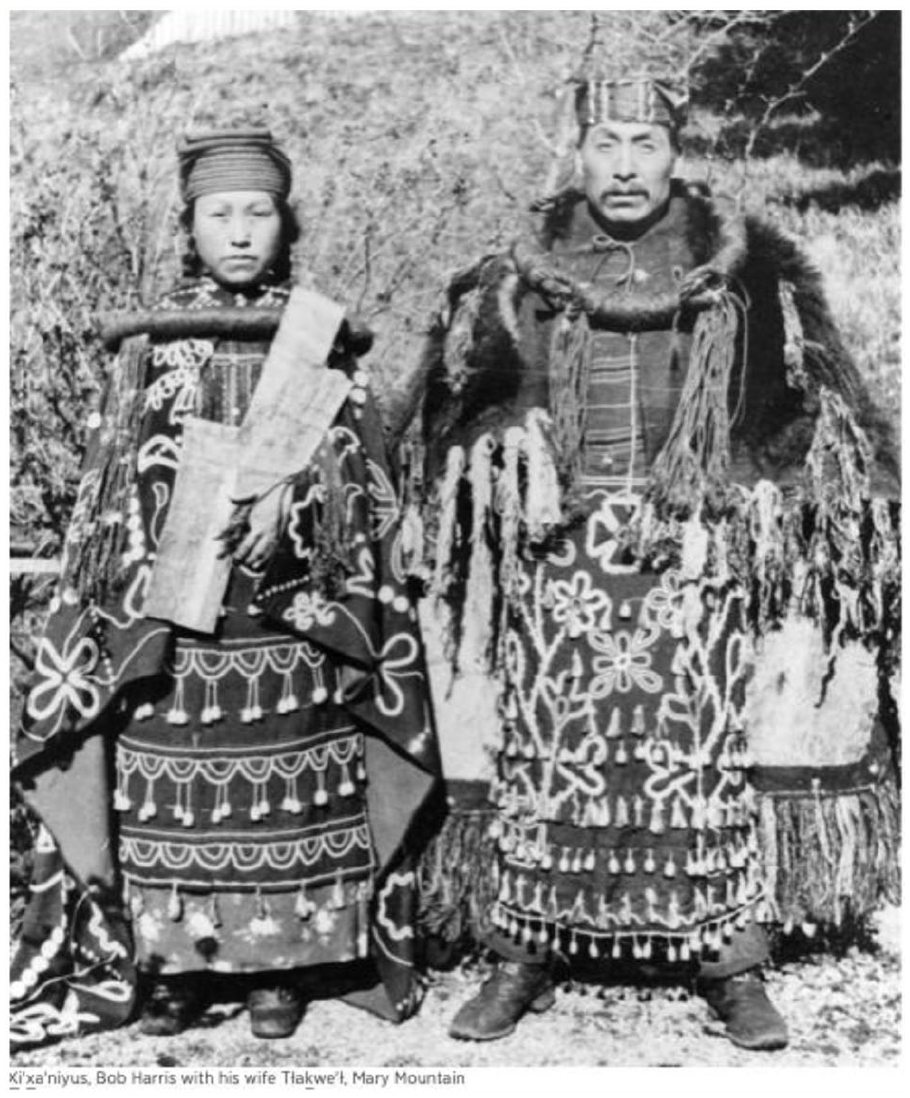
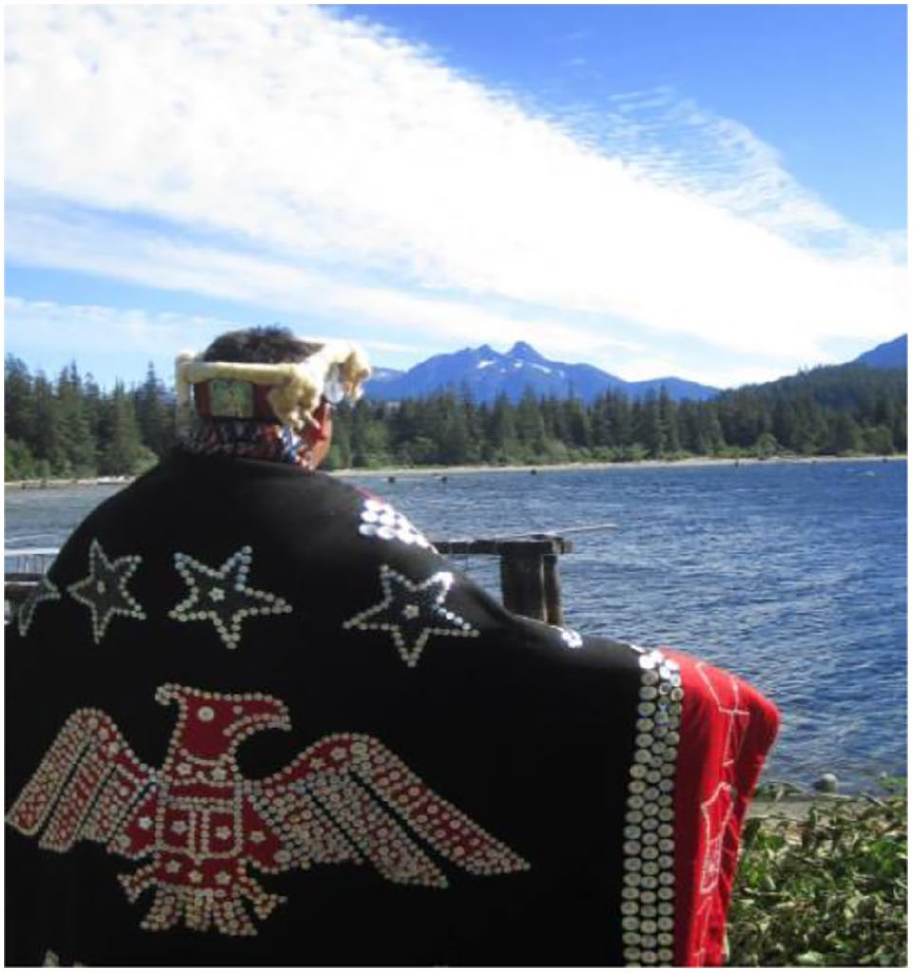
Traditionally, furs, skins and cedar bark of different types were worn to display individual rank and prestige within the community, as well as in ceremony. Due to the availability of local materials, similar dress would be used in both everyday life and ceremonially; however, certain specialty pieces used only in ceremony would be adorned with trade goods or carved crest figures (Figure 2). Barriers created due to colonialism, such as the potlatch ban affected the continuation of our traditional ways of being; however, many traditions related to clothing and regalia have been maintained and enhanced over time, while some have—unfortunately—been lost. One such example of traditional clothing is the K’angextola—the button blanket. Button blankets, while considered traditional, used trade materials—such as wool, cotton, beads and buttons, highlighting the ongoing and dynamic nature of Kwakwaka’wakw culture. Button blankets developed alongside the fur trade and increasing access to material wealth for the Kwakwaka’wakw. Wool blankets traded through the Hudson Bay Company were used by coastal peoples, incorporating this new material into potlatch ceremonies. Button blankets—which are dance robes worn in ceremony—display an individual’s rank within society and tell the history of the individual wearing the blanket through the family crest figures displayed. This visual means of displaying identity and kinship was important, as the Kwakwaka’wakw did not traditionally have a writing system for their language, instead using complex visual art to document important histories. In the case of button blankets, many pieces of information are available through the artform, including a main crest design of the person’s family, coppers owned or given throughout one’s life, other sub-crest figures, and occasionally food sources that were given to guests at previous family ceremonies. Coppers are both material and ceremonial objects; made of copper and sometimes called a copper shield, coppers can be bought or sold, inherited or gifted through dowry. This figure is often displayed on button blankets and other pieces of regalia. Every copper owns a name and individual value. Some examples of food that could be displayed were clover leaves and certain flowers. A main food staple in the past, accumulating enough clover roots or flowers to feed guests during a potlatch ceremony required a great deal of resources, making this nutritious feast an integral aspect of identity and pride.
The potlatch ceremony is a platform where the host Chief and their family publicly acknowledge their family history, genealogical ties, origin stories and current life events. The potlatch ceremony is for sharing family pride and history and enact the Kwakwaka’wakw ideal of reciprocity. During these ceremonies, many important songs and dances take place, and the button blanket is often worn and used by people of all genders and ages during dances.
Although new found wealth for the Kwakwaka’wakw through the fur trade initially provided additional resources for use during the potlatch, ongoing colonial encroachment had several negative impacts, including the loss of land and resources, and the eventual ban of the potlatch and other Indigenous ceremonies (Davidson & Davidson, 2018; U’Mista Cultural Society, 2019a, 2019b). Further colonial violence was enacted through the Indian Residential School System and Indian and tuberculosis hospitals (Bombay et al., 2014; McKenzie et al., 2016; Milloy, 1999; Mosby & Galloway, 2017; Truth and Reconciliation Commission, 2015a; Wilk et al., 2017). With the increasing restriction of access to ancestral lands, the Kwakwaka’wakw and other Indigenous Peoples in Canada were forced to depend on new trade items and food sources, making traditional knowledges in these areas difficult to retain and transmit across generations (Kelm, 1999; Turner & Turner, 2008). The potlatch ban disrupted the intergenerational transmission of culture, as people were imprisoned and numerous ceremonial objects were seized illegally by the Canadian colonial government (U’Mista Cultural Society, 2019b). The negative impacts on cultural continuity were continued through the Indian Residential School and Indian hospital systems, wherein children were forcefully removed from their homes, impacting language transmission, cultural continuity, and individual and community health and wellbeing (Geddes, 2017; Lux, 2016; Truth and Reconciliation Commission, 2015a). In addition, pre-colonial social structures that celebrated community Elders were disrupted, resulting in increased risk of social isolation for Elders and the wider community. Many Indigenous communities continue to face barriers to health and wellbeing linked to historic trauma and ongoing colonialism. The ‘Namgis, as well as the other Kwakwaka’wakw descendants, continue to pass down the traditions and have much to celebrate. The majority of the masks seized under duress have been returned—thanks to advocacy by the community (U’Mista Cultural Society, 2019a), language classes are being provided by the Sanala Research Team, as well as in the local schools. The younger generations are increasingly interested in learning their gwayileas (traditional Kwakwa̱ka̱’wakw ways), such as gathering and preserving food and cedar bark weaving.
The Sanala regalia initiative brings people together for learning and connecting to their ancestral history. These activities are deeply connected with Kwak̓wala language, identity, ceremony and cultural continuity. Regalia making acts as culturally rooted and community-led health promotion, drawing on an ongoing programme of community-based and PAR with the ‘Namgis community. Through this ongoing research, ‘Namgis community members and participants from other surrounding First Nations shared the impacts of regalia making on their identity, connection, healing and wellness, strengthening tangible and intangible aspects of their family, history and community identity. Many ‘Namgis traditions can be sewn onto a button blanket, making the creation of regalia a tool for knowing oneself in relation to family lineage.
Methods
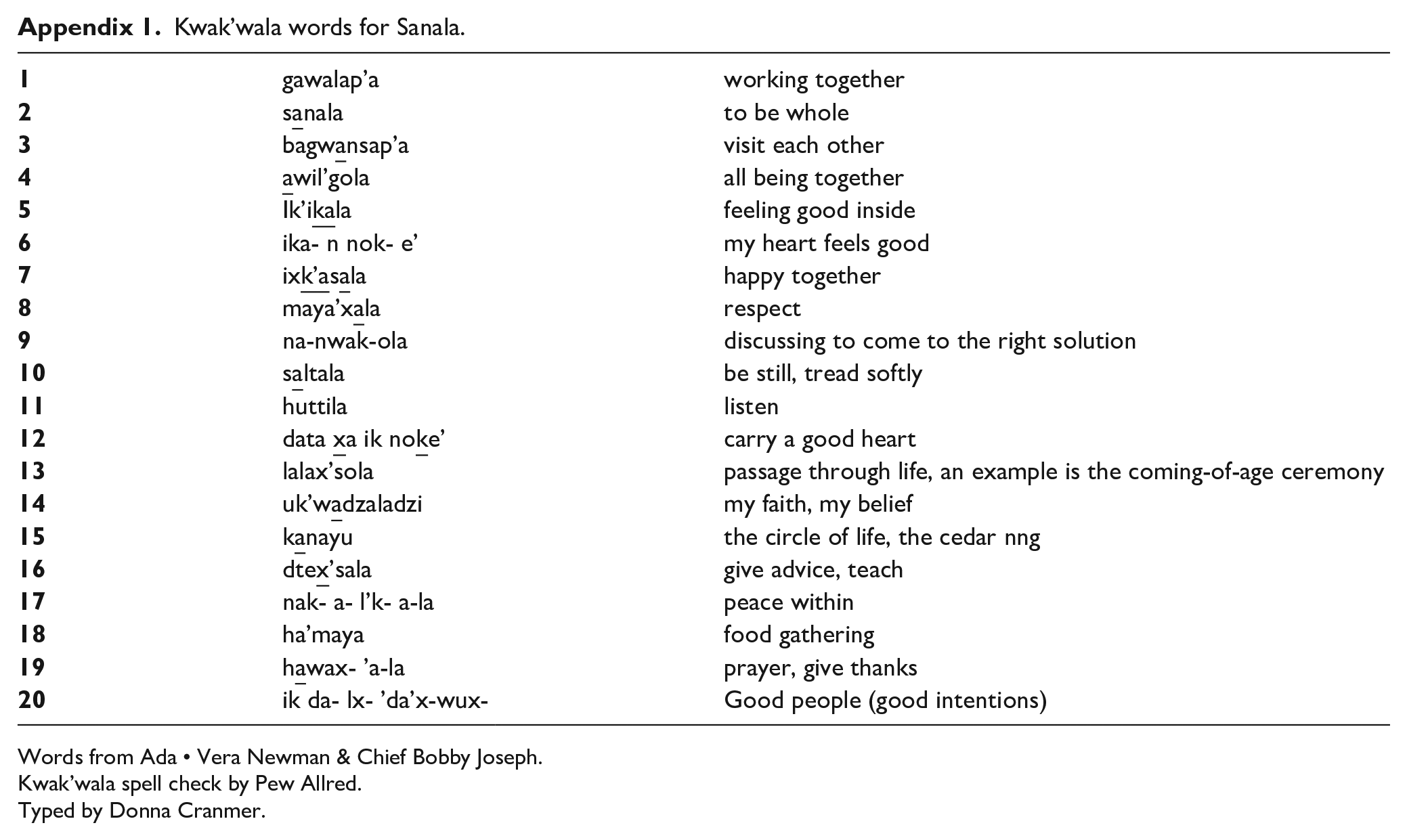
This article presents findings from a community-based PAR partnership between the UBC, School of Nursing, and the ‘Namgis First Nation. Qualitative research was undertaken to explore the impacts of a weekly regalia-making programme that also included Kwak̓wala language speaking (Brown et al., 2012). Kwakwaka’wakw means Kwak̓wala-speaking people; given this, one co-author, Elder Vera Newman, raised the question of what their communities would call themselves if there were no more fluent Kwak̓wala speakers in their communities. In 2014, Kwak̓wala learning and speaking was integrated into the Sanala regalia-making programme as a means to expand participant engagement with ‘Namgis traditional teachings; learning Kwak̓wala and connecting to Kwakwaka’wakw teachings were an integral part of the supernatural spirit that connected participants to their identity and ancestors. Learning and speaking Kwak̓wala opened and closed the regalia sessions in ceremony and strengthened the relationship among language, culture and identity as processes of decolonization and reclamation. Together, participants spoke Kwak̓wala words and phrases, while Elders, Knowledge Keepers and fluent speakers shared their meaning; each word spoken encapsulated distinct meanings that were embodied learned, shared and practised together over time. An example print out from these lessons is available (Appendix 1). In this way, regalia making became the space and place where identity, culture and language were intertwined towards learning and connecting in community.
Data were collected through naturalistic observation and via conversation and participation in regalia making—sorting buttons, threading machines—and individual and circle interviews with participating community members. Circle interviewing was undertaken as a decolonizing research approach of naturalistic inquiry (Denzin & Lincoln, 2008) focused on conversing and sitting with people as they were in the midst of sewing, the phenomena under study, rather than as decontextualized group discussion as can be the case within conventional focus groups (Kovach, 2009). This programme’s vision was created by Barbara Cranmer and co-authors Trevor Isaac and Elder Vera Newman and run for 3 hr bi-weekly with food and prayer circles from 2016 to 2018, and then again in 2019 until COVID-19 restrictions required the programme be halted in February 2020. ‘Namgis members of the Sanala team guided the decolonizing research methodology, including all data collection and thematic analysis interpreted through Kwakwaka’wakw teachings. Data were collected over several sessions while the UBC team attended over five timepoints between 2016 and 2018. Circle conversation groups were run by Sanala Co-Leads Barbara Cranmer, Helen Brown and Elder Vera Newman, and were intended to explore programme impacts, with a specific focus on impacts related to healing, wellness, identity and belonging. Circle conversations were audio recorded, subsequently transcribed and anonymized.
All the Indigenous participants (n = 56) were either members of the Kwakwaka’wakw, including ‘Namgis and other neighbouring Nations. We also included a small group of non-Indigenous participants (n = 5). These non-Indigenous participants all lived in the Alert Bay municipality, and were interested in learning about their own family lineages and committed to upholding respectful learning of—without appropriating—the cultural teachings and knowledge within Kwakwaka’wakw regalia making. Our team was very aware of the potential risks of cultural appropriation by non-Indigenous participants, and clear with these participants that it was not appropriate to learn from and with us, and to then act like experts in Kwakwaka’wakw culture. Overall, our team leaned towards sharing our teachings to “educate the big world about who we are” (co-author Andrea Cranmer). We believe that when more non-Indigenous people see and learn our Bak̓wam—First Nations—ways, they can understand and learn about us as people. One non-Indigenous woman made a crest image of a crow and, as our lead, Elder Vera Newman said,
that was OK, because we don’t have crows in our crests, and they made vests not blankets. We invited non-Indigenous people to honour the importance of their own learning and being educated, knowing we could guide this during our sessions.
Results
Regalia making through Sanala supported health and wellness for participants by providing opportunities for strengths-based and meaningful engagement and relationships with the community. By coming together, participants felt connected to their communities, impacts that were expressed both individually and relationally, reflecting social, emotional and spiritual experiences in the midst of creating their regalia.
Each and every regalia-making class and Kwak̓wala learning and speaking ceremony was guided by Kwakwaka’wakw teachings. The Kwakwaka’wakw teachings were fundamental in the guiding relationships and time spent together. These teachings and protocols have been passed on through generations since time immemorial, and were lived and embodied in the making of family crests and discussion of ancestry. Each gathering was opened and closed in prayer, participants sat in a circle, and Elders were invited to eat and to speak first. These protocols and the teachings they embodied guided each and every step of regalia making. For example, to make a blanket or apron, a participant would begin by researching who they are and where they come from. Each crest comes from a participant’s ancestors, and to honour their ancestors, they must engage in the ongoing learning, knowing and honouring of gwayilelas (our ways). Non-Indigenous participants researched their own stories and were guided by Kwakwaka’wakw teachings to create their own culturally meaningful items while remaining respectful and culturally safe. During blanket making, participants learnt ‘Namgis dances and the Kwak̓wala language, and shared in their individual and collective origin stories and ancestry to Sanala, to become whole. In the words of one co-author, Andrea Cranmer, “it wasn’t just blanket making, it was cultural infusion,” steeped in ancestral teachings of learning, sharing, remembering and researching.
Pride in selves
Participating community members shared their experiences and emotional responses related to the designing and sewing of their individual regalia within a community connected through shared expressive and aesthetic activities. One person spoke of the inseparability of how feeling connected to and loved by others through regalia making created the chance for personal pride: “I felt connected, a part of, and loved. I also felt proud, real proud, yes.” Another person described the embodied sense of wholism through sewing and learning about the works of others; she stated that during blanket making, “my heart felt whole,” while others described lightness and joy from being together and working side by side, put simply: “I felt happy.” Participants shared in circle discussions about the efforts required to arrive at the weekly evening session, juggling family responsibilities and, for some, travel to ‘Yalis. One woman who lived off of the Island would take a small powerboat from her home in Port McNeil, BC, to join the bi-weekly sessions, stating bad weather would not keep her from joining. Feeling connected to the community of people engaged in artistry was palpable in the regalia-making space; people would periodically hold up their blankets and aprons, smile to themselves and then quietly begin working again. The visible impacts for people were evident in the personal moments of seeing the beauty of their work and pride as the images took shape, one button at a time, while also noticing how others were similarly connecting to their work. The sewing space was described by Elders as a place of learning, pride and connection, all experiences that are integrally connected to self and identity.
Uplifting each other
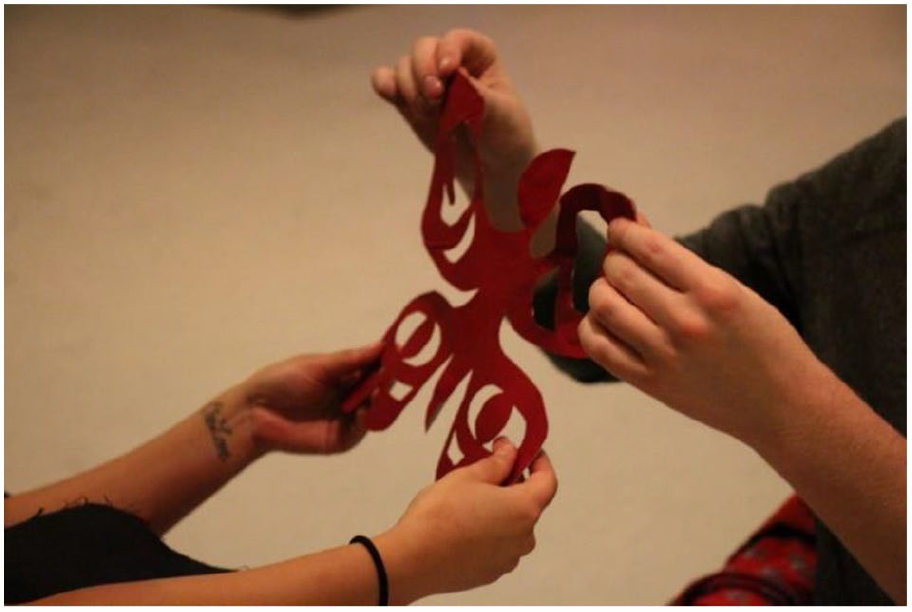
Blanket-making also provided opportunities for creativity and artistry. This in turn created a collective identity of artists and community members engaged in their shared history and evolving cultural practices (Figure 3).
Sanala participants working together to design regalia. Photo credit: Steve Calvert.
One participant spoke of the collective beauty when seeing everyone’s creativity: “I felt really in awe to be in there, to see all the different designs and to see so many of them. It was just a really beautiful experience.” Another participant shared their pride in being a part of something that reflected the meaning of Sanala, to be whole, to participate in creating and sustaining wholeness with others: “I was really proud to be in this part. We really are Sanala. And I’m proud that I finally did my butterfly blanket, Gilakas’la [thank you].” This participant highlighted the importance for our research team of being Sanala through “cultural intervention research”—as this work is named and framed within the context of a funded research programme. We are reminded of how Sanala is more than research and more than programming, it is an embodied and collective experience for healing and wellness through connections with family, community, spirit, language, land, history, ceremony, art and ancestry.
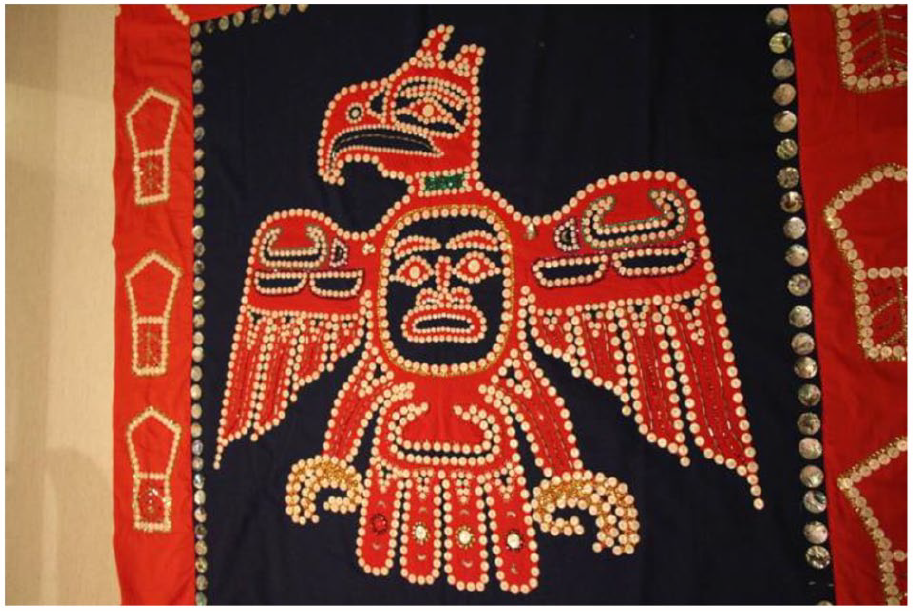
Participants spoke of deeply feeling the experience of sewing regalia while also imaging their anticipated joy and pride in their finished blanket (Figure 4) or apron. One person said, “I felt honoured and connected to be part of this group, and also to make a blanket.” When blankets were shared with and worn by others, the feeling of Sanala worked to lift each other up. As one participant described, “I just wore hers, and I found it uplifting.” Through these collective experiences and the weekly act of sewing and engaging together as individual regalia pieces took form, participants built and sustained connection through the expression of ‘Namgis culture and identity, as well as the Kwak̓wala language. One participant shared how cultural strength—both lived and practised—provided the basis for being creative in ways intended to be shared with the wider collective of the Nation:
I’m proud and fortunate to have been brought up in two culturally strong families. And being part of that part in the Big House reconnected us with our culture, and allowed for me to bring out some creativity, to add to the regalia that my husband and my sons already have. It gave me great pride to show that off.
A button blanket, made during the weekly workshop. Photo credit: Steve Calvert.
Even for participants who did not arrive feeling strong in their culture, the weekly meeting provided opportunities for cultural revitalization and resurgence, as well as learning Kwak̓wala and practicing using the language in community with others. Even for those who did not originally feel like they were a part of their culture, regalia making provided opportunities for ongoing learning and engagement that affirmed commitments to know and inquire within their own families about lineage and ceremonial crests. Participating community members spoke of blanket making as helping them to be strong, which in turn provided the chance for growth through cultural identity and connections. As described by one participant, “I just felt honoured to be a part of our beautiful culture.”
Blanket making as medicine
During one regalia-making session, a young woman struggling with mental health challenges entered, and was first welcomed by co-author Elder Vera Newman, who invited her to join. As this young woman joined the sewing of fabric and buttons, others welcomed her and learned more about her. This young woman continued to participate for several weeks and eventually shared with our Sanala team that joining blanket making “saved her life” and that when in the space she “felt the love in the room.” Blanket making became a place for many to connect, feel included, safe and valued within the relationships and community created every week when weaving regalia making together with speaking Kwak̓wala.
Kwak̓wala language as identity
Time spent together creating regalia was also time spent together learning Kwak̓wala and being in conversation with one another. Fluent Kwak̓wala speakers and Elders would guide language lessons, sharing words and phrases that were relevant to regalia making—such as the names of different designs, family crests and aspects of ‘Namgis history reflected in regalia making. In addition, individuals were able to sit together, be in conversation together, passing the time, sharing stories and living through language. One participant shared that regalia making confirms identity in a unique way “that no one will ever be able to take away again.” As an Elder and fluent speaker leading the regalia making described, “we are Kwakwaka’wakw, meaning Kwak̓wala speaking people. Without our language, we do not truly know who we are.” The importance of language as lived, shared and embodied through daily life and cultural activities was foundational to the benefit of regalia making. As one participant emphasized:
When we speak our language, we are strong in our culture and this helps us to not lose our way. We know this is how to be healthy, through sharing, togetherness, uplifting our strengths and each other in traditional ways of being together. When we are strong in culture, we are connected as a people, bonded to our families and that helps us see we have choices and get back to who we are today and where we need to go.
Another participant spoke of how being amid the weekly aesthetic experience of regalia making reflects the inseparability of ‘Namgis culture, health and wellness:
Being together in culture is a way of life, how we express our view of the world through art, stories, ceremonies and language, but never stuck or the same, always changing, dynamic and evolving. This means we need healthy programs that are closest to our way of life.
Learning, celebrating, and sharing crests and regalia
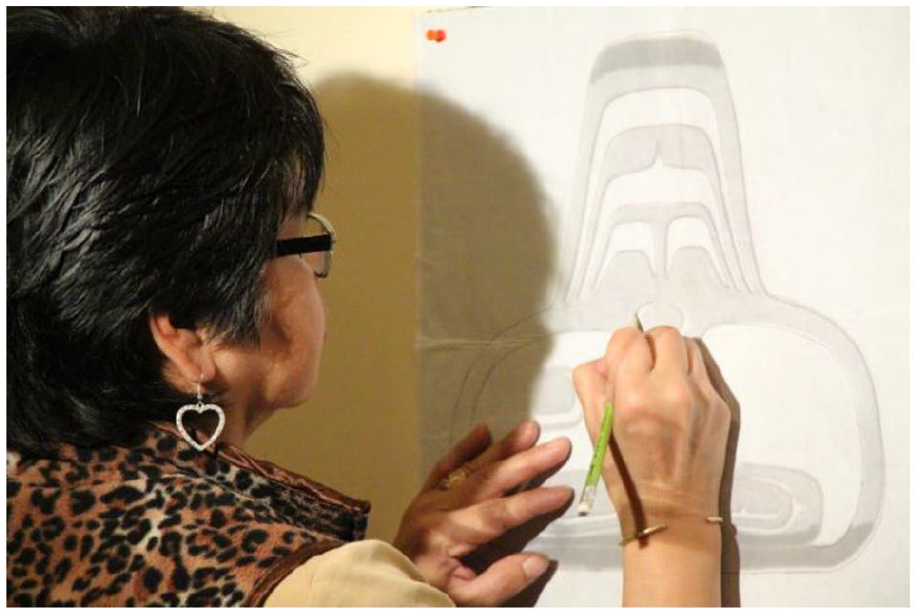
Elder Vera Newman describes how during an evening of blanket making one mother was asked by her children “mum, what’s our crest?” The mother in that moment called her grandfather to ask about their family crest and was subsequently invited to his house to pick up the plaque that displays their family crest. When she returned to blanket making with the plaque, co-author and artist Trevor Isaac skillfully sketched the crest design for their blanket. Other community members drew their own crests (Figure 5). In this single evening session, a mother learned about oral histories related to the crest that would now span, connect and celebrate three generations as she sewed the crest onto blankets for her children.
A community member drawing a family crest. Photo credit: Steve Calvert.
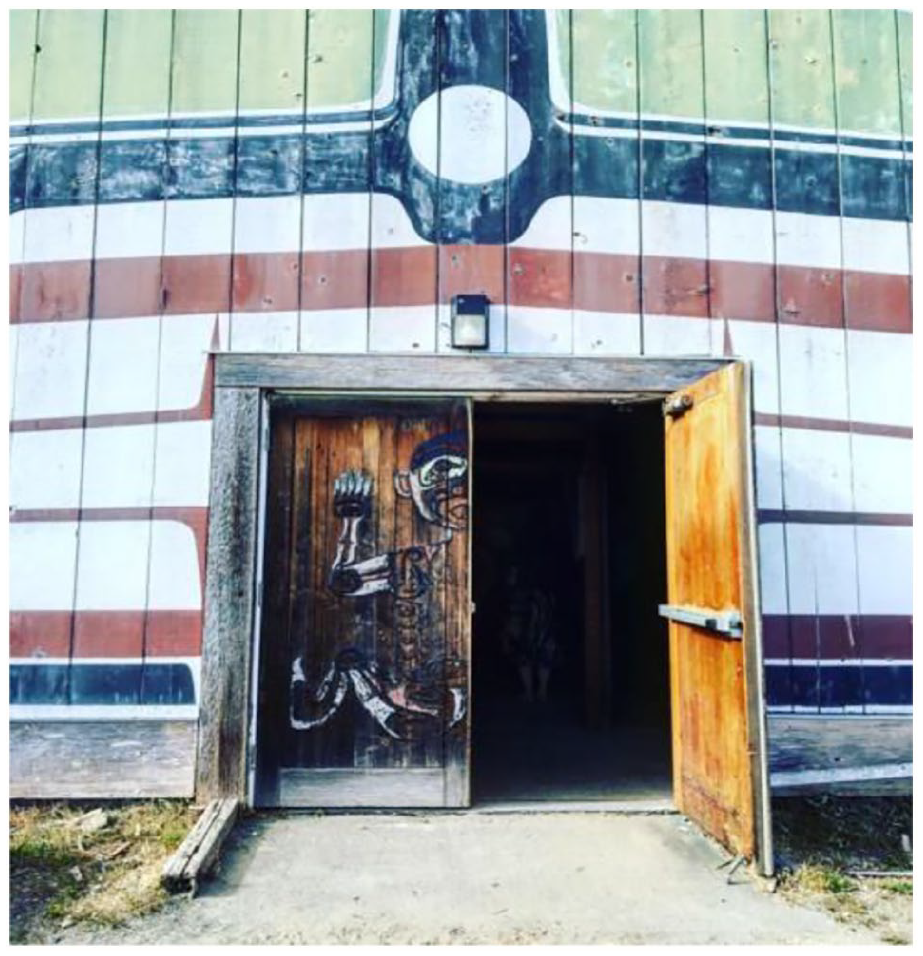
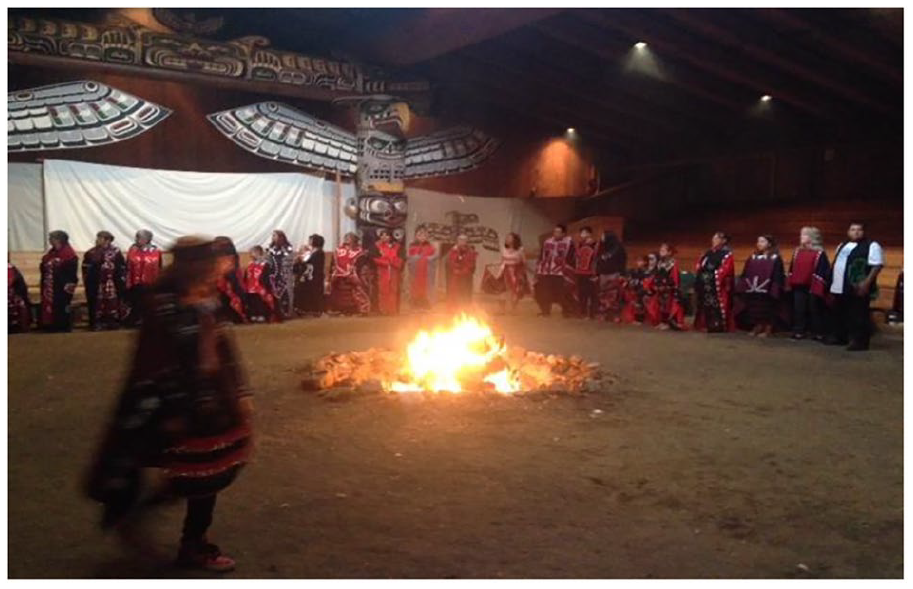
Participants spoke of the act of regalia making, and also the significance of where and how the blankets were displayed, shared and celebrated with family and the wider community. The regalia-making initiative cumulated in several ceremonies held at the Gukwdzi—Big House—to celebrate and share the regalia through ceremony, including drumming, singing and dancing (Figure 6). Historically, Big Houses were traditional homes, and today are used for potlatches and ceremonies, as well as hosting gatherings and sharing family songs, dances and other important celebrations. These regalia ceremonies in the Big House were described as providing healing for participants. One person shared that:
Our people have been hit so hard, with our community in particular, with all of the deaths. And for me, being there [at blanket making] meant going back to the Big House, and being part of something really big, positive and healing. And, I was most proud, of not just the little children, but some of the Elders in the group, who produced such beautiful works of art.
For many participants, the experience of celebrating cultural identities stitched into fabric became an emotional and spiritual experience once the regalia were worn in ceremonies. This was particularly poignant for many against the backdrop of ongoing colonial violence of residential schools and resulting intergenerational disconnection from and erasure of culture, language, teachings and ceremonies. One person said, “I’m going to be honest, I felt very emotional. Because, I’ve never done this as a child, and I’ve done this for my children. So, I’m emotional, proud and happy.”
The entrance to the ‘Namgis Gukwdzi—Big House. Photo credit: Helen Brown.
The widespread interconnections between regalia, ceremony, connections to nature, healing and wellness were expressed as participating community members reflected and remembered how colonial incursion and its continuities impact cultural identity, language and wellness. Against this backdrop, participants connected regalia making to ‘Namgis resurgence and self-determination through their part in rich and diverse Kwakwaka’wakw traditions and ceremonial practices, including the creation, wearing and sharing of ceremonial regalia. This work reflects blanket makers’ determination in our study to sustain identity and culture against the backdrop of colonial policies and systems, such as the banning of ceremonies. One participant spoke how identity and belonging is integrally connected to cultural resurgence, justice and sovereignty:
We’ve been fortunate enough to be brought up in culture on both sides of our family, so we know how it feels in our heart to live as much of it as we can. The thing that made me so happy and proud of it, was to see other people have the opportunity to connect to something that belongs to them. And that made me happy. It made me happy to see the [families] stand up, it made me happy to see . . . families come together for a good cause, for something positive, that’s going to lay down a foundation that no one will ever be able to take away again. So that’s what I was most proud of, to see all you celebrate that sense of belonging.
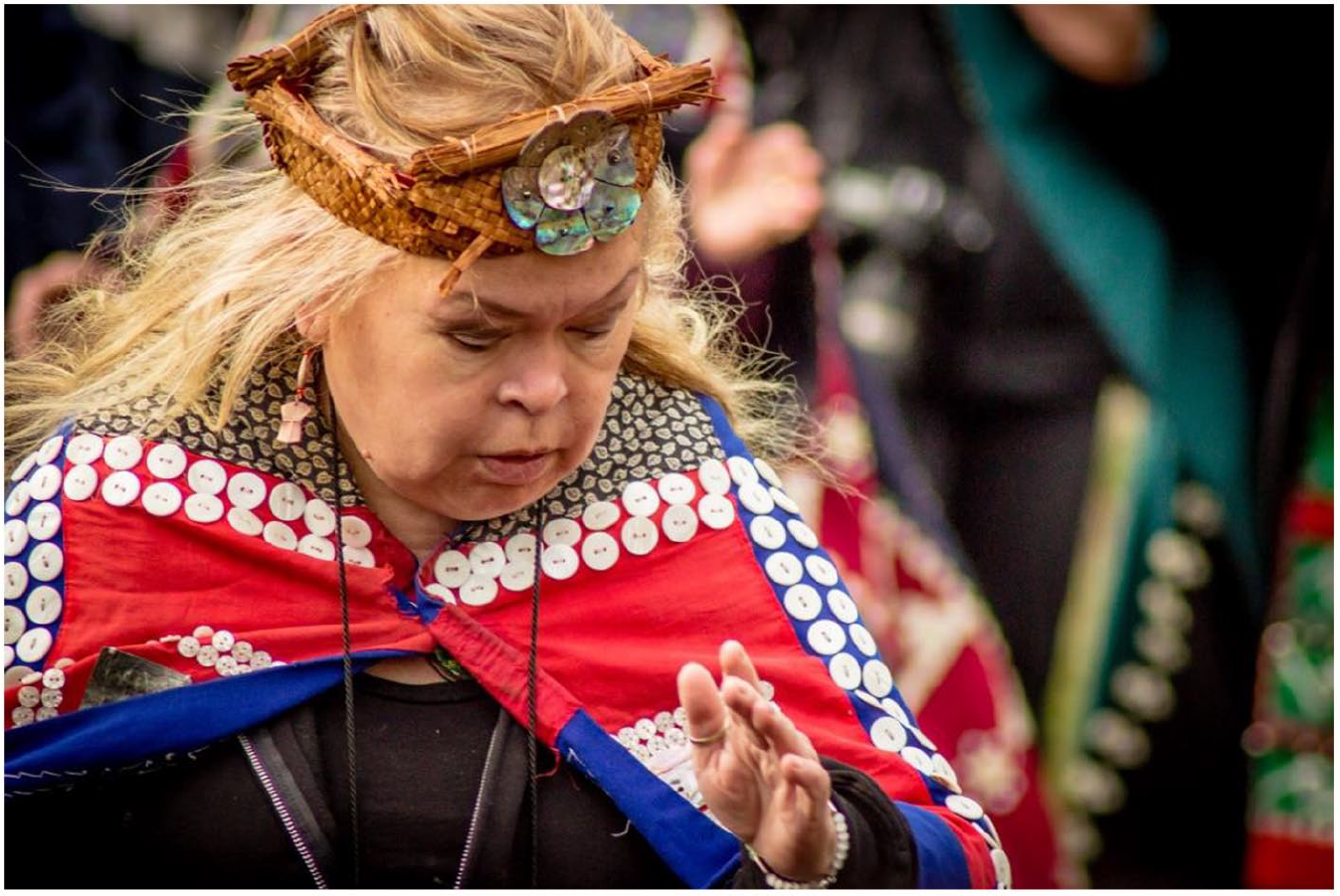
As individuals and connected communities, and through celebrating and sharing regalia, participants stitched identities and created and sustained opportunities to strengthen culture, belonging and ceremony. These impacts were individual and collective, woven and sewn carefully through fabrics, crests and button designs. Our findings highlight the importance of creating uplifting spaces that reclaim colonial losses and the ongoing harms of framing wellness and healing through Western biomedical and deficit ideologies that produce programming devoid of our ways. Regalia making centres Indigenous Knowledge Systems embedded in wholism, ceremony, artistic expression, history, ancestry, land and language. During each annual event celebrating and sharing regalia, participants danced in ceremony to drumming and singing that calls the ancestors and honours the spirit world, experiences that connect them to one another and their regalia, and the blankets and aprons yet to come (Figure 7).
Button blanket participants dancing their regalia. Photo credit: Kelsey Timler.
Implications
We, Kwakwaka’wakw, have been here since the time when our supernatural ancestors transformed from their supernatural form to human. For over two hundred years our gwayilelas (our way of being) has withstood the colonization and trauma that came with the western worldview and the colonial Canadian government. It is through the resistance of our ancestors that we are here to carry on our culture. (Elder Vera Newman)
Colonial cultural oppression and dislocation have attempted to disrupt the sovereignty, health, healing and wellness of Indigenous peoples (Marshall, 2015; Negin et al., 2015; Wotherspoon & Hansen, 2013). Specifically, “socially driven legislation and policies have been created to ‘rid the Indian from the child’ through the Indian Act, Residential School Act, Child Welfare, land dispossessions and so much more” (Absolon, 2016, p. 46). Moreover, historic and ongoing colonialism has created and sustained systems that restrict Indigenous health and wellness through social exclusion and disconnection from land, community and language (Cao et al., 2018; de Finney, 2014; Henry, 2002; Marshall, 2015; Palmater, 2011; Saloojee, 2005; Wotherspoon & Hansen, 2013). This exclusion has associated impacts on cultural identity and wellbeing, as colonialism and other oppressive forces have worked to subvert Indigenous Knowledge Systems, cultures and cultural practices that are inseparable from effectively and collectively strengthening First Nations Peoples’ health, healing and wellness.
Prior to 2013, community health and wellness care was provided to BC First Nation through a patchwork and under-funded system of Community Health Centres (Longhurts & Cohen, 2019). Since then, the signing of the BC’s Tripartite Framework Agreement on First Nations Health Governance among Health Canada, BC Ministry of Health and BC First Nations resulted in a shift of responsibility to the First Nations Health Authority (FNHA). Health services and programming currently implemented by FNHA is based on an understanding of First Nations conceptualizations healing and wholistic health practices as central to health, and that these processes are often overlooked within the mainstream Euro-Canadian model. FNHA asserts the need for Nation-based leadership for integrating traditional healing and culture into wellness-oriented health services. Our findings reflect the importance of FNHA’s strategic action framework to implement community-led service models that can demonstrate how dynamic cultural practices can contribute to wellness through interconnections between language, regalia making, identity, belonging and connection, and how such community initiatives and programmes can contribute to wellness associated with overall improved health. While the existence of FNHA is a landmark Canadian policy directive, there remains a pressing need for integrating culture and healing into community wellness model and programme development, as advocated by Indigenous scholars, advocates and health leaders, and allies (Czyzewski, 2011; Greenwood et al., 2018). These calls are supported by diverse Indigenous knowledges related to health and wellbeing, as well as research evidence gathered through participatory research in partnership with Indigenous communities across Canada. Specifically, Indigenous Elders, Knowledge Keepers and scholars have highlighted the foundational importance of the practice and sharing of culture as health and healing (Bourke et al., 2018; Gone, 2013; Greenwood et al., 2018), cultural revitalization as decolonization (Adese, 2014; Alfred, 2014; Grey & Patel, 2015; Irlbacher-Fox, 2014; Kamal et al., 2015; Lavallee & Poole, 2010; Radu et al., 2014; Simpson, 2014; Tuck & Yang, 2012; Wildcat et al., 2014), the importance of land and space in healing (Basso, 1996; Goeman, 2013; Wilson, 2003), and the importance of sustainable funding to support community-led health initiatives (Dawson, 2019; Kallil, 2019).
Culture and language as health and healing
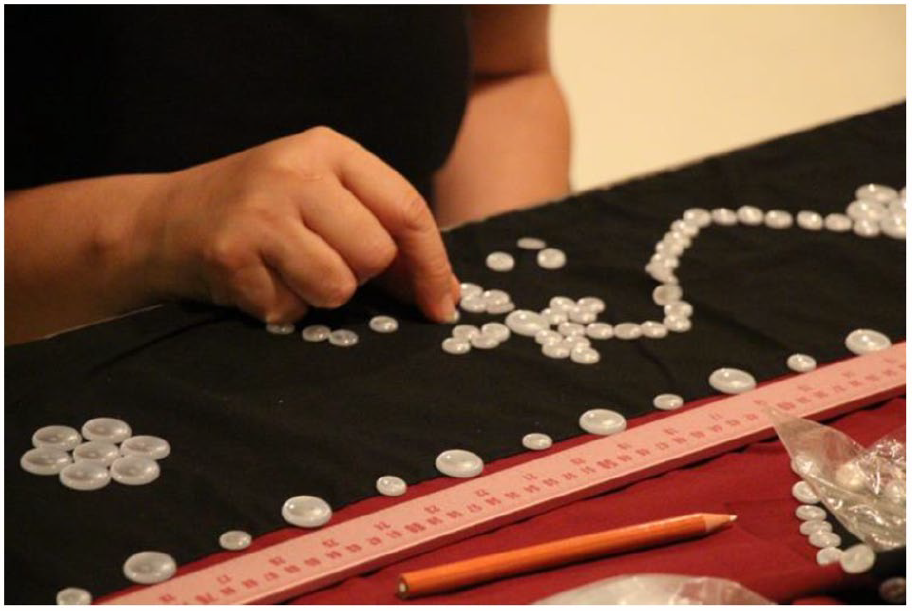
Sanala regalia making provided opportunities for language revitalization, cultural continuity and engagement with cultural identity and practices, which in turn supported health and wellbeing for participating community members. Participants shared how they felt more connected, had increased self-esteem and felt increased pride in their identity through the process of regalia making; these aspects are integral to mental health and wellbeing (Adelson, 1998; Bombay et al., 2014; Kirmayer et al., 2003) as well as Kwakwaka’wakw understandings of health and healing (Caban, 2018; Dawson, 2019). Regalia making created and sustained opportunities for health and healing through culture, through a holistic understanding of health as collective, embodied and lived (Figure 8). This is significant given the narrow focus on health as individual and behavioural across the Euro-Western medical model and the ongoing harms that this colonial system enacts on Indigenous communities. By viewing health as collective and communal, Kwakwa̱ka̱’wakw regalia making pushes back against this individualization of health and provides spaces for communities to build and enact health together.
Sewing buttons. Photo credit: Steve Calvert.
Cultural revitalization as decolonization
The creation and sharing of regalia and the (re)learning of Kwak̓wala supported cultural and language revitalization for members of the ‘Namgis community. Some participants were survivors of the Indian Residential School System, and all were impacted by the colonial Potlatch ban and disruption of Kwakwa̱ka̱’wakw health, social and governance systems which continues today through colonial-appointed band councils and the disvaluing of hereditary chiefs and matriarch-led governance structures. In this context, the creation of regalia and (re)learning of language in a reserve created by the colonial government to force dispossession from ancestral lands is a radical act of decolonization and resurgence. Participants expressed deep positive impact in hearing and learning their language, and a desire to continue to do so over time, in community. Knowledge Keepers help Elders and community members (re)connect to their ‘Namgis identity as they sit, sewing, and speak Kwak̓wala, collectively engaging in community and health in ways that push back again these dispossessions. This supported participants to (re)claim identity and to feel pride and joy in being ‘Namgis and speaking Kwak̓wala.
Creating regalia in meaningful spaces
Space, place and land are foundational to Indigenous health and wellbeing (Basso, 1996; Christensen, 2016; Goeman, 2008, 2013; Wilson, 2003). For regalia making, the weekly sessions took place at U’mista Cultural Centre, a local non-profit, museum and cultural society. U’mista is also where many items previously illegally seized under duress from familial Potlatch collections have been repatriated and returned, after tireless advocacy by the U’mista Cultural Society and community leaders and Elders. U’mista sits in close proximity to land where the demolished St. Michael’s Residential School once stood; the now grassy open space both symbolizes historical trauma and lingering intergenerational impacts and the healing, hope and strength of the Kwakwa̱ka̱’wakw as told in the award-winning short documentary by Barbara Cranmer titled Our Voices, Our Stories. The land-based juxtaposition of the Kwakwa̱ka̱’wakw potlatch collection and ceremonial artefact repatriation and its role in cultural programming and storytelling symbolizes resurgence, strength and resilience within close proximity to land where the harms and colonial violence of the St. Michaels Residential School linger within the minds and heart of many generations of ‘Namgis Peoples. Making regalia and strengthening identity in this space on and of this land is a powerful place for decolonizing the disruption of art, history and knowledge sharing (Figure 9). In addition, annual celebrations were held in the ‘Namgis Big House where regalia was proudly shared and celebrated; this ceremonial place as where participants danced in their regalia deepened the meaning and collective pride of participants’ artistic creations.
Regalia in ‘Yalis. Photo credit: Steve Calvert.
In loving memory of Barb Cranmer. Photo credit: E. Baker.
The importance of sustainable funding
This project has been funded by overlapping research grants, and driven by a commitment by all team members to continue to support community priorities around cultural continuity and health through collective, artistic and cultural activities. While we are grateful to our funders, we also are aware that there is a need for sustainable funding for Indigenous health and wellbeing that acknowledges the foundational importance of culture, language and collectivity. In other aspects of government, funding for Indigenous programmes has been called out for its pilot project mentality, a reality that continues within health and social programming and undermines the wealth of knowledge that exists in Indigenous communities (Public Safety Canada, 2018). In addition, federal jurisdiction over Indigenous health services—through the colonial Indian Act—results in complexity, jurisdictional ambiguity, funding mismanagement and unnecessary bureaucracy (Lavoie, 2013; Lavoie et al., 2011). For the ‘Namgis community, regalia making has provided participating community members with a place to gather, in community, living culture, practicing language and healing collectively. Given calls to justice related to Indigenous health and wellbeing and the importance of cultural practices in the Canadian Truth and Reconciliation Commission and the National Inquiry into Missing and Murdered Indigenous Women & Girls (National Inquiry into Missing and Murdered Indigenous Women and Girls, 2019; Truth and Reconciliation Commission, 2015b), additional funding placed directly in community to support health and wellness is urgently needed.
Conclusion
The Sanala Participatory Action programme of research supported community-driven regalia to support the health and wellbeing of ‘Namgis Peoples through the creation of button blankets, aprons and other items of regalia, the learning of histories and stories associated with family crests and lineage, and the connecting with culture and language to support healing. This weekly programme supported (re)connection and community cohesion, while also engaging in the radical act of cultural continuity and language revitalization. This act—of being in community and embodying a living culture—is radical in the context of ongoing colonial violence and cultural genocide occurring in Canada. Thus, regalia making is an act of decolonization, of creating health and supporting collective healing through cultural practices that were historically banned by the colonial state, and currently under-funded and unrecognized across all levels of Canadian government.
Elder Vera Newman captures the importance of regalia as cultural continuity, interwoven with language, in her closing words:
The beauty of knowing our language is that it belongs to us, it’s always been here for us. We are generous people, always willing to share. Keeping our language, our songs, our dances alive help us be proud of who we are and the importance of what we’ve learned and share. We are fortunate to be given such wonderful gifts, our language, dance and songs, as we learn more about who we are the richer we become.
Footnotes
Appendix
Kwak’wala words for Sanala.
1
gawalap’a
working together
2
sanala
to be whole
3
bagwansap’a
visit each other
4
awil’gola
all being together
5
Ik’ikala
feeling good inside
6
ika- n nok- e’
my heart feels good
7
ixk’asala
happy together
8
maya’xala
respect
9
na-nwak-ola
discussing to come to the right solution
10
saltala
be still, tread softly
11
huttila
listen
12
data xa ik noke’
carry a good heart
13
lalax’sola
passage through life, an example is the coming-of-age ceremony
14
uk’wadzaladzi
my faith, my belief
15
kanayu
the circle of life, the cedar nng
16
dtex’sala
give advice, teach
17
nak- a- l’k- a-la
peace within
18
ha’maya
food gathering
19
hawax- ’a-la
prayer, give thanks
20
ik da- lx- ’da’x-wux-
Good people (good intentions)
Words from Ada • Vera Newman & Chief Bobby Joseph.
Kwak’wala spell check by Pew Allred.
Typed by Donna Cranmer.
Acknowledgements
This paper was written in honour of the late Barb Cranmer, a strong ‘Namgis warrior woman, an artist, an advocate, a daughter, a sister, an aunt, a friend, and world renowned and award-winning documentary film maker. Sanala began with a vision she and her mother, Elder Vera Newman, held for many years about culture as the foundation of health, connection, relationships, wellness and Indigenous reclaimation and resurgence. Sanala continues since Barb’s passing to the spirit world as we collectively honour the work through her strength, teachings, love, kindness and laughter of her life.
Declaration of conflicting interests
The author(s) declared no potential conflicts of interest with respect to the research, authorship and/or publication of this article.
Funding
The author(s) disclosed receipt of the following financial support for the research, authorship and/or publication of this article: This study was funded with support from the Vancouver Foundation and UBC private donors.
ORCID iD
Kelsey Timler
Glossary
A̱mx̱same’ the supernatural spirit wraps around ussu sa ‘Nawalakw
Bak̓wam First Nations; Indigenous Peoples
gilakas’la thank you
Gukwdzi Big House
gwayileas traditional Kwakwa̱ka̱’wakw ways; our ways; our way of being
k’angextola button blanket; a type of Kwakwa̱ka̱’wakw regalia
Kwakwa̱ka̱’ kwak̓wala-speaking people; a First Nation from wakw what is now called Canada, whose ancestral territory stretches across north Vancouver Island, on the Canadian west coast; the Kwakwa̱ka̱’wakw consist of 19 tribes
Kwak̓wala the language of the Kwakwa̱ka̱’wakw
‘Namgis one of the tribes of the Kwakwa̱ka̱’wakw; the ‘Namgis are the Peoples of the Nimpkish River
Sanala to be whole—emotionally, spiritually, physically and mentally
‘Yalis Alert Bay, British Columbia, Canada; this village, on Cormorant Island, is the current home of ‘Namgis, after displacement from their unceded ancestral lands on the Nimpkish River
References
1.
AbsolonK. E. (2016). Wholistic and ethical: Social inclusion with Indigenous peoples. Social Inclusion, 4(1), 44–56. https://doi.org/10.17645/si.v4i1.444
2.
AdelsonN. (1998). Health beliefs and the politics of Cree well-being. Health: An Interdisciplinary Journal for the Social Study of Health, Illness and Medicine, 2(1), 5–22. https://doi.org/10.1177/136345939800200101
3.
AdeseJ. (2014). Spirit giving: Ecological knowing in Metis life narratives. Decolonization: Indigeneity, Education & Society, 3(3), 48–66.
4.
AlfredG. T. (2014). The Akwesasne cultural restoration program: A Mohawk approach to land-based education. Decolonization: Indigeneity, Education & Society, 3(3), 134–144.
5.
BassoK. H. (1996). Wisdom sits in places: Landscape and language among the Western Apache. University of New Mexico Press.
6.
BombayA.MathesonK.AnismanH. (2014). The intergenerational effects of Indian Residential Schools: Implications for the concept of historical trauma. Transcultural Psychiatry, 51(3), 320–338. https://doi.org/10.1177/1363461513503380
7.
BourkeS.WrightA.GuthrieJ.RussellL.DunbarT.LovettR. (2018). Evidence review of Indigenous culture for health and wellbeing. The International Journal of Health, Wellness, and Society, 8, 11–27. https://doi.org/10.18848/2156-8960/CGP/v08i04/11-27
8.
BrownH.McPhersonG.PetersonR.NewmanV.CranmerB. (2012). Our land, our language: Connecting dispossession and health equity in an Indigenous context. Canadian Journal of Nursing Research, 44(2), 44–63.
9.
CabanN. (2018). A space to call our own: The U’Mista Cultural Centre as a representative of First Nations collective agency and its associated health benefits. University of Auckland Press.
10.
CaoL.BurtonV. S.JrLiuL. (2018). Correlates of illegal drug use among Indigenous peoples in Canada: A test of social support theory. International Journal of Offender Therapy and Comparative Criminology, 62(14), 4510–4527.
CranmerB. (Director). (2008). T’lina: The rendering of wealth [Film]. Nimpkish Wind Productions Inc; National Film Board of Canada/Office national du film du Canada.
13.
CullonD. (2013). A view from the watchman’s pole: Salmon, animism and the Kwakwaka’wakw summer ceremonial. BC Studies, 177, 9–37.
14.
CzyzewskiK. (2011). Colonialism as a broader social determinant of health. International Indigenous Policy Journal, 2(1), Article 17.
15.
DavidsonS. F.DavidsonR. (2018). Potlatch as pedagogy: Learning through ceremony. Portgage & Main Press.
16.
Dawson ‘N.-M. M. (2019). ławeyasens gayułas: Ancestral teachings to reclaim the roles of Kwakwaka’wakw women in governance and leadership [Unpublished master’s thesis]. Royal Roads University.
17.
de FinneyS. (2014). Under the shadow of empire: Indigenous girls’ presencing as decolonizing force. Girlhood Studies, 7(1), 8–26. https://doi.org/10.3167/ghs.2014.070103
18.
DellC. A.SeguinM.HopkinsC.TempierR.Mehl-MadronaL.DellD.DuncanR.MosierK. (2011). From benzos to berries: Treatment offered at an Aboriginal youth solvent abuse treatment centre relays the importance of culture. Canadian Journal of Psychiatry, 56(2), 75–83.
19.
DenzinN. K.LincolnY. A. (2008). Introduction: Critical methodologies and Indigenous inquiry. In DenzinN. K.LincolnY. A.Tuhiwai SmithL. (Eds.), Handbook of critical and Indigenous methodologies (pp. 1–20). SAGE.
GeddesG. (2017). Medicine unbundled: A journey through the minefields of Indigenous health care. Heritage House Publishing.
22.
GoemanM. (2008). From place to territories and back again: Centering storied land in the discussion of Indigenous nation-building. International Journal of Critical Indigenous Studies, 1(1), Article 34. https://doi.org/10.5204/ijcis.v1i1.20
23.
GoemanM. (2013). Mark my words: Native women mapping our nations. University of Minnesota Press.
24.
GoneJ. P. (2013). Redressing First Nations historical trauma: Theorizing mechanisms for Indigenous culture as mental health treatment. Transcultpsychiatry, 50, 683–706. https://doi.org/10.1177/1363461513487669
25.
GoneJ. P.Calf LookingP. E. (2011). American Indian culture as substance abuse treatment: Pursuing evidence for a local intervention. Journal of Psychoactive Drugs, 43(4), 291–296. https://doi.org/10.1080/02791072.2011.628915
26.
GoodkindJ.LaNoueM.LeeC.FreelandL.FreundR. (2012). Feasibility, acceptability, and initial findings from a community-based cultural mental health intervention for American Indian youth and their families. Journal of Community Psychology, 40(4), 381–405. https://doi.org/10.1002/jcop.20517
27.
GreenwoodM.De LeeuwS.LindsayN. M. (Eds.) (2018). Determinants of Indigenous peoples’ health: Beyond the social (2nd ed.). Canadian Scholars’ Press.
28.
GreyS.PatelR. (2015). Food sovereignty as decolonization: Some contributions from Indigenous movements to food system and development politics. Agriculture and Human Values, 32(3), 431–444. https://doi.org/10.1007/s10460-014-9548-9
29.
HenryF. (2002). Canada’s contribution to the “management” of ethno-cultural diversity. Canadian Journal of Communication, 27(2), 231–242. https://doi.org/10.22230/cjc.2002v27n2a1297
30.
Irlbacher-FoxS. (2014). Traditional knowledge, co-existence and co-resistance. Decolonization: Indigeneity, Education & Society, 3(3), 145–158.
31.
JonaitisA. (2006). Smoked fish and fermented oil: Taste and smell among the Kwakwaka’wakw. In EdwardsE.GosdenC.PhillipsR. B. (Eds.), Sensible objects: Colonialism, museums and material culture (pp. 141–168). Berg.
KamalA. G.LinklaterR.ThompsonS.DippleJ.CommitteeI. M. (2015). A recipe for change: Reclamation of Indigenous food sovereignty in O-Pipon-Na-Piwin Cree Nation for decolonization, resource sharing, and cultural restoration. Globalizations, 12(4), 559–575. https://doi.org/10.1080/14747731.2015.1039761
34.
KelmM.-E. (1999). Colonizing bodies: Aboriginal health and healing in British Columbia, 1900–50. University of British Columbia Press.
35.
KirmayerL.SimpsonC.CargoM. (2003). Healing traditions: Culture, community and mental health promotion with Canadian Aboriginal peoples. Australasian Psychiatry, 11(1 Suppl.), S15–S23. https://doi.org/10.1046/j.1038-5282.2003.02010.x
36.
KovachM. (2009). Indigenous methodologies: Characteristics, conversations and contexts. University of Toronto Press.
37.
LavalleeL. F.PooleJ. M. (2010). Beyond recovery: Colonization, health and healing for Indigenous people in Canada. International Journal of Mental Health and Addiction, 8(2), 271–281. https://doi.org/10.1007/s11469-009-9239-8
38.
LavoieJ. G. (2013). Policy silences: Why Canada needs a national First Nations, Inuit and Métis health policy. International Journal of Circumpolar Health, 72(1), Article 22690. https://doi.org/10.3402/ijch.v72i0.22690
McKenzieH.VarcoeC.BrowneA.DayL. (2016). Disrupting the continuities among residential schools, the sixties scoop and child welfare: An analysis of colonial and neocolonial discourses. International Indigenous Policy Journal, 7(2). https://doi.org/10.18584/iipj.2016.7.2.4
44.
MilloyJ. S. (1999). A national crime: The Canadian government and the residential school system. University of Manitoba Press.
45.
MosbyI.GallowayT. (2017). “The abiding condition was hunger”: Assessing the long-term biological and health effects of malnutrition and hunger in Canada’s residential schools. British Journal of Canadian Studies, 30(2), 147–162. https://doi.org/10.3828/bjcs.2017.9
National Inquiry into Missing and Murdered Indigenous Women and Girls. (2019). Reclaiming power and place: The final report of the National Inquiry into Missing and Murdered Indigenous Women and Girls. https://www.mmiwg-ffada.ca/
48.
NeginJ.AspinC.GadsdenT.ReadingC. (2015). HIV among Indigenous peoples: A review of the literature on HIV-related behaviour since the beginning of the epidemic. AIDS and Behavior, 19(9), 1720–1734. https://doi.org/10.1007/s10461-015-1023-0
RaduI.HouseL. M.PashagumskumE. (2014). Land, life and knowledge and Chisasibi: Intergenerational healing in the bush. Decolonization: Indigeneity, Education & Society, 3(3), 86–105.
52.
SaloojeeA. (2005). Social inclusion, anti-racism and democratic citizenship. Fernwood Publishing.
TuckE.YangW. K. (2012). Decolonization is not a metaphor. Decolonization: Indigeneity, Education & Society, 1(1), 1–40.
58.
TurnerN. J.TurnerK. L. (2008). “Where our women used to get the food”: Cumulative effects and loss of ethnobotanical knowledge and practice: Case study from coastal British Columbia. Botany, 86(2), 103–115.
WaterfallH. P. (2018). Healing through culture. In TortellP.TurinM.YoungM. (Eds.), Memory (pp. 9–20). Peter Wall Institute for Advanced Studies.
64.
WildcatM.McDonaldM.Irlbacher-FoxS.CoulthardG. (2014). Learning from the land: Indigenous land based pedagogy and decolonization. Decolonization: Indigeneity, Education & Society, 3(3), I–XV.
65.
WilkP.MaltbyA.CookeM. (2017). Residential schools and the effects on Indigenous health and well-being in Canada: A scoping review. Public Health Reviews, 38(1), Article 8. https://doi.org/10.1186/s40985-017-0055-6
66.
WilsonK. (2003). Therapeutic landscapes and First Nations peoples: An exploration of culture, health and place. Health & Place, 9(2), 83–93. https://doi.org/10.1016/S1353-8292(02)00016-3
67.
WotherspoonT.HansenJ. (2013). The “Idle no more” movement: Paradoxes of First Nations inclusion in the Canadian context. Social Inclusion, 1(1), 21–36.
68.
WilsonK. (2003). Therapeutic landscapes and First Nations peoples: An exploration of culture, health and place. Health & Place, 9(2), 83–93. https://doi.org/10.1016/S1353-8292(02)00016-3
69.
WotherspoonT.HansenJ. (2013). The “Idle no more” movement: Paradoxes of First Nations inclusion in the Canadian context. Social Inclusion, 1(1), 21–36.