



Abstract
The aim of this study was to utilize a computational methodology based on Gene Reversal Rate (GRR) scoring to repurpose existing drugs for a rare and understudied cancer: inflammatory breast cancer (IBC). This method uses IBC-related gene expression signatures (GES) and drug-induced gene expression profiles from the LINCS database to calculate a GRR score for each candidate drug, and is based on the idea that a compound that can counteract gene expression changes of a disease may have potential therapeutic applications for that disease. Genes related to IBC with associated differential expression data (265 up-regulated and 122 down-regulated) were collated from PubMed-indexed publications. Drug-induced gene expression profiles were downloaded from the LINCS database and candidate drugs to treat IBC were predicted using their GRR scores. Thirty-two (32) drug perturbations that could potentially reverse the pre-compiled list of 297 IBC genes were obtained using the LINCS Canvas Browser (LCB) analysis. Binary combinations of the 32 perturbations were assessed computationally to identify combined perturbations with the highest GRR scores, and resulted in 131 combinations with GRR greater than 80%, that reverse up to 264 of the 297 genes in the IBC-GES. The top 35 combinations involve 20 unique individual drug perturbations, and 19 potential drug candidates. A comprehensive literature search confirmed 17 of the 19 known drugs as having either anti-cancer or anti-inflammatory activities. AZD-7545, BMS-754807, and nimesulide target known IBC relevant genes: PDK, Met, and COX, respectively. AG-14361, butalbital, and clobenpropit are known to be functionally relevant in DNA damage, cell cycle, and apoptosis, respectively. These findings support the use of the GRR approach to identify drug candidates and potential combination therapies that could be used to treat rare diseases such as IBC.
Keywords
Introduction
Gene expression reversal methodology is increasingly being utilized to identify potential drugs for repurposing.1 -4 The underlying assumption of these approaches is that a disease can be treated by a drug that has been shown to revert the disease related gene expression signature (GES) back to a normal gene expression state. This approach has been enabled by the fast growth of large publically available gene expression databases such as GEO (Gene Expression Omnibus) at the National Center for Biotechnology Information (NCBI), 5 the large-scale perturbation database termed Connectivity Map (CMap), 6 and the Library of Integrated Network-Based Cellular Signatures (LINCS).7 -9 CMap is a resource that uses cellular responses to perturbations to find relationships between diseases, genes, and therapeutics. 6 The LINCS Center for Transcriptomics at the Broad Institute has generated a more than 1000-fold expansion of CMap. 10 1.3 million gene expression profiles have been generated by LINCS with L1000 technology, a high-throughput technique to estimate mRNA expression on a genome-wide scale.10,11 While only ~1000 genes are determined in each L1000 experiment; a model using computational processing of extensive GEO gene expression datasets allows an estimation of the expression of genes (~22 000) in the remaining transcriptome. LINCS L1000 data can be queried using a web-enabled search interface called LINCS Canvas Browser (LCB).5,12
Strategies based on gene expression signatures (GES) are advantageous in that they do not require a large amount of a priori knowledge about particular disease targets.6,13,14 Gene expression data and pharmacologic databases can be combined to detect the gene expression/transcriptome reversal potency of drug candidates for a specific disease.15,16 Gene expression profiling of drug response GES can be used to predict responses of drugs to disease. For example, recently, Berthelet et al 17 used computational screening of 90 FDA-approved anti-cancer drugs to identify a new BRCA independent GES that can be used to predict breast cancer sensitivity to cisplatin. Compounds that can reverse the gene expression profile of disease-related genes18,19 can complement those discovered via traditional target-based discovery methods. The potential of this approach was demonstrated by Chen et al, 19 who showed that the potency of a drug to reverse cancer-associated gene expression changes positively correlates with that drug’s efficacy in preclinical models of several cancers, including liver cancer models. 20 Using a reverse gene expression scoring (RGES) approach, these authors predicted 4 compounds showing high potency to reverse gene expression in liver cancer, 19 that they further validated as effective in 5 liver cancer cell lines. A number of recent studies have used the gene expression reversal approach to identify drugs for repurposing including for example those for a range of cancers,21 -24 including breast cancer,25,27 psoriasis, 26 and rare diseases.27,28
Inflammatory breast cancer (IBC) is rare, understudied, and the most aggressive subtype of breast cancer.29 -31 IBC represents about 2% to 4% of all diagnosed breast cancers,32 -34 however, it is estimated to account for as high as 8% to 10% of breast cancer deaths in the USA.14,33,35,36 Compared to non-IBC breast cancer patients, outcomes for IBC patients are worse, such as significantly poor prognosis and survival rate.37,38 Treatment options for the most aggressive forms of IBC, including triple-negative (TN)-IBC are very limited.39,40 Recently, common diagnostic criteria to guide treatment and research of IBC was proposed based on clinical, pathologic, and imaging features. 41 New treatment strategies for IBC including genomic profiling are being pursued.42,43 Several transcriptome-wide gene expression studies have investigated GES for IBC compared to non-IBC. 44 However, the discovery and validation of distinct molecular and/or genetic factors or pathways that are specific for IBC is challenging. 41 An IBC-specific 79-gene expression panel enriched in immune pathways has been identifed, 45 which includes a recently reported subset of adaptive stress response genes. 46 A recent reanalysis of the 79-gene IBC signature identified a prominent role for MYC-mediated transcriptional activity in IBC. 47 In another study, an analysis of TN-IBC and non-TNIBC identified 75 and 81 gene sets that are differentially expressed. 48 There is urgent need to develop therapeutics that target IBC specifically and to identify molecular targets unique to IBC.30,31
Here, we aimed to identify drug candidates that have the potential to reverse a GES compiled for IBC. We integrated gene expression patterns for IBC obtained from PubMed publications,45,48 -52 as well as compound/perturbation-induced GESs obtained from open-source datasets (GSE92742) to identify 297 genes related to IBC. With this information, a computational scoring approach termed Gene Reversal Rate (GRR) was implemented to calculate GRRs, and used to identify drug perturbations in the LINCS database that gave the best gene expression reversal potential for IBC. Nineteen (19) drug candidates and 32 drug combinations were identified and are proposed as potential repurposed therapeutics for IBC.
Methods
Overall GRR drug repurposing design
The overall flow of the GRR drug repurposing method is shown in Figure 1. IBC specific GES were obtained from PubMed literature; and perturbation-induced gene expression profiles collected for each perturbation (drug) candidate from LINCS (https://lincscloud.org/). Once the IBC-GES and perturbation-induced gene expression profiles were obtained, the GRR for each drug perturbation was computed based on the 2 signatures. GRR, based on RGES, 19 was calculated using the number of reversed genes divided by the total number of IBC-specific genes. In addition, the gene expression profiles of binary combinations of the drug perturbations were computed and analyzed against the IBC-specific GES. The GRR of binary combination was calculated using the number of unique reversed genes in both perturbations divided by the total number of IBC-specific genes. This analysis resulted in binary drug combinations as potential “cocktail” treatment options for IBC.

Workflow for using Gene Reversal Rate (GRR) to identify drugs for IBC. Perturbation: Compound under specific experiment conditions such as dose, time-point, and cell-line (from LINCS). (A) Pipeline of IBC and perturbation GESs generation. (B) Pipeline of candidate drugs for IBC repurposing. Abbreviations: GES: gene expression signature; LINCS = Library of integrated network-based cellular signatures.
The rationale of our method is based on the idea that a compound or a compound combination that could counteract the gene expression changes of the disease (i.e., IBC in this study) may have beneficial effects against the disease. The scoring scheme should reflect this counteracting effect, and we have adopted the term Gene Reversal Rate (GRR) scoring for this study.
Construction of IBC gene expression signature (GES)
Gene expression data were compiled from prior PubMed publications assessing differential gene expression patterns for IBC.45,48 -52 This gene list was curated to remove duplicates as well as any genes that have no associated gene expression data; and this resulted in the master list of IBC-GES comprising 387 genes with associated gene expression data, including 265 up-regulated and 122 down-regulated genes (see Supplemental Table S1). Figure 2 shows the relative expression profile for all the 387 collated genes in the master IBC-GES.

Combined IBC gene expression signature (GES). A total of 387 genes with detailed gene expression data comprise the IBC gene expression signature (265 up-regulated and 122 down-regulated genes). This master IBC-GES (387 genes) was generated from an initial list of 624 IBC-associated genes after removing duplicates and eliminating any genes without associated gene expression log fold change data. The initial 624 genes were collected from 6 PubMed publications.45,48 -52
Perturbation-induced gene expression signatures
Two steps were taken to obtain the perturbation-induced GES to be used for calculating the GRR score against IBC. First, the 387 IBC-related genes compiled above were entered into the LINCS Canvas Browser (LCB) as a query to search against differentially expressed gene lists from the L1000 dataset, which contains ∼150 000 experimental conditions (e.g., compounds in different cell lines), to find the top matches. 12 Overlap between the input gene list and the gene lists of each experiment in LINCS are compared by LCB and the top 50 with the highest overlap produced. 12 Experimental conditions were searched that potentially reverse the direction of the gene expression changes of the query (i.e., the IBC gene expression pattern, a gene is reversed from up to down expression or vice versa). The magnitudes of the log fold changes in the datasets are not considered in the matching algorithm. 12 Second, from LINCS (as of Mar 03, 2021, https://lincscloud.org/ hosted by the Connectivity Map Project at the Broad Institute), we downloaded the Level 3 (Q2NORM) gene expression data from a GEO GSE92742 dataset, which consisted of 978 landmark transcripts (L1000 genes) plus inferred genes. This was done using the R package Slinky (as of Mar 03, 2021, https://bioconductor.org/packages/release/bioc/html/slinky.html). Gene expression data of the matched experiments were extracted from each of the identified datasets, which were then individually preprocessed using a log2 transformation and normalization approach.
Computation of gene reversal rate scores (GRR) for each perturbation
We define a score termed Gene Reversal Rate (GRR) as the percentage of total IBC-GES genes reversely expressed in a compound perturbation experiment. (i.e., for the IBC gene expression pattern, a gene is reversed from up to down expression or vice versa. The magnitudes of the log fold changes in the datasets are not considered.) The GRRs were computed between the IBC-GES and each of the perturbation’s GES. Specifically, for each of the selected perturbations, the GRR was calculated using the number of reversed genes divided by the total number of IBC-specific genes.

where nRG = the number of IBC genes reversely expressed in a compound perturbation experiment; nIBC = the number of total IBC genes. Here, nIBC = 297.
Binary combination of perturbations
All possible combinations of any 2 perturbations’ GES (Gene Expression Signature) were conducted. For each combination of perturbations, a combined GRR was calculated; with those having a high combined GRR selected for further analysis. Note that only the binary (1 or 0) information about whether the genes are up- or down-expressed is used, irrespective of the actual fold values of any expression changes.
Results
Construction of the IBC gene expression signature (GES)
A compiled IBC gene expression list of 624 genes was assembled by us from previously published studies assessing differential gene expression in IBC.45,48 -52 (For more details, see Method and Supplemental Table S1). Figure 2 shows the expression profile for all 387 collated genes in the IBC-GES.
Identification of perturbations that potentially reverse IBC-GES
The 387 IBC-GES was entered into the LINCS Canvas Browser (LCB) as the query to search for matched experiments that could potentially reverse IBC-specific GES. A gene is deemed reversely expressed if expression changes from up to down expression or vice versa. The magnitudes of the log fold changes in the datasets are not considered. The search resulted in a total of 46 matching experiments in LINCS with 32 experiments having associated gene expression data (Table 1).
Perturbations that potentially reverse IBC-GES. a

LINCS gave a total of 46 matching experiments with 32 experiments having associated gene expression data.
An experiment from LINCS is described in the format of “perturbation, dose, time-point, cell-line, and batch.” Experiments that were processed by the L1000 in 1 experimental run are termed a batch. For example, experiment Medetomidine_10 µm_6 h_HCC515_CPC005 means use 10 µm medetomidine treatment for cell line HCC515 for 6 hours in batch CPC005. 12
Perturbation-induced gene expression signatures
Five levels of L1000 data are available for download. Level 3 is the normalized gene expression profiles. 11 Level 3 (Q2NORM) gene expression profiles from the GEO GSE92742 dataset were downloaded (from https://www.ncbi.nlm.nih.gov/geo/query/acc.cgi on March 21, 2021) using R Package Slinky (https://bioconductor.org/packages/release/bioc/html/slinky.html). The gene expression data for the above 32 matched experiments (Table 1) were extracted from each of the identified datasets, which were then individually preprocessed using a log2 transformation and normalization approach. Two hundred ninety-seven of the 387 IBC-GES genes were found to be included in the 12 328 expression genes found in LINCS.
Calculation of Gene Reversal Rate (GRR)
For each of the 32 experiments identified from the LCB search (Table 1), Gene Reversal Rate (GRR) was calculated. The GRR scores ranged from 45% (for ST-209453_10 µm_24 h_PC3_CPC013) to 60% (for ZM-336372_102.71 µm_6 h_U937_CPC006 and Clobenpropit_10 µm_24 h_PC3_CPC001) (Table 2). Figures 3 and 4 show examples of single perturbation drug reversal patterns for drugs Ticarcillin and Tyrphostin-AG-1478, respectfully on the IBC-GES.
GRR of perturbations.
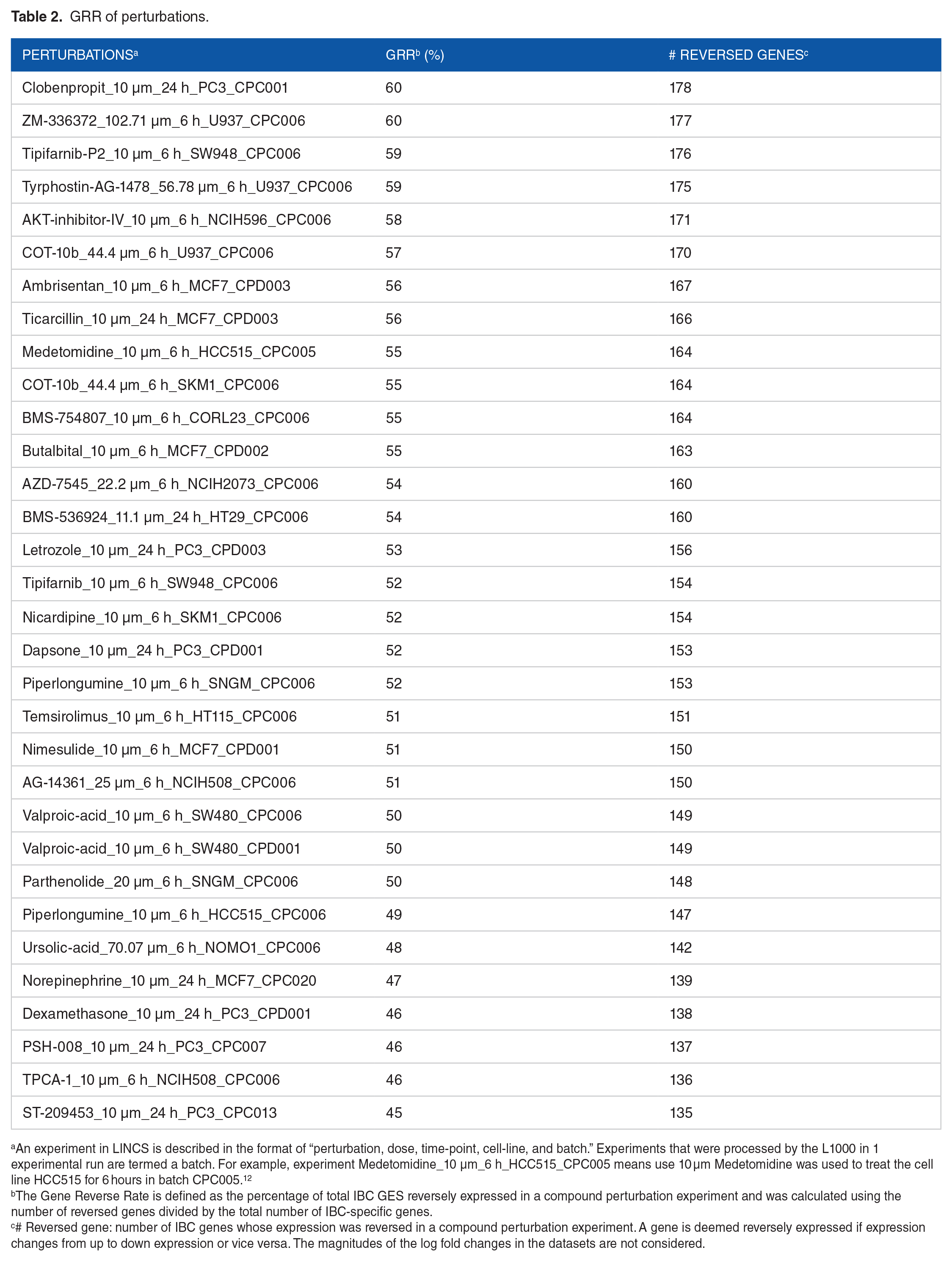
An experiment in LINCS is described in the format of “perturbation, dose, time-point, cell-line, and batch.” Experiments that were processed by the L1000 in 1 experimental run are termed a batch. For example, experiment Medetomidine_10 µm_6 h_HCC515_CPC005 means use 10 µm Medetomidine was used to treat the cell line HCC515 for 6 hours in batch CPC005. 12
The Gene Reverse Rate is defined as the percentage of total IBC GES reversely expressed in a compound perturbation experiment and was calculated using the number of reversed genes divided by the total number of IBC-specific genes.
# Reversed gene: number of IBC genes whose expression was reversed in a compound perturbation experiment. A gene is deemed reversely expressed if expression changes from up to down expression or vice versa. The magnitudes of the log fold changes in the datasets are not considered.

Gene expression patterns for single perturbation Ticarcillin_10 µm_24 h_MCF7_CPD003: (A) overall view of all of the 297 IBC-GES genes expressed in Ticarcillin_10 µm_24 h_MCF7_CPD003 with 56% gene reversal rate (GRR) and (B) focused view of 74 IBC-GES genes (| Log FC | >1, 66 up-regulated, 8 down-regulated) that are reversely expressed in Ticarcillin_10 µm_24 h_MCF7_CPD003.

Gene expression patterns for single perturbation Tyrphostin-AG-1478_56.78 µm_6 h_U937_CPC006: (A) overall view of all of the 297 IBC-GES genes expressed in Tyrphostin-AG-1478_56.78 µm_6 h_U937_CPC006 with 59% gene reversal rate (GRR) and (B) focused view of 67 IBC-GES genes (| Log FC | >1, 60 up-regulated, 7 down-regulated) reversely expressed in Tyrphostin-AG-1478_56.78 µm_6 h_U937_CPC006.
Gene expression patterns of binary perturbation combinations
From the 32 selected experiments that have an impact in reversing the IBC-GES (Table 2), we generated all two-way combinations of the perturbation gene expression patterns to give a total of 496 combined expression profiles. Each of these 496 profiles was then compared with the IBC-GES pattern to find the combinations that give the highest gene reversal rates (GRR). The GRR of a single perturbation ranged between 45% and 60% (135-178 genes, Table 2) while the GRR of a binary combination ranged from 50% to 89% (149-264 genes). There are 131 combinations that give a GRR greater than 80%, with 35 of the 131 combinations have a GRR greater than 83%. We chose a threshold of 83% for further analysis. The combination of Ticarcillin_10 µm_24 h_MCF7_CPD003 and Tyrphostin-AG-1478_56.78 µm_6 h_U937_CPC006 had the highest GRR at 89% (Table 3 and Figure 5).
Binary drug perturbation combinations with GRR ⩾ 83%.
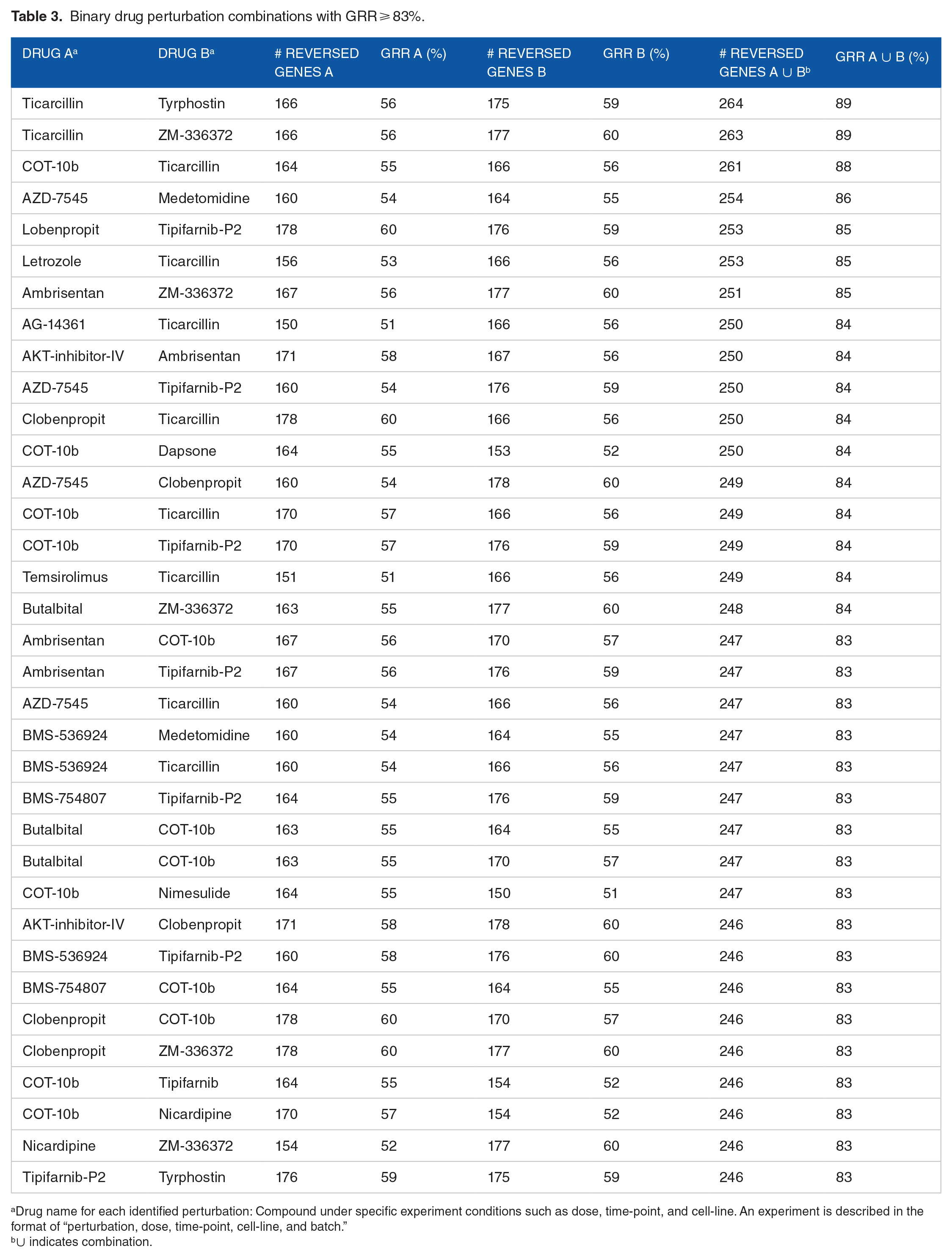
Drug name for each identified perturbation: Compound under specific experiment conditions such as dose, time-point, and cell-line. An experiment is described in the format of “perturbation, dose, time-point, cell-line, and batch.”
∪ indicates combination.

Gene expression patterns of binary combination of Ticarcillin_10 µm_24 h_MCF7_CPD003 and Tyrphostin-AG-1478_56.78 µm_6 h_U937_CPC006: (A) overall view of the 297 IBC-GES genes expressed in binary combination of Ticarcillin_10 µm_24 h_MCF7_CPD003 and Tyrphostin-AG-1478_56.78 µm_6 h_U937_CPC006 with 89% GRR and (B) 109 IBC-GES genes (| Log FC | >1, 95 up-regulated, 14 down-regulated) reversely expressed in binary combination of Ticarcillin_10 µm_24 h_MCF7_CPD003 and Tyrphostin-AG-1478_56.78 µm_6 h_U937_CPC006.
Identification from GRR analysis of drugs that could be repurposed for IBC
From the GRR analysis (Table 3), we identified 20 unique drug perturbations that can potentially be repurposed for IBC (Table 4), which includes 19 individual compounds.
LINCS drug perturbations predicted by GRR for IBC.

An experiment in LINCS is described in the format of “perturbation, dose, time-point, cell-line, and batch.” A batch is a collection of experiments that were processed by the L1000 in 1 experimental run. For example, experiment Medetomidine_10 µm_6 h_HCC515_CPC005 means use 10 µm Medetomidine treat cell line HCC515 for 6 hours in batch CPC005. 12 Twelve cell lines are involved in these 20 predicted perturbations in LINCS: 4 large intestine cell lines—NCIH508, HT29, HT115, and SW948; 3 lung cell lines—NCIH596, NCIH2073, and HCC515; 1 breast cancer cell line—MCF7; 1 metastasis: CORL23; 1 prostate—PC3; 1 blood - SKM1; and 1 pleural effusion—U937.
Discussion
We have utilized a computational scoring system, termed Gene Reversal Rate (GRR), to mine public gene expression data sets to identify existing drugs to repurpose for rare and understudied diseases such as IBC. With limited information regarding specific IBC molecular targets, the GRR approach uses only a signature-based scoring function and is based on the RGES approach developed by Chen et al. 19 For our study, first, an IBC gene expression set consisting of 387 genes was collated from published studies.45,48 -52 Two hundred ninety-seven of these 387 IBC-GES genes were identified to be included in the 12 328 expression genes in LINCS. We then used these IBC-associated differentially expressed genes as the query against drug signatures from LINCS. We found that our GRR analysis, in addition to identifying individual compounds/perturbations, also identified binary perturbation combinations of 32 selected experiments with high GRR. Of the 297 genes, 45% to 60% of the genes were reversed by identified single perturbations and 50% to 89% of the genes were reversed by identified binary perturbation combinations. From the top 35 binary combinations (GRR greater than 83%), we identified 20 unique perturbations comprising 19 individual drugs that reverse to some degree up to 264 of the 297 genes. These included the following compounds: AG-14361, AKT-inhibitor-IV, Ambrisentan, AZD-7545, BMS-536924, BMS-754807, Butalbital, Clobenpropit, COT-10b, Dapsone, Letrozole, Medetomidine, Nicardipine, Nimesulide, Temsirolimus, Ticarcillin, Tipifarnib-P2, Tyrphostin-AG-1478, ZM-336372. The mechanisms of action (MOA) of these drugs and relevance as potential therapeutics for IBC are discussed below.
Mechanisms of the individual perturbations
Among the 19 compounds identified from our GRR study on IBC, 17 have published findings indicating that they may have potential pharmacologic effects against human cancers with varied mechanisms, spanning anti-proliferation, anti-inflammation, tumor growth reduction, cancer drug resistance, and anti-metastatic potential (Table 5). For example, AG14361, Ambrisentan, AZD7545, and Clobenpropit have been used as anti-cancer therapy for many cancers including breast cancer.53 -58 Anti-cancer agents AKT-inhibitor-IV and BMS-754807 have been shown to have anti-proliferative activities against human cancer cells.59,60 BMS-536924, Tyrphostin AG-1478, and ZM-336372 significantly suppressed cancer viability, migration, and invasion of different human cancer cells.61 -66 COT-10b, Dapsone, Nicardipine, and Nimesulide are anti-inflammatory drugs and also potential anticancer agents.67 -72 Letrozole has been used in hormone therapy for breast cancer and polycystic ovary syndrome.73,74 Temsirolimus, a FDA-approved anti-cancer drug has efficacy in certain solid tumors as an inhibitor of angiogenesis. 75 Ticarcillin is active against resistant organisms that commonly affect patients with cancer, 76 and Tipifarnib effectively inhibits tumorigenesis in thyroid cancer. 77 Six of the compounds, Dapsone, Letrozole, Nimesulide, Temsirolimus, Tipifarnib, and Tyrphostin AG-1478, have been studied in various breast cancer models.73,74,78 -83 Rypens et al 47 recently reported that MYC driven expression patterns are overexpressed in IBC. AZD-7545, BMS-754807, and Nimesulide target PDK, 55 Met, 60 and COX71,72 respectively, which are direct MYC target genes and so these drugs may have relevance for IBC. 47 Al Abo 46 recently reported that adaptive stress response (ASR) genes associated with breast cancer subtypes such as IBC and survival outcomes were functionally relevant in cell cycle, DNA damage response, signal transduction, and regulation of cell death-related processes. AG-14361, 53 butalbital, 84 and clobenpropit56,57 target DNA damage, cell cycle, and apoptosis respectively, and may be potential therapeutic candidates against IBC. Two of the 19 compounds, Letrozole and Tipifarnib, have different mechanisms of action, and have been tested in clinical trials with varying degrees of success against IBC. 85 Table 5 lists the 19 drugs and their associated mechanisms.
Mechanisms and molecular targets of GRR identified compounds.

The approval status of the 19 drugs was also investigated (Table 6). Eleven of the 19 predicted compounds: Ambrisentan, BMS-754807, Butalbital, Dapsone, Letrozole, Medetomidine, Nicardipine, Nimesulide, Temsirolimus, Ticarcillin, and Tipifarnib, are either FDA-approved (https://www.accessdata.fda.gov/scripts/cder/ob/index.cfm) or found in ClinicalTrials (https://www.clinicaltrials.gov/). The remaining 8 compounds, AG-14361, AKT-inhibitor-IV, AZD-7545, BMS-536924, Clobenpropit, COT-10b, Tyrphostin-AG-1478, and ZM-336372, have not been FDA-approved.
FDA-approval status of GRR identified compounds.

Drug FDA status (for any indication) (https://www.accessdata.fda.gov/scripts/cder/ob/index.cfm) and clinical trials status (https://www.clinicaltrials.gov/) was accessed on 7 July, 2022.
Mechanisms of binary combinations of perturbations
Thirty-five (35) of the identified binary perturbation combinations had a GRR greater than 83%. Anti-cancer drug combinations have the potential to enhance therapeutic efficacy compared to a single drug approach as they can target key pathways in a synergistic or additive manner, potentially also reducing drug resistance. 87 In our study, 28 out of the 35 combinations are the results of a binary combination of the 17 compounds with potential activity in cancer mentioned above. For example, the GRR increased from 51% for a single perturbation (such as Temsirolimus and AG14361) to 89% for a binary perturbation combination (such as Ticarcillin + ZM-336372 or Ticarcillin + Tyrphostin AG-1478). The approach to combine therapeutic agents initially used for the treatment of different diseases other than cancer can be effective primarily when the FDA-approved agents target similar pathways to those also found in cancer. In our study, 2 of the 19 compound candidates, Butalbital and Medetomidine, have not to our knowledge, been reported as having anti-cancer activity. Butalbital and Medetomidine, are sedatives that help to decrease anxiety and depression.84,86 Depression is a common comorbidity in cancer cases where a common biological mechanism may be involved, such as a dysregulated immune system. 88 When Butalbital is combined with COT-10b, Tipifarnib, or ZM-336372, the GRR increased from 55% to 84%. Thus, we propose that Butalbital and Medetomidine may also have potential pharmacologic effects against IBC.
Among these top 35 combinations, the anti-inflammatory drug COT-10b is especially interesting as 12 out of the 35 combinations are a combination with COT-10b (LINCS ID: LSM-6226). COT (Tpl2 in mice) is a serine/threonine MAP3 kinase that regulates production of TNF-a and other pro-inflammatory cytokines such as IL-1b via the ERK/MAP kinase pathway. COT-10b was demonstrated to selectively inhibit the COT pathway following LPS stimulation in macrophages. 67 Since inflammatory signals are a key feature of IBC,46,89 the identification of COT-10b solely based on its gene expression pattern reversal is significant and needs to be explored. Another interesting drug is Ticarcillin, with 10 of the 35 combinations resulted from a combination of Ticarcillin with other perturbations. Ticarcillin is an antibiotic that is effective against gram-positive cocci and most Gram-negative organisms. 90 Ticarcillin is also active against resistant organisms that commonly affect patients with cancer. 76
Since 2017, the LINCS database has cataloged ~40 000 unique perturbations from over 50 different human cellular systems using more than 19 000 chemical reagents including drugs and other small molecule chemicals.10,12 If one conducts a complete binary drug combination of the >19 000 chemical reagents, there would be over 1.8 × 10⁸ possible combinations and it would be impossible to screen all of them by conventional wet-lab high-throughput drug screening approaches. Using the GRR approach, the overall time and costs of identifying combination perturbations can be reduced dramatically, and we quickly identified 35 targeted combinations. Thus, this GRR method can be effective in prioritizing combinations for biological testing. However, the ultimate validation should be based on experimental testing of the combinations predicted by this method. This will be performed in our future work in this area.
A number of complementary signature-based drug screening methodologies have been reported such as machine learning, network analysis, text mining and semantic inference.3,4,14,91,92 Recently, Yang et al 4 reported a survey of optimal strategies for signature-based drug repositioning, with XSum being identified as the optimal signature matching method for drug retrieval. 93 These analyses 4 also demonstrated that the RGES approach19,20 was superior to other methods and might serve as an alternative approach. Chen et al 19 developed the RGES approach and applied it to predict and test 4 compounds with efficacy against liver cancer. Shukla et al 2 discussed various signature-based approaches to drug repurposing and suggested an approach for utilizing LINCS resources involving using disease- or phenotype-associated differentially expressed genes (DEG) as the query against the drug signatures. This is consistent with our approach, in that we used an IBC-associated GES as the query against the drug signatures from LINCS. In the literature, the exact sizes of optimal signatures vary substantially, and a query signature size of 100 has been suggested to be applicable for drug retrieval. 4 In our LINCS query, the IBC signature size was 297, which is more than the literature recommended size of 100 and should represent a reasonable reflection of the genetic characteristics of IBC. A caveat to the utility of the gene reversal approach has been suggested recently by Koudijs et al, 15 where they undertook a comprehensive validation of the transcriptome reversion concept and suggest that its potential predictive power may be overstated as many of the drugs identified in these types of studies have general anti-proliferative effects which should be accounted for when trying to identify drugs targeting specific disease relevant pathways. Instead of trying to reverse all differentially expressed genes, a solution suggested by Koudijs et al 15 is to separate upstream driver gene effects from downstream passenger gene effects, which is beyond the scope of our current study.
From our study, 19 compounds are predicted to be potentially useful to be repurposed for treating IBC, with published studies confirming that 17 of the compounds have anti-cancer or anti-inflammatory activities. The 19 compounds we identified by GRR come from different disease areas and have widely varying mechanisms of action, and their potential anti-proliferative effects await experimental verification as part of future studies. An additional beneficial feature of our approach is that we identified drug combinations from different therapeutic areas; that is, anti-cancer drugs and anti-inflammatory drugs, solely based on the gene expression pattern reversal without any pre-conceived notion of targets and pathways. Our study supports the use of a computational reversal gene expression approach to identify new drug candidates for disease where very few known targets are available. Hence, the GRR approach has potential for identifying new drugs for understudied diseases. In addition, the compounds identified in the present study are not the same as the ones identified in our previous work. 94 The previous paper found 24 molecules based on textual phenotype analysis (i.e., Word2Vec similarity analysis) of cancer-related textual corpus and drugs. The suggested compounds are being evaluated in experimental work ongoing in our laboratory. Our current study has been proposed as a complementary and orthogonal approach to the text mining one. It appears that the gene reversal analysis based on the LINCS database (which contains a much wider set of more than just cancer-related compounds or perturbations) has identified additional different compounds that are not limited to anti-cancer drugs. Even though it would be mutually supporting if both methods identified an overlapping list of compounds, the fact that the 2 lists are not overlapping indicated that the 2 methods are complementary and orthogonal as designed in order to increase the diversity of candidates for drug repurposing.
While we identified a number of novel compounds for potential testing in IBC, challenges in our study include the limited number of IBC cases with associated gene expression data and the development of relevant functional assays to assess the identified drugs for effects in IBC models. Thus, future research should include developing relevant mechanistic functional assays to ensure successful development of these ideas into potential drug candidates for IBC.
Supplemental Material
sj-docx-1-cix-10.1177_11769351231202588 – Supplemental material for Applying a Gene Reversal Rate Computational Methodology to Identify Drugs for a Rare Cancer: Inflammatory Breast Cancer
Supplemental material, sj-docx-1-cix-10.1177_11769351231202588 for Applying a Gene Reversal Rate Computational Methodology to Identify Drugs for a Rare Cancer: Inflammatory Breast Cancer by Xiaojia Ji, Kevin P Williams and Weifan Zheng in Cancer Informatics
Supplemental Material
sj-docx-2-cix-10.1177_11769351231202588 – Supplemental material for Applying a Gene Reversal Rate Computational Methodology to Identify Drugs for a Rare Cancer: Inflammatory Breast Cancer
Supplemental material, sj-docx-2-cix-10.1177_11769351231202588 for Applying a Gene Reversal Rate Computational Methodology to Identify Drugs for a Rare Cancer: Inflammatory Breast Cancer by Xiaojia Ji, Kevin P Williams and Weifan Zheng in Cancer Informatics
Footnotes
Author Contributions
K.P.W. and W.Z. conceived the project. X.J. carried out the study and implemented the methods and analyzed the results. All authors participated in writing the manuscript and approved the final manuscript.
Declaration of Conflicting Interests:
The author(s) declared no potential conflicts of interest with respect to the research, authorship, and/or publication of this article.
Funding:
The author(s) disclosed receipt of the following financial support for the research, authorship, and/or publication of this article: This work was supported by National Institute of Health grants [U54CA156735, P20CA202924, U54MD012392, R01MD017405, and R15CA223994], with additional support from the Golden LEAF Foundation and the BIOIMPACT Initiative of the State of North Carolina. It was also supported in part by a sub-award from UNC-Chapel Hill to W.Z. from NIH U01CA207160, and from a ROI grant from the UNC System.
Supplemental Material
Supplemental material for this article is available online.
References
Supplementary Material
Please find the following supplemental material available below.
For Open Access articles published under a Creative Commons License, all supplemental material carries the same license as the article it is associated with.
For non-Open Access articles published, all supplemental material carries a non-exclusive license, and permission requests for re-use of supplemental material or any part of supplemental material shall be sent directly to the copyright owner as specified in the copyright notice associated with the article.
