




Abstract
Introduction:
Mobile health is an emerging technology around the world that can be effective in cancer screening. This study aimed to examine the effectiveness of mobile health applications on cancer screening.
Methods:
We conducted a systematic literature review of studies related to the use of mobile health applications in cancer screening. We also conducted a comprehensive search of articles on cancer screening related to the use of mobile health applications in journals published between January 1, 2008, and January 31, 2019, using 5 databases: IEEE, Scopus, Web of Science, Science Direct and PubMed.
Results:
A total of 23 articles met the inclusion criteria and were included in the present review. All studies have identified positive effects of applications on cancer screening and clinical health outcomes. Furthermore, more than half of mobile applications had multiple functions such as providing information, planning and education. Moreover, most of the studies, which examined the satisfaction of patients and quality improvement, showed healthcare application users have significantly higher satisfaction of living and it leads to improving quality.
Conclusion:
This study found that the use of mobile health applications has a positive impact on health-related behaviours and outcomes. Application users were more satisfied with applying mobile health applications to manage their health condition in comparison with users who received conventional care.
Introduction
Mobile health (mHealth) has been developed as a component of electronic health (eHealth). mHealth involves the use of mobile communication technologies to promote health by supporting healthy practices (eg, delivery of healthcare information, health data collection or patient observation and provision of care). 1 Furthermore, mHealth can improve continuous health monitoring of both populations and individuals. mHealth has the potential to improve health outcome, support chronic disease self-management, reduce cost, enhance efficiency and decrease the number of patient visits to healthcare facilities, and provide on-demand, localized and personalized interventions. 2
In this age of advanced technologies and digital devices, physicians increasingly use electronic devices for patient care, clinical guidelines and education. Mobile applications (apps) are new tools that can be downloaded onto mobile devices such as tablet computers and smartphones. Many of them are targeted at medical providers. These apps may lead to enhanced patient care, increase efficiency or provide individualized learning for clinicians. 3
mHealth enables the timely data collection, transmission, storage as well as data analyses, sharing and reporting. 1 Besides, mHealth applications contribute to improving healthcare through monitoring, diagnoses and treatment. 4 The advent of smartphone technologies that empower quick and easy access, transfer and tracking of data and information, as well as sharing, interactive displays and interventions that can be highly engaging, has promoted adoption. Furthermore, mHealth has increased accessibility to healthcare provider and services, improved quality of healthcare and reduced cost of healthcare. 5
Cancer screening programmes aim to detect cancer precursors or cancers at an early stage before symptoms appear. Early detection is beneficial when cancer incidence or cancer death is prevented. Screening may be a system of checking for the presence or absence of disease. Cancer screening is effective in reducing cancer incidence and mortality.4,6 Health organizations recommend screening for cancers such as cervical cancer and breast cancer, and their recommendations have been adopted in many countries. Despite their success, population-based cancer screening programmes face the challenge of overcoming geographical barriers for rural and low-income healthcare centre which are often less likely to be reached by preventive healthcare services than urban healthcare centre. 7 The number of cancer survivors continues to increase based on the growth and ageing of the population and improvements in early detection and treatment. mHealth technologies play an important role in helping cancer patients to become active participants in their care. Given the ubiquity of mobile devices and the omnipresent wireless connectivity, mHealth solutions have the capability to provide just-in-time support that is both adaptive and targeted to user needs. mHealth solutions can be used to generate and share patient-centred care planning, manage late effects with cancer and its treatments, promote lifestyle and behavioural changes and assist survivors with communication with healthcare providers. Mobile applications afforded cancer patients the ability to engage with their health providers and their support networks. 8
The use of smartphones and mHealth applications is now almost universal. mHealth provides the opportunity to improve health communication, exchange medical information, educate target populations and record health data and support data collection, even in rural and remote areas. Countries with low medical resources need added support and assistance in the delivery of modern healthcare. The development of mHealth applications in cancer screening is a low-cost and easy-to-use strategy that appears to be appreciated by patients and caregivers, and which could potentially improve the quality of healthcare. 9 The mHealth can measurably improve outcomes relating to health issues that commonly affect this population. 10 Results of previous studies indicate the effectiveness of mHealth for self-management.10,11 This study aimed to examine the impact of mHealth applications on cancer screening.
Materials and Methods
Search strategy
We searched for articles published in electronic databases from January 1, 2008, to January 31, 2019, using 5 databases: IEEE, Scopus, Web of Science, Science Direct and PubMed.
A researcher has conducted the research and found the related articles of the systematic review. The searches used the following keywords and medical subject heading (MeSH) terms in various combinations. We derived 2 broad themes that were then combined with the Boolean operator ‘AND’. The first theme in Mesh ‘mobile health’ was created by the Boolean operator ‘OR’ to combine text words (‘Mobile Health’, OR ‘mHealth’, OR ‘Smartphone*’, OR ‘Mobile app*’). The second theme ‘cancer screening’ was the broad aspect and created for the search strategy. In this study, to ensure the quality of this systematic review, the Preferred Reporting Items for Systematic Reviews and Meta-Analyses (PRISMA) guidelines were used. 12 This is a tool developed to confirm the quality of studies acquired during systematic reviews (see Figure 1).

Preferred Reporting Items for Systematic Reviews and Meta-Analyses (PRISMA).
Inclusion and exclusion criteria
We included papers with the following characteristics: (1) published in English, (2) published between 2008 and 2019, (3) papers were related to changes in cancer screening and (4) articles designed for app-based interventions to improve cancer screening. In this study, excluded criteria were qualitative studies, books, conference proceedings, dissertations, protocols, conference abstracts, protocol papers, editorials and commentary. Furthermore, unrelated subjects were excluded such as examining text messages and telephone reminder call, telehealth, telemedicine, eHealth, digital health, wearables, web, e-mails, twitter, social network services, vaccination, sensor, biomarker and microchip, scope, health marketing, biopsy, portable mobile or mobile unit, Personal Health Record (PHR) and Internet of Things (IoT). In this study, news, guidelines, booklet of conferences, magazine, educational programme and curriculum, Cancer programme, meeting, association (society), white paper report, bioinformatics and big data were excluded. We also excluded studies lacking indicators or outcomes for cancer screening, not using applications as the intervention tools or concentrating specifically on app design and development. Moreover, papers were removed if their content was unrelated to the research topic or insufficient and vague information existed.
Study selection
Three investigators independently reviewed papers based on titles and abstracts attributed to inclusion and exclusion criteria, and subsequently, the irrelevant studies have been removed. One reviewer (HS) conducted data extraction and other reviewers rechecked the accuracy of the results (NS, MA). The same researchers read and reviewed the entire texts to make the final decision. The reasons for inclusion and exclusion have been identified.
Data extraction and synthesis
An initial data extraction form was developed at this stage of the review. Data elements were extracted from each article that was organized in 2 sections: general items (study, year, country, cancer type, participants, intervention, follow-up, features, finding) and specific items (providing information, planning [goal-setting], education and training, positive feedback, remote clinical diagnosis, early detection, feasibility in low-resource setting or countries, availability and accessibility, clinical assistant, efficacy, effectiveness, ease of use and simplicity). The selected papers were summarized in the final step of our methodology and important factors were identified. Thus, the statistical results of systematic reviews were described for outcomes reported in the studies (see Tables 1 and 2).
Summary characteristics of articles included.

Abbreviations: CC, cervical cancer; CCS, cervical cancer screening; CHN, community health nurse; CIN, cervical intraepithelial neoplasia grade; EMR, electronic medical record; ERSPC, European Randomized Study of Screening for Prostate Cancer; EVA, enhanced visual assessment; FHP, frontline healthcare provider; FHW, frontline healthcare workers; HPV, human papillomavirus; PrCA, prostate cancer; SSE, skin self-examination; VIA, visual inspection under acetic acid; VILI, visual inspection with Iodine solution.
Acetowhite: staining and its significance in the diagnosis of oral mucosal lesions in women with genital HPV infections.
Summary of the positive impact of mobile health on cancer screening.

Results
Characteristics of included studies
In this review, in terms of the intervention duration, the longest study duration was 20 months. 24 Furthermore, the shortest study duration was 1 week. 17 In terms of the populations and regions, 7 studies (30.4%) had a significant number of mHealth usage in remote regions with limited infrastructure for high-risk populations, remote clinical diagnosis and remote patient monitoring.9,15,22,26,30,32,33 The remote mHealth approach is a step towards a more successful oral cancer screening programme 32 and also maintenance of patient records for follow-up. 33 Seven studies (30.4%) had reported that mHealth improves healthcare quality in remote regions. 14 Three studies (13%) had indicated that mHealth increases efficacy9,13,20,28,29,32,33 and 12 studies (52.1%) had shown that mHealth increases effectiveness.9,16,21 -24,27,29,30 -33 Participants in 5 studies (21.7%) provided positive feedback of using a smartphone.13,14,23,24,31 In terms of the type of interventions, 3 studies (13%) included the mHealth intervention with video systems.14,28,30 The comprehensive characteristics of included papers are summarized in Table 1.
The 23 selected studies were analysed in this systematic review, and the following 6 themes related to cancer screening were created: 39.1% cervical cancer,9,13,14,16,17,20,21,25,26 17.3% oral cancer,15,30,32,33 13% prostate cancer,19,27,28 13% skin cancer,18,22,31 13% breast cancer4,23,29 and 4.3% lung cancer. 24 The cancer types are shown in Figure 2.
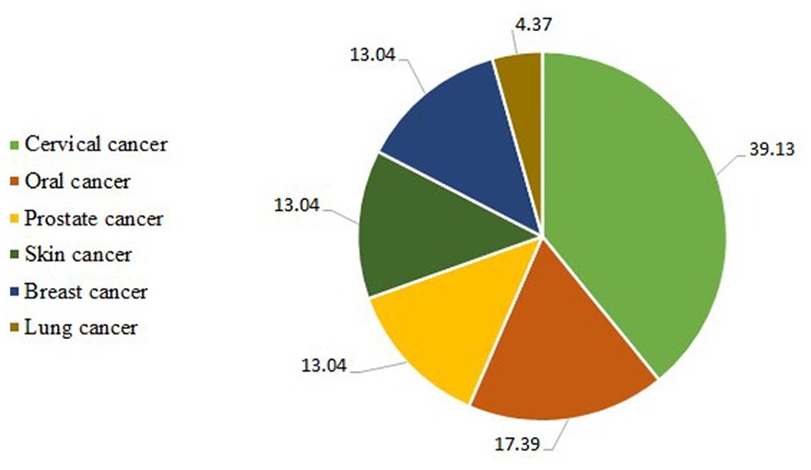
Cancer types screening by mobile health.
Content characteristics and positive impact factors of apps
Some app characteristics of contents and features were categorized according to the functions and impacts: 17 These are providing information (39.1%),4,9,17,19,21,24,27,29,31 planning (goal-setting) (8.6%),13,24 positive feedback (17.3%),14,23,24,31 monitoring and evaluation (8.6%),9,17 decision-making (26%),1,9,17,20,21,27 education and training (30.4%),9,17,20 -22,24,28 health awareness information (8.6%),4,24 remote clinical diagnosis (30.4%),9,15,22,26,30,32,33 feasibility in low-resource setting or countries (30.4%),15,16,20,21,25,26,32 early detection (34.7%),4,15,18,22,25,26,30,32 efficacy (30.4%),9,13,20,28,29,32 ,33 effectiveness (47.8%),14,16,21,23,24,27,29,30,32,33 ease of use and simplicity (21.7%),16,20,21,29,31 availability and accessibility (17.3%)9,25,28,31 and clinical assistance (21.7%).4,14,22,24,31
Furthermore, additional app characteristics, such as self-monitoring and self-diagnosing18,31 accuracy, 30 enhanced visual image and high-quality image, improved screening strategy, 26 transfer and collect data, 9 increased health behaviour management, 4 personal risk assessment, 24 recommendations, 22 classifications,20,21,22 flexibility, 29 interaction and supporting job aid, 17 medical records, 16 avoidance of unnecessary interventions and biopsy,19,27 risk calculator, 19 reduced time to detect, mobile teledermatology, 18 and low cost and portable, 15 were extracted from this study.
Half of these apps provide multiple functions for managing behaviours related to health. The most common functions of mHealth apps were providing the opportunity for education or training, remote clinical diagnosis, providing information, early detection, efficacy and effectiveness. All participants underwent usual or standardized care in the control groups. Table 2 gives an overview of the positive impact of mHealth from 2008 to 2019.
Discussion
It seems that mHealth apps are widespread and their effectiveness is increasing promptly.13,14,16,21,23,24,27,29,30,32 ,33 In this study, 23 studies had been selected to evaluate mHealth influence on cancer screening. Most studies indicated a positive contribution to the adoption of the smartphone. Participants launched the application on iOS or Android devices and had access to cancer screening applications. With the widespread use of smartphones in user’s daily lives, it is highly recommended to use mHealth apps for managing user’s health.
The important role of mobile devices is providing access to accurate and timely cancer data while emphasizing on the importance of data privacy and security during data transmission. 34 mHealth-enabled telemedicine demonstrated the potential role of mHealth in supporting screening and diagnosis of cancers. 35
The major barriers to mHealth are data security, confidentiality and ownership. Thus, the consideration of the ethical-legal aspects is of paramount importance when handling data in the mHealth field for cancer care. 36 In whatever way, 3 studies had some limitation to use mHealth. Tran et al 25 found that the smartphone’s image quality is probably not as good as those obtained with colposcopy. In addition, Quercia et al 9 found that 1 of the problems faced by the on-site caregivers was the language barrier when trying to explain the study inclusion criteria, but once patients accepted to attend the screening, the use of the application instead of written paper records was no longer a limitation to the screening visit.
Lee et al 29 reported that the lack of considerable differences in these results, such as the social desirability effects along with spillover effects or prospective contamination and social desirability, affects the results of the study. There are multiple potential confounding factors that are believed to have influenced the receipt of mammography in both groups, 1 of which is monthly phone calls to verify the receipt of mammogram over the 6-month follow-up. Owens et al, 28 in addition, reported the lack of instructions available for education.
Nevertheless, it is hard to evaluate the impact of apps according to the findings of 1 single study. So, it is essential to have further studies on this issue. Eventually, this study, in which the results of reviewed studies have been considered, has indicated more reliable proof to show the influence of smartphone apps. More than half of the reviewed studies were about common cancers in women (cervical and breast cancer). In addition, the longest study duration was 20 months. 24 Furthermore, the shortest study duration was 1 week. 17 Five studies (22%) reported users’ satisfaction of using the smartphone app.9,13,28 -30
According to Pereira-Azevedo et al, 27 the mobile application has been designed to not only give patients support but also to help healthcare specialists in the process of the decision-making. The application seems to be easy to work with; hence, it is very useful in the everyday care of patients. It could be also used in a clinical setting to avoid unnecessary biopsies and decrease the risk of prostate cancer, and as a result, it can diminish overdiagnosis and overtreatment. Furthermore, Tokosi et al 4 reported that the screening system has increased attendance at breast cancer clinics and promoted early detection and screening.
In the present research, half of the studies showed great effectiveness (47%).13,14,16,21,23,24,27,29,30,32 -33 It could be presumed that as the application used in users’ daily lives is highly feasible and acceptable, the rate of retention is high. Therefore, it is possible to adapt mHealth apps significantly so that cancer screening outcomes in users can be promoted largely by monitoring, managing and assisting them. In this review, some studies9,17,24,31,32 considered apps that perform multiple functions, such as providing information, planning, feedback, monitoring, evaluation, decision-making, education and health awareness information. In contrast, other studies15,17,25,32 considered apps for telehealth services. This means that there are many unconditional features belonging to the apps that may not be able to work congruously. So, there is a need to have an efficient app to meet the users’ needs and intentions. Hence, by giving users the right feedback, mHealth app is able to prepare personalized information. In this review, there were several limitations. First, despite the reporting time limits, this systematic review was restricted to published articles from 2008 to 2019. Second, we surveyed published papers on 5 main databases. Therefore, this study can be a landscape for prospective studies. Third, in this review, the impact of mHealth intervention was included, but documents related to gamification and telehealth were not examined in this research. Fourth, we excluded other types of papers such as opinion pieces, editorials, viewpoints and publications in languages other than English. It will not be possible to provide an overview of all studies and all cancers around the world given our limited resources. That is why it is not appropriate to generalize these findings to other developing countries. Fifth, in this study, we did not consider phases of screening such as early diagnosis, early detection and screening test.
Conclusion
In this study, a summary of the features and advantages of the mHealth app in cancer screening outcomes has been given. Most of the employed mHealth technologies reported positive outcomes across the continuum of cancer screening. Along with the studies done previously, this study indicates that the use of mHealth apps can influence cancer screening positively, knowledge enhancement related to screening, presenting information, goal-setting or planning, reminding, monitoring, giving feedback, evaluation, support job aid, integration, decisions, education, interaction and health awareness information. Finally, mHealth interventions have demonstrated potential impacts on addressing various challenges facing cancer screening, even in low-resource settings, hence a promising field for supporting cancer care. In addition, most apps are proven to have a better function in improving cancer screening outcomes. Compared with conventional care users, most app users seem to be pleased with the use of mHealth. Although most studies taken into account suggested particular positive impact on health improvement, there is a great need to have other studies in which larger samples are used and more lengthy interventions are applied to confirm the positive effects of mHealth applications. Further study is needed to consider the health app’s impacts in larger detail.
Footnotes
Author Contributions
HS, MA and NS independently reviewed papers based on titles and abstracts attributed to inclusion and exclusion criteria and, subsequently, the irrelevant studies have been removed. HS conducted data extraction. NS and MA rechecked the accuracy. MA provided guidance on the article.
Declaration of Conflicting Interests:
The author(s) declared no potential conflicts of interest with respect to the research, authorship, and/or publication of this article.
Funding:
The author(s) received no financial support for the research, authorship, and/or publication of this article.
