




Abstract
The aim of this study was to determine the effect of a course on transcultural midwifery on the attitudes of midwifery students towards intercultural sensitivity. This study used a pretest-posttest quasi-experimental design with experimental and control groups and was conducted with midwifery students. The results indicated that the difference between pretest and posttest scores averaged across the scale was statistically significant for students in the experimental group (p < .05) and not statistically significant for students in the control group (p > .05). The intercultural sensitivity of students who enrolled in the course on transcultural midwifery increased.
Culture is defined as values, beliefs, attitudes and behaviours, customs and traditions learned, shared and passed on from generation to generation by a group of people (Bayık Temel, 2008; Bolsoy & Sevil, 2006). Cultural sensitivity is defined as developing appropriate, positive and effective behaviour in terms of intercultural communication considering the cultural differences and similarities, cultural background and ethnic structure of the individual (Aslan et al., 2016).
Interactions between people from different cultures are increasing due to the changing and globalizing world and the driving factors such as economic conditions, migrations and wars, and societies are becoming progressively multicultural (Yılmaz et al., 2017). With its unique geographical location, Turkey has hosted various civilizations and migrations and is now home to people from many diverse cultures. This has also affected health services, requiring healthcare professionals to provide culturally appropriate care to individuals with differing cultural characteristics (Bulduk et al., 2011).
Intercultural sensitivity in healthcare services with effective communication, effective intervention and consequently increased satisfaction contributes to improving the quality of the service provided (Cetişli et al., 2016; Eğinli, 2011). Health professionals, especially midwives and nurses, who are the forefront healthcare providers, should be able to evaluate individuals and groups in the context of their own traditions and customs, understand healthcare needs and plan their interventions according to cultural differences. However, intercultural sensitivity is a gradual process that matures over time, whereby the individual develops emotionally and cognitively in the face of cultural differences and reaches intercultural communication competence. This is why it is necessary to prepare individuals with a high level of intercultural sensitivity, especially in areas such as healthcare and education, to deal with this cultural medley in today’s world (Bayik Temel, 2008). This imposes important responsibilities on educational institutions in healthcare that train students who are equipped to meet the healthcare needs of multicultural societies and are sensitive to cultural problems (Bulduk et al., 2011). To fulfil this responsibility, educational institutions must first determine the current cultural sensitivity levels of future midwives, revise their curricula in line with the requirements determined and develop appropriate educational environments with optimal education, interventions and social projects (Menage et al., 2017). Previous studies have pointed out taking courses with intercultural health content, having experience abroad and making friends from different countries as the factors affecting the level of intercultural sensitivity (Beser et al., 2021; Kaya et al., 2021).
When the literature is reviewed, we see that studies on intercultural sensitivity mostly focus on working midwives and nurses (Can et al., 2022; Çifçi & Değer, 2021; Gümüşsoy et al., 2021; Guner et al., 2022). In a study conducted by Briscoe (2013), undergraduate midwifery students in Northwest England were provided with the opportunity to develop cultural sensitivity using the Global Midwifery Module tool within the midwifery bachelor’s program. As a result, it was found that awareness of international midwifery increased, contributed to the development of intercultural midwifery and instilled confidence in dealing with individuals from different cultures. In the study by Kelleher et al. (2016), nursing and midwifery students perceived the development of cultural sensitivity as one of the key intercultural benefits of studying abroad. Numerous studies supporting the value of international experiences in enhancing cultural competence for students are found in the literature (Edmonds, 2010; Koskinen & Tossavainen, 2004; Ruddock & Turner, 2007). Upon reviewing the relevant literature, no study was found that attempted to improve the intercultural sensitivity of midwifery students. In this respect, it is believed that the study will fill the gap in the field and encourage working with different groups.
Our study aims to determine the effect of the transcultural midwifery course, which is given to train culturally sensitive midwives, on students’ cultural sensitivity levels.
Methods
Study design and sample
This study used a pretest-posttest quasi-experimental design with experimental and control groups and was conducted with midwifery students in the second year of the health sciences faculty of a public university in the northeast region of Turkey in the 2021–22 academic year. Sixty-four midwifery students voluntarily enrolled in the transcultural midwifery course. Of them, 60 students who agreed to participate in the study were assigned to the experimental group. There were 70 midwifery students who did not choose the transcultural midwifery course but preferred another elective course. Sixty-four of them who agreed to participate in the study were assigned to the control group. The inclusion criteria for the experimental group were to agree to participate in the study and to have enrolled in the transcultural midwifery course. The inclusion criteria for the control group were to agree to participate in the study and to have enrolled in an elective course other than the transcultural midwifery course.
Data collection
Data collection tools were completed with the students in both the experimental and control groups one day before the start of the course (pretest). Then, the students who elected the transcultural midwifery course attended the course for a total of 28 hours, two hours per week for 14 weeks. The transcultural midwifery lesson was given to the students in the experimental group by the researcher SES. The researcher received training related to the relevant course during both her master’s and doctoral education. In addition, the researcher has pedagogical formation training. In addition, the researcher has been giving the transcultural midwifery course in the midwifery department for three years. The course content was prepared based on the literature information. The content of the transcultural midwifery (TE) course was as follows:
culture concept and its definitions, cultural elements;
the place and importance of culture in health, the concept of health and disease and its relationship with culture, socio-cultural factors affecting health;
transcultural concept, intercultural communication (values, beliefs);
intercultural health approaches;
cultural practices and midwifery approaches that affect women’s health;
Turkish culture and midwifery in Turkish culture; cultural practices in prenatal, natal, postnatal and childcare;
midwifery in European countries; cultural practices in prenatal, natal, postnatal and childcare.
The students in the control group who did not elect the transcultural midwifery course attended other courses that they elected for a total of 28 hours, two hours a week for 14 weeks. Data collection tools were completed again in both groups after the courses ended (posttest).
Measures
A questionnaire form and Intercultural Sensitivity Scale were used to collect research data.
Data analysis
Numbers, percentages, standard deviation and mean were used in the evaluation of the data. Kurtosis-skewness values were considered to determine whether the distribution was normal. The skewness value should be in the range of ± 2 to be fit for normal distribution (Tabachnick & Fidell, 2013). The skewness values were found to be in the range of −1.686–1.912 for the control group and −.572–1.087 for the experimental group. Since the skewness values obtained from the scales and their sub-dimensions were in the range of ± 2, it was determined that all scales showed a normal distribution.
Ethical considerations
The approval and written permission necessary for carrying out this study were received from the ethical committee (approval number 2021/02/08). Additionally, written consent to use the scales was received from the authors, and the verbal consent of student participants was received.
Results
The control variables were participants’ age, the high school they graduated from, their willingness to choose the profession, whether they would choose the profession again, whether they liked the profession, whether they were having problems with foreigners, whether dealing with foreigners decreased efficiency and whether they could speak a second language. For control variables, the difference between the experimental and control groups was not statistically significant and the groups were similar (p > .05, Table 1).
Comparison of the control variables of the study.
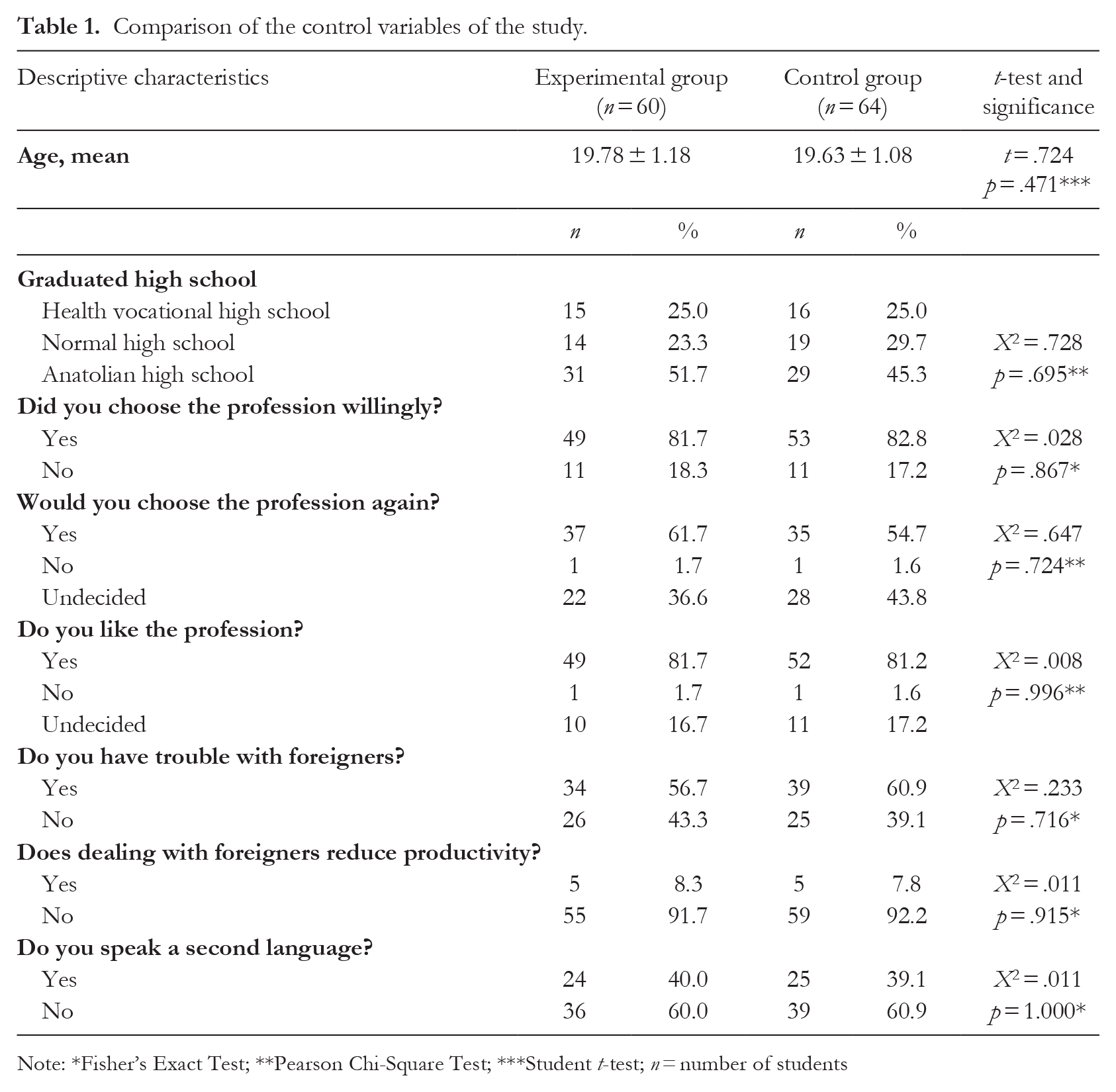
Note: *Fisher’s Exact Test; **Pearson Chi-Square Test; ***Student t-test; n = number of students
The distribution of the total and sub-dimension mean scores of the Intercultural Sensitivity Scale for the experimental and control groups is given in Table 2. The pretest total mean score of the experimental group was 89.36 ± 10.86, and the posttest mean score was 98.83 ± 7.30. The mean pretest total score of the control group was 89.79 ± 10.47, and the mean posttest score was 91.46 ± 12.9 (Table 2).
Distribution of total and sub-dimension mean scores of the Intercultural Sensitivity Scale.
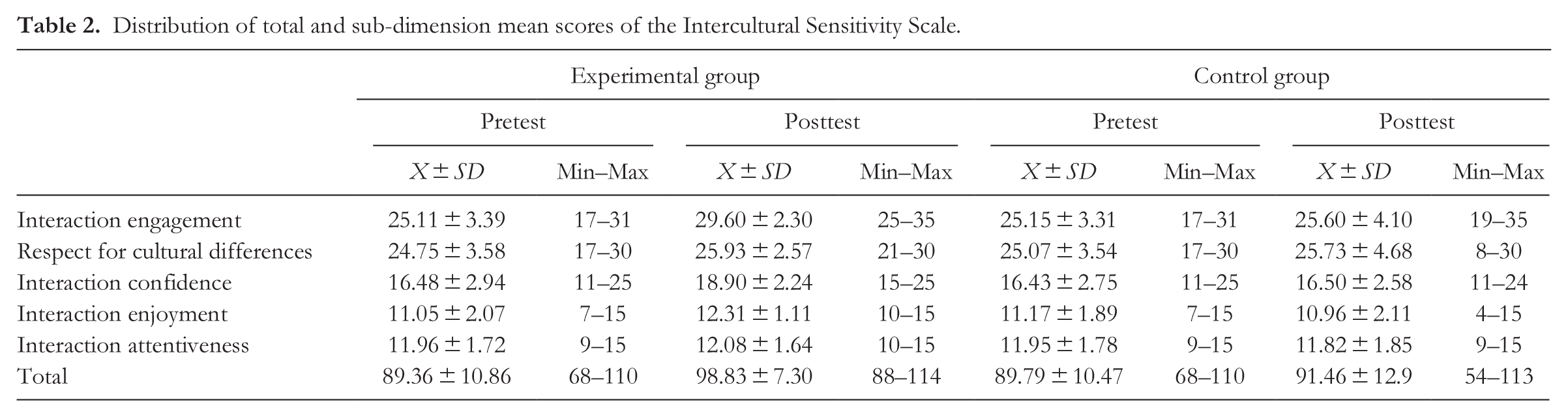
The pretest Intercultural Sensitivity Scale mean scores of the students in the experimental and control groups were similar, with no statistically significant difference observed between the groups (p > .05). The students in the experimental group scored 29.60 ± 2.30 from interaction engagement, 25.93 ± 2.57 from respect for cultural differences, 18.90 ± 2.24 from interaction confidence, 12.31 ± 1.11 from interaction enjoyment and 12.08 ± 1.64 from interaction attentiveness sub-dimensions, with the total mean score being 98.83 ± 7.30. The same values in the control group were 25.60 ± 4.10, 25.73 ± 4.68, 16.50 ± 2.58, 10.96 ± 2.11, 11.82 ± 1.85 and 91.46 ± 12.9, respectively (Table 3).
Comparison of Intercultural Sensitivity Scale pretest and posttest mean scores of the experimental and control groups.

aIndependent samples t-test.
p < .001.
The comparison of the Intercultural Sensitivity Scale pretest-posttest mean scores of the experimental group demonstrated statistically significant differences in interaction engagement, interaction confidence, interaction enjoyment sub-dimensions and total scale scores (p < .001) (Table 4).
Comparison of pretest-posttest Intercultural Sensitivity Scale mean scores of the experimental group.

Paired sample t-test.
p < .001.
In the comparison of the Intercultural Sensitivity Scale pretest-posttest mean scores of the control group, the difference in mean scores in all sub-dimensions and between the groups in the total score was statistically insignificant (p > .05) (Table 5).
Comparison of pretest-posttest Intercultural Sensitivity Scale mean scores of the control group.

Note: *paired sample t-test
Discussion
Wars, migrations, racism, economic crises, demographic changes, advances in treatment methods and changes in patient expectations around the world mean that care areas in health institutions should be fitted for diverse cultural characteristics and should provide adequate care (Bayık Temel, 2015). The midwifery profession in the globalizing world has adopted the necessity and responsibility of providing individual-centred care to society as a whole and to ethnic groups (Bayık Temel, 2008). Thus, it is necessary to achieve cultural competence by ensuring that midwives and midwifery students acquire cultural awareness, knowledge, sensitivity and practice skills to provide culturally adequate care.
In our study findings, the experimental group had pretest and posttest total mean scores of 89.36 ± 10.86 and 98.83 ± 7.30, respectively, compared to the control group with pretest and posttest total mean scores of 89.79 ± 10.47 and 91.46 ± 12.9, respectively (Table 2). In Mamueva’s (2021) study, the total mean score of the students on the Intercultural Sensitivity Scale was 80 ± 5. Gönenç et al. (2018) found the intercultural sensitivity mean score of 75.73 + 10.1 for midwives and nurses. In the study by Guner et al. (2022), the total score of the Intercultural Sensitivity Scale of midwifery students was 88.96 ± 10.82. The mean ISS scores were average or good in the studies conducted with healthcare professionals and students in the field of health in the national literature (Arli & Bakan, 2018; Bilgiç & Şahin, 2019; Demirel et al., 2020; Gönenç et al., 2018; Kılıç & Sevinç, 2018; Özkan, 2021). The midwifery students in our study, on the other hand, had average intercultural sensitivity in comparison to the studies from our country. Multicultural societies may have conflicts and crises when living together but may also form an effective communication environment. People from different cultures lived in Turkey in harmony and peace in the past, and we believe this continues to the present day.
In the comparison of the pretest-posttest mean scores of the Intercultural Sensitivity Scale of the experimental group, the differences in interaction engagement, interaction confidence, interaction enjoyment scores and the difference in total between the groups were found to be statistically significant (Table 4). The difference between the Intercultural Sensitivity Scale pretest and posttest level mean scores of the control group was not statistically significant (Table 5). These results are in agreement with the literature. A cultural competence training programme conducted by Dığrak (2020) with nursing students had a positive effect on students’ cultural competence. In the study of Cerezo et al. (2014) with third-year nursing students in Spain, cultural competence education was effective in increasing cultural sensitivity. In the study conducted by Kaçan and Örsal (2020) with second-year nursing students in our country, intercultural nursing education was described as an effective teaching method in developing students’ professional values, empathic skills, cultural sensitivity, cultural intelligence and healthy lifestyle behaviours. In their study to raise cultural sensitivity in first-year nursing students through a workshop, Özdişçi and Tanriverdi (2020) noted an increase in cultural sensitivity mean scores. Contrary to these studies, Şahin and Ayaz-Alkaya (2024) reported that taking an intercultural nursing course did not result in a significant difference in increasing cultural sensitivity. Several authors have emphasized the importance of integrating a course to help students attain cultural knowledge, skills, awareness and communication to amplify a culturally sensitive approach (Hotun Şahin et al., 2009; Lancellottı, 2008; Narayanasamy & White, 2005; Tortumluoğlu, 2004). The result of this study shows that the transcultural midwifery course significantly increased the sub-dimension of intercultural sensitivity in the experimental group and that the training programme was effective, consistent with the literature. This result suggests that the transcultural midwifery course taken by the experimental group participating in the study paved the way for students to be aware of other cultures and to have a positive approach towards intercultural differences.
Conclusion and recommendations
Students in the experimental group who chose to take the transcultural midwifery course had improved interaction engagement, interaction confidence and interaction enjoyment skills and respect for cultural differences, which are important in overcoming the difficulties they experience in communicating with foreigners. On the other hand, no change was observed in the intercultural sensitivity of the students in the control group who did not choose to take the transcultural midwifery course.
Integrating intercultural content into the midwifery curriculum is no longer a choice but apparently a necessity in today’s world of global migrations.
Midwifery students will become culturally competent practitioners if they adopt a holistic approach and provide culturally appropriate care.