



Abstract
Finger representations are used to count or show quantities. How fingers are lifted to count and the type of representation that we use to communicate quantities have been the focus of studies that have aimed at providing evidence of dominant patterns across cultures. In the current study, we go beyond those studies and investigate intracultural variability. Specifically, whether finger counting habits and finger montring patterns are similar in children and adults. To this aim, a total of 3,210 Spaniard participants took part in this study (637 children and 2,573 adults). All of them were assessed regarding handedness, the way in which they counted with their fingers from 1 to 10 (finger counting) and how they show quantities with their fingers (finger montring). The results showed certain consistency; however, there was substantial variability within each group. Findings are interpreted within the context of current theories reinforcing the relevance of finger patterns to support the understanding of the meaning of numbers.
Fingers can be used to count and represent numbers. Indeed, finger counting helps children to acquire basic skills for mathematical development such as the acquisition of number knowledge (Butterworth, 1999), the understanding of cardinality (Orrantia et al., 2022) and to perform calculations (specially, additions and subtractions). Previous research has shown that fingers’ use contributes to releasing working memory and serves as an external aid while performing operations (Andres et al., 2008; Beller & Bender, 2011; Di Luca & Pesenti, 2011). Several authors have suggested that finger counting could be the ‘missing tool’ between the sensory-motor experience and mathematical concepts (Andres et al., 2008; Bender & Beller, 2012; Gashaj et al., 2019) or the ‘missing link’ that establishes the connection between non-symbolic numbers and symbolic arithmetic (Fayol & Seron, 2005). Nonetheless, research on this topic is scarce and has focused on the role of finger counting on children’s maths abilities (i.e., how finger counting contributes to counting abilities and to the understanding of the meaning of numbers; Gunderson et al., 2015). Whereas some studies have investigated cultural differences, there is no evidence of intracultural stability or whether there are canonical finger patterns that are invariant and independent of developmental stage. In this study, we investigate how two different samples (children and adults) count and represent numbers with fingers in Spain and provide an overview of aspects of finger montring and finger counting that vary across cultures and are more sensitive to intracultural differences.
The role of fingers on the acquisition and development of maths skills
Finger counting can support and strengthen the acquisition of counting principles and the performance of calculations. For instance, fingers can contribute to the understanding of one-to-one correspondence, stable order and cardinality (Gelman & Gallistel, 1978). Children use fingers to keep track of elements that are counted and those that remain to be counted, assigning each finger a verbal label. This would contribute to scaffolding the one-to-one correspondence principle. In addition, counting with fingers allows understanding the principle of stable order since fingers are arranged in order on one hand and, usually, we start counting at one end of the hand by lifting or touching all the fingers in order until we reach the other end. Other studies have observed that while children are learning the meaning of number words, they are simultaneously learning to perform gestures representing numbers with their fingers (Gibson et al., 2023; Goldin-Meadow et al., 2014; Gunderson et al., 2015): that is, the cardinality or meaning of numbers.
There is also evidence that kindergarteners rely on finger counting to solve arithmetic tasks (Fuson, 1982), even when no explicit instructions for using fingers have been given (Siegler & Shrager, 1984). Moreover, it has been found that the use of fingers facilitates simple addition and subtraction by serving as a tool that helps alleviate working memory and aids in performing correct calculations (Bender & Beller, 2011; Dupont-Boime & Thevenot, 2018; Wiese, 2004). Here is an example of how fingers can be used to count. Imagine that a child wants to solve the following arithmetic word problem: ‘John has five coins and his sister gave him three more. How many coins has John now?’ To solve the problem, the child can use the most basic strategy, that is, counting all (Baroody, 1987), and count with his fingers in one hand, ‘one, two, three, four and five’, and with the other hand, ‘one, two and three’, and after that he can count all the fingers: ‘one, two, three, four, five, six, seven and eight’. Alternatively, if the child has internalized the representation of small numbers with finger patterns, then five fingers can be raised simultaneously with one hand and three fingers with the other hand. In this case, the child would be able to recognize the patterns faster and give a quicker response to the problem (without using another counting strategy). So, fingers can be used in two different ways: (1) to count an amount and hold up a finger for each of the numbers that are being said; or (2) the pattern can be stored in the mind and displayed directly to represent an amount. That leads us to different types of finger numeral representations — finger counting and finger montring (Soylu et al., 2018).
Finger counting and finger montring: acting and communicating quantities with hands
Finger counting is referred to as an act in movement and it is used as an aid to count and perform arithmetic operations (typically, fingers are lifted with every object counted). On the other hand, finger montring is referred to as a static act, that is, the use of finger configurations to represent and communicate cardinal numbers. For example, at a restaurant, we raise three fingers simultaneously rather than showing them one by one to indicate that we want three refreshments (Pika et al., 2009). This differentiation is important because finger representations during counting seem to differ from those used to show quantity to other people (Di Luca & Pesenti, 2011; Wasner et al., 2015). For instance, most Europeans start finger counting with the thumb to count one (Lindemann et al., 2011); nevertheless, they use the index finger when they have to ask for one beer in a restaurant (Crollen et al., 2011; Di Luca & Pesenti, 2008; Pika et al., 2009). Importantly, there are also substantial differences across cultures in terms of whether finger representations align with the quantity that they represent or not. For instance, whereas in Western countries six fingers are raised to indicate six items, in many Asian countries only two fingers are raised (thumb and pinkie).
Sociocultural differences in finger counting
Extant studies on the use of finger counting have focused on different aspects: (i) counting with palms facing oneself or palms down; (ii) patterns that involve raising fingers and those in which fingers are bent; (iii) hand that starts the counting; (iv) and whether there is anatomical symmetry or spatial continuation when counting involves both hands. Cipora et al. (2022) pointed out that we can also analyse which finger starts the sequence. Nonetheless, those aspects have not attracted the same level of attention. For instance, few studies have investigated the orientation of palms while counting. Bender and Beller (2012) found that raising fingers was the typical approach in European countries, while in Japan people start counting with an open palm and bending the fingers (Nishiyama, 2013).
The bulk of research comes from studies that have investigated the hand and finger that start the counting sequence. Studies have shown that most Europeans lift one finger for each number, establishing the principle of one-to-one correspondence between fingers and numbers. Nonetheless, there is considerable variability across countries and cultures. Whereas some authors have found that Scots (Fischer, 2008), Dutch, Canadians, Finns, Germans, Italians, Belgians and Americans show a preference for starting to count with the left hand (Lindemann et al., 2011), others have found that Belgian (Di Luca & Pesenti, 2008; Sato & Lalain, 2008), Polish (Hohol et al., 2018), British, German (Cipora et al., 2022) and French participants (Sato & Lalain, 2008) prefer to start counting with the right hand. In the case of Middle Eastern cultures, people tend to start counting with the right hand (Lindemann et al., 2011).
The order in which Canadians, Italians, Belgians, French, Germans, Poles and Scots lift their fingers to count is similar — i.e., they start with the thumb, and continue with the index, middle, ring and pinkie fingers of the same hand before passing to the other hand and repeating the same process (e.g., Brozzoli et al., 2008; Di Luca & Pesenti, 2008, 2010; Domahs et al., 2010; Fabbri, 2013; Fischer, 2008; Morrissey et al., 2016; Pika et al., 2009; Sato & Lalain, 2008; Zago & Badets, 2016). However, Middle Eastern cultures (e.g., Iranians; Lindemann et al., 2011) and some indigenous cultures (such as Tsimane, from Amazonia) choose the pinkie finger to start counting (Cipora et al., 2022). Chinese people start counting with the index finger (Domahs et al., 2010).
Sociocultural differences in finger montring
In contrast to the level of attention that finger counting has attracted, very few studies have been conducted to analyse how quantity is communicated with fingers — i.e., finger montring. Germans use the thumb to start finger counting but also use that finger to communicate ‘one’ (Cipora et al., 2022; Pika et al., 2009). French Canadians (Pika et al., 2009) and British (Cipora et al., 2022) use the thumb to start counting ‘one’, but when they have to communicate ‘one’, they lift the index finger. Such disparities also reveal huge variability within and across cultures regarding how fingers are used to communicate quantities. Wasner et al. (2015), with a sample of 76 adult participants, showed that the finger representations used for numbers 1–9 were different in 44% of trials — comparing finger counting and finger montring, participants changed the hand, the finger or both in almost half of trials. These findings suggest that people know different finger representations and they use them depending on different factors (e.g., situation, availability of hands, etc.). Recently, Cipora et al. (2022) have also analysed the way of communicating quantities in British, Germans and an indigenous tribe from Colombia (Tsimane). Findings show that, even within the same culture, different patterns of representations are used to communicate quantities.
The present study
The aim of the present study is to investigate finger counting and finger montring in Spaniard children and adults. Specifically, we look at (i) uncovering dominant representations of finger montring as well as characterizing dominant aspects of finger montring and (ii) exploring intracultural variability in finger counting and finger montring. To this end, we consider two different groups that may indeed reflect such variability, children and adults. Note that this is a key difference with previous studies. The review of the literature shows that studies have mainly focused on defining differences across cultures rather than on studying intracultural variability. Furthermore, there are no appropriate reports of finger representations in Spain. Liutsko et al. (2017) provided very limited evidence with 48 children from 10 to 12 years old.
Method
Participants
A total of 3,210 children and adults from Spain participated in this study. Children in the current sample were drawn from a large-scale study that investigates the development of maths skills during the first years of formal school.
Children Sample: 637 children (304 girls; Mage = 6.01 years, SD = 1.47, range = 3–8) from three different schools in a small city in the west of Spain were recruited for the purpose of this study. None of these children presented developmental disorders or disabilities. For all children, informed consent was obtained from the parents before testing. Thirteen participants were removed from this sample because they were not able to count beyond 5 or their accuracies were less than 50% in the tasks described below.
Children were evaluated individually in their respective schools by a trained research assistant. Data were collected in two different sessions of 15 minutes along with other tasks about numerical processing. Note that three- and four-year-olds were not assessed with the finger montring task because they already had difficulties counting with their fingers. Moreover, there was a group of six-year-olds that did not give their consent to be evaluated in a second session, and for this reason, they were not assessed in finger montring. The final sample of children for the finger montring task was 410 participants of five, six, seven and eight years of age.
Adult Sample: Data from 2,573 adult participants from different regions of Spain were collected. Data from 30 participants were incomplete and not included in final analyses. All participants gave their written consent to the study. The final adult sample consisted of 2,543 participants (71.2%, women; Mage = 37.5 years, SD = 14.7, range = 16–79). The adult group consisted mostly of active workers (N = 58.12%), full-time college students (N = 22.14%), part-time college students (N = 3.26%), unemployed (N = 5.86%) and retired or inactive adults (N = 10.61%).
Data from adults were collected through an online questionnaire (average response time was about eight minutes). Basic demographic data (i.e., gender, age, country of birth, educational attainment and occupation) were also collected. The questionnaire was adapted from Hohol et al. (2018). Additionally, some questions about finger montring were included (see Finger montring task for detailed information). The questionnaire was distributed via email. The period of data collection was about eight weeks. The English translation of the questionnaire can be accessed at https://forms.gle/rwLbouoVG2Yy7MCU7.
Materials
Handedness assessment
In this task children were asked to write their names (or to draw a picture for the little ones) on paper and to build a tower with some cubes. Those who did the two activities with the right hand were categorized as right-handers, those who did both activities with the left hand were categorized as left-handers, and those who did each activity with one hand or were incapable of doing some of the activities were categorized as non-defined. In the case of adult participants, they were asked: ‘What hand do you always use to write?’ with three options: right, left or either of them indistinctly. Those who marked the right hand were categorized as right-handers, those who chose the left hand were categorized as left-handers, and those who marked both hands were categorized as ambidextrous.
Finger counting
In this task, both children and adult participants were given the same instruction: ‘Please leave your hands free and clench your fists in front of you. Now, start counting with your fingers from 1 to 10’ (Fabbri, 2013; Fischer, 2008). Information regarding the finger counting pattern was categorized according to Cipora et al. (2022, see Results section). Additional information related to (i) the hand that starts the count (right or left), (ii) the finger that starts the count, (iii) the finger used to count 6 (thumb, index, middle, ring or pinkie) and (iv) the transition from one hand to another (anatomical symmetry vs spatially continuity) was also collected. Anatomical symmetry is characterized by starting with the same finger on both hands and following the same sequence. In contrast, spatially continuous counting is characterized by projecting the numbers in an ordinal line with fingers (the last finger that is used to count with the first hand is the same as the first finger of the second hand that is used to continue the count. A third type of category was added for those transitions that did not fit into any of the previous categories.
Finger montring
This task is based on the tasks that Pika et al. (2009) and Wasner et al. (2015) used in their experiments. For children, the experimenter said: ‘Imagine that you go to the kiosk and you want to ask for some candies, but the person in charge cannot listen to you, so you have to show him the quantity with your fingers. How do you ask for five?’ And participants had to depict that number with their fingers as accurately as possible. After each trial, children had to close their fists and then a new number was asked by the experimenter. Participants were sitting with their fists closed and their hands on the table. Students were asked to show numbers from 1 to 9 (except 5) with their fingers (in the following order: 3, 7, 1, 8, 4, 6, 2, 9). Trials in which children represented a quantity other than the requested were excluded and only correct representations were considered for the current study.
For adult participants, the question was: ‘Imagine you go to a bar, and you have to order a quantity of drinks, but the waiter can’t listen to you, so you have to make the gesture with your hands’. Then, they were presented with different alternatives for each number 1 to 9 (except 5). Those patterns were based on previous studies. For instance, for the representation of number 2 they were presented with: (i) index and middle finger; (ii) thumb and index finger; and (iii) pinkie and ring finger. A fourth alternative included the words ‘other pattern’. In the case of numbers 4 and 9, participants were only presented with two alternatives because for the representation of number 4 there are only two possible canonical options: (i) index, middle, ring and pinkie (that is, all fingers except the thumb); and (ii) thumb, index, middle and ring (that is, all fingers except the pinkie).
Data analysis
Given the nature of the data, nonparametric statistics were used (Pearson’s Chi-Squared test). To compare specific types of finger representations between groups (children and adults), z-tests with Bonferroni adjustment for multiple comparisons were performed. To check the effect size, we used Cramer V statistic, which, according to Cohen’s (2013) standards, indicates if the effect is small (.1), medium (.3) or large (.5). Analyses were conducted using SPSS®.
Results
Finger counting
Frequencies regarding each aspect of finger counting 1 that was considered are summarized in Table 1.
Finger counting patterns in children and adults.
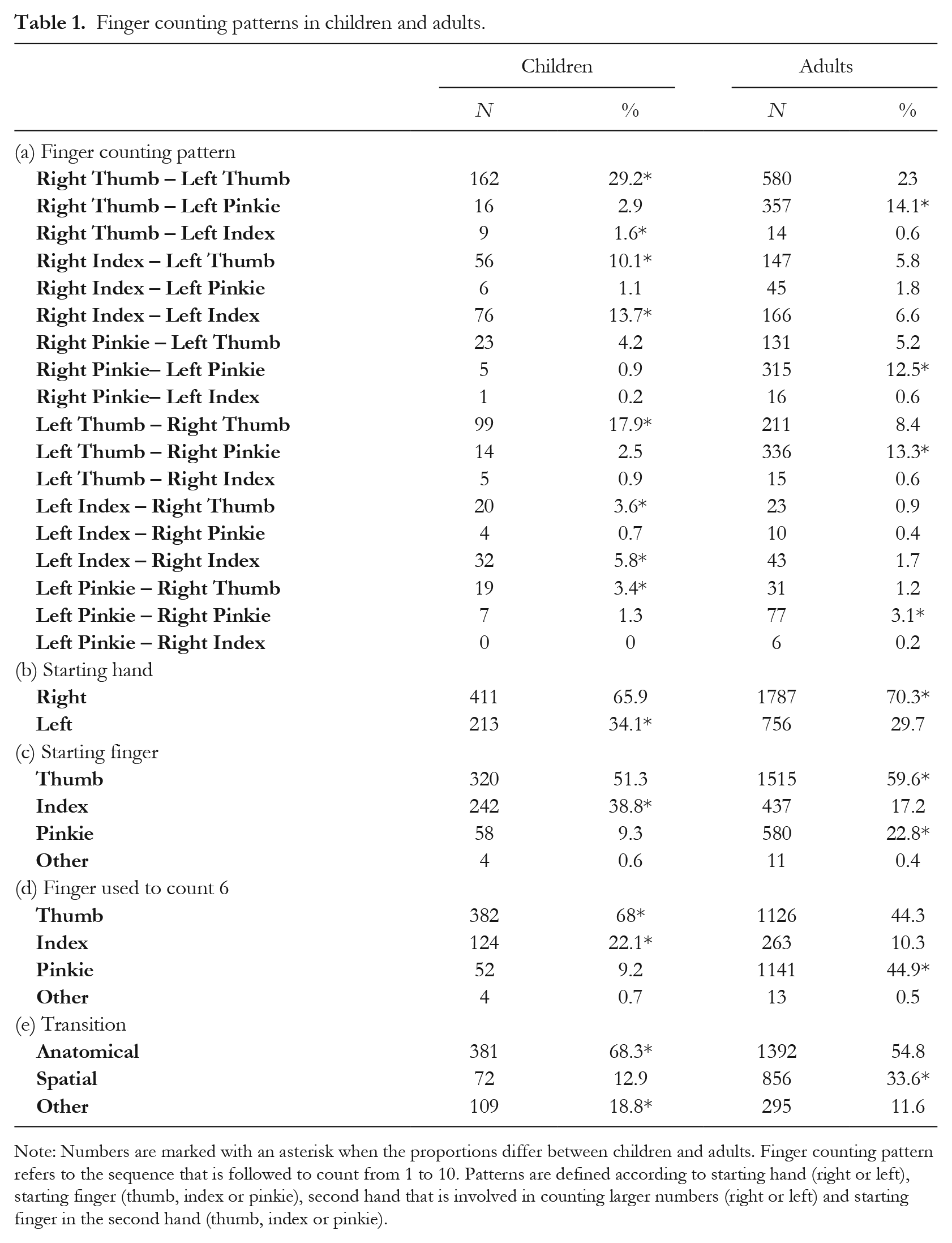
Note: Numbers are marked with an asterisk when the proportions differ between children and adults. Finger counting pattern refers to the sequence that is followed to count from 1 to 10. Patterns are defined according to starting hand (right or left), starting finger (thumb, index or pinkie), second hand that is involved in counting larger numbers (right or left) and starting finger in the second hand (thumb, index or pinkie).
Finger counting patterns
Eighteen types of patterns were identified according to the order in which fingers were raised. 2 The most predominant pattern used by children and adults was the same: starting with the right thumb to count one (followed by all the fingers of the same hand in order — index, middle, ring and pinkie) and continuing with the left thumb following the same pattern (see Table 1, panel a). Nevertheless, a chi-square test revealed significant differences between children and adults in the types of counting patterns that were analysed, χ2(17, n = 3,077) = 330.25, p < .001. The magnitude of this association was moderate (.33). Note that this is probably due to substantial variability in both children’s and adults’ counting patterns. For instance, while children prefer to start counting with the thumb or pinkie finger in both hands, adult participants showed a tendency to start with the thumb in the first hand and continue with the pinkie in the second hand or starting with the thumb in both hands.
Starting hand for finger counting
The dominant pattern in both children and adults referred to mapping the numbers from 1 to 5 to the right hand during counting (see Table 1, panel b). A chi-square test revealed that such a pattern was more established in adults than in children [χ2(1, n = 3,167) = 4.58, p = .032], although the effect size was small (.04). There was an association between Starting Hand and Handedness 3 (see Table 2) in both children [χ2(1, n = 624) = 18.91, p > .0001] and adults [χ2(1, n = 2,543) = 202.89, p < .0001], showing that most participants preferred to start counting with their dominant hand.
Handedness and starting hand.
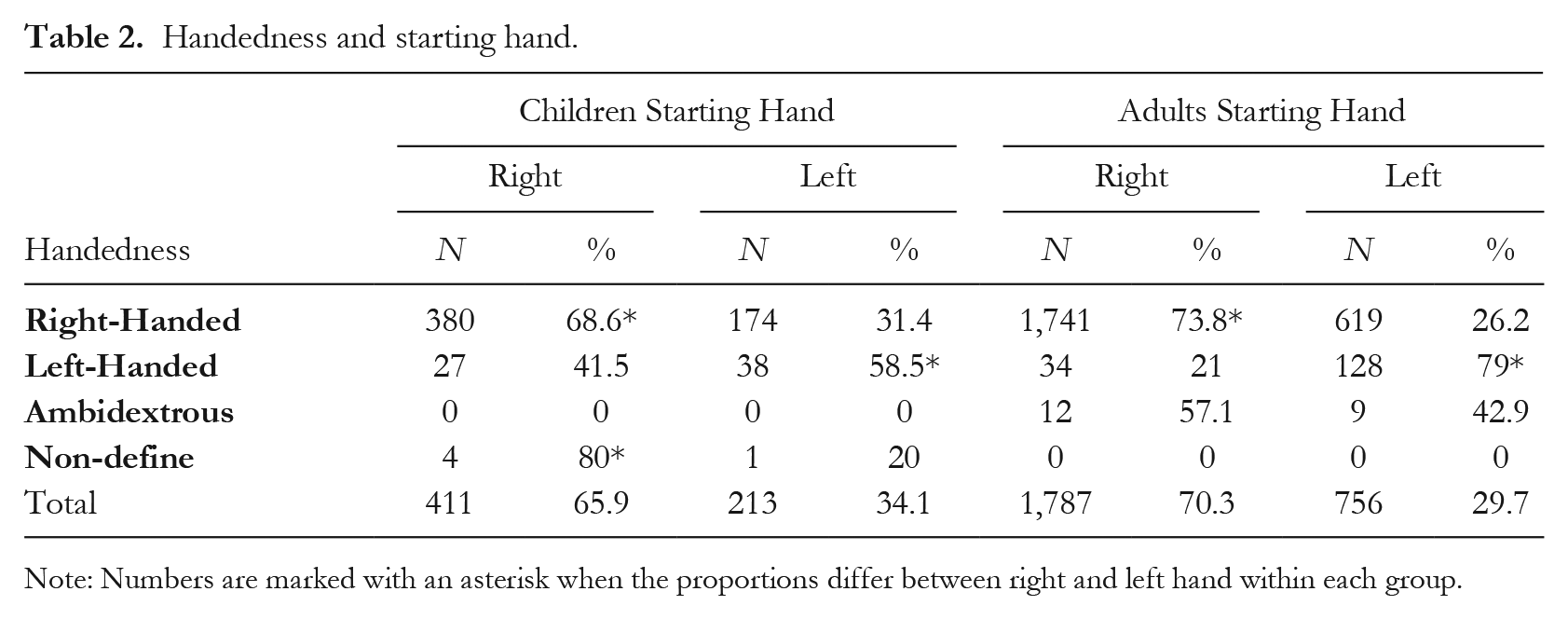
Note: Numbers are marked with an asterisk when the proportions differ between right and left hand within each group.
Starting finger for finger counting
There was consistency in the finger that children and adults use to start counting. Both prefer to start counting with the thumb, although there was variability in both groups. A chi-square difference test revealed an association between group and starting finger (see Table 1, panel c), [χ2(3, n = 3,167) = 160.83, p < .001], owing to discrepancies in other than the dominant pattern. The magnitude of this association was moderate (.23). There was a higher proportion of children who started counting with the index finger, whereas the proportion of adults choosing the pinkie finger to start counting was higher than that of children.
Finger used to count 6
We found no consistency between children and adults. Table 1 (panel d) shows that the majority of children used the thumb to count 6 whereas adult participants used their pinkie finger, χ2(3, n = 3,105) = 256.24, p < .001.
Transition from one hand to another
As can be seen in Table 1 (panel e), the majority of children and adults used an anatomical transition; that is, they started counting with the same finger in both hands. A chi-square test revealed significant differences between groups, χ2(2, n = 3.105) = 98.834, p < .001. The proportion of adult participants using spatial continuity from one hand to another was higher than that of children.
Finger montring
Table 3 shows the frequencies corresponding to each pattern identified in the study.
Finger montring representations by number in children and adults.
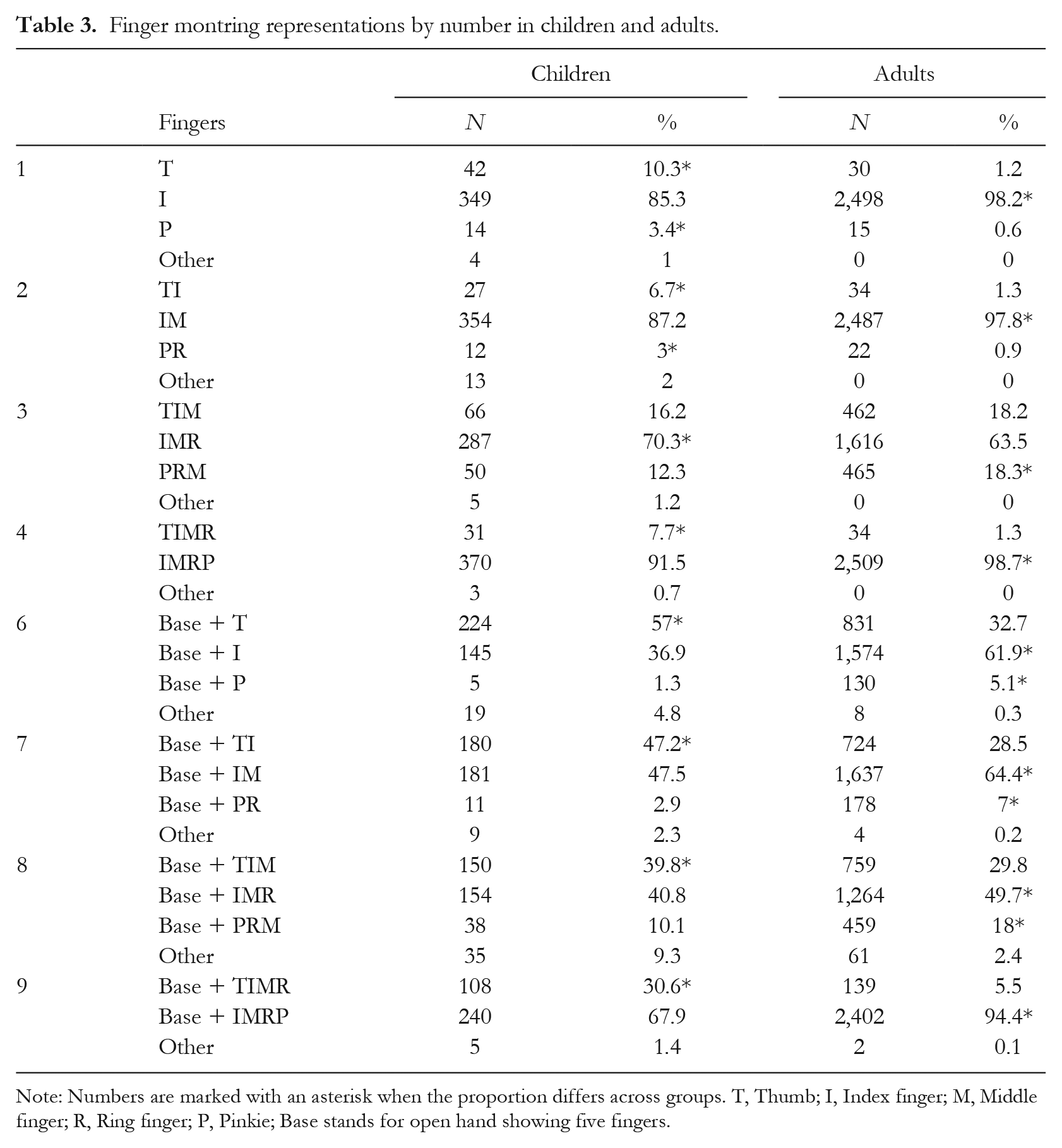
Note: Numbers are marked with an asterisk when the proportion differs across groups. T, Thumb; I, Index finger; M, Middle finger; R, Ring finger; P, Pinkie; Base stands for open hand showing five fingers.
Number 1
The most predominant finger representation in both children and adults was lifting the index finger. A chi-square test revealed an association between group and type of representation [χ2(2, n = 2,950) = 154.291, p < .0001], probably because the proportion of participants using another type of representation (thumb or pinkie finger) was higher in children (the effect size was small, .23).
Number 2
The most frequent pattern in both children and adults was lifting the index and middle fingers. Like number 1, a chi-square test revealed that the proportion of children using another type of representation (thumb and index finger or pinkie and ring finger) was higher, χ2(2, n = 2,936) = 66.334, p < .0001 (although the effect size was small, .15).
Number 3
The dominant pattern in both groups was showing the index, middle and ring fingers, although the proportion of children using this representation was higher. A chi-square test was significant, [χ2(2, n = 2,946) = 10.66, p < .01] (although the size effect was very small, .06), owing to adult participants using other patterns more frequently than children.
Number 4
More than 90% of children and adults lifted the index, middle, ring and pinkie fingers. An association between groups and the type of representation was found, χ2(2, n = 2,944) = 65.58, p < .0001 (although the size effect was small, .15). The proportion of children showing other patterns was slightly higher than that of adults.
Number 6
The dominant pattern in children and adults was different, χ2(2, n = 2,909) = 106.147, p < .0001, although the size effect was small (.19). Most adults show 6 with an open hand and the index finger of the other hand, whereas the majority of children show an open hand and the thumb of the other hand.
Numbers 7 and 8
We found dominant patterns in adults, but we did not identify dominant patterns in children. Both chi-square tests were significant (Number 7: χ2(2, n = 2,911) = 62.47, p < .0001; Number 8: χ2(2, n = 2,824) = 27.857, p < .0001). Note that the proportion of adults that reported other than the dominant patterns also increased (with respect to the patterns that corresponded to small numbers).
Number 9
The dominant pattern in both children and adults was an open hand and the index, middle, ring and pinkie fingers of the other hand. The chi-square test was significant, χ2(2, n = 2,889) = 255.839, p < .0001, and the size effect was moderate (.3), probably owing to children showing other patterns more frequently than adults. For instance, about 30% of children showed number 9 with an open hand and the thumb, index, middle and ring fingers of the other hand, whereas that pattern in adults corresponded to about 5% of the sample.
Discussion
In this study, we investigated intracultural variability in finger counting and montring. Results suggest certain consistency in patterns, independently of developmental stage. Overall, both children and adults showed similar patterns when it comes to using fingers for counting purposes or for transmitting information about quantities. Furthermore, we found that dominant counting and finger montring patterns aligned with those described in other Western countries — those which Bender and Beller (2012) claimed to be employed by most European citizens.
Finger counting
The dominant pattern to count from 1 to 10 in children and adults involves starting with the thumb of the right hand followed by all fingers of this hand in order and counting 6 with the left thumb following the same order. It is worth mentioning that, although dominant, this pattern is used by less than a third of participants and substantial variability was found in both groups. For instance, most children start with the same finger on both hands, usually the thumb or the index finger, while adults are more likely to start with the thumb on the first hand and the pinkie finger of the second hand. Although the dominant transition in both children and adults is the anatomical transition (i.e., starting with the same finger on both hands), there is a high percentage of adults who have a spatial continuity in counting. It is possible that learning numbers or reading may influence this process (Lindemann et al., 2011; Shaki et al., 2010).
In general, both children and adults start counting with the right hand and the thumb. These results are in line with previous research conducted in other European countries (e.g., Di Luca & Pesenti, 2008; Liutsko et al., 2017; Sato & Lalain, 2008). Furthermore, the hand that starts the counting was aligned with handedness, which has also been found in previous studies (e.g., Cipora et al., 2022; Di Luca et al., 2006; Hohol et al., 2018; Morrissey et al., 2016; Sato & Lalain, 2008; Sato et al., 2007). This seems more robust in adult participants. However, a considerable proportion of participants started with their non-dominant hand (especially in the case of children). These findings suggest that when handedness is fully developed, and the culture does not provide a definite pattern (Hohol et al., 2018), hand preference influences the hand with which counting starts.
Regarding the finger that starts the counting, previous studies have shown consistency across cultures in Western countries. For example, Cipora et al. (2022) and Fischer (2008) showed that more than 82% of British, German and Finnish participants used the thumb to start counting. However, this is not the case in Spain as less than 60% of participants in the current study started counting with the thumb, so intracultural variability is higher than in other countries.
Finally, it is important to note that situational factors can influence the finger counting sequence that participants engage in (Hohol et al., 2018; Lucidi & Thevenot, 2014; Wasner et al., 2015) — for instance, individuals may switch their preferred hand for counting when they are holding an object.
Finger montring
The dominant pattern in both children and adults was using the index finger as the basis for representations (in particular for small numbers, 1 to 5). For instance, when asked to communicate ‘two’ with fingers, participants usually lift the index and middle fingers as opposed to using the thumb and index finger (which is the dominant finger counting pattern). This aligns with other studies that have investigated how fingers are used to communicate quantities (e.g., Crollen et al., 2011; Morrissey et al., 2016; Wasner et al., 2015). Although there are no scientific grounds to support why certain patterns become dominant, it is feasible that fine motor difficulty explains why the patterns described above are dominant.
Note that we found substantial variability in both children and adults when it comes to larger numbers (6 to 8) and that we could not identify a dominant pattern for some of those numbers in children, which may be due to lack of familiarity with finger patterns that correspond to large numbers. It is also feasible that counting patterns interfere to some extent. For instance, whereas most adults represent number 6 with an open hand and the index finger of the other hand, children showed an open hand and the thumb of the other hand, which aligns with the finger counting pattern. Similarly, regarding number 9, children used a representation that included all fingers except the pinkie finger of one hand.
It is thought that the representation of numbers with fingers offers children the opportunity to learn and internalize the fundamental properties of numbers through sensory-motor interactions with the world (Gashaj et al., 2019). This process could be achieved through what Galperin (1992) called materialized action; that is, people learn through their interactions with materials (fingers, in this case) and eventually they become less dependent on the material support and more aware of the meanings they entail (properties of numbers). 4 These characteristics make fingers an important tool for counting (Domahs et al., 2010) and for the understanding of abstract mathematical concepts (Kirsh, 2013).
Limitations and future studies
This study is not without limitations. First and foremost, our children and adult samples cannot be considered representative. For instance, children in the current study were enrolled in schools serving children from middle-SES backgrounds, mostly. Therefore, studies with a representative population may provide more robust evidence regarding canonical patterns and whether such patterns in Spain are similar to those described in other countries. Note that, as far as we know, there are no studies that have considered samples that may be representative. In addition, data on participants’ sociocultural origins and whether handedness had been corrected during childhood were not collected, so these two factors should be considered in future studies to ensure that only intracultural differences are measured. Furthermore, although we have aimed at investigating intracultural differences across two different developmental stages, our study is not longitudinal. Thus, our findings cannot be interpreted from a pure developmental perspective — we do not know whether children’s finger counting and finger montring change over development and which are the factors that may affect such changes. Our study suggests certain stability, but more research is needed to support that finding.
Future studies should also investigate the role of fingers in regular instructional contexts — for instance, whether children are allowed to use fingers to support the understanding of basic processes such as addition and subtraction. Although there is evidence that finger representations may contribute to the learning of basic mathematical aspects (Crollen & Noël, 2015; Newman, 2016; Newman & Soylu, 2014; Previtali et al., 2011), we do not know to what extent teachers support this approach. Furthermore, studies have shown that children with learning difficulties in mathematics rely to a larger extent on their fingers to solve operations and have lower memory recall than children without such difficulties (Hanich et al., 2001; Jordan et al., 2002, 2003; Ostad, 1997, 1999). Nevertheless, we do not know what type of representations these children use. Findings from the current study also raise additional questions that should be addressed. For instance, we do not know whether there is intraindividual variability at earlier stages and whether finger counting precedes finger montring. Our findings suggest that this may be the case, but more evidence is needed.
Conclusion
Findings from the current study suggest that finger counting and finger montring are quite stable within the same culture and that children and adults share similar dominant patterns. Nonetheless, we found substantial variability when it comes to communicating large quantities (6–9) with fingers, suggesting that lack of familiarity with these representations may affect the outcome of studies that have investigated associations between finger montring and mathematics in young children — i.e., there is no canonical representation for certain numbers. We also observed that finger montring in children may be more associated with ordinal processes involved in finger counting, although there are additional aspects that potentially may affect this finding, such as teachers’ instruction, observational learning and enculturation.