




Abstract
Given that pedagogical activity is eminently discursive, this article seeks to provide conceptual elements that help to describe teachers’ pedagogical discourse when teaching curricular contents. Working from the constructivist tradition and the cultural psychology approach, which uphold the social and cultural origin of human cognition, a discursive model is proposed that involves two dimensions: the dialogic-monologic and the narrative-paradigmatic. From the dialogic pole, teaching maintains the naturalness of a spontaneous conversation, intentionally including pedagogical elements that inquire into the students’ comprehension of the information and promoting argumentation, participation and the extension of group discussion. From the narrative pole, teaching seeks to contextualize the thematic contents to help students to gain perspective and understand the course and intentionality of actions. Considering both perspectives of analysis, we propose a conceptual schema for studying the phenomenon of teaching in which we theoretically characterize the different types of pedagogical discourses that emerge when articulating these two dimensions. Finally, we point to future lines of research that could emerge from this proposal.
The cultural origin of human cognition has been upheld by different authors and from different vantage points (Bruner, 1991; Rogoff, 2003; Tomasello et al., 1993; Valsiner & Van der Veer, 2000; Vygotsky, 1931/1995; Wagoner & Brescó de Luna, 2018). In this article, we highlight the role of social interactions mediated by signs in the construction of the mind, where knowledge is primarily constructed in the interpsychological plane and later reconstructed in the intrapsychological plane (Larraín, 2017; Larraín & Haye, 2014; Vygotsky, 1979, 1934/1991, 1931/1995). From this perspective, social interaction would facilitate sharing common meanings as well as creating, enriching and developing our cognitive skills, which would comprise the matrix of individual thinking (Lantolf & Thorne, 2006; Zittoun et al., 2013).
Therefore, meaning depends not only on the existence of a signifier and signified but also a referent that enables the relationship between them to be determined (Haye & Torres-Sahli, 2017; Larraín & Haye, 2014; Peirce, 1894/1992; Singer, 1985). The referent is developed based on a social dialogue constructed along with others, which sustains and supports the relationship between the signifier and signified, facilitating the full understanding of the message (Singer, 1980). Therefore, the signified, or meaning, emerges from our interaction with the social world and is an intersubjective creation (Haye & Torres-Sahli, 2017; Leitao, 2001; Valsiner & Van der Veer, 2000), given that the individual and the community cannot be either conceived or understood outside the linguistic and cognitive system (Peirce, 1894/1992). However, not all interactions among human beings are necessarily effective in terms of the production of meanings. To achieve this efficacy, each interaction must meet at least two requirements:
On the other hand,
In the interaction between an adult and a child, in addition to intersubjectivity and reciprocity, a third element which should be considered in the analysis is added: the
Different studies in the neo-Vygotskyan vein (cf., Howe et al., 2019; Rogoff, 2003) concur in showing that this type of interaction context tends to produce solid, stable learning. The benefits of asymmetry (on the cognitive plane) and symmetry (on the social-relational plane) can be explained by the fact that human beings develop cognitively through mediated experiences, where someone guides and elaborates our experience and gives it meaning, purpose and organization (Kozulin, 2002; Wertsch, 2007). In this way, in the adult–child relationship, the adult provides structure and support and builds bridges between what the child already knows and the new knowledge they need to learn, thus facilitating the gradual transfer of responsibility towards the child when solving a problem. The relationship between parents and children is a prototypical example of this type of interaction. When mothers and children interact to solve a problem, mothers create an affective context where they put themselves in the child’s place, identifying their information and knowledge needs and giving them the assistance they need every step of the way (Rogoff, 2003).
A similar interaction is assumed to happen at school (Baquero, 2017). Through teacher–student interaction, depending on the academic content, the teacher and students may undertake an interpretative process in which they coordinate and share perspectives to reach mutual understanding (Mercer, 2013; Rex & Green, 2008; Van Compernolle & Williams, 2012). To do so, the dialogue between teacher and students requires particular instructional features that enable the teacher to get an idea of the meaning that the students have and the relationships they have forged among school concepts. The teacher needs to inquire into students’ prior learning in order to present new concepts at the appropriate degree of difficulty and provide the level of support the students need to learn and thus work more autonomously in the future (Larraín, 2017; Maloch, 2002; Wells, 2007).
There are two theoretical traditions which have researched the characteristics of interaction in adult–child relationships: the dialogic perspective (Guzmán & Larraín, 2021; Howe et al., 2019; Larraín, 2017; Mercer, 2009; Rex & Green, 2008; Tharp & Gallimore, 1991; Tharp & Yamauchi, 1994; Wells, 2006) and the narrative perspective (Martin, 2000; Rosemberg & Borzone, 2001; Stein et al., 2020). The dialogic perspective has become more widespread in educational research with studies of pedagogical communicative exchanges between the teacher and students during the teaching–learning process (Mehan, 1998; Mercer, 2008; Van Compernolle & Williams, 2012). The narrative tradition emerged from studying narrativity in communicative exchange processes between mothers and children (Bruner, 2002; Nelson, 1996) and was later shifted to the field of education in an effort to assess its impact on student learning (Carretero & Castorina, 2010; Klecan-Aker & Gill, 2005; Mehta et al., 2005; Menti & Rosemberg, 2016; Stein et al., 2020).
In this article, we uphold the thesis that the narrative tradition may significantly enrich and complement the dialogic. The integration of both of them enables us to better characterize the pedagogical discourse that includes both the exposition of contents and the communicative exchange between the teacher and their students. To uphold this thesis, we shall first present a summary of each of the two research traditions mentioned above and then propose a model that integrates them in a two-dimensional system. We shall illustrate the four categories stemming from this system through examples of interactions at school adapted to fit each classification. We shall argue that the two-dimensional characterization of the teacher–student interaction allows for a more precise and nuanced understanding of the phenomena inherent to the teaching–learning relationship. Finally, we shall list future applied research and interventions which are possible thanks to this model based on cultural psychology.
The dialogic perspective of teacher discourse in the pedagogical interaction
The teaching practice known as instructional dialogue 1 appears to be a simple discussion conducted between a teacher and a group of students about an idea or concept. However, it stands out because there is a coherent focus and high level of participation in which ideas and thoughts are explored with conceptual depth (Tharp & Gallimore, 1991). The goal is to resemble a real discussion that retains the properties of a conversation while being educational in nature. That is, it retains the naturalness of spontaneous language but intentionally includes pedagogical elements like reinforcing different ideas, promoting student participation and extending group discussion (Dawes, 2008; Tharp & Gallimore, 1991; Tharp & Yamauchi, 1994; Van Compernolle & Williams, 2012).
In this way, the construction of knowledge in the classroom is favoured by interactions between the teacher and their students which maintain the spirit of a conversation. It is a conversation aloud between the teacher and students and a silent conversation inside each student and teacher (Larraín, 2017; Mercer & Howe, 2012). That is, not only does it lead to the joint construction of knowledge, but both the teacher and their students also transform their previous knowledge and level of understanding through that interaction (Koike, 2003). This dialogic conversation is characterized by being a shared inquiry, that is, the coordinated action of fluidly responding to and interacting with ideas, opinions, memories and emotions. For this reason, understanding is always evolutionary and stems from the dialogic event itself (Howe, 2021; Valsiner & Van der Veer, 2000).
Listening and participating in the teacher’s dialogic discourse has positive consequences for students. It creates an opportunity for students’ conceptual and linguistic development (Davin, 2013). Teachers stimulate the advent of new thoughts in students and invite them to think and criticize themselves by getting them involved in interactions that promote analysis, reflection and critical thinking (Tharp & Yamauchi, 1994; Van Compernolle & Williams, 2012). By being able to talk about a given content, they make it theirs, appropriating it not only mechanically but also in an integrated, meaningful way. They thus learn and develop thinking skills (Morrone et al., 2004; Van Compernolle & Williams, 2012).
Tharp and Gallimore (1991) studied dialogue in educational situations, particularly verbal interactions between teacher and students, and distinguished instructional conversation from monologic interaction. The latter is characterized as a series of dispersed questions by the teacher that require a convergent, factual response from students, where the ‘question’ form prompts the student to recite the contents.
These forms of interaction can be interpreted as poles along a continuum which we suggest calling the
In contrast, the teacher’s discourse is considered close to the
The narrative perspective of teacher discourse in the pedagogical interaction
The second tradition that studies adult–child interaction is the narrative perspective, which has been addressed less than dialogicity in the field of education. From this perspective, narration is considered one of the most powerful and common forms of human interaction, because it is the format in which humans organize information and think about the world (Nelson, 1996). Narration is a form of communication whose purpose is to recount a succession of deeds done by one or several characters in a given time and space. It is a temporally described discourse that shows causal relationships through episodes that are meaningful and contextualized (Bruner, 2002). Its grammar of common sense captures essential distinctions like who did what to whom, for what purpose, with what result, in what situation, in what temporal succession and with what means. This discursive style allows people to gain perspective and understand people’s actions and intentionality (Bruner, 1991, 1998).
Given that narrative discourse is a means of communication that facilitates the construction of meanings, it can be used in the academic arena due to the learning benefits it provides (Stein et al., 2020). For example, it has been found that children understand logical propositions better when they are part of a story than when taught these contents out of context (Bruner, 1998). When students describe their good teachers as passionate ‘storytellers’, this means that they use stories or tales as an effective pedagogical strategy (Rex et al., 2002). Narrative teachers provide examples, enact, use anecdotes and humour and tell personal stories that help students to understand and become interested in academic topics (Borzone & Rosemberg, 1994; Martin, 2000; Rosemberg & Borzone, 2001).
Listening and participating in the teacher’s narrative discourse has positive consequences for students. On the one hand, they develop their narrative capacity by learning how to understand and tell stories (Kaderavek & Sulzby, 2000), which has positive results in terms of children’s language comprehension, cognitive capacity (Klecan-Aker & Gill, 2005) and breadth of discursive repertoire. On the other hand, it approximates the children to literacy and improves their school performance (Mehta et al., 2005), as they become more competent readers and writers (Fang, 2000). It has been found that children recall more information when they receive it in narrative compared to logical format (Nelson, 1993; Tessler & Nelson, 1994).
Following what Bruner (1998, 2002) has posited, we propose a second dimension that covers this aspect of teacher interaction, which we call the
In contrast, instructional discourse is considered close to the
Dialogicity and narrativity as orthogonal dimensions of teacher discourse in pedagogical interactions
In accordance with the above, it is coherent to hypothesize that student learning will be greater if the teacher’s discourse is highly dialogic and narrative. A highly dialogic teacher would promote the students’ appropriation of a more active, reflective and elaborate learning (Tharp & Gallimore, 1991; Tharp & Yamauchi, 1994; Van Compernolle & Williams, 2012), while a highly narrative teacher would foster better recall and recount of the content (Mehta et al., 2005; Nelson, 1993; Tessler & Nelson, 1994).
However, we should inquire more deeply into the relationship that may exist between these two dimensions: dialogicity and negativity. We claim that it is possible to describe instructional practice in terms of both dimensions at the same time, creating a map in which four possible types of instructional discourses can be recognized: (1) dialogic and narrative; (2) dialogic and paradigmatic; (3) monologic and narrative; and (4) monologic and paradigmatic. Table 1 presents examples of these four types of discourses in a communicative interaction between teacher and student when teaching curricular content.
Examples of pedagogical discourses in the classroom according to the two-dimensionality model.
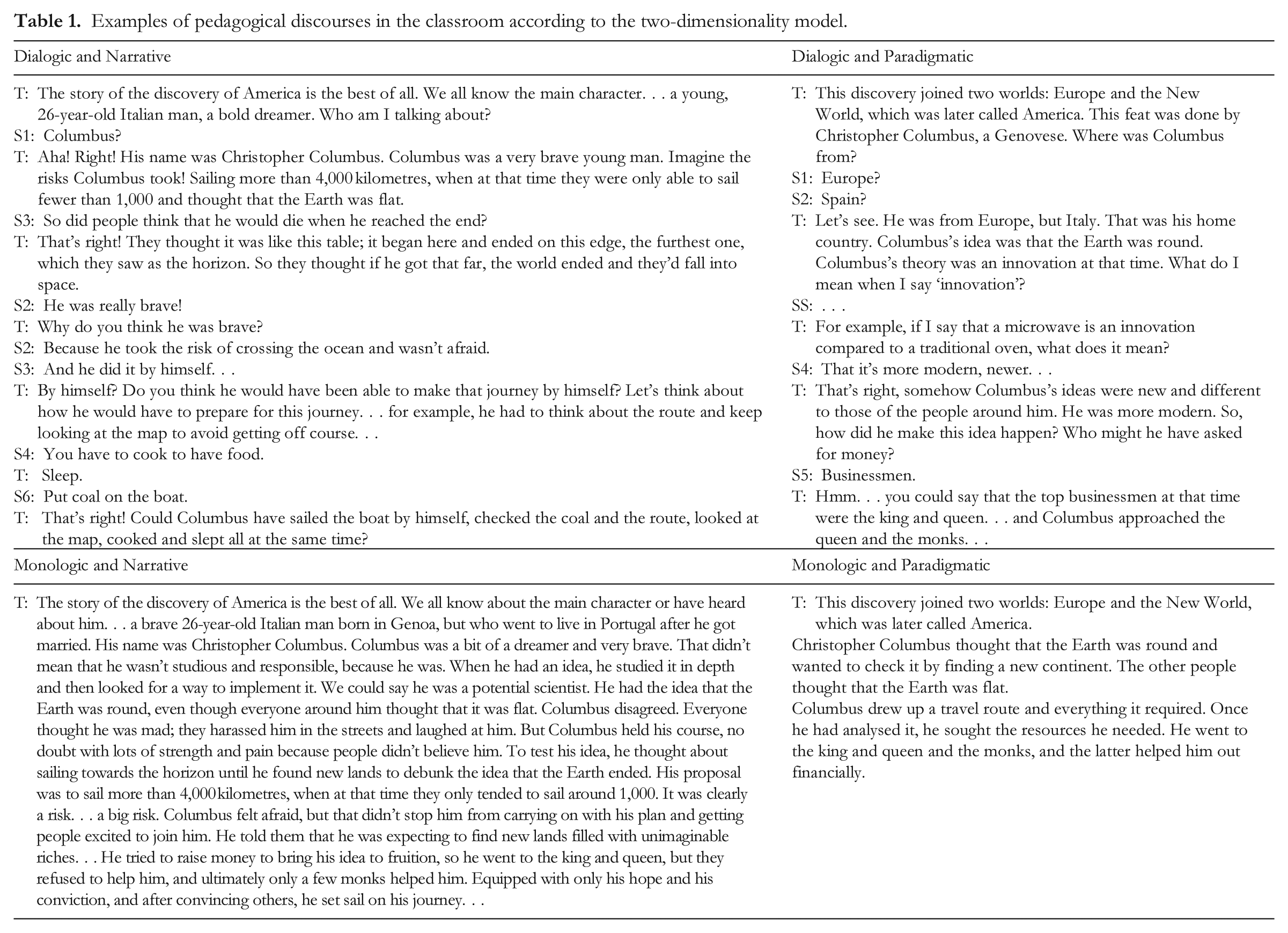
Based on this conceptual schema, we hypothesize that each of these types of teacher discourse influences the type of interaction that the teacher establishes with students and their consequent learning. Thus, a dialogic and narrative educational discourse is characterized by a fluid dialogue between the teacher and students and high student participation through questions and comments that keep the discussion going. The teacher stimulates and extends the students’ discursive production by inquiring into their understanding of the subjects being discussed, giving examples, anecdotes and stories that contextualize the content, and facilitating its comprehension and application, as illustrated in Table 1. Another example of the link between the dialogic and narrative poles is the discursive story present in a puppet show or play. In these situations, the characters engage in dialogue to share their viewpoints and are presented within a context. The story is interactive, and the characters participate to create the narration.
A dialogic and paradigmatic discourse maintains the same dialogic properties. It is an ongoing conversation from the teacher to the students on the topic being studied, but the dialogue differs because it follows a logical order, seeking evidence from students to affirm the arguments and/or question the theory. It does not inquire into the dramatic, contextual or subjective aspects of the content being taught, as illustrated in the example in Table 1. This type of discourse can be seen in debates among presidential candidates or lawyers at a trial, for example. In these discourses, the participants present their arguments with a certain logic, appealing to the objective and technical aspects. They have to argue, counterargue, debunk and defend their positions according to their rivals’ responses, which means that they must be responding moment by moment according to the course of the dialogue.
A monologic and narrative discourse is represented by teacher talk without (much) interaction with the students. The teacher’s discourse is rich in storytelling, with the understanding that it is based on stories, tales and anecdotes that render the knowledge pertinent and accessible to students. These stories would serve as a context and bridge for interpreting something new. Along with the example in Table 1 from a school situation, this type of discourse could be illustrated by a journalist’s story about a geopolitical crisis somewhere in the world. In this discourse, the journalist would tell a story which has characters, a plot and a context, where there are different positions, while noting emotions and subjectivities. The journalist would not judge them or try to tell an objective ‘truth’ but instead would try to report on all the angles of the issue.
Finally, a monologic and paradigmatic teacher discourse is related to a non-interactive discourse which follows a logical order, presenting information and data on the topic being studied. This is the typical professor’s lecture, as seen in Table 1. Another way of understanding this type of discourse is to imagine a doctor explaining the state of public health during a pandemic on the television. The doctor’s discourse would be framed within the medical model, a scientific explanation which is supposedly objective and based on logic, with invariable causes and consequences of the disease.
Final comments
In this theoretical article, we have proposed a model that brings together two traditions which analyse the discourse that teachers use in their teaching practice in a complementary fashion, namely dialogic and narrative, under the assumption that pedagogical discourses can be advantageously analysed articulating both gazes. Based on this two-dimensional proposal, we have developed a description of four types of teacher discourse. This description enriches the way pedagogical discourse can be analysed and provides potential clues for research and intervention.
Regarding research, this schema of four types of pedagogical discourse must first be validated by empirical studies. Secondly, if these four types of discourse are indeed recognizable, it is legitimate to ask which of them is the most frequent in pedagogical practice and more specifically what conditions prompt their appearance. In this sense, it is reasonable to think that there are both dispositional and curricular factors, as well as situational-contextual factors that affect the frequency with which the different types of pedagogical discourse described above are used. On the other hand, it is conceptually relevant to ask how these forms of discourse are learned and developed in teachers. Is it a unique, unitary process? Or, revisiting the Vygotskyan approach to development, is it possible that these four forms of discourse are constructed by restructuring previous psychological processes mediated by specific discourses, which would operate as the precursors of these more advanced, complex and dynamic forms of teacher discourse? In that sense, could we posit a kind of development of discursive thinking among teachers that would gradually lead to the diversification of the types of teacher discourse we have theoretically proposed here?
From the methodological standpoint, if this proposal implies something more than a mere juxtaposition of perspectives and traditions, then a review of data collection and analysis strategies is needed. Are there specific characteristics of each of the four forms of teacher discourse that go beyond the properties that enable them to be classified on either pole of the dimensions originally proposed in the literature? How would we be able to discern these specific characteristics?
On the other hand, more closely tied to the sphere of educational intervention, thanks to this conceptual proposal it is possible to question the potential differences between the learning promoted by each of these types of teacher discourse. Might some of them more effectively promote better, deeper or more extensive learning? Do these differences in learning take place in all domains of school knowledge or only in some of them? Are there interaction effects between the types of teacher discourse and the domains of knowledge? May there be interaction effects with other relevant variables in human learning processes, such as the students’ knowledge trajectory, the students’ composition by age and gender or their previous knowledge in different subjects?
The answers to these questions also open up possibilities to promote the use of different types of pedagogical discourse according to the specific learning objectives. Likewise, they would offer tools to guide teacher training so teachers can guide their own discourse towards one of the four types proposed depending on the learning objectives they are seeking. In this way, teacher training would be challenged to develop integrated thinking (Kallio, 2011, 2020) in which the objective is not for the teacher to develop a single teaching style but to appropriate a range of possible discourses and be capable of voluntarily deciding which they are going to use in each area of their work using conscious criteria. The usefulness of the conceptualization proposed in this article comes precisely in this sphere: to promote better learning among the students that attend our schools. Future research will enable this potential usefulness to be evaluated.