




Abstract
This study sought to ascertain the relationship between the varying levels of dialogicity and narrativity found in the discourse of different teachers when teaching, as well as their students’ learning of the same curricular content. A multilevel, correlational quantitative design was used, with the data collection technique of classroom teacher observation, to determine the teachers’ levels of dialogicity and narrativity. Questionnaires were also administered to students to assess their learning and the quality of their recall of the content taught in the classes. The participants were 13 teachers with proven pedagogical excellence in language and communication who taught classes in 13 Chilean schools, as well as their 350 students in their last year of high school education. Using a linear hierarchical model, we concluded that there is a positive, significant relationship between the narrativity of the teacher discourse and student learning. We also found that males learned better with more narrative teachers, while females learned better with more dialogic teachers.
This study is affiliated with the historical-cultural tradition that claims that human psychological development is cultural in nature (Garton, 1994; Wertsch, 1991) and that, as Vygotsky (1979) claimed, there is a primacy of social processes in the construction of awareness. Thus, he claimed that the sociocultural is part of the organization and construction of human psychological functions (Santamaría, 1997; Valsiner, 2000).
From this theoretical perspective, learning involves reconstructing and internalizing knowledge through communicative exchange with others (Cubero & Santamaría, 2005; Pozo, 1998), which enables us to interpret and jointly elaborate knowledge (Izquierdo-Magaldi et al., 2014). That is, through social interaction and dialogue, we manage to understand content and negotiate and renegotiate meaning, making it possible to construct and appropriate knowledge, which transforms information into one’s own, lasting knowledge (Veraksa et al., 2016; Wertsch, 1991). Through dialogue, a discourse is jointly constructed which is shared and understood; therefore, given that this knowledge is created jointly with others, students can internalize, practise and apply it (Lave & Wenger, 1991; Rodríguez & Berryman, 2002).
With the understanding that cognition develops through interaction and social dialogue, the role of the teacher and their communication style with students when teaching plays an important role in constructing students’ knowledge. The way the teacher teaches and explains the content, how they communicate, the interaction they establish with their students and the way they get the students involved in constructing knowledge are some of the axes which have to be addressed in depth in order to effectively inquire into the dynamics that facilitate learning in the school teaching process.
In this study, we examined two teacher communicative styles, namely dialogicity and narrativity, and the relationship between these types of teacher discourse and student learning. The concept of dialogicity refers to the teacher’s ability to use ongoing dialogue as a way of checking students’ understanding of the content being taught, promoting student argumentation, answering student questions, negotiating the meanings of the content and helping the students to reformulate and modify their understanding of a topic (Davin, 2013; Mercer & Howe, 2012; Tharp & Gallimore, 1991; Wells, 1999). There is empirical evidence that discourse characterized by high dialogicity facilitates the understanding of abstract, complex concepts (Rosemberg & Borzone, 2001). Furthermore, dialogue creates structures that assist students in their learning, leading them to understand new knowledge (Mehan, 1998; Mercer & Howe, 2012) and improving students’ performance and skills like speculation, hypothesizing and discussing ideas (Van Compernolle & Williams, 2012; Van Zee & Minstrell, 1997).
Narrativity, on the other hand, has to do with the ability to contextualize the content taught through descriptive stories which present dramatic events that are meaningful for the students. These narrative stories can be composed of comments on everyday events, examples, stories or anecdotes that allow the students to more closely and vividly understand the topic being studied (Bruner, 1998; Martin, 2000; Nelson, 1993). Narrative discourse facilitates the construction and contextualization of meanings (Esteban, 2002; Nelson, 1996). It allows students to more easily understand logical propositions (Bruner, 1998) and improves their ability to recall information both quantitatively and qualitatively (Nelson, 1993). Mercer (1997) confirms that students have better recall of content they are taught when teachers use examples, stories, tales and anecdotes.
The hypothesis underlying this research posits that there is a higher likelihood of finding better learning in students who are taught by teachers with a highly dialogic and narrative discourse style, compared to student learning with teachers whose discourse is characterized by low dialogicity and low narrativity.
This study’s relevance is based on two aspects. First, it highlights teacher instructional discourse as a fundamental tool in achieving high-quality student learning not only from the dialogic but also from the narrative standpoint. Secondly, it proposes a methodology for analysing instructional discourse based on teacher classroom observation for both dimensions.
Method
Design
The design of this study falls within a quantitative approach with a correlational design, as it seeks to explore the relationship between two measurements of teacher instructional discourse (namely dialogicity and narrativity) and assess student learning. It is a study with a multilevel design, given that the student variables are nested within the teacher variables, which implies that changes in one group depend on the other group (Raudenbush & Bryk, 2002). Dialogicity and narrativity are characteristics found in teacher discourse that represent one level of analysis, while learning was assessed by the performance of these teachers’ students, which represents another level nested within the previous one. The timeframe is repeated measures, given that student learning was assessed at two different times: at the beginning and end of the thematic unit.
Due to the hierarchical structure of the data studied, that is, student learning nested within the classes based on the characteristics of the teachers’ instructional discourse, a hierarchical linear modelling (HLM) analysis was used. This analysis was conducted in two phases: (a) the base model was reviewed; and (b) the model was then analysed with level-2 predictors. The data analyses were performed with the statistical programs HLM 6.02 and MPLUS 5.21.
Participants
The participants in the study were divided into two levels: teachers and students.
Teachers
The sample was composed of 13 teachers (eight women and five men) who taught language and communication classes to students in the fourth year of middle school, which is the last year of education in the Chilean educational system. They came from 13 schools, both public and subsidized (seven were privately owned but subsidized and six were public). The teachers’ mean age was 43.01 years (45 for the men and 42.12 for the women), and they had an average of 18.17 years of experience.
These 13 participants were chosen from a broader sample composed of 38 teachers who had been assessed by the Pedagogical Excellence Assignment Programme to Recognize Teacher Achievement in the category of ‘outstanding’, the highest in Chile’s teacher assessment system between 2002 and 2014. This decision was taken so that the quality of the teachers in the sample did not interfere with the differences in their students’ learning.
To determine the teachers’ levels of dialogicity and narrativity, three 45-minute videos (one teaching hour) of each of them teaching class were observed and analysed. One of the videos was viewed before the research and enabled us to choose the teachers who were invited to participate in the study. Additionally, these teachers were filmed in two class sessions during the study while they were teaching the unit on ‘Essays’ in the language and communication class.
The records enabled us to estimate a tendency regarding the presence of the instructional discourse characteristics of the teachers in the study. Specifically, the teachers were classified into four categories: (1) highly dialogic and highly narrative; (2) predominantly dialogic with low narrativity; (3) predominantly narrative with low dialogicity; and (4) low dialogicity and narrativity. This categorization enabled us to have a variety of scores on the dimensions of teacher discourse being studied.
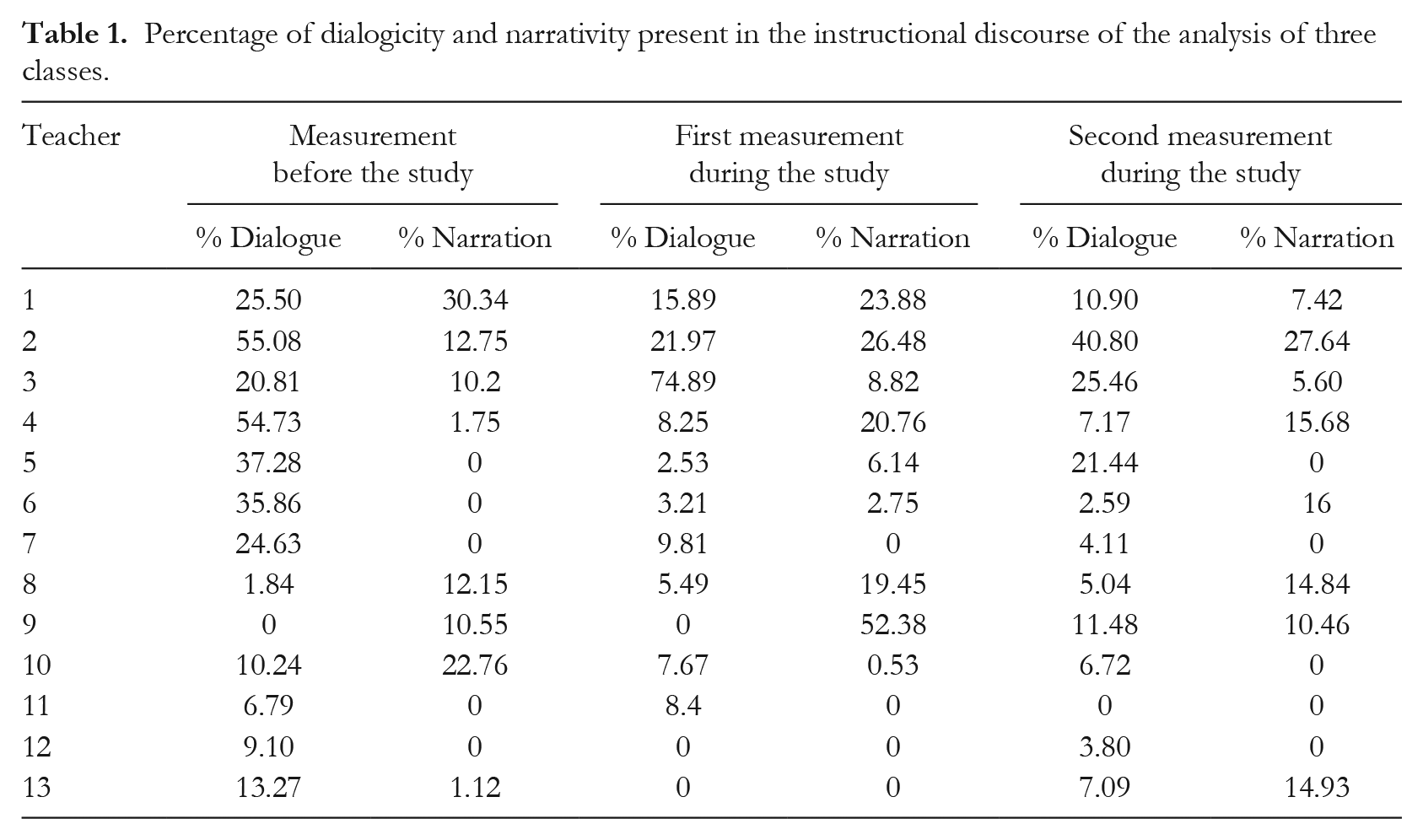
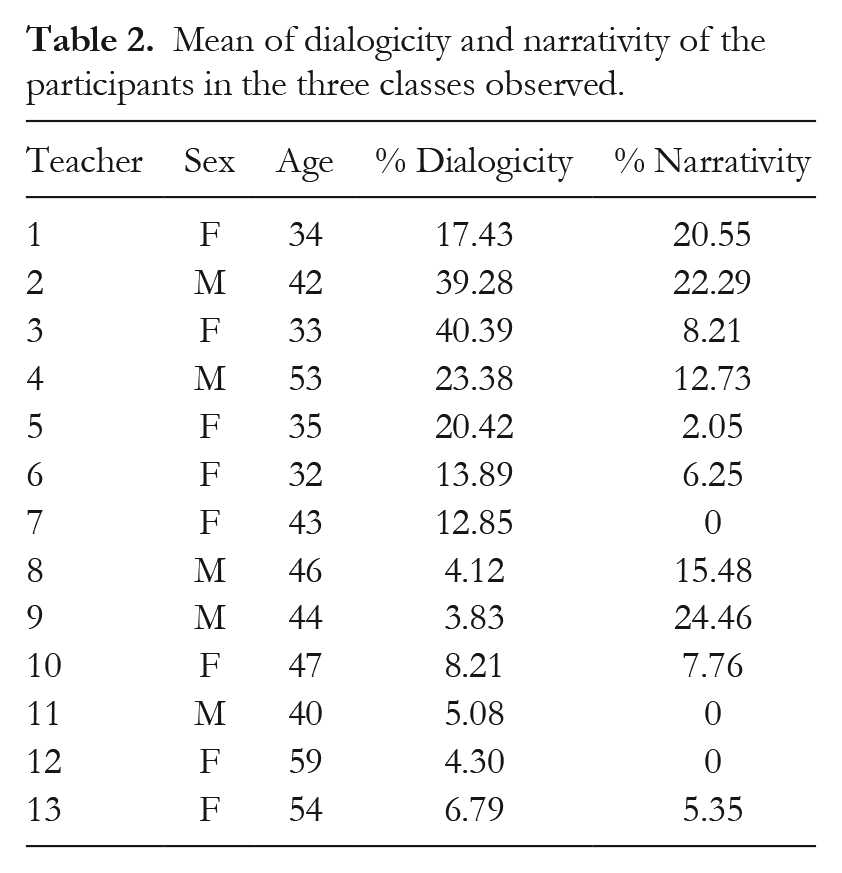
Tables 1 and 2 show the measurements of each teacher in the three opportunities and the average percentage of dialogicity and narrativity based on these three videos. A repeated measures analysis was performed, which did not reveal any significant differences in the three measures of dialogicity (χ2 = 5.27, 2gl, p > .05) or in the three of narrativity (χ2 = .38, 2gl, p > .05). Furthermore, the correlation between the mean of the three measurements and the first measurement was r = .72 (p < .01) in the dialogicity dimension and r = .64 (p < .05) in the narrativity dimension. This indicates some congruence in the tendency towards dialogue and narration in each of the teachers chosen when they were teaching.
Percentage of dialogicity and narrativity present in the instructional discourse of the analysis of three classes.
Mean of dialogicity and narrativity of the participants in the three classes observed.
Students
The sample was composed of 350 students (192 females and 158 males) in their last year of school education. The mean age was 17.38 (with a range between 15 and 21). The students were from 13 mixed schools (seven private subsidized and six public) in six regions of Chile, specifically 148 students in public schools (42.3%) and 202 students in subsidized schools (57.7%).
Variables and measurement instruments
Independent variables of the teacher
Dialogicity of teacher discourse
Based on the literature and a review of the videos of the teachers’ classes in the disciplinary area, an observation template was designed to measure this variable. This template was validated via an assessment process by judges. The results showed consistency among their expert judgements that was within the bounds of acceptability (r = .689, p < .05). Furthermore, the instrument also had an adequate reliability index α = .80.
On the other hand, each of the videos was assessed by different assistants, who filled out a template in which they determined: (a) in what second the dialogue began and ended; (b) the length of the dialogue in seconds; (c) whether the dialogue constructed knowledge (with three or more speech acts, open-ended questions and responses) or whether it did not (truncated exchanges with fewer than three speech acts, with closed questions and responses); and (d) the total number of seconds of teacher instructional discourse (when the teacher is teaching the class, excluding other activities like taking attendance, reviewing homework individually or disciplining). In this way, the percentage of dialogues that constructed knowledge was calculated in relation to the instructional class time. The inter-judge concordance in each of these elements was higher than r = .78.
The highly dialogic teachers interacted verbally with the students and encouraged them to participate and discuss the content. Pedagogical dialogue predominated in their discourse, as they used different techniques that serve the purpose of scaffolding. Operationally, a teacher was considered ‘highly dialogic’ if they occupied 15% or more of the instructional class time with dialogues that constructed knowledge. Dialogues that construct knowledge are those with three or more speech acts in which knowledge is elaborated and re-elaborated through open-ended responses and questions.
Narrativity of teacher discourse
To measure this dimension, another template was designed with the same criteria as the first one. High inter-judge concordance was found (r = .81, p < .05), with a reliability index of α = .87.
Furthermore, each of the videos was assessed by two judges, who filled out a template where they determined: (a) at what second the narration started and ended; (b) the amount of time the narration lasted in seconds; and (c) the total number of seconds of instructional teacher discourse. In this way, the percentage of narrative stories was calculated in relation to the instructional class time. The inter-judge concordance in each of these elements was higher than r = .82.
A narrative teacher was characterized by using a discourse during their classes that features drama and historicity. Their narration is organized temporally the way tales and stories are, showing causal relationships through meaningful episodes, contextualizing the events or thematic contents and helping the student to see the world from the perspective of the narrator telling it and distinguishing it from the way they see it as spectators.
Operationally, a teacher was considered ‘highly narrative’ if they occupied 15% or more of the instructional time in class on narrations, including stories, tales or anecdotes that help the teacher to contextualize curricular content.
Independent variables of the students
Two tests were administered that measured the students’ recall in order to analyse their relationship with information recall. In this way, we sought to prevent the results from being due to the students’ personal abilities related to the type of information recall. The tests were:
(a) Memory test in paradigmatic format: Verbal Seriation Test (V-S), which is one of the subtests in the Battery of Phonemic Tests (BEVTA) created by Bravo Valdivieso and Pinto (1995). Its goal is to measure the test-taker’s ability to retain series with significant verbal meaning. It assesses verbal auditory reception and comprehension of simple phrases, auditory memory of meaningful verbal series and verbal written expression of them. Its K-R reliability level is higher than .70.
(b) Memory test in narrative format: This test consisted of choosing a two-page narrative written text which was read aloud to the class. Once the reading was over, the students were asked to reproduce what they recalled of it. They had five minutes to do so. The goal was to assess their retention of oral information in a narrative format in a context that gave the content they heard meaning and sense. It also assessed whether the story reproduced in writing was properly sequenced and connected and included the main ideas of the text in an understandable, contextualized way. A correction rubric was created with a maximum of 19 points.
A third variable related to the mother’s educational level was also considered. The literature has provided empirical evidence of a significant relationship between this variable and children’s academic performance (Bullón et al., 2017; Chaparro et al., 2016; Labin et al., 2015). Due to the fact that the mother’s higher educational level is related to children’s higher cognitive development and academic performance, this variable was considered relevant to this study.
Dependent variable
Student learning
Learning is viewed as the appropriation and meaningful understanding of the content taught by the teacher, which can be observed through the organizational and conceptual complexity that students have achieved and their ability to transfer the content learned to another task. Student learning was viewed as a measure of change, so we administered the same learning test in a pre-test and post-test version after all the students were taught the same curricular unit during an equivalent period of time. Operationally speaking, the students were considered to have achieved better learning the larger the difference between the post-test and the pre-test was.
To measure their learning, a written test was designed that assessed the content unit on Essays, which lasted 15 pedagogical hours over the course of six to eight classes. The plans and programmes of the Ministry of Education for this grade were reviewed to create the test. After that, each teacher was given a list of all the unit’s expected learning outcomes and asked to choose the most relevant ones and the ones that were the most feasible for students to learn. Based on this, the expected learning outcomes with agreement were chosen.
The test considered the design of items that pointed to conceptual enrichment, the ability to integrate contents, the application of knowledge and recall or memorization of these contents. Thus, the test had 10 items which were expected to contribute to two learning dimensions: (a) declarative knowledge, meaning factual and conceptual knowledge; and (b) procedural knowledge, meaning the ability to apply knowledge to resolve something.
The test was validated by experts and showed adequate interjudge agreement rates (r = .77; p < .05). After that, a factorial analysis was applied, examining factorial structures from one to four factors. To identify the number of factors, the eigenvalues were analysed using the Scree Test. The test showed a change in the graph’s slope after the second eigenvalue, so the two-factor solution was adopted given that it was considered the most appropriate. The two-factor solution explained 57% of the variance, while the one-factor solution, with all the items grouped together, explained 43% of the variance. The analyses were conducted considering one and two factors to examine the differences between overall learning and each dimension: declarative and procedural.
Thus, the instrument was composed of 10 items (six loaded in factor 1 on declarative knowledge and four loaded in factor 2 on procedural knowledge), with a maximum score of 26 points (17 points in the conceptual dimension and nine points in the procedural dimension). The 10 items were distributed as follows: six essay questions (19 points) and four short-answer questions (seven points). The test’s reliability was also adequate (α = .89 for the first factor, and α = .91 for the second factor).
The test’s correction guide was constructed via three inputs: (i) the curricular content that appears in the Ministry’s plans and programmes for this unit; (ii) the answers to each of the questions by two language and communication teachers at this level (not those who reviewed the construction of the test); and (iii) the responses on each of the questions on the tests of four students who recently graduated from this grade.
Procedure
The data collection procedure was performed by 13 research assistants (one per school) who were specifically trained. Furthermore, four of them were trained in the video coding process, two in dialogicity and two in narrativity. The process took place during the first two months of the second semester of classes in the following steps:
(1)
(a) The students and teacher were told about the work to be done and were asked to read and sign (if they agreed) the informed consent form.
(b) Then the students were administered the Learning Test, which had to be filled out at the beginning of class. The test lasted 60 minutes.
(2)
(3)
(4)
(5)
Results
Below we present three hierarchical models which consider different dependent variables associated with student learning: overall, declarative and procedural.
Model 1: overall learning
This model considered the overall learning score earned based on the difference between the post-test and the pre-test as the dependent variable and the following variables as the predictors at the individual and group levels: (1) group: percentage of teacher narrativity, percentage of teacher dialogicity, teacher’s age, teacher’s sex and teacher’s experience; (2) individual: pre-test overall learning, sex, socioeconomic level, paradigmatic memory score, narrative memory score and mother’s educational level; (3) interaction variables: student’s sex × teacher’s narrativity, teacher’s sex × teacher’s dialogicity, paradigmatic memory × teacher’s narrativity, paradigmatic memory × teacher’s dialogicity, narrative memory × teacher’s narrativity, narrative memory × teacher’s dialogicity.
In the first phase, one random intercept was estimated as the initial model using students’ overall learning at the end of the curricular unit on Essays as the dependent variable. The result for the estimation of intra-subject variance was σ2 = 9.35, while for the estimation of inter-subject variance it was τ00 = 7.44. Finally, 44.3% of the total variance in overall learning corresponded to inter-subject variability.
When entering the second-level predictors, that is, the variables related to the type of teacher instructional discourse, we find that these predictors explained 93.3% of the total initial variance among groups (7.44).
When analysing the effect of the variables at the individual level (see Table 3), we find that the variables pre-test, sex and narrative memory are statistically significant on the results of overall learning. The higher the score on the pre-test, the higher the learning (β = .391, p < .001). Plus, the students with a higher score on the test assessing narrative memory also showed better learning (β = .311, p < .001), and females showed better learning than males (β = 1.10, p = .01).
Model 1: overall learning.
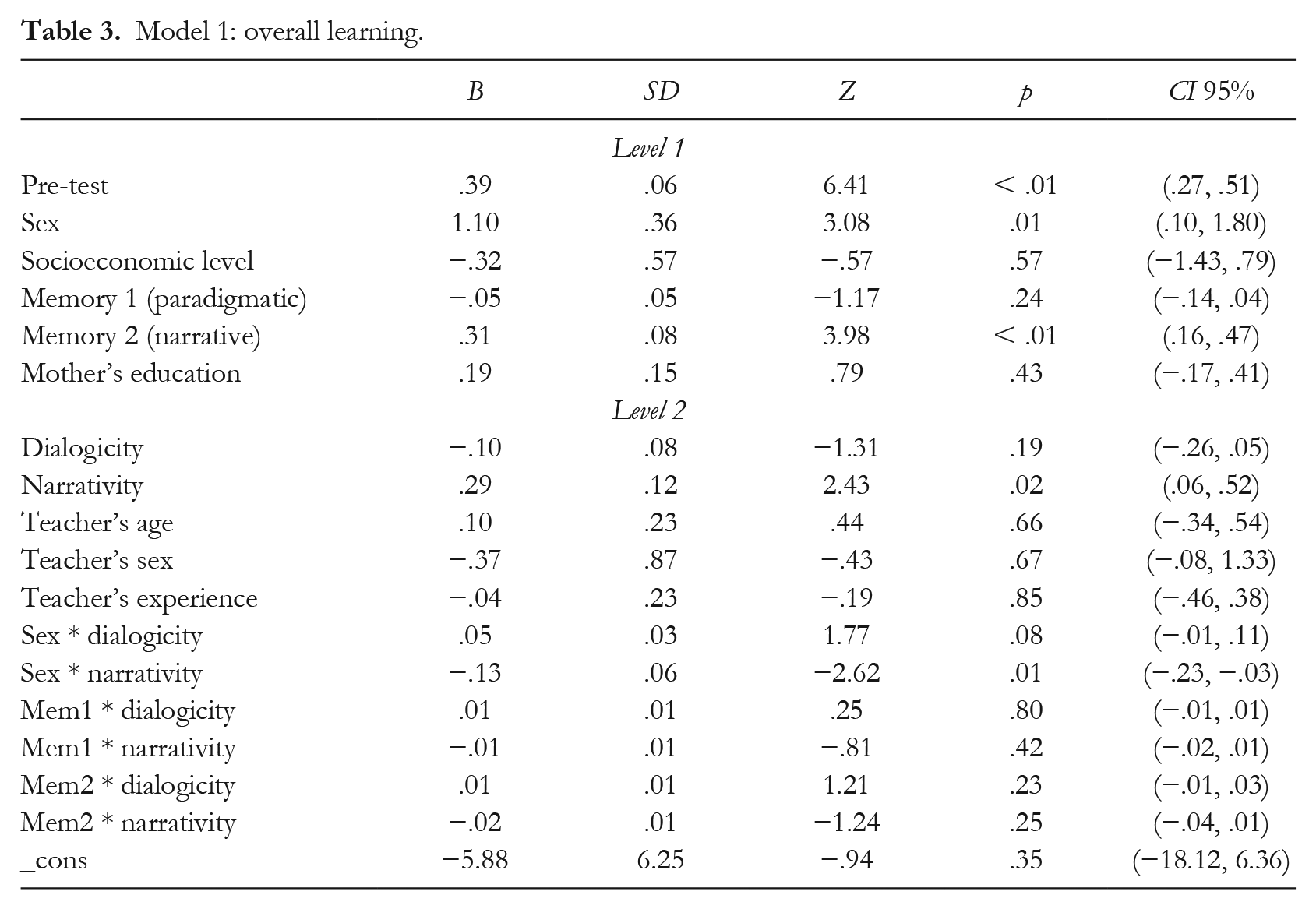
Regarding the group variables, the teacher’s level of narrativity in the classroom has a positive, significant effect on student learning. The higher the narrativity shown by the teacher, the better the learning (β = .288, p = .015). There is no principle effect of dialogicity.
With regard to the analysis of the interaction of the level-1 and level-2 variables, certain relationships among variables were found. The student’s sex and the percentage of teacher narrativity in class interact negatively and significantly with student performance. That is, males learn more the higher the narrativity in the teachers’ instructional discourse (β = −.131, p = .009). Table 3 shows the results of Model 1.
Model 2: declarative learning
This model considered the difference between the post-test and the pre-test only in the declarative dimension on the learning test as the dependent variable, and its predictors were the same individual and group variables as in Model 1.
In the first phase, as the initial model we estimated a random intercept model using the students’ declarative learning at the end of the curricular unit on ‘Essays’ as the dependent variable. The result for the estimation of intra-subject variance was σ2 = 3.38, while the estimation of inter-subject variance was τ00 = 1.70. Finally, 33.5% of the total variance in declarative learning corresponded to the inter-subject variability.
When the second-level predictors were entered, that is, the variables related to the type of teacher instructional discourse, we found that these predictors explain 97.1% of the initial total variance among the groups (1.70).
When analysing the effect of the individual variables (see Table 4), we found that the variables pre-test declarative, sex and narrative memory are statistically significant in the declarative learning results. The higher the score on the pre-test, the better learning in the declarative dimension of the test (β = .302, p < .001). Furthermore, the students who earned a higher score on the test assessing narrative memory also showed better learning in the declarative dimension of the test (β = .169, p < .001). Females performed better than males (β = .742, p < .001).
Model 2: declarative learning.
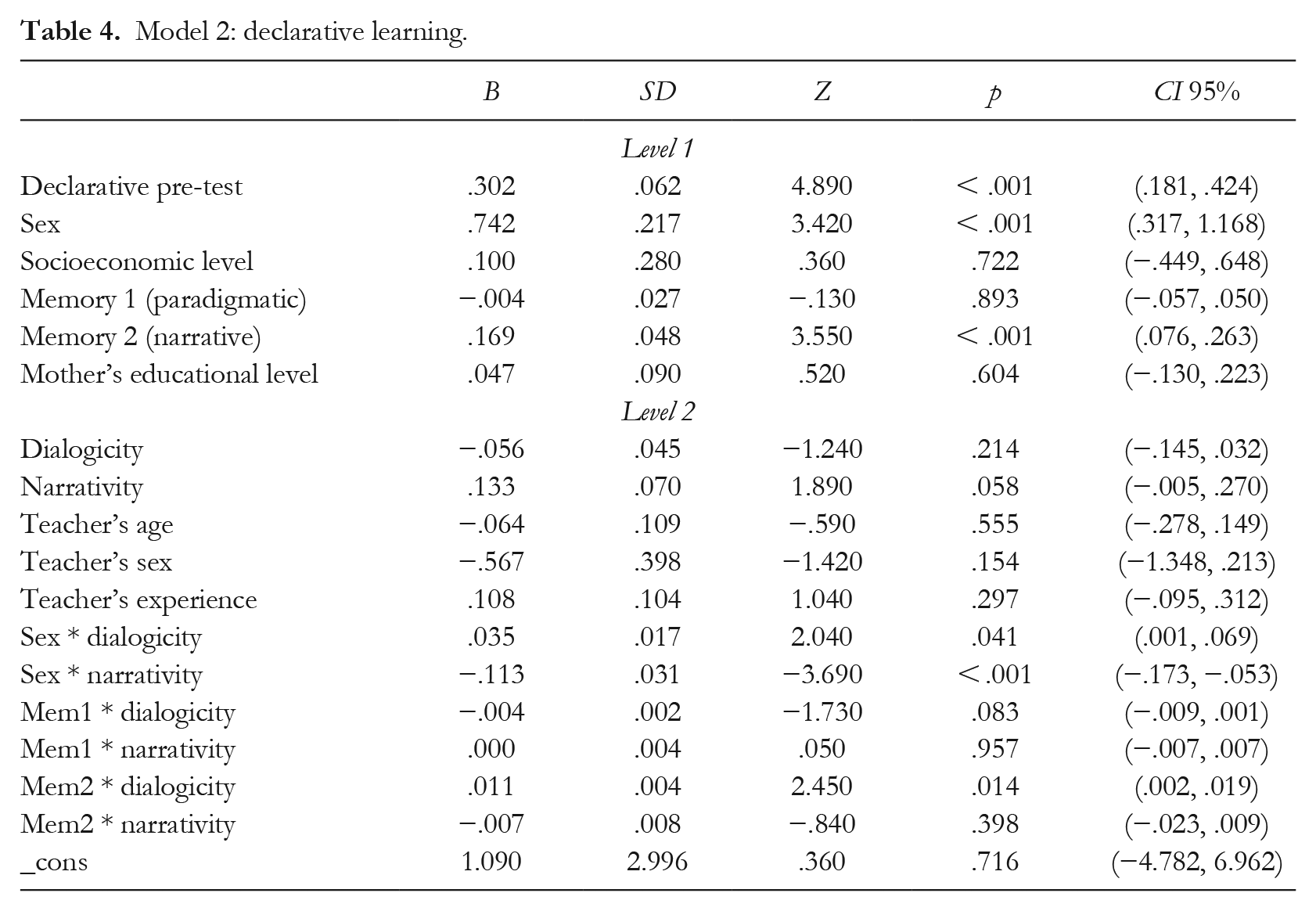
A marginal effect was found in the interaction between sex and dialogicity, as the effect is positive but marginal in the post-test of the declarative dimension (β = .050, p = .076), which may indicate that females perform better on declarative knowledge the higher the dialogicity in their teachers’ instructional discourse.
Regarding the teacher variable, the narrativity of the teacher’s instructional discourse has a marginal effect on the students’ performance in declarative learning. That is, the higher the narrativity used by the teacher in the classroom, the better the students’ results in declarative learning (β = .132, p = .058).
Another interesting result was found when analysing the interaction of the level-1 and level-2 variables: student’s sex and percentage of teacher dialogicity during class. This interaction is positive and significant (β = .035, p = .041), which indicates that females perform better in declarative learning the higher the dialogicity of their teachers’ instructional discourse.
Likewise, the interaction between the variables student’s sex and percentage of teacher narrativity during class is also significant. This interaction is negative and significant (β = −.113, p < .001), which indicates that males perform better in declarative learning the better the narrativity of their teachers’ instructional discourse. Table 4 shows the results of this model.
Model 3: procedural learning
This model considered the difference between the post-test and pre-test in the procedural dimension of the learning test as the dependent variable, and its predictors were the same individual and group variables as in Models 1 and 2.
We estimated as the initial model a random intercept model using the students’ procedural learning at the end of the curricular unit on ‘Essays’ as the dependent variable. The result for the estimation of intra-subject variance was σ2 = 1.96, while the estimation of inter-subject variance was τ00 = .62. Finally, 24.0% of the total variance in procedural learning corresponded to the inter-subject variability.
When the second-level predictors were entered, that is, the variables related to the type of teacher instructional discourse, we found that these predictors explain 40.3% of the initial total variance among the groups (.62).
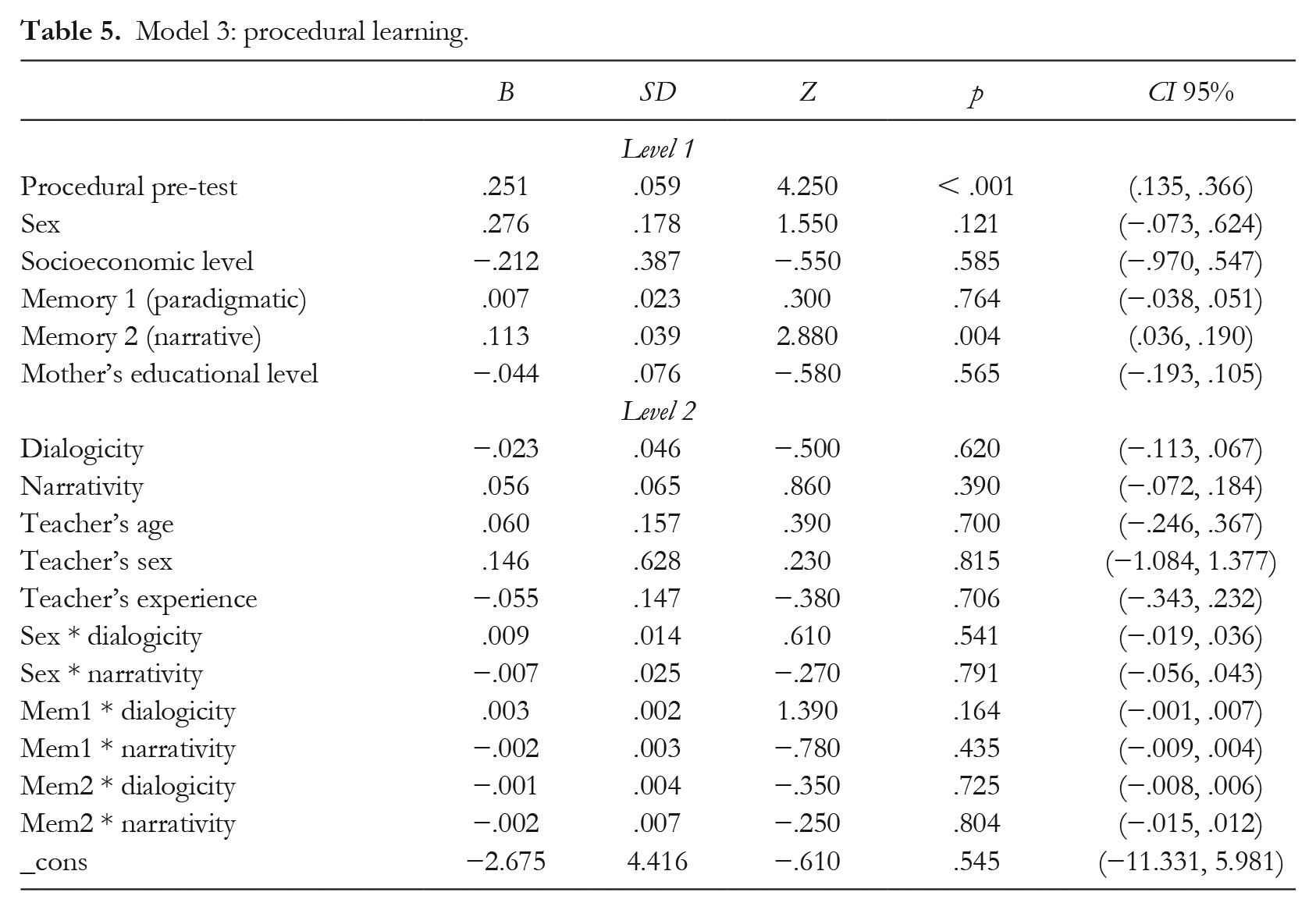
When analysing the effect of the individual variables (see Table 5), we found that the variables pre-test declarative and narrative memory are statistically significant in the procedural learning results. The higher the score on the pre-test, the better learning in the procedural dimension of the test (β = .251, p = .001). However, the students who earned a higher score on the test assessing narrative memory also showed better learning in the procedural dimension of the test (β = .113, p < .004). Table 5 summarizes the results of the model.
Model 3: procedural learning.
Discussion and conclusions
The results found in this study enable us to conclude the presence of a positive, significant relationship between the narrativity of instructional discourse and student learning. The higher the presence of narrativity in the teacher’s instructional discourse, the better the student learning. These results corroborate an important part of the study's hypothesis. Indeed, the teacher’s pedagogical discourse when teaching is specifically related to student learning. In this case, the narrative quality of the teacher’s discourse is associated with better learning in all students. That is, when the teacher contextualizes and dramatizes the events they are teaching, bringing a temporal dimension and creating a plot with a denouement, the students learn and recall what was taught better because they situate it and make it meaningful. This corroborates the claims of Bruner (2003), Martin (2000) and Nelson (1993, 1996), when they argue that a narrative account is easier for humans to understand and recall because it is the way we speak to ourselves, construct our identity and explain the world.
Regarding the individual student variables that affect their learning, we found that their score on the pre-test, their sex and their performance on the test assessing narrative memory have a positive, significant effect on learning. That is, the higher the score on the pre-test, the better the learning. On the other hand, the students who earned better scores on the test assessing narrative memory also show better learning, and females performed better than males. This occurs equally for the dependent variable overall learning and the dependent variable declarative learning. In other words, female students with high scores on the pre-test and high performance in narrative memory achieved better overall learning and better learning in the declarative contents of the assessment.
These results confirm ideas that are familiar from the constructivist framework. On the one hand, prior learning facilitates subsequent learning because it enables what is known to be related with what is learned later in a more coherent and lasting fashion, as Ausubel (2002) posits in his theory of meaningful learning. On the other hand, because there is a relationship between students’ base narrative memory and their learning, this reaffirms the importance of narrations in interpreting, elaborating and incorporating knowledge. The higher the skill at explaining oneself to the world and knowledge in narrative format, the better the learning. In this sense, the ability to express and understand narratively is a competence that should be developed in children and young people to enhance their future learning (Stein et al., 2020).
With regard to the interaction between individual variables and the teacher variables measured (dialogicity and narrativity), we found that the interaction between the student’s sex and the teacher’s instructional narrativity is negative and significant. That is, males learn more the higher the narrativity of their teachers’ instructional discourse. This result is repeated when measuring their learning of declarative content on the learning test.
Regarding the interaction between sex and dialogicity, we found a positive and significant effect in the declarative dimension of learning: females learn more declaratively when their teachers show a higher presence of instructional dialogicity when teaching.
These results were not within the study’s hypotheses, but they are interesting to highlight. We found an interaction between student’s sex, learning and the teacher’s discursive style such that males learn better with more narrative teachers and women with more dialogic teachers. This may be related to gender differences in the students, which influence the way they elaborate and interpret information, leading their learning to be facilitated by either dimension. It is impossible to conclude why this facilitates their learning. It may be because there is a more familiar or frequent style in the way males and females interact with knowledge, or it could be that they process it differently. This is a finding worth exploring further in subsequent studies.
As a whole, these results enable us to sustain the interest in providing a more complex description of teacher instructional discourse in the dimensions of dialogicity and narrativity, inasmuch as both dimensions explain different aspects of the variability of student learning and are related with their prior learning trajectories in complex ways. However, this study is not conclusive regarding the general hypothesis that unitary forms of instructional discourses with qualitative differences between them can be described at the crossroads of both dimensions (Villaroel & Sebastián, in this same issue).
In this sense, it is important to mention that this line of research has opportunities for improvement by increasing the sample size and expanding the range of teachers chosen, given that the base levels of dialogicity and narrativity were not sufficiently high. Nonetheless, we assert that the fundamental contribution of this study lies in the ecological validity of its results. The data collected come from teacher discourse in natural settings during the exercise of teaching, with no instructions or guidelines to follow, which helps to make the results generalizable to the population as a whole. This study highlights the narrative and dialogic dimension of pedagogical teacher discourse and presents a procedure to categorize teachers into each of them by analysing classroom interactions, which is also a contribution to further studies of this topic. The results confirm the importance of instructional discourse and light the way for new studies that more deeply analyse the relationship between male and female student learning depending on the type of teacher pedagogical discourse. This study also encourages us to think about the need for new lines of research that complement these results through experimental studies and/or design-based research (Sandoval, 2014). In those studies, teachers could be trained in the skills of narrativity and/or dialogicity in order to analyse these dimensions with sufficiently high and low levels. Furthermore, this type of study would generate more controlled educational spaces where the (micro)genesis of these forms of instructional teacher discourse and the role these forms of discourse play in the processes of transforming the ways students think could be investigated.