



Abstract
Agency (i.e., the ability to act intentionally within the constraints of a given social context) is an important aspect of constructing a narrative identity. For young people in secure care, their freedom is highly restricted, which may hinder their abilities to act and feel agentic. Therefore, the aim of this study was to examine how agency was expressed in stories written by young people in secure care in Sweden. A thematic narrative analysis of 53 narratives resulted in three main themes—change in perspective, engagement with the outer world and resistance—indicating that agency can be expressed despite a constrained environment and may include both adaptive and harmful behaviours. Based on the findings, it is suggested that key elements of adaptive agency in young people are social relationships and trust, as well as support of their achievement and competence.
In Sweden, secure care is an out-of-home placement option for children and youths who display criminal behaviour, extensive use of alcohol and/or drugs, and/or other self-destructive behaviour (Enell et al., 2022). Care on a compulsory basis is deemed necessary when voluntary interventions have proved insufficient (Lappi-Seppälä, 2018). Thus, secure care constitutes a last resort for young people displaying destructive behaviour in order to provide stability, healthy socialization, treatment and skill development, along with access to education. Unlike other interventions in the child welfare system, secure care institutions have far-reaching powers, including the ability to apply restrictive measures, such as incarceration, body search, temporary isolation and care in solitude (Enell et al., 2022). Therefore, being placed under secure care means losing the ability to influence one’s own life in several aspects. Young people in secure care often face complex and adverse life experiences, which may complicate and limit perceived agency (e.g., Cameron-Mathiassen et al., 2022). Secure care placement itself can further challenge expressions of agency, where previous studies suggest that young people seem to struggle to create a coherent and clear life story around their experiences (Enell & Wilińska, 2021; Vogel, 2018). Moreover, young people placed in secure care do not always know when they will get out, which often leaves them feeling anxious, frustrated and unable to engage (Henriksen & Refsgaard, 2021; Turcotte & Fenchel, 2024), and a loss of control and feelings of being alienated from the outside world seem to impede young people’s efforts to achieve a sense of belonging and self-control over their life situation (Enell, 2016). Therefore, in this article, we seek to better understand whether and how agency is expressed in stories written by young people in secure care.
Young People in Secure Care
Swedish state-run secure accommodations are responsible for handling, controlling, treating and educating young people with extensive psychosocial and behavioural problems. The institutions are run by the National Board of Institutional Care (SiS), an independent government agency. Youths are referred by the social services under the Care of Young Persons (Special Provisions) Act (LVU), constituting the majority (95%) of all case decisions regarding the secure care of young people (SiS, 2021). About one third (35%) of youths placed under the LVU are female and two thirds (65%) are male (SiS, 2021). Apart from aging out of care, with an upper age limit of 21 years, there is no time limit for how long an individual can be placed; the average time placed in secure care under the LVU in 2023 was 214 days (SiS, 2023). SiS is also responsible for carrying out time-limited legal sanctions between 14 days and 4 years (on average 530 days in 2023; SiS, 2023) under the Secure Youth Care Act (LSU), to which young people aged 15–18 years are sentenced when they have committed serious criminal offenses such as aggravated assault, rape, manslaughter or murder, the majority of this group (98%) being male. Accordingly, secure care can be understood as being organized in the borderland between the welfare and legal systems (Enell, 2023).
Every year, around a thousand young people in Sweden are placed in secure care, where almost half (46%) of the young people are 16–17 years old (SiS, 2021). At this age, it is common for young people to be preoccupied with who they have been, who they are and who they will become. This period is also characterized by youth seeking independence from social roles and expectations where the social contexts in which youth are situated can bind or circumscribe their expressions of agency while simultaneously offering them resources to establish a sense of agency. Therefore, it is important to study how young people in secure care, who are faced with barriers and constraints before as well as during being placed, express, adjust and take control over their lives in light of being institutionalized.
Formations and Expression of Agency
In the present study, we adopt a perspective on narratives (both as a theory and as an analytical tool) grounded in psychology (McAdams, 2018) influenced by a critical view on narratives as socially situated, dynamic meaning-making practices (De Fina, 2015). Narratives are thus understood as active constructions through which individuals negotiate and position themselves in relation to others, both within the stories they tell about themselves and in the context where the narrative is told. We thus focus on the integrative function of a narrative for the individual where narratives explain what a life means to the person living it and reveal the ways in which the individual makes sense out of their experiences. Narratives are characterized by a variety of elements that point towards meaning, where an important thematic element for how an individual makes sense of life events, which seems to be relevant across several cultures, is its level and quality of agency (McAdams et al., 1996; McLean et al., 2020; Turner et al., 2024). Agency is defined here as the capacity to act intentionally, and it can also be conceptualized in terms of possibility (Vigh, 2008), that is, the extent to which individuals are able to act within the constraints of a given social context. Agency thus encompasses action, decision-making processes and self-expressions. This conceptualization enables exploration of how young people make sense of their lives by positioning themselves in relation to both structural conditions (e.g., personal, familial and institutional resources) and their own perceived capacities. In the literature, agency is described as constituting several aspects. One such aspect is the narrator’s expression of autonomy (Adler et al., 2016; McLean et al., 2020), which can be defined as having the ability to act based on one’s own free will and not being affected by others. Another is the expression of self-mastery (Adler, 2012; McAdams et al., 1996), which stands for an individual’s ability to exercise self-control and move towards their goals. A third is the expression of achievement (Adler, 2012; McLean et al., 2020), here meaning the ability to complete tasks successfully through effort, skill and courage.
When telling stories about unusual or challenging aspects of their lives, individuals try to negotiate the meaning of the events. Agency appears to be of extra importance when people narrate stories about difficult life events (McAdams & McLean, 2013), with higher levels of agency in people’s narratives being associated with higher levels of well-being (Adler et al., 2016). Difficult life events are a common experience among young people in secure care. For example, research has shown that youth in secure care have had extensive difficult and adverse lives and potentially traumatizing experiences, such as school problems, mental health problems, experiences of child maltreatment, sexual and physical abuse, and parental social and psychological problems (Westlake et al., 2023). Previous research also suggests that, at least in some cultures, the ability to attribute redemptive meanings, that is, an emotionally negative event transitioning into a positive outcome or positive attribution of the identity (McAdams, 2006) in one’s life, correlates with mental health, well-being and maturity (e.g., Adler et al., 2016). As agency and affective themes such as redemption have been found to be interlinked (McLean et al., 2020), this article focuses on how themes of agency can be found in redemptive stories from youths in secure care in order to shed light on how, or even whether, agency can be expressed in this context.
Agency Within Secure Care
Different aspects of being placed in secure care, such as being confined and subjected to coercive measures, may affect placed youths’ feelings of being agentic (Henriksen et al., 2023). In addition to being restricted in their physical space, young people may find themselves in a new social environment where their earlier relationships are either broken or interrupted, while building positive and stable relationships is pivotal in supporting agency (Moore et al., 2018; Pinheiro et al., 2024). Although the institutional context puts constraints on young people’s lives, including their physical and temporal freedom as well as their ways of expressing themselves, previous research suggests that they are not passive recipients of the care. For example, Polvere (2014) examined agency in formerly institutionalized youths and young adults in the United States and found that they used different agentic strategies to manage oppressive institutional practices. These strategies were compliance, resistance, self-advocacy and dialectical thinking. In another study, Vogel (2018) interviewed young females in secure care in Sweden and found that in their narratives the girls tried to position themselves as agents in their own lives, emphasizing their independence and ability to take responsibility. In an ethnographic study on how identity was constructed in a Swedish secure residential home for young males, Franzén (2017) found a paradox whereby the young men accepted the restrictions of the secure care while simultaneously developing subjective and personal autonomy (Franzén, 2017). Yet another study (Neagu & Sebba, 2019) suggests that the quality of the relationships with staff is detrimental to a sense of agency, whereas in this study empathetic listening and acting on a youth’s views were important features of the personnel, which helped the young people develop a sense of agency over time. A recent systematic review (Cameron-Mathiassen et al., 2022) of the experiences of young people living in residential care showed that this group had difficulty being agentic in their decision-making. Furthermore, when the young people were not able to be self-sufficient in situations in which agency was expected, they felt disappointed and dissatisfied. In contrast, findings by Schofield et al. (2017) suggest that young people in secure care experience a duality in relation to being placed, as they feel both powerful (e.g., when breaking rules) and powerless (e.g., when decisions are made for them). Schofield et al. (2017) concluded that gaining an appropriate sense of agency while placed in care, as well as during the time after, was linked to stories of trust and connection in the young people’s relationships. They also found that agency was one core factor in going from seeing oneself as a victim of hardships to seeing oneself as a survivor of these experiences.
Taken together, previous research suggests that young people placed in secure care often face a range of structural and relational constraints that may impact how they perceive and express agency. While previous research has shown that youth in such settings are not merely passive recipients of care, agency has often been treated as a secondary theme, explored primarily through interviews using smaller (e.g., Schofield et al., 2017) or gender-specific samples (e.g., Franzén, 2017; Vogel, 2018). The present study foregrounds agency by examining how it is expressed in redemptive narratives. As redemption involves turning something bad into something good or meaningful (McAdams, 2006), we expect to find valuable knowledge in these narratives on how youths in secure care can express agency while living in a severely constrained everyday context. By using written texts produced in secure care, we explore agency as a discursive and situated practice.
Aim and Research Questions
The overall aim of this study was to explore how agency is expressed in redemptive stories written by young people in secure care. Based on this, the following research questions were examined: (a) What expressions of agency can be identified in redemptive narratives, and (b) what is the thematic content of these expressions?
Method
Material
The material is constituted of personal narratives from the writing exercise ‘Unga berättar’ (Young people narrate), which is a voluntary part of the curriculum in schools for young people living in secure care residential homes in Sweden (SiS, n.d.). The exercise allows the young people to express their thoughts and emotions as a way to find motivation and a desire to learn. Since 2008, SiS has published an annual anthology containing texts from the exercise. The material is not edited in either form or content, and all submitted texts are included; the only revisions that are made are omissions of names and places to ensure anonymity. All of the anthologies are publicly available on the SiS website and can be downloaded for free in a PDF format or ordered as a book. The narratives in the anthologies can be understood as small stories (Georgakopoulou, 2015), in both the literal sense, as they are generally shorter and do not follow a prototypical ‘big story’ format, and metaphorically, ranging from the telling of past, ongoing or anticipated experiences to narrative hesitations and absences. Small stories as concept recognize that narrative genres provide both affordances and constraints for storytelling, offering culturally and contextually available templates that shape how narratives can be performed discursively. Thus, we seek to examine how young people in secure care position themselves and orient to meanings, expectations and possibilities within their social worlds. In this sense, small stories allow us to analyse agency as interactionally negotiated and contextually shaped in the institutional setting.
Anthologies published between 2011 and 2020 (49–154 texts per year) were included in this study. No anthology was published in 2018 due to changes to European laws concerning the sharing of personal information (European Parliament and Council, 2016), and some previous and later anthologies were excluded from the study as they contained specific themes (e.g., change or the future) that might have impacted the narratives’ structure and content. Because the texts are anonymized, we did not have access to background information regarding the young people who wrote them. Out of a total of 939 texts, 503 were coded as personal narratives, defined as including an event that was not exclusively future-oriented (e.g., about an event a person hopes will occur in the future) and a self-biographical theme (for more details about the coding procedure and reliability, see Carlsson et al., 2025). Each text was treated as a single entity throughout the analytical process, even if some texts included multiple situations and storylines. Out of the 503 narratives, 53 (10.5%) were identified as having the emotional sequence of redemption as part of their narrative, whereby a redemptive sequence was defined as a story framed by a positive emotional tone and ending in a positive place (Eriksson et al., 2020; for more details, see Carlsson et al., 2025). These stories often contained an emotional shift from a negative to a positive tone, but stories with an overall positive tone throughout the narrative were also coded as redemptive.
Ethical Considerations
The research project was submitted to the Swedish Ethical Review Authority, who in an advisory opinion stated that they had no ethical concerns regarding the project (Dr. no.: 2022-00934-01). Different ethical considerations guided our analysis, especially given the institutional context and the personal nature of the narratives. We aimed to preserve the integrity of the stories by avoiding reductionism and attending to narrative choices, including silences and refusals. We highlighted how agency was discursively expressed under constrained conditions while remaining critically aware of our own role as researchers in shaping these representations.
Data Analysis
Thematic narrative analysis was applied to examine if and how agency was expressed as well as the thematic content of agency, that is, what concreate situations, experiences and actions the young people described in their expressions of agency (Riessman, 2008). Further, the analysis was guided by the three ways in which agency can be detected in a narrative, as described in the introduction (autonomy, self-mastery and achievement), but openness to specific thoughts, behaviours and reflections connected to the general definition of agency was also applied. Agency was analysed from the narrator’s perspective, meaning that if the narrator expressed actions in an agentic way, this was considered a sign of narrative agency. This meant that agency did not necessarily equal adaptive or socially desirable behaviour.
The analytic procedure followed Robinson’s (2022) hybrid approach. This meant that we first created a thematic model based on a smaller number of narratives and used this as a basis for further coding of the remaining narratives while being open to new codes and themes (Robinson, 2022). The analysis was performed in Swedish, and thereafter, both themes and selected quotes were translated into English (for the original Swedish quotes, see the Appendix). For the practical procedure, the steps suggested by Braun and Clarke (2006) were utilized. The first step entailed reading all 53 narratives that were coded as redemptive stories, in order to become familiar with the data and note any initial thoughts. Thereafter, 20 narratives were selected for initial analysis, with two to three chosen from each year for the purpose of representativeness. The narratives were coded independently between two coders (N.R and R.Q) and were thereafter discussed until consensus was reached. All expressions of agency found in the material were coded, meaning that a single narrative/text could have multiple codes (and later be represented by multiple themes). Next, the codes were discussed and sorted into a total of 27 code groups, which were clustered into seven potential themes. These themes were then discussed and revised. All these steps were discussed with the fifth author (J.C), who supervised the coding, and disagreements were solved through discussion. When the initial thematic model was established, an additional 20 narratives were coded using Robinson’s (2022) hybrid approach. Two new potential themes were formed during this step. Then, the thematic model and potential new themes were reviewed and discussed in the analytic group (N.R, A.Q and J.C). This resulted in a final model containing six themes. The remaining 13 narratives were coded accordingly, and no further changes were made to the model in this step. Next, to ensure that the thematic model was representative of the data, all narratives were reread in relation to the final six themes. The six themes were then clustered in pairs under the three main themes, and the relationships between the three main themes were compared. During this step, autonomy, self-mastery and achievement were each connected to one of the three main themes. As a final step, to ensure validity, the first author (A.A), who had not previously been involved in the coding process, read through all narratives in relation to the main themes and subthemes and discussed these with the coders. The thematic model was deemed sufficient, and no additional changes were made at this point.
Results
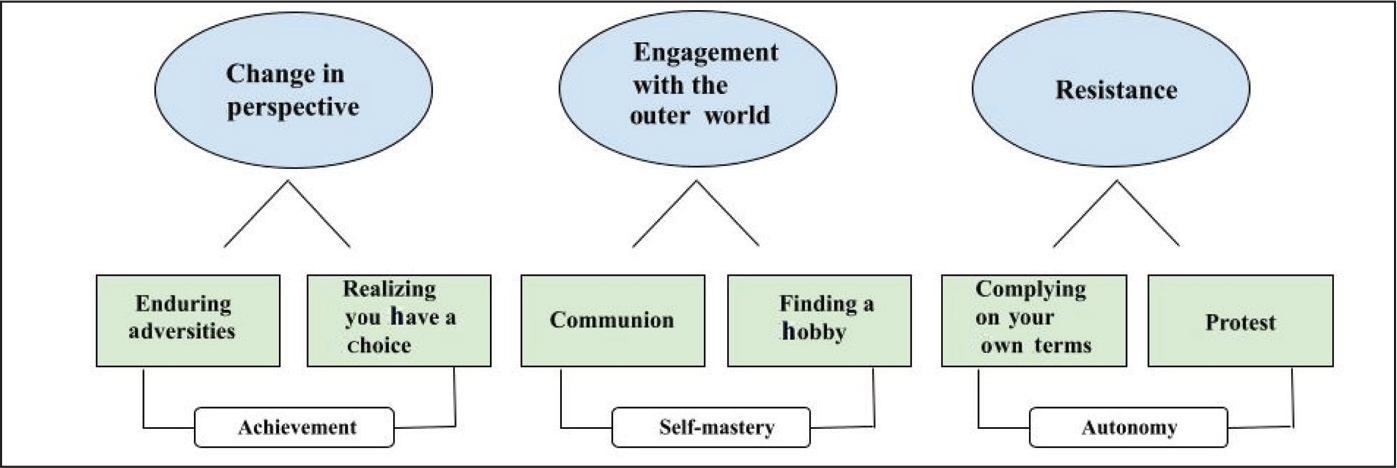
The analysis showed that not all narratives included aspects of agency, as 17 lacked agentic expressions. However, a majority—that is, 36 narratives—did contain descriptions of agency, and the analysis of these resulted in three main themes and six subthemes (see Figure 1). Each main theme and its subthemes were predominantly connected to one of the three ways in which agency can be detected in a narrative that guided the analysis: autonomy, self-mastery or achievement (see Figure 1). Each main theme and its respective subthemes are described in detail in Figure 1.
Agency Through Change in Perspective
In this theme, agency was expressed through a change in perspective that had led the narrator to view their experiences in a new self-reinforcing way. For example, the narratives included expressions that reflected an internal transformation, often triggered by past experiences or turning points, leading them to a realization that they had the power to take control over their life. The agency expressed here was rooted in personal insight, often articulated through phrases emphasizing individual strength, choice and determination (e.g., ‘This time, I’ll do it on my terms’ or ‘As long as you have the will, you can manage anything’). Recurrent words in this theme included ‘choice’, ‘self-awareness’, ‘starting over’ and ‘strength’. The young people described feeling strengthened and in control because of their new mindset. In this theme, agency was mostly seen in expressions of achievement, which meant that agency was shown through descriptions of how the narrator had overcome challenges or succeeded in some way. This theme had two subthemes: enduring adversities and realizing you have a choice.
Enduring Adversities
This subtheme captured agency through the young people writing about how they had endured difficult life events, for example, overcoming drug abuse, surviving physical or emotional violence, or managing to spend time in secure care. Narratives coded to this subtheme included young people expressing being strengthened and having more control over their situation because of their endurance. The changes in perspective now meant that they wanted to change their lives, take more responsibility and prove themselves. This new way of looking at themselves and their capabilities also meant moving away from a self-image as a victim of abuse and hardship to one as a survivor of these experiences, as stated in the following excerpt:
Even though I’ve lost the person whom I love the most, and I’ve been fucking abused I don’t want to live like some kind of victim.… In a way I also want to thank those fucking idiotic guys who abused me. It has made me so unbelievably strong, I can handle seeing and hearing anything now without feeling bad. (ID 13059)
This subtheme was also seen in stories about being in secure care, in which the young person viewed the placement as a new starting point. This can be noted, for example, in descriptions of how receiving and completing treatment were a part of the journey to the second chance they felt they had been given:
Will go through an assessment here for two to three months and after that HVB home [open youth care], again, then maybe—if I manage it—I’m allowed to move back home. I will make new friends and simply start my life over! (ID 14043)
Realizing You Have a Choice
This subtheme represents agency, in terms of achievement, highlighting how the narrators felt increasingly in control of their lives and actions. This entailed descriptions of how the young people had started acting differently and were able to make changes. The changes were expressed through, for example, describing regret over earlier actions in life, wanting to act differently going forward and, most importantly, feeling that one was able to do so. In narrative 14046, this was expressed in the following way:
I got a contact person within Soc [social services]. I just want to say thanks T for trying your best, but I wasn’t ready to quit. I thought a lot about how I wasn’t going to quit doing drugs and committing crimes. But then I had a change of thought, I wanted to get on with my treatment.
The realization that one had a choice was often described in relation to reaching a low point in life. This included, for example, negative consequences of the narrator’s own destructive behaviour, as expressed in the following excerpt:
I drank until I lost my apartments, my dog, my siblings, my family, my friends, close to dying, close to prison, and became homeless. Now I had two choices continue with this life and die or deal with the problems and continue to live? I chose the latter. (ID 14004)
Agency Through Engagement with the Outer World
This theme captured an externally prompted change in agency. Here, the shift occurred through interactions with the surrounding world, be it supportive staff, family members or meaningful activities. The young person’s sense of agency emerged from the trust, safety and motivation they experienced in these encounters. Agency was expressed here through narratives that attributed change to external circumstances (e.g., ‘Meeting the staff made me willing to accept help’ or ‘Without SiS, I’d be on the street’). Words such as ‘motivated’, ‘help’ and ‘safe’ were part of the narratives in this theme. Here, agency was mostly seen in expressions of self-mastery as the young people described how they were able to control their feelings or work towards new goals when engaged in something that gave them purpose, with support from others. This theme had two subthemes: communion and finding a hobby.
Communion
This subtheme represents how agency in terms of self-mastery was developed through communion with and support from other people. For example, narratives coded here described how getting to know new people, such as friends or the staff at SiS, helped the young people to live a life that was aligned with their own beliefs and wishes. Furthermore, people from life outside of care (family, a partner or old friends) were described as sources of support in developing this type of agency. In the following excerpt, the narrator described how the communion they felt with new friends had led them to change their behaviour and act in a way that showed self-mastery.
I made friends who were with me because they really wanted that.… Friends who liked me because of who I was, real friends. I started skipping school, smoking, stealing and coming home late. I started to speak up and shouted out to the world how unfair everyone was. I started to stand up for what I believed and refused to keep it to myself. For the first time in my life I was at the center of attention. And I enjoyed it 100%. (ID 13048)
In this narrative, the narrator described that with the support of other people, they had been able to express themselves and master new things. This example also shows that an increase in agency does not necessarily mean that the described behaviour is more adaptive. However, this subtheme also captured how agency could develop through the young people feeling loved by others, which motivated them to make a change in their life and take control of their current situation in a more adaptive way. In the following excerpt, the narrator described how feeling loved and seen by the staff at SiS had helped them master their situation and even think about the future:
I’ve never gotten as much love from staff at any other place I’ve been before. The staff held me and hugged me for a long time if I was sad. I felt really loved there <3 … The future for me is bright, I want kids, two of them. I’m in high school and I will get a good education. In the future I want to work as an ambulance paramedic, and then maybe at SiS. Because I want to give the same love and support I’ve gotten, and give it to someone who needs it <3. (ID 20009)
Finding a Hobby
In this subtheme, agency was interpreted through signs of self-mastery in terms of the narrator expressing that they had become able to control their emotions or fulfil themselves by finding a hobby they experienced as meaningful. For example, one narrator wrote: ‘I could take away all of my anger and anxiety through soccer and it gave me a big smile’ (ID 11043). A hobby could also lead to changes in behaviour and lifestyle. For example, the narrator described how songwriting had increased their ability to control their anger and disengage from criminal behaviour, as writing music made them feel calm:
I don’t talk to anyone was angry with everything all the time just wanted to leave. … thought about what he [the staff] had said to me about [being back at] square 1, so I started writing texts about everything the family, school, my girlfriend and food. Don’t know how the texts turned out but I felt calm like a therapy for me. (ID 15085)
Agency Through Resistance
This theme entails how agency was expressed through resistance, by defying the rules of secure care and other authorities or by opposing coercion in other ways. In this way, agency was mostly seen in signs of autonomy as the young people expressed wishes to act according to their own will. Typically, this theme was connected to narrations of situations in which the young person had lost their independence and tried to take back some form of control over the situation. Phrases such as ‘I refused’ and ‘I only obeyed to get what I want’ illustrated the resistance. The theme had two subthemes: complying on your own terms and protest.
Complying on Your Own Terms
This subtheme of resistance represents how agency in terms of autonomy was expressed with reference to the narrators going along with the decisions made about and for them, but only on their own terms. One way this was shown was in descriptions of how the young people had influenced the circumstances surrounding their placement, such as deciding when and how to turn themselves over to the authorities. This was seen as an effort to exercise autonomy even in a situation in which their personal freedom was highly limited. For example:
Later I got a different social services bitch, I thank her to this day for putting an LVU on me on [specific date] and issuing a warrant for me. I took off from my meeting with Soc [social services] and went to my school said goodbye to my friends at that time. Took a few last puffs and called mom and told her to come with me to the police station. I was ready to turn myself in. (ID 14046)
Another way agency was expressed in this subtheme was through descriptions of how the narrator behaved well in secure care in order to be allowed to go home. They created autonomy by accepting rules or demands but maintaining personal reasons for doing so. In the following excerpt, the narrator described they followed the rules and therefore were allowed to go home on the weekends:
So I got to move back to a SiS home where I was supposed to stay for a year, and instead of doing something meaningful with that time I built up a hatred. A hatred towards the state and authorities and everyone in between, I put on an ass-kissing facade and bluffed my way out of sis as fast as I got there. (ID 13018)
Protest
Another way the narrators expressed agency through resistance was through descriptions of protesting and trying to take back control in a situation in which they had no authority. These expressions were seen as signs of autonomy and fighting for the right to self-govern. Typically, this was seen in narrations of situations in which the young people’s room for action was highly limited. Moreover, the content of the agentic action described in such situations could rarely be described as adaptive in the great scheme of things as it often involved engaging in extreme behaviours to show their protest, for example, making threats or attempting self-harm or suicide. In the following excerpt, a narrator described how a suicide threat had managed to get them moved to a relative’s home:
First I lived there [short-term foster care] for one week, but I wanted to live with my aunt. At first I wasn’t allowed to do that so I threatened to kill myself if I wasn’t allowed to move to her place. They brought it up and I was finally allowed to move there. (ID 12020)
In this narrative, agency is expressed through the narrator’s goal-oriented behaviour in which, from the narrator’s perspective, the suicide threat had functioned as a means to an end: in order to feel in control of their life, they had threatened to take their own life.
This subtheme also entailed stories of young people escaping secure care as a way of protesting their limited ability to influence the decision regarding their placement. This is illustrated in narrative 14053:
I asked Soc [social services] if I could move back to [name of secure care institution] but wasn’t allowed so I ran back home to my family where the youth police then came and picked me up and drove me to [name of other secure care institution].
Discussion
The overall purpose of this study was to examine how agency was expressed in redemptive stories written by young people in secure care. The results indicate, in line with previous research on marginalized youth (e.g., Fox‐Williams, 2019), that even though they were in environments that limited their ability, resources, or capacity to change their social circumstances the young people expressed strategies to navigate challenging social conditions which can be recognized as forms of agency. However, about one third (17 of 53) of the narratives did not include expressions of agency. This is in line with the findings by Cameron-Mathiassen et al. (2022) showing that young people in locked environments had difficulty being agentic in their decision-making. As all narratives included in the present study followed a redemptive emotional tone, which has previously been related to agency (McLean et al., 2020), the lack of agency in some texts suggests that expressing agency while in secure care is challenging. It is possible that some of the agentic themes described in this study, particularly those linked to resistance, would be more prevalent in stories not following a redemptive arche as this positive emotional tone could reflect an accommodation of compliance with the institutional discourse. Additionally, our previous research (Carlsson et al., 2025) showed that only half of the youths’ narratives included meaning making, indicating further challenges in articulating agency. This points to the need for future studies to explore expressions of agency and meaning making in general.
The theme change in perspective illustrates how agency is internally driven and narrated in relation to adversity, related to both difficult experiences early in life and being in secure care. In this theme, agency is rooted in personal insights gained through difficult life situations, leading the young person to realize they have the power to take control over their life. Agency is expressed through achievement, illustrating that young people are capable of using hardships as a source of power to claim agency over their story and position themselves as survivors of the hardships rather than victims of their circumstances, or use these experiences as a starting point to make new choices in life. The theme mirrors the redemptive storyline—that is, young people narrate something positive that comes from the difficult situations they describe (McAdams, 2006); thus, it is not surprising to find this in the sample of narratives chosen for this study. For future research, it might be of interest to investigate whether this type of agency is common in narratives from young people in secure care overall or if it is mostly connected to this emotional tone regardless of context.
The second theme, engagement with the outer world, suggests that agency is not only expressed as an individual achievement and autonomy but rather, at least for youths in secure care, might be experienced through feelings of belonging. This contrasts with McAdams et al.’s (1996) early descriptions of agency and communion as partly opposing constructs. However, later research indicates that agency and communion can be viewed as parallel motivational and affective themes (McLean et al., 2020), whereas our results indicate that communion can precede agency. Thus, together with previous results from Schofield et al. (2017), who concluded that gaining agency while placed in care can be linked to trust and connection in young people’s relationships, our results suggest that agency and communion can be intertwined and possibly even strengthen each other. This theme also illustrated that agency was experienced when young people felt meaningfulness through activities and hobbies. The narratives described how, in addition to being fun and enjoyable activities, these undertakings helped regulate both their emotions and behaviours. This points to the importance of extracurricular activities and socializing, as such activities can be situated as a platform for creating opportunities for youths to learn or develop in ways that will both give them a sense of agency and broaden their future horizons.
A third way the youths in secure care expressed agency was through resistance, with the results showing how they either opposed the institution’s rules and restrictions or followed them only on their own terms. Thus, this theme captured agency in the young people’s endeavours to become autonomous in a setting where power was exerted over them. This aligns with research showing that youth in secure care manage their stay by protesting or complying on their own terms (e.g., Turcotte & Fenchel, 2024). Previous research has indicated that, among young people in secure care, agency can occur as a resistance to others’ view of them. For example, Vogel (2018) described how girls in secure care positioned themselves as agents in relation to authorities by resisting society’s dominant view of them as victims. In the same way, Macleod et al. (2021) suggest that young people in care resisted negative appraisals and judgements about them and instead positioned themselves against negative and stereotypical assumptions about how they should be or act. In our findings, the resistance primarily involves the restrictions and lack of autonomy related to the secure care itself. However, the results show that young people’s resistance may be positive for them in terms of finding agency in a context that can restrict this development. This can also be understood as a contextually situated form of agency (Gooding et al., 2023), where agency can include both self-protective and harming actions taken within constrained settings. Some of the findings, particularly concerning agency as resistance, suggested that the young people resorted to extreme means of exercising autonomy by using the same type of behaviours that had led to their placement in the first place, such as self-harm or running away. This suggests that agency can be expressed through destructive behaviours and can help us understand how such behaviours (although harmful) can serve an important function in youths’ lives. This raises the question of how secure care can support the young people’s sense of agency in less-harmful ways and how agency can be encouraged so that it occurs through, for example, engagement with the outside world rather than in opposition to care. Hence, the young people should be supported in feeling empowered in constructive ways. Previous research has suggested that youth can tolerate restrictions of liberty and even appreciate authority if this takes place within trust-based relationships (e.g., Neagu & Sebba, 2019). Thus, the communal aspect of agency is again emphasized, whereby trusting and firm—yet clear and kind—adults within the frame of care are important.
This study advances youth research by combining narrative analysis with the context of compulsory secure care. Building on earlier work on marginalized and institutionalized youth (e.g., Schofield et al., 2017; Vogel, 2018), it shows how agency in youth narratives appears as achievement, communion and resistance, shaped by the relational and structural constraints of secure care. Examining redemptive stories also nuances the link between agency and redemption, demonstrating how young people use narrative to assert or renegotiate their sense of agency even under coercive conditions. In doing so, it strengthens the empirical and theoretical foundations for context-sensitive narrative approaches in youth research.
Limitations
The naturalistic setting of using narratives that were not intended for research purposes gives us limited background information on those who wrote the texts, or author intent. Another limitation of the material that was used is that, because it is not possible to ask follow-up questions, the narratives can be misinterpreted. Also, the narratives were written within the educational setting of secure care institutions and thus under conditions of compulsory placement. This institutional environment, characterized by coercion and supervision, and pedagogical oversight, may have shaped both the form and the content of the texts. The expectation to participate in a school exercise, combined with the institutional discourse of rehabilitation and self-improvement, may have implicitly encouraged certain narrative forms, such as redemptive storylines, while discouraging or silencing others. In other words, young people’s stories were not produced in a neutral environment but within a context where institutional values (e.g., progress, change or compliance) and power relations could subtly guide what kinds of experiences were narratable, what aspects could be emphasized or omitted, and how agency could be framed. Acknowledging this context highlights the importance of interpreting the narratives as situated performances rather than merely accounts of inner experience. Finally, as we included only redemptive stories, it is possible that other narratives might have yielded different results; thus, future stories should include different types of emotional sequences.
Conclusions
The findings suggest that agency is attempted in the lives of young people in care, even though the environment is characterized by strong coercive and controlling elements, with agency sometimes being expressed because of these restraints. The narratives showed how young people in secure care had been able to use previous hardships and difficult experiences within secure care as turning points in order to feel, and be, more agentic through their achievements. The findings also highlight a relational understanding of agency, emphasizing that it is not merely independence, but an independence that is intertwined with communion and therefore interdependent with others. Agency was also expressed in resisting the care and the restriction of being institutionalized in order to feel autonomy, to the extent that it sometimes even included harmful behaviour. In sum, the results suggest that, although it might not be easy, agency can be expressed in narratives from young people in secure care. The findings point to the importance of creating a care environment that fosters social relationships and trust and supports young people’s feelings of achievement and competence; our results highlight the importance of meaningfulness in relation to feeling competent, with activities such as sports and songwriting possibly offering developmental potential. The findings also indicate the importance of helping young people create agency in more adaptive ways when their only outlet has been resistance and even harmful behaviours, which points to the importance of allowing room for young people to self-govern in more positive ways.
Footnotes
Declaration of Conflicting Interests
The authors declared no potential conflicts of interest with respect to the research, authorship and/or publication of this article.
Funding
This work was supported by a grant from The Sven Jerring Foundation.