




Abstract
Research on young people’s perceptions of economic disadvantage has not focused on specific groups, or adversity connected to demographic phenomena such as migration. The current study seeks to explore perceptions about receiving state economic support among young people in newly arrived families from Syria. Participants were young people in families who arrived in Sweden between 2014 and 2016 and were in receipt of social assistance. Analysing interview data using a thematic approach (Braun & Clarke, 2006, Qualitative Research in Psychology, vol. 3, pp. 77–101) and applying Kuczynski and De Mol’s (2015) model of children’s agency reveal how participants’ experiences of social assistance in this study differ from those of young people in previous studies. Rather than connecting social assistance with hardship, limitations, stigma and shame, participants viewed social assistance as sufficient for current needs and providing opportunities to improve the family’s situation. Reciprocity was also highlighted, with participants expressing the desire to contribute to a welfare system from which they currently benefitted.
Keywords
Introduction
While numerous reports have described the long-term effects of low income on young people’s living situations, studies exploring young people’s perceptions of economic adversity and income support have only begun to appear in the last decade. Often with a departure point in childhood sociology, this research has generated important knowledge about how young people understand and act in relation to the family’s economic situation (Bolin, 2016; Fernqvist et al., 2007; Griet et al., 2013; Harju & Thorød, 2010; Redmond, 2009). In Sweden, many of the children and young people living in families reliant on social assistance—and who are assessed to be among the poorest in the country—have an immigrant background (National Board of Health and Welfare, 2019). However, little is known about how young people with migrant backgrounds relate to the means through which their family receives income, or how they experience being part of a family that receives state economic support. This is particularly true in the case of newly arrived children and young people, of whom, currently, a majority have grown up in Syria. As Pieloch et al. (2016) note, ‘although the Syrian refugee crisis is at the forefront of current global concern, studies have yet to be published on the resilience of refugee children from Syria’, and research might not be expected to take place ‘until after they are resettled’ (p. 337). By focusing on how young people in newly arrived families from Syria experience the family’s receipt of social assistance, the purpose of the current study is to begin to fill this gap.
Young People and Economic Adversity
Research into the situation of children and young people in economically disadvantaged families is generally quantitative. Data from large-scale surveys and population-based registers are used to establish the nature of support and the consequences that state welfare has on children’s lives (Abello et al., 2016; Bates et al., 2010; Navicke et al., 2013; Ringbäck Weitofta et al., 2008; Ristikari, 2018). Studies demonstrate that social disadvantage and limited economic resources impact on several areas of a young person’s life, including health outcomes, school achievement, longer-term employment and career prospects (Abello et al., 2016). Often, comparative studies highlight differences across countries and between groups; for example, Povlsen et al. (2018), who studied economic poverty in the Nordic countries, were able to show that families with dependent children had generally fewer problems in making ends meet, compared to families in other EU countries, and that levels of poverty are not linked to the family’s capacity to make money last. Focusing on income levels, studies point to differences between children with parents with an immigrant background and those with parents born in the country, with parents with immigrant background being generally poorer (see e.g., Bradshaw & Richardson, 2009; Gustafsson & Österberg, 2018).
Fewer studies have investigated how children and young people understand economic adversity (Ruck et al., 2019). When qualitatively oriented research has been carried out and relative poverty is approached from the child’s perspective, studies have explored how young people experience adversity and the strategies they use to handle material disadvantages (Fernqvist, 2013; Knight et al., 2018; Odenbring, 2019; Redmond & Skattebol, 2014). Findings indicate that it is not the poverty per se that affects children the most, but different forms of social exclusion (Redmond, 2009). Young people living in economically disadvantaged families frequently experience feelings of shame and stigma, which, over time can become systematically internalized (Fernqvist, 2013; Knight et al., 2018; Odenbring, 2019; Redmond & Skattebol, 2014). In a study by Knight et al. (2018), young people reported feelings of shame when peers offered to share food with them. While aware of their disadvantaged situation, the young people in this study contested media and political discourses blaming individuals and families for not trying hard enough to improve their situation. Rather, they viewed poverty, and their parents’ unemployment, as structural problems. In a study comparing experiences across age groups, Fernqvist (2013) describes how teenagers appear to internalize feelings of shame, both about feeling poor and about having to make efforts to conceal being poor, to a greater extent than younger children. Over time, constant feelings of shame can develop into patterns of stigma, which pervade people’s self-perceptions and their interactions with others (cf. Goffman, 1986).
At the same time, studies also highlight the importance of resilience and how young people contribute to and draw on the strength of family connections (Redmond, 2009). Young people do not accept economic adversity in passive ways but respond as active agents. Studies show how they develop strategies to manage economically precarious situations (Fernqvist, 2013; Redmond & Skattebol, 2014). Strategies developed to cope with economic adversity involve, for example, purposefully adapting to the family’s economic circumstances (Redmond, 2009; Ridge, 2013). Redmond (2009) describes a form of ‘agency of adaption’ that demonstrates an everyday and personal response to poverty by cognitively accepting and ‘getting by’. It is also evident that the young people cope with economic adversity by acting in ways that not only positively influence their own situation, but also that of the family (Bolin, 2016; Cheang & Goh, 2018; Harju & Thorød, 2010; Redmond, 2009). While these can be understood as short-term coping strategies, children and young people also act agentively in developing long-term strategies for coping with economic disadvantage. Here, a well-recognized strategy involves making attempts to do well in school and, by investing in their education, to bring about a change in the family’s economic future (Cheang & Goh, 2018). These efforts can be understood in relation to cultural discourses that frame perseverance in school and dedication to study as delivering material rewards. Messages about succeeding through one’s own efforts are common in countries (both Western and developing) with traditions of ‘self-made success’. These messages can be compelling for many young people and a source of agentic capacity (Ruck et al., 2019).
Migration and the Welfare System
Like other European countries, the Swedish welfare system provides economic support for those who have no means of income and who have the right to reside in the country. Social assistance is a means-tested cash benefit that is assessed by social workers and involves consideration of a number of factors, for example, food costs for the household and the cost of hygiene products (National Board of Health and Welfare, 2013). Capital assets, for example, a car, a house or other properties, savings or other valuable goods, are disqualifying and relate to all members of the household. Of those people who received social assistance in Sweden in 2018, 65 per cent were born outside the country. Most frequently, these people and their families received social assistance due to unemployment and because they did not qualify for other forms of income support benefit (National Board of Health and Welfare, 2019). Children from families with migration backgrounds are strongly represented in this group (National Board of Health and Welfare, 2019). Often parents have not been in Sweden sufficiently long to become established on the labour market.
During the period between 2015 and 2016, a significant increase in the number of asylum seekers entering the European Union occurred. In relation to its size, Sweden received (and granted asylum to) the highest number of refugees of all EU countries (Statistic Sweden, 2020a). During 2015, approximately one-third of migrants to Sweden were from Syria. Following a change in legislation in July 2016, asylum seekers from qualifying countries no longer received a permanent residence permit. In 2019, the majority of asylum seekers were still from Syria (Statistic Sweden, 2020a). Given the nature of the Syrian conflict and the change in Swedish migration policy for many Syrian families, the future remains uncertain, and they lack the right to remain permanently in Sweden. In terms of demographics, by 2017, Syrians had surpassed Finnish nationals as the largest ‘born-abroad’ group in Sweden (9% of the born-abroad group coming from Syria, opposed to 8% from Finland) (Statistic Sweden, 2020b).
Study and Purpose
In child and youth studies, research exploring how children and young people understand and experience economic inequality has delivered important insights into social stigma, agency and economic inequality (Ruck et al., 2019). However, research about the perceptions, beliefs and strategies of children and young people living in economic disadvantage has not generally focused on specific groups, nor on adversity connected to demographic phenomena such as migration. Given the lack of research into children and young people’s experiences of economic adversity in migration contexts, and because economic hardship and the experiences it generates are likely to differ in established families compared to newly arrived families, it is important that research is carried out with different social groups. Research focusing on the situation of children and young people in newly arrived families is particularly important, as these families can be among the most vulnerable and resource-deficient groups in society, often lacking the social networks that provide support in times of greatest need (Osman et al., 2016). Against this background, the purpose of the current study is, in a Swedish context, to explore the perceptions of children and young people about receiving state economic support among newly arrived families from Syria. To this end, the following research question was formulated:
Theoretical Framework
The concept of children’s agency functions as a way to develop understandings of how young people are actively involved in shaping their lives. Agency aligns with the social construction of childhood and highlights children’s active involvement in shaping child–adult relations. (Redmond, 2009). As Kuczynski and De Mol (2015) explain, the ‘child’ of contemporary developmental psychology is compatible with the actor and agent of sociology’s ‘child’. As they explain, both perspectives hold the view of the child as an agent exerting agency. Broadly, agency is to be understood as the ‘capacity to act’. In Giddens’ (1984) framing, this involves two characteristics: first, having a choice about whether or not to act, and, secondly, engaging in a process of reflexive monitoring. As Redmond (2009) makes it clear, this can be interpreted in the sense that the child/young person demonstrates an awareness of actions that he/she takes, and, further, that the child seeks to explain his/her own and others’ actions through interpretations of the structural environment. Kuczynski and De Mol (2015) identify three dimensions of children’s agency: autonomy, construction and action. Autonomy, which is the motivational aspect of agency, involves self-preservation and self-determination. Children have a need to experience being efficacious in coaction with the social environment. When attempts to exert influence are impeded, children can display resistance. Construction involves the capacity to interpret coactions with the social environment. This can be manifested in, for example, reasoning about and developing understandings of one’s situation, and involves both cognition and emotions. Action refers to the guiding of behaviour through internal processes. It involves meaning-making and the formulation of intentions and goals. As Redmond (2009) has argued in relation to young people living in economic hardship, economic adversity functions to facilitate agency in ways that afford opportunities to assess, and to respond to, demanding living conditions.
Data and Methods
Recruitment Procedures, Inclusion Criteria and Participants
The recruitment for this study took place in three steps. In a first step, 314 households who received social assistance in Municipality X were identified by the researchers. Households that included dependent children were 147. Of these, 73 households included children aged 10 or over who were living at home. In a second step, all of these families were contacted, and the child/children were invited to participate in a research interview. In families with parents born abroad—which was the case in 59 of the 73 households (81%)—contact with the families was mediated by a mother tongue-speaking social work assistant (språkstödjare) employed by the municipality, in nearly all cases, an Arabic-speaker. Initially, contact was made by telephone. A parent in the household was provided with information about the research project. Thereafter, written information, including consent forms, was sent by post. A week thereafter, a follow-up phone call was made, and the parent/parents were asked whether their child/children would be interested in participating. In some cases, all of the children in the family agreed to participate. In others, only some of the children agreed. In a third step, and once agreement to participate had been indicated, families were contacted again, and appointments were made. At the interview, parents (for children under 15) and the children/young people themselves handed in and/or completed written consent forms. At this time, the children/young people were again given information about the project, this time in Swedish.
Information About the Young People Participating in the Study
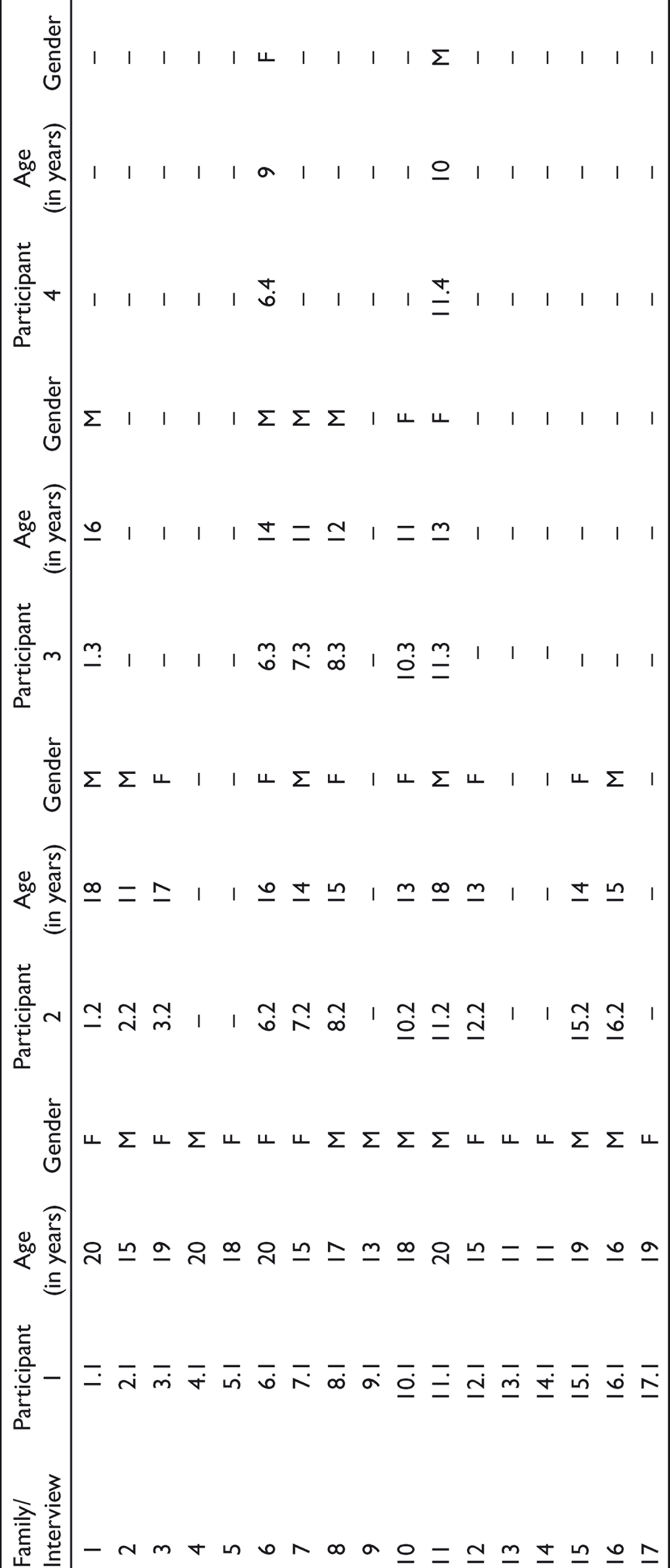
A large majority of families with dependent children and who received social assistance in Municipality X were from Syria. To create a data subset for the current study, we applied the following inclusion criteria that:
the child/young person’s parents/parent had arrived from Syria between 2014 and 2016; the child/young person was not younger than 10 and had not reached the age of 21; and the child/young person was living with the parents/parent at the time of the interview.
Applying these criteria, 36 young people were included in the study. The majority lived in families that had arrived in Sweden during 2015. With the exception of one participant, all lived in families with two parents. Information about the age and gender of the participants is presented in Table 1. The number assigned to each participant, for example 7.2, corresponds to the interview (the seventh carried out) and placement of the child in relation to siblings (the second in the family).
Interviews
Interviews were carried out with 36 children from 17 families. The interviews were carried out in Swedish and using an interview guide, with themes such as reasons for the parents receiving social assistance, social assistance as a benefit and thoughts about the future. The interviews took place either at the Social Services Department, or at a local education centre. In each case where more than one child in a family had agreed to participate, the children were asked if they wished to be interviewed together. In all cases, the participants chose sibling interviews. The interviews, which on average lasted between 45 and 60 min, were conducted separately by three research assistants. Each assistant had received extensive training in conducting child-centred research interviews from the first author. Although the research assistants had worked with families from Syria, they had no additional knowledge of Syrian culture, or the Arabic language. In no case was a parent present during the interview. Audio recordings were made, and verbatim transcripts created. Two hundred and fifty-six pages of written data were created.
Ethics
The research design was approved by the Regional Ethical Review Board for the West of Sweden, in accordance with the Ethical Review of Research Involving Humans Act (2003:460) (Ministry of Education and Cultural Affairs, 2003), Decision nr 930-18/2019-00565. The study participants were provided with information about the purpose of the research, that they could terminate participation at any time, and that information provided would be treated confidentially, and that their name would not be revealed in the report. Contact information was provided, and participants were told that the interview transcripts would be stored in a safe archive.
Analysis
Working with the data, a thematic analytical approach was adopted. Thematic analysis involves searching a dataset with the aim of discovering patterns of meaning. These patterns are then interpreted. The analytical process was carried out following the procedures described by Braun and Clarke (2006). First the data were entered into NVivo 11.0, a software tool to conduct qualitative methods analysis. Each interview transcript was entered as a single case. Thereafter, the data were coded inductively, and constant comparison techniques, such as re-reading and re-coding (Braun & Clark, 2006), were employed. From across the interviews, three themes were identified: social assistance was sufficient, social assistance facilitates future opportunities and receiving social assistance generates desires for reciprocity.
Results and Discussion
The most striking finding emerging from the interviews is how these young participants relate to social assistance in a matter-of-fact way, as something entirely normal and to be expected in the type of situation in which they find themselves. This stands in stark contrast to other studies, where children and young people living in economic adversity consistently report how economic disadvantage is associated with stigma and shame (Redmond, 2009). Rather, the participants in our study recognize that because their parents do not have sufficiently developed language skills, it is not possible for them to secure employment. They see the social welfare opportunities in Sweden as facilitating the possibility for the family to build a new life; they express appreciation of the welfare benefits made available; and they recognize how in many ways they have a fortunate situation. These findings are in line with the findings of other recent research in Sweden where, for example, mothers in newly arrived families express being fortunate in finding themselves in situations where welfare benefits are available (Bergnehr, 2016). The children and young people in the study are well aware of how welfare resources are generated, and how the Swedish taxation system enables benefits to be paid to people—including newly arrived families—who lack opportunities to gain employment (Marttila et al., 2010).
The findings that emerge from the current study stand out from previous research in a number of ways. First, many participants give voice to the idea that the money they receive is adequate, and that it is sufficient to meet the family’s needs. The second way in which the current findings differ from previous research is that the young people describe how social assistance facilitates future opportunities, and means that they (and their parents) do not need to worry about finding immediate work and can pursue programmes of education that can lead to long-term, sustainable employment. Finally, the participants view the receipt of social assistance as involving obligations, and they express desires for reciprocity which, through future employment, can be discharged when they themselves become taxpayers.
Sufficiency
Children and young people living in adverse economic circumstances are often acutely aware of their family’s situation and their own social exclusion (Redmond, 2009). In families that are persistently disadvantaged, children and young people perceive themselves as having how low social status (Rivenbark et al., 2019). Here, in the current study, the participants were also aware that their parents did not have the economic resources common in other families. However, participants did not give voice to the types of social discomfort and low self-esteem described in other studies (Redmond, 2009; Rivenbark et al., 2019; Ruck et al., 2019). Rather, among the current participants, there was an awareness that the family’s situation was a consequence of circumstances beyond their parents’ control. Indeed, even though many of the participants appear to have grown up in affluent circumstances, and lived prosperous lives in Syria, there are no expressions of bitterness or sorrow about the current situation. Instead, in exercising agency, they are able to construct understandings of their situation (Kuczynski & De Mol, 2015). Putting a positive twist on things, and speaking about how the family is fortunate to be together, is a good example of construction:
I: But has it been a big difference? Your parents’ having jobs in Syria and a good income, like you said, and then, that today, when you came to Sweden, things are different? How has that affected you? R: It has affected me a lot. Because it is a big difference. I can tell you that we lived in a good area. We had a lot of money, you could say. We had like flats, and we had a summerhouse. And a small house and a car. So that…but that’s how it is with war, that you lose this. But the best thing is that you have your family. (4.1, 20 years)
Similar to previous studies, the current participants are very aware that they rely on social assistance (Harju & Thorød, 2010). However, while in previous research children and young people have often described lacking opportunities that come with parents’ employment, it is noteworthy how these children display an acceptance of the family’s situation and are satisfied with the living standards and opportunities that social assistance allows. While in previous research in Sweden young people describe how economic adversity poses restrictions on what they can buy and do (Odenbring, 2019), in these young people’s framings, the family has enough money for the things they need. In this way, they also express agency through action (Kuczynski & De Mol, 2015). Using strategies of adaptation, they find ways to adjust to the family’s changed economic circumstances. In the following examples, participants express how, even if the family has to live on a tight budget, the economic resources they receive are sufficient for their needs:
R1: There’s a difference. He [the father] can’t be as generous here in Sweden, because we have to live with this income. A fixed income. But in Syria he used to buy whatever he wanted. That’s why my Mum is more careful. She says, ’I need that, but only that’ …she has to control more. R2: That’s right. Our rent is pretty expensive. R1: Yes, exactly. R2: More than ten thousand. So, like, he does not just get paid from work. It’s not enough. I: And expensive bills too? R1: Yes, but we manage. We manage well, actually. (1.2, 18 years; 1.3, 16 years) I: What is it like to have social assistance? R: That he gets help, or? I: Yes. R; Yes, it feels good. I: If you had had more money, what difference do you think it might have? R: I don’t think there’d be much of a difference. I: No? R: We have all that we need. (10.1, 18 years)
While the participants do not experience the types of social constraints that come with economic adversity, which have been evident in other studies (Redmond & Skattebol, 2014; Ridge, 2013), this is not to say that they are unaware of material discrepancies. Rather, the sense of being worse-off than peers seems to be outweighed by a strong family affiliation. Framing responsibility for the family’s economy as a collective undertaking also involves the exercise of agency. Evidencing a capacity to interpret coactions with the social environment, these young people construct understandings of their circumstances (Kuczynski & De Mol, 2015). They actively position themselves in close solidarity with their parents, electing to describe what might otherwise be experienced as a ‘missing out of material things’ as something that is non-essential. In the interviews, participants frequently gave expression to a sense of solidarity within the family, and how they are fortunate to be in a situation where it is possible to make ends meet, as, for example, this 18-year-old expresses:
I: When your parents talk about it [social assistance] at home, in what way do they talk about it? R: In a positive way. You know, it’s good that you get social assistance when, like, you haven’t got a job. Otherwise you wouldn’t have anything. I: Yes, it’s good. But I am thinking though how it affects you, that you as a family get social assistance. Do you notice it in any way? R: No. Not my family. But sometimes when you are at school, so you like check the different brands of clothes others have. Like that. I: That young people compare? R: Yes. I: Do you feel that you compare yourself to others? R: No. No. Not me. But I see it. Sometimes in the class. I: That people compare? R: Yes. That’s how it is. I: What do you think about that? R: Well, it’s wrong I feel. You don’t need brands to look good.(5.1, 18 years)
At the same time that the participants describe how social assistance provides the family with resources that are sufficient, which enable them to live in a way they are content with, many describe their situation as benefit recipients as temporary. In the following two sections, we examine more closely the ways in which the current situation is framed as a disjunctive period in the family’s life, and how the participants perceive a future that is unconstrained by reliance on state welfare payments, and where they can fulfil their potential as productive members of society.
Opportunity
In previous studies of children and young people living in conditions of economic adversity, material disadvantage is often chronic and welfare receipt is enduring. While it is commonly found that participants express little optimism about the future (Redmond, 2009), studies also show how they can imagine and fantasize about better futures for themselves and their families. Highlighting young people’s agentic capacity, As Roets et al. (2015) describe how they ‘actively develop creative ideas to mediate and negotiate the impact of disadvantage on their own lives and the lives of relevant others, such as their parents and families’ (p. 283) and, despite the fact that ‘poverty shapes and restricts their space and time to do all sorts of things’, they ‘also imagine a socially just future’ (p. 284).
In studies of situations where parental unemployment is temporary, for example, when a parent is made redundant or loses a well-paid job. it has been found that young people can use their agency in expressing an understanding of their situation. Involving forms of action (Kuczynski & De Mol, 2015), young people are able to formulate positive intentions and nurture optimistic views of the future; for example, in Bolin (2016), it was found that young people were able to develop strategies to manage economic adversity. While the young people felt sadness for their parent’s situation, they spoke of how family bonds could be strengthened in coping with adversity together. This ‘togetherness’ enabled them to manage current economic hardship and to imagine a future where they would be better-off. For the current participants, it similarly appears that concerns are not much focused on immediate economic restraints associated with social assistance. Rather, in a manifestation of action (Kuczynski & De Mol, 2015), they project forward into the future and formulate the long-term goal of secure employment:
R: Money is not a big problem for us. But the thing that is, the only problem we have, is employment. That’s the problem. Not the money itself. I: No…Not that you have not enough money? R: No. We’re surviving. (17.1, 19 years)
While they are concerned about their parents’ lack of employment, the participants view social assistance as a means that makes it possible for their parents to develop skills that will enable them to find employment in the future:
It is good that social assistance helps. There are countries where there isn’t social assistance, if you don’t work you don’t get anything, but here you can study. (9.1, 13 year)
Because of these opportunities, participants frame the future optimistically, explaining how reliance on social assistance is a temporary situation that will pass once their family members find employment:
I: Do you think that it will affect you in the future, that you and your family have social assistance? R: In the future? No, no I don’t think so. Because you can’t be on social assistance the whole time. You’re going to get some job in the end. So I don’t think so. (5.1, 18 years)
In addition to seeing social assistance as a passing situation in the family’s life, several participants describe how it creates a space for personal development, unlocking opportunities for themselves and their families. This positive view of social assistance is clearly articulated in the following interview extract where, in an example of construction (Kuczynski & De Mol, 2015), two boys frame social assistance as a facilitator of long-term opportunities for them and their families:
I: How do you think social assistance works as support? What do you think about it? R: Well, to be honest, at the moment, I think that it is good. Otherwise we would starve. I: If there hadn’t been social assistance? R: Otherwise we’d destroy our own futures. And work. Like, instead of studying, we’d have to work in order to support our parents. Or take care of things at home. It is the same thing for my brother. So in that way it is the future. I: So you mean that it provides the possibility to study, if you have social assistance? R1: Exactly. I: If you’d not had social assistance you would have had to work, and then you wouldn’t have been able to study? R1: Exactly. That’s what I meant. So it provides a big opportunity. You have to live in a limited way, but it is possible that, there are four of us, and that my mum and dad can find a job. There is the hope that you can improve. If there hadn’t been social assistance there wouldn’t have been any hope. I think that it is really good because here in Sweden nobody starves or has a problem with food or drink or clothes. Or a place to live. Everyone has these things. You see it. This is Sweden and people are supported in thinking about the future. You don’t think mostly about food, but rather about the future. R2: At the same time I think that in the future it’ll be better… By going through the situation we’re experiencing now, we absolutely won’t want to experience the same situation. So that gives us hope, to work hard in a job and by studying in the future. (11.1, 20 years; 11.2, 18 years)
That social assistance provides opportunities to prepare for a better future through study is reinforced by messages from their parents. In asylum-seeking families, it is often a priority for parents that their children take advantage of the opportunities available in the host country (Atweir et al., 2009). As one of these two brothers explains, parents are also involved in framing the message that social assistance makes future opportunities possible:
I: How do you think that your parents think about getting social assistance? R1: They think a lot about getting a job. To cope with this situation. I: Yes, finding a job… R1: Yes, finding a job. They’re always comforting us by telling us to keep studying. So that you can get a good job. Then you can have what you want living here. I: So studying further means that you survive? R1: Exactly.
However, at the same time, some participants feel that social assistance can create problems if a person were to become too accustomed to receiving benefits and does not capitalize on the opportunities for study and personal development. This risk is described by a participant who reflects on the advantages and disadvantages attached to social assistance:
R: It [social assistance] can be negative for us, now and in the future. I: In what way? R: Because it could be that nothing happens. It’s they who do everything, and we just take. But we can study here now. In school. So it’s positive. (6.1, 20 years)
The fear of falling into a pattern of passive acceptance where, over time, it becomes normal to rely on social assistance—it could be that nothing happens—is coupled with the fear that immigrants can be positioned negatively by other people in society, and a situation where It’s they who do everything, and we just take. This expression of agency—in wanting to avoid the feeling of not being a productive member of society and wanting instead to contribute—is expressed by many of the participants. Evidencing autonomy and self-determination, as the young people experience opportunities to be efficacious in coaction with the social environment (Kuczynski & De Mol, 2015), these expressions involve notions of reciprocity.
Reciprocity
Reciprocity is a moral norm that plays an important role in how people balance perceptions about receiving and providing different forms of support. The central idea is that receiving more than one gives can lead to feelings of indebtedness, guilt and shame (Gouldner, 1960). Norms of reciprocity influence how people interpret and feel about different forms of support they receive (Antonucci & Jackson, 1990). In previous research in which children and young people have been asked about how they relate to and understand the situation of receiving social assistance, it is often found that being in a family reliant on welfare payments generates feelings of shame (Harju & Thorød, 2010). However, among the current participants, there appears to be no sense of shame or stigma attached to social assistance. Rather, the participants view the family’s receipt of social assistance in a matter-of-fact manner. In this way, and through the exercise of agency, they understand social assistance as a positive benefit:
I: Is it an entitlement? Is it shameful to get social assistance? Is it good or bad? R1: Good. R2: Why would it be shameful? (8.1, 17 years; 8.2, 15 years)
At the same, while there is no obvious sense of stigma associated with being supported by state welfare, the participants are aware that social assistance derives from taxation-based revenue, and that self-sufficiency is preferable, as these two siblings describe:
R1: It is better that I get a job. That you can support yourself. That’s what I think. I: You mean that it is better to work than getting social assistance? R1: Yes. I: That you support yourself rather than being supported? Is that it? R1: Yes. I: Mmm. Do you think the same? Do you agree? R2: It is good to take it from the Social, because they help us. But it is better that you support yourself. R1: But society, I mean this thing that you should look for work, pay tax, help each other, and so forth. Because those of us who study at upper secondary school, or whatever, we get money from Study Support (CSN). We get it from those who pay tax. (6.1, 20 years; 6.2, 16 years)
In addition to a desire to become self-sufficient and not reliant on state benefits— the expression of autonomy and self-determination (Kuczynski & De Mol, 2015)—many participants describe a sense of discomfort about receiving income generated by the work of others and their desire to contribute to the society:
R1: It is good that they help us. It is better than us having nothing. So I think that it [social assistance] is good. But it feels a little hard for me…I don’t want to take other people’s money. It feels that, when others pay tax, and then they give the tax money to us, it feels a little hard. I: OK. R1: It feels a little hard. I don’t want to take other people’s money. I’ll wait until I am eighteen so that I can work. I want to work. And no worries, I’ll help my parents. But it’s a little hard when you take money from someone else. I: That it feels difficult? R2: Yes. I: You’re nodding a little. Do you feel the same, or what do you think? R1: Yes, it’s true. I: The tax that you will pay. Do you think then that other people will feel like this? The ones who take the money? R1: No, it feels…because I have taken this money, so it feels that I would be paying it back. I would feel good. (3.1, 19 years; 3.2, 17 years)
While these participants’ reflections provide a further example of construction (Kuczynski & De Mol, 2015)—feeling uneasy about being reliant on money created through the work of others which is redistributed through social welfare—other participants take a more personally distanced view. For them, construction involves reasoning about how social assistance is part of a system that builds on contributions made by people at different stages in their lives. This more rational, pragmatic perspective is clearly articulated by another of the older participants. Asked to reflect on the advantages and disadvantages attached to social assistance, he frames his answer from a macro-level, talking about resource distribution across the life cycle:
R: Sometimes it’s good, sometimes it’s bad. It’s good because you shouldn’t spend money on just anything. It’s tax money. Everyone pays tax. I have also paid tax. When you work you pay tax. And sometimes you can feel bad about paying tax [laughs]. But it’s at the same time good for all of us, good for my parents, and for my children in the future. For example, I don’t want to pay tax, because it’s not fun paying tax. But at the same time you get it in the future through healthcare, school meals. At school you can eat every day! And everything costs. So it is, how do you say it in Swedish? I mean it’s like… I: You get it back? R: Yes, sort of. Like a circle. (4.1, 20 years)
While the desire for reciprocity has been identified as affecting adults who receive welfare support (Espvall & Dellgran, 2010), it less usual that younger people living in economic adversity express such sentiments. In this sense, the participants in the current study may differ from similarly aged peers who live in families receiving social assistance, but who are not recently arrived, or have different ethnic, cultural or socio-economic backgrounds. Here, in many of the families, parents had tertiary-level education and professional backgrounds. Several owned their own businesses in Syria. In families where parents are well-educated and resourceful, young people tend to develop more complex theories about economic disadvantage and are able to develop awareness of the structural causes of inequality (Flanagan et al., 2014). Here, the insights these participants express can be understood as a consequence of their social backgrounds and of the messages that parents give about the opportunities and obligations connected with migration.
Conclusion and Limitations
In our analysis of the ways that young people in newly arrived families from Syria experience the family’s receipt of social assistance, we have drawn attention to three aspects that appear as distinctive, which set their experiences apart from those of similarly aged young people reported in many previous studies. The nature and manifestation of the agency of young people in these newly arrived families differ in one important respect; these young people do not experience parental receipt of social assistance to be stigmatizing. Rather than connecting social assistance with economic hardship and limited opportunities, describing how financial adversity is associated with stigma and shame, and detailing how resources need to be carefully managed, the participants in this study view social assistance as sufficient for the current needs. While previous research has shown that young people in economically disadvantaged circumstances can imagine a brighter and more equitable future (Roets et al., 2015), our study reveals how these young people map out futures where the current receipt of social assistance provides opportunities for improving the family’s situation. As part of this process of modelling the future, participants give expression to desires for reciprocity and talk about how life in the future will enable them to contribute to a system of welfare from which they themselves are currently benefitting. The positive views about social assistance and the positive outlook on both the current situation and life in the future suggest that young people in newly arrived families from countries such as Syria can constitute a particularly resilient group. They have a positive outlook on life; they appreciate what they have; and they value social and educational opportunities. Importantly, perspectives such as these have been found to promote resilience among young people in asylum-seeking contexts (Pieloch et al., 2016). As Correa-Velez et al. (2010) have argued, the ‘opportunity to flourish, to become at home [and] to belong is powerfully shaped by the prevailing social climate and structures that are openly inclusive or that exclude’ (p. 1406). For the current participants, the majority of whom qualify for permanent residence in Sweden, social assistance makes an important contribution in creating stability in the present and generating optimism for the future. This points to an experience of social assistance as a source of opportunities.
Finally, an important limitation needs to be noted. As part of the study’s design, interviews with the young people were carried out by staff employed in the social services department in the municipality where the research was carried out. Although these people were not directly involved in making assessments about a family’s eligibility for social assistance, it is nevertheless the case that the young participants might have experienced a need to position themselves in a positive light (e.g., by talking about social assistance in positive terms), not presenting themselves as ungrateful and describing plans for the future aimed at positive outcomes (study and employability). Further, the young people’s ‘informed consent’ may not be meaningful due to the circumstance of having Swedish as a second language, and difficulties to fully understand that they can decline to participate (Bailey & Williams, 2018). The possibility of social desirability biases needs therefore to be recognized.
Footnotes
The authors declared no potential conflicts of interest with respect to the research, authorship and/or publication of this article.
Funding
The authors received no financial support for the research, authorship and/or publication of this article.