



Abstract
The article examines the relationship between excessive alcohol consumption, social context and perceived cultural norms in three European countries from the perspective of young adults. This generation is the first to come of age in a globalized world, frequently discussed in terms of diminishing national and regional differences. Several scholars have argued that these transformations have contributed to an increasing homogenization of European drinking cultures. The article seeks to analyse how young adults from different sociocultural backgrounds define and interpret excessive drinking, emphasizing both similarities and divergences in drinking practices. In doing so, it demonstrates how such practices are embedded in broader historical developments and contemporary cultural attitudes. Drawing on 24 focus group interviews conducted with young adults in Denmark, Estonia and Italy, the analysis is structured along three dimensions: the perceived (un)acceptability of excessive alcohol use, processes of ‘othering’ in explaining excessive drinking and gender-specific drinking norms.
Keywords
Introduction
Existing research on excessive drinking has often focused on separating risky drinking from non-risky drinking patterns by examining the amount and frequency of alcohol use in different populations. Terms such as ‘binge drinking’ (Labhart et al., 2018), ‘heavy episodic drinking’ (Linden-Carmichael et al., 2017) and more recently ‘high-intensity drinking’, which distinguishes binge drinking episodes from alcohol intake that exceeds the standard threshold (Patrick & Azar 2018, p. 50), have been used to measure and define alcohol-related risks. However, when it comes to the meaning and context or even the pleasures of excessive drinking, much remains relatively unexplored (Nicholls & Hunt, 2025). This is despite the facts that occasional binge drinking exists as a routine part of social life in many European countries and as a central part of ‘having fun’ and that the harmful effects and negative consequences of excessive drinking are often downplayed by young people (Linden-Carmichael et al., 2017; Peltzer & Pengpid, 2016). Some of the existing literature that has examined the experience and meaning of excessive drinking (Delaney et al., 2007; Demant & Järvinen, 2010; Rolando et. al., 2024; Thickett et al., 2013) argues that excessive alcohol consumption is associated with sociability, socializing, popularity and thus social capital. However, much of the literature that has focused on the meaning of excessive drinking has focused on national drinking cultures, whereas cross-cultural research examining commonalities and differences in excessive drinking is scarce (however, see, e.g., Demant & Törrönen, 2011; Pennay et al., 2022; Rolando, 2024). Against this background, our aim is to examine the meanings that ordinary people attach to excessive drinking, and, in particular, we will look at the context, group identity formation and gender in three different national settings. As a starting point, we use the concept of ‘drinking cultures’ (e.g., Gordon et al., 2012; Savic et al., 2016) to show how drinking practices relate to both wider historical developments and contemporary attitudes. Drawing on 24 focus group interviews conducted in Denmark, Estonia and Italy, this article focuses on norms and meanings of excessive alcohol consumption at the micro level.
First, the article provides the analytical framework for wet and dry drinking cultures, boundary-making and gender differences in alcohol consumption. Next, a brief overview of the alcohol cultures in the three countries is provided, followed by an introduction to the data and methods. In our qualitative micro-level cross-cultural comparative analysis, we aim to answer the following three questions: (a) How are acceptable drinking and unacceptable excessive drinking defined? (b) How are cultural distinctions used to define the boundaries of acceptable drinking? (c) How does gender influence norms related to excessive drinking? Taken together, our analysis attempts to encapsulate cultural similarities and differences in excessive drinking in different country contexts.
Analytical Background
‘Wet’ and ‘Dry’ Drinking Cultures
Differences in European drinking cultures, regarding the social norms of alcohol use and patterns of drinking, have traditionally been explained through the typology of ‘wet’ and ‘dry’ (Room & Mäkelä, 2000, p. 477). In ‘wet’ drinking cultures, alcohol use is integrated into everyday life, and such cultures are characterized by less restrictive alcohol policies, frequent use of alcohol, a low portion of abstainers and lower levels of acute alcohol intoxication. This contrasts with ‘dry’ drinking cultures characterized by more restrictive alcohol policies, heavy episodic alcohol use, and higher rates of drunkenness, alcohol-related diseases and mortality (De Visser, 2021, pp. 139–140). Moreover, Snowden (2015, p. 395) notes that alcohol use and drinking patterns are influenced by social norms regarding acceptable and unacceptable behaviour. In ‘dry’ drinking cultures, where moderate alcohol use is not part of everyday routine, intoxication-oriented drinking (i.e., consuming large quantities of alcohol with the aim of getting drunk) is perceived as a ‘time-out’ period, during which the regular system of social rules and norms is dismissed (Bloomfield et al., 2003, p. 96; Snowden, 2015, p. 395). In ‘wet’ drinking cultures, which traditionally exhibit lighter, yet more frequent patterns of alcohol use, high levels of drunkenness and public intoxication are deemed inappropriate (Rolando & Beccaria, 2018). However, another body of literature argues that the dichotomy of ‘wet’ and ‘dry’ alone fails to understand contemporary drinking cultures, as these are more complex than the dichotomy alludes to. In fact, we see both patterns of homogenization and differentiation in attitudes, norms and practices of alcohol consumption (Bloomfield et al., 2003, p. 96; Gordon et al., 2012, p. 7). Local drinking cultures can vary significantly in their drinking patterns, indicating a need to explore the different cultural meanings and patterns associated with alcohol use, even within the same community (Savic et al., 2016).
The Dynamics of ‘Us’ and ‘Others’ in Alcohol Consumption
Alcohol consumption is also about cultural identification and belonging, informing how individuals and groups express themselves and interact with others. Furthermore, drinking as a social activity can function as an inclusion and exclusion practice that helps to generate images of ‘us’ and ‘others’ (Sulkunen, 2002). For example, Sulkunen (2002) found that middle-class moderate drinkers in Finland identified their drinking style as mature and controlled, in contrast to the ‘wild’ drinking style of working class and young people (see also Bogren (2020) for similar findings from Sweden). Similarly, among recreational drug users in Estonia with high cultural capital, they contrasted themselves with young clubbers who, in their view had excessive, irresponsible and unhealthy drug use (Allaste, 2006). Furthermore, cultural identities are often formed in contrast to the ‘tasteless other’ (Muggleton, 2000). For example, types of drinks and ways of consuming alcohol can be important in defining and reinforcing cultural identities, such as Finnish or Swedish middle-class drinkers perceive themselves as highly competent alcohol users with an avant-garde position in society (Bogren, 2020; Sulkunen, 2002). The above differentiations are not only about intoxication but also about agency and control. That is, ‘others’ are often defined as being without proper agency and ability to control their behaviour. This establishes a sense of superiority for the ‘we’ group, who define themselves as having the qualifications and characteristics necessary to be seen as subjects and autonomous individuals capable of exercising agency over their actions (Sulkunen, 2009). Negative attitudes in relation to drinking to excess have been associated with a ‘lack of self-control’, ‘immaturity’ and being a ‘weak drinker’ (Creswell et al., 2013; Demant & Järvinen, 2010).
The Gendered Patterns of excessive drinking
Excessive drinking is most prevalent among young men, peaking in early adulthood and declining steadily thereafter (Gmel et al., 2003; Kuntsche et al., 2004; Patrick & Azar, 2018). Excessive drinking varies by gender and age, both because of gendered norms around drinking and because women become more intoxicated than men after consuming the same amount of alcohol (Patrick & Azar, 2018). Although men generally experience more alcohol-related health risks (Nolen-Hoeksema, 2004; Schulte et al., 2009), excessive drinking, severe intoxication and public intoxication among men are widely tolerated, excused and/or neutralized (Aresi et al., 2021; Buvik & Baklien, 2015; Wilsnack & Wilsnack, 2002). Consuming large amounts of alcohol and holding one’s liquor are rooted in a traditional ‘macho’ culture and are associated with characteristics such as ‘resilience’, ‘risk-taking’ and ‘aggression’ (Holmila & Raitasalo, 2005; Peralta, 2007; Visser & McDonnell, 2012). However, the gender gap in alcohol consumption and drunkenness has narrowed in several European countries due to increased alcohol use among women and, especially, intoxication-oriented drinking behaviour (Demant & Törrönen, 2011; Rolando et al., 2020; Törrönen et al., 2017; Visser & McDonnell, 2012). Such changes in perspectives are related to larger sociocultural changes and transformations of traditional gender roles, including women increasingly working outside the home, the adoption of male-centric values and greater consumer freedom (Holmila & Raitasalo, 2005; Kobin, 2013b). Despite some deconstructing and revaluation of traditional gender-stereotypical norms around alcohol (Jensen et al., 2019), heavy drinking among women continues to be subject to double standards and sociocultural criticism (Visser & McDonnell, 2012). Aresi et al. (2021), Brooks (2011) and Kobin (2013) link gender-specific attitudes towards alcohol use to societal gender roles and norms, where the moral code is more lenient for men, and heavy drinking and public drunkenness in women are regarded as ‘unattractive’ and ‘unfeminine’ and not socially accepted.
Context: The Cases of Denmark, Estonia and Italy
Historically, Denmark, Estonia and Italy have different drinking cultures. Italy provides an example of a ‘wet’ drinking culture, with total alcohol consumption steadily decreasing since the 1970s (Allamani & Beccaria, 2007). This decline was driven by urbanization and changes in the labour market, sustained by social self-regulation based on informal norms of wine-drinking cultures (Allamani & Beccaria, 2007). Typical features of the traditional Italian drinking culture such as consuming alcohol during meals and negative attitudes towards drunkenness were subsequently reinforced by trends that cherish the ‘competent drinker’; a lover of quality wine (or beer) who is interested in the taste and ‘right’ combination with food, rather than in psychotropic effects (Beccaria & Pretto, 2021; Poppi & Beccaria, 2022).
In Denmark, the consumption of alcohol per capita almost tripled between the mid-1960s and the mid-1980s, followed by a rather stable period and a decrease from the late 1990s (Eriksen, 2023, p. 23). This rapid growth in the level of consumption occurred due to a very lenient alcohol policy, economic growth, a rising middle class and an active alcohol industry (Elmeland, 1996). Although average consumption has decreased in Denmark since its peak in the mid-1980s, it remains an example of a ‘dry’ drinking culture, with a dominant intoxicated-oriented drinking style and a focus on the positive aspect of alcohol among most consumers (Järvinen, 2003; Tolstrup et al., 2019). From an international perspective, the drinking culture among the Danish youth stands out, as young Danes drink large amounts of alcohol, and their drinking style has been characterized by ‘determined drunkenness’ and ‘controlled loss of control’ (Østergaard, 2009; Kolind, 2011).
In Estonia, alcohol consumption used to be comparable to other post-Soviet countries and was characterized by regular excessive alcohol consumption (Lai & Habicht, 2011; Täht et al., 2020). Due to the prevalence of spirits and high levels of excessive drinking (Saar & Trasberg, 2021), it has traditionally been associated with the ‘dry’ drinking culture. In the last decades, however, Estonian drinking culture was showing signs of becoming a ‘mixed’ culture. While excessive drinking, characterized by social norms specific to the ‘dry’ culture, exists in wider society today (Saar & Trasberg, 2021), the rate of drunkenness and the level of alcohol consumption among young people have decreased (Oja et al., 2023) and are now more characterized by social norms of ‘wet’ culture regarding acceptable and unacceptable behaviour. According to previous studies, Estonian young adults find frequent moderate drinking and excessive drinking on special occasions acceptable (Kobin, 2013). This change in drinking culture is attributed to the transition from a socialist to a capitalist society with a free-market economy, increasing individualization, and hedonistic ‘Western’ lifestyle influences, including alcohol marketing and media portrayals of alcohol use that were integrated into youth culture (Kobin, 2013a).
Data and Method
Data consist of 24 focus group interviews (N = 128) with young adults (2–40 years old) from Estonia, Italy and Denmark. These countries were selected to represent different cultural contexts with contrasting traditions and patterns of alcohol consumption.
Recruitment and Participants
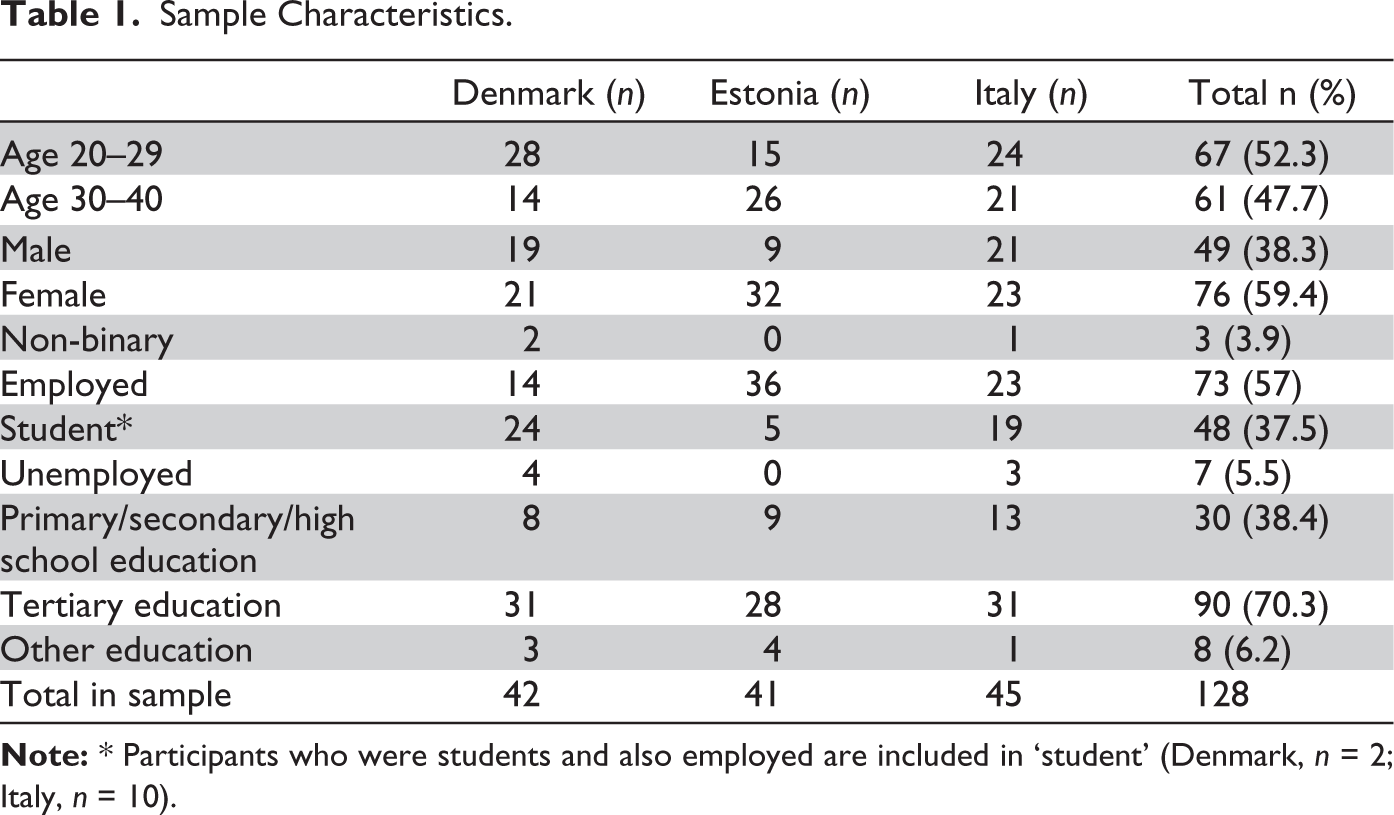
As a large part of the existing literature on young people and drinking focuses on students, we wanted to include a broader and more socially diverse group, taking into account variations in age, gender and socio-economic status (educational background). The goal was to recruit participants in their early adulthood with experience with alcohol influence, and the focus groups were divided into the age groups 20–29 and 30–40 years. While this was an object of other articles (Allaste & Bennett, 2013), comparing age groups is not an aim of the present one, as the focus here is on cultural and gender variations. Detailed information about our research participants can be found in Table 1.
Sample Characteristics.
Participants were recruited through open postings on various social media platforms (Facebook, YouTube, Instagram, Twitter and Reddit) using the researchers’ social networks and the ‘snowball’ sampling technique. The registration form asked for age, gender, education level and e-mail contact. Although we experienced a certain number of no-shows in all three countries, the method made it possible to recruit participants across a large geographic area, it was time-saving for the participants, and it allowed shy or more reserved individuals to participate, as their camera could be turned off (see also McKenna & Green, 2002).
Interviews
The focus group interviews were conducted using the method reception analytical group interview (Sulkunen & Egerer, 2009), which used two video clips of scenes with excessive drinking in different contexts (a youth party on a rooftop terrace and a German beer festival, Oktoberfest) as a stimulus to elicit both individual and collective meaning-making processes, experiences, feelings and perspectives on excessive drinking. Each focus group was started by establishing ground rules and emphasizing the importance of acceptance and space for disagreements to ensure good group dynamics and allow different opinions and nuances. One of the benefits of focus groups is that they provide a better opportunity than individual interviews to study similarities and differences in participants’ attitudes and experiences (Berg, 2000). For some of the younger participants, the video format seemed less intrusive and easier to participate in if they had a busy schedule. Moreover, the COVID-19 pandemic seemed to have prepared most of the participants for the online format, as the use of online meetings in school and work contexts has become far more widespread than before. Focus group interviews lasted an average of 70–80 minutes and were conducted by a moderator with a focus on minimizing the researcher’s influence and promoting undisturbed, spontaneous interactions between the participants. All interviews followed the same thematic interview guide (translated into the local language), which started with a discussion of video clips, followed by discussions of the conceptualization of ‘drinking a lot’, which included contexts, motives and risks of excessive drinking. During the interviews, the participants reflected on their personal experiences with excessive drinking as well as sociocultural norms for high alcohol consumption. As a topic such as excessive drinking can be highly moralized, it was important that the interviewers’ approach was as open and neutral as possible, with a focus on making the conversation flow easily and as comfortably as possible so that the participants felt safe while sharing their experiences and attitudes. This was done, among other things, by adapting the framework to suit the individual participants. For example, for some, it was useful to turn off the camera, choose a pseudonym or speak in general terms, and the interviewer’s role as a moderator focused on ensuring that everyone was heard.
We tried to have an even gender distribution in the focus groups, and if that was not possible, then gender segregated. One Danish and one Estonian focus group, however, had only one male participant, but we still ended up with all participants sharing personal experiences.
Data Analysis
All group discussions were audio or video recorded with the participants’ permission and transcribed verbatim. A common coding framework was used, with family codes identified on the basis of the research questions, but open to the addition of sub-codes so that the researchers in the three countries could add unexpected themes that emerged in the discussions. Using computer-aided qualitative data analysis software such as Nvivo or Atlas-Ti, the collected data were coded using principles from constructive grounded theory, namely focused coding combined with open and axial coding (Charmaz, 2006). Open coding involved carefully reading the interviews and highlighting themes and meaningful sentences. Focused and axial coding was used to group open codes under generalized categories based on a common coding framework, which included overall family codes derived from research questions (clips, contexts, conceptualization, motives and perceived risks). The initial analysis was performed separately in each country and resulted in country-specific reports. Research teams then met in person to carefully discuss the results, identify key cross-national themes and plan the cross-national analysis (Allaste et al., 2022). In summary, the analysis and coding took place as a process that linked empirical focus, ongoing comparison between results across countries in the research team and an ongoing revisiting of the empirical material.
The article uses the material coded under the joint family codes ‘conceptualization of excessive drinking’, ‘motivations for drinking’ and ‘contexts for drinking’ focusing on the topics of acceptable versus unacceptable excessive drinking practices. The data are structured three dimensionally: the (un)acceptability of excessive alcohol consumption, distinctions based on alcohol consumption and gender-specific drinking norms, all of which highlight the processes of cultural ‘othering’ and identify social drinking violations and benefits within different national drinking cultures. All statements by the authors are based on the analysed material, and quotes are used to illustrate arguments.
Research Ethics
Ethical approval of this type of social science research is not formally required in any of the three countries. However, the research teams followed the European Union’s ethical guidelines (European Commission, 2021) as well as the partner countries’ national laws on privacy and confidentiality. All participants were provided information clarifying the purpose of the research and the voluntary nature of participation. Participants knew that they were free to leave the session at any time if they wished. The participants’ confidentiality and anonymity were sought in the focus groups; therefore, the participants’ names were not asked, and they were not asked to provide personal information or discuss personal experiences. All names used in the analyses are pseudonyms.
Results
In the following, we compare our participants’ experience related to excessive drinking in the three countries: Denmark, Estonia and Italy. Especially, we focus on the following: how acceptable and unacceptable excessive drinking was defined, processes of ‘othering’ in explaining excessive drinking and excessive drinking and gender.
Acceptable and Unacceptable Excessive Drinking
In all countries in this study, excessive drinking was perceived as acceptable at special events and celebrations. For example, annual occasions, cultural holidays and personal life events could be catalyst for both intentional and unintentional excessive drinking and were used to strengthen unity and belonging. For Estonian and Danish participants, ‘routine’ weekend get-togethers and casual partying were also seen as possible contexts for excessive drinking. In fact, Danish participants highlighted that excessive drinking occurred in similar ways on both special and routine occasions and was guided by the peer group’s norms of not being, as Demant and Järvinen note (2011, p. 95), a ‘weak drinker’.
In Estonia, drinking alcohol on special occasions was sometimes considered a social obligation. That is, drinking on such occasions was associated with peer pressures. Borsari and Carey (2001, pp. 393, 420) note that peer pressure is central to drinking among young adults and range from polite implicit remarks to direct encouragement to drink. However, Estonian participants emphasized that it was primarily the older generation who encouraged individuals to consume alcohol, which can be interpreted in the light of the earlier mentioned generational switch in alcohol culture:
Merilin: I have noticed that usually, it is the older generation, who force you to consume strong liquor. Younger people understand that if you refuse to drink, there must be a reason for it. Older people often insist, come up with reasons to convince you, and ask why you’re refusing to drink. (EE_FG02_20-29_F)
For Italian participants, there was a clear division between ‘routine’ and ‘special’ drinking occasions, with excessive drinking typically associated with ‘birthdays and festivities like Christmas, Easter, and New Year’s Eve’.
Across all countries, drinking alone was seen as problematic and unacceptable. Even in Denmark where there is a relaxed attitude towards excessive drinking, drinking was seen as a basic social activity:
Michael: I rarely know anyone who has gotten wildly drunk in the company of only one other person. That’s not normal. Getting drunk requires an atmosphere and preferably more than four people. (DK_FG08_30-40_M)
In line with previous studies (Demant & Järvinen, 2011, p. 97), participants viewed drinking alone as unhealthy, harmful and pointless for numb negative emotional states. In Estonia, participants also disassociated themselves from solitary drinking practices due to the harmful health consequences and negative societal connotations. Drinking alone was primarily seen as a coping strategy to relieve stress, reduce anxiety and suppress depressive thoughts.
Among the Italian participants, excessive alcohol consumption as a coping mechanism to deal with negative emotional states was primarily discussed in the context of high-risk alcohol use, where the goal was to ‘turning off awareness’ and ‘dissociating from oneself’—drinking practices that were described as counterproductive in terms of alleviating psychological problems.
The distinction between acceptable and unacceptable drinking was often based on the consequences of excessive drinking. In both Italy and Estonia, participants associated inappropriate drinking with loss of control, poor self-regulation, upsetting others, vomiting, memory loss and lethargy. Furthermore, in these two countries, excessive drinking and severe drunkenness were closely associated with symptoms that were assessed retrospectively, and even at times unexpectedly, such as nausea, hangover and headache.
For Danish participants, however, the consequences of excessive drinking were often clearly expected and accepted in an almost strategic way. Like when hangovers are seen as a routine part of drinking and partying:
Martin: I have participated in ‘dates’ [a drinking game] with an empty stomach and when I have eaten well. The advantage of an empty stomach is that less comes up when you must vomit, as opposed to when you have eaten. (DK_FG05_30-40_M)
While intoxication-oriented drinking and its negative consequences are widely accepted and integrated into Danish drinking culture, Estonian and Italian participants were more critical of alcohol consumption that they perceived as uncontrolled.
Processes of ‘Othering’ in Explaining Excessive Drinking
In all countries, participants defined their own drinking habits as ‘mature’, characterized by ‘knowing your limits’. This contrasted with what they saw as the ‘wild’ intoxication-oriented drinking behaviour of young people—a behaviour that was considered unacceptable after early adulthood. In Estonia, young people, largely referred to as students, were portrayed as drinking only to get drunk, which was seen as a part of the general rebellious and risk-taking practices of youth. Furthermore, young people were seen as susceptible to peer pressure, and to drink alcohol to impress peers and fit in with others:
Merle: It shows maybe some kind of reputation when you can brag somewhere about how much you drank. (EE_FG01_30-40_F)
Italian participants distanced themselves from seemingly unmotivated and aimless drinking, as excessive drinking was seen as something that primarily took place in the context of youth or student drinking cultures associated with experimentation, lack of taste, and poor knowledge of alcoholic beverages:
Roberta: Playing drinking games, disconnecting after months of studying for exams, drinking without rules, and mixing incredible drinks – all that doesn’t take place anymore. At that time, I mostly drank to be intoxicated. (IT_FG.06_30-40_F)
As Quigley and Marlatt (1996, p. 185) argue, young people often ‘mature out’ of binge drinking patterns due to the responsibilities that come with adult life. Similarly, Italian participants, older than 30 years, recalled that a transition from heavy to moderate drinking in their mid- to late 20s also coincided with developing a taste for higher-quality alcohol, emphasizing a shift in values and expectations associated with drinking.
In Denmark, most participants also distinguished themselves from younger people, particularly teenagers who were perceived as exploring their limits and showing inexperience in their alcohol consumption practices. That is, young people were seen as ‘novices’ who were in the process of learning the skills of consuming larger quantities of alcohol:
In addition to the distinctions between young and more mature, adult drinking practices, the ‘othering’ processes especially in Estonia and to some extent in Italy were also influenced by a distinction between urban and rural drinking cultures. In Estonia, unacceptable drinking patterns, especially intoxication-oriented alcohol use, and negative alcohol-related consequences were often attributed to uncultured village communities that were perceived as socially and culturally stagnant. Rural behaviours and values around alcohol consumption were often criticized as ‘tasteless’ and seemed incompatible with the preferences of young urban adults. Participants attributed the high alcohol consumption and ‘backward’ drinking culture in small towns and rural areas to the limited access to non-alcohol entertainment and leisure activities.
Although Italian participants also linked drinking to a lack of entertainment in rural areas, Estonia’s case was distinct due to its strong negative ties to the Soviet past. The divide between the urban ‘us’ and the rural ‘them’ reflects the latter’s association with Soviet-era drinking culture, where alcohol was a coping mechanism for socio-economic hardships (Trapencieris & Sniķere, 2016, p. 86). After re-independence, more avant-garde young Estonians sought a ‘Western’ lifestyle, distancing themselves from Soviet-era drinking patterns (Allaste, 2015). While urban young adults might prefer more moderate habits, excessive drinking persists in rural areas. Urban young adults view the ‘old-fashioned’ drinking style as harmful, favoring a more refined, sensorial approach akin to wet drinking cultures.:
Rasmus: An Estonian gets drunk in a second and crawls around the floor at the village parties where I’ve been. In the beginning, it is all very beautiful, the band plays and everything is exciting, but then the beer gets switched out with vodka and it all goes downhill. […] I have a very specific drinking system where I’ve created an infographic of where the most common red grapes in Italy are. I try to taste everything and understand what I like. It’s not about getting drunk, but rather discovering what the flavours are, what’s dry, sour, and all kinds of fruits. (EE_FG08_20-29_M)
In Italy, the process of othering of alcohol consumption was mostly rooted in the perceived difference between Italian and foreign drinking cultures. Excessive drinking was not considered part of traditional Italian everyday drinking culture (frequent, but light drinking with to meals). Though drinking habits are changing in Italy and daily alcohol use is decreasing among younger generations (Beccaria & Rolando, 2016), there are still negative attitudes towards drunkenness and intoxication-oriented drinking is still associated with foreign drinking cultures. Italian participants also tended to connect the ‘wild drinking’ of young people with global homogenizing trends in alcohol use, such as when Italian participants referred to experiences of excessive drinking in abroad:
Matteo: In 2018 and 2019, I participated in a one-year Erasmus program in Barcelona in Spain, and I saw some really ‘brutal’ scenes. I have always been used to exaggeration and drinking alcohol to excess, but that wasn’t even fun. There were these guys who fell apart without even having fun and without knowing why they were drinking. (IT_FG.07_20-29_M)
Italian participants associated foreign drinking cultures with ‘wild’, alcohol-fuelled parties, and frequent excessive drinking leading to loss of control, which was perceived as opposed to the local culture linked to social drinking motives and moderate alcohol consumption.
In Denmark, there were no clear processes of ‘othering’ related to drinking. Instead, the term ‘art of drinking’ was at times employed to define boundaries within the drinking culture. While in Italy and Estonia, ‘wild’, out-of-control drinking was contrasted to a ‘mature’ drinking culture, Danish participants perceived youth as beginners in the ‘art of drinking’, learning how to handle large amounts of liquor and reach the peak of drunkenness at a right time during a night out. In contrast to the ‘othering’ processes between the ‘novice’ and ‘mature’ drinkers, Danish participants emphasized values such as solidarity and belonging. The ‘booze-filled journey’ of learning the ‘art of drinking’ and settling into a mature, heavy drinking pattern can be seen as an inherent part of Danish drinking culture and socialization practices. Drinking and getting drunk was largely described as a ‘craft’ or ‘skill’ that required planning and continuous practice, involving regular attendance at social gatherings and frequent alcohol consumption:
Simon: I would also say that there is a fine line between getting hammered and nailing it, where you are very drunk, but in a controlled way, where you just laugh about everything. […] I have gotten significantly better at it with age, and the more I have partied and drank. I feel I have become good at nailing it and having fun at parties. (DK_FG03_20-29_M)
Young people’s drinking patterns were described as ‘wild’ and without limits, leading young adults to highlight themselves as competent drinkers. Especially in Estonia and Italy, the transition to a more sophisticated way of drinking—which in Italy excludes drunkenness (Beccaria et al., 2015)—is expected to happen in the mid- to late 20s. In Denmark, however, excessive drinking practices aimed at drunkenness continue into mature adulthood.
Excessive Drinking and Gender
In all three countries, participants associated excessive drinking and intoxication-oriented alcohol consumption with traditional patterns of (hyper)masculinity. In Estonia, the connection between excessive drinking and masculinity existed in the context of male-centric student parties where excessive drinking is seen as a social norm and a central component of the male bonding ritual. The relationship between alcohol use and masculinity was further discussed in the context of partying that can play out as unofficial drinking competitions, where the goal is not only to keep up with your peers but also to drink more than other men as a sign of machismo; a way to gain respect and boost one’s self-esteem:
Elisabet: I think a lot of men are concerned with overpowering each other. We can call it toxic masculinity. Men need to be better than others and that means drinking more alcohol than others. (EE_FG04_20-29_F)
Likewise, some Italian participants also perceived excessive drinking as a part of traditional ‘male’ culture that is particularly linked to rural areas. For example, excessive drinking was perceived as a result of external drinking pressure, as being ‘lightweight’ or abstaining from alcohol is stigmatized and ridiculed within the ‘macho’ environment:
Mattia: There is a need for boys to drink more or demonstrate that they can drink more, that they want to drink more compared to girls. I’ve never heard of any girl being challenged to drink. On the other hand, it happens often that boys are challenged to drink to prove something. (IT_FG.05_20-29_M)
Rooted in traditional Italian male culture, heavy alcohol use and intoxication-oriented drinking practices are further understood as a rite of passage from youth to adulthood. Furthermore, drinking in typical ‘macho’ cultures was sometimes seen by our participants as associated with violence, impaired judgment and distorted cognition, which was seen as contributing to conflictual environments
In Denmark, our participants emphasized that excessive drinking was not perceived as gender specific. However, although excessive drinking was not exclusively linked to a macho culture, gender stereotypes were still central to Danish drinking narratives (Bjønness et al., 2022). For instance, stories were also about male-dominated gatherings characterized by heavier drinking, loudness and machismo, as in the quotation below:
Storm: When my boyfriend’s football team comes home and gathers in the backyard, it’s a different culture among the boys. I mean, they are nice 28-year-old men, most of them, but it is a different culture among those boys. Much more macho, much drunker, and much more beer, and louder. And the music is also turned up a notch higher, and there is not nearly as much talking. (DK_FG03_20-29_NB)
Variations in drinking habits among Estonian and some extent Italian participants were attributed to the gender-based doubling of standards, as women were perceived much more obliged than men to consider the potential reputational consequences of excessive drinking. To mitigate the negative consequences of drinking, Italian and Estonian female participants identified a range of coping mechanisms. These strategies included limiting one’s intake of alcohol and maintaining control over one’s behaviour to avoid impulsive and careless decision-making that could result in social ridicule and/or falling victim:
Ilenia: I realized that in unfamiliar situations with new people, I don’t exaggerate with drinking. I have internalized that being alone in a nightclub where I don’t know anyone and don’t understand anything could be dangerous. If I’m more relaxed about the setting, I drink more and feel calmer. (IT_FG.04_30-40_F)
Danish participants highlighted a link between high alcohol intake and instances of inappropriate physical contact, sexual attention or ‘victimizing situations’ (Petersen et al., 2023) that can happen to women. However, the perceived risks did not deter Danish women from drinking heavily.
While informants from all three countries recognized that women could consume alcohol to the same extent as men, Estonian and Italian participants noted that women’s alcohol consumption is subject to double standards, suggesting that there is an existing stigma associated with women who drink ‘too much’ and are drunk in public.
Conclusion and Discussion
Our study examined differences in drinking cultures in Denmark, Estonia and Italy. In line with Savic et al.’s review and considerations of studies of drinking cultures, we have focused on ‘norms around patterns, practices and settings in relation to alcohol and alcohol problems that operate (…) in a society or in a sub-group within a society’ (Savic et al., 2016, p. 280). At the same time, we have kept in mind that drinking cultures are neither homogeneous nor static.
We have shown that among our research participants, there is a certain degree of uniformity in drinking norms and practices of excessive alcohol consumption, which rests on distinctions between normal and abnormal excessive drinking. Moreover, and consistent with previous studies, our participants considered excessive drinking and drunkenness to be acceptable only at social events and ‘special’ parties (Foxcroft & Tsertsvadze, 2012, p. 128), while drinking alone was considered unacceptable (Creswell et al., 2013; Demant & Järvinen, 2010). Furthermore, our participants distanced themselves from the very young, who they felt often drank uncontrolled, immature and risky (Kolind, 2011).
In addition to these similarities, our participants also held a number of divergent views on the acceptability of excessive drinking and intoxication that may help to understand the persistent differences in European drinking cultures. As Muggleton (2000) and Sulkunen (2009) have noted, cultural boundaries are established through the process of ‘othering’. Such processes of ‘othering’ can include categorizing groups as having excessive and unacceptable drinking practices. Excessive drinking and drunkenness are largely considered unacceptable in Italy, especially for adults, while controlled moderate drinking is perceived as a means to maintain the traditional drinking culture. Italian young people who drank ‘too much’ were perceived as being influenced by international trends. And the distinction between ‘us’ and ‘them’ was often based on an opposition between local/national and foreign drinking cultures, with our Italian participants disapproving of the intoxication-oriented drinking patterns of ‘dry’ drinking cultures (Beccaria et al., 2015).
The influence of socio-economic changes on alcohol representations was more evident in Estonia than in the other countries. These socio-economic changes were, for instance, reflected in the (often contradictory) generational differences our participants described in attitudes towards excessive drinking. For example, younger adults in the cities distanced themselves from the drinking practices they saw in the countryside precisely because they saw it as a sad and continuing legacy of the Soviet era and associated it with the excessive ‘old-fashioned’ alcohol consumption of the older generations (Allaste, 2015). However, our Estonian participants also emphasized the importance of self-control, which they did not associate with the drinking practices of the older generation, a self-control that can be related to the increasing individualism in Estonia in recent decades (Allaste & Bennett, 2013). In sum, the urban–rural dichotomy played a major role in our Estonian participants’ categorizations of appropriate and inappropriate drinking, and this division had strong links to the Soviet era. The rural–urban did not play the same role in the other two countries as a way of othering.
In Denmark, the ‘othering’ processes were almost non-existent, as intoxication-oriented drinking and the negative consequences of excessive drinking are widely accepted and integrated into the Danish ‘dry’ drinking culture. This is consistent with previous studies that have shown that drinking in Denmark is strongly related to social inclusion within ‘mainstream’ contexts (Herold & Kolind, 2022). While in Italy and Estonia, adults are expected to ‘mature out’ (Quigley & Marlatt, 1996, p. 185) of excessive drinking practices, the Danish participants rather saw wild youth drinking as a temporary ‘trainee phase’ to test their tolerance to alcoholic beverages. The boundaries around drinking practices were primarily defined through the term ‘the art of drinking’, with an emphasis on learning to derive pleasure from excessive drinking. In Denmark, excessive drinking, characterized as ‘determined drunkenness’ (Østergaard, 2009), is closely related to socialization and community. In this light, ‘the art of drinking heavily’ and the associated drunkenness can be considered a positive and intentional behaviour, and an inherent part of Danish culture and identity.
In particular, Italian and Danish participants had different understandings of ‘competent drinking’. In Italy, mature drinking is associated with avoiding getting drunk, whereas Danish participants emphasized the importance of developing skills to manage intoxication. Although the pleasurable aspects of drinking in both countries are strictly associated with having fun and bonding; in Italy, drunkenness is what separates the pleasant from the unpleasant (Rolando et al., 2024). In all three countries, excessive drinking was perceived as a means for men to seek acceptance and recognition from their peers, which is consistent with previous research on traditional ‘macho’ cultures (Visser & McDonnell, 2012). In Estonia and Italy, the association between macho culture and excessive drinking existed across different social groups, which differ from the Danish participants who linked macho culture to specific social circles and not the wider alcohol culture. While most Italian and Estonian participants acknowledged the existence of gender-specific double standards for alcohol use (Aresi et al., 2021) and the ways it affected perceptions of (un)acceptable excessive drinking and drunkenness, the differences were critically discussed. This is consistent with previous studies showing that Estonian young women have practised drinking as a way of expressing gender equality while being affected by existing ideals about taking care not to ‘damage their reputation’ (Kobin, 2013b).
In conclusion, our study demonstrates that the (un)acceptability of excessive alcohol consumption is linked to overarching cultural values and societal development. Furthermore, traditional drinking cultures influence the micro-level meanings associated with excessive alcohol use. Nevertheless, local drinking cultures are multifaceted, encompassing different meanings and attitudes towards drinking (Savic et al., 2016), and are subject to change, especially among younger adults. However, even in cases where alcohol consumption is gradually changing, traditional drinking cultures can exert influence, albeit in different ways, as exemplified by the contrasting perspectives of the Italian and Estonian participants. Despite global influences, the limits of acceptable excessive drinking in Italy are still based on the norms of a traditional ‘wet’ culture. In contrast, younger adults in Estonia are motivated to challenge the norms of a ‘dry’ culture, even though it is still prevalent in society. Although globalization is a strong driver of changes in alcohol culture (Bloomfield et al., 2003, p. 96; Gordon et al., 2012, p. 7; Room & Mäkelä, 2000, p. 478), national circumstances have not lost their influence. Prevention efforts, alcohol campaigns and policies should take this into account. While global strategies to reduce the harmful use of alcohol can provide a framework, it would be beneficial to remember that, in addition to regulating access to alcohol through availability and pricing, more effective messages should also address the cultural values associated with drinking and drunkenness in national contexts.
Limitations
Although we used the same recruitment strategy in all three countries and tried to ensure a diverse sample (see Table 1), differences in the composition of the sample across the three countries may explain some of the differences in our findings across the three countries. For example, values associated with urban and rural drinking may be influenced by the degree of urbanization in our sample. Furthermore, we are aware that our comparison of differences in the meaning of excessive drinking at a national level will necessarily omit important nuances and variations within individual cultures.
Footnotes
Declaration of Conflicting Interests
The authors declared no potential conflicts of interest with respect to the research, authorship and/or publication of this article.
Funding
This study was funded by the Lifestyle Research Network, which receives funding in the form of an educational grant from Diageo, PLC.