



Abstract
Increasing numbers of young adults in Australia are choosing to abstain from alcohol. Research demonstrates young adults encounter difficulties when choosing to abstain in settings where alcohol consumption is common or expected. This qualitative study explored the lived experiences of abstainers aged 18–24 years to understand if the acceptance of their non-drinking practices is changing and how they managed their non-drinking practice in social contexts where alcohol consumption is common in Queensland, Australia. Drawing on the theoretical framework of symbolic interactionism, we show how drinking practices are prevalent and powerful, evident through pressure from significant others to drink. Second, we show how young adults enact agency to deal with this pressure and participate as a non-drinker through (a) having a strong sense of being, (b) using an empowered verbal response to deflect pressure and (c) choosing alternative non-alcohol-related activities. The findings offer insight into how young adults wishing to refrain from alcohol may participate openly as abstainers in heterogenous drinking groups.
Introduction
Recent global data suggest that increasing numbers of young people in high-income countries are choosing not to drink alcohol (Livingston, 2014; Ng Fat et al., 2018; Pennay, Holmes et al., 2018). Data from Australia support this trend with abstainers aged 14 years and above increasing from 17.3% in 2007 to 23.8% in 2019 (Australian Institute of Health and Welfare [AIHW], 2020). Of significance is the increase in young adult abstainers aged 18–24 years, from 13.1% in 2007 to 20.8% in 2019 (AIHW, 2020). A possible explanation for this changing decline in alcohol consumption is that youth are becoming more informed and health-conscious, engaging less in risk-taking behaviours and are in turn, in pursuit of a more meaningful lifestyle (Caluzzi & Pennay, 2019). An increasingly technological society has also provided young adults with alternative forms of entertainment and communication, shaping the way youth socialise without the use of alcohol (Caluzzi & Pennay, 2019). However, alcohol consumption remains a public health issue among young adults with previous qualitative research finding that excessive consumption is expected amongst this age group with a polarised ‘all or nothing’ approach to drinking where moderation is not a desired option (Advocat & Lindsay, 2015, p. 143). Young adults have reported experiencing difficulties abstaining in settings where alcohol consumption is common, with many adopting management strategies to conceal or facilitate their non-drinking practice (Herman-Kinney & Kinney, 2013). Understanding what enables young adults to abstain from alcohol is important and may inform health promotion initiatives to support the sober curious and other abstainers in social contexts where alcohol consumption is common, more broadly described as drinking cultures.
Drinking cultures are complex and diverse between and within countries, with typologies defined according to attitudes, norms, degree of drunkenness, and what, how and where alcohol is consumed (Savic et al., 2016). Australia’s drinking culture has previously been described as a macro-level practise based on value orientations adhered to across the nation (Sargent, 1968). Room (1975) offered an alternative frame of reference, arguing cultural norms regarding alcohol consumption and control are ultimately what defines a drinking culture at both macro and micro levels. These norms continue to define Australia’s drinking practices, setting the boundaries of what is expected, what is common and what is problematic at both a macro (societal) and micro (subgroup) level (Savic et al., 2016).
Drinking practices in Australia are influenced by society’s norms and values with alcohol consumption a part of social, cultural and celebratory activities (AIHW, 2020). This consumption is often associated with heavy drinking patterns and intoxication (Supski & Lindsay, 2017), correlated with an increased risk of harm to the individual or to others (Dresler & Anderson, 2018; Simonet, 2014). This drinking pattern is especially true amongst young adults, a micro-level context, with 42.2% of 18–24-year-olds consuming 11 or more drinks on one occasion in 2019 (AIHW, 2020). Alcohol consumption is associated with social identification and acceptance at this age (Advocat & Lindsay, 2015); a communal practice facilitating friendships and social inclusion or exclusion (Dresler & Anderson, 2018). Non-drinkers have experienced difficulties abstaining in this micro-level social context, facing pressure from drinkers (Pavlidis et al., 2019; Pennay, MacLean et al., 2018) and have developed coping mechanisms such as actively avoiding events where alcohol is served or adopting roles such as the designated driver or caretaker (Hardcastle et al., 2019; Herring et al., 2014). Abstainers have also chosen to conceal their non-drinking identity as a mechanism of self-protection to avoid the associated stigma of being seen as boring and unsociable (Banister et al., 2019; Young et al., 2015).
Considering the difficulties previously reported by non-drinkers, the increased abstinence amongst young adults is a strategically important trend to explore and understand. Pavlidis et al. (2019) suggest that non-drinking youth are challenging the drinking norms, whilst actively managing the discreditable abstainer identity, arguing more research is required to better understand the strategies abstainers adopt to maintain their non-drinking practice. Previous studies have focused on the identity of the abstainer and their social exclusion (Conroy & de Visser, 2013; Jacobs et al., 2018). However, there is growing interest in examining the changing experiences of abstainers within drinking cultures. This study seeks to understand how sociological meanings influence an individual’s behaviour towards alcohol. In particular, it seeks to explore how abstainers assign meaning to alcohol through social interactions within a social context of changing alcohol consumption trends and how new meanings are created as a result of this interaction.
The theoretical framework of symbolic interactionism has guided our understanding of the literature and the empirical research. This sociological perspective is concerned with the relationship between an individual and society, whereby the individual plays an integral part in shaping their world within a social process (Mead & Morris, 1934). Blumer (1969) categorized its three main concepts: (a) people assign meaning to things in order to decide how to react to them, (b) meaning evolves through social interactions within a social and cultural context and (c) new meanings are created as a result of this interaction. Snow (2001) believes there exists a further stage, that of human agency, accounting for the drive of individuals when considering social and cultural constraints. This fourth concept focuses on the intentions and behaviour of the individual considering meaning within the contextual constraints (Snow, 2001). This framework facilitates our understanding of the individual’s behaviour when choosing to abstain from alcohol within different social contexts.
Methods
Design
A qualitative design was used to investigate young adult abstainers’ experiences to understand what it was like to abstain in contexts where drinking was common and how they maintained their abstinence. The focus of the research is concerned with identifying and understanding the abstainers’ lived experiences and gathering rich subjective narrative data. Therefore, an interpretive phenomenological approach was used to discover the meaning of a participant’s experience of a phenomenon and its influencing contextual forces (Bynum & Varpio, 2018). Semi-structured interviews of up to 60 minutes duration were chosen as the method of data collection, suitable for their dynamic approach to encouraging exchange of information and free-flowing discussion according to participant responses (Kallio et al., 2016). An interview protocol was constructed consisting of open-ended questions examining why participants chose to abstain in a normative drinking culture, how they felt when abstaining within drinking groups and what strategies they used when saying ‘no’ to alcohol when amongst drinkers.
Research Sample
Purposive sampling was used to determine the pool of participants, with inclusion criteria established as young adults aged 18–24 years who had abstained from drinking alcohol for six months or more. The research focus was on self-sanctioned abstinence from young people of legal drinking age, as opposed to abstinence sanctioned via religion or beliefs. The latter may influence the motivation and experience of the abstainer in a different way than a self-sanctioned abstainer (Advocat & Lindsay, 2015). Pregnancy was also an exclusion criterion unless the participant routinely abstained from drinking alcohol prior to pregnancy for non-pregnancy-related reasons. Snowball sampling was not required for this study, and therefore, participants were recruited independently from each other rather than from similar or the same social groups.
Recruitment took place via the Griffith University research volunteers broadcast email, distributed monthly to the staff and student populations of the University. Furthermore, digital posters were used to advertise the research project on social media platforms including LinkedIn, Griffith University online community sites and the Hello Sunday Morning not-for-profit organization’s Facebook page. The research team received 23 responses in total, three of which did not meet the inclusion criteria and were excluded. Six respondents that expressed an initial interest did not proceed to interview. The final sample of 14 participants consisted of 10 females and four males, 13 were university students and one participant in full-time employment who had recently graduated, as seen in Table 1.
Participant Demographics
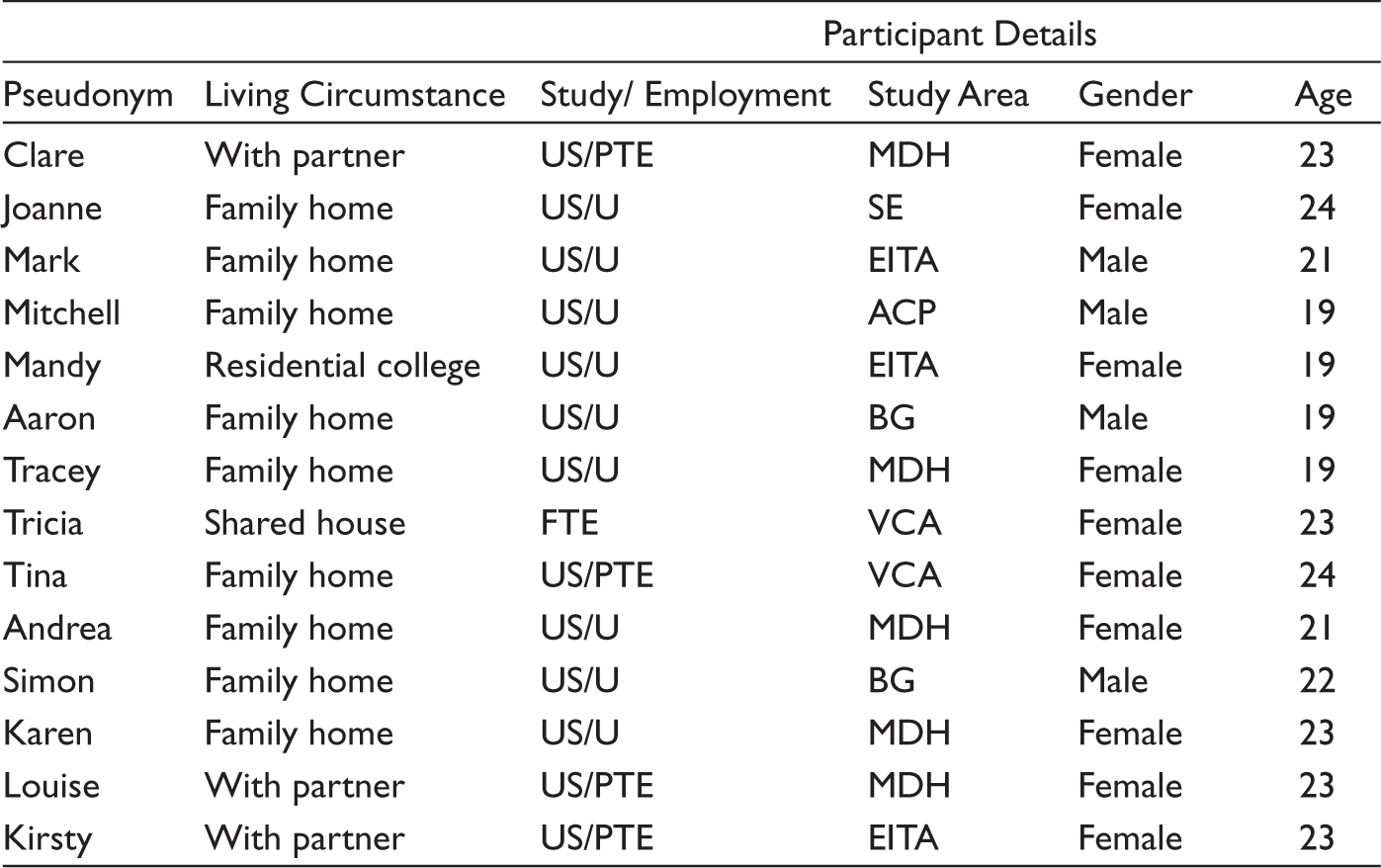
All interested participants were provided with the Informed Consent Package and offered the opportunity to ask questions. Once voluntary participation was agreed upon, participant consent was completed by email. Social distancing restrictions due to COVID-19 meant all interviews were held online via Skype or Zoom, booked at a mutually convenient time, and conducted by the first researcher ensuring consistency of technique. All interviews were audio-recorded with the participants’ permission and recordings transcribed verbatim. Transcripts were allocated a pseudonym, de-identifying the participant and maintaining confidentiality. The audio recording was deleted following transcription. The participants were not reimbursed in any way, however, all were thanked for their valuable voluntary participation.
Data Analysis
The analysis of the data was shaped by an interpretive phenomenological approach, whereby the participants made sense of their experiences whilst recounting them to the researcher, and the researcher interpreted the meaning of the participants’ accounts. The researcher acknowledged the importance of maintaining rigour in this data collection process, by practising reflexivity to reduce researcher bias. This involved using a critical process of inquiry where the researcher consciously acknowledged their own preconceived ideas and values of the social context being explored to avoid influencing the collection and interpretation of the data (Errasti-Ibarrondo et al., 2018). Thematic analysis, an inductive process of identifying and analysing patterns of themes within the data, was used to evaluate the participants’ responses (Scharp & Sanders, 2019). The process of thematic analysis has been outlined as compiling the data, disassembling the data and re-assembling the data (Castleberry & Nolen, 2018). Compiling the data commences with transcription of the interviews, a process during which the researcher becomes familiar with the data (Castleberry & Nolen, 2018). The data are then disassembled into meaningful groups or codes. The first researcher used a manual colour coding system and created a label or ‘description’ of each code to easily identify codes within the text.
The process was repeated for each interview, using a new colour/label when new descriptions appeared. Codes consisted of words, phrases or sometimes short sentences, representing the ‘what, where, when, why and how’ of the phenomena expressed by participants (Castleberry & Nolen, 2018). For example, peer pressure, supportive friends, perception of alcohol and experiences of others were codes regularly identified within the data. Codes were then re-assembled to form broader categories, capturing common responses and meanings between participants in relation to research questions asking what they felt about the culture of drinking in Australia, why participants chose to abstain and how they managed their abstinence. Themes that emerged from analysis of the responses were a strong sense of being, deflection of peer pressure using an empowered verbal response and choosing non-alcohol-related social activities.
Results
The participants were first asked why they chose to abstain in a culture where drinking is considered the norm, as per the semi-structured interview schedule (see Appendix). Symbolic interactionism describes how individuals assign meaning to things in order to decide how to react to them, and how meaning evolves through social interactions (Handberg et al., 2015). Meanings assigned to alcohol by the participants included but were not limited to it being costly, unhealthy and simply unnecessary as shown in Table 2.
Reasons for Abstaining
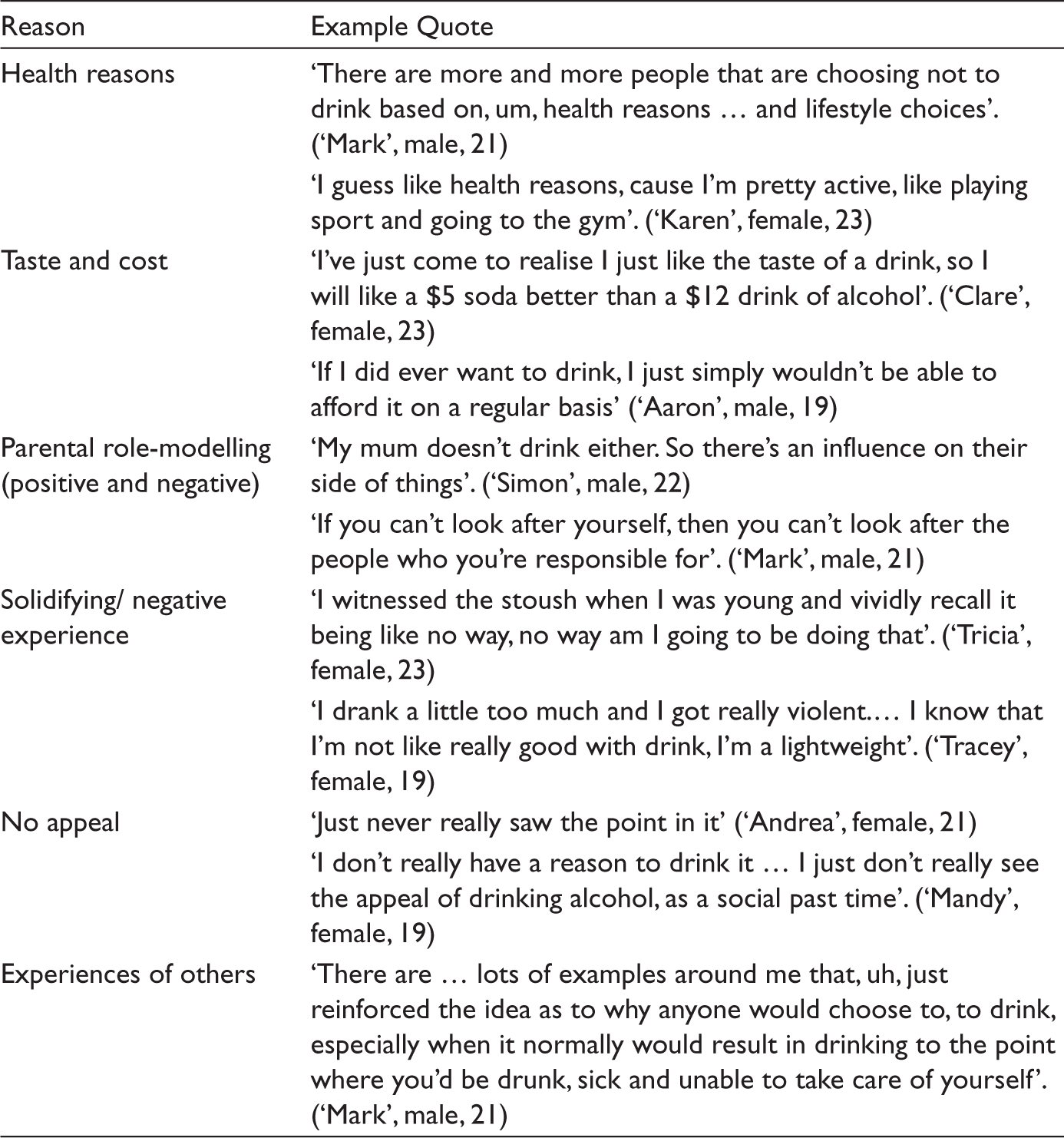
For many participants, the social contexts and their interactions with others shaped the meaning further, through associated negative experiences and solidifying moments. All participants had consumed alcohol at least once in their lifetime, with seven reporting consuming alcohol for a period of time. However, there was no notable difference between participant reasons for abstaining based on previous consumption levels. In order to understand how the participants assigned meaning to alcohol in contemporary social contexts, the participants were asked to describe their feelings about the practice of drinking in Australia. They described a culture where alcohol is embedded within social practices at both macro and micro levels.
Social Contexts of Drinking
The following examples of different social contexts demonstrate how the participants assigned meaning to alcohol when considering the contextual forces. The participants first described the alcohol drinking culture more broadly as prevalent and a common element of social practices in young adult groups. Tricia (female, 23) who had recently graduated with a degree in the visual and creative art area, described the widespread use of alcohol within Australia as problematic: ‘It’s part of our culture, it’s part of our media, our celebrities are based on it, our sports people are based on it’. Mitchell (male, 19) described alcohol consumption as a ‘wild, common thing to do across Australia’ and something he had ‘turned down a lot’. Tracey (female, 19) viewed it as a social practice particularly associated with the micro-context of university life, and this experience solidified her non-drinking; ‘So first year uni, you know, the whole culture of it, like partying and drinking and getting into that mold, the first trimester was pretty bad’. Whilst this study sample consisted of mainly university students, the participants spoke of their experiences in other social contexts, including the Australian Defence Force (ADF) and rural areas, where drinking was common and expected.
The consumption of alcohol was described as particularly prevalent and risky amongst young adults in the micro-context of the ADF, as experienced by two participants who had since left the ADF for non-alcohol-related reasons. The combination of readily available subsidized alcohol and a young adult population receiving a salary, appeared to exacerbate heavy and frequent drinking practices in ADF youth: ‘They have these drinks for $2 or something like that, really cheap. So that’s why a lot of people drink in the defence force ‘cos you can get it like dirt cheap’ (Karen, female, 23). Mark (male, 21) felt that drinking was widespread in Australian society and culture but described the ADF drinking culture as ‘toxic’ and ‘potent’ and how he made a pre-emptive decision to uphold his non-drinking to maintain his professional reputation.
Rural locations were also described by participants as ‘risky drinking’ settings with the prevalence of alcohol serving outlets and the lack of alternative activities contributing to the normative drinking culture. Karen (female, 23) for example described the country town context she lived in previously as ‘pretty big drinkers’ and Tricia’s (female, 23) experience of drinking behaviours in a rural town was seen as ‘problematic in the extreme’. The drinking practices of rural locations and the ADF demonstrate differing motivations for drinking, such as the lack of alternative rural social opportunities and cheap and readily available alcohol in the ADF. As such the meaning of the participants from these settings assigned to alcohol evolved through experiencing other’s risky and problematic drinking. The experiences facilitated their decision to choose an alternative practice, against the perceived normativity of drinking. In order to further understand how meaning towards alcohol evolved through their social interactions, the participants were then asked what it was like abstaining when amongst drinkers.
Pressure from Significant Others
Several participants described a pressure to conform to the predominant drinking behaviour in various social contexts. Karen (female, 23) described a social pressure that was more associated with her younger adult years: ‘When I was younger they’d be like, oh, just have one sip, you know, you might like it … you haven’t found your drink yet you know, you might like this’. The pressure from drinkers would often intensify when faced with the abstainer’s refusal of alcohol, as described by Mark (male, 21); ‘Like they’re constantly just trying to ask or push it to the point where they force me to have a drink’. Louise (female, 23) also recalled her experience of relentless peer pressure as a ‘constant tension’. The pressure was also applied using derogatory comments to one participant, questioning her choice to participate in the social occasion without alcohol, seen in this response; ‘They would say like … are you like the saint of the group? … if you didn’t want to drink, like, why’d you come?’ (Tracey, female, 19).
Pressure to drink was also experienced in the social context of close and extended family members, as Kirsty (female, 23) expressed: ‘My mom generally tries to push me into having a drink or two with her’. Several participants expressed frustration at their parents’ difficulty in accepting their abstaining choice, with parents’ persistent attempts to offer alcohol. Participants described how their parents hoped they would change their abstinence choice and ‘be just like everyone else’ (Tina, female, 24) or require a ‘justification and a reason’ for abstaining (Louise, female, 23). The participants’ experiences demonstrate a pressure on the abstainers to conform to the drinking norm. The participants had assigned meaning to alcohol and their non-drinking choice whilst experiencing social pressure to drink, actively going against the expected behaviour. For example, as expressed by Tricia (female, 23), ‘No you can definitely trust I am not going to do this’ and Mark (male, 21) who felt ‘to go against drinking [is] an uncommon act’. In order to understand how they managed their abstinence, the participants were asked how they dealt with this pressure.
Three Themes of Agency
Symbolic interactionists describe a fourth concept, that of human agency, as the motivation of the individual when considering the social contextual forces (Snow, 2001). The findings have indicated that this concept of symbolic interactionism was a more prominent theme evident in the participants’ behaviours who enacted agency to outwardly exist as abstainers. Three themes of such agency were identified within the participant experiences: (a) having a strong sense of being, (b) deflecting pressure from significant others by using an empowered verbal response and (c) choosing non-alcohol-related activities.
Strong Sense of Being
Most participants enacted their choice to abstain with a strong sense of being. The participants expressed a strong sense of who they were and were able to enact their individual choice as an abstainer comfortably amongst drinkers. For some, such as Simon (male, 22) who ‘never really cared for alcohol’, the abstaining appeared to happen without any pre-thought or planning and he found it hard to put into words: ‘I wouldn’t really know where to start because it just came naturally to me’. Joanne (female, 24) also described her strong inner sense: ‘It just came naturally to me.… I’m not really understanding it as like a conscious effort. I just don’t drink’. Alternatively, Mark (male, 21) described how he had always re-affirmed his own position with himself, expressing his sense of being and suggesting possible benefits of being an abstainer:
It’s perfectly fine not to drink … your time and money can be spent doing something much more productive … I had always told myself that it’s absolutely fine, it’s perfectly fine not to drink … I really don’t see like I’m missing out on anything … I really think that I optimise my time doing things that are beneficial.
The participants’ expression of their self-assured behaviours when considering the social pressures of a normative drinking context demonstrate a level of comfort with their determination and abstinence choice. Applying the theoretical framework of symbolic interactionism, the pressure to drink is viewed as a constraint to individual behaviour choices, but the agency of the individual to determine their own behaviour facilitates participants’ abstinence choices.
The exception to this strong level of comfort with their abstainer identity was evident in two participants’ responses who chose to drink Mocktails, a non-alcoholic alternative drink, as a way of passing as a drinker and avoiding questions. Kirsty (female, 23) said ‘It’s a good way to just like have a drink in your hand and maybe people assume you’re drinking so that you’re not constantly getting questions why you’re not drinking’ and Tricia (female, 23):
I tend to drink mocktails a lot or like other beverages … there’s some really phenomenal great fake spirit called Seedlip.… It’s like a fake gin … it looked real, and I was kind of like, this is a way I can be a part of it.
For these participants, the meaning assigned to alcohol remains, but they recognized the social norms around drinking and retained a sense of agency by altering their behaviour to manage their abstinence more discretely.
Three participants discussed how driving was useful as a non-drinker but were keen to convey they drove for other reasons such as convenience or logistics, as opposed to excusing their abstinence: ‘I did drive sometimes ‘cause it was convenient to me, but I wasn’t the designated driver’ (Louise, female, 23). Mitchell’s (male, 19) busy competitive sports schedule similarly determined his necessity to drive; ‘There’s not many other ways I could go out and not be the one driving home’. Kirsty (female, 23) conveyed her driving was more a choice of remaining in control and gave her the confidence to feel safe when socializing: ‘I like just driving places that I know I can drive home’. Most participants were aware of management strategies such as driving to conceal non-drinking but did not feel it necessary to adopt such strategies, choosing instead to act openly and with agency when amongst drinkers.
Mandy (female, 19) was keen to share her strong sense of being as something someone else could achieve: ‘You have it in yourself to make your choice to not drink … and you should hold onto that choice and not give in … it’s not embarrassing’. Similarly, Tricia (female, 23) expressed a strong sense of being and had encouraging words for anyone considering abstaining from alcohol: ‘You’re not disappointing anyone or letting anyone down or like letting your younger version of yourself down. Yes. You can do whatever you want. It’s absolutely fine’. All except three participants socialized in contexts with both drinkers and non-drinkers, demonstrating the potential situations where pressure to drink may arise. However, the strong sense of being exhibited by the participants empowered them to co-exist as an abstainer when amongst drinkers, by being comfortable with their abstainer identity. Abstainers used this strong sense of being when responding to the offer of alcohol within the social context of drinking, evident in their verbal responses.
Deflecting Pressure Using an Empowered Verbal Response
Most participants were able to deflect pressure from significant others, choosing not to conceal their abstinence when amongst drinkers and thus were able to co-exist as a non-drinker in a drinking culture. They demonstrated agency when using a determined verbal response to external differences in drinking practices, be it with family members, close friends or lesser-known peers. Participants were able to deflect the pressure to drink, outwardly identifying as an abstainer amongst drinkers, with a strong and honest response. Tracey (female, 19) who had experienced negative effects from alcohol, for example, responds, ‘I know that this isn’t for me.… I’m not good around like alcohol, so I’m not even going to go down that path’. Tricia (female, 23) dismissed questioning from her drinking peers with humour: ‘Some people kind of really push it, just like what happened to you? And then I always joke and I’m kinda like, there’s no trauma, like there’s no big story here’. Andrea (female, 21), who felt alcohol was not necessary for a good time, did not complicate her response to her peers with elaborate discussion when she faced questioning but simply deflected the pressure: ‘I’ve had a few situations where people have been like, why don’t you drink? This is so wrong … and I was like, I just don’t see the point’.
Another participant who decided to abstain in her early teens due to the health effects of alcohol deflected peer pressure by recounting the positives in her life in response to questions:
It was often those questions came back to me like, what’s wrong? why aren’t you doing this? why aren’t you drinking? and I’m like, dude I’m 23, I don’t drink, I don’t smoke, I have my own business … what could be wrong?! (Louise, female, 23)
The participants were firm in their decision and remained consistent during the experience of being pressured by others, at times also exerting pressure outwardly themselves in order to deflect the social pressure:
I just kind of lost it one day at a friend … and I just was like, hey, you know, like I’m not gonna, I’m not gonna start drinking. Like you can stop, you need to stop kind of doing that. (Tricia, female, 23)
Participants were aware of the curiosity and sometimes shocked reaction of drinkers to their alcohol refusal but described their responses as straightforward. Mitchell (male, 19) who experienced peer pressure to drink after sports games, described his experience of saying no to alcohol as something he did without pre-thought: ‘It’s just reactionary. I just say no’. Simon (male, 22), who was dedicating himself to his studies, described being ‘apt at shrugging off other people’s judgment’ and Kirsty’s (female, 23) response, when socializing with her partner’s drinking friends, was truthful and simple: ‘Sometimes I can just say like, no, I’d rather just drink water.… Um, and they’ll like back off’. Her ability to deflect pressure with an empowered verbal response had evolved over time: ‘I feel as I’ve got older I’ve got like better at saying like, no, I don’t want to’.
The fact that many participants had the ability to respond in a determined manner, with a simple empowered ‘no thank you, I don’t drink’ demonstrated agency in the process of abstaining. They had assigned meaning to alcohol, with this meaning emerging through their social interactions in the social contexts of both drinking and non-drinking groups. Overall, the participants did not demonstrate a need to offer social justification or expand their abstinence choice explanation. Whilst the abstainers demonstrated their ability to co-exist with drinkers, they also chose non-alcohol-related social activities with friends, regardless of drinking status.
Choosing Alternative Non-alcohol-related Activities
Alternative ways to socialise required agency in the participant’s behaviour, including consciously choosing activities such as Kirsty (female, 23) who enjoyed going to the beach or bowling; ‘I usually try and find an activity, um, rather than just like going to someone’s place to drink’. For some, this became a proactive way of avoiding the pressure of drinking, such as Joanne (female, 24) who acknowledged the discomfort alcohol-related activities caused, ‘I don’t tend to like the situations where alcohol usually comes up’ and Tracey (female, 19) who ‘put off going to parties’ after her drink was spiked. Several participants chose varying forms of gaming as a social activity, such as Joanne (female, 24) who spent time socializing online: ‘I play the Dungeons and Dragons occasionally and yeah, that’s usually during the day. So not much alcohol involved’. Karen (female, 23) also chose online gaming with friends she had known since high school, ‘I do play a lot of video games and stuff’ as did Simon (male, 22) who met with gaming friends in each other’s houses, ‘I play basically Dungeons and Dragons, once a week’.
Non-digital gaming such as card and board games were also social activities chosen by the participants: ‘I play magic the gathering, another card game … board games…’ (Simon, male, 22). Simon (male, 22) described how his friends met once a week next to a Craft Beer Bar, however, despite the proximity this did not mean they chose to visit it: ‘I think the whole time I’ve seen maybe one person go there and one of the people works there and he doesn’t even drink’. Whilst some may argue that youth who gravitate towards gaming may be less inclined to drink, research suggests this is not the case (Halkjelsvik et al., 2021; Pape et al., 2018). In our study, of the four participants who chose gaming as a social activity, two reported gaming with friends who drank alcohol, and one reported he did not actively avoid alcohol-related events. For some participants the choice of activity satisfied their non-drinking preference with other non-drinkers, where one participant felt that board games facilitated her involvement as a non-drinker with a group of drinking friends; ‘I’m here to play board games not to drink.… It sort of changes it from like a way to get a drink to, we get to like have fun and play board games’ (Kirsty, female, 23). Therefore, gaming served as means to engage with non-drinkers as well as friends who drink alcohol rather than being seen as an activity that non-drinkers do.
Some participants socialized with friends whilst visiting the cinema such as Andrea (female, 21): ‘I just go to the movies a lot … and we’ll have dinner or we’ll go see a movie and then we’ll just like, um, go shopping or something’. Karen (female, 23) said ‘we always love going to the movies and like bowling’ and Tracey (female, 19) described how she would ask her friends to ‘dinner or lunch or even better the beach’. Participants expressed the fact that while non-alcohol-related activities were preferred, it did not deter their friends who drank alcohol from socializing with them; ‘Most of my friends are like happy to go out and do things’ (Kirsty, female, 23) and how non-drinking is no longer a focus of conversation; ‘we don’t really talk about it. It’s just kind of like that’s her thing and that’s absolutely fine’ (Tricia, female, 23). The ability to pro-actively choose non-alcohol-related social activities may be contributing to shaping young adult drinking practices with, as one participant described, ‘more of a tolerance to people that want to do something different’ (Mark, male, 21) and ‘more people want to do other things’ (Mandy, female, 19). Thus, the participants were able to practice and maintain their abstinence outwardly in both drinking and non-drinking social contexts.
Discussion
The findings of this study demonstrate the pressure to drink in social contexts in Australia remains powerful, however, there is a shift towards young adults’ changing social practices, with some non-drinkers able to socialise in both drinking and non-drinking groups. Australia’s young adult drinking practices are described in previous research as all or nothing, with a go-hard or go-home approach to drinking (Advocat & Lindsay, 2015). This study sample consisted mostly of university students, of whom the expectation to drink is known to be high (Supski et al., 2017). Conversely, this study’s participants described how they outwardly practised their abstinence, having both drinking and non-drinking friends. Half of the participants had been drinkers for a period of time, but interestingly the data does not suggest they had to change their existing interests or other lifestyle activities to become abstainers, however, new non-drinking activities did emerge. The findings have demonstrated through the lens of symbolic interactionism, these contemporary young adult abstainers are comfortable socializing with drinkers, which may indicate a shift in attitude towards non-drinking. The participants are essentially ‘out and proud’ abstainers with a strong sense of being, feeling comfortable in their own skin and not concerned with concealing their abstainer identity. This contrasts with results found in previous studies where abstainers have distanced themselves from the negative stereotypical abstainer identity, choosing to deny, disassociate from or conceal their non-drinking identity (Banister et al., 2019; Herman-Kinney & Kinney, 2013. These findings could reflect a changing landscape of young adult social groups, consisting of increasingly diverse social identities and a greater prevalence of varying social practices.
The participants’ frustration at experiencing pressure from significant others to drink appears to drive their determined action in the form of their strong sense of being and verbal response. This contrasts with previously described strategies of using a subject position to excuse their non-drinking, such as the designated driver or caretaker (Advocat & Lindsay, 2015). Whilst the findings of this study also demonstrate the use of such strategies, they were not often utilized. Conversely, this study’s participants outwardly identified as abstainers amongst drinkers without adopting strategies to manage their abstinence, as has previously been reported (Herring et al., 2014; Pennay, MacLean et al., 2018). Most participants were able to use their strong sense of being through verbal responses in social situations to continue socializing and maintain their non-drinking position. This verbal deflection of the pressure to drink differs from previous findings where non-drinkers have adapted their response to the social context, walked away to avoid further pressure or provided a social justification for their non-drinking (Herring et al., 2014; Frank et al., 2020). There has been an increasing interest in understanding how young adults achieve their non-drinking practice within heavy drinking cultures (Caluzzi et al., 2020; Supski & Lindsay, 2017) and these findings contribute to this growing body of work.
The findings of this study may be useful when considering the types of social events where risky or heavy drinking amongst young adults is prevalent, such as music festivals and nightclubs (Dresler & Anderson, 2018). The emergence of the conscious clubbing movement, where the focus is on alcohol-free music and dancing events, is a deviation away from the association with alcohol and an opportunity for young adults to socialise without alcohol and have a good time (Davies et al., 2019). However, the findings from our study show that such segregation may not be necessary and that drinkers and non-drinkers can successfully mix. Furthermore, they could be used to encourage those who wish to abstain from alcohol while attending mainstream events to promote an alternative social non-drinking practice ‘within’ contexts where heavy drinking is prevalent.
Supski and Lindsay (2017) argue the positive abstainer identity has remained absent from the literature, with abstainers balancing agency and strategies such as choosing one’s peers. This study’s participants demonstrated agentic action over adaptive strategies, deflecting peer pressure as opposed to resisting it and that peer selection was not necessarily required in managing the abstainer identity. This contrasts with abstainers reporting avoiding non-drinking groups, as a way of concealing their drinking status to avoid the associated stigma (Pavlidis et al., 2019). The findings would suggest that the practice of abstinence is not a detrimental factor in determining either friendship formation or maintenance and is not prohibitive to socializing in young adult groups. This ability to co-exist in drinking and non-drinking social contexts contributes to normalizing the communication around non-drinking, with social interactions regarding non-drinking choices becoming more prevalent and increasing young adults’ exposure to alternative behaviours.
The participants interviewed were engaging openly as non-drinkers in homogenous groups of non-drinkers, using agentic action to choose alternative non-alcohol-related activities, such as gaming or going to the movies. The shift in the uptake of alternative social activities not focused on alcohol is a positive behaviour trend to promote amongst young adults. Furthermore, this study contributes to the literature by demonstrating abstainers chose not only to avoid alcohol-related activities but embrace activities with their friends that drink alcohol, whilst maintaining their abstinence. Through the lens of symbolic interactionism, this social practice can be explained as the individual’s creation of new meaning shaping their world, giving rise to a changing society (Carter & Fuller, 2016), as opposed to society constraining an individual’s choices.
The theory of symbolic interactionism facilitates our interpretation of the findings, whereby the participants demonstrate agency in their choice to abstain from drinking alcohol and maintain their abstinence within a social context of drinking. Whilst competing norms such as cost of alcohol or health reasons may have shaped the participant’s abstinence choice, this study highlights the agency participants used when abstaining among drinkers. They demonstrated a level of agentic action in participating as a non-drinker despite the social pressure to drink. Symbolic interactionism describes how the social process facilitates a ‘bottom-up’ approach to societal functioning and how the repeated purposeful interactions of individuals characterise a society (Carter & Fuller, 2016). This theoretical framework helps us understand how the increasing trend of abstaining is evolving, with the individual’s experience creating new meaning within social contexts where drinking is common. The abstainers’ ability to co-exist with drinkers facilitates a positive ‘collective’ movement and in turn, may help the social acceptance of the abstainer amongst young adult drinkers. The findings offer insight into how young adults who wish to refrain from drinking alcohol, can and may empower potential non-drinkers in their behavioural choices. The study findings could also be relevant to other countries with similar problematic binge-drinking cultures, such as the United Kingdom and the United States of America (Conroy & de Visser, 2013; Herman-Kinney & Kinney, 2013) to support young adults experiencing difficulties when considering non-drinking.
Limitations
Whilst the study has contributed to the body of knowledge in the field of abstinence within settings where drinking alcohol is common and offers considerable insight into the lived experience of the abstainer, it is not without limitations. The use of symbolic interactionism as a theoretical framework may limit the scope of the findings as it focuses on individual interpretations of meaning through social interactions and does not describe the broader macro-level structures that may contribute to the interpretation. The study sample is disproportionately female, and therefore an equal balance of male/female participants may have provided an alternative representation of this young adult group. The majority of the participant sample were university students, potentially narrowing the experiences of abstainers to within university social settings as opposed to their experiences at a macro-level of societal social practices. Finally, the ability of the researcher to conduct their research with reflexivity in considering the social context of the study and avoid influencing the data collection and analysis is a potential limitation in this qualitative study.
Conclusion
Examination of the lived experience of the abstainer, in a normative drinking culture, suggests abstainers participate openly without concealment of their identity, with the ability to choose to participate in both drinking and non-drinking groups. The young adult abstainers used agency to deflect pressure from significant others and enact their choice to abstain without concealment. However, the drinking culture of young adults remains a public health issue, with heavy consumption of alcohol being the norm in this age group. Therefore, the findings of how these contemporary abstainers co-exist amongst drinkers may inform health promotion campaigns aimed at continuing to create heterogenous drinking contexts and addressing the normative communication of alcohol. These findings may support non-drinkers in their behavioural choices by raising awareness of individual skills for health behaviour management and non-alcohol alternative contexts. These findings may also influence young adults considering non-drinking, further supporting the abstinence trend.
Future Research Recommendations
It would be most valuable to explore the impact of the presence of abstainers amongst drinkers, as there is limited evidence demonstrating the moderation effect of non-drinking on heavy drinking patterns. Furthermore, qualitative research exploring the experiences of sober curious young adults, those that are questioning their drinking habits and perhaps considering abstaining from drinking, would be useful to understand the contextual forces young adults face when considering this change.
Footnotes
Acknowledgements
The researchers thank all participants for sharing their experiences and making this research possible.
Consent to Participate and for Publication
All research participants provided voluntary informed consent to participate in the study and consent for publication of the study findings.
Declaration of Conflicting Interests
The authors declared no potential conflicts of interest with respect to the research, authorship and/or publication of this article.
Ethics Approval Statement
Ethical clearance was obtained from the Griffith University Human Research Ethics Committee and the scope of the research was conducted according to the National Statement on Ethical Conduct in Human Research 2007 (Updated 2015).
Funding
The authors received no financial support for the research, authorship and/or publication of this article.
Appendix
The consumption of alcohol is common in Australia and is considered the norm in society.
What are your feelings about the culture of drinking alcohol in Australian society?
(Prompts: Family / School / University / work / sport)
What is your experience of abstaining when amongst drinkers and/or peers?
What is it like saying ‘no’ to alcohol when among drinkers and/or among peers?
How have the recent COVID-19 social restrictions affected your experience of abstaining?