



Abstract
This article examines the role of social capital within families and its interaction with parental socio-economic status in shaping the likelihood of young adults in Germany experiencing episodes of not being in employment, education or training (NEET). Using longitudinal data from the German Family Panel (pairfam), we reconstruct trajectories for the initial 5 years after leaving school that include the occurrence and persistence of NEET episodes. The findings indicate that family social capital, in particular parent–child communication built on trust and feelings of emotional security towards parents, can lower the risk of long-lasting and recurring NEET episodes. Moreover, high levels of family social capital can even out differences in the likelihood of experiencing NEET episodes according to socio-economic background.
Introduction
Germany is well known for its efficient youth transition system with smooth school-to-work transitions (STWT) and successful labour market entries (Walther, 2006), evidenced by one of the lowest incidences of young people not in employment, education or training (NEET) in Europe (Assmann & Broschinski, 2021; Eurofound, 2016). Over the last few decades, however, adolescents’ transitions into the labour market have become more diverse and insecure as well as less standardized and linear (Achatz et al., 2022; Achatz & Schels, 2023; Brzinsky-Fay, 2022; Brzinsky-Fay & Solga, 2016; Holtmann et al., 2019), leading to a prolongation of this life stage and raising the bar for young people to manage their transition to adulthood (Schoon & Silbereisen, 2009).
In this situation, educational and occupational decision-making is not only shaped by structural constraints (e.g., the selectivity, standardization and segregation of the education system or the business cycle) but more and more by individual choices (Kohli, 2007). However, these decision-making processes are embedded in social constraints defined by the individuals’ socio-economic contexts (Schoon & Lyons-Amos, 2016), which are predominantly shaped by their family of origin, for example, parental social networks (Roth, 2018; Roth & Weißmann, 2022), parental educational and occupational expectations (Fischer-Browne, 2022; Pinquart & Ebeling, 2020), the alignment of parental and students’ goals (Kim & Schneider, 2005), the degree of parental support (Swartz et al., 2011, 2017) and parental occupations, social class and employment status (Schoon, 2014; Stocke, 2007; Whiston & Keller, 2004b).
While information and knowledge as well as financial resources are quite helpful during the STWT, it is an open question whether and how parents are able to effectively incorporate these resources into their child-rearing to promote successful career development. The intergenerational transmission of resources, knowledge and values may thus depend more on the quality of the parent–child relationship, such as parents spending time and effort on their children, consistent interactions or strong affectual bonds, which can be subsumed as the social capital within families (Broschinski et al., 2022).
Against this background, this study examines the role of the family of origin during the initial 5 years (60 months) of young people’s career development by addressing the following research questions: (a) How does a family’s social capital shape the success of young adults’ STWT in terms of experiencing NEET episodes? (b) How does family social capital interact with parental socio-economic background in shaping the risk of experiencing NEET episodes?
This study makes several contributions to the literature. First, by analysing the association between family social capital (alongside and in interaction with parental socio-economic status) and the occurrence and duration of NEET episodes during the STWT, it opens the black box of ‘family background’ and the process of intergenerational transmission. Second, instead of viewing transitions into working life as a single status change, we use longitudinal data and sequence analysis to show that this transition is a process characterized by multi-layered and highly diverse trajectories. This longitudinal perspective provides a more detailed picture of the diversity of STWTs in Germany including NEET episodes. Third, by using path analysis, we are able to investigate not only the influence of the family’s human, financial and social capital on the occurrence of NEET episodes during the STWT but also the existence of mediators and moderators between these types of capital, that is, the interaction between parental socio-economic status and the parent–child relationship.
The article is structured as follows. The next section discusses the particularities of NEET episodes in the German transition system followed by a third section briefly reviewing previous findings on the incidence and characteristics of NEET episodes in Germany. The fourth section presents the theoretical framework for this study and the role of family social capital on youth transitions. Subsequently, the data and methods are discussed and the empirical findings presented. The article closes with a brief summary of the most important findings and a conclusion.
The German Transition System
International comparative research has highlighted that different institutional settings have a significant impact on the number of young people classified as NEETs and the composition of this group (Assmann & Broschinski, 2021; Eurofound, 2016). The institutional landscape in Germany can be considered an employment-centred transition system (Walther, 2006), characterized by a highly selective and standardized education system and a strong emphasis on vocational training. School students and, first and foremost, their parents have to take crucial decisions at a very early stage. After primary school, students start one of three main educational tracks according to their prior performance. These tracks, which are relatively hard to switch, lead to the lower school-leaving certificate (Hauptschulabschluss), the intermediate school-leaving certificate (Realschulabschluss) or the higher school-leaving certificate (Abitur). The types of certificates are clearly distinct with respect to requirements, curricula, duration and qualification and therefore strongly determine adolescents’ later STWT.
In many cases, school leavers with lower-secondary education enter the dual system of vocational education and training (VET), combining company-based apprenticeship training with school-based vocational education, which is considered the ‘royal road’ to employment (Achatz & Schels, 2023) because vocational training has traditionally been the route followed by the overwhelming majority of school leavers (BIBB, 2024). STWTs in Germany are thus strongly shaped by the highly standardized and stratified VET system (Kleinert & Jacob, 2019). Students with an upper-secondary degree (Abitur) are entitled to continue with higher education.
In Germany, schooling is compulsory from the age of 6 to the age of 18. The obligation to attend school full-time lasts until the 9th or 10th grade. After that, there is an obligation to attend further schooling (e.g., Gymnasium) or vocational education until age 18. For those under the age of 18 who fail to enter either VET or higher education, participation in prevocational education programmes—provided by the national employment service’s career service—is obligatory but does not lead to recognized VET certificates (Brzinsky-Fay & Solga, 2016; Protsch & Solga, 2016). The aim of these schemes is to develop readiness for vocational training and prepare school leavers to take up regular apprenticeships by providing initial basic vocational skills (BIBB, 2024). The consequence of these legal requirements is that, by definition, NEET status is not legally possible before the age of 18. These prevocational programmes, however, are viewed critically in some quarters. It is sometimes argued that participants are kept in interim programmes rather than receiving serious educational or training opportunities (Heinz, 2014; Holtmann et al., 2019, 2021). Against this background, it seems more appropriate to categorize young people in prevocational training schemes as being NEET rather than being in education or training—at least in the case of minors—as the effect this activity status has on the accumulation of human capital is similar to inactivity.
Another aspect of the German youth transition system is the possibility of short NEET episodes due to ‘institutionalized gaps’ affecting transitions between school and the vocational system or university. For example, many students leave school in June and start vocational training in August or higher education in October, leading to transition-specific NEET episodes. Consequently, NEET episodes can occur at different transitional stages: between school and university/VET, between two different contracts or as an episode where people cannot work or decide not to for different reasons.
STWTs in Germany and the Incidence of NEET
While episodes of higher education, VET or employment are seen as characteristics of successful and promising STWTs, extensive or repeated episodes of being NEET indicate a more vulnerable transition, as they are associated with lower human capital development and a higher risk of future labour market disadvantages (Contini et al., 2019; Luijkx & Wolbers, 2009; Ralston et al., 2022). Compared to other European countries, Germany is known for one of the lowest incidences of young people not in employment, education or training. Only around 7% of the 15- to 29-year-olds in Germany are designated as NEET compared to 15%–23% in countries like Spain, Greece or Italy (Assmann & Broschinski, 2021). However, momentary snapshots such as the cross-sectional NEET rate tell only one part of the story, as recent longitudinal and sequence analyses of young people’s educational and vocational trajectories reveal a more complex and diverse picture of STWT patterns in Germany. According to Brzinsky-Fay and Solga (2016), a vast majority of adolescents in Germany (about 84% across five different cohorts) experienced a more or less ideal typical STWT, in the form of either VET trajectories (70%) with different lengths of schooling or a university pathway (13.6%). However, they also observed a trajectory of instability (5.7%), showing a high degree of non-linearity, with young people on this pathway experiencing a high number of status shifts and long and frequent NEET episodes. Until the age of 30, 18% of these people had never been employed (Brzinsky-Fay & Solga, 2016). Moreover, the researchers also found a tendency towards increasing disadvantages in the STWT for younger cohorts, in particular for those with lower education (Brzinsky-Fay & Solga, 2016).
Broschinski et al. (2022) draw a similar picture of STWT patterns in Germany (based on a more recent cohort (1991–1993) compared to Brzinsky-Fay & Solga, 2016). They found seven different STWT patterns for Germany limited to a 60-month period after leaving school. While the majority of young people follow a more or less standard and linear pathway over the initial 60 months after leaving school, that is, two clusters of academic tracks (36%) and four different VET clusters (52.3%), one cluster with highly erratic trajectories includes about 12% of all young people. The latter is characterized by a non-linear school-to-work transition pattern, marked by no clear occupational progression and the frequent occurrence of NEET phases.
The most comprehensive study on the prevalence of NEET episodes in the STWT in Germany by Brzinsky-Fay (2022) reveals that about 50% of labour market entrants experienced at least a 1-month NEET period during their transition to working life (Brzinsky-Fay, 2022). Against this background, it becomes clear that experiencing a period of being NEET is much more widespread in Germany than commonly perceived, and its occurrence differs far more in terms of duration and frequency rather than whether it occurs at all. Further differences can be observed in particular with regard to the duration and solidification of the NEET status (Brzinsky-Fay, 2022): while trajectories of early and late higher education (19.8%) as well as short and long VET (44.7%) contain very few and short NEET episodes, about 13% of young people experience very long durations of NEET status and 17.2% exhibit very discontinuous trajectories. These results show that NEET trajectories are very heterogenous in Germany. Among all of those who experienced at least one NEET episode during their STWT, women, people born abroad, people with children as well as younger birth cohorts seem to have the highest risk of experiencing NEET episodes (Brzinsky-Fay, 2022).
With regard to educational attainment, Achatz and Schels (2023) found that 9% of school-leavers under 21 with a lower or intermediate school-leaving certificate followed a non-directional progress trajectory with a high degree of instability, including repeated unemployment spells and participation in different labour market programmes and training schemes. The disadvantages of school leavers with lower secondary school certificates are even more pronounced in the case of students leaving special needs schools, which works as an institutional label, resulting in long-term scarring effects and higher NEET risks compared to other low-attainment students (Menze et al., 2023).
Family Background, Social Capital and Early Career Development
As mentioned above, the German transition system requires a series of decision-making processes that largely take place within the family of origin. While there is a large body of research examining the crucial role of the family with regard to emerging adulthood (see Oliveira et al., 2020; Pinquart & Ebeling, 2020, for a systematic review) as well as educational achievement (Buis, 2013; Bukodi & Goldthorpe, 2013; Ermisch & Francesconi, 2001; Heisig et al., 2020; Li & Qiu, 2018; Li & Xie, 2020; Minello & Blossfeld, 2017; Mönkediek & Diewald, 2022; OECD, 2018; Otani, 2019; Roksa & Potter, 2011; Schleicher, 2019; Schulz et al., 2017), family background tends to play only a subordinate role in the STWT literature or is limited to parental socio-economic status (e.g., Brzinsky-Fay, 2022; Byun, 2018; Caroleo et al., 2022; Ciccarelli & Fabrizi, 2017; Erola et al., 2016; Pitkänen et al., 2021; Sirniö et al., 2017; Smith et al., 2016).
Following Coleman (1988, 1990), however, family background is composed not only of parental human capital (knowledge, skills and capabilities) or financial capital (income or wealth) but also of the family’s social capital—which receives much less attention in the STWT literature. In Coleman’s understanding, family social capital exists in personal relations and can be understood as the link between individuals and their immediate familial environment, that is, intrafamilial relationships (parent–child) as well as extrafamilial relationships between members of the community (neighbours, school or other parents). These two types of family social capital are usually described as bonding and bridging social capital (Putnam, 2001).
In recent years, there has been a growing trend towards researching STWT in the tradition of Burt (1995), Lin (1999) and Granovetter (1974) that conceptualizes (family) social capital as the accessibility of resources (e.g., information about apprenticeships or vacant jobs) via parental social networks, thus focusing on bridging social capital and weak rather than strong ties (e.g., Roth, 2014, 2018; Roth & Weißmann, 2022). However, the role of bonding social capital on early career development, that is, the quality of intrafamilial relationships and family structure, has still not been sufficiently researched. To the best of our knowledge, only few studies have examined intrafamilial relationships with regard to the STWT or NEET episodes (e.g., Alfieri et al., 2015; Broschinski et al., 2022). Therefore, the focus of our study lies on the role of intrafamilial social capital.
In this context, family matters in terms of not only whether parents possess crucial resources (e.g., knowledge or money) or social contacts but also of how much time and effort they invest in their offspring and whether they engage in consistent interactions. This behaviour can build strong affectual bonds through which resources and knowledge as well as norms, expectations and obligations are transmitted to the next generation (Hoffmann & Dufur, 2018). The value of intrafamilial social capital is thus embedded in the relationships between family members, which can be utilized by individuals as resources to achieve their aims and interests (Furstenberg & Kaplan, 2004). Therefore, Coleman concluded that ‘if the human capital possessed by parents is not complemented by social capital embodied in family relations, it is irrelevant to the child’s educational growth that the parent has a great deal, or a small amount, of human capital’ (Coleman, 1988, p. 110).
Moreover, two dimensions of family social capital can be distinguished: one refers to its structure and the other to its function. Structure describes the potential time and effort that parents can invest in their offspring, which requires both their physical presence and their attention (Coleman, 1988). Therefore, the number of adults/parents in the household as well as the number of siblings plays a crucial role for intergenerational transmission. Single-parent families or families with more than one child might therefore have a structural disadvantage compared to dual-parent families with only one child by having fewer capacities for activities, support or communication (Cáceres-Delpiano, 2006; Chen, 2020; Coleman, 1990), resulting in negative effects on educational outcomes (Bernardi & Boertien, 2017; Francesconi et al., 2010; Ginther & Pollak, 2004; McLanahan et al., 2013) or career development (Klein et al., 2022).
In addition to the physical presence and attention given by parents, the functional dimension of family social capital describes the quality of parent–child relationships. Engaging in consistent interactions and trusting communication is crucial because it contributes to the intergenerational transmission of norms, work values and ideas about career development (Cemalcilar et al., 2018; Sümer et al., 2019). It is well documented that spending time with offspring (e.g., learning together or support with schoolwork) has a positive effect on children’s commitment in school (Doepke & Zilibotti, 2019; Merçon-Vargas et al., 2020). Moreover, effective and positive parent–child communication is important, since children develop ideas and beliefs about themselves based on how their parents communicate with them (Runcan et al., 2012; Schrodt et al., 2008; Smith et al., 2009). It also helps in building individual resilience and coping with stress (Theiss, 2018).
In addition, strong emotional bonds between parents and children are crucial for young people’s decision-making processes (Blustein et al., 1995). It is well known that strong affective ties support emotional stability, encourage autonomy and occupational exploration, and promote successful individuation (Berríos-Allison, 2005; Diewald & Lüdicke, 2007; Kracke & Noack, 2005; Whiston & Keller, 2004a). These characteristics enable young people to choose the path that suits their interests and abilities best, without having to worry about disappointing their parents or losing their affection (Bynner & Parsons, 2002; Côté, 2016). Therefore, Coleman argues that ‘[t]he existence of a strong relation between adult and child must be regarded, on the whole, as a source of social capital important for the development of the child’ (Coleman, 1990, p. 593). This leads us to our first assumption:
H1: Higher degrees of family social capital, that is, a functional family structure, trusting communication, strong emotional bonds as well as parental support, are associated with fewer and shorter NEET episodes during the STWT.
The three forms of capital (human, financial and social) are of course not completely independent of each other. This means that the level of the family’s social capital might be correlated with parental socio-economic status. Indeed, it is very well documented that parenting practices and parental values vary strongly by social class, in particular due to disparities in resources between upper-class and lower-class families (Cano, 2022; Kohn, 1976; Lee, 2023; Sherman & Harris, 2012). The central underlying mechanism is that low income, material deprivation and higher levels of uncertainty lead to reduced physical and cognitive capacities, resulting in more conflicts between family members and a decline in parent–child attachment (Conger et al., 2010; Masarik & Conger, 2017). Additionally, a higher level of parental education is found to have a positive influence on parenting practices, as parents with higher education spend far more time with their offspring (e.g., by monitoring homework), teaching study skills and emphasizing school readiness (Lareau, 2012; McLanahan, 2004). Furthermore, upper-class parents seem to be more committed to autonomy and self-direction (e.g., self-control, curiosity, passion for learning), while lower-class parents tend to value obedience and conformity to authority (Alwin & Tufiș, 2021; Kohn, 1976; Weininger & Lareau, 2009).
Against this background, we assume the following mediations resulting in indirect relationships between socio-economic status and periods of being NEET:
H2a: Higher parental socio-economic status results in higher degrees of family social capital, which in turn has an additional indirect effect on the risk of experiencing NEET episodes during the STWT.
Moreover, as educational level is one of the most significant factors affecting the risk of experiencing NEET episodes, and is itself strongly affected by socio-economic background as well as the level of social capital within the family, we further assume an additional indirect effect of parental socio-economic status and family social capital on NEET experiences during the STWT beyond the offspring’s educational attainment.
H2b: Higher parental socio-economic status and greater family social capital have an additional indirect effect on the risk of experiencing NEET episodes during the STWT.
In addition to the direct and mediating effects of family social capital, moderating effects can also be expected. Therefore, the negative effect of parental socio-economic status on experiencing NEET episodes during the STWT can be assumed to be moderated by the level of family social capital. In his seminal work, Coleman (1990) pointed out that parents can compensate for structural disadvantages, such as a lack of monetary resources or knowledge, with high levels of investment in their offspring. Therefore, we assume that high levels of family social capital are able to even out differences in the likelihood of experiencing NEET episodes during the STWT according to the socio-economic background.
H3: Higher levels of family social capital moderate the negative effects of a lower socio-economic status on the risk of experiencing NEET episodes during the STWT.
Data and Method
Data
This study uses data from 11 waves (2008/2009–2019/2020) of the German Family Panel, pairfam (Huinink et al., 2011). Pairfam provides detailed information on the respondents’ educational and employment careers as well as information on their relationships with parents, peers and partners (Brüderl et al., 2020), thus opening up unique opportunities to study the STWTs of young people in Germany. Our sample includes respondents from the first birth cohort from 1991 to 1993, who were 15–17 years old in 2008 when the first wave was conducted. We limit the observation period to 60 months after they left school. As a result, the observation periods are identical for all observation units. Moreover, the period is long enough to see how often and for how long NEET episodes occur during the first years of the transition from school to work, thus allowing comparisons with other studies (Brzinsky-Fay, 2007; Scherer, 2005). For missing information on the months between the age of 15 and the first observation, we draw on the retrospective bioact data to achieve a common starting point for all individuals. As the number of variables with missing values is relatively high and a list-wise deletion would lead to a significant reduction in sample size, we decided to estimate missing values via the Full Information Maximum Likelihood method (Allison, 2012; Hayes & Enders, 2012). In order to avoid further missings due to missing information about the mother/father of the respondent, we split the whole sample into two sub-samples: the first one contains only information with regard to the mother and the second contains only information about the father. The mother’s sub-sample contains 1,572 individuals, and the father’s sub-sample contains 1,292 individuals. 1
Measures
The main variable of interest is young people’s employment status, which was operationalized for an observational period of 60 months directly after leaving school. We use monthly status information to generate detailed transition sequences. To keep the transitional trajectories as simple as possible, we restrict our analysis to three different activity statuses: education, employment and NEET. For a detailed recoding of the 22 statuses from the original activity variable into these three statuses, see Table A1 (Supplemental Material). NEET status exists if the respondent has one of the following activity statuses: unemployment, retirement, maternity leave, homemaker and other forms of non-employment. Education is regarded as any form of education, training and apprenticeships including internships as well as civil/military service. Employment is considered any form of regular or marginal employment as well as irregular forms of employment. In light of the above discussion of prevocational training programmes in the German transition system, we decided to also consider under 18-year-olds in prevocational education as NEETs. 2
Some scholars argue that the length of the NEET episode is more important than its occurrences per se. Bynner and Parsons (2002) argue that only episodes longer than 6 months matter for future employment prospects, while others emphasize repeated spells (Eurofound, 2016). Therefore, the main focus of this study is the frequency and persistence of NEET episodes. Thus, we construct a direct measure—the NEET intensity score (NIS). The NIS is inspired by Manzoni and Mooi-Reci’s (2018) measure of success and failure within sequences and is constructed by adding up the number of month-long NEET episodes, which are then weighted by their position in the whole sequence (from 1 to 60) relative to the whole length of the sequence (60 months). 3 Thus, later NEET episodes have higher weights. The weighting of the NEET episodes by their chronological position is justified by the structure and institutions of the German education and training system. 4
For testing our hypotheses on family social capital, family structure is measured by two items: first, by the question whether parents were ever separated and, second, by the number of siblings the respondent grew up with. With regard to the function of family social capital, three different indexes are used, each consisting of the mean value of various items (see Table 1). Trusting communication encompasses the quality of parent–child communication in terms of sharing thoughts or secrets with each other as well as healthy forms of conflict resolution. Emotional security enquires about the (feared) parental reaction to the adolescent’s misbehaviour or failure as well as the existence of unfulfilled bonding needs towards the parents. Parental support is measured by the self-perceived support received from parents regarding giving advice, receiving help in preparing documents or homework and receiving financial help.
Description of Measures and Items.
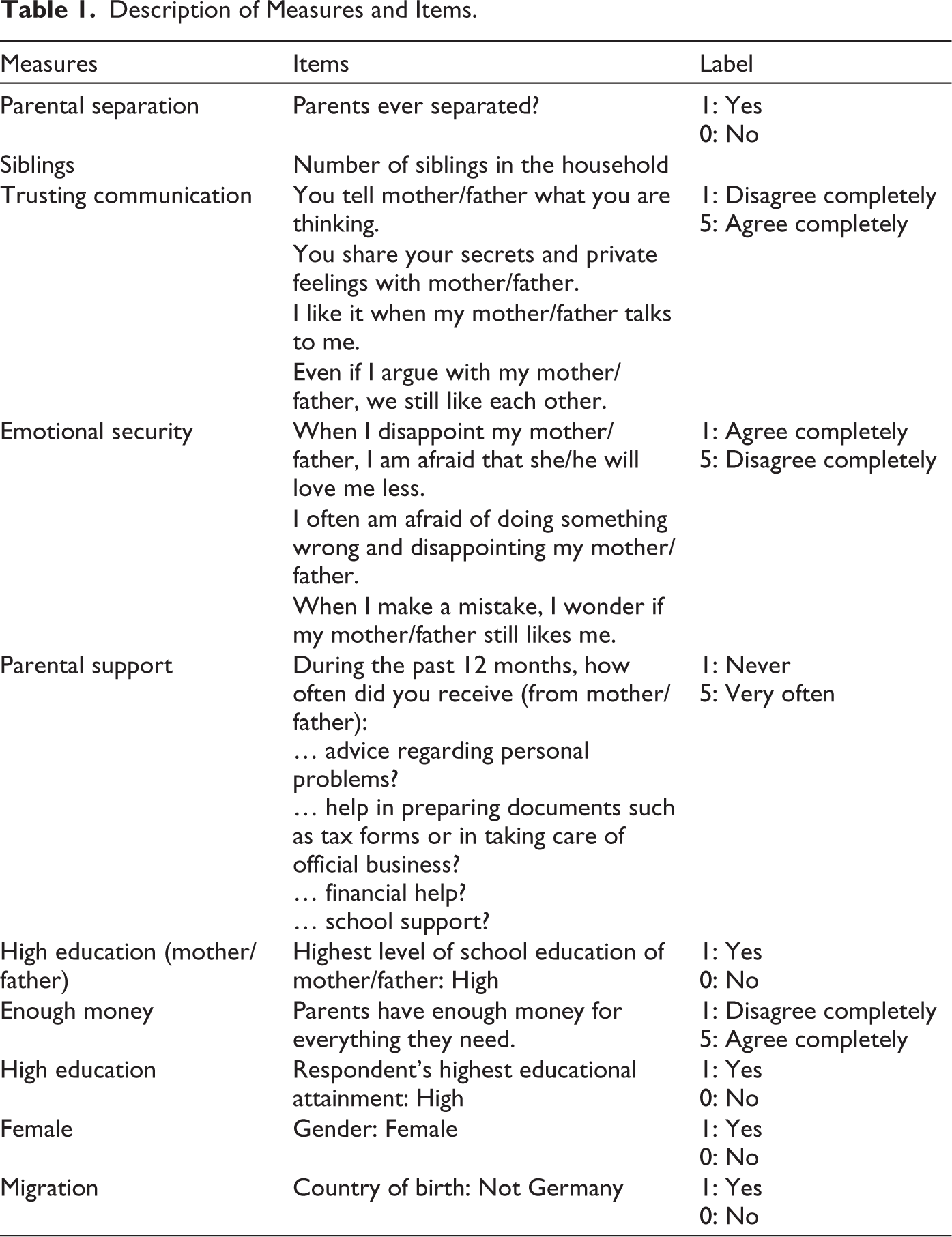
Parental socio-economic status is measured by both the educational attainment of the mother/father (human capital) and the household’s subjective financial situation from the child’s perspective as proxy information for parental financial capital (enough money). Furthermore, we include the adolescent’s gender, migration background and highest educational level to control for socio-demographic differences at the individual level.
Methods
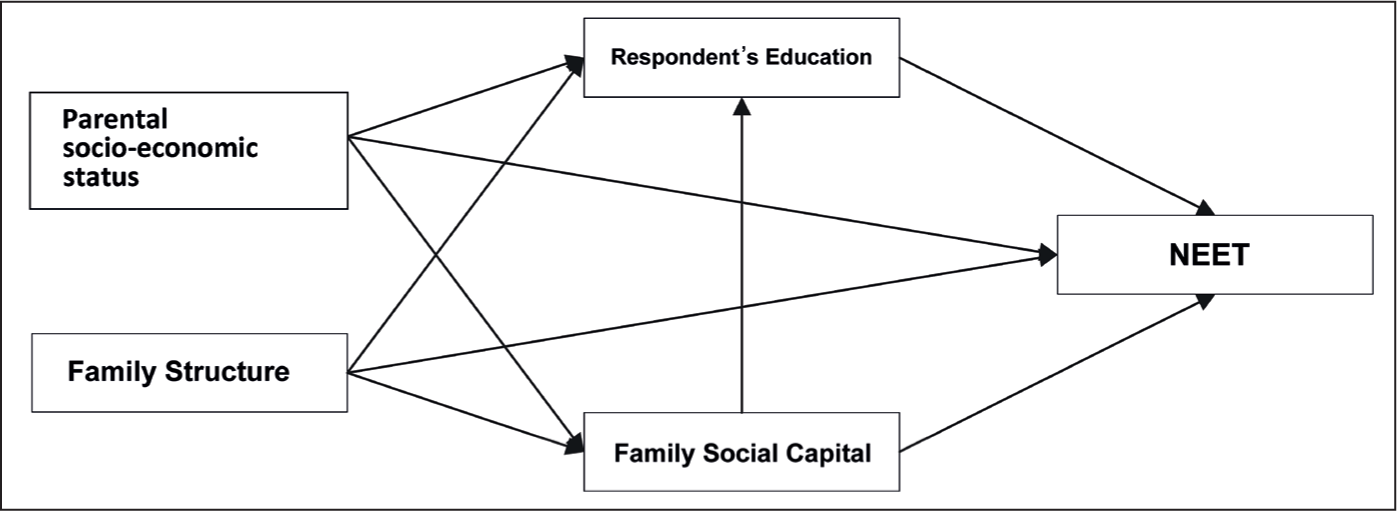
In order to take account of the complex relationships between the three forms of capital we postulated, we apply a path analysis with manifest variables using MPLUS (Muthén & Muthén, 2017). As a first step, linear regressions are estimated to analyse the direct effects of human, financial and social capital as well as all the other covariates on the NIS (H1). With regard to H2, a mediation analysis was conducted to test whether the variables for parental human and financial capital are mediated through the family’s social capital, that is, whether they have not only a direct but also an indirect effect on the NIS via family social capital.
With regard to H3, interaction effects are estimated between the socio-economic variables and the social capital variables in order to measure a moderating effect of the family’s social capital on the (dis)advantages of higher/lower parental human and financial capital. To estimate standard errors, we apply the bootstrap technique with 1,000 repetitions. The path analysis is summarized in Figure 1.
Conceptual Diagram of Modelling the Role of Family Social Capital on NIS.
Results
Descriptive Findings
With regard to the frequency and duration of NEET episodes, Figure 2 depicts four different clusters of trajectories that vary considerably in their NEET intensity score (NIS) over the first 60 months after leaving school. 5 More than half of the young people have never experienced at least 1 month of NEET status (Cluster A). Most of them start in educational programmes (VET as well as higher education) and are in employment after 60 months. Clusters B and C include individuals who had only a few and/or very early experiences of NEET status. In particular, Cluster B depicts mostly NEET episodes that are due to ‘institutional gaps’ between finishing school and the beginning of VET programmes or higher education (mostly between 2 and 3 months). Cluster C mainly depicts NEET episodes up to 1 year directly after leaving school that are usually due to ‘gap years’ involving some kind of voluntary service, travelling or time for (re-)orientation. Cluster D, however, shows trajectories of young people (around 16%) who have experienced either a high number or very long NEET episodes, most of which occur very late in this 60-month period (in contrast to the ‘institutional gap’ in Cluster B).
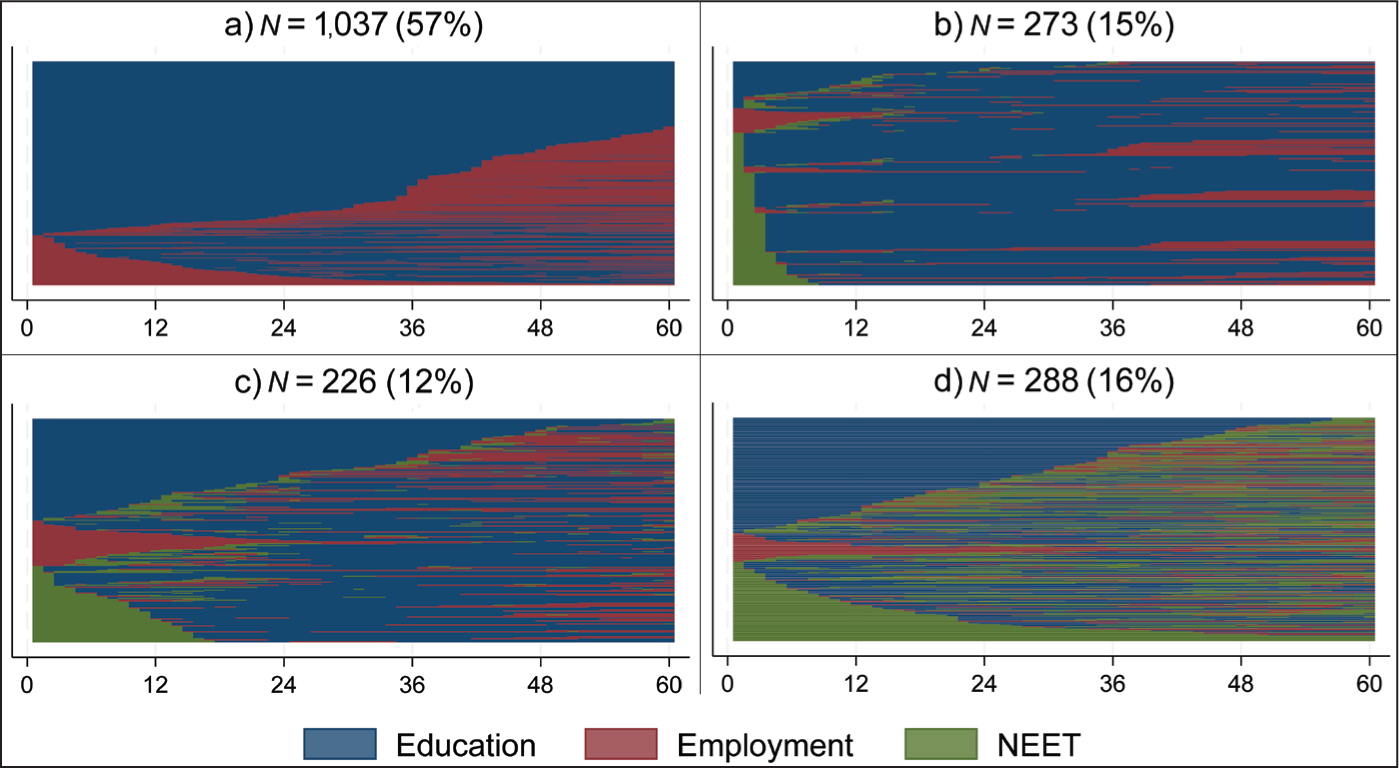
Therefore, a large number of individuals in Cluster D have not yet made a successful transition from school and the system of VET/higher education to employment. With regard to the composition of each cluster, Table 2 shows that young people in Cluster D are considerably less likely to have a higher level of education, are more often female and have a migration background. In terms of family background, they are more likely to be from families with lower human and financial capital, and more often from households with more siblings and separated parents. Moreover, young people in Cluster D report slightly lower levels of trusting communication (in particular with their fathers), emotional security (particularly in relation to their mothers) and parental support (particularly from their fathers). Altogether, this is a first hint at the strong influence of the family’s human, financial as well as social capital on the risk of youth disengagement from education and employment.
Description of the Four Clusters.

The Role of Family Social Capital in Experiencing NEET Episodes
As a next step, we conduct separate analyses, one with information on mothers and the other with information on fathers. The results of the path models are reported in Tables 3 and 4. Both models show that the respondents’ educational level is negatively correlated with the NEET intensity score (NIS), which is statistically significant and has the largest effect size of all covariates (first column of Tables 3 and 4). This means that a higher educational level is associated with fewer and/or earlier NEET episodes.
Regarding family background, both parental financial capital and human capital show a significant negative correlation with the NIS. Thus, a higher family socio-economic status is associated with a more direct and smooth transition from education to work. A statistically significant correlation is also found for two of the three factors comprising family social capital—at least for mothers. Therefore, trusting communication as well as high levels of emotional security are negatively correlated with the occurrence and persistence of NEET episodes. However, the effect size is only about half as large compared to educational attainment. Regarding family structure, we see that growing up with a higher number of siblings or being affected by parental separation is associated with a higher frequency and persistency of NEET episodes. Overall, these findings support H1, that a higher level of family social capital reduces the risk of experiencing NEET episodes during the STWT.
As we are also interested in the interplay between the parent–child relationship, family structure and parental socio-economic status, we estimate how these covariates are in turn affected by each other in order to estimate indirect effects on the NIS. Looking at the second column of Table 3, we see that the respondents’ educational level correlates not only with the parental socio-economic status (a finding that is already well known in educational research) but also with the family’s social capital, that is, at least in terms of emotional security towards the mother. Thus, a weaker emotional bond between mothers and their children is associated with lower educational attainment, which is in turn associated with a higher likelihood of experiencing NEET episodes. Moreover, the same argument is true in the case of more siblings.
Linear Regressions on the NEET Intensity Score (NIS) for Mothers (Standardized Coefficients).

Controlled for gender and migration background but not reported.
*p < .05; **p < .01; ***p < .001.
Furthermore, we wanted to know how family social capital is influenced by parental human and financial capital in accordance with the literature on social class and parenting styles. Columns 3–5 of Table 3 and 4 show that a higher level of financial capital is associated with more trusting communication, higher emotional security and more parental support, while higher human capital is only associated with higher levels of emotional security—at least in the case of mothers. In the case of fathers, human capital also has a significant impact on the level of support.
Linear Regressions on the NEET Intensity Score (NIS) for Fathers (Standardized Coefficients).

*p < .05; **p < .01; ***p < .001.
However, the direct effects (as shown in Table 3 and 4) only tell half the story of how family background affects young adolescents’ transitions into working life. Table 5 presents the total effects of parental socio-economic status on NIS, that is, the sum of the direct effects and the indirect effects that work through the mediator, that is, the family social capital.
Direct, Indirect and Total Effects on NIS for Mothers and Fathers (Standardized Coefficients).

*p < .05; **p < 0.01; ***p < .001.
According to Table 5, a high educational level on behalf of the mother not only reduces the NIS directly by –0.041 points (which is the exact coefficient from Table 3) but also indirectly by –0.056 points, in particular through the child’s educational level (−0.055). That means that a high educational level on behalf of the mother is associated with a higher educational level of the child, which in turn reduces the risk of experiencing NEET. Therefore, in total, a mother’s higher educational level results in a –0.097 points lower NIS compared to a lower educational level of the mother. The direct and indirect effects of the father’s educational level are very similar.
Results for the family’s financial capital point in a similar direction. The indirect effect of enough money (–0.064) is mainly driven by the offspring’s higher educational level (–0.041), which in turn correlates with lower levels of NIS. In the case of mothers, enough money is also associated with a lower NIS via trusting communication (–0.009) and emotional security (–0.013). This indicates that a good financial situation correlates positively with a good parent–child relationship, which in turn reduces the risk of experiencing NEET.
Finally, we estimate interaction effects between the variables for parental socio-economic status and family social capital. We assume that higher levels of family social capital moderate the negative effect of a lower socio-economic status on the risk of experiencing NEET episodes during the STWT. Figures 3 (mothers) and 4 (fathers) show the conditional effects of parental socio-economic status on the NIS by family social capital in order to demonstrate how trusting communication, emotional security and parental support can moderate the (dis)advantages of differences in socio-economic background. Significant differences can be seen in the case of all three family social capital variables and financial capital: the risk of experiencing NEET episodes during the STWT varies between children from low- and high-income families. However, with high levels of trusting communication, emotional security as well as parental support, these differences disappear (at least in the case of mothers). With regard to emotional security, the same effect is prevalent in the case of parental human capital. This means that strong emotional bonds, good communication and reliable support between parents and their offspring can compensate for a lack of financial and partly human capital and therefore even out differences in the likelihood of experiencing NEET episodes according to the socio-economic background.


Conclusion
Examining the role of the family in young people’s educational and occupational attainment has always been at the heart of empirical educational and labour market research. For the most part, however, previous studies have focused mainly on aspects of parental educational level or their disposable income, ignoring the crucial role that relationships within the family play. This study sought to fill this gap by analysing the role of family social capital for early career development of young adolescents alongside and in interaction with parental human and financial capital. Moreover, we focused on the bonding dimension of social capital rather than the bridging dimension as previous studies have done (e.g., Roth, 2018; Roth & Weißmann, 2022).
Based on longitudinal data from the German Family Panel (pairfam), we reconstructed the career trajectories of young people for the first 5 years after leaving school and analysed the frequency and persistence of NEET episodes—measured by the NEET intensity score (NIS). Our results show that almost half of all adolescents in Germany experience at least a 1-month NEET episode in their STWT, while 16% can be classified as having experienced very severe periods of disengagement from education and employment, which is in line with previous studies for Germany (Brzinsky-Fay, 2022).
Regarding the explanatory factors for the occurrence and persistence of NEET episodes, family background has been shown to have an impactful role. First, parental educational level and the family’s financial situation have a very robust and negative relationship with NEET experiences. A higher parental socio-economic status thus favours early career planning and occupational orientation right after leaving school. This is especially true if one considers that socio-economic background has a huge impact on the offspring’s educational attainment, which in turn is one of the most significant factors explaining the occurrence of NEET episodes during the STWT.
In addition, we could demonstrate that family structure as well as the quality of parent–child relationships play an additional and independent role. Thus, two-parent families with fewer children as well as greater family social capital, that is, trusting communication and secure emotional bonds between parents and children, are associated with smooth and more linear STWTs. Moreover, families with more financial capital seem to have a higher level of social capital, which in turn indirectly reduces the risk of experiencing NEET episodes. These findings seem to be more important in the case of mothers compared to fathers. A further contribution of this study is that moderating effects between parental socio-economic status and family social capital have been found, showing that high levels of family social capital can compensate for socio-economic disadvantages. Therefore, strong emotional bonds between parents and their offspring, good and trusting communication and high degrees of parental support can even out differences in parental socio-economic status.
There are also some limitations to this study. First, the observation period is limited to the initial 60 months after leaving school. It would be interesting to extend this period to see how trajectories develop further beyond the initial 5 years. Second, even an observation period of 60 month after leaving school already leads to a panel mortality of almost half the initial sample, which harbours the risk of biased results as we do not know if the dropouts are somehow correlated with the relationship between family background and NEET. Third, we excluded other interesting aspects of early career development from our study, for example, how satisfied young adults are with their situation or how they interpret their experience of NEET episodes. Do they perceive them as an impairment or as an opportunity for new career orientation? Finally, our results are based on correlations rather than causalities. Unfortunately, some information is not available over multiple waves. Therefore, it is not possible to consider the impact of dynamics in parent–child relationships or family structure on youth career development. Rather, we focused on the family structure and parent–child relationship quality at age 15–16.
Our results have implications for future research: Instead of focusing on human and financial capital alone when examining the role of family background with regard to the STWT, the structure of families as well as the quality of parent–child relationships plays a crucial role in explaining early career development. In general, this indicates that intrafamilial dynamics at an early age (15–16 years) show long-lasting life course dependencies beyond educational attainment, at least with regard to the initial years of career development. Moreover, it has been shown that only considering direct effects underestimates the influence of family-related variables. By considering the existing relations and interdependencies between all three forms of family capital, that is, the mediating and moderating effects, it has been possible to identify the power of family capital to shape young people’s transition from school to work.
Supplemental Material
Supplemental material for this article is available online.
Supplemental Material
Supplemental material for this article is available online.
Footnotes
Declaration of Conflicting Interests
The authors declared no potential conflicts of interest with respect to the research, authorship and/or publication of this article.
Funding
The authors received no financial support for the research, authorship and/or publication of this article.
Notes
References
Supplementary Material
Please find the following supplemental material available below.
For Open Access articles published under a Creative Commons License, all supplemental material carries the same license as the article it is associated with.
For non-Open Access articles published, all supplemental material carries a non-exclusive license, and permission requests for re-use of supplemental material or any part of supplemental material shall be sent directly to the copyright owner as specified in the copyright notice associated with the article.
