



Abstract
This article aims to shed light on ethical pitfalls that may occur when researchers conduct research with young people (aged 15–24). Young age itself does not automatically indicate vulnerability. Yet, young research participants may be in need of extraordinary measures that safeguard their well-being. The presented pitfalls centre around the issues of consent, power and agency, and relationships and confidentiality. The article contributes to the research literature by creating awareness about these ethical pitfalls that otherwise may pass by unnoticed and by exploring how such pitfalls may be avoided or addressed. To this purpose, the authors build upon the existing knowledge base and reflect upon their own experiences as youth researchers. The article may be used as a thinking or discussion tool and concludes with recommendations that may become part of youth researchers’ ethical toolkit.
Introduction
This article explores ethical pitfalls that researchers may face when conducting research involving young people. In recent decades, there has been a growing interest in research on and with young people, covering a wide range of topics from various disciplines. Giving young people the opportunity to take part in research that may improve understanding of their lives and living conditions is important. The growing interest in youth research can be seen as an acknowledgement that youngsters may have different experiences and feelings from adults and, thus, that we need to include their voices in research (Spencer, 2021). However, involving young people in research presents a range of ethical challenges and complexities that are often seen as specific to young people. As summarized by Brooks and te Riele (2013), this is related to contextual factors which differentiate youth research from other forms of social research. These factors include age-related institutions and contexts that structure the lives of young people (e.g., schools and youth clubs), the construction of youth as a critical period for development and transition, and power imbalances between young people as a social group and researchers (Brooks & te Riele, 2013). Consequently, young people are often considered an inherently vulnerable group when it comes to research and ethical approval for research projects (Cullen & Walsh, 2020; te Riele, 2012).
In this article, we draw on the notion of ‘ethics in practice’ (Guillemin & Gillam, 2004) to shed light on ethical pitfalls that researchers may experience when doing research with young people. It is widely accepted that unexpected situations will occur when conducting research, and that such situations require researchers to respond in an ethically appropriate way. To this purpose, Guillemin and Gillam (2004) distinguish between two different dimensions of ethics in research, which they term ‘procedural ethics’ and ‘ethics in practice’. Procedural ethics can be described as standardized ethical rules and guidelines issued by ethics committees. Contrary to this, ethics in practice are described as ‘the everyday ethical issues that arise in the doing of research’ (p. 263), thereby taking into consideration the local, context-bound particulars of a research study. As argued by Guillemin and Gillam, procedural ethics cannot provide all that is needed when dealing with ethical issues in the practice of research. Once the researcher is out in the field, difficult, unexpected situations may arise, and researchers may be forced to make immediate decisions about ethical concerns. It is within this dimension of ‘ethics in practice’ that the notion of reflexivity and the researcher’s ‘ethical competence’ (p. 269) come into play, i.e., the researcher’s willingness to acknowledge the ethical dimension of the situation and their ability to respond appropriately when ethical issues arise.
The concept of ‘ethics in practice’ provides a useful framework for researchers when considering their role in responding to unexpected ethical challenges that arise from interactions with research participants, and it has been used by researchers in discussions about appropriate ethical behaviour in research on a wide range of subjects (e.g., Fletcher, 2022; McEvoy et al., 2017; Robinson, 2020). Although the process of gaining approval for research from ethics committees aims to anticipate likely ethical challenges, researchers claim that ethical rules and guidelines do not adequately prepare for unforeseen situations in the field (e.g., Leyshon, 2002; McEvoy et al., 2017; Takeda, 2022) and may even be obstructive to their work (e.g., Brown et al., 2020). The distinction between ‘procedural ethics’ and ‘ethics in practice’ may then be useful, and other researchers have made similar distinctions between ‘paper ethics’ and ‘real-world research’ (Armstrong et al., 2014) or between a ‘rules-based approach’ and a ‘situated based approach’ (Goredema-Braid, 2010). All these distinctions have in common that they emphasize the need to focus on the local and specific rather than the universal principles.
In this article, we argue that, although well familiar with fundamental ethical principles, such as informed consent, avoidance of harm and guarantees of confidentiality and anonymity, youth researchers may find themselves in tricky ethical situations that may be seen as specific to research involving young people. Adolescents and emerging adults represent a unique group when it comes to participation in research. Their lack of assertiveness and life experience relative to adults may make them equally vulnerable to power imbalances and exploitation in research as children. However, as opposed to children, young people aged 16 or older in most cases no longer depend on parental consent to participate in research (European Union, 2018). Hence, although many of the ethical issues discussed in the literature on research involving children are equally relevant for research with young people, a number of specific challenges may arise in research with young people (see e.g., Brooks & te Riele, 2013; Cullen & Walsh, 2020; McCarry, 2005).
Aim of the Article
In this article, we present and discuss ethical pitfalls that researchers may face in research involving young people. We address the following research question: Which ethical pitfalls can occur in research involving young people, and how can they be avoided or addressed?
Based on the above research question, we have chosen six ethical pitfalls that we regard as typical to youth research. When referring to youth or young people in this article, we focus on adolescents and emerging adults, i.e., people aged 15–24, as suggested by the United Nations (2010). We understand ethical pitfalls as blind spots (cf. Clay, 2012), i.e., they are neither apparent nor easily recognized. In certain cases, such pitfalls may cause difficulties that require immediate action from the researcher. However, in other cases, they may pass by unnoticed for the researcher, but cause discomfort or harm to the research participant. The presented pitfalls are structured around central themes that are most prevalent in literature on ethics in youth research, namely, the issues of consent, power and agency and relationships and confidentiality (see e.g., Cullen & Walsh, 2020; Heath et al., 2009; te Riele, 2012). As youth researchers, we have experienced all of the presented pitfalls ourselves, some of them repeatedly and in different contexts. We therefore believe that this article may prove valuable to youth researchers, in the educational field as well as in other contexts. The article may be used as a thinking or discussion tool for creating awareness around these pitfalls, e.g., amongst students before entering the field.
In the next section, we describe our research background and some of our experiences with youth research, before presenting a brief introduction to the ethics of research with young people.
Our Research Background and Professional Experiences
As educational researchers, we have substantial experience with doing studies with young people, both quantitatively and qualitatively. Over the last 20 years, Evi conducted amongst others several studies on dropout from vocational education and training, including two longitudinal studies over several years. In one of her recent projects, a small group of young people who were identified as being at risk of dropping out of upper secondary education was interviewed up to three times over a three-year period; as students in upper secondary school (year 2), as apprentices (year 4) and after completing their trade certificate. The study faced several ethical challenges typical of youth research, including the recruitment of students, which was organized through the teachers. Furthermore, the longitudinal design of the study facilitated a trusting relationship between Evi and the participants, and the vulnerability of the young people caused an extra commitment on her part. At the same time, she was impressed by how the young people handled challenging situations in education and training and their everyday lives, and by their motivation and engagement to work hard and complete their education.
Veerle conducted, amongst others, an intervention study with students with intellectual disability, with the aim of helping them improve their self-determination skills. The young people were new to participating in research and their diagnosis of intellectual disability presented an additional vulnerability to the research situation. During the study, Veerle encountered certain situations that had the potential of being ethically challenging, such as when one student told her that he wanted to participate in the study, but his teacher—who functioned as a gatekeeper—knew of personal reasons regarding the student’s home situation that contraindicated research participation. Despite the fact that these reasons were valid, the gatekeeper’s decision put the student in a position where he was denied agency. In a study regarding the self-determination of young people with intellectual disability, this was all the more problematic.
Hence, the idea for this article evolved from our own professional experiences, from discussions between us two researchers and from the desire to explore our experiences and reflections further and share them with a larger audience.
The Ethics of Research with Young People: A Brief Introduction
Ethical complexities and dilemmas in research involving young people have in recent years gained more attention (e.g., Spencer, 2021). The challenges and difficulties discussed by youth researchers largely relate to the issues of consent, power and agency, and relationships and confidentiality (see e.g., Cullen & Walsh, 2020; Heath et al., 2009; Loveridge et al., 2023; McCarry, 2005; Spencer, 2021; te Riele, 2012).
Issues of consent are related to the concern that young people might not have the competency or the autonomy to make informed decisions as to whether or not to participate in a research project. Informed consent is widely recognized as one of the founding principles of research ethics and is written into the codes of social research organizations. The ethical guidelines of the British Educational Research Association (2018, p. 9) define informed consent as ‘the condition by which participants understand and agree to their participation, and the terms and practicalities of it, without any duress, prior to the research getting underway’. As specified by the British Sociological Association (2017, p. 5), this means that researchers have a responsibility ‘to explain in appropriate detail, and in terms meaningful to participants, what the research is about, who is undertaking and financing it, why it is being undertaken and how it is to be distributed and used’. Some of the concern relates to the question of whether young people have the maturity and/or competency necessary to understand the information provided to them about a study and their rights and to make up their own minds about their participation in research (e.g., Cullen & Walsh, 2020). Furthermore, the issue of consent is inherently linked to power relations between adults and young people (e.g., McCarry, 2005). Expectations or close relationships to adults can make it difficult for young people to decline to participate in a study, and young people’s autonomous decision about research participation may be threatened for fear of disappointing the researcher (see also Loveridge et al., 2023). This might be especially so in an institutional setting such as a school, where young people may be asked to participate in research by an adult person of trust, such as a teacher. Research with young people is often conducted through a gatekeeper, e.g., a parent, teacher or youth worker, who typically has a position of power over the young person (e.g., Cullen & Walsh, 2020; Lenton et al., 2021; McCarry, 2005).
To address these issues and opportunities for young people’s dissent, researchers highlight the importance of viewing consent as an ongoing and dynamic process (e.g., Loveridge et al., 2023; McCarry, 2005; Morrow, 2008). Traditionally, consent has been seen as given as part of a one-off event before the research gets under way, on the basis of the presentation of adequate information for the participants (e.g., McCarry, 2005). However, such a traditional understanding of informed consent has been criticized for being impractical, especially in research involving children and young people. As McCarry (2005) clarifies, process consent or ongoing consent means that young research participants should be asked before, during and at the end of the research process if they are (still) consenting to participate in the study. Moreover, ongoing consent implies that participants’ decision to withdraw should be fully and unconditionally accepted—at any stage. Furthermore, by safeguarding young people’s autonomy and capacity to participate in research, process consent is also seen as an empowering tool, amplifying young people’s voices while at the same time reducing the power of the researcher (e.g., Loveridge et al., 2023).
Issues of power further entail the complexity of power relations in youth research. Research studies are usually characterized by a power imbalance between researcher and participant, and this is particularly so in research with young people (e.g., Cullen & Walsh, 2020; Morrow, 2008). To address issues of power and power relationships throughout the whole research process, the concept of agency has gained a central role in youth research, emphasizing that young people are able to act agentically and autonomously within the research process, with the aim of creating a pathway for young people’s empowerment (e.g., Heath et al., 2009; te Riele, 2012). Loveridge et al. (2023) encourage ‘power sharing’, where power does not operate as a one-way flow, but instead, is something that circulates dynamically between researcher and participant. In general, youth researchers argue for a more nuanced understanding of power and more relational and collaborative approaches in youth research (e.g., Heath et al., 2009; Loveridge et al., 2023; Morrow, 2008; te Riele, 2012).
After this brief introduction to some of the most common ethical issues in research with young people, we will now turn to presenting and discussing six ethical pitfalls. Then, the article concludes with a discussion of the limitations of research ethics committees and with recommendations for youth researchers.
When doing research with young people, gatekeepers are often the first point of contact for researchers. Gatekeepers, such as parents, teachers or other professionals, form a connective link between the researcher and possible participants, and in practice, access to young participants is usually negotiated via gatekeepers who may even manage the recruitment of participants on behalf of the researcher. This way, gatekeepers may function as a ‘safety barrier’ (McCarry, 2005, p. 95) as they have the power—and responsibility—to screen out any research that might be inappropriate or unsafe for young people to participate in. However, gatekeepers’ selection of participants may involve an ethical pitfall concerning the principle of voluntary participation in research. While gatekeepers may prevent and protect ‘their youngsters’ from participating in research that may be harmful to them, their role could also be described as disempowering as they might take decisions on behalf of the young people. Gatekeepers are normally in a position of power over the young people, and their relationship with young people is therefore often characterized by asymmetry and dependency, as well as by trust. For young people, it can be difficult to voice their opinions and refuse to participate if they so wish when feeling encouraged—or even coerced—to participate by an adult person of trust. Hence, the power relations between gatekeepers and young participants may cause undue influence and affect how free young people actually feel to accept or decline participation in research. However, ‘bypassing’ gatekeepers and contacting young people directly (for instance in a school context) may be equally challenging because of certain hierarchies of power that operate in such contexts, and it may not always be feasible for researchers to gain access without contacting gatekeepers first.
Although the potentially obstructive and disempowering role of gatekeepers regarding young peoples’ voluntary participation in research is well covered in the literature (see e.g., Lenton et al., 2021; McCarry, 2005; Spencer, 2021), in practice, undue adult influence on young people’s decisions to take part in research is not always easy to detect. Researchers may take for granted that gatekeepers inform young people that participation is voluntary and that they do not decide for them. However, this might not always be the case, and if a gatekeeper gives consent on behalf of a young person, there are few structures to ensure that this person feels free to refuse participation (Spencer, 2021). When doing research in schools, we usually contact school leaders or teachers for help in the recruitment process. Although we inform gatekeepers about the importance of voluntary participation, we now and then get the impression that students are not fully aware of the voluntary aspect of participating in research when they meet us. For example, we sometimes hear from participants: ‘My teacher said I’m supposed to have an interview with you’. As researchers, we therefore ought to keep in mind the asymmetrical power relationship between gatekeepers and young people and how this may affect the recruitment and consent process. Moreover, it is the researcher’s responsibility to be aware of all kinds of signals, both verbal and non-verbal, that could suggest that a young participant is feeling uncomfortable or overwhelmed and that the interview should not start or proceed any further (see also Lenton et al., 2021). Ultimately, it is important to view young people’s consent as an ongoing, dynamic process. Process consent acknowledges that decisions about research participation should be negotiated on an ongoing basis rather than being assumed as a one-time agreement at the beginning of the study (e.g., Heath et al., 2009; Spencer, 2021).
Much contemporary research with young people is conducted in schools, youth clubs or other age-related institutions where young people may be influenced by their peers when considering research participation. Adolescents have a strong need to belong and fit in with their peers along with a fear of missing out (Beyens et al., 2016; von Tetzchner, 2019), and the need to conform and not deviate from the norm may be young people’s main motivation for research participation, rather than, for instance, a personal interest for the research topic or a desire to contribute to knowledge expansion. For researchers, the presence of peer pressure may pose an ethical pitfall in two ways. In some cases, young people may welcome the opportunity to share personal experiences with a researcher during an in-depth interview. Yet, when their peers dismiss participation, they may themselves choose to decline the invitation to participate, since it may pose a social risk to go against the stream. Consequently, their voices may remain unheard. In other cases, young people may feel pressured to participate because their friends are doing so. If so, their consent is not entirely free. Staksrud (2019) labels this form of consent ‘the “social pressure” consent’ and argues that it may compromise data reliability as participants are not motivated and more likely to lie in their answers. Thus, consent is not always an autonomous decision; group dynamics and peer pressure may determine whether young people will participate in research or not.
For researchers, group dynamics and peer influence on research participation can be difficult to identify and sometimes also difficult to prevent, for instance when consent is obtained in classrooms. Smette (2019) reported a situation where she was seeking consent in a lower secondary classroom where some boys decided to withdraw their participation from the study although they had already signed the consent form—after having observed that one of their friends decided not to participate. Although such situations cannot always be avoided, in some cases it may be possible to take specific measures to avoid peer pressure during recruitment and data collection. For instance, during a classroom survey with a pencil-and-paper questionnaire, we first handed out the questionnaire to all the students in the classroom, before explaining that research participation is voluntary. At this point, we informed students that if they did not wish to participate, they could simply answer the questionnaire but not hand it in to the researcher afterwards. This approach made it easier for students to withstand peer pressure, as their own choice became less visible for their peers. Additionally, during this classroom data collection, all participants were rewarded with a gift card for a movie theatre, and students were informed that everyone in the classroom would receive this reward, regardless of whether they chose to participate in the study or not. Hence, our strategies made it possible for students to accept or decline participation without drawing others’ attention to their decision. Moreover, their choice would not lead to consequences that would single them out from their peers.
Thus, although peer influence cannot always be avoided and may sometimes be difficult to identify, researchers are encouraged to think about how the grouping of informants and the methods of data collection may create social pressure on young people and their decision-making processes.
In addition to being voluntary (cf. pitfalls 1 and 2), consent must be informed and comprehended. However, in research with young people, researchers may experience various challenges when seeking consent from their young participants. As we have experienced ourselves, young people sometimes do not actually listen to the information that is provided about the study and about their rights. In some cases, there may be a gap between the contents and language of the information sheet on the one hand and the language comprehension of young people on the other (see also Brown et al., 2020). Furthermore, young people may experience difficulties with staying focused on issues that are not immediately rewarding (such as listening to a lengthy statement about informed consent), and/or they may have poorer self-control to suppress their responses (e.g., waiting with signing the consent form until the researcher has explained the aim of the study and their rights as research participants). In addition, young people may lack the assertiveness that is required to ask for clarifications when needed (e.g., Duncan et al., 2009), and, consequently, they may be at risk of not fully comprehending what they are consenting to. Thus, depending on the young people’s emotional and cognitive capacity, it may be questioned whether young people always have the competency to comprehend the process and purpose of research and to make up their own minds concerning their potential involvement in a research project (e.g., Duncan et al., 2009; Heath et al., 2009).
In our own experience, young research participants sometimes lack the ability or maturity to understand the scope of participation in research, and in some cases, they are so eager to get started with the interview that they do not really pay attention to the information about informed consent. Thus, for researchers, it can sometimes be difficult to guarantee that participants understand what they are consenting to, and, as described by Wiles (2013, p. 32), they might be ‘overwhelmed by young people’s enthusiasm and just think “yeah they understand, fine let’s get on”…’. However, here lies an ethical pitfall that we have experienced ourselves. As one of our participants asked after the interview had been conducted: ‘What did you say this was going to be used for?’ This statement illustrates that the young participant did not entirely grasp the purpose of the study to which he had consented.
To avoid pitfalls related to informed consent in our research with young people, we find it useful to try to read the information sheet through the eyes of young research participants and to ensure that the language is adapted to the age group. Furthermore, we have positive experiences with checking participants’ understanding of the research process, not simply by asking whether they have understood the information (a yes/no question), but by asking whether they could describe for us why they thought they were being invited in the study, and how they would go about in case they wish to withdraw from the study. This way, we can easily identify gaps in the young person’s understanding, so that we can provide additional information where needed. This approach is in line with recommendations for children’s participation in research (see e.g., Alderson, 2005), but it may also be useful when conducting research with young people. Moreover, during our research with young people, we are careful to revisit the issue of informed consent regularly with the research participants. Thus, we view informed consent as an ongoing process of communication (e.g., Heath et al., 2009; Spencer, 2021). These measures may help to respect the agency of young research participants and safeguard their informed consent.
Power disparities can affect the research process at various stages, including recruitment and young people’s decisions to take part in research (cf. pitfall 1), the process of informed consent (cf. pitfall 3) and, not least, during the interview situation itself. Despite consenting to participate, young people do not always have the confidence or life experience to speak up for themselves and claim their rights. Therefore, they may be particularly vulnerable to exploitation in research. For example, researchers may push young participants too much when they appear not very eager or willing to talk and only answer briefly. Young people may find it difficult to communicate to the researcher when they do not wish to answer a certain question, when they wish to finish the interview or when they want to withdraw their consent. In our own research, we have experienced situations where young participants appeared to feel uncomfortable with a question, and where we realized that they might see us as an authority figure and find it difficult to say that they did not want to answer a certain question.
In general, the experiences of research participants are not well studied in the existing literature (Dennis, 2014). While people who participate in a research interview might appreciate the opportunity to talk about their experiences and be listened to by someone who really listens (e.g., Dickson-Swift et al., 2007), some studies indicate that research participation may also be associated with negative feelings such as uncertainty, anxiety or feeling burdened by the researcher (Lowes & Gill, 2006). Some research participants even report feeling coerced to participate (Hebenstreit & DePrince, 2012). The causes of such negative experiences are not well-researched; yet it may be assumed that the power imbalance between researcher and research participant is a core issue. When it comes to youth research, this power imbalance might be even more prevalent, which may affect the experiences of young research participants accordingly. As described insightfully by McEvoy et al. (2017), in a research setting with adolescent participants, researchers may sometimes adopt a position of authority, even when they strive to ensure that participants are free to exercise their right to not respond to questions at all times. It was only when reading through the transcripts and listening to the recordings that McEvoy noticed that she had unwittingly attempted to compel a young participant to answer questions to which he did not respond. While this researcher openly shared her experiences and discussed how power dynamics might have compromised the principle of informed consent, in other cases, researchers may not be aware of how the young people’s situation of relative powerlessness might impact the research situation.
To address power inequalities in research, we argue that researchers are required to adopt a position of reflexivity to critically scrutinize their actions and their role in the field (cf. Guillemin & Gillam, 2004). This entails critically reflecting upon the notion of the researcher as expert, while at the same time striving to equalize power throughout the research process. Hence, researchers need to develop not only an awareness of the power imbalance, but also a sensitivity towards the participant’s verbal and non-verbal communication for clues about the research participant’s state of mind (see e.g., Morgan et al., 2017). To regularly step back from the interview situation and take a moment to observe the participant’s mood may be one way of preventing that young people become trapped in a situation that requires confidence and assertiveness to get out of.
In interview situations with young people, researchers may experience that participants readily open up and share personal, intimate information. As to our own experience, especially young people in vulnerable life situations often appreciate the opportunity to talk to someone who is really listening. On the one hand, researchers may welcome research participants who openly share personal stories, and they actively invite them to do so by building rapport. On the other hand, the boundaries of the researcher’s role may get blurred when participants see researchers as therapists, helpers or friends, rather than as researchers. The inherently relational nature of qualitative research may complicate these boundary issues (Garrels et al., 2022). While researchers know that their relationship to the participants comes to an end when the interview is finished, some research participants may have unrealistic expectations about the format of the researcher-participant relationship (Bashir, 2020). This may be an issue in all qualitative studies, but when doing research with young people in difficult life situations, the establishing of rapport may lead to even more complex ethical situations for the youth researcher. In particular, researchers may experience challenges when a feeling of responsibility for the minor participant manifests itself. Bengtsson and Mølholt (2016) describe this continuous challenge of balancing the researcher-participant relationship in their study with young people who were placed in out-of-home care. The limitations of the researcher role may leave researchers with ethical discomfort and concern towards their young participants (see also Eriksen, 2013).
From our own experience, we have for instance conducted qualitative interviews with vulnerable young people, in which they shared their dissatisfaction about a school situation or apprenticeship with us, followed by a more or less explicitly stated question for advice or help. Clearly, the safety and confidentiality that developed during the interview situation caused these young participants to see us as allies rather than as merely interested researchers. Simultaneously, we have also felt sincere concern for our young participants who found themselves in difficult life situations, and we have sometimes felt uncomfortable and even frustrated within the confinements of our researcher role. It lies within the nature of qualitative interviewing that researchers never fully know which direction an interview will take, and participants may share information that the researcher is not prepared for (see e.g., Schmid et al., 2024). Often, ethics committees encourage researchers to think through a plan for follow-up in research with vulnerable participants. Yet, in practice, procedural ethics are not always sufficient nor adequate in the field (cf. Guillemin & Gillam, 2004). In such cases, being able to refer the young person to the right support agency has helped us manage this ethical challenge. In addition, we have found it useful to discuss such situations with colleague researchers for moral support.
In youth research, young participants are often recruited collectively, for example, when the sample of a study is selected from a school, a classroom or a youth club. While this may simplify the recruitment process for the researcher, it also entails an ethical pitfall concerning the researcher’s promise of confidentiality and anonymity. In research publications, it may not be difficult to ensure anonymity of participants towards outsiders, i.e., what is referred to as external anonymity (Smette, 2019). However, it can be harder to guarantee participants’ anonymity towards other participants involved in the study (i.e., internal anonymity). Will the students be able to identify which of their classmates is being referred to in the researcher’s description of a classroom situation? As emphasized by Smette (2019), young peoples’ knowledge about each other is complex and may make it possible for them to identify others based on descriptions of particular ways of being or acting even if what is usually identified as sensitive personal information is left out. In a similar way, it might be possible for teachers to recognize the students behind the quotations presented in a research article. As described by Walford (2005) and Tolich (2004), it is not uncommon for research participants to identify themselves and other insiders in research publications, despite pseudonyms, and in some cases, this can lead to frustration or other negative emotions for both participant and researcher.
In our own school research, we have experienced that it can sometimes be difficult to provide thick descriptions of participants and the research context and at the same time ensure internal anonymity. For instance, in a research project based on qualitative interviews with upper secondary students from different vocational programmes, we put a lot of effort into ensuring internal anonymity for our participants. Because there were only a few students from the same vocational programme within each respective school, we carefully avoided any contextual information about the different educational programmes in our research publications. This means that quotations from the young participants were included with a pseudonym indicating their gender; however, in most cases, no information was provided about whether our participants were intending to become a cook, a car mechanic or a health care assistant. While this may be considered an effective way to safeguard participants’ anonymity towards those involved in the same research study, we also suffered the loss of contextual information about the students’ educational background, the classroom or workshop setting and their plans for the future. Other ways to preserve anonymity may be to change participants’ gender, age or other characteristics that are not relevant to the focus of the particular study (Wiles et al., 2008).
As argued by Tolich (2004), internal anonymity is generally unacknowledged in ethical codes and often overlooked by researchers who usually think of external anonymity when they promise research participants not to identify them in research publications. Therefore, in research conducted in schools, youth clubs or other similar institutions where participants’ connected relationships have the potential to harm their informants, researchers should distinguish between internal and external anonymity (cf. Smette, 2019).
Discussion
In this article, we have described and discussed six ethical pitfalls that may occur in research with young people. Certain issues of consent, power and agency, and relationships and confidentiality seem at the core of situations that may be ethically challenging in such a subtle way that they may go by unnoticed for the researcher. However, as argued by te Riele (2012), while researchers are used to explaining the methodologies they used and the findings they gained, they rarely write about ethical challenges and obstacles they encountered. Yet, youth research (as any social research) inevitably poses researchers with ethical challenges. While ethics committees and procedural ethics may address some of the ethical issues that may arise in practice, researchers from various fields have experienced that ethical research is much more than gaining approval from research ethics committees and it has been claimed that ethical rules and guidelines do not adequately prepare for unforeseen situations in the field (e.g., Leyshon, 2002; McEvoy et al., 2017; Takeda, 2022).
This raises questions concerning the role of ethics committees in preventing ethical pitfalls, or at least, in drawing researchers’ attention to them. Currently, ethics committees play a pivotal role in ensuring ethical research standards, such as minimizing harm, respecting autonomy, ensuring informed consent and protecting privacy (see e.g., Brown et al., 2020). However, in our own experience, the guidelines of ethics committees do not always take into consideration all of the ethical challenges or pitfalls that may occur in the field, that is, issues of ethics in practice (cf. Guillemin & Gillam, 2004). For instance, ethics committees generally emphasize procedural ethics, such as the importance of gaining written consent at the beginning of a research study, but the importance of consent as an ongoing process rarely seems to be addressed when ethics committees consider approving a research study. Similarly, ethics committees concern themselves with how data will be stored and how researchers will adhere to the General Data Protection Regulation (European Union, 2018), but in our own research, we have never received questions concerning the internal anonymity of our data. In other situations, we have experienced that ethics committees demand elaborate information sheets, thereby making them less accessible to young research participants. Thus, despite approval from an ethics committee, various ethical challenges may remain. Yet, approval by ethics committees may cause researchers to be too much at ease when it comes to safeguarding the well-being of (young) research participants. Being aware of the dissonance between procedural ethics and ethics in practice may help researchers to consider their role in responding to unexpected situations when conducting research (see also Robinson, 2020).
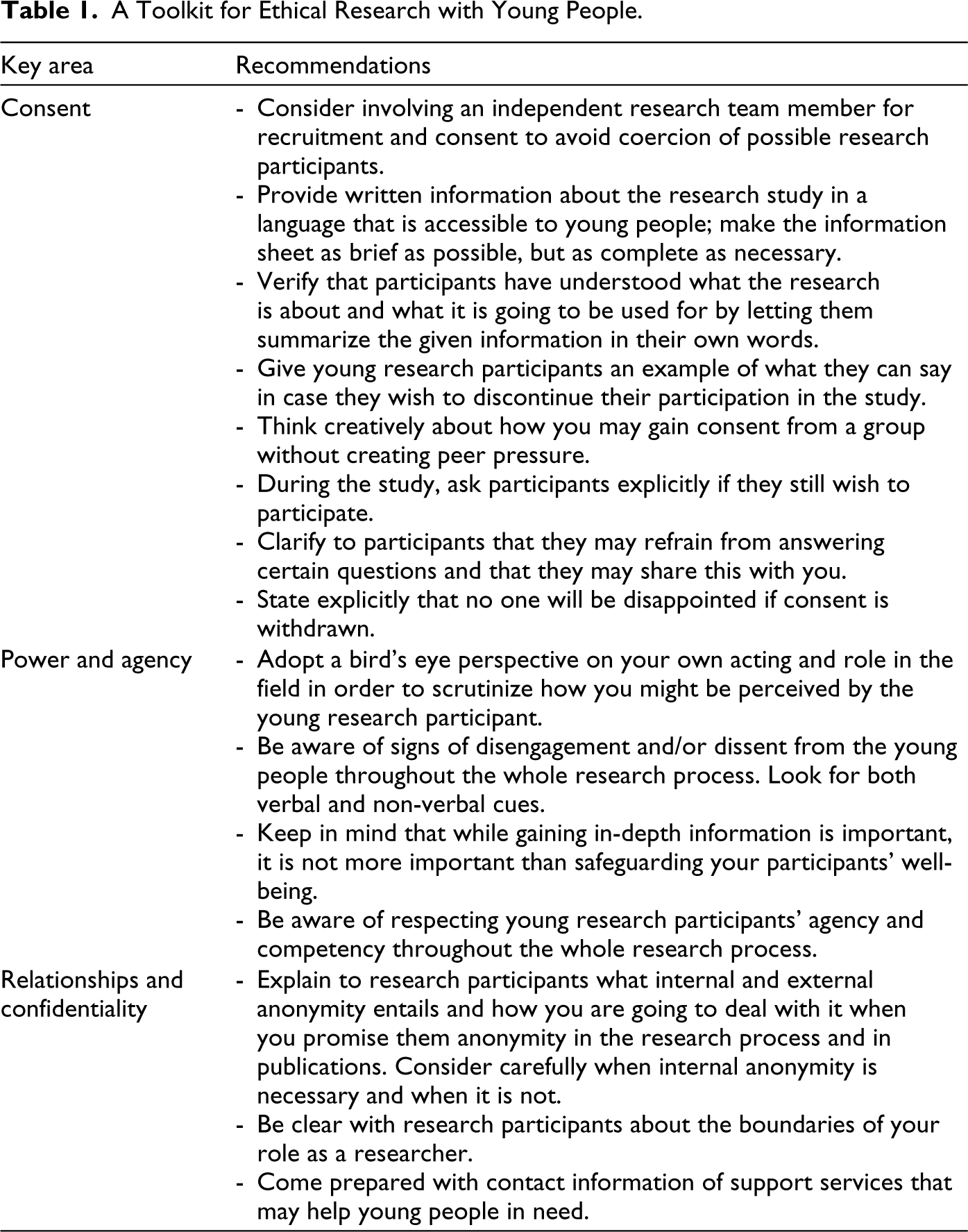
To be better prepared for the unexpected as an integral part of doing research, te Riele (2012) argues that (youth) researchers need ethical resources just as much as they need methodological and conceptual resources. One way to provide resources for researchers is to share experiences and reflections about challenges and pitfalls that youth researchers may encounter in the practice of research. The presented six ethical pitfalls in this article may be used as a thinking tool or a discussion tool for both students and researchers. Furthermore, as a contribution to the need for an ‘ethical toolkit’ (te Riele, 2012, p. 6), our experiences and reflections are summarized in recommendations for youth researchers in Table 1. The presented collection of recommendations is by no means exhaustive. Yet, the recommendations aim to help identify and address ethical pitfalls in research involving young people, and as such they may become part of youth researchers’ ethical toolkit.
A Toolkit for Ethical Research with Young People.
Finally, the question arises as to whether ethics in practice is something that ethics committees can and ought to deal with, and if so, how. As highlighted in this article, ethical pitfalls are often subtle challenges that occur in the interaction between researcher, participant and context, thereby making it difficult for ethics committees to anticipate them. However, there might be a potential for improvement in courses on research ethics for new researchers. As with ethics committees, such courses tend to cover overarching ethical themes (i.e., procedural ethics), whereas experiences and reflections of researchers, such as the ethical pitfalls described in this article, usually do not receive much attention. Yet, reflections of researchers who have experience in navigating ethical challenges and pitfalls can be valuable to ethics committees and the development of ethics application forms and training material for new researchers. This article and the presented recommendations for youth researchers may contribute to increased awareness of the dissonance between procedural ethics and ethics in practice, thereby helping to ensure that young people are protected adequately as research participants.
Footnotes
Declaration of Conflicting Interests
The authors declared no potential conflicts of interest with respect to the research, authorship and/or publication of this article.
Funding
The authors received no financial support for the research, authorship and/or publication of this article.