




Abstract
This autoethnography documents the emergence and persistence of the sexual abuse I experienced by multiple male peer athletes in a youth sports setting. The testimony signals how my presence in the locker room felt like a space invader for the group, resulting in numerous micro-behaviours, group formation processes, and shifting norms, which led to sexual abuse. Based on the notes and writings in my diary, a thick description is produced, to help facilitate an understanding of the culture in which the abuse took place. I offer my story as a pedagogical resource to incorporate in bystander education programs to teach trainers and coaches about the toxic and harmful interactions and dynamics that can emerge in male team sports because of a dominant, masculine, team culture.
Introduction
Dear Safeguarding Officer,
After 15 years, I feel ready to speak up about the abuse I experienced at my local sports organization. Over a period of five months, multiple teammates sexually touched and abused me without consent. Nobody intervened: not my teammates and not my coach or trainer. After my parents found my diary, the truth came out. Although my parents addressed the abuse at the club, a good conversation with the teammates would be sufficient to end the matter. Two weeks later, I was expected to start training with the team again, putting me back into an unsafe sports environment. I send this email to report the abuse in the hope that it will not happen again at the local sports organization. I hope you can support me in this process.
Thank you!
This is the letter I wrote 15 years after the abuse to the safeguarding officer of the Centre of Safe Sports in the Netherlands. The letter shows the power bystanders potentially have to remedy interpersonal violence in sports if they are alert and decide to intervene. My testimony is one of the many Dutch stories of interpersonal violence in sports. In the Netherlands, more than one out of five young athletes experience mild to severe psychological violence in their sports careers (Mulder et al., 2020). One out of eight athletes is a survivor of sexual abuse in sports (Vertommen et al., 2016). In 62% of the sexual abuse cases in sports in the Netherlands, multiple perpetrators are identified as abusers (De Vries et al., 2017, p. 35). In 58.8% of the physical abuse cases, a teammate is identified as the perpetrator. For sexual abuse, this number is 40.7% (Mulder et al., 2020, p. 63). These figures highlight that in the Netherlands teammates are more likely to be agents of physical and sexual abuse than, for example, coaches. This article offers an autoethnographic account of how the multi-perpetrator, peer-athlete abuse, I experienced, developed and sustained.
Absence of Male Survivor-athletes’ Voices in the Safe Sports Literature
I feel like I never got out of that locker room. While I want to move beyond the trauma, my brain is not very good at forgetting. The way I coped with the abuse when I was 15 years old still affects the way I relate to people, behave and deal with stress. Memories about the abuse can be reactivated with the slightest hint of danger, touch or remark, leading to overwhelming feelings of powerlessness and stress. For me, such situations often lead to unpleasant emotions, intense physical sensations and increased fear and anxiety.
Nevertheless, I believe it is important to include more male survivor voices in the safe sports literature. In recent years, the number of studies focusing on interpersonal violence increased (Stevens, 2019). Male survivor voices, however, have barely been included in the safe sports literature (but see the work of Hartill, 2005, 2009; Mountjoy et al., 2022; Palmer & Feldman, 2017; Spiegel, 2003 for society at large). Earlier studies, written from a feminist perspective, focused on the ‘male’ coach as the perpetrator and the female victim (e.g., Brackenridge & Fasting, 2002; Kirby & Greaves, 1996; Lenskyj, 1992). Hartill (2009, p. 225) even speaks of the dominance of the ‘male-perpetrator-female victim’ paradigm in the literature on safe sports.
Male survivors barely speak up about their abuse, as they feel more than average shame, guilt, dissociation and self-blame about the harassment that happened to them (Dorahy & Clearwater, 2012). Dominant gender norms created an intense internal conflict in my own decision about whether to speak up about my abuse. Showing emotions and talking about the abuse felt like a weakness and did not align with the somatic norm I was taught, a norm which defined ‘a male’ as being dominant, strong, rational and without emotions (Puwar, 2004, p. 14). This feeling was reinforced by the memories of male peer athletes being able to dominate me and hurt my most vulnerable parts, that is, my intimate body parts and my being. For a long time, it felt as if speaking up about the abuse would acknowledge that I am a ‘lesser’ male. I agree with Hartill (2009, p. 232) when he argues that ‘social science needs to develop a fuller account of the relationship between male sports and the childhood sexual abuse of males: such an account must be based on empirical data’.
Absence of Analysis of Multi-perpetrator Abuse Processes by Minor Peers
Similar to the absence of male survivor voices in the academic literature, not many studies mention the emerging, intensifying and solidifying development of multi-perpetrator, peer athlete abuse by minors in sports, despite the findings of some studies that peer athletes are more often than coaches or adult support staff identified as agents of sexual abuse in youth sports (Alexander et al., 2011; Elendu & Umeakuka, 2011; Rintaugu et al., 2014).
Following various testimonies of mostly female athletes, Brackenridge (2001) developed a generalized model of the grooming process in sports by a single perpetrator (oftentimes ‘the coach’). This model was inspired by Finkelhor (1984). Brackenridge’s generalized model contains the following stages: targeting a potential victim, building trust and friendship, developing isolation and control, building loyalty, and initiation of sexual abuse and securing secrecy. While Brackenridge (2001) uses the concept of grooming, other scholars speak of ‘the phase of subjection’ (Spiegel, 2003) or ‘processes of entrapment’ (Gallagher, 1999) to describe the process of turning a sports environment into a setting in which sexual abuse of young athletes can occur. Until now, Brackenridge’s model has been the most cited model to explain how within coach-athlete settings abuse emerges, intensifies and solidifies.
The generalized model cannot be used to explain the incremental developments leading up to my sexual abuse, as the model does not account for multi-perpetrator group dynamics. However, there are two specific similarities between Brackenridge’s (2001) generalized model and my own testimony. The first similarity is that sexual abuse is a process that starts before a perpetrator lays hands on the victim’s body. In my testimony, you will read about the incremental process in which boundaries erode up to the point that perpetrators felt comfortable or invincible enough that they could do whatever they wanted to my body.
A second similarity with Brackenridge’s model is that my abuse took place within a climate of secrecy. In the team, a climate of ‘what happens in the locker room, stays in the locker room’ was formed. This climate created a context in which norms, about what was tolerable behaviour and what was not, could shift. Unlike a single-perpetrator abuse case, my team did not have to find a ‘secret’ or private location for the abuse, they just had to ensure that the common space in which we came together—that is, the locker room—turned into a hidden space for outsiders (like the trainer, coach and parents). This testimony intends to bring a new perspective to existing and related storylines on how abuse in youth sports comes about and can persist.
Aim and Research Question
As such, this article responds to the scientific need to get a better sense of the development and experiences of abuse of male survivors, especially by teammates in youth male sport settings. In addition, this autoethnography aims to make ‘witnessing’ possible (Ellis & Bocher, 2006). Sports club managers, trainers, coaches, volunteers, parents, peer athletes, and other people involved in grassroots sports clubs will acknowledge that you should not touch athletes without consent. They are, however, often unaware of how abuse develops. In fact, people who have not experienced abuse in sports have a blind spot; they do not know how terrible a situation can become. This is why we need to tell survivors’ stories (Mountjoy et al., 2022). I wish that people could learn from my experience and speak out more about the subject of sexual abuse in sports. Following these aims, this article provides an answer to the question: How does peer-athlete abuse in a youth, male, team setting with multiple perpetrators emerge, intensify and solidify?
The remainder of this article is organized as follows. The article starts by presenting two propositions, which help to explore how the sexual abuse I endured in a male team setting could emerge and persist. Subsequently, the article addresses the use of autoethnography as a method of sharing survivor stories. Then, the build-up stage to the ‘start’ of abuse is described and the stage in which over a longer period I experienced harassment and abuse. After that, I reflect on the aftermath of the abuse. This article ends with an epilogue, which discusses what the autoethnography teaches us (i.e., sport professionals) about multi-perpetrator abuse of young athletes in male team sport settings.
Theoretical Framework
Within the safe sports literature, there are limited studies which theorize on or explain how multi-perpetrator, peer-athlete abuse in a male team sports setting can emerge and persist. One of the few exceptions is the work of Palmer and Feldman (2017) who distinguish different cultures in which sexual abuse towards males in boys’ organizations is likely to occur. Inspired by their work I draft the social ordering proposition as a focal lens to look at the development of the abuse I endured. In addition, I build on the work of Lee Sinden (2013), to draft a second proposition: the punishment proposition.
Lee Sinden (2013) studied elite athletes’ decisions to continue to train in sport when they are not physically healthy enough to do so. She did this from a sports sociology perspective. Although Lee Sinden’s work discusses emotional abuse and neglect towards individual athletes, I believe that her observations can also be applied to instances of sexual abuse in team settings. Her work makes us aware that spaces, like a locker room, may appear neutral, but in fact, operate with and reinforce implicit ‘norms’. Individuals who embody these implicit norms and behaviours naturally are deemed as having the right to belong in that specific space (e.g., on a sports team or a locker room), while others can be marked as being out of place. If an individual is marked as ‘being out of place’, the likelihood increases that the person faces marginalization (Puwar, 2004, p. 31). Marginalization in a male sports team can take different forms, varying from infantilization and petty humiliations to extreme forms of emotional, physical or sexual abuse (Hartill, 2005).
The first proposition that I draft—the social ordering proposition—identifies the use of sexual abuse, and other forms of harmful behaviours towards peers (such as physically aggressive posturing, verbally aggressive communication and the use of homophobic taunts), as a result of ‘masculine-validating processes’ in teams; individual members try to counter fears of emasculation and acquire a ‘hero-image’ in the team, by showing how well they are able to harm and hurt their peers (Dunning & Maguire, 1996). Palmer and Feldman (2017, p. 26), highlight that especially in male sports teams with strong macho cultural elements, boys are naturally aggressive and innately driven to dominate their peers. They explain that within macho team cultures individual athletes learn to value harsh treatment because it is assumed to be indicative of strength and maturity (Palmer & Feldman, 2017). When boys behave aggressively towards their peers in such cultures, coaches and trainers often interpret it as ‘boys being boys’ or even as beneficial to the group ordering process. The social ordering proposition, as such, expects that acts of interpersonal violence are used to mark a victim as being lower in the pecking order, whereas perpetrators gain a higher social status in the team by showcasing aggressive and harmful behaviours towards peers. The harmful behaviours will last up to the point that every team member is ‘satisfied’ with their social ranking in the team; if not, individual athletes continue to try and obtain a higher position on the team’s social pyramid at the cost of their peers’ wellbeing.
The second proposition I draft is the punishment proposition. The punishment proposition shows similarities with the social ordering proposition yet takes a slightly different approach as it does not immediately describe an expected way of behaving. The ‘expected way of behaving’ is rather something context-dependent. The punishment proposition views (sexual) abuse as a way to discipline and punish an individual for not conforming to the normalized way of behaving in the male sports team setting (Lee Sinden, 2013, p. 617). A central element of the hypothesis is the process of normalization. Normalization can be defined as the process by which individuals are shaped, regulated, and conformed to a certain set of standards and ideals for human thought and human conduct, against which individuals are assessed, measured and judged (Lee Sinden, 2013, p. 617). Normalization separates individuals’ behaviour into categories of ‘normal’ and ‘abnormal’. Being abnormal or non-conforming to the ways in which individuals are supposed to behave, can result in individuals being ‘punished’ in order to discipline them and close the gap within the group between those who conform and those who do not. Normalization works through the method of ‘hierarchical observation’. This implies that athletes watch and police each other and persuade peers to act in ways to fit in. This ‘network of surveilling gazes’ (Lee Sinden, 2013, p. 617) allows harmful practices, like sexual abuse as a punishment, to continue and persist up to the point that the victim conforms to the way athletes in the group are supposed to behave.
This autoethnography explores whether the social ordering proposition, the punishment proposition, or elements of both propositions, explain the emergence and persistence of the multi-perpetrator, peer-athlete abuse I experienced for six months and how it affected my presence in the locker room.
Methodology
When writing an autoethnography, an author retroactively and selectively writes about past experiences (Ellis et al., 2011, p. 275). Insights are assembled using hindsight (Denzin, 1989; Freeman, 2004). I write about selective events of the abuse. Within the literature these selective events are called ‘epiphanies’ (Ellis et al., 2011, p. 275). While epiphanies are self-acclaimed phenomena in which one person may consider the experience transformative while another may not, focussing on epiphanies allows us to uncover the underlying mechanisms of how such a personally transformative event came to be (Ellis et al., 2011). In addition, autoethnographic descriptions invite ‘outsiders’ to obtain meaningful, accessible and evocative insights about events or experiences that they are unfamiliar with (Ellis et al., 2011, p. 276). That is also the value of using autoethnographies as methods to share survivor stories.
Excerpts from my diary are presented in the results section. These excerpts were selected based on their relevance to describe how the multi-perpetrator, peer-athlete abuse I experienced, emerged, intensified and solidified. Before the abuse, I wrote infrequently in my diary. From the second training of the season onwards, where, as you will read, the first inappropriate behaviours took place in the locker room, I started writing more frequently in my diary. I did not write at regular intervals. Instead, I mostly wrote after stressful and harmful events, oftentimes in the middle of the night after the trainings, as a way to calm down my mind and try to put words to what I observed and experienced in the locker room. As the amount of interpersonal violence, I experienced increased, so did the pages of text I wrote about the abuse in my diary.
During the writing process of the autoethnography, I recalled, using hindsight, my perceptions and experiences of the abuse. These recall practices helped me align the research with the vocabulary I use today to describe and look back on the abuse. In that sense, this ethnography is not a mere personal story but allows readers to understand the lingering effects (i.e., recollections, memories, images and feelings) of abuse, which remain otherwise cloaked in secrecy (Ellis et al., 2011, p. 275).
This autoethnography includes, besides me, several other people. My former teammates, coach and trainer, janitor, as well as parents and a schoolteacher play significant roles. The inclusion of these persons poses ethical dilemmas, specifically regarding their anonymity and the way they are portrayed with flattened representations of their own personalities in the testimony (Febos, 2022; Kuhlin et al., 2020, p. 216). To protect anonymity, I do not mention in the article the name of the sports club or the team, and I exclude the names of the peer athletes, trainer, coach, janitor and teacher.
For people ‘closer to me’, who cannot be anonymized as they carry the same last name, like my brother and parents, I asked for permission to write about the abuse. I invited them to read the article after I finished it yet before I submitted it to a journal. In this way, I wanted to make sure that I had the space to write about my own recollections of the abuse, without being influenced too much by the memories of people important to me. At the same time, I wanted to avoid that I submitted an article that would provide emotional harm to them. Therefore, I provided my brother, parents and partner an opportunity to read the article and give comments before it became a part of the academic review system. My brother, parents and partner did not object to my research intentions, and after reading the article, they did not recognize any inconsistencies or false representations of what happened to me.
I asked two experienced colleagues to ‘walk with me’ while writing the autoethnography. ‘Walking with me’ implied that they read and reread my article six times, and we had seven one-hour meetings to discuss how I described the emergence and persistence of the multi-perpetrator, peer-athlete abuse, how this could be theoretically understood, and what the implications were of reducing living human beings to one-sided characters in my testimony (especially, regarding the classification of ‘perpetrator’).
To me, autoethnography is a means to tell the story of abuse in accordance with how I lived it. I am aware of the fact that others, who were a part of the experiences, can look at the story from a different perspective. My concentrated focus on myself and the semi-erasure of everyone else is for me inherently an ethical positioning and a deliberate refusal to tell stories that do not belong to me (Febos, 2022). This means that I try not to speculate in the autoethnography on the experiences, decisions, or motivations of others about what happened in the locker room. In the results section, The excerpts of my diary are presented in an indented manner, while my reflections on the relevance of these excerpts and/or the (further) development of the abuse are presented in the common style of the article.
My Memories and Reflections of the Abuse
Excerpt 1: Gay guys cannot play soccer
It is the evening of the first training. I approach the door of the locker room: Locker Room 1. It is a locker room with which I am unfamiliar. Previously, as a non-selection member, I was not allowed to enter this part of the building. It was a reserved space for the club’s main and selection teams. I touch the doorknob. How will my new teammates respond? I know a few of them, but no one is a good friend. I take a step through the doorway. I see the faces of my new teammates turn. They must also be curious to see who is on their team that year. Immediately, one of the (soon to be) team captains who recognizes me shouts, ‘Vidar, what are you doing here? The locker rooms of the amateurs are on the other side of the building.’ I do not know how to respond; ‘have you lost your voice?’ Another teammate joins the conversation: ‘are you our new super talent?’ ‘But I am selected,’ I respond. ‘Not by us,’ another teammate replies, ‘don’t you dare to disappoint us.’ I hesitate but enter. I sit down on the cold bench. It feels uneasy. I am a stranger in the space, and my teammates just made that very clear.
When thinking back to that moment of entry, I wonder whether I disturbed my teammates’ image of what a selection player looks like. I was not muscular and did not go to the gym. I had no girlfriend, and I was not fast. As a defender, I did not dare to talk strategy; that role was assigned to midfielders and strikers. There were rumours about my sexual orientation; some teammates had seen me perform a song by Christina Aguilera at the local school just before the summer. Singing was considered a feminine activity. At that time, I was unaware of what being ‘gay’ or ‘straight’ implied. In fact, I was not yet doubting my heterosexuality. But I remember one teammate jokingly asked that night, ‘are you afraid of the ball, Vidar? Because gay guys can’t play soccer’.
Most teammates had already played together for several years. In addition, many saw each other in church on Sunday mornings. There was a network of spaces where the teammates met and where through repetition and rehearsals norms were established about how you ought to behave in the settings where the ‘group members’ came together. This created a strong social bond. I was not a part of that group. After the first training session, I wrote in my diary that I would do everything in my power to become a part of the group.
Excerpt 2: Igniting flares
‘Get the fireworks away from my body.’ I scream. A teammate tried to get a small flare close to my intimate body parts. It is the evening after the second training. I am half-naked as I prepare to shower. My skin feels damaged, although my teammate did not touch me. I see traces of ash on the floor. Smoke fills the locker room. Some teammates are amused and laugh. Others are scared. It started with the two captains who were brave enough to light some flares, who soon were followed by a few others, their ‘assistants’. I show weakness. In a reflex, I get my stuff and run outside, away from the locker room. I am flabbergasted. What kind of team is this? The next training, I discover that the janitor later that evening entered the locker room. He heard the smoke alarm go off and smelled the smoke. He got angry with the team for lighting flares but was unaware of the bodily boundaries that had been crossed. The trainer and coach condemn the team’s behaviour, but at the same time, they say, ‘we understand that this is just a part of boys being boys, we were also young once. So, just leave the flares at home next time.’
I remember that the team decided not to share what happened during the second training night or who brought the flares into the locker room. In a sense, the team silently agreed to keep what happened in the locker room within its four walls. In consequence, the physical space of the locker room became a social space that was non-permeable for outsiders, such as the trainer, coach, or even parents. I felt trapped. I was not yet a part of the ‘in-group’, and I feared that if I spoke up about the incident to the coach or trainer repercussions from my teammates would follow. So, I stayed silent. I believed it would do me no harm. Adhering to the informal code of silence could even help me become a real member of the team, as I showed the team that they could count on my silence and loyalty. Everyone’s loyalty to the group and silence created a dynamic in which the team captains acted as if they were kings of the locker room.
Excerpt 3: Give it a kiss
It is an evening in October, just before the autumn party at the local school. One of the team captains brags about a ‘chick’ who will suck his penis at the party. While sharing the story, he takes his penis out of his pants and spins it in the open air. I look. I am not supposed to look. I cannot help it. My body behaves in such a way that I can no longer control it. A teammate sees a bulge in my pants. ‘Damn, Vidar you are really gay! Hey guys, you see, he likes it.’ The team captain approaches me. The space becomes smaller. ‘Give it a kiss,’ he says. ‘Leave me alone,’ I shout. ‘No, give it a kiss,’ he repeats, immediately followed by, ‘never mind, I’d rather save it for the chick.’ I feel embarrassed. Why does my body feel this sensation?
The ‘penis incident’ was the start of a toxic performative humiliation ritual which gradually developed in the team. Frequently, team members were encouraged, or even pressured, to throw the clean clothes of peers into the showers or deliberately open the valve of a teammate’s tire so that he cannot cycle home. In this way, you could prove that you belonged on the team. Your social position, as such, came at the cost of others. Regularly, one of the team captains ran in front of me during the warming-up and pulled his pants down. ‘You like what you see, Vidar?’ Teammates would laugh and even the trainer and coach could not hide their smiles.
As the humiliation games continued, the team’s leaders learnt who their closest assistants were. These assistants eagerly participated in humiliation activities. Another group of teammates served as an audience; they laughed and made encouraging gestures. A remarkable number of peers did not take sides. They accepted the risk that they could be humiliated verbally. In that sense, I was not the only victim or target in the locker room. Yet, the humiliation they experienced was not as severe as the physical and sexual abuse I had to deal with. These ‘outsiders’ were, however, not non-involved. They allowed the performative ritual to continue by silently approving it. There could have been individuals in the locker room who defended me, for example, by speaking up against the captains of the team. However, defenders were rarely present in the locker room. Teammates were especially applauded for their humiliation games if they combined it with a great sense of humour, just as the following excerpt shows:
One evening six teammates rip my pants off my body and touch my butt to get a better look at my ‘smartass’. Bystanders find the joke and behaviour amusing, but this is the first time that the perpetrators touch my skin. Internally I cry, but I cannot show it. If I show tears then it is just giving ‘them’ something else to pick on. It would be new ammunition for the perpetrators to break me. I decide not to shower in the locker room; instead, I go straight home. ‘Do not let your parents know what happened’, is a sentence I keep on repeating in my mind while cycling home. I enter the house and rush into the bathroom. While the water runs down from the shower head on my body, I still feel the invisible perpetrators’ hands on my skin. I try to rub my skin clean with soap. I pour the bottle of soap once, twice, even three times over my body, but the imprints remain.
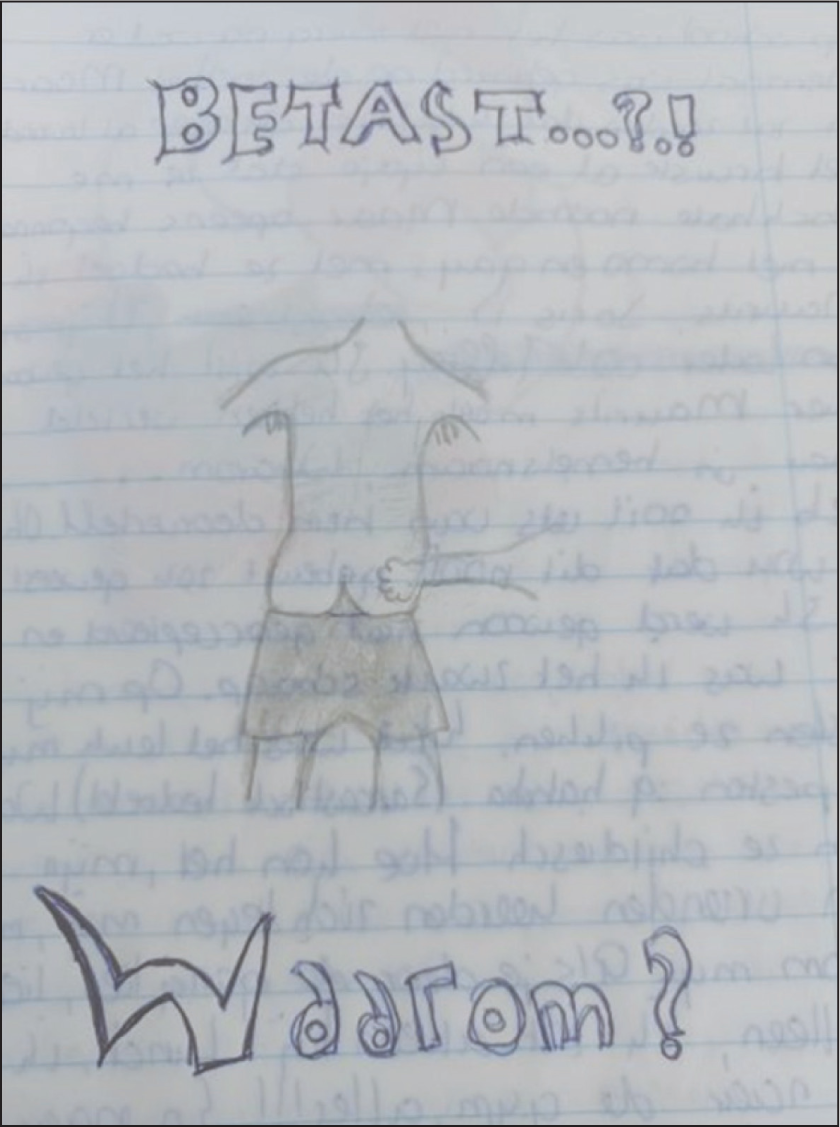
Even to this day, I remember exactly where they put their hands on my body. Every time I get stressed, the pain goes to the same spot as my teammates touched me for the first time. My body remembers the emotional scars. That evening I made the drawing presented in Figure 1, with a hand touching my butt, with the subtext: harassed, why [in Dutch: betast, waarom]?
Drawing from Diary After Locker Room Incident Where for the First Time Bodily Boundaries Were Crossed.
Excerpt 4: Scared of the dark
It is an evening in November. After the training, I cycle home. I feel safe because I am outside of the locker room. I suddenly hear the voice of one of the team captains: ‘get him guys!’ The sounds of the bikes approaching become louder, and I panic. A group of six teammates circle around me like a group of vultures. ‘Where are you going, Vidar? Is this not the right time for that promised kiss on my penis?’ I try to get away from them, but one of the team captains’ assistants kicks me off my bike. I fall on the cold wet asphalt. Another ‘assistant’ gets my sports bag and throws it in the ditch next to the road. My bike follows soon after. I look up, feeling scared. Will they hit me? Their silhouettes approach me. I do not recall how long the moment lasted, but after what I believe to be minutes, they turn around and cycle away, leaving me in the dark. I have blood on my elbows. I do not know what to do. I am caught between two choices: staying at the club or not going to the training sessions anymore. My parents paid a lot of money for me to have a hobby, so I decide to keep going to the soccer practices. At home, I say that the blood on my elbows is the result of a slide tackle on the artificial grass pitch.
With me continuing to train, teammates may have believed that I did not mind the harassment. I am not even sure whether they perceived their behaviours as harassment. From that evening on, every time I entered the shower, I could expect teammates to touch my intimate body parts or twerk against my butt. ‘You like this, right, gay guy?’ was a recurring homophobic taunt that they used, both to justify their actions and mark me as different from anyone else in the team. Two times a week during training and once a week on Saturdays these forms of sexual harassment occurred for a period of three months. It was normalized. No one in the locker room helped me. No one outside the locker room knew what was going on inside.
Excerpt 5: Reaching out for help
‘Vidar how are you doing?,’ asks my schoolteacher. I cry. It is the sixth time we meet, after I reached out to her to alleviate the stress of abuse. She is my favorite teacher. I know that there is no connection between the sports club and her, but there is a connection between her and my parents. I hope that she will disclose my case to my parents, but I do not dare to ask her to do that. For now, she provides me with a safe space to breathe. Although I am in ‘her’ space, she always keeps a bit of distance. Just like she does today. So, I ask her, ‘why do you hesitate to put an arm around me?’ She responds, ‘I am too afraid that that would trigger unpleasant emotions for you.’
The teacher advised me to keep writing about the abuse in my diary if I was not yet ready to tell my parents my secret. In this way, I would at least ‘build up evidence’ about what happened to me. Unfortunately, the teacher died soon after from a terminal illness. The teacher had not told me about her illness. With her passing, my informal support felt away.
Excerpt 6: Being quartered
We get back in the locker room after the first training in December. Suddenly, six perpetrators feel so invincible that they grab my arms and legs. While they quarter me, other hands go down to my penis. I hang more than a meter above the floor. I am scared that they will drop me. I feel pain in my limbs, but I get aroused. I look up to the ceiling in the hope that I do not register the incident and that I am somehow in another place. The six perpetrators are too strong: I am unable to move, hit, or scratch someone. Other teammates simply watch; they seem to know that if they speak up or intervene, they can be quartered next. The trainer and coach do not know what is going on. A few minutes ago, they left the locker room; exactly according to protocol.
From the ‘quartering’ incident onwards, I started telling my parents on the training evenings that I had too much homework to prepare. I knew I would not be in the starting squad the next Saturday if I did not attend the training sessions. This was one of the rules that the team agreed to at the start of the season. When I had to go to the training sessions, I intentionally forgot my towel. In this way, there was limited time and opportunity for the perpetrators to humiliate and hurt me. By the end of the season, I paid 15 euros into the group activity jar; 50 eurocents for every time I ‘forgot’ a towel. No one asked me if there was something going on with me, although this could have been an obvious question for a trainer or coach to ask after forgetting a towel more than twenty times.
Excerpt 7: The disclosure
In January, I went on a ski trip with the school. For me, the week away was a stress-free period, as no one from the team joined, so I did not have to worry about the humiliation and abuse. Just before the end of the trip, my parents phoned me: ‘Vidar, we found your diary.’ They discovered it while cleaning my room. After the phone call, I was furious. Why did they invade my private space? Why could I not disclose my abuse on my own terms? The conversation with my parents about the abuse when I returned home was very short, as the following excerpt shows:
I return home from the ski trip. My father picks me up from school. We do not say a word. My mother always asks the questions, so we wait until we get home. Entering the house with my travel bags feels like a walk of shame. I do not know what words to use. For me, abuse is too big of a word, as it implies that I have to tell my parents that I was unable to protect my body. Abuse is something I only relate to penetration. Fortunately, this did not happen to me. My parents want to know, if what I wrote down was true? ‘Yes,’ is my limited response. The conversation is over, leaving me with doubts about what would happen next. Do I have to return to soccer? How am I supposed to act if I run into teammates at school or in the village?
My parents contacted the trainer and coach of the team after my disclosure. The trainer and coach insisted on having a big conversation with the team, to resolve ‘the issue’ as quickly as possible. I was not part of the team conversation; I felt too numb. My father participated in the conversation. Teammates recognized what happened but indicated that they had no intention of hurting me. All kinds of suggestions were done to ‘welcome’ me back to the team, for example, picking me up from home and cycle together to the training facility. I declined. I wanted control over re-entering the space that had been so harmful to me.
Excerpt 8: Re-entering the harmful space
Two weeks later I started training again. I did not want to return, but the trainer and coach made it clear that the problem was fixed. I would not be humiliated and harassed anymore, so there was no longer a reason to skip training sessions and matches. The trainer and coach encouraged me, ‘to work on a positive ending of the season’. Re-entering the locker room was difficult:
I stand in front of the locker room door again. This time the door appears familiar. I enter. Some faces turn. Only a few teammates are present. Perhaps, other teammates did not know how to act in the ‘renegotiated’ space. I arrive just a few minutes before the official start of the training. In this way, I do not spend too much time in a tense atmosphere. The few teammates who are there, ask me: ‘we were not the real perpetrators, right?’ They are right. The real perpetrators are not present. But the question feels like a stab in the back and confirms my expectation that the team conversation did not address the damage ‘their abuse’ caused. I do not want to tell them that everyone played a part in the abuse. I am still too scared to say exactly what I think. Instead, I tell, ‘indeed, you guys were not the main perpetrators.’ They leave me alone for the rest of the evening. The trainer and coach greet me but do not talk about the disclosure.
The last weeks of the season went by fast. Indeed, no one abused me anymore. They simply ignored my presence. For me, the invisibility was a better situation than being the spotlight of abuse. However, the fear of something happening remained.
Epilogue
I wrote it down. The words that were hidden in the dark corners of my mind are now written on article. For a long time, I doubted whether I should write about the abuse. It helped me that other survivors shared their testimonies in the media, especially Renald Majoor (Volkskrant, 2017). He showed me that I was not alone with my story; that in the Netherlands there are more male survivors of sexual abuse in sports.
Abused. For me it is still difficult to use the word or write it down, but it is important to do so if I want to break the taboo of male abuse in sports. With this autoethnography, I showed how the multi-perpetrator, peer-athlete, abuse I endured emerged, intensified, and solidified in our sports team. It is important to recognize that the abuse was not simply the result of the contextless actions of certain individual teammates. Over the course of six months, the locker room transformed into a social space in which sexual abuse was allowed to occur and persist. The locker room became a social context where a strong socially constructed narrative dictated the behaviour expected of a selection player.
This narrative marked me as an outsider and established social hierarchies within the team based on one’s willingness and ability to inflict harm and humiliation upon peers. Furthermore, it fostered an ‘omerta’ code of silence and loyalty, ensuring that everyone remained complicit and quiet. Eventually, due to shifting norms about tolerable and intolerable behaviours, the narrative created a setting in which teammates could sexually abuse me. This ‘storyline’ about the grooming (Brackenridge, 2001), subjection (Sieger, 2003) or entrapment (Gallagher, 1999) of young athletes has barely been mentioned before in testimonies in the safe sports literature. In addition, it follows a different trajectory than Brackenridge’s (2001) grooming model. The development of my abuse for the most part aligns with the social-ordering proposition I drafted in the theoretical framework. This proposition assumes that sexual abuse in team sport settings stems from ‘masculine-validating processes’ among team members, where individual members try to counter fears of emasculation and acquire a ‘hero-image’ in the team, by showing how well they are able to harm and hurt their peers. Sexual abuse was not used as a punishment for not adhering to the expected way of behaving.
However, the punishment proposition, and especially Lee Sinden’s (2013, p. 617) concept of hierarchical observation, explains why the masculine-validating processes were able to continue and persist. To elaborate, I argue that a certain kind of ‘surveillance script’ developed which the teammates followed. The script was rehearsed and reproduced every time we entered the locker room. Some of the teammates freely embraced their assigned roles in the ‘script’. Other teammates were ‘controlled’ by the team captains or their assistants to the extent that they were told how to act; these teammates were expected to conform without questioning the routine of humiliating and hurting their fellow teammates, otherwise, they could be the next victim.
The autoethnography teaches us that ‘bodies’ and ‘spaces’, like the locker room, are entangled with each other. My body and the bodies of my peer athletes were more than just biological entities; they were also social constructions that were shaped by the social norms that regulated our social context. Some of my team members and their bodies were deemed as having the right to belong on the team and in the space of the locker room, while others (like me) were marked as ‘space invaders’, who were, in accordance with how both the space of the locker room and the ‘bodies’ within the locker room were imagined, circumscribed as being out of place (Puwar, 2004). Hence, the perpetrators were not only able to hurt my ‘biological body’, but on a social level, they also marginalized the presence of ‘my body’ in the social processes that took place in the locker room. This affected my behaviour in the team.
For example, in the locker room I was invisible for any sport-technical related advice and my presence was ignored in any strategic team discussions. During the ‘visible’ moments of humiliation and harassment, I struggled with the doubts my teammates had concerning my capabilities as a right-wing defender. I never seemed to be good enough. I did everything in my power to prove them wrong by continuing to attend the training sessions. Besides the ritual intimidation and episodes of sexual abuse, homophobic taunts were used to infantilize me as inferior, as ‘being gay’ was synonymous with ‘being weak’. This infantilization strengthened the teammates’ belief that I was not fit to be a part of the team. Many times, I have wondered why I did not ‘just’ walk out of the locker room, when the sexual abuse occurred. The honest truth is that when teammates shouted at me, touched me, or showcased any other harmful behaviours, I felt so paralyzed that ‘undergoing’ or ‘accepting’ the harmful behaviours felt as the quickest way out of the locker room. The marginalization processes, as such, figuratively straightjacketed me and made me so numb that I found it difficult to resist the abuse and humiliation in the moment.
On the basis of my own experiences, I have begun to think of multi-perpetrator, peer-athlete abuse in male team settings as a situational, incremental process that develops as a consequence of the presence of a dominant narrative about masculinity that values harsh treatment, harm and violence between peers and, simultaneously, the absence of a counter-narrative, that teaches 12- to 18-year-olds, about the harmful things that can happen in locker rooms and the responsibility they have in looking after each other. Maybe it is wishful thinking, but I do believe that if within my team more attention was given to pro-social bystander behaviour, much harm and violence could have been prevented in the locker room. Of course, ‘we’ (i.e., adult sports professionals and sports researchers) should not make young athletes responsible if things go astray, but you want to educate them about how abuse emerges, intensifies, and solidifies, and what they can do to help minimize or stop it. Just as young adults are taught sexual education at secondary school, and given options for safe sex, they also need to know that they can make certain choices in situations and cultures that are threatening within the team setting or locker room. My multi-perpetrator, peer-athlete abuse testimony can be a starting point for conversation with young athletes. We, ‘adults’, should then provide good reporting and disciplinary sanction systems, as well as help the young athletes if they notify an adult (either a coach, trainer, or parent) about abusive dynamics in the locker room or any other place inside or outside the sport club.
I would never claim that my story represents every story of peer athlete abuse in male team sports. In line with Owton and Sparkes (2017) and Brackenridge and Fasting (2005), I believe that more autoethnographic research should be conducted to gain a better understanding of the circumstances and social dynamics, in which sexual abuse and exploitation of athletes occurs. And that is possible. More than ever, athletes bravely disclose their experiences of abuse. The sports sector should listen to and learn from survivors’ stories. The more survivors give voice to what they experienced, the better the research field and sports sector can understand what ingrained narratives negatively impact the safety of athletes. Because it is time to accept that abuse in sports is not the result of ‘a few bad apples’, but more often the very fabric and milieu of organized sports provide a context conducive to the sexual abuse of athletes (see also Hartill, 2009, p. 244).
Although this autoethnography has a specific eye for the circumstances of abuse towards boys in organized male sports, future (autoethnographic) research should be devoted to incidents of abuse towards high-risk groups, such as transgender and non-binary athletes or athletes with an impairment (but see the pioneering work of Linghede, 2018; Rutland et al., 2022; Tuakli-Wosornu et al., 2020). From these studies, we know that our understanding of abuse in sports does not always fit the peculiarities in which these vulnerable groups of athletes participate. By including their voices within the safe space the academic literature provides, the field of safe sports studies can further mature, thereby enriching the scholarly and professional debates on how to put a stop to abuse in the sports sector.
Footnotes
Declaration of Conflicting Interests
The author declared no potential conflicts of interest with respect to the research, authorship and/or publication of this article.
Funding
The author received no financial support for the research, authorship and/or publication of this article.