



Abstract
A sense of belonging can be created through social relationships with other people but also through engagement in arenas such as work, school or leisure activities. The aim of the study was to examine the social relationships of young adults with intellectual disability who are not in employment, education or daily activity, as well as how these relationships are conditions for experiences of belonging. Semi-structured interviews with 10 individuals were conducted followed by thematic analysis. The results show that despite not having a daily occupation, the target group has meaningful social relationships that are informal (family, friends and online) and organized (professionals and leisure activities) in nature. These relationships contribute to a sense of belonging. Moreover, aspects related to having an intellectual disability, to being a young adult and their occupational status influence the groups’ relationships and experiences of belonging.
Introduction
Social relationships and networks have a significant role in everyday life. The connections and meaningful relationships that individuals have with other people, places or activities can evoke a sense of belonging (Yuval-Davis, 2006). For people with intellectual disability, previous research suggests that social relationships provide socializing activities (Dyke et al., 2013), support and assistance with navigating services (Leonard et al., 2016) and that social relationships increase well-being and a sense of belonging (Wilson et al., 2017). Social relationships stem from various sources and arenas, for example, from family members, school, social media, the workplace or through participation in leisure activities. However, research shows that people with intellectual disability face difficulties with gaining employment in the labour market (Arvidsson, 2016; Tideman et al., 2017) and often experience social isolation and limited social networks (van Asselt-Goverts et al., 2015; Velsvik Bele & Kvalsund, 2016; Umb-Carlsson & Sonnander, 2005).
In Sweden, young people with intellectual disability attend an adapted four-year school called upper secondary school for pupils with intellectual disability (USSID). Research by Arvidsson et al. (2015) on post-school occupations for former USSID students found that the majority participated in daily activity programmes (46.9%), disability day programmes provided under the Swedish Act Concerning Support and Service for Persons with Certain Functional Impairments (LSS). Another 22.4% were employed and 6.6% were involved in education programmes. However, 24.1% of former students were not participating in any of these occupations (Arvidsson et al., 2015). In the subsequent research, these individuals not involved in employment, education or daily activity have been termed NEED (Luthra et al., 2018a). The similar term NEET refers to young people in the general population who are not in employment, education or training and includes several broad subgroups such as people with disability (Eurofound, 2012). While there are similarities between the two concepts, the use of NEED solely concerns young adults with intellectual disability and is therefore a more appropriate term to implement in this study.
There is limited knowledge and research regarding people with intellectual disability who are NEED, including understandings of their social relationships and how these promote experiences of belonging. Individuals who are NEED and lack a daily known occupation may have limited opportunities to develop meaningful social relationships due to their position outside of central arenas where social interactions occur. The relational model of disability focuses on the relationship between an impairment and the environment that is unaccommodating (Tideman & Strandberg, 2018). Through the relational model, aspects such as occupational status and social relationships of young adults who are NEED are framed within a perspective that accounts for both individual and environmental factors.
The aim of the present study is to examine how young adults who are NEED activity describe and understand their social relationships, as well as how these relationships are conditions for experiences of belonging.
Previous Research
In a set of studies on young adults who are NEED (Luthra, 2019, 2020; Luthra et al., 2018a, 2018b), the research highlights the group’s heterogeneity, multidimensionality and non-static nature. These results show how background factors, use of financial support and disability services, and family situations are associated with being NEED in various ways. Additionally, first-hand experiences suggest a complex interaction of individual and environmental factors that contribute to NEED status. However, subjective experiences of social relationships and the concept of belonging have been unexplored in the target group.
Social relationships can be conducive to a sense of belonging. Various platforms that facilitate social interactions and opportunities for shared experiences enhance feelings of belonging (Gur & Bina, 2022). For example, common places for forming and maintaining relationships include the workplace, school and online (Chadwick et al., 2022; van Asselt-Goverts et al., 2013). Previous research has shown that people with intellectual disability have fewer close friendships, spend leisure time alone or with staff and family and are less likely to live with a partner or have children (Umb-Carlsson & Sonnander, 2005). Many people with intellectual disability tend to have their social networks within their families, with professionals providing care, or in transition programmes in which they participate (Dyke et al., 2013; Kamstra et al., 2015; Schneider & Hattie, 2016; van Asselt-Goverts et al., 2013, 2015). In a literature review, Gur and Bina (2022) show that people with intellectual disability experienced a sense of belonging when they felt accepted, safe, recognized and included in a community. Individuals also actively choose to which areas they want to belong, for example, as it relates to self-identification with their disability (Olin & Ringsby-Jansson, 2009).
For some people with intellectual disability, family plays a central role (Umb-Carlsson & Sonnander 2005). Parents are important in transition planning (Leonard et al., 2016) and have a role of fostering social participation (Wilson et al., 2017). Mothers tend to have a primary role in the transition process to adulthood, including taking on the responsibility of facilitating and coordinating services and supports (Dyke et al., 2013; Midjo & Ellingsen Aune, 2018). However, too much involvement on behalf of parents can be experienced as controlling, patronizing and frustrating, despite that young people with intellectual disability view these behaviours as a consequence of their parents caring for them (Salt et al., 2019). According to Umb-Carlsson and Sonnander (2005), people with intellectual disability are more likely to live at home with their parents compared to the general population. Although parents see independent living as a common marker of adulthood, they have concerns about their child living outside the family home (Midjo & Ellingsen Aune, 2018).
Professionals in the support and service system are part of the social networks for many people with intellectual disability and provide daily interactions along with social and practical support (Forrester-Jones et al., 2006; van Asselt-Goverts et al., 2013). Although relationships with staff are described as meaningful, they are not always reciprocal (Forrester-Jones et al., 2006). Another way to foster social relationships and a sense of belonging is under more organized circumstances, for example through recreational and leisure activities (Gur & Bina, 2022). Arenas that have an organized element provide opportunities to develop friendships, which in turn increase well-being, activity and feelings of belonging (Wilson et al., 2017). Often, social relationships are primarily with others who have a disability, while interactions with people without a disability are limited (Dusseljee et al., 2011; Umb-Carlsson & Sonnander, 2005).
The life stages of young adulthood mean that various milestones are encountered. This presents changes and development of not only social relationships but also the individual’s process towards independence. Söder (1989) discusses that people with disability, who need various degrees of support, may simultaneously be regarded as lacking autonomy. The concept of ‘adult-less’ adulthood refers to people with intellectual disability being viewed as children rather than as responsible adults (Umb-Carlsson & Lindstedt, 2011). Young people with intellectual disability employ a negotiating approach in their transition to adulthood rooted in ‘needing more support from their parents than their same-age peers or siblings, yet desiring the same level of independence as those peers’ (Renwick et al., 2019, p. 959).
Theoretical Approach
A sense of belonging can develop in relationships with others, a community or a place and depends on both individual and environmental factors (Mahar et al., 2012; Yuval-Davis, 2006). Belonging is experienced in relation to social categories (gender, ethnicity etc.), depends on self-identity, reflects emotional attachment and is affected by societal norms and ideologies (Yuval-Davis, 2006). These various aspects suggest that belonging evolves in various settings and conditions. Research demonstrates that common characteristics of belonging centre on feelings of being valued, understood, safe, accepted, needed, respected, comfortable and are related to a sense of insiderness and fitting in (Gur & Bina 2022; Hall, 2010; Mahar et al., 2012; Robinson et al., 2020). Gur and Bina (2022) discuss that belonging increases when individuals have opportunities to actively participate in various settings, such as in employment and organized activities, as this allows for interactions with others. Belonging is based on the individual’s own feelings but occurs in relation to other people, in recreational activities or in meaningful places and settings like the home (Robinson et al., 2020; Strnadová et al., 2018). Belonging is central to our identity and how we view ourselves (May, 2013; Robinson et al., 2020). There is a component of reciprocity that is needed for a sense of belonging where the individual must feel accepted, which could for example be based on having shared experiences and understandings (Mahar et al., 2012).
Gur and Bina (2022) highlight that both society and individuals have important roles in facilitating a sense of belonging: society needs to create more access to opportunities for social interactions, and the individual must actively participate. Belonging encompasses positive feelings but can also be chosen or resisted (May, 2013). As a result, not experiencing belonging, or feeling lonely, can also occur. Barriers for belonging include if an individual feels that others only see their disability, or if they encounter prejudice, experience discrimination or are subjected to bullying (Robinson et al., 2020; Strnadová et al., 2018).
In this study, belonging is operationalized based on the theoretical literature, which presents belonging as the intrinsic values and feelings that individuals express as they describe relationships, places and settings. Not only does the analysis focus on the different meanings ascribed to social relationships and settings, but also, how these variously relate to a sense of belonging. There is limited knowledge about young adults with intellectual disability who do not have daily occupations of employment, studies or disability-day programmes, and who as a result are not engaged in central arenas that allow for social interactions and meaningful relationships to be created. The present study therefore aims to explore how these young adults themselves experience their social relationships and a sense of belonging.
Method
Design
Qualitative semi-structured interviews were used in the study. Interviews aim to understand individual’s perspectives and the meanings they attribute to their experiences (Kvale & Brinkmann, 2014), which in the present study allows for understanding personal experiences among people categorized as NEED. An interview guide was used to adhere to the aim of the study and to allow for stimulating comprehensive narratives from the respondents. The interview guide consisted of questions organized under the themes: describing a typical day, social relationships and belonging (belonging in relation to other people, pets and places) and the process from upper secondary school (USSID) to being NEED. Examples of questions were ‘Who are the people in your family? How does it feel when you are with your family?’ and ‘What plans did you have after USSID?’. People with intellectual disability are viewed as a vulnerable group in research; therefore, ethical considerations were made throughout the study including repeating information and highlighting participation being voluntary and confidential. The study has been approved by the Regional Ethical Review Board in Lund, Sweden (No. 2016/719).
Participants
The inclusion criteria for participation were having a background in USSID, being approximately 20–30 years old, and not being involved in employment, education or daily activity. Participants were either currently NEED or had previously experienced extended periods of being NEED. Some of the participants were recruited through organizations that work with young adults with intellectual disability, for example, organizations that arrange daily activities, leisure activities or facilitate in finding employment. Other participants were recruited via municipalities, habilitation services, online advertisements and school personnel at USSID. A total of 10 individuals (five men and five women) between the ages of 21 and 31 years old from various municipalities in Sweden participated in the study. All of them had a background in USSID. Six participants did not currently have an occupation of employment, education, or daily activity, whereas four participants previously had lengthy periods of being NEED. Pseudonyms are used to protect the participants’ anonymity.
Data Collection
The researcher contacted gatekeepers at various organizations who informed potential participants. The participants received written and oral information about the study and were given time to decide if they wanted to participate. Interviews took place in the participant’s home or in meeting rooms, and locations were always chosen to suit the participant’s comfort. In three interviews, the participants chose to have a support person present. Before the interviews began, information about the study was repeated and questions were answered before proceeding to signing the consent form. Considerations were made during the interviews for sufficient time to answer questions, speaking at a comfortable pace, asking one question at a time and avoiding leading questions (Cederborg et al., 2009). The interviews were recorded on a digital recorder and had an average duration of 49 min. At the end of the interview, time was set aside for discussions of potential questions and for making sure that the participants felt comfortable with the situation, including what they had shared during the interview.
The potential challenges with interviewing individuals who have an intellectual disability have been highlighted in other research (Lövgren, 2013), including increased social desirability (McDonald & Patka, 2012; Ringsby-Jansson, 2002). During the interviews, these aspects were considered as well as that some individuals could find it difficult to open up and share their experiences. The interviewer therefore ensured that the participants felt comfortable, allowed for ample time and posed questions in various ways when needed.
Analysis
The coding and analysis of the data were done in accordance with the framework and thematic analysis (Braun & Clarke, 2006; Bryman, 2015). Memos were written after each interview to record particular behaviours or feelings, and each interview was transcribed verbatim. To begin the coding and analysis process, first, the transcriptions and memos were read several times so that the researcher could become familiar with the material (Braun & Clarke, 2006). Second, meaningful units relevant for the aim of the study were extracted and concentrated for each participant and organized in a matrix. When these meaningful units were concentrated, notations with initial codes for the units were also made. Third, the meaningful units were organized in a matrix across all participants and arranged into relevant categories. For example, units that focused on family relationships were sorted together. Finally, these categories and the units they contained were read repeatedly, reviewed and analysed in order to begin developing themes and subthemes. The process of developing themes and subthemes was done with the aim of the study in mind, i.e., exploring social relationships and experiences of belonging, and entailed a constant review of the emerging themes in light of the empirical data.
Results
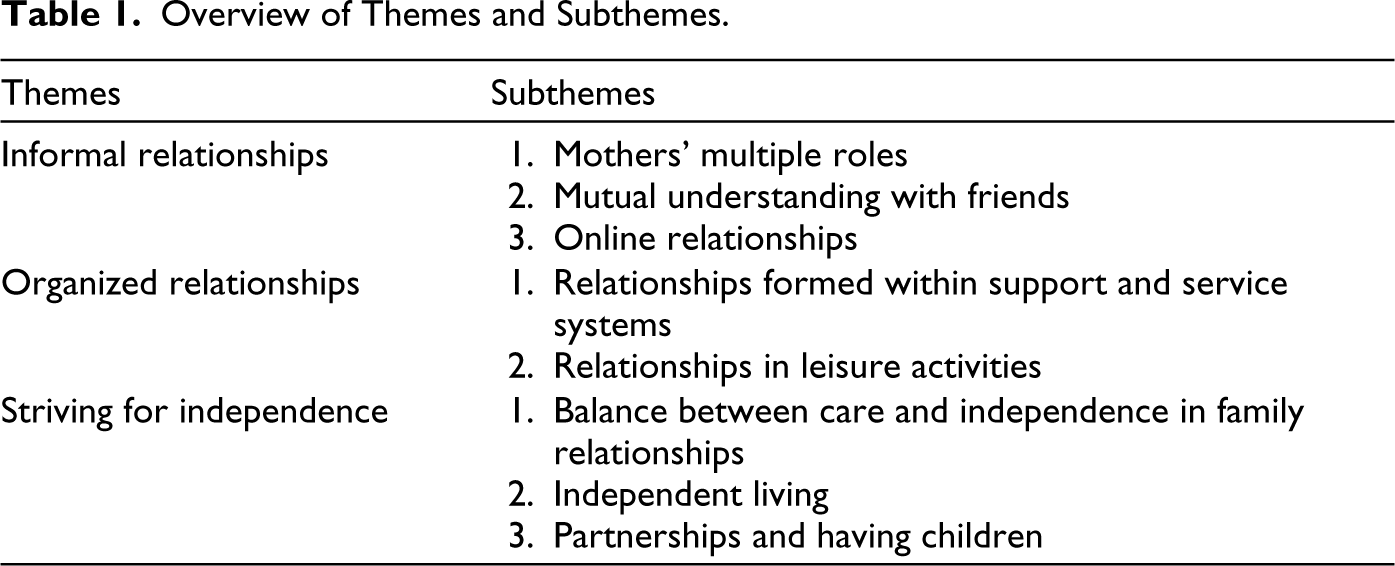
This section presents themes and subthemes that illustrate the social relationships of young adults with intellectual disability who are NEED and how these relate to experiences of belonging. The three themes are informal relationships, organized relationships and striving for independence. An overview of the themes and subthemes are presented in Table 1.
Overview of Themes and Subthemes.
Informal Relationships
This theme illustrates the participants’ informal relationships with family, friends and online, as well as how these provide a sense of belonging. The theme includes three subthemes: mothers’ multiple roles, mutual understanding with friends and online relationships.
Mothers’ Multiple Roles
Family members—be it one’s childhood family or a family of one’s own—have significant roles in the participants’ lives. Family is often described with positive feelings and as a key part of many participants’ social networks, which is congruent with previous research (Kamstra et al., 2015; van Asselt-Goverts et al., 2013). For some, relationships with family members are the most important, while others describe their family with less emphasis. The relationships with family members centre on their intrinsic value and in providing support, comfort, security, assurance and enjoyment, which align with feelings of belonging (Hall, 2010; Mahar et al., 2012; Robinson et al., 2020).
Family members are helpful with decision-making, support in pursuing an occupation and providing extra financial support. When asked about the decision to live independently, Adam responded: ‘My mom and I decided that together, that now it is time to take the step and move away from home.’ Mothers are more often mentioned than fathers. In line with other research (Dyke et al., 2013; Midjo & Ellingsen Aune, 2018), mothers are particularly central and take on multiple roles for young adults who are NEED. The participants describe mothers as having a practical function of assisting with decision-making, daily tasks and navigating systems of formal support. Adam says, ‘It is mom who takes care of things like with the social insurance agency and things that I think are very hard’. Mothers are also a source of support as illustrated by Emma’s response when asked if she is satisfied with her family relationships: ‘I’m really content, my mom has always been there for me. She still is today.’ Moreover, mothers have a social function, and some spend time with their mothers frequently. Mothers advocate for their children and ensure they get appropriate financial support and living accommodations.
In sum, family relationships are important, and through these relationships individuals can experience feelings of belonging. Mothers are particularly important, as they have multiple social, practical and caretaking roles.
Mutual Understanding with Friends
Participants commonly emphasize the importance of their friends. Many have friendships established over several years, where friendships consist of sharing personal experiences and providing a sense of support. Regarding his friends, Samuel says:
I would not have made it this far without them. They were very supportive during difficult times. I was depressed for a while and they were there for me. When my relatives passed away, they were always there. And in the same way I was there when they were not feeling well. (Samuel)
Samuel illustrates the importance of supporting one another in his friendships. Others emphasize doing ‘normal’ activities with their friends. Eric comments:
We go out and party maybe, drive around with the car or socialize, like everything that guys typically do. Yeah, the normal that guys, when one is a group of guys, typically do. Maybe one feels like going out to the bar or yeah, stuff like that. (Eric)
As described by Eric, being ‘normal’ with friends provides feelings of insiderness and fitting in, which underlines experiences of belonging (Hall, 2010).
Two participants mention the desire for more friends; however, finding friends can be difficult as described by Emma: ‘I am mostly looking for people who have children right now so that one can get like the same perspective as me … but it is pretty hard.’ A few participants shared that they had a difficult time making friends during their school years, felt alone or were bullied.
Friendships appear to build on a notion of similarity. These similarities act as a bond that ties the participants and their friends together. For the participants, these similarities included living in the same area, attending the same school or participating in the same activities. One similarity that emerged was a background in USSID or having a disability, which created experiences that helped friends relate to and understand each other, as illustrated by Sofie: ‘I have made really lovely friends during all these years … that I really like have been able to talk to and that I have really felt that they are like me.’ This aspect relates to the importance of shared experiences, understanding, and identities in a sense of belonging (Mahar et al., 2012; Wilson et al., 2017). Mahar et al. (2012) discuss that simply having physical or intellectual commonalities is not enough to determine belonging, rather it is the shared experiences and understandings that create a sense of belonging. Congruently, having an intellectual disability or a background in USSID brings people together, but it is relating to each other that leads to feelings of belonging between them.
Some of the NEED groups who perhaps do not identify with having an intellectual disability placed more emphasis on friends without a disability. In line with May (2013), this non-identification can lead to resistance in feelings of belonging with people who have a disability and instead individuals choose belonging with people without a disability.
Online Relationships
One type of social relationships among the participants was found in the use of the digital platforms. All but one of the participants used social media. Social media was often described as a way to keep in touch and communicate with family, friends and contacts whom they already know. Social media was also a way of sharing information and connecting with others with shared interests and hobbies. Some participants had online friends that they did not interact with or know in real life. Julia says:
I talk to friends and get to know new people and have become a member of quite a few of those groups where one can make new girlfriends.… So I have made some new friends, so we are going to meet and arrange … like get-togethers where we all can meet and get to know each other and stuff. (Julia)
As seen with Julia’s quote, social media can be an avenue for cultivating new friendships. This may be easier for some participants than others due to negative experiences with social media such as harassment or bullying.
May (2013) explains the increase in global connections and changes in how people communicate and how friendships are constructed; moreover, partaking in digital arenas evokes a sense of cultural belonging. Chadwick et al. (2022) highlight the importance that online interactions had in reducing loneliness among people with intellectual disability during the pandemic. For young adults who are NEED, using social media is a way to maintain, create or expand social relationships and networks. The participants’ online connections with other people and online activities allow for a sense of community and belonging to occur. Although social media provides accessible opportunities for different forms of communication and can be an important arena for social relationships, research indicates that it does not necessarily take away the importance of real-life relationships (Decieux et al., 2018).
Organized Relationships
The analysis identified a theme of social relationships that have been formed in an organized setting or under organized circumstances. These are presented as the following subthemes: relationships formed within support and service systems and relationships in leisure activities.
Relationships Formed Within Support and Service Systems
People with intellectual disability may need various degrees of support in everyday life. Many have links to the care system and formal systems of service and support. For example, some have formal supports under the LSS Act which include living accommodations (various housing forms with access to care and support) and daily activity/internships. Four participants mention professionals/personnel as part of their daily social interactions and as an important supportive function, for example, personnel help with administrative work and assist with daily tasks. When asked about the people he interacts with daily, Adam responds: ‘It is the personnel at my living accommodation. And they are very good because they help with a lot … and like help a little with doing dishes and stuff that one thinks is very hard.’ Participants describe personnel as people they spend time with and who help them with tasks and facilitate their engagement in activities. This facilitating role is important for individual opportunities to participate in activities (Robinson et al., 2020). Elliot mentions having a contact person (a support under the LSS Act that aids in facilitating social and leisure activities), whom he spends time with: ‘Sometimes I go with my contact person.… I have two others, but one of them I don’t go to the movies with very much. We do other things.’ In some cases, the participants have known these professionals for many years and have well-established relationships with them.
For some individuals who are NEED, professionals are a part of their social network and assist them with tasks in everyday life, which is similar to previous research (Dyke et al., 2013; van Asselt-Goverts et al., 2013). On the one hand, the relationships with professionals have social and supportive values. On the other hand, these relationships in relation to belonging can be problematized. It is unknown if these relationships are reciprocal (Forrester-Jones et al., 2006). In addition, for people with intellectual disability who need support in daily life, these relationships with professionals can become more important than they would for others. Although participants describe these relationships as meaningful, they may not describe all of them with the same intrinsic value as they describe their relationships with friends and family. As a result, belonging in these relationships is intertwined with being dependent on others but also highlights individual agency in choosing with whom one experiences belonging.
Relationships in Leisure Activities
Participating in leisure activities can be an opportunity to create social relationships. The participants describe participating in or attending activities such as going to the gym, sports teams for people with disability, church, choir, daily activity, organizations that work with people with disability, photography, bowling, art, cultural/religious groups and empowerment/activist groups. The participants’ engagements in these activities vary from every day to once a week. Sharing activities provides a functional element in relationships as well as a foundation for developing closeness (Sullivan et al., 2016). Organized settings that have personnel present can assist individuals with intellectual disability to develop relationships (Wilson et al., 2017).
For several participants, these socially organized settings provide a sense of community, togetherness, security, belonging, acceptance, support and being around others to which they can relate. Sofie comments:
Everyone is really nice to each other; it is a really lovely sense of community and … there is no exclusion, there is no bullying, and everyone is like friends with everyone and everyone talks to everyone, and I think that is really fantastic. (Sofie)
As the quote illustrates, participation in activities contributes to feeling included (Robinson et al., 2020). These settings provide feelings of fitting in (Hall, 2010) and result in positive feelings that facilitate a sense of belonging.
The relationships that stem from leisure activities create feelings of belonging for the participants. However, at times, these relationships are limited to the specific setting. Participants do not spend time with the people they have come to know in this setting outside of the leisure activity. When asked if he was satisfied with these relationships, Vincent replied: ‘I think I give it a five because I do not meet with them that often.… It is only at this specific setting. It is not like I see them outside of this.’
Striving for Independence
While social relationships are central among individuals who are NEED, a yearning for independence also emerged in the interviews. The desire for independence in turn influenced some of their relationships and experiences of belonging. This theme has three subthemes: balance between care and independence in family relationships, independent living and partnerships and having children.
Balance Between Care and Independence in Family Relationships
Despite the important role that parents and often mothers have, a few participants describe the dynamic between them and their parents as being more complex in character. It is common for parents to have concerns as their child with an intellectual disability transition to independent lives (Dyke et al., 2013; Leonard et al., 2016; Midjo & Ellingsen Aune, 2018; Sullivan et al., 2016). How parents view their child’s abilities to be independent can influence milestones as both Julia and Vincent illustrate when they discuss the process of moving out:
[I]t took two years before I got an apartment. But then my parents and I said that instead of me moving to my own apartment completely on my own, it was better that I moved to formal accommodation so I get to learn everything how it is and the reality of living alone, because they didn’t think I could manage it. (Julia) Mom does not want me to move from home. She thinks that I will become an alcoholic or a drug addict if I live by myself and let anyone in. (Vincent)
Vincent’s protective family fears that something bad will happen to him, perhaps in part due to past experiences. There is a tendency to view individuals with a disability more as a child than as an adult (Söder, 1989; Umb-Carlsson & Lindstedt, 2011). The participants share that their parents’ concern is influential in various aspects of their lives. Parental involvement can be experienced as negative, like for Eric who finds his mother’s involvement a hassle:
Eric: Mom should not like all the time get involved in my business. Interviewer: In which way? Eric: Like ‘No, that will take way too long time if you do it this way, it will take too long time. First you want to improve your grades then go to folk high school (adult education). No, you are going to get a job and move out from home’.
Eric’s quote illustrates a clash between his mother and himself when it comes to his choice of an occupation (employment versus further education). In this life stage of young adulthood, a clash can occur between needing support from one’s parents and at the same time wanting independence similar to one’s peers (Renwick et al., 2019). In sum, a duality emerges for young adults who are NEED, where on the one hand, family relationships are meaningful and create a sense of belonging, but on the other hand, can impede the participants’ pursuits of independence.
Independent Living
Many of the participants express a yearning to live on their own. The notion of living independently is associated with a sense of belonging, since making decisions and practising autonomy where one life relate to feeling belonging in relation to a place (Strnadová et al., 2018). Half of the participants live with their parents. While many of them describe leading independent lives, they all express a desire to move out since this would entail increased independence, being closer to school, having their own and more space, and being closer to public transportation. Umb-Carlsson and Lindstedt (2011) describe that having one’s own home is akin to being viewed and treated as an adult, as well as relates to quality of life. According to Sofie and Charlotte, living alone is a means of achieving independence:
Mostly I want to live close to school, but also like to get away from home a bit and like stand on my own legs and manage a bit on my own. (Sofie) I enjoy living with my mom but sure it would be nice to live alone. Because I feel that I get on my mom’s nerves sometimes. And I am a person that wants to actually manage on my own, I like this with paying bills.… But like I said, it is expensive, so I don’t think it will happen, but I am glad for the time that I can live at home with my mom. (Charlotte)
Charlotte believes that living alone would provide her with a sense of pride, but high costs prevent her from moving out. Poor finances were mentioned by a few participants as a common barrier to independent living, along with their parent’s concerns and long waiting lists for housing.
Two participants currently live on their own and three participants live in formal accommodations provided under the LSS Act. The participants describe that living in group accommodations has the benefits of being around others close in age, participating in activities, and having personnel nearby. In line with previous research (Gur & Bina, 2022; Strnadová et al., 2018), the positive feelings that the participants convey about their living accommodations, their relationships with others, and the opportunities to actively participate in these settings, as well as feeling independence and autonomy, together facilitate a sense of belonging in relation to a place.
Partnerships and Having Children
Six participants are currently dating or have a boyfriend/girlfriend. These relationships with partners generate positive feelings and a sense of belonging among the participants. One central aspect in these romantic relationships, as with friendships, is a component of similarity and mutual understanding (Mahar et al., 2012; May, 2013; Wilson et al., 2017). Some have partners who also attended USSID or have a disability, and this shared experience can be viewed as contributing to the participants’ sense of belonging in these relationships. Participants convey that their romantic partners are understanding, supportive, caring and encouraging. The three participants who are single all say that they would like a partner at some point.
Most of the participants do not have children, similar to the findings of Umb-Carlsson and Sonnander (2005). However, many express that they would like to have children in the future. When Samuel was asked about this he responded:
[M]y parents want grandchildren.… I still think that it is beautiful to create a life. One still wants something that can continue one’s family tree.… I do have plans for that, I don’t know when that will be but some day. (Samuel)
Samuel’s quote shows that having children could be a way to continue building his family and is also desired by his parents. When asked about her desires for the future, Alice replied: ‘if you don’t count getting a job, yeah it is the usual things; should start a family and such.’ As illustrated by Alice, having children is viewed as a natural step of adulthood. Emma is the only participant who has children, which she describes as the best part of her life.
Two participants stated that they did not want or were uncertain about having children. Sofie explained that a reason for this was that she ‘can’t really see myself in that role.’ The participants themselves or family members express limitations in these participants’ abilities to be a parent, often due to their disability or well-being. Adam comments: ‘Yes, one wants that (to have children) but I don’t know if I could handle that because of my disability, but nothing is impossible so why not.’
The participants’ descriptions of having children present norms and markers of adulthood that follow an individual becoming independent. Children could be potential relationships that generate feelings of belonging. However, most of the participants do not have children and although many are still young, their future pursuits of having children are also affected by their own and others’ views of their capabilities to be parents.
The striving for independence theme and its subthemes demonstrates that the notion of independence is an additional and influential layer to understanding the NEED groups’ social relationships and experiences of belonging.
Discussion
The aim of this study was to examine the social relationships of young adults with intellectual disability who are NEED activity, as well as how these relationships are conditions for experiences of belonging. The findings illustrate that the target group has varying types of social relationships, which provide different sources for a sense of belonging. Informal (family, friends and online) and organized (professional/personnel and leisure activities) social relationships evoke feelings of being accepted, supported, like others and fitting in, and together these relationships and feelings are conditions that lead to individuals’ experiences of belonging. Moreover, the various social relationships that the NEED group have do not automatically equate to a sense of belonging. Rather, individuals can move and choose between different types of belonging depending on their interests, self-identification and engagement in various contexts.
A sense of belonging is complex and is generated in different relationships and contexts, and with others who are similar or dissimilar to us. This complexity underlines the notion that belonging is not a static state (May, 2013). The same diversity is seen in the NEED group. Many place great emphasis on relationships with other people as central to their sense of belonging. This same emphasis on primarily relational belonging is highlighted in other research as well (May, 2013; Strnadová et al., 2018). In line with the concept of belonging (Gur & Bina 2022; Hall, 2010; Mahar et al., 2012; May, 2013; Robinson et al., 2020), the experience of belonging for young adults who are NEED comes from positive feelings, connections, reciprocity, mutual understanding and a sense of identification, all of which stem from their social relationships. The importance of identity as it relates to belonging is for example seen among those in the NEED group who do not identify with a disability and instead seek relationships and belonging in other arenas where the disability is not at the centre, for example, in leisure activities. This is an illustration of where individuals choose or resist belonging (May 2013; Olin & Ringsby-Jansson, 2009) and highlight the individual’s active role in the experience of belonging. In line with Mahar et al. (2012), it also suggests that having an intellectual disability is not necessarily the only factor that creates similarity or mutual understanding in relationships. Mutual understanding is also based on common interests.
The results show that for young adults with intellectual disability who are NEED, the desire for independence also influences social relationships and experiences of belonging. The dynamics between independence, social relationships and belonging are amplified by what it entails to have a disability, including the need for support it entails. This can lead to tension and is regarded as part of the transition to adulthood (Renwick et al., 2019). Together, it highlights the pursuit of independence as another dimension of understanding the NEED groups’ relationships.
Previous research suggests that people with intellectual disability have limited social networks and increasingly experience isolation (Umb-Carlsson & Sonnander, 2005), which the present study also found among some people who are NEED. However, and more importantly, the results portray a variety of meaningful relationships that constitute arenas for a sense of belonging. The NEED group describe their social relationships, such as friends having an important role, in a way similar to young adults in general. At the same time, there are aspects related to having an intellectual disability and not having a daily occupation that distinguishes this particular group, for example, the role of mothers in decision-making or the challenges with gaining independence. Therefore, the social relationships in the NEED group can be understood as complex where multiple aspects related to having an intellectual disability, to being a young adult, and not having a known occupation are simultaneously influential. This complexity can be understood as further amplified by the influence of both society and the individual’s engagement in a sense of belonging as outlined by Gur and Bina (2022). Together, this points to the multidimensional perspectives and the relational model that account for individual and environmental factors that are necessary for understanding the NEED group.
There are limitations in the study. The sample was small, but arguably saturation was reached by the final interviews. Because people who are NEED are a diverse group, the representativeness of the participants should be considered. There are likely individuals who are more isolated or have different circumstances that were not represented among the participants. The USSID and the LSS Act are specific for the Swedish context; varying national systems for support and services are likely to influence how people with intellectual disability in other countries perceive social relations and belonging in their daily lives.
Conclusion
This study has explored the social relationships and experiences of belonging for young adults with intellectual disability who are not participating in employment, education or daily activity. Despite not having a daily occupation, individuals have informal and organized social relationships that generate positive feelings and a sense of belonging. Yet, at times, the social relationships and experience of belonging are influenced by the desire for independence and aspects surrounding their disability, for example, needing support from family members. The findings contribute to a nuanced understanding of the NEED group specifically, as well as how various social relationships and participation in arenas that allow for social interactions generate a sense of belonging. Future research should continue to explore this topic among people with various degrees of intellectual disability, in various subgroups of NEED and in various cultural contexts.
Footnotes
Acknowledgements
This work was supported by Misa AB and Halmstad University.
Declaration of Conflicting Interests
The author declared no potential conflicts of interest with respect to the research, authorship and/or publication of this article.
Funding
The research was funded by Misa AB and Halmstad University