



Abstract
The Convention on the Rights of the Child states that all children and young people have the right to have a voice in matters concerning them, in accordance with age and maturity. In the endeavour to make youth sport a safe place free from abuse and harassment, it is crucial to ensure that young athletes can exercise their participation rights. Drawing from an online study involving over 550 Swedish young equestrians aged 15–17, the aim was to investigate whether and in what ways young equestrians can make their voices heard. The results show that the possibility to have a voice is conditioned by sociocultural factors such as what type of stable the youths are active in. The results are analysed from ‘The ladder of participation’. In sum, social interaction and access to horses are important conditions for how young equestrians experience the possibility to have a voice.
Introduction
This article focuses on young Swedish equestrians’ participation rights and their possibilities to have a voice. This focus relates to the so-called youth voice agenda which has received increasing interest in recent decades in areas such as education, welfare, citizenship and health (Bessant, 2004; Biesta et al., 2009; Horgan & Kennan, 2022; Lansdown, 2001; Quennerstedt, 2019; Sinclair, 2004; Thomas, 2007). However, in organized sport, which is an important part of life for many young people, almost no attention has been given to youth voices and participation rights. Although the implementation of human rights issues is, in general, a growing field within sport (David, 2005; Donnelly, 2008; Sinohara, 2020). Lang (2022) points out that little is known about the views of young athletes or whether their voices are genuinely incorporated into sporting practice, suggesting that the voices of young athletes are still largely unheard (see also UNICEF, 2011).
The lack of studies on youth participation rights in organized sport is problematic for several reasons. The most obvious reason is that the rights of children and young people are universal and fundamental and should be secured. In Sweden, as in the rest of the Nordic countries, most individuals join a sports club at one point during their youth (Thedin Jakobsson et al., 2018), and it is regarded as an important arena for the fostering of both skills and values (Peterson, 2008). However, whether these values include youth participation rights is less known, although they should be. Sport clubs are state-funded through the umbrella organization the Swedish Sports Confederation, and there is a clear mission from the state as well as from the organization itself that children and youth should be able to influence their sporting practice and be involved in decision-making. The goal is that sport should be a ‘school of democracy’ (Swedish Sport Confederation, 2019, p. 11). Another reason for focusing on youth voices is that giving young people a chance to influence essential matters also means giving them an opportunity to impact their day-to-day lives. Sport clubs have succeeded in recruiting children and young people, but they are less successful in keeping them. Many drop out from the age of 11 and onwards (Norberg & Wahlgren, 2023; Thedin Jakobsson et al., 2018). Having influence, being heard and feeling included have proved to be important for continuing in sport (Trondman, 2011). Making sure that young people have a voice is thus a way to attract youth to stay on. In addition, giving young people a voice may be a crucial factor in preventing abuse and harassment (Hong, 2006; Weissensteiner, 2015). Former athletes have recently stepped forward and shared stories of abuse happening in their younger days, which indicates that the sporting context is characterized by a culture of silence (Barker Ruchti & Varea, 2021; Rudolfs et al., 2019). Against this background, research about young people’s participation rights in sport is needed. In this study, we are interested in mapping out and analysing when and in what matters young people have a voice and can speak out in the sporting context.
The focus here is on equestrian sport in Sweden. Equestrianism is one of the largest youth sports regarding the number of participants, and Sweden is one of the countries with the highest number of horses per capita in Europe (Swedish Board of Agriculture, 2016). There are about 860 riding clubs of which 450 are riding schools with many young riders (Swedish Equestrian Federation, 2020), and more than half the members of equestrian clubs are under the age of 26. Equestrian sport is one of the most popular sports for girls and young women, and over 90% of members are female (Swedish Equestrian Federation, 2017). The equestrian sport includes both the riding activity and the leisure time spent in the stable, for example when taking care of the horses.
On the one hand, the stable has proved to be a social sphere where young girls in the Nordic countries socialize and cooperate. Research shows that equestrian sport can be a place where young girls develop leadership skills, learn to take responsibility and become independent (Forsberg, 2007; Forsberg & Tebelius, 2011; Ojanen, 2012; Thorell et al., 2018). On the other hand, in connection with the #metoo movement negative experiences from young equestrian girls became public through media. Stories were shared about exploitation by adults who had the power to decide who would gain advantages in the stable, such as riding the best horse, taking part in competitions, or receiving other sought-after benefits (#visparkarbakut, 2017). Today, some years later, stories about emotional and sexual abuse are still voiced, for example in documentaries and newspapers (Aftonbladet, 2022; Nyheter, 2022). Thus, the situation is paradoxical: equestrianism seems to provide a sporting environment that is empowering, but it is also a place where hierarchies and a culture of silence seem to prevail. This paradox is yet another reason why we need more knowledge about the conditions that enable young equestrians to exercise their participation rights and have a voice in sport.
Participation Rights—What Does It Mean?
According to UNICEF (2011), participation is a process in which children and young people learn to express themselves and take part in decision-making at different levels. Participation rights are based on several articles in the United Nations Convention on the Rights of the Child (UNCRC), but Article 12 is regarded as one of the most important as it is included in the core principles. It recognizes children and young people as actors in their own lives stipulating that children (anyone under 18 years of age) have the right to have a voice in all matters that concern them and that their views should be accounted for (United Nations, 1989). However, many scholars emphasize that there are certain challenges in implementing Article 12, not least in sport (McMellon & Tisdall, 2020). One possible reason is that a developmentalist conceptualization of childhood still prevails in sport, which prevents children and youth from being heard (Lang, 2022). Another obstacle is the ubiquity of behaviouristic coaching models characterized by one-way communication and direct instructions from coach to athlete, although other forms of pedagogy are brought forward (Light & Harvey, 2017).
To improve our understanding of conditions for participation and having a voice, we make use of the concepts of social and political participation. This means that we see participation as part of the concept of democracy, and as such it has two dimensions. One dimension relates to inclusion and ‘being part of’ something, while the other relates to influence and having a voice. To distinguish the two, we are inspired by Elvstrand (2009) and others (see also Redelius & Eliasson, 2022), who use the concepts of social participation and political participation. Social participation can be defined as the feeling of belonging to a group, where the emphasis is on the inclusive aspects and the social benefits achieved through participation. Political participation, on the other hand, is about having the opportunity to take initiative and influence one’s situation. In this dimension, the emphasis is on young people’s voices and being involved in decision-making processes. In the present study, the aim is to map out and analyse both the ‘social dimension’, such as the feeling of belonging to a community, and the ‘political dimension’, such as the experience of having a voice and being involved in decision-making.
Theoretical Framework and Analytical Tool
This study draws on a sociocultural framework which means that we see human actions as situated in social practices. In line with such an approach, a certain physical activity that takes place in a sporting context, such as equestrianism, is regarded as part of a movement culture where specific logics prevail, and where there are both spoken and unspoken rules and expectations about how participants, including children and young people, should act (see also Engström et al., 2018). Young equestrians, as well as riding teachers/instructors and coaches, thus act based on their own knowledge and experience and according to what they consciously or unconsciously perceive is required, permitted, or possible (Säljö, 2014). We find it fruitful to distinguish between young equestrians within riding schools and private stables, as these two settings could be seen as diverse cultures that may entail different basic conditions for young equestrians.
The Swedish riding schools are standardized and controlled for quality by the Swedish Equestrian Federation. This ‘quality mark’ means that the federation oversees how the riding school activities are carried out, for example regarding safety aspects, and that there are educated riding teachers/instructors. The affiliation with the Swedish Equestrian Federation also implies that they are expected to work according to the Swedish Sports Confederation’s values and policy documents (2019), which include securing youth participation rights (Swedish Equestrian Federation, 2021).
At the riding school, the school or club owns the horses, and the riding activities are conducted in groups where each rider is assigned a horse for a riding lesson. This means that the rider does not have the sole responsibility for a horse, even if riders in smaller riding schools often need to get involved and help with various stable tasks and duties. As mentioned earlier, riding schools and clubs mostly have female members but the history of riding schools in Sweden emanates from military traditions. When the first riding schools in Sweden were established, former military staff were often employed as riding instructors. They brought with them teaching traditions characterized by giving orders and one-way communication. This can still be seen, for example, in prevailing hierarchies, where instructors are not questioned. Research also shows that there are limited dialogues between the instructor and the rider (Lundesjö-Kvart, 2020; Thorell & Hedenborg, 2015).
In private stables, the assumption is that young equestrians have access to a horse they own or help the owner with the horse. Thus, private stables are not a school setting with organized activities, and these stables are not always affiliated with the Equestrian Federation and are therefore not obliged to follow their requirements to the same extent as riding schools. The stables are often owned by a private person or a small business. In these stables, stable duties and riding are usually done independently. We believe a sociocultural framework is relevant to analyse the conditions that may prevail in these two cultures.
Included in this framework is the notion that participation is not either/or, meaning it is not a dichotomous but a continuous variable. In the study, the metaphor of the ‘ladder of participation’, originating from Arnstein (1969) and developed by Hart (1992, 2008), is used as a tool to analyse different forms or degrees of participation, especially the political dimension. According to Hart (1992), there are different levels of participation; from ‘low’ or non-participation levels, such as manipulation, decoration and tokenism (which he included to show that such levels exist), to levels where participation occurs. Those levels are where young people are informed and/or consulted, and involved in adult decisions, namely when they take initiative and make decisions together with adults (Hart, 1992). Hart (2008) points out that the different levels of participation can be of use for visualizing social structures that can facilitate conditions for participation. We believe that makes it a useful analytical tool to include in the sociocultural framework.
Method
This study has a quantitative approach, and the method used is an online survey. The intention was to map out and analyse the experiences of participation rights in a large number of young equestrians aged 15–17 years old.
Questionnaire—Design and Distribution
A questionnaire with 66 items (including open-ended questions) was developed. The questionnaire was constructed to represent different levels of participation according to Hart (1992, 2008). The statements were rated on a Likert scale with four grades: totally agree, mostly agree, hardly agree and do not agree. The survey was tested beforehand in a voluntary pilot discussion with eight young equestrians from a nearby riding school. The discussion aimed to ensure that the key issues were understood correctly and possible to respond to and led to some small changes being made to the survey.
The questionnaire was distributed online and a link to the survey was shared via organizations within the equine sector, social media (Facebook, Instagram) and upper secondary schools with subjects related to equestrianism in the curriculum. The survey was also noticed on various well-known websites within equestrian sport. The link to the survey was thus shared on social media by both organizations and youths themselves. The intention behind using social media for distribution was to reach young equestrians from different types and sizes of stables.
The use of an online survey was deemed appropriate as the study was conducted during the COVID-19 pandemic when youth sport was restricted in many ways. In equestrian sport, riding was allowed to proceed, but there were restrictions, that is, there was no space for interaction, and ‘hanging out’ in the stable was not allowed. A letter of information about the aim of the research project and contact details in case of any questions were included in the survey. Participants were also requested to answer according to their ‘normal’ sporting context, without pandemic restrictions.
The questionnaire was distributed as an online anonymous survey to equestrians aged 15–17. That age group was chosen because in these ages, youths are still considered children (up to 18 years old) according to the UNCRC, and they are old enough to reflect on their sporting context related to the aim of this study. Another reason is that according to the Swedish Research Council (2017), from age 15 individuals are allowed to decide for themselves if they want to participate and do not need parental consent. With the survey followed information that clearly stated that participation was voluntary and that their names or riding clubs should not be stated. This ensured that answers could not be traced to respondents, and individuals could not be identified. Since no personal information was gathered and the participants were 15 years or older, ethical approval was not needed (Ethical Review Act, 2003, p. 460). The data collection was carried out in accordance with ethical guidelines from the Swedish Research Council (2017).
Participants
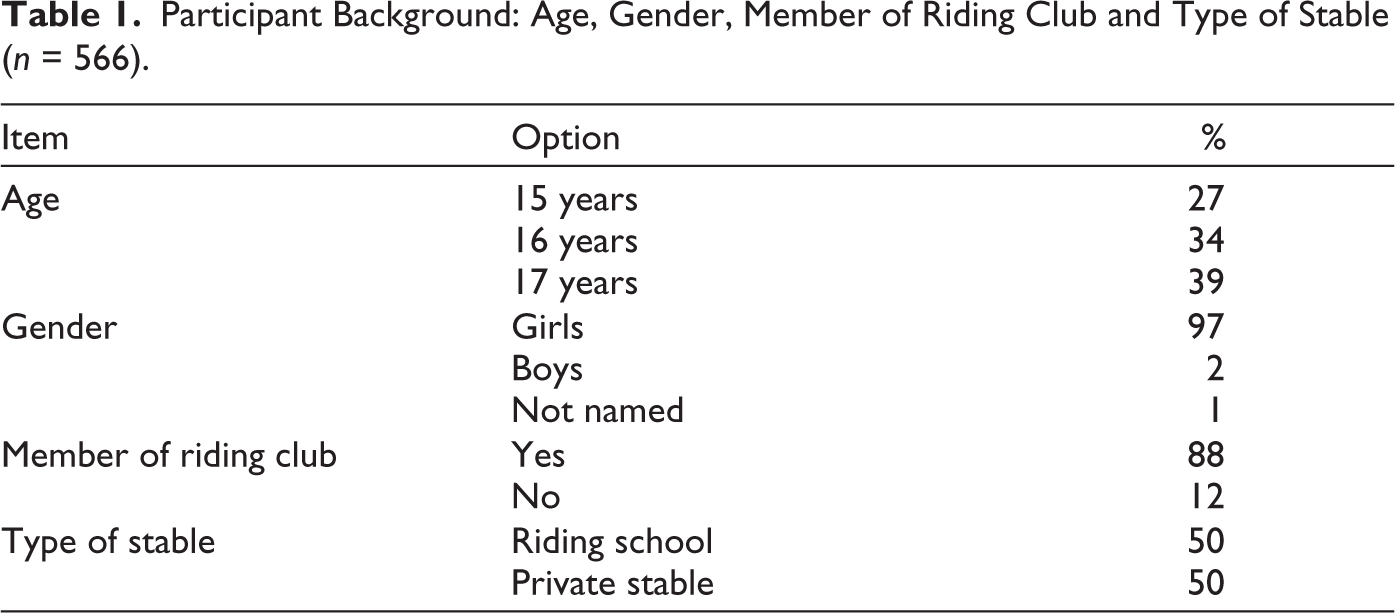
The sample consisted of 566 participants aged 15–17. Table 1 provides an overview of the participants’ background information, such as age, gender and type of stable.
The young equestrians are distributed rather evenly among the different age groups. Two percent of the respondents are boys, and although this figure is very low, it is in line with gender representation among young equestrians aged 7–25 (Norberg & Wahlgren, 2023). The 12 boys that answered the survey are evenly spread in the data in terms of age, residence and type of stable. Article 12 applies to all children, and therefore we saw no reason to exclude boys although they were few in the sample.
Within all the respondents, the residential spread is evenly distributed across sparsely populated areas to big cities with suburbs. Thus, the respondents come from various geographical areas. The young equestrians were also asked to rate their family’s economic situation with the options ‘not good at all’, ‘quite good’, ‘good’ and ‘very good’. A high proportion, 77% (n = 563) rated their family economy as ‘good’ or ‘very good’. Two groups of respondents were identified: one group with 281 youths at riding schools (50%) and one group with 285 youths at private stables (50%).
Participant Background: Age, Gender, Member of Riding Club and Type of Stable (n = 566).
Analysis
The data were processed and analysed in Microsoft Excel (2016) and IBM SPSS Statistics ver. 27 (2020). The analysis is based on descriptive statistics and aims to summarize and describe potential patterns of how participation is experienced among young equestrians.
An overview of missing data and whether participants dropped out was made to see if this would impact the results for different statements. The rate of dropout within the different statements is in the range of n = 20–60, in a comparison between the groups (private stables versus riding schools), there were no more than n = 24. The dropouts throughout the statements in focus were not considered to impact the results since the spread of dropouts was even.
In the analysis, questions representing different levels of participation were used and contrasted to highlight how young equestrians experience different forms of participation and how these may be conditioned. As mentioned, the analysis is based on the different levels developed by Hart (1992) ranging from Level 4: assigned and informed, Level 5–6: informed and consulted and/or involved in adult decisions to Level 7–8: taking initiative and making decisions together with adults (see Table 2).
The first part of the analysis is based on five statements representing different levels of participation including all answers from all youths in both private stables and riding schools. Second, a comparison between private stables and riding schools was made to see whether the conditions in different types of stable (different cultures) could be a reason for the different patterns that emerged. We found that the youth from riding schools experienced participation to a lower extent. We, therefore, wanted to study this group in more detail since riding schools are affiliated with the Swedish Equestrian Federation and are expected to work with and implement guidelines from the Swedish Sport Confederation. Statements about the importance of clubs allowing young people to be part of decision-making and feel included pervade these guidelines (Swedish Sport Confederation, 2019).
The next step in the analysis focused specifically on the young equestrians in riding schools. Factors that could impact their conditions to have a voice (political participation) were analysed, using questions such as: ‘What can you influence in the riding lesson/training?’, ‘Do adults in the stable ask about your view?’ and ‘Are you active within the youth committee?’ Statements relating to social participation were also rated by the youths in riding schools.
Results
We begin the results section by describing or mapping out all the participants’ responses to statements about different levels of political participation. In Table 2, the statements are presented as Level 4–8 (Hart, 1992) as described above.
Proportion of Youths Who Answered Totally/Mostly Agree or Hardly/Do Not Agree on Statements About Different Levels of Political Participation (%) (n = 419–428).
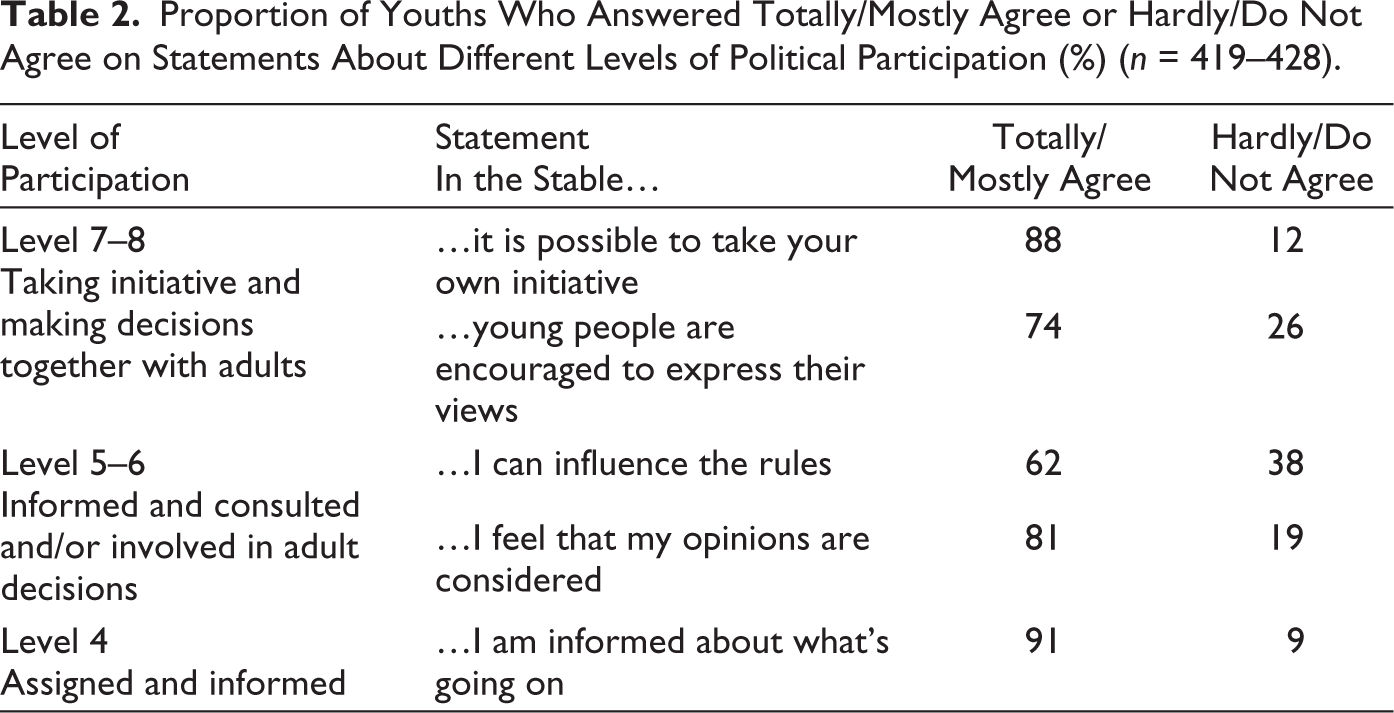
A vast majority (91%) of the young equestrians feel that they are informed (Level 4) about what is going on. A majority (81%) also feel that their opinions are considered, and two-thirds (62%) state that they can influence the rules, which indicates that they are informed and consulted and/or involved in adult decisions (Levels 5–6). A high proportion (74%) answered that young people are encouraged to express their views or that it is possible to take your own initiative (88%). These figures imply that the political participation experienced by the youth is at a high level. At the same time, almost 40% responded that they hardly or do not agree that it is possible to influence the rules, and 26% do not feel that young people are encouraged to express their views. Moreover, almost 20% do not feel that their opinions are considered.
We also compared the answers to the statements in Table 2 by young equestrians in riding schools with those in private stables (Figure 1). Figure 1 gives an overview of how participants from the different types of stables experience their possibilities to have a voice on different levels.
Proportion of Youths in Riding Schools and Private Stables Who Rate Five Statements Representing Different Levels of Political Participation with ‘Totally Agree’ (%) (n = 419–428).
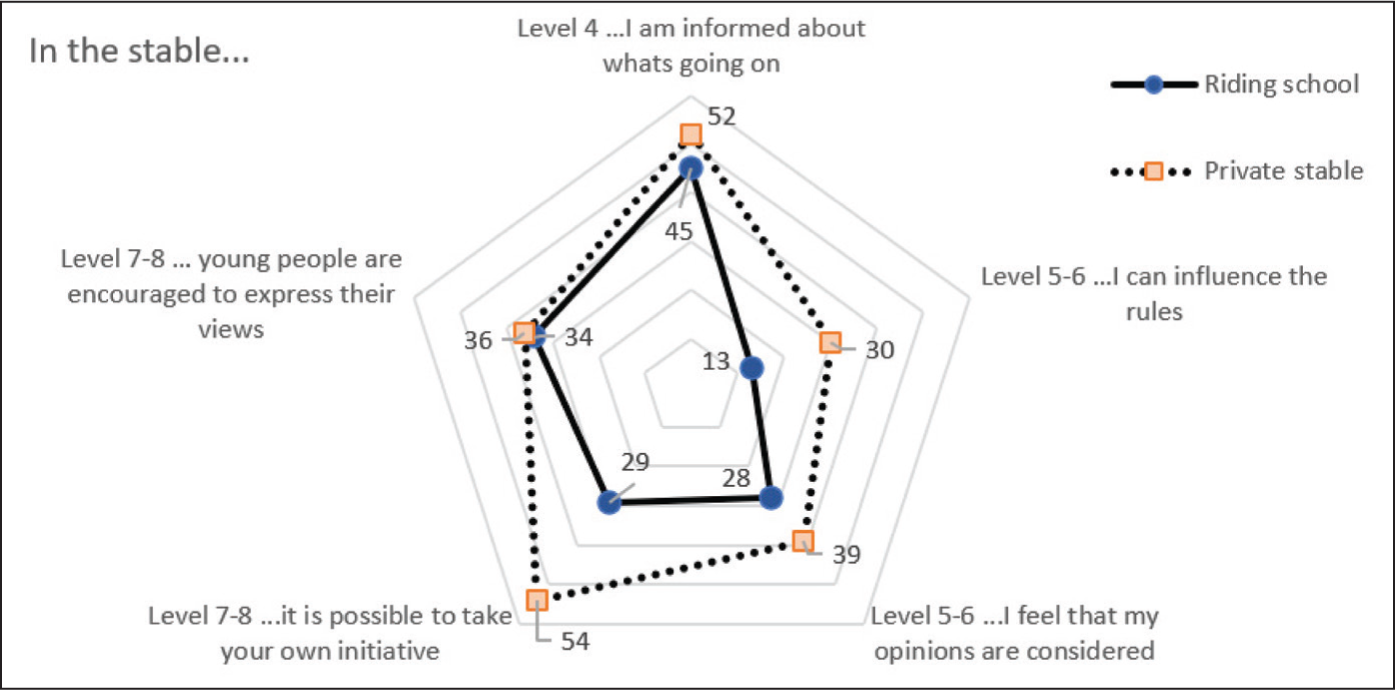
Regarding Level 4 (assigned, informed), 52% of youths in private stables and 45% in riding schools totally agree that they are informed about what is going on. When it comes to Level 5–6 (informed and consulted, involved in adult decisions), 30% of those in private stables totally agree that they can influence the rules, while for youth in riding schools, it is 13%. Almost 40% of those in private stables and 28% in riding schools totally agree that their opinions are considered. In private stables, 54% of the young equestrians totally agree that it is possible to take your own initiative, while a smaller portion, 29%, from riding schools answers the same.
Although young equestrians from both types of stables seem to experience that they are informed (Level 4), higher levels of participation differ between the groups. The results show that youths in private stables answer ‘totally agree’ to a higher extent than those in riding schools when asked if they are informed, consulted, can take initiative and influence the rules. The line in Figure 1 is made to visualize that the possibilities for political participation for youths in riding schools seem narrower or more limited. In the following, we will therefore focus more in-depth on the responses from youths in the riding schools and analyse their participation rights further.
Patterns of Having a Voice in Riding Schools
So far, we have shown results about youths’ experiences of political participation. We will look deeper into the possibilities for youths at the riding schools to come up with suggestions and speak out when they feel that something is wrong, but we will also pay attention to the social dimension of participation. Statements and responses related to the youths’ social and political participation are presented in Table 3.
Proportion of Youths Experiencing Social and Political Participation Within Riding Schools (%) (n = 219–225).
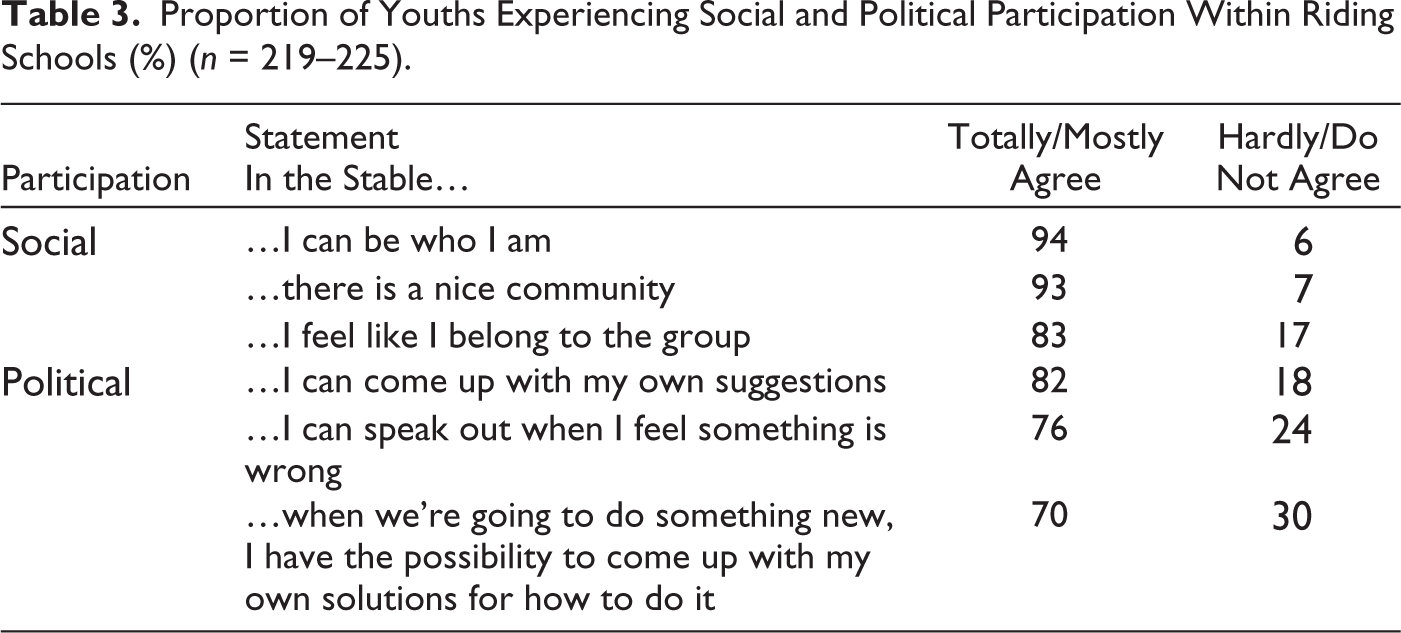
Table 3 shows that the participants from riding schools generally indicate a high level of both dimensions of participation. However, it is notable that a higher proportion of the youths totally or mostly agree with the statements related to social participation. The political participation described in the statements needs to be offered and supported by interactions with adults, while the social participation described in Table 3 could occur between the youths themselves. In the next step, we are therefore interested in finding out which adults young people encounter in the stable. Predetermined categories of adults were optional, and our findings show that adults in riding schools consist of riding teachers/instructors (90%), stable staff (88%) and riding school managers (78%). Other adults present in the stable are parents (77%), adult riders (74%) and horse owners (69%). It is important to note that the riding teachers/instructors also often work in the stable as stable staff or sometimes as stable managers. Figure 2 illustrates how the youths themselves perceive whether their voices are heard by different adults in the stable.
Proportion of Adults Asking About Youths’ Views in Riding Schools (%) (n = 211).
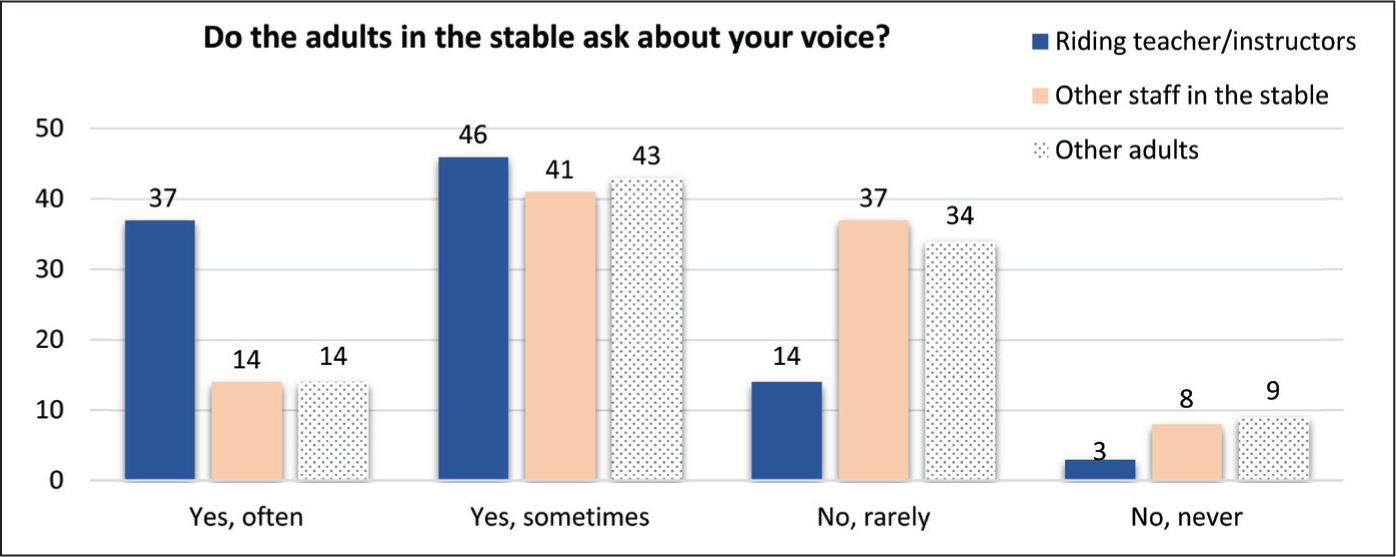
Figure 2 shows that riding teachers/instructors more often ask about the views of young equestrians compared to other staff in the stables or other adults. As can be seen in Figure 2, over 40% of the youth state that other staff in the stable rarely or never ask about the young equestrians’ views while riding teachers/instructors often or sometimes ask.
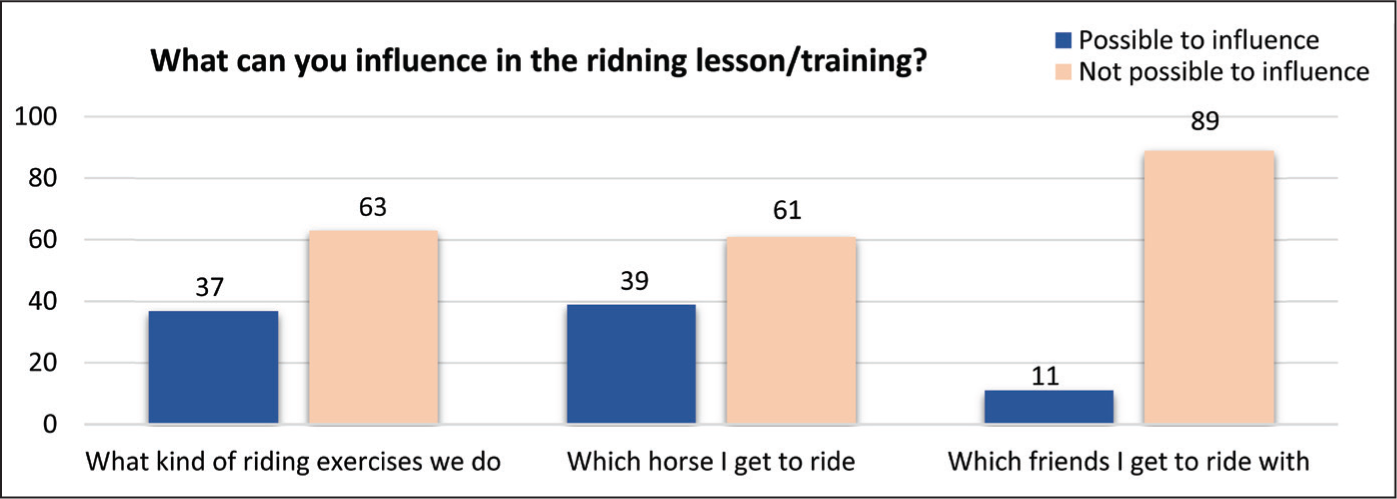
Youths also received questions about the possibility of having a voice in riding lessons or during training (Figure 3). The question was ‘What can you influence in the riding lesson regarding the kind of exercises, which horse to ride, and which friends to ride with?’ They could answer all options (see Figure 3).
Figure 3 shows that a large proportion of the youths do not feel that they have the possibility to influence the kind of riding exercises (63%), which horses to ride (61%), or which friends to ride with during riding exercises (89%). These results give a different picture than the one above (Figure 2) where the young riders stated that teachers/instructors were the ones often asking about their views. In Figure 2, it was suggested that the teachers/instructors often or sometimes ask about young equestrians’ views, but when asked specifically about the choice of exercises, horses and friends, few feel that they can influence those matters.
Proportion of Youths Who Feel That They Can or Cannot Influence Riding Exercises, Which Horse to Ride and Which Friends to Ride with (%) (n = 281).
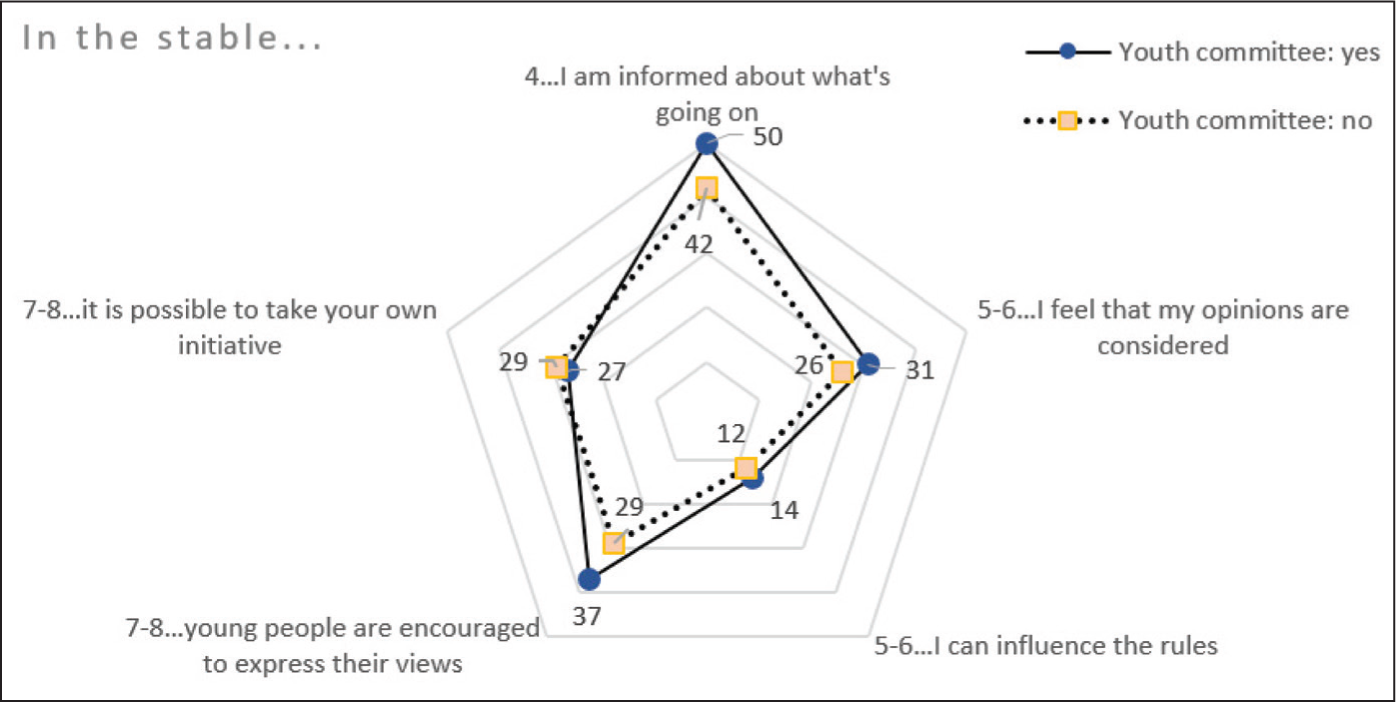
It is highlighted by the Swedish Equestrian Federation that riding schools and clubs should work actively to engage young people in decision-making processes. One way to do this is for youths to be a part of a youth committee, which was also asked about in the questionnaire. In a youth committee, the youths have their own board with representation in the riding club board, and they also arrange activities for children and young people. Whether such an engagement seemed to impact the experience of political participation is shown in Figure 4. The figure shows the proportion of youths answering ‘totally agree’ when asked about different levels of participation.
A higher proportion of youths who belong to a youth committee answer that they totally agree with statements related to different levels of political participation in comparison with youths who are not engaged in such a committee. For example, half of those belonging to a committee totally agree that they are informed about what is going on and 42% of those not involved feel the same. Almost 40% (37%) of youths engaged in youth committees feel that they can express their views in comparison with almost 30% (29%) of the youths not part of a youth committee.
In sum, the results show that the feeling of social participation is experienced as higher than political participation among young equestrians at riding schools (Table 3). In riding schools, riding teachers/instructors seem to ask the young equestrians about their views more frequently than stable staff and other adults (Figure 2), although during the riding lesson/training, the youths largely experience the possibility to influence as greatly diminished (Figure 3). It is also relevant to notice that youths who are engaged in the youth committee are slightly more likely to experience a higher level of participation as shown in Figure 4.
Level of Participation Among Youths in Riding Schools Engaged or Not Engaged in the Youth Committee (%) (n = 198).
Discussion
The study presented in this article aimed to map out and analyse youth’s participation rights in sport, with a focus on equestrianism. This aim included both the ‘social dimension’ of participation, such as the feeling of belonging to a community, and the ‘political dimension’, such as the experience of having a voice and being involved in decision-making. According to Lang (2022) and a review of trends, challenges and opportunities in relation to participation (McMellon & Tisdall, 2020), almost no work has been done in sport that focuses on youth participation rights, and although Hart’s model (1992) has been used for decades in research about children’s rights in education, it has never been applied in sport. Consequently, there is not much sport science research to relate the results to in the discussion, but we will engage with literature from other fields. We will also make use of the sociocultural framework and analytical tools to discuss the results and expand the analyses. So, what can be said about young equestrians’ possibilities to exercise their participation rights?
On the one hand, we can conclude that in general, a large majority of young equestrians in this study report a high degree of political participation—a high level according to Hart’s metaphor (1992). The vast majority answer that they totally or mostly agree that it is possible to take initiative on your own, that they are encouraged to express their views and that their views are considered. Almost everyone (over 90%) totally or mostly agrees that they are informed about what is going on. On the other hand, there are differences within the group, and whether the riding schools and private stables have succeeded in creating an atmosphere of inclusion and decision-making depends on how these results should be interpreted and viewed.
In line with a sociocultural perspective, we see the two settings, riding schools and private stables, as diverse movement cultures where different conditions prevail for the young riders. Approaching a physical activity, such as being involved in equestrianism, in terms of participation in movement culture means that this form of physical activity is never ‘just any’ activity. It can seldom be viewed as culturally neutral, but physical activity or movements, are always historically, culturally and socially situated. This means that the physical activity equestrianism is located in space and time and tied to certain norms and values (cf. Sewell, 2005). If we consider riding schools and private stables as different cultures, we may be able to distinguish between prevailing conditions by asking: How is the activity regulated? What can be said and what is one expected to do—or not to do?
In a private stable, both youth and adults have specific duties to cater for, take care of and ride, either their own horse or someone else’s. This means that in a private stable one already has access to a horse and can, more or less, decide for oneself what to do and when to ride. Another condition is that young people and adults act on the same level—both could have similar degrees of responsibility, independence and freedom. There are safety rules that must be followed (Swedish Equestrian Federation, 2018), but the rules seem possible to influence and change to some extent. Our interpretation is that the conditions in the private stables give youth greater possibilities to decide things for themselves without having to ask teachers or instructors. In other words, they experience political participation to a higher extent. It should be pointed out, however, that this seemingly non-hierarchical situation between adults and young equestrians may make them more exposed since there are no obvious leaders or other responsible grown-ups to turn to if needed.
If we consider the riding schools, the activities are more regulated. The schools mostly own the horses, and this entails important differences in responsibility for and access to the horses. Our assumption is that there is a certain power order in the riding schools since young riders are in the hands of adults (see also Eliasson, 2017). In order to have a voice and be able to influence (political participation), their participation rights must be offered by someone. Safety rules are especially important in the riding school context since horse-handling knowledge and riding experience vary among the members (Swedish Equestrian Federation, 2018). Accordingly, these rules impact the culture and limit the political dimension. Hart’s metaphor (1992) is a useful tool since it provides a critical perspective on participation and in what ways youth are involved. In this setting, the young equestrians seem to be informed (Level 4) but do not feel that they have as many possibilities to influence on a higher level (5 and 6), for example, to influence activities and take their own initiatives, in comparison to youth in private stables.
In a study that investigated how young people learn democratic citizenship through participation, different contexts provided different opportunities for acting and being that impacted citizenship learning (Biesta et al., 2009). The conclusion was that contexts do matter. When comparing the two cultures in this study, we arrive at the same conclusion. The ‘doing’ of participation is an effect of the sociocultural context where interaction becomes or does not become natural (see Elvstrand & Lago, 2019). Therefore, it is important that riding teachers/instructors and other stable staff work to promote a culture where interaction between adults and youth is a normal way of communication.
The activities in private stables and riding schools are regulated differently which appears to impact how youth exercise their political participation. Why contexts matter can be discussed in relation to the seminal work done by Lundy (2007) who states that ‘voice is not enough’ and proposes a new way of conceptualizing Article 12. She claims that apart from voice (children and youth are facilitated to express their views) consideration must also be given to audience (someone is listening), space (there are opportunities to express one’s views) and influence (the views are accounted for and given weight). We will bear this in mind as we move on and discuss the specific results of youth in riding schools.
The Feeling of Participation in Riding Schools
The context within the riding school is an important factor to consider, since it has been described as a ‘social arena’ for young people (Thorell et al., 2018). In a comparison of social and political participation within the riding school, the young equestrians experience a higher degree of social participation. The feeling of being a part of a community and that ‘one can be oneself’ could be more related to interaction with friends than having so-called political participation that needs to be facilitated or ‘given’ by adults. A contradiction that seems to exist, however, is that even though aspects of social participation are indicated as high (>83%), few respond that they can influence what friends they are allowed to ride with, which is an important aspect of social participation. One way of ‘doing’ participation could be by giving them a voice (political participation) about what friends to ride with, which also impacts their social participation as belonging to a group. According to Elvstrand (2009), increased social participation can improve the sense of political participation and she points out that even though these are two dimensions of participation, they are often interconnected and interrelated.
In the riding school culture, certain norms and values prevail relating to riding levels, safe horse handling and the military history of the sport (Eliasson, 2017; Hedenborg, 2009). The military tradition is to some extent still present, especially in how communication is carried out. Lundesjö-Kvart (2020) points out that one-way communication is common, not least during riding lessons. Such lessons could be perceived as a sub-culture within the culture of the riding schools. In that setting, the majority feel that they are unable to influence aspects such for example what exercises they do during the lesson (political participation). This is a worthy reflection in relation to learning (Light & Harvey, 2017). To enhance learning, a pedagogy consisting of dialogues is promoted where young riders need to be let in and be part of how their sport activity is designed so that their views of what to improve is considered. Also, as pointed out by Elvstrand (2009) in a study from a school context; if youths get to know their instructor and are used to dialogues, they may feel more included (social participation) and the step to make their voices heard is shorter (political participation).
Are Young Equestrians’ Participation Rights Secured?
In the introduction, we claimed that the situation in equestrianism is paradoxical, young people (not least women) learn to take responsibility and develop leadership skills, but a culture of silence also prevails. Can this situation be traced in the results? Drawing from the results, a high proportion of the youth in this study feel included and reports that they can make their voice heard. A majority thus seem to be able to exercise their participation rights, but there is a small group that does not feel that way. Looking at the proportion of youth with low levels of participation, we can conclude that one out of 10 feels that they are not informed about what is going on, and one out of five reports that their voices are hardly or never considered. These numbers do not have to be problematic. Not everyone wants to have a ‘high level’ of participation and is satisfied with coming to the stable to ride without taking initiative or being engaged further, but instructors and leaders need to be observant.
A result that does raise concerns, however, emanates from the statement ‘I can speak out when I feel that something is wrong’. A majority, or 74%, totally or mostly agree that they can, but one quarter (26%) highlight that they hardly ever or never can speak out when they feel that something is wrong. Even though we do not know what that proportion of youth feel that they cannot speak out about, these answers are important and show that there are issues to address concerning voice and space (Lundy, 2007). It is one thing to have a voice in non-crucial situations, and quite another when higher stakes decisions are made. Young people’s voices should always be taken into consideration, not only when their voices resonate with the adults. Creating an atmosphere where youth can raise their voice when they feel something is wrong is important to create a safe sport, protect them and understand their lives (Lansdown, 2001).
Strengths and Limitations
The present article is an attempt to broaden the knowledge about the participation rights of young equestrians and their opportunities to have their voices heard. The use of an online questionnaire to gather their views on this subject has both strengths and limitations (Denscombe, 2021). One strength is that the online survey could reach a large sample and map out a phenomenon (Evans & Mathur, 2005). The youths’ responses were provided from behind a screen and under full anonymity; this could have impacted the results in different ways.
One limitation is that it was not possible to ask follow-up questions (Andrade, 2020; Denscombe, 2021). Thus, the interpretation of statements in the questionnaire is difficult and it would have been valuable to get a broader and more substantial picture of young riders’ experiences, especially concerning their lack of voice when they feel something is wrong, that is, what ‘wrong’ means. Since participation is an experience that is subjective to each respondent a more qualitative approach would have made it possible to ask for clarifications.
As many as 566 young equestrians agreed to give their views about participation; this suggests that having a voice is an important issue to them. Since they answered anonymously, respondents could give an honest opinion regarding how they felt about their experiences of having a voice in their sport. The extent to which the submitted responses reflect ‘reality’ can never be determined, particularly as every person’s perception of ‘reality’ is different (Andrade, 2020). These feelings represent their subjective experiences of their participation rights and the extent to which they have a voice. A premise is that participation is not dichotomous, and the use of Hart’s metaphor makes it possible to get some insight into what kind of participation young equestrians’ experience which must be seen as a strength in the study.
It is also appropriate to reflect on the socio-economic background of the young equestrians. In the sample, a majority comes from economic conditions that they rate as ‘good’ or ‘very good’. Equestrianism is also considered an expensive sport (Swedish Sport Confederation, 2009) which is likely to affect the possibility of being in the sport. Although socio-economic background is not the focus of this study, we are aware that cultural and economic resources could impact youths’ participation (rights) in sport (Andersen & Bakken, 2019; Norberg et al., 2023). Another relevant issue to bring up is the fact that only 12 boys are represented. Even though a majority of youth involved in equestrian sport are girls, it would be important to get a better view of how boys are experiencing their social and political participation.
Conclusion
This study is, to our knowledge, one of the very few empirical studies which aim to map out and analyse young athletes’ participation rights in sport. It shows that the majority of the youth in this study feel included (social participation) and that their voices are considered (political participation). A sociocultural perspective has been a valuable framework for the analyses as it directs focus on how social and cultural factors influence the experiences, opportunities and rights of young equestrians. We can conclude that contexts do matter, and the conditions for having a voice differ in different cultures (riding schools and private stables), and different social settings (during riding lessons) and so does the possibility of being involved and engaged on a high level in relation to Hart’s ladder metaphor. Equestrian sport has in many ways succeeded in creating an inclusive atmosphere where youth are encouraged to express their views, but there are some warning signs.
There is a small group who do not feel informed, included or listened to and almost one out of four do not feel that they can speak up if they feel that something is wrong. Therefore, leaders and teachers/instructors must continue to facilitate participation by offering a culture where youths are encouraged to speak, also about aspects they consider negative or wrong, and where they are involved in different aspects of their sporting context (Eliasson, 2017; Horgan & Kennan, 2022; Trondman, 2011). This means acknowledging youths’ voices, giving them space, listening to what they have to say and giving it due weight (Archard & Skivenes, 2009; Lundy, 2007).
Considering that there has been limited attention to children’s and young people’s participation rights in areas that concern and affect them, such as play, leisure and sports (McMellon & Tisdall, 2020), this study is one small piece of a bigger puzzle. More knowledge is needed about the conditions for youths’ participation rights in other movement cultures, such as those that attract both genders to a similar extent or activities that recruit other socioeconomic groups. Based on this study, more knowledge is also needed about the ‘doing’ of participation. A question that remains is how coaches and leaders in different sports can facilitate an atmosphere where young people can fully exercise their participation rights and where contexts do not matter.
Footnotes
Declaration of Conflicting Interests
The authors declared no potential conflicts of interest with respect to the research, authorship and/or publication of this article.
Funding
The study is funded by The Swedish-Norwegian Foundation for Equine Research.