



Abstract
Scholars of democratic citizenship and citizenship education have long discussed whether willingness to commit civil disobedience (CD) is an important attribute of citizens to defend and enforce democratic and human rights. In light of the youth protests of recent years, this article examines whether 14-year-old students consider CD important for being a good citizen. Using representative Danish, German, Dutch and Norwegian samples from the International Civic and Citizenship Education Study 2016, this study investigates dimensions of students’ concepts of citizenship and their relatedness to civic knowledge and support for equal rights. Confirmatory factor analysis established CD as a distinct dimension of good citizenship whose scale is metrically invariant across countries. However, linear regressions showed a negative impact of civic knowledge and support for equal gender rights on CD attitudes, raising the question if the empirical pattern of students supporting CD fits with theoretical assumptions of critical or transformative citizenship education.
Keywords
Introduction
In the Fridays for Future movement initiated in 2018 by the 15-year-old Greta Thunberg, students from many countries around the world boycotted their schooling to protest for the fight against climate change. In doing so, they broke the law of their countries in order to direct public attention to an issue that they believed to be crucial for the future of human beings (Dupuis-Déri, 2021). Scholars discussed this as a form of (environmental) civil disobedience (CD) (Biswas & Mattheis, 2022). The Sunflower Student Movement in Taiwan in 2014 (Wang & Weng, 2017), the Umbrella Movement and the democratic protests in Hong Kong (Lee & Chiu, 2018) were other recent examples where young students included illegal, nonviolent actions in their protests in order to defend freedom and democracy. More recently, the Black Lives Matter movement has built on a long tradition of civil disobedient protests aimed at combating racism, this time with students as ‘major forces in overt activism’ (Hendricks et al., 2021, p. 1). Prior to the start of the Fridays for Future movement, students in northern and western European countries were widely described as politically uninvolved and passive, even though sophisticated analyses already showed complex patterns of youth participation (Amnå & Ekman, 2014; Sloam, 2016). The widespread participation in Fridays for Future by even very young students came as a surprise. Moreover, Fridays for Future was described as a movement shaped by educated young girls (Wahlström et al., 2019), whereas previous research on CD had found less strong representation of girls in illegal participation or protests (Klein, 2006, p. 306). The protest reinforces existing debates regarding the role of peaceful but lawbreaking protests in democracy.
Drawing on data from the International Civic and Citizenship Education Study (ICCS) 2016 from educational systems in Denmark, Germany (North Rhine-Westphalia [NRW]), the Netherlands and Norway, this article focuses on the question if 14-year-old students consider a willingness to engage in CD as an important element of being a good citizen. The theoretical section introduces Rawls’s (1971) considerations regarding CD and perspectives on young people’s conceptualizations of good citizenship, and how these relate to concepts underpinning civic and citizenship education (Banks, 2017; Hoskins et al., 2012; Westheimer & Kahne, 2004). Next, the following aspects are investigated:
Prevalence: To what extent do students see CD as being part of good citizenship? Dimensionality: How is willingness to commit CD related to other dimensions of good citizenship? Relatedness of CD: How is the perceived importance of CD connected with student characteristics and students’ civic knowledge and support for human rights?
Concepts of Citizenship
Citizenship in modern democracies can in a narrow sense be defined by the possession of full political rights granted by a state as a status with rights and obligations. In a broader sense, citizenship further relates to the self-identification as a citizen and or is understood as a social practice based on an agency in the political arena of a community (Isin & Turner, 2002; Jones & Gaventa, 2002). The latter might also involve members of the community not (yet) having full political rights. Marshall (1950, p. 10) drew a distinction between civil, social and political elements of citizenship, and his deliberations continue to be influential for theoretical and empirical research on citizenship. For example, Janoski (1998) relates Marshall’s distinction to three concepts of citizenship he derived from democratic theories:
Generally, the focus in liberal theory lays on the rights of citizens as equals, on freedom secured through basic political rights such as the right to vote and on individual responsibility related to civil elements of citizenship. Communitarian theory focuses on social elements of citizenship and the commitment to a shared identity and shared values while republican theory emphasizes political elements of participation and shared social as well as political practice. (Civil) disobedience has rarely been in the scope of these general concepts of citizenship. Hoskins et al. (2012) complemented the three concepts of citizenship with a model that refers to critical theory. Critical citizens are not tasked with identifying with the state or community but rather should engage in distanced, analytical reflection of these relationships and advocacy of social justice and de-hierarchization (e.g. Horkheimer, 2002 [1972]). Ranciere (1992) placed the process of disidentification at the centre of politics as a process of emancipation that is instigated by excluded or marginalized groups. In turn, Norris (1999) described the ‘critical citizen’ as a citizen who strongly supports basic democratic values while showing greater willingness to criticize political performance, thereby keeping democratic systems responsive and fostering democratic development. In this perspective, general education and political knowledge are key factors driving the increase in citizens’ democratic demands on a democratic system. While in general, forms of resistance and disobedience appear to bear the greatest affinity with the concept of citizenship derived by critical theory, the most prominent definition of CD is rooted in the liberal theory of Rawls.
Civil Disobedience
According to Rawls (1971), CD consists of ‘a public, nonviolent, conscientious yet political act contrary to law usually done with the aim of bringing about a change in the law or policies of government’ (Rawls, 1971, p. 401) to secure or enforce justice or democratic or human rights. It is central to the definitions of CD offered by Rawls (1971, pp. 320–322) and Habermas (1989) that although a selective violation of law is implied, the fundamental democratic and legal order as a whole is accepted by the performers of CD. CD can therefore be described as a form of lawbreaking that is based ‘on a deeper respect for law and legality’ (Scheuerman, 2018, p. 7).
While CD describes an illegal form of political participation, willingness to engage in CD can be seen as an important resource for a liberal democratic society against authoritarian governmental aspirations. The general disposition to engage in justified CD introduces persistence into a ‘nearly just society’ (Rawls, 1971, p. 383). According to this understanding, collective acts of CD are motivated by individuals’ conviction that specific legal regulations or state acts contradict the norms and values underlying the democratic system as a whole, whereby a change via legal ways of pressure is considered not possible or is regarded as ineffective or unattainable (Arendt, 1972).
Authors differ in their understanding of CD, particularly regarding Rawls’s requirement for a ‘nearly just’ society and regarding the scope of forms of political actions and reasons which should be included in CD (Jubb, 2019). Scholars further discuss the requirements injustice laws or state-related actions must have so that citizens are no longer bound to the general obligation to obey the law. However, Delmas posits that the natural duty of justice introduced by Rawls as a common ground for the moral duty to obey the law supports not only a right but a ‘duty to resist injustice’ (Delmas, 2018, p. 100) in instances of state injustice encompassing a ‘public denial of citizens’ free and equal status’ or a ‘democratic enactment or toleration of violations of the basic rights and dignity of noncitizens’ (Delmas, 2018, p. 76–78). The assumption of CD as a duty aligns well with the understanding that the willingness to engage in CD constitutes a significant attribute of good citizenship. Delmas (2018) further criticizes the implied requirement of nonviolence and seeks to widen the concept of CD. Concurrently, it is important to distinguish CD from further forms of illegal participation, predominantly associated with right-wing populist movements, which aim not to uphold but to undermine citizens’ free and equal status or the fundamental rights of noncitizens and are becoming increasingly vocal within various pluralistic democracies. Therefore, for the purpose of this article, Rawls’s basic definition serves to distinguish CD from more general forms of protest and other forms of illegal political action, such as political violence.
Civil Disobedience in Students’ Concepts of Citizenship
In light of these theoretical considerations, the question presents itself if the respective dimensions of citizenship can be found empirically in the attitudinal structures of (emerging) citizens. As outlined, various concepts of citizenship are based on different and more or less contested democratic theories. However, looking at the attributes that the respective theories ascribe to ‘ideal’ citizens, one may ask if these attributes of citizenship are complementary or whether ‘contestedness’ (Bruun, 2015, p. 7) between the citizenship ideals gives rise to differential patterns of relationship between the dimensions of citizenship. Abs (2013) suggested a systematic categorization of citizenship ideals that allows a theory-based classification of survey instruments. To this end, the individual, social and political areas of citizenship (Marshall, 1950) are each divided into heteronomous and autonomous forms (Kohlberg, 1984). Applying this classification on CD, it can be conceptualized as autonomous forms in the political area, which cover unconventional political engagement in critical distance to the state. Attributes of CD would then be expected to be most closely connected with the social-autonomous form of responsibility, which entails active engagement for social justice. A less robust connection would be expected with attributes associated with the political-heteronomous (conventional political participation) and the social-heteronomous forms (commitment to individual aid, e.g. donating). Finally, CD would be expected to have the weakest connection with the individual-responsible dimension in autonomous (commitment to individual respect) and heteronomous forms (obedience to authorities). The categorization can be traced back to democratic theories in terms of their relative importance for the respective concepts of citizenship as they are described above, but not in the sense of a clear assignment to forms of specific theories (Abs, 2013, p. 270).
Previous empirical studies on the perceptions of good citizenship by students or citizens showed close connections between conceptually distinct forms (Conover et al., 1991; van Deth, 2007). However, with confirmatory factor analyses of data from a study of German eighth-graders, 11th graders and first-year university students, Abs (2013, p. 276) showed that the relationships of the latent constructs varied in accordance with the theoretical assumptions outlined above for at least four empirically distinct constructs of citizenship: the most distal citizen ideals (i.e., individual-responsible heteronomous ideals and political autonomous ideals) showed only weak correlations, while adjoining citizenship ideals were empirically very closely related.
Abs’s (2013) findings provided some evidence for the fact that students had already developed systematic beliefs about the ideal attributes of citizens. However, no attributes related to CD (e.g. preparedness for illegal forms of participation) were included in Abs’s analyses. One goal of this article is to investigate to what extent students include aspects of CD in their views on good citizenship and how this relates to the other dimensions of citizenship. This requires evaluating the measurement quality of the applied instruments, which operationalize the willingness of CD as good citizenship behaviour.
Regarding the connection between CD and concepts of citizenship, the following hypotheses will be tested:
H1.1: CD can be identified as an empirical relevant and coherent form of students’ concepts of good citizenship (prevalence). H1.2: CD shows differential relationships with other dimensions of good citizenship corresponding to the spectrum of democracy models (dimensionality).
The introduced systematic categorization of concepts of citizen does not refer to specific democratic countries. The four countries Denmark, Germany (NRW), the Netherlands and Norway included in the analyses can all be described as liberal, pluralistic democracies in Northern and Western Europe with high levels of secured political rights and civil liberties (Freedom House, 2023). While a variation in respect to their political culture (e.g. a stronger welfare state orientation in Denmark and Norway) might affect the level of prevalence, no differences regarding the dimensionalities of concepts of good citizenship are expected.
H1.3: The conception of CD as an element of good citizenship is invariant across the investigated countries.
Civil Disobedience in Concepts of Civic and Citizenship Education
The discourse about young people’s concepts of good citizenship is closely connected with questions of civic and citizenship education (CCE). This is particularly true for the extent to which support for CD is related to further outcomes of CCE. One major goal of education has always been to integrate young people in the existing political and social order, while they internalize the main values of society (Fend, 2009). On the other hand, education also has the purpose to enable students to question the existing political and social order (Biesta, 2011; Freire, 1970). It is worth noting that the introduced concept of CD cannot be located on one side of this tension because the described behaviour is indeed based on a strong commitment to shared values of a democratic order through questioning it.
Addressing the fundamental educational tensions between assimilation/enculturation and emancipation/subjectivation (Hahn-Laudenberg, 2022), Westheimer and Kahne (2004) identified three types of citizenship as aims for CCE: personally responsible citizenship, participatory citizenship and justice-oriented citizenship. Personally responsible citizens obey the law, pay their taxes and perform individual volunteering work or offer donations. Participatory citizens are active members of their community and society and engage in collective volunteering and conventional forms of participation. A justice-oriented citizen critically analyses the structures of politics, economics and society, addresses injustices and may aim for systematic changes in society (Westheimer & Kahne, 2004, p. 240). Analyses showed that in the (vast) majority cases, the investigated CCE programmes in the United States that aimed to advance the democratic purposes of education reduced citizenship education to goals relating to personally responsible citizenship, which ‘are not inherently about democracy’ (Westheimer, 2019, p. 6) because they could imply assimilation into any system. Furthermore, the authors found that some CCE programmes targeted active citizens who engaged within given structures, and that only few programmes fostered specific democratic goals such as critical thinking or reflection about political issues.
In the work conducted by Veugelers (2007), a slightly different categorization emerges, encompassing three distinct clusters of goals within the realm of citizenship education, namely, adaption and discipline, autonomy, and critical thinking and social awareness. Veugelers linked two educational objectives each to three types of citizenship: the adaptive citizen, who places great importance on discipline and some importance on social awareness; the individualistic citizen, who places great importance on discipline and autonomy; and the critical democratic citizen, who places great importance on autonomy and social awareness.
The types of both approaches match Abs’s (2013) categorization of citizenship ideals very well. It is remarkable that the role of CD is not explicitly discussed in either of these widely cited classifications of CCE concepts, even if recent publications have suggested that acts of CD can at least be partially assigned to justice-oriented citizenship (Westheimer, 2019, p. 14). Regarding the relatedness between support for CD as an aspect of good citizenship and other outcomes of CCE, two competing and opposed hypotheses can be derived from the outlined concepts:
H2.1: Assimilation hypothesis—Students with a deeper knowledge about and understanding of democracy and with stronger support for values such as equal rights for marginalized groups are less likely to integrate aspects of CD in their concept of good citizenship. The assimilation hypothesis implies that no positive correlative attitude pattern can be detected with regard to Rawls’s concept of CD. H2.2: Critical citizenship hypothesis—Students with a deeper knowledge about and understanding of democracy and with stronger support for values such as equal rights for marginalized groups are more likely to integrate aspects of CD in their concept of good citizenship. The critical citizenship hypothesis can also be related to Norris’s critical citizen theory.
Recently, Banks (2017) introduced the concept of transformative citizenship education. This concept addresses CD more explicitly:
Transformative citizens take action to implement and promote policies, actions, and changes that are consistent with values such as human rights, social justice, and equality. The actions that transformative citizens take might—and sometimes do—violate existing local, state, and national laws. (Banks, 2017, p. 368)
Unlike previous typologies, Banks identified types of citizenship not primarily as competing with each other. For Banks, the concepts should highlight differences in the relationship between citizens—individuals or groups—and the state, and the behaviour of an individual or a group based on this relationship. ‘Recognized citizens’ are recognized by the state and society as a ‘legitimate, legal, and valued member’ with ‘full rights and opportunities to participate’ (Banks, 2017, p. 367), whereas participation is not required from the community. Participatory citizenship is present when recognized citizens use their rights to influence society. In this sense, it is possible to identify similarities between Banks’s conceptualization and Westheimer and Kahne’s dimensions of personal-responsible (which combines individual responsible forms and the social heteronomous form of citizenship) and participatory citizenship (combining social forms and the political heteronomous form of citizenship).
Groups and individuals experience failed citizenship if they are not structurally included in the political, social or cultural system. They can be described as ‘individuals or groups [who] … do not internalize the values and ethos of the nation state, feel structurally excluded within it, and have highly ambivalent feelings towards it’ (Banks, 2017: 367). Banks viewed transformative citizenship education at schools as a tool for addressing failed citizenship and for enabling students to acquire structural inclusion, political efficacy and civic action skills, through building competencies to claim and use political rights. This entails the experience of recognition and social cohesion in the classroom.
Given Banks’s theory, one would expect a U-shaped relationship between the perceived importance of CD for being a good citizen, and civic knowledge and support for equal rights; this gives rise to hypothesis H2.3.
H2.3: Transformative citizenship hypothesis—Very low levels of civic knowledge and low support for equal rights values connect with a higher perceived importance of CD as a sign of failed citizenship, while very high levels of civic knowledge and support for core equal rights values connect with the perceived importance of CD as a sign of transformative citizenship.
It must be considered that beyond general similarities the four countries vary in their concept of CCE. Moreover, schools and teachers in all four countries have wide latitude in its implementation, so practices vary widely among schools and teachers. For example, German schools’ responses to the Fridays for Future movement ranged from suppression to encouraging less disobedient forms of expression to actively supporting school strikes (Biswas & Mattheis, 2022). The comparison of intended or implemented curricula in relation to the underlying citizenship ideals is beyond the scope of this article. Instead, the focus is to investigate the relatedness of different outcomes of CCE: civic knowledge, support for equal rights and the perceived importance of CD.
Earlier studies provided an inconsistent pattern of results regarding the relationship between CD, civic knowledge and support for equal rights. Positive correlations between the level of education and a willingness to commit CD were found among somewhat older adolescents in Germany (Klein, 2006, p. 308). Similarly, the Civic Education study (CIVED) in 1999 (Torney-Purta et al., 2001) found a negative effect of students’ civic knowledge on willingness for illegal participation for the German subsample (Oesterreich, 2002, p. 219). In recent years, support for CD has been intensively discussed and investigated in connection with the CD movements in Taiwan and Hong Kong. While in Taiwan, negative relationships between educational level and support for CD were reported (Wang & Weng, 2017), surveys in Hong Kong found positive relationships between educational level and support for the Umbrella Movement and no significant relationship with political knowledge (Wong, 2019). Deimel and Abs (2022) found higher preparedness for CD among German students in regional areas with a higher variety of opportunities (e.g. younger population and greater economic power and public expenditure on supporting families and culture in a given district), while the degree of wealth or urbanization did not show significant effects.
Method
Data Source
ICCS 2016 was the fourth ICCS conducted by the International Association for the Evaluation of Educational Achievement (IEA). ICCS 2016 investigated how students were being prepared to undertake their role as citizens in a democracy. The study was conducted in 24 countries with representative stratified samples of students assessed in classes, in grades where the student’s average age was at least 13.5 years (grade 9 in Norway and grade 8 in all other countries). Students took a civic knowledge test and completed a questionnaire about their experiences, perceptions, attitudes and willingness to participate. Information regarding the stratified sampling, the international instruments and core descriptive results have been published (Schulz et al., 2018b). Since the first iteration of the study in 1971, students have been asked about their perspectives on good citizenship, although the wording of the question and the queried attributes have changed over time (Hahn-Laudenberg et al., 2017, pp. 81–86). The concept of good citizenship in ICCS relates to the classification of Marshall (1950) and Janoski (1998) (Kennedy, 2006; Torney-Purta et al., 2001, p. 78).
For ICCS 2016, the inclusion of attributes connected to forms of legitimate-disobedient citizenship was discussed but did not find their way into the international framework (Hegna & Huang, 2015). However, at least four educational systems implemented these as national additions: Denmark (N = 6,254), Germany, NRW (N = 1,451), the Netherlands (N = 2,812) and Norway (N = 6,271). For this article, analyses were conducted on the representative samples of these four countries which included items regarding disobedient citizenship. All four countries are pluralistic democracies with notably high rankings on the Human Development Index (comp. Table 2). Young people are excluded from voting for national parliament until the age of 18 in each of the countries. However, different less institutionalized as well as specific forms of youth participation such as student councils are open for 14-year-olds (Schulz et al., 2018a). Analyses drew on data from the public use file of ICCS 2016 and on data which were collected and provided as national additions in the four countries.
Variables
All attitudinal scales provided by the IEA represented weighted likelihood estimators based on partial credit models which were standardized to an international mean of 50 and a standard deviation of 10. All scales were recoded so that higher scores mean higher support or stronger manifestation of the represented construct. A description of all items can be found in the technical report of ICCS 2016 (Schulz et al., 2018b).
To measure students’ perceptions of good citizenship, ICCS 2016 asked: ‘How important are the following behaviours for being a good adult citizen?’ Students rated 17 items on a 4-point Likert scale from very important to not important at all. It was possible to map the items to the theoretical concepts of citizenship introduced in the theoretical part of this article (Hahn-Laudenberg et al., 2017). ICCS 2016 derived three international scales from the items to describe dimensions of students’ views on what constitutes good citizenship behaviour (Schulz et al., 2018a, pp. 117–125):
The scale students’ perceptions of the importance of conventional citizenship (α = 0.66 for Denmark; α = 0.74 for Germany, NRW; α = 0.70 for the Netherlands and α = 0.69 for Norway) was based on six items describing traditional attributes of citizenship in a liberal democracy (e.g. ‘voting in every national election’). The scale students’ perceptions of the importance of social-movement-related citizenship (α = 0.81, 0.79, 0.73, 0.72) consisted of four items describing attributes of issue-oriented involvement, such as ‘taking part in activities to protect the environment’. The scale students’ perceptions of the importance of personal responsibility for citizenship (α = 0.71, 0.79, 0.74, 0.76) was assessed with seven items capturing more individualized forms of behaviour such as ‘working hard’.
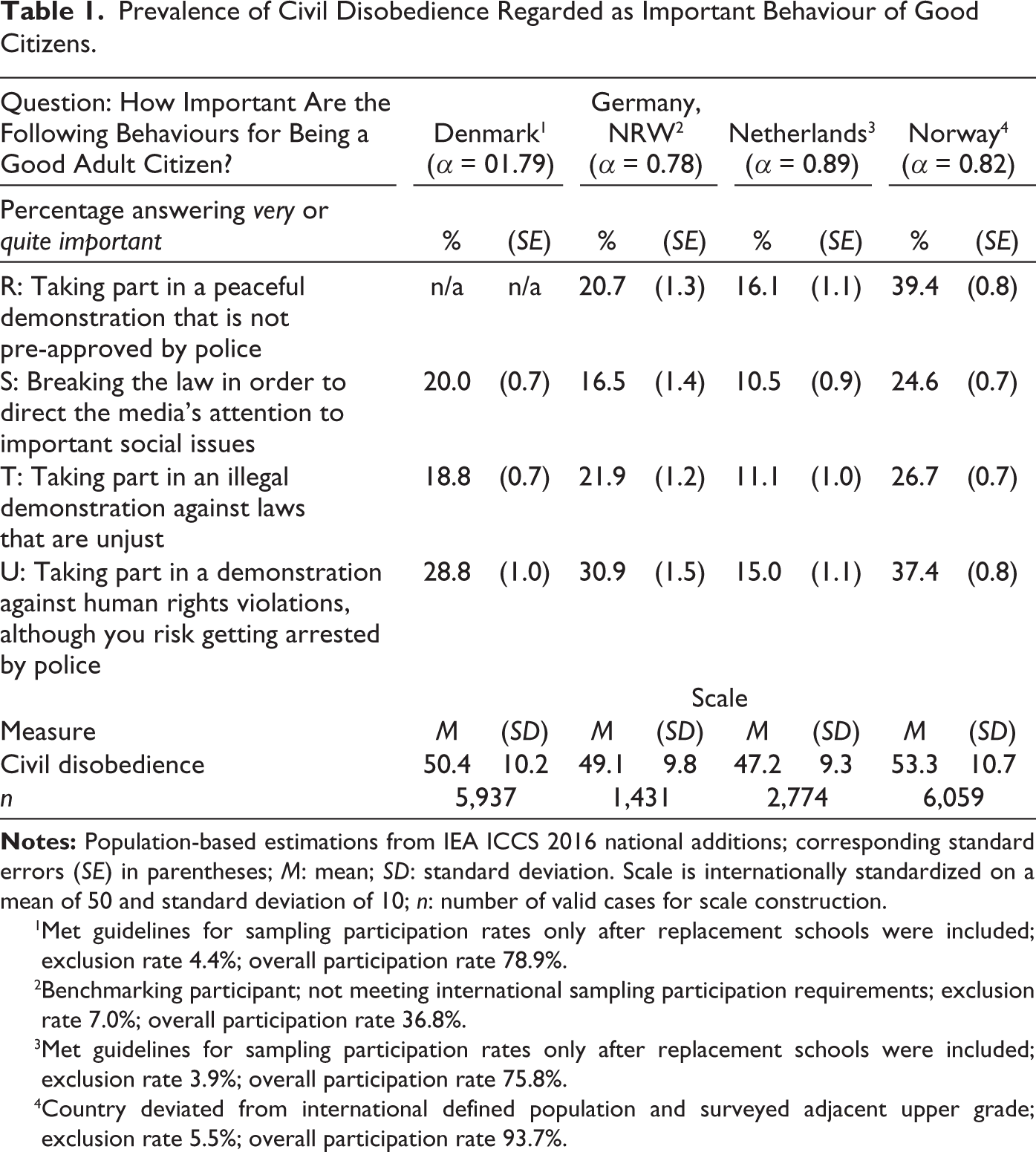
Table 1 shows the four items added at a national level regarding students’ perceptions of the importance of CD as well as their descriptive results. In the wording of the items, a clear connection with Rawls’s concept of CD can be detected, whereby disobedience is justified by a greater good, such as an important social issue (S), unjust laws (T) or human rights (U). Such justification was only missing in item R, which was not included by Denmark. The wording of item U would seem to imply illegal behaviour on the part of the police rather than the demonstrators. As a dependent variable, the scale students’ perceptions of the importance of CD was computed based on the four (three for Denmark) items added at a national level as an inverted mean value (if at least two values were applicable) in SPSS 24 (IBM Corp., 2017) and again standardized to an international mean of 50 and a standard deviation of 10.
Prevalence of Civil Disobedience Regarded as Important Behaviour of Good Citizens.
1 Met guidelines for sampling participation rates only after replacement schools were included; exclusion rate 4.4%; overall participation rate 78.9%.
2 Benchmarking participant; not meeting international sampling participation requirements; exclusion rate 7.0%; overall participation rate 36.8%.
3 Met guidelines for sampling participation rates only after replacement schools were included; exclusion rate 3.9%; overall participation rate 75.8%.
4 Country deviated from international defined population and surveyed adjacent upper grade; exclusion rate 5.5%; overall participation rate 93.7%.
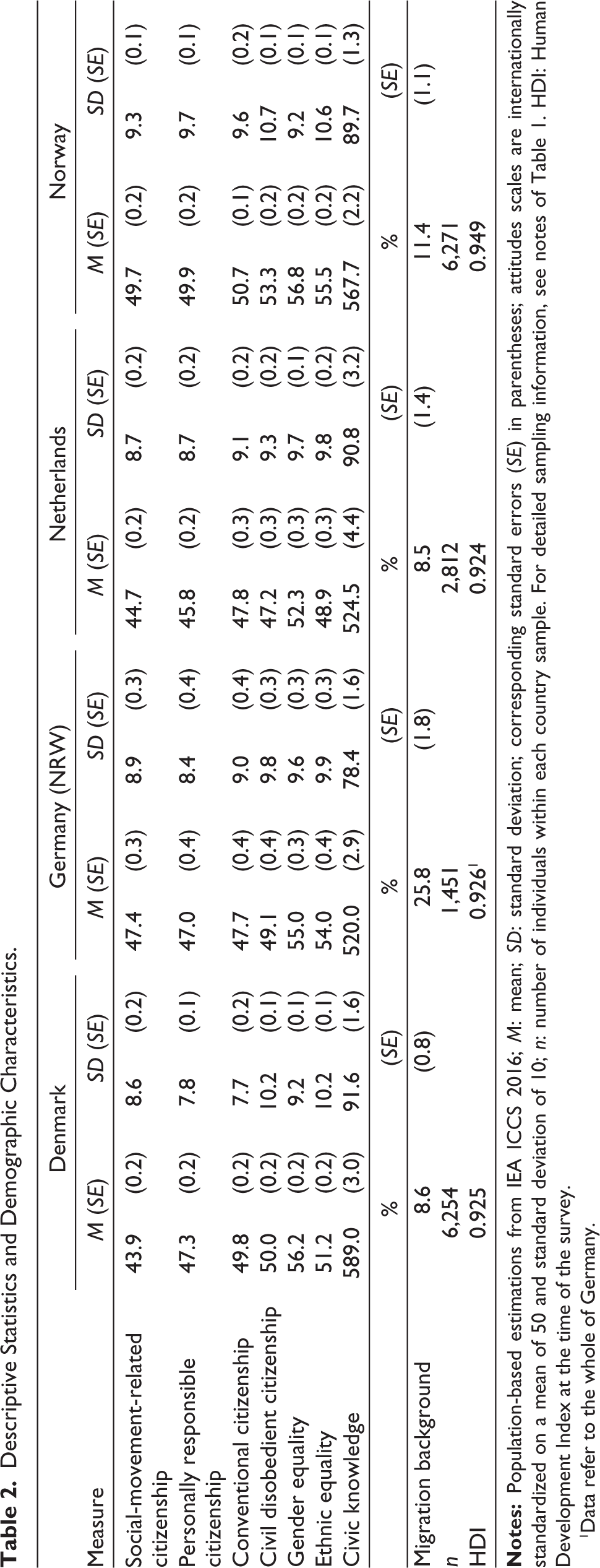
Civic knowledge was assessed with a 45-min timed test in a rotated booklet design including multiple-choice and open-ended tasks. Questions were aimed at the conceptual civic knowledge related to questions of civic society and systems, principles, participation and identity. Most questions were related to a short contextual stimulus. Published sample items are described in the international report (Schulz et al., 2018a). The scale drew on 87 items and was internationally scaled to a mean of 500 and a standard deviation of 100. Five plausible values for students were provided based on Rasch analyses, with higher values indicating higher levels of civic knowledge. Table 2 provides descriptive statistics for the level of civic knowledge in the four countries.
Descriptive Statistics and Demographic Characteristics.
Notes: Population-based estimations from IEA ICCS 2016; M: mean; SD: standard deviation; corresponding standard errors (SE) in parentheses; attitudes scales are internationally standardized on a mean of 50 and standard deviation of 10; n: number of individuals within each country sample. For detailed sampling information, see notes of Table 1. HDI: Human Development Index at the time of the survey.
1 Data refer to the whole of Germany.
Students’ support for equal rights was considered using two variables. First, the scale students’ attitudes towards gender equality (α = 0.86, 0.80, 0.83, 0.83) were assessed with six items. Students rated items such as ‘Men and women should have equal opportunities to take part in government’ on a 4-point Likert scale from strongly agree to strongly disagree. Second, students’ attitudes towards equal rights for all ethnic/racial groups were assessed with five items (α = 0.85, 0.83, 0.85, 0.90) such as ‘Members of all <ethnic/racial groups> should have the same rights and responsibilities’ on a 4-point Likert scale from strongly agree to strongly disagree.
Regarding the individual background of students, three variables were considered. Students’ gender was evaluated by one question with two options (0 = boy and 1 = girl; 51% girls). In accordance with the international report, no immigration background (=0) was assigned when the student and at least one parent were born in the country. According to this definition, about 9% of students had an immigration background in Denmark and the Netherlands, 11% in Norway and 25% in Germany, NRW. The students’ socioeconomic background (National Composite Indicator of Socioeconomic Background, NISB) comprised three indices: the highest-ranking occupation of parents, the highest level of parental education and the self-reported number of books at home. The NISB was z-standardized at a national level to a mean of 0 and a standard deviation of 1 (Schulz et al., 2018b). Table 2 provides descriptive statistics for each variable in the four countries.
Analyses
To test Hypothesis 1, confirmative factor analyses (CFA) were conducted in Mplus 8.2 (Muthén & Muthén, 2017) for all ‘good citizenship’ items considering the clustered structure of the data and sampling weights. Dimensional analyses for the good citizen scales were based on a pooled sample of Germany, NRW, the Netherlands and Norway. Separate analyses were conducted for Denmark due to the implementation of only three instead of four disobedient citizen items. Afterwards, multi-group CFA were conducted to investigate if the scale students’ perceptions of the importance of CD were invariant across countries.
Descriptive statistics and analyses of relatedness were calculated with the IDB Analyzer (IEA, 2018), which provides macros for SPSS to estimate population-based values. In order to test Hypothesis 2, linear regressions were conducted for the four countries separately. The regression included civic knowledge, students’ support for human rights and equality, and students’ individual background to explain variance of students’ perceptions of the importance of CD. After inspecting questions of linearity, we adopted the recommendation of Simonsohn (2018) as described below and ran two additional separate regressions for the groups with high and low civic knowledge.
Results
This section presents results regarding the prevalence, dimensionality (CFA) and relatedness of variables.
Prevalence
As shown in Table 1, only a minority of students stated that attributes of CD are very or quite important for being a good adult citizen. Percentages were quite high in Norway, where at least one in four students supported each of the items, and noticeably lower compared to all other countries in the Netherlands. The attitudes of students in Denmark and Germany, NRW ranged in between. For all items, percentages differ significantly between countries, with one exception: no significant differences were found for question 23U between Denmark and Germany, NRW. The high internal consistency (α = 0.79 for Denmark; α = 0.78 for Germany, NRW; α = 0.89 for the Netherlands; α = 0.82 for Norway) of the items supports H1.1.
Dimensionality
The dimensionality of students’ perceptions of good citizenship was estimated with CFA for the pooled sample (the Netherlands, Norway and Germany, NRW) as well as for each country separately. We adopted the three dimensions from the international report and conceptualized the fourth latent variable based on four CD items. The results for the pooled sample are presented in Figure 1. All CD items contributed to the latent construct with high factor loadings, further supporting H1.1. Correlations between civil-disobedient and conventional and social-movement-related citizenship were significant but weak (0.16***/0.17***). No significant correlation with personal-responsible citizenship was observed. Country-specific CFA reaffirmed that CD and personal-responsible citizenship evolved empirically to be the most distinct concepts: in the Netherlands, the correlation is weak negative (−0.14***); in Norway, weak positive (0.09***); and in Germany, NRW, not significant, thus supporting H1.2. In line with findings from the international report of ICCS 2016 (Schulz et al., 2018a), the other three dimensions were strongly related.
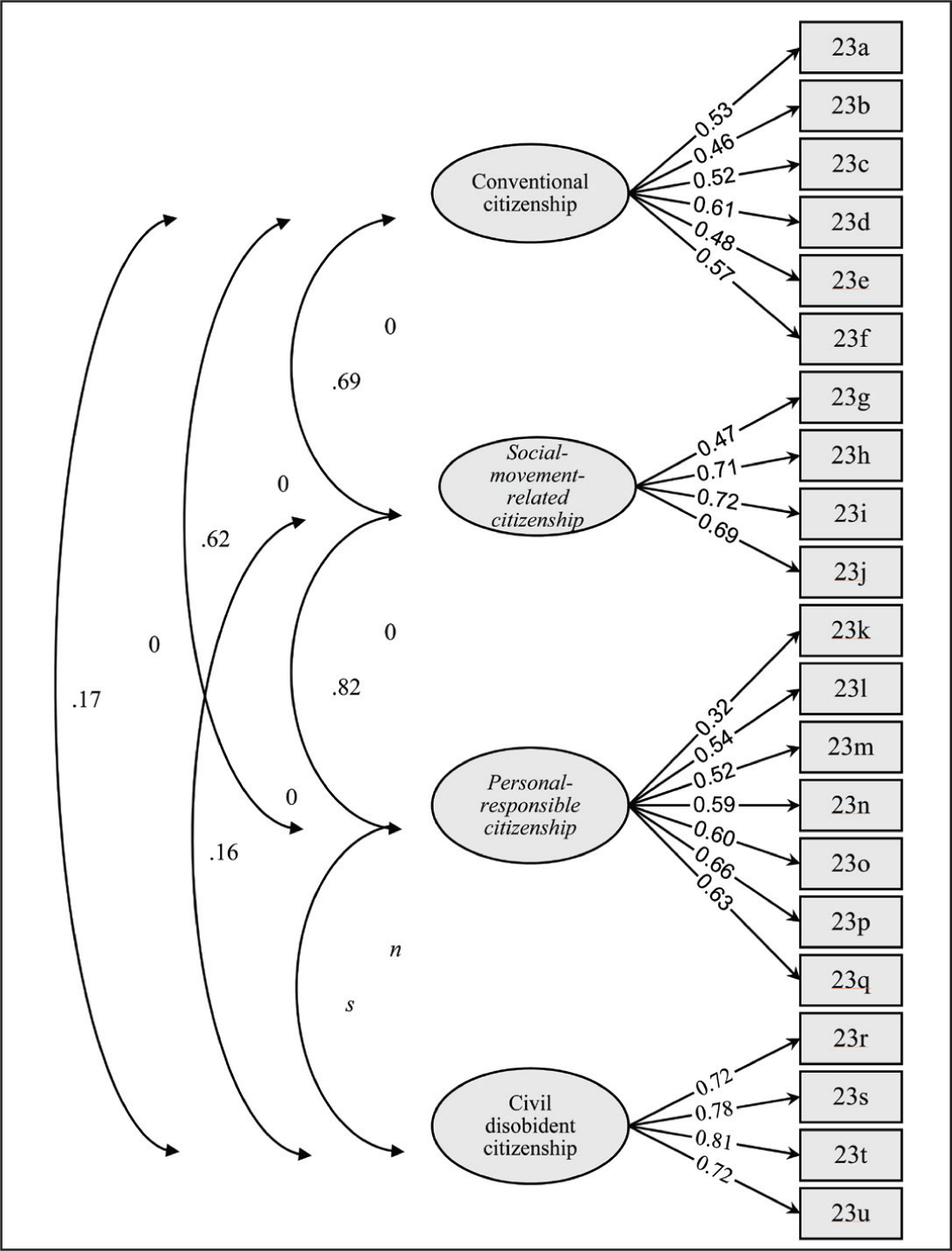
Separate CFA was undertaken with the Danish data because only three of the four disobedient items were included in the questionnaire, χ2/df = 4,195/164***; CFI =0.80; RMSEA =0.06; SRMR = 0.08. Results showed a similar pattern: sufficient factor loadings on the latent variable CD (0.648–0.875), no significant correlation between the civil-disobedient dimension and personal-responsible citizenship, and a significant but weak latent correlation with conventional citizenship (.11). The correlation with social-movement-related citizenship (.328) was still weak but considerably stronger than in the pooled sample of the other three countries, which better matches the theoretical considerations in H1.2. As expected, high correlations could be observed between the three remaining dimensions (.56–.62).
Multi-group CFA examine if an instrument measures the same construct by comparing scales across groups, e.g. educational systems. At every step, restrictions are introduced to control invariance for the set of items (configural), the item loadings (metric) and item intercepts/mean structure for the same latent value (scalar; see Rutkowski & Svetina, 2014). Table 3 compares fit indices for multi-group CFA focused on the aspect of CD. Again, dimensionality analyses were based on data from the Netherlands, Norway and Germany, NRW but excluded Denmark. The configural model had an acceptable fit for multi-group comparison. The differences with the metric model met the requirements for overall fit as well. Rutkowski and Svetina (2014) suggested that SRMR values should be interpreted only in conjunction with other measures.
Results of Multi-group Confirmatory Factor Analyses for Students’ Perceptions of the Importance of Civil Disobedience.
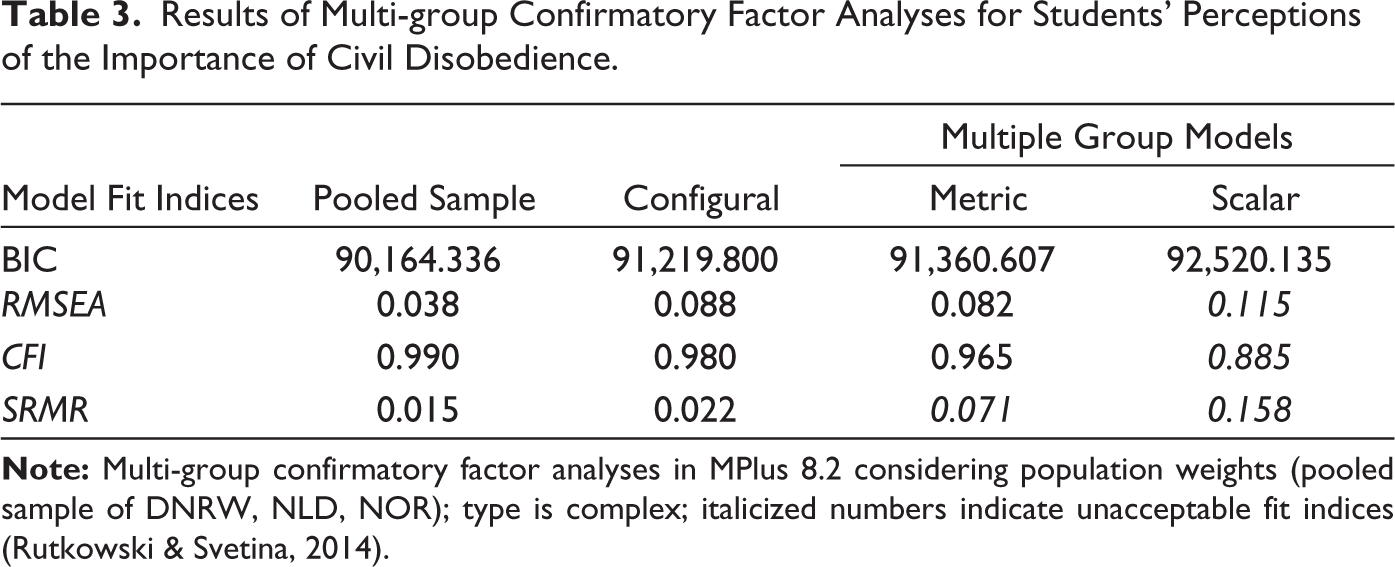
The model fit for the scalar model was significantly lower. Absolute fit and the difference with the metric model were not acceptable; therefore, no scalar invariance could be observed if comparing the scale across countries. Metric invariance supported comparing the strength of relationships with other variables, for example in structural analyses such as regressions, partly supporting H1.3. Due to scalar non-invariance, differences in the means of a scale computed across countries should be interpreted with caution.
Relatedness
Figure 2 displays the shape of the correlation between the mean of the perceived importance of CD and the civic knowledge scale. Higher values represent a higher level of perceived importance of CD and higher levels of civic knowledge, respectively. For the purpose of visualization, the civic knowledge scale was split into nine intervals of 42 scale points each, referring to the international level boundaries at 395, 497 and 563 scale points. Values from Germany, NRW are not represented in the highest category because there were only 10 observations representing less than 1% of students, compared to more than 2% in the Netherlands, 7% in Norway and 13% in Denmark. As previously noted, country differences in the means of the CD scale should be interpreted with caution due to scalar non-invariance and differences in the item set of Denmark.
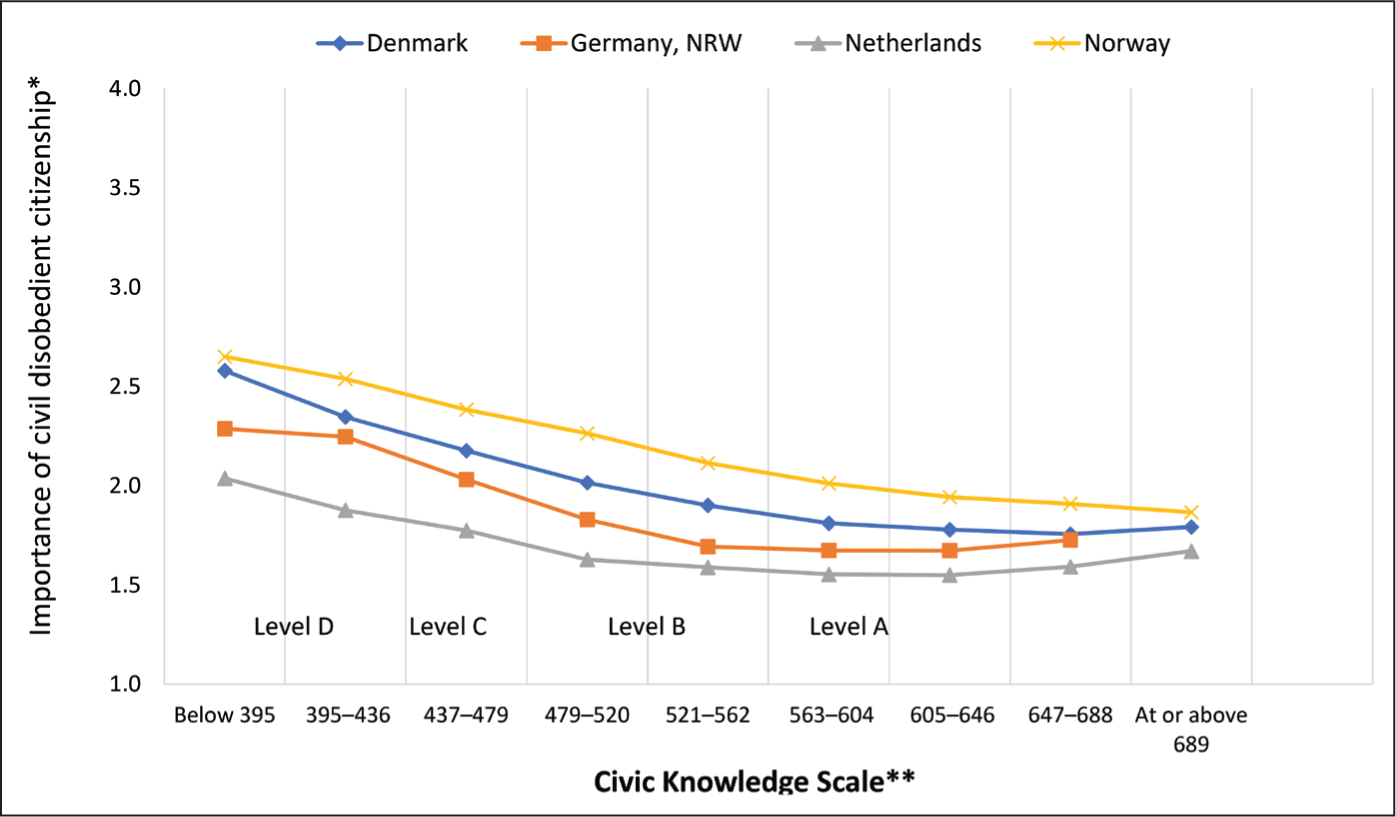
For all four countries, it is apparent that students with lower levels of civic knowledge showed stronger support for CD as an important attribute of being a good citizen. However, no clear relationship could be observed for students with civic knowledge above level B (above the interval between levels B and A). In three countries (except Norway), we were able to observe a slight change to a positive correlation, but the differences did not gain in significance. This raises the question if a linear regression can be applied successfully to explain variance in students’ perceptions of the importance of CD.
For relationships with a change of sign, quadratic terms are occasionally included in regression analyses. Simonsohn (2018) addressed the fact that this may frequently lead to invalid conclusions. He suggested undertaking separate regression analyses (two-line test) and provided an algorithm to estimate the optimal breaking point.
This article followed Simonsohn’s suggestion. However, instead of applying the algorithm to the data, the division in this report complied with the suggested theoretical considerations. Following the description of the levels of civic knowledge, knowledge at level A can be described as a condition for understanding structures and questioning positions. More than half of the students in Norway and Denmark and around one-third in the Netherlands and Germany, NRW achieved this level of knowledge. This group was analysed separately from the group of students with lower levels of civic knowledge. The cut-off point was defined at 563 scale points of the estimated plausible values mean.
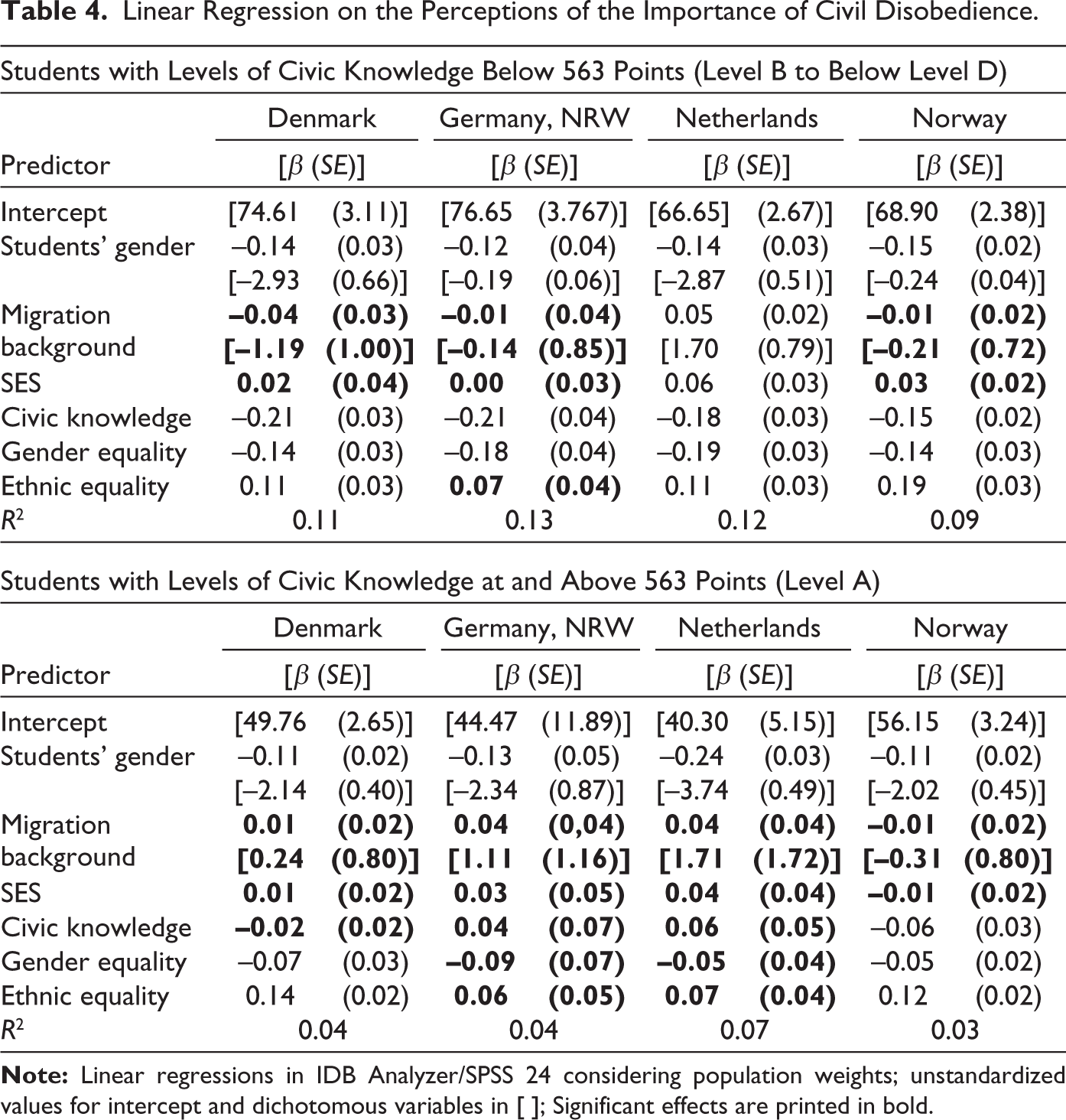
Table 4 presents the results of the linear regression analyses on the importance of CD by country.
Results for the group of students with a level of civic knowledge below 563 scale points are displayed in the top half of Table 4. Overall, the considered variables could explain the variance between 9% and 13% in students’ perceived importance of CD. In accordance with previous research, girls in all four countries were less likely to include CD in their concept of good citizenship. This gender effect was particularly strong in the Netherlands. Students’ immigration background had a small and weak significant effect only in the Netherlands, and students’ SES did not show significant effects in any of the models. As evident in Figure 2, students with more civic knowledge were less likely to say that CD is important for being a good adult citizen. This was significant in all countries and the strongest predictor in Denmark and Germany, NRW (β = −0.21), supporting H2.1. A higher level of support for gender equality negatively predicted the importance of CD consistently across the countries (supporting H2.1). When controlling for knowledge and support for gender equality, students with higher support for equal rights for all ethnic groups were more likely to find CD important for good citizenship in Norway, and to a minor extent in Denmark and the Netherlands (partly supporting H2.2), while bivariate correlations were close to zero in the three countries and weakly negative in Germany, NRW.
The bottom half of Table 4 shows results for the group with civic knowledge at 563 scale points and above. For this group, hardly any variance (between 3% and 7%) could be explained by the independent variables. In Germany, NRW and the Netherlands, students’ gender remained the only significant predictor for the importance of CD, whereby this effect was noticeably stronger in the Netherlands. In Norway and Denmark, results resembled the effect structure of the former group at a decreased level. Among students with higher levels of civic knowledge, further variances in civic knowledge did not seem to have any substantial effect on the perceived importance of civil disobedient citizenship (not supporting H2.2 and H2.3).
Linear Regression on the Perceptions of the Importance of Civil Disobedience.
Discussion
Only a minority of students expressed the belief that attributes of CD are important for being a good citizen in a democracy. Regarding the correlation of CD with other dimensions of good citizenship, the CFA of all dimensions of good citizenship provided strong support for H1.1, that is, that civil disobedient citizenship describes a distinct concept of good citizenship. In line with Abs (2013), the theoretically most distinct concept of personal-responsible citizenship turned out to have the lowest empirical connection. However, only the Danish results showed the expected comparably higher correlations between CD and the theoretically closest dimension of citizenship, social-movement-related citizenship. Considering the close correlations with the three further dimensions—conventional, social-movement-related and personal-responsible citizenship—analysis highlighted that 14-year-old students are able to evaluate distinctive concepts of good citizenship. This finding has important implications for further emerging questions regarding the conceptualization of citizenship by adolescents.
Regarding Hypothesis 2, results indicated a complex picture. Outcomes of CCE (civic knowledge and support for values such as equal rights for marginalized groups) seemed to be more connected to assimilation in the political system and the rejection of a duty to disobedience in cases of state injustice. For this age group at least, a gain of civic knowledge to some extent accompanied an assimilation effect in the existing political order (H2.1). This pattern could be found for students with a level of civic knowledge that encompassed three aspects: an understanding of the broad concept of representative democracy as a political system, the recognition of ways in which institutions and laws can be used to protect and promote society’s values and principles, and the potential role of citizens as voters in a representative democracy (Schulz et al., 2018a, p. 46). For students with even higher levels of civic knowledge, analyses were not able to explain who was more likely to integrate CD into their concepts of good citizenship. Analyses could not provide empirical evidence for H2.3 (transformative citizenship), and only very limited evidence for H2.2 (critical citizenship). The positive effect of support for equal rights for all ethnic groups on CD when controlling for knowledge and support for gender equality raises the question whether perceived marginalization of minorities corresponds to a higher support for CD; this question could be explored in further research.
As seen in previous research, girls are clearly less likely to support CD attributes. None of our analyses found evidence of a change of this gender pattern. The visible acts of CD committed by highly educated young girls in the Fridays for Future movement a mere two years after ICCS 2016 was conducted cannot be accounted for by the structural analyses of ICCS 2016 data.
Our findings may be somewhat limited by the low level of explained variance in the regression models. The question of who the students who state that a willingness to commit CD is an important aspect of being a good adult citizen are can only be answered to a very small extent with these analyses. Further studies with a specific focus on this question need to consider additional variables. Particular emphasis should be accorded to a meticulous examination of the interplay between perspectives on CD and experiences of exclusion marginalization or discrimination, for example due to migration or race. Furthermore, a more in-depth exploration of the significance of internal and external political efficacy holds promise. Low explained variance might also be connected to some ceiling effects, for example with regard to the items of gender equality (Schulz et al., 2018a, p. 123). Harder to agree items regarding the support for equal rights for marginalized groups might enable a deeper insight into students’ perspectives on CD. The positive effect of support for equal rights for all ethnic groups when controlling for civic knowledge and support for gender equality may support this assumption. In addition, latent class analyses might be an option for further investigation of the current data, as applied for the international item pool on students’ perceptions of good citizenship (Torres Irribarra & Carrasco, 2021) but preliminary analyses were not encouraging.
The prevalence and relatedness of students’ perceived importance of CD for being a good citizen might also be linked with a classic perspective of Kohlberg’s theory of cognitive moral development (1984). One could argue that to fit with Rawls’s conceptualization of CD, a line of argument would require a postconventional level of moral reasoning. Considering the age group in focus, the majority of eighth graders would be expected to reach the conventional level of moral reasoning, which is oriented towards interpersonal accord and conformity (third stage) or authority and social-order maintaining (fourth stage). It would be fruitful to take a closer look at how cognitive moral reasoning, civic knowledge and support for CD interact in different age groups.
In addition, the presented analyses could only include data of four countries with similar political structures and quality of governance as additional countries did not administer the items on good citizenship related to CD. A broader range of countries might lead to different results. Similar studies focusing on students’ trust in institutions have highlighted that the relationship between civic knowledge and attitudes differs across countries in accordance with the democratic performance of the countries (Hahn-Laudenberg & Abs, 2020; Lauglo, 2013). The question of good citizenship focuses more on the individual citizen than on the system, but the Rawlsian definition of CD highlights the close connection between system and individual behaviours.
Reflecting on the results of the present study, the question remains if students’ perceptions of CD may have changed in the past few years in the analysed countries. The Fridays for Future movement might for the first time have personally confronted students in the analysed countries with the question if a willingness to commit acts of CD is important for being a good citizen. Further studies which consider this question will need to be undertaken; such research might also consider the recent research about attitudes towards CD in Asian countries. Moreover, future research should investigate whether students considered the Fridays for Future movement an actual act of CD.
The article did not answer the conceptual question of what kind of citizenship CCE should aim for. Nevertheless, our findings support a general understanding that students’ actual concepts of CD do not necessarily match the theoretical considerations underpinning the phenomenon of CD. Learning and instruction need to integrate those students’ preconceptions if students are to be enabled to develop a considered and reflective concept of citizenship. To this end, teacher education needs to reflect on normative criteria that distinguish CD from anti-democratic forms of illegal participation as well as on the issue that availability of CD and perspectives on CD might differ for students and citizens depending on their position in society. In any case, the role of CD for democracies remains a controversial issue, which should be discussed with the students in the context of CCE.
Footnotes
Acknowledgements
The author would like to express her thanks and gratitude to the four national research managers: Hermann Josef Abs (Germany, North Rhine-Westphalia, University of Duisburg-Essen), Jens Bruun (Denmark, Aarhus University), Lihong Huang (Norway, OsloMet—Oslo Metropolitan University) and Anke Munniksma (the Netherlands, University of Amsterdam) for providing the required national data regarding the items on CD as well as for their support and feedback during the preparation of the article. Likewise, the author would like to thank Vegard Svagård (Norway, OsloMet—Oslo Metropolitan University), who supported early analyses and data preparation.
Declaration of Conflicting Interests
The author declared no potential conflicts of interest with respect to the research, authorship and/or publication of this article.
Funding
The author received no financial support for the research, authorship and/or publication of this article.