




Abstract
Since the beginning of 2020, the coronavirus disease (COVID-19) and its lockdowns have changed the current lives of young people drastically. Given the importance of future orientations for young people’s mental well-being, it is important to investigate if and how this lockdown affected young people’s future orientations. In this study, 34 Dutch young people (aged 16–24) with diverse backgrounds were interviewed during the lockdown of spring 2020 in the Netherlands. Results showed that young people experienced effects of COVID-19 on their current lives and short-term futures, but according to these young people, their long-term futures would not be affected by the first COVID-19 lockdown. The latter finding may be explained by young people’s assumed temporality of the pandemic, their general optimistic attitudes, two-track thinking, strong feelings of agency and flexibility.
Introduction
Since the beginning of 2020, the coronavirus disease (COVID-19) outbreak has changed the lives of people all around the world drastically. Up to the early autumn of 2021, the pandemic has already cost over five million lives globally, and numbers are still rising (World Health Organisation, 2021). People have experienced the death and illness of loved ones, have lived with the fear of getting infected, or fear other consequences of the pandemic (e.g., unemployment). Since this pandemic highlights that the future is uncontrollable and uncertain, the question arises whether COVID-19 negatively affected how young people perceive their futures (Holman & Grisham, 2020; Settersten et al., 2020). This is an important question, because maintaining positive future orientations is important for well-being, especially in contexts of coping with adversity (Holman & Grisham, 2020; Holman & Silver, 2005; Seginer, 2008). Since future orientations serve as guidance for future behavior and important life-course decisions, this is particularly relevant for young people (Seginer, 2008; Sharp et al., 2020). Therefore, this paper investigated if and how young people’s future orientations are affected during the first months of the COVID-19 pandemic by interviewing 34 Dutch young people in spring 2020.
A variety of terms have been used for future-oriented cognitions, including future orientations, possible selves, future aspirations or future expectations. Although these constructs differ slightly, they all involve how people see (a specific aspect of) their futures (Beal & Crockett, 2010). The most general concept, future orientations, represents ‘the image individuals have about their future, as consciously represented and self-reported’ (Seginer, 2008, p. 272). As such, future orientations represent a collection of attitudes, feelings and/or assumptions that are based on past and present experiences and interact with an individual’s social environment, to form ideas or cognitions about one’s future (McCabe & Barnett, 2000). Future orientations act as incentive for future behavior (Markus & Nurius, 1986). Positive future orientations are therefore important for future well-being, especially in times of development, such as the transition into adulthood (Seginer, 2008). Negative future orientations have been related to lower future school performances and attendance (Jackman & MacPhee, 2017; Khattab, 2015), delinquent or risk behaviors (Anderson et al., 2020; Prince et al., 2019) and mental health problems (Kerpelman et al., 2008; Verdugo & Sánchez-Sandoval, 2020). This study focused on the broad range of future orientations and includes expectations, aspirations, fears, possible selves and feelings towards the future.
The COVID-19 outbreak, and the lockdowns it required, have had an enormous impact on the lives of young people in many countries, including the Netherlands. In March 2020, the Dutch government launched a lockdown 1 to limit new infections. Schools, hospitality, theaters and sports facilities were closed, social distancing was mandatory, and people were asked to work from home if possible. Theoretically, there are several reasons why this lockdown may have affected the development of young people. From a socioecological perspective, human development is shaped by its social context in which both macro- and micro-level events occur that influence human development (Bronfenbrenner, 1977). As future orientations are shaped in the social context, they are influenced by past and present experiences (Markus & Nurius, 1986; Nurmi, 1991). Coleman (2008) argued that we should not consider the future a distinct and disconnected temporality but as a horizon that is ‘the assemblage of past and present temporalities’(p. 87). It can, therefore, be expected that the sudden change in social context due to the first COVID-19 lockdown has impacted young people’s future orientations.
Potential Negative Effects of the First COVID-19 Lockdown
There are several reasons why the first months of COVID-19 may have negative effects on young people’s future orientations. First, due to sudden lockdown, a future financial crisis was likely. People all around the world could feel the economic consequences of this pandemic (Phillipson et al., 2020). Statistics Netherlands registered a record decline in the number of jobs, especially in sectors in which young people were working (e.g., hospitality; CBS, 2020). Indeed, research found an increase in economic anxiety as a consequence of COVID-19, especially in younger individuals (Bareket-Bojmel et al., 2020), which may have impacted their perspectives on their futures negatively (Settersten et al., 2020). Second, a sudden virus outbreak of this size could have made people realize that neither the world nor the future can be controlled, which might also have led to less focus on the future (Holman & Grisham, 2020) or even a more negative view of the future. Young people might have experienced that their life is on hold, feel unproductive and postpone relevant life decisions, which may have altered their future orientations. Thus, due to current economical insecurities, anxiety and lack of control, COVID-19 may have negatively affected young people’s future orientations.
Why Would COVID-19 Not (Yet) Affect Young People’s Future Orientations?
In contrast to the above, there are several reasons to expect that COVID-19, and particularly the first months of the pandemic, may not have seriously affected young people’s future orientations.
Being Optimistic
First, people in general tend to be overly optimistic about themselves and their abilities (Reynolds et al., 2006; Taylor & Brown, 1994; Taylor et al., 1989), especially in times of adversity. As Taylor and Armor (1996) stated: ‘When faced with threatening information or stressful events, people often respond with mildly distorted positive perceptions of themselves (self-aggrandizement), an exaggerated sense of personal control, and overly optimistic expectations about the future’ (p. 873). Several empirical studies (Du Bois-Reymond, 1998; Evans, 2002; Rudd & Evans, 1998; Wyn & Woodman, 2006) found high levels of personal optimism and an espousal of meritocratic values among young people. This optimism can make people more resilient to stressful events and act as coping strategies when facing adversity (Nikunen & Korvajärvi, 2020). Thus, in times of COVID-19, optimistic attitudes might be a successful coping mechanism to deal with the challenges. Therefore, it can be expected that young people have maintained a positive attitude towards their futures.
Two-track Thinking
Second, previous research indicated that young people typically do not internalize or integrate societal problems into their personal future orientations. They tend to see societal problems as not their problem: ‘It’s not my problem, it does not affect me or those around me’ (Ellis, 2004, p. 11). In the context of macro-level problems (e.g. climate change) researchers found the belief that one’s own future will be rosy while the world is in danger (Norgaard, 2006, p. 352). This can lead to so-called two-track thinking: a disjuncture between the global future and one’s personal future (Leahy et al., 2010; Threadgold, 2012). In one track, the critical nature of a problem is acknowledged. In the second track, young people envisage their own personal future and make decisions about their own lives. Although not only found in young people (Norgaard, 2006), this two-track thinking might be particularly present in young people (Threadgold, 2012), as adolescence and early adulthood are characterized by a focus on the self and the necessity to build one’s personal life and career (Arnett, 2000).
This two-track thinking has been found in empirical research in young people and has been seen as a coping mechanism more so than structural denial (Threadgold, 2012). Earlier research showed that young people were positive about their personal futures, while they expressed some societal worries (e.g., worries about climate change, geopolitical issues or terrorism; Palings et al., 2015; Threadgold, 2012). For example, Threadgold (2012) found that the majority of Australian participants had faith in achieving their ambitions and in overcoming barriers, but ‘virtually all participants expressed quite apocalyptic views of the future in terms of climate change, peak oil, politics and terrorism, and war’ (p. 6). Two-track thinking might also apply to the COVID-19 pandemic, resulting in positive future orientations of young people’s personal futures in these times of macro-level adversity.
Individualization of the Life Course
Third, according to the individualization thesis, the individualization of the life course in late modern societies facilitates the freedom to choose one’s own path in life. This is referred to as ‘choice biographies’ (Du Bois-Reymond, 1998) and is indicative of fewer structural constraints (Du Bois-Reymond et al., 2001). Because individual life courses are less structured and less linear (Liefbroer & Toulemon, 2010), this can create more flexibility to deal with unexpected events, such as the COVID-19 pandemic. As a consequence, the impact of the COVID-19 pandemic on future orientations may be limited. In addition, due to this individualization, young people might feel more and more responsible for their own life courses (Beck & Beck-Gernsheim, 2002; Côté, 2002). Individual life courses may be marked by the idea that individuals can act as active shapers of their own life, referred to as agency in the sociological life course theory (Elder, 1998) or self-efficacy in the psychological social cognitive theory (Bandura, 1977). Strong feelings of agency mean that individuals feel in charge of their own lives. Therefore, young people may have felt in control and competent to deal with this adversity, and as a result, have remained positive towards their futures regardless of COVID-19.
However, this individualization has also been suggested to imply that young people are responsible to deal with personal failure and unanticipated events themselves (Beck & Beck-Gernsheim, 2002). Life is no longer a given, but an individual task, charging individuals with the responsibility to perform this task, including its consequences and side effects (Bauman, 2002). ‘Your own life – your own failure. Consequently, societal crisis phenomena … can be shifted as a burden of risk onto the shoulders of individuals. Social problems can be directly turned into psychological dispositions’ (Beck & Beck-Gernsheim, 2002, p. 24). Thus, young people may have emphasized that they are in control of, and responsible for, their personal lives and success during the first months of COVID-19. As such, potential negative consequences of COVID-19 may have been perceived as a personal failure, which in turn might have negatively affected young people’s future orientations.
In all, it can be argued that the first COVID-19 lockdown, its economic and existential insecurities, and potential feelings of personal failure could have negatively affected young people’s future orientations. Alternatively, young people’s optimism, two-track thinking and responsibility and agency may also have prevented young people from experiencing negative effects of the first COVID-19 lockdown on their personal future orientations.
Methods
Procedure
For the current study, semi-structured interviews were held with 34 Dutch young people between 16 and 26 years old. In the interviews, participants were asked to describe their lives in 2030, to what extent they had confidence in their futures, saw opportunities or barriers, whether they planned their futures, and how COVID-19 affected how they oriented towards the future. All interviews were conducted digitally with Microsoft Teams in May and June 2020, during the first COVID-19 lockdown in the Netherlands. Interviews lasted 20–40 minutes each. Ethical approval was gained from the Ethics Assessment Committee of the Faculty of Social Sciences at Utrecht University (FETC18-070).
Participants
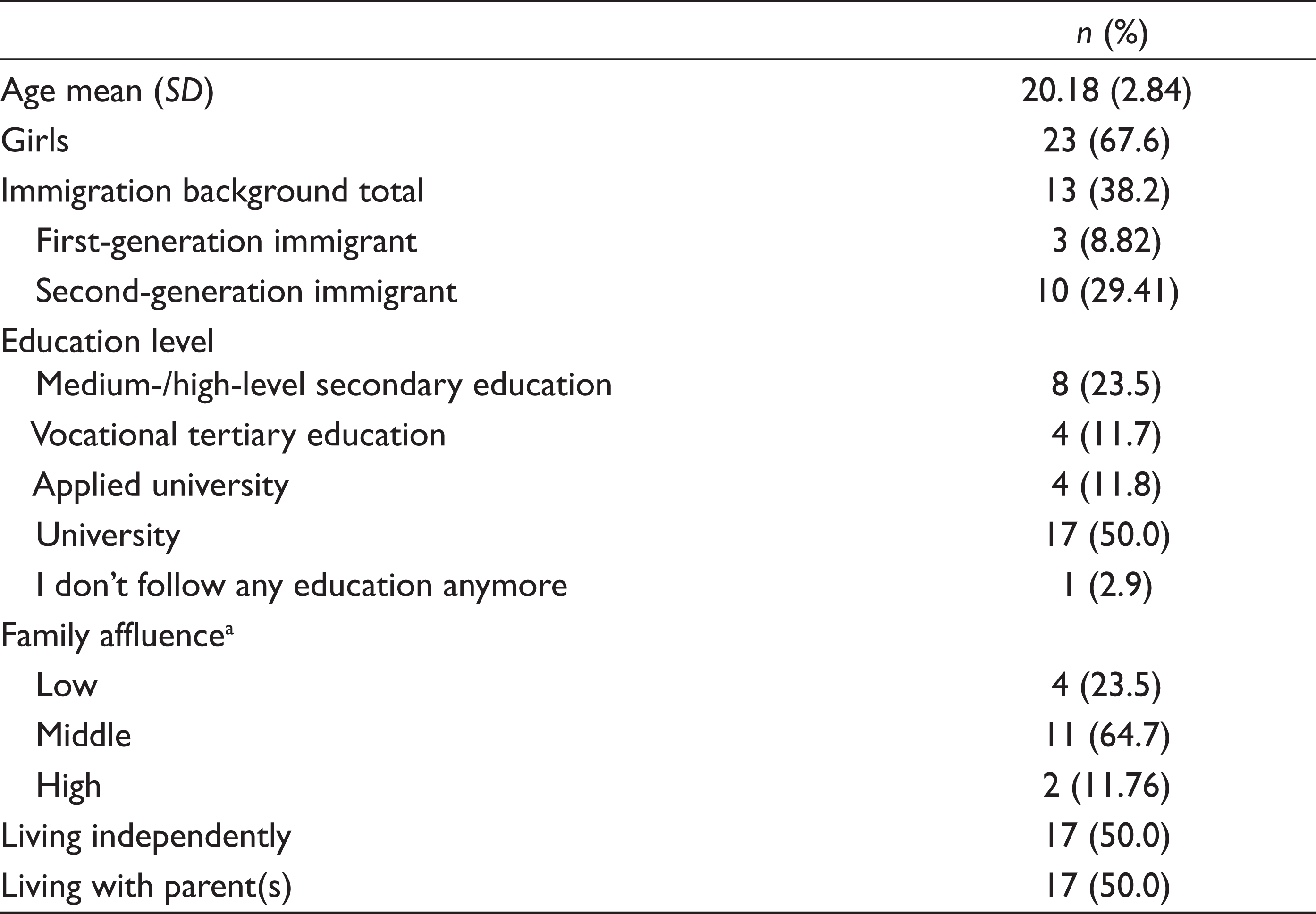
Participants were recruited through snowball sampling with the aim to collect a diverse sample in age, gender, education level and immigration background. We interviewed 23 (68%) young women and 11 (32%) young men between 16 and 26 years old with a mixture of sociodemographic characteristics (mean age 20.2, SD = 2.8). Thirteen participants (38%) had an immigration background (either they themselves or at least one of their parents was born abroad). The young people had diverse educational backgrounds (i.e., from lower secondary education to the higher level tertiary education), although young people with higher educational levels were somewhat overrepresented. More detailed sample characteristics are presented in Table 1.
Sample Characteristics.
Coding and Analysis
Semi-structured interviews were held by trained interviewers who were either master students or junior researchers. All interviewers received training on qualitative interviewing. Additionally, interviewers received feedback on one or more taped trial interviews to ensure the quality of the interviews. The interviews were recorded and transcribed by master students and research assistants. Interviews were coded by two researchers in NVivo 12. For data collection and analyses, the thematic approach of Braun and Clarke (2006) was used. First, following a semantic approach, explicit themes were identified and generated in initial codes and sub-codes. Underlying themes that might shape the semantic content of the data emerging from the first coding round were discussed, specified and then coded in a second coding round (Braun & Clarke, 2006). To guarantee inter-coder reliability, the first interview was coded simultaneously by two researchers, and coding was discussed openly. Second, three additional interviews were coded separately by both researchers. Coding results were compared and discussed until agreement was established. A third researcher was consulted when necessary. Thereafter, the remaining interviews were randomly divided between the two researchers. Weekly coder meetings were held to discuss coding uncertainties along the way.
Results
Interviews revealed that young people did not feel that COVID-19 seriously influences their long-term futures. In general, young people’s future orientations were focused on important life themes as education, career and personal relationships, without referring to COVID-19. Interestingly, even though participants were in the midst of a lockdown, hardly any participants, independent of social background, mentioned COVID-19 spontaneously when asked to describe their personal lives in 2030. This indicates that COVID-19 did not play a large role in young people’s long-term future orientations at the time of the study. For example, a considerable number of young people expressed the ambition to explore the world and experience other cultures. Although they were aware that traveling was impossible because of the pandemic, their personal desires and expectations to travel the world seemed not to be seriously affected by the COVID-19 situation. Indeed, even in the midst of the first lockdown, some participants mentioned the aspiration of going on a trip around the world or vacations to faraway lands, without referring to COVID-19 restrictions.
When participants were explicitly asked how they thought about the effects of COVID-19 on their future orientations, they generally expressed they did not expect it to affect their personal futures in the long term. Thus, although some studies found negative effects of COVID-19 on young people’s current well-being (Levita, 2020; Wang et al., 2020), the young people we interviewed indicated that the first lockdown was not that detrimental for their long-term future orientations. The interviews give rise to several mechanisms that could explain this seemingly limited impact of COVID-19 on young people’s future orientations, which we will discuss below.
Assumed Temporality
One possible reason for the limited impact of the first COVID-19 lockdown on young people’s long-term future orientations could be that most participants expected the pandemic to be temporal. The vast majority was optimistic about the duration of the pandemic and emphasized that they expected it to be gone soon. For example, Sanne 2 (19) stated after she was asked whether COVID-19 affected the way she saw her future: ‘No, I don’t think so. I think it’ll all blow over in the end. It could be that we’ll be dealing with it for maybe a year. But I think in the end, in the big picture, it won’t matter much.’ Many participants talked about COVID-19 as if it would be soon gone. For example, Emir (17) stated: ‘Well, I think the coronavirus will be over in a few months. So, I think it won’t take that long anymore. That’s why I think it shouldn’t influence my future.’
The assumed temporality was also visible when talking about their travel plans. Some participants mentioned their lives were on hold at this moment, but they were confident that they would be able to continue with their plans once the restrictions would be lifted. Amber (25), for example, stated: ‘I would actually do that too this year [going on a trip], but of course with COVID-19 that’s uhm… It’s on a bit of a hold, but it’ll just be postponed ….’ However, it is important to note that these young people were interviewed in the first lockdown, and this optimism about the temporality of COVID-19 may have diminished in later phases of the pandemic. For example, Stijn (16) stated:
I’m not afraid, so to say. … It [being afraid] might come though, if the situation is still like this at the end of this year, I might think like, yeah, I would like to make a trip around the world in two years from now and it might be that this is no longer possible because people don’t want to help you because they are afraid you’re sick. … So, no I’m not afraid right now, but it could still come.
The assumed temporality could explain why young people did experience that the COVID-19 restrictions influenced their current lives and short-term futures, but that they did not think it would affect their personal long-term futures in terms of career ambitions or personal relationships. Simone (20): ‘I am not very afraid that COVID-19 influences the future in the longer term, it is more in the short term.’ Samira (20) emphasized that she felt COVID-19 would be more of a short-term influence when she talked about her educational path: ‘Yes, I am a bit uncertain about when I will start [studying]. Also it is a bit uncertain how I will fill my gap-year exactly. But that is not a huge problem for me.’
Sander (22) stated that COVID-19 had some impact on how he felt now, but not on his future orientations:
Well, I wouldn’t say it necessarily has a huge impact on… no, not necessarily on my dreams and ambitions. I think that, in general, this has really remained the same. All I do know is that, for example, the grade I will give to my life… Yes, I’m in a bit of a dip right now. And I think that is directly linked to the Corona crisis, so in that respect it is, but I think in the long term my dreams and ambitions have actually not changed.
Anne-Sophie (21) was a bit more doubtful. She emphasized she saw effects in the short term, but could not imagine to what extent it would affect her long-term future: ‘On the short term, yes. I had to change the entire sequencing of my study because I could not go abroad… I don’t know to what extent it will affect my long-term future.’
Some participants mentioned the first months of COVID-19 had positive effects on their current lives or saw COVID-19 as an opportunity for personal growth. A small group of participants mentioned an increased awareness of the privileged positions they were living in before COVID-19. Anne-Sophie (21) highlighted: ‘In the long term it’s kind of a reality check. That we actually have a really good life.’ Taking a step back from their everyday lives also allowed the young people to evaluate their daily lives and activities. Participants with busy schedules explained that the lockdown restrictions decreased stress because it suddenly slowed down their lives. They saw this sudden change as an opportunity for personal growth in the future. Jenny (24), for example, explained:
For me, it actually couldn’t have been a better timing because I was actually working overtime way too much. And I think that more people have had that, taking a step back can be good. Yeah, I would like to know where to draw my line. I would like to change my lifestyle in that sense. That I don’t say ‘yes’ to everything anymore. Sometimes it’s okay not to answer the phone.
Also, Hajar (22) emphasized she wants to learn from the COVID-19 situation and react differently whenever something like COVID-19 would happen again:
I think that sitting at home and doing nothing can impact your mental health. So, I think in the future, if that ever happens again, I will really take measures for myself to get through this situation well. So really take time for myself and go outside. And do nothing for a bit.
Optimism
That young people were optimistic about the duration and impact of COVID-19 on their future orientations seems illustrative of a generally optimistic attitude that participants expressed. This optimism could also be reflected in how young people dealt with the restrictions during the lockdown and in how they experienced the impact these restrictions had on their current lives. Some participants showed positive attitudes by emphasizing the aspects of life that had not changed during the first months of COVID-19. For example, many participants mentioned that their education continued throughout the lockdown. Although online, they could still study. Relatedly, other participants highlighted that they felt their lives (i.e., as young, studying people) were not impacted as much as the lives of others. For example, Oscar (17) showed a remarkable optimistic attitude. Although he was severely restricted by the first lockdown, he still felt it could have been worse.
For me, it hasn’t had much influence on my life with this because I just, it canceled my exams and I can’t do some things for a long time and see few people, but for me it, no I don’t think so. I don’t think, it hasn’t left much of an impression on me either when I compare it to other people, I think.
When interpreting young people’s experiences related to the first months of COVID-19, it is important to mention that many participants had a hard time expressing worries about their futures in general, whether related to COVID-19 or not. Most participants said they did not have any worries about their future. When probing deeper, some participants mentioned they had some uncertainties, but no real worries. Others came up with some concerns, but these were downplayed immediately, as they emphasized all would be fine eventually. The optimism participants expressed about their future in the first months of COVID-19 might thus be an illustration of how young people think about worries about the future in general.
The optimistic attitude young people in our study showed is in line with previous research that found a generally optimistic attitude among young people in times of adversity. Taylor and Armor (1996) already stated that people tend to be overly optimistic in times of adversity and that this optimism can act as a way to cope with the situation. Nikunen and Korvajärvi (2020) found this mechanism in young people facing the adversity of the financial crisis. Moreover, in their study among university graduates in the aftermath of the Great Recession, Shane and Heckhausen (2016) found that this group expressed optimism towards the future. Thus, the optimistic attitude of young people during the first months of COVID-19 might be illustrative of young people’s general optimism in times of adversity.
Two-track Thinking
About one-third of the participants thought COVID-19 changed something in the way they thought about the future in general. For example, they were aware of decreased opportunities to travel, a potential second wave or of the possibility of other pandemics in the future. Lars (18) said:
Except that I think there is, of course, a chance that such a COVID pandemic will happen or be caused again and that you will still have something like this in 10 years or so. That you have a lockdown again and you can’t go outside again and stuff. That might be one more thing I learned from it in terms of future prospects, but that’s quite small.
However, although these participants did acknowledge the societal impact of the pandemic and its first lockdown, they did not seem to integrate this in their personal long-term futures. As Lars (18) continued: ‘I think, it doesn’t necessarily do something to my [emphasis added] ambitions because I have a fair guarantee that I can go on with the plans I have.’
That young people did not integrate the current situation into their personal future orientations might be a mechanism to cope with the situation. Norgaard (2006) described that people did not respond to global warming because they ignored the problem and its consequences in their daily lives. About his research into young people’s reactions to environmental issues, Threadgold (2012) noted: ‘the two-track thinking of the young people in this research seems more like a defense mechanism for coping than denial’ (p. 10). In our case, it could be that young people did not want to see the negative impact COVID-19 could have on their personal futures, as a form of self-protection, and thus that the optimism about their personal futures is a coping mechanism. This could explain why their long-term future orientations remained positive.
Individualization of the Life Course
In addition to the assumed temporality, optimism and two-track thinking, participants’ feelings of responsibility and agency could explain the limited impact of the first months of COVID-19 on their future orientations. In individualistic societies like the Dutch, individuals may feel responsible for their own success in life. In addition, they may feel able to accomplish this success, indicating feelings of agency. However, young people might also overemphasize their agency, as acknowledging that they cannot shape their own futures might feel like personal failure. Some participants emphasized this individualism: How you deal with times of adversity is your own responsibility. As Melissa (23) indicated:
It’s really a mindset thing. I have people around me who are really pessimistic. I actually live the same life as you, but I think it’s amazing. You just shouldn’t whine, now with the Corona crisis, I am discovering a lot of things, while others are just complaining about staying inside. So, you can just handle it differently.
Also, Kimberly (21) highlighted that it is up to you to deal with the situation. She showed she developed her own ways to deal with the situation herself:
It just turns into a kind of new normal for yourself more and more. So you start… I’m starting to find my way in it more and more. So how you deal with it, how you can still meet your needs, the social contact, while you’re still keeping to those rules.
Amber (25) emphasized her responsibility and agency by focusing on what she could do herself to deal with the situation when she explained how she had changed her short-term future plans due to COVID-19:
But I kind of had in my head that I would make a trip to Namibia and Botswana this year, but that is of course not happening. And I actually didn’t want to apply for jobs immediately after I graduated, just keep working in hospitality for a while. But, because I can’t do that now of course, I’m just going to apply right away. But then I’m kind of afraid that those trips you want to make will be put on hold a little longer.
While young people emphasized the importance of their personal responsibility and agency when dealing with the consequences of the COVID-19 pandemic and lockdown, they also indicated they liked to go with the flow of life, without thinking too much ahead and without planning their future lives. For example, Simone (20) explained the expected COVID-19 effects on her future:
Only on the short term of course, but more than that … no, I’m not worried about that. I think like, what comes will come. If it does bother us, we’ll talk about it then. Then there are other possibilities to come up with a solution. But at this moment, I am not worried that my future will go down with this, no.
This short-term focus might increase flexibility and prevent young people from worrying about the COVID-19 impact on their long-term future. Previous research suggested that a short-term focus and little life-course planning could be a way for young people to cope with uncertainties (Leccardi, 2005), such as COVID-19, as it creates more flexibility to deal with unexpected events (Settersten et al., 2020). This was illustrated by Stijn (16), who stated: ‘I don’t think it makes much sense to look further than a year ahead, I already told my parents that. I think I find it a bit useless that people look so far into the future.’ When asked why he did not like to plan his future, Stijn (16) responded:
Yeah, I don’t know. It’s just some kind of feeling, everything can go differently, all kinds of things can happen that make your planning go wrong and then you can feel like you did something wrong. Maybe that’s why. That it goes differently from what you’d planned, and that you will feel like you did it wrong then or that you should have done it differently. And if you don’t make such a planning, less can go wrong.
In sum, young people in our study experienced the effects of COVID-19 on their current lives and short-term futures. However, possibly due to the assumed temporality of the pandemic, their optimistic mindsets, two-track thinking, strong feelings of agency, responsibility and flexibility, young people’s long-term futures were not affected yet by the first COVID-19 lockdown.
Conclusion
This study investigated to what extent and how young people feel the COVID-19 epidemic and lockdown in spring 2020 affected their future orientations. Experiencing a sudden shock such as the COVID-19 pandemic, the lockdown and its social and economic consequences might have impacted how young people feel about their possible futures. Our study, however, showed that at the time of the first COVID-19 lockdown in spring 2020, our participants did not feel that COVID-19 had serious consequences for their long-term future orientations. Although some participants experienced that their life was ‘on hold’ for a short while, they considered the situation as only temporary. The young people in our study were generally optimistic. They focused on the positive sides, on parts of their lives that had not changed, and believed they would be able to continue their lives once the pandemic would be over. While most participants were aware of the impact of the first lockdown on the societal future and their personal short-term futures, they did not integrate this into their personal future orientations for the long term. Although they experienced the first months of COVID-19 as far from desirable, they showed optimistic, agentic and flexible attitudes, which might have helped them remain positive towards their futures.
Our findings showed that the young people in our study expressed the expectation that COVID-19 would be only something temporal. This could be an expression of the hope that the situation would change for the better soon. Seginer (2008) suggested a model in which hope mediates the relation between macro-level challenges and positive future orientations in young people. For young people hope is ‘… enabling the pursuit of their goals; as an asset to draw on when much else is lost; and a necessary part of living: “a live without hope is no life at all”’ (Bishop & Willis, 2014, p. 778). It is likely that, especially at the beginning of the pandemic, the hope that COVID-19 would be gone soon kept young people optimistic about their futures.
In addition, in line with earlier studies (Nikunen & Korvajärvi, 2020; Shane & Heckhausen, 2016), the young people in our study were optimistic about their futures, even in times of adversity. These findings are partly in line with other qualitative research that also found optimistic attitudes among young people about the impact of COVID-19 on their current lives and near futures (Émon et al., 2021; Timonen et al., 2021). However, these authors also revealed patterns of discontent and worry among some of their participants. These differences in results might be explained by the fact that we focused on long-term futures while Émon et al. (2021) focused on young people’s current lives and near futures. Possibly the stronger feelings of agency that young people in our study expressed may have played a role as well. As Taylor and Armor (1996) and Leccardi (2005) suggested, the optimism towards the future in our study and confidence in one’s own abilities to handle the situation can act as an effective coping strategy in times of uncertainty and adversity. Whether this optimism is realistic or not, it certainly keeps up the spirit, which is again in accordance with Seginer’s (2008) model of hope. It should be noted, however, that most young people did not experience a global problem of this size before. Therefore, it might also be that these young people were not able to assess the impact and gravity of this pandemic.
This study furthermore showed that the young people distinguished between their own personal futures and the futures of society in general. We can refer to this as two-track-thinking (Leahy et al., 2010; Threadgold, 2012): in one track, they did see the impact of the pandemic on society and the future in general. The young people acknowledged that the COVID-19 pandemic had an impact on society in general and realized that other people’s futures might be affected. The second track represented young people’s personal futures, which they felt were not impacted strongly by COVID-19 yet, especially not in the long term. This is in line with previous studies that already found societal adversity does not necessarily affect young people’s personal future orientations. These studies also revealed two tracks of thinking: Young people were worried about social or environmental issues, but still optimistic about their own personal futures (Anttila, et al., 2000; Hamilton, 2010; Nikunen & Korvajärvi, 2020; Norgaard, 2006; Threadgold, 2012).
Furthermore, our results are in line with the notion that the life course has been individualized. Individualization could make young people feel more responsible for their own trajectories, and as such emphasizes young people’s own agency and responsibility when dealing with the consequences of the COVID-19 pandemic. Also, the less structured life courses following individualization could make young people more flexible, less worried about temporary deviations from the standard life-course trajectory, and as such experience less impact of COVID-19 on their long-term future orientations. The control young people feel may or may not be realistic. That is, young people might to some extent overestimate the amount of control over their lives because admitting that are not in control could be considered as personal failure.
Limitations
This study is, to our knowledge, one of the first to provide an in-depth insight into how young people experienced the first COVID-19 lockdown in relation to their long-term futures. However, findings should be interpreted in light of some limitations. First, we have interviewed young people in the first lockdown of 2020 (May and June), when the pandemic had been present for about five months. This period might be characterized by the sudden shock of an acute lockdown, great insecurity, anxiety and lack of knowledge and perspective of how this pandemic would evolve (Wang et al., 2020). Alternatively, this lack of knowledge might have influenced young people’s opinions about the impact of the pandemic in such a way that they downplayed its seriousness. As the pandemic turned out to last much longer, the impact of COVID-19 may have become more profound than shown in this study. The optimism young people expressed at the beginning of the pandemic may have decreased after becoming aware of the gravity of the pandemic and experiencing the long duration of COVID-19. Future research is, therefore, encouraged to investigate young people’s future orientations in the later stages of the pandemic. Related to this, we did not ask participants whether they knew someone who was infected with COVID-19. Possibly participants did not express severe anxiety or worries related to the pandemic, because they had not (yet) experienced COVID-19 in their own social network.
Second, we asked young people about their futures in 2030, which is 10 years ahead, which could be considered as long-term futures for young people. It might be that, for these young people, this was too far ahead, too abstract, to imagine how today’s situation would affect that and that therefore young people did not integrate the current adversity into their long-term future orientations. Third, given the influence of culture on young people’s future orientations (Nurmi, 1989) and because COVID-19 measures were country specific, our results are culturally sensitive. More research into young people’s future orientations in other countries is needed.
Fourth, when compared to the Dutch general population, despite efforts to include a diverse sample of participants, our sample included a relatively large share of young people with higher educational levels, females and young people with an immigration background. Because the experiences of the impact of COVID-19 on future orientations did not systematically differ much between participants in our study, similar results are likely to emerge in a different Dutch sample of young people. However, we cannot rule out that our specific sample composition led to specific findings. For instance, young people with higher educational levels have been found to experience fewer difficulties and more agency in their lives than young people with lower educational levels (Settersten et al., 2020), and therefore young people with a higher educational level may report a relatively weak impact of COVID-19 on their future orientations.
Finally, the results of this study should be interpreted not only in light of the specific sample of participants but also in light of that the study was conducted in the Netherlands. For decades, young people in the Netherlands were among those reporting the highest well-being levels across Europe (Currie et al., 2008; Inchley et al., 2016). Additionally, compared to other European countries, they expressed very positive relationships with their parents and peers (Currie et al., 2012). This supportive social environment could have protected the young people in our study against the harsh consequences of the first COVID-19 lockdown. More research in less affluent countries and groups of young people in less stable social contexts is warranted.
In sum, our study indicated that the adversity of the first COVID-19 lockdown seemed to be limited to young people’s current lives and short-term futures, and not (yet) negatively affected their long-term futures. Despite the adversity, young people were optimistic and showed agentic and flexible attitudes towards their longer-term futures.
Footnotes
Declaration of Conflicting Interests
The authors declared no potential conflicts of interest with respect to the research, authorship and/or publication of this article.
Funding
This work was supported by the Faculty of Social and Behavioral Sciences, Utrecht University in order to stimulate research on the potential effects of COVID-19.