




Abstract
This qualitative observational study examines Finnish students’ self-initiated YouTube videos of school mealtimes, leaning theoretically on childhood sociology and social constructionist philosophy. Conceptualization of formal and informal dimensions of school mealtimes supported an examination of social media as a tool for children and young people for creative content production and expressions of agency, while acknowledging how their activities challenged formal rules and restrictions. The study shows how YouTube enabled students to construct cool and fun spaces within school mealtimes and provided them ways to voice their opinions of its formal contents. However, the publicity of social media resulted also with collisions between formal and informal dimensions, as the differing norms of online and offline contexts clashed. Overall, results illustrate social meanings of school mealtimes for students, their expressions of agency in relation to institutional boundaries and YouTube as a pathway for children and young people to connect and be heard.
Keywords
Introduction
This study examines young people’s views and activities in relation to school mealtimes through using social media as a lens to their school meal experiences and practices. Although youth perspectives are at the core of youth studies, current school meal research often emphasizes adult-led conceptualizations, which typically lean on nutrition and health promotion. While these health-related aspects are important parts of food and eating, additional approaches are needed for understanding what meanings and justifications school mealtimes receive in the daily lives of children and young people (Daniel & Gustafsson, 2011; Neely et al., 2014).
By example, a focus on dietary health can conceal social aspects of mealtimes, which prior research has identified as particularly important for both students in primary school (Berggren et al., 2019) and of secondary school age (Neely et al., 2014). When agendas collide, mealtimes can become contested spaces (McIntosh et al., 2011), in which practices and ownership are negotiated or challenged. For instance, Pike’s (2011) study of primary school students in the UK (i.e., 5–11 years of age) showed that when negotiation failed, students resisted authority by avoiding surveillance, ignoring lunchtime staff or confronting them directly (Pike, 2011). The Finnish study of Kyrönlampi (2014) showed how students of approximately 9 years of age used humour during lunchtime for transforming boring routines into fun and enjoyable activities. Based on the unconventionality of food play in the Finnish food culture, Kyrönlampi (2014) saw joking around in the dining room as a way to resist the adult-governed school institution. As underlined by Lanas and Corbett (2011), however, students’ counteractions to broader cultural practices or institutional structures can receive other aims besides resistance, and defining all contesting actions as such might misinterpret their agency. Particularly, Lanas and Corbett (2011) found that students’ challenging agency that confronted existing structures could be motivated by the pursuit of (a) relevant knowledge, (b) personal psychological restoration, (c) trust in their own terms and (d) dialogue in which they are heard. These complementary interpretations of student agency call for sensitivity to motivations of actors themselves.
Similarly, we approach students’ activities by assuming that they are legitimate actors with their own aims, which might not always be apparent from institutional perspectives. The study leans on social constructionist philosophy, drawing theoretical inspiration from childhood sociology (Christensen & James, 2000; Corsaro, 2005), the roots of which have been traced to Berger and Luckmann (1966), Mead (1934), Blumer (1969) and Burr (2015). Accordingly, we see children and young people as active agents, contributing to social change, and define school mealtimes more broadly than as places for students to passively move towards adult-set goals.
The article uses non-elicited videos posted by children and young people on YouTube, which to our knowledge have not been previously analysed within school meal research. As a contribution to research on children and youth online, and as called for by Way and Redden (2017), we explore how children and young people use YouTube as a tool for creative content production and expression of agency. Through focusing on school meal related content, we hope to continue the discussion of how youth research can contribute to food studies in schools and beyond, although these themes have in the past been scarce in this area (Bugge, 2010). Our empirical focus is on Finnish-speaking students, and results should be interpreted against the Finnish school meal system. 1 Our empirical material focuses on primary school students of 7–12 years of age and secondary school students aged 13–15 years. 2
Conceptualizing YouTube Videos of School Mealtimes
We approach YouTube as a window to students’ views and activities in relation to school mealtimes. Our conceptualization consists of two parts: (a) school mealtimes as including both formal and informal perspectives and (b) social media as a tool supporting informal content production of school mealtimes. This conceptualization has enabled us to examine students’ use of social media as an opportunity to express agency (Way & Redden, 2017), while acknowledging also offline institutional boundaries in relation to which students’ activities take place (Lanas & Corbett, 2011). Accordingly, school mealtimes in schools are not taken as passive backdrops for activities, but they are taken as a framework against which also students’ informal activities are negotiated. In parallel, Thomson (2005) illustrates how the schoolyard has been dominated as ‘a territory of adult surveillance and intervention’, although this space affords students a certain amount of freedom and autonomy. The analytical separation of informal and formal perspectives directs attention to tensions that arise from, for example, the interplay between freedom and restriction in schools. Similar distinctions have been previously made in studying constructions of identity during school mealtimes (Valentine, 2000); the school class as a social space (Paju, 2011) or a space for constructing power relations (McGregor, 2004); or the process of producing citizenship, difference and professionalization at school (Gordon et al., 2000). In this study, we define the informal dimension of school mealtimes as embedded in and intertwined with the formal dimension, making definitions of both dimensions essential for contextualizing and interpreting the contents of students’ YouTube videos.
In reference to the first part of our conceptualization, the formal dimension of school mealtimes includes the curriculum and other official documents, such as legislation, school meal recommendations or educational materials, as well as all formal activities during the mealtime that can be interpreted to have been initiated because of its educational aims. Elements of the formal structure further include the preparation, contents and display of the meal from a food service perspective; the schedule and time frame of the mealtime; the process of queuing for and compiling the meal; formal seating arrangements; and collective notions of proper table manners. The informal dimension, then, includes informal discussions and interaction between those who take part in the mealtime, as well as school meal related contents and activities connected with informal social networks, peer-group cultures and leisure. Institutional conventions and restrictions in terms of school mealtimes are taken as the formal framework in relation to which also students’ informal activities are negotiated, and against which potential criticism or resistance is enacted (Lanas & Corbett, 2011).
The second part of our conceptualization illustrates how YouTube can function for children and young people as a pathway for enforcing and extending the informal dimension of school mealtimes. This aligns with prior research, exemplifying how social media can offer children and young people not only entertainment but also opportunities for social connection and autonomy (Boyd, 2014), empowerment (Westlund & Bjur, 2014), engagement (Campos & Simões, 2014) and self-expression (Davies, 2007; Lüders, 2011). In terms of YouTube, in particular, Kozinets et al. (2014) emphasize the opportunities of this platform for sharing social experiences and describe it as a context that offers participants clusters of particular topics, but not necessarily deep engagement in social relationships with other online users. To complement this definition, however, the works of Boyd (2014) and Décieux et al. (2019) illustrate how social media offer ways for young people to enforce their friendship-driven interactions not only online but also offline. Notably, because of the public and cross-contextual nature of social media, unforeseen audiences of online contents can cause contexts to collapse (Boyd, 2014), which can result in clashes between formal and informal dimensions of school mealtimes across online and offline boundaries.
Data and Analysis
The study is framed as a qualitative observational study of YouTube videos (Moreno et al., 2013), with researcher’s reflexive field diary offering complementary perspectives. YouTube was chosen as the data collection site based on the rich variety of video materials on school mealtimes. Data collection was narrowed to include only videos that could be interpreted as self-initiated. These delineations were made at early stages of fieldwork, and they were supported by researcher’s field notes.
Initial searches on YouTube in December 2016 produced 1,330 relevant results and confirmed that those posting videos seemed to be either primary school students (7–12 years) or of secondary school age (13–15 years). Because of this age range, the Ethical Board of Pre-examination for the Human Sciences at the University of Helsinki was consulted. According to the decision (42/2016), the study follows ethical principles of the Finnish Advisory Board on Research Integrity. The board underlined careful anonymization of data and recommended that the purpose and content of the study be explained to participants whenever possible.
Data were collected between December 2016 and February 2017. Based on the Ethical Board’s recommendation, research participants were informed whenever contact information was available on their YouTube channels. 3 In all, 25 participants could be contacted, and they were informed about the aims and stages of the study, as well as anonymization of data. These participants were informed that they could decline the use of their videos in the study at any stage via e-mail, yet, no such notifications were received. Notably, one participant separately wished not to be recognized from the results. To secure anonymity, extracts from videos of this participant were analysed but are not presented in this article. The data collection did not include any other interactions with the persons producing the videos.
Online searches included data collection cycles with altogether 22 word combinations (in Finnish), such as varying inflected forms of ‘school food’ and ‘school mealtimes’, as well as ‘food vlogging’ or ‘my day school’. To secure participants’ anonymity, exact wordings of search words are not presented here. In all searches, 10 interleaves of search results were systematically examined. For anonymity reasons, the videos were never downloaded or saved on a computer; instead, their contents were transcribed verbatim. Furthermore, no visual materials from original videos are presented in this article. The transcribed video data document verbal dialogue and interaction; gestures and facial expressions; tone and volume of voice; description of physical environment; as well as video length and publication date.
Data collection was discontinued upon estimated saturation. The data cover 71 videos (73 minutes 8 seconds) from 41 YouTube channels, posted between 9 February 2012 and 9 February 2017. The 5-year time period was considered to ensure variation and novelty. From these materials, the content aligning with the specific delineation of this study was transcribed, producing 72 pages of text (Microsoft Word.docx file format, 122,521 characters with spaces). The scope of the researcher’s field diary was 65 pages (Microsoft Word.docx file format, 84,511 characters with spaces). In addition to documenting online navigation, the diary included reflection of the research process, preliminary analysis of data and excerpts from social media sites, such as their terms of use.
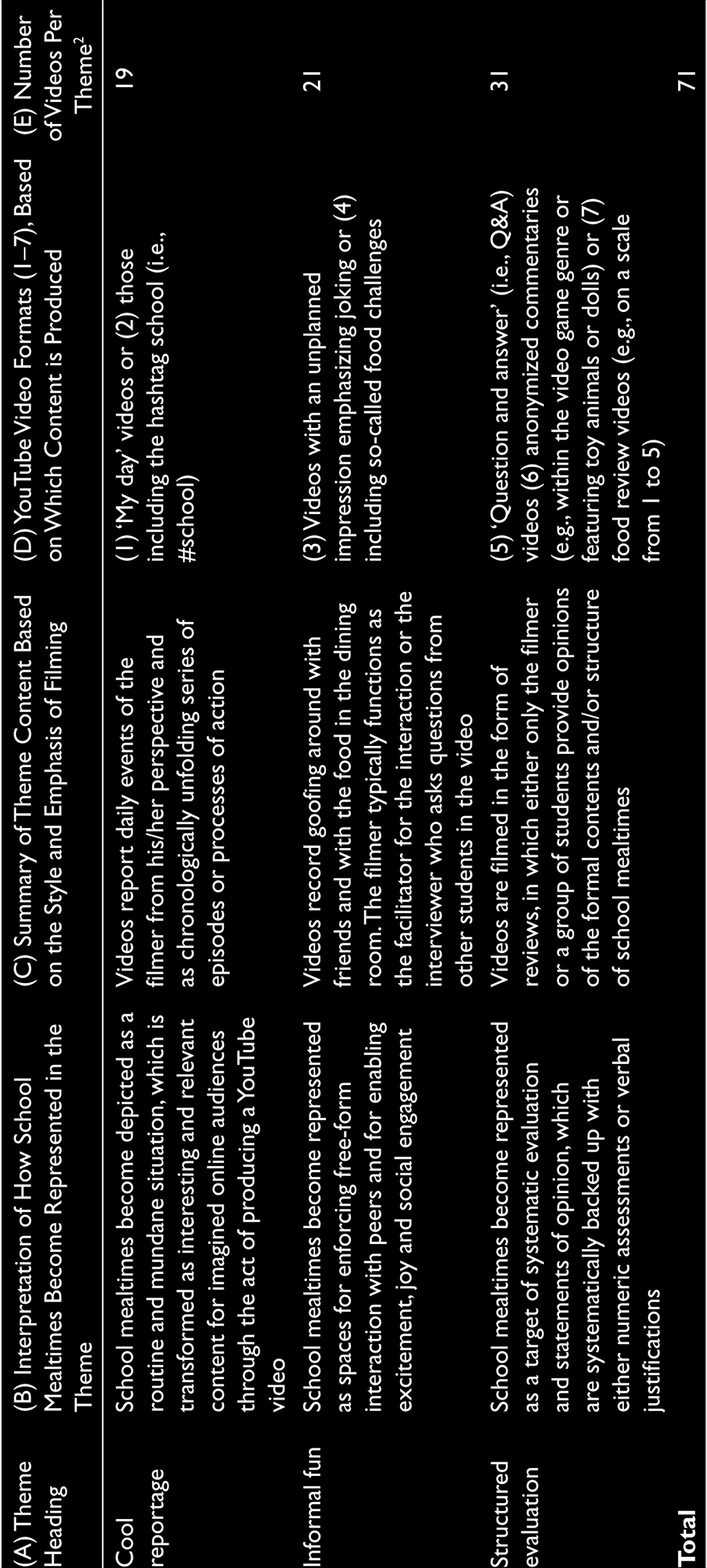
The analyses can be described as abductive (Hatch, 2002), which unfolded in two stages: the first stage was data-driven, thematic and descriptive, and it aimed to summarize what the children and young people were doing in relation to school mealtimes. In practice, the video transcripts were read several times, with the focus on searching for similarities and differences among and between the videos. Referring to Glaser and Strauss (1967), Ryan and Bernard (2003) define this technique as the ‘constant comparison method’. It includes making systematic comparisons across data units, which can be, for example, lines of text, expressions from different informants or as here pairs of whole texts (i.e., transcripts of videos) (Ryan & Bernard, 2003). At this point, researcher’s field diary notes were revisited, which resulted with the insight that the video format (i.e., the style and structure of a YouTube video) influenced distinctively the nature of the content (i.e., how school mealtimes were represented). Based on this, the transcripts we read anew, with the itemization of seven different video formats in the data. These seven formats were combined into three thematic groups (see columns D and E in Table 1) on the grounds of style-connected contents of the videos (column C in Table 1). The thematic groups were then given the following descriptive headings: ‘cool reportage’, ‘informal fun’, and ‘structured evaluation’ (column A in Table 1). Finally, video transcripts were read through once more, and the coding of videos according to the three themes checked with the support of the Atlas.ti program.
In the second stage, the analysis aimed to deepen the understanding of how school mealtimes became represented in each theme (column B in Table 1), as well as to interpret why the videos had been produced and posted on YouTube. The concept of challenging agency (Lanas & Corbett, 2011) and the analytical separation of formal and informal dimensions (Gordon et al., 2000; McGregor, 2004; Paju, 2011; Thomson, 2005; Valentine, 2000) guided our analyses of students’ motives, as well as interpretations of the tensions that emerged between students’ activities and the formal school meal framework. Finally, leaning on Boyd (2014), Davies (2007) and Way and Redden (2017), we enriched our reading of how students’ activities in the videos were affected by their imagined online audiences, how the publicity of YouTube caused formal and informal dimensions of school mealtimes to clash, how filming the videos could be interpreted to reinforce or change students’ experiences of school mealtimes and how YouTube provided them tools to pursue their aspirations to connect socially and to voice their opinions in ways that could not necessarily be possible in the offline. In the following, results are organized according to the three themes established in the first stage of analysis. The names of participants are pseudonyms created by the first author.
Thematization of Self-initiated YouTube Videos of School Mealtimes 1 .
Results
Cool Reportage
Videos representing Cool reportage described school mealtimes as embedded in the chronological ordering of daily life, and as one event among many in the midst of the school day. Contents were produced through filming so-called My day videos, or with including a school hashtag (i.e., #school), which was depicted by students as an opportunity to transform the school-related themes into relevant and relatable content for their intended audience (cf. Boyd, 2014):
[Video begins in the morning in the kitchen] Jepa: [approximately a primary school-aged (i.e. 7-12 years) boy]: ‘School vlog, school is a really mundane thing and it is, like, half of my viewers go to school every day. But, anyway, when you combine this [school] with a vlog, it becomes a rather interesting video, although school is a pretty boring thing’. […]
Above, based on the reference to school attendance (…half of my viewers go to school every day…), it can be interpreted that a considerable part of Jepa’s viewers are other school students. In the video, Jepa describes how he, with the help of filming the video, modifies school attendance from boring into interesting (…when you combine this [school] with a vlog, it becomes a rather interesting video, although school is a pretty boring thing. …). The power of online contexts to transform mundane aspects of daily life (i.e., ‘everyday’) has been noted also in previous research on sharing visual images (Davies, 2007). As the video continues, Jepa focuses on documenting the process of taking part in the school mealtime:
[In the next transcribed episode, Jepa is in the queue in the school dining room. The picture angle is on Jepa’s food tray. Jepa places a fork and a knife on the paper napkin on the tray with his left hand while filming on the right hand. He moves the tray with his left hand, lifts a drinking glass from the rack and places it on the tray and moves forward in the food line. The perspective of the video shows the tray, then moves quickly to show a plateful of food.] Jepa: ‘It’s [the food] not very good, but one has to eat’. [The transcribed episode ends.]
In reference to our conceptualization of school mealtimes, the beginning of the extract could be interpreted to depict the formal routines of the mealtime (i.e., standing in the queue, compiling the meal, etc.). However, the act of filming and posting the video on YouTube imbues the event with also informal meaning and extends the enforced informal dimension into the virtual world. At the end of the video, Jepa presents criticism towards school food (It’s [the food] not very good, but one has to eat.), which counteracts the formal dimension and, thus, builds distance to formal contents and structures. In all, producing and publishing the video enables Jepa to actively construct ‘a cool space’ (cf. Boyd, 2014) in the midst of the mealtime, add elements to the event that include peer-cultural relevance (i.e., aspects that can be imagined to interest his intended audience, that is, other school students) and connect him to a broader social context online.
In addition to its potentially transformative and interest-awaking properties, social media also includes particular challenges. As discussed, the cross-contextual nature of social media can cause norms of separate settings to clash, when viewers other than those originally intended gain access to online materials (Boyd, 2014). The following extract from another video by Jepa is an example of this, as it describes getting punished because an audience unforeseen to him (i.e., teachers of his school) had come across his video:
[The video begins with a boy, approximately of primary school age (7–12 years), who stands in a room and talks about his school vlog] Jepa: ‘So I got punished for leaving the school mealtime a few minutes too early. And like, then I watched it [the “my school” video already filmed] and I thought [sighs loudly] that like, really, do the teachers really look at my videos. … But for real, they watch my videos, so I can’t really make a vlog out of this [the “may day” video already filmed] and post it, because then I would get punished. So there was no school vlog this time, but I’ll make them again next week’. [Transcribed episode ends.]
Above, Jepa reflects on and deals with the collapsed contexts (…I can’t really make a vlog out of this … but I’ll make them again next week.). According to Boyd (2014), this is frequently necessary for modern youth, as they interact online. Although Jepa’s videos include counteractions to formal restrictions (… leaving the school mealtime a few minutes too early.), and refraining from posting a particular video to avoid punishment (…so I can’t really make a vlog out of this [the ‘may day’ video already filmed] and post it, because then I would get punished.), he seems to be more preoccupied with the informal activity of video-making than motivated by active resistance to formal mealtime rules. Furthermore, his video can be interpreted as actively reaching out to his imagined online audience in an attempt to find dialogue in which he is heard, which resonates with the concept of ‘challenging agency’ (Lanas & Corbett, 2011).
In sum, this subsection illustrates how YouTube offers students tools for transforming the formal dimension of school mealtimes into ‘cool reportage’, the style and contents of which align with their informal aims. However, when creating these virtual extensions of the informal dimension of school mealtimes, students sometimes had to deal with clashing norms as a consequence of unforeseen audiences (cf. ‘context collapse’). Although some of the videos represented actions that counteracted formal aims and restrictions (e.g., leaving the dining room early), the majority of materials in this category could not be interpreted as clear-cut rebellion towards formal structures of the mealtime, but rather as ‘mobilization of opportunities to use media in pursuit of own interests’ (Way & Redden, 2017; p. 125); in other words, as aspirations of students to occupy themselves within the informal dimension of school mealtimes in their own terms and to produce online materials that are relatable and exciting for their imagined audience (see Boyd, 2014).
Informal Fun
The theme Informal fun depicts school mealtimes as spaces for having fun with friends and food as a tool for playing and counteracting formal conventions. All videos were filmed by using the school dining room as the setting for the activity. Such as in the study of Pike (2011), the mealtime provided students opportunities to spend unstructured time together. The fact that school mealtimes are not as strictly regulated as, for example, classroom activities, can be interpreted as one reason for students to have made videos with using the dining room as the setting for the activity. From this perspective, the informal dimension of school mealtimes may function as a non-controlled restorative emotional space (cf. Lanas & Corbett, 2011) for students, which provides temporary relief from the pressures of going to school, as well as access to sources of relaxation through evoking positive emotions.
Overall, the materials of this theme seemed unplanned and spontaneous. However, on YouTube channels with regular postings, repetitions began to emerge, like particular persons receiving recurring roles or an identical joke repeated in each video. In this way, the playful activity seemed to find its own internal structure and the players to take particular positions. Thus, these seemingly spontaneous and in-the-moment videos had deeper significance in connection with the children and young people’s construction of social identities and offline group positions. As referred to also by Boyd (2014), the notion of audience crossed online and offline boundaries, as the target audience seemed sometimes to be as much the immediate offline peer group as the broader imagined community online.
In addition to joking and fooling around, the content of this theme included so-called food challenges and filming activities that deliberately crossed conventional table manners. Examples include eating as fast and as much as possible or eating unconventional food combinations, like carrot patties with ice cream. Accordingly, this theme represents a fun and playful space, where everything is upside down and opposite to conventions. From an institutional perspective, it is possible to interpret these videos as including elements of intentional resistance to adult-set rules by counteracting the norms of the meal situation (cf. Kyrönlampi, 2014; Pike, 2011). On the other hand, they can also be seen as ‘challenging agency’ motivated by the pursuit of psychological restoration (cf. Lanas & Corbett, 2011). In line with the latter interpretation, prior research has identified that placing school food as a target or a source of humour can function for students as a way to avoid social exclusion or to amuse peers (Janhonen, 2017).
Although the videos often included explicit references to intentions to post the video publicly on YouTube, many were deliberately filmed in secrecy from adults. In the study of Pike (2011), counteracting rules in secrecy was defined as resistance by ‘avoiding surveillance’, but the aforementioned extract could also be seen as ensuring the construction of the informal space in their own terms. By example, the following extract illustrates preparations for a ‘food challenge’, which eventually included eating fish soup with an excess amount of salt:
[The video begins with a close-up of a meal. There is salmon soup on the plate. The camera rises from the plate towards a boy of approximately secondary school age (i.e. 13–15 years), who sits opposite the person filming.] A boy’s voice says [speaking with a rural dialect]: ‘Okay, Aapo. Put the fucking salt in there, a little bit, nice’. [The camera spins around. Aapo holds a salt shaker in his hand. The camera shifts back to the soup plate.] The boy filming: ‘Here is my wonderful school food’. [The boy filming zooms into his soup plate; then the camera moves back to Aapo’s plate.] The boy filming: ‘Aapo, put, you should put [salt in the soup]’. Aapo: ‘Mmm’. [rising intonation] [The boy filming and Aapo speak simultaneously]: Boy filming: ‘There, the salt shaker awaits already’. Aapo: ‘If possible, I’ll put it [the salt] so no teacher can see…’.
The transcribed episode ends)
In the video, Aapo pointedly states that he will try to avoid the eyes of the teachers (If possible, I’ll put it [the salt] so no teacher can see…). Based on this, it can be interpreted that the students were very aware of the fact that they were acting against norms and table manners. Or even more so: that their counteractions to rules were crucial parts of the excitement and fun. Notably, although deliberately avoiding teachers’ supervision, the particular intended audience of the video (and, therefore, also the main source of motivation for the activity) could be understood to be the immediate offline friend group, as well as the imagined online viewers. In all, this theme portrays school mealtimes as arenas for play, imagination and doing things differently, and as an informal and fun space for constructing the social identities and offline group positions of students.
Structured Evaluation
Videos of Structured evaluation can be interpreted as voicing one’s experience-based opinions about school mealtimes. The majority of the videos were filmed in the school dining room, with sporadic exceptions using the person’s bedroom at home as the setting for the video or filmed in a way in which it was not possible to identify the context with certainty. Overall, the content across this theme was presented in a matter-of-fact style and provided structured justifications for opinions. As a frequent characteristic, many videos graded school food on a scale of 1–5, with a few exceptions using a 1–10 scale. The following is an example of a positive review:
[The video begins with a boy of approximately secondary school age, i.e. 13-15 years, sitting opposite the person filming in the school dining room.] Boy filming: ‘Hello again to you all. Now we have two guests here’. [The camera turns towards two boys sitting on the left side of the camera, who say ‘Hello’. The camera turns towards the boy filming.] Boy filming: ‘I have here today macaroni casserole and then he [turns the camera towards the boy who sits on the left side] has that potato stuff…’. The second boy says from outside the camera angle: ‘And a little bit of macaroni casserole’. The boy filming: ‘Yeah. Joni also has the potato stuff and …’. Someone says behind the camera angle: ‘Potato-fish stuff’. The boy filming: ‘Olli has macaroni casserole’. Someone says behind the camera: ‘And a little bit of the fish here underneath’. Olli: ‘Yeah, there’s a small pile of this [potato-fish casserole]’. [The camera turns towards the plate of the boy filming.] Boy filming: ‘So, now I’ll test the salad. There’s a quite good structure in this. It tastes quite good. And I have a little bit of ketchup here on top [of the macaroni casserole]. It looks really good’. [The camera turns towards the water glasses on the tray of the boy filming.] Boy filming: ‘Two glasses of water. Let’s taste this water’. [The camera follows the hand of the boy filming as he takes a sip of water from the glass.] Someone outside the camera angle: ‘Tastes like water’. Boy filming: ‘Really good. Tastes like water’. [Another boy comes to the table with his tray and sits on the opposite side of the table. The camera follows the new boy, and someone calls, ‘Hi!’.] Boy filming to the new boy: ‘You have macaroni casserole, too’. New boy: ‘Yeah, look, the fish was such a mush that…[the rest of the sentence is unclear.]’ Boy filming: ‘Yeah. Well, I’ll give this the grade eight, this macaroni casserole’. Someone outside the camera angle: ‘Eight out of what? Ten?’ Boy filming: ‘Eight out of ten’. The boy sitting opposite the camera says: ‘I like this. This is probably one of the best foods at school, so I’ll give this ten out of ten’. Boy filming: ‘Nice…’ Olli: ‘I’ll give the macaroni casserole maybe something like eight out of ten’. [Camera turns towards Joni] Boy filming: ‘What do you give?’ Joni: ‘This fish stuff, well, ten out of ten’. Boy filming: ‘Well, there you have it. Bye’. [The video ends.]
Evaluative above-mentioned videos often included references to one’s favourite and least favourite school lunch dishes (This is probably one of the best foods at school, so I’ll give this ten out of ten), and they highlighted the taste and structure of school meals (There’s a quite good structure in this. It tastes quite good.). The boy filming addresses potential viewers straightforwardly (Hello again to you all., Well, there you have it.), suggesting that also this video has been constructed with an imagined audience in mind (cf. Boyd, 2014).
It is noteworthy that there were also videos in which the faces of persons talking were concealed. In addition to publicity, then, YouTube can be said to offer children and young people opportunities to connect with an online social network in an anonymized way. Accordingly, Boyd (2014) states that young people taking part in social media are rarely looking for attention that comes with being public. Rather, they most simply aspire to be in public, while focusing on what it means to be a part of a wider social world (Ibid.). Examples from this study include commentaries within the video game genre, in which it was commonplace to stream and/or record oneself playing a game, and simultaneously provide a commentary track on a particular topic. Another anonymized video format featured toy animals, with the person filming either functioning as the narrator or stating his/her opinion with the dolls’ help, as follows:
[The video, with the pseudonym Puppet show, begins with a close-up of a cat doll. There is music in the background. The person filming cannot be seen; only her voice can be heard. Her finger moves the cat doll’s head as she speaks.] A girl’s voice: ‘Hello. Here is my first video featuring a particular topic. I just wanna say that the aim of these videos is not to hurt anyone’s feelings. I just express my own opinions and tell my own experiences, that is, if I have them. But let’s get started. This topic was given to me by [X], and it is: school food.[…]
The video is constructed in a question and answer (Q&A) format, in which YouTube channel subscribers suggest topics for video makers (This topic was given to me by [X], and it is: school food.). In line with the chosen anonymity, the girl carefully addresses her potential commentators, underlining that she only wants to state her own opinion (I just express my own opinions and tell my own experiences…), and that she does not mean to upset anyone (…the aim of these videos is not to hurt anyone’s feelings). Based on this, she can be interpreted to navigate the challenges of persistence, visibility, spreadability and searchability of online contents (Boyd, 2014). As the video continues, she reflects upon school mealtimes in an exceptionally diverse manner:
Especially here in secondary school, you can always hear a lot of complaints and such, that ‘school food is fucking awful’ and that nothing is good. My own opinion is that school food is pretty good, if you think that I get it for free and that it costs like something under one euro. And anyway, it includes everything, foods, bread, salads, drinks and sometimes even dessert. So in my opinion, it’s pretty OK, if you compare it with the price. Yeah, I admit that some meat in the meat soup is not fully A-level meat, because usually even I don’t eat the meat then. But I don’t complain about it without a reason. Because you know, complaining doesn’t make a difference, because the school lunch personnel cannot decide among themselves that ‘Hey, that person doesn’t like this meat, so let’s prepare something better’, because there is no money. So I’m quite happy and thankful about the fact that I get it for free, even though it is not always very good. But you eat it anyway. It’s healthy and versatile, so why complain? Especially those kinds of [comments] that the bread is a bit hard, and then you throw the bread on the floor, like, ‘Yeah, no way I’m gonna eat that’. I think it’s kind of childish. […]
Above, the girl presents both critical viewpoints (‘…it is not always very good’.) and positive notions (So I’m quite happy and thankful about the fact that I get it for free…; …it includes everything…, It’s healthy and versatile, so why complain?). In contrast to examples in themes Cool reportage’ and Informal fun, no apparent rules or conventions of school mealtimes are broken, which was typical for all material representing Structured evaluation.
In summary, this subsection illustrates how YouTube offered children and young people opportunities for constructing youth-centric public spaces for being heard, which might, otherwise, be inaccessible to them (see Boyd, 2014). Since the videos were not initiated as a part of formal educational activities, they can be defined as a part of the informal dimension of the mealtime. Despite the fact that no rule breaking was represented, some videos were deliberately constructed anonymously, which can be interpreted as aspirations of being in public without seeking the attention of publicity (Boyd, 2014), and of safeguarding oneself against confrontation.
Discussion
This article examined children and young people’s non-elicited YouTube videos as representations of the informal dimension of school mealtimes. The analyses included interpretations of students’ use of social media as an opportunity for creative content production and expressions of agency (Way & Redden, 2017). Furthermore, to be able to acknowledge offline institutional boundaries in relation to which students’ activities are negotiated in schools (see, e.g., Thomson, 2005), we defined school mealtimes as including both formal and informal dimensions. Guided by this conceptual framework, we itemized instances in the data in which students’ and adults’ agendas in relation to school mealtimes could be said to be in contrast (McIntosh et al., 2011) and, thus, exemplified forms of challenging agency (Lanas & Corbett, 2011).
As referred, school mealtimes can be characterized as an institutional context that not only puts students under adult surveillance but also allows them a certain degree of freedom. In the Finnish context, current guidelines (NNC, 2017) place more emphasis than before on learning together during the mealtime and assign the task of formal guidance and education during the meal for teachers and other adults of the school. In contrast, students tend to interpret the mealtime as their own time (Daniel & Gustafsson, 2011; Janhonen et al., 2016; Neely et al. 2014), which highlights the informal and recreational purposes. However, there presently exists limited research knowledge of what takes place in this informal space and what is the significance of these activities from students’ perspectives. Through unprecedented online data, we have sought to shed light to students’ own motives for their informal activities. These are topical issues in the current school meal research context, since students’ views and participatory approaches have received growing emphasis in both recent studies (e.g., Berggren et al., 2019) and on the policy level (NNC, 2017).
With an aspiration to continue discussion of the importance of social aspects of school mealtimes for students (Berggren et al., 2019; Daniel & Gustafsson, 2011; Neely et al., 2014), this study has provided examples and insights about the potential ways in which the informal dimension of school mealtimes can function as a space for young people to enforce social relationships with peers. As a contribution to the field of school meal research, we extend this discussion to social media, which has become an important part of the daily lives of contemporary children and youth, particularly from the perspective of friendship-driven social interactions (Boyd, 2014; Décieux et al., 2019, Lüders 2011). In line with Kozinets et al. (2014), YouTube functioned as a context for students to share their social experiences and opinions of school mealtimes (see themes ‘cool reportage’ and ‘structured evaluation’). However, aligning with Boyd’s work (2014), the theme ‘informal fun’ provided examples also of how social media functioned as a way to engage in meaningful interaction with offline friends.
In sum, our conceptualization of school mealtimes directed analytical attention to how students used social media for (a) transforming the formal framework of school mealtimes into something exciting for themselves and for their ‘imagined audiences’ (cf. Boyd, 2014); (b) for enforcing the non-controlled restorative emotional characteristics (cf. Lanas & Corbett, 2011) of the mealtime; and (c) for creating public spaces for being heard in their own terms (see Boyd, 2014). As called for by Way and Redden (2017), the three themes (‘cool reportage’, ‘informal fun’ and ‘structured evaluation’) and the identified styles and formats of the videos (Table 1) also provide examples of children and young people’s creative content production online. Furthermore, YouTube enabled students to express agency in the pursuit of their own interests (Ibid.). In line with previous research (Boyd, 2014; Décieux et al., 2019; Lanas & Corbett, 2011; Lüders, 2011), these interests included opportunities for social connection and interaction with peers both online and offline, as well as aspirations to be heard. Notably, when entering the virtual world, students had to negotiate not only with the potentially wide and unforeseen audiences online (Boyd, 2014) but also in reference to the tensions between the formal and informal elements of school mealtimes. Thus, results provided examples of how the publicity and cross-contextuality of social media caused informal and formal dimensions of school mealtimes to clash, resulting with offline consequences unforeseen to the youth.
The observational design of this study (i.e., refraining from interaction with participants) bears limitations in terms of interpreting children and young people’s own motives for actions, which should be complemented in further research. For example, interviews with participants (Kozinets et al., 2014) or cross-contextual data with ethnographic orientation (Hine, 2008; Morey et al., 2012) could be beneficial in future studies. Due to the delineation on Finnish-speaking youth and the Finnish school meal context, generalizations should be made with caution. Further research is needed also for investigating differences of primary and secondary school settings, as well as participants of different age groups; conceptualizations of school mealtimes in relation to remaining recess time; the process of filming and editing the YouTube videos; and parents’ perspectives. In addition, the roles of social media in providing young people platforms for interaction and online co-creation of their school meal cultures would be an interesting avenue for research.
Conclusions
Results showed that children and young people’s YouTube videos enforced and extended the informal dimension of school mealtimes and provided students opportunities for seeking social connection and becoming heard. Based on our study, we call for more research on school mealtimes that acknowledge students’ own motives to their actions. This will provide a deeper understanding of the social dynamics of school mealtimes; its role as a part of the overall experience of going to school; as well as the informal and/or formal opportunities it provides for expressions of student agency. As a continuance of our conceptualization, we suggest that the formal dimension of school mealtimes could be extended into a more seamless collaboration with food education within school subjects, and that school food services could be developed in ways that allow students more versatile ways to be heard and to make a difference. However, these should be carried out without eliminating opportunities for relaxing during the mealtime (i.e., in accordance with the informal dimension) and with preserving also pathways for expressing opinions anonymously. In the Finnish context, these notions can be said to be in line with official documents, 2 which highlight the need for also school-level development work in the future. For further school meal research, including online materials, we encourage research designs that complement observational approaches with, for example, interview data.
Footnotes
Acknowledgements
Our sincere thanks to the Finnish Youth Research Network; and the University of Helsinki for providing facilities and collegial support during the study; the anonymous reviewers for their on-point suggestions; and postdoctoral researcher Eila Kauppinen for helpful comments in the finalizing stages of this article.
Declaration of Conflicting Interests
The authors declared no potential conflicts of interest with respect to the research, authorship and/or publication of this article.
Funding
The research received funding from the Elli Suninen and Rachel Troberg foundation.