




Abstract
Building on the relational approaches, particularly social relational theory, this study investigates how Chinese adolescents plan their transition to post-compulsory education through relational influences between themselves and their parents. By examining the family and school lives of 25 Chinese adolescents from a small Chinese town, it has been found that they exercise their agency when negotiating their educational future with their parents. Their mixed agentic strategies are embedded in multiple parenting styles and they result in differing levels of agreement. Despite such variation, the adolescent–parent relationship is interpreted as the reliable interdependence across the participants. The findings provide new insights into parental influence on young Chinese people’s educational future and stress the value of the relational approach in studying the family–education nexus.
Introduction
Parents are a fundamental influence in the everyday lives of young people (Lahelma & Gordon, 2008; Milne & Aurini, 2015; Wyn et al., 2011). This is particularly true in China (Byun et al., 2012; Chao & Tseng, 2002; Wang et al., 2019), where parents’ high demands for their children’s education have been widely researched. However, rapid societal change has reshaped the traditional authoritarian parenting style in contemporary China. In contrast to the individualization of Western countries, the modernization process in China is characterized by ‘economic, political, social and/or cultural changes occurr[ing] in an extremely condensed manner’ (Kyung-Sup, 2010, p. 446). These changes reflect the dynamic interplay of the old and the new institutions in which individualism challenges the collectivist family and state orientation but does not replace it (Yan, 2010). This new societal structure reshapes the everyday lives of individuals. For example, increasing evidence (Qi, 2016; Wang, 2014) reveals that children and young people in China still strongly bond with their parents, but they do so within a more equitable, respectful framework of reciprocity. In light of these changes, it is timely to study the new ways in which parents influence young Chinese people’s educational biographies.
The transition to post-compulsory education is the first crucial point in the educational biographies of most school-aged young people (around ages 14–16) (Aaltonen, 2013; Ule et al., 2016), and this is very much the case in China (Tang, 2016). In China, compulsory education includes primary school and middle school. After completing middle school, students take a standardized high-school entrance exam (‘zhongkao’) organized by local educational authorities. The results of the ‘zhongkao’ determine whether students can continue their education. At present, completing high school and even university has become a common life choice for young Chinese people (Ministry of Education [MOE], 2017), but China still maintains a selective education system. Most adolescents start to choose (are selected for) their different educational paths after the turning point of the ‘zhongkao’. Academic schools are more demanding, but they are favoured over their vocational counterparts. The preference in the labour market for academic diplomas has reinforced the academic–vocational stratification (Ling, 2015). Students completing middle school take the ‘zhongkao’ and compete for the expected academic schools, but only half of them succeed in earning a place (MOE, 2017). The transition from middle school to high school is also a concern in this study, but its primary interest is the planning process, not the outcome of the transition.
It is against this background that this study investigates how Chinese adolescents plan their transitions to their post-compulsory education through relational influences between them and their parents. This exploration takes the relational approach as its theoretical position (Cuervo & Wyn, 2014, 2017; Maccoby, 2014). In particular, social relational theory (Kuczynski & De Mol, 2015) and Woodman’s (2011) argument about the future were applied when analysing the interview data from 25 adolescents in a small Chinese town. This study proposes that these adolescents exercise their agency when negotiating their educational future with their parents embedded in the context of their adolescent–parent relationship.
Parental Influence, Relational Approach and Education
A host of research about the entanglement between young people’s families and their education has focused on parental influence, particularly within the frame of Pierre Bourdieu’s cultural reproduction theory (Bourdieu, 1977; Davies & Rizk, 2018). According to this theory, the parents who possess more cultural capital (Evans et al., 2014; Milne & Aurini, 2015; Sheng, 2014) are more able to secure educational opportunities for their children. Cultural reproduction theory also helps explain the diversity in adolescents’ educational future in East Asia, but the following studies have produced mixed findings. These studies have found that cultural capital, such as parental reading and family participation in cultural activities, is irrelevant or negatively related to East Asian adolescents’ academic achievements (Byun et al., 2012; Yamamoto & Brinton, 2010). Even parental support that is directly related to improving skills and knowledge for testing, such as educational supervision, has been found to have no association with Chinese adolescents’ academic performances (Wang et al., 2019). This result is consistent with the discussion of ‘education fever’ (Byun et al., 2012) in East Asian families—that is, parents being keen to involve themselves in their children’s educational careers (Liu & Xie, 2015). Particularly for the generations who were born after the implementation of one-child policy in China, parents have strongly invested in their children’s education (Liu, 2008). These findings challenge the cultural capital theory by showing an inconsistency between parents’ cultural experience and children’s educational outcomes. Therefore, other approaches are required to conceptualize family dynamics regarding their connection to young people’s educational future.
Studies of parenting have increasingly concentrated on the relational perspective of the family process rather than the unidirectional impact parents have on their children (Kuczynski & De Mol, 2015; Maccoby, 2014). This perspective shares a point about children with sociologists—they conceptualize children as active agents, like their parents, who can influence their relationship, decision-making and social constraints (Behrens & Evans, 2002; Mayall, 2002). The relational approach has been used to analyse the Chinese child–parent relationship in multiple family contexts (Cheang & Goh, 2018; Goh, 2013; Goh & Kuczynski, 2009). On the one hand, these studies have described the various strategies that adolescents use to influence their parents. On the other hand, they have concluded that adolescent agency is not free, but it is situated in the past, present and future of child–parent relationship. Few studies have employed this perspective to explore the family process in terms of children’s education [a recent exception is Cheang and Goh (2018)].
In a similar vein, several scholars (Cuervo & Wyn, 2014; Wyn et al., 2011) have brought the relational approach back to youth studies. This proposal can be linked to the changed life experiences of young people in late modernity. There are growing requirements that young people exercise their agency to navigate their education, employment and other aspects of life (Du Bois-Reymond, 1998; Furlong et al., 2011; Wyn, 2009). This increasing self-responsibility of recent generations may recreate traditional biographical patterns based on individuals’ families’ social classes (Furlong & Cartmel, 2007). This shift still concedes parents’ impact on young people, but new and subtle forms of reproduction may also appear (Furlong et al., 2011). Responding to these new forms of inheritance, Cuervo and Wyn (2014, 2017) have emphasized studying youth from a relational perspective, introducing the metaphor of belonging. One of the three dimensions of this metaphorical concept is that young people seek belonging to the people who matter to them, the most important of whom are their parents. Studying the constant process of young people’s efforts and struggles to maintain relationship with their parents uncovers the connections between the decisions and transitions that occur in young people’s lives.
Taking the relational approach, several empirical studies have confirmed the complicated, multidirectional, intergenerational interactions involved in young people’s educational future (Butler & Muir, 2017; Lahelma & Gordon, 2008; Wyn et al., 2011). In these studies, young people have reported considering their parents’ health, happiness and economic situations when making their educational decisions. Such intention to include their parents in constructing their educational biographies has also been captured in China. For example, Fuligni and Zhang (2004) have argued that Chinese adolescents believe staying on the educational path is a guarantee of economic well-being for themselves and their families. The stronger the expectation adolescents have of repaying their parents, the better their academic performance tends to be (Pomerantz et al., 2011; Tao & Hong, 2014).
Social Relational Theory and Multiple Orientations towards the Future
Social relational theory serves as the main analytical framework of this article to conceptualize the processual and interactive elements between young people and their parents (Kuczynski, 2003; Kuczynski & De Mol, 2015; Kuczynski et al., 2011). This theory suggests that ‘{p}arents and children are considered to interact as human agents within a system of culturally embedded social relationships’ (Kuczynski et al., 2011, p. 172). Accordingly, family dynamics are not limited to behavioural actions and reactions between children and parents. Children and parents make their own meanings within the relationship in which their agency is embedded. This theory is advanced in analysing the new interaction patterns between children and parents which commonly begin with changes in environment or life course transitions (Kuczynski & De Mol, 2015).
Three conceptual tools of social relational theory are used in the present study. The first concept, agency, considers both parents and children ‘as actors with the ability to make sense of the environment, initiate change, and make choices’ (Kuczynski, 2003, p. 9). This understanding is consistent with the work of many sociologists (e.g. Behrens & Evans, 2002; Emirbayer & Mische, 1998; Mayall, 2002). The second concept is the relationship context in which parents and children create their own meanings of their relationship based on past interactions and future goals. The typology of parenting styles (Maccoby & Martin, 1983) could be useful for analysing children’s interpretations of their child–parent relationship contexts, including authoritative, authoritarian, permissive and uninvolved parenting styles. As sources of meaning, these varied child–parent relationship contexts may both constrain and enable parents’ and children’s agency. Understanding agency within relationship contexts involves relational and temporal perspectives of agency (Behrens & Evans, 2002; Emirbayer & Mische, 1998; Juvonen & Romakkaniemi, 2019). The third concept is qualitative change. As agents, children and parents may have contradictory concerns. The processes of negotiating, tolerating or combatting these contradictions may result in qualitative changes that give new meanings to child–parent relationship.
In analysing the process of planning for school transitions, this study applies Woodman’s (2011) argument about multiple orientations towards the future (cf. Leccardi, 2005). Woodman goes beyond the idea that the future is only about planning and suggest viewing young people’s future as a mixture of the present-centred and the future-centred strategies they have formed through interactions significantly with others. These mixed orientations towards the future are closely linked to wider societal changes that do not support traditional long-term biographical planning (Brannen & Nilsen, 2002). Such a trend shifts the approach to contextualizing young people’s practices and actions regarding their future, which now includes multiple strategies of concurrently ‘shap{ing} the future and engag{ing} in the present’ (Woodman, 2011, pp. 125). This is also supported by Emirbayer and Mische’s understanding of agency ‘as a temporally embedded process of social engagement’ (1998, p. 962) which is informed by the past, the present and the future.
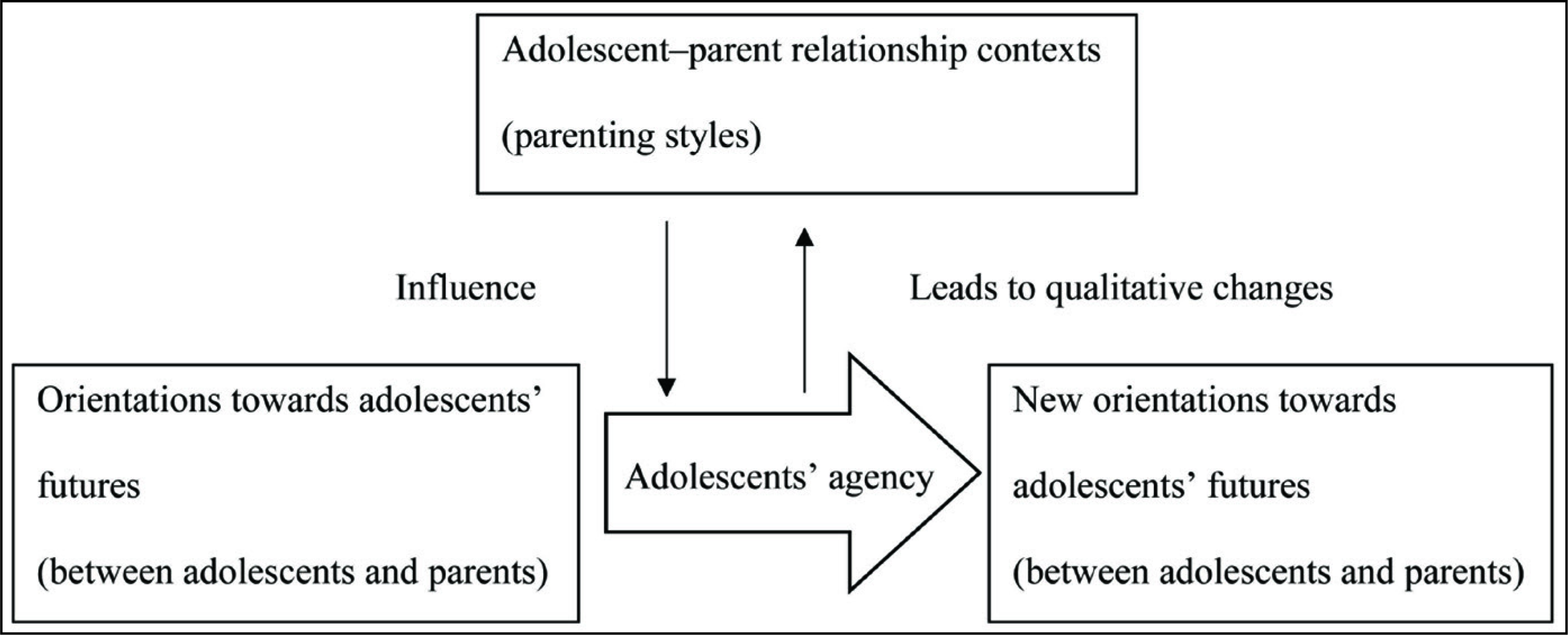
Figure 1 illustrates the conceptual framework this study develops to analyse relational influences between adolescents and parents in planning school transitions. This process may begin with adolescents’ and parents’ different orientations towards adolescents’ educational future. Adolescents exercise their agency to negotiate such contradictions between their interests and their parents’ expectations. Adolescents’ selections of agentic strategies are embedded in their adolescent–parent relationship contexts, which are linked to the parenting styles in their families. In this, adolescents’ agency is not simply influenced by, but may in turn lead to, qualitative changes in their adolescent–parent relationship contexts. New orientations towards adolescents’ future and their child–parent relationship may be temporarily created through this process of negotiation.
Data and Methods
The data are part of a larger 2016 qualitative study about adolescents’ experiences of compulsory school transitions, family relationship and personal well-being. The fieldwork was conducted in a public middle school in a town of Hebei Province that is surrounded by mountains and rural areas. Hebei Province has a population of over 74 million, with a per capita disposable income of urban households that ranked as ‘low range’ in China in 2016 (National Data, 2020). The town’s major industry is mining, and as the mining sector is under pressure all over the world the local economy is experiencing a transformation. The town has two primary schools, two middle schools, one academic high school and one vocational high school. The students of the selected middle school have the option to transition to any of the high schools in Hebei Province. According to the headmaster of the selected school, in 2016, around half of the students who completed the middle-school programme continued their education in academic high schools in urban areas, and most of the remaining half were enrolled in academic high schools in rural areas and vocational high schools. Overall, the selected urban area has limited economic resources compared with the national average, and the competition for the socially expected academic high schools, particularly the ones in urban areas, is considerable.
All 546 final-year students of the selected school were included in the larger 2016 qualitative study. During the first 3 weeks of fieldwork, all the participants were asked to write essays about their families and school lives. An analysis of this information provided an overview for selecting a smaller subsample for in-depth study. Interviewing, a classic method in youth studies (Wyn & Woodman, 2007), was then adopted to explore the rich accounts of the interactive processes between young people and their parents in planning their school transitions. Thirty-two interviewees were invited to participate in individual interviews because of their distinctive experiences that represented the diversity of the larger sample of 546 in terms of their families’ parenting styles (Maccoby & Martin, 1983) and their plans for school transitions (e.g. aiming for academic or vocational diplomas). Seven informants were removed from this subsample because they or their parents did not consent to participate. In total, 25 adolescents were interviewed in Mandarin Chinese.
The interviews were semi-structured and conducted individually in a meeting room at the selected school; they lasted from 20 to 40 min each. The interviewees were asked to describe the daily lives of their families, historical relationship with their parents, school experiences and educational plans. The researchers complied with the ethical principles of their research community in Finland (Finnish National Board on Research Integrity [TENK], 2009) as well as the cultural expectation of parental consent for children engaging in out-of-school activities in China. Collecting the final-year students’ essays was permitted by the local education bureau and the selected school. The students were verbally informed about their rights to participate or not to participate in the study, given complete information about the research and the researchers’ plan to analyse and publish their answers. A total of 489 (90%) students chose to participate (i.e. submitted their essays). Before the interviews, the consent forms, including the research background and main interview questions, were provided to the 25 interviewees and their parents. Any information that could identify the participants was removed. All the interviews were voice-recorded (with permission) and transcribed verbatim (yielding 416 pages in total).
This article is an analysis of these 25 individual interviews. The interviewees were 14–16 years old. Approximately equal numbers of girls (N = 14) and boys (N = 11) were recruited. The participants had a range of family situations. Nine participants came from families with parents who did not have professional jobs. In the other 16 families, at least one parent had a professional job, such as a civil servant, doctor or teacher. Ten participants lived only with their mothers or grandmothers, due to their fathers’ absence at distant workplaces. The other 15 participants lived with both their fathers and mothers. Ten of the participants mainly described their child–mother relationship, five described their child–father relationship and ten did not distinguish between the two.
A content analysis was conducted with the help of Atlas.ti software (version 7.5) to summarize the main categories in the participants’ narratives (Mayring, 2014). First, all the transcripts were descriptively coded to generalize similar issues regarding the participants’ family and school lives. The coding at this stage produced clusters of ideas to further establish categories. Next, all the transcripts within the identified fields were coded into several categories, such as their practices and reflections of adolescent–parent relationship, educational strategies and aspirations for education. Guided by social relational theory (Kuczynski & De Mol, 2015) and the focus of temporal orientations towards the future (Woodman, 2011), these categories were conceptualized and refined to describe the broad and varied patterns of how these adolescents navigated their school transitions with their parents. After several rounds of iterative revision, three categories emerged: the first turning point of life, mixed agentic strategies and reliable adolescent–parent relationship contexts. In the next section, these categories are analysed, and extended narratives are used to illustrate the manifold dimensions of the relational influence between parents and children regarding education.
Results
The First Turning Point of Life: The Quest for Academic Success
This section discusses the young participants’ orientations towards their school transitions and their parents’ influences over these possibilities (Emirbayer & Mische, 1998; Woodman, 2011). The participants reported having intensively discussed the significance of transitioning to high school with their parents since their last year of middle school. Many of the informants described this school transition as the ‘first turning point of life’, the results of which would decide their educational and occupational paths. All of the participants were aware of the hierarchy of their transition results: the academic high schools in cities, the academic high schools in their own town and then the vocational high schools. Here, following a certain path is expected—academic high school, university and then a prestigious job—which the parents encouraged. As one girl said, ‘If I can go to a highly-rated high school, my fate may be different’. She further explained how her mother bluntly told her to pursue the ‘highly rated’ academic schools:
My mother {told me that} if {I can attend a} good high school … it is much easier to go to a good university… . I really don’t want to go to the high school in {my town}… . If you attend a poor high school, … you will end up at … the third-tier universities. You can’t find a good job because the good positions are for the people {who graduate} from the first- and second-tier universities. Therefore, I must study hard and go to a good university. Then, my future will be promising.
There are a variety of expected transition plans to academic high schools. Unlike this girl, who favoured the academic high schools in cities, some participants with low academic attainment considered the local one to be their best future option. Other popular choices were the art programmes in these academic high schools due to their much lower academic requirements than their academic counterparts. However, most of the interviewees reported their parents’ pessimistic attitudes towards this ‘shortcut’ to getting enrolled in an academic high school. For example, one girl spent several months persuading her father to support her preparation for the music programme because her father believed ‘It was not easy to find a job in the future {as a musician}’. Another girl reported similar disagreements who aimed to use her talent with the Erhu instrument to apply to the art programme.
I feel that learning Erhu is good. My academic achievement is poor. I may be recruited by {the local academic high school} through the skill of Erhu… . My parents didn’t agree. They said, “learning Erhu is useless. It is better that you improve your academic performance”.
Unlike disputes about the different programmes in academic high schools, vocational education was universally unacceptable to most of the participants and their parents. Poor evaluations of vocational high school were common in the participants’ accounts. Some of the interviewees overtly warned about this self-evident decision to become ‘bad students’: ‘don’t choose a vocational high school’. One boy even received a threat from his mother about this option: ‘If I can’t go to academic high schools, then {my parents} won’t continue to support my schooling anymore’.
These adolescents sensed that their parents were not only keen to support socially expected promising future for them, but they also actively participated in the process of rearranging their present lives to secure such plans. Most of the participants explained that they had adopted totally new life routines in the last year of middle school with the sole purpose of improving their academic performances. One girl described her typical daily schedule:
{I wake up at} half past six… . {At} a quarter past seven, {I} go {to school}. There is no time for breakfast… . {At noon, my mother} cooks for me… . Sometimes I do some homework because {I am} afraid of not finishing {homework} in the evening. {I go to school in the afternoon.} … After dinner, I work on homework again… . Usually, {I finish my homework} around 11 p.m.
Most of this girl’s daily life involved learning and exercising her knowledge at school. Except for time spent sleeping, all her family time, around 4–5 hours each day, was occupied by completing homework and previewing and reviewing the teaching material. Although she stopped going to private tutoring on the weekends, she was barely allowed to relax: ‘{I} feel {my father} cannot accept that I don’t learn every minute’. She seemed to be influenced by her father’s quest for her success and believed that such an exam-oriented lifestyle was imperative. She even planned to ‘be more rigorous’ than what her parents required, despite feeling stressed.
I should read textbooks during the breaks in between classes. I must start my homework very early, and the mealtime should be shorter. {I should} finish homework very early and memorize the textbooks. {I should} read the textbooks all weekend without thinking about having fun. {I should} use the time on the bus to read textbooks.
It is noteworthy that a small group of students had decided to continue their education in vocational schools. Unsurprisingly, a common reason for this choice was their poor academic performance, which made them less confident about attaining academic success. Although it seems that this group chose less competitive paths than their peers who sought positions at academic high schools, they were uncertain about their unconventional choices. Such uncertainty could barely be reduced by their parents who desired that they attend academic high schools as discussed earlier. As a result, these young people lived with doubt, and even fear, of their future. For example, one boy who decided to attend a vocational high school shared the following:
I worried about my future almost every day. I continuously asked myself, “What should I do if I can’t have a promising future?” After questioning, I still don’t know… . So, I can only do whatever I did before.
Overall, most of the participants were aware of the significant impact of academic success on their future, and that academic high schools would provide them with greater chances of continuing their education and obtaining promising jobs. These adolescents’ parents not only played roles in promoting this long-term transition plan, but also actively engaged in the process of achieving this goal in their present family lives. Nevertheless, not all of the participants followed parental expectations to continue their education in academic high schools. This small group in particular carried significant emotional burdens during this stage of constructing their educational future.
Mixed Agentic Strategies: Striving for Mutually Agreed-Upon Transition Plans
The previous section outlined the common tendencies these young people and their parents had in articulating their educational future. Digging deeper into the data within the framework of social relational theory (Kuczynski & De Mol, 2015), this section illustrates how the participants exercised their agency to shape their parents’ educational involvement.
Their resistance to their parents’ control was one of the compelling pieces of evidence confirming the adolescents’ agency (Kuczynski & De Mol, 2015). These adolescents commonly selected indirect ways to resolve the differences between them and their parents, sensing high demands but low responsiveness from their parents. One strategy was resistant compliance (Parkin & Kuczynski, 2012). When using this strategy, the adolescents complied only with their parents’ requests in appearance while actually executing their own plans. For example, according to one boy’s account, his parents believed that due to their poor financial situation, he could ‘only have a promising future by having competitive academic performance’. In contrast, he believed that ‘all roads lead to Rome’ and planned to set up a business. He tried to persuade his parents to accept his future plan, but his parents only ‘agreed with {his} view for a few days’. Afterward, when his parents talked about their ‘old ideas’ of achieving an academic diploma, ‘I listened {to them}’, he said, ‘but {I didn’t} do what they asked {me to do}’.
Resistance to parents was sometimes more concealed, particularly among the adolescents whose parents lacked educational experience. This group seemingly followed their parents’ suggestions to put more effort into their schooling, but their narratives revealed their nuanced modifications of their parents’ guidance. For example, one girl’s parents, a driver and a stay-at-home mother, had stressed the significance of education ‘day and night’ since middle school. However, she explained that her parents ‘could barely help’ because ‘my learning’, as she said, ‘cannot be improved simply because of their words’. She had adopted the strategy of coping with academic difficulties by seeking support from peers, teachers and the internet.
Some of the participants negotiated family disagreements and co-created new agreements with their parents who mostly adopted the authoritative parenting style. For example, one girl had a close relationship with her father who was a businessman and had been to university. Her father was always supportive and barely expressed strict academic requirements to her. When, in the summer before ninth grade, she expressed her desire to choose music as her future path, she clearly experienced a qualitative change (Kuczynski & De Mol, 2015) in her child–father relationship. Her father had strongly valued an academic diploma and had tried to steer her back to this transition plan by controlling her time:
He didn’t let me go out for the whole winter holiday {when I was} in 8th grade. He basically stayed at home and supervised my study. During that time, I felt depressed.
Despite the qualitative change in her father’s parenting, she knew how to effectively reshape her father’s influence through their past interactions. She had concluded, ‘Maybe you can’t persuade him immediately, but he will think it through later’. Therefore, she adopted the strategy of continuously persuading her father. She finally received her father’s apologies for his control and gained his support for her decision to study music.
For those living with authoritative parents, it was difficult to identify the adolescents’ agency due to their parents’ active responsiveness to their educational needs. For example, another girl similarly selected art as her future career. Her process of cooperative planning with her father went more smoothly than the aforementioned girl. When she had difficulties deciding whether to choose an arts high school or an academic high school with an art programme, her father voiced his opinion about the latter choice. Eventually, she accepted her father’s idea. While this acceptance was not as simple as showing her father obedience, her agency lay in the strategic use of her father’s educational experience and social network to collect the relevant information to make a decision:
My father was familiar with {different educational trajectories}. He purposely checked {the information}… . He has a friend {who works in} a high school… . Therefore, I was persuaded by {my father}.
In contrast to the agency identified in the previous excerpts, a few of the interviewees experienced powerlessness to influence their parents in their school transitions. The adolescents in these families often sensed that their parents were either overly demanding or neglecting their educational needs. These informants mainly navigated their future as their own concern. For example, one boy’s father worked out of town and came home once a month. Their rare communication was usually about school, but the boy explained that his father ‘stopped asking after middle school’. Although he lived full time with his mother, ‘She doesn’t talk so much to me. Only minor things, nothing important’.
In sum, these narratives identify the various agentic strategies that these adolescents developed to influence their parents when planning for their future, such as resistant compliance, modification and negotiation. The participants’ selection of agentic strategies depended on their meaning-making of their adolescent–parent relationship, particularly their perceptions of parenting styles. Most of the participants experienced authoritative or authoritarian parenting practices regarding their education (Maccoby & Martin, 1983), and their agency was oriented to reshape, rather than dispose of, their parents’ engagement. The interviewees’ preliminary purposes for exercising their agency were to resolve family disagreements and create transition plans that would balance their own interests and their parents’ educational suggestions.
Reliable Adolescent–Parent Relationship Context: Making Meaning from the Past and for the Future
In what follows, this study traces the shared interpretations of the adolescent–parent relationship across the participants with multifaceted parenting styles through their experiences in the past and their imaginations of the future (Kuczynski & De Mol, 2015). The participants interpreted their relationship with their parents in a variety of ways, as discussed earlier, but most of them considered their parents to be reliable sources of support. They sensed their parents’ good intentions and affirmed the solid interdependence between themselves and their parents. As one boy whose parents had demanding requirements for his schooling shared,
My parents tried their best to persuade me to be more diligent in my schooling… . They constantly informed me of this idea. It’s always and only about this subject… . I don’t even want to go back home now… . However, I still felt close to my parents. Only when they started to nag {about getting academic diplomas} did I feel annoyed.
The positive positioning of child–parent relationship was apparent to a great extent in the descriptions of how these young people took advantage of their parents’ social and cultural capital to frame their educational biographies. As one girl explained, if she was able to attend the teacher training programme at high school, her parents, who were teachers, ‘may help me to find a job in the future’ through their personal networks. Similarly, another girl expressed her parents’ role in offering suggestions about her future compared with her peers and teachers:
It is impossible to discuss {your future} with the teachers… . The teachers may respond, “Why are you telling me about your private life?” Some teachers may be annoyed. If you tell your classmates {ideas about your future}, {they} cannot help {you} as a result of being of the same age.
Reliance on parents was built on positive interactions throughout the history of the child–parent relationship. Many participants, for instance, recalled happy moments with their parents. Day-to-day care and educational support (e.g. private tutoring) were key factors connecting them to their parents. The adolescents mentioned that such parental practices were mainly provided by their mothers, and they were often about ‘small issues’ such as cooking, buying medicine and doing laundry. As one girl commented, however, ‘It’s a big deal {for my mother} to take care of me every day’. Similarly, when one girl and one boy expressed the need to hire private tutors, their parents immediately ‘searched for several possible tutoring centres’.
The anticipation of long-term connectedness with their parents encouraged these adolescents to protect their relationship when modifying their parents’ educational engagement. When asked about their parents’ positions in their future, all of the participants expressed their wishes to take care of their parents. Along with the cultural expectation to support ageing parents, most of the participants made such commitments as genuine rewards for their parents’ past and present support. As one girl said, ‘No matter if I am rich or not, I will take care of my mother in the future’. Another girl said, ‘Because my parents are quite old, I need to take them into account [in my decision-making]’. Several participants happily expected to live with their parents when they had grown up, as one girl stated:
My mother is now working … and supporting our education. She only has a little time for herself. When I grow up and earn money, I will move our whole family to a big city. {Then} everyone will have a good house {and} my mom won’t need to work… . {We will} enjoy being a happy family. It will feel good.
A specific example of how past experiences and future expectations of child–parent relationship contextualized these adolescents’ agency was their concern for taking over the responsibility for their families from their parents. This was particularly the case for the adolescents from lower-income families who witnessed their parents’ hardships in working. Consistent with previous studies (Fuligni & Zhang, 2004; Pomerantz et al., 2011; Tao & Hong, 2014), they saw competing for a position in an academic high school as the best way to improve their parents’ well-being. Even though this major commitment was accompanied by significant emotional burdens, these participants still insisted on following this path. One girl with poor academic performance, whose parents were a market cashier and a security guard, shared the following:
Education is very important… . Everything depends on the diploma… . If I have a diploma, I can find a good job and earn more money. In the future, I can support my younger brother to go to school when my parents are old… . I must go to the academic high schools… . I just force myself to keep going.
These narratives demonstrate the formation of the reliable child–parent relationship context that provides the background of the collaborative aims of the participants’ agency. The reliance that most participants had on their parents was grounded in their experiences of their parents’ constant daily care, deep investments in their future and their expectations of maintaining long-term interdependence with their parents. These past, present and future perspectives of the child–parent relationship illustrate the adolescents’ efforts to seek belonging with their parents (Cuervo & Wyn, 2017).
Conclusion
Planning a school transition is a complicated process in which young people exercise their agency to resist, negotiate and conflict with their parents’ educational engagement. This argument, based on young Chinese people’s experiences, responds to the claim that young people have become more responsible for constructing their future in late modernity (Du Bois-Reymond, 1998; Wyn, 2009). This growing responsibility, however, cannot be understood as young people pursuing full autonomy from their parents (Butler & Muir, 2017; Lahelma & Gordon, 2008; Wyn et al., 2011). On the contrary, young people’s orientations towards their future are consistently embedded in their relationship with their parents. So are young Chinese people—they are being given more power to plan their lives, and at the same time their parents are still expected to offer holistic support and guidance (Wang, 2014; Qi, 2016). Identifying parents as sources of support to manage their life transitions, the Chinese adolescents in this study further show how they actively balance their parents’ and their own educational aspirations to achieve certain levels of agreement of how to continue their education. In this sense, this analysis contributes to youth studies by illuminating young people’s roles in maintaining and negotiating their significant relationship and their belonging in China (Cuervo & Wyn, 2014).
Rather than using the traditional lens of parental influence, this article illustrates how to study family engagement in education via social relational theory (Kuczynski & De Mol, 2015). This relational approach deepens our understanding of how young people orient their future (Woodman, 2011) and how their agency shapes their parents’ engagement (Behrens & Evans, 2002). This analysis highlights young people’s mixed agentic strategies in relation to negotiating their parents’ suggestions about orientations towards the future. Such negotiations are embedded in various parenting styles and result in differing levels of agreement. This new approach does not devalue the perspective of parental influence—rather, by broadening our horizons to consider the relational influence between parents and children, we can learn about the nuances of adolescents varied and even ‘irregular’ educational strategies in making plans for their school transitions. For example, the participants from lower-income families can also work hard and orient themselves towards the same academic success as their counterparts when motivated by family belonging (cf. Cheang & Goh, 2018). These youth-reported family dynamics resonate with the emerging theme that structural divisions have been reproduced across generations in more complex ways than simple capital transmission (Furlong & Cartmel, 2007; Furlong et al., 2011). Relational approaches exemplify the advantage in explaining the complexities of the family–education nexus.
While the relational approach employed here offers a fruitful way to address the question of how families influence young people’s educational future, the cultural relevance of this approach must be noted. The analytical power of social relational theory in this study has a connection with the Chinese culture of parents’ participation in their children’s education. As briefly introduced in the beginning, the traditional collectivist orientation is gradually being combined with Western individualism in Chinese society (Yan, 2010). These societal changes give young people and their parents the respect to interact and negotiate with each other when planning for their educational future—thus, it is beneficial to study such relationalities in China. Given that precarious contexts drive young people back to their families today, relational approaches can be promising in examining sustained family belonging in youth.
Footnotes
Acknowledgements
We would like to thank all the young people who participated in this study. We would also like to thank Sosnet seminar (international group), Matilda Wrede-Jäntti, Tarja Juvonen and Juha-Pekka Lauronen for their feedback on this article.
Declaration of Conflicting Interests
The authors declared no potential conflicts of interest with respect to the research, authorship and/or publication of this article.
Funding
This work was supported by the China Scholarship Council (CSC) under Grant No. 201607960005.