




Abstract
This study investigates how young Ghanaians’ mobility between Ghana and The Netherlands relates to their educational resilience. Based on 20 months of multi-sited ethnographic research following 30 youths of 16–25 age group, we deploy a socio-ecological approach developed in social psychology to identify three resilience-building mechanisms: connection to motivational others, active recollection and comparative confrontation. These mechanisms have to date remained outside of the purview of resilience research and research on migration and education, as these fields focus on the nation-state rather than the transnational context in which young people operate. They thereby ignore mobility patterns that make other contexts relevant to young people’s educational resilience. As such, we expand the socio-ecological model of resilience to include transnational elements and show how mobility can positively relate to education and the resilience of migrant youth.
Keywords
Summary
Trips by migrant youth to their origin country are seen by institutional actors such as teachers and social workers as disrupting youth’s educational progress, and some European countries have financial and legal consequences when these trips take place during the school year. We follow Ghanaian youth living in The Netherlands on their journeys to Ghana and study how they experience such trips and are affected by them. Trips allow young people to reconnect with family and old friends, recollect memories, and confront them with poverty in their country of origin, making them resilient and motivated when facing adversities in school in the Netherlands.
Introduction
Mobility among migrant youth in the form of visits to their country of origin is a common phenomenon (Haller & Landolt, 2005; Schimmer & van Tubergen, 2014; van Geel & Mazzucato, 2018). Scholars investigating the impact of migration on education, however, rarely investigate the relation between mobility and education (Gulson & Symes, 2017; Mazzucato, 2015). This article analyses how young people of Ghanaian background move within and between Ghana and The Netherlands—what we call their mobility trajectories—and how what transpires during these moves relates to their education, by concentrating specifically on their educational resilience.
Resilience is understood as ‘a dynamic process encompassing positive adaptation within the context of significant adversity’ (Luthar et al., 2000, p. 543). Educational resilience refers to resilience manifested in the educational domain (Alva, 1991; Waxman et al., 2006). Getting through the school system can be a challenging experience for migrant youth due to new curricula, didactical cultures and language (Adams & Kirova, 2006). Additionally, migrant youth face other issues that discriminate against them. For example, in The Netherlands, schools are segregated especially in urban areas (Onderwijsinspectie, 2017), the abilities of students with migrant backgrounds are often underestimated by their teachers and discrimination during internship applications, often a mandatory component of their curriculum, are persistent problems (Kennisplatform Integratie & Samenleving, 2015; Rijksoverheid, 2018).
Studies argue that educational resilience helps migrant youth to further their education despite such hurdles (e.g., Alva, 1991; Kumi-Yeboah & Smith, 2017; Wu et al., 2012). Few studies, though, investigate young people’s perspectives and voices on this matter (but see, Li et al., 2018). Furthermore, educational resilience literature has to date focused on the resources that young people have at their disposal in the country where they reside and go to school. Yet we know from transnational migration studies that migrants continue to engage with their origin countries in multiple ways, creating transnational social fields (Glick-Schiller, 2005). These studies argue that transnational social fields are constituted by several national contexts that are relevant for understanding migrants’ lives, relationships, aims and activities. Levitt (2009) argues that this is not only relevant for adults but also for young people of migrant background. Yet resilience literature ignores transnational social fields. Finally, while transnational migration studies tend to focus on the international moves between home and host country, the ‘new mobilities turn’ (Urry, 2007) has pointed out that migratory experiences are shaped by (im)mobility prior, during or after international migration (e.g., Schapendonk, 2012; van Geel & Mazzucato, 2018; Wagner, 2017). This recent literature has started to follow migrants’ specific moves through time and space, yet has rarely focused on young people.
Given the indications that transnational social fields can be of importance for migrant youth, we investigate whether and how such fields are of relevance for their educational resilience. We focus on the travels that young Ghanaians, living and schooling in The Netherlands, engage in because we argue that such travels are the most immediate way for young people to maintain, revive and develop their relationships with people in Ghana, thus creating an active transnational social field. We explore whether visits to Ghana can help explain why young people from equally underprivileged backgrounds differ in their educational pathways, with some excelling while others struggle (Fernández-Kelly, 2008; Mazzucato, 2015; Rutter, 2012; Waxman et al., 2006).
The Ghanaian community in The Netherlands is estimated at 24,000, of whom 9,816 are categorized as ‘second generation’ (Centraal Bureau voor de Statistiek, 2018). This figure is an underestimation given the presence of undocumented migrants. Ghanaians came to The Netherlands in the 1980s and 1990s, in search of a better livelihood during economic decline in the wider West-African region. Many occupy blue-collar jobs and live in the neighbourhood in Amsterdam where this research was conducted.
We identify three mutually constitutive mechanisms which shape the educational resilience of young people with a migrant background through their mobility trajectories: connection to motivational others, active recollection and comparative confrontation. As such, we contribute to debates on how mobility relates to young people’s education (Gulson & Symes, 2017). We expand on the socio-ecological model of educational resilience developed within the field of psychology by deeply investigating the role of the transnational context and by taking young people’s views and experiences as analytical starting points.
Theoretical Framework
Educational Resilience and Mobility Trajectories
Scholarship on educational outcomes of migrant youth focuses on factors that are generally significant for educational outcomes, irrespective of migration background. For example, factors such as socio-economic status, parental motivation and educational background, neighbourhood composition and resources, school context and support of significant others have all been found to impact the way migrant youth fare in school (e.g., Kao, 1999; Portes & Fernández-Kelly, 2008; Portes & Zhou, 1993; Schnell et al., 2013; Sichling & Roth, 2017; Suárez-Orozco et al., 2010; Turney & Kao, 2009). Unexplored are factors that lie outside of the nation-state in which young people live, which are, potentially, highly relevant to migrant youth. Moreover, such research categorizes young people according to their first international move (first generation, second generation and all variants in between) but it does not study the mobility of young people per se (Mazzucato, 2015; van Geel & Mazzucato, 2018). Yet mobility scholars argue that people’s movements through space and time are pertinent for understanding contemporary social reality (Sheller & Urry, 2006; Urry, 2007). For migrants in particular, if and how they are able to travel, may impact their migratory experiences, for example, because supportive transnational relationships can be maintained or because material assets and identities are shaped during mobility (e.g., Schapendonk, 2012; van Geel & Mazzucato, 2018; Wagner, 2017). By bringing these literatures together, we hypothesize that young people’s geographic mobility affects the resources they can employ to shape their educational pathways. As such, we investigate alternative, transnational elements that may affect how migrant youth fare in school.
The resources that young people can employ to shape their education has been the study of psychological research. Recent work conceptualizes people as embedded in a broader ecology composed of family, school and culture, such as religion, cultural beliefs and practices, all of which provide access to specific resources that build resilience (Holleran & Waller, 2003; Masten, 2018; Motti-Stefanidi, 2018; Panter-Brick & Eggerman, 2012; Ungar, 2008). This differs from previous research which acknowledged context but treated resilience as an outcome of individual characteristics and personality traits (Masten, 2014; Rutter, 2012; Rutter, 2015; Schoon & Bartley, 2008). Within the recent ecological model of resilience, young people’s resilience is formed through interaction with these systems. For example, in times of hardship, cultural beliefs, positive identity and religious practices can ‘provide a sense of continuity, connectedness, hope, positive identity, and meaning in life’ (Masten, 2018, p. 21).
Within ‘systems’, healthy, warm and supportive family relations (Masten, 2018) are ‘the relational foundation of resilience’ (Franceschelli et al., 2017). However, most studies focus on the parent-child relationship, guided by a Western conceptualization of ‘family’, yet nuclear families are not the norm nor universal (Motti-Stefanidi, 2018; Xiang et al., 2018). With specific reference to West Africa where Ghana is located, norms of social parenthood, child circulation or fostering are an integral part of kinship and child-rearing practices (Goody, 1982). In a transnational context, children have been found to have meaningful and bonding relationships with multiple caregivers in multiple countries (Mazzucato et al., 2017; Olwig, 2007), questioning thus the presumption that physical proximity is a prerequisite for family functioning (Fresnoza-Flot, 2009; Madianou & Miller, 2011; Mazzucato & Schans, 2011). This implies that when looking at environmental factors that affect young people’s education such as family composition, it is important to consider the role of people living far from young people but who possibly continue to play an important role in young people’s lives after migration. We, therefore, investigate young people’s transnational relationships and how mobility shapes their ability, or lack thereof, to draw from these relationships to build educational resilience.
‘Resilience’ is a contested concept. Especially the increasing use of ‘resilience’ in social policy is critiqued (e.g., Bottrell, 2013; Dagdeviren et al., 2016; Gregory, 2014; Joseph, 2013). Scholars argue that ‘resilience’ fits a neo-liberal discourse by promoting self-help and individual responsibility. This enables policymakers to neglect broader societal structures and path-dependencies that cause adversity (Hickman, 2018).
Methodological critiques have also been made. A persistent lack of conceptual clarity plagues the concept. Questions such as ‘is resilience an attribute or a process?’ and ‘to what extent is it a positive phenomenon?’ are debated. For example, Hickman (2018) concludes that the positive connotation attached to ‘resilience’ (‘thriving’, ‘succeeding’, ‘overcoming’) does not reflect the empirical realities of people whose lives are more accurately described as ‘getting by’, ‘surviving’ and ‘enduring’ because they are unable to exercise any form of transformative agency. In light of this conceptual vagueness, the popularity of the concept in the social policy becomes even more problematic.
These critiques are important and the reason why we choose to study resilience within an ecological model where the environment within which young people build resilience is central. Our contribution is to look specifically at the transnational elements of their environment. This allows us to focus on young people’s agency and counter the dominant narratives of migrant youth as lacking agency while giving due attention to how a transnational environment impacts such agency.
Methodology
This study is based on 20 months of multi-sited (Falzon, 2009) ethnographic fieldwork conducted in The Netherlands (18 months) and Ghana (2 months) with 30 young people of Ghanaian background (16 males and 14 females) between 16 and 25 years old. The young people needed to have made at least one international move between Ghana and The Netherlands, but they could have been born in Ghana, The Netherlands or elsewhere, as long as their parents were of Ghanaian origin. Other selection criteria were that young people needed to have experienced attending school in both countries and that their last mobility took place no longer than 10 years ago and when they were above the age of 12 for reasons of recollection.
The ethnography was conducted by living in a neighbourhood of Amsterdam where many Ghanaians live in order to be able to observe and participate in young people’s daily lives in as natural a way as possible, by hanging out, meeting by chance or going places together. Access was difficult, among other things because of the age, educational and ethnic background of the field researcher. Previous negative experiences with journalists and researchers, the undocumented status of some Ghanaians in The Netherlands and countless negative encounters with white institutional actors, made young people hesitant to trust a researcher. The fieldwork thus entailed a long period for young people to get to know the researcher and to build trust. Furthermore, to ensure informed consent, the field researcher used a continual and processual informative approach by often explaining to young people the reason for the researcher’s presence. Participant observation was conducted in significant locations such as schools, music studios, churches, homes, homework classes, barbershops, cultural events and on the streets. When the trust was established, the observations were complemented with life-history interviews, creative writing exercises, network mapping, mobility mapping, photo exercises and informal conversations. We did not interview relatives directly as we gave primacy to our relationship with the young people, however, we did map young people’s networks and observed them interacting within their networks in The Netherlands and Ghana. The positionality of the field researcher as a white female in her late 20s surely impacted the access she had to information. It was for example not possible to investigate the male-only spaces navigated by some young Muslim participants. Yet, in other instances, she gained specific insights because of her positionality such as when young people sought her help with personal or institutional matters because of her independent position.
During the course of fieldwork, 12 young people returned to Ghana. In the summers of 2015 and 2016, we accompanied 7 of them and stayed with the families and participated in their daily routines. Some participated in a diary and photo-project in which they documented their journeys.
We analyse within-group differences to examine why young people coming from a similar context in The Netherlands show different educational pathways (Fernández-Kelly, 2008; Mazzucato, 2015), rather than comparing young Ghanaians to a majority population or to other migrant groups as is commonly done in migration, education and resilience studies (Luthar et al., 2000; Rutter, 2015). Through a within-group analysis, we identify the mechanisms that are set into motion during visits to Ghana by analysing the biographies and data from all 30 participants, 16 of which engaged in one trip from Ghana to The Netherlands and 14 of which engaged in multiple trips to and from Ghana. We compare the absence or presence of trips to Ghana and analyse what transpires during such trips. We choose to focus on two model cases, Ebenezer and Harley, in order to illustrate in-depth how these mechanisms work. However, the analysis of their cases and the identification of the mechanisms come from the analysis of data from all 30 young people. We add examples from other participants in illustrating elements of a mechanism.
Ebenezer and Harley, give us the opportunity to build a most-similar-case comparison (Gerring, 2007), consisting of two cases that are very similar on most characteristics but differ in the characteristic that is being studied. Ebenezer and Harley have similar socio-economic backgrounds, family structure, both were born in Ghana and migrated to The Netherlands at a young age, they live in the same neighbourhood and attend secondary schools of comparable levels and environments. They have very different mobility trajectories. This allows us to investigate what can happen to educational resilience when mobility trajectories differ. What follows is an introduction to Harley’s and Ebenezer’s backgrounds.
Two ‘Most Similar’ Cases Compared
The Dutch Context
Harley (19 years old) and Ebenezer (18 years old) had similar educational histories until recently. They attended the same secondary school where they entered via the so-called ISK-class: special classes for just-arrived students with a strong focus on Dutch language-acquisition. The student population of this school was predominantly of non-Western or migrant descent. The school had fewer resources to cater to the special needs of its students and since 2014 was classified as ‘weak’ by the Inspectorate of Education. Both left secondary school without a diploma and attended special schools for non-diploma students. The first school they attended was the same for both boys. Harley and Ebenezer then changed schools, which were both characterized by high dropout rates (see next section) and high student populations with special needs.
Furthermore, Ebenezer and Harley came from working-class backgrounds. Both boys were living with their mothers. Their mothers were both pioneer migrants who obtained a secondary education in Ghana prior to moving to The Netherlands. Harley’s mother received social benefits and occasionally earned some extra income with housekeeping. Ebenezer’s mother was working double shifts and sublet his room to make ends meet. Harley’s father lived in the USA and provided an extra source of income. Yet, this relative financial advantage that Harley had over Ebenezer was recent (as we will see below) and not invested in Harley’s education (such as in private language classes, homework assistance or the like). Additionally, the two young men were living in the same low-income neighbourhood in Amsterdam. Although the neighbourhood had improved significantly through urban renewal projects, it still had a notorious reputation for high crime-rates, social-benefit dependency and poverty rates (Onderzoek, Informatie en Statistiek Amsterdam, 2017). Ebenezer and Harley lived life rather alone—they had a handful of friends in The Netherlands but were reluctant to reach out to a wider peer network.
Harley’s and Ebenezer’s Need for Educational Resilience
Both Harley and Ebenezer needed to develop educational resilience in response to the adversities they experienced in school. So far, their insertions into the Dutch educational system had been difficult, interspersed with discouraging experiences and a structural lack of support. In secondary school, teachers considered their werkhouding (learning attitude) insufficient; both left secondary school without a diploma, which is an entrance requirement for post-secondary education in The Netherlands. Their only possibility to obtain a diploma was to enrol in schools that could grant them a supplementary certificate allowing them to enter vocational education. Both young men reported deeply unsettling feelings during this period when they were learning side-by-side with students who were diagnosed with learning disabilities or severe behavioural problems. By the end of our fieldwork, they were both at the lowest level of their respective vocational trajectories, aiming for a diploma in 1 (Harley) and 2 (Ebenezer) years.
Ebenezer and Harley thus faced similar educational challenges that required resilient responses if they were to complete their education with a diploma. Yet, the educational resilience that they demonstrated throughout the fieldwork when they were at a crucial point in their educational pathways, differed significantly. Albeit with ups and downs, Harley showed resilience through his actions to increase his chances of successful completion: he requested extra study materials, completed his homework consistently, was pro-active in fulfilling his internship requirements, sought help on choices about schools and, over time, reported growing confidence in his ability to obtain his diploma. Moreover, he resisted dropping out of school while his school type experienced a 43 per cent drop-out rate of non-Western male students (Centraal Bureau voor de Statistiek, 2015). Ebenezer, instead, was managing with difficulty, despite being in a school type with a significantly lower dropout rate (17%) among non-Western male students in that same year. Only a couple of months into vocational training, Ebenezer was reprimanded by his monitoring civil servant, due to his many absences. Ebenezer was not motivated to find an internship and ended up taking one he disliked, he copied his homework from classmates and reported being confused about what he was doing in this school. The clearest sign of his demotivation was his inability to show up altogether. We are therefore interested in investigating why these two young people, who are so similar in many important characteristics generally considered by the literature to be influential in determining educational progress, show such different educational resilience.
Transnational Context and Mobility Trajectories
Figures 1a (Harley) and 1b (Ebenezer) show that both grew up in Ghana and were left in the care of others while their mothers travelled to The Netherlands. Yet they also show significant differences in the mobility trajectories of the two boys. Ebenezer was constantly moving between his primary caregivers—his maternal aunt and grandmother—and his father. Although Ebenezer’s father was around, they did not develop a good relationship. Since coming to The Netherlands at age 12, Ebenezer has not visited Ghana, nor family or friends in other countries and has limited contact with his father who still lives in Ghana.
Harley, instead, experienced multiple mobilities between Ghana and The Netherlands. While growing up in Ghana, he was living with his maternal aunt and later with his maternal grandmother in Accra. His mother brought him to The Netherlands at age 5 but had to send him back soon thereafter because of her undocumented status, which did not allow her to provide sufficient care. At age 14, Harley returned to The Netherlands. He visited Ghana two times (at age 16 and 18). Harley did not know his father until he was 14. The family reunification of both boys with their respective mothers in The Netherlands after extended periods of separation was not easy, a common experience among the young Ghanaians in our study. Although both reported frustrations and had regular clashes with their mothers, both were attached to their mothers.
(a) Mobility Trajectory Harley and (b) Mobility Trajectory Ebenezer
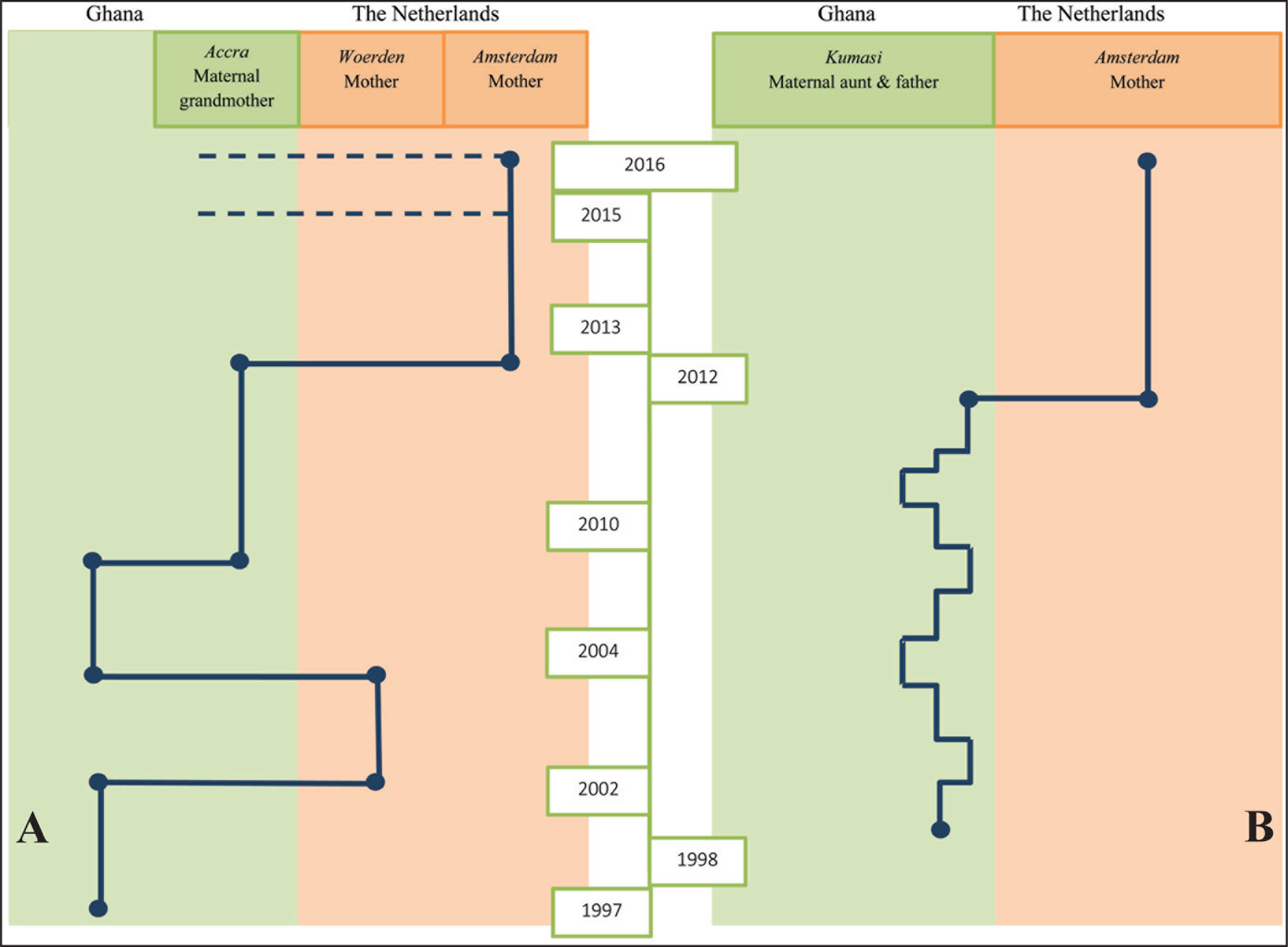
By following these two young men’s mobility trajectories, we investigate the meaning these moves have for them and how their mobility impacts the access and opportunities the young men have to mobilize resources for their educational resilience. We find three specific educational resilience-building mechanisms that are related to their mobility trajectories, elaborated upon below.
Relational Resilience and Connecting to Motivational Others
Harley’s and Ebenezer’s changing family constellations over time and space caused separation or reunification with family members, friends or teachers who are or were important for them. Although communication can be enhanced by modern technology, and literature shows how ‘family work’ can be conducted at a distance through ICT (Fresnoza-Flot, 2009; Madianou & Miller, 2011), network maintenance remains a challenging and relational process that benefits from regular face-to-face interactions (Haagsman & Mazzucato, 2014). The young Ghanaians in our study generally expressed difficulty in managing pressures and demands they received through phone calls from family members and friends in Ghana. Moreover, insertion in a new school system, building a life in a new society can take time and energy, leaving some young people to concentrate more on their new lives ‘here’ while putting their lives ‘there’ on hold. Ebenezer struggled with his network maintenance, as he explains:
I am not that good with contact. But that does not mean you are not in my mind! I can neglect calling you for 2 years, but you would not leave my mind. I will think about you a lot. This is how it is with my grandmother. [When I ask him to share his thoughts about his grandmother, he describes:] Oh, I really need to call her, but then it does not happen. I do not know why, I swear, but it never works out. But that does not mean she is not important to me, you see? (Personal communication, 20 March 2016)
Ebenezer’s inability to maintain satisfactory family ties should be understood as intertwined with increasing problems, feelings of abandonment and loneliness. Ebenezer’s desire to maintain bonds with people in Ghana was counterbalanced by feeling pressure from the people in Ghana to call them. Indeed, young people in our study often experienced contact as forceful and disciplinary. At times, this made them reluctant to actively engage in communication. Ebenezer repeatedly reported that he did not have a supportive network in The Netherlands, nor in Ghana. He felt he could only trust and rely on himself. Unsatisfactory contact with significant people in his network cut him off from a resource that in Harley’s case turned out to be a motivational one.
Harley also experienced pressure from Ghana but his trips to Ghana led to a different result. Harley described the ‘advice’ given by phone by his uncles and aunties in Ghana as putting pressure on him. Yet his holidays allowed him to experience time together with previous caregivers. After his holiday in Ghana, he expressed an understanding for what he now came to see as well-intentioned advice of family members:
I see it like you know, old people [referring to a paternal uncle] always say this kind of thing [do well in school]. They do not want their children to grow up being like something else, different. (Personal communication, 10 October 2015)
Lengthy personal interaction with family members gave Harley the opportunity to reaffirm relationships and understand that advice and disciplining are signs of a caring relationship. Previous caregivers set aside time to listen to complaints and concerns he had and offered some encouraging words. Harley and his sister, for example, explained the trouble they experienced with their mother and in school to their aunty and previous caregiver. Their aunty listened carefully while nodding supportively and calmly expressing her understanding with ‘yes’ and ‘of course’. Then, she offered concrete strategies to peacefully interact with their mother and added ‘you have to accept it; you have two homes now’ (fieldnotes, 17 June 2015). Their aunty went on to give direction on how to embrace the responsibilities but also opportunities created by their transnational life. Similar dynamics were witnessed during trips to Ghana made by other participants. Maame, 19 years old, independently undertook two self-financed trips to Ghana, primarily to rekindle the relationship with her previous caregivers, her aunt and maternal grandmother. Moreover, her aunt, being a headteacher, had always offered her the most motivation for her education. Maame longed for that again, as in The Netherlands she mostly had to motivate herself. ‘I feel motivated again’ was Maame’s firm answer when we asked her how she felt upon return from our joint holiday to Ghana (fieldnotes, 6 September 2016).
Physical presence in Ghana also allows for serendipitous encounters that can help to rekindle old ties and serve to motivate young people. Harley had a spontaneous encounter with his former teacher. During the unplanned visit, his teacher filled him with compliments interspersed with expressions of kind yet insisting expectations: upon completion of his education, Harley must return to Ghana. The country needs him, his former teacher claimed. Harley was not used to being addressed with such respect from a teacher and clearly brightened from this meeting. Upon returning to The Netherlands, Harley repeatedly referred to this spontaneous visit, with a broad smile on his face.
We observed many such serendipitous encounters in Ghana. They occur thanks to a rare combination of presence, timing and luck involving people that the young Ghanaians had not planned to visit. The accidental nature of these impromptu meetings is difficult to theorize (Gladkova & Mazzucato, 2017). However, they do occur, and while they do not all have to be positive, we noted many supportive encounters and their beneficial effects on young people. Explicit expressions of trust, pride and confidence in young people’s abilities from acquaintances increase their feeling of being supported. Two months after we returned from Ghana, Harley explained, ‘it is good that they [family members and acquaintances in Ghana] give me that advice, cuz, also I am trying to do my best in everything I do’ (personal communication, 24 October 2015). This example shows that encouraging experiences in Ghana can be drawn upon in The Netherlands to help young people persevere in their education. Especially for those on lower educational tracks, such positive encounters can be stimulating, given their contrasting experiences in The Netherlands. Without being physically present in Ghana, such chance encounters cannot happen.
Healthy, supportive relationships are essential for building resilience (Franceschelli et al., 2017; Masten, 2018). Several studies have shown that ‘caregiver–child’ relationships are important for resilience building in cultures where not only parents but also extended family members partake in caregiving and rearing children (Panter-Brick et al., 2014; Poeze et al., 2017). A similar logic seems relevant to the educational resilience of young Ghanaians who lived with various caregivers throughout their lives (van Geel & Mazzucato, 2018). We argue that mobility can help young people to maintain their transnational relationships that extend beyond the nuclear family. Through mobility, these transnational relationships serve as a resource for resilience building.
Active Recollection
Ebenezer and Harley’s mobility trajectories reveal that they lived with different people at various points in their lives. Especially after their first international move, young Ghanaians may begin living with a previously absent parent or relative who is unfamiliar with their childhood or family narratives in Ghana. Ebenezer explains that he can get severe headaches from thinking about his life. He has questions about himself, his life and his character that bother him to the extent that he cannot get to sleep. He explains:
You really want to sleep but you cannot because your mind is exploding. If someone could take a look into my head!! Everything is messed up there!… I do not really know how I became like this … I have forgotten how I was when I was a child. That is a bummer, maybe I have changed due to something. Why am I like this? Maybe not, maybe I have always been like this. (Personal communication, 20 March 2016)
Hakim struggles with similar questions. He also did not go back to Ghana after coming to The Netherlands. In Ghana, Hakim lived with his paternal grandmother. During one of the interviews, Hakim points to his body:
at the back of his head, he shows a big scar, one he showed during our first meeting as well. Then there is a big scar at the left side of his face, under his eye. Then, he pulls his arm pointing at a scar on his biceps.… Sometimes he looks at his body and wonders. While he is mumbling this, he rubs over his arms and shakes his head. ‘Sometimes I look at my belly, I have little scratches there. I do not know what it is’. Later, Hakim adds: ‘These kinds of things, I have to know them. I have to go to Ghana, to realise things, to search for answers. I have to figure them out’. (Personal communication, 5 February 2016)
Ebenezer thinks that his aunt, with whom he partly grew up, would be a good person to describe his childhood to him. She is still living in Ghana and contact with her occurs primarily for disciplinary issues. While Ebenezer could ask his previous caregivers about their childhood, young people generally expressed their inability to discuss sensitive topics through the phone or virtually. Ebenezer explains why:
I am not really good with WhatsApp, you know. I just wanna sit down and talk, like this [pointing his finger at me and back to himself]. Just face-to-face. Sit and talk, I do not like it through WhatsApp, through the phone with these things. But maybe she has forgotten too, how I was. (Personal communication, 20 March 2016)
Among our participants, we found that young people avoid such sensitive questions not only because of feelings of insecurity, awkwardness or shame. They know that these questions could potentially disturb family relationships by awakening sensitive themes and feel the responsibility not to do so. In this delicate domain, communication technologies, elsewhere proven to generate co-presence in transnational families (Baldassar et al., 2016), are not sufficient for young people. Given the desired face-to-face interaction, prolonged immobility can lead to regret, especially when primary caregivers and carriers of this knowledge pass away prior to young people being able to reconnect with them. This happened to Hakim and with five other young people in our sample.
Mobility can help young people to pose questions about their past. Alex, 21 years old, visited his maternal grandmother to ask her more about his family history. He explains: ‘It is important to know these things. When she dies, then there is no one left who can tell me these stories. I have asked her everything’ (personal communication, 28 July 2016). Other young people undertook trips to reach out for information about important chapters of Ghanaian histories, such as to Elmina Castle, a well-preserved slave trade settlement close to Cape Coast. Harley participated in a guided tour through Nkrumah Memorial, the Mausoleum built for Ghana’s first and famous president after independence, Kwame Nkrumah. He soaked in the information, intrigued by the impressive strength of Nkrumah’s post-independence ideological policies to free Ghana, and Africa, from its former colonial oppressors. Two months after he came back from Ghana, Harley listed Nkrumah as one of his role models, feeling inspired by his strength, boldness and commitment.
Recollections of the past are important resources that can be drawn upon for resilience because your past makes you who you are (Fernández-Kelly, 2008; Franceschelli et al., 2017). Retrospective narratives about family history, for example, build educational resilience in Black Caribbean young people in the UK (Franceschelli et al., 2017), a finding that resonates with a study conducted with young Mexicans in the USA (Fernández-Kelly, 2008). Narrations of community strength can also instil a sense of meaning, pride and endurance in young people because those stories create the feeling that young people can rely on a strength that is passed on for generations (Franceschelli et al., 2017). Relative immobility after migrating can block access to knowledge and recollections of suffering, overcoming and stamina.
Comparative Confrontation
Mobility may also facilitate comparison and meaning-making. In casual chatting with former classmates or by simply walking down the streets in Ghana, young people are confronted with a set of unpleasant conditions. Daniella explains:
Here in Ghana, things are very difficult.… Sometimes when I am in the car and I see someone passing by to sell food I try to imagine how his life is: probably [he is] not able to choose what time he wants to eat. I know that he is probably living in this overly dense neighbourhood, in a very crowded house. And there is food only what there is and if you are too late there is nothing left and you go to bed with an empty stomach. You know? Because … there is no more food. (Personal communication, 16 July 2015)
Being confronted with such realities refreshes young people’s memory of what was once theirs or could have been theirs. Both when recounting their holidays and in our observations when we accompanied them, young people alternated between persistent complaining about everyday inconveniences—such as dumsor, the recurring power cuts, no running and hot water, the lack of a well-functioning Internet, open sewages and pollution in the city—with voicing admiration for how Ghanaians make a living despite all of these difficulties. Many admitted that they had forgotten these hardships.
Almost two months after his summer holiday in Ghana, Harley reflected on the educational and occupational position of his cousins in Ghana and concluded that, despite the long educational path that is before him, he was slightly better off in The Netherlands where youth unemployment is lower and social welfare guarantees a minimum income. His cousins, who were still waiting to determine the actual value of their university diplomas in Ghana, were not guaranteed these social securities. Poverty, a lack of opportunities, the fierce desire of many Ghanaians to ‘make it abroad’ despite their inability to achieve this dream, and the experience of what a hustle daily life can be in Ghana: all of this makes young people realise the opportunities they have through migration.
When young Ghanaians are at a critical juncture or at the bottom of the Dutch educational system, as Harley and Ebenezer, they can derive strength from comparative confrontation. Meaning-making in life is important for resilience as it creates hope and purpose which makes perseverance worthwhile (Masten, 2018; Panter-Brick & Eggerman, 2012). Comparative confrontation broadens young people’s horizon beyond the Dutch setting because their skills acquired abroad are expressly welcomed in Ghana, as shown by Harley’s experience with his former teacher, recounted above. Ghana creates a field of future opportunities when young people realise the potentially valuable contribution they can make to the country’s development. This turns their struggles in the Dutch educational system into a purposeful experience—not only for themselves but for a wider community.
Ebenezer expressed multiple times that he would not know what to do in Ghana. It was difficult for him to imagine what he could contribute there. The sensorial impact that physical presence can generate is important here. For Harley, it was easier to imagine possibly meaningful futures in Ghana after his teacher had outlined to him how his skills could be of use there. The comparative abilities of young Ghanaians who never visit Ghana after migrating remain limited to the Dutch context, especially when they are in a low socio-economic position or experience limitations in their possibilities to flourish. Selective memory, to which all humans are subject (Schaefer & Philippot, 2005), filters out some aspects over others and confines immobile young people’s abilities to compare and thus reframe their experiences in The Netherlands. Again, our analysis illustrates the significant resilience-building potential of actual physical mobility.
Conclusion
We identified three educational resilience-building mechanisms that can be activated through mobility. First, transnational relationships can be maintained or rekindled and opportunities for serendipitous encounters are created. Second, experiences in Ghana can serve to elicit active recollection, while immobility reduces young people’s ability to form such recollections. These two mechanisms have been previously identified in general resilience literature but here we showed how they work in a transnational context and in relation to educational resilience specifically. Comparative confrontation, the third mechanism, emerged from our data. This mechanism helps give meaning and purpose to young people’s attempts to strive educationally and is enabled by confrontation with the specific developmental context of Ghana. While home visits may not always and only result in positive effects on young people’s educational resilience, we have identified these mechanisms as the most commonly experienced in our sample of young Ghanaians and they constitute an important differentiating factor between young people who showed variety in their educational resilience. Thus, by broadening the investigation to a transnational context, analyses of young people’s educational resilience can include the potentially important role of significant others who do not reside in the same nation-state as the young people and the experiences that transpire during mobility.
We showed that mobility is not necessarily negatively related to migrant youth’s educational progress, as is often assumed by educational institutions in migrant-receiving countries (van Geel, 2019). Migration and education literature generally categorizes young people according to their or their parents’ international move, by studying first- or second-generation migrant youth, but it does not focus on their actual mobility. We argue that educational outcomes, and in this case educational resilience, are affected by such mobility and therefore should be included in analyses of migration and education. Furthermore, analyses usually focus on between-group differences by comparing young people from different countries or with ‘native’ young people. We instead analysed one group, young people of Ghanaian background, thereby focusing on within-group differences to investigate deeply the mechanisms that help young people develop educational resilience, despite their similar socio-economic and community backgrounds. Thus, by focusing on patterns and experiences of mobility, we moved beyond the ethnic lens that dominates in migration studies and which can hide many relevant factors other than just where one comes from (Dahinden, 2016; van Geel & Mazzucato, 2018).
It was not possible for us to investigate whether the mobility experiences of young males differed from those of young females given the small nature of our sample. It may be that the mechanisms we identified work differently due to the gendered nature of activities or expectations in home countries. Also, negative or disappointing reunifications with previous caregivers or significant others may happen. We did not encounter such experiences but we cannot exclude such a possibility. Investigating both aspects are fruitful avenues for future research.
We analysed educational resilience through a socio-ecological framework by highlighting the contextual nature of resilience. Such context is not only confined to the nation-state where young people reside but is situated across the places they have lived in throughout their lives, and the caregivers they have had along the way. This enabled us to understand educational outcomes beyond the local context in which young people live. In so doing we have expanded the socio-ecological model of resilience to include the transnational context to make the model more suitable for research with youth who have mobility in their life histories.
At the same time, it is important to acknowledge that such transnational mobility is of specific value to the youth of migrant background because of structural constraints such as discrimination and societal path-dependencies they face in many countries where they reside. This has two implications. It is important for schools to find ways to positively engage with the mobility of migrant youth in order to facilitate the potential positive effects of mobility on educational resilience. At the same time, policymakers need to continue to pay unrelenting attention to the structural constraints experienced by migrant youth in their countries of residence.
Footnotes
The authors declared no potential conflicts of interest with respect to the research, authorship and/or publication of this article.
Funding
The authors disclosed receipt of the following financial support for the research, authorship and/or publication of this article: This research is part of the MO-TRAYL project, led by the second author, and has received funding from ERC Consolidator Grant 682982.