



Abstract
This paper presents a method to identify the dynamic mechanical properties of soft not self-supporting viscoelastic materials at high frequencies using sandwich beams. The motivation of this alternative method comes from the fact that the method of Ross, Kerwin and Ungar (RKU), proposed by the standard ASTM E 756-05, adds structural rigidity to the sandwich as shear increases, for example at high frequencies, and consequently, the stiffness of the core material is underestimated. The proposed method is based on a homogenization technique for sandwich beams that takes into account quadratic shear stress in the formulation, instead of a constant shear as the RKU method. To prove its worth, the properties of a soft polymer are identified by both methods from experimental transmissibility measures carried out on a sandwich beam up to 2500 Hz. Then, finite element simulations are performed using the obtained material properties to compare the numerical transmissibility functions with the experimental one. A numerical comparison for the case of a sandwich beam with a thicker viscoelastic core is also completed, proving the improvement in the stiffness and damping properties identification in the high frequency range by considering quadratic shear in the formulation. As a result, the identified mechanical properties by the proposed method are more accurate at high frequencies and for thicker core beams, i.e., when the shear effect is significant.
Keywords
Introduction
The reduction of structural vibration and noise is a significant problem in engineering applications. Damping as a dissipation into heat of part of the mechanical energy associated to vibration. Indeed, studies in several industrial sectors aim at enlarging the life of the components, to increase the comfort of the user, and/or to enhance safety, by means of these vibrations damping.1–4
There are both active and passive damping techniques 5 and, among the latter, surface treatments by means of viscoelastic materials are especially interesting, due to their relative simplicity to be physically implemented and to their low cost. 6 Under dynamic loads, these viscoelastic materials show a higher capacity to dissipate the vibration energy than, for instance, isotropic elastic materials such as metals. The viscoelastic behaviour of these materials reflects on a complex modulus that depends on both frequency, temperature and strain.7,8
In order to characterise and empirically determine the dynamic properties of polymeric materials, and specifically their complex modulus, several methods can be used. Mainly, some are preferred to others in terms of the range of frequencies under study. In this context, Ward and Hadley propose the following classification
9
: 1 Quasi-static phenomena under 1 Hz: creep and relaxation tests. 2 Low frequencies up to 10 Hz: free vibration tests. 3 Medium frequencies up to 100 Hz: forced vibrations tests without resonance. 4 High frequencies between 0.1 and 10 kHz: forced vibrations tests with resonance. 5 Frequencies beyond 10 kHz: wave propagation methods.
The techniques used in these tests vary: rheological methods, 10 dynamic mechanical thermal analysis (DMTA), 11 or the standard test method E 756-05 12 of the American Society for Testing and Materials (ASTM). This method stands out compared to the others when being applied to frequencies up to 5000 Hz, and it has been extensively used to estimate the dynamic properties of a wide range of materials. For example, Allahverdizadeh et al. 13 characterises the properties of a sandwich beam with an electrorheological fluid layer, Avil et al. 14 investigated the contribution of carbon nanotubes to vibration damping of composite beams, Selvaraj and Ramamoorthy 15 analysed the dynamics of laminated composite sandwich beams containing carbon nanotubes reinforced magnetorheological elastomer, and Han and Yu 16 studied the effect of interfacial properties on the damping performance of steel–polymer sandwich cantilever beam composites.
This standard test, in the case of soft non-self-supporting polymers, aims to characterise the material by means of constrained layer damping (CLD) specimens. 17 In this kind of configuration two metallic layers form, along with a viscoelastic core, a sandwich-type structure. As for the theoretical studies in the field of sandwich structures, Mead and Markus 18 obtained a sixth-order differential equation of motion in terms of a three-layer sandwich beam with a viscoelastic core. These authors also presented 19 the differential equation for damped normal modes of a three-layer embedded sandwich beam with the aim of getting the resonant frequency and loss factor of these sandwich structures. Yan and Dowell 20 developed a linear equation that explains the vibrations of sandwich finite plates or beams. Rao and Nakra 21 analysed theoretically the flexural vibration of unsymmetrical sandwich beams and plates with viscoelastic cores, by means of complex elastic parameters. Lu et al.22–24 studied, with both theoretical and experimental results, damped composite rings, beams and plates built from a thin viscoelastic layer located between two elastic layers. Rao and He 25 studied the dynamic behaviour of a multi-damping layer composite beam with anisotropic laminated constraining layer. Treviso et al. 26 gathered the available literature on damping in composite materials, including sandwich structures. Also, Feng et al. 27 made a review that outlined recent research efforts on creative design for sandwich structures with different core constructions. More recently, Hu et al. 28 analysed several theories regarding the kinematics and modelling of sandwich structures. Ferreira et al. 29 took into account a possible progressive damage for composite laminates using a higher-order finite element method.
Nevertheless, damping of symmetric CLD beams with metallic skins and thin viscoelastic core is governed by the shear stress of the core, and its properties can be obtained by means of the well-known RKU model.30–32 This is a homogenisation method where a model is built to study the properties of the sandwich by means of an equivalent complex flexural stiffness as if it were a homogeneous beam. In addition to the characterization of materials, this model has been widely used over time up to the present day for the structural dynamic analysis of sandwich structures with viscoelastic core, due to its relative simplicity to implement. For example, Pelayo and López-Anelle 33 take the RKU model as reference to compare experimental and numerical results of multi-layered laminated glass beams. Also, Sessner et al. 34 use the RKU model to analyse the modal damping behaviour of carbon-fibre-reinforced polymer (CFRP), elastomer and metal laminates. Other authors have developed more sophisticated models to analyse particular behaviours of CLD sandwich structures and use the RKU model to evaluate the performance of the developed models. For example, Xie et al. 35 developed a finite element that takes into account damping originated by extension and compression deformations of the core, and Auquier et al. 36 developed a dynamic equivalent mode to analyse imperfect interfaces. However, it was proved that the RKU method tends to rigidize the sandwich, 37 that is, it models the structure stiffer than the actual one, specially at high frequencies or for thick beams. As a consequence, the value for storage modulus obtained with the ASTM E 756-05 standard is lower than the real one, and errors can be made specially at the highest frequencies, and/or if the identified properties are used in thick beams or plates.
To avoid the excess of stiffness of the RKU method, Cortés and Sarría
37
developed a new homogenisation method, also very simple to implement, that gives better results than RKU. This accuracy improvement is mainly obtained for thick viscoelastic cores or for those cases in which the shear stress is more significant, such as for high frequency excitations. Therefore, in this paper this method is adapted to be used as a material properties identification method that complements the standard ASTM E 756-05 to improve the damping properties identification at high frequencies and for thick viscoelastic sandwich cores. The paper is structured as follows: • In the Introduction section the motivation of the research is presented, based on an extensive review of the literature concerning sandwich structures. • Next, the formulation of the alternative method derived from the homogenisation model for beams is presented.
37
• The Experimental procedure section describes how the experimental transmissibility function is obtained. A brief description of the application of the ASTM E 756-05 standard to obtain the frequency dependent shear complex modulus based on the RKU method is also presented. • To validate the proposed method, the following section presents the comparison between the results provided by the RKU method and the alternative one. Besides, a 2D finite element model is developed and the numerical transmissibility functions obtained from the identified material properties are compared with the experimental transmissibility one. Finally, a comparison for the material properties identified by both methods is carried out between the respective numerical transmissibility functions of a beam with a thicker viscoelastic layer. • Finally, the most remarkable aspects are highlighted in the Conclusions section.
Presentation of the alternative method
The ASTM E756-05 standard
12
proposes a method to obtain the damping properties of viscoelastic materials, namely the frequency dependent complex modulus
Specifically, to obtain the shear complex modulus Geometry of the sandwich specimen.
Once
The idea of the alternative method is to make use of the homogenisation method of 37 but the other way round, i.e., from experimental data to material properties. This homogenisation method is summarised in the Annexe of this paper. It is presented for a general case of a three-layer beam, and in this work the specific application of a symmetric sandwich with metallic skins and viscoelastic core is adopted.
Once


This is a homogenised experimental stiffness that takes into account the real mechanical behaviour of the specimen, including bending and shear effects. In contrast, the equivalent theoretical flexural stiffness

The relationship between the theoretical and the experimental stiffness results







For the particular case of a thin viscoelastic layer, equation (9) could be simplified as follows,



The equations for these two mechanical properties have been obtained by the proposed alternative method, which considers that the shear effects are more significant at high frequencies and/or in thick beams.
Experimental procedure
This section describes the experimental procedure: the sandwich specimen properties, the experimental equipment and the measurement chain, the measured transmissibility function, the procedure to obtain the modal parameters
Description of the sandwich specimen
The material for the specimens was supplied by the company Replasa Advanced Materials S.A.
41
The raw material was a sandwich plate coming from a coil manufactured in a production line of coil coating, as shown and explained in Figure 2. Schematic representation of the industrial line to manufacture coils of the sandwich material: (a) The coils of the two metallic sheets are positioned at the beginning of both metal strip lines and then are decoiled at a constant speed in (a). When a coil is finished, the feeding section stops and is joint to the next coil by the stitchers (b). The accumulators (c) and (i) allows the line to run continuously when a section of the line is stopped. The pre-treatment stations (d) prepare the surfaces of the metallic strips to ensure optimal adhesion of the adhesive. This is achieved by removing rust, oils, impurities, and other contaminants. The adhesive is applied in (e) and pre-dried and pre-cured in the oven (f). The metal strips are adhered in (g) and the sandwich strip is conformed. The final curation under pressure and cooling are given in (h). The sandwich strip is finally coiled in (k), and the shears (j) cuts the strip when the coil of the manufactured sandwich has the defined dimensions.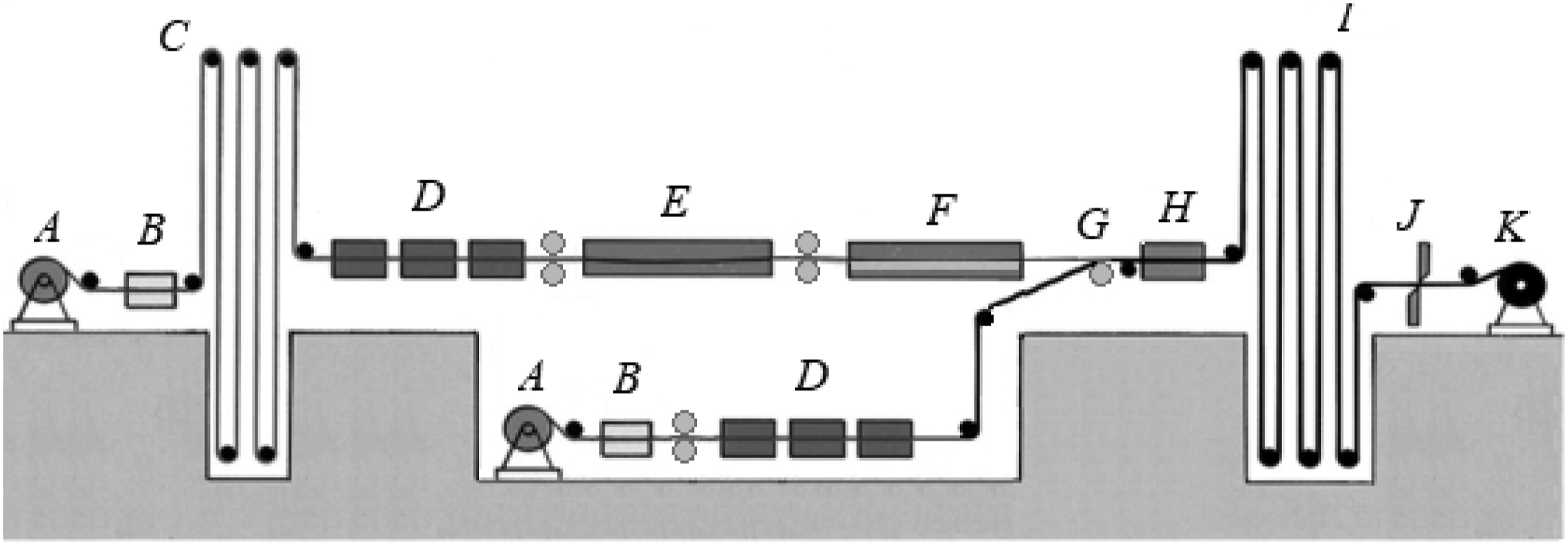
The sandwich beam was built by wire-cut electrical discharge machining (EDM), resulting as two rectangular skins glued by the adhesive, or viscoelastic material (see Figure 1), whose properties are to be determined. Specifically, the skins were made of galvanised steel DX51 Z275. Its elastic modulus and density where measured, giving
Geometry of the sandwich specimen.

Experimental results
The experimental equipment and the measurement chain to obtain the transmissibility function of a point located at 5 mm of the free end of the specimen are illustrated in Figure 3. The specimen was fixed to an electrodynamic shaker that induced a base motion, and the velocity of the measuring point was acquired by means of a laser vibrometer. Experimental set-up: (a) scheme of the measurement chain; (b) a global view of the laser vibrometer and the electrodynamic shaker installed on a rigid bed isolated by pneumatical supports; (c) a view in detail of the sandwich specimen fixed at the shaker, of the accelerometer on the base and of the laser beam incident on the reference point of the specimen.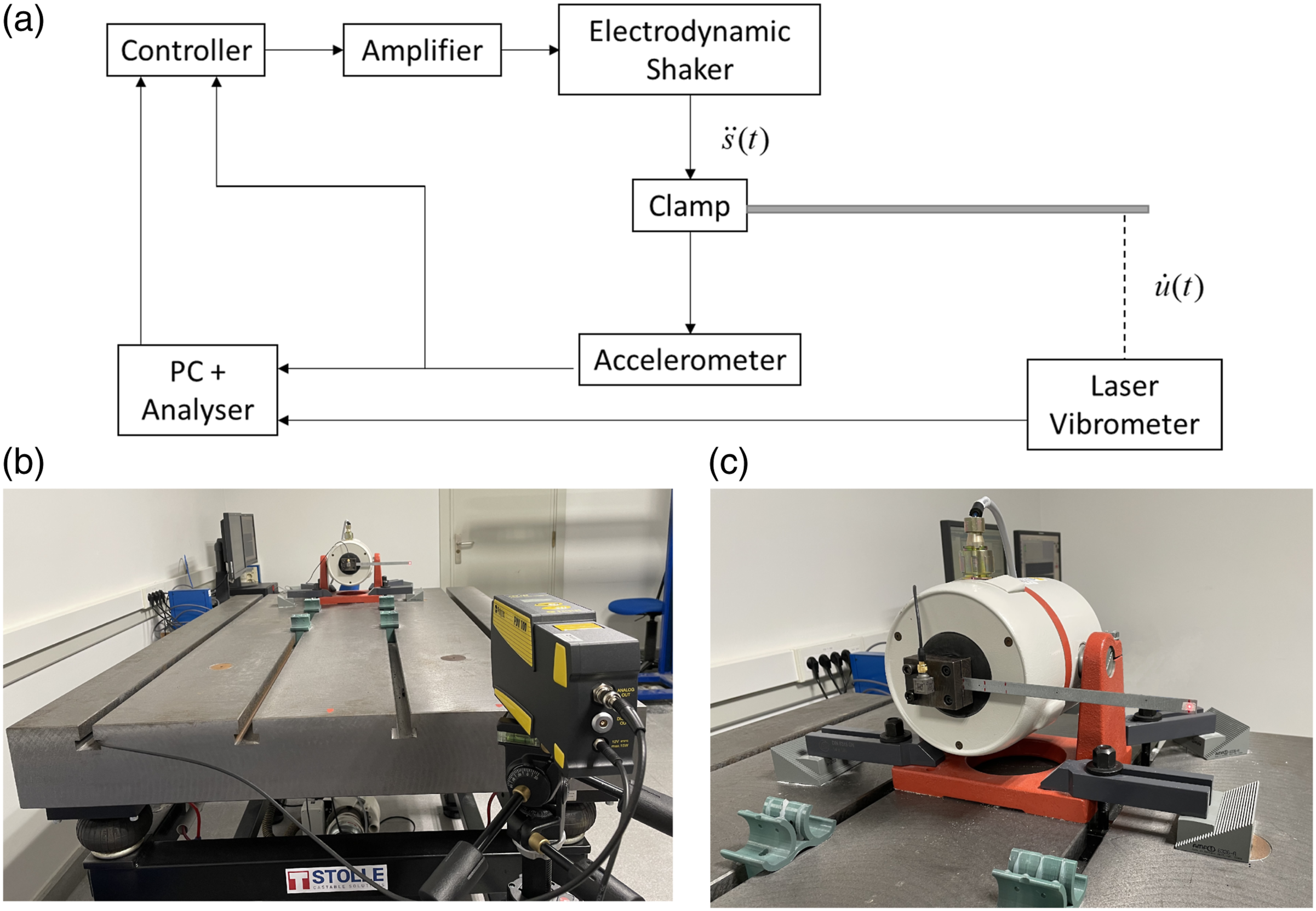
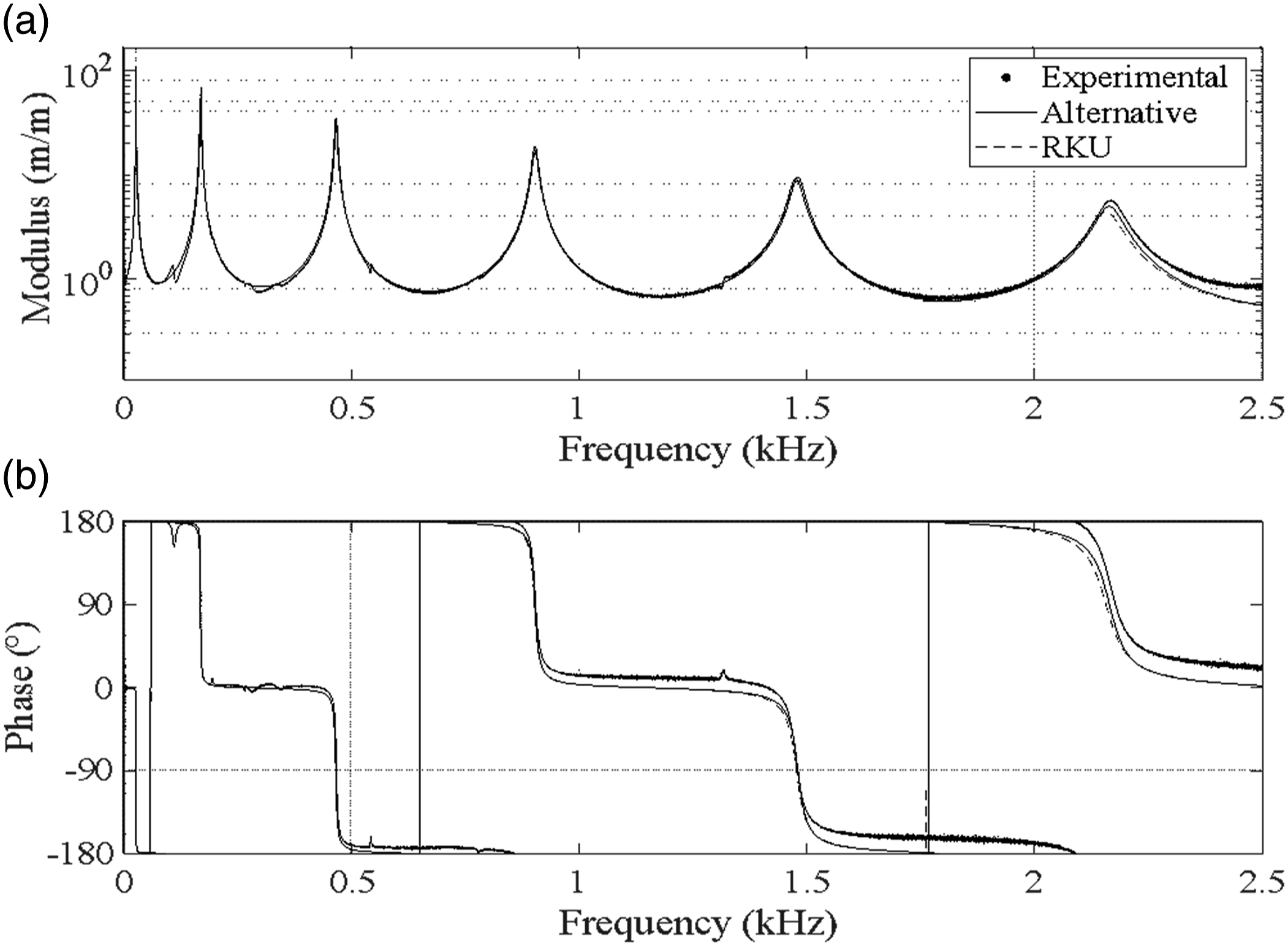
The experimental testing was performed at room temperature in a frequency range of 0 to 2.5 kHz with a resolution of 0.039 Hz. The acceleration of the base Experimental transmissibility curve of the viscoelastic sandwich beam: (a) modulus, (b) phase.
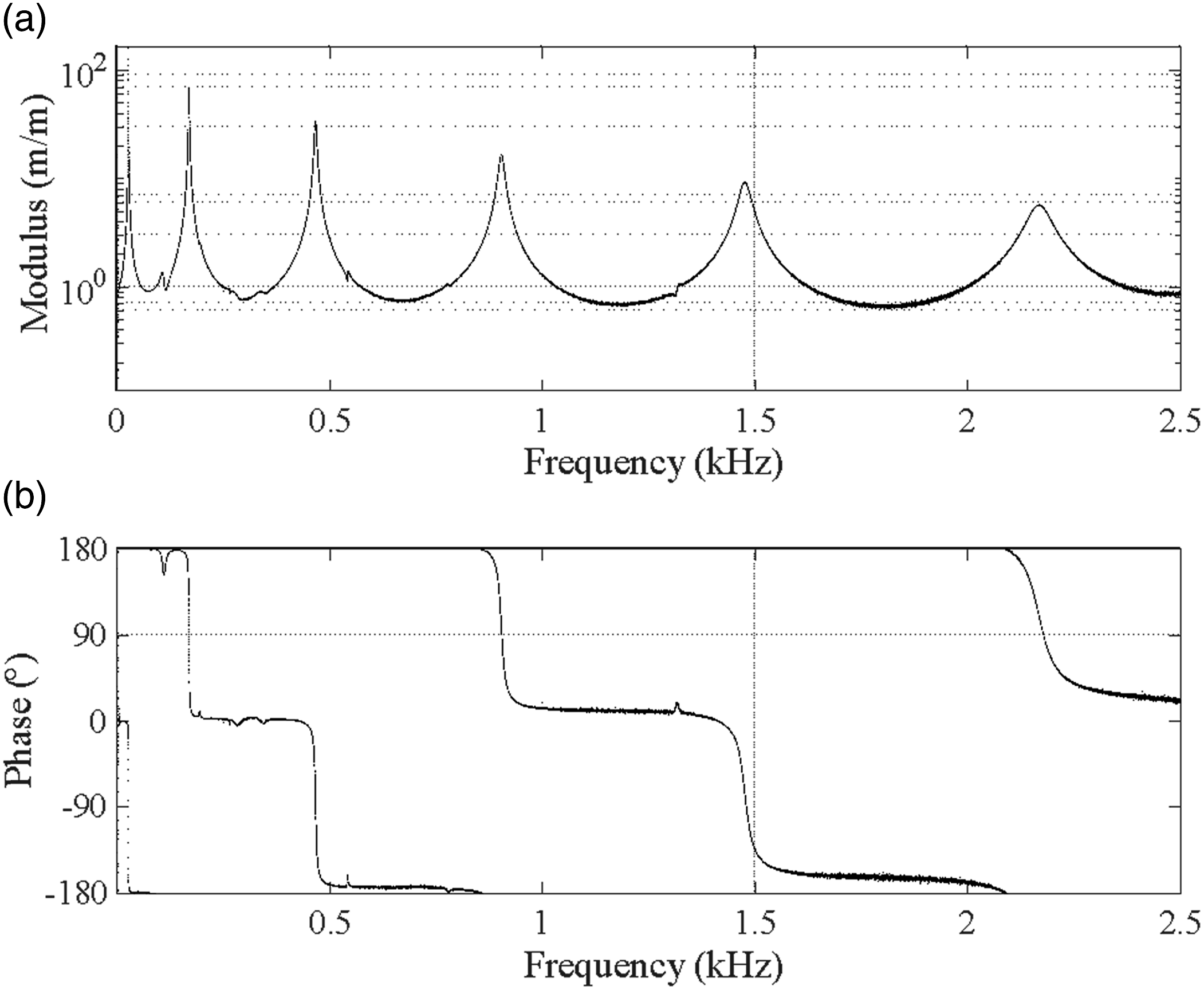
From this curve, the modal parameters
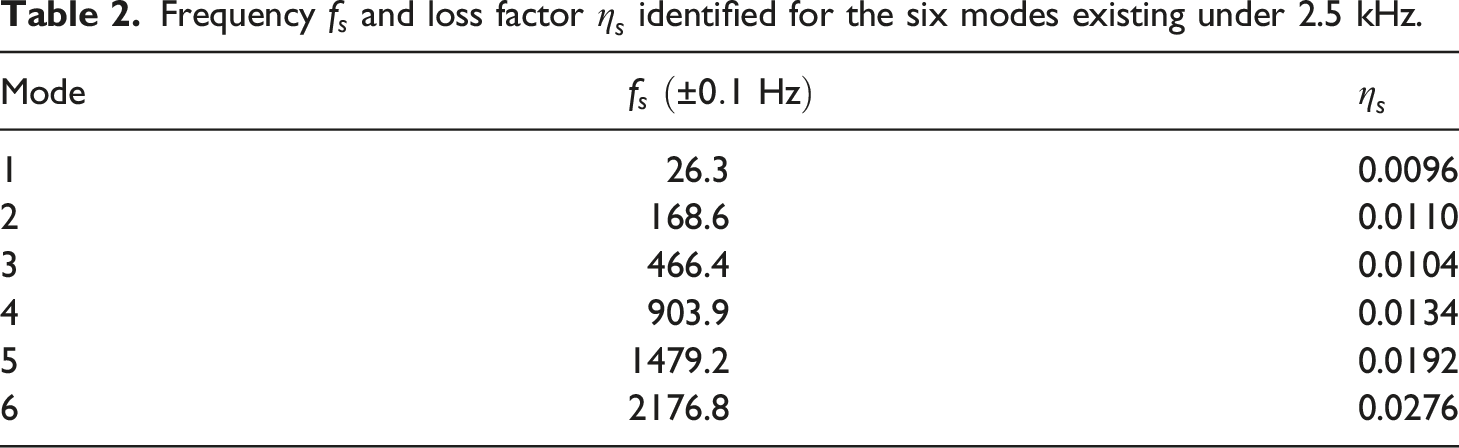
Identification of the modal parameters


Frequency
Equations to obtain the complex modulus by the RKU method
Once 



Comparison between the RKU and alternative methods
In this section a comparison between the results obtained by the RKU and the alternative methods are presented. The comparison is carried out in three ways. First, the results of the complex shear modulus are obtained and compared. Then, the transmissibility functions obtained by a 2D finite element model making use of the properties obtained by both methods are compared with the experimental transmissibility curve. And finally, in order to show that the stiffening introduced by RKU is greater with high core thicknesses and at high frequencies, the transmissibility functions of a finite element model of a beam with 2 mm of viscoelastic core are obtained and compared with the material properties identified by the RKU and the alternative methods.
Obtention of the shear storage modulus and loss factor
Shear storage modulus
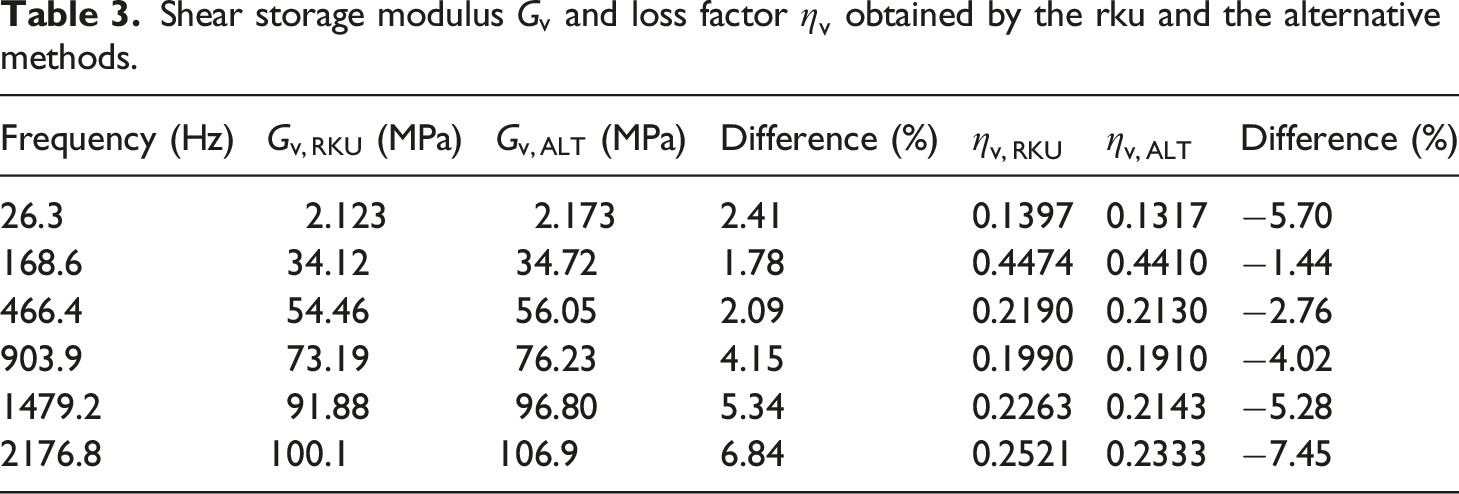
In general, it can be concluded that for both methods, the shear storage modulus of the viscoelastic material of the sandwich beam core shows an increasing trend. It is worth mentioning that the results of the first resonance may have less accuracy because the transmissibility curve represented in Figure 4 shows that the first resonance peak is built by few data, since it is very steep and its width is small compared to the other resonance peaks.
The differences between the two analysed methods are patent: the alternative method provides results that are higher than the RKU one, the biggest difference being 6.84% at the highest frequency. This is because as previously mentioned, the RKU homogenisation method adds stiffness to the mechanical behaviour of the beam, and consequently, to counter, the stiffness of the material is reduced. This effect increases with frequency, so if a test had been carried out up to a higher frequency (the standard procedure establishes that it can be applied up to 5 kHz), greater differences would have been found between both methods. Regarding the shear loss factor of the viscoelastic material, the alternative method gives a lower value. This is because the loss factor is defined as the ratio between the loss modulus and the storage modulus, i.e. the imaginary and the real parts of the complex modulus. As previously mentioned, the excess of the rigidity coming from the RKU method implies a reduction of the storage modulus of the material, and then, the ratio between the loss modulus and the storage modulus is higher for the RKU model. Ignoring the first frequency, the difference is also increasing, reaching up to 7.45% at the highest frequency.
Concluding, it has been put into evidence that there are remarkable differences between the results given by the RKU and the alternative methods when the dynamic test is carried out at high frequencies. This is because the higher the frequency, the more important the shear effects are, and the alternative method better reflects the shear effects. The next subsection shows a comparison between the experimental transmissibility and the simulated ones by means of a finite element model making use of the material properties shown in Table 3. This is to show that the dynamic properties of the core estimated with the new proposed method are more accurate, since they take into account shear whose effect is more evident at high frequencies.
Comparison between simulated and experimental transmissibility functions
A simulation of the response to a base motion of the specimen has been performed by means of a 2D finite element model. The discretisation of the specimen has been carried out by quadrilateral finite elements formulated under plane-stress assumption.
43
The finite elements have 2 degrees of freedom per node (the two in-plane displacements), and the interpolation functions are bi-linear. The mass
The geometry and the properties of the model are in the Description of the sandwich specimen subsection and in Tables 1 and 3. Besides, for the 2D finite element model, the Poisson’s ratios were taken Comparison between the experimental transmissibility function and the simulated one by means of a 2D finite element model with the properties obtained by the alternative and RKU methods for the sandwich viscoelastic beam: (a) modulus, (b) phase.
Resonance frequencies and peak amplitudes given by the experimental curve and differences of the results given by the 2D models.
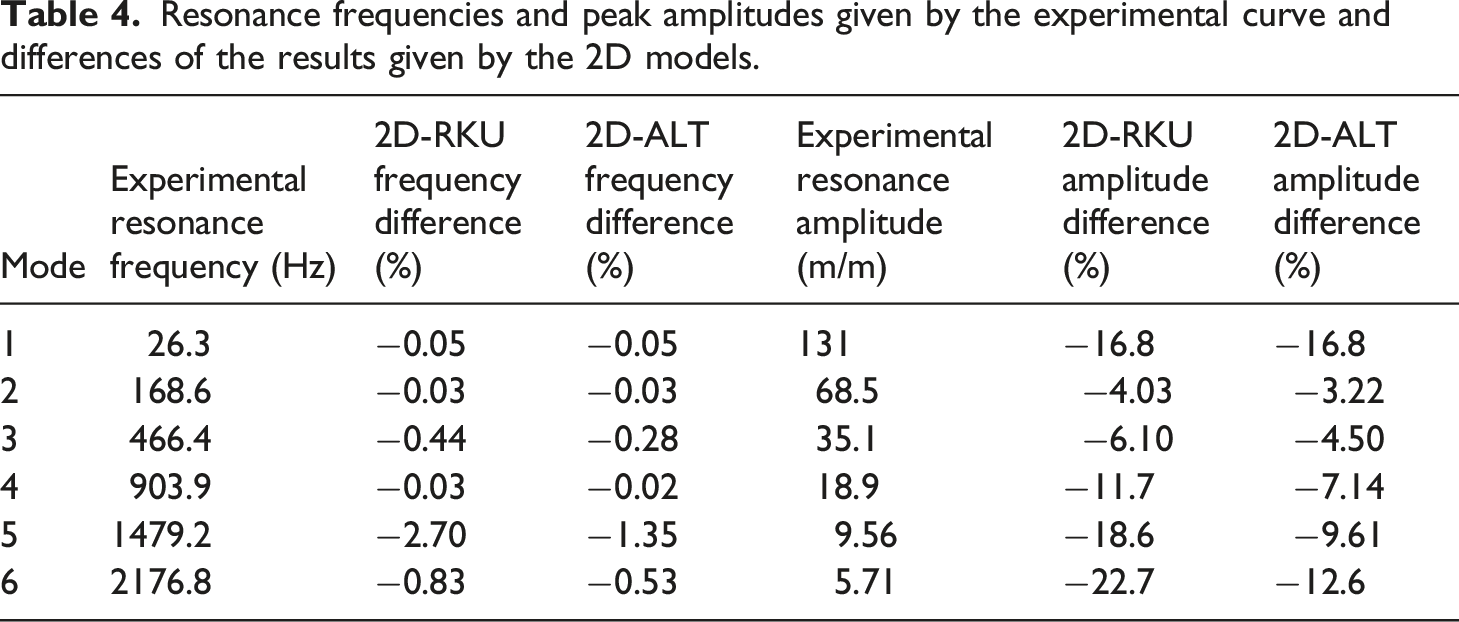
From these results it can be pointed out that the peak amplitudes of the 2D models are lower than the ones of the experimental curve. Ignoring the first mode, the differences increase with frequency. Specifically, the 2D model with the alternative method properties gives a maximum peak amplitude 12.6% lower than the experimental curve, and the difference of the model with the RKU properties is practically doubled with respect the experimental result, a 22.7%. These differences are because both homogenisation methods rigidise the structural system, and then the mechanical properties obtained in the previous subsection have been sub-estimated. The new proposed method gives better results because the added structural rigidity is lower. However, the differences from the experimental results could be reduced if the inertial forces of the transverse area were also considered in the homogenisation method.
Concerning the resonance frequencies, it can be highlighted that they are essentially the same between the experimental curve and the one of the 2D model with the properties of the alternative method, and that the one of the RKU properties is slightly lower. These differences between the curves are not significant because the thickness of the viscoelastic layer is very small, almost 15 times smaller than that of the metallic layers. For this reason, in order to highlight the importance of the value of the material properties, in the next subsection a simulation with a greater thickness of the viscoelastic layer is carried out.
Comparison between simulated transmissibility functions for a thicker core
In this section a simulation of the response to a base motion of a sandwich beam with a viscoelastic core of 2 mm is performed. In this case, the viscoelastic layer is discretised with four finite elements along the thickness. All the geometric, physical and mechanical properties are the same as the models of the previous subsection. The transmissibility functions obtained with the two material models, the one of the alternative method and the one of the RKU method, are compared in Figure 6. Comparison between the simulated transmissibility functions of a sandwich beam with 2 mm of viscoelastic layer thickness: (a) modulus and (b) phase.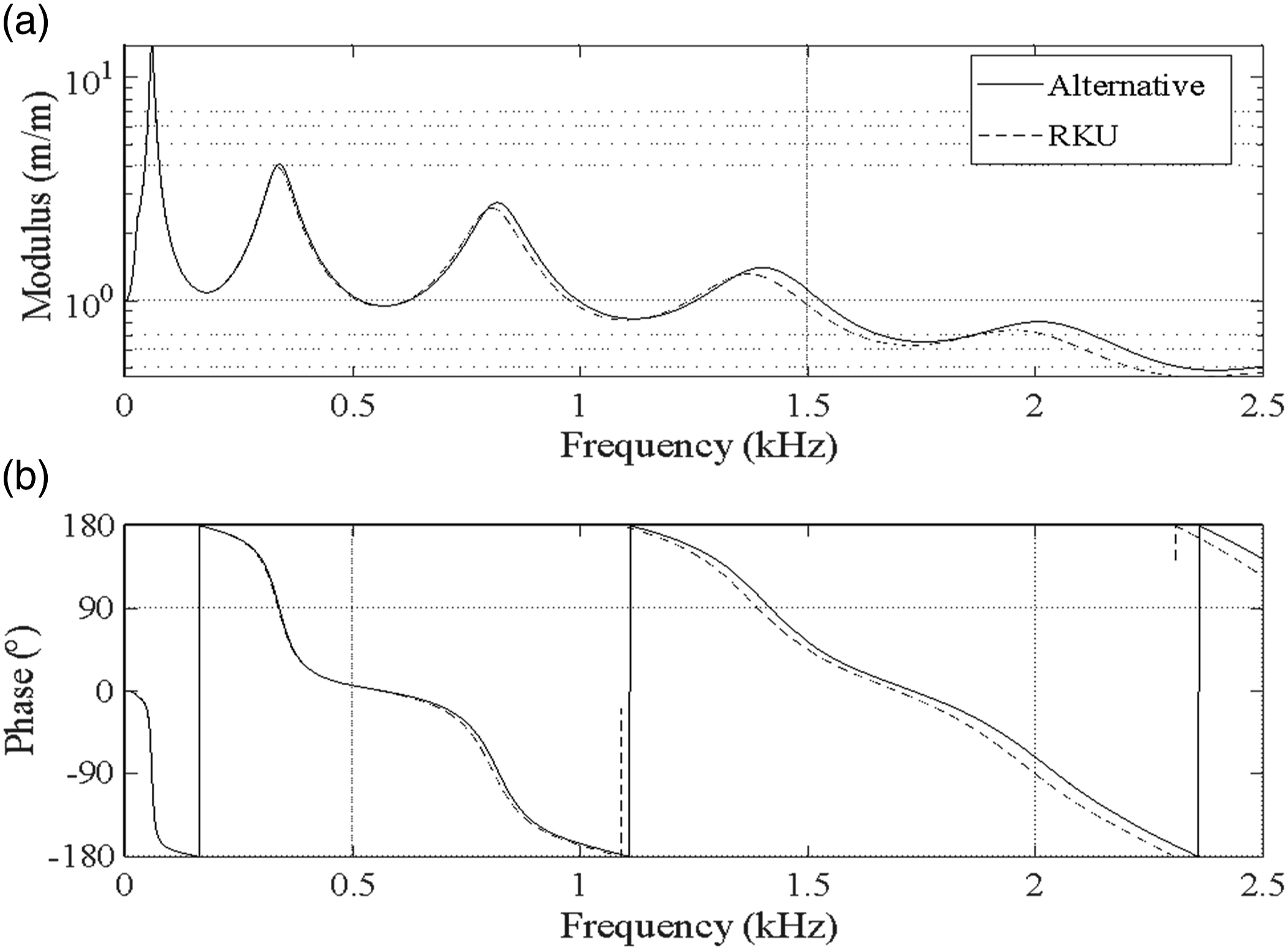
In this figure, it can be underlined that both curves show only five resonance peaks, because the natural frequencies of the beam have been increased and the sixth resonance peak is outside of the analysed bandwidth. By analysing the differences between both curves, it can be seen that they are more remarkable as the frequency increases. For the fifth peak, the resonance frequency for the model with the alternative method properties is 2058 Hz, and for the case of the RKU method properties, it is 1953 Hz, a 5.1% smaller. These differences should be more notable if a wider bandwidth is used or if the beam thickness is bigger. This is because the shear effect is more significant at high frequencies and/or in thick beams, and the proposed method in this paper takes into account the shear stress more accurately than the RKU method.
Concluding, as has been demonstrated throughout this investigation, the proposed alternative method provides more precise mechanical properties of viscoelastic materials than the RKU method proposed by the ASTM standard.
Conclusions
This research has presented a method to identify the dynamic mechanical properties of soft viscoelastic materials at high frequencies as an alternative to the RKU method used in the standard ASTM E 756-05.
The proposed method is based on a homogenisation technique of sandwich beams, but without the underestimation of the structural rigidity that the RKU method introduces, and it considers quadratic shear in the formulation improving the accuracy for high frequency scenarios and for thick viscoelastic materials. Also, the proposed identification method improves the RKU at lower frequencies as the thickness increases.
Consequently, the stiffness and damping properties of the viscoelastic material are more accurately identified with the proposed alternative method, having a significant impact on the dynamic response prediction capacity of viscoelastic layered structures.
The proposed method improves and extends to high frequencies the design of vibration attenuation devices with soft polymeric materials, for example in areas as human transportation systems in which the authors investigate, by improving the identification of stiffness and damping properties for viscoelastic materials.
Footnotes
Acknowledgements
The authors thank Replasa Advanced Materials S.A. for the sandwich material supply.
Declaration of conflicting interests
The author(s) declared no potential conflicts of interest with respect to the research, authorship, and/or publication of this article.
Funding
The author(s) disclosed receipt of the following financial support for the research, authorship, and/or publication of this article: This study received financial support from the Basque Government through the Research Group program IT1507–22, from the CONVICA (KK-2022/00050) and PREVICOM (KK-2022/00029) projects.
