



Abstract
Objectives
Feline intervertebral disc disease (IVDD), historically an uncommonly described problem, is being increasingly documented in the current literature. The objective of this systematic review was to consolidate existing knowledge of feline IVDD, identify possible prognostic factors and assist by offering clearer guidelines when managing a feline spinal patient.
Methods
A systematic search of two databases was conducted using keywords related to feline IVDD. Studies with cats diagnosed with IVDD, including treatment and outcome details, were reviewed. Prognostic factors were evaluated for their impact on overall outcomes.
Results
A total of 57 studies with 1113 cats were identified after the reviewing process and 23 studies with 93 cats remained for statistical analysis. Most cats (59%) had lumbar spine involvement, followed by thoracolumbar (31%) and cervical (5%) segments. Intervertebral disc extrusion was the most common diagnosis (65/93), followed by intervertebral disc protrusion (16/93) and acute non-compressive nucleus pulposus extrusion (12/93). Deep pain perception was preserved in 87% of cats. Surgical intervention was performed in 75/93 cats while 17/93 were treated conservatively, with 1/93 being euthanased intraoperatively. Overall, 85% of cats had a positive outcome, 11% had a negative outcome and outcomes were undetermined in 4% of cases. Possible influencing factors analysed included breed, sex, age (in years and life stage), weight, affected spinal segment, number of affected discs, micturition status, treatment choice, deep pain perception and IVDD type. No statistically significant prognostic factors (P >0.05) were identified.
Conclusions and relevance
Although no specific prognostic factors could be identified, the systematic review suggests that feline IVDD has a predominantly positive prognosis regardless of treatment choice. Given the low evidence level and small sample size, further multicentre, prospective studies with larger cohorts are required to establish reliable prognostic factors for feline IVDD.
Introduction
Intervertebral disc disease (IVDD) is considered an uncommon problem in cats, 1 unlike in dogs, where IVDD accounts for the most frequently diagnosed neurosurgical disease of the thoracolumbar spine. 2 Feline thoracolumbar IVDD has received increasing attention in the literature in recent years.1,3–10 A recent classification of canine IVDD showed that most types of IVDD may also be applicable to cats.10–13
Fenn and Olby 11 classified IVDD into intervertebral disc herniations (IVDHs) and embolisms. Herniations are further divided into intervertebral disc extrusions (IVDEs) or Hansen type I with an acute onset of neurological signs, intervertebral disc protrusions (IVDPs) or Hansen type II with typically more chronic deterioration of neurological signs. Furthermore, traumatic IVDEs with intramedullary injuries include acute non-compressive nucleus pulposus extrusion (ANNPE) and hydrated nucleus pulposus extrusion. Lastly, fibrocartilaginous embolism (FCEM) accounts for the embolic type of spinal disorders.
The prognosis for canine IVDD, whether managed conservatively or surgically, has been comprehensively documented, with deep pain perception identified as the most significant prognostic indicator. 14 A recent study of canine IVDDs could identify additional prognostic factors such as blood biomarkers, allowing for a more defined prognosis when predicting recovery time and outcome. 15 When deep pain perception is present, the prognosis for surgical intervention is generally regarded as favourable, with approximately 70–90% of dogs regaining normal ambulation.16,17 On the contrary, recent studies investigating feline spinal disorders suggest that deep pain perception may not serve as a prognostic factor.10,13,18–21 Feline-specific prognostic indicators have yet to be established, which complicates outcome predictions because of a paucity of significant data.10,12 The majority of available data are limited to case reports or retrospective studies with small case numbers.12,13,20,22–33
The clinical signs for IVDD in cats and dogs are similar, including spinal pain, paresis, paralysis and urinary incontinence;2,11,34 however, the clinical signs are not specific for IVDD and may also be seen with other spinal disorders.21,34,35 Nevertheless, IVDD is still the second most common cause for emergency admission to veterinary clinics, after aortic thrombosis, when presented with an acute onset of neurological signs. 36
The objective of the systematic review and meta-analysis reported here was to evaluate published data that could be used to consolidate current knowledge regarding feline IVDD and to identify reliable prognostic indicators that may aid in establishing improved management strategies.
Materials and methods
The study was approved by the ethics committee of the veterinary faculty of Ludwig-Maximilians-Universität München (reference no 359-11-05-2023).
Search methods
For the literature review, a search for literature on established websites and search engines (PubMed and Google Scholar) was performed using the keywords ‘cat/cats’, ‘feline’, ‘IVDE’, ‘IVDP’, ‘ANNPE’, ‘IVDD’, ‘spinal’, ‘spinal disorder’ and/or ‘disc herniation’. In addition, all relevant references cited within these studies were examined. Cases documented in these publications were systematically screened for demographics, clinical presentations, neurological findings, diagnostic imaging results, affected regions, treatment modalities and outcomes.
Inclusion criteria
The inclusion criteria mandated a definitive diagnosis of IVDD. All of the information regarding demographics, clinical presentations, neurological findings, diagnostic imaging results, affected regions, treatment modalities and outcomes had to be reported. The last literature search was conducted on 31 January 2025.
The included cases were categorised according to the type of IVDD (IVDE, IVDP or ANNPE) as per Fenn and Olby. 11
Exclusion criteria
Previous reviews and studies describing merely diagnostic findings without any further description of treatment and outcome were excluded.
Studies and case reports documenting aortic thromboembolism, fractures or spinal neoplasia were excluded. Additional exclusion criteria for the assessment of prognostic factors were lack of follow-up data, treatment choice, incomplete patient signalment and cases that resulted in euthanasia after imaging. Cases in the FCEM category were excluded from further analysis because of the non-surgical and vascular pathophysiology of this category.
Evaluation methods
Each affected site was allocated its own column within a table (Excel version 2412; Microsoft) to facilitate the evaluation of the most frequently impacted regions. Follow-up periods were similarly organised into dedicated columns. Outcomes were initially graded as excellent, fair or poor based on the data available. An excellent outcome was defined by the absence of neurological deficits and normal ambulation at the last evaluation. Cases of mild neurological deficits (eg, slight reduction in proprioception, mild monoparesis or ataxia) were classified as having a fair outcome. Cases of paraparesis, lacking deep pain perception or showing no improvement during the final assessment were considered to have a poor outcome. Outcomes were further grouped as positive or negative, with positive outcomes including the excellent and fair cases, while the negative group consisted solely of poor outcome cases.
The age of the cats was determined numerically and as a life stage. The life stages were categorised as described in the 2021 American Animal Hospital Association (AAHA)/American Association of Feline Practitioners (AAFP) feline life stage guidelines. 37 The life stages are as follows: kitten = 0–12 months; adult = 1–6 years; mature = 7–10 years; and senior = 11+ years.
All studies that met the inclusion criteria were graded using the levels of evidence according to the Oxford Centre for Evidence-Based Medicine (OCEBM). 38
Data analysis
The cats included were compiled and analysed for breed, sex, age, weight, affected spinal segments, deep pain perception status, voluntary urination, treatment choice, number of affected discs, IVDD type and follow-up details for each individual cat. Cats with multiple affected sites across different spinal segments (eg, T13–L1 and L5–L6) were excluded from this specific analysis. Neuter status was not considered because of the small number of intact cats being identified as neutered. Inconsistency between neuroanatomical localisation and lesions identified through imaging resulted in exclusion of further analysis.
Data were analysed using commercial statistical software (R version 4.4.3, 2025-02-28). The normality of the data distribution was assessed using the Shapiro–Wilk test, and the homogeneity of variances was evaluated using the Levene test. For statistical analysis, simple univariable tests were conducted, including Pearson’s χ2 test and Fisher’s exact test for categorical variables, Kruskal–Wallis test for non-normally distributed numeric variables and Fisher’s ANOVA for age. Univariate logistic regression analysis was performed for the remaining parameters. A P value <0.05 was considered statistically significant. In addition, for univariable logistic regression models with more than two estimates, the Tukey P value correction for multiple testing was applied for post-hoc comparisons.
Results
A total of 57 studies describing 1113 cats were identified in the current literature. Following the reviewing process with the inclusion and exclusion criteria, 23 studies with a total of 93 cats remained for evaluation of prognostic factors. Information regarding the exclusion process can be seen in Figure 1. The excluded studies can be found in the reference list.1,3–6,8,22,23,27,31,32,34–36,39–57

Flow diagram illustrating the study selection process for the meta-analysis. ANNPE = acute non-compressive nucleus pulposus extrusion; IVDE = intervertebral disc extrusion; IVPD = intervertebral disc prolapse
Of the 23 included studies, 17 were grouped in evidence level 4 and six were in evidence level 3, according to the OCEBM. The complete grading of each study is shown in Table 1.
Evidence level and number of cats in included studies

OCEBM = Oxford Centre for Evidence-Based Medicine
Of the 93 included cats, 52 were DSH, 14 were DLH and 27 were defined as ‘other’ breed because of the small numbers in distribution of the pedigree breeds.
The cats’ mean age was 8.3 ± 3.5 years and their mean weight 5.3 ± 1.7 kg. There were 36 female cats and 57 male cats.
In addition to their age, the cats were also grouped into life stages according to the AAHA scheme. 37 The analysed population consisted of 33 adult cats, 34 mature cats, 25 senior cats and one kitten.
In total, 82 cats had one affected disc, seven cats had two affected discs, three cats had three affected discs and one cat had seven affected discs.
The number of spinal segments affected included the cervical spine (5/93, 5.4%), thoracolumbar spine (29/93, 31.2%) and lumbar spine (55/93, 59.1%). Of the 93 cats, four (4.3%) had affected discs in the thoracolumbar as well as in the lumbar spinal segments. The types of IVDD in the population were distributed as follows: ANNPE = 12/93, IVDE = 65/93 and IVDP = 16/93. Pretreatment deep pain perception was absent in 12/93 (13%) cats and present in 81/93 (87%). Voluntary micturition was inconsistently recorded, with relevant information available for only 22/93 cats. Among these, 16 were reported to have lost voluntary control of urination.
The cats were treated conservatively in 17/93 (18%) cases, while 75/93 (81%) cats received surgical intervention with spinal cord decompression. One cat was euthanased intraoperatively because of severe spinal cord trauma.
The overall outcome after treatment was reported to be positive in 79 (85%) cats and negative in 10 (11%). In four (4%) cats, outcome could not be determined. The signalment of the included cats as well as other descriptive reported data here are summarised in Table 2.
Demographics of all statistical evaluated cats with intervertebral disc disease

Data are n or mean ± SD
‘Other’ includes all other breeds: Siamese (n = 6), Persian (n = 4), Abyssinian (n = 2), Balinese (n = 2), British Shorthair (n = 2), domestic mediumhair (n = 2), Himalayan (n = 2), Maine Coon (n = 2), Manx (n = 2), Bengal (n = 1), Egyptian Mau (n = 1), Oriental Shorthair (n = 1)
ANNPE = acute non-compressive nucleus pulposus extrusion; DLH = domestic longhair; DSH = domestic shorthair; IVDD = intervertebral disc disease; IVDE = intervertebral disc extrusion; IVDP = intervertebral disc protrusion
A statistical evaluation of prognostic factors was performed using data from the 93 eligible cats. Variables analysed included age, breed, sex, body weight, life stage, treatment, number of affected sites, deep pain perception, kind of disease, voluntary urination and affected spinal segment as potential predictors of overall outcome.
Complete data sets were available for most of the evaluated factors. However, for voluntary urination (only reported in 22/93 cats), body weight (in 62/93 cats) and affected site (in 91/93 cats), only incomplete data sets were available, which were still included for reporting purposes.
A statistically significant influence on the overall outcome could not be demonstrated for any of the evaluated prognostic factors (P >0.05).
The statistical comparisons and results for each possible prognostic factor on the overall outcome are shown in Table 3.
Statistical evaluation of possible prognostic factors
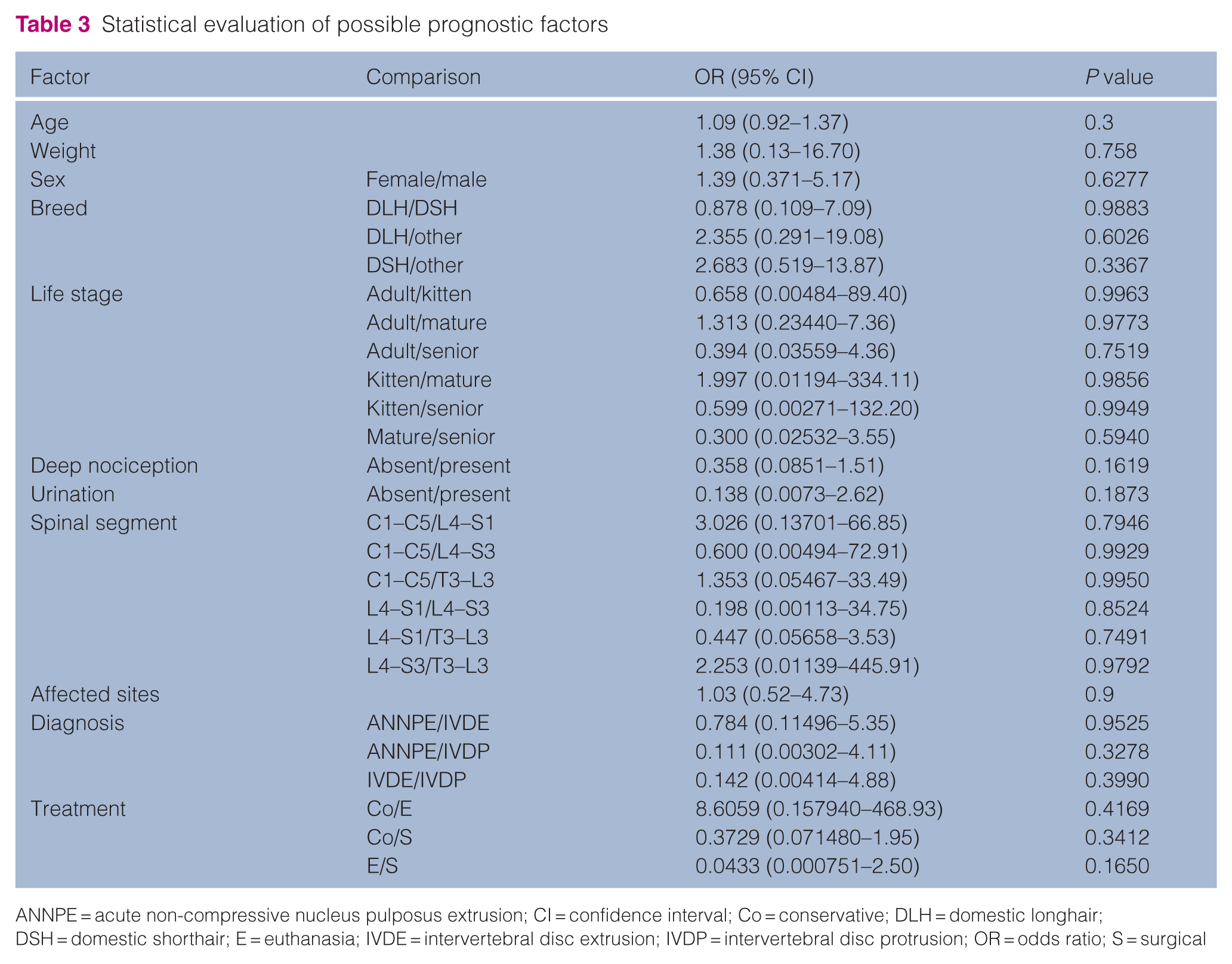
ANNPE = acute non-compressive nucleus pulposus extrusion; CI = confidence interval; Co = conservative; DLH = domestic longhair; DSH = domestic shorthair; E = euthanasia; IVDE = intervertebral disc extrusion; IVDP = intervertebral disc protrusion; OR = odds ratio; S = surgical
A post-hoc power analysis indicated that the number of cases included in the study provided a statistical power of 29%. To achieve a power of at least 80%, a minimum of 349 animals would have been required to reach statistical significance.
Discussion
In this systematic review and meta-analysis, a total of 57 studies including 1113 cats with spinal disease were identified. However, only 93 (8.35%) cats could be included in the meta-analysis and statistical evaluation for prognostic factors. No systematic review or meta-analysis is currently available for the prognosis and outcome of IVDD in cats. The most recent review, published in 2002, examined 11 studies and focused on the clinical presentations of affected cats. 31 Several studies that could potentially be categorised at higher evidence levels were excluded based on our inclusion criteria, which required a definitive diagnosis, documented outcomes and sufficient details to associate each cat with an affected spinal segment. The first published studies from King and Smith22–24 regarding IVDD in the cat showed that IVDP can be a common finding in the spine of older cats. As a result of these studies being cadaveric or gross pathology studies, the described cases had to be excluded from statistical evaluation because of a lack of documented outcomes.
Furthermore, the study by Mella et al, 3 which reported on a larger cohort of cats, did not provide detailed data for the individual, inhibiting the assessment for prognostic factors. Similarly, numerous recent studies lacked individual case information, resulting in the overall low evidence power of this review.4,6,34,36,51
Larger studies by Bibbiani et al 1 and Soteras et al 5 that focused on diagnostic findings while omitting the treatment and outcome could not be included. Only studies with an evidence level of 3 and 4 according to the OCEBM could be included in this meta-analysis, revealing a lack of evidence about prognostic factors for IVDD in cats in the current literature.
The analysed prognostic factors showed no significant effect on the overall outcome. As Olby et al 15 showed in their 2020 study, multiple factors can influence the outcome of IVDD in dogs. They showed that deep pain perception, onset and duration of signs as well as parts of the signalment, such as breed and weight, might have an impact on the overall outcome.
The breed of the cats showed no significant influence on outcome. Although a large number of pedigree breeds were represented in the included studies, many breeds were only present in small numbers. Certain breeds with congenital tail deformities, such as the Manx, can exhibit concurrent neurological signs affecting the pelvic limbs and upper spine. 65 Therefore, it remains possible that some breeds have a poorer prognosis than others. For statistical purposes, all purebred cats were grouped together and an analysis of individual breeds was not feasible.
A further evaluated prognostic factor was the sex of the cat. Most cats were castrated/spayed and only a total of three intact cats were identified; therefore, neuter status was omitted for prognostic purposes. Male cats were overrepresented in our data, making up almost two-thirds of the total number of cats. This concurs with other recent studies showing male cats to be affected more often than female cats. 1 However, the statistical analysis showed no influence of sex on outcome.
We could also show that older cats appear more prone to IVDD, as described in the studies by King and Smith. 23 As different ages were grouped into life stages according to the AAHA, 37 we tried to see if there was a trend for the outcome. Neither the age itself nor the life stage showed significant influence on the outcome. This observation may be due to older cats being more susceptible to IVDD than younger cats and making up a bigger percentile of our cohort.
Since time to ambulation in dogs with spinal cord injury was significantly affected by their body weight, we wanted to show that body weight influenced the outcome for IVDD. 66 Although body weight was not available for 33% of the cats, we evaluated body weight as a possible prognostic factor to see if there were trends with heavier cats having a poorer outcome. This could not be proven with the current data. Moreover, our acquired data showed that heavier cats have a slightly better outcome than cats with a lower body weight. This could also be due to the overrepresentation of male adult cats, which are typically heavier than female and younger cats.
The modified Frankel score was not consistently applied across all publications. As a result, the evaluation of neurological status was omitted, as it was not feasible to reliably assess this retrospectively from the available data.67,68
Because localisation of lesions in the spine based solely on neurological examination can be inaccurate, the definitive lesion identified through diagnostic imaging was used to determine the affected disc site. The analysis showed that cats were almost twice as likely to have lesions in the lumbar spine compared with the thoracic or thoracolumbar spine segments. This finding is consistent with previous studies.1,5
However, the affected spinal segment did not appear to influence the overall outcome. In addition, the potential impact of multiple affected sites on prognosis and outcome was evaluated. As most reported cases involved only a single affected disc, the number of affected sites showed no significant association with the overall outcome.
The status of voluntary urination is an important factor influencing the outcome in the canine patient. 15 In a recent study, the loss of micturition and defecation of dogs was researched and a possible influence on the severity of the spinal cord damage was proposed. 69 In the present review, urination status was only described in 22 cats across the included studies. The reason for the low number of reported cases is unclear. It could reflect the acute presentation of the patient or simply due to the cat being predominantly outdoors. Nevertheless, evaluation of the available information showed no influence of voluntary urination on the overall outcome.
A recent study by Amey et al 6 regarding the outcome of conservative and surgical treatment of feline IVDD showed no difference between treatments. The data presented there showed an uneven distribution between conservative and surgical treatment; however, the choice of treatment did not influence the overall outcome in feline IVDD. This is contrary to canine IVDD, where surgical intervention is reported to achieve a favourable outcome over conservative treatment. 17
The distribution of IVDD in these cats is coherent with other studies,1,6,10 which showed IVDE as the most common type followed by IVDP and ANNPE.
Deep pain perception is an important prognostic factor in dogs, with its presence strongly associated with a favourable outcome.2,17 Among the evaluated studies, only 12 cats were identified with documented loss of deep pain perception. Owing to the small number of documented cases, the available data were insufficient for statistical analysis to determine whether deep pain perception holds similar prognostic value in cats as it does in dogs. 9 Furthermore, studies that included cats lacking deep pain perception reported both positive and negative outcomes.4,10,13,18–21 Although no significant association was found between deep pain perception and outcome, 9/12 (75%) cats without deep pain perception experienced a positive outcome – after surgical treatment in six cats and after conservative treatment in three. All conservatively treated cats were diagnosed with ANNPE. Although this observation suggests that deep pain perception may be a less critical prognostic factor in cats than in dogs, this interpretation should be approached cautiously given the small sample size and retrospective nature of the study.
The limitations of this study, as a systematic review and meta-analysis, lie in its reliance on previously published data. The overall low level of evidence among the included studies highlights the need for further research with a higher level of evidence. From a statistical perspective, additional limitations include the uneven distribution of potential prognostic factors, the small sample size and the low statistical power of the analysed population, as demonstrated by the post-hoc analysis.
Conclusions
This systematic review suggests that, based on the current literature, cats generally have a favourable outcome regardless of the chosen treatment. No evaluated prognostic factors could be established for the outcome of IVDD in cats. In contrast to dogs, deep pain perception was not identified as a prognostic indicator for feline IVDD. However, this finding should be interpreted with caution owing to the limited statistical power, small sample size and inherent nature of the study. Future multicentre, prospective studies with larger cohorts and higher evidence levels are needed to enable a more accurate assessment and identification of prognostic factors in feline IVDD.
Footnotes
Author note
The data that support the findings of this review are available from the corresponding author upon reasonable request.
Conflict of interest
The authors declared no potential conflicts of interest with respect to the research, authorship, and/or publication of this article.
Funding
The authors received no financial support for the research, authorship, and/or publication of this article.
Ethical approval
This work did not involve the use of animals and therefore ethical approval was not specifically required for publication in JFMS.
Informed consent
This work did not involve the use of animals (including cadavers) and therefore informed consent was not required. No animals or people are identifiable within this publication, and therefore additional informed consent for publication was not required.
