



Abstract
Practical relevance
Specific nutritional management strategies play an important role in several feline diseases. Comorbidities sensitive to nutritional management should be taken into account when formulating a feeding plan for cats; this should include diet choice, daily allowance and feeding method. Cats with multiple disease conditions, especially those in the senior age range, make up a significant proportion of patients seen in clinical practice; nutritional management strategies are therefore an important consideration for practitioners.
Clinical challenges
Nutritional strategies indicated for each condition in a cat with comorbidities might not be compatible. Even when they are compatible, commercial diets may not always be available for the specific combination of diseases. Choosing the best diet for each patient requires careful nutritional assessment and knowledge of the nutritional profile of the dietary options available.
Evidence base
The evidence for the nutritional management of several feline conditions is variable and is focused on cats with one disease. The recommendations provided in this paper are drawn from the existing literature as well as the clinical experience of the authors.
Aims
The aim of this review is to protocolise the nutritional approach to comorbidities and discuss important aspects to consider when making dietary choices for patients with comorbidities, including nutritional assessment, identifying nutritional strategies for each condition, the assessment of the compatibility of nutritional goals, disease prioritisation and decision-making.
Audience
This paper sets out a practical, step-by-step approach for general and feline veterinary healthcare team members to customise for the nutritional management of feline patients with comorbidities.
Keywords
Introduction
There are several diseases in cats where nutritional management plays an important role. 1 These diseases can therefore be described as nutrient sensitive. Chronic kidney disease (CKD),2,3 diabetes mellitus,4–7 obesity 8 chronic enteropathy9–11 liver disease, 12 osteoarthritis 13 and urolithiasis, 14 among others, are all nutrient-sensitive diseases. The role of diet is variable among conditions, and it can be a primary intervention or play more of a supportive role.
In all cases, patients require a feeding plan, which includes diet choice, daily allowance and feeding method. For patients with nutrient-sensitive diseases, diet choice will often include a dietetic food (this can also be called a therapeutic or veterinary diet). These veterinary diets are regulated differently depending on the country; for example, in Europe, PARNUT legislation 15 ('feed for particular nutritional uses') describes the minimum nutritional modifications that a product must meet in order to be marketed as such. This legislation also defines any additional information needed on the label, including that the food should be used under veterinary supervision; however, these diets can be bought by the pet caregivers without any veterinary team input. Regulations are different in the USA, where the legislation 16 does not define the minimum modifications needed for a diet to make therapeutic claims, but it does require these products to be sold exclusively under the prescription of a veterinarian that has examined the patient.
An additional level of complexity is in cats with more than one disease condition. This presence of comorbidities is found most often in senior feline patients as there are a variety of diseases that are more common older cats, such as CKD, joint disease, cognitive dysfunction, neoplasia and endocrinopathies.17–20 One retrospective study found that 68.8% of a cohort of cats had both CKD and degenerative joint disease. 21
There are publications focusing on the medical management of specific feline comorbidities, such as triaditis, 22 diabetes mellitus and pancreatitis, 23 hyperthyroidism and CKD, 24 obesity and diabetes mellitus, 25 and others,26–28 and also on general approaches to these patients. 17 The current review focuses specifically on strategies and important aspects to consider when making diet choice in these patients (summarised in Figure 1), as it can be difficult to determine the best feeding approach. The '2021 AAHA nutrition and weight management guidelines for dogs and cats' can help identify nutrient-sensitive diseases that might require specific nutritional management. 29

Decision tree to choose a suitable diet in patients with comorbidities
Step 1: Nutritional assessment
Nutritional assessment is the first step required when deciding on a feeding plan for any feline patient.30,31 As there is no single easy way to assess the nutritional status of an individual, nutritional assessment guidelines have been developed. An initial screening process should first be performed to identify any nutritional risk factors. This screening process involves assessing the animal and its diet and environment using information from signalment, history and physical examination. If any risk factors are identified, an advanced assessment should be carried out and this might include a more detailed diet history and other diagnostics. Patients with comorbidities must undergo both screening and advanced assessment.
The World Small Animal Veterinary Association (WSAVA) has a variety of tools 32 to help the veterinary healthcare team perform a nutritional assessment, including body condition score (BCS) and muscle condition score (MCS) charts, diet history forms and a checklist where the risk factors can be easily identified. The risk factors identified within the history include altered gastrointestinal function, previous or ongoing medical conditions, receiving medications and/or supplements, unconventional diets, too many treats and inadequate housing conditions. The risk factors identified on the physical examination include an abnormal BCS and/or MCS, involuntary weight changes, poor skin and coat, dental disease and new medical conditions. The signalment information is also important, as the feeding plan, including diet choice, will vary depending on breed, sex, age and life stage of the cat.
Step 2: Wishlist
Once all the relevant disease processes have been identified via the nutritional assessment, those that are amenable to specific nutritional management should be identified. While all patients require nutritional support in the form of a complete diet fed in adequate amounts, not all conditions benefit from dietary modifications to help manage their condition. For example, a cat with hyperadrenocorticism can be fed with a large variety of foods, as long as nutrient and energy requirements are being met. These conditions, therefore, need not be considered when choosing a diet in a patient with multiple other diseases.
A complete list of nutritional and feeding goals should be made for each of the health conditions that are nutrient sensitive (see examples in Figure 2). This will facilitate the visual comparison of the different needs to easily perform step 3 (assessing compatibility). Identifying these goals should be based on the evidence-based research available (see box).

Examples of nutritional and feeding strategies in patients with multiple conditions
Nutritional goals to consider in each case comprise different aspects of the nutritional profile, including macronutrient content (fat, protein, carbohydrate), fibre, moisture and micronutrients (such as phosphorus, sodium or omega 3 fatty acids). The nutritional goals can also include other dietary characteristics (such as energy density, digestibility and type/amount of ingredients) and other aspects of the feeding plan (such as calorie provision and feeding method).
Step 3: Assess compatibility of nutritional goals
Once the desired nutritional and feeding goals are listed, the next step is to decide if these strategies are compatible and can coexist in a diet, be it commercial or homemade. There are pros and cons to both commercial and homemade diets. 34 Commercial diets can be tested (including in clinical trials), tend to be more affordable and are easier to access and use; therefore, efforts should be made to find commercial options if possible. Homemade diets can be an excellent option when there are no commercial options with the desired nutritional composition, or if the individual pet does not find the suitable commercial diet to be palatable. However, in the authors' experience, homemade diets are not always palatable for cats.

Step 4a: Choosing a diet if nutritional and feeding strategies are incompatible
Compatibility does not necessarily mean that a commercial diet with all the desired characteristics exists in the market. Dietetic pet food availability depends on many factors, including geographical location, and choices can therefore be very limited. One example of compatible strategies but limited commercial choices would be a patient with obesity and adverse food reactions. Diets formulated for safe and effective weight loss usually contain common pet food ingredients and therefore might not be tolerated in cases of allergies or intolerances. On the other hand, other combinations of diseases can be fully compatible, for example, obesity and diabetes mellitus, as weight control is a crucial nutritional goal in both conditions.
Some dietetic pet foods are formulated with secondary claims. One common example of this is for the management of struvite and calcium oxalate urolithiasis. Manufacturers can use analyses such as relative supersaturation as a proxy to evaluate stone formation risk with specific diets.35–38 While this type of analysis has its limitations, it does provide some of the desired strategies to deal with uroliths in diets formulated for other conditions, such as chronic enteropathies, obesity and diabetes mellitus. Feline CKD diets (except some early-stage products) are recommended for urate urolithiasis, so it is a straightforward decision for this combination of diseases. Diets marketed to manage multiple feline conditions are also available in certain countries and these include obesity and urinary disease (struvite, calcium oxalate and, in some cases, idiopathic cystitis), adverse food reactions and urinary disease, adverse food reactions and CKD, and joint disease and CKD.
Finally, even if there are no secondary claims or multiple conditions as indications, some diets can be selected for specific comor-bidities given their nutritional profile. For example, using a wet food is a usual recommendation for idiopathic cystitis39,40 and calcium oxalate urolithiasis; 14 therefore, choosing a high moisture diet for the other condition(s) is appropriate. Additionally, the degree of the nutritional modifications needed (such as the target level of a macronutrient) can also affect diet choice and this can increase or decrease diet choices available (see example in Figure 3).
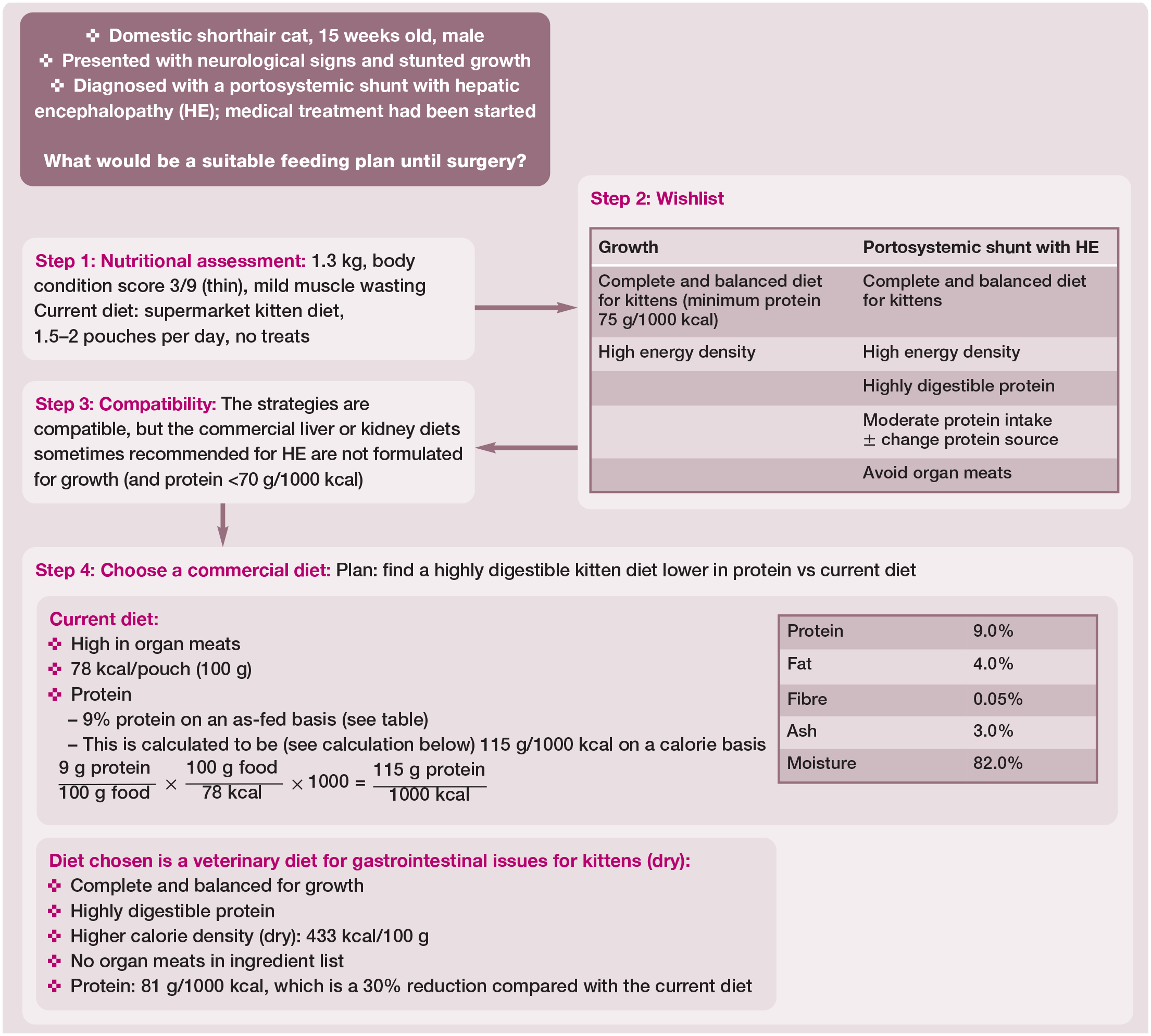
Example of the steps involved when choosing a diet for a growing kitten with a portosystemic shunt, including the need to convert the units for protein in different diets to be able to compare them accurately
To make decisions about an appropriate diet, it is critical to have the product guides of the manufacturers available, to know all the ways in which a specific diet might work and what degree of evidence supports their claims. Moreover, comparing specific nutrients among diets is necessary, and comparing on an as-fed basis can be very misleading, as these values are affected by the moisture content and energy density of the diet. Comparing nutrients on a calorie basis is therefore recommended. Some product guides present nutrients on a calorie basis; if not, performing calculations to convert from as fed to units per 100 or 1000 kcal is required (see example in Figure 3).41,42 It is also important to remember to apply the same nutritional strategies to any treats and supplements provided to the patient.
Board-certified veterinary nutritionists can help identify commercial options in complex cases and can also formulate a customised homemade diet in cases where a commercial option does not exist or is not available. 43 The use of generic recipes from books or the internet is not recommended, as they have been shown to have multiple nutritional issues.44,45 One abstract analysing the cases (canine and feline) received by a referral veterinary nutrition service in the USA over 1 year noted that 59% of all referrals presented with comorbidities, and they were able to prescribe commercial recommendations for half of these patients, while the other half received a custom homemade diet formulation. 46
Step 4b: Choosing a diet if nutritional and feeding strategies are incompatible
If the strategies are not compatible, the decision on the approach to the cat's diet will need to be made individually based on which conditions affect survival, patient and caregiver preference, including palatability and budget, and, most importantly, the quality of life of both the patient and its caregivers. Prioritising diseases is also a good choice when the strategies are compatible but there are no commercial options available, the patient will not eat the recommended diet or if homemade diets cannot be used.
It is also important to take into consideration other therapeutic measures that can be used as an alternative, or in addition, to diet for each of the conditions, and also think about the strength of evidence for the efficacy of the proposed nutritional management. For example, there are clinical long-term studies on the benefit of dietary therapy for feline CKD,2,47 especially in azotaemic patients, and it is considered the cornerstone of treatment. 48 For this reason, it is reasonable to prioritise a renal diet when stage 2 or higher CKD is present, together with other diseases where supportive evidence is less robust.


Nutritional strategies for chronic kidney disease and food-responsive chronic enteropathy
Even when prioritising a nutritional strategy for a particular condition, it can be possible to select from the diet choices one that might be more appropriate for the other comorbidities present; being able to compare the relevant nutrients among diets therefore remains important. Mixing two commercial dietetic pet foods aiming to obtain the benefits of both is not recommended as standard practice. While there are some situations where this could work, the benefit of a therapeutic diet is obtained when fed alone as the main source of nutrition, and mixing two diets can result in losing the benefits of both.


Nutritional strategies for chronic kidney disease and diabetes mellitus

Comparison of protein intake vs requirement in a male castrated 10-year-old cat with diabetes and chronic kidney disease (CKD). NRC = National Research Council
Key Points
✜ A complete nutritional assessment is essential to identify nutrient-sensitive diseases and their nutritional strategies, which may or may not be compatible.
✜ Commercial diets for the management of multiple conditions in the same cat are available. Being aware of these and able to find their nutritional characteristics in the appropriate units is important.
✜ Homemade diets can be a good choice in patients where there are no commercial diets adequate for all conditions available (or palatable). The authors recommend consulting with a board-certified veterinary nutritionist to obtain a safe and nutritious custom recipe in these cases. They can also help with finding commercial options in complex cases.
✜ When strategies are not compatible, diseases must be prioritised before choosing the best available diet on a case-by-case basis, based on survival, quality of life, patient and caregiver preferences, alternative treatment options and strength of evidence.
Footnotes
Conflict of interest
The authors declared no potential conflicts of interest with respect to the research, authorship, and / or publication of this article.
Funding
The authors of this commissioned Clinical Spotlight review received an honorarium; as for all ]FMS articles, this Clinical Spotlight article went through peer review.
Ethical approval
This work did not involve the use of animals and therefore ethical approval was not specifically required for publication in ]FMS.
Informed consent
This work did not involve the use of animals (including cadavers) and therefore informed consent was not required. For any animals or people identifiable within this publication, additional informed consent for publication was obtained.
