



Abstract
Objectives
The objective of the study was to investigate the prevalence of hyperthyroidism in Spain, including its geographical distribution and prevalence across different age groups.
Methods
A cross-sectional study was conducted. Samples submitted to a reference laboratory to evaluate serum total thyroxine concentration (TT4) during a 3-year period were evaluated (n = 27,888). A cat was considered hyperthyroid if the TT4 concentration was greater than 60.4 nmol/l (4.7 μg/dl). Hyperthyroid cats were classified based on their TT4 concentration at diagnosis as mildly (TT4 60.4–124.8 nmol/l [4.7–9.7 μg/dl]), moderately (TT4 124.8–249.68 nmol/l [9.7–19.4 μg/dl]) or severely (TT4 >249.6 nmol/l [>19.4 μg/dl]) hyperthyroid. The samples were also grouped by life stage, into young adults (1–6 years old), mature adults (7–10 years old) and seniors (>10 years old). The study included samples from 17 regions of Spain and geographical mapping was based on seven domains.
Results
One thousand seven hundred and twenty-two out of 27,888 cats (6.2%, 95% confidence interval [CI] = 5.9–6.5) were classified as hyperthyroid. Within the hyperthyroid group, ages ranged from 2 to 25 years old, with a median of 14 years. Within the hyperthyroid population, 14/368 (3.8%), 27/368 (7.3%) and 327/368 (88.8%) were young adults, mature adults and seniors, respectively. The prevalence of hyperthyroidism in this laboratory-based sample in Spain was 2.7 (95% CI = 0.4–5.7) to 6.9% (95% CI = 6.4–7.4), depending on the geographical region. During the study period, 8.2% of cases that were initially non-hyperthyroid were later diagnosed with hyperthyroidism.
Conclusions and relevance
Prevalence of hyperthyroidism in Spain is 6.2% (95% CI = 5.9–6.5) overall and 7.9% (95% CI = 7.2–8.8) in cats older than 10 years. The distribution of the disease is heterogeneous between different geographical regions. Further large-scale prospective studies are required to determine the risk factors in each region and understand the reasons for this variation.
Introduction
Feline hyperthyroidism is the most common endocrine disease among cats worldwide; however, the prevalence of this disease appears to vary significantly depending on the geographical region. 1 This multisystemic disorder, caused by excessive levels of thyroxine (T4) and triiodothyronine (T3), has an unclear aetiology; 2 however, the thyroid pathological findings linked to hyperthyroidism are well documented, with functional thyroid adenomatous hyperplasia affecting one or both thyroid lobes being the most common abnormality.3,4 Several factors contribute to the development and severity of this disease, including genetics, dietary intake of iodine and selenium, age and lifestyle. 1 In addition, these factors can influence the onset of the disease and its distribution, which can explain the differences in prevalence observed in studies conducted to date.1,5
The awareness of feline hyperthyroidism among owners and veterinarians has increased significantly. As a result, serum total thyroxine (TT4) concentration measurement has become a routine part of geriatric feline serum biochemistry profiles, leading to earlier diagnosis of cats with hyperthyroidism. The age range of cats diagnosed with this condition is between 4 and 22 years, with a median age of 13 years.6–8 Although hyperthyroidism is rare in cats younger than 4 years old, a few cases have been reported. 9
There has been an increase in the reported prevalence of hyperthyroidism in several countries. For instance, in Germany, the prevalence increased by 10% in 17 years, and, in North America, it increased by 2% in 20 years.10–12 In addition, the prevalence of the disease varies across different countries, with studies reporting 21% in Ireland, 20% in Poland, 3.9% in Hong Kong, 2.4–3% in the UK and 7% in South Africa.13–18 In all these studies, age has been identified as a significant risk factor for the development of hyperthyroidism; however, it is important to note that these prevalence rates may be biased by the type of population included in the studies. In some cases, only geriatric cats were considered, which may increase the actual prevalence of the disease, whereas, in other cases, only patients treated in specialist veterinary hospitals were included, which may not provide an accurate representation of the population of each region.
In 2005, a study was conducted to analyse the cumulative incidence per year of hyperthyroidism in cats over 9 years of age in referral hospitals in Spain and compare this with hospitals in the UK. 19 The study found that the incidence in Spain was 1.53%, whereas in the UK, it was 11.92%. 19 As a result, for many years, it was suspected that the prevalence of this disease in Spain could be lower than in other European countries; however, the study had a significant limitation because only 27% of the cats over 9 years old were investigated for hyperthyroidism during the study period. 19 This limitation restricted the diagnosis of the disease in the geriatric population.
One study was performed in 2015 to assess the prevalence of hyperthyroidism in cats in Spain. 20 The study found that 10% of the cats included in the study had hyperthyroidism. 20 The disease was more common in older cats, with a 14% prevalence in cats over 13 years; 20 therefore, the prevalence in Spain was found to be similar to that of other European countries. Nevertheless, it is important to note that the study had a small sample size, including only 207 cats, randomly selected, with the only inclusion criterion being cats older than 8 years, with laboratory analyses conducted at a single reference laboratory. 20 Moreover, 10% of cats diagnosed as hyperthyroid based on their TT4 levels did not exhibit clinical signs consistent with hyperthyroidism. 20 This highlights the necessity of regularly assessing thyroid function in older cats, even if they display no clinical signs.
The objective of the present study was to determine the prevalence of feline hyperthyroidism among cats owned in Spain, both overall and regionally. Additionally, the study aimed to evaluate the percentage of animals that developed hyperthyroidism during the study period based on more than one measurement of TT4.
Materials and methods
A retrospective descriptive cross-sectional study was conducted to determine the prevalence of hyperthyroid cats. Blood samples were submitted to a single reference laboratory from general practice and referral veterinary hospitals during a 3-year period (January 2016 to December 2018) for TT4 analysis. The possession of the TT4 value was regarded as the exclusive inclusion criterion. Details regarding the rationales for requesting the TT4 measurement were not accessible.
All cats in the study were tested for feline TT4 concentrations using a chemiluminescent competitive immunoassay (Immulite 2000). This method has been validated for measuring TT4 concentrations in cats and was used to determine if a cat was hyperthyroid. 21 Cats were classified as hyperthyroid when the TT4 concentration was greater than 60.4 nmol/l (4.7 μg/dl) because the reference interval for normal TT4 concentrations in cats is 10.3–60.4 nmol/l (0.8–4.7 μg/dl). In some cases, multiple TT4 measurements were taken during the study period, and, if any of these results were greater than 60.4 nmol/l (4.7 μg/dl), the cat was considered hyperthyroid.
The study collected the following data (when available) for each case: age, region of origin and serum TT4 concentration. Hyperthyroid cats were classified based on their TT4 concentration at diagnosis as mildly (TT4 60.4–124.8 nmol/l [4.7–9.7 μg/dl]), moderately (TT4 124.8–249.68 nmol/l [9.7–19.4 μg/dl]) or severely (TT4 >249.6 nmol/l [>19.4 μg/dl]) hyperthyroid. 22 The samples were also grouped by life stage as young adults (1–6 years old), mature adults (7–10 years old) and seniors (>10 years old) according to the 2021 American Animal Hospital Association (AAHA) and the American Association of Feline Practitioners (AAFP) feline life stage guidelines. 23 The study included samples from 17 regions of Spain, mapped geographically by zip code to characterise the distribution of the disease in cats throughout Spain. The geographical mapping was based on seven domains: North, Northwest, Northeast, South, Centre, Centre East and Canary Islands.
Data normality was examined using the histogram evaluation and Kolmogorov–Smirnov test. Normally distributed data were presented as the mean ± SD, while non-normally distributed data were expressed as the median and range. Assuming normality, group comparisons (age and disease severity) were performed using Student’s t-test and ANOVA to identify significant differences. Non-normally distributed data required non-parametric testing (Mann–Whitney U-test and the Kruskal–Wallis test). Post-hoc evaluations involved the application of the Scheffé procedure. Furthermore, the Jonckheere–Terpstra test was employed to ascertain the significance of trends between the life stage variable and TT4. P <0.05 was considered statistically significant. SPSS Statistics for Macintosh, version 22.0 (IBM) was used for statistical analysis.
Results
Samples from 27,888 cats were submitted for TT4 analysis during the study period. Age was available in 6515/27888 cats (23.3%) and ranged from 1 to 25 years old with a median of 12 years. Based on the available data on age, the distribution within the group with known ages was 639/6515 (9.8%) young adults, 1744/6515 (26.8%) mature adults and 4132/6515 (63.4%) seniors. One thousand seven hundred and twenty-two out of 27,888 (6.2%, 95% confidence interval [CI] = 5.9–6.5) were classified as hyperthyroid. Within this group, age was available in 368/1722 (21.3%) and ranged from 2 to 25 years old with a median of 14 years. Within the group for which age data were available, 14/639 (2.2%, 95% CI = 1.1–3.3) young adults, 27/1744 (1.5%, 95% CI = 1.0–2.1) mature adults and 327/4132 (7.9%, 95% CI = 7.2–8.8) senior cats were classified as hyperthyroid. Among the cats with TT4 values exceeding 60.4 nmol/l (4.7 μg/dl) and for which age was known, the distribution of age was 14/368 (3.8%) young adults, 27/368 (7.3%) mature adults and 327/368 (88.8%) seniors. In addition, of the 27,888 cats, TT4 analysis was repeated in 2373 (8.5%). In the repeated measurements of 205 cats (8.2%), TT4 levels were found to exceed 60.4 nmol/l (4.7 μg/dl), indicating a potential development of hyperthyroidism because they had been lower in the initial assessment.
Overall, the severity of the disease was mild, moderate and severe in 53.6%, 46.3% and 0.1% of the cases, respectively. When the severity was analysed according to the life stage, 7/14 (50%) of young adult hyperthyroid cats presented mild disease, 6/14 (42.9%) presented moderate disease and 1/14 (7.1%) presented severe disease. Within the mature adult hyperthyroid cats, 14/27 (51.9%) presented mild disease, 13/27 (48.1%) presented moderate disease and none of the cases had severe disease. Finally, among the senior hyperthyroid cats, 188/327 (57.5%) presented mild disease, 139/327 (42.5%) presented moderate disease and none of the cases had severe disease.
Geographical location was known in 26,340/27,888 (94.4%), of which 9521 (36.1%) were submitted from the Northeast, 7136 (27.1%) were submitted from the Centre, 2609 (9.9%) were submitted from the South, 2435 (9.2%) were submitted from the North, 2409 (9.1%) were submitted from the Northwest, 2118 (8%) were submitted from the Centre East and 112 (4%) were submitted from the Canary Islands. The prevalence of hyperthyroidism within each region was 2.7% (95% CI presented 0.4–5.7), 4.6% (95% CI = 3.8–5.5), 5.1% (95% CI = 4.2–6.0), 6.1% (95% CI = 5.1–7.0), 6.2% (95% CI = 5.6–6.8), 6.3% (95% CI = 5.2–7.3) and 6.9% (95% CI = 6.4–7.4) of the cats coming from the Canary Islands, North, Northwest, South, Centre, Centre East and Northeast, respectively (Figure 1).
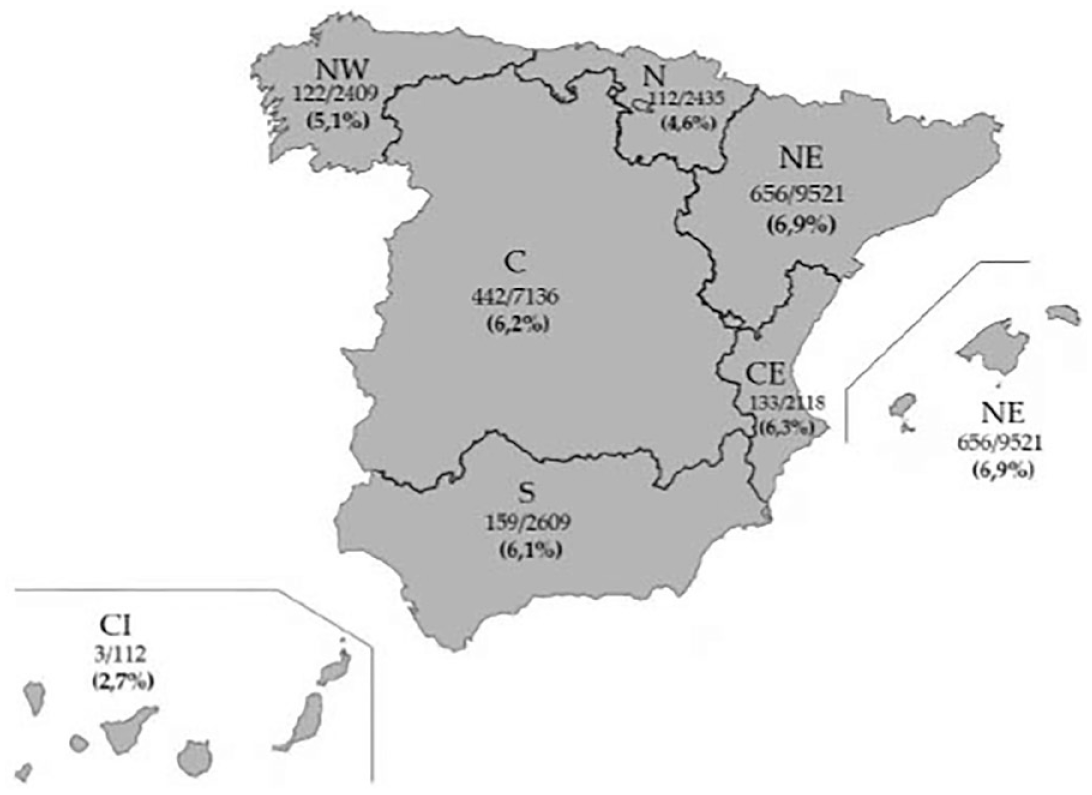
The geographical distribution of the regions along with the prevalence of hyperthyroidism in each region. Geographical areas: Northwest (NW), North (N), Northeast (NE), C (Centre), S (South), CE (Centre East) and Canary Islands (CI)
No statistical significance was observed between life stage and severity of the disease (P = 0.111); however, TT4 showed statistically significant differences between life stage groups (P <0.001). Post-hoc analysis revealed a statistically significant difference between seniors and both young adult and mature adult groups, being greater in seniors than young adults (P <0.001 and 95% CI = 0.2145–0.6267) and seniors than mature adults (P <0.001 and 95% CI = 0.3575–0.6344). However, no statistical significance was observed between young and mature adults (P = 0.713 and 95% CI = –0.149 to 0.2995). The Jonckheere–Terpstra test showed a significant trend, with TT4 concentrations increasing as life stage levels increased in the population of cats for which age was known.
Discussion
This study is the largest prevalence study ever conducted in Spain on feline hyperthyroidism. The overall prevalence of feline hyperthyroidism in Spain in this study was 6.2% (95% CI = 5.9 – 6.5). These results show that hyperthyroidism, as defined by a TT4 above the reference interval, is a relatively common endocrinopathy in Spain, although its prevalence is lower than in other European countries such as Ireland, Poland, Portugal and Germany.11,13,14,24 The only other estimate of the prevalence of feline hyperthyroidism in Spain was in 2015 and it was higher than found in this study. 20 The discrepancy could potentially be attributed to the fact that the study conducted by Periáñez et al 20 solely focused on cats that were above 8 years old, whereas the present study included cats of all age groups. However, when comparing the prevalence of hyperthyroidism in our senior cat group (7.9%) with the study population of Periáñez et al 20 (10%), we still observe a difference between the two studies.
The median age of the cats classified as hyperthyroid was 14 years (range 2–25 years). In the present study, the senior population was most affected, accounting for 7.9% of the population. These results agree with previous prevalence studies carried out worldwide.11,13–18 Hyperthyroidism is more prevalent in older cats than young cats, so it is not surprising that the prevalence of the disease in the senior group was much higher than in the young adult group. While the senior population is more susceptible to this disease, it is worth noting that the prevalence of 3.8% in the young adult population was significant. This highlights the fact that young cats are also at risk of having TT4 concentrations above the reference interval and should not be overlooked. Risk factors such as diet, insecticides, herbicides and feeder materials have been proposed as risk factors that may affect the younger population, potentially causing cats to develop hyperthyroidism at younger ages. 1 As we are still uncertain about the underlying causes of this disease, we may inadvertently expose the feline population to these factors. This could change the typical presentation of the disease, ultimately increasing its incidence among previously less affected populations, such as young cats.
The 2021 AAFP Feline Senior Care Guidelines recommend annual checkups starting at ages 7–10 years, increasing frequency with age. 25 It is recommended that individuals undergo annual baseline tests, including a complete blood count, serum biochemistry panel, urinalysis, blood pressure measurement and TT4 evaluation. 25 During the study period, 8.2% of cases that were initially non-hyperthyroid were later diagnosed with hyperthyroidism; however, the reason for conducting repeat testing was unknown, which makes it difficult to draw further conclusions. Some of the cats initially classified as non-hyperthyroid may actually be hyperthyroid cats undergoing treatment at the time.
In our sample, no correlation was observed between the severity of the disease and the age group. Only one case was classified as severely hyperthyroid in the young age group. The fact that all cases in the adult and senior groups were classified as mildly or moderately above the reference interval may reflect the awareness of this disease in this population and the inclusion of the TT4 parameter in senior wellness panels. The prevalence of hyperthyroidism varied depending on the location in the country. It was lower in the Canary Islands (2.7%) and higher in the Northeast (6.9%). The study did not investigate the reasons for this variability, but it is possible that factors such as lifestyle, climate and veterinary care played a role because the Canary Islands provided the fewest samples for analysis. Furthermore, the significant difference in the number of cases from each geographical group may have affected the prevalence estimates obtained from each location.
The limitations of this study mainly relate to the definition of hyperthyroid being based on clinical pathology data only. The clinical history of the patients included in the study was not available, making it possible that some patients already receiving treatment for hyperthyroidism were inadvertently classified in the non-hyperthyroidism group, thus underestimating the true prevalence of the disease. The absence of information regarding the reason and degree of suspicion for the TT4 analysis requests introduced potential bias in the selected population; therefore, the prevalence might be overestimated if the veterinarian specifically requested the TT4 analysis. Furthermore, important epidemiological factors such as sex, lifestyle and diet were not evaluated, which are known to be risk factors for developing the disease. This information could have given us insights into the diverse distribution of the disease in our population.
Finally, we only considered hyperthyroid cases when the TT4 was greater than 60.49 nmol/l (4.7 μg/dl), which may underestimate the real hyperthyroid population because TT4 concentrations may be within the reference interval of between 5% and 10% for all hyperthyroid cats and in up to 40% for those considered mildly affected. 26 Additionally, for 5% of healthy cats, TT4 would be expected to be outside the reference range. However, it is important to remember that even when TT4 levels are within the normal range for adult and geriatric cats, if they show compatible clinical signs and the TT4 tends to increase, this could be a sign of hyperthyroidism. 26 Therefore, it is recommended to further investigate patients with clinical suspicion of hyperthyroidism and TT4 values greater than 45 nmol/l (3.5 μg/dl), especially in senior cats.26,27
Conclusions
Our study has found that the prevalence of hyperthyroidism in a large laboratory-based sample in Spain was 6.2% overall and 7.9% in cats older than 10 years. While the disease is more common in older cats, it can also affect young adult and mature adult cats; therefore, it is important to investigate hyperthyroidism in these age groups if they show any clinical signs. Having a TT4 above the reference interval was not evenly distributed geographically, and further large-scale prospective studies are required to determine the risk factors in each region and understand the reason for this variation.
Footnotes
Author note
This study was presented as a poster at the EVCIM-CA online conference of 2020.
Conflict of interest
The authors declared no potential conflicts of interest with respect to the research, authorship, and/or publication of this article.
Funding
The authors received no financial support for the research, authorship, and/or publication of this article.
Ethical approval
The work described in this manuscript involved the use of non-experimental (owned or unowned) animals. Established internationally recognised high standards (‘best practice’) of veterinary clinical care for the individual patient were always followed and/or this work involved the use of cadavers. Ethical approval from a committee was therefore not specifically required for publication in JFMS. Although not required, where ethical approval was still obtained, it is stated in the manuscript.
Informed consent
Informed consent (verbal or written) was obtained from the owner or legal custodian of all animal(s) described in this work (experimental or non-experimental animals, including cadavers, tissues and samples) for all procedure(s) undertaken (prospective or retrospective studies). No animals or people are identifiable within this publication, and therefore additional informed consent for publication was not required.
