



Abstract
Background:
There has been a growing interest in alternatives to surgery for controlling reproduction in tom cats, and the resultant medical options add to a practitioner’s toolbox when handling these cases in clinical practice. It is important, however, that when suggesting these drugs, veterinarians have a good understanding of their mode of action, and their correct use and dosage.
Clinical relevance:
Breeders increasingly wish to be able to switch on/off the reproductive ability of their tom cats in a controlled manner. In addition, in small animal medicine, there has been concern from some academics, and a growing number of pet cat owners, about potential long-term effects of surgical sterilisation. Further, for some cats surgical castration may not be possible due to health conditions that mean anaesthesia is unsafe. In all of these scenarios, medical alternatives to surgery can prove useful.
Equipment and technical skills:
No special equipment or technical skills are required. A good knowledge of the medical alternatives to surgical sterilisation for controlling reproduction in a tom, and making sure the patient is a suitable candidate, are, however, important for ensuring the cat’s health during and after treatment and the owner’s satisfaction.
Audience:
This review is aimed principally (but not exclusively) at veterinary practitioners working with cat breeders who seek a temporary arrest in their tom cat’s reproduction. It may also help practitioners with clients who would like an alternative to surgery or with cats where anaesthesia for surgical castration is not possible.
Evidence base:
Advances in reproductive feline medicine have resulted in improved knowledge of medical contraception. This review draws on scientific evidence-based papers that report on the mode of action, length of efficacy and potential side effects of different methods of medical contraception, as well as the authors’ own clinical experience.
Keywords
Introduction
Historically, the method of controlling reproduction in tom cats has been very simple: surgical castration. An increase in purebred cat breeding during the second half of the last century, however, has caused a major paradigm shift in the type of intervention breeders expect feline practitioners to perform in tom cats. Breeders often prevent their toms from mating queens all year round as they tend to eat less while calling for females and thereby lose weight and condition. Preventing male intercat aggression is another reason for tom cats to have a rest period during their reproductive life, and this allows another male to take its turn. Anecdotally, these periods of rest have typically been achieved with physical distancing and the use of progestogens. Since the early 2000s, however, new drugs such as gonadotropin-releasing hormone (GnRH) agonists and melatonin have shown promising results.
This review focuses on the hormonal drugs for controlling reproduction in male cats currently available to feline practitioners. The reversibility of their effects, which is due to temporary suppression of testosterone secretion and spermatogenesis, makes this option appealing for breeders. The different compounds are described in the sections to follow. Other drugs and treatment protocols that have shown some promising results in feline clinical trials, but which are not currently available for most practitioners, are also briefly discussed in the box on page 6.

Progestogens
Progestogens (or progestins) are synthetic analogues of progesterone that exert negative feedback on the hypothalamus by inhibiting the release of GnRH and therefore, in turn, the release of follicle-stimulating hormone (FSH) and luteinising hormone (LH). 1 Through this mechanism, hormonal secretion of male gonadal steroids is inhibited, resulting in the cessation of spermatogenesis and reproductive behaviour (including urine spraying), and improved socialisation with other cats. 2
There is a wealth of publications on side effects following the use/overuse of progestogens in cats; however, the vast majority of available information is for queens, 3 and data for males (see box) is scant and anecdotal. Side effects typically reported as common in queens after treatment with progestogens (see the accompanying review on the reversible control of reproduction in queens 8 ) include: diabetes or glucose intolerance (most commonly following the overuse of megestrol acetate [MA] but not following the overuse of medroxyprogesterone acetate [MPA]); mammary neoplasia (following the overuse of MPA); adrenocortical suppression (following over- or prolonged use of MA); cutaneous xanthomatosis; and blindness due to hyperlipidaemia causing opacity of the anterior chamber (following the overuse of MPA).9,10
As side effects are commonly observed as soon as the safety level is exceeded, progestogens should always be used at the lowest possible dosage of any individual range and with caution. While very little is known about the side effects of progestogens in tom cats (and there is no published data for proligestone [PRG] in particular), the use of appropriate dosing, as suggested in the review on reversible control of reproduction in queens, 8 is unlikely to cause any health problems provided that general health and normal liver and kidney function are demonstrated prior to treatment.
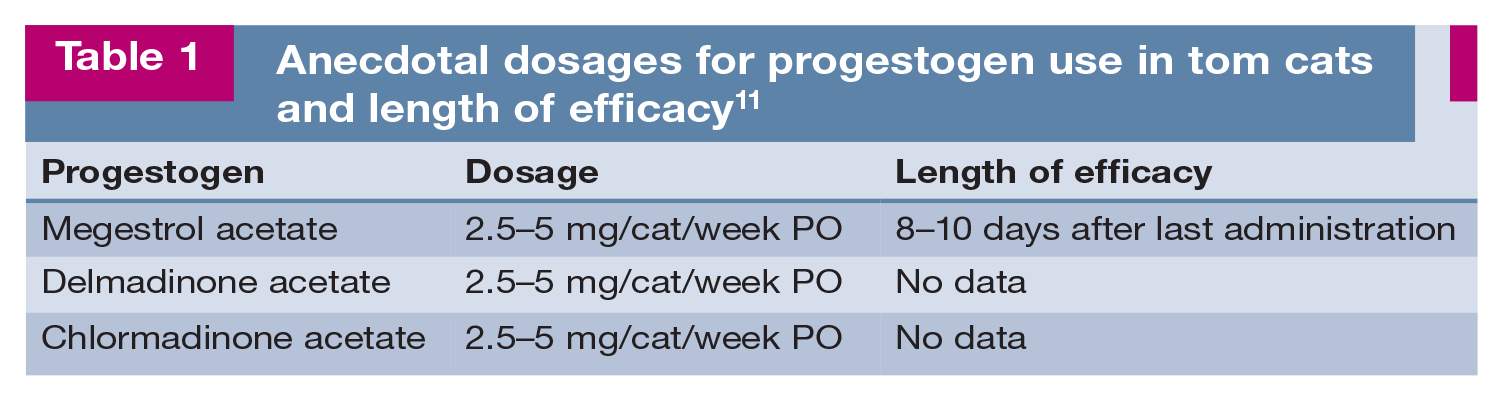
As for data on side effects, information on the dosage and efficacy of progestogens in tom cats is scant (Table 1). The authors suggest, however, that dosages regarded as safe in the queen can be mirrored in the tom; for instance, 1.5 mg/kg SC every 3 months for MPA (S Romagnoli, unpublished observations), 25 mg/cat every 5 months for PRG and 11 ug/kg/day for MA. 8
Anecdotal dosages for progestogen use in tom cats and length of efficacy 11

Melatonin
Cats are considered seasonal breeders, with reproductive activity negatively influenced by higher levels of melatonin during decreasing photoperiod seasons. 12 The highest impact of melatonin is observed in queens, which may fail to display oestrus at various times during the year depending on latitude; for example, during late summer and autumn in central-southern Europe or late autumn and winter in northern Europe. Unlike in queens, tom cats may simply show moderate annual variations of semen quality that typically do not influence their reproductive capacity.13-15 Interestingly, prolonged periods of long photoperiod are followed by a decrease in sperm quality, implying that photorefractoriness is needed for optimum spermatogenesis and sperm quality. 16
In one study, the following results were reported 90 days after subcutaneous placement of 18 mg melatonin implants in tom cats: 82% lower sperm count, 38.5% lower sperm motility, 22% lower integrity of the acrosomal membrane, 30% lower plasma membrane integrity and 32% lower normal morphology. The negative effects on spermatogenesis were observed between 105 and 120 days after implant insertion and restoration of seminal parameters was evident at 261 ± 22 days after implant insertion. 17 The reduction in sperm characteristics from the use of the melatonin implants was similar to those found in tom cats during the non-breeding season. Although sperm quality of melaton-inimplanted tom cats was significantly reduced for approximately 4 months, treated toms were still able to produce semen and, interestingly, ejaculate volume and testosterone concentrations were not affected. 17
As fertility trials of melatonin-implanted tom cats have not yet been performed, it remains to be established whether or not conception may be avoided with such low-quality semen production. As conception in carnivores can be achieved even with very low semen quality, further investigation of melatonin’s effects on fertility is vital for determining whether this drug could be used for controlling reproduction in tom cats.
GnRH agonists
GnRH agonists, such as deslorelin and azagly-nafarelin, have been reported to control reproduction in small animals. Deslorelin is currently marketed in several countries around the world under the brand name Suprelorin (Virbac) for use in dogs and ferrets and its off-label use in cats in countries where cat fancying is popular has almost overtaken its use in other species due to its prolonged effect.18-22 In June 2022, the European Medicine Agency approved the use of deslorelin in male cats.
GnRH agonists bind to pituitary GnRH receptors causing a prolonged release of LH and FSH followed by a desensitisation of their receptors. 23 In males, such prolonged gonadotropin release results in an initial increase in testosterone secretion, which may last from a few days to 1-2 weeks (Table 2), and is referred to as the ‘flare-up effect’.22,24-26 The increased testosterone secretion commonly causes an increase in reproductive behaviour (libido, mounting, mating) during the first 2 weeks post-implantation. 27 This is paralleled by a temporary improvement in semen quality, which is maintained throughout the first 3-4 weeks post-treatment despite downregulation of GnRH receptors lowering testosterone concentrations to basal values during this time.23,28 Complete sterility may be reached in individual cats as late as 72 days post-implantation (Table 2). 28
Physiological effect of deslorelin in tom cats

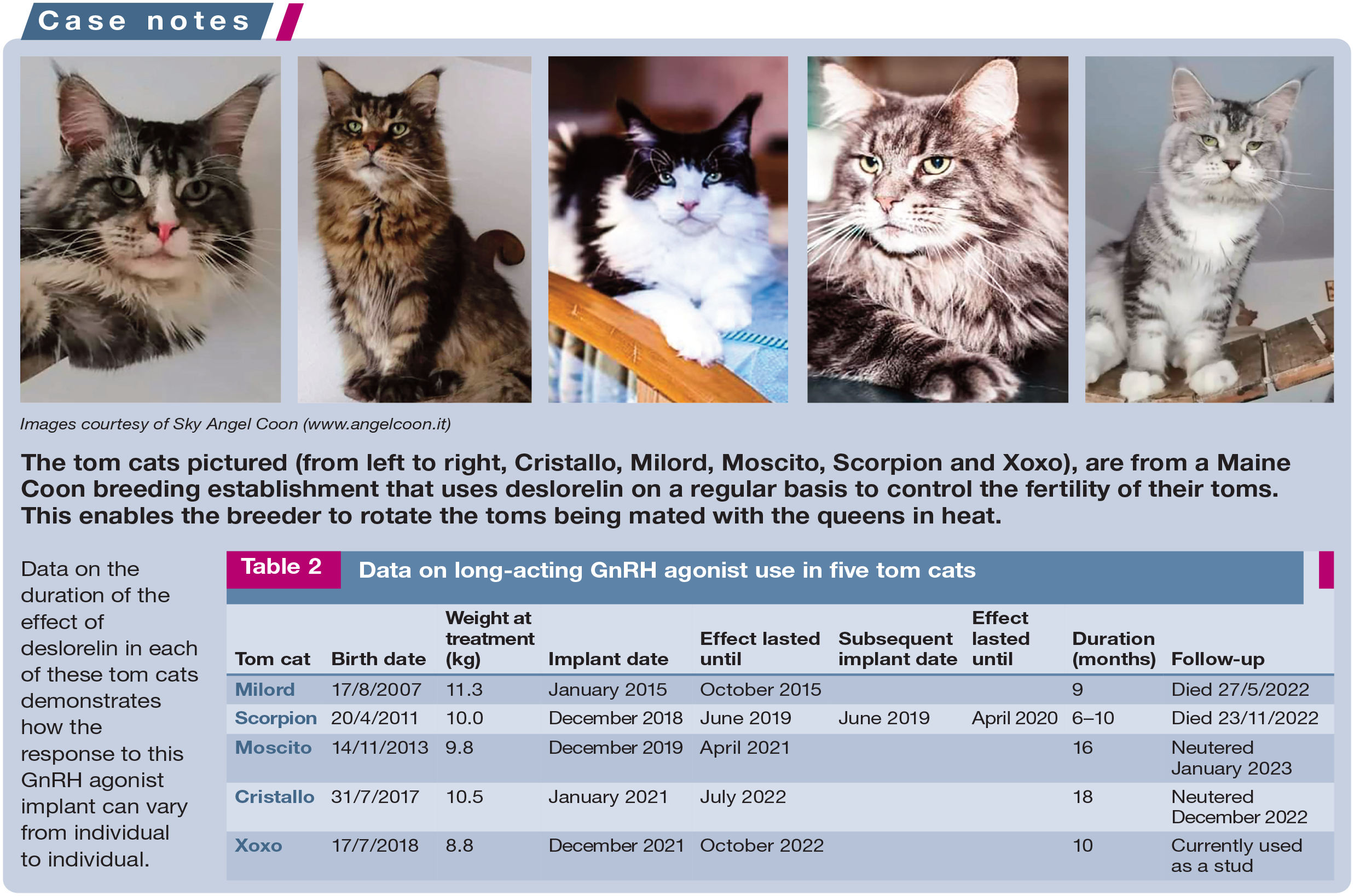
In tom cats treated with a 4.7 mg deslorelin implant, testosterone levels rapidly declined 20 days after insertion, 27 remaining at basal levels (below 0.1 ng/ml) for several months or even years (see below). As a consequence of low testosterone secretion, male cats will generally stop roaming and performing mounting behaviour and urine marking (although urine marking can occasionally persist or resume during treatment as it is also influenced by behavioural cues), and their urine will lose its typical male cat odour. Additionally, some tom cats may show sluggish, unsuccessful mounting. 27 The blockade of these reproductive activities and duration of reproductive control for the 4.7 mg implant is most commonly 12-15 months; however, there is high individual variability (see the Case notes) and the full range can encompass durations of 6-9 months as well as 18-21 months.18,22,29 For the 9.4 mg deslorelin implant, one study reported a lack of testosterone secretion for an average of 805 days (n = 15, range of 750-850 days), suggesting a duration of reproductive control of 25-28 months. 28
In deslorelin-treated cats, testicular volume is an interesting indicator of the response to treatment, with there being a progressive decrease during treatment (24% at 2 months, 50% at 6 months and 60% at 12 months). 28 In parallel with the decrease in testicular volume and semen quality, the penile spines also disappear completely between 9 and 14 weeks post-treatment (Figure 1).2,23,25,27,30,31 All of these effects owing to the lack of testosterone secretion are completely reversed after the end of treatment or following implant removal.2,23,25,27,30,31 The resumption of some of these reproductive features, such as the growth of penile spines and the capacity to respond to a GnRH stimulation test testosterone secretion, can be observed as early as 23 days following the removal of a 4.7 mg deslorelin implant. 31

(a) Penile spines (b) disappear completely 9 to 14 weeks after deslorelin implantation.
Occasionally, a tom cat may not respond to a deslorelin treatment. The authors have observed a small number (approximately 5%) of male cats that fail to respond to deslorelin (data not published). Reasons for such failure are still unclear. Tom cats not responding to deslorelin may become tamer (if presented for strong libido/slight aggressiveness), stop roaming and show reduced interest in females, but they remain fully fertile and may impregnate queens bred in oestrus.

Periumbilical placement of a deslorelin implant. (a) The needle of the applicator is gently pushed against the periumbilical skin, while the skin fold is held with the opposite hand. (b) The applicator’s needle is then fully inserted into the sucutaneous tissue, at which point the plunger is fully pushed, releasing the implant

GnRH antagonists
GnRH antagonists block pituitary GnRH receptors and thus the release of LH and FSH. 32 Acyline, a GnRH antagonist, has been used experimentally in a few animal species but long-term studies in adult cats are lacking. In a study of 12 adult tom cats, a single subcutaneous injection of acyline (330 μg/kg) caused marked but reversible arrest of germinal epithelium and epidydimal sperm with consequent impairment of spermiogenesis, spermatocytogenesis and sperm motility as soon as 2 weeks post-treatment. Despite germinal alterations (thinning of tubular epithelium) and the increased presence of dead spermatids and spermatozoa, no alteration of gross testicular features were observed, as well as no histological evidence of Sertoli and Leydig cell damage, indicating a specific action of acyline in causing androgen deprivation. 33 Acyline-induced sterility disappeared at the end of the study on day 60 post-treatment.
Although safety data are lacking in adult tom cats, acyline appears to be safe and devoid of side effects in adult dogs. 33 No flare-up effect has been observed in dogs treated with acyline. This is to be expected as flare-ups are due to a sustained release of gonadotropins such as LH causing a sustained release of testosterone; acyline causes a sharp decrease of LH to basal values with a consequent sharp decrease of testosterone to basal values, making a flare-up effect impossible. GnRH antagonists constitute a promising novel route of medical contraception provided that longer lasting formulations can be developed. 2

Key Points
✜ Progestogens can be used safely in tom cats provided that appropriate dosing is used.
✜ Published side effects owing to the use of long-acting progestogens in tom cats are due to excessively high doses and should not be regarded as common following proper use.
✜ Melatonin causes a decrease in semen quality, but to levels similar to those produced during the non-breeding season. Whether melatonin-treated toms are capable of impregnating a female and producing a normal litter remains to be established.
✜ Long-acting GnRH agonists such as deslorelin cause a reversible blockade of reproductive capacity in approximately 95% of treated cats without any side effects.
✜ Fertility and reproductive behaviour may improve during the first 2 weeks following deslorelin implantation and semen quality may improve during the first month. Sterility occurs during the second month, with occasional cats still capable of producing poorly concentrated but motile semen as late as 72 days after implantation.
✜ Deslorelin’s duration of reproductive control is typically 12-15 months (4.7 mg implant) or 25-28 months (9.4 mg implant).
✜ The subcutaneous tissue of the periumbical area is the preferred site for placing a deslorelin implant.
✜ GnRH antagonists act by blocking pituitary GnRH receptors. Their use appears to be safe and promising provided that longer acting formulations can be produced.
✜ A flare-up effect is to be expected following use of GnRH agonists but not following use of GnRH antagonists.
Footnotes
Conflict of interest
The authors declared no potential conflicts of interest with respect to the research, authorship, and/or publication of this article.
Funding
The authors received no financial support for the research, authorship, and/or publication of this article.
Ethical approval
This work did not involve the use of animals and therefore ethical approval was not specifically required for publication in JFMS.
Informed consent
This work did not involve the use of animals (including cadavers) and therefore informed consent was not required. For any animals or people individually identifiable within this publication, informed consent (verbal or written) for their use in the publication was obtained from the people involved.