



Abstract
Objectives
The objectives of this study were to generate a robust evidence base on the prevalence of common disorders in cats and develop a deeper understanding of disorder associations with sex and age that could offer important opportunities for targeted veterinary care to improve feline health and welfare.
Methods
A random sample of 18,249 cats was obtained from 1,255,130 cats under primary care during 2019 within VetCompass, an epidemiological research programme based on anonymised primary care veterinary clinical records. All disorders recorded during 2019 were extracted and reported, and associations with sex and age were examined.
Results
The most prevalent disorders were periodontal disease (n = 2780 [15.2%], 95% confidence interval [CI] 14.72–15.76), obesity (n = 2114 [11.6%], 95% CI 11.12–12.06) and dental disease (n = 1502 [8.2%], 95% CI 7.84–8.64). Compared with male cats, females had an increased prevalence of poor quality of life, postoperative complications and hyperthyroidism, among others. Male cats had a higher prevalence of periodontal disease, road traffic accident (RTA) and obesity. Younger cats (<8 years) had an increased prevalence of cat bite abscess, flea infestation and RTA, while older cats (⩾8 years) had increased prevalence of lameness, cystitis and dental disease, among others.
Conclusions and relevance
These findings suggest that the veterinary profession needs to engage more effectively in informing owners on common preventable disorders (ie, obesity and dental disease). This new information can contribute to more targeted health surveillance and more effective veterinary interventions to promote improved health and welfare in pet cats. Large-scale collection and analysis of anonymised veterinary clinical records offer an important clinical resource for research.
Keywords
Introduction
There are approximately 10.7–12.2 million cats in the UK, with 27% of UK households estimated to own at least one cat.1,2 The close human–animal bonds shared between cats and their owners in these households support mutually beneficial and dynamic relationships that are influenced by several behaviours essential to good health and well-being in both species. 3 Going beyond just the mere presence of a cat in the household, physical, emotional and social interactions with their pet cat have been shown to reduce measurable negative moods, anxiety, depression and introversion in people.4,5 However, conversely, it is also legally and ethically incumbent on owners and keepers to care for their animals’ physical and mental health. 6 A key element towards fulfilling this caregiver role is for owners to have a thorough grasp of the frequency of common medical conditions that may affect their animals. 7 For example, greater sharing of awareness that disorders such as dental disease and obesity are common but largely preventable diseases could support owners in taking more proactive approaches to their cat’s healthcare, under the guidance of their veterinary practice. 8 Furthermore, a deeper understanding of how sex and age differentially affect disorder risk should allow owners to make better informed decisions, both when they are choosing a cat in the first place and later, during ownership. 9 For example, previous studies have documented an increased risk of road traffic accidents (RTAs) in young male cats. 10 Consequently, with this information to hand, owners living on a busy road may elect to acquire an older cat or a female cat to reduce the probability of their cat having an RTA.
Quality of life (QoL) can be challenging for owners to interpret accurately in cats. For example, while osteoarthritis (OA) is reportedly a relatively common problem in cats, being formally diagnosed in 2.0% of cats, 11 overt lameness is not its most common clinical feature. 12 Instead, the main clinical signs are changes in behaviour and lifestyle, which develop gradually but which owners often interpret as simply reflecting typical ‘old age’. 13 Overt signs of pain are less commonly exhibited because cats have evolved to hide signs of illness as an adaptation to being both a prey animal, as well as a predator. 14 Hence, while pain associated with OA may significantly reduce a cat’s QoL, limited owner awareness of the high prevalence of OA in older cats may often result in failure to seek veterinary care. 15 Greater awareness of age-specific disorder risks can therefore promote enhanced access to veterinary care that could be followed by the use of questionnaires such as the Feline Musculoskeletal Pain Index (FMPI) for the evaluation of OA-associated pain to help with the recognition and alleviation of pain. 16
Over their lifetime, domestic animals experience varying risk levels of developing a wide range of individual disorders. 17 Deeper understanding of how disorder risk varies according to age and sex can allow for more targeted prophylaxis, detection and interventions. 18 Previous work has indicated that periodontal disease, flea infestation and obesity are, overall, the most common disorders in cats. 11 However, there is evidence for increasing risk with advancing age across several individual disorders, as well as for multimorbidity; for example, OA, chronic kidney disease (CKD), dental disease, hyperthyroidism and/or feline dementia (also known as cognitive dysfunction syndrome). 9 Disorder risk has also been shown to vary by sex in cats; for example, there are higher odds of RTA in male cats after accounting for the effects of neuter status, age, breed and season. 19 Differential disorder risk associated with age and sex suggests that these factors could be used to support improved preventive strategies, earlier recognition and enhanced clinical management with improved QoL for affected cats.
With this broad background, the current study aimed to report the prevalence of common disorders in cats under primary veterinary care during 2019 in the UK, and to explore associations between common disorders with sex and age. The paper highlights opportunities for veterinary professionals (veterinary surgeons and veterinary nurses) to focus on recognising age and sex effects on disorder risk for targeted healthcare approaches and supports the benefits of engaging owners within preventive healthcare programmes, with a particular focus on dental health and weight control.
Materials and methods
The study population included all cats under primary veterinary care at clinics participating in the VetCompass Programme in 2019. Cats under veterinary care were defined as those with at least one electronic patient record (EPR; free-text clinical note, treatment or body weight) recorded in 2019. VetCompass is an epidemiological research programme that collates and investigates de-identified EPR data from primary care veterinary practices across the UK. 20 Relevant data fields available to VetCompass researchers include a unique animal identifier along with veterinary group identifier, species, breed, date of birth, sex and neuter status, along with clinical information from free-form text clinical notes and treatment with relevant dates.
A retrospective cohort study design was used to estimate the 1-year (2019) period prevalence of the most commonly diagnosed disorders. Sample size calculations estimated that 11,932 cats were needed to report the prevalence for a disorder occurring in 2.0% of cats with 0.25% margin of error at a 95% confidence level (CI) from a population of 1,255,130 cats. 21 Ethical approval was obtained from The Royal Veterinary College Ethics and Welfare Committee (reference number SR2018-1652).
The study design, data extraction and analysis methods followed those that have been previously published.11,17,22 A random sample of 18,249 cats was obtained from the overall sampling frame of all cats under veterinary care in 2019. These cats were randomly ordered, and all information in the EPR relating to 2019 was manually reviewed to extract the most definitive diagnoses recorded for all disorders that existed during 2019. 17 The EPRs were accessed via the VetCompass online user interface (VetCompass.org) and the manual review process was carried out by six final-year veterinary undergraduate students under the direct supervision of the lead author (DGON).
Each disorder event was followed over time in the cohort data source to identify the most definitive diagnosis terms recorded, and to verify that the diagnosis had not been revised over time. The VetCompass system does not require veterinary surgeons to code diagnoses or to make any changes to their preferred note-making styles at the point of veterinary care. The notes and other clinical information routinely recorded during episodes of veterinary care are examined later by VetCompass researchers to extract information on targeted research questions. Every distinct disorder with evidence for existence within the clinical records was coded to the most precise diagnostic or descriptive term available in the VeNom coding system. 23 Disorders described in the clinical notes using presenting sign terms (eg, ‘vomiting’ or ‘vomiting and diarrhoea’), but without a formally recorded clinical diagnostic term, were included using the first sign listed (eg, vomiting). The extracted diagnosis terms were mapped to a dual hierarchy of diagnostic precision for analysis – precise-level and grouped-level – as previously described. 24 Briefly, precise-level terms described the original extracted terms at the maximal diagnostic precision recorded within the clinical notes (eg, inflammatory bowel disease [IBD] would remain as IBD). Grouped-level terms mapped the original diagnosis terms to a general level of diagnostic precision (eg, IBD would map to enteropathy). Data on elective (eg, neutering) or prophylactic (eg, vaccination) clinical events themselves were not recorded, but any disorders identified during such clinical examinations were included. No distinction was made between pre-existing and incident disorder presentations.
Following data checking for internal validity and cleaning in Microsoft Excel, analyses were conducted using Stata Version 16. Breed descriptive information entered by the participating practices was cleaned and mapped to a VetCompass breed list derived and extended from the VeNom Coding breed list. 23 A purebred variable categorised cats of recognisable breeds as ‘purebred’, and cats recorded as mixes of breeds or without breed information as ‘non-purebred’. 25 Sex and neuter status were defined by the final available EPR value. Adult body weight was defined as the average (mean) of all body weight (kg) values recorded for each cat after reaching 9 months old. Age (years) was defined at 31 December 2019 as the final date by which each cat in the cohort was classified as either a case or a non-case for each disorder. Cats were categorised by age as younger (<8.0 years) and older (⩾8.0 years).
One-year period prevalence values with 95% CIs described the probability of diagnosis at least once during 2019. CI estimates were derived from standard errors based on approximation to the binomial distribution. 26 The median age (years) across all affected animals was reported. Prevalence values were reported overall and separately for females and males. Univariable comparisons used the χ2 test to compare categorical variables and the Mann–Whitney U-test to compare continuous variables. 26 Statistical significance was set at the 5% level.
Results
Demography
From an available population of 1,255,130 cats under veterinary care across six multi-clinic veterinary groups and partnerships in the UK during 2019, the current study included a random sample of 18,249 (1.4%) cats. The study sample cats included 9141 (50.1%) females and 8944 (48.5%) males. The median age of the overall study sample of cats was 5.67 years (range 0.03–23.90; interquartile range [IQR] 2.39–10.32). Females (median 5.76 years [range 0.03–23.90; IQR 2.48–10.63]) were statistically younger than males (median 5.59 years [range 0.05–23.26; IQR 2.33-9.94]; P <0.001). The median adult body weight of the overall study sample of cats was 5.50 kg (range 1.50–15.00; IQR 3.99–7.40). The median adult body weight of females (5.49 kg [range 1.50–15.00; IQR 3.95–7.39]) did not differ statistically compared with males (5.50 kg [range 1.50–15.00; IQR 4.00–7.43]; P = 0.449). Of the 18,005 cats with breed information recorded, 12.0% (n = 2164) were classified as purebred. The most common pure breeds were British Shorthair (n = 542; 3.0%), Ragdoll (n = 328; 1.8%), Bengal (n = 219; 1.2%), Maine Coon (n = 168; 0.9%), Persian (n = 131; 0.7%) and Siamese (n = 123; 0.7%), and there were 15,841 (88.0%) crossbred cats. Data completeness for the variables in the study sample was as follows: breed 98.7%, sex 99.1%, neuter status 99.1%, age 98.3% and adult body weight 61.5%.
Summary disorder occurrence
From the random sample of 18,249 cats with data extracted on all recorded disorders for 2019, 12,042 (66.0%) had at least one disorder recorded during 2019. The EPR of the remaining 6207 (34.0%) cats had zero disorders recorded in 2019 and mainly presented for prophylactic clinical care. The proportion of male cats (67.5%) with at least one disorder recorded was statistically higher compared with females (64.6%; P <0.001). The median age of cats with at least one disorder recorded (6.88 years [range 0.03–23.90; IQR 3.05–11.48]) was older than for cats that had zero disorders recorded (3.77 years [range 0.03–23.80; IQR 1.63–7.64]; P <0.001).
The median annual disorder count per cat during 2019 was one disorder (range 0–15; IQR 0–2). The median annual disorder count was statistically higher in males (1 [range 0–15; IQR 0–2]) compared with females (1 [range 0–14; IQR 0–2]; P <0.001). The median disorder count was higher in older (⩾8.0 years) cats (2 [range 0–15; IQR 1–3]) than in younger (<8.0 years) cats (1 [range 0–13; IQR 0–2]; P <0.001).
Precise-level disorder occurrence
Across the 18,249 study cats, there were 25,891 unique disorder events recorded during 2019, encompassing 641 distinct precise-level disorder terms. The most prevalent precise-level precision disorders recorded were periodontal disease (n = 2780 [15.2%], 95% CI 14.72–15.76), obesity (n = 2114 [11.6%], 95% CI 11.12–12.06), dental disease (n = 1502 [8.2%], 95% CI 7.84–8.64), overgrown nail(s) (n = 954 [5.2%], 95% CI 4.91–5.56), flea infestation (n = 926 [5.1%], 95% CI 4.76–5.40) and heart murmur (n = 811 [4.4%], 95% CI 4.15–4.75) (Table 1).
Prevalence of the 30 most common disorders at a precise-level of diagnostic precision recorded in cats (n = 18,249) under general practice veterinary care at UK practices participating in the VetCompass programme from 1 January to 31 December 2019

P values reflect females vs males, and younger (<8 years) vs older (⩾8 years) cats
CI = confidence interval; F = female; M = male; RR = risk ratio
Among the 30 most common precise-level disorders, the prevalence differed between the sexes for 14 (46.7%) disorders. Females had a statistically higher prevalence than males for six disorders: poor QoL, postoperative wound complication, overgrooming, flea bite hypersensitivity, overgrown nail(s) and hyperthyroidism. Males had higher prevalence than females for eight disorders: periodontal disease, RTA, heart murmur, lameness, obesity, abscess, wound and cat bite injury.
The median age of cats recorded with each of the 30 most common precise-level disorders varied from 1.67 years for postoperative wound complication to 16.78 years for poor QoL. Among the 30 most common precise-level disorders, the prevalence differed between the younger (<8 years) and older (⩾8 years) cats for 27 (90.0%) disorders. Younger cats had higher prevalence than older cats for four disorders: cat bite injury, flea infestation, RTA and postoperative wound complication. Older cats had higher prevalence for 23 disorders: lameness, abscess, cystitis, overgrooming, dental disease, constipation, thin/underweight, OA, haircoat disorder, anorexia, otitis externa, vomiting, cardiac dysrhythmia, weight loss, CKD, disorder not diagnosed, periodontal disease, poor QoL, heart murmur, flea bite hypersensitivity, obesity, overgrown nail(s) and hyperthyroidism (Table 1).
Grouped-level disorder occurrence
The study included 67 distinct grouped-level disorder terms. The most prevalent were dental disorder (n = 3870 [21.2%], 95% CI 20.62–21.81), obesity (n = 2114 [11.6%], 95% CI 11.12–12.06), skin disorder (n = 1757 [9.6%], 95% CI 9.20–10.07), enteropathy (n = 1552 [8.5%], 95% CI 8.10–8.92), parasite infestation (n = 1150 [6.3%], 95% CI 5.95–6.66) and heart disease (n = 1093 [6.0%], 95% CI 5.65–6.34) (Table 2).
Prevalence of the 30 most common disorders at a grouped-level of diagnostic precision recorded in cats (n = 18,249) under general practice veterinary care at UK practices participating in the VetCompass programme from 1 January to 31 December 2019
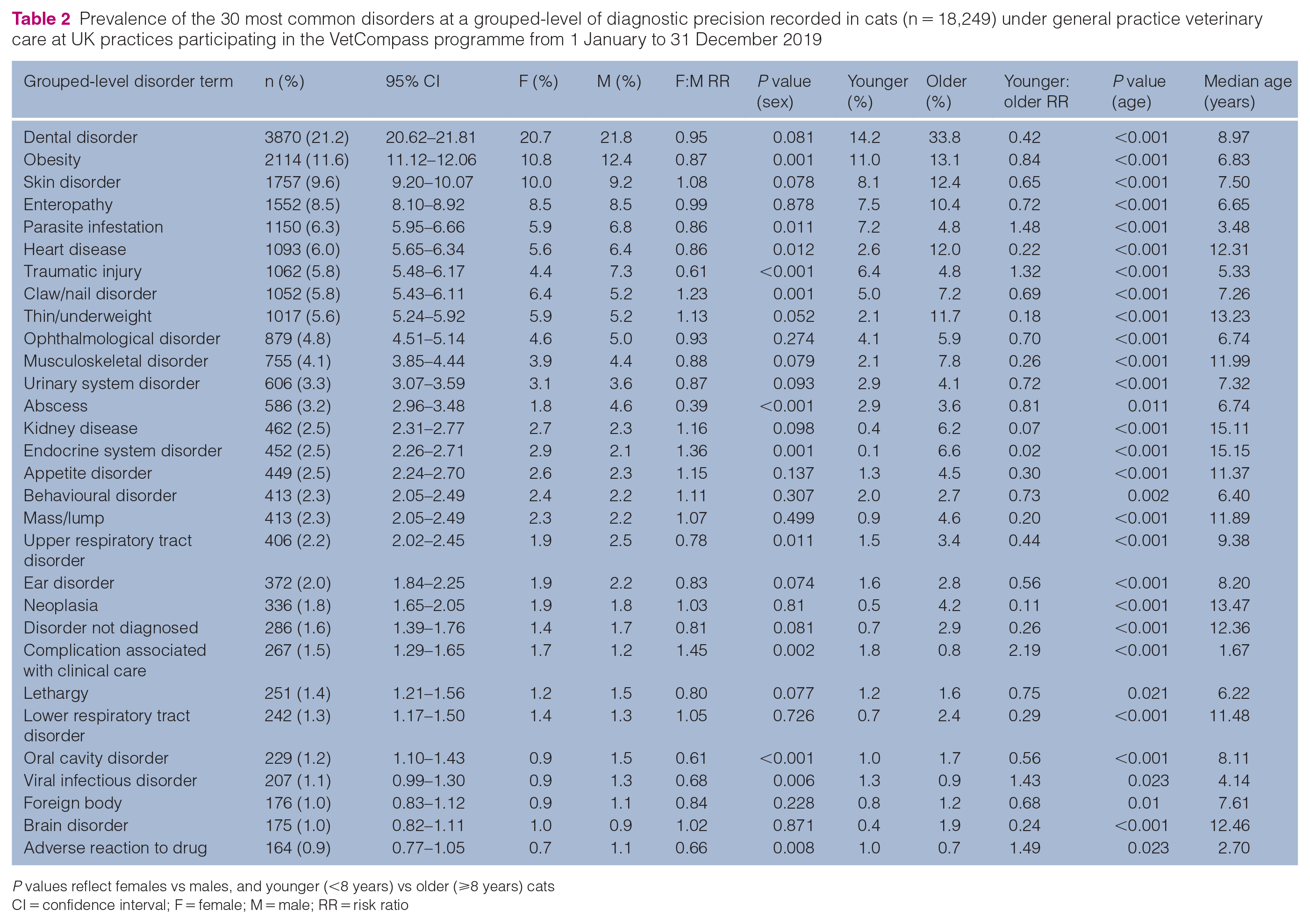
P values reflect females vs males, and younger (<8 years) vs older (⩾8 years) cats
CI = confidence interval; F = female; M = male; RR = risk ratio
Among the 30 most common grouped-level disorders, the prevalence differed between the sexes for 12 (40.0%) disorders. Females had higher prevalence than males for three disorders: complication associated with clinical care, claw/nail disorder and endocrine system disorder. Males had higher prevalence than females for nine disorders: heart disease, parasite infestation, upper respiratory tract disorder, adverse reaction to drug, viral infectious disorder, obesity, traumatic injury, abscess and oral cavity disorder.
The median age of cats recorded with each of the 30 most common grouped-level disorders varied from 1.67 years for postoperative wound complication to 15.15 years for endocrine system disorder. The prevalence differed between the younger (<8 years) and older (⩾8 years) cats for all 30 of the most common grouped-level disorders. Younger cats had a higher prevalence than older cats for five disorders: adverse reaction to drug, viral infectious disorder, complication associated with clinical care, parasite infestation and traumatic injury. Older cats had higher prevalence for the remaining 25 disorders (Table 2).
Discussion
This is the largest study to date to use general practice veterinary data to report the prevalence of commonly diagnosed disorders in cats in the UK. A study using a similar methodology was published in 2013; however, it included only 3584 cats vs 18,249 cats in the current study. 11 The present study used anonymised veterinary clinical data from the VetCompass programme 20 to report the frequencies of common disorders of cats under general veterinary care in the UK in 2019. The prevalence for each disorder was reported at a refined level of diagnostic precision (the precise level) and at a more general level of diagnostic precision (the grouped level). The study placed special focus on disorder associations with sex and age.
The results suggest an increase in the proportion of purebred cats in the UK, increasing from 11.0% in 2013 to 12.0% in 2019, and also a change in the relative popularity of some breeds, with Ragdolls now the second most popular pure breed in the UK and Persian cats dropping to fifth place. 11 Given the growing awareness of health and welfare issues associated with severe brachycephaly in companion animal species and growing public calls to ‘stop and think before buying a flat-faced animal’,27,28 it is reassuring for animal welfare to see a reduction in the ownership of the severely brachycephalic Persian breed with its documented health issues, 29 with choice of pure breed ownership potentially moving to the Ragdoll, which is only mildly brachycephalic.
The most prevalent disorders diagnosed in cats in 2019 were periodontal disease (15.2%), obesity (11.6%) and dental disease (8.2%). These findings are of particular note as comparison with a 2013 study that used a similar data source suggests an increase in the prevalence of dental disease (at a grouped level from 15.1% to 21.2%), with periodontal disease increasing at a precise-level diagnosis from 13.9% to 15.2%. At the group level, obesity increased from 6.7% to 11.6%. 11 The median age of the cats also rose from 4.50 years to 5.67 years between the time of the two studies, with an increase in the proportion of purebred cats from 11.0% to 12.0%, as well as some changes in the proportions of particular cat breeds (see below). However, it is noteworthy that there were some methodological differences between the two studies that may have accounted for some of these differences. For example, the current study included only diagnoses recorded during a single year of clinical care (2019), whereas the earlier study included all diagnoses recorded over a longer period (from September 2009 to 15 January 2014), which may have artifactually increased the probability of diagnosis-making within individual cats. It is also possible that the standard of note-making within veterinary clinical records may have changed over time and that these apparent differences in disorder frequency reflect more detailed record-making over time. However, if correct, marked increases in the prevalence of dental/periodontal disease in just 6 years are concerning. Although gingivitis is considered a reversible condition with adequate plaque control and thorough dental home care, gingivitis develops into periodontal disease as the disease progresses, and periodontitis is an essentially irreversible and progressive disease. 30 Similarly, the development and recognition of obesity should be readily apparent to owners, and represents another potentially preventable and reversible disorder. 8
An apparently rising UK prevalence of common disorders such as obesity and dental disease in cats not only suggests direct harm to health, but may also predispose affected cats to multimorbidities. For example, obesity is one of the main risk factors for feline type 2 diabetes mellitus 31 mediated by insulin resistance, 32 where insulin sensitivity is reduced by >50% in obese cats vs lean cats. 33 Obesity has also been associated with an increased risk of dermatological issues, OA, cardiovascular disease, neoplasia and urolithiasis. 34 Similarly, periodontal/dental disease has been associated with direct oral pain and tooth loss, as well as systemic bacteraemia 30 and CKD. 35 However, with good owner motivation and veterinary intervention, much of the suffering from these and other painful, debilitating and eventually life-limiting conditions that are highly preventable could be avoided in pet cats. 8 Obesity has grown to become one of the most significant health and welfare problems affecting pet cats in developed countries worldwide, with up to 60% of pet cats now being overweight or obese. 8 There are many reasons for worldwide rising levels of overweight/obesity in pet cats, including increased neutering, ease of access of highly palatable calorie-dense foods, reduced activity and changes in the owner–cat bond. 8 The older median age of the cats in 2019 vs 2013 may also have contributed to rising obesity rates, with some previous evidence for increased risk of obesity in cats possibly driven by reducing metabolic rates with ageing. 36
Consideration of health from the perspective of disorders with differential risk by sex and age could be used to tailor preventive healthcare strategies and improve patient outcomes. In the current study, when looking at age- and sex-associated disorders, female cats had an increased prevalence of poor QoL, postoperative complications (including post-spay issues) and hyperthyroidism, among other disorders, while males were more likely to have periodontal disease, RTA, heart murmur, lameness, obesity and cat bite abscesses, among others. Younger cats (<8 years old) had an increased prevalence of cat bite abscesses, flea infestation and RTA, while older cats (⩾8 years old) were more likely to have more than one disorder overall, including lameness, cystitis and dental disease, among others. These results support earlier evidence that cats tend to develop multimorbidities as they advance in years, such as lameness, hyperthyroidism and CKD. 37 Some of these sex associations have been noted previously (eg, increased risk of RTA in male cats vs females). 19 In addition, the current study also reports that male cats show increased risk of abscesses, wounds and cat bite injuries that are all likely secondary to greater tendencies towards roaming and fighting in male cats than in females. 38 The new information on sex and age predispositions provided in the current study can assist with the tailoring of preventive healthcare advice to the specific age and sex of individual cats for greater effect. For example, owners of young male cats could be advised to keep these cats indoors or to introduce night curfews to prevent or reduce the risk of RTA and cat fighting. Greater emphasis could be placed on ensuring older cats are assessed for multimorbidities, with females in particular being assessed for hyperthyroidism as soon as any weight loss is noted. When assessing older cats, asking owners to complete a short questionnaire exploring the signs of OA and dementia could help to identify these common conditions earlier (eg, the FMPI). 16
Understanding and leveraging the pet–owner bond is critical for improved delivery of effective preventive healthcare. 39 Veterinary teams can play a key supporting role in ensuring good health is maintained in pet cats in their home environment in relation to disorders such as obesity and dental disease. Practical and innovative ways need to be developed to communicate more effectively with owners (eg, putting attention-grabbing information about dental disease and obesity into kitten packs, and sharing reliable information on the high frequency and welfare impacts of these diseases, along with useful information on preventive actions that owners can take). Veterinary nurse clinics could be used more effectively at early intervention points to promote better oral healthcare and give advice about weight gain in pet cats. 40 Movement of standard vaccination protocols towards 3-yearly time frames may inadvertently reduce routine owner–veterinary contact, resulting in diminished levels of healthcare for cats, as well as a loss of veterinary revenue if owners do not perceive a financial value from health-check consultations in the absence of a vaccination. 41 However, owners may be willing to attend nurse clinics that could provide an important preventive healthcare service and identify cats that need referral for a full veterinary surgeon consultation, thereby avoiding the patient being lost from the practice and also allowing the clinic to recover some of this lost revenue.
The current study has some limitations. The participating practices were a convenience sample of six veterinary groups in the UK and therefore may not be fully representative of all veterinary practices in the UK. VetCompass continues to recruit practices, and future studies will increasingly represent more UK veterinary practices. The quality and validity of EPR recording relied on the clinical acumen and note-taking of individual practitioners. Many of the extracted disorder terms reflected the norms of primary care practice by representing presenting signs (eg, lameness) recorded in lieu of full, formal biomedical diagnoses. The use of these terms might reflect the instigation by clinicians of empirical management protocols at the initial presentation of common disorders, reducing the temporal and financial burden of requiring a confirmed clinical diagnosis. It is possible that the selection of the first sign from lists with multiple presenting sign terms (eg, ‘vomiting and diarrhoea’) could have skewed the prevalence results at the diagnosis level; however, this should not have misclassified the results at the grouped level of precision. Neuter status was included in the analysis as recorded in the originating clinical data; however, these values may be falsely low because many veterinary practice management software systems apply a default neuter value of ‘entire’, which might not always be updated post-neutering. The effects of neutering on disorder occurrence were not explored in the current study because neuter status is a time-dependent variable, and the temporal order of disorder occurrence and neutering were not extracted in the current study data. Some purebred and pedigree-cross cats might have been misclassified in the EPR data. The number of cats from specific pure breeds was under-powered for statistically reliable breed-based analyses.
Conclusions
This study identified the most prevalent disorders of cats presented to general practice veterinary clinics in the UK as periodontal disease, obesity and dental disease. Compared with results from a similar study 6 years earlier, the 2019 results suggest an increasing diagnosis rate of dental disease and obesity in UK pet cats. Several disorders were noted with differential risk by age and sex, suggesting some useful welfare opportunities for veterinary professionals to target tailored veterinary care to specific higher-risk groups of cats. The high frequency of preventable disorders such as dental disease and obesity in pet cats suggests the value of improved veterinary communication and education of the cat-owning public about the value of preventing obesity and implementing dental care programmes. Overall, these results across the spectrum of common disorders in cats can assist veterinarians, veterinary nurses, cat breeders and cat owners by providing an evidence base to understand and predict disorder occurrence, and to identify key health and welfare opportunities for their cats.
Footnotes
Acknowledgements
Thanks to Noel Kennedy (RVC) for VetCompass software and programming development. We are grateful to the following researchers, who assisted with data collection during this project: Alyx Blenkarn, Annabelle Loustric, Annie Mura, Harriet McAuslan, Kirstin Sutherland and Rebecca Bostock. We acknowledge the Medivet Veterinary Partnership, Vets4Pets/Companion Care, Goddard Veterinary Group, CVS Group, IVC Evidensia, Linnaeus Group, Beaumont Sainsbury Animal Hospital, Blue Cross, PDSA, Dogs Trust, Vets Now and the other UK practices who collaborate in VetCompass. We are grateful to The Kennel Club Charitable Trust, Agria Pet Insurance and The Kennel Club for supporting VetCompass. The data set supporting the conclusions of this article will be made available in the RVC Research Online repository.
Conflict of interest
The authors declared no potential conflicts of interest with respect to the research, authorship, and/or publication of this article.
Funding
This study was supported at the RVC by an award from the Kennel Club Charitable Trust and Agria Pet Insurance. Neither the Kennel Club Charitable Trust nor Agria Pet Insurance had any input in the design of the study, the collection, analysis and interpretation of data, or in writing the manuscript.
Ethical approval
The work described in this manuscript involved the use of non-experimental (owned or unowned) animals. Established internationally recognised high standards (‘best practice’) of veterinary clinical care for the individual patient were always followed and/or this work involved the use of cadavers. Ethical approval from a committee was therefore not specifically required for publication in JFMS. Although not required, where ethical approval was still obtained, it is stated in the manuscript.
Informed consent
Informed consent (verbal or written) was obtained from the owner or legal custodian of all animal(s) described in this work (experimental or non-experimental animals, including cadavers) for all procedure(s) undertaken (prospective or retrospective studies). For any animals or people individually identifiable within this publication, informed consent (verbal or written) for their use in the publication was obtained from the people involved.
