



Abstract
Objectives
The COVID-19 pandemic saw major changes to small animal veterinary practice, many of which may have had an impact on stress in cats presented to the clinic. The aim of this study was to examine the nature of feline outpatient visits before and during the pandemic, and examine signs of stress noted in cats before, during and after these visits.
Methods
A questionnaire was used to gather data on cat owner experiences of visits to the veterinary clinic. Data were gathered on the owner’s most recent experience of a consultation, with consultations occurring in February 2020 or earlier coded as a standard consultation, and consultations occurring in March 2020 or later coded as COVID-19 consultations.
Results
A total of 371 responses were received, with 210 coded as standard consultations and 161 coded as COVID-19 consultations. Consultation type varied significantly between standard and COVID-19 consultations (P <0.001), with emergency consultations more frequent and preventive healthcare consultations less frequent during the COVID-19 pandemic. The area in which the owner and their cat waited also varied significantly between standard and COVID-19 consultations (P <0.001), with standard consultations more likely to involve time in a waiting room while COVID-19 consultations were often called straight in or waited outside the practice. Most owners notedbehaviours associated with stress in their cats, regardless of consultation type, although trying to hide or escape were noted more frequently for cats seen prior to the COVID-19 pandemic.
Conclusions and relevance
The findings suggest that outpatient visits to the veterinary clinic were stressful for cats both prior to and during the COVID-19 pandemic, but some measures taken during the pandemic, for example less use of waiting rooms, could be used alongside existing cat friendly measures to help to reduce stress in feline patients.
Introduction
The initial months of the COVID-19 pandemic saw various major changes in small animal veterinary practice, including the increased use of personal protective equipment; 1 a switch to increased use of telemedicine and remote prescribing; changes in the approach to routine procedures such as vaccination and neutering; limiting client contact to urgent, emergent or emergency situations; and changes in access to indoor areas of the clinic for clients.2–4 This may have led to changes in sources of stress for cats being presented to the clinic during the pandemic.
The Happy Cats survey was set up to identify important sources of stress for cats before, during and after outpatient visits to the veterinary clinic, and highlight measures that may be effective in addressing these sources of stress. As the survey was developed just prior to the start of the pandemic, the data collection period provided an opportunity to examine differences in potential sources of stress for cats presented to the clinic before and during the pandemic.
The aim of this study was to examine differences in the nature of feline outpatient visits before and during the COVID-19 pandemic, and to examine signs of stress noted in these cats before, during and after their visit. Given the potentially quieter, less populous clinics and reduced use of waiting rooms, it was hypothesised that cats presented during the pandemic would show fewer signs of stress.
Materials and methods
The target population for the questionnaire was cat owners or carers with recent experience of a veterinary consultation. Respondents could take part from anywhere in the world, had to be at least 18 years old and could only complete one questionnaire per household. The questionnaire (see the supplementary material) was made up of 51 questions taking a variety of forms, including numerical score, multiple choice and free-text boxes. Questions around cat behaviours associated with stress were developed through discussion and consensus among authors (SMAC, RSD and DAG-M) based on their experiences and insights, and supported by the literature. 5 The final questionnaire was hosted on the Vet Professionals website in full compliance with General Data Protection Regulation (EU 109 2016/679). The questionnaire ran from 24 March to 1 July 2020. An invitation to complete the relevant survey was emailed to cat owners on the Vet Professionals database, promoted on social media (eg, Facebook and Twitter) and promoted by relevant organisations (eg, International Cat Care and Cats Protection), and snowball sampling was also conducted.
Data collected from the survey were collated and stored using FormSite (Vroman Systems) before being downloaded to Microsoft Excel for data processing and descriptive analysis. Responses were excluded if participants had not proceeded past the consent page or had only answered the demographics section/had not answered at least one question about their experience of visiting the clinic. Demographic data and responses to questions about the owner’s most recent experience of attending the clinic with their cat are considered in this paper. Other sections of the questionnaire have been submitted for publication separately. Consultations that took place during February 2020 or earlier were coded as standard consultations, while consultations that took place during March 2020 or later were coded as COVID consultations. Percentages were generated for categorical variables, while for non-parametric continuous variables, such as patient age, median and interquartile range (IQR) were generated. χ2 analysis was conducted in SPSS Version 28 (IBM) to compare categorical variables such as consultation type or waiting area between standard and COVID-19 consultations. For χ2 analysis, consultation type categories were condensed into emergency (in or out of hours); illness (short or long term); admit for surgery; preventative healthcare; and other.
Approval was obtained from the Human Ethical Review Committee (HERC) at the Royal (Dick) School of Veterinary Studies, The University of Edinburgh, for the collection of data through an online questionnaire of cat owners, and subsequent analysis of this data (approved 21 March 2020; reference: HERC_483_20).
Results
Demographics
There were a total of 371 responses to the questionnaire. Most respondents (n = 273 [73.6%]) were from the UK, 44 (11.9%) were from the USA, 11 (3.0%) were from Ireland and 19 other countries were represented (all <10 each). A total of 210 responses were about ‘standard’ consultations, while 161 responses were about ‘COVID’ consultations. The cats presented for consultation were comparable in age between standard and COVID-19 consultations, with both having a median age of 7 years (IQR 3–12).
Purpose of the visit
COVID-19 consultations were more frequently for an emergency (either out of hours or during normal hours) and, less frequently, for preventive medicine than standard consultations (Figure 1). Consultation type varied significantly between COVID-19 and standard consultations (χ2 = 32.115 [4 degrees of freedom, n = 371]; P <0.001).

Type of consultation the cat was presented for during standard (n = 210) and COVID-19 (n = 161) consultations
Waiting room
Standard consultations more frequently involved the patient waiting in a shared waiting room or a cat-only area of the general waiting room, while COVID-19 consultations more frequently involved the patient being called straight in or an ‘other’ option being selected (Figure 2) (χ2 = 88.166 [4 degrees of freedom, n = 328]; P <0.001). Most of those selecting ‘other’ waited outside the practice (eg, in their car or in the car park).
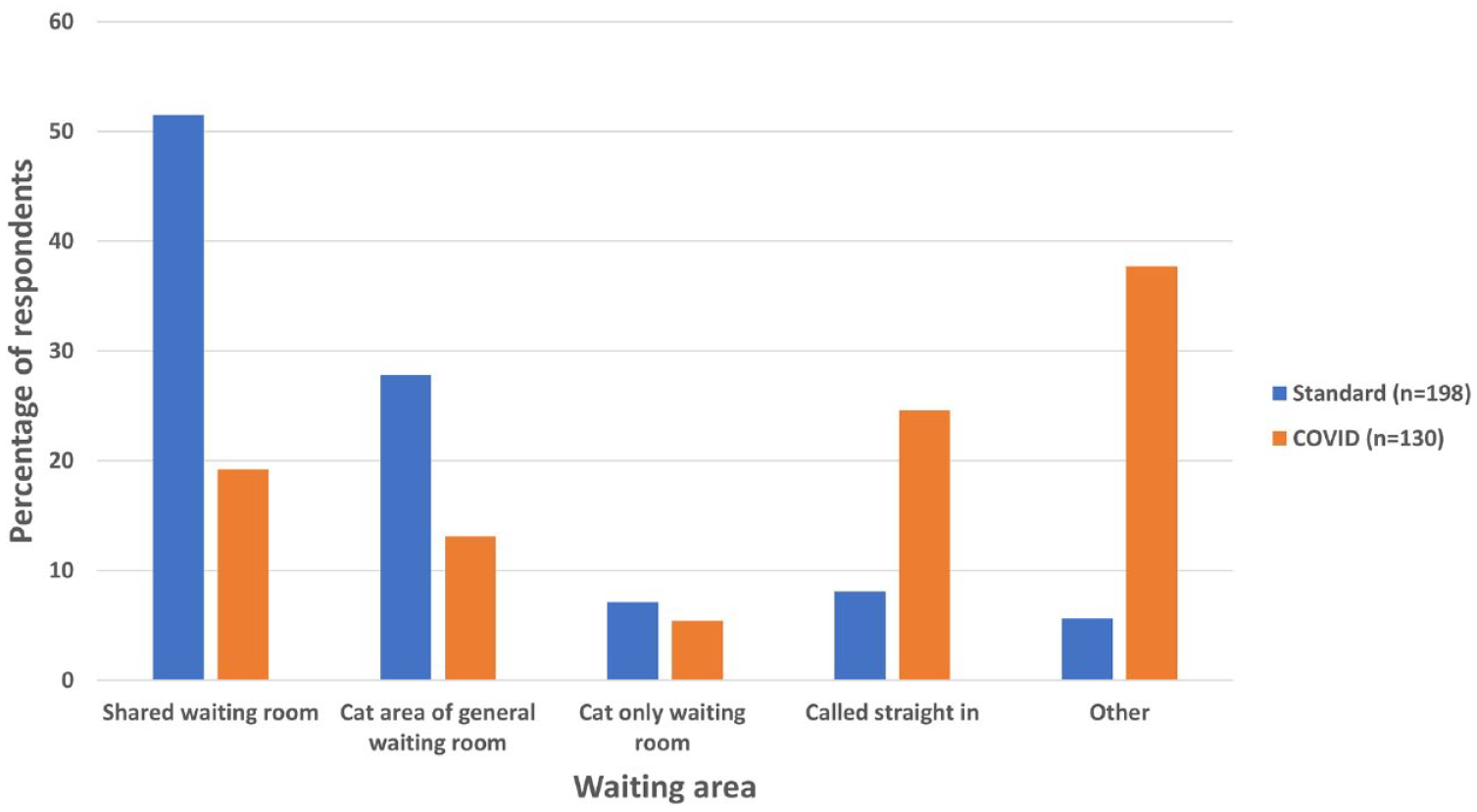
Area in which the client and cat waited for the consultation for standard (n = 198) and COVID-19 (n = 130) consultations. Most of those selecting ‘other’ waited outside the practice (eg, in their car or in the car park)
Behaviour
Most owners recognised at least one behaviour associated with stress in their cat before, during or after the visit (covering the time period from getting the cat into their carrier right through to their behaviour for the rest of the day at home, after the consultation). Some behaviours, such as trying to escape or hide, were noted more frequently for standard than for COVID-19 consultations (Figure 3).

Cat behaviours noted by the client at any point during a visit for a standard (n = 193) or COVID-19 (n = 115) consultation (including getting the cat into the carrier, transporting the cat to the clinic, waiting to be called in, etc). Multiple options could be selected for cats displaying more than one of these behaviours
Discussion
The results highlight differences in the nature of consultations before the pandemic and in the early months of it. The occurrence of less preventive medicine and more emergency appointments during the COVID-19 period might generally be expected to be associated with higher stress levels for cats and owners presenting to the veterinary clinic, owing to the cats being unwell. However, the findings highlight changes in procedure during COVID-19, such as less use of the waiting room, with more being called straight in or waiting outside, which may have had a positive impact on cat stress. Additional findings from this survey will be reported separately (Caney SMA, Robinson NJ, Gunn-Moore DA and Dean, RS, unpublished data) but found that owners rated various aspects of the waiting room experience, such as length of wait and presence of other people and animals, as stressful for their cats. This raises the question of whether some measures introduced during the COVID-19 pandemic, for example cat owners waiting outside in their car until the consultation itself, could be beneficial in reducing cat stress, particularly in practices where the provision of other cat friendly measures (eg, a cat-only waiting room or area) 6 is not feasible. Increased use of telemedicine alongside face-to-face appointments may be another change worth retaining post-pandemic, with recent findings suggesting that both veterinary professionals and owners viewed reduced stress for their cat to be the biggest advantage of telemedicine. 7
Despite the differences in the nature of and procedures surrounding consultations, the majority of owners noted at least one behaviour associated with stress during their visit to the veterinary clinic. Many of the owners presenting their cat during the COVID-19 pandemic may not have been present in the consultation itself due to changes in procedure, which may explain why behaviours that are easier to observe with the cat out of its carrier (eg, ‘trying to hide’ and ‘trying to escape’) were noted less frequently by these owners. The finding that most of these owners noted other signs of stress in their cat during the lead up to and after the consultation highlights that it is not simply the consultation itself that is a source of stress. The importance of reducing stress in cats requiring veterinary attention has been highlighted by another recent study, 8 and should focus on all stages of the visit, including whether the visit should be face to face or virtual; how owners can help make travel less stressful for their cat; the waiting room experience; and the consultation itself.
One limitation of this study is that it was planned before the pandemic, and so questions were not tailored to asking owners about their experience in the light of changes in procedure due to COVID-19, and no data were gathered on the COVID-19 restrictions in place for that consultation, with these varying considerably between practices. Questions in the survey that asked about the consultation itself, for example perceived stress rating, method of removal from carrier and scruffing, could not be included as the owner was mostly not present in the consultation room during the COVID-19 pandemic. In addition, the use of March 2020 onwards as a cut-off may not have been an accurate reflection of when changes in procedure took place, with some COVID-related precautions introduced sooner than others.
Conclusions
Visits to the veterinary clinic occurring both before and during the pandemic are a source of stress, but some measures taken during the COVID-19 pandemic (eg, less use of waiting rooms) could be useful for reducing cat stress in the future, alongside other measures.
Supplemental Material
Supplementary File 1
Happy Cats Online survey to study stress in cats and their carers when visiting a veterinary clinic as an outpatient.
Footnotes
Acknowledgements
The authors thank Vet Professionals for their involvement in promoting the questionnaire, and the cat owners involved in completing the questionnaire.
Supplementary material
The following file is available online:
Supplementary File 1: Happy Cats Online survey to study stress in cats and their carers when visiting a veterinary clinic as an outpatient.
Conflict of interest
The authors declared no potential conflicts of interest with respect to the research, authorship, and/or publication of this article. The topic of study, study design, statistical analysis, interpretation of the results, decision to publish and writing of the manuscript were undertaken independently of the funders MSD Animal Health.
Funding
This work was supported by MSD Animal Health.
Ethical approval
This work did not involve the use of animals and therefore ethical approval was not specifically required for publication in JFMS. Although not required, where ethical approval was still obtained, it is stated in the manuscript.
Informed consent
This work did not involve the use of animals (including cadavers) and therefore informed consent was not required. No animals or people are identifiable within this publication, and therefore additional informed consent for publication was not required.

References
Supplementary Material
Please find the following supplemental material available below.
For Open Access articles published under a Creative Commons License, all supplemental material carries the same license as the article it is associated with.
For non-Open Access articles published, all supplemental material carries a non-exclusive license, and permission requests for re-use of supplemental material or any part of supplemental material shall be sent directly to the copyright owner as specified in the copyright notice associated with the article.
