



Abstract
Objectives
The aim of this study was to determine how frequently body weight, body condition score (BCS) and terms pertaining to weight status are recorded in the electronic health records (EHRs) of veterinary practices in the UK, as well as to examine the variables affecting recording and associated with body weight, where recorded.
Methods
Data recorded in EHRs were searched in two 3-month periods in 2019 and 2020. For each visit, variables including type and time of consultation, signalment, recording of body weight, recording of BCS, weight (kg), BCS value and whether an overweight or weight-loss term was used in free text were recorded. Linear mixed-effects models were created to examine associations between body weight and variables, while mixed-effects logistic regression was used to determine associations between the same variables and weight or BCS recording.
Results
The statistical data set comprised 129,076 visits from 129,076 cats at 361 practices. Weight was recorded at most (95.2%) visits, BCS was recorded at only 22.5% of visits, and terms associated with weight loss and overweight status were recorded in 10.0% and 7.2% of free-text records, respectively. Where BCS was recorded, approximately one-third of cats had an overweight score (8.0% of total visits). Using either an overweight term (P <0.001) or weight-loss term (P <0.001) was associated with increased odds of body weight being recorded, while being an out-of-hours (P <0.001) or non-routine consultation (P <0.001) were associated with decreased odds. Increasing age (P <0.001), using a weight-loss term (P <0.001) and using an overweight term (P <0.001) were associated with increased odds of BCS being recorded, while being a non-routine consultation (P <0.001) was associated with decreased odds. Recording BCS was negatively associated with recording body weight and vice versa.
Conclusions and relevance
Cats are regularly weighed in UK practice, but BCS is less frequently recorded, and both are less often recorded in non-routine consultations. To improve both the treatment and assessment of health and nutrition in cats, veterinary professionals should record body weight and BCS concurrently at every consultation.
Introduction
Obesity is one of the most common medical disorders of pet cats,1,2 and is regarded as a significant welfare issue, 3 given its associations with multiple comorbidities2,4 and mortality. 5 Cats in underweight condition also have a greater overall mortality risk and higher morbidity.5,6 As a result, regular assessment of body weight and body condition score (BCS) are important for establishing a cat’s health status, as well as for ensuring accurate medication dosing. The early identification of changes in either body weight or BCS, or both, enable prompt action, in terms of both diagnostic investigations and intervention.
Measuring body weight has the advantages of being quick, easy, repeatable and objective, but it cannot be used alone to assess body composition as it cannot readily distinguish the contribution of different tissue types. 7 Nonetheless, regular body weight recording is a very sensitive method of monitoring weight change over time. 8 Body condition scoring is a rapid, semi-quantitative method estimating body fat percentage through visual assessment of body shape and palpation of body fat. 9 The most commonly used systems include the 5- or 9-point scales, which are used based on individual preference. A 9-point BCS scale has high interassessor agreement and correlates well with the gold standard dual-energy X-ray absorptiometry (DEXA) when estimating body fat percentage.9–12
Previous studies suggest that veterinarians infrequently record body weight or BCS for dogs, 13 and rarely record terms pertaining to weight status (eg, ‘overweight’ or ‘obese’) in the electronic health records (EHRs). 14 Nutritional assessment, which includes body weight and BCS assessment, is also rarely performed by veterinary professionals in several countries.15,16
However, to date, no studies have assessed how frequently such measures are recorded for cats in veterinary practices in the UK. Therefore, the aim of this study was to investigate how frequently veterinarians recorded body weight, BCS and terms pertaining to the weight status of cats in electronic patient records, as well as to explore variables that may affect the reporting of such measures. A second aim was to determine variables associated with body weight in cats where this had been recorded.
Materials and methods
Data collection
Ethical approval was provided by CVS Ethical Review Committee (CVS-2021-007) and the Central University Research Ethics Committees, University of Liverpool (ref. 10074). Utilising data stored within the practice management system (RoboVet) of CVS, a corporate group in the UK, EHRs were searched by time frame for entries based on the criteria of a specified consultation or vaccination professional fee being sold to feline patients. Data from two time periods were included, comprising the final quarter (1 October to 31 December) of 2019 and 2020. Data were extracted from each entry to confirm whether the cat’s weight had been recorded within the system’s statistics table or whether the abbreviations or phrases ‘kg’, ‘BCS’ or ‘body condition score’ were recorded in the clinical record (1 indicating present, 0 indicating absent). This excluded entries of ‘kg’ where this text was associated with dispensing labels only. Each entry was exported to Microsoft Excel for analysis.
Variables recorded
For each visit, the following variables were recorded: cat ID; practice ID; year (2019 vs 2020); day type (weekday vs weekend); consultation type (routine vs non-routine; see the table in the supplementary material for definitions); time period (morning, afternoon, evening, out-of-hours); age; sex (female vs male); neuter status (sexually intact vs neutered); breed group (based on Governing Council of the Cat Fancy [GCCF] classification); whether weight was recorded (yes vs no); whether a BCS was recorded (yes vs no); weight (kg); BCS value; and whether an overweight term or weight-loss term was used in the free text (Table 1). Overweight BCS was classed as >5/9 or >3/5, depending upon the system. Where BCS was recorded without a denominator (eg, /5 or /9), cats were only classified as ‘overweight BCS’ when the system used was obvious. In this respect, scores of 4 or 5 without a denominator were not included because it was unclear whether they represented ideal weight (on the 9-point BCS system) or overweight (on the 5-point BCS system); conversely, scores of 6–9 were included because such scores implied that the 9-point system had been used.
Terminology assessed in the free text of electronic health records

Statistical analysis
Data were first entered into an electronic spreadsheet (Microsoft Excel for Mac version 16.19), and checked for errors (eg, typographical errors with categorical variables and unrealistic values for age and body weight). The final data sets are summarised in Table 2. Statistical analyses were performed with both a computer software package (JMP version 16.0.0; SAS Institute) and an online open-access statistical language and environment (R version 4.2.0; http://www.R-project.org). The computer software package was used to calculate summary data for the ‘complete data set’ (data after error checking), including proportions (percentages) for categorical data, mean ± SD for continuous data that were normally distributed (determined by Shapiro–Wilk test and examination of Q–Q plots), or median and interquartile range (IQR) for continuous data that were not normally distributed. However, given that the data set used for statistical analyses used only one visit per cat (see below), data on the number of visits were reported as median (range), so that the full extent of the data range could be highlighted. Further, given concerns over reliability, data on neuter status were not recorded or used in analyses. In this respect, neuter status must be manually changed within the EHR at the time of neutering, and this is not consistently done (ST and ME, personal observations), meaning that many cats recorded as sexually intact might, in fact, have been neutered.
Summary of demographic data for cats included in the study

Data are presented as n (%) unless otherwise indicated
Number with missing data; note that these data are not used in percentage calculations for categorical data
IQR = interquartile range
The ‘text explorer’ function of the computer software package was also used to analyse free-form text in electronic patient records to identify visit records that included terms associated with overweight status, weight loss and BCS (see Table 1). This function enables a list of terms to be identified from the free text along with the frequency of their use. One observer (AJG) reviewed this list to identify the relevant terms to be included in the analysis. Prior to selection, the context of use of each term was determined by reviewing random selections of free text where the term appeared. This ensured that the terms included in the analysis were relevant even when there were spelling errors. Some terms of potential relevance were not included because they were sometimes used in alternative (irrelevant) contexts. For example, the word ‘fat’ was often used to describe adipose tissue rather than to infer the presence of obesity (eg, subcutaneous fat, inflamed fat and the presence of fat during surgery). Likewise, the term ‘thin’ was commonly used as a descriptor for body parts, tissues or disease processes (eg, thin haircoat, thin layer of tartar and thin gap). Finally, when identifying terms associated with weight loss, no distinction was made between cats where the weight loss was intentional (eg, weight management in an overweight cat) and those where weight loss was related to illness.
The online statistical environment was used for mixed-effects linear modelling and mixed-effects logistic regression (using the package lme 4). 17 To ensure that models remained balanced, a subset of data was created (the ‘statistical data set’); first, only centres where there had been at least 200 visits were selected. Thereafter, a single visit was selected for each cat seen, by taking the first available visit chronologically. The cats included in the statistical data set were broadly similar to those in the main population (Tables 2 and 3). Linear mixed-effects models were created to examine associations between body weight and the variables described above (see ‘Variables recorded’); mixed-effects logistic regression was used to determine associations between the recording of either weight or BCS and the same variables. In all models, centre was included as a random effect, while all remaining variables were included as fixed effects. Initially, separate models were constructed with both the random effect and a single fixed effect. Thereafter, a further model was constructed, again containing the random effect and all fixed effects that were statistically significant (P <0.05) in the initial models.Competing models were then tested in a backwards and forwards stepwise fashion with the best-fit model chosen using the Bayesian Information Criterion (BIC); with this approach, the model was repeatedly refined with the addition or removal of variables until the model with the smallest BIC was found. Models with interaction terms were also tested when these were thought to be clinically relevant. These included possible interactions between year and GCCF breed, pedigree status, recording a weight-loss term, recording an overweight term or recording an overweight BCS; possible interactions between day type and time period or consultation type; possible interactions between consultation type and either age or time period; and possible interactions among recording an overweight BCS, using an overweight term or using a weight-loss term. Such interaction terms were retained in the model when overall fit was improved (as determined by the BIC). Possible multicollinearity in all models was assessed using the generalised variance inflation factor (GVIF) and GVIF(1/(2×Df), and was deemed to be acceptable when all values were <4 and <2 for GVIF and GVIF(1/(2×Df), respectively. For mixed-effects linear regression models, residuals were checked (using scatterplots of residuals vs fitted values, histograms and Q–Q plots), while influential data points were identified using Cook’s distance and removed if necessary (Cook’s distance >0.1). The results of the linear mixed-effects models are expressed as least-squares means and 95% confidence intervals (CIs), with pairwise comparisons among subgroups made using the Tukey method. The results of mixed-effects logistic regression models are reported as odds ratios (ORs) with the associated 95% CI. For all analyses, the level of statistical significance was set at P <0.05 and two-sided analyses were used throughout.
Summary data for cats included in the study

Data are presented as n (%) unless otherwise stated
Number with missing data; note that these data are not used in percentage calculations for categorical data
GCCF = Governing Council of the Cat Fancy; IQR = interquartile range
Results
Final study population and subset for statistical analysis
The complete data set comprised 240,115 visits from 136,052 cats at 486 different centres (Table 2). The median number of visits recorded at each centre was 397 (IQR 189–735), the median number of visits per cat was 1 (range 1–16) and there were a similar number of visits in 2019 and 2020. Median age was 7.7 years (IQR 3.2–12.5 years; Table 3), there was a broadly equal distribution of male and female cats (male 50.7%, female 49.3%) and most cats were of mixed breed (n = 119,614; 87.9%), but several other breeds were also included (Table 3). The statistical data set comprised 129,076 visits from 129,076 cats at 361 different veterinary centres, with the distribution of data being broadly similar to the complete data set (Table 2), except that almost two-thirds of visits were in 2019.
Weighing, body condition scoring and terminology
In the complete data set, weight was recorded at most (228,480; 95.2%) visits, whilst BCS was recorded at less than a quarter (n = 54,010; 22.5% [Table 4]). In a minority of records, terms associated with weight loss (n = 24,012; 10.0%) and overweight status (n = 17,265; 7.2%) were used in the free text, while an overweight BCS was formally recorded at 19,318 visits (8.0%), corresponding to approximately one-third of occasions where BCS was recorded (Table 4).
Summary data for weight and body condition data recorded at visits

Data are presented as n (%)
BCS = body condition score
Variables associated with body weight
Tables 5 and 6 show the results from the initial and final linear mixed-effects models, respectively, assessing the associations between body weight and different variables. In the final model, the variables positively associated with body weight (kg) were consultation type (non-routine >routine; P <0.001); day type (weekend >weekday; P <0.001); time period (afternoon >evening; P = 0.046); age (P <0.001); sex (male >female; P <0.001); GCCF group (Maine Coon and Norwegian Forest Cat >mixed breed >Birman, Persian, Ragdoll, Russian, Siamese and other GCCF; all P <0.001); overweight term used (P <0.001); and overweight BCS recorded (P <0.001). The variables negatively associated with body weight were year (2020 <2019; P <0.001) and use of a weight-loss term (P = 0.003). The final model also included a negative interaction term between consultation type and age, whereby mean body weight was marginally greater at routine vs non-routine consultations (P <0.001). A further interaction was evident between year and consultation type, whereby the weight of cats attending routine consultation was less in 2020 than in 2019 (P <0.001). There were additional interactions between year and either using an overweight term or recording an overweight BCS (P <0.001 for both); in both cases, the average weight of cats was greater in 2020 than in 2019, when either an overweight term was used or an overweight BCS was recorded (P <0.001 for both). Further, there were interactions between the use of a weight-loss term and either the use of an overweight term or the recording of an overweight BCS; in both cases, the average weight of cats was greater when a weight-loss term was recorded with either an overweight term or an overweight BCS (P <0.001 for both). Finally, there was a negative interaction between the use of an overweight term and the recording of an overweight BCS (P <0.001).
Results of the initial mixed-effects linear models examining univariable associations between various fixed effects and body weight
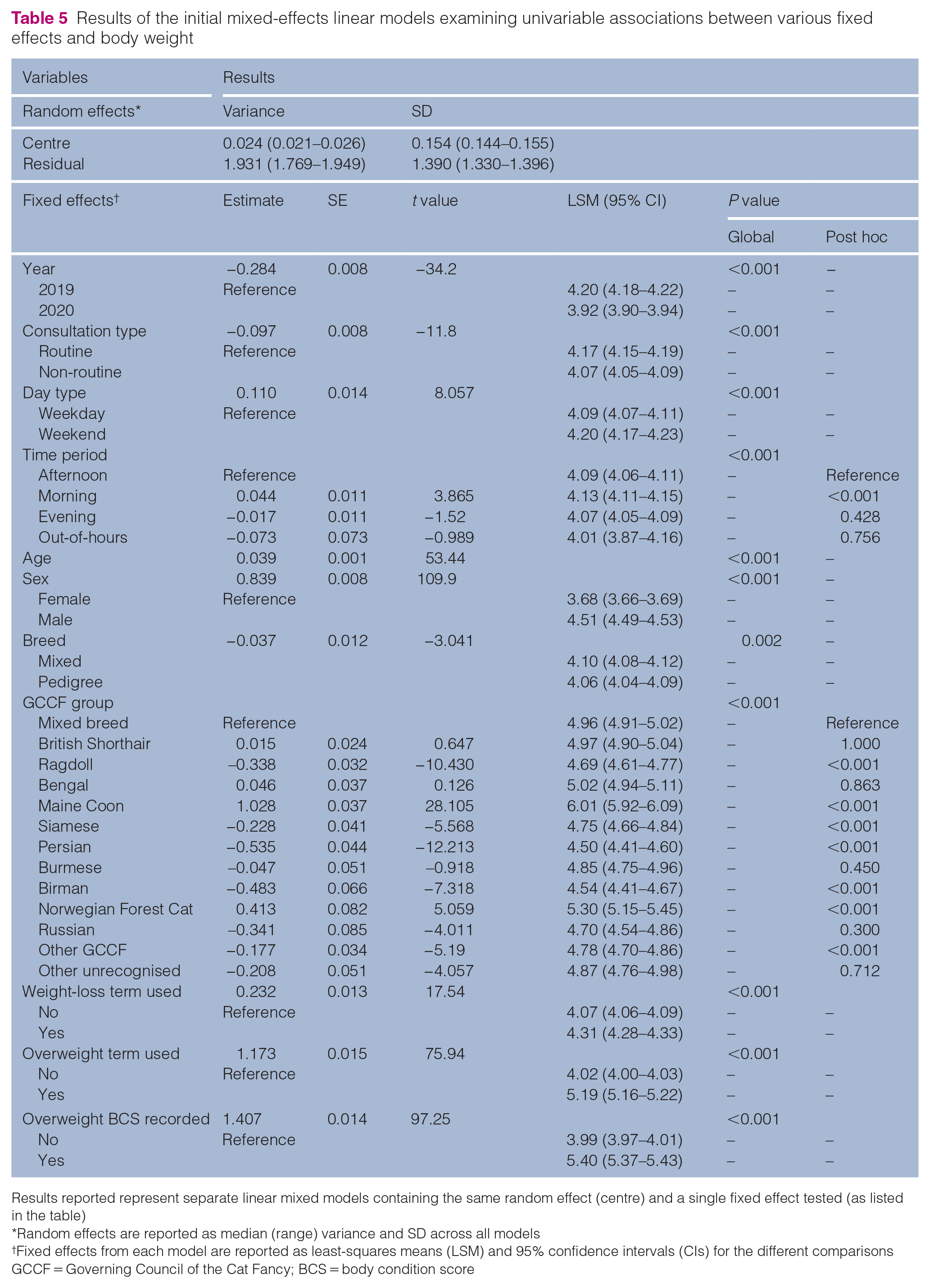
Results reported represent separate linear mixed models containing the same random effect (centre) and a single fixed effect tested (as listed in the table)
Random effects are reported as median (range) variance and SD across all models
Fixed effects from each model are reported as least-squares means (LSM) and 95% confidence intervals (CIs) for the different comparisons
GCCF = Governing Council of the Cat Fancy; BCS = body condition score
Results of the final multivariable mixed-effects linear model examining associations between various fixed effects and body weight

Results reported represent the final best-fit multivariable linear mixed model containing the random effect (centre) and a different combination of all fixed effects (as listed in the table)
Random effects are reported as the variance and SD of the final model
Fixed effects from each model are reported as least-squares means (LSM) and 95% confidence intervals (CI) for the different comparisons
Interaction terms included in the final model
GCCF = Governing Council of the Cat Fancy; BCS = body condition score
Variables associated with veterinary professionals recording body weight
Tables 7 and 8 show the results from initial and final mixed-effects logistic regression models, respectively, assessing associations between the recording of body weight by veterinarians and different variables. In the final multiple logistic regression model, using either an overweight term (P <0.001) or weight-loss term (P <0.001) was associated with increased odds of body weight being recorded, while being an out-of-hours consultation (P <0.001), being a non-routine consultation (P <0.001) or having BCS recorded (P <0.001) were associated with decreased odds.
Results of the initial univariable mixed-effects logistic regression models examining associations between various fixed effects and veterinary professionals recording body weight
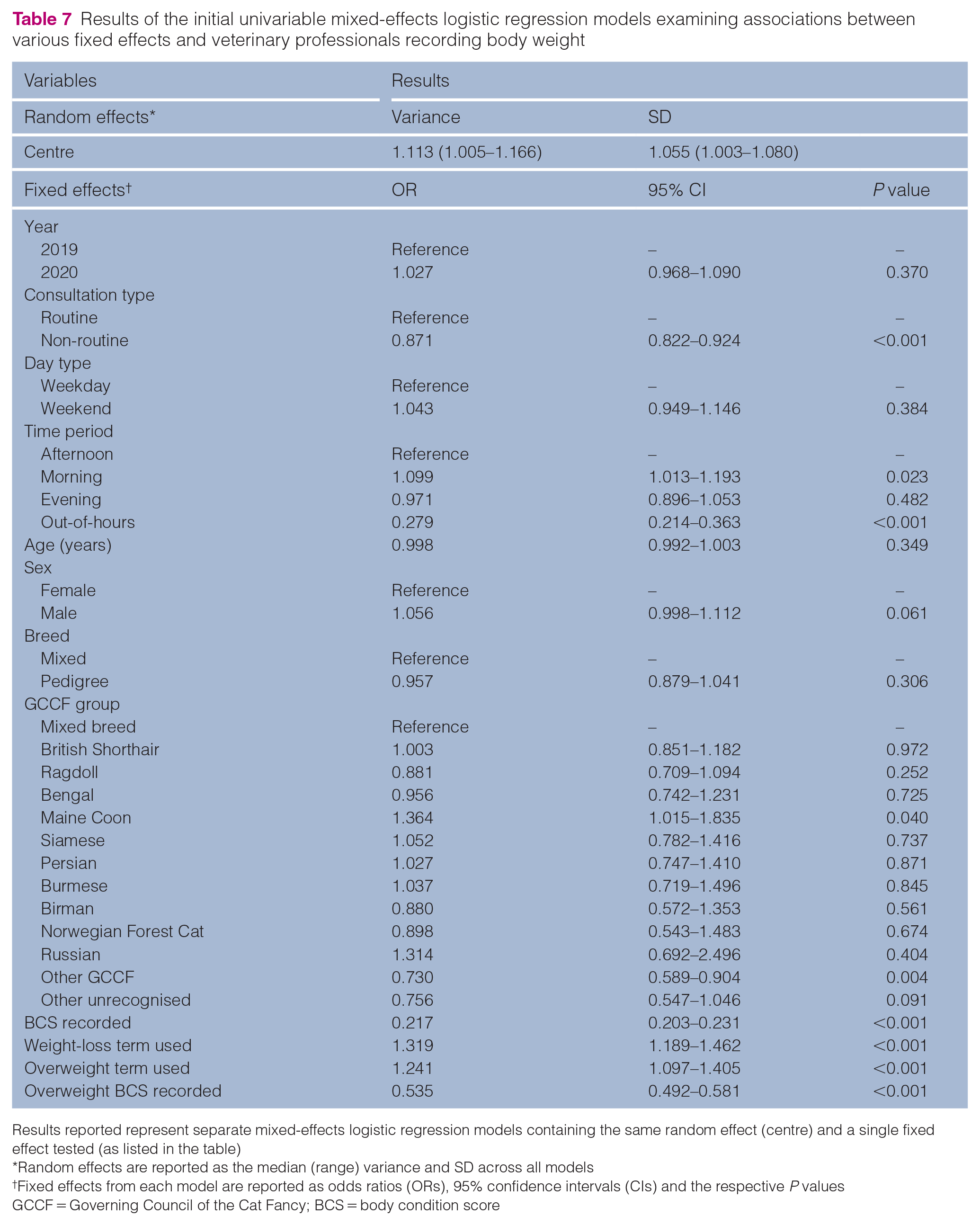
Results reported represent separate mixed-effects logistic regression models containing the same random effect (centre) and a single fixed effect tested (as listed in the table)
Random effects are reported as the median (range) variance and SD across all models
Fixed effects from each model are reported as odds ratios (ORs), 95% confidence intervals (CIs) and the respective P values
GCCF = Governing Council of the Cat Fancy; BCS = body condition score
Results of final multivariable mixed-effects logistic regression model examining associations between various fixed effects and veterinary professionals recording body weight

Results reported represent the final best-fit multivariable mixed-effects logistic regression model containing the random effect (centre) and a different combination of all fixed effects (as listed in the table)
Random effects are reported as the variance and SD of the final model
Fixed effects from each model are reported as odds ratios (ORs), 95% confidence intervals (CIs) and the respective P values
BCS = body condition score
Variables associated with veterinary professionals recording BCS
Tables 9 and 10 show the results from initial and final mixed-effects logistic regression models, respectively, assessing associations between the recording of BCS by veterinarians and different variables. In the final multiple logistic regression model, year (2020 >2019; P <0.001), increasing age (P <0.001), using a weight-loss term (P <0.001) and using an overweight term (P <0.001) were all associated with increased odds of BCS being recorded, while being a non-routine consultation (P <0.001) and having body weight recorded (P <0.001) were associated with decreased odds. There was also an interaction between year and consultation type, whereby routine consultations in 2020 were associated with a decreased odds of having BCS recorded (P <0.001). Finally, although being of male sex was not itself associated with the odds of recording BCS (P = 0.214), model fit was worse when this was removed.
Results of the initial univariable mixed-effects logistic regression models examining associations between various fixed effects and veterinary professionals recording body condition score

Results reported represent separate mixed-effects logistic regression models containing the same random effect (centre) and a single fixed effect tested (as listed in the table)
Random effects are reported as the median (range) variance and SD across all models
Fixed effects from each model are reported as odds ratios (ORs), 95% confidence intervals (CIs) and the respective P values
GCCF = Governing Council of the Cat Fancy
Results of the final multivariable mixed-effects logistic regression model examining associations between various fixed effects and veterinary professionals recording body condition score

Results reported represent the final best-fit multivariable mixed-effects logistic regression model containing the random effect (centre) and a different combination of all fixed effects (as listed in the table)
Random effects are reported as the variance and SD of the final model
Fixed effects from each model are reported as odds ratios (ORs), 95% confidence intervals (CIs) and the respective P values
Interaction term included in the final model
Discussion
In this study, we examined how frequently UK veterinary clinics recorded body weight and BCS, during two time periods and using EHRs from a large population of cats in the UK. Cats were regularly weighed in both routine and non-routine consultations (95.2% of visits), which was more frequently than reported in one previous study in dogs, 13 where body weight was recorded only every seven visits. However, our findings were consistent with results from two surveys of veterinarians, whereby 95% and 85%, respectively, of respondents reported using measuring body weight as part of a nutritional assessment;15,16 that said, in one of these studies, only 38% of Belgian veterinarians had separate scales for cats. 15 In contrast to weight, in the present study, BCS was recorded in only 22.5% of all consultations, suggesting that, as in previous studies in companion animals,13–16,18 this measure is infrequently assessed. The advantages of the assessment of BCS include indirect assessment of body composition – which reflects the results of DEXA scanning9–11 – and providing a semi-quantitative method of monitoring weight status without the need for scales. 1 In a previous study, 15 veterinarians reported reasons for irregular use of BCS and muscle condition scoring in dogs and cats, with 27% reporting insufficient experience or a lack of habit in performing the method, 23% reporting time constraints during consultation and 20% reporting use of such assessments only when related to clinical signs.
There was a negative association between the recording of body weight and BCS in the current study, suggesting that veterinarians are selective in the clinical measures they choose to record during a consultation. This is, perhaps, further highlighted by the fact that both body weight and BCS were more likely to be recorded when either a weight-loss or an overweight term was used in the EHR. The odds of recording BCS was also positively associated with increasing age. Taken together, these findings suggest that body weight and BCS are more likely to be assessed if perceived to be clinically relevant, a finding similar to that of a previous study whereby nutritional assessment was more likely if patients had existing or suspected health complaints, dietary-related conditions or evidence of malnutrition. 16 However, this suggestion is contradicted by the fact that both BCS and body weight were less likely to be recorded in non-routine consultations in the current study. If body weight and BCS are mainly recorded in older or unwell patients, opportunities to address weight-related problems proactively (eg, occult weight loss and small weight gains) could be overlooked at a time when interventions could be most effective. 19 Therefore, the authors would strongly recommend recording both these measures concurrently at all consultations, as this increases the available clinical information, thereby aiding decision-making (eg, during nutritional assessment and for medication dosing). In one study, survey respondents stated that they would value additional tools to assist nutritional assessment, such as videos explaining BCS and muscle condition score. 16 Based on the findings of the current study, veterinary professionals may benefit from further education and emphasis on the benefits of measuring BCS and body weight concurrently in cats.
The odds of recording body weight were less for out-of-hours consultations, which might partly be associated with the fact that these consultations would overwhelmingly be non-routine, rather than routine when body weight recording more commonly occurred. It might also reflect the possible time pressures on, or fatigue in, veterinary staff when working out of hours, not least after long days. In this respect, time pressures may build up during the day as fatigue increases; in human medicine, a decline in medical diligence is reported in the afternoon vs the morning, 20 and medication errors are more likely overnight and at weekends. 21
In the current study, terms associated with overweight status appeared in only 7% of records, with such lack of documentation previously reported in studies of both dogs 14 and cats.2,22 The reported prevalence of overweight status in UK cats ranges from 12% to 52%,23,24 while a greater prevalence has been reported in other countries; for example, 63% in New Zealand 25 and 41% in the USA. 2 This suggests either under-recording of overweight status in the current study, or a lack of recognition of its impact on morbidity and mortality in cats, as previously seen.2,4,5 The reasons for this lack of recording are not known but might be due to time constraints or a reluctance to hold discussions about obesity with owners for fear of causing offence.1,14 Under-reporting in the current study is also suggested by the fact that although overweight BCS was recorded in only 8% of records, this represented approximately a third of all scores recorded. However, as mentioned above, the accuracy of this result is not clear because, in approximately 10% of instances, the BCS denominator was not reported, meaning that scores of 4 or 5 could represent either ideal weight with the 9-point BCS, or overweight with the 5-point BCS. For the future, such confusion could be addressed if an automated field for BCS were available in veterinary EHRs.
Several variables were associated with body weight itself in the final multivariable mixed-effects model, many of which would be expected, including breed, sex and age. However, there were also effects of day type and time period, whereby cats seen at weekends were, on average, heavier, while those seen during the evening or out of hours were, on average, lighter. Such associations might reflect differences in types of appointment scheduled at different times (eg, routine appointments more likely in the mornings and at weekends) or be related to possible effects of illness (eg, sicker cats seen during the evenings and out of hours). There were also complex interactions between variables, such as the interaction between age and consultation type, whereby older cats seen at routine consultations were heavier than those seen at non-routine consultations. Other variables associated with body weight included the use of a weight-loss term, use of an overweight term and recording an overweight BCS, as well as interactions among these variables. Cats were, on average, heavier when either an overweight term was used or an overweight BCS was recorded. Further, cats were, on average, lighter when a weight-loss term was used, except when used in conjunction with either an overweight term or an overweight BCS. This suggests that weight-loss terms were used not only to document weight loss due to illness, but also intended weight loss during weight management. Finally, and perhaps surprisingly, body weight was negatively associated with cats where both an overweight term and an overweight BCS was used concurrently. The reason for this interaction is not clear but might reflect, perhaps, that these are used interchangeably (ie, either an overweight term or an overweight BCS is noted in the record); alternatively, overweight terms might have occasionally been used in a negative context (eg, ‘not overweight’ or ‘no longer overweight’) in conjunction with instances when an overweight BCS was not recorded.
The use of data from the final quarter of both 2019 and 2020 in the current study enabled us to examine possible effects of the COVID-19 pandemic on the recording of body weight and BCS. Although there was no year effect on the recording of body weight, BCS was more often recorded in 2020 than in 2019, except during routine consultations, when it was less commonly assessed. The reasons for these differences are not clear, but they might be related both to changes in working practices (eg, BCS recorded less often during routine consultations) and population differences (eg, overweight cats more often observed during non-routine consultations) during the COVID-19 pandemic. The results of the current study also suggest complex effects of the COVID-19 pandemic on body weight. For example, on average, cats were lighter in 2020 than in 2019, and there was a separate interaction between year and consultation type, suggesting that this weight difference was most pronounced in cats weighed at routine consultations (in 2020 vs 2019). These findings might reflect increased numbers of kittens being registered during the COVID-19 pandemic and requiring initial vaccination appointments. Despite the negative association between year and body weight overall, there were positive interactions between body weight and either the use of an overweight term or recording an overweight BCS; this suggests that overweight cats were heavier in 2020 than in 2019, perhaps implying that overweight cats were differentially prone to gaining weight during the COVID-19 pandemic. Were this effect to be true, possible explanations would include altered owner husbandry (eg, increased feeding of treats) or the inability to undertake weight management during the COVID-19 pandemic. Alternatively, it might simply reflect the altered priorities of veterinarians during the COVID-19 pandemic; for example, recording an overweight term or BCS only in the most severely overweight cats. Given that this was an observational study, such a causal association cannot be confirmed, and further work would be required to assess the true impact of the COVID-19 pandemic on the body weight and body condition of cats.
Limitations of the study include the method of identification of appropriate terms for the analysis, which was a manual process undertaken by one study author (AJG). Although many spelling errors were identified, other spelling errors might have been overlooked. It is also possible that some terms were missed because they were used too infrequently to be highlighted by the free-text search; for example, terms such as ‘skinny’ might have been expected but were not identified in this study. Finally, some relevant terms had to be excluded because they were used in other (non-weight-related) contexts, as already described for terms such as ‘fat’ or ‘thin’.
A second limitation was the fact that neuter status was not included as a variable in our data analysis. The vast majority (~80%) of cats in the data set were recorded as being neutered, but there are limitations with this because the information is not always accurate (eg, due to the EHR not always being manually updated post-neutering [ST and ME, unpublished observations]), making this variable unreliable. In this respect, approximately 20% cats over 1 year old are recorded as sexually intact in this study population, which is a greater proportion than would be typical of cats from these practices. Given concerns over the accuracy of this variable, it was not included.
A third limitation is the fact that multiple veterinarians and practices were included, including a small number of referral practices, meaning that there would likely be many different protocols for recording body weight, BCS (including different scales) and weight-related terms. Further, weighing scales were not standardised, and varied between veterinarians, and within and between clinics. Finally, there were many different reasons for cats being seen at non-routine consultations, and these were not subdivided, meaning that differences in body weight and BCS recording for different diseases were not individually assessed. Arguably, this would require further studies examining cats diagnosed with specific disease conditions.
Conclusions
In the current study of EHRs in UK veterinary practices, it was found that cats are frequently weighed, and this was positively associated with use of an overweight term or a weight-loss term, but negatively associated with being either an out-of-hours or a non-routine consultation. BCS was less commonly recorded and was positively associated with age, using a weight-loss term and using an overweight term but negatively associated with being a non-routine consultation. Although the fact that most cats are weighed during every consultation is encouraging, recording BCS is less common. In our opinion, both body weight and BCS should be recorded at every consultation as this would increase the available clinical information, thereby aiding decision-making and promoting early interventions.
Supplemental Material
Table
Classification of consultations into routine or non-routine and excluded consultations.
Footnotes
Acknowledgements
Thanks to CVS for allowing access to their electronic health records in order to perform the study.
Author note
The results of this study were presented, in part, as an abstract presentation at the 2022 ISFM Feline Congress in Rhodes.
Supplementary material
The following file is available online:
Table: Classification of consultations into routine or non-routine and excluded consultations.
The final data sets are available from the corresponding author upon request.
Conflict of interest
AJG is an employee of the University of Liverpool, but his post is financially supported by Royal Canin. AJG has also received financial remuneration for providing educational material, speaking at conferences and consultancy work from this company; all such remuneration has been for projects unrelated to the work reported in this manuscript. ST and ME are employees of CVS. All other authors declare no conflict of interest with respect to this research, authorship or publication of this article.
Funding
GR received funding from the INSPIRE scheme for her involvement in this project. The authors received no financial support for the research, authorship or publication of this article.
Ethical approval
This work did not involve the use of animals and therefore ethical approval was not specifically required for publication in JFMS. Although not required, where ethical approval was still obtained, it is stated in the manuscript.
Informed consent
This work did not involve the use of animals (including cadavers) and therefore informed consent was not required. No animals or people are identifiable within this publication, and therefore additional informed consent for publication was not required.

References
Supplementary Material
Please find the following supplemental material available below.
For Open Access articles published under a Creative Commons License, all supplemental material carries the same license as the article it is associated with.
For non-Open Access articles published, all supplemental material carries a non-exclusive license, and permission requests for re-use of supplemental material or any part of supplemental material shall be sent directly to the copyright owner as specified in the copyright notice associated with the article.
