




Abstract
Objectives
The study aimed to evaluate the efficacy of a eutectic lidocaine/prilocaine cream (EMLA cream; Astra Pharmaceuticals) in reducing pain and reaction to venepuncture during jugular blood sampling in cats after a 30-min topical application time.
Methods
The study was a prospective, blind, controlled clinical trial. Eighteen healthy client-owned cats were randomly allocated to two study groups. All cats were clipped on the left jugular groove region and then, depending on the study group, either the placebo (liquid paraffin) or EMLA cream was applied to the region. The area was then kept protected for the next 30 mins. Except for the operator who administered the product, all operators were blinded to the study groups. Blood sampling was performed by an experienced operator and a stress score was assigned to each cat according to the reactions observed during the venepuncture. Also, the procedure was classified as being ‘easy’ or ‘difficult’ by the same operator.
Results
A significantly reduced stress score was observed in cats that received the EMLA cream compared with those belonging to the placebo group (P = 0.048); withdrawal movements were observed in 1/9 cats treated with the EMLA cream vs 7/9 cats of the placebo group (P = 0.015). The jugular venepuncture was defined as easy in 1/9 cats that received the placebo and in 8/9 cats in the EMLA group (P = 0.015).
Conclusions and relevance
The present study provides evidence for the efficacy of the EMLA cream after a 30-min application time for jugular venepuncture in cats, together with significantly reduced stress for patients. Therefore, this study supports the routine use of EMLA cream as good practice to enhance the welfare of cats and to simplify venepuncture procedures.
Introduction
Venepuncture and blood sampling are common procedures in veterinary practice. However, in cats, the restraint and the venepuncture itself can be frightening, painful and stressful. 1 Guidelines on feline-friendly nursing care suggest several strategies to reduce stress during clinical procedures and hospitalisation, thus enhancing patient welfare, as well as therapeutic possibilities. 2 For instance, the reduction of stress and nociceptive reactions to venepuncture using local anaesthesia has been described in children,3,4 and could represent a helpful tool to simplify the procedure and minimise related discomfort in cats. 1
Eutectic mixture of local anaesthetics (EMLA) cream is a topical anaesthetic product containing 2.5% lidocaine and 2.5% prilocaine (EMLA cream; Astra Pharmaceuticals). In humans, the eutectic mixture provides good local absorption of active substances, thus enhancing the analgesic action.5,6 So far, the efficacy of EMLA cream in cats has only been evaluated in cephalic vein catheterisation,7,8 and for the insertion of central venous devices.9,10 Similar studies have also been conducted for dogs.7,11 Despite the evidence of promising results in both species, the manufacturer-recommended application time to obtain an appropriate analgesic effect is 60 mins. This could present itself as a limitation to the daily use of EMLA cream in the veterinary practice. However, a study evaluating the efficacy of EMLA cream for venepuncture in children 3 demonstrated effectiveness after only 30 mins. Also, the efficacy of the EMLA cream has recently been demonstrated after 20 mins for cephalic intravenous catheter placement in sedated cats. 8
Given the above, the purpose of the present study was to evaluate the efficacy of EMLA cream after a 30-min application time in reducing pain and thus subsequently the reactions associated with venepuncture during blood sampling in cats. In this study, it was hypothesised that the discomfort would be significantly reduced in the EMLA group compared with the control group and that the blood sampling procedure would be more manageable for the operators.
Materials and methods
The study was designed as a prospective, blind, controlled clinical trial and was performed at the Veterinary Teaching Hospital (VTH) of the University of Teramo, Italy, between April and July 2019. A sample size calculation using bibliographic data 10 and assuming a probability (power) of 0.8 and an alpha of 0.05 suggested studying nine experimental subjects and nine controls. The study was approved by the Committee on Animal Research and Ethics of the Universities of Chieti-Pescara, Teramo and Experimental Zooprophylactic Institute of AeM (CEISA). Healthy owned cats referred to the VTH for health check-ups, pre-anaesthetic evaluation before neutering or for blood donations were selected and enrolled in the study.
All owners were provided with an informed consent form prepared especially for the study, and the cats were kept in a calm and separated waiting area until the visit. Next, for each cat, patient history was collected and a complete clinical examination was performed by an appointed operator.
Patients were only enrolled if they did not present with skin irritation, inflammation or wounds on the neck region; moreover, only cats compliant during the handling at the clinical examination were enrolled in the study. Consequently, a score based on a Modified Behavioural Pain Scale 10 was assigned to each subject during the clinical examination and exclusion was planned for cats with a score of ⩾2 (Table 1).
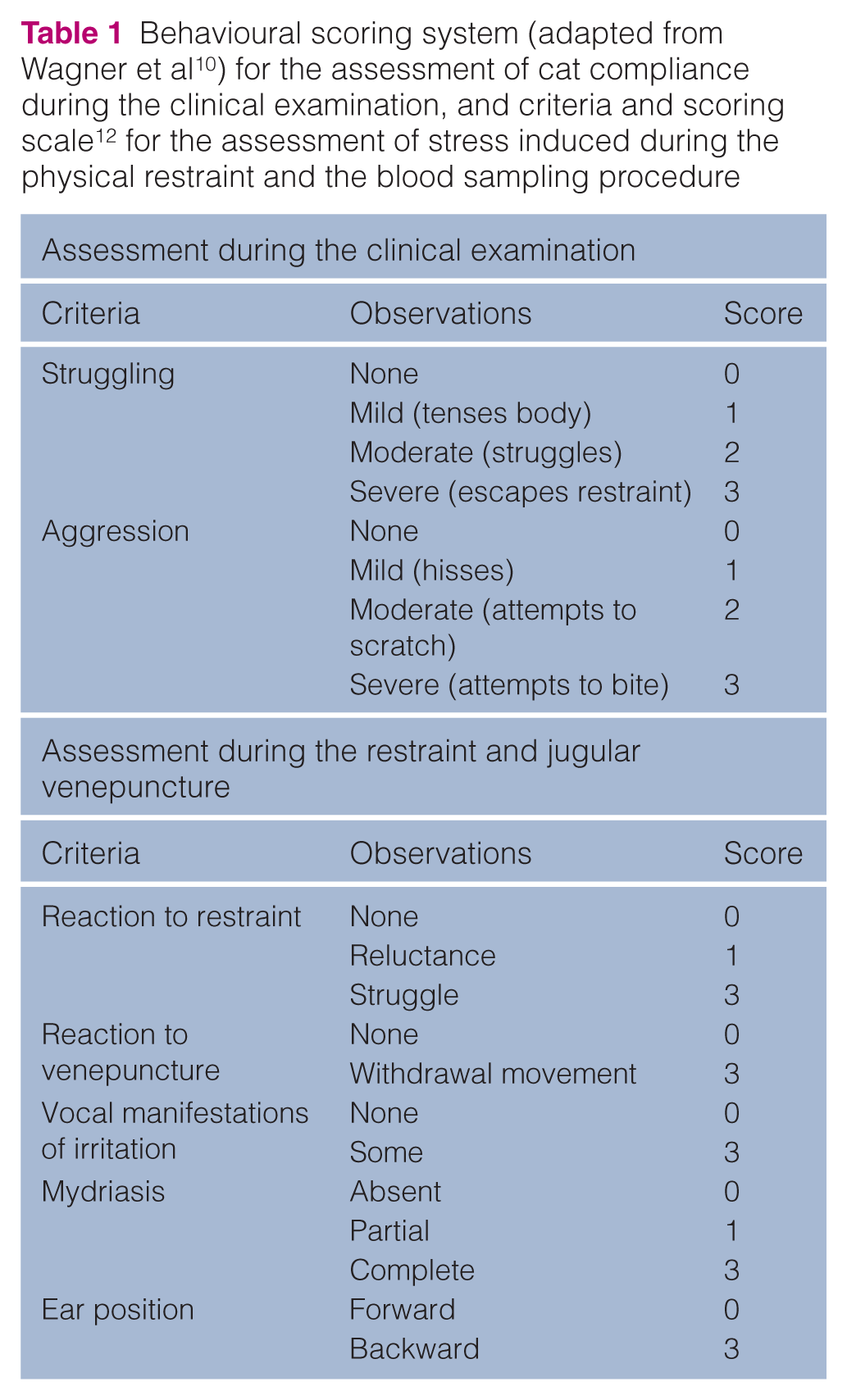
Enrolled patients were randomly 13 allocated to one of two study groups: the EMLA group or the placebo group. Except for the operator who administered the product, all operators were blind to the study groups. In all cats, an area of 2 × 4 cm on the left jugular region was clipped and, according to the study group, 1 ml of EMLA cream (ie, 5% emulsion preparation, containing 2.5% each of lidocaine/prilocaine) or 1 ml of of placebo (ie, liquid paraffin) 7 was applied and left for 30 mins. To protect the treated area, an occlusive bandage of plastic film was directly applied and then covered with an external layer of cotton wool. The cat was then left undisturbed in a cage under visual observation.
All the procedures (ie, handling, restraint, venepuncture, evaluation of reactions) were standardised and always performed by the same experienced operators. Before the venepuncture was performed, the skin of the sampling area was disinfected with an alcohol-based antiseptic solution (ie, 0.5% chlorhexidine, 70% ethanol). During the blood sampling, the cats’ reactions were evaluated, as previously reported, and a stress score was assigned 12 for the handling and jugular venepuncture procedure (Table 1).
The ease and success of the procedure were also evaluated. In particular, the operator who performed the venepuncture was asked to describe the overall procedure as ‘easy’ or ‘difficult’; 14 blood sampling was classified as easy if the syringe was filled up slowly and steadily, without movement of the needle in the vein and without the perforation of the back wall of the vein. 15 Before and after the procedure, rectal temperature, respiratory rate and heart rate were also recorded as additional indicators of stress or discomfort.16–18 Specifically, heart rate and respiratory rate were assessed, respectively, by heart auscultation and direct observation for 30 s.
Fifteen minutes after the procedure, the treated area was examined for local adverse reactions (eg, erythema, oedema, pruritus) and complications related to the venepuncture (eg, haematoma, extravasation, pain).
Statistical analysis was carried out using the software GraphPad Prism version 6.01. Normality was checked by the D’Agostino Pearson’s test and the data were analysed using descriptive statistics and reported as mean ± SD or median (range), according to their distribution. Unpaired variables were compared using the t-test or Mann–Whitney test, while paired data were compared using the t-test for paired data or the Wilcoxon’s test. Fisher’s exact test was used to compare categorical variables. Statistical significance was considered as a P value <0.05.
Results
Eighteen domestic shorthair healthy cats were enrolled in the study; six additional cats were excluded from further evaluations because they were highly reluctant to manipulation (eg, attempts to escape, struggle) during the clinical examination (ie, Modified Behavioural Pain Scale score ⩾2).
The EMLA group included one intact male, six neutered males, one intact female and one spayed female, while the placebo group included two intact males, five neutered males and two spayed females (P = 0.497). The median age of the cats belonging to the EMLA group was 3 years (range 2–15 years), while the cats of the placebo group had a median age of 4 years (range 1–11 years) (P > 0.999).
The median respiratory rate recorded during the clinical examination was 40 breaths per minute (range 24–80) in the EMLA group and 40 breaths per minute (range 36–67 breaths per minute) in the placebo group (P = 0.582); the median heart rate was 185 beats per minute (bpm; range 140–220 bpm) in the EMLA group and 180 bpm (range 147–220 bpm) in the placebo group (P = 0.445); median rectal temperature was 38.4°C (range 37.0–39.4°C) in the EMLA group and 38.5°C (range 37.1–39.1°C) in the placebo group (P = 0.675). No statistical differences were found within each of the two study groups when comparing the values obtained during the clinical examination with those obtained after the procedure for respiratory rate (EMLA group, P = 0.718; placebo group, P = 1.000), heart rate (EMLA group, P = 0.625; placebo group, P = 0.921) and body temperature (EMLA group, P = 0.617; placebo group, P = 0.880).
The procedure of blood sampling was classified as easy in 9/18 cats, of which one cat belonged to the placebo group and the other eight cats belonged to the EMLA group (P = 0.015).
A significantly lower median stress score was observed for cats in the EMLA group (median 2, range 0–8) compared with those in the placebo group (median 6, range 0–12) (P = 0.048) (Table 2), with withdrawal movements observed in only 1/9 cats treated with the EMLA cream vs 7/9 cats of the placebo group (P = 0.015). A further comparison between the two study groups for the assessment of stress during the venepuncture procedure is summarised in Table 3.
Scores obtained from each cat during the blood sampling procedure

Frequency of each manifestation recorded for the assessment of stress during the blood sampling procedure in the two study groups
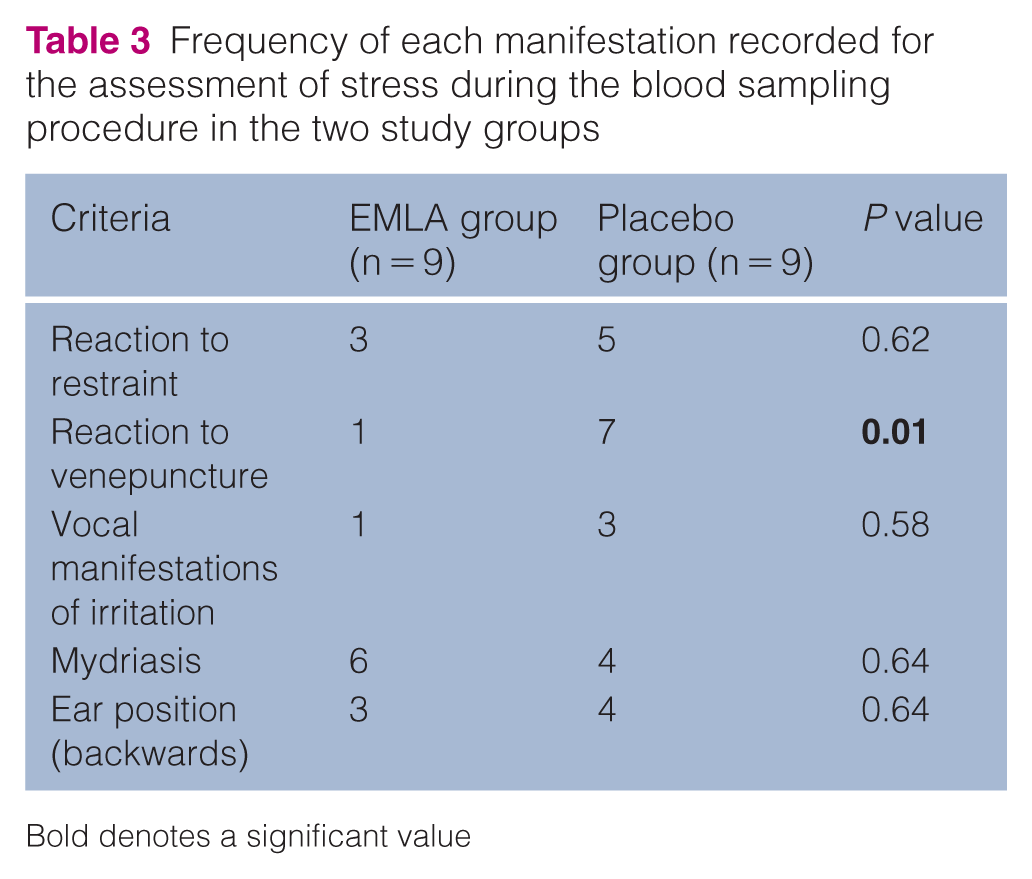
Bold denotes a significant value
During the inspection of the treated area, 15 mins after the sampling, it was recorded that one cat in the EMLA group and one cat in the placebo group presented with haematoma (P = 1.000).
Discussion
The results of the present study provide evidence that the EMLA cream, applied 30 mins before the jugular venepuncture, significantly reduces the reactions of cats to the procedure. This finding is consistent with the results obtained by previous studies conducted in children and cats where the efficacy of the anaesthetic cream was evaluated after an application time shorter than 60 mins (ie, the application time recommended by the manufacturer).3,8 However, a controlled study evaluating the efficacy of the EMLA cream in dogs after application times of 30 and 60 mins showed a significantly reduced reaction to intravenous catheter placement only after 60 mins of action.11 Differences inherent to the skin and behaviour of the species, as well as peripheral vasoconstriction induced by stress,16,19 could all be factors that contribute to the effectiveness of the shorter application time able to provide an analgesic effect. 8
The success rate of the venepuncture procedure was higher in the EMLA group and was associated with lower stress scores when compared with cats that received the placebo. Similarly, less discomfort has previously been observed during jugular catheterisation in cats that received EMLA cream 60 mins before the procedure, compared with a placebo group. 10
With regard to the success of the procedure, among the cats belonging to the EMLA group, in only one was the procedure classified as unsuccessful. In this cat, despite a low score (ie, 1) being recorded during the clinical examination, during the blood sampling procedure signs suggesting fear or anxiety, such as vocalisations and having its ears backwards, were observed. This resulted in a high stress score (ie, 8) during the blood sampling procedure.
In the present study, for each of the study groups, no differences for heart rate, respiratory rate or body temperature were found between the values recorded during the clinical examination and those recorded after the procedure. Although after the blood sampling an increase in such parameters could have been expected in the placebo group compared with the EMLA group, it should be considered that these physiological parameters may not be sensitive enough to assess stress and pain. In addition, they could have been affected by the clinical setting.12,16,17
No adverse reactions were identified in cats treated with the EMLA cream and the development of the haematoma in one cat could be attributed to the difficulty of the blood sampling procedure rather than to local toxicity; these findings are consistent with those observed in a previous study, in which no local adverse reactions such as swelling, erythema or pruritus, were observed in the feline study population. 9
Despite the fact that methemoglobinaemia has been reported as a rare systemic adverse reaction in humans, 5 this adverse effect has not been observed in healthy cats, 9 and was not evaluated in the present study.
The present study provides evidence for the efficacy of the EMLA cream in cats after an application time of 30 mins, justifying its daily use in clinical practice in order to reduce stress related to blood sampling procedures.
Additional studies are warranted to further assess the behavioural response of cats to the described procedure, such as specific evaluations relative to facial expression,20,21 laboratory parameters of stress and the quality of blood sampling.22,23
Conclusions
The efficacy of EMLA cream in cats is herein confirmed. Despite the fact that an application time of 60 mins is still recommended by the manufacturer and supported by previous studies in veterinary medicine, an application time of 30 mins appears to be adequate for blood sampling via jugular venepuncture in this species and even more suitable in certain clinical settings such as acute care. 24 Thus, the results of the present study support the routine use of EMLA cream as good practice in a veterinary clinic. This, especially in a feline-friendly environment, would help improve the welfare of cats undergoing venepuncture procedures and help simplify the procedure for operators.
Footnotes
Conflict of interest
The authors declared no potential conflicts of interest with respect to the research, authorship, and/or publication of this article.
Funding
The authors received no financial support for the research, authorship, and/or publication of this article.
Ethical approval
This work involved the use of non-experimental animals (owned or unowned) and procedures that differed from established internationally recognised high standards (‘best practice’) of veterinary clinical care for the individual patient. The study therefore had ethical approval from an established committee as stated in the manuscript.
Informed consent
For the procedures informed, written consent was obtained from the owner or legal custodian of all animals described in this work. No animals or humans are identifiable within this publication, and therefore additional informed consent for publication was not required.
