



Abstract
Objectives
Owing to the lack of literature on training cats to use an artificial vagina (AV), we performed a retrospective study on the success of training tom cats for semen collection using an AV.
Methods
Records from training 20 cats (2009 until 2019) for semen collection using AVs were analyzed. Sexual preferences, behavior towards humans, queens and other tom cats, as well as libido, number of training sessions and rate of success were observed. Data are presented as percentages and the results are described subjectively.
Results
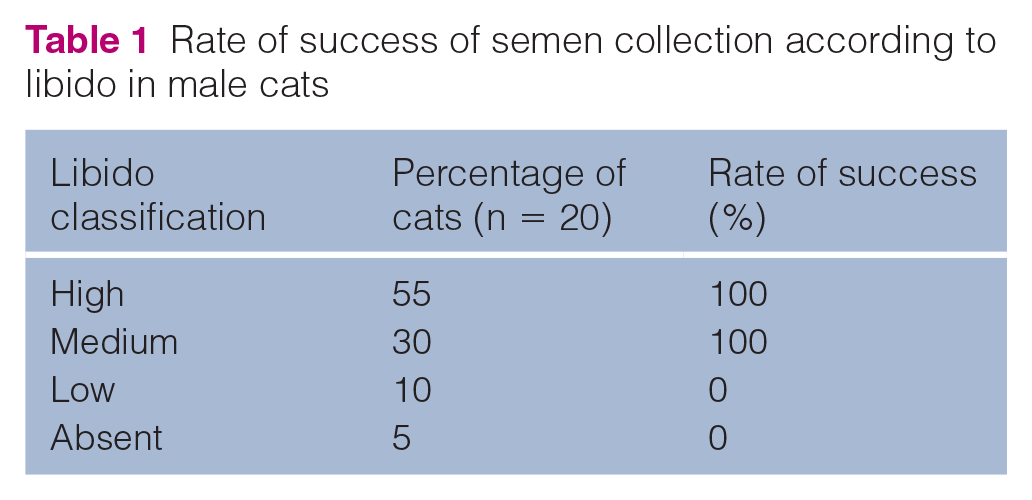
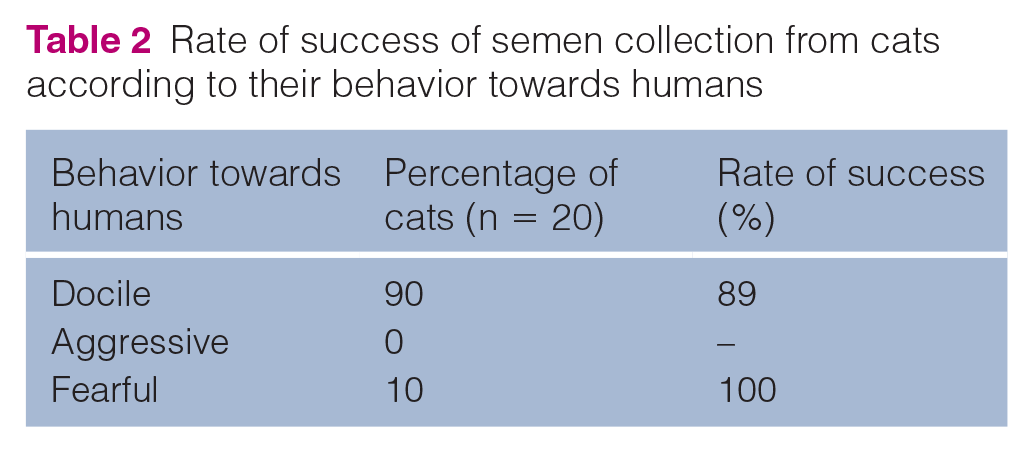
In 85% of tom cats, collection using an AV was performed successfully. Training was unsuccessful when libido was low or absent. Behavior towards humans did not interfere with the success rate, while libido did.
Conclusions and relevance
Most tom cats can be successfully trained to have semen collected using an AV; the number of training sessions required depends on the male’s libido and the technician’s experience.
Introduction
Semen collection is necessary for most assisted reproduction techniques, such as artificial insemination and in vitro embryo production. In cats, many methods have been described to obtain semen, including electroejaculation,1,2 urethral catheterization and pharmacological ejaculation, 3 epididymal recovery4,5 and use of an artificial vagina (AV). 6
Electroejaculation is considered the method of choice for semen collection in non-domestic felids, and there are many publications describing the use of this methodology.7–12 For domestic cats, electroejaculation is indicated for males that have low libido, are aggressive or that cannot breed under natural conditions. Electroejaculation requires anesthesia, specialized equipment and trained staff, and cannot be used frequently in the same individual. 1 Furthermore, the semen quality and success rate are influenced by the anesthetic protocol used for this procedure. 13
Recently, the use of medetomidine to obtain semen in cats was described. 3 The authors catheterized the cat penis using a tom cat catheter after medetomidine administration and recovered high-quality sperm. Other articles using the same technique have been published;14–16 however, the impossibility of obtaining frequent samples can make it unsuitable.
Use of an AV to collect semen from tom cats was first described in 1970 by Sojka et al, 6 when the first artificial insemination in cats was performed. Since then, other authors have used this technique to retrieve semen from cats. For this method, a rubber bulb is attached to a small graduate tube and used as an AV (Figure 1). The male is allowed to mount a teaser queen, and the AV is attached to the penis during his attempt to penetrate the female.6,17

(a) Artificial vagina (AV) used for semen collection in domestic cats. (b) A latex bulb from a medicine dropper is used as the top of the AV. (c) A cut in the bulb is performed to attach it in a 1.5 ml microtube (Eppendorf)
Semen collection using an AV can be used twice a day for up to 10 consecutive days without compromising the sperm quality; 18 this method is also inexpensive and does not require anesthesia. This is the method of choice for semen collection in other species, 19 while for cats, this methodology is used as the first option primarily in colonies, as it is impractical in clinical conditions owing to cats’ sexual behavior.17,20
Most articles published on feline semen collection using an AV provide information regarding semen quality or the use of samples obtained by this method in artificial insemination and other assisted reproduction techniques.6,18,21 Few data are available on cat training and the rate of success. For these reasons, our main objective was to perform a retrospective study on training tom cats for semen collection using an AV.
Materials and methods
All procedures were carried out in accordance with the ethical standards of the committee on animal experimentation of São Paulo State University (UNESP).
Animals
Seventeen mixed breed tom cats, three Maine Coon tom cats, one Maine Coon queen and three mixed breed queens (age range 1–10 years) were used in this study. The purebred cats were privately owned, and the other 20 cats were maintained in an experimental cattery (17 males and three females at the Department of Animal Reproduction and Veterinary Radiology, Faculty of Veterinary Medicine and Animal Science, UNESP, Botucatu, Brazil). The animals were fed commercial cat food, and water was provided ad libitum.
Tom cats were maintained in groups and had visual and olfactory contact with intact and ovariohysterectomized queens. Males that presented aggressive behavior towards other males were maintained in cages and had access to the solarium once a day for at least 3 h.
Training for semen collection
An AV was used for semen collection as described previously. 6 A queen in estrus was presented to the tom cat, which was allowed to mount the female and was stimulated by hand until complete erection; only then was the AV slipped over the glans penis until ejaculation (Figure 2).

Artificial vagina (AV) placement during semen collection. The tom cat is allowed to mount the queen and when the penis is fully erect, before the male introduces it into the vagina, the penis is introduced into the AV. Gentle movements can be performed to stimulate ejaculation
Males that showed aggressive behavior towards other males were released into the solarium by themselves during training sessions. Males with docile behavior were presented to the estrual female in the presence of other tom cats to increase competition and induce them to pursue the queen.
If the female did not show any interest and was aggressive towards a specific tom cat, another female or a phantom was presented (Figure 3). The phantom was maintained with the females to absorb their smell, but no pheromone was used to attract the tom cats towards the phantom. Switching females also occurred when the tom cat did not show interest towards a female. We considered a male to lack interest when the tom cat did not approach the queen and sniff the vulva.

Semen collection using an artificial vagina. In this collection, a toy cat was used as a phantom to tease the tom cat and semen was collected while the tom cat mounted the phantom
The libido of each male was classified as high, medium, low or non-existent. Libido was considered high when the male would immediately seek the queen to initiate courting; medium when the male would take at least 2–5 mins to seek the queen to initiate courting; low when the male would take longer than 5 mins to seek the queen to initiate courting; and absent when the male did not initiate courting at any time while the queen was in the same room or when the male showed aggressive behavior towards the queen.
The males were classified by their behavior towards humans, tom cats and queens as docile, aggressive or fearful (when contact was avoided). Preferences regarding females and the ability to mount and for semen to be collected using the phantom instead of a queen were also recorded.
Each training session lasted less than 30 mins per cat, and there was usually an interval from 2 to 7 days between sessions if the first session was not successful. We considered a cat trained when two semen samples were obtained in the same session. All of the training sessions were performed by only one experienced technician. Records from 2009 to 2019 were included in this research.
Owing to differences among methodologies for evaluating semen over the years, we did not include semen analysis in this study.
Statistical analysis
Sexual preferences, behavior and success were expressed as percentages. Data were described subjectively.
Results
The tom cats were successfully trained for semen collection using an AV in 85% of the cases (n = 17/20) and it required 3.8 ± 3.1 sessions of training. Two (n = 2/3) of the males that did not respond positively experienced at least 10 training sessions; the third tom cat received only one session, and it was sufficient to prove that it was not suited to this method of semen collection.
Most cats exhibited high libido; the rate of training success for each level of libido is presented in Table 1. Only one male (5%) was aggressive towards queens, and seven males (35%) were aggressive towards other tom cats. Furthermore, two tom cats (10%) showed signs of fear towards humans. The percentages of cats successfully trained according to their behavior towards humans and queens are presented in Tables 2 and 3.
Rate of success of semen collection according to libido in male cats
Rate of success of semen collection from cats according to their behavior towards humans
Rate of success of semen collection from cats according to their behavior towards queens

Preferences for a specific queen were observed in 20% of the tom cats. In 25% of the cats it was possible to collect semen using the phantom after a collection routine was established.
Discussion
Our retrospective research showed that it was possible to collect semen using AVs in over 80% of cats subjected to training. Many authors affirm that not all cats are suited to this methodology,17,22,23 and there are few publications describing the rate of success. While in one article 60% of the cats were trained to ejaculate using an AV, 6 another described a 100% success rate, albeit with a low number of subjects (n = 5). 24
One to 10 sessions were enough to achieve semen collection; other authors report success after 1.5 to 5.5 months of training (with three sessions/week) 24 and 2 weeks of frequent handling. 6 Longer training may be required for younger and inexperienced males, and perhaps this is why our cats responded faster, since most of them were sexually mature. Also, we noticed that cats trained more recently required fewer sessions; in most recent cases, it was possible to collect semen twice during the first session, indicating that over the years, the ability of the trainer improved.
There are multiple factors that influence the success of semen collection using an AV. The experience and ability of the technician conducting the sessions are among the most important. Often, we observed inexperienced researchers who were unable to conclude the training. We propose that the learning curve is longer for the collector than for the tom cats.
A good trainer must know feline anatomy and behavior and also must be observant and patient to determine the best time and place and which female to use for semen collection. This expertise can only be achieved after practice. The trainer must observe if the male shows interest in the female by sniffing and licking her vulva and head; also, some males spend a longer time courting, and the trainer must understand and allow the male to do so to increase its libido before it mounts. When the male shows no interest in the queen, it should be presented to alternate females before it is considered a male with low or absent libido.
In our study, only one cat had no libido and was extremely aggressive towards other cats, although it presented a very docile behavior towards humans and even other species, such as rats, sheep, dogs and horses. Owing to this male’s aggression towards two queens during training, we decided that it was not suited to this collection method.
The two cats that presented low libido did not respond to the training. This may have been due to their age (both were approximately 1 year old) and lack of experience, or because of hierarchical relations with the other males in the same room. After at least 10 sessions, we established that training was unsuccessful.
Our results demonstrate that behavior towards humans is not an impediment to training. Semen could also be collected from males that showed fear and a lack of trust in humans; surprisingly, the number of sessions did not increase as a result of this behavior. Obviously, the semen collector must be experienced to ensure their own safety as well as that of the cats.
Queens are usually the ones that choose a sexual partner, and a strong preference for a female with which to mate is not really expected in tom cats. 25 As expected, most of our males did not show preferences towards the queens used for semen collection. However, 20% did show preferences, and, for this reason, the use of more than one female during training sessions can increase the success rate, as it will provide the trainer with the opportunity to observe the sexual behavior in different contexts and determine if a particular male has low libido or simply prefers an alternative female.
The use of phantoms instead of teaser queens for semen collection has been described previously. 23 This method allows semen collection without the need for a queen and can be very practical. In our experience, this method is better established after the males are experienced at semen collection with an AV. We were able to use the phantom for 25% of our individuals, but not all cats were given this option. We believe that more males could be trained to use this technique, and we strongly advise the use of a phantom in catteries where the use of a female is not possible.
Conclusions
We were able to train 17 cats for semen collection using an AV. Semen was obtained from 85% of the tom cats. Contrary to the conclusions of most authors, behavior towards humans did not influence the success rate, while a lack of libido and aggressive behavior towards queens did.
Footnotes
Acknowledgements
We thank Dr Ticiana Franco Pereira da Silva, who first taught Dr Ackermann to collect cat semen using an AV.
Conflict of interest
The authors declared no potential conflicts of interest with respect to the research, authorship, and/or publication of this article.
Funding
We thank the São Paulo Research Foundation (FAPESP) for providing financial support (Process: 2009/11677-6, 2011/23318-0, 2012/09002-3, 2013/13091-4).
Ethical approval
This work involved the use of experimental animals and the study therefore had ethical approval from an established committee as stated in the manuscript.
Informed consent
Informed consent (either verbal or written) was obtained from the owners or legal custodians of all animals described in this work for the procedures undertaken. For any animals or humans individually identifiable within this publication, informed consent for their use in the publication (verbal) was obtained from the people involved.
