



Abstract
Objectives
This study aimed to investigate the effects of intramuscular medetomidine and xylazine on tear flow in healthy cats.
Methods
Five cats each received medetomidine 10, 20, 40 and 80 µg/kg IM; xylazine 1.0, 2.0, 4.0 and 8.0 mg/kg IM; and physiological saline (2.0 ml IM) in a randomised order separated by intervals of at least 1 week. The Schirmer tear test (STT) I was performed in both eyes before and 0.25, 0.5, 0.75, 1, 2, 3, 4, 5, 6, 7, 8 and 24 h after each dose.
Results
The STT I value decreased significantly at 0.5 and 1.0 h and at 0.75 and 1.0 h in both eyes after administration of medetomidine at 10 or 40 µg/kg. After administration of medetomidine 80 µg/kg, there was a significant decrease in the STT I reading at 0.75, 2 and 3 h in the left eye and 0.75, 1, 2 and 3 h in the right eye. The STT I value decreased significantly at: 0.5, 0.75, 1 and 2 h in the left eye and 0.75 h in the right eye after administration of xylazine 1.0 mg/kg; 0.5, 0.75, 1 and 2 h in the left eye and 0.5, 0.75, 1 and 3 h in the right eye after administration of xylazine 2.0 mg/kg; 0.5, 0.75, 1 and 2 h in both eyes after administration of xylazine 4.0 mg/kg; and 0.5, 0.75, 1, 2 and 3 h in the left eye and 0.75, 1, 2, 3 and 4 h in the right eye after administration of xylazine 8.0 mg/kg.
Conclusions and relevance
Both medetomidine and xylazine significantly decreased feline tear flow measured by STT I. Therefore, the ocular surface should be monitored carefully and protected appropriately in cats treated with these sedatives.
Introduction
Some anaesthetic and sedative agents are well known to decrease tear flow in certain species, including the domestic cat.1–9 Medetomidine and xylazine are alpha (α)2-adrenoceptor agonists that are widely used as potent sedatives and analgesics in veterinary medicine, and are also reported to decrease tear flow in animals.1,4,10,11
The literature on α2-adrenoceptor agonist-induced reduction of tear flow in cats is limited. Ghaffari et al investigated the effect of xylazine on the Schirmer tear test (STT) I value in normal cats, but did not evaluate the effect of medetomidine. 4 Di Pietro et al investigated the effect of a combination of medetomidine and ketamine on the STT I value in cats, but did not assess the effect of medetomidine alone. 8 In both those studies, the time allowed for observation of the STT I value was less than 25 mins after administration of the α2-adrenoceptor agonists.
The aim of the present study was to investigate the effects of medetomidine and xylazine on tear flow when administered in various doses for a longer duration than in the previous studies and to compare the results between medetomidine and xylazine.
Materials and methods
Animals
The study included five experimental normal cats (three spayed cats, one intact female cat and one intact male cat) with a mean ± SD age of 3.0 ± 1.1 years, a mean ± SD weight of 3.6 ± 0.5 kg and no ophthalmic abnormalities. The cats were maintained under uniform conditions in an institutional animal laboratory. No abnormalities were detected during routine physical and ophthalmic examinations, including observation of the globe and eyelids, STT I testing, assessment of corneal and eyelid reflexes, vision testing, assessment of direct and indirect pupillary light reflexes, slit-lamp biomicroscopy, direct ophthalmoscopy and intraocular pressure measurement, performed before the study. All cats were judged to have an American Society of Anesthesiologists’ physical status of 1. 12 All procedures performed were approved by the Animal Care and Use Committee of Kurashiki University of Science and the Arts.
Procedures
Each cat received nine injections during the study. All cats were allowed to acclimate to the experimental room for 15 h before the injections were administered. Food was withheld for 15 h before the injection in all cases. All injections were administered in the semimembranosus muscle. All the cats received 2.0 ml physiological saline solution (control treatment), medetomidine hydrochloride 0.1% (10, 20, 40 and 80 µg/kg [Domitor; Nippon Zenyaku Kogyo]) and xylazine hydrochloride 2.0% (1.0, 2.0, 4.0 and 8.0 mg/kg [Celactal; Bayer Yakuhin]) with an interval of at least a week between successive injections. The order of the treatments was determined using a randomised Latin square crossover study design.
STT I measurements
Tear flow was measured before (baseline) and 0.25, 0.50, 0.75, 1, 2, 3, 4, 5, 6, 7, 8 and 24 h after each injection. The baseline measurement was obtained at 9 a.m. for all treatments. After each injection, all cats remained in the experimental room for 24 h without any further treatment, including administration of a reversal agent, regardless of whether they still appeared sedated at >8 h after injection of medetomidine or xylazine. Both eyes were tested using STT strips (ColorBar Schirmer tear test; EagleVision). The end of each strip was placed inside the lateral aspect of the lower eyelid. After 60 s, the distance that was wet on the strip was recorded as the STT I value. For each experiment, STT strips with the same lot number were used for all 13 measurements. To standardise the body position, all cats were positioned in sternal recumbency with the eyelids relaxed during each STT I reading.
Statistical analysis
The Friedman test for repeated measures was used to evaluate the effects of time on each treatment. When a significant difference was found, the Dunn test was used to compare the mean value at baseline with the mean value at each time point. Differences between the left and right eyes at each time point for each treatment were examined using the Wilcoxon matched-pairs signed-rank test. Data are reported as mean ± SEM. All statistical analyses were performed using a statistical software (Graphpad Prism 7). A P value <0.05 was considered statistically significant.
Results
There were no significant differences in STT I values between the left and right eyes for any of the treatments administered in the study. There were no significant changes in the STT I readings in either the left or the right eye after receiving placebo injection (Table 1).
Schirmer tear test I value after medetomidine and xylazine administration

Data are presented as the left/right eyes mm/min (mean ± SEM, n = 5)
Significantly different from baseline value (P <0.05)
Cats in both the medetomidine and xylazine treatment groups showed either a significant decrease or a tendency towards a decrease in STT I values dose-dependently in the left and right eyes when compared with the baseline values within 0.75 h of administration. In both eyes, the decreased STT I reading gradually returned to the baseline value (Figures 1 and 2).

Mean Schirmer tear test (STT) I values of the left and right eyes after intramuscular medetomidine administration. Each point and vertical bar represent the mean and SEM (n = 5). *P <0.05 compared with the baseline value
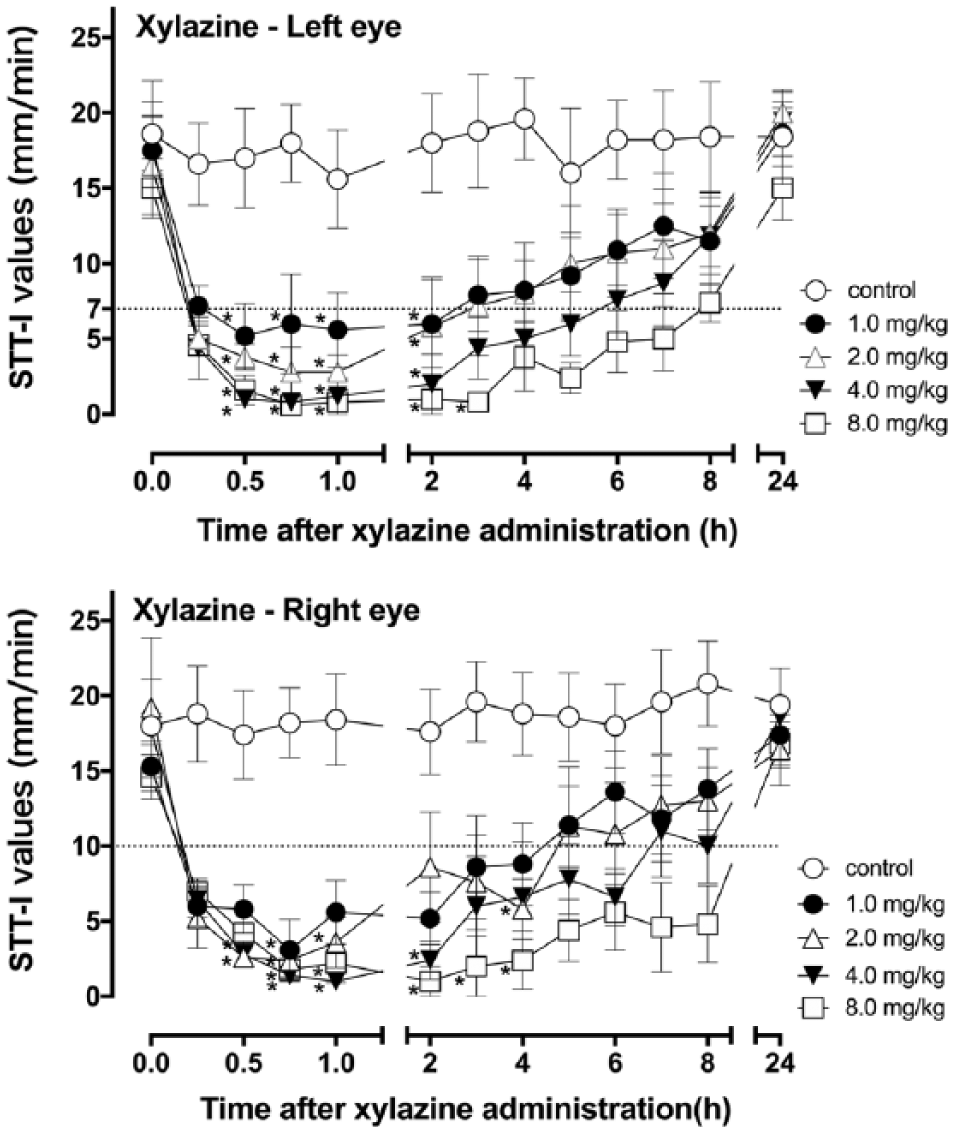
Mean Schirmer tear test (STT) I values of the left and right eyes after intramuscular xylazine administration. Each point and vertical bar represent the mean and SEM (n = 5). *P <0.05 compared with the baseline value
The mean STT I value decreased to <7 mm/min in both eyes after administration of medetomidine 40 or 80 µg/kg but not after administration of medetomidine 10 or 20 µg/kg. The time during which STT I values were <7 mm/min in both eyes was at least 1.75 h after a dose of 40 µg/kg and 2.75 h after a dose of 80 µg/kg.
In all the xylazine-treated groups, regardless of the dose administered, the mean STT I value in both eyes decreased to <7 mm/min from 0.5–2 h after administration. An STT I value <7 mm/min persisted in both eyes for at least 1.5, 0.75, 4.75 and 6.75 h after administration of xylazine at respective doses of 1.0, 2.0, 4.0 and 8.0 mg/kg.
Discussion
Similarly to previous reports in dogs,10,11 administration of medetomidine and xylazine led to a significant decrease in the STT I value in our present study in cats. As in the previous canine study, 10 a decrease in the STT I value induced by medetomidine was reversed by administration of atipamezole, an α2-adrenoceptor antagonist. Our present results and the findings of the previous reports suggest that the α2-adrenoceptor is involved in the decreased STT I readings induced by medetomidine and xylazine in the cat. However, other anaesthetic and sedative drugs have also been reported to decrease STT I readings in cats and dogs.1,4–6,9 Therefore, it has not been clear whether the decreases in STT I readings observed after administration of medetomidine or xylazine are a direct result of the α2-adrenoceptor or an indirect result of the mechanisms common to various anaesthetic and sedative drugs.
The decrease in tear flow in response to administration of medetomidine or xylazine was severe and sustained, although no mechanism involving the α2-adrenoceptor was revealed. The mean STT I readings of <7 mm/min after administration of medetomidine 40 and 80 µg/kg and all doses of xylazine are clearly less than the reference interval (RI) of 14.3 ± 4.7 to 16.92 ± 5.73 mm/min in normal cats.2,13–16 An inadequate supply of tear fluid adversely affects the smoothness and lubrication of the cornea and impairs important metabolic and immune processes. However, unlike dogs, 17 cats do not necessarily show any clinical signs when their STT I value is low. A decreased STT I reading that was below the RI was sustained for more than 1 h after administration of medetomidine at 10 μg/kg or 20 µg/kg. A sustained decrease in tear flow could cause irritation of the ocular surface and might result in keratoconjunctivitis sicca, although this disorder is less common in cats than in dogs. 17 When medetomidine or xylazine is administered in cats, even at a low dose, the ocular surface should be protected from drying by artificial tear solution or a lubricating ophthalmic ointment. However, a recent study found that ophthalmic ointment irritates the ocular surface in cats. 18 Therefore, the recommendation is to use an ophthalmic gel.
The findings of our present study in cats and those of our previous study in dogs suggest that the doses of medetomidine and xylazine administered in each experiment were not necessarily equipotent. Our inability to exclude this possibility is a limitation of this research. Furthermore, the STT I reading represents the total tear fluid secretion volume, which includes both reflex and maintenance secretion, but not the actual volume of tears produced. Therefore, it was not clear whether or not the decrease in the STT I value observed in the present study reflects a decrease in a production of tears.
Conclusions
The results of this study indicated that intramuscular administration of medetomidine or xylazine induced a severe and sustained decrease in the STT I value in normal cats. Therefore, in cats that require sedation with medetomidine or xylazine, the ocular surface, including the cornea, should be monitored carefully and protected appropriately.
Footnotes
Conflict of interest
The authors declared no potential conflicts of interest with respect to the research, authorship, and/or publication of this article.
Funding
The authors received no financial support for the research, authorship, and/or publication of this article.
