




Abstract
This article analyses reasons for not reporting sexual harassment within the Swedish police. The empirical data consisting of interviews, participant observation, testimonies from the police #MeToo call, and internal police investigations is analysed through tracing ‘disclaimers’, a form of discursive devices aligning actions to restore meaning. The article identifies 20 disclaimers that represent distinct reasons for not reporting sexual harassment perpetrated by colleagues and supervisors. These disclaimers shed light on police cultural norms and what we label as ‘male network acceptance’, that together with organisational factors influence the un/willingness to report experiences of sexual harassment. The findings show that sexual harassment is renegotiated when perpetrated by colleagues, and that both the harassed and bystanders doubt that reporting will lead to positive impacts. There is therefore a need to develop and implement alternative ways of handling sexual harassment that enable a shift from individual guilt, and re-frame sexual harassment as an issue of collegial concern.
Introduction
There is extensive documentation about the prevalence of and testimonies about sexual harassment among police officers within police forces internationally (de Haas et al., 2010; Huang & Cao, 2008; Rostami et al., 2024) and in Sweden specifically (#nödvärn, 2017; Rostami et al., 2022; Swedish Police Union, 2020a). Still, hardly any reports about sexual harassment reach supervisors, HR or the police union (e.g., Brown et al., 2018; Steinþórsdóttir & Pétursdóttir, 2018), despite sworn police officers’ duty to report (Lundgren & Wieslander, 2024a). While all employers, including government agencies such as the police, have an obligation to investigate, prevent, and take measures against sexual harassment, this obligation of course requires that the employer has knowledge about the sexual harassment. The Swedish Police Union encourages members to report experiences of sexual harassment within the police to their employer and/or to the union, and points to the lack of reports or willingness to come forward as an obstacle in their work against sexual harassment (Swedish Police Union, 2020b, n.d).
Aim and Research Questions
The aim of this article is to understand why there are hardly any reports of sexual harassment within the Swedish police, despite extensive documentation of prevalence and testimonies about sexual harassment by colleagues and supervisors. This is done through tracing disclaimers for not reporting experiences of sexual harassment in interviews from police officers and trainees, testimonies from the #MeToo call from the police, and internal police investigations about sexual harassment among police officers. These disclaimers shed light on why the request and encouragement that police officers report experiences of sexual harassment may be difficult in practise. This leads to concrete policy recommendations about alternative ways of handling sexual harassment within the police. The article answers the following research questions: 1. Which reasons for not reporting sexual harassment by colleagues or supervisors are expressed by police officers in the Swedish police force? 2. How can this reasoning be interpreted within a police context? 3. How is sexual harassment re/negotiated through such reasoning?
Definitions
Reporting
In this article, we do not use the term “report” only in the sense of filing a formal complaint which may then lead to a legal process through a police investigation. Instead, we use “report” in a broader sense, which also includes speaking up about or sharing experiences of sexual harassment with a colleague, manager, or safety or union representative.
What is Sexual Harassment?
There is a large research field on definitions of sexual harassment; both legal (Cortina & Areguin, 2021; McCann, 2005; Wegerstad, 2022) and scholarly definitions (Fitzgerald & Cortina, 2018; Leskinen et al., 2011; McDonald, 2012). In Sweden, sexual harassment is regulated in the Swedish Discrimination Act (2008: 567, Chap 1, Sect 4), the Swedish Work Environment Act (1977: 1160), and in the Swedish Penal Code (1962: 700, Chap 6 on sexual offences e.g., sexual molestation and assault). The two former Acts govern employers’ obligations to investigate, prevent, follow up on, and take measures against sexual harassment in the workplace. Sexual harassment is in this context defined as behaviour of a sexual nature that violates somebody’s dignity (Chapter 1, Section 4 of the Swedish Discrimination Act).
According to the Swedish Police Union, sexual harassment is when someone consciously violates your dignity. At the same time, it is the harassed who decides whether or not behaviour is considered violating (Swedish Police Union, n.d). The Swedish Police Union instructs members who experience sexual harassment at their workplace to communicate to the harasser that the behaviour is experienced as a violation (ibid.). The harassed are moreover encouraged to tell a colleague, safety or union representative about the sexual harassment, contact their manager, document the harassment, and finally, to report the sexual harassment to the employer. If the sexual harassment continues after making the employer (The Swedish Police Authority) aware of the situation, the employee is encouraged to contact the Police Union or the Discrimination Ombudsman (Swedish Police Union, n.d).
Previous Research
Research shows that victims of sexual harassment and sexual assault by colleagues or supervisors cope with and respond to these situations in a variety of ways, but that very few victims report the harassment due to potential negative consequences for both the harassed and the harasser (e.g., Bergman et al., 2002; Fitzgerald et al., 1995). Notifying a supervisor or filing a formal complaint is described as a victim’s “last resort when all other efforts have failed” (Fitzgerald et al., 1995, s. 121).
In previous research, there is increasing attention to the significance of the organisational context in understanding organisational and individual responses to sexual harassment (Bergman et al., 2002). Also, research on social interaction has highlighted how silence around sexual harassment is a collective process and has thus contributed to understanding some of the mechanisms concerning the persistence of sexual harassment at work (Hershcovis et al., 2021). Hershcovis et al. (2021) use social network theory as a way to understand why those who experience or are aware of sexual harassment often say or do nothing. Network silence contributes to the persistence of sexual harassment due to a lack of consequences for perpetrators and support for victims, which further reinforces silence, since other members observe and model this silence. Male-dominated and masculine-oriented workplaces are related to higher incidents of sexual harassment, and the gendered context of a workplace thus becomes vital in understanding the prevalence of harassment (Bergman et al., 2002; Hershcovis et al., 2021).
Gendered Ideals and Sexual Harassment Within the Police
For decades, research has documented sexual harassment as an expected feature of working as a police officer (Brown & Heidensohn, 2000; Cunningham & Ramshaw, 2020; Rabe-Hemp, 2008) and as part of a male-dominated police culture (Brown et al., 2019; Steinþórsdóttir & Pétursdóttir, 2018). Previous research on police work has characterised police culture as comprised by hegemonic masculinity and sexism (e.g., Fielding, 1994; Manning, 1978; Reiner, 2010). In Sweden, the Police Authority has faced external pressure to work with issues such as gender equality and equal opportunities. Like other government agencies in Sweden, the police has formulated new ‘organisational values’ (Rikspolisstyrelsen, 2009). Police employees interpret such initiatives as ‘PC’ (politically correct) (Wieslander, 2021), and these have therefore met some internal resistance and been considered provocative, infantilising, and disrespectful of police officers’ competence and sense of justice (Sefton, 2011; Wieslander, 2021). The Swedish #MeToo-call in 2017 was initiated by current and former female police officers and gained large recognition and support (#nödvärn, 2017). This initiative shed light on the extent of sexual harassment currently and historically, and reflected similar experiences as documented in other contexts (Cunningham & Ramshaw, 2020). Despite changes during the last decades towards a more inclusive profession, the ideal police officer is still clearly imbued with masculine characteristics (Loftus, 2009; Silvestri, 2017), which requires that women or minorities within the profession adjust to this ideal (and are nevertheless considered inferior in comparison to male colleagues) (e.g., Prokos & Padavic, 2002; Rabe-Hemp, 2017).
These gendered ideals form a context to sexual harassment within the police. A large survey study among serving policewomen in 35 countries showed that 77% had experienced sexual harassment from colleagues (Brown & Heidensohn, 2000). More recent studies also report a high prevalence of sexual harassment within the police (Rostami et al., 2024) and police staff report that supervisors are often the ones initiating sexually harassing behaviours (Brown et al., 2018, p. 371).
Nevertheless, few complaints are filed about experiencing or witnessing sexual harassment within the police (Brown et al., 2018; Lonsway et al., 2013). Reporting also differs between ranks; for instance, young female police officers who are new within the profession are more likely to experience sexual harassment, but also less inclined than others in the ranks to report the harassment (e.g., Brown & Heidensohn, 2000; Lee & Yu, 2020). A recent study shows that both the police culture and the code of silence (the informal prohibition to report misconduct of fellow officers) form barriers for reporting sexual harassment, due to negative consequences for the harassed, such as bullying, ostracism, and the spreading of rumours (Davis et al., 2023; Lundgren & Wieslander, 2024a).
The (non)reporting of sexual harassment by colleagues within the police must therefore be understood in relation to the so-called “blue code of silence” which has been documented since the 1970s, and is considered a central cultural trait of the police (e.g., Kutnjak Ivković et al., 2020; Skolnick, 2002; Westmarland, 2005). This code of silence reflects a sense of loyalty and strong collegiality within “the blue family,” and under this code, reporting colleagues would be considered betrayal and a dishonest act (Kutnjak Ivković et al., 2020; Maher, 2003). Collegiality can be both a vital resource, but also a challenge for professional relations, especially in the handling of irregularities and misconduct among colleagues (Löfgren & Wieslander, 2020). There is thus a number of important implications of the police occupational culture for understanding discriminatory practices within the police, where there is a parallel acceptance of, and also major obstacles for women and minorities to integrate into the profession (Brown et al., 2018, 2019; Loftus, 2009; Rabe-Hemp, 2017).
The gendered character of the police organisation and the above mentioned police cultural traits form a context for the low rates of complaints filed about sexual harassment and misconduct within police services internationally. Previous research stresses the fear of retaliations as a main reason for not reporting sexual harassment by colleagues or supervisors, including victim-blaming, social retaliation, physical punishments, and threats (Kraska & Kappeler, 1995; Lonsway et al., 2013). Other reasons include the harassed’s lack of confidence in reporting and witnesses’ guilt regarding the potential consequences for the harasser if they were to report (Sweeting & Cole, 2022). One more specific reason for not reporting is due to ineffectual reporting procedures: “fewer than 7% of those affected said they had informally complained, and only 2% indicated they had taken out a formal complaint. Most (40%) said that it was just easier to keep quiet and 37% thought nothing would be done” (Brown et al., 2018, p. 366). Another reason for not reporting is what in previous research is known as the “officer shuffle”, in which police officers involved in misconduct or sexual violence do not face disciplinary action but are instead simply moved to another department or area (Rabe-Hemp & Braithwaite, 2013; Stinson et al., 2015; Sweeting & Cole, 2022). De Haas et al. (2010) therefore suggest that “implementing a comprehensive anti–sexual-harassment policy alone may not be sufficient to prevent sexual harassment,” since the prevalence of sexual harassment does not, in fact, differ between police forces who have such polices and those who do not. Moreover, filing a report about sexual harassment often leads to an investigation by the Internal Affairs Department, and allegations about a police officer’s misconduct must be severe to be considered legitimate to report (cf. Maher, 2008).
Moreover, Maher’s (2003, 2008, 2010) studies show a widespread uncertainty as to what constitutes sexual misconduct and harassment within the police. This uncertainty is reinforced by the sexualised banter that forms part of police culture. Such jargon is often perceived as harmless fun and an important feature of police identity, blurring the boundaries of discriminatory practices (cf. Brown, 2007; Cunningham & Ramshaw, 2020; Wieslander, 2021).
Despite this extensive research, there is no up-to-date study that explores the non-reporting of sexual harassment explicitly and problematises police officers’ unwillingness to report in relation to individual, group, and organisational/cultural conditions. This article examines reasons for not reporting sexual harassment by colleagues and supervisors within the Swedish police, and aims to paint a comprehensive picture of the reasons for not speaking up about sexual harassment. In doing so, the article contributes to new knowledge as to how the dynamics of police culture and relationships within the police influence the (non)reporting of sexual harassment.
Material, Method of Analysis, and Methodology
Data Material
The data material analysed in the present study consists of: a) participant observation and interviews with police employees, trainees, students, former police officers, managers, and union representatives; b) testimonies from the #MeToo call from the Swedish police; and c) internal police investigations about sexual harassment and assault against police officers by colleagues or supervisors.
The first dataset includes 34 in depth-interviews with former or current police employees (n = 28) and police students (n = 6) about their experiences or handling of sexual harassment by colleagues, supervisors, other students, or teachers. Of these 34 individuals, 13 were men and 21 were women, 10 held a position as manager within the police force, 7 had a position as Union representative, and 3 had a position within Human Relations. The interviews were semi-structured, audio-recorded, and transcribed verbatim. In addition, we used data from participant observation during a one-day training session on sexual harassment for police instructors. During this training session, police instructors discussed—among other things—their own experiences of sexual harassment within the police and reflected on their own practices of non-reporting. Relevant data here consists of field notes from this training session.
The second data set includes published data from the #MeToo call from the Swedish police, entitled #nödvärn (English: “self-defence”) (#nödvärn, 2017). #nödvärn contained more than 500 testimonies of self-reported experiences of sexual harassment, and for the analysis we have focused on testimonies that elaborate on the motivation or reason not to report the sexual harassment; from the perspective of the harassed, bystanders, or managers (see Lundgren & Wieslander, 2024a, 2024b for detailed descriptions of this data set).
The third dataset includes three internal police investigations about sexual harassment, molestation, or assault between police officers from the 2015–2020 period. For this study, we have selected these three police investigations, since they included a report filed by a manager or bystander, but also interrogations with the harassed (and bystanders) about why they chose not to report the sexual harassment. This data includes extensive interrogations with the harassed, witnesses, and the harasser.
The text transcriptions from interviews, the #MeToo call #nödvärn, and text from internal police investigations served as the base for analytical coding. Due to ethical considerations and to secure confidentiality, the presentation of the analysis contains few details about the incidents and involved police officers. We therefore only provide the data necessary for the purpose of this article. In the analysis, as described below, we used theoretically informed coding (Charmaz, 2006) of the analytical tool disclaimer that focused on explicit motivations and reasons not to report incidents of sexual harassment.
Analysing Conversations in Institutional Contexts Using Discursive Psychology
The analysis of the data is based on critical discursive psychology, which examines what natural talk accomplishes; i.e., the performative aspects of language (Edley, 2001; Hepburn & Wiggins, 2007; Wetherell & Potter, 1992). The analysis focuses on disclaimers as discursive resources (Hewitt & Stokes, 1975) that define specific reasons and dismissals expressed by the harassed, bystanders, or managers to justify the non-reporting of an incident of sexual harassment.
Within critical discursive psychology, language is seen as a flexible resource in which utterances and claims are indirect ways to accomplish actions; for instance to complain, praise, blame (Potter, 1996), or discriminate (Wetherell & Potter, 1992). Besides focusing on micro-practices in conversations, the analysis also takes the institutional context and the social consequences into consideration (Edley, 2001).
Disclaimers as Justifications to Restore Meaning
For this article, the transcripts of the data material are analysed with a focus on the expressions used to justify not speaking up about or reporting an incident of sexual harassment. In the analysis we make use of a general set of discursive devices that Hewitt and Stokes (1975) label “aligning actions,” which they define as “verbal efforts to restore or assure meaningful interaction in the face of problematic situations” (ibid., 838). Discursively, sexual harassment may be viewed as a form of “fractured” social interaction, with the effect of damaged or threatened identities (e.g., as “harassed,” “harasser”) that can be contested and rejected, which affect the course and outcome of social interaction. People may, for instance, be embarrassed by their own and others’ misbehaviour, and therefore strive to “repair” these disruptive lines of conduct and restore meaning through aligning actions. Aligning actions can take the form of accounts, denials, or pre-emptive dismissals of responsibility—so-called “disclaimers.” In the terms of Hewitt and Stokes: “a disclaimer is a verbal device employed to ward off and defeat in advance doubts and negative typifications which may result from intended conduct” (ibid., 3). Disclaimers are therefore used to sustain social interaction and to avoid disrupted relationships.
For the datasets of this study, we have identified and analysed disclaimers used to motivate the non-disclosure or non-reporting of sexual harassment by colleagues or supervisors. Our analysis differs somewhat from Hewitt & Stokes, who analyse disclaimers in regard to the speakers’ own words or deeds. We rather use “disclaimers” as rhetorical arguments that justify individuals’ reasons for not following a suggested or required course of action; i.e., to speak up about, disclose, or report sexual harassment. These disclaimers are understood as discursive tools to legitimise, reason, or justify the course of action of not speaking up. Moreover, the context of the situation is of importance for this kind of analysis, as it gives clues to specific terms and conditions within an organisation (i.e., on structural, cultural, or individual levels) that influence the subject matter.
After identifying disclaimers for not reporting sexual harassment, we have sorted and thematically organised and categorised the different disclaimers in relation to their directed focus for the non-reporting. We have identified and labelled 20 different disclaimers that are categorised into five different overarching categories: a) disclaimers regarding the police organisation and culture, b) disclaimers regarding the harassed, c) disclaimers regarding the harasser, d) disclaimers regarding the relation between the harasser and harassed; and lastly, e) disclaimers that renegotiate what constitutes sexual harassment.
Findings: Disclaimers for Not Reporting Sexual Harassment Within the Police
In this section, we present the disclaimers for not reporting sexual harassment. We also discuss these disclaimers in relation to contextual features of the police culture and police management, which are crucial to understand the non-disclosure and non-reporting of sexual harassment within the Swedish police.
Below we present a Figure 1 to illustrate the relation between the different categories of disclaimers. The figure visualises the results of the analysis, showing how sexual harassment is understood within the police context and the different reasons for not speaking up about or reporting incidents of sexual harassment by colleagues and supervisors. Disclaimers for the non-reporting of sexual harassment within the police.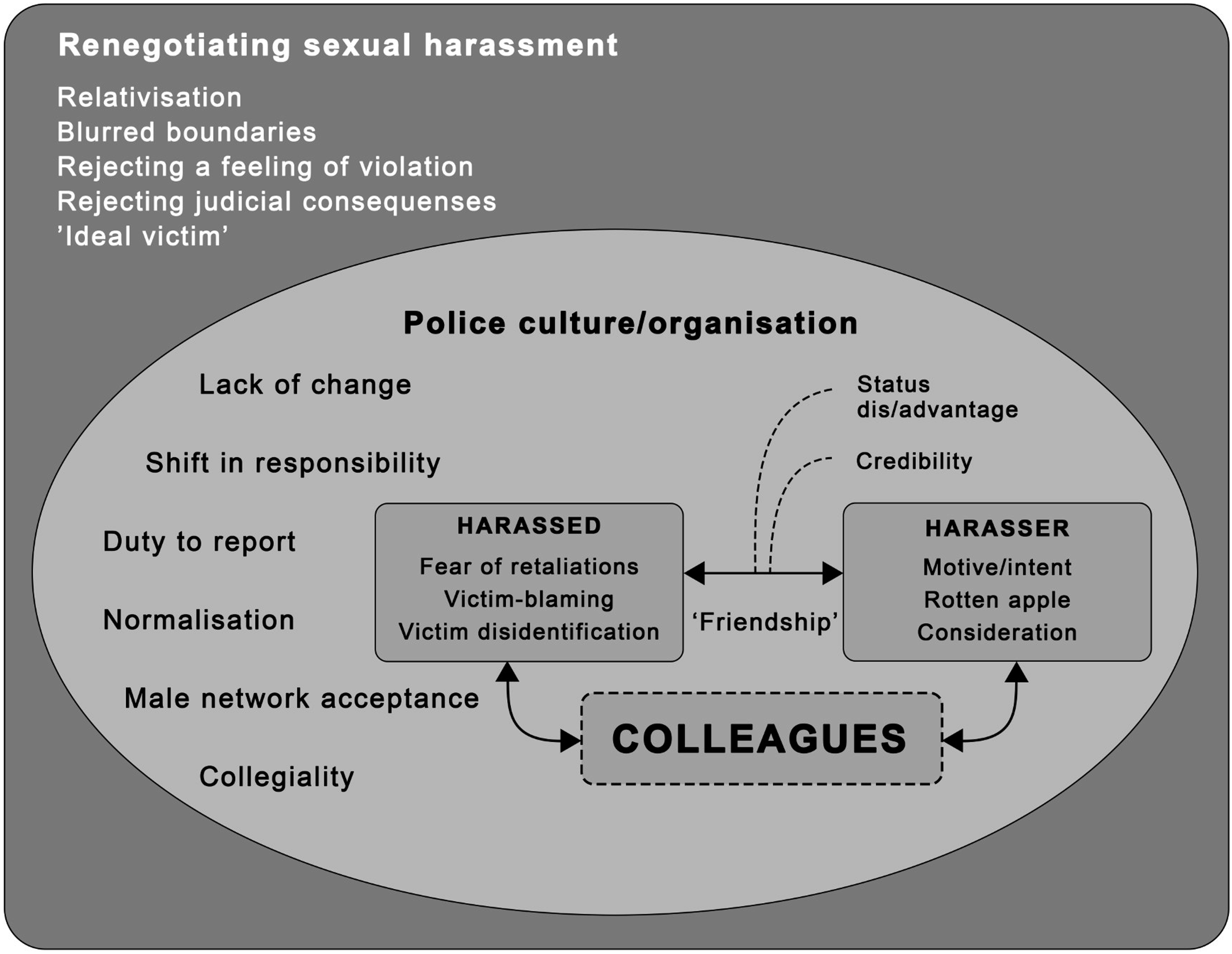
Disclaimers Regarding the Police Organisation and Culture
One set of disclaimers was directed at the level of the police organisation or police culture.
Lack of Change
A recurring statement from police officers who had experienced harassment by colleagues or supervisors was: “nothing happens anyway.” Such statements expressed a logic that there was no reason to report experiences of sexual harassment, due to the lack of short-term impact on the part of the harasser or long-term impact on the organisation or on the general police culture. Expected lack of short-term impact on the part of the harasser; e.g., a lack of disciplinary measures following a report, was used as a justification for not reporting such incidents. This was expressed in an internal police investigation: “when [the harassed] went back to work after a week, she had planned to talk to [the harasser, her manager] but then changed her mind, thinking that it was not her job to do so. [The harassed] considered speaking to [the manager of the harasser] but found out that [the manager] already knew about [the harasser] and that the manager had still decided to hire [the harasser]. [The harassed] then thought that there was no point in her speaking up.” This statement expands the expected lack of consequences to cover a lack of actions on part of management if receiving a report. A similar reasoning was used when pointing to the lack of long-term impact of reporting sexual harassment in terms of organisational or cultural change. Several interviewees who had experienced harassment argued that they might find reporting worthwhile if it would contribute to a change in police culture, but they doubted that such change would result from a single case of reporting. These accounts on the lack of effects of reporting in the organisation form pre-emptive dismissals that reporting would not lead to consequences or change.
Shift in Responsibility
Another disclaimer for not reporting sexual harassment was that reporting was “someone else’s responsibility.” This was reflected in an internal police investigation about a case of sexual harassment, in an interrogation with a witness who was a colleague of both the harassed and the harasser, and also a manager within the police: “[the witness] was taken aback by the incident and wasn’t sure how to act. He mulled it over for a while […] During the party [the witness] wondered what he should do. Later, during the party, he heard [the harasser] tell [another manager] about the incident. [The witness] could not remember who the manager was. He then thought that the incident had come to the attention of a[nother] manager and so he could let the incident ‘drop’.” The disclaimer that “someone else” in the organisation had been informed about the harassment, and that the matter of how to proceed was therefore on someone else’s desk, in the above case “saved” the manager [the witness in this case] from having to act on his knowledge of the harassment. This disclaimer contributed to shifting the responsibility of his own duty to report, passing it on higher up in the organisation. The phrase that the sexual harassment “had come to the attention of a[nother] manager so he could let the incident ‘drop’” also illustrates a structural feature in the police organisation; that managers have a juridical obligation to act on misconduct that comes to their attention. This specific organisational logic can therefore be used as a disclaimer for not reporting, if the matter is on “someone else’s desk.”
Duty to Report
All sworn police officers have a duty to report potential legal offences that come to their attention (cf. Lundgren & Wieslander, 2024a). Nevertheless, reporting sexual harassment implies breaking the “blue code of silence.” This dilemma can be traced in the above disclaimer about “someone else’s responsibility,” in which the manager is described as “mulling over” what would form a correct line of action, instead of simply reporting what had come to his attention. This reasoning was also expressed in interviews with police officers who had been harassed by colleagues or supervisors, such as in the statement “if I had brought it up with my supervisor, he would have had to report it.” The duty to report was frequently referred to by both harassed individuals and union representatives when discussing the limitations of collegial procedures to disclose misconduct. Speaking up would potentially result in judicial consequences, which meant that police officers hesitated to disclose such incidents (cf. Lundgren & Wieslander, 2024a). Police officers are well aware of the duty to report, and several interviewees expressed that they would rely on the duty to report if a colleague was harassed, but not when it came to their own experiences of sexual harassment: “it doesn’t matter that I have a duty to report. If there is a risk that everything could get worse if I filed a complaint, then I’m not going to do it! But if I saw someone else being harassed, if I saw it, then I wouldn’t hesitate for a second.” [emphasis by interviewee]
Normalisation
Another disclaimer concerned the normalisation of everyday experiences of sexual harassment, and focused on norms surrounding the sexualised jargon in police culture. One interviewee stated that “I was [in my early 20s] and it became an everyday experience. I guess I didn’t find it that offensive, but often we were in the patrol car, he [her supervisor] would kind of just pinch my thigh.” Another interviewee explained that “I did not [feel violated by him pressing his erection against me], because I’m normalised.” These accounts portray a supervisor pinching one’s thigh while on service or unwanted sexualised touching by a superintendent as so everyday and mundane that they were hardly worth mentioning. The second interviewee even explicitly included a reflection of such incidents, re-phrasing “normalisation” as an individual process that formed part of working in the police profession (“I’m normalised”). This context—unwanted physical touching as a part of an everyday professional reality—becomes a backdrop for the non-reporting of sexual harassment by colleagues and supervisors. Since these are considered normal everyday experiences, this forms a disclaimer for not warranting a report. In many interviews, the interviewees recall such incidents from the beginning of their career as young and newly recruited police assistants or as trainees. This might reflect that at the time, they reacted to the unwanted touching, but gradually, this became a normalised and expected everyday experience, which in turn would disqualify any suggestion to report the incidents.
Male Network Acceptance
Another disclaimer regarded specific features of police culture, and illustrates that conforming to the norms and behaviour of the “in-group” is significant for not reporting sexual harassment. The male network and the importance of being accepted as a woman were in some instances explicitly expressed, like in the case of a bystander explaining the reason she believed a female manager had not reported an incident when a male manager exposed himself in front of other colleagues: It’s not that easy to gain acceptance from the male network. […] It’s a male-dominated workplace, you can’t say or do just anything. […] So [the incident] was covered up. […] There are informal structures. […] There are agendas. It looks better if the unit is quiet and there aren’t that many incidents […]. You really want to get promoted, which means there can’t be any scandals. It’s about being a woman in a male-dominated profession. But I think you learn to read the codes. And yeah, no one says ‘I’m a feminist’ at work.
Adjusting to perceived norms and behaviours becomes a requirement; not only to advance in the career ladder, but also to secure a position that you already have gained in a male network. Network acceptance becomes a vital condition within the organisation, although difficult to grasp, since it is seldom expressed explicitly (as in the quote above), but rather forms an informal code that you learn to decode by spending time in the organisation. This disclaimer was also expressed in an interview with a police officer who described her own experience of sexual assault by two colleagues and why she did not report it: “no, we were friends, but that’s just how you fool around, and I wanted to be part of the gang.” Adjusting to norms and behaviours and receiving acceptance within the group was thus considered more important than reporting an experience of sexual assault by two of her closest colleagues.
Collegiality
Another frequent disclaimer regarded the role of colleagues as bystanders, and concerned the collegial aspect and consequences of reporting. One interviewee stated that, “the thing is, there were two witnesses [colleagues] to the incident. I don’t know, I wouldn’t want to force them to testify […] I didn’t want to expose them to having to speak of it.” This reasoning frames the non-reporting of sexual harassment as a form of consideration for their colleagues. Were the harassed to report her experience of sexual harassment, there was a risk that her colleagues would be called to testify as witnesses, forcing them to break the “blue code of silence,” which would be considered disloyal and lead to potential retaliations against the person reporting (cf. Lundgren & Wieslander, 2024a). Reporting might also force colleagues to “take sides,” as explained by another interviewee: “people would have wanted to pick a side.” These statements reflect care and consideration for colleagues, and not reporting experiences of harassment would “spare” their colleagues from having to pick sides and potentially to testify. This disclaimer adheres to and confirms the ‘blue code of silence’ which ranks loyalty and protection of other police officers highly.
Disclaimers Regarding the Harassed
Another set of disclaimers were specifically focused on the role of the harassed if they were to report sexual harassment.
Fear of Retaliations
In an internal police investigation, the harassed explained why she had not reported the harassment the following way: “[the harassed] was worried that things would get worse for her, that they would make something up about [her, the harassed].” Similar accounts were expressed in interviews with police officers regarding a fear of retaliations if they were to speak up about their experiences of sexual harassment by colleagues or supervisors. One interviewee stated “I can’t risk being ostracised” and another that “there would just have been a lot of talking, and you don’t want to be the one that people speak of.” These statements illustrate an explicit fear of negative consequences for the harassed if they were to report a colleague. Potential retaliations following a report might be social in character (bullying, ostracism), or result in negative consequences for the individual career of the harassed (missed opportunities of promotion, lack of salary raise, change of work assignments), and even lead to anonymous threats directed at the harassed. Several of the interviewees portrayed such potential negative consequences as worse than the harassment itself (Lundgren & Wieslander, 2024a). According to this logic, it is the harassed who will face negative consequences if they were to report experiences of sexual harassment, not the harasser. This makes reporting a non-option, in that non-reporting becomes a strategy to minimise the risks for the harassed.
Victim-Blaming
The data on police officers who had experienced sexual harassment by colleagues or supervisors also includes disclaimers that implicitly or explicitly place blame on the harassed. This is illustrated by an interviewee in the statement “I’ve often thought that I’m the problem, there’s something wrong with me,” when reflecting on the fact that “everybody knew” that she had been sexually assaulted by a colleague, but the only aftermath was her harasser being promoted. The expression that “I’m the problem” explicitly re-frames the experience of sexual harassment by a colleague into victim-blaming—by the harassed herself. This interviewee elaborated: “I knew all along that I hadn’t done anything wrong, but still, it would feel like my fault if he looked bad because he did something stupid.” This statement places responsibility on the harassed to make sure the harasser does not get into trouble, and thus becomes a disclaimer for non-reporting. Taken together, such statements form a logic of victim-blaming on two levels: the harassed first expressed that “she must be the problem” for having experienced sexual harassment. Second, were she to report the sexual harassment, she would create a problem for the harasser. The “problem” thus becomes the harassed’s experience and her potential actions, not the harasser’s actions or the harassment. This reasoning also renders a logic advocating the non-reporting of sexual harassment.
Victim Dis-identification
Both internal police investigations and testimonies from the #MeToo call from the police include statements such as: “I don’t feel like a crime victim” (Interrogation, victim) and “I don’t feel like an injured party” (nödvärn, 2017, p. 50). Through these testimonies, the harassed effectively distance themselves from an imagined role as crime victim, plaintiff, or injured party, and through this dismiss the relevance of reporting their experiences of sexual harassment. And the other way around, reporting the harassment would make them crime victims, a position they do not acknowledge or identify with. This performative positioning is closely related to their role and task as police officers, and forms a contrast to third-party citizens that they deal with as “crime victims” in their role of police officers. This disclaimer cements a fundamental dis-identification with “the other side” of this division; the potential of being “policed” as opposed to being the police. This division categorises people into “us” and “them,” police versus criminals and crime victims—and as police officers, they can only fit into the first category (cf. Ekman, 1999).
Disclaimers Regarding the Harasser
Yet another set of disclaimers regarded the harasser.
Consideration for the Harasser
This disclaimer focuses on potential negative consequences for the harasser were the harassed to report the sexual harassment; for instance, disciplinary actions against the harasser such as dismissal, but also personal consequences such as a potential divorce if the harassment became known. One interviewee stated that: “it would feel like my fault if he looked bad because he did something stupid. […] Speaking of it would be like throwing him under the bus.” More far-reaching worries were expressed in an internal police investigation with a manager who had reported an incident of sexual harassment that had come to his attention: “when [the manager] talked to [the harassed], she said that she hesitated to speak up as she feared that [the harasser] would then commit suicide.” These statements include an implicit or explicit ascription of responsibility to the harassed for potential consequences for the harasser, were they to speak up. Protecting the harasser from such consequences forms a disclaimer for not reporting experiences of sexual harassment.
“Rotten Apple”
Several interviewees reasoned around the character of their harassing colleagues in the following terms: “Yeah, some people are like that, like rotten apples. […] Many of them have left the force, the worst ones […] But there are still some left, and it’s like, ‘whatever’.” Another police officer recounted a similar reasoning: “‘He’s just like that’, and that kind of makes it ok. […] ‘He’s a bit touchy-feely when he’s drunk,’ or ‘he doesn’t mean anything bad by it.’ You kind of hide it behind ‘he’s just like that, he can’t help it.’” These statements portray harassers as “rotten apples,” which is a common metaphor within the police force to frame police officers’ misconduct (Barker, 1977). This disclaimer supports a decision not to report harassing behaviour, since rotten apples “can’t change.” Such statements were also expressed by bystanders or others in the organisation to imply that the harassed should not feel violated since “everybody knows” that the harassing individual “is like that.”
Motive
Another disclaimer regards the assumed lack of motive or intent attributed to the harasser, such as in the interview statement “he didn’t mean anything bad.” Another interviewee said: “but he was like really drunk, and I don’t think he meant it like…, not sexually, or what do I know. I don’t know how to explain it, but like a friend, or in a nice way.” This reframes the motive of the harasser in terms of kind intentions or as simply a mistake. The harassment therefore does not warrant a report, because the intention was assumedly not to harass. This reasoning around motive or intent also reflects a criminal logic in which intent is a core concept in criminal law; an element that must be proven to ensure conviction of a legal offence. The lack of intent thus disqualifies an act from being framed as sexual harassment, and accordingly, from being reported.
Disclaimers Regarding the Relationship Between the Harassed and Harasser
As seen in Figure 1 above, three disclaimers concern the relationship between the harassed and harasser; “(but) we’re friends,” credibility, and status dis/advantage. The two latter disclaimers are particularly significant in regard to colleagues, since credibility and status advantage are qualities you gain in the eyes of a wider social network.
“(But) We’re Friends”
The closeness or bonds between the harassed and the harasser form a central mechanism to justify the non-reporting of sexual harassment within the police. A police officer who was sexually assaulted by two male colleagues explained that she did not want to take the matter further due to her friendship with them. She stated in an interview that she still liked them, but not what they did to her, and: “they’re my friends. [I don’t] want this to become an issue. Because these guys, they’re good guys, apart from [the assault], I still talk to them. I meet up with them, we have a laugh.” In a similar way, she described her mixed feelings about another colleague in her unit who had sexually harassed her on several occasions: “I’ve thought about that. […] How I’m still able to like him after what he did to me.” This disclaimer illustrates the close bonds that can develop between members of a patrol unit and how these bonds are significant to understand the non-reporting of sexual harassment. Many incidents reported in our data do in fact occur between colleagues who know each other well. Against the backdrop of the central role of collegiality within the police, as discussed above, this disclaimer additionally implies that the stronger the bonds of friendship, the more difficult it is to speak up about sexual harassment by a colleague.
Credibility
Another disclaimer relates to the harassed and harasser’s relations to colleagues in a broader way. The interviews with police officers who had experienced sexual harassment by colleagues or supervisors included statements such as “no one would believe me.” Another interviewee stated: “who would believe me? And speaking of relationships, he [the harasser] happens to be married to another superintendent.” These accounts centre the credibility of the harassed, showing that the harassed doubted whether their colleagues would believe them if they were to speak up about their experiences of harassment by colleagues and supervisors. This makes reporting a non-option. This disclaimer is tightly connected to relationships and hierarchies within the police, in that credibility comes with status, rank, bonds and relationships to others within the organisation. Many police officers in our data described experiences of sexual harassment while new recruits. As mentioned above, previous research shows that junior female police officers are the least inclined to report sexual harassment. The second statement above, that “he [the harasser] is married to another superintendent” forms a concise summary of this point. Not reporting experiences of sexual harassment is a logical implication of the assumption that no one would believe the harassed due to lower rank and status in the organisation. In Figure 1, this disclaimer is placed between the harasser and the harassed, due to the relational aspect. However, it was more often explicitly expressed as attributing higher credibility to the harasser and lower to the harassed.
Status Dis/advantage
Closely related to the credibility disclaimer was a disclaimer that focused on the perceived status of the harassed and the harasser. Like the credibility disclaimer, this disclaimer is also placed between the harasser and the harassed in Figure 1, and was most commonly expressed by ascribing the harasser a status advantage. One interviewee stated that: “he [the harasser] had such good relationships with people and I was a new recruit. No one knew who I was, it was like, ‘haha, I’m the one who’s reporting colleagues’, you know.” Another interviewee clarified her decision not to report being harassed by a colleague with: “also, knowing that he had all those relationships with people…” The status disadvantage in which the harasser had a more senior position than the harassed here becomes a reason not to report sexual harassment. Similarly, this disclaimer was used for not reporting police officers who were popular or had formal or informal power positions within the organisation. As previously mentioned, several police officers recounted having experienced sexual harassment by senior colleagues or instructors when they were new recruits or trainees. This reflects the hierarchical relationships of power and dependence that characterise the police organisation. Several interviewees stated that it would be impossible to report one’s superintendent for sexual harassment. This reflects a broader point that reporting is inextricably linked to relationships within the organisation for credibility, support, and consequences, such as retaliations.
Disclaimers That Renegotiate What Constitutes Sexual Harassment
Finally, the data includes several disclaimers that question and renegotiate what constitutes sexual harassment when it occurs between colleagues within the police.
Relativisation
A relativisation disclaimer was used in interview statements, such as “it [the sexual harassment] wasn’t that bad/serious” and “him pressing his erection against me is discomfort level 2 out of 10.” Harassed police officers often compared an incident of sexual harassment to (other) sexual offences: “because it wasn’t rape, you know? It wasn’t at that level. […] It wasn’t a big deal.” or “It was pretty minor, I mean, it wasn’t rape, he pulled my skirt off, kind of as a joke. But I didn’t find it funny, of course.” These statements compare the experiences of sexual harassment to rape and assault, thus relativising the severity of the harassment, which in turn becomes an argument for not reporting. Such relativising accounts were also used by the interviewees when comparing their often-dangerous everyday professional reality as police officers to the common sexist banter among colleagues within the police. In this context, reporting a jargon of sexual harassment was considered “stupid.” In relation to the profession as a police officer, it was portrayed as absurd to be bothered or offended by sexist comments or unwanted touching from colleagues to the degree of warranting a report.
Blurred Boundaries
The “blurred boundaries” disclaimer is grounded in the assumed intentions of the harasser, and constructs sexual harassment as “failed flirting.” A male police trainee who was harassed by a classmate said that “I guess she was up for it.” He thus re-constructs the incident as a failed invitation for a sexual fling, and not as a situation warranting a report. The data (both interviews and testimonies in the #MeToo call #nödvärn) also includes comments from bystanders witnessing sexual harassment who state that “you should consider it flattering,” which re-interprets sexual harassment as a (positive) confirmation of the attractiveness of the harassed. A similar logic was reflected in the account of a police officer, when she confronted her male colleagues about the rumour of a “list of lays” that ranked the female colleagues at the station in terms of sexual desirability. At first, her male colleagues denied the existence of such a list, only to add that “you just want a top ranking” (fieldnote, participant observation). In an internal police investigation, a witness stated that, “[the harasser] said it “just for fun,” even though in retrospect he understood that it wasn’t particularly funny.” In this investigation report, the harassed also stated that “before the current incident, [the harasser] had on several occasions told [the harassed] that she was his ‘dream girl’ and also said that ‘if only we were dating.’” These statements, on the one hand, blur the boundary between sexual harassment and flirtatious compliments, and on the other hand contrast the two, creating an opposition through which flirtatious intent cannot simultaneously form sexual harassment.
Rejecting a Feeling of Violation
In interviews with police officers who had experienced sexual harassment by colleagues or supervisors, some interviewees expressed that they in fact considered the incident to constitute sexual harassment, but they did not feel violated or offended, arguing that the incident therefore did not warrant a report. This reasoning around non-reporting thus renegotiates what constitutes sexual harassment, in statements such as: “no, I don’t feel that violated by it. I thought it was disgusting of him, but I don’t want to report it” and “I am angry and saddened by what happened, but I don’t feel violated.” In these statements, for an incident to warrant a report, it needs to have been experienced a specific way, namely as a violation. For an act to be “disgusting” or for someone to feel “angry” does in these statements not necessarily correspond to feeling violated. A lack of “violation” then becomes an argument against reporting. This forms another form of relativisation of the severity of sexual harassment, as illustrated in another interview statement: “I think [my colleagues] would have thought that [irritated tone] ‘come on, is this really worth reporting?’ People would have thought that, and I felt the same.”
Rejecting Judicial Consequences
Closely related, albeit distinct from the previous disclaimer, are instances in which the harassed expressed feeling violated but still did not consider the incident to constitute sexual harassment, since this might lead to the filing of a report and potentially a subsequent legal process. One interviewee stated: “I mean, I feel offended and angry about it, but I don’t know. I didn’t want it to become a legal process.” In this reasoning, through the act of reporting, an act becomes sexual harassment; i.e., if an act warrants being reported, it is given significance as sexual harassment (cf. Lundgren & Wieslander, 2024a for an expanded discussion of this point).
“Ideal Victim”
Our interviews also include instances in which a non-stereotypical gendering of the harassed and the harasser made it difficult to acknowledge sexual harassment. In such instances, an “ideal victim” could not be recognised (cf. Christie, 1986; Duggan, 2018), which lead to a renegotiation of what was considered to constitute sexual harassment. This was expressed in an interview with a male police student who stated: “I don’t see it as sexual harassment since it’s a woman who’s doing it, and it’s…, there’s like a short circuit in my head, or not a short circuit, but, women have learnt that men will do this and men haven’t learnt that women might touch you when you don’t want them to.” This failure to acknowledge his experience of unwanted touching by a female classmate as sexual harassment implies a renegotiation of the harassment and made reporting a non-option for this student.
Discussion
Previous research on the lack of reports of sexual harassment within the police has mainly pointed to organisational shortcomings and a resilient male police culture (e.g., Brown et al., 2018), or to the harassed’s lack of confidence and fear of retaliation (e.g., Davis et al., 2023; Sweeting & Cole, 2022). The present study supports these findings but also extends previous knowledge about the reasons for not reporting sexual harassment by focusing solely on the reasons for not reporting. We extend previous research on responses to and silencing of sexual harassment in other contexts (Bergman et al., 2002; Fitzgerald et al., 1995; Hershcovis et al., 2021), by identifying 20 distinct disclaimers that illustrate the interconnected mechanisms of the non-reporting and silencing of sexual harassment on both an individual- and group-level in the police force. We show how this silencing is connected to various police cultural aspects and offer nuanced new information on the dynamics of police culture by highlighting the interrelated mechanisms at play concerning both the phenomenon of sexual harassment and how it is experienced and perceived when it occurs between colleagues within the police.
As stated in previous research (Brown et al., 2019; Steinþórsdóttir & Pétursdóttir, 2018), masculine traits within police culture play a significant role for understanding the non-reporting of sexual harassment. Our findings show how norms within police culture, and the strive to adapt to these norms to gain what we here label as “male network acceptance,” become naturalising arguments that frame sexual harassment as part of an everyday professional reality as a police officer. A naturalising and taken for granted understanding of the characteristics of police reality contributes to an assumed improbability of change within the organisation, which in turn becomes a justification of the non-reporting of sexual harassment. Moreover, a set of disclaimers that renegotiate what constitutes sexual harassment within the police expand the reasoning for not reporting experiences of harassment by colleagues or supervisors. This extends previous research on sexual harassment, as our findings illustrate how understandings of sexual harassing behaviours shift when occurring between colleagues. Several disclaimers relativised the severity of the incident, portrayed sexual harassment as mundane everyday experiences, and blurred the boundary between accepted social interaction such as flirting on the one hand, and harassment on the other. Sexual harassment was renegotiated as “failed flirting,” using the presumed motive of the harasser as a disqualifier for warranting a report, and the severity of sexual harassment was relativised and contrasted against sexual offences such as rape. This naturalisation of police officers’ professional reality and relativisation of experiences of harassment interrelate with additional aspects, such as relationships of dependence, and the status and prescribed credibility of the harasser and the harassed within the organisation. This leads to pre-emptive assumptions that reporting would not lead to positive impact or change in the organisation, and that the risks if reporting are considered to outweigh potential benefits.
Our analysis of the disclaimers that explicitly related to the broader group of colleagues further extends previous research on sexual harassment within the police. Reporting sexual harassment might potentially lead to a legal process in which peers would be called to testify, thus forcing them to take sides and break the “blue code of silence” (cf. Lundgren & Wieslander, 2024a), and be drawn into what is perceived as a conflict between colleagues (the harasser and the harassed). Thus, not reporting experiences of harassment becomes a performative act of the harassed “being a good colleague,” ranking consideration for colleagues above what is framed as personal grievance. Moreover, the fear or worry that the harasser would get into trouble was used as an argument against reporting, expressing a meta-reflection on part of the harassed in that they took responsibility for the actions of the harasser.
The non-reporting of sexual harassment is therefore tightly connected to relationships and the “blue family” within the police. The harassed feared retaliations if “snitching” or forcing colleagues to take sides and testify, thus breaking the “blue code of silence.” In light of this, it appeared safer to place responsibility for reporting on “someone else” or some other (higher) level in the organisation. The strive to form part of the “blue family” of police collegiality is furthermore intrinsically connected to what we label as “male network acceptance,” and disclaimers regarding credibility and status within the police force. This deepens our understanding of how hierarchies within the social network become justifications for the non-reporting of sexual harassment within the police context. A number of disclaimers centred around relationships and hierarchies within the group of colleagues, from relational aspects between the harasser and harassed, to expressions of doubt on part the harassed about their own credibility in relation to established bonds of loyalty among colleagues and supervisors. Another central disclaimer was the “(but) we’re friends,” showing how the family-like bonds that are established between unit-members within the police form a backdrop for all other disclaimers. This disclaimer binds together disclaimers on all levels and creates a sound justification for not reporting sexual harassment, since it interconnects different levels of disclaimers; at the intersection of the harassed (I like him), harasser (my friend), the context (the blue family), and how harassment is renegotiated (not as sexual harassment).
In a context where collegiality is so highly valued, it poses a great risk to challenge this by disclosing acts of harassment. This is evident in disclaimers that express fear of retaliations, ostracism, becoming the object of bullying etc. if speaking up about experiences of harassment, which confirms findings in previous research (e.g., Davis et al., 2023; Lonsway et al., 2013; Sweeting & Cole, 2022). This reasoning was also expressed in cases where everybody agreed that the harasser was at fault. Through reporting, the harassed would create a “problem” for colleagues and the harasser, and thus become the “problem” (cf. Lundgren & Wieslander, 2024a). This clearly made reporting a non-option.
Our findings show how the gendered context and social networks of collegial bonds within the police shape how the harassed and bystanders perceive and handle sexual harassment by colleagues and supervisors. Considerations for the consequences for the harassed, the harasser and other colleagues (witnesses) illustrate the centrality of collegiality and trust within “the blue family,” which are prioritised over individual experiences of harassment. In this sense, collegial trust governs occupational discretion and control (cf. Löfgren & Wieslander, 2020).
Concluding Remarks
This study expands previous research by focusing on the reasons why sexual harassment within the police goes unreported. Shaped by the surrounding institution and police cultural norms as well as by society at large, these disclaimers constitute individual acts of resistance, through non-compliance with a formal policy that requests that police officers and trainees confront, disclose, and report experiences of sexual harassment by colleagues or supervisors to their employer and/or trade union.
Taken together, the disclaimers identified in this study form a solid resistance against reporting, but also challenge understandings of sexual harassment itself. What occurs is a normalisation and silencing of sexual harassment. The mechanisms that make it difficult to address sexual harassment within the police also make it more difficult to prevent sexual harassment and to enable accountability. There is also a risk that such disclaimers contribute to an organisational inability to act and to the preservation of a culture of silence within the police force.
Through identifying a number of disclaimers for not reporting, we also identify how sexual harassment is understood when it occurs between colleagues, and how aspects of police culture shape and are shaped by these understandings. One conclusion that can be drawn is that adapting to police cultural norms and values is perceived as more important than recognising and reporting acts of sexual harassment. A collective relativisation of the severity of sexual harassment solidifies arguments against reporting. Initiatives that encourage police officers and trainees to report sexual harassment within the police force thus fall flat since they clash with established police cultural norms.
For decades, police culture has been identified as an enabling factor and obstacle for handling internal misconduct and irregularities (e.g., Loftus, 2009; Maher, 2008; Silvestri, 2017). Despite internal work to alter police culture, change is slow and often met with resistance (e.g., Loftus, 2009). This signals a need for alternative approaches to facilitate change. Could such alternative approaches take some of the highly valued police cultural aspects as a point of departure, i.e., taking advantage of the centrality of collegiality and loyalty? This is discussed further below.
Policy Implications
Speaking up and reporting sexual harassment form prescribed ways of handling sexual harassment within the police. Previous research (e.g., de Haas et al., 2010) suggests that policies against sexual harassment and encouraging the harassed to report are not enough. Despite clear recommendations and procedures for reporting sexual harassment, the findings presented in this article show the complexities and difficulties of speaking up about sexual harassment perpetrated by colleagues and supervisors.
While this article analyses the reasons for not reporting sexual harassment within the police, we wish to stress we do not propose increased reporting of sexual harassment as a desired objective or main “solution” that would signal progress in handling sexual harassment. Increased reports of sexual harassment might in some cases imply that sexual harassment is taken more seriously within the organisation. Still, insisting that the harassed or bystanders report sexual harassment may imply concrete risks for the harassed that must be taken seriously; of retaliation, ostracism and being considered a “bad colleague”, due to the entrenched blue code of silence. It is of course imperative for the police authority to protect the harassed from retaliations if they speak up about experiences of sexual harassment. But handling sexual harassment only through reporting is problematic since it places responsibility for handling the harassment on the harasser or on bystanders, thus potentially shifting focus from the acts and responsibility of the harasser (Lundgren & Wieslander, 2024b). Moreover, it contributes to an understanding of sexual harassment as a matter of only individual blame (Lundgren & Wieslander, 2024a). Therefore, while solid routines within the organisation for filing complaints and ensuring individual accountability are of the utmost importance, it is also necessary to work with the larger organisational culture. There is thus a need to envision, develop and implement alternative ways of handling sexual harassment that contribute to re-framing sexual harassment as a work environment issue that concerns the whole organisation.
The interconnected justifications for non-reporting presented in this article are firmly rooted in police cultural aspects of collegiality. This further stresses why formal complaints are not a productive way forward for the handling of sexual harassment by colleagues and supervisors. Instead, we suggest that the strong collegiality can, and perhaps should, be used in order to develop alternative ways of preventing and handling sexual harassment among colleagues. Alternative solutions may depart from and make use of the care for and strong sense of collegial responsibility within the police, centring on the fact that those harassed are in fact colleagues within the “blue family.” This would capitalise on the centrality of trust and caring for the well-being of all colleagues, and prioritisation of collegial concern, contributing to shift the understanding of sexual harassment towards an issue that concerns the well-being of all colleagues. This also implies shifting the perspective of sexual harassment from an individual problem (of the harassed, or as a “conflict” between the harassed and harasser) to a collective problem that acknowledges the relational aspects of harassment (Hershcovis et al., 2021). The central role of collegiality and strong sense of loyalty within “the blue family” are ultimately based on the premise that trust and protection of colleagues is necessary in a dangerous profession such as the police. Police officers depend on their colleagues for their safety, and not reporting colleagues for harassment might in this context also form a risk-minimising strategy. Integrating these central police cultural aspects in how sexual harassment is dealt with might contribute to a better work environment more generally, beyond the issue of harassment. This would moreover form an alternative to top-down discourses on sexual harassment from management and HR, which are met with resistance since they are perceived as clashing with an everyday professional reality. Instead, work against sexual harassment could be re-framed as an issue of collegial concern. This suggestion would still require a careful evaluation of potential limitations for implementation, taking into consideration previous research on the risks inherent in collective disciplining.
How could such an alternative approach be envisioned, that replaces the focus on reporting sexual harassment with solutions that benefit from the centrality of trust, collegiality and loyalty within the police? Considering the highly valued “raw but cordial” internal jargon, along with blurring and discrepancies of what constitutes sexual harassment, there is a need to establish an open and inclusive dialogue within the police about these issues. Without the opportunity for police officers to address these questions in collegial forums, without immediately being bound by the duty to report, they will remain silenced, and harassment might be enabled by the very same silence. We suggest that collegial discussions about the boundaries between jargon, banter, and jokes on the one hand, and harassment and violations on the other, can become preventive in themselves, since they may facilitate an open exchange around norms and values that are otherwise framed as illegitimate. In a context in which the majority strives for conformity and where experiences of sexual harassment are oftentimes covered up, sexual harassment needs to be acknowledged as a common, shared experience and legitimate problem within the police, without getting stuck in individual guilt and blame. Moreover, considering the limitations inherent in the duty to report (cf. Lundgren & Wieslander, 2024a), instituting a (civil) position with high level of confidentiality, i.e., not bound by law to file complaints, could potentially bypass some of these limitations and risks of speaking up about sexual harassment. It is also important to communicate steps and measures taken by the organisation back to the harassed and to bystanders, to ensure transparency about how sexual harassment is followed up on. This would form a response to the “lack of change” disclaimer that has been reported as a significant aspect of non-reporting both within the police and elsewhere (e.g., Bergman et al., 2002; Brown et al., 2018).
In line with previous research, we show that collegial relations and networks within organisations contribute to the persistence of and silence around malpractices such as sexual harassment (cf. Hershcovis et al., 2021). Further research is required to explore managers’ role and possibility to change work cultures within the police force, taking into consideration that supervisors/managers and union representatives also form part of the police culture and social networks, and are thus part of the same relationships of dependence as other employees.
Overall, there is a need for a shift in responsibility within the organisation of the police. Sexual harassment is commonly regarded as a “scandal” and as “bad optics” that can have negative consequences for individual career ladders and for the “trademark” of the police in society. This leads to silencing and covering up of sexual harassment. In this sense, a lack of reports is a bigger problem than reports of sexual harassment. Police officers speaking up about sexual harassment could instead be viewed as progress, as a sign that the organisation has acknowledged and made visible the problem, and developed necessary fora for a collegial discussion that include the organisation as a whole.
Footnotes
Declaration of Conflicting Interests
The author(s) declared no potential conflicts of interest with respect to the research, authorship, and/or publication of this article.
Funding
The author(s) disclosed receipt of the following financial support for the research, authorship, and/or publication of this article: This research has been funded by the Swedish Crime Victim Fund grant no. 3470/2021 and Swedish Research Council for Health, Working Life and Welfare grant no. 2022-00128.
