



Abstract
The study of identity work has grown exponentially in the past decade; however, little research has been undertaken in challenging occupational contexts, such as policing. Existing studies have focused on tensions between personal and work identities, such as being a woman in a male-dominated workplace, or how officers have responded to threats to their occupational identities. Using data collected from interviews with 32 Canadian police officers, this study examines the circumstances that compel officers to engage in identity work and the processes undertaken to alleviate these identity conflicts or threats. The findings illustrate that police officer identity work is prompted by four primary triggers, defined as: (1) identity strain; (2) work-identity stigma; (3) identity maturation; and (4) organizational indifference. The findings also suggest that these triggers are influenced by police culture and the related socialization processes that continue to emphasize traditional masculine attributes (e.g., aggression, physical strength and toughness).
Introduction
In the past decade, numerous organizations within the defence and public safety sectors have come under intense scrutiny for sexual harassment (e.g., Canadian Armed Forces, Corrections Canada, LAPD, NYPD, Royal Canadian Mounted Police, U.S. Military) and other negative behaviors, such as race-based discrimination (e.g., Corrections Canada, RCMP, U.S. Military). Calls for organizational reform tend to recommend increased recruitment of women and members from other marginalized groups. Yet these recommendations neglect the influence of the work environment on how individuals strive to create self-meaning. In other words, these proposed changes overlook the reality that police officers are more than their occupational identities and that environmental forces are likely to compel them to manage their conflicting identities through the process of identity work — the “cognitive, discursive, physical, and behavioral activities that individuals undertake with the goal of forming, repairing, maintaining, strengthening, revising, or rejecting” their sense of self within the context of work (Caza, Vough, & Puranik., 2018, p. 895). Understanding the relationship between occupational context and identity work is important as it can aid our understanding of the factors contributing to challenging work environments, particularly for marginalized identities.
Within the workplace, people work on three types of identities: collective (organizational and occupational), role, and personal identities (Ashforth et al., 2008). While identity work can be triggered through the adoption of a new occupational identity or in response to organizational change, other forms of intense identity work can emerge from a challenging work environment (Petriglieri, 2015; Pratt, 2000), negative work experiences (Lutgen-Sandvik, 2008), or tensions between personal and professional identities (Creed et al., 2010; Koerner, 2014).
Within a policing context, the majority of research has largely been limited to the police occupational identity, such as examining the ideological strategies officers engage in to cope with criticisms of their occupation (e.g., Dick, 2005). For example, several studies show how police officers emphasize the positive aspects of their work, such as self-sacrifice, heroism, or performing a critical public service over external depictions of physical force and aggression (e.g., Ashforth & Kreiner, 2014; Dick, 2005; Gramlich & Parker, 2017; Marier & Moule, 2019; Rantatalo, 2016). To a much lesser extent, this research has also explored conflicts between a specific personal identity (i.e., gender, sexuality, or family status) and the police occupational identity (e.g., du Plessis et al., 2020; Rabe-Hemp, 2009; Veldman et al., 2017). Despite the contributions of prior research, we know little about the contextual factors that trigger differing forms of identity work or the conflicts that potentially emerge between officers’ differing identities. Of equal interest is the type of identity work officers engage in to potentially resolve these conflicts. In short, greater knowledge of these contours of identity work is likely to assist police leaders with developing more inclusive and supportive workplaces.
The current study explores the when, why, and how of identity work through data collected from interviews with 32 Canadian police officers. This phenomenological approach extends prior research by first exploring individual motives for becoming a police officer, followed by an examination of the experiences that compel varying types of identity work and lead to potential shifts in work-related or personal identities. Importantly, this study offers practical insights for undertaking organizational reforms. This paper begins with an overview of the literature on identity work and the theoretical framework adapted for the study. The methods are then described, followed by a presentation of key findings and a discussion of the paper’s implications for research and practice.
Theoretical Framework of Identity Work
Over the years, there has been a surge in studies on identity work, with researchers frequently citing definitions provided by early scholars (e.g., Alvesson & Willmott, 2002; Snow & Anderson, 1987; Sveningsson & Alvesson, 2003). These definitions emphasized the type of activities that are involved in identity work, including forming, repairing, maintaining, strengthening, or revising identities for the purposes of: (1) managing multiple, and often conflicting identities to make sense of who one is (e.g., Sveningsson & Alvesson, 2003); (2) creating and maintaining an individual’s authenticity and uniqueness (Watson, 2008); and/or (3) managing the boundaries between personal and social identities (Kreiner et al., 2006b; Pratt, 2000).
Identity work research has frequently been criticized for lacking a coherent theoretical framework (e.g., Caza et al., 2018; Lepisto et al., 2015). To overcome this issue, the current study draws from social identity and identity theories and two theoretical frameworks to explain key questions of when, how, and why people engage in identity work, and the potential implications of this work. According to social identity theory, people seek out certain identities to enhance the way they see themselves and are seen by others (Tajfel & Turner, 1985; Turner, 1985). These identities are created when individuals attach themselves to distinct social groups, with the goal to belong to a desirable ‘in-group’ and to distinguish themselves from those who are perceived as outsiders (Hogg & McGarty, 1990). Identity theory suggests that these identities represent self-meanings that are linked to participation in work-related activities, such as organizational, occupational, or role identities (Ashforth, 2001; Dutton et al., 2010; Stryker & Burke, 2000). These identities might also pertain to several nonwork factors, including personal attributes, personality, abilities, and interests (Gecas & Burke, 1995; Piening et al., 2020; Savage et al., 2019), such as sports or politics. These two theories suggest that individuals primarily engage in identity work to change the extent to which they see themselves as members of social groups or change the meaning of these identities (Kyratsis et al., 2017).
The first theoretical framework adopted for this study is a general model that emphasizes the processes and motivations of work-related identity work (Lepisto et al., 2015). The second is an overarching framework that integrates several key assumptions, including: (1) individuals hold multiple, interdependent identities (e.g., personal and work-related identities); and that (2) identity work is relational (i.e., constructed with others), (3) temporal (i.e., past, present and future); and (4) involves both conscious and unconscious processes (Caza et al., 2018). The current study integrates key elements from these two frameworks to provide a more rigorous theoretical foundation for investigating occurrences of identity work at key points in a police officer’s career, such as recruitment, training, and early job postings, as well as throughout their entire tenure as a police officer. This adapted framework is depicted in Figure 1 and further discussed below. Theoretical framework of identity work (adapted from Caza et al., 2018; Lepisto et al., 2015).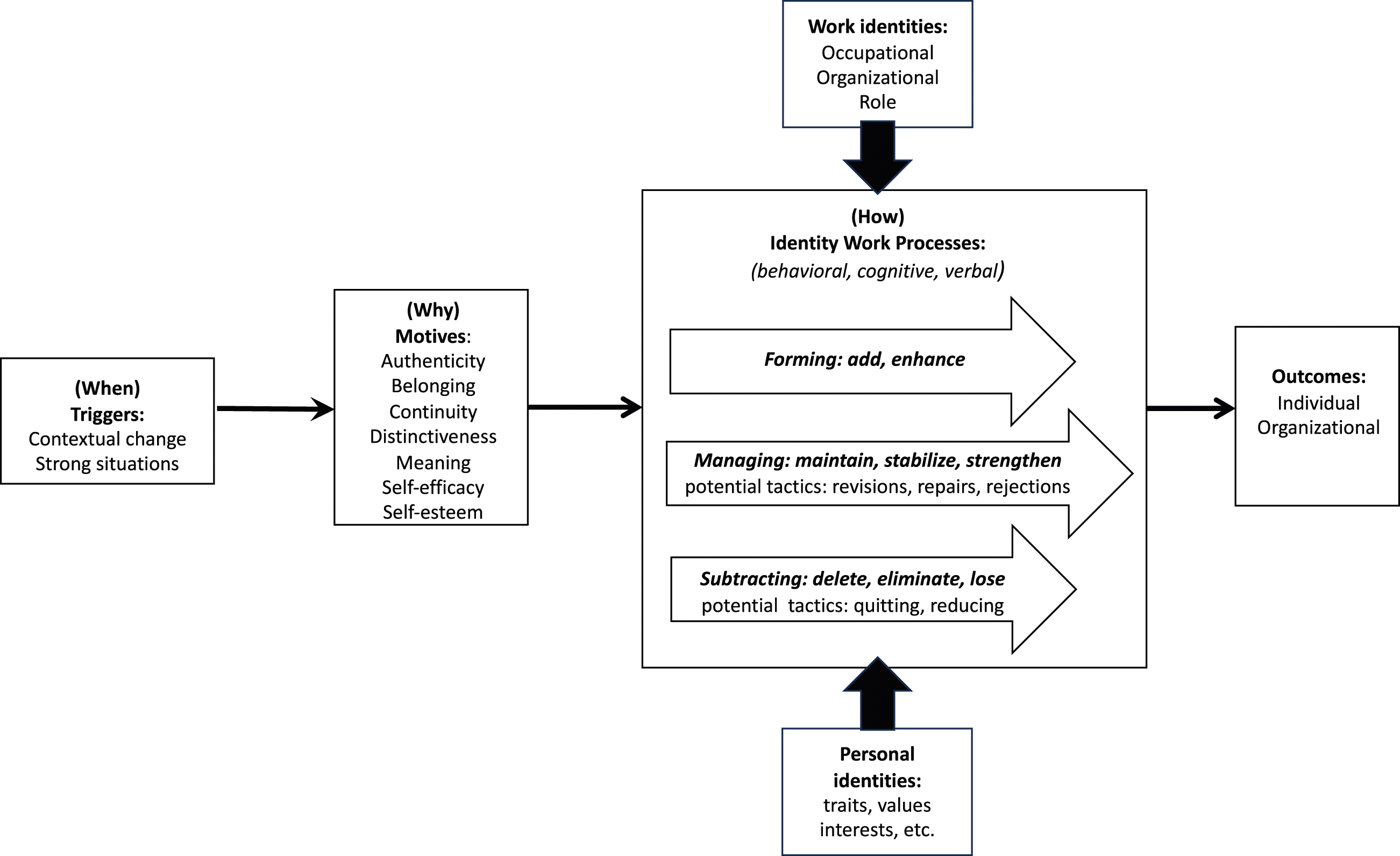
The When and Why of Identity Work
Within their theoretical model of identity work, Lepisto et al. (2015) propose two general types of triggers (the when): (1) contextual change (changes in work practices or individual transitions); and (2) strong situations (e.g., strong cultures, constraining workplaces, competition for resources) in which the social environment potentially challenges seven different identity motives (e.g., authenticity, belonging, self-esteem). From Caza et al. (2018), these strong situations can also encompass threats to a collective or personal identity. For instance, extensive criticism of the police can destabilize one’s identity as a police officer. Similarly, being perceived as ill-suited for police work based on one or more personal identities, such as gender or sexuality, can destabilize both occupational and personal identities. Such scenarios can lead to attempts to stabilize these identities through a specific identity work process or tactic to fulfill one or more identity motives (the why).
Vignoles (2011) suggests that individuals can have multiple motives for engaging in identity work, including the desire for meaning, such as assuming the meaningful identity of a police officer who serves their community (meaning motive) or to distinguish themselves from others that may be perceived as lower status, such as police officers who engage in misconduct (distinctiveness motive) or to distinguish themselves as a higher caliber officer: an investigator. Identity work might also be undertaken to connect past, present and future identities (continuity motive) or to maintain one’s sense of self (authenticity). For example, this could include following in the footsteps of other family members who have been police officers or to maintain a coveted identity as a crime fighting police officer. This might also involve aligning a role with how individuals see themselves, such as a crime fighter or a community policing officer. Other motives to engage in identity work can include enhancing self-esteem (self-esteem motive), competence (self-efficacy motive), or to feel included and accepted by others (belonging motive).
Identity Work Tactics and Processes (The How)
The framework presented in Figure 1 illustrates that identity work can be categorized into three different types: behavioral, cognitive, and verbal (Caza et al., 2018; Lepisto et al., 2015). Behavioral identity work generally consists of actions that construct, revise, and/or maintain social identities (Ashforth et al., 2007; Caza et al., 2018). Such actions might involve distinct efforts to maintain a separation between personal and professional identities (e.g., Kreiner et al., 2006b), mimicking the actions of a role model or mentor (Covaleski et al., 1998), or distancing oneself from other members or roles that are perceived to be inferior (e.g., Ashforth et al., 2007; Perrott, 2019). Behavioral identity work might also be physical in that it involves the use of self, objects or other materials within the work environment to help craft a desired identity. For example, studies show how police officers use their physical bodies to display fitness and toughness (Courpasson & Monties, 2017).
Cognitive identity work pertains to various activities that involve self-questioning or reflective sensemaking in order to interpret, understand or evaluate an identity or to make sense of multiple identities (Caza et al., 2018). Prior research illustrates that these activities can include mentally creating an identity hierarchy to better manage personal and professional identities (Kreiner et al., 2006a), reframing the meaning attached to a stigmatized occupational identity (e.g., Ashforth & Kreiner, 1999), or projecting the undesirable attributes of an identity (Petriglieri & Stein, 2012), such as police abuse of force onto select groups within policing (i.e., uniformed patrol officers).
Finally, verbal identity work occurs through communication when individuals use narratives and dialogue to shape an identity, such as using adjectives to distinguish the role of a “boring manager” from an “inspiring leader” (Carroll & Levy, 2010), adopting language associated with a “tough talking cop”, or expressing suspicion and cynicism about outsiders. Other studies have illustrated how the identities of police recruits are often influenced by seasoned officers who share war stories associated with being a “real” police officer (e.g., Van Maanen, 2010). As demonstrated in Figure 1, one or more of these identity work tactics can be undertaken within three broad identity construction processes: forming, managing, and subtracting.
Forming
Forming a new identity is one of the more commonly studied identity work processes associated with adding, gaining or enhancing an identity (Lepisto et al., 2015). Within a policing context, prior research has largely focused on the identity outcomes of socialization practices (e.g., Charman, 2017; Morrow, 2008). For example, a study involving a State Police training academy in the United States revealed how the war stories shared by instructors helped new recruits establish a professional identity that was defined as serving a higher purpose, emphasizing police solidarity, and making a clear distinction between the role of the police and civilians (Morrow, 2008). Other forming examples might arise from transitioning from a patrol officer to a detective, adopting the identity of a police leader, or enhancing one’s identity as a community policing officer rather than a physical crime fighter.
Managing
Managing refers to the general upkeep of an identity that includes actions to maintain, stabilize, or strengthen an identity (Caza et al., 2018; Lepisto et al., 2015). For clarity, stabilizing refers to various activities, including, repairing, revising, or rejecting. Relevant studies show how individuals attempt to stabilize (i.e., repair) their personal identities in various situations, such as when their personal characteristics have been devalued (e.g., traits, values or abilities; Kyratsis et al., 2017; Lutgen-Sandvik, 2008), or when they have been humiliated (Aquino & Douglas, 2003), bullied (Lutgen-Sandvik, 2008), or denied promotion (Vough & Caza, 2017). Scholars have also examined various repair processes undertaken in response to various organizational identity threats (Bednar, 2012; Durand & Vergne, 2015; Kjaergaard et al., 2011; Petriglieri, 2015; Tracey & Phillips, 2016), including perceived shifts in an organization’s image following different change processes (e.g., structural, cultural or operational; Kreiner et al., 2015), or public scandals (Bednar, 2012; Durand & Vergne, 2015).
Subtracting
As the name suggests, subtracting involves some form of loss through deleting (partial or full), eliminating or losing an identity, and is considered to be the least studied aspect of identity work (Lepisto et al., 2015). Whereas subtracting an identity might arise from changing roles, with an individual choosing to delete the lower status identity (Dutton et al., 2010), identity loss may result from voluntary or involuntary termination from a valued work identity (Shepherd & Williams, 2018). In the context of policing, officers may choose to subtract a work-related (organizational) identity by reducing its significance or quitting a police department that fails to support its members.
Potential Outcomes of Identity Work
A common expectation of identity work is that an identity conflict or tension will be resolved (Caza et al., 2018) or that a perceived identity threat will be reduced (Petriglieri, 2015); however, there is no guarantee that such outcome will be achieved. In reality, identity work can have both positive and negative implications for individuals. For instance, while women may revise their gender identities to gain a sense of belonging in a masculine work environment, women may not be truly accepted in a male-dominated occupation that emphasizes and values masculine traits (e.g., Davies & Thomas, 2003). On the other hand, identity work is more likely to lead to increased job satisfaction and engagement, particularly, if individuals can adopt their authentic identities at work (Cable et al., 2013). For organizations, individual identity work can also bring both positive and negative outcomes, such as causing employees to potentially strengthen or weaken their attachment to the organization or to reject proposed organizational changes. Similarly, identity work may lead to improved or reduced job performance and to positive or negative shifts in organizational identity (Caza et al., 2018).
The next section describes how the adapted theoretical framework of identity work is applied to the current study to address two primary research questions: (1) How do police officers engage in identity work? (2) What circumstances or events trigger or motivate identity work processes?
Methods
For the current study, data were collected from semi-structured interviews with 32 serving Canadian police officers during 2020. Specifically, the data were derived from interview questions that explored motives for becoming a police officer, positive and negative work experiences, changes in occupational roles, and changes in the importance of police or organizational identities over the course of an officer’s career. Participants were advised that the study focused on their identities as police officers and/or members of a particular service and individual efforts to manage these identities over time. Invitations to participate in the study were posted on a police-only social media site as well as shared with a provincial association of police leaders for dissemination to their members. Due to COVID-19 restrictions, all interviews were conducted by either telephone or video conferencing (i.e., Microsoft Teams, FaceTime or Skype) and ranged from 45 to 120 minutes in duration.
Participants
Of the final sample of 32 officers, 25 self-identified as men and 7 as women, with one woman identifying as Black. All other participants were White. Participants ranged in rank from constable to superintendent, with the majority (11) holding the rank of constable. Three officers had experience working in one or more Canadian police services, and four had previous police experience outside of Canada. In addition, a few officers had prior experience in other occupations before joining the police. The average years of service was 19.
Analyses
As a first step, all interview transcripts were extensively reviewed to become familiar with the data. In accordance with the interview protocol, the data were then coded relative to each of the higher-level questions: motivation for becoming a police officer and joining a specific police service, positive and negative work experiences, and potential implications for work-related identities. To achieve a theoretically grounded investigation of identity work, subsequent analyses involved a deductive process that was aligned with the adapted framework of identity work (Figure 1). Using thematic analysis (Braun & Clarke, 2022; Guest et al., 2012), the data were subsequently examined for evidence of the three identity work processes (i.e., forming, managing, and subtracting) and coded accordingly. Each example of an identity work process was then reviewed to determine the type of identity work (i.e., behavioral, cognitive or verbal), the potential triggers (the ‘when’), and motives (i.e., meaning, distinctiveness, continuity, self-esteem, self-efficacy, authenticity, and belonging; Lepisto et al., 2015; Vignoles, 2011; Vignoles et al., 2006) associated with these identity work processes.
As the managing and subtracting processes were comprised of multiple possible strategies, additional levels of analysis were required. For instance, following the initial coding of the data under the identity work process of managing, the data were analyzed for indication of a specific managing process (i.e., maintain, stabilize, or strengthen) and a potential tactic to manage the work-related and/or personal identities. After the initial coding was completed, the coding process was further refined by working back and forth between the data and the coding categories. This step required multiple reviews of the interview transcripts, including specific responses to questions about the motives for becoming a police officer, positive and negative work experiences, various role transitions, and how the police identity might have changed over the officer’s career. In the next section, the results of these analyses are presented.
Results
Whereas Figure 1 illustrates that forming a new identity (how) is one of three primary identity work processes, the results of the analyses reveal that this process was much less prominent in the data. Forming a work identity primarily involved being hired as a police officer or taking on new roles within a specific police department. The motives (the why) for becoming a police officer were mainly driven by the need for meaning, such as the opportunity to serve the community and to help people. Some officers indicated the desire to become a police officer was motivated by the continuation of a family legacy of service and helping others, and the adoption of a role that aligned with their self-image (authenticity). Forming a new identity also involved adding a new role, such as a police detective or a leadership position following promotion. For these latter identity work processes, the distinctiveness motive was identified as the primary reason officers transitioned from patrol to investigations, with one officer describing a detective as “the thinking person’s police officer”. For transitions to new leadership roles, the data indicated that these identity changes seemingly fulfilled the self-efficacy motive, whereby officers could demonstrate their competence and influence their working environment.
Overall, the results illustrate that the most prominent type of identity work engaged in by officers was managing one or more identities, primarily as a result of conflict between work and personal identities. The data indicate that these processes involved behavioral, cognitive, or verbal actions to maintain or strengthen the police identity, with stabilization processes (e.g., repairing, revising) found to be the most common form of identity work. The results further reveal four primary triggers of these common types of identity work, defined as: (1) identity strain, (2) work-identity stigma, (3) identity maturation, and (4) organizational indifference (See Figure 2). Revised framework of identity work.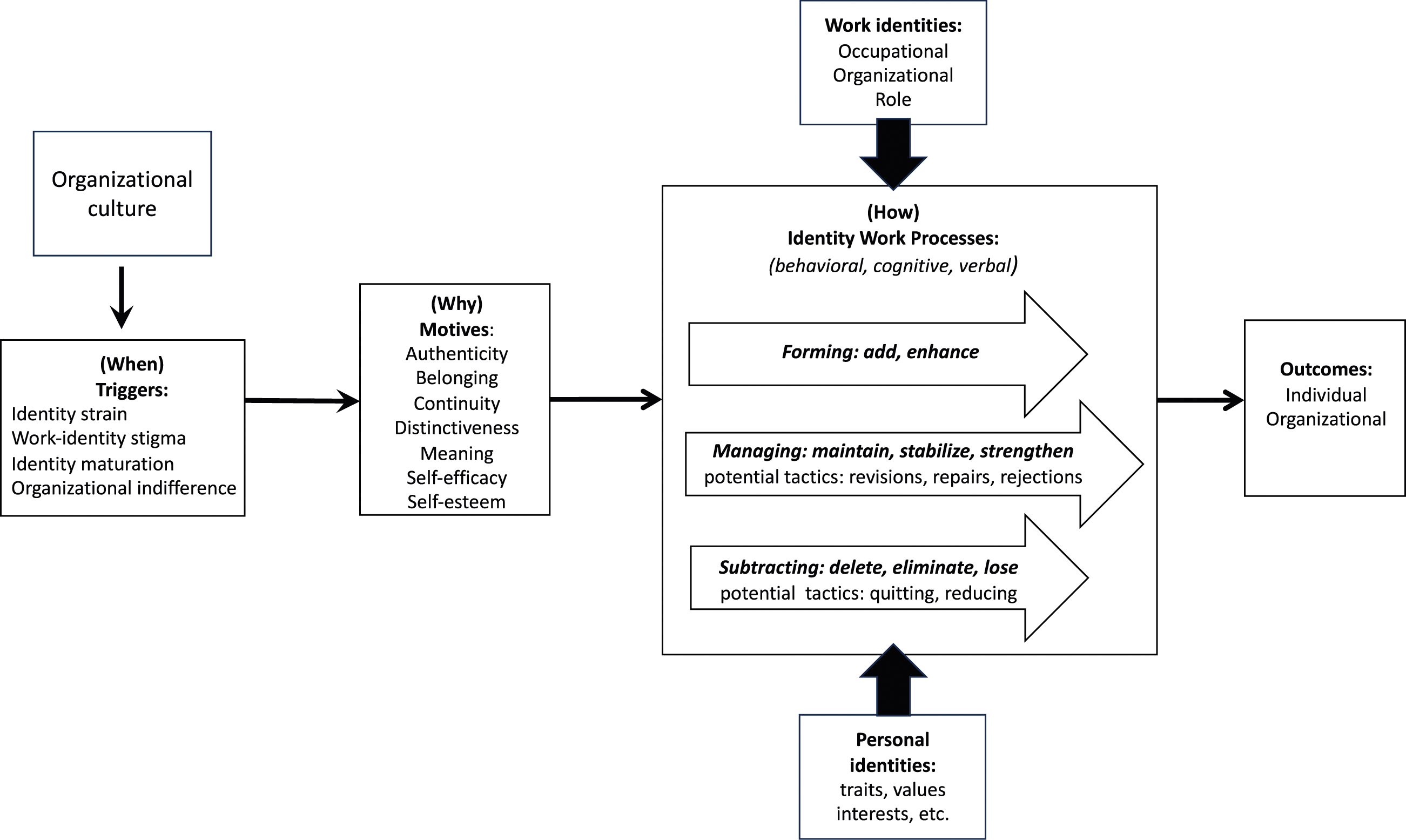
The following section discusses these four primary triggers, along with examples of related identity work processes (the how). Where the motives for identity work are discernible from the data, examples are also provided of the applicable identity motive (the why of identity work). Many of the examples presented also highlight the assumptions from Caza et al. (2018), namely, that identity work is relational (i.e., constructed with others), temporal (i.e., occurs in the past, present and future), involves both conscious and unconscious processes, and that individuals hold multiple, interdependent identities (e.g., personal and work-related identities).
Trigger: Identity Strain
The primary trigger for the managing processes of identity work is defined as identity strain due to the perceptions of individuals that one or more personal and potentially intersecting identities is not aligned with the prevailing identity of a police officer. In this section, four common identity strains are presented and discussed. These include strains pertaining to identities based on gender, the intersecting identities of gender and race or gender and motherhood, and conflicting values.
Gender
Because of the masculine nature of police work, the strain between the female gender identity and workplace expectations contributed to intense identity work. For example, a female officer described a situation that occurred at a small police station during the first few years of career in which her actions to de-escalate a situation were perceived as too soft by her male colleagues. In response, the officer was forced to reconcile her female identity with the behavioral expectations of a police officer (e.g., typically associated with masculinity; Rawski & Workman-Stark, 2018; Workman-Stark, 2020), and her own self-definition. Despite attempts to diminish her as a police officer due to gendered expectations for behavior, she rejected perceptions of others that her actions did not meet expectations, and instead she emphasized that her actions were an indication of competence (self-efficacy motive). I dealt with an impaired person at a bar, got him home safely, issued him a ticket the next day and basically sat down with his parents and had an intervention, and was very well received. But when that was reviewed by my male colleagues, [they said] “sometimes you just need to start throwing some punches, especially as a female, start throwing your weight around to prove to them not to mess with you.” I was really disheartened to be verbally attacked…I’m confident in the decisions I made, it’s just disheartening when people kind of see some things one way and you’re telling me I have to prove something because I’m a woman… (Corporal, female, 11 years of service)
Likewise, another female officer described altering her behavior to avoid traditional stereotypes associated with women in policing. A key concern was to avoid being grouped in with the “other women” who were seen as weak or not as committed to the job. Therefore, admitting she might need time off would risk her being targeted by others. Because she had commenced her service when there were fewer women in the department, she admitted that she continued to adapt her behavior at all points in her career. That is, she continued to revise her identity as a female police officer to present a more favorable identity that would be accepted by others. I didn’t want to admit to my sergeant that I was struggling because right away they think “ooh, there’s the woman, having to take time off” because you would hear them talk about other people like that. You didn’t want to be that person and when I look back, I never said anything about it. I just thought okay I’m just going to get out of the way and move on and do my job because if you stayed under the radar and didn’t become a target of anything and just did your work, they only knew you for your work. So, it was just that you didn’t want to become part of the policewomen who book off because there’s always that: “oh they just come to work to have babies and then they never do police work again”. (Acting Staff Sergeant, female, 25 years of service)
However, the gender-identity strain was not experienced in the same way by all female officers. For female officers, in which their gender was a significant part of their overall identity, expectations to be a “bad ass”, “to work 24/7”, or to be like other tough women who cursed and swore like the men were ultimately rejected as these behaviors conflicted with how they viewed themselves as women (authenticity motive). On the other hand, officers, whose gender identity was less important, attempted to manage the police-gender identity strain by condemning other women who came forward with complaints of gender discrimination and harassment. For example, complainants were described by a senior, female officer as a “bunch of whiners” who helped perpetuate the perception that “all men were predators and all women were weak victims.” This depiction, including the quote below, illustrate how some women rejected the image of women being seen as victims and weak based on the need to belong and to be treated as an insider (belonging motive). I have a huge underlying pride for being a cop and maybe because of what I went through… I know bullying occurs, but I think there are other ways to deal with it, than the media and painting all of us with the same brush that all the women are being bullied and sexually assaulted and all the men are pigs. (Inspector, female, 30 years of service)
Intersecting Identities
The data also highlight the pressure on female officers to work just hard as male officers to fit in and be accepted as well as face the additional identity strain from being both a woman and a mother. As demonstrated from the quote below, this strain created extensive identity work on how to maintain these important, intersecting identities, particularly when considering maternity leave. Consistent with the previous examples, these tensions were created by a work environment that was seemingly intolerant of women in the workplace, challenging the motive to belong. Part of my reputation is I’ve always been known as one of those policewomen who did the same exact jobs as all the policemen, never asked for any special treatment, did the jobs equally as well as everybody else, so I didn’t have that reputation of being a wallflower. I was part of the organization and I didn’t want to lose that reputation. I was always kick-ass copper, in there like a dirty shirt, so I was thinking about my reputation right, instead of going off work and how would that look. (Sergeant, female, 16 years of service)
Further, the data reveal some identity strain from the intersecting identities of being a woman and a minority police officer. For instance, the Black female officer described the common occurrence of how she had been overlooked in management meetings facilitated by the previous head of the department. To fulfill the belonging motive and be more included, she managed how she “showed up” in these meetings by minimizing (i.e., revising) both her gender and racial identities and acting more like a White, masculine person. The people listen attentively around the table but when I complete what I’m saying, they just switch to the next person, and if the next person is a guy and he’s a white guy, whatever that person says it’s “oh yeah, that’s a good point” and they’ll validate each other around the table. Then you get to person number six after me and that person might say exactly what I said and all of a sudden, they validate it and say, “make sure you record that”. So, if you looked at the notes from the meeting, you seldom find that [I] contributed…(Superintendent, female, 26 years of service)
Conflicting Values
The strain between an officer’s personal values and pressure from the organizational culture to assume a certain police identity was also evident in the data. This strain, which was made worse from a desire to avoid retaliation or rejection (belonging motive), was particularly salient early in an officer’s career when this police identity conflicted with the officer’s own values and how he saw himself as a police officer. Sometimes it was just an act because you would have to do something or say something just so you wouldn’t get harassed or bullied, but you didn’t believe it. And if I was on my own, I would certainly not have acted that way when policing people, because I grew up a certain way and I still carried that same personality, but I had to adapt a little bit to survive. (Inspector, male, 33 years of service)
Whereas this strain caused some officers to revise their police identities to “go along to get along” and fulfill the belonging motive, others ultimately rejected the pressure to conform to this identity as well as remain silent about police misconduct. Instead, they reported the unethical behavior, thereby reflecting the motives of authenticity and continuity. Unfortunately, for a couple of officers, the organization’s reaction to their complaint caused them to further revise their work-related identity by reducing its importance to their overall sense of self. If you stand up and do the right thing and dig your heels in, you’re going to pay, and that’s exactly what I’ve seen. Unfortunately, I’ve seen pretty significant, unethical and corrupt behavior… and I’ve been targeted because I chose to actually stand up and stay the course and do the right thing…(Sergeant, male, 21 years of service)
Trigger: Work-Identity Stigma
As the interviews were conducted following the police-involved death of George Floyd (Hill et al., 2020), the growing police stigma from this and other instances of excessive use of force, created a challenging situation and an identity threat for several officers in the study. I don’t feel different about what my role needs to be and how I wish it would be in the community, but for whatever reason we’re getting decimated in the media. All of a sudden, we’re just a bunch of racists and you never know what kind of experience you’re going to have when you go out and talk to somebody… (Senior constable, male, 13 years of service)
The results suggest that this growing stigma situation challenged several identity motives, including continuity, meaning, and self-esteem. As such, efforts to manage and stabilize the police identity involved behavioral reactions, such as officers revising how they performed their work. In some instances, officers concealed their work identity (Goffman, 1963; Monteblanco, 2018) when interacting with people outside of policing to avoid confrontation or criticism about their work. These latter actions illustrate that the temporal nature of identity work can also be intermittent and situation specific as the police identity was subtracted from the officer’s overall identity only when they were off shift and interacting with members of the public. I’m always so much more cognizant - is my body camera on or is someone filming me across the street? It’s seems the people that are the loudest about it are the least well informed, and I feel like it throws a barrier in terms of me actually being able to do my job because I come into a situation to deal with somebody, and they already have this idea in their mind of what a police officer is, what they’re going to do. Maybe they’re a minority and think I’m going to smash their face through a window or something. I’m like “look man I’m just here to help you”, stop paying attention to what you see on TV… (Constable, male, 3 years of service) Obviously if you meet somebody new and say that’s what you do, they’re kind of abrasive and don’t want to talk to you or treat you differently than they would normally treat a person if they’re not a police officer. If I do meet new people and don’t know if I’ll see them again, I tell them I work for the city. I’m proud to be a police officer but I think since the Black Lives Matter began, I definitely prevent myself from saying it to most people just because you don’t know what their perspective is on it or what they’re feeling about it, or if they think all cops are the same. (Constable, female, 6 years of service)
Similar to Waddington (1999), general criticisms or calls to defund the police were also met with behavioral tactics to repair the police identity that ranged from defending the actions of the police, disparaging proposed police reforms as unrealistic, or condemning the critics. These actions primarily reflect the motives for continuity and maintaining self-esteem. In contrast, other officers aimed to strengthen their identities as upstanding police officers by distinguishing themselves from problematic officers who sought to taint the police identity through their misconduct (distinctiveness motive). An unexpected finding was that some officers attempted to manage this work-identity stigma by reframing criticisms of the police as opportunities for change, such as talking to people rather than using force, addressing perceptions of people who have “been treated badly by the police”, and taking steps to professionalize the role of the police. Additionally, some officers went further by challenging the reactions of police colleagues who were seen as too defensive in response to criticism and missing the bigger picture of maintaining public support of the police (distinctiveness motive). We don’t want anybody just being defensive about the police, because as I say it’s not about us the public servants, it’s not about us and our culture, trying to protect something we have. Yes, I support my colleagues and what we do and why we do it, but if we lose the support of society we’re lost, we’re done. (Senior Detective, male, 25 years of service)
While less prevalent in the data, the results also showed that some officers sought to stabilize the tainted police identity by rejecting some aspects, such as use of aggressive tactics and the image of the warrior cop. As noted by one officer: “when I look around and see the high and tight haircuts, the big blue machine and all muscled up, the way they speak to people, it’s not me, it’s not the police…we’re not warriors, we’re not soldiers.” (Detective Sergeant, male, 12 years of service). These responses imply the motives of continuity, meaning, and distinctiveness for officers to maintain an identity that was aligned with the image of community and service.
Trigger: Identity Maturation
This third trigger is defined as identity maturation, and a type of contextual change, due to the many accounts of officers revising both their personal and their occupational identities as they matured in their respective roles or in their personal identities. For instance, some officers explained that experience on the job contributed to reframing their police identity to encompass more meaning and honour. These examples suggest that as officers matured, the motive to find meaning in their work was more prominent for some officers. When I first joined, I probably didn’t join for those noble reasons of helping people, preventing crime, keeping the peace and what have you…whereas now being older and financially secure and more stable, it’s actually more important… I train recruits now in my role and I will say to them I honestly do feel it’s a very honourable position they’re going into, and I genuinely mean that…I’m very proud to be a police officer…All the reasons why I should have joined, when I first joined, are now the reasons why I’m still a cop. (Sergeant, male, 24 years of service)
In other cases, more time on the job (i.e., maturity) caused officers to apply a stabilization process of revising their identity as a police officer or to take specific steps to behave in a way that conformed more with their self-image (authenticity motive). For instance, the data illustrate how a female officer’s early efforts to fit in led to several negative outcomes. As she matured in her role, she gained sufficient confidence to change the way she interacted with others at work (authenticity, self-esteem motives). Similarly, a junior male constable described an identity crisis, in which he initially bought into an “us versus them” mentality (i.e., between the police and the public) when he first got on the job to avoid being ostracized by his team. However, after a few years on the job he was able to reject this “us versus them” identity and align himself with others who shared similar views (authenticity motive). Having five years in now, I find myself, and again having kind of gone through my identity crisis and come out of it, I think I’m in better shape. So personally I’m o.k. with that, I don’t want to be a part of that. If they want to ostracize me, great. Overall, I still have really good relationships with everybody I work with and I’m just all about doing the work the best I can, being a hard worker and I think people respect that. I just don’t buy into all the other talk and the gossiping. (Junior constable, male, 5 years of service)
As officers gained more experience, they also engaged in a reflective process of examining the police identity and what they wanted to achieve in both their police career and personal life, which often required revising their work and personal identities. I would say around year three, I would call it a tempering process. Instead of running around like my hair was on fire, I took a step back and looked at the bigger picture - what I wanted from my career, where I see policing fit into society and the different perspectives around policing, which funny enough there’s so many right now, especially in the past year. But that really started a couple years prior and that again launched me into going back to school. I kind of took myself out of that live, breathe police work and acknowledged that I still love the job, I still love what I’m doing, but there’s a lot more outside of police work. So, I found a little bit more balanced approach at that three-to-five-year mark. (Constable, male, 5 years of service)
Maturing as an individual and taking on new roles, such as becoming a spouse, partner, or parent, also precipitated identity work that saw the creation of a new hierarchy of identities in which the police identity was much less salient or on equal standing with a personal identity. Much like Kreiner et al. (2006a), who illustrated how priests engaged in boundary work to maintain boundaries between identities, officers undertook purposeful steps to maintain personal and professional boundaries, including physically removing visual symbols of the job (e.g., a police t-shirt), turning off police-issues smart phones when off duty, or developing an external social network that was distinct and removed from policing. These identity work processes involved forming new personal identities as well as subtracting (reducing) the police identity to achieve greater work-life balance.
Officers who were near to retirement expressed concern about leaving a career (subtracting) that was ‘like a family’ and how they would they redefine themselves. To reduce the impact of the pending subtraction (loss) of the police identity, a common suggestion was for officers to establish interests beyond policing to prepare themselves for retirement and losing the police identity. “It’s like one day you’re a cop and then you’re not a cop, and three days after that no one even remembers you were even there, so you’d better have things outside that” (Sergeant, male).
Trigger: Organizational Indifference
The final trigger is defined as organizational indifference because it represents individual perceptions that the respective police organization did not adequately respond to issues that were deemed critical to some officers. These issues ranged from complaints of police misconduct, harassment, and other forms of mistreatment to a lack of demonstrated support for officer well-being. I’m probably one of the few people out there to say a woman harassed me but it happened. At the same time, it’s like you’re a guy, you should not care about this… they essentially told me that the flavor of the day is harassment against women, so it’s the role reversal, we don’t care. (Senior constable, male, 12 years of service) [T]here were issues concerning sexual improprieties down to outright sexual misconduct, you might even say assault in some cases, by certain members of the police service and nothing was done with it, nothing whatsoever. (Detective constable, male, 10 years of service)
In all cases, the organization’s reaction to these issues precipitated a downward revision of an officer’s identity as a member of a specific police service, with a few officers subtracting this organizational identity and adding (forming) a new one as they moved to another police service. A key point was that the officers viewed the organizational identity as no longer being aligned with how they viewed themselves, thereby suggesting that these identity shifts reflected the authenticity, distinctiveness, and self-esteem motives. I was disappointed that they wouldn’t take care of me when I worked so hard (Inspector, female, 30 years of service) I have almost zero attachment to the organization, but I have one hundred percent attachment to my community, and I will continue to serve my community in the best way I can in the role as a police officer. (Sergeant, female, 16 years of service)
In the final section of this paper, the implications for research and practice, as well as the limitations of the current study and avenues for future research are discussed.
Discussion
Through interviews with 32 Canadian police officers, this study explored the how, why, and when of police officer identity work. Specifically, using an adapted theoretical framework of identity work (Figure 2), this study examined the identity work experiences of police officers, including the types of identity work processes (i.e., forming, managing, or subtracting) and the circumstances that triggered this identity work (the when) as well as the need to fulfill one or more potential motives (i.e., the why; authenticity, belonging, continuity, distinctiveness, meaning, self-efficacy, self-esteem). The results illustrate that participants primarily engaged in identity work to stabilize the police identity or resolve conflicts between their personal and professional identities, which arose from four primary triggers: (1) identity strain from the perceived lower value placed on certain personal identities (e.g., gender, race, motherhood) or conflicts with personal values; (2) work-identity stigma due to the growing stigma of the police occupational identity; (3) identity maturation related to certain personal identities, such as a parent or spouse, and/or the maturing of the police identity; and (4) organizational indifference due to key issues, including police misconduct, sexual harassment, and officer wellness.
In response to identity strain, some efforts to stabilize personal or work-related identities focused on rejecting some parts of an identity, such as rejecting associations of the female gender with weakness, the police identity with aggression, expectations to act tough, or certain definitions reflecting commitment to the job. In a few instances, rather than rejecting these identity expectations, some female officers condemned other women for speaking up about harassment. These responses were seemingly motivated by the need for authenticity, for self-esteem, to achieve distinctiveness as a police officer who worked with and served the community, or to simultaneously to fulfill the belonging motive and be distinct from the “whiners” who complain about harassment. Identity strains did not always arise due to a singular identity; they also involved intersecting identities, including gender and motherhood or gender and race, which created additional challenges for affected officers due to a work environment that was less accepting of non-conforming identities. For some officers, these strains led to identity revisions in which they managed (i.e., revised) how they showed up in meetings or held back from taking maternity leave to avoid being seen as less committed.
Despite some of the female participants advancing in their careers, either through seniority in years of service or through formal promotion, they continued to engage in ongoing identity work. This work was seemingly based on cultural norms that continued to be promoted and endorsed by other officers. In other words, while the work environment might have changed from the time they commenced their careers as police officers, they were still conditioned by a police culture that was heavily male-dominated and less accepting of women. Gender, and to some extent, the intersecting identities of gender and race have been frequently examined in policing research; however, the findings from the current study illustrate that these work-identity conflicts continue to endure.
An interesting finding was the identity strain that emerged from conflicts between an officer’s personal values and aspects of the police culture that pressured officers to behave a certain way. Like previous studies (Ashforth et al., 2007; Caza et al., 2018), identity work occurred in response to cultural norms that compelled officers to engage in certain types of behaviors to fit in and be accepted, such as being aggressive (Du Plessis et al., 2020). Adapting one’s behavior to conform may have mitigated the potential threat of alienation from the team and fulfilled the belonging motive, yet it did not resolve the primary identity conflict or fulfill the motive for authenticity. Thus, adopting these conflicting aspects of a police identity are more likely to have damaged the officers’ self-image (Cowen & Hodgson, 2015). Similarly, attempts to resolve gender identity strains might have alleviated the immediate identity threat; however, they did not resolve the source of the strain, which was the devaluation of feminine attributes and the inability of female officers to be their authentic selves.
Whereas the increased stigma of policing triggered identity work for many officers, their reactions were quite diverse. For instance, some officers revised how they performed their work or how they communicated their police identity to others. To fulfill the self-esteem motive, others sought to repair this stigmatized identity by condemning police critics or distancing themselves from officers who perpetuated a more aggressive police identity or engaged in misconduct. On an encouraging note, the findings indicate that as some officers matured, both as a person and as an officer, they were able to reject negative aspects of the police identity that they adopted earlier in their career.
The final trigger of organizational indifference occurred after action/inaction by the organization that was contrary to what some officers expected. As a result, they subtracted the organizational identity by quitting the organization or reducing its significance as part of their overall identity. Taken together, the findings suggest that these four identity work triggers were influenced by an organizational culture that promoted the image of a police officer as aggressive, tough, committed, and isolated from the public.
Implications for Research and Practice
This study has several important implications for both research and practice. First, it extends existing literature on identity work in policing by further exploring the when, why, and how of identity work. In so doing, the study builds on previous examinations, such as the socialization processes that influence the development of a police identity (e.g., Charman, 2017), providing a more in-depth investigation of how officers experience and respond to various types of identity conflicts or threats at key points in their careers. Prior identity work research in policing has been limited to investigations of occupational identity or specific work-personal identity conflicts (e.g., Ainsworth et al., 2013; Compton & Brandhorst, 2021; du Plessis et al., 2020; Perrott, 2019; Rabe-Hemp, 2009; Shreffler et al., 2011; Gilder, 2019; Veldman et al., 2017). The current study extends this research by highlighting identity conflicts arising from the intersectionality between the occupational identity of a police officer and various personal identities; (for example, gender, race, family status, and personal values).
Second, by applying an adapted theoretical framework, the study has addressed criticisms of prior research on identity work, namely that it has been conducted in piecemeal fashion or failed to incorporate a sufficient theoretical foundation. The study findings also provide support for the untested assumptions from Caza et al. (2018), demonstrating that identity work is relational (i.e., constructed with others), temporal (i.e., occurs in the past, present and future), and that individuals hold multiple, interdependent identities (e.g., personal and work-related identities). Further, as the study was not limited to an investigation of identity work at one point in an officer’s career, it enabled a richer examination of the temporal nature of identity work and the identification of four types of identity work triggers: (1) identity strain; (2) work-identity stigma; (3) identity maturation; and (4) organizational indifference.
Third, whereas previous studies have used differing theoretical lens to explore the influence of police culture on gender (e.g., Sanders et al., 2022) or gender and racial identities (e.g., Bikos, 2022), the current study benefited from the application of an adapted theoretical framework of identity work to explore the when, why, and how of identity work involving officers’ work-related and personal identities. Importantly, the findings highlight how aspects of police culture contribute to challenging or strong situations and four primary identity work triggers. The study findings also contribute to a revised framework of identity work, depicted in Figure 2, which will enable researchers to further explore this phenomenon in the context of policing.
From a practical perspective, the findings provide important insights into the various circumstances, including key points in an officer’s career, that might trigger and motivate some form of identity work. Previous depictions of policing have highlighted the tendency to endorse an ideal image of a police officer; that is, an officer who is, masculine, aggressive, and physically strong (e.g., Archbold et al., 2010), and often isolated from the public (Loftus, 2010). In turn, these factors influence unique socialization processes through which members work to develop the ideal occupational identity (e.g., Archer, 1999; Miller & Rayner, 2012), while managing potential conflicts with their personal identities. Similar to other policing research, the study findings illustrate that these enduring aspects of police culture (Atkinson, 2017; Silvestri, 2017), along with the continued emphasis on idealized traits of a police officer, pressured officers to conform in order to be accepted. In addition to promoting a more aggressive style of policing, the psychological wellbeing of individual officers is likely to be reduced because of the ongoing strains of managing conflicts between their personal and professional identities.
To address these issues, police leaders should endorse relevant competencies required for police work (e.g., conflict resolution, communication, problem solving) rather than emphasizing traditional masculine attributes. Through this approach, police leaders may begin redefining the prototypical image of a police officer by avoiding distinctions between traits that are typically deemed either masculine or feminine. For instance, as socialization processes are most pronounced early in an officer’s career (e.g., Charman, 2017), there should be a greater emphasis on selecting coach officers and supervisors who emulate ethical leadership values—the “demonstration of normatively appropriate conduct through personal actions and interpersonal relationships, and the promotion of such conduct to followers through two-way communication, reinforcement, and decision-making” (Brown et al., 2005, p. 120). Key to this leadership approach is to clearly communicate ethical standards of behavior and hold violators appropriately accountable when they fail to meet these standards. Over the longer term, these actions should help reduce the triggers of identity work (i.e., identity strain, work-identity stigma, and perceived organizational indifference) and establish more inclusive and supportive workplaces.
An interesting observation from the study was how some officers reframed increased criticisms of the police as opportunities for change, such as talking to people rather than using force, addressing perceptions of people who have been “treated badly by the police”, and taking steps to professionalize the role of the police. In short, these findings suggest that the death of George Floyd, and other egregious incidents, have created a tipping point in which some officers acknowledge the need for change, thereby acting as potential resources to help drive necessary reforms in policing.
Limitations and Future Research
Despite the contributions of this study, it has some limitations. First, while the study sample incorporated some women, people of color were significantly underrepresented. Second, the study did not probe other potentially marginalized personal identities, such as those defined by sexuality, physical ability, or mental health. Future studies should consider methods that allow for a deeper exploration of other personal identities and potential conflicts with the police identity. Additionally, the current study highlighted tensions between two potentially competing occupational identities of a police officer: the physical crime fighter and the community guardian. Future research would benefit from further investigation of these differing identities and how they might influence identity work. Third, although the study explored examples of identity work at different phases in officers’ careers, the interviews were conducted at one point in time and did not fully examine the individual and organizational outcomes of identity work. A longitudinal study that examines identity processes at specific points, including initial training, the first posting, and the end of the first few years on the job, is likely to produce a richer account of the temporal nature of identity work. Finally, studies incorporating experimental design processes are likely to provide much needed evidence of interventions that reduce the contextual factors compelling intense forms of identity work, such as the development of best practices promoting ethical leadership.
Conclusions
Through the application of an identity work framework, this study illustrates how enduring aspects of police culture contribute to triggers of identity work relating to conflicts between officers’ personal identities and the identity of a police officer, or identity threats created by increased criticisms of the police. Specifically, the findings offer some insight into the implications of occupational context on marginalized identities as well as personal values that conflict with dominant norms. While the findings also highlight the persistent and problematic emphasis on masculine traits, including an aggressive style of policing, they also illustrate the openness of some officers to policing reforms. From the results, the study provides some practical recommendations to address the factors contributing to intense forms of identity work.
Footnotes
Declaration of Conflicting Interests
The author(s) declared no potential conflicts of interest with respect to the research, authorship, and/or publication of this article.
Funding
The author(s) received no financial support for the research, authorship, and/or publication of this article.
