



Abstract
One key feature for scenario-based training is introducing stressful, realistic scenarios for trainees. Some law enforcement agencies have begun using virtual reality systems to provide scenario training for their officers. Therefore, the current study was conducted to assess if a virtual reality training scenario can elicit a similar stress response as a realistic scenario-based training scenario. The independent groups quasi-experiment collected salivary markers of acute stress (α-amylase and secretory immunoglobulin A) prior to, and immediately following, either an in-person scenario-based training exercise (n=31) or a virtual reality scenario (n=27) based on the in-person exercise. Difference-in-difference and two-way ANOVA tests were performed. Overall, participants exposed to the virtual reality scenario experienced a similar stress response to the realistic in-person scenario-based training exercise. Implications for law enforcement agencies are discussed to hopefully move police training forward.
Police officers are often required to perform a wide variety of duties on any given shift. These duties can range from mundane administrative tasks (writing parking tickets) to low-level citizen contacts (wellness checks) to potentially contentious citizens contacts (domestic violence calls for service) to the extreme (responding to a shooting). No matter how many different types of calls for service exist, citizens expect the police to know how to respond to the different situations that may occur (Hinds, 2009; Johnson, 2004; Percy, 1980). In an effort to ensure officer competency, agencies provide their officers with a variety of training opportunities both in the initial training academy as well as throughout their career. Many of these training opportunities include some aspect of scenario-based training (SBT) to expose police officers to simulated citizen encounters (Buehler, 2021). One key aspect of SBT is allowing officers the opportunity to practice response options (e.g., decision-making) while under simulated stress as a form of stress inoculation to improve performance and resiliency among police officers should they experience a similar incident while on the job (Greco & Fischetti, 2018; Wiederhold, 2014).
Virtual reality (VR) technology has entered the police training market in recent years. These training opportunities potentially allow law enforcement agencies the ability to provide their officers with a wide variety of training scenarios with a single piece of technology. While there are some scholars working on skill retention utilizing VR (Butt et al., 2018; Lohre et al., 2020), there appears to be a dearth of scholarship seeking to understand if policing VR training environments can elicit similar stress responses as in-person SBT scenarios. This paper seeks to address this gap in the literature through an extensive quasi-experiment examining salivary markers of stress in both a realistic SBT exercise and an identical exercise conducted in VR.
Literature Review
Scenario-Based Training
Policing is a complex and high-stress career involving difficult choices in an ever-changing environment. As such, training needs to prepare officers for real-world encounters beyond classroom learning. One method to achieve this involves the use of SBT. SBT can take on many different forms depending on the training topic. However, SBT generally places students in scenarios that mimic real-world encounters with role-players to expose trainees to situations similar to what they will experience on the job (e.g., deescalating role players during crisis intervention training). SBT has widely become a standard practice for law enforcement training in the US, and it provides several benefits over classroom instruction alone. Scholars and practitioners have discussed the benefits of such training (Bartel, 2021; International Association of Chiefs of Police [IACP], 2012; Lynch, 2005). Nearly all (99.7%) academies employ some form of SBT in conjunction with classroom learning (Buehler, 2021). Additionally, SBT has been widely integrated into in-service training as a means of further developing, honing, and maintaining complex job skills (Jenkins et al., 2021; Peeters et al., 2014). Research has shown a combination of SBT (stressful) and classroom (nonstress) teaching to be an effective strategy for training law enforcement (Blumberg et al., 2019).
SBT may be an effective training method supported by Kolb’s experiential learning theory (ELT) (Kolb, 1984). This theory has previously been applied to other aspects of policing including the comparison of basic firearm trainings for police officers (Henriksen & Kruke, 2021) and police training with body-worn cameras (Moats et al., 2008; Phelps et al., 2018; Richards et al., 2018). ELT suggests learning occurs when knowledge is gained through experience (Kolb, 1984). To properly learn something, a person must go through a four-stage cyclical cycle where they have an experience and then transform the experience (i.e., learn from the experience) (McCarthy, 2016). The four stages of the process are: concrete experience (experiencing), reflective observation (reflecting), abstract conceptualization (thinking), and active experimentation (acting) (McCarthy, 2016). As described by Kolb (1984), a person going through this learning process must first have a concrete experience (i.e., feeling tangible qualities of the world). They must then reflect on what has happened. After reflection, one must make conclusions about the new information gathered. Using these conclusions, one must then use the learning to try something new. SBT facilitates these four stages by providing a real-world scenario in which a trainee can practice a skill, reflect on the process/outcome, consider the feedback, and apply lessons learned to the next scenario.
Modern SBT consist of artificially constructed scenarios that are designed to provide practice for the trainee while also allowing the instructor to assess the knowledge, skills, and abilities discussed in the classroom. One of the major benefits associated with SBT is the ability of instructors to provide direct and immediate feedback to trainees. Providing this immediate corrective feedback has been shown to substantially increase skill-based performance in police training (O’Neill et al., 2018; Martaindale, 2021). Furthermore, feedback can focus on both the process and the outcome performance of the scenario (van den Bosch & Riemersma, 2004). This makes SBT an especially efficient form of training when considering that there are likely multiple ways to achieve the same outcome.
Another strength of SBT is the ability to safely simulate a stressful environment. Many studies have shown the negative impact of stress on police performance (Andersen et al., 2016; Giessing et al., 2019; Oudejans, 2008; Sandel et al., 2021; Taverniers et al., 2011). High stress levels can impact attention, performance, and behavior as well as cause perceptual distortions (e.g., tunnel vision, auditory exclusion, etc.), reduced or impaired motor dexterity, decreased cognitive processing, and decreased sensory awareness (Arnetz et al., 2009; Bennell et al., 2021; Burke, 2017; Di Nota et al., 2021; Johnson, 2008; Klinger & Brunson, 2009). For this reason, researchers have suggested that trainings should be stressful and realistic (Baldwin et al., 2022; Bennell et al., 2021; Blair et al., 2019; Nieuwenhuys et al., 2009). SBT allows officers to practice techniques in a stressful environment that more closely simulates the real-world (Andersen et al., 2016; van den Bosch & Riemersma, 2004). Officers can practice multiple repetitions to increase muscle memory and help overcome the physiological effects of high stress environments. While the ratio of classroom to SBT varies by academy, about half of officers (52.3%) are trained using a balanced combination of nonstress and stressful practices (Buehler, 2021).
While there are clear advantages to conducting SBT, there are some drawbacks as well. For instance, the facility where the SBT is conducted can play a large role in the realism and types of the scenarios. Props, equipment, safety, and logistical concerns (e.g., number of training pistols, training ammunition required, number of actors, safety equipment for actors) must also be considered (Lynch, 2005; Whitcomb, 1999). Given these requirements, the cost of providing the training to participants may be high (Beinicke & Muff, 2018).
Another possible issue arises regarding the consistency of live-action scenarios. Coordination between the actors, instructors, and observers is required to ensure a cohesive realistic training scenario (Lynch, 2005; Whitcomb, 1999). Without this consistency, the effectiveness of the training may be diminished. One suggestion for reducing the drawbacks of live-action SBT has been to incorporate virtual reality (VR). For example, using a VR system would maximize the control and consistency of the scenarios (Pan & Hamilton, 2018). Once a virtual reality scenario is created, all the components of the scenario remain the same unless a change is desired by the creator. Therefore, all participants should receive the exact same training while using the virtual reality system compared to differences that might be experienced in SBT. For this, and other benefits, professional fields (e.g., nursing, refineries) are now using virtual reality systems as a training medium (Aïm et al., 2016; Alaker et al., 2016; Mao et al., 2021; Pallavicini et al., 2016; Radhakrishnan et al., 2021; Sacks et al., 2013).
Virtual Reality
Virtual reality (VR) is defined as the use of computer modeling and simulation that enables a person to interact with an artificial three-dimensional visual or other sensory environment (Britannica, 2023). Some scholars consider desktop applications or videos projected on a wall as VR while others utilize immersive technologies such as VR specific headsets (Buttussi & Chittaro, 2017). VR training is growing in popularity and has been used in multiple fields such as medicine (Bernardo, 2017; Izard et al., 2018) and military operations (Lele, 2013; Pallavicini et al., 2016) to improve job performance and reduce occupational-induced stress.
Researchers have recently begun to suggest the use of VR as a medium to provide training to first responders (Mossel et al., 2021; Peretti et al., 2021). Although it has primarily been used for recreational gaming and entertainment, VR systems offer two unique benefits when used for training. First, the use of VR environments allows trainees to be placed in situations which may be nearly impossible to replicate in a physical environment because of practical or ethical issues (Slater & Sanchez-Vives, 2016). Second, because the VR environment does not change without the input of the controller of the system, it can be used for exact repetition of conditions during experiments or training exercises (Slater & Sanchez-Vives, 2016). This is especially useful when having the user interact with another person performing a specific action (e.g., having a user playing the role of a police officer interact with a man holding a gun). Finally, some research suggests that using VR can not only increase skills such as live fire scores, but also increase motivation to learn (Bhagat et al., 2016).
Another reason for the wide use of VR systems for professional training is that the systems can elicit physiological responses from users when placed in a stressful environment (Chittaro, 2014; Chittaro & Buttussi, 2015). Additionally, researchers have shown that participants using a VR system behave similarly to those in the real world (Seward et al., 2007; Siegrist et al., 2019). The ability for a VR system to induce stress combined with the real-world reactions from participants allows for the realism of a live-action scenario. That being said, more research needs to be done to determine if VR training would induce the same level of stress as a live-action scenario in policing.
Stress Response and Training
Several salivary biomarkers of stress have been used to measure responses to acute psychological stress. Two of the most prominent measures of acute stress response are salivary α-amylase and secretory immunoglobulin A (SIgA) (Ivković et al., 2015; McAllister & Martaindale, 2021; Tzira et al., 2018). Salivary α-amylase is used as a marker of stress that increases in response to the activation of the sympathoadrenal (SA) axis, while salivary cortisol concentrations relate to activation of the hypothalamic pituitary adrenal (HPA) axis (Golden et al., 2011; Petrakova et al., 2015). SIgA concentrations have been used as a marker for both acute and chronic exposure to stress (Ivković et al., 2015; Matos-Gomes et al., 2010; Ring et al., 2005). While salivary cortisol (S-CORT) is also used as a stress response measure, it is not appropriate for detecting acute levels of stress when individuals are exposed to short duration stressors. Research has shown that S-CORT is responsive when participants are exposed to at least a 10-minute stress event (Bozovic et al., 2013). Additionally, while heart rate can indicate stressful conditions, it is not a direct reflector of activation of the body’s stress response (i.e., activation of the SA and HPA axes). While changes in heart rate could possibly be due to the activation of these systems, often, heart rate can increase due to a reduction of parasympathetic activity which does not necessarily reflect increased stress (Tanaka et al., 2013).
McAllister et al., (2020) examined the physiological stress response of participants experiencing a realistic active shooter SBT scenario through the analysis of salivary stress markers. The study created a realistic SBT scenario by using professional actors and simulated wounds reflective of an active shooter. Participants completed the SBT in approximately 50 seconds. As shown in Figure 1, SIgA and salivary α-amylase were found to be significantly elevated five minutes after the scenario was completed compared to levels before participation in the scenario. McAllister et al., (2020) also reported other traditional stress markers (such as S-CORT) that are not suited for acute stress response. α-amylase and SIgA concentrations.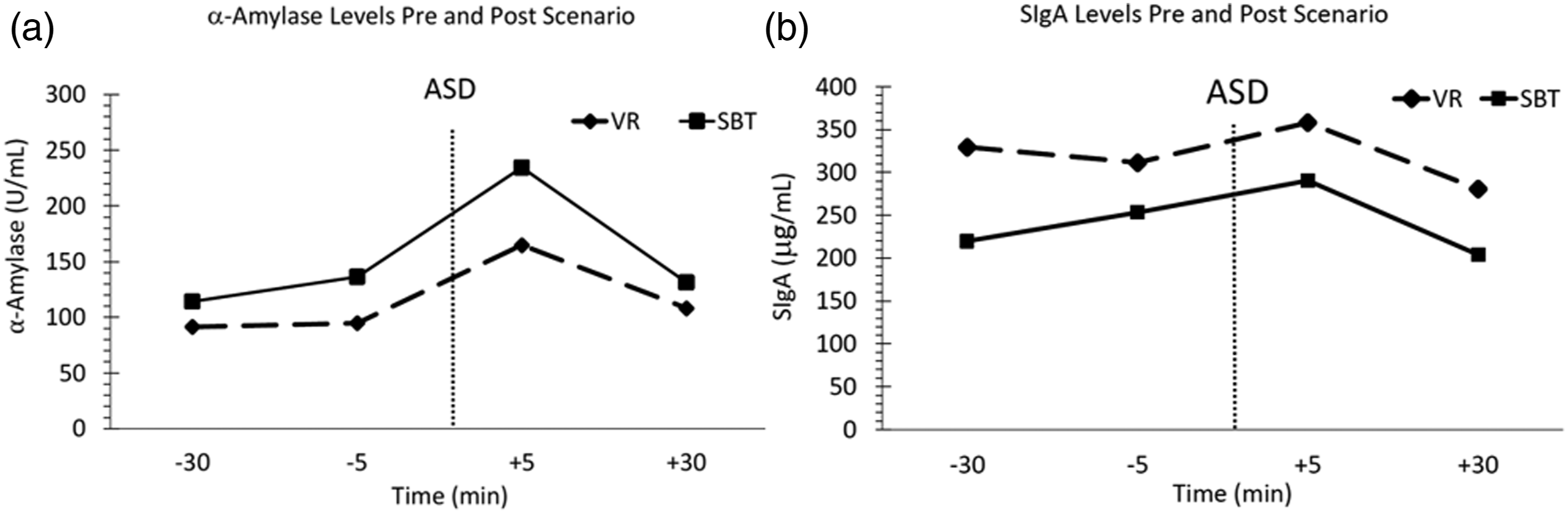
McAllister et al., (2022) conducted a similar study that had participants complete active shooter training using a VR system rather than live-action SBT. The VR environment was constructed using the exact same scene and scenario as McAllister et al., (2020) live-action SBT. As such, participants completed the VR scenario in approximately 50 seconds. Figure 2 provides a visual comparison of the active shooter SBT scenario (left side) to the VR scenario (right side) to showcase the similarities between the two. Figure 1 shows salivary α-amylase and SIgA levels were higher after the VR scenario compared to levels before the VR scenario. Visual comparison of active shooter SBT scenario and VR scenario.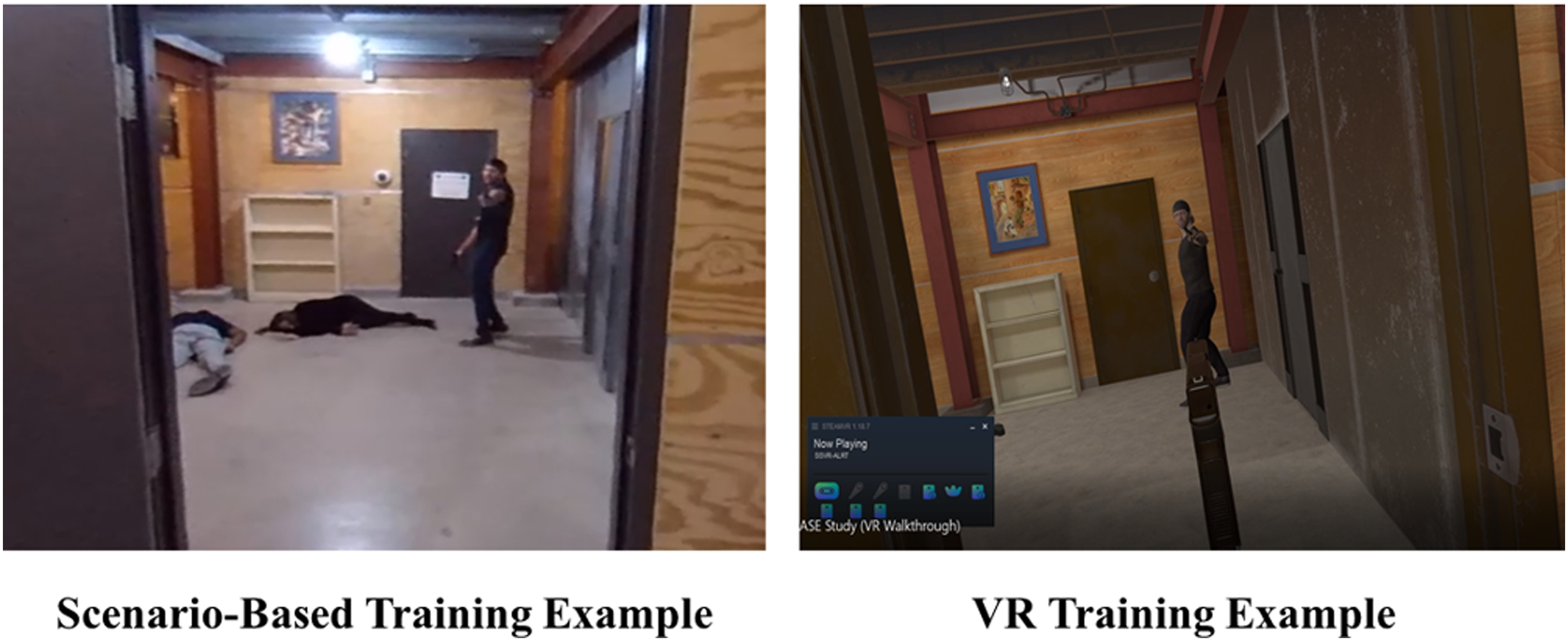
While salivary stress markers have been used to demonstrate that both SBT (Arble et al., 2019; Giessing et al., 2019; Strahler & Ziegert, 2015) and stressful VR scenarios (Martens et al., 2019) independently elicit physiological stress from participants, no academic study has examined whether physiological stress levels are similar for police officers undergoing SBT to training conducted in VR. The current study attempts to address this gap in the literature by comparing participant physiological stress responses during a simulated active shooter event conducted during SBT and in VR.
Both the SBT and VR studies showed a significant acute stress response following the ∼50 second scenario. However, it is unclear if participants in both studies exhibited statistically similar stress responses. Given that both the SBT and VR studies described above utilized the same intervention, data collection methods, and salivary stress markers, it is possible to examine whether similar stress was experienced by participants exposed to each type of training method (SBT vs. VR). As such, this manuscript tests the following hypotheses:
Participants exposed to a VR scenario will experience a different stress response than participants exposed to a SBT scenario.
Participants exposed to a VR scenario will not experience a different similar stress response than participants exposed to a SBT scenario.
Method
Design
This study followed a quasi-experimental design with independent samples in two conditions. The first condition was the live-action SBT by McAllister et al., (2020). These data were collected in Fall 2019. The second condition was the VR active shooter scenario as reported by McAllister et al., (2022). The VR condition data were collected in Spring 2021. The SBT condition incorporated professional actors to enhance realism for participants. For this reason, the research team captured 360-degree video footage of the SBT condition as if the camera was a participant (i.e., the actors played out the scenario while the 360-degree camera “walked” through the scene). The 360-degree footage and captured audio was used to recreate the exact scenario in a VR environment for the VR condition. This process limited the research team’s ability to randomly assign participants to conditions (i.e., there was a significant development time between the SBT and VR conditions). Furthermore, due to the COVID-19 pandemic, the VR condition data collection was delayed until the Texas State University in San Marcos, TX IRB allowed in-person research to resume.
Participants
Participant Demographics.
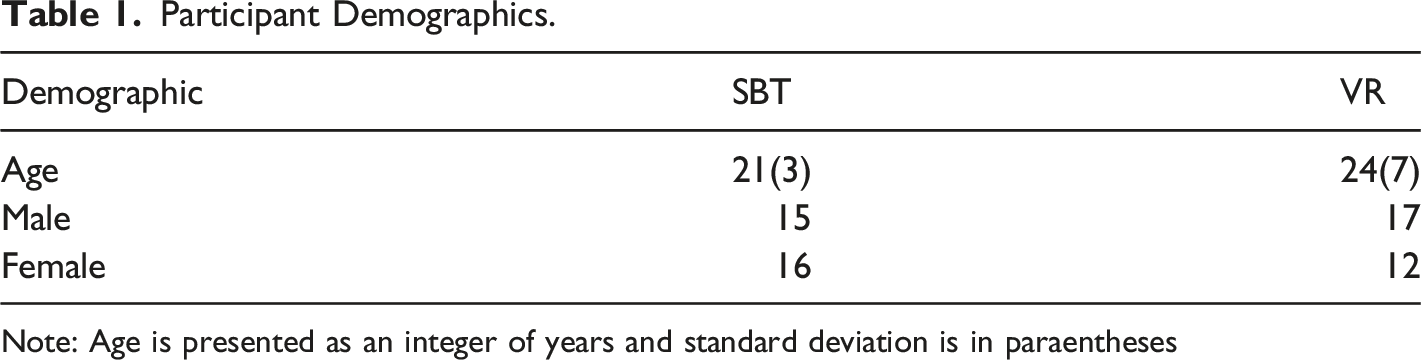
Note: Age is presented as an integer of years and standard deviation is in paraentheses
Procedure
Data collected during both the SBT and VR conditions underwent identical procedures. The individual manuscripts for both the SBT (McAllister et al., 2020) and VR (McAllister et al., 2022) contain extensive descriptions of the scenarios, equipment, and overall procedures to enhance replication. However, we will summarize the procedures here to provide context. Participants were required to provide IRB approved electronic informed consent prior to submitting a health history questionnaire to qualify for the study. Participants were required to be: 1) non-cigarette smokers and 2) free from any major stressor in the last 30 days such as death in the family, new job, etc. All participants were asked to arrive at least 4 hours fasted and to avoid all nicotine exposure within 24 hours of testing.
Upon arrival, participants rested in a quiet room and provided saliva samples 30 minutes and 5 minutes before exposure to either the SBT or VR intervention. Participants then provided saliva samples 5 minutes and 30 minutes post intervention which were collected via passive drool method (McAllister et al., 2020, 2022). As described above, the SBT and VR procedures were identical, the VR scenario was developed as a mirror image of the SBT based on the 360-degree video and audio provided to the VR provider. For the SBT, after completing the initial resting period, participants were shown to the study location and listened to fictious radio traffic of a shooting in progress. Once instructed, they “entered” the scene as the first responding officer. Immediately after entering the hallway, participants saw a screaming victim with extensive injuries (e.g., eviscerated bowels, gunshots) laying on the floor. A second victim with gunshot wounds to her left arm and leg ran out of a room approximately five feet away from the first victim. As soon as the participant reached the threshold of the attack room, they were presented with one victim on the ground with a traumatic head injury and the shooter firing his handgun at the last standing victim. Participants then used their training weapon to “shoot” the attacker and end the scenario. Participants then proceeded to another room to rest and provide their post-intervention saliva samples. The VR group experienced the exact same scenario in a virtual environment. They donned HTC Vive Pro headset (HTC Corp, New Taipei, Taiwan) and were able to physically move through the entire environment and experience all the sights and sounds just like the SBT group.
Variables
The primary variables are the salivary markers α-amylase and SIgA. Both α-amylase and SIgA are measures of acute stress. Other measures, such as S-CORT, have been shown to not respond to acute stress exposure less than 10 minutes (Bozovic et al., 2013). Data were collected at −30, −5, +5, and +30 minutes. As seen in Figure 1 and Figure 3, both α-amylase and SIgA have a noticeable increase in stress levels from −5 and +5 minutes, which are the measurements immediately prior to and post exposure to the intervention. For this reason, this assessment will examine these two time points to answer the question if a VR scenario can elicit a similar stress response to a realistic SBT scenario. SBT and VR differences.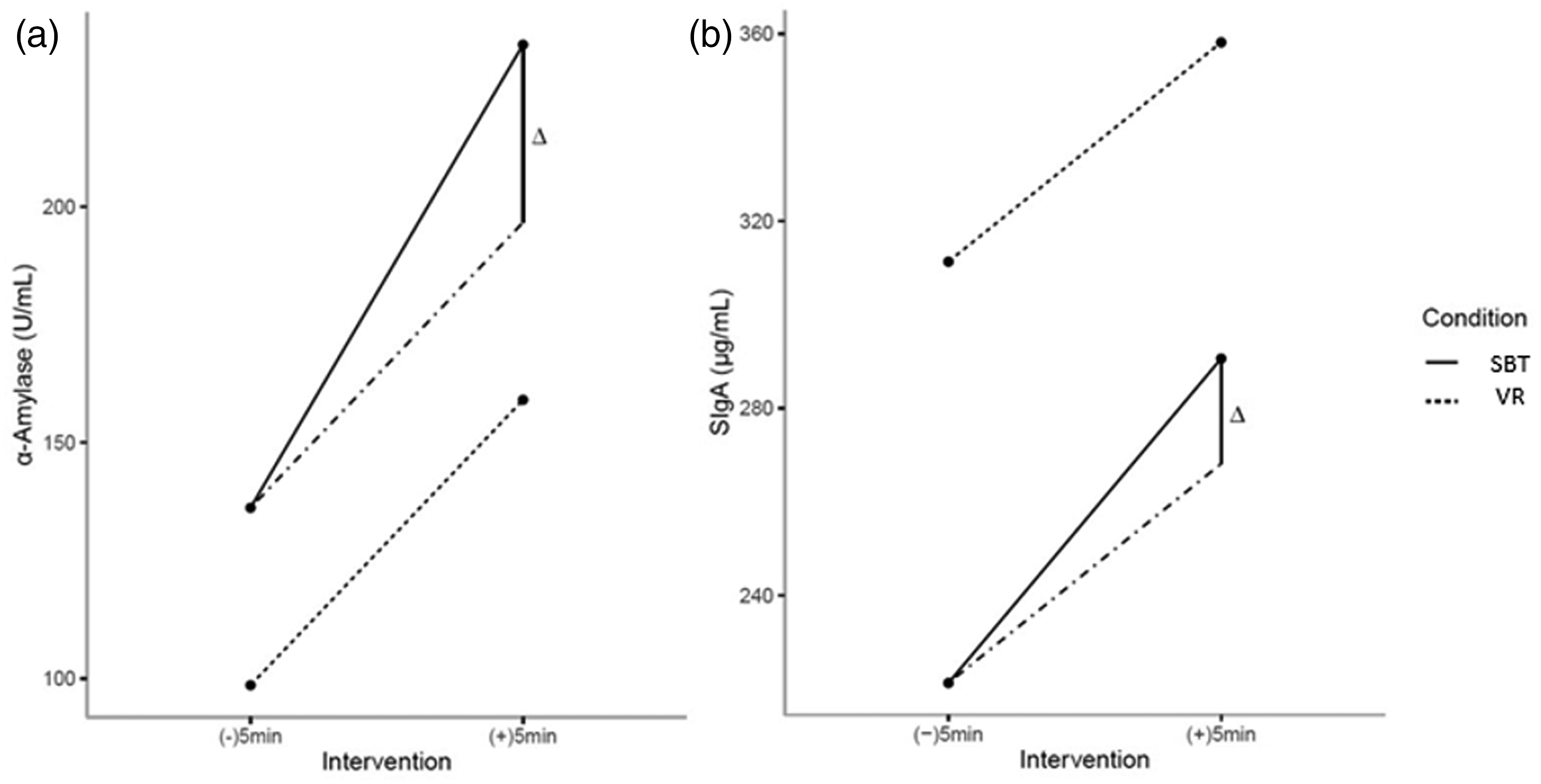
Analytic Technique
The SBT and VR condition data collection periods were separated by nearly 18 months. This was due to 1) development time needed to create an exact replica of the SBT condition in a virtual environment and 2) IRB restrictions on in-person data collection during the COVID-19 pandemic. This quasi-experimental design did not allow for random assignment to conditions. For this reason, we analyzed the data using a 2x2 difference-in-differences (DiD) model (i.e., 2 conditions x 2 time points). The DiD model assumes the two groups are inherently different at baseline due to the data being collected at different time points. A DiD estimate is the difference between the change in outcomes before and after a treatment in a treatment versus control group (
While the DiD model is suited for quasi-experimental data, we note the technique is not widely used in the field. For this reason, we also present results via a two-way ANOVA. The DiD and two-way ANOVA findings are the same.
Results
Figure 3 graphically combines the SBT and VR conditions −5 and +5 measurements for both α-amylase (A) and SIgA (B). The SBT condition is shown with a solid black line, and the VR condition is shown by the dotted black line. The SBT and VR condition pre-intervention measurements are different. This was expected because the project design did not allow for random assignment to conditions. The dot-dash line superimposes the VR slope with the same start point as the SBT condition. This graphically represents the DiD interaction term wherein the post-intervention differences (represented by the vertical black line and delta symbol [Δ]) can be assessed based on the individual slopes. It is worth noting, Figure 3 shows these data exhibit the required parallel trends for a DiD model.
Difference-in-difference output.
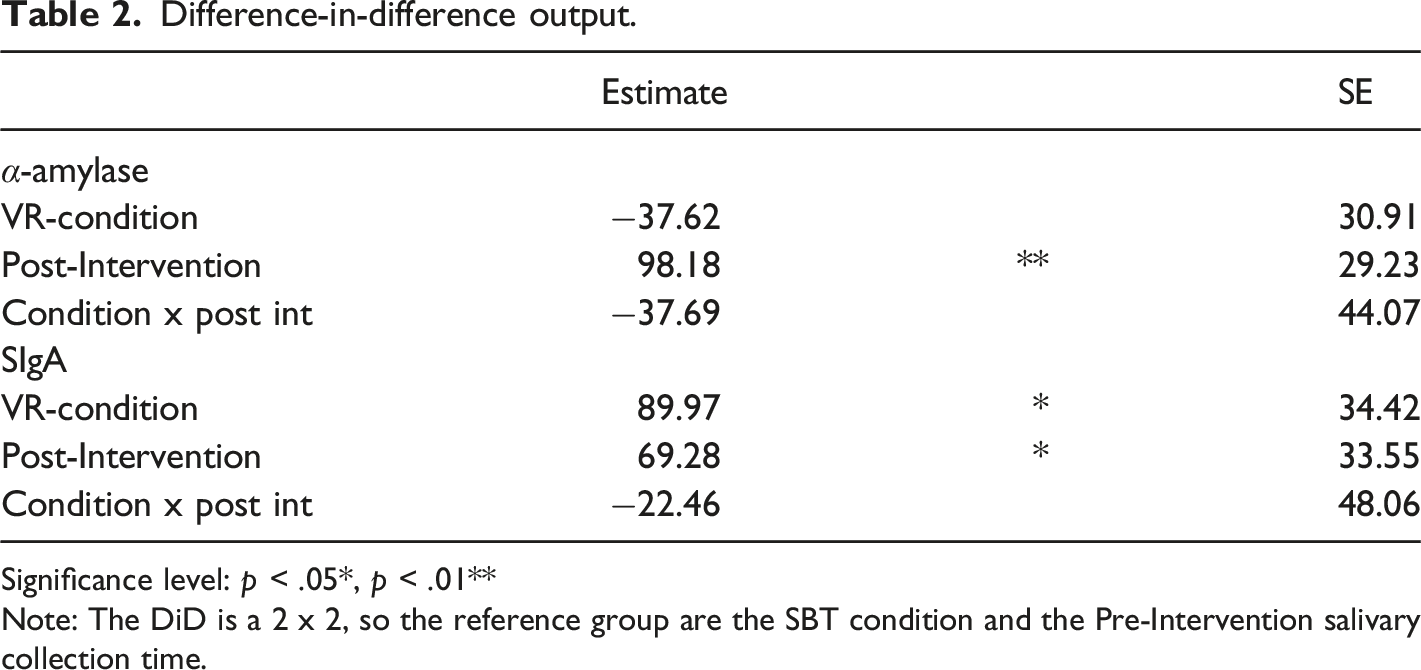
Significance level: p < .05*, p < .01**
Note: The DiD is a 2 x 2, so the reference group are the SBT condition and the Pre-Intervention salivary collection time.
Regarding SIgA (Figure 3(b)), the SBT condition increased from a pre-intervention level of 221.34 (96.26) to a post-intervention level of 290.62 (117.04). The VR condition increased from 311.31 (129.18) pre-intervention to 358.14 (145.74) post-intervention. Once again, the interaction term of the DiD model was non-significant. The difference between the two groups was 22.46 μg/mL (see Table 2).
While we present results for the DiD models, we understand that some readers may prefer to see results presented as a two-way ANOVA with the salivary measure serving as the dependent variable. The two main effects were the condition (VR, SBT) and saliva measurement time (pre-, post-intervention). As presented in Figure 3 (and discussed in the DiD results) the interaction term represents the observed difference in the dependent variable (α-amylase or SIgA salivary measures) for the condition (VR, SBT) when controlling for the pre-/post-intervention measurement (see Δ in Figure 3). α-amylase had a significant main effect for the condition (f(1, 105) = 7.06, p < .01) and measurement time (f(1, 105) = 13.91, p < .001). However, the interaction term was not significant (f(1, 105) = 0.73, p = 0.39) indicating no difference between the condition for the post-intervention time measurement. A Tukey HSD post-hoc analysis was conducted to better understand the differences between the two conditions. There was not a significant difference between the two conditions for the pre-intervention time (
Similarly, SIgA had a significant main effect for the condition (f(1, 107) = 10.26, p < .01) and post-intervention measurement time (f(1, 107) = 5.90, p < .05). The interaction term was not significant (f(1, 107) = 0.22, p = 0.64) indicating no difference between the condition for the post-intervention time measurement. Another Tukey HSD post-hoc analysis was conducted. There was not a significant difference between the two conditions for the pre-intervention time (
Discussion
This quasi-experiment sought to understand if a VR environment could elicit a similar acute stress response as a realistic SBT exercise related to law enforcement active shooter response training. With more first responder training utilizing VR systems (Mossel et al., 2021; Peretti et al., 2021), it’s important to understand if such training is comparable to SBT in provoking stress. Both difference-in-differences and two-way ANOVA analyses indicate that VR technology can elicit a similar acute stress response as a short (∼50 seconds) SBT utilizing professional actors. The acute stress response was shown with two different salivary measures of acute stress (α-amylase and SIgA). The non-significant interaction terms in all models lead us to fail to reject the H0 that there would be no difference between conditions. Supplementing SBT with VR seems to be where the field is heading. However, SBT plays an important role in preparing law enforcement for responding in stressful situations. Thus, it is important to know how these training techniques compare in stress response. This study provides an important next step based on previous research conducted in this area (see McAllister et al., 2020, 2022).
The real-world implications of this initial study are important. As we highlighted in the literature review, SBT is widely implemented in law enforcement training with 99.7% of police academies utilizing some form of SBT to supplement classroom instruction (Buehler, 2021). However, SBT does come at a substantial cost, both fiscally and logistically. Regarding fiscal cost, agencies implementing SBT are required to devote substantial personnel time to planning and deploying the training. This is especially true if the “actors” are employed by the agency and must be present for multiple days to allow for trainees to undergo the SBT exercise. If the agency opts to hire professional actors, this is yet another expense that must be accounted for. Beyond personnel cost, agencies must purchase equipment and expendables (e.g., training ammunition/taser cartridges) to support the SBT. Logistically speaking, the SBT can be limited by the availability of training locations and personnel schedules. Agencies tied to a small number of training locations may quickly saturate the possible scenarios provided to trainees. For example, if an agency is limited to one building, trainees may not get exposed to scenarios in schools, places of business, or residential structures. Furthermore, the effectiveness of the training may be greatly diminished if the training personnel do not provide realistic acting or if the same personnel are utilized as the potential aggressor. Trainees may learn to read cues from the training staff and anticipate upcoming events thus developing training scars that have real-world implications.
While these are potential issues with SBT, we are not suggesting that it does not serve an important function in training law enforcement officers. Exposure to stressful situations and receiving immediate feedback on performance by trained instructors are incredibly valuable aspects of SBT. Our position is simply that VR may be a viable solution to some of the downsides of SBT. The current study showcases that VR elicits a similar stress response as a highly realistic SBT exercise. However, VR has the added benefit of not requiring several personnel to play the various roles required in a SBT, citizen demographics and actions can be quickly changed to provide trainees with a variety of possible scenarios, the training location experienced in the VR environment can be changed quickly (e.g., a school for one scenario and a residential structure for the next), the training is consistent between all trainees, and training staff can still provide valuable feedback on student performance as they complete their training. Furthermore, trainees can quickly access a scenario before or after a shift without disrupting staffing levels. In fact, these short bursts of training over a long period of time have been shown to increase skill retention in some fields (Macnamara et al., 2014).
While VR may help fill in some of the logistical constraints present with SBT, it does require a financial investment. VR training has been shown to cost more initially but be a cheaper option than live exercise training over time (Farra et al., 2019). Some agencies have utilized federal grants, such as the COPS Office Community Policing Development Grant (www.cops.usdoj.gov/cpd), to fund the acquisition of VR technology whereas others have privately financed VR systems. There is also a wide range regarding the type of VR system used for training. At the low-end of the spectrum, VR can refer to projecting video of pre-recorded scenarios on a wall. The high-end of the spectrum includes fully immersive systems where the user can freely move through a virtual environment while wearing a heads-up display and interacting with avatars. The system used in this experiment was fully immersive.
While there are some drawbacks, we believe VR can play an important role in law enforcement training as an additional training tool. We do not advocate for VR replacing all law enforcement SBT. For example, VR does not allow for users to practice certain hands-on skills such as applying handcuffs. However, VR can provide short bursts of immersive training that empirically induces an acute stress response by trainees.
Because VR was able to produce a similar stress response to a realistic SBT exercise, it is likely that VR can provide experiential training opportunities inline with experiential learning theory (ELT). As noted in the literature review, SBT and ELT have been successfully applied to a variety of law enforcement training (Henriksen & Kruke, 2021; Moats et al., 2008; Phelps et al., 2018; Richards et al., 2018), so it is within reason that VR will play an important role in the future of law enforcement training.
Lastly, we also believe VR can play an important role in policing/criminal justice research. Researchers can present study participants with replicable scenarios capable of producing a similar stress response as in-person scenarios (if that is desired) or alter characteristics of the scene to answer important research questions. For example, VR provides the opportunity to present multiple factors (e.g., time of day, presence of bystanders, priming effects), while holding everything else constant in the scenario.
Limitations and Future Research
As with all studies, this study is not without limitations. Due to the period of time required to build the VR environment and the COVID-19 pandemic, approximately 18 months passed between the SBT and VR data collection periods. It is possible that there was some sort of history effect present; however, the DiD and two-way ANOVA models do take the quasi-experimental design into consideration. It is worth noting that the SBT data collection utilized professional actors to enhance the realism. It is possible that the professional actors outperformed what normal law enforcement training personnel would do in an SBT. This additional realism could have increased the acute stress response present in the SBT portion of the study. Regardless, the VR was found to be statistically similar to the realistic SBT. For this reason, it may be worthwhile to replicate the SBT study using law enforcement trainers instead of professional actors to better understand if this impacted acute stress response or not. Next, this study focused on the ability to elicit a stress response with a short (∼50 second) scenario. Future studies must consider the impact of the training on skill development and retention. It is possible that VR and SBT have different long-term effects on skill development and retention for law enforcement officers. It is important to understand if one method improves the long-term performance of law enforcement officers or not. Additionally, future studies should look at utilizing VR as the medium in a wide range of applications. This study showcased how VR can elicit a stress response, so future studies can examine topics such as witness identification, recall, and perceptions utilizing VR as the medium.
Another limitation to consider is that the participants in this study were college students rather than police officers. College students may not exhibit the same stress levels of change in stress that a police officer would in a similar scenario. However, college students are of a similar age as the average police recruit (i.e., 20–25 years old; Violanti et al., 2013), and this sample should mimic this population. Though, as previously mentioned, several studies have found more stressful scenarios to impact police performance (Andersen et al., 2016; Giessing et al., 2019; Oudejans, 2008; Sandel et al., 2021; Taverniers et al., 2011). Future studies could be done using an officer sample to better match those who would receive SBT and VR training.
Conclusion
An important feature of SBT is the induction of some level of stress on trainees. Emerging VR technology is currently being adapted to train law enforcement officers on a variety of skills such as use of force. However, it was unclear if VR could elicit a similar stress response as SBT in a law enforcement context. This manuscript provides initial evidence that VR can elicit a similar stress response to SBT. Law enforcement agencies using VR technology can harness this to help supplement SBT where possible. We do not suggest that VR training should replace SBT; rather, we suggest that law enforcement agencies may find unique opportunities within their training environment where VR can enhance replication for stressful scenarios to be experienced by all their officers. For example, if an agency is conducting de-escalation training and would like each officer to experience the same situation, VR may be the best tool for the job.
Footnotes
Declaration of conflicting interests
The author(s) declared no potential conflicts of interest with respect to the research, authorship, and/or publication of this article.
Funding
The authors disclose receipt of partial financial support for the execution of this project: U.S. DOJ—Office of Community Oriented Policing Services (COPS Office) Award # 2019ASWXK001
