




Abstract
There is a lack of instructional literature on how to conduct a feminist evaluation to highlight and transform systemic issues in gendered and intersecting power relations. Feminist Participatory Action Research (FPAR) enables a process for conducting community-driven, -led and -owned feminist evaluations that drive social justice actions. By undertaking a critical review of existing literature, this article presents guiding principles and practices in how to conduct a feminist evaluation using FPAR. These principles and practices provide a framework for those who are seeking an evidence base for transformative social justice action in communities, particularly those who are working with complexity in systems-change interventions with multiple stakeholders.
Keywords
Introduction
Feminist movements informed by third-wave feminism accentuate the need for inclusive evaluation methodologies and practices (Podems, 2010). There is a growing body of knowledge about feminist and transformative evaluation and practice to meet these demands (Brisolara et al., 2014; Godden, Macnish et al., 2020; Haylock & Miller, 2016; Mcdiarnid et al., 2021; Mertens, 2009, 2010; Pillow, 2002; Podems, 2010; Sielbeck-Bowen et al., 2002). Feminist evaluation stems from feminist theory and aims to intentionally create social and structural change for social, economic and political equality through disrupting power (Bamberger & Podems, 2002; Mcdiarmid et al., 2021); acknowledging that any feminist evaluation cannot be fully objective or value-free (Podems, 2010). Feminist evaluation focuses on the critique of power and interrogation of gender norms, which are also the focus of the evaluation study itself, the evaluand and the implementation of the study (Brisolara et al., 2014; Chakma, 2016; Haylock & Miller, 2016; Mcdiarmid et al., 2021). Although feminist evaluation engages critical theory to highlight systemic issues underlying gendered and intersectional experiences, there is no prescription about how to conduct a feminist evaluation (Brisolara et al., 2014; Haylock & Miller, 2016; Podems, 2010, 2018), with most feminist evaluation literature focusing on the principles of how to conduct a feminist evaluation. It is intended that evaluative methodologies, processes and/or tools are selected for a feminist evaluation based on the evaluative questions that are required to be answered with a feminist lens (Wyatt et al., 2021). However, this presents challenges for evaluators wanting to apply a feminist approach but who are unsure about how to do this in practice.
Feminist Participatory Action Research (FPAR) is a social research paradigm which offers a methodology for conducting feminist evaluation. In FPAR, the community own and lead all stages of the research process (Godden et al., 2020). Both the FPAR process and results are action-centric (Fine & Torre, 2019). The process ensures that the community identifies the problems to be explored in the study, co-designs the methods, conducts the collection of evidence, analyzes the results, reports the findings, and designs and implements actions (Coghlan & Brydon-Miller, 2014; Maguire, 2001). An FPAR study not only generates knowledge about gendered and intersectional experiences and patriarchal power dynamics, but also instigates and mobilizes positive social change (Cahill et al., 2010; Sandwick et al., 2018). FPAR has similar theoretical underpinnings as feminist evaluation, and thus provides a methodological framework in which a feminist evaluation study can be conducted, along with a demonstrated rigorous approach that can provide structure to the evaluation.
Both feminist evaluation and FPAR emphasize inclusivity of marginalized peoples, deeply challenging the neoliberal and patriarchal status quo to transform society for the rights of people across all their diversities (Chakma, 2016; Lykes & Hershberg, 2012). We believe a key benefit of combining feminist evaluation with FPAR is the opportunity to examine the neoliberal and patriarchal context of the evaluation. By shifting the evaluation audience to the community (who traditionally are the beneficiary of the evaluand), the evaluation can assist to navigate the contexts in which the initiative is working to promote social justice, inclusion, and participation for positive transformative change. Feminist evaluation using FPAR could also be useful for donors who are seeking to experiment with feminist evaluation to transfer the power of decision-making on design, implementation and interpretation of evaluation findings to the community, and who have the available time and resources to commit to this. Feminist evaluation using FPAR can critique whose “value” it is in conducting an evaluation. By ensuring the community has the power of decision-making, ownership, and leadership of the design, implementation and use of the evaluation outputs, the findings and reflections can be used to sustain social justice change (Lazar, 2017).
There is a lack of guidance on conducting feminist evaluations, and similarly, there is also currently no existing guidance on how to conduct a feminist evaluation using FPAR. Through a critical review of existing literature, we have written this article to identify a consolidated set of suggested principles and practices to guide a feminist evaluation using FPAR. FPAR is a social research approach, and as such, there is limited information in the evaluation field about whether FPAR has a ‘place’ in evaluation. The critical review helps us understand common principles and practices between feminist evaluation and FPAR, and how this social research approach can be adapted for conducting a feminist evaluation for transformative change.
We have undertaken this review using a critical realist and interpretivist approach. As Pilgrim (2020) outlines, critical realists take an ontological position that there is a distinction between our individual interpretation of the world around us and that “the world exists independent of what we know or think about it” (p. 3). Pilgrim explains that we interpret the world through a social reality, created out of the interplay between different sources of power. A critical realist approach is appropriate for this review, as there is no one way of interpreting feminism; rather, interpretations vary depending on what we are exposed to in our context. The interpretivist approach further amplifies critical realism to explore how socially constructed notions of power could be used for positive social change. By including an interpretivist lens, we are also able to interpret various observations of feminism and how structural changes to patriarchal and neoliberal power can establish this critical reality (Sovacool & Hess, 2017). Similarly, our critical feminist lens enables us to examine the neoliberal hyper-capitalist patriarchal underpinnings of social research and evaluation (i.e., why we conduct such studies – for whose value is it to do so?) (Cannizzo, 2018), and to understand the role of patriarchal power and the current realities of women and minority groups in the evaluation context (Lazar, 2017).
To write this article, we have reviewed peer-reviewed English-language literature across the fields of feminist evaluation and FPAR. Within these parameters, there is limited literature on this topic, although there is sufficient information to identify trends and propositions for feminist evaluation practice using FPAR. The article begins by analysing the relationships between feminist evaluation and FPAR, including their common principles and practices, and examines existing literature regarding feminist evaluation using FPAR. We then propose a framework for feminist evaluation using FPAR with guiding principles and practices. The article concludes with some potential limitations or challenges with applying FPAR as an evaluation methodology.
Feminist Evaluation, FPAR, and the Relationship Between Them
Feminist Evaluation
Feminist evaluation draws from feminist theories and politics to further the wellbeing of all people, regardless of their identities and experiences, as well as to locate the evaluand in its patriarchal context (Ward, 2002). There is no one identifiable feminist theory (Bamberger & Podems, 2002; Brisolara et al., 2014) and similarly so, feminist evaluation presents in different forms depending on the researcher's theoretical interpretation of feminism as there is no prescribed or specific approach (Podems & Negroustoueva, 2016). Literature suggests a commonality in feminist evaluation to “expose the individual and institutional practices that have denied access to women and other oppressed groups and have ignored or devalued women” (Brabeck & Brabeck, 2009, p. 39), and to articulate and express values that are distinct to feminist evaluation (Mcdiarmid et al., 2021).
Podems (2010) describes how feminist evaluation has followed the trends of the different waves of feminism and that throughout the first and second waves of feminism, gender-focused evaluations examined sex-disaggregated information to gain insights on the differences between female and male experiences of an intervention; with the term “gender-focused” preferred over “feminist” due to negative connotations of the term feminist. Gender-focused evaluation considers “sex” as the genetic make-up of one's anatomy and “gender” as a social construct of relationships between female- and male- identifying people. Feminist evaluation progressed through the evolution of the third wave of feminism in the late-20th and early-21st centuries, focusing on institutionalisation, social change, and the patriarchal underpinnings of society inherently disadvantaging women and minority groups, through gendered stereotypes and other intersecting injustices (Maclaran, 2015). Importantly, Brisolara et al. (2014) also explain that current interpretations of feminist evaluation explore inequities within gendered power relations and the ways that these intersect with geographic location, culture, religion, financial status, LGBTIAQ+ identification, and other cross-cutting societal statuses. They note feminist evaluation also considers the assumptions, biases and consequences of policies and practices on gendered and intersecting power relations, including community perspectives of their lived experiences.
Feminist evaluation belongs to a cluster of ideologically oriented evaluation approaches stemming from critical social science epistemology which examines the macro-politics of power to reveal and deconstruct structural injustices (such as the patriarchy) and generate action to rectify these injustices (Greene, 2011). Other forms of critical evaluation include critical evaluation theory (Everitt & Hardiker, 1996); communicative evaluation theory (Niemi & Kemmis, 1999); inclusive evaluation theory (Mertens, 1999, 2003); and transformative evaluation (Mertens, 2009; Mertens & Wilson, 2012).
Although not explicitly stated, critical evaluation approaches such as feminist evaluation sit under the “value” branch of Christie and Alkin's (2008) re-examined evaluation theory tree, as it interrogates whose “value” it is to conduct an evaluation, noting that “value” is subjective due to the role of stakeholders in the study. Power within a feminist evaluation study is held by the beneficiaries to emphasise their voices are heard as they “work for social justice” (Brisolara et al., 2014, p. 21). This power shift is shown by the focus on stakeholder involvement throughout the process, from creation and planning to collaborating, to developing useful and implementable findings to ensure meaningful participation and the generation of fit-for-purpose findings for transformative social change (Haylock & Miller, 2016).
There is no one set of feminist evaluation principles. Building on the work of Sielbeck-Bowen et al. (2002) and Brisolara et al. (2014), Wyatt et al. (2021) provide the most recent set of feminist principles to consider for monitoring and evaluation. These principles focus on power and agency (principles 1 and 2) and that change is non-linear, multifactorial and considers ecosystems (principles 3 to 5). Please see our depiction of these principles in Box 1.
Feminist Evaluation Principles of Practice
Acknowledge and consider power dynamics and multiple ways of knowing. Diverse views and experiences are required to understand the structural and systemic power relationships affecting women, girls and non-binary peoples.
Focus on agency and ensure that evaluation activities are useful and owned by beneficiaries, and that the evaluation is not just an accountability exercise.
Change is non-linear.
Change is multifactorial and transformative change occurs at multiple levels (individual and systemic, formal and informal). This includes changes in internalized attitudes and beliefs about roles; dismantling social and cultural norms; eliminating biases in laws, policies and public budgets; and providing equal access to resources, rights and opportunities. Movement building is also included.
Ecosystems/broad communities should be at the heart of sustainable system change.
Source: Drawn from Wyatt et al. (2021)
Wyatt and colleagues' (2021) feminist evaluation principles situate and establish an epistemological framework of feminist evaluation, laying the groundwork for potential evaluation outputs. These principles assist the evaluator or evaluation commissioner to articulate their perception of what knowledge is; what evaluation is and what it is used for; other structures of discrimination beyond patriarchy; and the underpinnings of systemic discrimination (including gender) that can impact an evaluation. In addition, Wyatt et al.'s principles acknowledge that change is multi-dimensional, non-linear, and requires systems change approaches to strengthen feminist evaluation practices for transformative social justice. Wyatt et al. also explain that beneficiaries are to be involved in the evaluation process, to ensure that beneficiaries own the evaluation activities, and that activities are useful to them (not just an accountability exercise). This is different from evaluations where the donor or implementing team own and lead the evaluation activities. By ensuring community leadership, the evaluation findings will be fit-for-purpose and can support transformative change within the community. Haylock and Miller (2016) and Podems (2018) note the importance of the evaluator in the feminist evaluation space to recognize their own power relationships and acknowledge that the act of evaluation holds inherent beliefs of power relations.
There are several critiques of feminist evaluation including that the process can be time-consuming; questions about the validity of evaluation findings; and difficulties in implementation (Greene, 2011; Hay, 2012; Haylock & Miller, 2016). Hay (2012) argues that feminist evaluators require more demonstration of the rigour and validity of such an approach, including the limitations of the study. Feminist evaluation is subject to the values of the evaluation stakeholders and how these values are defined. Hay (2012) also notes that the rigour of feminist evaluation could possibly be discredited due to interpretive bias and potential exclusion of marginalized groups, and suggests that multiple methods are used. Furthermore, Greene (2011) argues that feminist evaluation is difficult to implement due to its evolution from a set of principles—rather than a specific methodology—with a risk of possible imposition of the evaluator's values. As such, it is difficult to determine what is considered “best practice” in undertaking feminist evaluation, and indeed what it takes for an evaluation to be considered “feminist.” We also note that we experienced difficulties locating recent literature on “feminist” evaluation, as other languages such as “inclusive” or “transformative” evaluation was often used instead (for example, see Mertens, 2009). Nevertheless, despite identified challenges in implementation, feminist evaluation provides an opportunity to include non-evaluators throughout the evaluation process, further enabling social justice action (Brisolara et al., 2014; Wyatt et al., 2021). Feminist evaluation also provides a possible framework to evaluate nonlinear change and examine gendered and intersecting power relations that underpin interventions and evaluands (Haylock & Miller, 2016).
Feminist Participatory Action Research
FPAR is a methodological paradigm for research and action to understand and dismantle structures of power (Chakma, 2016; Godden et al., 2020). It grew from the tradition of Action Research (Dewey, 1997; Lewin, 1947; Stringer, 2007) that emphasises a systematic, cyclical approach to understand, test, and improve practice. Influenced by Freirean consciousness-raising (Freire, 1989), participatory action research emerged as a political process whereby people experiencing disadvantage and marginalization are supported to lead their own research and action processes to understand and challenge systemic power (Kindon et al., 2007; Leal, 2007). FPAR extends the participatory paradigm further by centering intersectional perspectives in knowledge and action for social change and inclusion (Cahill et al., 2010; Sandwick et al., 2018). FPAR is an action-oriented approach to social research and focuses on gendered power relations from an intersectional perspective both in theory and practice (Coghlan & Brydon-Miller, 2014; Fine & Torre, 2019).
FPAR combines social research with political activism (Chakma, 2016; Reid & Frisby, 2008). It aims to generate knowledge and evidence to strengthen social movements and take collective action to change the condition of those who experience patriarchal oppression, demand their rights, and challenge structural power (Lappin, 2020). More specifically, FPAR focuses on experiences and rights at the grassroots or community level to destabilize the neoliberal, colonial, capitalist and patriarchal systems that marginalize them (Godden et al., 2020; Lykes & Hershberg, 2012). An intersectional approach is particularly paramount to understand multiple and intersecting injustices (Tolhurst et al., 2012). Feminist consciousness-raising and activism are thus central to FPAR (Chakma, 2016; Hayhurst et al., 2018).
Similar to feminist evaluation, FPAR examines the role of the researcher and how their underlying assumptions and perspectives help or hinder a study (Reid et al., 2006). Reflecting a commitment to dismantling traditional researcher/subject power relationships, people who participate in FPAR are considered “co-researchers” (Godden, 2017a; Kirby, 2011). The term co-researchers indicate that FPAR participants have ownership of the process and have responsibility to undertake social justice activism as agents for transformative change (Wickramasinghe, 2010). As Gustafson et al. (2019) argue, FPAR co-researchers facilitate a connection between the research aims, equitable processes, and research outcomes that are transformative, community-engaged, and solutions-focused. Through FPAR, co-researchers collaboratively design methods, collect and analyse data, report their findings, and develop, implement and reflect on activist strategies to challenge injustices (Fine & Torre, 2019; Godden et al., 2020). This is enabled through activist processes of democratic and inclusive decision-making (Godden, 2017b).
FPAR involves ongoing cycles of action and reflection as co-researchers move through their research and activism (Lykes & Hershberg, 2012; Reid & Frisby, 2008). The process includes critical collective reflection on power relations (Brabeck & Brabeck, 2014; Hilsen, 2006), and deliberate sharing and redistribution of power. Feminist ethics of solidarity and collective care are paramount (Brabeck & Brabeck, 2014; Brydon-Miller, 2009). As a political methodology to challenge hierarchies of knowledge, FPAR embraces creative and participatory methods that foster inclusion and accessibility, such as arts-based methods, participatory rural appraisal, and PhotoVoice (Cornell et al., 2019; Godden, 2017a; Hayhurst, 2017).
In a paper evaluating the impacts of an FPAR program for climate justice in the Asia-Pacific region, Godden et al. (2020) documented principles of FPAR as outlined by the Asia Pacific Forum on Women, Law and Development (APWLD), a leading civil society organisation in the FPAR space. We have communicated APWLD's FPAR principles of practice in Box 2.
Feminist Participatory Action Research Principles of Practice
The purpose of FPAR is structural change
FPAR amplifies female identifying people's voice
FPAR is owned by the community
FPAR takes an intersectional approach
FPAR aims to shift power
FPAR fosters movement building/collective action
FPAR building capacity of all
FPAR involves free prior and informed consent
FPAR prioritizes safety, care and solidarity
Source: Drawn from Asia Pacific Forum on Women, Law and Development, as Cited in Godden et al. (2020)
The principles outlined in Box 2 demonstrate the political impetus of FPAR—to build social movements and collective action, to shift power, and to demand structural change. Juxtaposed with the feminist evaluation principles, the FPAR principles of practice focus on the purpose and process of the study. The principles prioritize collective reflection to integrate activism throughout the research process (Godden et al., 2020). Such reflection deeply interrogates the patriarchal roots of how the study is conducted, the findings, and the role of co-researchers in surfacing these findings (and any assumptions being made along the way) (Lykes & Hershberg, 2012). Furthermore, FPAR principles of practice consider the ethical positionality of people and communities participating in the study. This includes explicitly promoting free prior and informed consent, and prioritizing safety, care and solidarity.
There are various challenges and criticisms of FPAR. A common challenge in FPAR is that because the study is participant-driven and participant-led (rather than funder-driven), it may not be possible or appropriate for research results to be documented in traditional published form (Coghlan & Brydon-Miller, 2014). As Gustafson et al. (2019) articulate, reporting in FPAR may not always align with academic publishing because “the traditional rules of publishing our findings in scholarly journals may be at odds with the epistemic stance and discursive claims we hold as feminists conducting PAR” (p. 5). Coghlan and Brydon-Miller (2014) also note that because FPAR is driven by the community, there may be no need for a written research report if findings are communicated in another format that the community understands. For example, findings could be conveyed through art, theatre, or other expressive forms (Godden et al., 2020). Another limitation of FPAR is that participatory methods can be delegitimized as unprofessional (Duraiappah et al., 2005) or tokenistic (Godden, 2017a), which may undermine the credibility of the research and actions. There are also ethical issues in navigating and sharing power (Gatenby & Humphries, 2000), and safety concerns with women leading activism to challenge systemic oppressive power in deeply patriarchal contexts (Godden et al., 2020). Notwithstanding these challenges, FPAR can be a powerful methodology for women and communities to document and understand injustices in their lives and mobilize for structural change.
Feminist Evaluation Using FPAR
Although the principles of feminist evaluation and FPAR identified above provide guidance for conducting feminist evaluation using FPAR, they do not come with practical suggestions on how to ensure studies are inclusive and adhere to these principles more broadly. Indeed, there is a lack of common process of how a feminist evaluation should or could be completed (Haylock & Miller, 2016; Podems & Negroustoueva, 2016). As a result, feminist evaluation studies are often folded into other approaches such as utilization-focused or participatory evaluation (Podems, 2010).
There is very limited literature available discussing feminist evaluation and FPAR (Godden et al., 2020; Mcdiarmid et al., 2021); suggesting that this is a relatively new approach. Godden and colleagues (2020) share findings and reflections from using FPAR as a methodology to evaluate APWLD's Climate Justice-Feminist Participatory Action Research Programme 2017–2019 (CJ-FPAR). This evaluation included Young Women Researchers (YWRs) and mentors from nine different women's rights organizations across Asia (Bangladesh, Cambodia, India, Myanmar, Nepal, Pakistan, Sri Lanka, Thailand, and Vietnam). All organizations were leading grassroots FPAR projects to address the gendered impacts of climate change in their communities and advocate for structural change. The approach suggests that some of Wyatt et al.'s (2021) feminist evaluation principles were used throughout the evaluation process, particularly the use of participatory decision-making and participatory methods.
In Godden et al.'s (2020) study, stakeholders co-designed and were involved in the evaluation activities, as the evaluation was iteratively merged with the key CJ-FPAR activities. These activities included, but were not limited to, regional FPAR training; pre-research consultation; documentation of the research design, narrative report and advocacy report; implementation of the participatory research process; and involvement in the final reflection meeting. YWRs collected evaluation data in their communities throughout the program, and collaboratively analyzed the data at the final reflection meeting. The evaluation methodology and findings supported women to undertake social justice action in their communities, while strengthening the theory and practice of the CJ-FPAR program more broadly. Through the CJ-FPAR program and the feminist evaluation using FPAR, women co-researchers and their communities developed “new knowledge, skills, and resources to demand climate justice; they have formed new women's groups, networks and alliances; they are participating in climate decision-making; and they actively lead climate change adaptation activities…” (Godden et al., 2020, p. 612).
In contrast, Mcdiarmid and colleagues (2021) examined feminist approaches of undertaking an evaluation using FPAR. The case study presented in this article was a mid-term review (MTR) conducted for the International Women's Development Agency's (IWDA's) Women's Action for Voice and Empowerment (WAVE) programme (note, the second author of this paper, Naomi Godden, was the lead evaluator for the MTR). WAVE was a 5-year programme involving 16 implementing partners across the Asia-Pacific region, seeking sustainable transformational change towards gender equality in areas such as women's leadership and violence against women. The evaluation was conducted separately to program activities, compared with Godden et al.'s (2020) approach of embedding the evaluation in each step of the CJ-FPAR program. The WAVE MTR combined FPAR with elements of Appreciative Inquiry to identify opportunities to strengthen the programme to achieve its main objectives.
In the WAVE MTR, implementing partners were involved throughout the evaluation process, including the planning phase, and selecting the key consultant team; input into the desk review; co-designing the MTR methodology; and leading participatory data collection and analysis and the final presentation (including a final written report and other presentation formats, and a follow up action-reflection process). Mcdiarmid et al. (2021) explain that the FPAR methodology for the feminist evaluation led to increased confidence and skills in evaluation design and process. This, in turn, led to collective ownership of the MTR findings by the implementing partners and other key stakeholders involved in the process. An example in practice was the use of inclusive and adaptive participatory tools and methods throughout the evaluation that was not pre-prescribed, which supported building rapport, relationships and trust with stakeholders.
While these two studies provide helpful insight into feminist evaluation using FPAR, there is a severe lack of literature and guidance on the theory and practice of this evaluation methodology. As such, in the next section, we propose some guiding principles and practices for feminist evaluation using FPAR to attempt to contribute to this emerging space.
A Guiding Framework for Feminist Evaluation Using FPAR
Undertaking a feminist approach to evaluation or research asserts the values of both the evaluator and the evaluand in an explicit way, noting values are inherent to evaluation and making judgements against an evaluand is based on one's interpretations and worldview (Christie & Alkin, 2008). As Patton (2002) explains, a feminist approach to evaluation is inherently reflexive and attentive to whose ‘voice’ is heard throughout the evaluation process. A feminist approach focuses on inherent injustices in societal and environmental structures with may oppress marginalized groups, and by undertaking an evaluation in such a way, challenges preconceived notions of power and justice (Podems, 2010).
Feminist evaluation and FPAR have a range of similarities. Both methodologies critically analyze the patriarchal and capitalist systems that underpin the society or community of the evaluand, and there is a deliberate emphasis on intersectionality and inclusion (Mertens, 2014; Reid et al., 2006; Reid & Frisby, 2008). Additionally, studies using either of these approaches are action-oriented and engage participatory methods (Mcdiarmid et al., 2021; Reid & Frisby, 2008). One key difference between feminist evaluation and FPAR, however, is community involvement throughout the process. Although feminist evaluation is participatory and community stakeholders are involved in each stage of the process (Brisolara et al., 2014; Podems, 2018), the evaluator generally facilitates the evaluation, with the drivers typically being the commissioners of the evaluation and/or the program team itself. Therefore, the “value” of the evaluation differs from FPAR, where the “value” inherently sits with the community (Gustafson et al., 2019). If there is an evaluator involved with an evaluation using FPAR, their role would likely be in a supporting or mentoring role, being invited into the space to provide guidance on the evaluation process (Chakma, 2016; Godden et al., 2020; Mcdiarmid et al., 2021).
Feminist evaluation or FPAR studies are intentionally “open” to allow different approaches for the evaluand/research and the community (Greene, 2011; Podems, 2010). However, our review indicates that FPAR can provide a methodological process for a feminist evaluation. FPAR principles compliment feminist evaluation principles, with their similarities and differences strengthening each another. By using FPAR to conduct a feminist evaluation, a well-rounded study can be generated that is participatory, intersectional, and action-focused, striving to generate positive social change.
Drawing from the literature, we propose a framework with guiding principles and practices for how a feminist evaluation can be undertaken through FPAR. Figure 1 outlines this approach. The boxes outside the circle are the guiding principles of feminist evaluation using FPAR, which underpin “how” to conduct the evaluation at every aspect of the study. The boxes within the circle outline the different “steps” of a feminist evaluation using FPAR, beginning at planning through to presentation of data, with the key difference from more traditional evaluations that social justice action is considered part of the evaluation. Importantly, Figure 1 also demonstrates that a feminist evaluation using an FPAR process is cyclical and does not stop when the evaluation is completed, as the process continues until the intended change has occurred. As such, between each step is a “reflection and action” component (explained further below). The inner circle notes the key areas of change the evaluation intends to bring about (note, these intended changes are drawn from APWLD's theory of change, as cited in Godden et al., 2020).
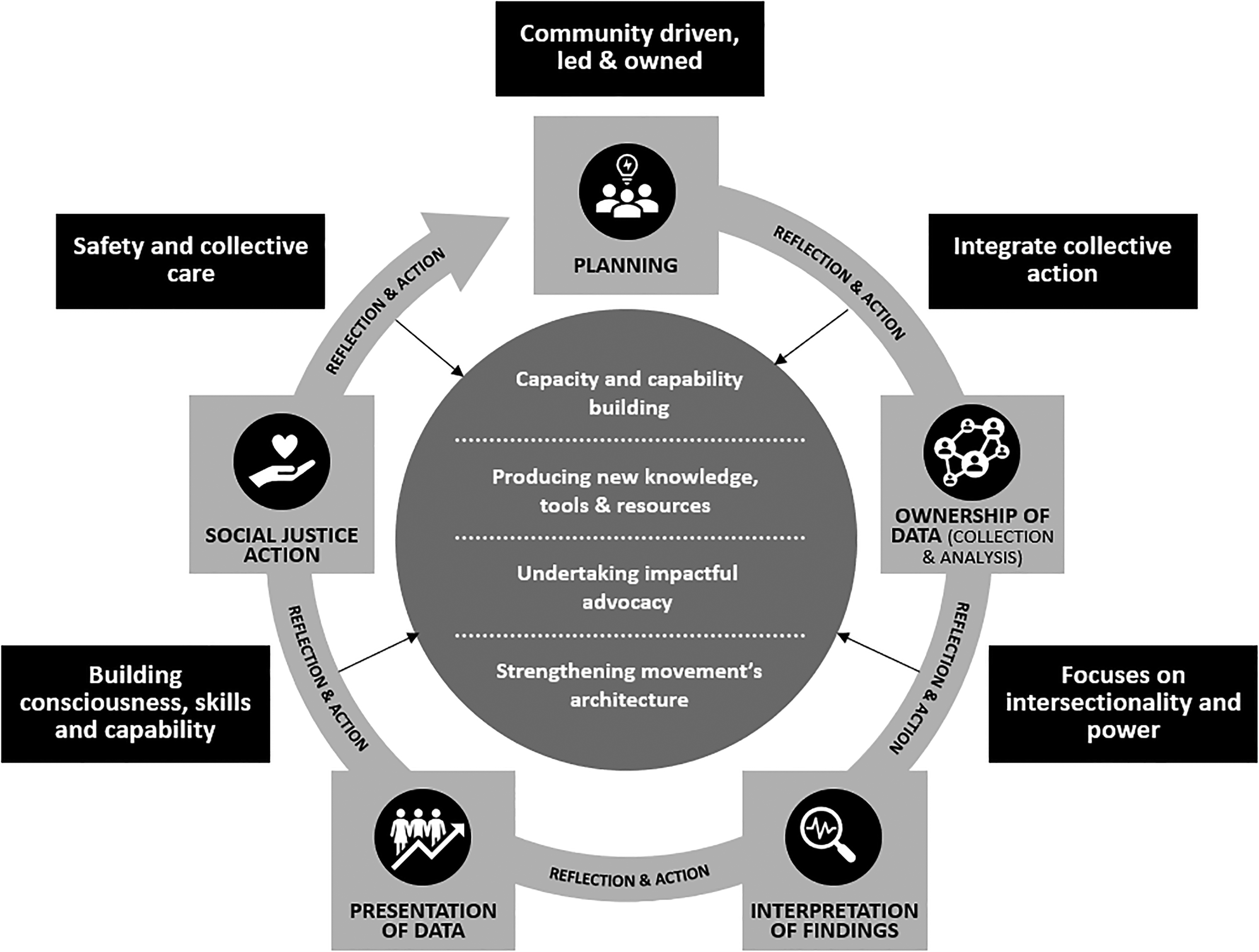
Guiding principles and practices of feminist evaluation using feminist participatory action research.
Principles for Feminist Evaluation Using FPAR
Our framework proposes five principles for feminist evaluation using FPAR. These are adapted from the literature and should be considered throughout the entire evaluation process (and even after the study is concluded) to guide the ‘way’ the evaluation is conducted.
Community led, community driven and community implemented
The community that the evaluation focuses on—whether it be the project team, other stakeholders or beneficiaries—drive the evaluation and decide how it is implemented and presented. This includes what and how data is being collected, and the use of the evaluation findings. This enables the community to lead the evaluation (Godden et al., 2020; Mcdiarmid et al., 2021). Feminist evaluation using FPAR actively engages as much of the affected community as possible and removes barriers to encourage broad participation. Feminist evaluation using FPAR uses participatory and inclusive tools and methods which can enhance the participation of people with literacy and access challenges. This includes creative, arts-based and non-text-based methods (Simons & McCormack, 2007), further discussed below. The evaluation is flexible, adaptable, and responsive to any context that arises, and is fluid; especially as people and organisations respond to change throughout the evaluation process (Reid & Frisby, 2008).
Integrate collective action
A feminist evaluation using FPAR is not just utilization-focused but action-focused. The evaluation process and results assist the community to take action for sustainable structural change (Chakma, 2016). Cycles of reflection and action are embedded throughout the evaluation to continuously improve the study and to strengthen feminist activism in the community. Collective action is embedded in the philosophy and process of the evaluation itself, rather than as part of a reflection activity at the conclusion of an evaluation. For example, communities involved in feminist evaluation using FPAR can embrace a range of collective actions to influence change, such as community organising, unionising, campaigning, lobbying, petitions, convening, media, demonstrations, and direct action (Godden et al., 2020; Mcdiarmid et al., 2021).
Focuses on intersectionality and power
Feminist evaluation using FPAR acknowledges the complexity of humanity which extends beyond sex-disaggregation of data and analysing the gendered and intersecting impacts of an intervention (Brisolara et al., 2014). Intersectional analyses of power are integral to feminist evaluation using FPAR. Mcdiarmid et al. (2021) note that conducting FPAR with a feminist evaluation lens acknowledges and acts on transformative change, seeking to transfer power. An intersectional approach assists the community to consider diversity of peoples’ lived experiences, whereby gender is layered with cultural, economic, political, geographical, social, educational, ability and religious identities and their associated power imbalances (Podems, 2010). An intersectional lens also assists in developing methods and actions that are accessible for and inclusive of peoples across their diverse lived experiences, to encourage ethical participation (Simons & McCormack, 2007).
Building consciousness, skills and capability
The purpose of feminist evaluation using FPAR is to challenge existing structures which may oppress marginalized groups. As such, the process of feminist evaluation using FPAR supports communities to build consciousness of structural oppressions and injustices as they relate to and intersect with patriarchy (Lazar, 2017). The evaluator and community are inward-looking, understanding their own identities, experiences, injustices, and privileges throughout the process and how this may influence the evaluation findings. Through cycles of reflection and action, the evaluation community analyzes their lived experiences, the patriarchal context, and opportunities for decolonization (Brisolara et al., 2014). In addition to internal reflection and action, the evaluator's role is to assist the community to build their skills and capabilities to undertake evaluation. Mcdiarmid et al. (2021) highlight that the integration of skills development into the evaluation activities not only assists in “relocate[ing] power for knowledge-creation and definition with local partners who are the intended users of the knowledge” (p. 95), but also increases the participating partner's confidence and ownership of the evaluation process and design. Instead of leading the evaluation, the evaluator is seen to be a methodological or technical advisor that supports the community to undertake specific evaluation tasks and to ensure they are upholding ethical and do no harm requirements for participants (Gustafson et al., 2019). It is important to acknowledge that trust and understanding between the evaluator and the community are complex and time-consuming (Godden, 2017a). The evaluation process needs sufficient time to collectively establish trust to ethically undertake the study and action, and this is especially important if the evaluator is a guest in the community.
Safety and collective care
As the community is driving, leading, and owning the feminist evaluation using FPAR, a do no harm and beneficence approach must be a high priority (Reid & Frisby, 2008). The principle of safety goes beyond free, prior, informed and continuing consent for all who participate in any evaluation activity and the option for any participant to withdraw at any time (Godden et al., 2020). There is a high level of duty of care and safety for everyone who is engaging in activism through evaluation. Godden et al. (2020) note that even though there may be strong relationships between commissioning organisations and participating partners, there are possible safety issues for those participating in the study and/or the evaluand, particularly around harassment, abuse, and arrest. Furthermore, data collection may not be able to be anonymous due to the use of participatory methods, and this should be collectively understood and consented to by the people who are collecting, providing, analyzing, reporting, and managing data (Gustafson et al., 2019). Feminist evaluation using FPAR has an emphasis on collective ethics and community care, responsibility, and accountability; particularly where data privacy and anonymity might not be able to be upheld. This is both a collective and individual responsibility, and the evaluator(s) are considered part of this community (Godden, 2017a).
Practices of Feminist Evaluation Using FPAR
Our framework in Figure 1 proposes a range of practices to be considered at each “stage” of a feminist evaluation using FPAR. The stages include planning; ownership of the data; interpretation of findings; presentation of the data; and social justice action. The cyclical process of reflection and action occurs throughout the implementation of each stage, and we also propose a collective process of reflection and action at the end of each phase. This can inform the next stage of the evaluation to strengthen its rigour and validity and adapt with the learnings. It also assists the community to identify findings that can be taken from this stage to inform social justice action (before waiting for the conclusion of the study). This cyclical process also allows everyone involved with the study (including the evaluators) to be self-reflective of their roles, experiences and power, and to collectively identify the evaluation's strengths and weaknesses, and recommendations to inform the next stage.
Planning
During the planning stage of a feminist evaluation using FPAR, participants come to a common understanding of the community itself and the issue/s at hand; what the evaluation is for; how the study will be conducted; their role in the study; and the change they want to bring about through the evaluation process (Godden et al., 2020). This planning phase is led and owned by the community, with key decision-making power held by this group. If there is an evaluator involved in this process as a guest to the community, they may provide guiding support and advice, including about any ethical considerations such as do no harm (Lykes & Hershberg, 2012; Mcdiarmid et al., 2021; Reid & Frisby, 2008). This stage adopts co-design practices (Godden et al., 2020; Mcdiarmid et al., 2021) to ensure the community is at the heart of planning and implementing the evaluation.
The community should be cognizant of the time it takes to undertake participatory approaches for evaluation, particularly with groups who are already stretched for time and resources, such as those engaged in activism (Godden et al., 2020). During the planning process, the community should collaboratively negotiate a compensation framework that is just and equitable.
Ownership of the data
During data collection and analysis, the community collects and owns the data, and controls how the data is used and analyzed (Reid & Frisby, 2008). The community decides how the data is to be collected, with an emphasis on creative, arts-based, and non-text forms of data collection. It may be helpful for the guiding evaluator to provide initial training to the community about the range of participatory data collection methods they could use. Some options include PhotoVoice; art (such as paintings, drawings, and sculptures); performing arts (such as poetry, song, movement, roleplay, and dance); Participatory Rural Appraisal tools (such as ranking and scoring); and storytelling (such as yarning, and Most Significant Change) (Dart & Davies, 2003; Godden, 2017b; Godden et al., 2020; Mcdiarmid et al., 2021; Simons & McCormack, 2007). Participant positionality is important to consider when selecting the data collection methods. This is to ensure that stakeholders involved in collecting the data feel comfortable doing so and that any visibility brought to these stakeholders does no harm (Godden et al., 2020; Williams, 2003).
Interpretation of findings
In feminist evaluation using FPAR, the community can use the common understandings from the evaluation planning stage (which may have since been adapted) to determine how the data is interpreted (Godden et al., 2020). This stage is where being ‘action-oriented’ comes to fruition. Through a participatory, dialogical process, community members examine the evaluation results and the contextual underpinnings of these findings against the issues at hand, including any capitalist, patriarchal or colonial notions (Mcdiarmid et al., 2021; Reid & Frisby, 2008; Reid et al., 2006). Once the findings have been determined and their framing agreed upon, the community can further explore the type of change they seek, including how the evaluation findings inform positive social change for the community.
Presentation of data
No matter how the findings of the evaluation are presented, a balance of the strengths and weaknesses of the evaluand and evaluation results should be communicated and considered (Lazar, 2017; Reid & Frisby, 2008). As change is non-linear and complex, the capturing of negative impacts, resistance, reactions and unexpected outcomes and their causes is as important as demonstrating the success, positive impacts, and outcomes in the community. This enhances learning not just for the community and their beneficiaries/stakeholders, but also for other communities who have similar interventions and/or would like to take a similar approach. In feminist evaluation using FPAR, it is important to emphasize collective ownership of reporting processes and to encourage “radical reporting” beyond the evaluation report in terms of the action-focused change (Gustafson et al., 2019; Mcdiarmid et al., 2021). This is up to the community to drive and lead as they have deep contextual knowledge and will ultimately use the findings to drive positive social change. Evaluation findings may not necessarily be communicated in a written report. The “report” could be in the form of a presentation, a performing art medium (such as dance, a play or production, a piece of music or poetry) or a form of documented creative art (such as a painting, drawing, or sculpture) (Simons & McCormack, 2007). For example, Mcdiarmid et al. (2021) explain that reporting for the WAVE MTR included a written methodology and findings report, videoed presentations and roleplays, collective stories, poems, letters, and maps. We note that feminist approaches to reporting and publishing also exist beyond FPAR. For example, the work of Max Libroiron and the Civic Laboratory for Environmental Action Research (CLEAR) provides extensive insight into transformational feminist and decolonial approaches to research and publishing, such as processes of community peer review (CLEAR, 2022).
Social justice action
The final practice of feminist evaluation using FPAR is engaging in collective action for social justice. Social justice action can occur throughout the evaluation process and after evaluation findings have been produced. Godden et al. (2020) demonstrate how the evaluator can assist the community to strengthen their movements for social justice and understand and apply activist tools such as theory of change, power mapping and critical pathway to analyze their context and plan actions to achieve their collective campaign goals. The community can then select and plan activist strategies to undertake campaigning and advocacy, drawing from tools such as community organising, petitions, demonstrations, media and more. Action can be undertaken throughout each step of the evaluation—the study does not need to be concluded to take up actions based on the learning and knowledge gained throughout the evaluation. Such action can be considered in the planning stage and can be redefined throughout, particularly during reflection points (Godden et al., 2020; Mcdiarmid et al., 2021). We stress that the ethics of social justice action are paramount. It is vital that the community are supported to collectively examine potential safety implications of different forms of activism, and that there are continued cycles of reflection and action as activism is undertaken. Solidarity with other activist movements and networks is particularly helpful and necessary.
Strengthening Feminist Movements Through Feminist Evaluation Using FPAR
Action is central to feminist evaluation using FPAR, ensuring that the learnings and knowledge generated throughout the evaluation are used for tangible action. In the middle of our framework in Figure 1, we provide a list of suggested intended impacts/changes that feminist evaluation using FPAR can inform to strengthen feminist movements. These are drawn from APWLD's theory of change (as cited in Godden et al., 2020) and include capacity and capability building; producing new knowledge, tools and resources; undertaking impactful advocacy; and strengthening the movement's architecture. Capacity and capability building includes increased consciousness and knowledge about social justice issues and the underpinning systems of oppressive power, and increased skills and capabilities in research, movement leadership and activism. Through the evaluation process, the community gains skills and experience in producing new knowledge, tools and resources to document and communicate their lived experiences, articulate the impacts or otherwise of interventions, and identify changes that are needed. The evaluation findings enable communities to engage in undertaking impactful advocacy with authorities and decision-makers to demand their human rights and transform patriarchal power structures. And through the process, the evaluation is strengthening the movement's architecture through “strengthening knowledge, skills, and capacity within organisations; building networks, relationships, and alliances; and increasing women's confidence and organising experience” (Godden et al., 2020, p. 606). It is intended that feminist evaluation using FPAR will support these processes to enhance feminist activist movements for structural change.
Conclusion
In this article, we have argued that FPAR is a valuable approach to undertake a feminist evaluation. Drawing from a critical review of existing literature, we have identified principles and practices of feminist evaluation using FPAR and presented a potential framework for communities and practitioners interested in conducting evaluation with this methodology. We believe that feminist evaluation using FPAR is a strengths-based way of conducting an evaluation to resist systems of oppressive power and inform structural change. Non-feminist evaluation approaches are often donor-led and -driven and may be disruptive to participants and beneficiaries (Mcdiarmid et al., 2021; Reid et al., 2006). Without care, neoliberal evaluation approaches can devalue participants and their role in the community, especially as findings are often not shared with them and are in formats which may be difficult for them to interact with (Lazar, 2017). The benefit of conducting a feminist evaluation using FPAR is that the evaluation journey is directed by the community, for their purpose and use in society, to generate activism and social change (Cannella & Manuelito, 2008).
Feminist evaluation using FPAR can be useful in the international development space - to ensure voices who have been traditionally oppressed are amplified, to resist patriarchal norms, and to demand equitable social justice reform. Conducting a feminist evaluation using FPAR can be a shift from other “traditional” forms of evaluation, particularly for those whose “value” in conducting evaluations is funder-focused and the requirements of the evaluation are funder-driven. Feminist evaluation using FPAR ensures that the evaluation process and findings prioritize the value of minorities in the community, across all their identities, as they are driving change. Feminist evaluation using FPAR can be used if the evaluand is at project- or program-level, but is highly beneficial for a systems-level intervention. Feminist evaluation using FPAR is useful to address complexities within an intervention, particularly when the intervention is multifaceted, and the change being sought is at different levels in the system.
The principles and practices of feminist evaluation using FPAR presented in this article may be useful for anyone who is interested in how evaluation can be used to support transformative social change. We argue that evaluation findings can be used to provide evidence about the role of the community in feminist movements in supporting progressive social change. The principles and practices can also be useful to those in the evaluation community seeking to support the design and implementation of evaluations that are consistent with other transformative approaches to research and evaluation, particularly in the context of global frameworks such as the Sustainable Development Goals (SDGs).
We encourage those who are wishing to conduct or commission a feminist evaluation using FPAR to reflect on their own practice and to understand the competencies and/or readiness assessments required for the commissioner and the evaluator to conduct a feminist evaluation using FPAR. The guiding principles and practices we have outlined may assist with such assessments to prepare all stakeholders for a considered, ethical and rigorous evaluation. Furthermore, this framework may also assist with examining the impact and usefulness of conducting a feminist evaluation using FPAR. By codifying principles and practices of feminist evaluation using FPAR, we are advocating for communities that can be silenced by more traditional evaluation approaches which at times embody neoliberal, colonial, and patriarchal values. Feminist evaluation using FPAR provides an evaluation platform through which communities can reclaim their power and instigate positive social change for themselves and their communities.
Footnotes
Declaration of Conflicting Interests
The author(s) declared no potential conflicts of interest with respect to the research, authorship, and/or publication of this article.
Funding
The author(s) received no financial support for the research, authorship, and/or publication of this article.
