



Abstract
Over the past decade, the Bellisario College at Penn State has built up a minor in digital media advertising and analytics that has become the most popular minor at the university, with 540 enrolled students and counting. This case study, from the developer and director of the minor, provides a point of reference for other advertising, marketing, or communications programs looking to enhance their digital course offerings. The sequence of courses is summarized, with a particular focus on the experiential capstone class—Digital Campaigns. Experiential learning is critical for the successful teaching of applied skills, and the evolution of the Digital Campaigns course provides a roadmap for navigating digital advertising teaching tools, platforms, and other resources. Program success metrics are summarized; limitations and future implications discussed.
Keywords
Introduction
Perhaps no industry has been more disrupted by digitization and the internet than media, from the decline of legacy traditional media like newspapers (Drews & Bull, 2024) to modern content creators being buffeted by sea-changes in entertainment delivery platforms (Mahanti, 2014). This disruption has been no less severe within the commercial enterprise at the core of the media system—advertising (Lee & Cho, 2020).
As changes to ad industry structure and practice have rippled through academia, programs have faced the need to update and augment the curriculum (Zahay et al., 2022). As this case study will relate, developing and maintaining relevant and student-centered digital advertising courses (or course content) is possible, but requires an appetite for innovation and a passion, or at least a strong tolerance, for disruption.
After establishing the theoretical context for curriculum development, the history of the minor will be summarized in detail, followed by evidence of the program’s success and learning outcomes. Finally, a decade’s experience evaluating and using digital advertising experiential teaching tools will be relayed. Limitations of the study and future considerations for the teaching of digital advertising and marketing will be discussed.
Background and Context
Experiential Learning Theory (ELT) (Kolb, 1984) provides a rich framework for understanding how using real-world tools can enhance educational outcomes, including in digital advertising and marketing. Kolb (1984) identified a four-stage learning cycle: Concrete Experience (CE), Reflective Observation (RO), Abstract Conceptualization (AC), and Active Experimentation (AE). Past research supports the notion that active engagement in all four stages of the cycle optimizes learning outcomes in the context of digital advertising and marketing.
Clarke et al. (2018) detail how Google Ad Grants facilitates experiential learning by providing access to live platforms, rich data, and a real-world interface. Results from Zahay et al. (2022) indicate that integrating experiential learning throughout a marketing curriculum allows graduating seniors to develop not only skills but also the ability to apply them in a way that prepares them for careers in the field. This directly supports the idea that optimizing experiential elements should be central to advertising curriculum development.
Similarly, Key et al. (2019) emphasize preparing students through a course design that teaches students how to use relevant digital marketing tools. This design aims to provide students with hands-on experience leading to the development of real-world skills and resume items. Specific activities summarized in this study included creating original content, performing keyword research, implementing Google Ads and social media promotions, analyzing results, and optimizing campaigns toward specific objectives.
Studies in this area have also evaluated the potential role industry certifications can play in teaching digital advertising. Laverie et al. (2020) argue that industry certifications are a productive way to prepare students for a career in the digital era.
Finally, ELT and the case study method have been used together in the Journal of Advertising Education. Lewis (2010) demonstrated that case studies are a productive way to convey successful teaching practices in the context of ELT.
The literature presents strong evidence that experiential learning in digital advertising courses is significantly enhanced by using real-world teaching tools such as Google Ads, Google Analytics, landing page builders, and custom parameter URL builders. This study will explore how such tools can engage students at each state of the ELT cycle: experiencing, reflecting, thinking, and acting.
Modify, Augment, or Create New?
A fundamental decision facing advertising and marketing faculty in the age of digital media is whether to modify existing course content, add more material to existing courses, or to create new courses altogether. If existing courses are heavily concept and theory driven, with minimal application, some relatively minor updating may suffice. This is unlikely to be the case for most advertising or marketing sequences, where learning and applying key concepts and theories is a major pedagogical emphasis.
In most cases, the choice is between significantly modifying existing courses, adding new courses, or a combination. Like similar university programs, the Bellisario College faced this choice over the past several years. While regular course updating is a fact of academic life, as the transformation of the media landscape accelerated in the early 2010s our faculty and administration determined more structural change would be necessary. Several factors came together that supported the development of a new minor.
When it came to developing curriculum for this new effort, another fundamental decision was necessary. Should the program emphasize the teaching of universal, platform-agnostic concepts and strategies or specific software application skills? We decided on a balanced approach. Students learn broad concepts and strategies that apply across platforms and disciplines, and then apply that knowledge using specific, industry-leading tools. This applies ELT throughout the sequence and ensures students progress through the learning stages essential for mastery of the topic. Specific examples will be relayed in the context of the Digital Campaigns class.
Organizing, Sequencing, and Developing a Digital Advertising Minor
Introduced in 2001, search engine marketing (SEM) had grown from $0 to $21 billion by 2013, making it the dominant digital ad format and representing over 12% of total media advertising spending (Digital Ad Formats and Total Media Ad Spending 2011–2015, 2025). Based on the growing significance of search, in the fall of 2014, I was featuring it more prominently in my media planning course and a student relayed to me that she was “taking a class in it.”
I learned that a professor in the College of Information Sciences and Technology had for the past few years been offering a class in SEM through participation in the Google Online Marketing Challenge (more on the history of the GOMC in the next section on experiential teaching tools). The course was very popular with students from our college, who routinely made up most of the students in the class. The professor teaching the SEM class and I agreed a new interdisciplinary minor would be the best way to extend the reach of the course and complement it with additional digital marketing coursework.
After getting buy-in from our deans, we started pulling people and resources together to develop the formal proposal. We began by reviewing the requirements for university minors and identifying which existing courses would potentially fit into the new sequence. Each university will have different standards. Our university allowed two courses that could count toward both a major and a minor. The new minor would be available across the university, so the sequence had to make sense for students with no coursework in communications or information systems. We had existing introductory courses that would provide industry overviews for advertising/public relations and information technology. We also had an existing social media course that would make sense in a digital advertising sequence. What had been the special topics SEM class would become the upper level, applied capstone experience for the sequence (renamed Digital Campaigns).
We then turned to the gaps we would need to fill with new courses, and two main areas of focus emerged. First would be a course on digital analytics. This topic was touched on in several different classes, but the minor would require a deep-dive course dedicated to the subject (to be titled Digital Media Metrics). Second was an overview of the new ad-tech platforms that had emerged to automate the buying and selling of digital advertising impression opportunities, and the new ethical considerations and implications they introduced (Digital Advertising).
Faculty volunteered to take the lead in new course development, with a coordinated effort to prioritize experiential elements in alignment with the foundations of ELT (Kolb, 1984; Richards & Marshall, 2019). Broad concepts and strategies are introduced to initiate abstract conceptualization (AC), hands-on platforms and exercises are used to facilitate active experimentation (AE) and concrete experience (CE), followed by encouraging students to step back for reflective observation (RO). Exercises are repeated to ensure students are cycling through the learning process and entering at different steps.
A formal proposal for the Digital Media Trends and Analytics (DMTA) minor was approved by the faculty senate in 2015. The 18-credit minor comprised six courses: Introduction to Information Systems, Introduction to Advertising (or Public Relations), Digital Media Metrics, Digital Public Relations, Digital Advertising, and Digital Campaigns.
This experience conveys the importance of an entrepreneurial approach to curriculum development. It is critical to survey current course offerings inside and outside the academic unit, and to reach out to potential partners and supporters.
It is essential to find allies and resources to help with the formal processes and make sure you’re following all the rules. Get buy-in from administration and keep them informed as to the process and progress. Be prepared to dedicate a lot of time to the effort and make sure this commitment contributes to your career trajectory and goals. Finally, be prepared to continue the commitment. Digital advertising is extremely dynamic and teaching in this area is for those who embrace change, and even chaos.
Having outlined the procedural steps taken to launch the minor, this article now turns to evaluating its reception and effectiveness. The following section provides a comprehensive summary of the minor’s popularity in the college and across the university, focusing first on quantitative enrollment data and then presenting information on new learning resources, assignments, and skills.
Method
This case study draws on multiple data sources to evaluate the minor’s outcomes over its first eight years (2017–2025). We compiled enrollment records and program completion data for descriptive trend analysis, and reviewed curricular artifacts (e.g., course syllabi, assignments, capstone projects) to qualitatively assess learning outcomes. Insights from instructor observations and reflections were also integrated. This mixed-method, descriptive approach allowed us to synthesize quantitative trends and qualitative insights in evaluating the program’s effectiveness.
The following section provides a comprehensive summary of the minor’s popularity in the college and across the university, focusing first on quantitative enrollment data and then presenting information on new learning resources, assignments, and skills.
Assessment and Evidence
The primary measure of learning upon graduation is completion of the minor itself (see Chart 1 below), although completion alone is not a direct measure of learning. In terms of post-graduation metrics, low response rates to alumni surveys due to bad contact information and other issues tend to make these sources unrepresentative and unreliable (“Demonstrating the ROI of Your Degrees,” 2015). Beyond the challenges of conducting representative and reliable alumni surveys, the concept of success is multidimensional, leading to considerable debate as to how to define the concept (Hanson, 2022). DMTA Graduations 2017-2025.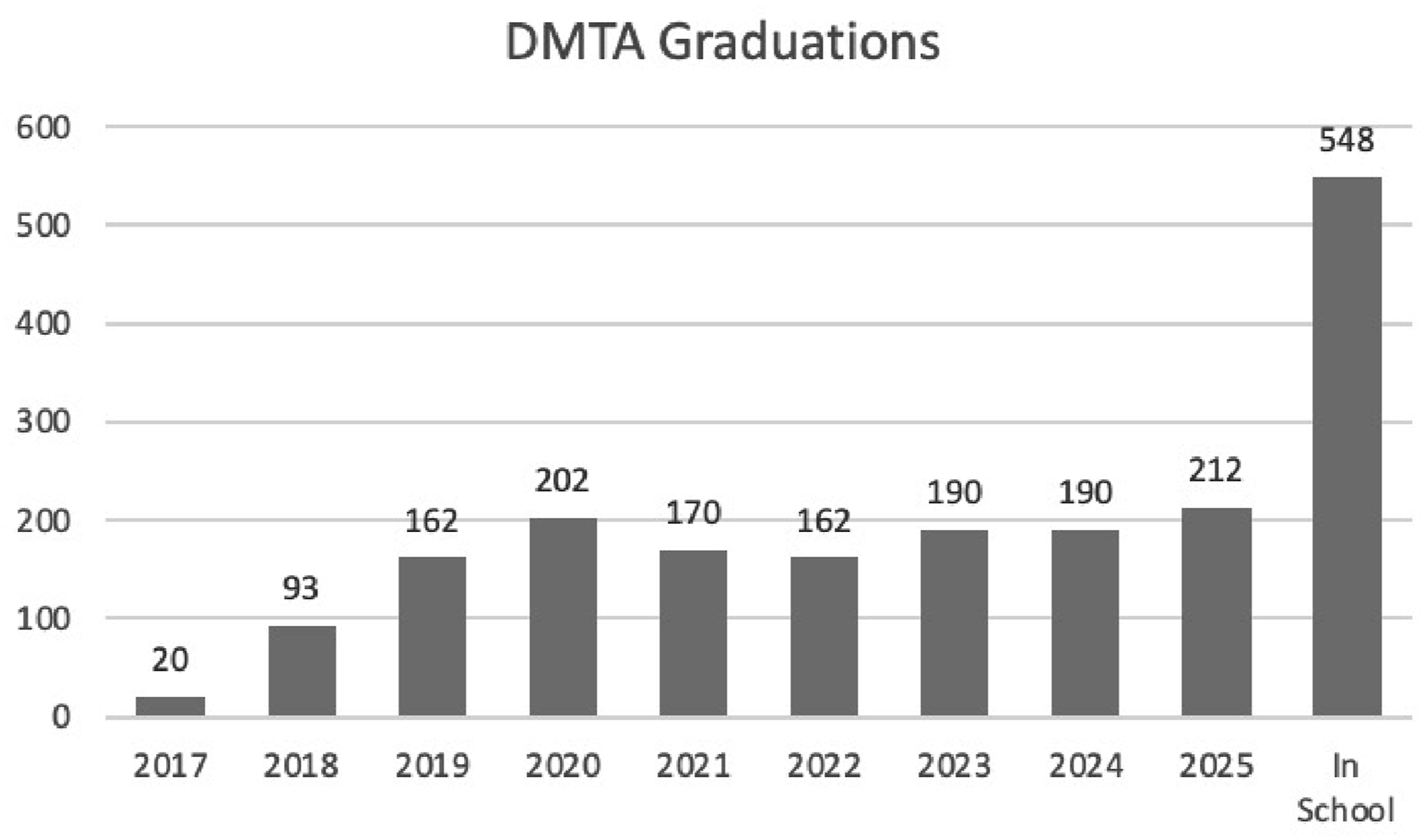
Overview of New Experiential Resources, Assignments, and Outcomes in Upper Level DMTA Courses
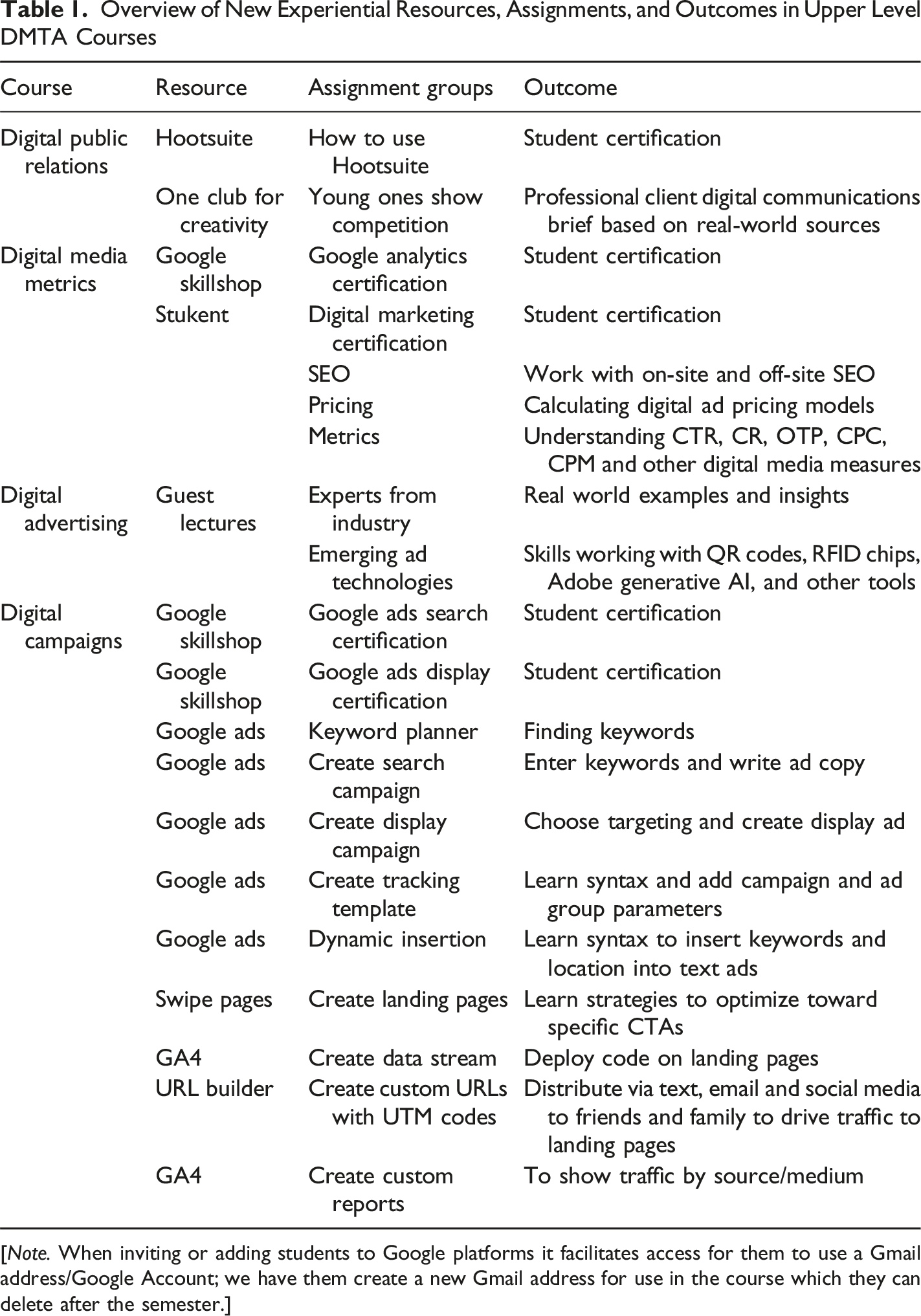
[Note. When inviting or adding students to Google platforms it facilitates access for them to use a Gmail address/Google Account; we have them create a new Gmail address for use in the course which they can delete after the semester.]
Chart 1 summarizes DMTA graduating students since program inception in 2017. The pandemic brought advising challenges that lowered student awareness and led to a dip in graduations 2020–2022. Since 2022, enrollments and graduations have been steadily increasing, and 548 students are currently enrolled with graduations scheduled for 2025–2027.
Student interest has also continued to expand beyond the Bellisario College. Chart 2 indicates how student interest in the minor has broadened as well as heightened. Although COMM students continue to make up the majority of DMTA enrollees (about 85%), students from 76 majors across 16 colleges have participated. PSU Colleges and Majors With DMTA Students.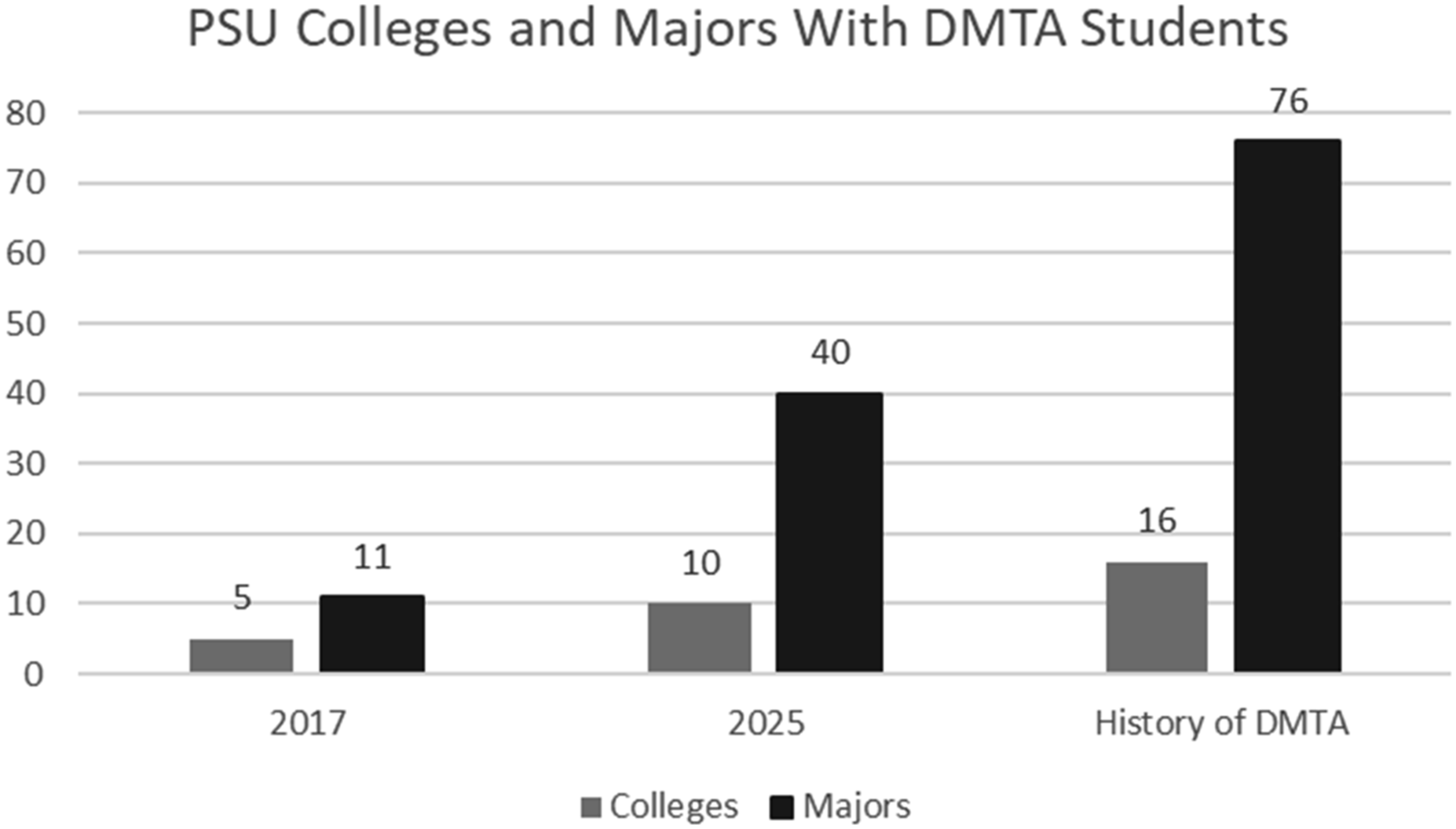
Another objective measure of program student impact is the number of certifications, resources, assignments, and learning outcomes included in the minor that are new to the college curriculum. As summarized in the Table 1, the program has added 9 learning resources, 5 industry certifications, 14 additional assignment groups, and 20 broad learning outcomes. Since 2018, over 99% of students now pass the Google Analytics certification exam (near 100% certification success is not surprising as students complete this training outside of class and can take the assessments as many times as needed). The complexity and quality of student capstone projects have steadily improved according to faculty rubric evaluations. The number of required elements for capstone digital campaigns has increased from 3 to 10 and the students scores have steadily improved.
Although reliable internship and post-graduation employment data is not available, the Assistant Dean for Internships and Career Placement has called the DMTA minor “transformational,” adding “from a placement perspective, the most compelling proof of the minor’s impact is this: students who complete the minor receive enhanced recruiter attention, internship interviews, and entry-level job consideration specifically due to their fluency with digital tools and analytics training.”
Taken together, these indicators paint a picture of a thriving, popular, and relevant minor that students find an increasingly valuable part of their academic experiences. The specific teaching tools available and used in the minor, and how they relate to ELT, are covered in the following sections.
Teaching Tools and Certifications
The foundational introductory courses in the minor are kept current with what you might call standard industry monitoring and course modification. As instructors monitor the environment and note changes to industry practices and platforms, changes are made to relevant course materials. This type of updating is to be expected in any college course, although programs related to media probably see more change than most other majors.
The more advanced courses in the minor (not including the capstone Digital Advertising course, to be discussed later) rely more heavily on hands-on assignments and experiences such as guest lectures, industry-based case studies and competitions, and certifications. Although not strictly speaking experiential, because they do not require students to use applied tools for themselves, they can be a close approximation because they focus on the workings and operation of one specific company or one specific sector or platform. Research has shown that industry certifications can enhance learning outcomes (Laverie et al., 2020).
For example, the Digital Media Metrics Course requires completion of the Google Analytics Certification (Google Analytics Certification, n.d). This 5-hour training provides a thorough overview of the functionality and operation of Google Analytics 4 (GA4). Material is primarily audio-visual, and students experience the look and feel and see how to navigate the platform to view basic dashboards and create custom reports, etc. The certification certainly provides more of a real world understanding of the platform than just reading about it, but it doesn’t come close to replicating the experience of using it.
A challenge for instructors using certifications is the proctoring of the exams. If completed out of class (which is the usual approach), it is impossible to say if students are working alone to answer the questions. Especially in the age of AI, the answers to all the certification exam questions are easy to find. Administering the exams or equivalent assessments in class is an option, but at the expense of precious time.
Many if not most students likely apply themselves and study the content and complete the certification quizzes on their own. However, even those students do not achieve confidence with the platforms. Each semester I ask my students in the Digital Campaigns class (who have all completed the Digital Media Metrics course and the analytics certification) to raise their hand if they feel at all confident in their ability to use GA4. Rarely does a hand go up.
Overall, industry certifications are accessible, free, and useful. Students can add them to their resumes and LinkedIn profiles. However, if they are not given the opportunity to actively use the platforms, certification training is only marginally useful. In addition, relying on outside tools means you are subject to changes completely outside of your control that will require changes to course materials. These changes can range from a minor annoyance to a major disruption.
For example, Google has moved the domain for its training material from google.com/training to skillshop.withgoogle.com, requiring minor updating of course links and assignment directions. Platforms may also modify their access permissions and subscription plans in more significant ways. The Social Media course had used Hootsuite as a teaching tool for social media campaign management. The free version was eliminated in 2023 and is now limited to a 30-day free trial, necessitating a major update to the course (the class requires completion of the free certification but not use of the platform).
New to the Academic Toolkit: Simulations
Academic publishers have also been forced to adapt to the fast-changing media and advertising landscape. In addition to the move toward online textbooks, publishers are developing web-based simulation software to provide an approximation of experiential learning.
This option can get students closer to the real thing with some clear benefits, but limitations as well. Several options are hitting the marketplace, most positioned more broadly as marketing simulations, not specifically advertising. Examples include Marketplace Simulations (marketplace-simulation.com), StratX Simulations (stratxsimulations.com), Simbound (simbound.com), and Interpretive Solutions (interpretive.com).
Our experience has been with a market leader in educational simulations, Stukent (stukent.com), which has branded its offerings as “Simternships.” We experimented with the Digital Marketing Simternship in the Digital Campaigns class and can report several positives along with limitations.
Unlike other third-party platforms with revenue streams and objectives unrelated to higher education, Stukent is an academic publisher focused on meeting the needs of educators. Their sales and customer service teams are dedicated to understanding the challenges being faced by professors in the digital marketing and advertising space and delivering products to meet those challenges. In our experience, the customer service was top quality both for faculty and students. However, these tools have some inherent limitations and artificiality.
The first consideration is that subscriptions to the simulations are not free, nor are they so expensive as to elicit “sticker shock” from students. Access for a semester is the same or less than the cost of an average academic textbook. (Note that if you require a Stukent digital textbook, students retain access to it and to all updates.)
Simulations are usually limited to one “client,” and all students go through the same prompts and resources for the same situation. Decision trees have limited options, which prevents students from discovering their own creative directions for the campaigns. For example, in the simulation of keyword advertising students must choose from a limited number of options; in the real world you enter your keywords based on your situation and objectives and have complete flexibility.
Finally, the feedback provided by the platforms is algorithmic and therefore suffers from the black box problem. As students complete “rounds” of the simulated marketing campaign, they receive scores and feedback on their performance. This feedback can be helpful, but it is sometimes difficult to explain. For example, one student may get an 85% positive score (or a certain number of positive check marks) while another student gets a 90%. Asked to explain exactly why the scores differed can be a challenge. It is likely a combination of factors (determined by an algorithm). Algorithmic opacity in AI grading systems is an ongoing challenge in academia (Farheen et al., 2025) as professors find it hard to explain or justify outcomes to students.
Depending on the goals and resources of each program, simulations may play a useful or even central role in digital marketing coursework. The companies are dedicated to customer service and helping solve problems, but simulations are by their nature limited and artificial experiences. Their value is proportional to effort, so instructors who assign them for “high stakes” should be prepared to make a similar effort to understand and explain results.
Certifications and simulations can approximate real-world experiences and expose students to three of the four cycles of experiential learning as defined by ELT. Instructors can introduce these teaching tools with abstract conceptualization (AC) and they can provide active experimentation (AE) and reflective observation (RO).
The fast-evolving domain of digital marketing and communications requires the addition of concrete experience (CE) to combine theory with practical application to ensure superior learning outcomes (Richards & Marshall, 2019). In the context of the DMTA minor, these experiential tools are introduced and leverage to maximum effect in the capstone course—Digital Campaigns.
Experiential, Real-World Platforms for Teaching Digital Advertising
The Digital Campaigns course offers a compelling case study in leveraging experiential, real-world platforms for teaching digital advertising. Its evolution highlights the essential need for educators to embrace disruption and adapt their teaching tools in this rapidly changing field.
Originally the class had centered on participation in the Google Online Marketing Challenge (GOMC), a program that allowed university professors to enlist students and find real clients and spend $250 on keyword advertising. Clients could be any company or firm that had no existing or prior Adwords account; the $250 came in the form of a credit from Google toward the first $250 worth of search ads placed for the client. (Google Adwords was changed to Google Ads in 2018.)
Unfortunately, Google discontinued the GOMC around the end of 2017, just as the new minor was launching. Having no way to teach the class as intended I developed a new approach. I explained the situation to the dean and requested $1500 dollars so students could find clients and run campaigns. Essentially it was the GOMC without the GOMC. Because the minor was still relatively new, there were only 24 students and teams of 4 could find 6 clients to work with.
Although significant course modifications were required to change the format, the plan worked and student feedback was positive. However, it was not going to be a long-term solution for a variety of reasons. First, by the fall semester the minor had doubled in size and two sections of Digital Advertising were offered—12 teams and 12 clients and a budget of $3000, which was a lot more to manage. Second, students were no longer spending “Google dollars” but university dollars. How to justify the selection of one client over another? Although this did not arise as an issue, no one complained, I wanted to bake more accountability into the program.
The solution to the client-selection process was to leverage existing university programs that supported startups in the region and state. The university identified and provided startup funds for worthy commercialization and expansion efforts by local businesses. These firms were already vetted and approved by the university. The Digital Campaigns class would simply step in to support those companies that reached the marketing phase of development and needed help with advertising.
This solution was a win-win-win. It provided excellent real-world clients for our students, helped the startups, and raised the profile of the college among multiple units across campus that participated in entrepreneurial programs. The dean was more than happy to continue funding a couple of thousands of dollars a year toward the program.
For some programs, such an arrangement may be an excellent permanent situation. If a reasonably small amount of funding can be obtained (or endowed) and a network of worthy clients identified, Google Ads can be used to provide marketing support and offer an excellent experiential learning experience for students. As long as the number of clients remains reasonable. Identifying and working with 3 to 6 clients a semester is realistic, anything more presents real challenges.
The continued growth of the minor expanded Digital Campaigns to three sections, then four. Finding local university-approved clients was not feasible, and by that time another Google program emerged that could provide a solution—the Non-Profit Marketing Immersion (NMI).
Google Adwords: The Past
When the GOMC was discontinued in 2017, many professors were looking for alternatives. A work-around emerged by leveraging the Google Ad Grants program (Google Ad Grants Program, n.d.). Started in 2003, the Ad Grants program provides eligible nonprofit organizations with up to $10,000 per month in free Google Search advertising to help them raise awareness, attract donors, and recruit volunteers. It is one of Google’s largest pro-social activities.
Educators realized they could find Ad Grants non-profits and offer their classes as a resource to help set up and optimize their keyword campaigns. Many non-profits with Ad Grants status do not have the resources or background to run Google Adwords campaigns, so providing this kind of support would be a win-win, and no cost for either party.
In 2018, a group of enterprising professors published “Teaching search engine marketing through the Google Ad Grants program” (Clarke et al., 2018). This article provided a step-by-step plan for linking university classes with Ad Grants non-profits to enhance student learning and help clients. Later that year, Google released the Google Ad Grants Online Marketing Challenge, which automated the process of connecting qualified university instructors with Ad Grants clients looking for keyword advertising help. This program was later renamed the Non-Profit Marketing Immersion (NMI) and continues today.
Correlation is not causation, but the timing was auspicious. The Clarke et al. article may have spurred Google all or in part to create the NMI, or perhaps not. There is evidence that other professors had taken the Ad Grants approach years before. An Adweek article from 2009 credited Emerson College professor David Gerzog for creatively using the Ad Grants program to teach digital advertising (Nicole, 2009). All these professors deserve credit for percolating the idea, and Google deserves credit for formalizing the arrangement in the NMI program.
Regardless of the provenance, the NMI seemed like a good solution for our Digital Campaigns class. Instead of having to go out and find qualified clients, the Google platform would do it for us. The NMI platform indicated student groups would be assigned clients in a week or two. We had them register on the platform within the first few weeks of class expecting plenty of time to be matched up with clients in the first month leaving plenty of time to set up campaigns, run them, and evaluate the results within the 15-week semester.
Three, and then four weeks later, many of our student groups were still waiting for clients. Different groups were on different schedules, some had clients and could start working, others needed something to do. Other difficulties arose. Some clients were basically “defunct” and no longer operating. How to help a client with no real operations or objectives? Other clients had incomplete and dysfunctional websites and did not have the resources to make changes to them. Some clients simply went radio-silent and did not answer student or professor emails.
On the other hand, some student groups worked with appreciative, responsive clients with quality websites and clear objectives. This led to groups operating on different timelines and needing fundamentally different instruction. Not ideal in class where all students are supposed to have the same learning experience.
It is possible to request new clients through the program, but this requires additional time and presents additional challenges with group coordination. For programs with smaller class sizes and a limited number of groups, the NMI can provide an excellent experiential learning experience. Instructors should be prepared to dedicate a good deal of time to client-management and individualized instruction. [It is likely that Google has improved the NMI program; we have not participated since 2018.]
In the evolution of our minor, this was not the case. The NMI was not going to scale the way we would need it to. The success and popularity of the minor continued to grow. Student demand led to our converting the Digital Advertising course to a lecture-lab format. Monday lectures would include all registered students—over 150 in some semesters—and lab groups of up to 30 students would meet with individual instructors later in the week. With far too many students to manage real clients (through the NMI or otherwise) we moved to using Google Ads as a teaching tool without running live campaigns.
Students find keywords, create campaigns, write ad copy, create ad extensions, choose geographic and audience targeting, set up conversion tracking, make tracking templates, and other tasks. Everything short of running the campaigns. We have students use other platforms and channels to drive traffic to round out the digital campaign-building experience.
Google Ads: The Present
The current format for Digital Campaigns uses Google Ads as a teaching tool, along with Google Analytics, a landing page builder, and other tools. Combining these platforms, we can have students “touch all the bases” of the ELT learning cycle.
Research has shown it does not matter which step in the process students start with, as long as they complete them all (Kartveit, 2009). We dive in with abstract conceptualization (AC) in the Monday lecture, where we introduce the key digital advertising concepts and strategy frameworks, then engage in active experimentation (AE) and concrete experience (CE) using real-world tools during lab session later in the week, followed by reflective observation (RO) as they discuss and explain how all the different elements of the digital campaign come together. For example, lab assignments require students to create Google Ads campaigns (an AE exercise) and track its performance data (CE), which they then reflect upon in class discussion (RO).
This format and philosophy has served the class well for years, but a review of our experience, specifically with the Google Ads platform, will be informative for others considering a similar approach.
Following our move from the NMI program, we had students create a Google Ads account for use in the class; it was free and open to anyone, all you need is a Google Account (Gmail address). Instructors would then invite all their students into a Google Ads Manager Account so they could access the student subaccounts and evaluate work.
In 2024, Google began requiring a billing method (credit card) during the account creation process. For multiple reasons we do not want students working in accounts with a billing method attached; it is a live platform and could start serving impressions. Initially, this requirement was infrequent. Google often rolls out changes to the user interface to small groups to test adoption (yet another disruption to be embraced). But by 2025 most students (but not all) were being roadblocked by the credit card popup and we had to abandon having students create new accounts.
Over the years I have acquired administrative access to quite a few (over 50) Google Ads accounts with no billing method attached. I organized these accounts into a logical naming hierarchy that corresponded the multiple lab and student team numbers, and we could invite students into these accounts for use as their “course” Google Ads accounts (typically 4 students per group in each account) and do the same basic assignments they had been doing in their individual accounts (student access is revoked at the end of the semester).
Google eventually cancels inactive accounts (Google support puts this at 15 months). Because the Google definition of “activity” is spending money, this has affected our accounts. Up until recently, reactivating the canceled accounts has been a simple, one-click operation. In fall 2025, however, Google announced a more aggressive policy toward inactive accounts. A small number of our accounts have been “closed” with no option to reactivate. For now we can still access and use “closed” accounts (we cannot run ads, but we don’t want to do that anyway). But it is likely these accounts will be deleted at some point. It is also likely that down the road more and possibly all our “inactive” accounts will be closed and deleted.
Google Ads: The Future
To summarize, Google Ads is a powerful platform to teach the fundamentals of digital advertising, but policies can change at any time. Inactive accounts will eventually be canceled and potentially deleted. We are currently preparing for this possibility. Options include returning to the NMI, using an academic publisher simulator, or finding a way to continue creating useable new Google Ads accounts.
Because of the challenges and drawbacks of other approaches, our intention is to continue using Google Ads. At the point we no longer have enough active Ads accounts to accommodate all students, we plan to use a university credit card to open new ones. At this point it will be critical that students follow directions and set $1 daily budgets and pause all campaigns as soon as they are created (and faculty will need to take responsibility to monitor this).
After 15 months of no spending (inactivity), these new accounts will also start to go through cancellation, closure, then deletion. It is not clear exactly how long this total process will take, but our experience indicates it could be years, or longer. As stated above, the policy can change at any time.
Despite these added layers of administrative difficulty, we believe the learning outcomes outweigh the challenges. Exposing students to the platform combines core critical thinking skills with specific strategies, decision-making skills, and platform functionality.
Keeping our students dialed in to a powerful real-world ad buying platform also keeps them up to date with the latest technological advances. As new AI features for generating keywords, writing ad copy, and finding targeting solutions are rolled out, we are witnessing them inside the platform in real time.
Google—If You’re Listening…
In the unlikely but not impossible event that this article makes its way to the right decision-maker at Google, a simple solution would be to allow qualified academics to create accounts with no billing method. This option could be tacked onto the NMI (which already qualifies professors) as “practice” accounts. Such a change would represent a small investment by Google and be a huge benefit for educators.
Combining Experiential Teaching Tools for a 360 Degree Marketing Perspective
In addition to Google Ads, the Digital Campaigns class uses Google Analytics (GA4), which is free and open access with no restrictions. We created an account with separate properties (subaccounts) for the various lab sections and groups and add students to those properties with Editor privileges.
We use Swipe Pages to teach students how to create landing pages. There are several vendors in this space; we chose Swipe Pages because there is no limit to the number of users (students) on the account. Students create landing pages and deploy tracking code from data streams set up in GA4.
To drive traffic to student landing pages (since we don’t run any ads), we have them create custom URLs with Urchin Tracking Module (UTM) codes and distribute to friends and family (via email, text, or social media). Students then track traffic to their landing pages in GA4 and can see the source/medium for the traffic based on the different UTM parameters in their custom URLs.
The combination of these tools provides a real-world experience that includes setting up campaign details and parameters in Google Ads, creating landing pages that align with the Call to Action in their ad campaigns, deploying GA4 tracking code on their landing pages, driving traffic to their pages using custom URLs with UTM codes, and creating custom reports in GA4 to show the source/medium for the traffic. This combination of tools provides a reasonable 360-degree view of modern digital ad campaign creation and optimization.
Academic Resources
DMTA Teaching Resource Requirements
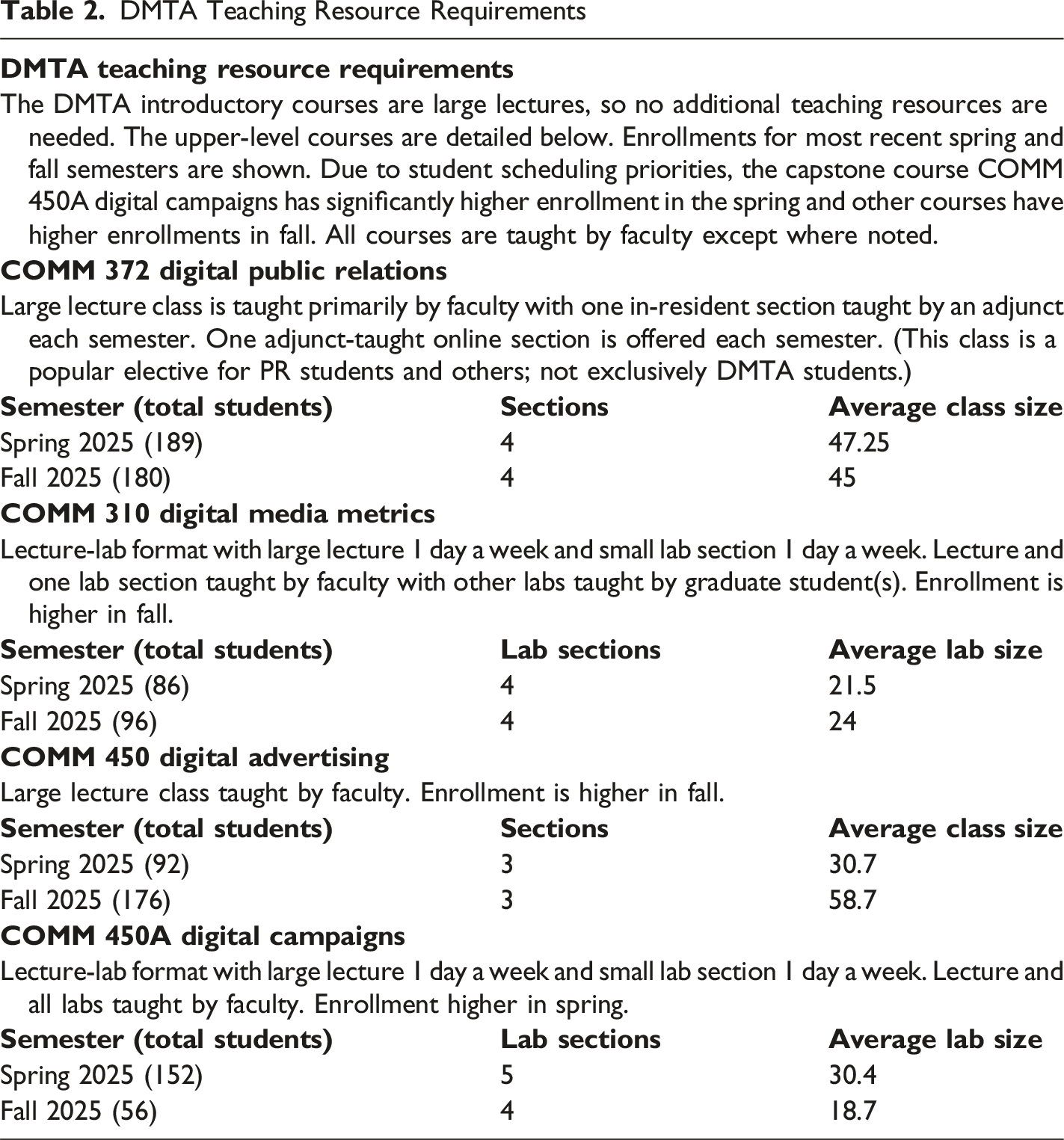
The introductory courses are large lectures, so no additional faculty resources are needed to accommodate the additional students. For the four upper-level courses, 16 sections were offered in spring 2025 (519 total students), of which 11 were taught by faculty, 2 by adjuncts, and 3 by graduate students. In fall 2025 (508 total students), 9 courses were taught by faculty, 2 by adjuncts, and 3 by graduate students. Class sizes for the four upper-level courses averaged between 21.5 and 47.3 in spring and between 18.7 and 58.7 in fall.
There is one online version of one class offered each semester, and there are plans to develop online versions of other upper-level courses to meet student needs.
The only experiential platform that is not free is the Swipe Pages landing page builder, which costs $1,788 per year. All other major platforms used (e.g., Google Ads and Google Analytics) are free for educational use. The Stukent “Simternship” digital marketing simulation we piloted requires a license (∼$50 per student) for full access, a cost that contributed to our decision not to adopt it at scale. Additionally, when Hootsuite’s free plan was eliminated in 2023, we adjusted by relying solely on its free certification content rather than the paid platform. As noted, Swipe Pages was chosen because there are no limits on the number of users and we can provide logins for all the students in the Digital Campaigns class (over 150 students in the spring semester).
Limitations
This case study is limited to one institution, with its own strengths and weaknesses. Different programs will have different experiences. Objective data on enrollment and student deliverables was used to measure program success.
We have obtained a great deal of positive qualitative feedback from alumni, recruiters, and employers, but challenges in obtaining representative and reliable post-graduation data represent a limitation. To the extent possible, programs are encouraged to institute a measurement strategy of post-graduation outcomes.
Conclusion
The evolving digital advertising landscape, marked by significant disruption, necessitates that academic curricula prioritize innovation and adaptability to effectively prepare students for industry. Experiential learning is crucial for developing practical skills and career readiness. While industry certifications and simulations offer some benefits, they often fall short in replicating the authentic experience needed for true platform confidence and real-world application. Leveraging live platforms, though presenting challenges such as policy changes and client management complexities, remains the most effective approach to providing students with a dynamic learning environment. Faculty must adopt an entrepreneurial mindset in curriculum development, embracing ongoing change and proactively seeking solutions to integrate these vital, real-world tools despite their inherent fluidity.
To ensure the curriculum keeps pace with emerging technologies like AI, we have mapped key digital competencies to courses in the minor. For example, the skill of effective AI prompting and content generation is integrated into Digital Advertising via assignments that use generative AI tools. Automation and optimization techniques are covered in Digital Media Metrics, where students learn to leverage automated analytics and ad platforms. The importance of transparency and ethics in AI-driven advertising is emphasized in Digital Advertising through case studies and discussions. Finally, an experimental mindset is fostered in Digital Campaigns by encouraging students to try new AI-driven platform features in a controlled, reflective setting.
Footnotes
Acknowledgments
This has been a team effort from the beginning and I would like to thank several people who were instrumental in helping make the DMTA minor a success: Drs. Krishna Jayakar and Heather Schoenberger and professors Bill Zimmerman and Stephanie Thomas, who developed courses; Deans Marie Hardin and Denise Bortree and department head Dr. Fuyuan Shen, who supported the effort administratively; as well as outstanding staff leadership from Jamey Perry, Nikki DiOiro, and Julie Evak. Finally, I never would have persevered without the tireless support, encouragement, and expert advice of my wife Dr. Colleen Connolly-Ahern.

Funding
The authors received no financial support for the research, authorship, and/or publication of this article.
Declaration of Conflicting Interests
The authors declared no potential conflicts of interest with respect to the research, authorship, and/or publication of this article.