




Abstract
This paper shows how boys respond to harassment awareness training programs and analyzes how such audiences might fail to see street harassment as ‘their’ problem (therefore deflecting responsibility for sexual violence). It is based on ethnographic observations of street harassment awareness programs organized in France and interviews with their participants. Boys’ intersectional identities informed how they responded to this program. Boys of color in schools in underprivileged areas argued that racism towards racialized men, rather than the latter’s behavior, often led white women to report being sexually harassed. White boys in schools located in more affluent areas avoided feeling responsible for street harassment by associating violent acts with working-class men or men of colour. I argue that boys are more likely to deflect responsibility for sexual violence when a training program insufficiently relates the message to their personal experiences and lifeworld.
Introduction
“Violence against women is a man’s problem” has become a popular slogan among organizations seeking to engage men in sexual violence prevention (Flood 2019; Reinicke 2022). The overwhelming majority of sexual violence is indeed committed by men (Peretz and Vidmar 2021), and toxic masculinity, characterized by traits promoting dominance, is identified as a cause of sexual violence and harassment (Connell and Messerschmidt 2005). The need for cultural change among men has been central in public debates since #MeToo, which has increased scholarly interest, not only in the consequences of problematic masculinities, but also in their politicization (Macomber 2018; PettyJohn et al., 2019). A growing body of work investigates how to effectively address men and boys through sexual violence policy (Baker 2009; Hearn, Pringle, and Balkmar 2018).
Sexual violence and harassment awareness training programs are among the main activist and policy responses to this desired cultural change among men (Jewkes et al., 2015; Peretz and Vidmar 2021). Such programs can be effective in countering rape myth acceptance and peer approval of sexual violence (Fisher 2019; Flood 2019), and have the potential for “educating for gender respect and justice through fostering boys’ and men’s critical understandings about gender inequality, masculinity and gender-based violence” (Keddie et al., 2023, 251). Nevertheless, the reception of many such programs by men is mixed, as they may provoke anger or be perceived as “male-bashing” (Abouelnaga 2023; Cares et al., 2015). Understanding the rationales behind boys and men’s responses is important for developing better strategies to involve them in preventing gender-based violence (Kimmel 1987; Ruxton 2004). Scholarship on sexual violence awareness training programs has become increasingly attentive to how intersecting identities in terms of race and class play into their reception (Ferguson 2019; Funk 2006; Salter 2016).
This article seeks to explain why responses to street harassment awareness training were much more antagonistic among students of color in schools in underprivileged areas than among mostly white boys in schools in more affluent areas. It builds on scholarship studying the reception of policy and training programs through qualitative methods (Maxwell 2020; Revillard 2018), drawing from ethnographic observations of thirteen training sessions by France’s foremost anti-street harassment organization, Stop harcèlement de rue (SHDR, Stop Street Harassment), as well as interviews with pupils, trainers, and high school staff. As in other countries (Desborough 2018; Fileborn 2022), the last decade saw a surge in French activism on street harassment. In response, street harassment has been criminalized in French law (Lieber 2021) and the national government and municipalities have implemented preventive policies such as inclusive safety audits (Hancock 2022; Lieber 2021) and awareness-raising campaigns (Dekker 2023). Education programs on street harassment remain limited but are emerging in France (Dekker 2019) as in other national contexts (Fileborn 2022), with bystander training programs being a common solution (Fileborn 2017; Fleetwood 2019). The implementation and effects of street harassment awareness training programs remain mostly unexplored.
While many pupils responded positively to the training by Stop harcèlement de rue and thanked the educators for giving them insight into street harassment and gender-based inequalities, negative responses were far from the exception. Resistance was particularly frequent among boys of color in schools in underprivileged suburbs of Paris. In schools in more privileged areas, on the contrary, boys (most of which were white) responded more positively. Should we conclude from this that the widespread sexism in the French banlieues 1 led pupils in schools there to respond negatively, while greater support for gender equality made boys in schools in more affluent areas more positively disposed to the activists’ feminist message? Such a conclusion would echo moral panics about the abundant sexism and homophobia in the cités, as French media and politicians commonly present gender-based violence as primarily a problem among men and boys of color or with an immigration background (Fassin and Fassin 2013).
The findings presented here show we cannot attribute differences in the reception of street harassment awareness-raising only to boys’ adherence or opposition to feminist values. Instead, this article develops a theory of how boys’ and men’s intersectional identities (in terms of race and class) inform how they might fail to see street harassment as “their problem,” thus deflecting responsibility for preventing sexual violence. This, in turn, shapes how they respond to awareness-raising programs on the subject. Considering how intersectional identities play into boys’ and men’s deflection of responsibility for sexual violence is important to develop more effective awareness-raising strategies that speak to the personal experiences and cultural specificities of different target groups.
Men and Boys’ Reception of Harassment Awareness Training through the Lens of Intersectionality
Men’s responses to violence prevention and gender equality training programs can be conceived as on a continuum, ranging from engaged to uninterested, resistant or even hostile (Flood 2019, 320). Sexual assault prevention programs are often met with disinterestedness or anger on the part of men (Rich et al., 2010), and men commonly perceive rape prevention workshops as “male bashing” (Scheel et al., 2001). Commonly identified sources of resistance or of lack of attitude change are masculine peer norms (Cares et al., 2015; Kleinman, Copp, and Wilson 2021), stereotyped attitudes and beliefs about women and sexual assault (Langhinrichsen-Rohling et al., 2011), or men’s vested interest in upholding gender inequality (Ahmed 2017). Boys’ desire to maintain status within a school environment of peer regulated hegemonic masculinity may produce negative responses to feminist messages (Banyard, Eckstein, and Moynihan 2010; Smith 2007). The most extensive body of work on men’s responses of feminism—backlash theory—highlights how negative response to awareness-raising may result from men’s perception of feminism as a real or imaginary threat to the status quo (Faludi 1991, 16; Superson and Cudd 2002). Kimmel defines antifeminist responses to social justice efforts as relying “on natural law and religious theories to demand women’s return to the private sphere of hearth and home” (1987, 262).
Race and class are key dimensions factoring into the reception of awareness training (Ferguson 2019). Recent scholarship on sexual violence awareness programs highlights the importance of addressing the intersecting forms of disadvantage and privilege that structure boys’ and men’s lives (Keddie et al., 2023; Oliffe et al., 2020). When training programs fail to consider cultural specificities and personal experiences, this tends to provoke resistance and backlash (Crenshaw 1991; Guénif-Souilamas 2006; Lwambo 2013; Viitanen and Colvin 2015). Cultural reductionism and “othering practices” of culturally marginalized men in the context of training programs logically produce resistance from those groups (Casey et al., 2013; Dworkin, Fleming, and Colvin 2015; Funk 2006). The failure to recognize the disadvantages and oppression of men of color, refugees, or immigrant men by presenting them solely as privileged in terms of their gender is an important source of backlash (Salter 2016).
Because being a man means different things in different contexts, training programs tailored to cultural specificities of the target group have been found to be more effective in bringing about attitudinal and behavioral change (Heppner et al., 1999). For example, gender equality training in professional sports works better when it builds on anti-sexist elements in sports culture (Albury et al., 2011). Similarly, the use of Islamic texts condemning violence against women can be effective when working with Muslim men (Simbandumwe et al., 2008). Drawing on one’s own oppression with racism can be a powerful strategy to foster feminist values in African-American men (West 2008).
Research on how intersectional identities shape the effects of training programs focuses primarily on oppressed and marginalized identities, as relating to race, class, ability, or sexuality (Ferguson 2019; Keddie, Flood, and Hewson-Munro 2022). However, how awareness-raising can speak to the personal experiences and cultural specificities of men who do not suffer from systematic discrimination and oppression has received less systematic attention. In recent years, whiteness and privilege have become more central in scholarly discussions of gender (McDermott and Ferguson 2022, 263; Murphy 2005, 466). Scholarship conceptualizes whiteness as a racial identity and dimension of social structure that privileges whites as the dominant group. For example, Murphy (2005) shows how feminizing narratives about Chinese-American men are commonly used to reaffirm white masculinity in the United States. White masculine superiority is naturalized through racist tropes of Black or Muslim men as sexually violent, which are commonly employed by mainstream media (Ferber 2007; Guénif-Souilamas 2006). “Stranger danger” narratives that associate sexism and gender-based violence with cultural Others allow White men to deflect responsibility for gender-based oppression and violence (Ahmed 2017; Chenier 2012).
However, research applying insights from whiteness studies to the reception of sexual violence awareness training remains scarce. For example, Flood (2019, 364) discusses prevention in immigrant, refugee, and ethnic minority contexts, but does not provide a detailed discussion of effective strategies to be “culturally specific” with regard publics consisting of men who are not underprivileged. In particular, how similar training programs are received by men and boys with different intersecting identities remains understudied and undertheorized. This article addresses that gap.
The argument of this article is that boys and men with different intersectional identities deflect responsibility for sexual violence in specific ways, and that this informs how they respond to such training programs. Perpetrators of domestic violence commonly deflect responsibility and blame others, which may go as far as claiming that “the table bashed her head” (Dobash and Dobash 2001, 191). Fostering responsibility in men for sexual violence is crucial for preventing it (Sukhu 2013). Even though not all men may be perpetrators of sexual violence, all men can have an influence on the culture and environment in which violence is committed. Responsibility, in this paper, does not necessarily refer to the interviewees or participants’ own responsibility in having committed or facilitated sexual violence—what has been called “causal responsibility” (Gusfield 1984, 13). Here, I mainly use it to describe what Gusfield names “political responsibility:” considering sexual violence as one’s “own” problem, in the sense of recognizing that it occurs within one’s own group or social environment and that one has a responsibility in preventing it (Barthe 2017). Feeling responsible for this social problem is a necessary condition for men to mobilize against sexual violence and play an active role in preventing it from occurring within their social context (Berkowitz 2002, 164).
Case Description and Data Collection
Context and General Outline of the Program
As in other countries (Holvikivi 2023), SHDR’s sessions were implemented in a context of increased attention for gender-based violence in school curricula, for which many schools turned to NGOs (Dekker 2019). Following increased media attention for street harassment in the mid-2010s, French state feminists (McBride and Mazur 2010) and activists started pleading for awareness-raising on this issue to be incorporated into school programs. Notably, a 2015 report by the High Council for Equality Between Women and Men recommended including harassment and violence in public space in the National Education System’s guide on “sexist behavior and sexual violence: preventing, identifying and acting” (HCEfh 2015, 31). Despite these efforts, at the time of research (2015–2020) there were no programs in the Paris metropolitan region addressing street harassment that depended primarily on government funding, and organizations relied upon volunteers and compensation from schools (Assemblée Nationale 2018, 29–31).
The organization Stop harcèlement de rue was founded in 2014. It was the first organization specialized in street harassment in France, and quickly became the leading agenda-setter on this issue. They were the most frequently mentioned organization in reporting on street harassment by French newspapers (Dekker 2024). Their understanding of and approach to addressing street harassment influenced policy, as the organization provided advice to key governmental organizations, such as the High Council for Gender Equality, the Ministry of Women’s Rights, and Paris’ Service for Equality, Integration, and Inclusion. In 2015, SHDR started organizing training sessions in high schools in Paris and its suburbs. The trainers were for the most part in their twenties, predominantly white, feminine-presenting, students or in possession of a graduate diploma. They created a website where school staff or pupils could contact them.
Around three quarters of SHDR’s training sessions took place in schools in Quartiers Politiques de la Ville (QPV, Political Neighborhoods of the City), defined by the French state mainly through the criteria of high poverty levels and low median incomes. All sessions were organized after school staff or pupils contacted SHDR, which means that this overrepresentation of schools in QPV’s cannot be explained by the preference of trainers. Rather, it resulted from an institutional dynamic of the French educational system. Since the increased media attention for sexism in the 2010s, many schools turned to specialized organizations to facilitate gender equality and sexual violence awareness training programs (Pasquier 2016). This led to the emergence of a market for gender equality education, in which organizations and artistic groups found themselves in competition for public budgets. Most of these budgets were tied to the school being situated in a QPV, which meant that mostly schools in those areas were encouraged to turn to these organizations (Massei 2021, 96).
SHDR’s training sessions lasted 2 hours and were highly interactive, as trainers’ encouraged pupils to debate various issues. The sessions were organized for one or multiple school classes, meaning they had a mixed-gender audience—although this article focuses on their reception by boys. They were organized through a PowerPoint presentation, which was divided in two parts. The first part addressed what the trainers called everyday sexism. It consisted of examples of gender inequalities and stereotypical representation of women in movies, advertisements, and politics. The trainers used this part to emphasize how street harassment is part of a broader system of gender-based inequality.
The second part specifically concerned street harassment. It started with the trainers role-playing a short “street harassment scenario.” The scenarios they played were based on the interactions depicted in the graphic novel Projet Crocodiles (“Crocodile Project”) by Thomas Mathieu, which in turn is based on interviews the Belgian author conducted with victims. The trainers used images from this graphic novel, in which men are portrayed as crocodiles, throughout their PowerPoint. After the scenario, the trainers would ask pupils whether they had experienced street harassment, which always provoked much discussion. Subsequently, they provided statistics about the prevalence of street harassment, how it disproportionately touches women and LGBTQI+ people, and its psychological and ripple effects. Learning to recognize that you are a victim, bystander, or perpetrator of street harassment required, according to SHDR, learning to recognize sexist structures in greater society that create a climate in which gender-based violence is condoned. Finally, they concluded the session with a 30-min interactive “Code of the streets” quiz. They consisted of quiz questions about street harassment with four responses, and activists invited pupils to discuss what they thought about each response and what they thought was the right one.
Data Collection
This article builds on reception research that takes the perspective of the targeted beneficiaries of policy as a starting point (Revillard 2018), meaning I focus on the meanings that pupils attach to the training. Ethnography and in-depth interviews are powerful methods to provide a comprehensive perspective of reception that goes beyond classic stimulus-response approaches to the evaluation of policy (Maxwell 2020). Awareness training programs may have unintended effects, as its target groups may appropriate their content in unexpected ways.
Overview of Observations per School.
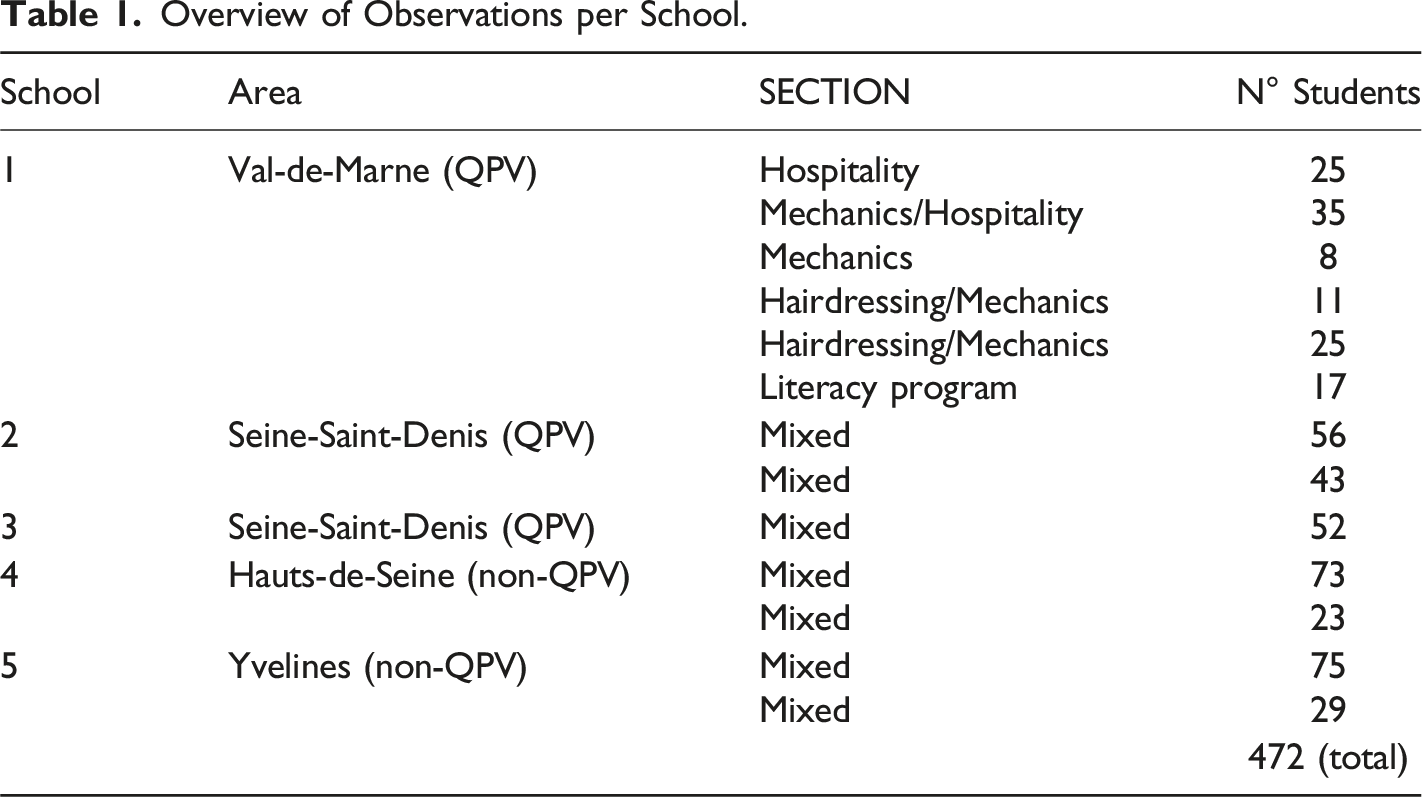
For each quote from the ethnographic observations, I provide the following information between brackets: pupils’ own ethno-racial self-identification (which is based on information I gathered from individual pupils after the session); whether the high school was situated in a QPV; the cursus of the class; the ethno-racial composition of the class. I express the latter as a fraction, for example 7/8. The number 7 in this fraction refers to all the pupils that I categorized as of color (nonwhite), meaning only one white student was present in this specific classroom (see Table 1). This fraction is based on my perception and not on pupils’ self-identification, which means I may have categorized some pupils as of color who do not identify as such themselves. I do not have data on the social class for pupils making statements during observations, but their presence in a QPV or non-QPV school provides an indication. When I speak of boys or girls for the observations, I mean masculine-presenting and feminine-presenting respectively, which is also based on my own categorization and may hide a greater diversity in gender identities.
The sessions were audio-recorded with the authorization of the trainers, high school staff, and pupils. I took notes on non-audible behavior such as facial expressions, which were incorporated into the transcriptions of the audio recordings. Much information was gathered through conversations with pupils before, after, and during the training sessions, as well as during the public transportation rides that I shared with trainers to and from the school. On the way there we discussed their expectations about each school, and on the way back they evaluated how things went. I also observed five internal meetings among trainers, which provided data on how they conceived of pupils’ responses and adapted their program over time.
Overview of Interviewees.
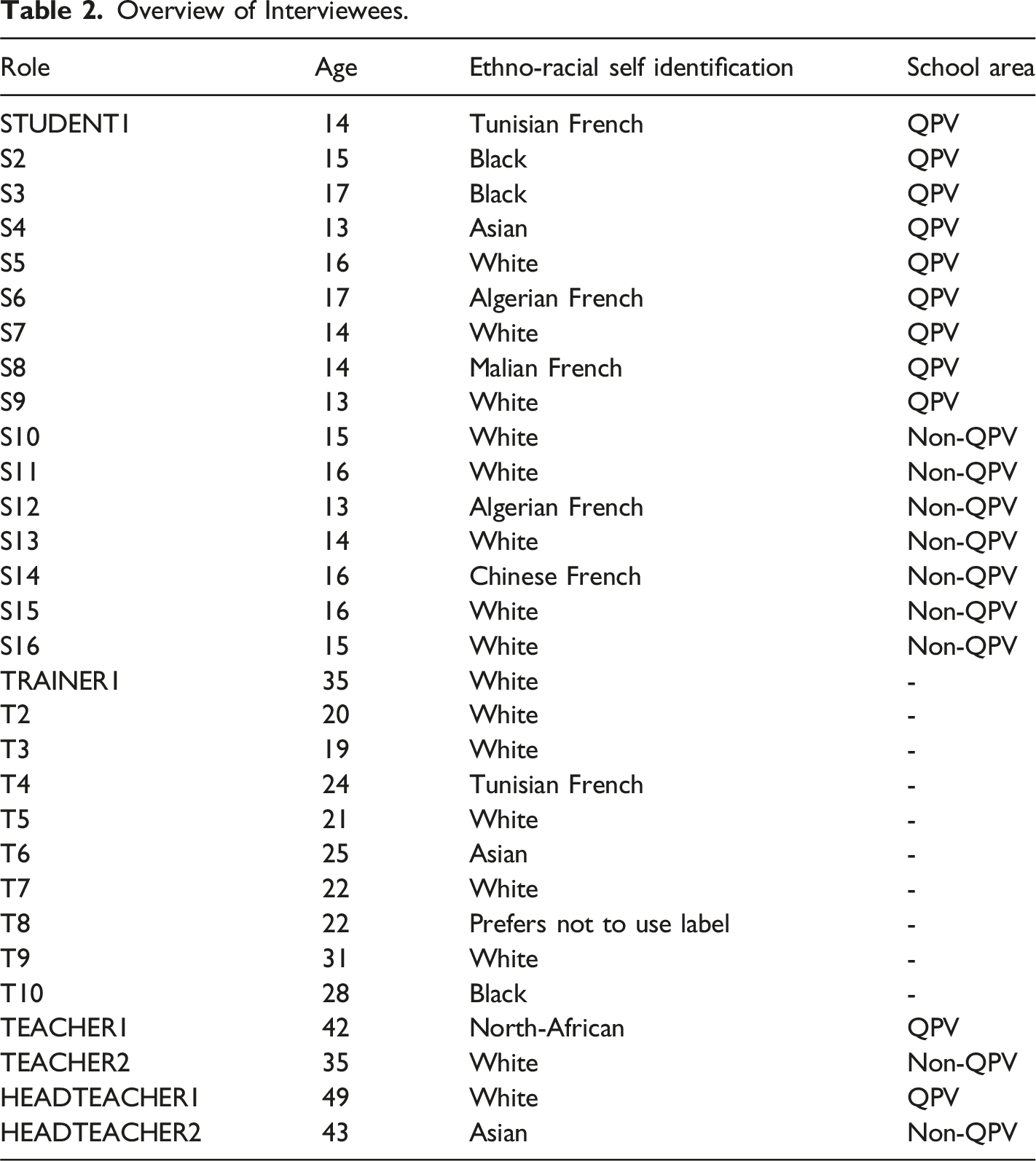
To capture the trainers’ perspective, I conducted ten interviews during which I asked about their strategy towards raising awareness, to recount moments they felt went well and ones that were difficult, and how they interpreted pupils’ responses. In addition, I interviewed two teachers and two head teachers. These interviews provided insight into how schools approached SHDR and how the sessions fit into school policies on gender equality.
The pupils provided assent for being cited verbatim, while informed consent was given by the school director and/or teacher. All adult interviewees gave informed consent for being cited verbatim. All names of pupils and trainers are pseudonyms, for which I chose names with similar cultural origins. I asked each interviewee about their ethno-racial self-identification (Table 2). One trainer refused to provide an ethno-racial identity because he thought the category is vague and problematic—which illustrates that race remains a controversial category in France, including among left-wing educators (Fassin and Fassin 2013).
Findings
Was Boys’ Antagonistic Response a Negation of the Trainers’ Feminist Message?
Despite numerous expressions of appreciation, the sessions also met with recurring resistance, both from girls and boys. This article focuses on the latter. SHDR members themselves tended to interpret boys’ angry or derisive responses as the product of their sexist worldviews and their vested interest in upholding patriarchy. Some boys indeed expressed sexist views and blamed the victims, which confirmed trainers’ interpretation. In one class, a boy said: I’ve done it before. A couple of weeks ago, I told a girl that she looked like a whore. I mean, with her mini skirt… She was asking for it. (self-identified as Tunisian-French, high school in Val-de-Marne, Mechanics and Hospitality, 27/35)
Masculine group bonding and peer pressure are identified as causes of street harassment (Wesselman and Kelly 2010) and status games shape collective attitudes concerning gender and feminism among schoolboys (Abraham 2008; Pascoe 2012). Indeed, some boys’ responses seemed to be informed by a desire to arouse admiration from masculine classmates by making fun of the trainers’ message. For example, during a session when the atmosphere became particularly brawly, boys shared stories of how they made women feel uncomfortable: One time, it was really hilarious… My friend said to her: “Your buttocks are falling out of your skirt,” and she covered her behind with her handbag. (self-identified as White, high school in Seine-Saint-Denis, mixed group, 39/52)
Trainers often interpreted boys’ antagonistic reactions as the product of their social position. In their view, if the training provoked anger or derision, this likely meant that boys felt their privileged position was being questioned and tried to obstruct discussion of gender-based violence. Anger on the part of the boys, then, was not necessarily something that the trainers wanted to avoid.
Negative response to the trainers’ messages was especially frequent among boys of color in schools in Paris’s less-affluent suburbs. In training sessions in predominantly white schools in more affluent areas, to the contrary, I observed less resistance and more pupils expressed support for the activists’ work and their message. In internal meetings, activists regularly expressed the same opinion: that their messages were better received in schools in more affluent locations. They tended to attribute such differences in reception to the idea that pupils in some classes were already aware (sensibilisés) of feminist understandings of violence and sexism before the session. This explanation resembles the Stages of Change framework, according to which men’s receptiveness of training programs depends on where they are on the continuum of readiness to end gender-based violence (Banyard, Eckstein, and Moynihan 2010). For example, at a meeting for trainers, an experienced trainer (self-identified as White) warned newcomers that sessions in some classes can be tough: A few months ago, we went to [suburb south of Paris], it was not like in some other schools. They were not sensibilisés at all. They started insulting us. You must be aware that it can sometimes be very hard. In classes in more difficult areas, it was hard to get our message across and they really didn’t want to listen.
Activists used cognitive language to discuss pupils’ responses: some understood the feminist message, while others did not, or only partially. Should we conclude from these findings that the widespread anti-progressive values in the French quartiers prevented pupils from seeing street harassment as a problem and caused them to refuse to listen to activists’ feminist discourse? And can the positive response of white pupils in schools in more affluent areas be explained by their greater condemnation of sexism and adherence to feminist ideals?
The ethnographic observations and interviews with pupils show that negative response cannot be explained only by boys’ sexist viewpoints and refusal to see harassment as a problem. Indeed, many pupils in all the schools where I conducted my observations expressed agreement with the idea that harassment is a problem that must be combatted. In that sense, many of them were feminists—although, as we saw above, this feminist awareness was not unanimously held and some pupils blamed the victims. Moreover, although pupils’ responses may reflect differences in how they respond to education and the school system in general, the interviews and observations show that their different reception cannot be fully explained by referring to “anti-school attitudes” (Abraham 2008) among youth in underprivileged areas. Instead, their responses reflected different ways in which boys deflected responsibility for street harassment and sexual violence.
Deflection of Responsibility to Racism in Society: “It’s Just because I’m Moroccan that She Reacts Badly”
Among boys in schools in underprivileged areas (QPV’s), the trainers’ discourse provoked a sense that they were under attack: “No, but it’s exaggerated. Now if we go and talk to a girl in the metro, it’s harassment” (self-identified as Algerian-French, high school in Val-de-Marne, Mechanics, 7/8); “Stop putting us into a box! We’re not all rapists” (self-identified as Black, high school in Seine-Saint-Denis, mixed cursus, 39/52). Many boys translated the discussion about street harassment into a racial or class question: “It’s just because I’m Moroccan that she reacts badly” (self-identified as Moroccan-French, high school in Seine-Saint-Denis, mixed cursus, 39/52). During one interview, a boy expressed his discomfort with the crocodile images from Projet Crocodiles: “You know what bothered me: the crocodiles, it’s an African animal. Is that us, the crocodiles?” (self-identified as Black, high school in Seine-Saint-Denis, mixed cursus, 39/52).
Trainers were regularly accused of imposing “white” or “Parisian” norms. In such instants, boys identified themselves as “jeunes de banlieue” (young people living in less-affluent suburbs) or as a specific ethno-cultural group—for instance, “Algerian-French”—in opposition to the “Parisian” members of SHDR. For many students of color, the trainers were the embodiment of an oppressive hegemonic order. There are many prejudices, like we jeunes de banlieue are going to rape all women. You’re saying we’re like dominants, but you don’t even know us. (self-identified as Algerian-French, high school in Val-de-Marne, Hairdressing/Mechanics, 21/25)
A boy stated during our interview: “It’s like with Marine Le Pen, she also says that in the banlieue we’re all rapists.” Activists’ abstract remarks that they opposed racist narratives about street harassment and emphasis on how harassment happens everywhere were often not sufficient to take away such worries. Boys’ responses illustrate how—even when a training program does not rely on racist narratives—in contexts where radical right parties and mainstream media frame sexual violence as a problem of men of color, the latter are likely to interpret awareness-raising on this subject as reinforcing stigmas.
Boys in QPV-area schools deflected responsibility for street harassment to racism and injustice towards migrants and men of color, or even held white women responsible for how they interpreted interactions with them. During our interview, a boy who self-identified as Black recounted an experience that occurred in a bus home from school: White girls can be so racist. I sat next to this girl and started talking to her, she was really nice looking…..Then out of nowhere she told me I was bothering her.
Repeated discussions erupted about the idea that the trainers were imposing norms concerning what constitutes harassment, that were exterior to their social group. It’s a white thing, a Parisian thing. Here it’s not the same. We talk much more to each other on the street. We’re not afraid of each other all the time. (Interview, self-identified as Tunisian-French, high school in Val-de-Marne)
In schools in underprivileged areas, the boys’ reactions affected the girls.
2
The boys in our class are not rapists. It’s just that white women are afraid of Arab men.…You don’t know them. (self-identified as Algerian-French, high school in Val-de-Marne, Literacy Program, 15/17) It’s true. It’s always white women, like from the 16th
3
[arrondissement] and so on. They say they’re the victims of banlieue men. But you don’t know how things work here. (self-identified as Malian-French, high school in Val-de-Marne, Hairdressing/Mechanics, 21/25)
Activists tried to accompany the girls in a process of “exculpation” (Gluckman 1972), building solidarity and collective identity as victims through the constitution of culprits with whom they should stop expressing solidarity: men who harass. However, when girls sensed that the boys in their class felt attacked, this created an atmosphere in which girls started acting out of solidarity with the boys—as part of a similar cultural group or social class—instead of with the trainers as women. In such situations, the first axis of victimization—that of women suffering from street harassment—was in tension with a second: boys who considered themselves and their friends as victims of stereotypes about men of color as sexual predators. Countering the idea that they needed to be “rescued” from their masculine classmates, the girls associated the status of street harassment victim with white women and Parisians and presented themselves as “not weak” and “able to take care of themselves.”
Given histories of racial stereotyping of Arab or Black men as perpetrators of sexual violence, boys of color are more likely to perceive efforts to raise awareness on this subject as reinforcing stigmas about them (Crenshaw 1991). This sentiment occasionally caused opposition to emerge between trainers and pupils, articulated in terms of teacher/student relations, or in differences in social class, racialization, or cultural background. In such cases, deflecting responsibility for street harassment to racism and oppression in society prevented boys of color from condemning harassment committed by their classmates or from expressing shame for behaving in such a manner themselves.
Trainers were not unaware of these dynamics. Indeed, how to raise awareness on street harassment without reproducing racial stigmas was a central concern for activists in France and elsewhere (Dekker 2024). SHDR trainers were themselves in a constant learning process. Over time, they made several adaptations to their program to try to avoid antagonism from boys of color. For example, they drew parallels between boys’ experiences with racism and girls’ experiences with harassment, which made the boys more likely to identify with the problem. Nonetheless, the focus on street harassment—a social problem that is popularly associated with men of color and underprivileged areas (Gayet-Viaud and Dekker 2021)—instead of on gender-based violence in general made it hard to avoid giving boys in QPV areas the feeling that they were being singled out. By focusing on street harassment, awareness-raising may inadvertently reproduce racial hierarchies (Holvikivi 2023).
White Innocents in Affluent Schools: “Street Harassment Is Horrible. I’m Glad It Doesn’t Happen Around Here”
In schools in more affluent areas (non-QPV’s), boys rarely stated that they felt under attack and girls expressed less discomfort in calling themselves victims of street harassment. In the metro home after a session in such a school, activists would often remark on how the training was “easy” because the pupils were already “very aware.” Should we conclude from pupils’ lack of resistance in these schools that they were more advanced in their feminist awareness than pupils in schools in underprivileged areas? A dynamic specific to these classes obliges us to nuance this idea.
During sessions in affluent area schools, many boys expressed their support when activists told them about the prevalence of street harassment. This stance was often accompanied by a belief that harassment is something that happens elsewhere. One boy, trying to understand better how the girls in his class dealt with street harassment, asked: So, when you go and take line 4 to go to Montmartre, for instance, you make sure you’re not alone, or you don’t go out at Chateau Rouge,
4
where it’s probably pretty tough? (self-identified as White, high school in Hauts-de-Seine, mixed cursus, 6/73)
Such viewpoints were often expressed in the interviews. For example, one boy stated that he found it “awful that this happens to girls. I’m glad that at least here in our school we’re all pretty aware of these things” (self-identified as White, high school in Hauts-de-Seine, mixed cursus, 6/73). Many white boys in affluent area schools did not feel attacked because they associated street harassment with cultural Others, a form of “white innocence” (Wekker 2016) that exempted them from responsibility for the problem. Employing narratives of “stranger danger” (Ahmed 2017; Chenier 2012) seemed to help boys accept the activists’ message and speak out in solidarity with the girls, without the sense that this touched them personally.
The focus on harassment in public space facilitated this deflection of responsibility. For example, one boy (who self-identified as White) referred to the video “10 Hours of Walking in New York City as a Woman” by the organization Hollaback!, in which a woman uses a hidden camera to film the constant harassment she experiences in New York City: I saw this video about a woman in New York. It was horrible. A guy followed her for 20 minutes and asked for her number. Then a guy shouted at her when she didn’t want to give her number. I found that scary. I mean, I also feel a bit uneasy when I go to some parts of St. Denis.
5
There’s always a group of guys there hanging next to the metro station. As a woman, it must sometimes be horrible there, especially if you go there at night.
6
Because street harassment is popularly associated with men of color and underprivileged areas (Lieber 2021), a session that concentrated on this singular form of gender-based violence was likely to make boys who are white and live in more affluent areas feel that they are not concerned. These boys did not feel attacked because they did not match their own behavior to the activists’ message, allowing them to deflect responsibility for gender-based violence.
This dynamic influenced how girls responded to the training. Boys’ deflection of responsibility made it easier for girls to identify with the activists as women and call themselves victims of street harassment, without “betraying” their classmates. Even though in interviews the girls did state that harassment occurs at their school, this rarely came up during the training. The focus on street harassment thus allowed girls to criticize men abstractly or Other men elsewhere, without condemning their classmates’ behavior. This, in turn, made it easier for boys to respond positively without feeling they were being personally attacked.
Within these sessions, homosocial interactions between boys contributed to the formation of in-groups and out-groups (see: Holgersson 2013; Pascoe 2012), centered around two ways of deflecting responsibility: “us” as “jeunes de banlieue” who are victims of racialized stereotypes concerning sexual violence; and “us” as progressive boys who are different from boys and men elsewhere who commit harassment. On the one hand, deflection may strengthen antagonism towards trainers: for example, when students of color feel that a training program’s message unduly puts responsibility on them, and they deflect responsibility to racism and injustice in society. On the other hand, deflection may enable positive response: for example, when white and upper-middle class pupils associate sexual violence with men and boys elsewhere. Positive response does not necessarily signal stronger commitment to feminism, or that a training is effective in that it leads men and boys to reflect on their own implication in women’s subordination and gender-based violence. Narratives of stranger danger cause men and boys to deflect responsibility and dissociate their own behavior from the educators’ message, thus allowing them to respond positively to a training program on gender-based violence. This is a collective and interactive process, and these findings underline the need to analyze homosocial interaction dynamics through an intersectional lens.
Conclusion
Racism and injustice in society create processes of deflection of responsibility for sexual violence among all types of men, but for different reasons. Boys and men’s intersectional identities, particularly in terms of their race and class, inform how they deflect responsibility in response to harassment awareness training programs. The comparison shows how men and boys are more likely to deflect responsibility for sexual violence when a training program insufficiently relates the message to their lifeworld and personal experiences. How to make sexual violence awareness training culturally specific has been mainly explored with respect to disempowered and underprivileged groups. These findings illustrate the need for better scholarly understandings of the reception of sexual violence training by men that are not underprivileged. Developing policy strategies that speak to each target group’s intersecting identities and experiences will be more successful in fostering political responsibility for sexual violence among all men.
This raises the question whether raising awareness on street harassment alone is the most effective strategy to do that. Experimental studies suggest that exercises that ask men to document sexism they witness in their daily lives can be an effective tool for raising awareness (Becker and Swim 2011). As Flood argues: One of the first steps in working with a particular group or community of men should be to map their gendered and sexual culture, in order to see what aspects of this culture contribute to violence against women and what aspects can be mobilized in support of non-violence. (2006, 31)
Such elements lacked for boys in schools in more privileged areas, as SHDR’s sessions concentrated on a type of violence and sexism—street harassment—that they associated with Other men elsewhere. By focusing exclusively on this subject, training organizations may neglect to raise awareness on harassment and sexual violence in contexts that are more familiar to men who spend little time in the streets. Conversely, the popular association of street harassment with men and boys of color made it extremely likely that the latter would feel attacked by a session that primarily focused on this form of gender-based violence.
A limitation of this article is its focus on awareness-raising on one type of violence: street harassment. An interesting question for future research is how people deflect responsibility for other kinds of gender-based violence, as well as for social problems such as climate change and poverty: how does deflection shape the reception of awareness-raising on different subjects? How do factors beyond the subject matter (e.g., trainers’ identity; the location of a training program (e.g., school, community center, prison)) prevent or encourage deflection among different target publics? Another limitation is this article’s focus on policy reception, which must be distinguished from policy effect (Revillard 2018). From the perspective of the “feminist killjoy” (Ahmed 2017), it might be argued that boys’ anger and derision signal discomfort that may transform into behavioral changes in the future. Given boys’ deflection of responsibility during and immediately after the session, it seems likely that the training did not cause them to radically change their behavior and attitudes. However, longitudinal effect research can improve our understanding of these deflection processes on the long term.
Footnotes
Declaration of Conflicting Interests
The author(s) declared no potential conflicts of interest with respect to the research, authorship, and/or publication of this article.
Funding
The author(s) disclosed receipt of the following financial support for the research, authorship, and/or publication of this article: This study was funded by the École des Hautes Etudes en Sciences Sociales (PhD contract), HORIZON EUROPE Marie Sklodowska-Curie Actions (101065519).
