




Abstract
This study examines the relationships between the variables “trust,” “participation,” “citizenship behaviors,” and “loyalty.” It also identifies the moderating effect of “exhibitor frequency at exhibitions.” Analyzing data from 240 exhibitors at major business-to-business (B2B) exhibitions in Seoul, Korea, the study found that “trust” positively influenced “participation,” “citizenship behaviors,” and “loyalty,” with “citizenship behavior” being the only significant predictor of “loyalty,” supporting four of six proposed hypotheses derived from social exchange theory. Additionally, exhibitors who attended more than twice demonstrated more proactive behavior and greater loyalty based on trust, thereby reinforcing exhibitor frequency as a moderating variable. These findings provide a theoretical basis and practical recommendations for exhibition promotion in the MICE (Meeting, Incentives, Conferences, Exhibitions) context.
Keywords
Highlights
The study found that trust and citizenship behaviors collectively partly determine exhibitor loyalty in business-to-business (B2B) exhibitions.
Favorable interactions and responsive exhibitors’ positive behaviors may not necessarily result in loyalty for the exhibition.
Repeat exhibitors, if they already have trust, are more engaged and responsible, leading to more successful exhibitions.
Introduction
The MICE industry is recognized as one of the fastest-growing segments within the tourism sector, generating millions in revenue for countries and cities worldwide, with both direct and indirect multiplier effects (An et al., 2021). According to recent statistics, the global business-to-business (B2B) trade show market was valued at US$64.5 billion in 2021 and is expected to grow to US$50.6 billion by the end of 2022 (Julia, 2024). Additionally, the Global Barometer, published by the UFI (2024, Global Association of the Exhibition Industry), indicated that exhibition revenues increased by an average of 20% in 2023, and, with this trend expected to continue, revenues are projected to grow by an average of 17% year-over-year in 2024. Furthermore, exhibition facilities add value for residents, enhance the attractiveness of destinations (He et al., 2019), and provide exhibitors with opportunities to meet professional buyers with high purchasing power benefiting business both locally and beyond (Lin, 2016). These critical advantages have intensified competition among national and local administration seeking to attract MICE events (Y. Wang et al., 2014). Thus it is essential to invest significant resources in building large-scale exhibition centers and hosting exhibitions to gain both economic and non-economic benefits (e.g., Deery & Jago, 2010).
Achieving a competitive advantage in business relationships often hinges on customer-centric relationship management that fosters enduring and sustainable relationships with diverse customers (Y. Wang et al., 2014). Building relationships is particularly effective in the exhibition sector because of its characteristics of service-based exchange (i.e., the exhibition product is based on experience and information exchange), a business market (i.e., exhibitors are business entities), and transactions being conducted via multiple channels (i.e., agents, chambers of commerce, trade associations; Palmatier et al., 2006). Furthermore, the key to an exhibition’s success depends on the close coordination of organizers and exhibitors, as the roles of organizers have evolved to include a communication function, working all-year-round as hubs, becoming information brokers, or acting as mouthpieces for their market (Jin et al., 2012). Organizers now need to identify industry trends, develop innovative exhibition concepts aligned with market demand, and help exhibitors to establish lasting communication with their customers, impacting exhibition operation, exhibitor behavior, and the relationship between them (Jin et al., 2012). Thus, it is critical for exhibitors and organizers to build a strong relationship to sustain subsequent exhibitions, and trust is one of the key dimensions that exhibitors consider critical in assessing relationship quality with organizers.
Trust is thought to be key to forming relationships between buyers and sellers, and is evidenced when customers develop a tacit understanding with sellers where it is thought that sellers are reliable and are acting in the interests of customers, therefore reducing perceived risk by a measure of reliability and honesty (Franklin & Marshall, 2019). Also, trust as one’s confidence in another’s goodwill in a social exchange is often regarded as a means of organizational control of risks, because such confidence encourages cooperation, enhances commitment, and avoids fear and resistance in social exchange perspectives (He et al., 2019).
In establishing the trust between buyer and seller, B2B (business-to-business) exhibitions have become an important means of encouraging collaboration that shares a common vision to improve the quality of exhibition services for visitors (Jia & Wan, 2022). Such exhibitions are often regarded as relationship marketing tools for exhibitors, for they provide a higher level of customer commitment and enterprise performance compared to transactional marketing (Oromendía et al., 2015). This supports the notion that the main activities at B2B exhibitions are not just traditional sales and procurement but also information exchange and networking, which are key elements in developing B2B marketing theory (Mora Cortez & Johnston, 2017). Therefore, the success of exhibitions depends on the extent to which exhibitors engage in intensive interactions, cooperation, and the exchange of ideas and resources such as information, knowledge, and experiences (Zhang et al., 2023). Ultimately, these activities form the foundation of value co-creation, leading to sustained successful exhibitions through close communication and cooperation between exhibitors and organizers (Wong & Lai, 2019). Therefore, it is imperative for organizers to implement various strategies to ensure that exhibitors remain engaged in their exhibitions and involve supportive and helping behaviors to create sustainable relationships.
Reflecting the essential role of trust and consistent engagement—including participation and citizenship behavior at exhibitions—previous literature has estimated the effects of trust on customer engagement (Pappas, 2016; Shen et al., 2020), participation (Dabholkar & Sheng, 2012), and citizenship as a form of value co-creation behavior (Roy et al., 2020; Waseem et al., 2021). However, these studies often do not specifically address the B2B context and so fail to capture how trust in organizers., and their active support, may enhance exhibitors’ enjoyment of such interactions. Such an emotive reaction encourages more responsive behaviors, leading to a form of co-organization of the event (Sridhar et al., 2015). Accordingly, this study aims to highlight the effect of trust on exhibitors’ participation and citizenship behavior at B2B exhibitions to address the failure to examine the dynamics of trust-commitment and behavioral relationships within the exhibitor–organizer relationship in MICE research.
In the highly competitive exhibition industry, attracting new customers and encouraging repeat visits are crucial. Initially, exhibition choice is influenced by attributes such as reputation, information access, and networking opportunities, while repeated visitation is driven by trust and commitment formulated by past attendance generating organizational gains (Whitfield & Webber, 2011). Much tourism research has confirmed that repeat visitation often leads to a sense of place attachment, and a parallel concept is applicable to the exhibition industry. “Exhibition attachment” is formed through on-site involvement and interactions (Fu et al., 2019). Past positive experiences can increase exhibitors’ willingness to engage more frequently and potentially deeply with any given exhibition (Huang, 2016). Therefore, repeat attendees who have established attachment and trust are more likely to participate proactively and engage in citizenship behaviors—such as sponsorship—thus contributing to the co-creation of exhibition value more than new exhibitors might. Despite these facts, there remains little consideration concerning the effect of trust on exhibitors’ participation and citizenship behavior. Indeed few studies have examined differences between first-time and other exhibitors in the exhibition industry, although several studies have examined group differences in the general tourism and hospitality sectors (Chang et al., 2013; Fuchs & Reichel, 2011; Hsu et al., 2014). The authors expect different behavioral dynamics in the exhibition industry between less and more frequent exhibitors regarding exhibition organizer support behaviors (Matzler et al., 2019).
Given this, the concept of social exchange is a useful framework to assess the evolving role of exhibitors as value creators in the MICE context. Exhibitors have complex roles, as they are both served by organizers and provide services to visitors, which strengthens their incentive to work closely with the organizer (Wong & Lai, 2018). Following this approach, the relationship between exhibitors and organizers evolves from passively receiving marketing information to actively engaging with exhibition creators to enhance the success of the exhibition (Yi & Gong, 2013). Social exchange theory, which denotes voluntary transactions between two or more parties for mutual benefit, supports these notions (Tafesse & Skallerud, 2015). Consequently, this study aims to investigate: (1) the effect of exhibitors’ trust on participation and citizenship behaviors that encourage exhibitors as value creators to establish long-term relationships with other stakeholders; (2) exhibitor loyalty to the exhibition arising from both participative and citizenship behaviors; and 3) the moderating effect of exhibiting frequency between trust, participation, citizenship behaviors, and loyalty.
Literature Review and Hypothesis Development
Social Exchange Theory in the B2B Context
Strategizing a business relationship involves not only the economic exchange of favorable products or services, but also the social and hedonic sharing of psychological rewards (Jeong & Oh, 2017). However, the limited explanations provided by transaction cost analysis in many relationship-based exchanges have prompted the adoption of social and psychological perspectives to better explain various B2B relationships, and to focus more on longer-term implications. Social Exchange Theory (SET) is one such approach that has gained widespread application in contemporary management research (Cropanzano et al., 2017).
Originally, SET viewed social relationships as a series of repeated exchanges where behavior was defined rationally by the difference between rewards and costs. Each party seeks to maximize their own benefits, which influences whether the relationship continues, engages, or terminates (Jeong & Oh, 2017). As the relationship develops and evolves through continuous evaluation of reciprocal outcomes, successful relationships are built on mutual dependence and trust (Nevin, 1995). Positive or negative exchange outcomes can differentially impact mutual dependence and trust, which, in turn, influence cooperation, commitment, and reputation (Hessling et al., 2018).
This study examines the journey from trust to commitment between exhibitors and organizers using the SET framework. Exhibitors benefit from the organizer’s platform, which facilitates sales leads and relational marketing with buyers. Conversely, organizers benefit from the business reach of exhibitors, which attracts buyers interested in specific products or services, while ensuring the exhibition’s survival and viability through consistent customer participation and stakeholder satisfaction. These exchange relationships create opportunities to build mutual dependence and trust, which are crucial for long-term business success. Although SET has been applied to some MICE research contexts, including events and festivals (Adongo et al., 2019; Alonso & Bressan, 2013; Taek Lim & Sil Lee, 2006), it has rarely been applied to the business exhibition context.
Participation and Citizenship Behaviors as Value Co-Creation Processes
Customer participation behavior encompasses all forms of customer involvement and engagement in the value-creation process. One key dimension is responsible behavior, where customers fulfill their duties and responsibilities for successful service delivery (Yi et al., 2011). In the exhibition industry, this includes following instructions, adhering to rules, and actively participating in co-programs (Dong et al., 2008). Participation behaviors encompass information seeking, information sharing, responsible behavior, and personal interaction (Revilla-Camacho et al., 2015). Exhibitors seek information from stakeholders to better understand their customers and market trends (Gummerus et al., 2012). This involvement in the value co-creation process enhances perceived performance (Saarijärvi et al., 2013). Sharing resources and information between exhibitors and organizers improves dialogue and outcomes for all parties (Hatch & Schultz, 2010). Additionally, positive personal interactions—such as being friendly, kind, and respectful—are essential for fostering strong mutual relationships (Kim et al., 2019).
Co-creative participative behavior involves required, role-specific actions, but participative citizenship behavior includes voluntary, “above and beyond expectations” actions, which provide exceptional value to the organization (Groth, 2005). While not essential for core service delivery, citizenship behavior significantly contributes to a firm’s effective functioning (Mitrega et al., 2022). This behavior encompasses feedback, advocacy, aid, and tolerance (Yi & Gong, 2013). For example, an exhibitor might enhance exhibition service delivery by suggesting improvements for associated social programs, advocating for purchase decisions, or promoting the organization through positive word-of-mouth among industry peers, thereby demonstrating loyalty (Bettencourt, 1997). Additionally, in the MICE context, exhibitors who are affectively committed and trust the organization are more likely to overlook service failures and remain tolerant despite inadequate service delivery (van Tonder et al., 2018). Ultimately these participation and citizenship behaviors drive collaborative relationships which denote partnership behavior characterized by attributes such as engagement, commitment, knowledge sharing, and/or resolving conflict (Weidenfeld et al., 2016; J. Yang et al., 2013), resulting in increased revisit intention or positive word-of-mouth (M. J. Lee et al., 2015).
According to Yi and Gong (2013), these forms of behaviors are considered value co-creation activities permitting the achievement of specific goals (France et al., 2015). The concept of value proposition is significant in the exhibition industry because an organizer provides a platform (the exhibition) for both exhibitors and visitors to achieve their business objectives. Value is co-created when exhibitors and buyers work with the organizer, who offers propositions to assist in reaching these objectives (Wong & Lai, 2019). This value creation is not due to a single factor, but results from the entire process occurring during the relationship (Hessling et al., 2018). Therefore, this study aims to explore the antecedents and consequences of both participation and citizenship behaviors as part of the joint value creation process, rather than merely focusing on the end value outcomes. These co-creation behaviors are expected to contribute to long-term and sustainable relationships supporting the growth of exhibitions.
Trust, Participation, and Citizenship Behaviors
Trust is a multidimensional concept comprising competence, dependability, and integrity (Hon & Grunig, 1999). It has been defined as a psychological contract, or a definitive faith established by the customer that facilitates social cooperation with the firm (K.-H. Lee & Hyun, 2016). Hennig-Thurau et al. (2002) suggest that the trust benefit is all the more valuable as it reduces failure costs and the level of perceived risk in business-to-business transactions. By reducing the risk in resource exchange, trust contributes to providing long-term relationships and loyalty, including a form of advocacy behavior. Recognizing that companies face competitive environments with perceived risk and uncertainty for customers, marketing researchers have studied trust and its consequences (Hennig-Thurau et al., 2002).
In business relationships, trust is regarded as “perhaps the single most powerful relationship marketing tool for a company” (Berry, 1995, p. 242), influencing intergroup behavior, such as a higher degree of cooperation, and intention to stay in the relationship (Bennett & Robson, 2004). Also, trust can be conceptualized as confidence in a partner’s responsible and benevolent behavior, which enhances willingness to rely on that partner (Füller & Bilgram, 2017), thereby shaping customers’ attitudes and behavior (Izogo et al., 2020).
Existing literature highlights that trust manifests as a customer’s confidence in the quality of information disseminated by an organization, and their willingness to accept that information (Toufaily et al., 2013). As trust strengthens, customers are more inclined to contribute to the organization by sharing information and fostering social relationships with other customers (Dabholkar & Sheng, 2012; Pappas, 2016). Furthermore, customers who trust an organization are more likely to provide valuable feedback aimed at enhancing the provider’s service quality, leading to improved long-term outcomes (Chen et al., 2020). Additionally, existing research indicates that trust in entrepreneurial activities boosts willingness to share information, advocate for buyers, and help in B2B contexts (Walz & Celuch, 2010).
In the context of information and social exchange, exhibitions serve as powerful marketing events that enhance social bonds between key actors (Rinallo et al., 2010). They facilitate strategic networking, increase sales opportunities, and foster learning activities as relationship outcomes (L.-Y. Li, 2006). As exhibitors often assess the trustworthiness of organizers regarding their ability to attract quality visitors (Smith et al., 1999), trust is widely accepted as a foundational element for strategic relationship development and long-term business relationships, including within the exhibition industry. However, existing literature tends to focus on customer commitment, engagement, and loyalty, as outcomes of trust, often overlooking the significance of proactive participation and citizenship behaviors in fostering sustainable business relationships (Lai, 2015).
While existing research supports that trust facilitates participation and citizenship behaviors, with a proven direct impact in other contexts (Alves & Wagner Mainardes, 2017; Casper Ferm & Thaichon, 2021; Dabholkar & Sheng, 2012; Roy et al., 2020; Shen et al., 2020; Song et al., 2019), there has been limited investigation of these dynamics, especially within the exhibition industry. Hence, we proposed that:
Hypothesis 1: Trust in an organizer has a positive impact on an exhibitor’s citizenship behavior
Hypothesis 2: Trust in an organizer has a positive impact on an exhibitor’s participation behavior.
Participation, Citizenship Behaviors, and Loyalty
Loyalty in exhibitions is defined as repeated participation in the same exhibition, and is often linked to positive word-of-mouth recommendations (Tanford & Jung, 2017). Cossío-Silva et al. (2016) indicated that participation behavior and citizenship behavior as value co-creation have a direct impact on loyalty by inhibiting switching behavior. Similar findings are reported by Celsi and Olson (1988) in the entertainment industry, and by Baker et al. (2009) regarding increased customer participation in the service industry. Grissemann and Stokburger-Sauer (2012) found that “when tourists have the opportunity to co-create a travel package, they are more likely to re-purchase from the same company and recommend the company to others” (p. 1485). It has been suggested that exhibition organizers are also able to develop loyal customers if they permit exhibitors to participate and become involved in the creation process. C.-C. Yang et al. (2014) and Y.-L. Lee et al. (2019) found examples of participation and citizenship behaviors as the process of value co-creation and loyalty creation in the hospitality and service industry. Consequently, we proposed that:
Hypothesis 3: Exhibitors’ citizenship behavior has a positive impact on exhibition loyalty
Hypothesis 4: Exhibitors’ participation behavior has a positive impact on exhibition loyalty.
Trust and Loyalty
Customer loyalty and trust has long been critical for helping the tourism and business event sectors to succeed (Akhtar et al., 2019; J. Liu et al., 2019). As previously noted, social exchange theory states that customers are likely to interact with service producers they trust (Cheng et al., 2017). Han and Hyun (2013) conceptualized trust as a type of bond that sustains a state where the supplier is reliable and meets customers’ expectations. For their part, Agustin and Singh (2005) stated that trust may lead to loyalty because trust can even arise from customers’ satisfaction with the way employees and companies handle complaints. In this sense, trust is the core component to maintaining long and stable relationships with customers, and it is an important factor in promoting long-term loyalty in the customer–provider context. Therefore, we propose the following hypothesis:
Hypothesis 5: Exhibitor’s trust has a positive impact on exhibition loyalty.
The Moderating Effect of Frequency of Visitation
Numerous studies of tourism and hospitality have compared first-time and repeated customers and shown inter-group differences in motivation (Hsu et al., 2014), preferences (Chang et al., 2013), and loyalty (Su & Swanson, 2017). It has been argued that people with differing degrees of familiarity with a product or service take part in varying participation activities (e.g., Fuchs & Reichel, 2011). Moreover, even though revisit exhibitors are thought to be more likely to show favorable attitudes toward organizers—and so demonstrate different expenditure patterns—such behavior has not been fully discussed. However, Rather et al. (2022) revealed in their research on tourism destination choices that repeat customers tended to co-create higher destination related value—that is, there was greater value in use and co-production opportunities.
In this study, exhibition visitation frequency was measured as either “first-time” or “repeat” for those who exhibited more than twice. X. Li et al. (2008) contended that first-time visitors are driven more by novelty, whereas repeat exhibitors enjoy familiarity with specific objects and are seen to be more antagonistic when faced with unsatisfactory service, being more likely to complain (Namkung & Jang, 2009). However, repeat exhibitors with higher trust levels tend to give more positive evaluations of an exhibition, and trust serves to offset antagonism, uncertainty, or unsatisfactory decisions (Fuchs & Reichel, 2011). That is, organizers may be given the benefit of the doubt. This is supported by Garbarino and Johnson (1999), who argued that trust and commitment are greater determinants of revisit intention in “high-visit groups.” Here, we are presuming that visiting frequency (first vs. repeat) will moderate the relationship between trust, customer participation, citizenship behaviors, and loyalty; that is, revisit exhibitors with higher trust levels demonstrate greater loyalty and engagement in creating joint value.
Hypothesis 6: Visiting frequency significantly moderate the relationship between trust and participation, citizenship behaviors and loyalty
Methodology
Sample and Data Collection
A survey was established using a questionnaire that measured trust, participation, citizenship behaviors, loyalty, and demographic information in the exhibition industry. The survey targeted exhibitors who had participated in four representative B2B exhibitions, such as Korea Pharm & Bio, CPHEX, Korea Mat, and Korea Lab in Seoul, Korea. Seoul’s eighth consecutive recognition in 2019 as the world’s best city for MICE makes it a particularly compelling subject for research, especially given its status as the largest city in South Korea for attracting global exhibitions. We obtained exhibitors’ contact information from exhibition hosts and used a simple random sampling method to send out 1,050 surveys via Google Forms from December 1 to 14, 2019. We received 240 usable responses, resulting in a 24% response rate, which is thought to be acceptable when considering firm-level data collection and no incentives (Holtom et al., 2022). In addition, there was some uniformity among respondents exhibiting at complementary exhibitions regarding B2B operations with relatively low final consumer sales. Data analysis was performed using structural equation modeling (SEM) to examine the causal relationships between exhibitor trust, participation behaviors, citizenship behavior, and loyalty. We also explored the moderating effect of first-time versus repeated visitation, using the PROCESS Macro Model 1. The Macro is designed largely to replicate findings derived from the use of various forms of confirmatory factor analysis, but differs by applying a standardized model based on the hypothesized relationships between direct and indirect relationships, including moderated mediation variables (Hayes, 2022). In doing so, it applies linear regression analysis to each equation and inherently compiles the tests required by CFA. It can also be used with bootstrapping to overcome problems of irregularity in sampling (Hayes et al., 2017).
Measurement Items
Items for the appropriate scales for the constructs were drawn from the above literature review. Trust was measured using four items developed by Xie et al. (2014) and Franklin and Marshall (2019). The participation behavior (15 items) and citizenship behavior (13 items) were measured using scales modified from those developed by Yi and Gong (2013). Loyalty was measured with three items derived from S. K. Lee et al. (2015). All research variables were rated on a 5-point Likert scale, ranging from 1 (strongly disagree) to 5 (strongly agree) with minor contextual adjustments made to the wording where necessary. Demographic variables, including sex, age, education, employment period, and position, were also collected.
Result and Findings
Sample Profile
Most of the exhibitors in the sample were male (65.4%), primarily in their 30s (47.5%), followed by those in their 40s (26.7%), and 20s (16.3%). Of the sample, 64.6% were university graduates, and an additional 15.8% had a master’s degree or above. About half of the respondents (50.8%) had worked more than 5 years. A quarter (25.4%) had 10 years of working experience (25.4%) followed by 1 to 2 years (13.3%), and 4 to 5 years (11.3%). Almost all exhibitors (87.4%) had exhibitor responsibilities at an exhibition or trade fair at the time of the research, and more than half (50.4%) were repeat exhibitors who had participated twice or more at specific exhibitions (see the Appendix in the online supplemental material).
Measurement Model
Initially, two items from customer participation behaviors were deleted through exploratory factor analysis because the outer loading values were not above 0.4. The Kaiser-Meyer-Olkin (KMO) test and Bartlett’s test of sphericity had values of 0.7 to 0.9 for each of the individual scales, Bartlett’s test of sphericity for the above constructs was significant (p < .001), verifying the adequacy of EFA use (George & Mallery, 2001). To test the internal consistency of items, assessment using Cronbach’s alpha indicated an acceptable level of reliability (α > 0.7) for experimental data (Nunnally, 1978). The constructs had good internal consistency (Table 1).
Exploratory Factor Analysis (EFA).
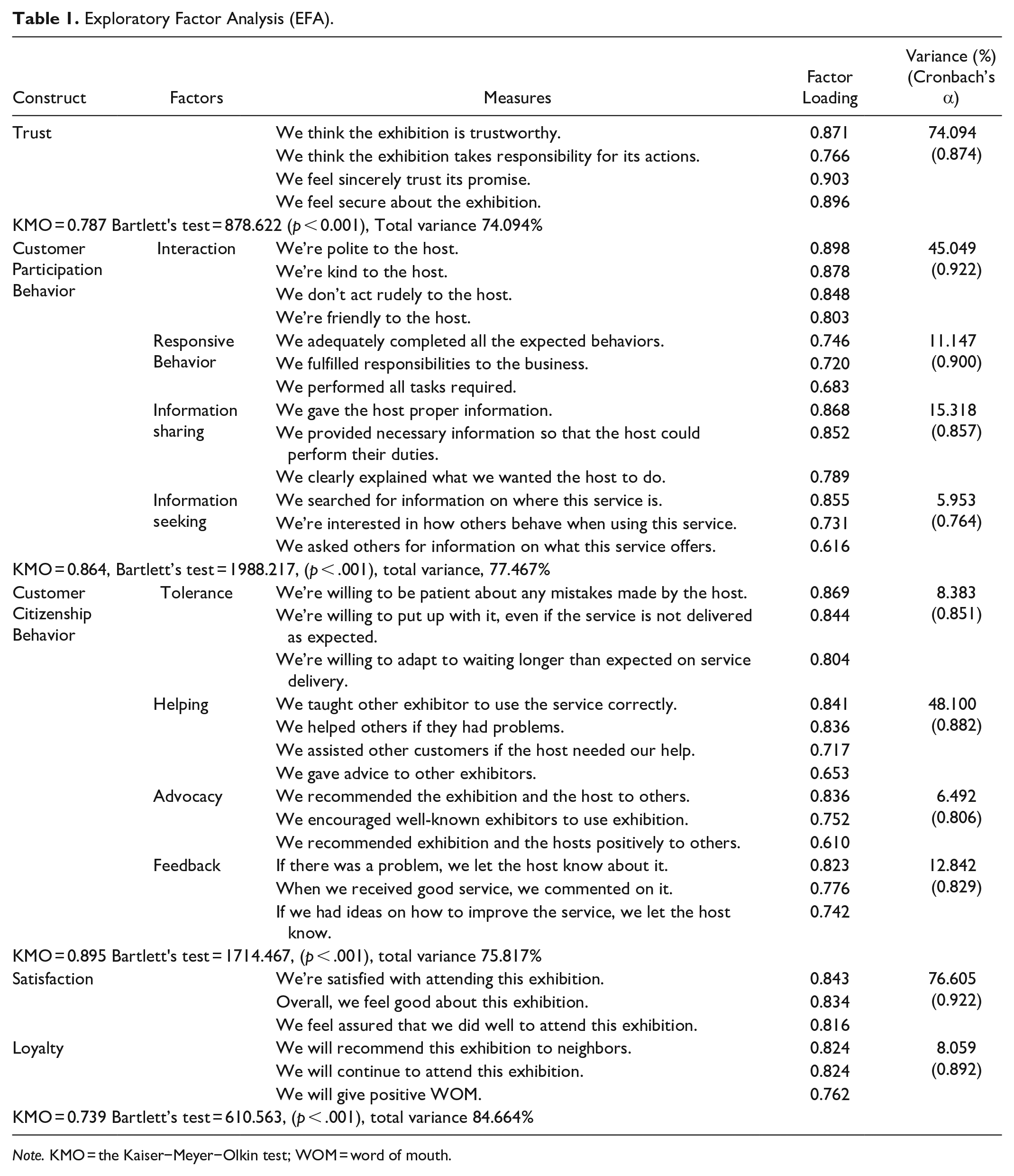
Note. KMO = the Kaiser−Meyer−Olkin test; WOM = word of mouth.
Following Soper (2020), and assuming an anticipated effect size = 0.25 and a desired power size of 0.8, the 15 items and five latent factors require a sample size of 209 to permit confirmatory factor analysis (CFA). Hence, according to Jackson (2003) and the use of the PASS software package, the current sample size permitted the use of CFA. Assessment of a variety of goodness-of-fit measures to evaluate the overall model fit showed the following results: χ2 (80) = 171.153, p < .000, df = 80, GFI = 0.909, NFI = 0.921, CFI = 0.956, RMR = 0.043, RMSEA = 0.069. All goodness-of-fit indices were within the acceptable limits (Hair et al., 2014). The composite reliability (CR) values were greater than the threshold of 0.70 (Fornell & Larcker, 1981). Convergent validity (CV) was assessed using the average variance extracted (AVE) of all constructs in the measurement model and CV > 0.5 (Fornell & Larcker, 1981). Moreover, the AVE for each construct was greater than the squared correlation coefficients for the corresponding inter-constructs and, thus, the measurement model was deemed acceptable regarding construct reliability and discriminant validity (see Tables 2 and 3).
Confirmatory Factor Analysis (CFA).
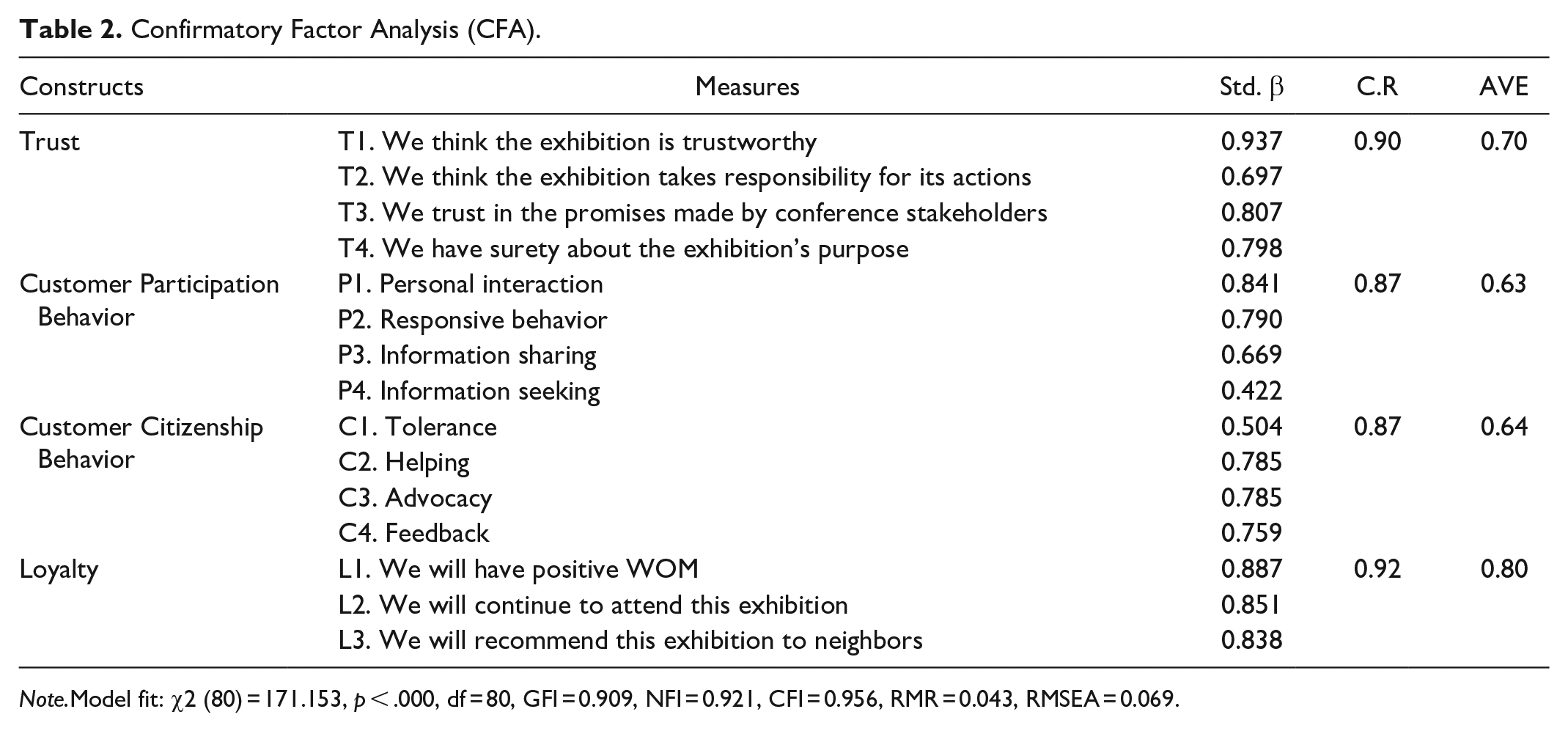
Note.Model fit: χ2 (80) = 171.153, p < .000, df = 80, GFI = 0.909, NFI = 0.921, CFI = 0.956, RMR = 0.043, RMSEA = 0.069.
Discriminant Validity.
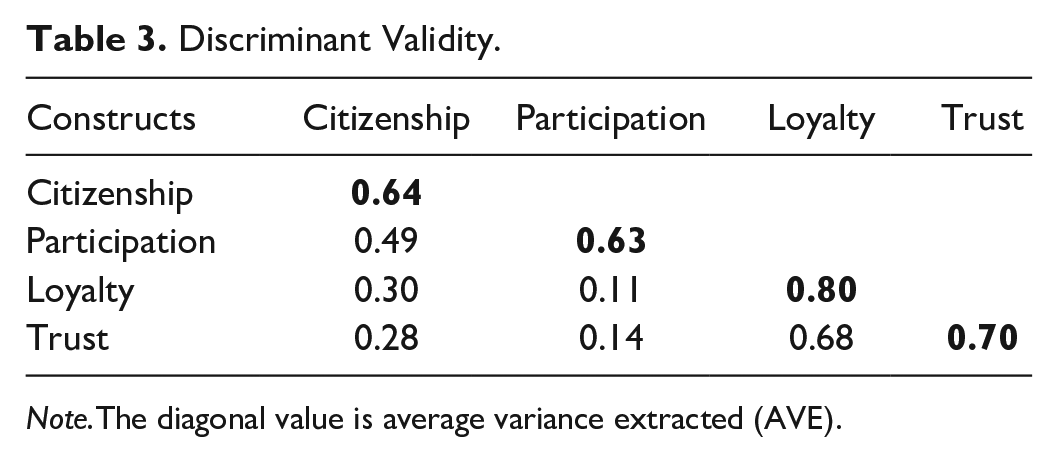
Note.The diagonal value is average variance extracted (AVE).
Structural Model
The findings from the structural equation model are shown in Figure 1 and Table 4. They indicate an adequate fit for the data: χ2 (81) = 210.129, p < .000, df = 81, GFI = 0.891, NFI = 0.903, CFI = 0.937, RMR = 0.043, and RMSEA = 0.082. All hypotheses were supported, except H4. Specifically, exhibitors’ trust of the exhibition behaviors was found to have a positive influence on citizenship behavior (ꞵ = 0.555, t = 6.056, p < .001) and participation behavior (ꞵ = 0.482, t = 4.779, p < .001) respectively, supporting H1 and H2.
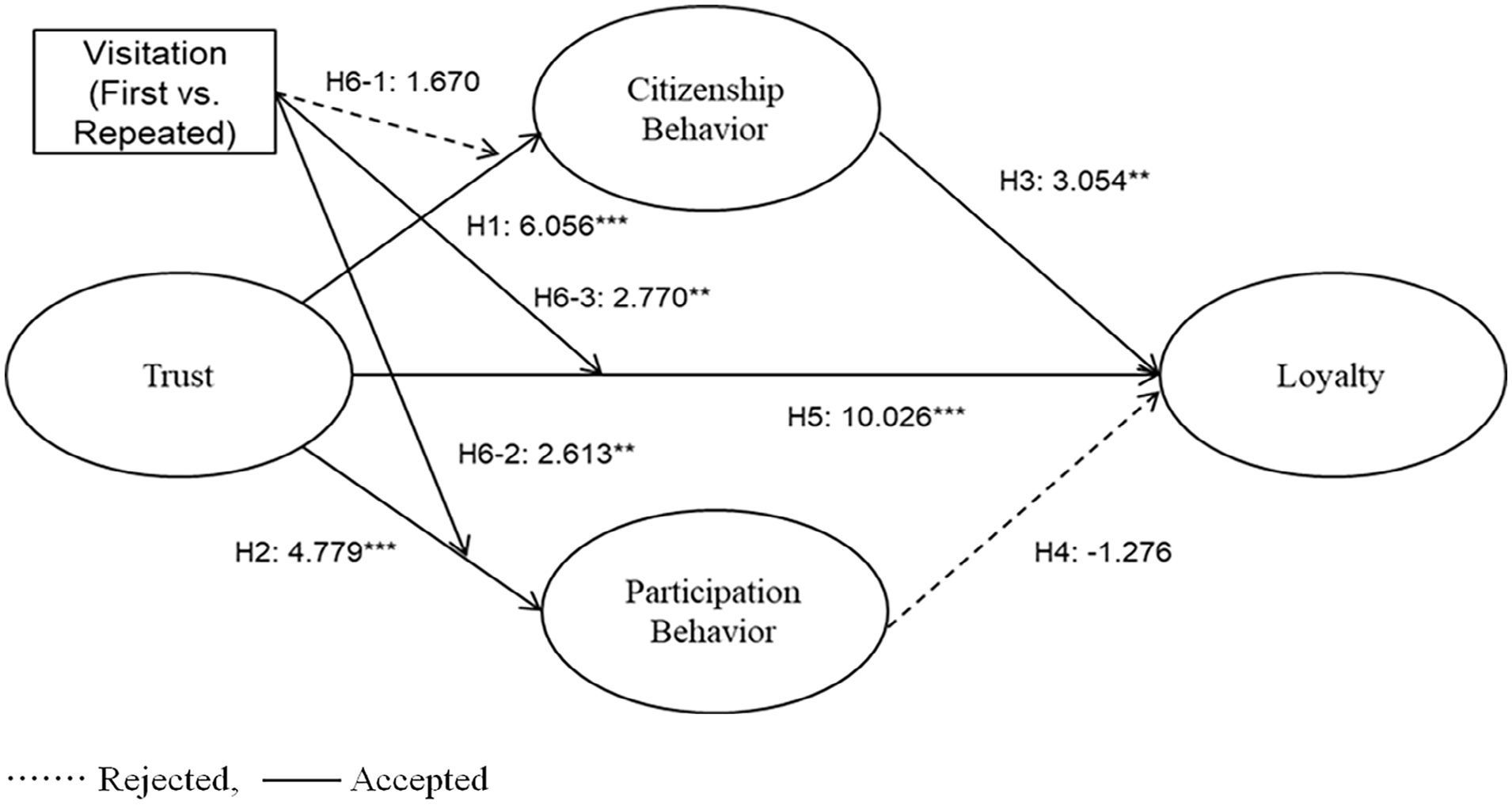
Result of SEM.
Result of Hypotheses Tests.
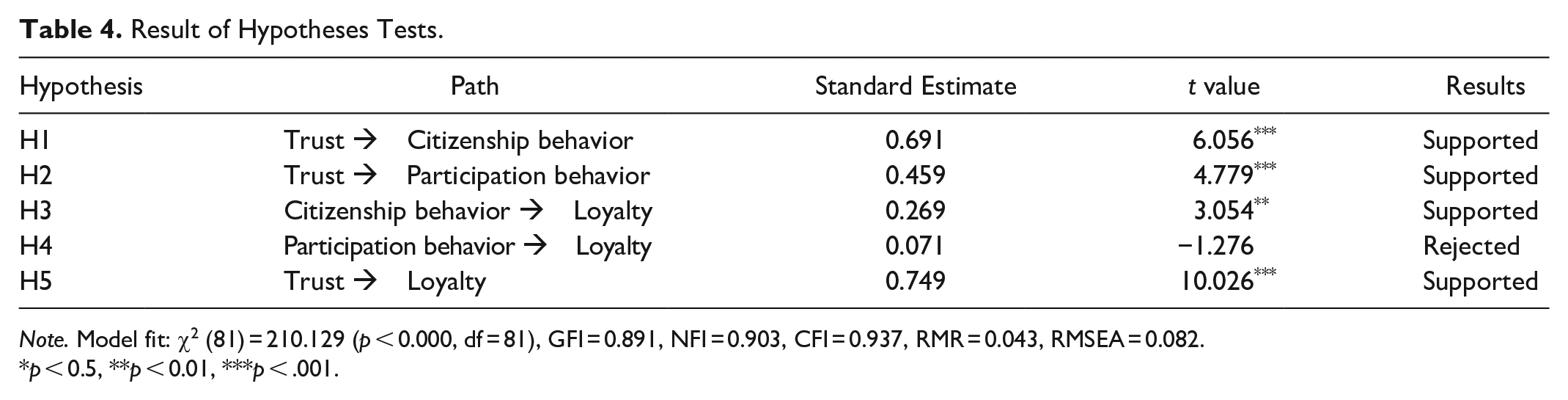
Note. Model fit: χ2 (81) = 210.129 (p < 0.000, df = 81), GFI = 0.891, NFI = 0.903, CFI = 0.937, RMR = 0.043, RMSEA = 0.082.
p < 0.5, **p < 0.01, ***p < .001.
These results imply that as an exhibitor’s trust increases, they become more willing to help, provide active feedback, have good interactions, and share and seek information proactively with the host organizer. Exhibitors’ citizenship behavior produced by trust had a positive impact on their loyalty (ꞵ = 0.219, t = 3.054, p < .01), supporting H3. On the other hand, exhibitors’ participation behaviors had no impact on loyalty (ꞵ = −0.082, t = −1.276) toward the exhibition, and thus H4 is rejected. These results differ from those of Kim et al. (2019), who found casual relationships between participation behavior and customer attitude. However, the findings suggest that exhibitors’ citizenship behavior is a much more important predictor of support for exhibition organizers. Finally, the results confirm prior research that trust has a positive influence on exhibitors’ loyalty (ꞵ = 0.685, t = 10.026, p < .001), supporting H5.
Moderating Effects
As noted above, the procedure of PROCESS Macro Model 1 for SPSS, proposed by Hayes (2022), was used to verify the moderating effect of visiting frequency (first vs. repeat) on the relationship between trust and participation, citizenship behaviors/loyalty (H6-1, H6-2, H6-3). Bootstrapping was used for verification with the confidential interval of 95%. As shown in Table 5, trust was found to have a respective positive significant effect on citizenship behavior, participation behavior, and loyalty (t values equaling = 5.330***, 2.432**, and 10.906***, respectively). The interaction effect between trust and visit frequency had a significantly positive effect on participation behavior (t = 2.613**, 95% CI [0.058, 0.416]) and loyalty (t = 2.770**, 95% CI [0.070, 0.415), thereby supporting H6-2 and 3), but H6-1 was rejected (t = 1.670, 95% CI [−0.028, 0.339]), including zero for the confidence interval of bootstrap.
The Result of the Moderating Effect of Visiting Frequency (H6).
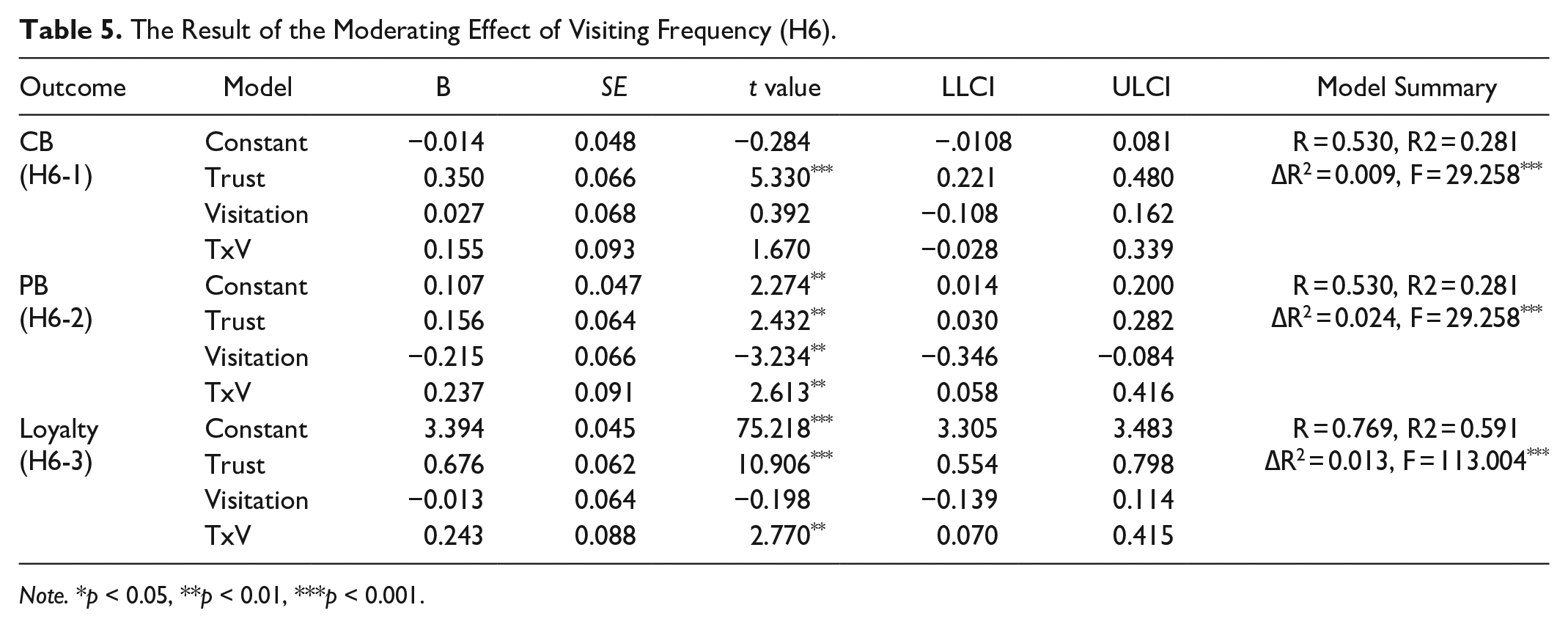
Note. *p < 0.05, **p < 0.01, ***p < 0.001.
The next step was to analyze the conditional effect of trust on participation behavior and loyalty, according to the level of visit frequency (first = 0, repeat = 1), and the effect of each was significant, as shown in Table 5. In other words, repeated visits have a much higher effect of trust on participation behavior and loyalty.
Conclusion and Discussion
Summary of the Findings
The purpose of the present study was to examine the influence of trust on exhibitors’ participation and citizenship behaviors, and whether these behaviors influenced exhibitors’ loyalty within the exhibition industry. The empirical results supported four hypotheses and rejected one hypothesis. The key findings are as follows:
First, as highlighted by Hennig-Thurau et al. (2002) and Songailiene et al. (2011), trust emerged as the most-valued benefit that exhibitors obtained from ongoing relations with the host, thereby verifying that trust has positive influence on citizenship, participation behaviors, and loyalty. This implies that trust plays a crucial role in mitigating challenges related to booth setup and preparation, thus supporting the notion proposed by Morgan and Hunt (1994) that trust is essential for successful B2B connections. The greater impact of trust on citizenship behavior compared to participation behavior suggests that once trust is established, exhibitors are likely to contribute additional value to the exhibition host beyond mere cooperation—an aspect not fully addressed in previous literature.
The study also confirms that citizenship behavior has a positive influence on exhibitors’ loyalty (Cossío-Silva et al., 2016; Y.-L. Lee et al., 2019; C.-C. Yang et al., 2014). However, no relationship was found between participation behavior and loyalty, contrasting with the findings of Grissemann and Stokburger-Sauer (2012). This suggests that while favorable interactions and responsive behaviors are beneficial, they may not necessarily result in positive word-of-mouth regarding the exhibition and host. The cultural norms in Korea indicate that interactions and responsible behavior might be perceived as basic business etiquette. Although information exchange and performance are crucial for the success of exhibitions, this study supports the idea that citizenship behavior plays a more significant role in determining long-term business relationships, a topic that, as previously noted, has been inadequately explored in existing research.
Finally, as a significant contribution of this study, frequency of exhibition attendance reinforces relationships such as trust/participation behavior and loyalty, but seemingly has little role in the relationship between trust and citizenship behavior. In simple terms, this implies that repeated attendance on the part of the exhibitor—even when they have high levels of trust—does not always lead to citizenship behaviors such as tolerance, helping, and feedback to others at the exhibition. The appearance of such behavior seems to depend on more specific ad-hoc events rather than a general formation of trust based on repeated experiences. Repeat attendance alone is not enough to generate positive outcomes, but loyalty and trust do make significant contributions. This implies that there is a need for a more nuanced approach on the part of event organizers that past attendance does not guarantee future attendance and, furthermore, does not in itself imply tolerance of sub-optimal performance by the event organizers.
Theoretical Implications
This study makes several notable contributions to the existing literature on the exhibition industry. First, it enhances our understanding of how reciprocal relationships between exhibitors and event organizers can be formed and nurtured by providing a deeper understanding of exhibitor loyalty through the examination of its link with trust, participation, and citizenship behaviors. This study contributes to the theoretical framework surrounding loyalty—particularly within the B2B exhibition industry—which has been relatively under-explored in comparison to customer loyalty in traditional retail settings (Kuhn & Mostert, 2018; Nakamori et al., 2022). Moreover, it explores the formation of shared visions, values, and potential co-production by employing social exchange theoretical frameworks, often omitted when analyzing the B2B exhibition setting (Sarmento et al., 2015). Given the economic importance of B2B exhibitions, the modeling also implies that trust and good citizenship behaviors are contributors to the broader economy.
Second, this study extends existing theory in the B2B literature by examining how the effects of trust on customer involvement, such as participation and loyalty, may differ between new and repeat customers. The investigation into how loyalty drivers differ between first-time and repeated exhibitors provides a nuanced view that many existing studies may overlook. Namely, while previous research has established trust as a crucial variable for triggering customer involvement, engagement, behavior, and loyalty (Arıca et al., 2023; Gansser et al., 2021; Srivastava et al., 2024), this study empirically reveals that the impact of trust is not uniform across all circumstances. Specifically, it demonstrates that repeat exhibitors, who already possess trust, are more engaged and responsible, leading to more successful exhibitions compared to new exhibitors. This nuanced finding has scarcely been addressed in the literature, although some studies have explored group comparisons related to exhibition attachment (Fu et al., 2019), augmented reality experience (Y. Liu et al., 2023), and perceived relationship quality (Jin et al., 2012). This distinction not only adds depth to exhibitor loyalty theory; it also suggests that loyalty-building strategies should be tailored based on exhibitors’ previous experiences, contributing a practical dimension to the theoretical framework. Therefore, examining the moderating effects of first-time versus repeated exhibitors in the pathway from trust to participation, citizenship, and loyalty will be a crucial area for future research in the exhibition literature.
Third, citizenship behavior, typically discussed within internal organizational settings, is rarely highlighted in external stakeholder relationships (Balaji, 2014). This study extends the concept to exhibitor–organizer interactions, showing that when exhibitors go beyond expected participation to support and enhance the event experience, they contribute significantly to value co-creation. This theoretical contribution enriches the literature by proposing that citizenship behavior can play a pivotal role in a collaborative business to business environment.
Lastly, the study underscores the importance of examining exhibitors’ participation and citizenship behaviors towards organizers, as these behaviors are vital for generating value co-creation. This focus on joint organizational outputs, such as co-design, idea co-conception, and co-marketing (Frow et al., 2015; Vargo & Lusch, 2008), is critical. By shifting the focus to the active roles exhibitors can play, this study suggests that co-creational behaviors could be as important—if not more so—than traditional relational quality factors in building strong exhibitor–organizer relationships. Nevertheless, existing literature has not fully addressed this aspect. Most research has concentrated on improving relational quality, including involvement, engagement, loyalty, and trust for long-term relationships (Jin et al., 2012; Lai, 2015; Lai & Wong, 2021). Thus, the approach adopted in this study encourages future research to consider co-created value as an equally important, parallel framework to relational quality in stakeholder interactions in the B2B exhibition sector.
Managerial Implications
This study also offers several important managerial implications. First, the exhibition organizer would find benefits in trying to enhance trust with exhibitors. An emphasis on staff possessing trusting dispositions and strong professional reputations will create a sense of trust that relies on individual attributes, effective communication, and organizational qualities (Robert et al., 2009). Mutual communication with exhibitors via social networks would be an effective way of building trust among exhibitors who otherwise may consider conference attendance as being simply the provision of data to be utilized for improved performance (W. Y. Wang et al., 2016).
Second, the exhibition organizer should closely monitor exhibitors’ behaviors regarding past patterns of support and participation in efforts to help create successful exhibitions. This requires the implementation of a monitoring system that includes exhibitors’ feedback and opinions on how the exhibition can be improved. This may be particularly crucial in a post-pandemic period that shows businesses increasingly using AI (Artificial Intelligence) and ICT (Information and Communication Technology) to engage with their respective clientele. Moreover, organizers should consider additional strategies that enhance the perceived value of responsible behavior, thus linking it more effectively to loyalty.
Third, this study reveals that repeat customers with higher levels of trust scores have the highest levels of loyalty, are interactive and responsive, and provide both positive and negative feedback to exhibition organizers. Trust thus plays a pivotal role in shaping a broader concept of industry citizenship. This study also highlights that repeat attendance at exhibitions has a distinct link to loyalty and citizenship, thereby reinforcing the need for event monitoring by organizers. Also, organizers should design specific strategies to offer repeat exhibitors greater personalized experience—long-term partnerships supplemented by incentives for shared responsibility.
Limitations and Further Research
Like other empirical studies, this research has some limitations that imply opportunities for further research. First, these results should be interpreted in the context of the exhibition industry with some care, because past findings highlight the significance of omitted variables including customers’ individual characteristics, organizers’ support and culture, and their employees’ involvement (Grissemann & Stokburger-Sauer, 2012). Future research can delve into such factors. Also, investigating cultural and individual differences of reciprocity will be another avenue for further studies to expand the present contribution and, additionally, comparisons between B2C (business-to-consumer) and B2B (business-to-business) fairs will be helpful to expand the research scope in the exhibition area, subject to the caveat noted in the final paragraph.
Second, the causal relationship between trust, participation, and citizenship behaviors could be further examined. In this study, trust was conceived as a determinant of the success of participation and citizenship behaviors which could trigger value creation, but the pattern of causality may well be reiterative. This potential reiterative nature of causality could be a subject for future research.
Finally, as the setting of the empirical study was Seoul, South Korea, the findings may not be generalizable to other regions or countries that possess less hierarchical cultural systems. Thus, future research is recommended to test the proposed measurement scale and conceptual model in other different regions possessing different cultural backgrounds, in order to permit possible global generalization. Finally, employing enhanced sampling techniques that permit international comparisons may further strengthen the validity and generalization of the findings.
Supplemental Material
sj-docx-1-jht-10.1177_10963480241311151 – Supplemental material for Exhibitor Loyalty Through Trust, Participation and Citizenship Behaviors – Moderating Effect of First-Time and Repeat Exhibitors
Supplemental material, sj-docx-1-jht-10.1177_10963480241311151 for Exhibitor Loyalty Through Trust, Participation and Citizenship Behaviors – Moderating Effect of First-Time and Repeat Exhibitors by Jiwon Lee and Chris Ryan in Journal of Hospitality & Tourism Research
Footnotes
Declaration of Conflicting Interests
The authors declared no potential conflicts of interest with respect to the research, authorship, and/or publication of this article.
Funding
The authors received no financial support for the research, authorship, and/or publication of this article.

Supplemental Material
Supplemental material for this article is available online.
Author Biographies
References
Supplementary Material
Please find the following supplemental material available below.
For Open Access articles published under a Creative Commons License, all supplemental material carries the same license as the article it is associated with.
For non-Open Access articles published, all supplemental material carries a non-exclusive license, and permission requests for re-use of supplemental material or any part of supplemental material shall be sent directly to the copyright owner as specified in the copyright notice associated with the article.
