




Abstract
Business education is undergoing paradigmatic changes, and business schools are feeling the brunt of these changes. This article proposes that “business as usual” is over for traditional business schools. Using Ohmae’s 3Cs—customers, competitors, and company—as an analytical framework, I examine important changes from different vantage points. From the perspective of customers, the focus lies on technological and value changes. In terms of competitors, the analysis centers on the growing number of alternative suppliers of business education and the geographic shifts in the business school landscape. As to the company dimension, I comment on the vast number and heterogeneity of business schools and suggest that they are heading toward a business model competition. In considering potential development paths for business schools, the article concludes that they require radical innovations to stay relevant.
Business education is undergoing paradigmatic changes, and business schools are feeling the brunt of these changes. In 2014, Rich Lyons, the former dean of the Haas School of Business at UC Berkeley, predicted that half the business schools in the world could go out of business in 5 to 10 years (“Haas Dean Confidently Predicts,” 2015). While this alarming and now imminent prophecy remains far away, we have witnessed a number of noteworthy financial struggles, mergers, and acquisitions. In the United Kingdom, Ashridge Business School has been acquired by Hult Business School, and Henley Business School has been rescued by the University of Reading. In France, the merger between Reims and Rouen resulted in NEOMA, that between Marseille and Bordeaux created KEDGE, and that between CERAM Business School in Sophia Antipolis and the ESC in Lille brought us SKEMA. In the United States, the Thunderbird School of Global Management in Arizona had to be bailed out by Arizona State University, and Cornell’s College of Business sought efficiencies by amalgamating the School of Hotel Administration, School of Applied Economics and Management, and Graduate School of Management.
At a program level, the 2-year full-time MBA model in the United States has been particularly hard-hit. For a number of years, even the top-ranked U.S. business schools have reported a substantial decline in MBA applications (Cutter, 2020). In their most recent survey, the Association to Advance Collegiate Schools of Business (AACSB, 2020) showed that the number of accredited full-time MBA programs in the United States shrank by 9% to 1,189 between 2014 and 2018; in the same period, schools also reported 119 fewer 2-year degrees (Gee, 2019). Among others, Wake Forest, Virginia Tech, the University of Iowa, Illinois at Urbana–Champaign, and Stetson University in Florida cut their traditional full-time MBA programs.
However, the downward trend observed in the United States is not mirrored elsewhere (Jack, 2019). In fact, the most recent Association of MBAs (AMBA) application and enrollment report indicated an average increase in applications between 2017 and 2018, of 9% for business schools and 8% for MBA programs (AMBA, 2019a). The average number of enrollments increased by 10% at school level and 9% for MBA programs. The largest increase was reported for China (including Hong Kong), where business school applications rose on average by 29%, with 16% at program level.
This article analyzes some of the underlying reasons behind these changes, explores why the developments are so uneven across geographies, and outlines alternative strategic trajectories for business schools. Below, I initially provide an overview of the numerous challenges business education is facing, using the perspective of business schools as traditional providers of advanced business education. Subsequently, I look at business education from a strategic perspective and employ Ohmae’s (1982) 3Cs—customers, competitors, and company—as a framework within which to scrutinize important drivers of change in more depth. In terms of customers, I focus on shifts in demand connected to technological developments and value changes among customers. With regard to competitors, digitalization is once again the key driver of change in that it leads to an increasing number of alternative suppliers of business education. In addition, I analyze the growing influence of Asian business schools and comment on European approaches to business education. As regards the company dimension, I comment on the vast number and heterogeneity of business schools and suggest that they move into business model competition. The article closes by considering potential development trajectories, concluding that business schools need radical innovations if they are to stay relevant.
Business School–Based Business Education: A Plethora of Concerns
Traditionally, advanced business education has been the core domain of business schools, and the attendance of a business school has long been a rite of passage for aspiring managers (Grey, 2007; Whitley, 1981). This has changed, and the incumbent position of business schools as the primary purveyors of advanced business education is now under attack. A number of pressure points, some new and some old, cause concern, and here I single out five key issues.
First, we are witnessing a digital paradigm shift, which has vastly increased knowledge about the requirements of potential students, enabled the development of highly customized content, and widened the options for delivering learning material to students. Unfortunately, however, business schools are not leading such changes, and innovative technologies and new business models in business education are largely developed outside business schools (Bradley et al., 2015).
Second, deglobalization and the shift of economic power to Asia is affecting scientific exchange and student flows. The idea that cross-border integration will diminish national autonomy and that ever-growing technoglobalism (Ostry & Nelson, 1995) will eventually lead to a “flat” world (T. L. Friedman, 2005; Rugman & Oh, 2008) has been proven wrong (Petricevic & Teece, 2019). “Recent geopolitical events such as Brexit and the US turning its back on multilateral trade and cooperation [has created] waves of uncertainty in higher education regarding international cooperation, the free movement of students, academics, scientific knowledge and ideas” (van der Wende, 2019, p. 9). These developments have been paralleled by a decline in the dominance of U.S. business schools. Different regions and countries have started to develop (Asia) or reaffirmed (Europe) their own business school models, which diverge from the dominant U.S. approach and are increasingly adapted toward different cultural, political, and economic systems (Thomas et al., 2013). This has resulted in substantial reputational gains for business schools outside the United States and the emergence of strong national champions. Europe, for example, pioneered the elite CEMS network, which offers a unique approach to graduate management education. In India, the Indian Institutes of Management (IIMs) and Indian School of Business have emerged as strong national champions. In South East Asia, institutions such as Hong Kong University of Science and Technology (HKUST), National University of Singapore, Singapore Management University (SMU), and Korea University are culturally well-embedded and have developed their own distinct approaches to teaching and research. In mainland China, excellent schools such as Peking University, Tsinghua, Zhejiang, Fudan, and Shanghai Jiao Tong have emerged and created China-specific electives.
Third, traditional business schools also face an enemy from within. Notwithstanding their remarkable expansion, especially between the 1960s and 1990s, the academic standing of business schools within universities has long been under criticism. When embedded in universities, business schools need to fight for their legitimacy and are frequently viewed as “cash cows” rather than as representatives of a serious academic discipline (Nussbaum, 1997; Pfeffer & Fong, 2004).
Fourth, even beyond such intraorganizational issues, many business schools around the world are still searching for their identity. As purveyors of advanced business education, they are persistently struggling with the tension between scientific rigor and practical relevance. The essence of this debate can be traced back to the influential reports by the Ford Foundation (Gordon & Howell, 1959) and the Carnegie Foundation (Pierson, 1959), which both criticized the pre-1950s trade-school era and advocated a scientific logical positivism (Thomas et al., 2013). The findings of these reports have shaped the work of business schools to the present day, but the tensions have never been resolved. This has resulted in a lingering identity crisis among business schools, where views on what exactly should constitute the essence of business education are diverging widely (Datar et al., 2010; Mintzberg, 2004; Pfeffer & Fong, 2002; Schoemaker, 2008; Skapinker, 2011; Thomas et al., 2013).
Fifth, business schools no longer only compete—or cooperate—with each other but also with specialist online education providers (e.g., Coursera), social platforms (e.g., LinkedIn Learning), consultants (e.g., McKinsey Academy), and companies that operate their own corporate universities (e.g., Unilever University). This has increased the strategic complexity for business schools: When should a school compete and when should it cooperate? With whom should it cooperate and what is the best way of cooperating? What drives the answers to such questions? Increased competition has not only weakened the position of business schools but also continues to shape the expectations of students, who compare the content and service levels of these other providers with that of business schools.
Arguably, there are other concerns for business schools, such as the increasing doubt about the value of degrees in the job market (Burnsed, 2011; Connley, 2018; Lobo & Burke-Smalley, 2018; Trusko, 2015), the impact of demographic shifts on student demand (Lutz, 2011) or the recruitment and retention of suitable faculty (Moratis et al., 2005). These issues alone are sufficient to illustrate that business schools are under pressure and face a radically changing environment. Thus, all is not well for business schools, which have traditionally been the key source of advanced business education. Below, I provide a more detailed analysis of some important drivers of change in advanced business education from different vantage points and discuss possible strategic trajectories for business schools.
Customers
Looking at business education from a customer perspective, I focus on two key aspects. The first concerns the paradigmatic changes in technology and their impact on learning and teaching; the second centers on changes in the values held by potential applicants. I start with technology and then turn to value changes, specifically the increasing demand for sustainability, which affect the curricula and conduct of business schools.
Speed of Technological Change
The impact of digital disruption on traditional business school education has already been discussed in a recent special issue of the Journal of Marketing Education (Crittenden & Peterson, 2019; Langan et al., 2019). However, at present, we only scratch the surface of a myriad of developments that revolutionize the way students will learn and business schools will teach in the future. Already, students want to learn wherever (e.g., on board a plane), however (e.g., by playing a business game), and whenever (e.g., at 2 a.m.) it best fits their individual needs. They also want learning to be a stimulating and enjoyable experience. Commuting to a business school located somewhere in a city, struggling to find a parking space, and listening to a traditional lecture hardly fit this picture.
Contrast such traditional methods with the potential offered by, say, virtual reality headsets such as Microsoft’s HoloLens, the Oculus Quest, or similar (Microsoft, 2018a; SaaSHub, 2020). Students could learn about consumer behavior in emerging markets by immersing themselves, say, in a souk in Marrakesh or a bazaar in Kolkata. In distribution and supply chain courses, they could embark on virtual tours through manufacturers’ shop floors and look at distribution centers. The technology could be used to make them feel like they are really at these places, without ever leaving their living rooms. The applications are only limited by our imagination and, unfortunately, by the substantial investments into their development and the purchase of accompanying hardware for students. Still, looking at Gartner’s (2019) hype cycle for education, virtual reality applications are rising in terms of market expectations.
Augmented-reality holographic technology is also set to change teaching approaches. Instead of faculty flying expensively and unsustainably around the world, they could be beamed into classrooms via holographic telepresence to give lectures or deliver entire courses in different continents. During one of AMBA’s Global Conferences in 2018, a live two-way discussion took place between the audience, located in Stockholm, and the digital human hologram of the chief executive officer (CEO) of ARHT Media, Larry O’Reilly, located in Toronto (Figure 1). The audience had the impression that O’Reilly was actually with them in Stockholm. The entire discussion could be stored for playback on demand. In fact, according to ARHT Media, such holograms can also be “captured, transmitted and displayed directly to multiple stages simultaneously with complete live two-way interactivity” (ARHT Media, n.d.). This appears to challenge the age-old wisdom that one cannot be in two places at the same time!

Hologram of the CEO of ARHT Media, located in Toronto (right) in discussion with AMBA moderator in Stockholm (left).
While being highly impressive, the technologies discussed so far are primarily altering the way knowledge is distributed. In other words, they influence where students learn (e.g., in-class vs. anywhere), when they learn (synchronous vs. asynchronous), and how they learn (e.g., listening to hologram professors vs. interacting with a PC). In contrast, artificial intelligence (AI) has the potential to personalize learning and tailor both content and pedagogical approach to the specific background and requirements of the learner. Imagine a middle manager working in human resource (HR) in a large pharma company who aims to change industry and to move into a marketing function. Clearly, this pharma HR-manager would have different learning requirements than a finance manager in the automotive industry preparing for a move into the C-suite. An MBA program would typically include some content that these individuals would already know or would not need—but any standardized MBA program would be hard-pressed to deliver, for example, the industry-specific insights they would require. Moreover, standardized programs are limited in their ability to adapt to individual learning styles. This is where AI products such as FLEXA—hailed by its manufacturer, Microsoft, as “the ultimate career-path mentor” (Microsoft, 2018b)—can help. In collaboration with the Politecnico di Milano, FLEXA undertakes to analyze the hard, soft, and digital skills of a participant and to identify their existing knowledge gaps in order to address their individual specific long-term professional aspirations. Next, it will provide participants with a range of content designed to fill the identified knowledge gaps. At present, this content is selected only from the Politecnico di Milano “and other certified Italian and international sources” (FLEXA, 2018). However, it is easy to see that FLEXA or similar AI products could completely alter the competitive dynamics in the management education arena. Courses from the Politecnico di Milano could, for example, readily be substituted by offers from, say, Bocconi or WU Vienna, and suddenly customer loyalty would shift from the business school to the system provider, in this instance Microsoft. When the programs and courses of a given business school can be easily supplanted by other offers, there is a danger that business schools become mere suppliers for platform providers.
Other emerging trends are microcredentials, digital badges, and stackable certificates (J. Friedman, 2016). “To earn a micro-credential, a certain number of activities, assessments, or projects related to the topic need to be completed. Once the requirements are completed, work can be submitted in order to earn the credential” (Study.com, n.d.). Microcredentials are endorsed on different platforms (e.g., ServiceNow, Study.com, NISE Micro Certificates) and by different universities. Australia’s Royal Melbourne Institute (RMIT), for example, offers a range of microcertificates and collaborates with KPMG, EY, and other companies (e.g., RMIT, n.d.). Many microcertificates come in the form of digital badges, which are web-enabled tokens or images representing a particular achievement.
Microcertificates and digital badges are closely related to stackable certificates, which are typically offered at public colleges and are short academic programs running for only a few weeks. Students can reuse (i.e., stack) such certificates later in life, for example, to get credits for bachelor degrees. This gives students the freedom to choose among different institutions after each short credential and pursue more advanced degrees without starting over (Brown, 2016). This again increases the competitive pressure on business schools.
Microcredentials have already found their way into some renowned business schools, which have started to offer students the chance to complete a series of massive open online courses (MOOCs) and earn a verified certificate from each. In the case of Massachusetts Institute of Technology (MIT), if students opt to complete an additional capstone exam, they receive the MITx MicroMaster credential. Meanwhile, training outside business schools is offered in smaller and smaller units. The American Marketing Association (AMA, 2019) provides its members with so-called “coffee breaks,” daily 10-minute lessons on a variety of topics. Another example of this atomization of digital learning can be found in a boutique firm, BY Learning Solutions (n.d., https://www.bylearnings.com), which helps design digital content. The company offers basic 1- or 2-minute “Skim” modules designed to build awareness and reinforce knowledge, 8- to 10-minute “Swim” modules that summarize and classify, and 20- to 30-minute advanced “Dive” modules.
Collectively, such rapid technological changes indicate the end of business as usual. Traditional business schools will struggle to survive without embracing such fundamental changes in technology and developing and implementing clear digitalization strategies.
Value Changes: Demand for Sustainability
Value changes of customers will also exert a profound influence on business education and will include demand for content addressing responsible management and ethical leadership as well as diversity and equality (Crisp, 2020). Below, I look in detail at the possible impact of one such value change: the demand for sustainability. I selected sustainability because of the 17 well-known United Nations Sustainable Development Goals (United Nations, 2015), and the fact that, in business, issues of sustainability now run throughout the entire supply chain, including the points of purchase and consumption (Gruber et al., 2014).
Sustainability is central to any discussion of value change. But, what does demand for sustainability mean and where does it come from? At a rudimentary level, sustainability refers to our concern that human activities should meet the needs of the present without compromising the ability of future generations to meet their own needs (United Nations, 1987). At a more detailed level, sustainability calls for the balancing of three fundamental dimensions: environmental protection, societal progress and economic growth, and requests for companies to focus on the triple bottom line of “planet, people, and profit” (Elkington, 1999; Simmons et al., 2018). While business school teaching has traditionally focused on economic growth, the “profit” part of the three sustainability dimensions, the “people” and “planet” dimensions of sustainability are now increasingly gaining center stage.
This will require a fundamental widening of the focus of business schools. In fact, most case discussions and lectures fail to even question the primacy of profit as an outcome variable in corporate value creation. Our teaching typically centers around how the various elements of the value chain contribute to increasing profits. We debate how employees can become more profit-oriented. We research how a supply chain can be optimized for profit. We teach how customer touch-points can be designed to increase profits, and we debate the most profitable pricing strategies. Even when corporate social responsibility (CSR) or sustainability issues are addressed, they are usually also cast into a model that focuses on profit outcomes, for example, “how do our CSR measures impact on profits?” Likewise, we debate whether supporting local causes is more profitable than supporting international causes, or whether a children’s charity or local art gallery will offer a higher return.
While these and similar questions are undoubtedly important for both teaching and research in business schools, it is the virtually exclusive focus on profit as an outcome variable that is the problem. What about nonfinancial outcomes, such as customer safety, reduction of waste, or employee health? What about organizations that have other purposes, such as social enterprises or B-corporations? Business schools have been slow in tackling questions of value and purpose, although recently deans of some top U.S. business schools appear to have recognized the need for change. One such is William Boulding, the dean of Duke’s Fuqua School of Business, who says, “We need our students to be thoughtful about the role of business in society, particularly at a moment in time when capitalism is coming under attack” (“American Business Schools,” 2019, para. 2).
Today, students, in their roles as consumers and increasingly in their parallel roles as employees, employers, and entrepreneurs, are concerned about a multitude of sustainability issues, such as food quality, their own ecofootprint, and working conditions (Öberseder et al., 2013). Legislators also focus more and more on issues such as environmental degradation or recycling. Finally, corporations themselves are not only reacting to shifting consumer demands and legal requirements but also explore sustainability issues such as recycling and energy conservation.
Business schools cannot ignore these value changes. Instead, the increasing demand for sustainability needs to translate into widening curricula in which much more debate on the purpose of the enterprise will have to take place. Faculty may still be ill-equipped to tackle such fundamental debates (Weber, 2013). Typically, teaching staff have a strong grounding in particular subject areas, such as finance, marketing, or statistics. This often leads to a confined debate of sustainability, ethics, and CSR in specialized courses instead of an integration of these aspects into subject-specific courses (Gruber & Schlegelmilch, 2013). This is not sufficient. Faculty needs to adopt more holistic viewpoints. Perhaps business schools of the future will employ philosophers to teach classes jointly with functional specialists.
Competitors
Alternative Suppliers of Business Education
Business schools are facing an increasing number of rather diverse competitors, in particular when considering nondegree offers. For a start, they may compete with their own faculty, who contract directly with companies seeking business education. Management gurus like Michael Porter from the Harvard Business School, Kim and Mauborgne from Institut Européen d’Administration des Affaires (INSEAD), or Gary Hamel from London Business School (LBS) exemplify this type of competition. However, well-known management gurus are only the most visible part of the issue; business schools suffer more from an army of lesser-known faculty members who work for corporations or alternative suppliers of business education. While noncompetition clauses in faculty employment contracts are an obvious way to deal with this, such clauses are uncommon in many countries. Moreover, it may sometimes be in the interests of business schools when well-known professors spread the reputation of their organization. Thus, there are circumstances where commercial interests and reputational considerations do not necessarily align.
Next, there are competitors who are enabled through digitalization, including specialized online education providers such as Cousera, FutureLearn, edX, Udemy, or Udacity. Where universities have founded these organizations and they are run as nonprofit entities, such as edX founded by MIT and Harvard, the relationship between individual business schools and providers is one of “coopetition,” seeking synergies by collaborating with competitors. Private companies, in contrast, compete more directly with business schools. Coursera, for example, founded by two Stanford professors, charges business schools for placing their courses on their platform and then incentivizes them with 6% to 15% of gross revenues received from the course participants, referred to as learners (Eckstein, 2019). Using this business model, Coursera has an estimated U.S. dollar market value of more than 1 billion (Adams, 2019).
In addition to organizations created for the sole purpose of providing online education, there are social media platforms that have branched out into providing online courses. One of the best known is LinkedIn Learning, which offers courses to its 675 million members (Omnicore, 2020). The fact that LinkedIn knows a lot about the career background of its members and sometimes also about their career aspirations enables the platform to make highly targeted offers to users.
Many business leaders and industry observers are dissatisfied with the curricula and foci of business schools. In essence, this critique has not changed over decades (e.g., Cheit, 1985; Hayes & Abernathy, 1980; Levitt, 1978; Livingstone, 1971; Mintzberg, 2004; Skapinker, 2011) and claims that business school teaching is “too analytical and detached, too academic, too technical and far too narrow and specialized” (Thomas et al., 2013, p. 69). This perception, as well as cost considerations, has given rise to the creation of corporate universities run by large companies around the world. Prominent examples include Sberbank University in Russia, Infosys Mysore Campus in India, the General Electric Crotonville Management Development Institute in the United States, or the Bertelsmann University in Germany. In its Executive Education Futures report, CarringtonCrisp (2018) found that less than a third (28%) of organizations use business schools for their custom executive education; in-house services (60%), consulting companies (51%), and online providers are used far more widely. Clearly, business schools are not the first-choice provider of business education among companies.
Geographic Shifts
Growing Influence of Asia
A brief look at the history of business schools helps appreciate the stunning emergence of Asian management education in recent years. Although the first business schools were in Europe, they quickly became a hallmark of the United States. Aula do Comércio (School of Commerce) in Lisbon, established in 1759 and closed in 1844, is said to be the world’s first government-sponsored school to specialize in the teaching of commerce, including accounting (Rodrigues et al., 2004). Meanwhile, ESCP Paris, founded in 1819, is regarded as the world’s oldest fully-fledged business school (ESCP Europe, n.d.). More than 60 years later, in 1881, the Wharton School of the University of Pennsylvania was established, according to its website as “the world’s first collegiate school of business” (The Wharton School, n.d., para. 1). Note the adjectival modifiers “fully-fledged” and “collegiate”—how important precise definitions are to support historical firsts! Next, in 1900, the Tuck School of Business at Dartmouth College was established as the first graduate school of management in the United States (The Tuck School of Business, n.d.). Tuck is particularly noteworthy in that it conferred the first advanced degree in business, a Master of Science in Commercial Sciences. This is widely regarded as the predecessor of the MBA. In 1908, the first MBA program was established by the Harvard Graduate School of Business Administration, and in 1943, the first Executive MBA (EMBA) was established at the University of Chicago, Booth School of Business. At this time, only American universities offered MBAs (Leach, 1993).
It was not until 1950 that MBA degrees became popular elsewhere. The first MBA program outside the United States was offered by the Ivey School of Business, University of Western Ontario, Canada. One year later, this was followed by the University of Pretoria in South Africa. In 1957, INSEAD in France became the first European business school to offer an MBA. The following decade then witnessed a burst of new business schools, including renowned institutions such as Manchester Business School and LBS in 1965.
The first MBA degree in Asia can be traced back to 1955. The Institute of Business Administration (n.d.) at the University of Karachi, Pakistan, offered an MBA with technical support from Wharton and, later, the University of Southern California. In 1963, Korea University established the Graduate School of Business Administration (Korea University Business School, n.d.) and recruited its first MBA students. Although commercial education existed in China before the upheavals of the Japanese invasion, the Civil War and the revolution (eChinacities.com, 2009), the MBA itself has a short history. The first nine MBA programs were launched only in 1991; today, there are more than 230 MBA programs in the country (China Education Centre, n.d.).
Notwithstanding the late adoption of MBAs in Asia, the 2019 “Global MBA ranking 2018” (2018b) full-time global MBA ranking included 15 Asian MBAs in the top 100, six of them from China. In its latest Executive MBA Ranking, 28 Asian MBAs are among the top 100, the top eight involving business schools from China (“Executive MBA ranking 2018,” 2018a). (This includes joint programs with an Asian business school as a partner.) A decade ago, the Financial Times ranked only four Asian MBAs among the top 100 in their full-time global MBA ranking, and only nine in their Executive MBA ranking. Skeptical readers who point to the widely criticized reliance on financial criteria in the FT rankings may instead turn to accreditation—AMBA now accredits more than 50 business schools with MBA programs in Asia, 39 of them in China alone. This provides further evidence of how important Asia’s business schools have become in just over two decades.
The phenomenal rise of MBA programs in Asia reflects the region’s transformation into a hotbed for global business. As Pavida Pananond, associate professor of Thammasat University in Bangkok, aptly comments, If you are sitting in London or Boston, you might not really feel the action as much as if you were sitting in Shanghai to see how business is growing in China. So one of the first advantages of these Asian schools is that you are located where the action is. (O’Chee, 2018)
Widening the lens for a moment, it is interesting to observe that China has now become one of the top choices for global students. While China did not even feature among the top destinations for global students in 2001, it ranked third in 2017 (Figure 2).
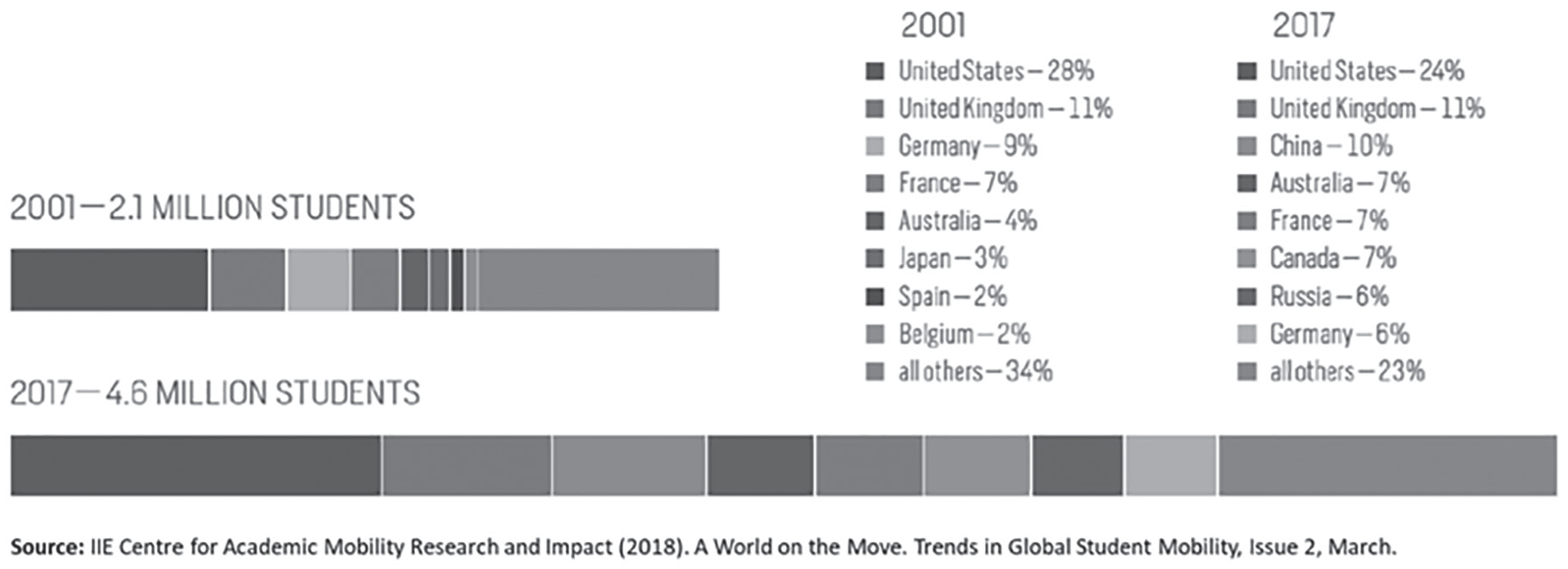
Host destination of globally mobile students 2001 and 2017.
In 2017, China also surpassed the United Kingdom and Germany for the first time in the number of citations of international science papers (Zhihao, 2017). Chinese top CEOs also seem to be the best-educated. “All of them have at least an undergraduate degree, and 33% even hold a doctorate, the highest value worldwide” (Study.EU, 2017). The same survey informs us that only 2% of top U.S. CEOs hold a doctorate degree.
Taken collectively, the dominance of American and European business schools is diminishing. Asian business schools are on the rise, and Chinese universities are attracting more incoming students than ever. Asian managers also appear to put more emphasis on formal education. Today, the emergence of top Asian business schools as formidable competitors is yet another indicator of the end of business as usual.
Reemergence of European Business Education
I have described how higher business education originated in Europe (Blanchard, 2009; Renouard, 1999). One can broadly distinguish between the Founding Period prior to 1944, the Assimilation Period, marked by an Americanization of European business schools after World War II, and the (re)emancipation of a European model in the late 1990s (Kaplan, 2014; Kieser, 2004; Üsdiken, 2004). In 1999, the European Union initiated Bologna process transformed European higher education and with it business school education. The Bologna Accord aimed to increase the comparability and standards of European degrees and established a clear division between undergraduate and graduate studies. A central aim was also to promote student mobility among different fields of study, institutions, and European nations (European Commission, n.d). The Europe-based accreditation systems, AMBA and EFMD, played an important role in shaping the distinctions between the United States and European business school models, as their accreditation criteria differ from the U.S.-based AACSB criteria (Thomas et al., 2013). Both AMBA and EQUIS place stricter requirements on internationalization and focus on how business schools are able to differentiate themselves from other schools, whereas AACSB focuses more strongly on curriculum design. According to Kaplan (2014), “this may explain why AMBA accreditation and, correspondingly, triple-crown accreditation (i.e. AACSB, AMBA, EQUIS) are primarily pursued by European [and some Asian] institutions, whereas only one USA school is AMBA-accredited and none has triple-crown accreditation” (p. 531). This situation has not changed to date, with Hult International Business School being the only U.S. business school that holds a triple-crown accreditation. Figure 3 shows the overlap between the three accreditation systems.

Overlap of accreditation systems.
Thomas et al. (2013) provide an in-depth discussion of the differences between Asian, European, and U.S. business schools. They identify particularly institutional, competitive, and social capital differences. Kaplan (2014) focuses primarily on content differences between United States and European approaches to business education and states that cross-cultural management, societal management, and an interdisciplinary perspective play a larger role in European than U.S. business schools.
Looking at one of Europe’s success stories, the CEMS program, supports Kaplan’s notion. CEMS emerged in the late 1980s and pioneered a unique approach to graduate management education, which includes a mandatory semester abroad at one of the CEMS universities, an industry internship at a top-level corporate partner, and the requirement to speak three languages when graduating from the program (CEMS, 2020). The CEMS universities that organized the first CEMS Master included Bocconi, ESADE, HEC Paris, the University of Cologne, RSM Erasmus University, the Catholic University of Louvain, Copenhagen Business School, the University of St. Gallen, and WU Vienna University of Economics and Business. In 2008, the model was extended beyond Europe, and CEMS was renamed, from “Community of European Management Schools and International Companies” to “The Global Alliance in Management Education.” Today, there are CEMS universities in South East Asia (Tsinghua University School of Economics and Management in Beijing, HKUST in Hong Kong, and the Korea University Business School in Soul), in India (The Indian Institute of Management, Calcutta), in Latin America (Escola de Administação de Empresas de São Paulo da Fundação Getulio Vargas and Universidad Adolfo Ibáñez, Chile), and in Africa (The American University in Cairo School of Business and the University of Cape Town Graduate School of Business). The Australian CEMS representative is the University of Sydney Business School, the Canadian partner is the Ivey Business School, and in the United States, it is the Cornell SC Johnson College of Business.
Company
The Typical Business School
In the first sentence of their book, Peters et al. (2018) state, “By any standard, and despite many critical attacks, business schools are one of the success stories of higher education” (p. 1). But how does this tally with Rich Lyons’s doomsday scenario of out-of-business business schools (“Haas dean confidently predicts,” 2015)? Are these experienced industry insiders talking about the same industry? In an attempt to reconcile these views, we have to recognize that there is no “typical” business school and, consequently, general predictions and critique of business schools at large may apply to some types of schools, but not to others. In fact, there is a myriad of different schools: private and public, self-standing and embedded in larger universities, theoretically oriented and managerially oriented, religious and secular, small and large, degree awarding and nondegree awarding, with executive education and without executive education.
The AACSB estimates that there are more than 13,000 institutions granting business degrees in the world (“Trouble in the Middle,” 2011). The same article also states that there are 1,500 to 2,500 business schools in India alone. There are no exact numbers, even when focusing only on business schools that award degrees. Any estimation of the market size is complicated by schools that only offer degrees validated by degree-awarding institutions. These institutions are often, but not exclusively, based overseas; many Australian, British, Canadian, and New Zealand universities are in the “validation business.” If one also considers the plethora of nondegree business education, ranging from specialist providers, corporate universities, and consultancies, the degree of fuzziness—and market size—increases exponentially. Were we to add pure online offers, any market size estimate would become guess work.
Rankings, usually by media-based organizations and typically cast in a top 100 list, provide some guidance through the clutter. However, the methodology behind such rankings is widely criticized (Corley & Gioia, 2000). In a survey investigating attitudes toward MBA rankings, AMBA (2019b) concluded as follows: An issue regularly cited is the “narrowness” of criteria, along with the lack of transparency about the basis upon which each criterion is selected. There is also a view that the criteria selected in rankings do not necessarily reflect those that matter most. (p. 3)
Despite such criticism, nearly four out of five respondents (79%) viewed the most widely known ranking, that of the Financial Times, as “very” or “fairly” accurate.
Accreditations by AACSB, AMBA, and EQUIS also help to shed light on the quality differences of degree-awarding business schools and programs. While AACSB accredits 874 business schools, of which 61% are in the United States (AACSB, 2020), AMBA and EQUIS are much more selective. At the time of writing, EQUIS accredited 189 business schools in 44 countries (EFMD, 2020) and AMBA accredits programs in 275 business schools located in more than 70 different countries (AMBA, 2020). AMBA also committed itself to restricting the number of accredited schools to no more than 300, which will obviously also restrict the number of triple-crown accredited schools.
Taken collectively, I draw three conclusions from the preceding paragraphs. First, it is important to define carefully the type of institution for which one attempts to make predictions. Second, the key issue does not appear to be a drastic decline in the need for business education, but a change in the composition and structure of demand. Third, if we focus on the incumbent business schools that hold at least one of the three major accreditations, a central question appears how they need to adapt to serve the new market realities. Below, I predict that these business schools are increasingly facing business model competition. I start by exploring in depth one radical scenario: a subscription model. This is followed by a brief look at the increasing importance of forging alliances.
Business Model Competition
Business-model competition requires thinking outside the box, and so, as an example, I begin with a radical idea: Future business schools could follow the trends in many parts of the digital economy and move from ownership to renting: unless graduates demonstrate a commitment to continuous professional development, their degrees would expire. For degrees with a leaning toward practical knowledge, such as marketing, the argument for granting a degree with an expiry date is particularly strong. Rapid environmental changes, primarily driven by technological advances, call for a continuous updating of knowledge (Crittenden & Peterson, 2019). To this end, a subscription model for degrees would just be a logical extension of the continuous professional development already required in some other professions, such as medical practitioners.
For business schools, degrees for rent could offer an interesting financial perspective. In a subscription model, the lifetime value of a customer could make a high one-time tuition fee less of a burden for potential applicants. From a student perspective, renting a degree could also arguably be more attractive than “buying” a degree, that is, paying the entire tuition fees in one lump sum. Spreading the financial burden of a business school education more evenly over one’s entire career would make tuition fees more palatable, especially when taking into account that yearly earnings are likely to increase as one’s career progresses.
These financial considerations lead to the troubling issue of business school economics. Traditional business schools have an inherent problem—with research and administrative obligations, full-time professors, depending on institution, seniority, and country may only spend a small proportion of their time teaching (Peters et al., 2018). Assuming a 40-hour week and calculating a generous 7 weeks of vacation, a university professor may spend at best 300 or as little as 120 of his or her 1800 hours annual work time in class.
Obviously, this model makes teaching rather expensive. Nonetheless, top schools are able to pass on the high costs to their students by charging tuition fees—MBA programs, for example, can run well in excess of $100,000 (Byrne, 2016) or with living costs included, may have a total price tag of some $200,000 (“American Business Schools,” 2019). However, for all but the very top institutions offering business degrees, this is rapidly becoming unsustainable (Schlegelmilch & Thomas, 2011). Moreover, the spiraling tuition fees lock out talented candidates for whom such costs are out of reach. A more even distribution of costs during working life may be an alternative that also has merit from a perspective of social equity and fairness.
However, the potential advantages of a subscription model go beyond financial aspects. Degrees for rent would also open a path for business schools to establish deeper and more long-term relationships with their customers. Such relationships offer an inherently more intensive mechanism for knowledge exchange between practitioners and academia than a traditional exchange between students and professors. On one hand, professors could tailor their teaching to the specific needs faced by managers at different stages of their careers and, thus, increase the relevance of the knowledge provided; on the other, senior managers could share more insightful practical knowledge with professors than young and often inexperienced degree students. Such exchanges could also inspire more attention to practical relevance in academic research. This would constitute a win–win situation for both business schools and their customers.
While a change to a degrees for rent subscription model would constitute a radical shift, currently most business schools seek to optimize potential by less far-reaching options. In their quest to reduce teaching costs, there is often an attempt to optimize delivery. This typically includes the use of clinical or practice-based faculty—essentially lecturers freed of research obligations. Blended learning or flipped-classrooms can further improve the bottom line if less costly tutors can at least partly replace expensive full-time faculty. In such models, individual students or groups of students work through a variety of tasks and teaching material outside class (cf. Lange et al., 2018) and only need attend the campus for a substantially reduced number of face-to-face teaching hours. While these cost reductions seek efficiencies within the existing business school model, they fail to question the rationale of the model itself. This is akin to blockbuster looking for cost savings when Netflix changed the rules of the game.
A less radical but still substantial change in the business model of business schools is the increasing importance of alliances, both between and among different business schools and between business schools and technology partners. Many alliances are technologically motivated and simply reflect that business schools cannot manage the substantial development costs of technology platforms themselves. Others, such as the aforementioned CEMS network, are motivated by the desire to offer students more international choices and a superior learning experience. A relatively recent example of a primarily technology-motivated platform is the “Future of Management Education” (2019) alliance. This consists of strong brands, including Imperial College, SMU Singapore, Ivey Business School, Melbourne Business School, European School of Management and Technology (ESMT) Berlin, EDHEC, and BI Norwegian Business School. The aim is to provide a common standard that enables the sharing of new technologies and pedagogies across the alliance. A major objective of the collaboration, launched in 2018, is to challenge the perception of digital education as a lesser alternative to classroom teaching (Moules, 2019). Although there is a growing number of business school collaborations of varying intensity, most schools find partnering with the heterogeneous group of technology providers from outside the traditional industry something of a scramble. University College London, for example, launched an online MBA in partnership with 2U, and Imperial College London offers an online global public health master with Coursera. “Learning Difficulties” (2018) reported that Imperial “had 10,000 expressions of interest from 170 countries for 75 places” (p. 51). There are also hybrid collaborations between business schools and technology platforms. Arizona State University, edX, and MIT, for example, offer a master’s degree in supply chain management and claim to offer the world’s first stackable, hybrid graduate degree program (Day, 2019).
Other e-learning platforms, such as the Khan Academy, P2PU or Udemy, work independently of traditional business schools. With the advent of MOOCs, the competitive dynamics start to shift from competition between individual business schools to competition between networks. These networks include web giants such as Google, publishers such as Pearson, and a whole range of companies that team up to design and distribute educational content. From a business school perspective, the danger may well be that their brand power erodes when they offer courses through a platform. Large and increasingly dominant technology platforms may become better known than individual business schools. For example, students may focus on Coursera when they buy a course and not on the school providing the course. This would parallel consumers who say they buy something from Amazon rather than from the vendor supplying Amazon. Student affiliation may switch from business school to platform, a threat that appears particularly relevant for schools with weaker brands.
Business schools may also forge alliances with consulting companies expanding their digital learning offers, such as the McKinsey Academy or Deloitte University. These companies do not (yet) have the right to grant degrees and typically only offer a certificate on completion of their courses. However, like the argument made in the preceding paragraph, it is ultimately debatable whether a certificate from a prestigious consulting company such as McKinsey or a degree from a relatively unknown middle-of-the-road university bears more currency. Business school education is becoming more heterogeneous as traditional business schools become increasingly entwined with other institutions.
Finally, the growing importance and complexity of alliances in business education is further evidenced by collaborations between corporate universities and traditional business schools. Take, for example, the aforementioned Sberbank Corporate University in Russia. Sberbank has built a large and impressive campus where they not only train their own employees but also those of selected partner companies. In this process, Sberbank Corporate University teams up with INSEAD and LBS—strong brands obviously still count—and makes use of learning material from the Khan Academy. Sberbank and other nonconventional business schools use a fly-in faculty model, which saves them the expense of full-time professors. Thus, while students at such institutions may well benefit from excellent professors with up-to-date research records, other business schools pay for the research time of these professors.
In summary, incumbent (mainly accredited) business schools face a myriad of competitive challenges, which call for business model innovations. Some such innovations may be radical, such as moving to a subscription model and offering “degrees for rent,” while others will center on forging networks, primarily to cope with increasing technological requirements. There is now increasing competition from outside the industry by consultants, publishers, and IT companies, and there are increasingly competitive corporate universities. In addition, there are business schools that are system integrators with minimal overheads and no research expenditures. These primarily rely on a fly-in external faculty model. All this suggests that the time for business as usual is over. A few cosmetic changes to an existing business model will be insufficient for survival. In particular, business schools that are not among the top aspirational brands will need to adopt alternative business models or risk falling foul of the paradigmatic changes in the business environment.
Alternative Development Paths for Business Schools
Do the developments discussed above herald the end of traditional accredited business schools? That is unlikely. But while some top schools will continue to thrive, many others may struggle, and may not survive. The future of any given business school will very much depend on its current reputation, its resources and capabilities, and the development trajectory it adopts. Below, I look at each of these factors in turn.
Reputation
Business schools with a strong reputation are likely to attract students to their campuses irrespective of their online activities. This is because students are not buying education as such, but rather a certificate from a respected institution with a strong brand (“Learning Difficulties,” 2018). Students generally would rather physically be at the Harvards, Whartons, and INSEADs of this world, rubbing shoulders with professors and fellow students. The on-campus experience provides a source of identity that cannot be matched by any online program. It has often been observed that we live today in a digitally hyperconnected world, which is accompanied by a certain amount of social isolation. Personal networking with influential peers and alumni can counters some of such isolation. Moreover, having an MBA from ABC (please insert a top brand business school of your choice) is as much a rite of passage en route to a desirable corporate career as it is an opportunity to acquire knowledge and skills. Thus, branding is still king for business schools.
Capability and Resources
Capability and resources, in particular with regard to HRs, are also important determinants of the future trajectory of business schools. To survive, business schools have to attract and hold on to excellent professors. They have to be able to create new and relevant knowledge, primarily but not exclusively in the form of papers in top academic journals. While such professors are expensive, quality content will ultimately drive the attractiveness of business school courses, regardless of whether these are delivered in class or online. However, the high production costs (i.e., professorial salaries in relation to teaching hours as well as the costs of professionally produced online teaching material) will squeeze some business schools out of business.
Development Trajectories
We can look at possible development trajectories of business schools by mapping them on a Strategy/Change matrix as depicted in Figure 4 (Prange & Schlegelmilch, 2018).
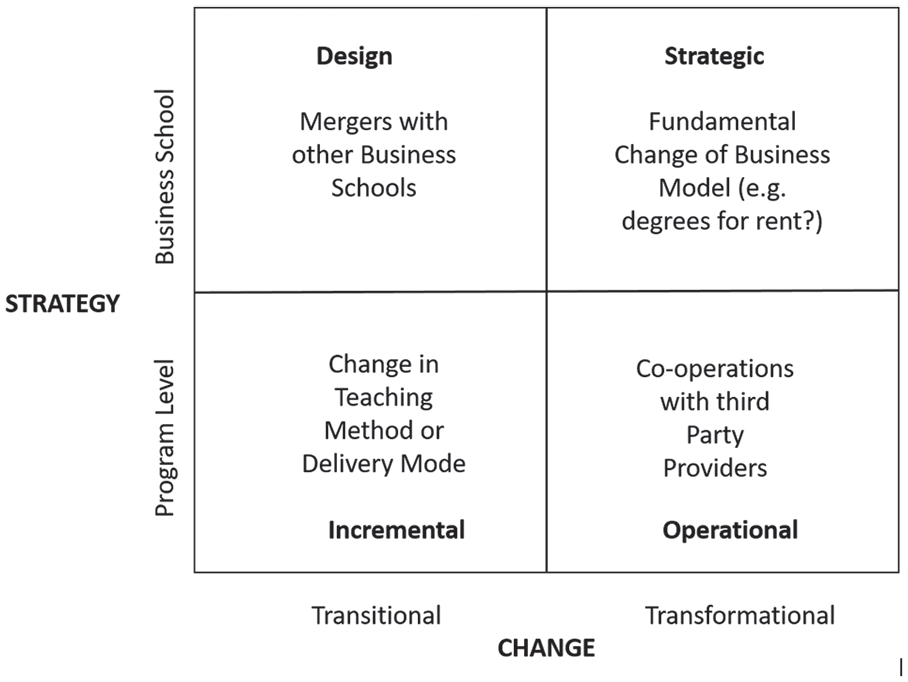
Strategy-change matrix.
Take the quadrant, labeled “Incremental,” which captures narrow business schools’ responses to the changing competitive landscape. Such responses affect only certain parts of a business school, such as its MSc programs. Examples may include changes in teaching method or delivery mode, such as blended learning, flipped classrooms or the use of life cases. In isolation, these developments, albeit necessary, will only have an incremental impact. Looked at in terms of the change potential such measures have on business schools, they would at best be transitional, that is, have relatively minor impact.
Moving to the next quadrant, “Operational,” the already-mentioned introduction of an online global health program by Imperial College London and their cooperation with Coursera springs to mind. These changes are much more fundamental to the fabric of a business school in that they go beyond the retooling of existing resources and require the development and acquisition of technical skills that traditional business schools typically do not possess. Still these changes affect only certain parts of a business school.
However, there are also changes that impact on the institution as a whole, which I refer to as “Design” changes. The 2010 formation of Finland’s Aalto University through a merger of the Helsinki University of Technology, Helsinki School of Economics, and the University of Art and Design is an example. Alternatively, look at the 2015 take-over of Ashridge Business School in the United Kingdom by Hult International Business School, an American organization with campuses in seven cities around the world. Although such mergers and acquisitions fundamentally change the resources and capabilities of the organizations involved, they do not automatically alter the business model of the new organization. If the newly formed business school continues to offer traditional lectures, possibly complemented by a few online courses, size alone is unlikely to protect it from sliding into decline.
The final quadrant captures “Strategic” changes. Here, the entire business school is affected and the change is truly transformational. This brings us back to the discussed subscription model, where degrees would be issued with expiry dates that require proof of continuous professional development to keep the degree valid.
Conclusion
Too often, business schools’ reactions to the changing competitive environment focus on more advertising, more scholarships (I do not want to call this price reductions, let alone discounting), and on saving teaching costs by bringing in less qualified instructors. Even for well-resourced institutions and those emerging aftermarket consolidation through mergers and acquisitions, such knee-jerk reactions are unlikely to stop the downward spiral of fewer qualified students, less income, and an increasingly restricted ability to make necessary investments. That said, some schools with massive endowments, strong brands, or the unquestioning support of taxpayers will be able to survive with only incremental changes to their way of doing business.
Less fortunate business schools, the majority, will have to think very carefully about their resources, capabilities, and, in particular, their purpose. In other words, these business schools have to review whether they need to change their business model. Before settling on a particular model, schools need to ask and gain clarity on a host of fundamental soul-searching questions: What constitutes success, both for the business school at large and for its degree programs? How can success best be measured? What role do teaching and research play? Is a school-specific research faculty viable? How important is impact—and what kind of impact is most relevant? How important are rankings? If important, which ranking is most relevant? What role do profits play? Is it sufficient to cover costs? Where should the school compete, and does it have the resources and capabilities to be an international player? Who are target audiences, and what do they expect in terms of program content, pedagogy, and mode of delivery? Which partners might be helpful to achieve set goals?
Of course, any business school dean will readily add another few dozen pertinent questions. Coming up with truthful answers that guide future strategies is more challenging. Some deans appear to be in a state of denial, hoping that the business school world will somehow be unaffected by the paradigmatic changes occurring in their environment. If fundamental changes are really required, the hope is that they can surely be tackled by the next dean. However, the uncomfortable truth is that this may already be too late for many programs and, indeed, many business schools.
As if matters were not complex enough, at the time of writing, the one all-important question is how the “new normal” will look after the Covid-19 crisis. With business schools suspending face-to-face teaching, students around the globe have now experienced the opportunities and challenges of distance learning. Likewise, the crisis dragged all faculty into online teaching, many reluctantly and for the first time. Regardless of what will remain of travel restrictions and social distancing after the Covid-19 pandemic, online learning is likely to see a massive boost in future.
This article, therefore, is a call for action. It encourages business schools to consider the need for more radical business-model innovations. While the turbulent changes in the environment are clearly uncomfortable for many business schools, they should also be viewed as opportunities, not just as threats. To take advantage of changes requires the courage to chart new routes, which may be very different for business schools with different resources, capabilities, and purposes. Not all will be able to serve their students in comfortable campuses with full-time faculty who spend most of their time on research. Some will use blended systems, both in terms of mixing teaching by practitioners and traditional academics and in terms of program delivery, using online and offline modes of instruction. Some will try to work with a modicum of their own faculty and become systems integrators. Some may not offer traditional degrees any longer, but certify short-focus interventions that keep managers abreast of new developments. Indeed, there may be business schools that work on a subscription basis, offering their graduates the opportunity for continuous professional development as they advance and change throughout their career paths. Even after the active career of a manager comes to an end, a business school may reach out to older learners and offer them attractive reasons to keep engaged with the school. A one-time intervention, which finishes with the award of a degree, would give way to a lifelong relationship, which starts with a degree. Perhaps, degrees for rent are just around the corner.
Footnotes
Declaration of Conflicting Interests
The author declared no potential conflicts of interest with respect to the research, authorship, and/or publication of this article.
Funding
The author received no financial support for the research, authorship, and/or publication of this article.
