




Abstract
The capacity to deal with digital transformation is a valuable asset for established organizations, and employees play a crucial role in this process. This study contributes to the understanding of employees’ sensemaking of digital transformation in the tour operating industry. Using prior digital transformation research, construal-level theory (CLT), and dynamic change perspectives, our scholarly work focuses on the complexities of organizational change in a digital transformation context. Although employees generally support digital transformation, our findings show that their perceptions change over time across a range of specific challenges experienced during the employee change journey. Our findings stress the importance of adopting a social exchange lens in digital transformation knowledge as this represents deep structure change that might cause well-designed transformation processes to fail. Implications for hospitality and tourism management are discussed.
Keywords
Introduction
Tour operators were long known for their unique knowledge of getaways and for forming important liaisons to make arrangements for prospective tourists. This, however, is generally no longer the case. Although tour operators still focus on selling package holidays to end consumers, rapid digital transformation has changed the industry into an e-commerce business in which information is easily available (Book et al., 2015). A failure to adapt has caused well-established firms to go bankrupt (Collinson, 2019), and digital transformation continues to be a high-impact driver for strategic change (Bilgili & Koc, 2021; Vlachopoulou & Fouskas, 2022; Vu & Hartley, 2022).
This implies that employees active in tour operating need to respond to ongoing change stemming from digital transformation and to develop “digital mindsets” (Solberg et al., 2020). Employees are confronted with the requirement to adapt to technology and to cope with changes in organizational values and culture (Karimi & Walter, 2015). Put more simply, employees in this context 1 often have a love for travel that provides them with intrinsic motivation and identity, but their drive is diminished when their business develops a data-driven, e-commerce focus in the wake of digital transformation. Moreover, such a change introduces drastically different organizational goals, processes, and even different jobs.
The current study reveals how this change is received by the individual employee: after all, their acceptance of digital transformation is crucial for success (Ahn & Chen, 2022; Schneider & Sting, 2020). Even when technical specifications of digital transformation are well designed and rolled out in accordance with best practices (Rousseau & Ten Have, 2022), change might still fail if employees resist the newly imposed deep structure changes that accompany digital transformation (Kellogg et al., 2020; Trenerry et al., 2021). These deep structure changes (change in deeply rooted organizational values and principles) are ill-understood as they are “barely articulated” (Heracleous & Bartunek, 2021, p. 216). By exploring different levels of sensemaking, this work shows why and how successful change at a managerial level (e.g., reaching strategic goals) can still be perceived by employees as a deep structure failure. Up until now, there is limited understanding of employees’ ongoing navigation and reorientation efforts in a changing environment. We aim to lift the study of employee perspectives from a mere static categorization of different outlooks (Schneider & Sting, 2020) or factors that should be taken into account (Trenerry et al., 2021), to an investigation that reveals an event-based journey which can be visualized and which sheds light on situational (based on context and events) and temporal responses. To understand employees’ multi-layered perceptions of digital transformation, we studied their continuous sensemaking of what is going on and how to respond (George, 2021). To this end, our main research question is as follows: How do employees interpret processes of digital transformation in their day-to-day organizational change experiences?
Digital transformation is defined as “a fundamental change process, enabled by the innovative use of digital technologies accompanied by the strategic leverage of key resources and capabilities, aiming to radically improve an entity and redefine its value proposition for its stakeholders” (Gong & Ribiere, 2021, p. 12). Although transformation in the tour operating business has been taking place for some time (Cave & Dredge, 2018), we see a pressing need to conduct empirical work in this field: tour operators are continuously developing various digital capabilities, implementing new value chains, and facilitating personalization of tourists’ experiences, to mention but a few examples (Buijtendijk et al., 2021; Personen, 2020; Vlachopoulou & Fouskas, 2022).
One of the shortcomings of the current literature of digital transformation (Gong & Ribiere, 2021) is that it largely overlooks the fact that this transformation touches upon deeply rooted organizational values and principles, something that may subsequently lead to ambiguous perspectives. For example, digital transformation has the potential to interfere with existing power structures and to lead to a revaluation or devaluation of traditional knowledge (Lanzolla et al., 2020). Such issues are often overlooked but may in fact lead to new and complex organizational challenges (Trittin-Ulbrich et al., 2020). Moreover, most previous literature on digital transformation is concerned with strategy and management (Busulwa et al., 2022; Pesonen, 2020) or technology adaptation (Venkatesh et al., 2003), thus leaving psychological and social employee-related issues understudied (Serenko et al., 2022). This is problematic because employee perceptions play a crucial role for digital transformation to succeed (Ahn & Chen, 2022; Solberg et al., 2020). In addition, employees’ feedback on psychological and/or social experiences often fails to reach change managers—either in a clear, or in a timely manner—a development that subsequently frustrates change management practice (Rousseau & Ten Have, 2022).
In response to this shortcoming, pioneering work was done by Schneider and Sting (2020) who studied a sample of manufacturing employees’ thoughts on the “fourth industrial revolution.” They introduced distinct interpretive frames (utilitarian, functional, anthropocentric, traditional, and playful) that serve as dominant logic driving employee perceptions. Although their study was context-specific and small-scale, it can be used to tailor change framing and enhance employee buy-in. Similarly, Solberg et al. (2020) elaborated on employees’ different beliefs about technological change by developing different types of digital mindsets (e.g., a growth mindset) that impact responses. Additionally, Trenerry et al. (2021) distinguished several factors at employee level that contribute to digital transformation. Regarding perceptions and attitudes, they stressed that job insecurity generally forms an important trigger for employees’ negative evaluation of digital transformation. Despite the important initial work on employee perceptions of digital transformation, scholarly work has so far largely ignored the dynamic nature of change: to the best of our knowledge, relevant studies present static characterizations or interpretive frames. This limits our understanding of real-time digital transformation (Hanelt et al., 2021) in which perceptions are expected to shift over time when individuals interact with others in their changing context (Langley et al., 2013).
We contribute in three ways to the recent and growing tradition of studying digital transformation through the eyes of employees and thus complement the dominant technical and/or managerial outlook. First, this paper contributes by showing how digital transformation is positively received when viewed as an abstract and impersonal development, but negatively received when viewed as concrete and personal in the social context of work. This illustrates how “construal-level” phenomena (e.g., concrete vs. abstract; Berson et al., 2021) factor in as an additional variable to consider in digital transformation processes (George, 2021). Second, our paper contributes by highlighting how employees dynamically shift their perceptions in a range of specific challenges experienced throughout the employee change journey. Such apparent dynamism reveals how change is fundamentally grounded in action rather than in stability, which challenges the oftentimes static treatments of interpretations of digital transformation reported in the literature to date (e.g., Schneider & Sting, 2020). Finally, this paper contributes by highlighting the impact of digital transformation on hospitality and tourism organizations. While digital transformation impacts any industry, this paper reveals specific challenges—including temporal shifts back to positive perceptions—that are especially relevant to the hospitality and tourism industry. As previously mentioned, digital transformation implies a radical change in this industry because it disrupts ongoing interactions and changes the specific skill sets that are needed to flourish in the work environment. Specifically, the intrinsic motivation that stems from travel craftsmanship (e.g., excellent knowledge of unique destinations and the competence to sell memories for life) and that forms a solid work identity (Ashforth & Schinoff, 2016) is under pressure in a rationalized, e-commerce-driven business model. Following such impoverishment (Selenko et al., 2022), important satisfiers for employees such as autonomy, competence, and connectedness (Meske & Junglas, 2021) are at risk, especially in this hospitality and tourism context.
Theory
We first consider literature that deals with digital transformation-driven change in organizations. Next, we address scholarly work that deals with employee perspectives on change, and we introduce insights concerning individuals’ interpretations of such phenomena.
Digital Transformation-Driven Organizational Change
Various scholars in information technology as well as in hospitality and tourism have investigated effects of technology that leads to organizational change (Li et al., 2019; Orlikowski & Barley, 2001; Poon, 1993). One of the first models on user adaptation to new technology was developed by Davis (Technology Acceptance Model TAM, 1989). Based on the concepts of ease of use and usefulness, Venkatesh and associates (2003) further developed TAM into a Unified Theory of Acceptance and Use of Technology (UTAUT). Building on this theory, scholars made efforts to predict technology acceptance and intention to use when implementing new information systems and technology in organizations. This stream of literature was then further developed to include perspectives of digitalization-driven business transformation (Aggarwal et al., 2017). Scholars refer to “digitization” to explain the technology changes from analog to digital operations and services while keeping the original business processes intact. They refer to “digitalization” to explain the use of digital technologies and data to redesign and replace traditional business processes (Gong & Ribiere, 2021).
Digital transformation (as defined in the Introduction) is concerned with the effects of technological innovation on organizational systems and their environment, including all stakeholders such as employees, customers, suppliers, and competitors. Digital transformation deviates from many other changes in several ways. First, the very nature and omnipresence of changes is something that affects the entire organization. More specifically, such changes have the power to shake up long-held assumptions on what is possible or impossible. The technologies involved, such as big data analytics, social media, mobile technology, and cloud computing, are easily accessible, open, and self-learning; as such, they present a need for permanent adjustments and continuous change (Hanelt et al., 2021).
Second, many digital solutions push back the prior boundaries of organizations or industries as the transformation introduces the involvement of a wider ecosystem or platform in which organizations participate. Digital infrastructures are open, flexible, and ready for use: not just by a single organization’s members, but by potentially anyone (Tilson et al., 2010). This leads to new and sometimes surprising innovation-driven cooperation such as Marriott using I-label booking technologies provided by Expedia, for example. This also means that where tour operators used to have unique destination and travel knowledge, contacts, and databases, this information now becomes more widely dispersed and transparent. In response, many tour operators are challenged to rethink business models and redefine their added value.
This continuous transformation seems to be recognized as the new normal in the wider hospitality and tourism context and urges organizations to “a shift away from strict hierarchy to flatter organizational structures and individualized jobs” (Ma et al., 2021, p. 2). In order to swiftly respond to change, organizations are developing designs that enable permanent adaptation (Hanelt et al., 2021; Reiswerk, 2018). Frequently, traditional top-down management fails to succeed in such complex change as successful digital transformation depends on employees’ active efforts and engagement in adopting new possibilities (Solberg et al., 2020). Because of its complexity, change triggered by digital transformation requires management to escape from “the rigidity of their own business model” (Buijtendijk et al., 2021, p. 1) and ways of thinking about change. It subsequently requires management to engage employees and to invite them to escape from their set ways as well.
Experiencing Digital Transformation at an Employee Level
Employees’ engagement in digital transformation depends on the social cognitive processes they use to make sense of change and to make decisions in this context (Solberg et al., 2020). However, the importance of developing an accurate understanding of crucial employee interpretations is generally overlooked by change leaders (Schneider & Sting, 2020; Selenko et al., 2022; Trenerry et al., 2021). Leader attempts at sensegiving in the context of digital transformation commonly focus on macro-perspectives on change, such as explaining the global competitive landscape and the need for downsizing human labor. In doing so, leaders talk about strategic issues and corporate actions (Jalonen et al., 2018). However, employees may perceive these issues as abstract or opaque and rather make sense of the (upcoming) situation based on perceived circumstances at the micro-level of the individual or the team (Berson et al., 2021).
Although change can be a source of joy, it is often dominated by negative attitudes, causing a high risk of failure for crucial initiatives (Kellog et al., 2020). Thus, whereas extant literature is focused to a large degree on ways to persuade employees to adapt to change (Bouckenooghe, 2010), employees are more likely to question “what will happen to me?” (Ford et al., 2008). They do so by using their own frames of reference. Examples of these are provided by Schneider and Sting (2020) who pointed out that out of the five perspectives mentioned earlier, employees especially adopt the functional (means–end), utilitarian (cost–benefit), and anthropocentric (human-made) frames for interpreting digital transformation-related change.
Employees often face newcomers who have specialized technical knowledge and skills (e.g., on AI, robotization, or cybersecurity) which they themselves do not have, and therefore they may fear to be replaced by these newcomers. A willingness to learn and openness to change are thus needed by everyone (Solberg et al., 2020). Trenerry and colleagues (2021) summarized the following factors that may influence digital transformation outcomes at an employee level: technology adoption, perceptions and attitudes towards digital transformation, skills and training, workplace resilience, and work-related wellbeing. Such individual-level concerns should be considered in larger organizational entities such as teams (team dynamics) and the organization itself (culture/climate) to better understand the determinants of digital transformation success (Trenerry et al., 2021). The different viewpoints brought forward represent grassroots ideas that add to the (currently incomplete) understanding of employee perceptions of digital transformation (Selenko et al., 2022). Whereas management might see digital transformation as an inevitable and logical form of change for their organization, employees’ buy-in cannot be taken for granted as their perceptions and interpretations vary and may differ from management’s claims.
Different Construal Levels
The perceived distance between management-level digital transformation concerns (for instance related to online market share) and employee-level change concerns (for instance related to joining a new team) and the resulting differences in perceptions can be explained with the help of Construal-Level Theory (CLT; Trope & Liberman, 2010). According to CLT, higher construal-level considerations include an abstract way of thinking that is characterized by using broad, general representations and focusing on the most important characteristics of a phenomenon and its value to the organization. Lower construal-level considerations include more detailed and practical representations and focuses on the “here and now” observable features of events (Berson et al., 2021).
Different perceptions resulting from high-construal versus low-construal sensemaking are expected to arise not only between management and employees: at intra-individual level, one can use (and switch between) different construal levels in the change sensemaking process. This outlook touches upon several challenges often faced in change management theory and practice (Berson et al., 2021). For example, a perceived high psychological distance to digital transformation—an example of change that evokes higher “construal-level” considerations (Trope & Liberman, 2010)—increases the risk for change to fail in daily organizational practice as employee involvement in such a change process would seem to be lower. Conversely, when lower construal-level considerations are involved in one and the same change process, compliant (concrete) change behaviors may hide forms of resistance that concern higher construal-level concepts, for instance related to an organization’s values and narratives (Heracleous & Bartunek, 2021). In the latter case, for example, daily operations may seem to run smoothly, but the risk of change failure in the long run remains considerably high.
Moreover, although lower construal-level considerations might come across as very “practical,” taking place at surface level, they often reflect dominant logic of what the organization is about. Employees’ daily responses reflect what is perceived as appropriate behavior and what is not, and they identify signification (shared meanings), domination (power by resource control), and legitimation (underlying norms), all of which form organizational deeper structures (Heracleous & Bartunek, 2021). Deep structures are conceptualized as “enduring aspects of social systems that operate at a subterranean level of social reality and shape events and actions on the observable, surface level” (Heracleous & Bartunek, 2021, p. 216). They might be “barely articulated” (Heracleous & Bartunek, 2021, p. 216), but a better understanding of small-scale change interpretations, exposing deep structures, is expected to benefit large-scale transformation (Trenerry et al., 2021). We expect different construal-level considerations to be employed by employees when forming perceptions of digital transformation.
Method
Because we intended to develop a detailed understanding of employee perceptions—in line with Schneider and Sting (2020)—we built on a qualitative, interpretive approach. Such an approach assumes that reality is not singular or objective but is shaped by experiences and contexts (Pratt, 2009). Furthermore, interpretive research pays attention to thoughts and feelings from a participant’s viewpoint as they make sense of a dynamic process that unfolds over time (Bhattacherjee, 2012; Gehman et al., 2017).
By conducting an industry case study (Tasci et al., 2020), multiple sources of information were included to gain an in-depth understanding of the context. In preparation of our study, we held interviews with management and HR professionals to learn about the challenges they faced. To determine which organizations to include in the study, we followed the advice given by the Dutch Association for Tour Operating to approach organizations that were known to be involved in digital transformation-related change. Decisions were made jointly by the authors of this article, and the actual data collection was carried out by the principal researcher who made sure that all research steps were thoroughly discussed within the team.
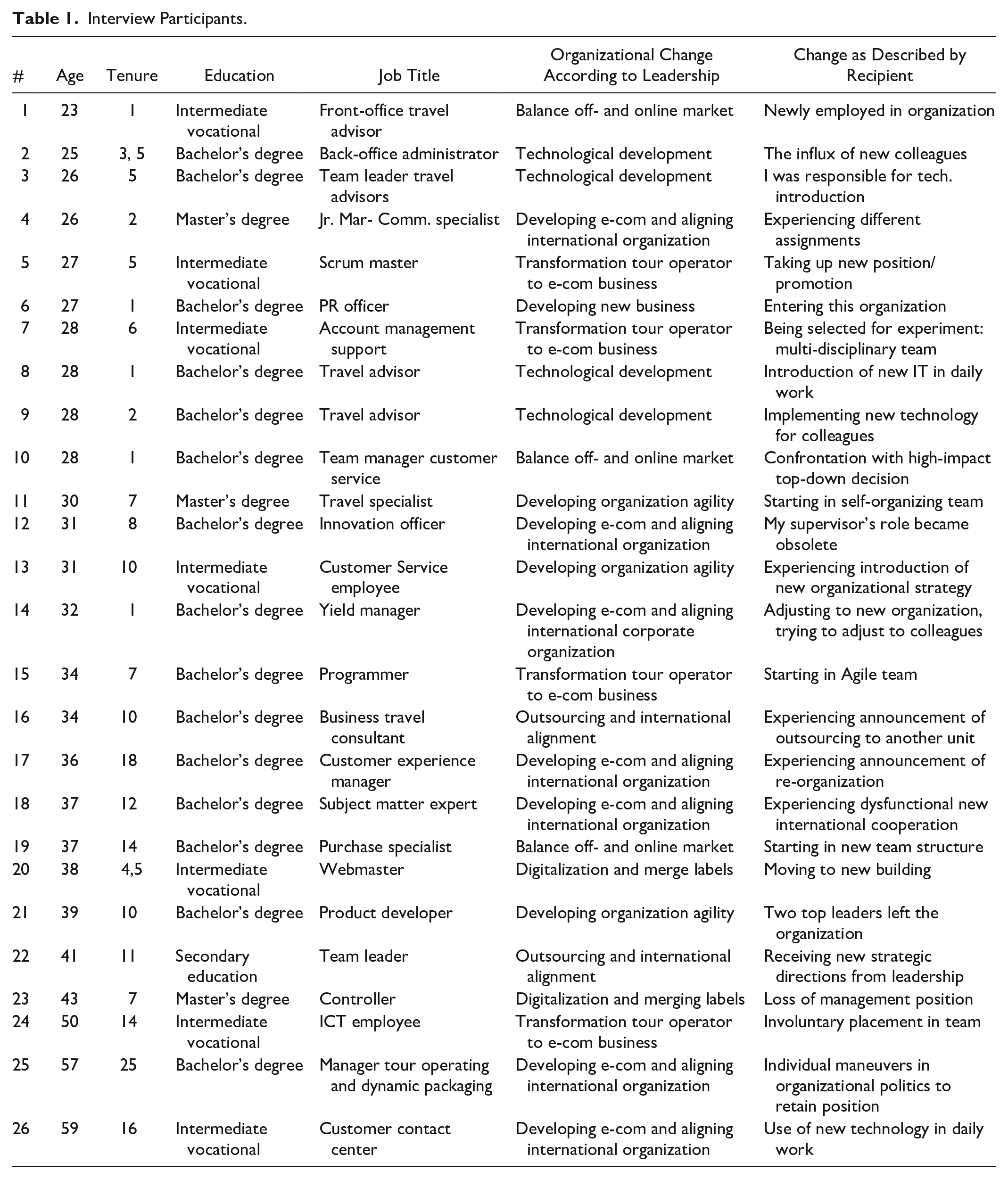
We conducted 26 in-depth employee interviews with individuals working in operations and experiencing change in their role as recipients. They were facing or had recently faced (< 2 years ago) consequences of digital transformation-related organizational change (see Table 1). Proximity to change was an important precondition, and we used purposive sampling to ensure that participants fitted the study in terms of its nature and purpose (Bhattacherjee, 2012). Beyond the proximity to change criterion, we used a sampling approach to fit the exploratory nature of our study and to reflect the heterogeneity of the industry. Specifically, we made sure that participants varied in terms of their organizational roles, age, and level of education (ranging from vocational training to university degrees). Finally, we triangulated our data by cross-validating the coding process with 15 HR professionals from the tour operating industry (Flick, 2018).
Interview Participants.
Data Collection
We collected data through intensive in-depth interviews whilst flexibly using an interview protocol (Gioia et al., 2013). We retained a focus on participants’ experiences but also allowed room for open-ended inquiry to ask additional questions when this was deemed necessary to reach the appropriate level of detail. We used Critical Incident Technique (CIT) to help participants recall events that they had experienced no more than 2 years ago. This technique is considered the best approach for collecting temporal data in qualitative research (Langley, 1999) because it elicits recollection of experienced emotions and intensity (Chell, 1998). We opted for an intra-personal approach because of our interest in the psychological, and relational adjustments—over time—made by the individual in the change process (George, 2021). The interviews were held in Dutch (as participants and interviewer were native Dutch). On average, they lasted 1 hr and took place on-site. All participants received full transcripts and were invited to check for omissions and/or to provide additional information, which led to minor textual remarks.
For triangulation, HR professionals in the industry were invited to discuss themes that they expected to reflect employee interpretations alongside digital transformation-related change (i.e., a real-life case on forming agile teams). In a second assignment, they were challenged to attribute emotional valence and intensity to anticipated employee interpretations. In small groups, they discussed and marked anticipated events and interpretations using post-it notes and smiley stickers in such a way that the result represented a change journey.
Data Analysis
Interpretive analysis is based on attempts to understand data through the eyes of participants. In our research, we first studied phenomena that were brought up via subjective interpretations of the experienced change. Next, we aimed to understand the meaning of interpretations to create rich and contextualized insights and to explore underlying motivations for participants’ responses (Gehman et al., 2017). Two of the current article’s co-authors analyzed the data through initial and focused coding while conducting constant comparisons between new and previously collected data. This was done to enhance, exclude, or form new codes as the research proceeded (Gioia et al., 2013). The first author led the analytical process and discussed codes with the second co-author, who then became involved in continuous recoding. The coding of our interviews resulted in a thematic overview (see Figure 1).
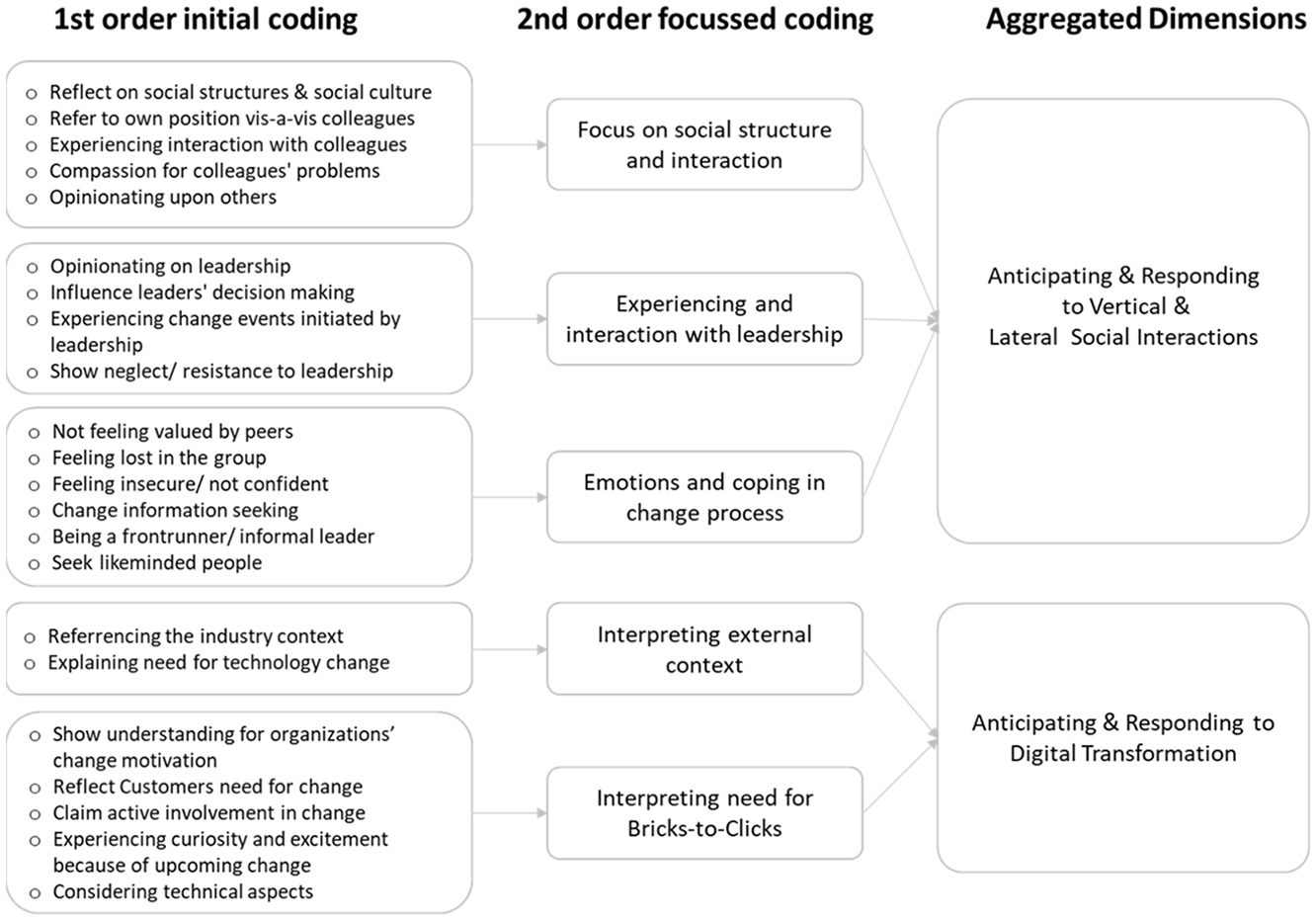
Data Structure Employee Interviews.
Since our research adopted a journey perspective, we also focused on when in the change process events and interactions took place. Fragments were used to create a storyline according to explicit event-in-time indications as reported by the participants (an aspect of Critical Incident Technique; Chell, 1998) or by the researcher’s interpretation of the participants’ stories. Captured memos were used to enrich the analytical process. This step led to the creation of a storyline detailing the journeys that reflected temporal interpretations of events and interactions. In doing so, the employee change journeys not only showed events, but also included employees’ interactions with their management and peers (Kandampully et al., 2016).
Next, interpretations were labeled in terms of representing positive, neutral, or negative experiences, and these were given an indication of perceived intensity (intense–medium–mild). Fragments were categorized according to explicit indications as reported by the participants (e.g., “and this had a huge negative emotional impact on me”), but also pauses and silence, changes in the tone of voice, repeated and accentuated formulations, and observed emotions collected in interviewer memos were used as indicators. As a result, a dynamic pattern was derived that reflected communalities in the change journeys. We compared the interpretations given by the HR professionals with our interview analysis to cross-validate our interpretation, and concluded that, overall, the HR session outcomes supported our results.
Results
In this section, we shall first cover themes that characterize participants’ interpretation of digital transformation. Second, we shall present our representation of the temporal change journey. We use thick descriptions that reflect the processes through the eyes of our participants (Balogun & Johnson, 2005; Bhattacherjee, 2012; Oreg et al., 2018).
Anticipating and Responding to Digital Transformation
Overall, our participants reported a positive attitude towards digital transformation (see Table 2a). This implies that a transformation story had become part of their sensemaking repertoire. Also the resulting change was initially perceived as a positive challenge (positive stress; Lazarus & Folkman, 1984) and, as employees felt comfortable and secure, they claimed to have strong personal change potential. This notion was illustrated by the participants’ recognition of the need for change and their active involvement as well as by the participants’ self-confidence in estimating how they generally dealt with change. As one of our participants working in account management support illustrated:
Digital Transformation as Taken-for-Granted Change.
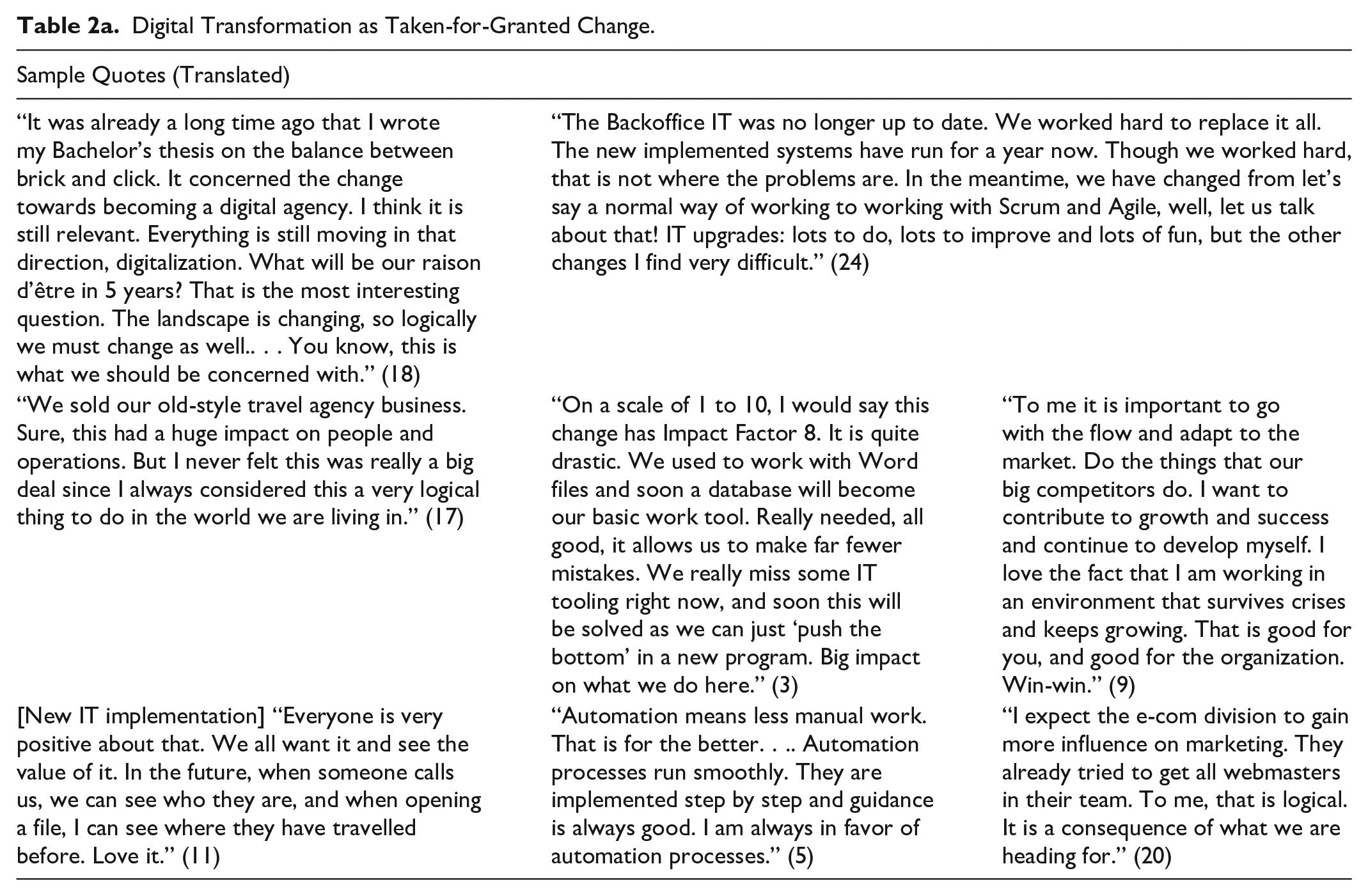
We are sort of an internet company, and as such, to freeze is to lose. So, for me it is only logical that changes keep coming.. . . For me, working with new tech is fun. Just “click around” and see how it works. Sometimes I feel like “there we go again,” again a new tool. Yet, then I say to myself: just challenge yourself. Adjustment takes a day, it happens overnight. (7)
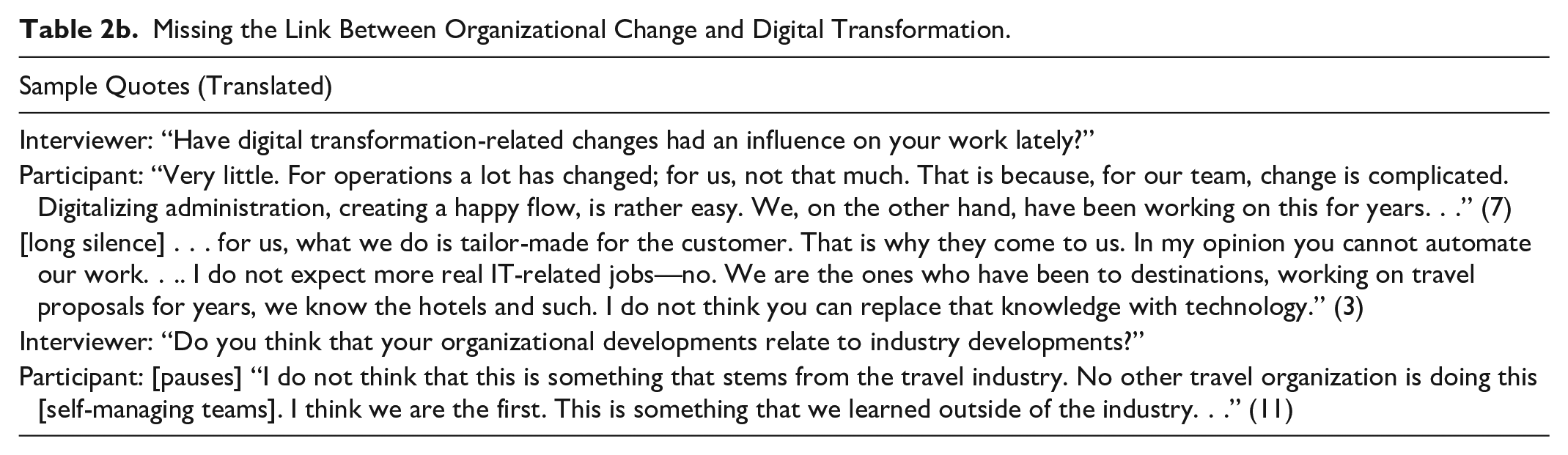
Besides the “taken-for-grantedness” of industry transformation, several participants did not seem to link the changes they had experienced to digital transformation (Table 2b).
Missing the Link Between Organizational Change and Digital Transformation.
Social Exchange and Rising Complexity
The most pressing topic for our participants was the experience of social exchange with peers and how change impacted the established social order (see Table 3). In general terms, employees often referred to liking each other, strongly valuing their peers’ positive connections, and the supportive atmosphere. There was a strong desire for equality and communion, and employees referred to the organizational “family” they felt part of.
Intra-Colleague Interaction Defines Experiences Shifting From Positive to Negative.
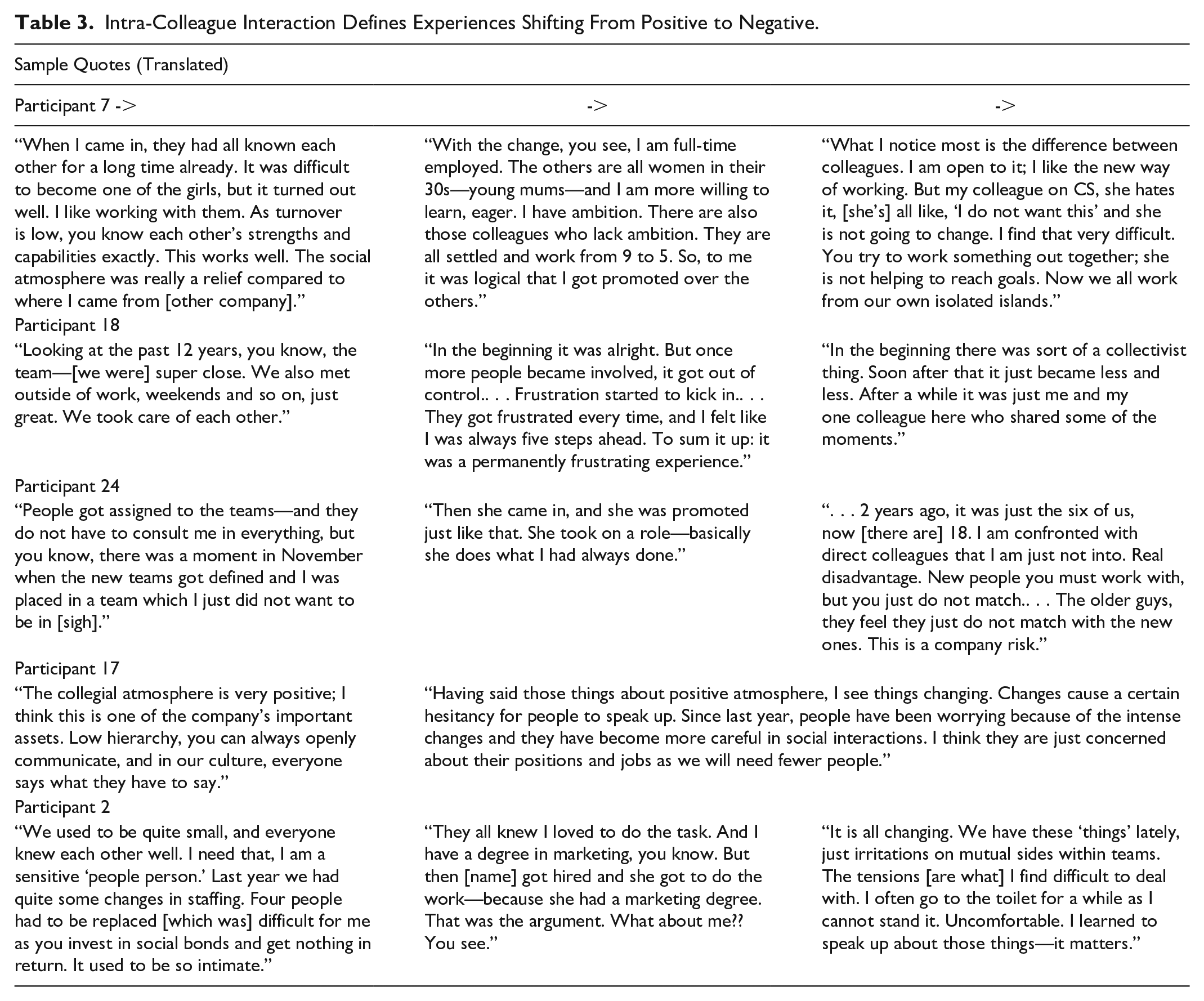
However, when digital transformation resulted in here-and-now organizational changes, social complexities arose as employees turned against each other and formed negative judgements. Many strongly engaged individuals struggled with the advent of new colleagues holding new ideas that stretched current routines. Not only were newcomers welcomed with skepticism, but also colleagues who took on new roles easily lost their peers’ social approval. A product developer (Participant 21) illustrated how social tension evolved: Excerpt 1 was captured at the beginning of the interview, and Excerpts 2 and 3 followed, capturing the change in the experiences: Excerpt 1: To accomplish things together, to me that is important in my job. Freedom, but also togetherness. Just the cosy and friendly atmosphere. In [name of organization] we do a lot to achieve that. Good atmosphere, getaways, all fun. [name of organization] really excels on that point and that is very appealing. People are really working with [a] passion for travel. Excerpt 2: The old crew has more affective commitment. No problem to work extra. The new people, they are less engaged with the organizations’ wellbeing. For them it all works differently. Excerpt 3: Eventually, well, I started to reflect. Then you think of how to safeguard your own status and position. At that time, I was less concerned with everyone else.
Employee Change Journeys
Our analytical process resulted in a micro-level representation of the temporal change journey as elaborated below.
“Oh yes, we live in a turbulent world”: Abstract interpretations
The journey begins as employees optimistically observe the environment while supporting the need for change. They refer to feeling at home in the organization and feeling strongly connected to their peers. Group status provides confidence towards the future (organization-based self-esteem; Pierce & Gardner, 2004). Change seems an abstract generalized theme (higher-level construal) as is illustrated by the following quotes: Change, for me no problem at all. To me it is just interesting to see how we can do things differently. How to handle it and with what results, my enthusiasm tells me it will always be for the better. A chance to deliver something worthwhile. That is why we are here. (Participant 3) Yes, it [change] is a good and [the] only logical thing to do; stagnation is deterioration. (Participant 8) I am an inquisitive person by nature, so I am always in for a change. Sometime ago we started to focus on e-commerce, so interesting, obviously—especially when considering the market we are in. It is unavoidable, you see. For me, change is positive. You either change or go out of business. (Participant 5) “I am an advocate of change [laughs]. Integrating brands creates a powerful position in relation to our competitors. You need this. (Participant 20)
“Change is coming, of course it is”: A chat with a colleague
The journey continues as employees informally find out that change is coming. A trigger for interpretive processes could be a chat with a colleague in which the change is mentioned: Of course. . .I know who is working on it. I saw a roadmap on his desk, so I brought it up and you just chit-chat and get the information rolling. Come on, we are all inquisitive people, right? Before they communicate, you find out. But you have to let them tell you. (Participant 15)
Employees hold a positive attitude. They are “warming up” for the change to come and try to get in touch with decision makers at the individual level.
I must say, I have been working here for quite some time. . .and by now I just know what is going on and what the consequences will be. I belong to the group of people who can easily estimate who will end up where, and what the upcoming change will mean to me. You learn to interpret upcoming change as it happens all the time. (Participant 17)
Employees first identify a wait-and-see period as part of their journey. Many chats amongst peers lead to collective sensemaking of what could happen. Through a process of deduction (Golden-Biddle, 2020), colleagues form heterogeneous interpretations of the little information available to them. Based on bits and pieces of information and conjecture from rumors (Lawrence & Callan, 2011), early change narratives are developed.
We all knew through the grapevine. It is a family business, so people talk. It was kind of secret, but many people knew. This caused friction.. . . By then, everyone had had the time to make up their minds about it all and decided for themselves how “open[ly]” they would approach it all. (Participant 7)
The uncertainty is not easy to deal with for all employees as stories, gossip, and jokes that are shared might be confusing: You find out through the grapevine instead of a proper e-mail or so. I get it, you cannot tell your employees everything. But this non-communication can have a huge influence on people. I feel uncomfortable with the non-communication period. It only causes “wild stories” and you do not exactly know what is true. (Participant 4)
“Did not see that coming”: The Town Hall meeting
Employees experience official communication and reflect on it. For example, the event is a town hall meeting in which the CEO announces change. Communication is often disappointing (not enough information is provided or decision-making outcomes are different from what was informally known before). Employees turn their attention to leadership acts. They evaluate their possibly changing position that could affect status and social structures. A first temporal shift from higher to lower construal-level sensemaking was observed in participants’ responses: I felt totally confused. I assumed, oh well, you see. They had talked to supervisors, some of them are my friends. But now they were told that their role just no longer existed. This was really a big thing. They came back from their talks one by one with tears in their eyes. I had heard some rumors before, but when finally it all became clear, I realized this had severe negative consequences. (Participant 11) It turned out they had bought software that was truly unsuitable. We were side-lined (again!) in the decision making. The deal had already been done.. . . It turned out this was unstoppable once we heard of it. They gave commitment without our consultation. That is the time to act. You know, I go and get more details. Then I find likeminded “warriors.” Internally we speak of “collective stupidity” portrayed by leadership. (Participant 15).
“Wait and see again”: Doing business as usual
After experiencing the formal message, employees continue their existing routines and wait for the change to come (reclaiming a certain psychological distance to the change). This “relaxed” wait-and-see attitude seems to be an implicit behavioral convention. In contrast, employees who vent their insecurity feel isolated as their attitude is not appreciated by the group. Additionally, for some employees these moments are difficult because old routines are still in place while new ways of working are foreseen.
Difficult time. Beginning of June, I was appointed in the new job, but I had to stay in my old job for months to come. So difficult. You see, because of the long wait in between. I had to learn a lot, yet also work a lot. I really struggled at that time. (Participant 5) A lot of time passed—months—and we knew the changes would come our way, but it became blurry and vague. The supervisors knew they were leaving, so they did not care that much, and we were just overwhelmed by our workloads and thought, “well, what will this change be anyway?” (Participant 11) “They introduced a new idea—an initiative that had been going on for some years. Yet, they just do not manage to hold on to their ideas. I am waiting for the moment that they will hold on.. . . They never do. (Participant 24)
“On the move”: Change implementation
Employees are confronted with concrete change implementation: people leaving, individuals taking up their position, new procedures coming into effect, and so forth. For a second time, perceptions shift to lower construal levels. This time, it seems to be a tipping point in the journey: a negative imbalance will prevail. As disagreements occur frequently, the group climate seems to change. Employees actively consider their position, status, and influence. Numerous experiences are “problematic,” “intense,” or “severe.” At that time, my colleagues’ jealousy was most severe. I could not handle it. Once I really started doing the work, the others felt regret I guess, as they then realized that they had wanted to do it too. (Participant 5) There was no one. We had to figure it out all by ourselves. When we were in need of advice, managers responded indifferently like “do not bother me, you take care of it,” and it was unclear who was leading who, we all had different managers, and the managers started to manipulate—as in wanting us to do work for them. It was impossible for us to prioritize. (Participant 7) What I remember most is the actual leaving of several supervisors. They had worked with us for so long and we used to have so much fun, and when they left, there was no real appreciation for all their efforts. My team was problematic, it just did not work. We all felt stressed, time-pressured, communication went wrong, everyone felt irritated and responded harshly towards one another. Too busy, too busy, no time, no time, always like that. It was a real energy drain. (Participant 11)
The implementation process continues. Most often, this forms a negative experience in which work friends become enemies and leadership is perceived to make crucial mistakes. The chaos caused by the social complexity of interactions shifts the attention away from considering why change was needed in the first place.
We tried to do the best we could, yet she didn’t. Not helping. That is just not working, an attitude like that. I confronted her. I said to her that if she kept spreading her negativity and kept bashing my role in the team, that I would start bashing hers. You really must speak up in a team, you cannot let it slip. It turned out we all received different information. Just little details that came out differently. This created misalignment amongst us. (Participant 7) All the talking. Especially people who experienced strong feelings of resistance. We felt remorse. It was turbulent—while work was continuing, of course. We had to come up with new solutions. Especially this time was a difficult time in the process for me personally. I felt resistance and did not know exactly what was happening. I was in a temporary team. I had to make sure that I would end up in a team that I liked. (Participant 11) What was difficult was the fact that [corporate brand] was having a hard time to let us in. They felt they were doing okay, so there was no intention to help us out. They were taking care of themselves. In the end we are all one. But that is not how it was perceived by them at that time. I never understood their way of thinking, but it sure made things complicated. (Participant 20)
“Like it or leave it”: Trying to cope during the evaluation meeting
Whether they like it or not, employees start adjusting. Accommodation experiences are represented in the data. Coping-characterized mechanisms dominate many interpretations, and employees actively engage in voicing behaviors, showing opposition, or asking for help. This is illustrated by our participants: The effect is that I am inclined to attract more work as I do not know my new colleagues very well. Can I depend on them? I am hesitant to let them handle things. I am the kind of person who prefers to do things myself in such a situation. I first have to see what they are worth. What [will] I do to manage it all? Well, every day at 11 am I go outside for a cigarette, and in my breaks, I also go outside. For me it is a must to go and get some fresh air—and luckily there are some friends from [name of division] who join me. (Participant 7) It is taking its toll. You need to gain some experience and skill, learn how to become more confident, and learn to fail and deal with criticism from colleagues—learn to accept. (Participant 11) What helps is that I always find someone who helps me put things in perspective. One of my colleagues, she is really good at developing more of a helicopter view, and the others, close to me, we talk about it—and in the end, we hope they [leadership] will learn something from it all [laughs]. Actually, it is not funny. Those experiences are quite costly, as in it costs a lot—lessons for us all. (Participant 13)
The change is implemented, both leaders and employees create opportunities for evaluation. These moments indicate a peak in negative interpretations; the situation is perceived as an ultimate “low.” Whereas leaders perceive the change to be completed, employees are in the midst of processing what has happened. As the change is no longer a daily topic in communication, employees will not easily express their mourning/recovery process. For example: I am far less involved now. We used to have smaller teams. Now, when there is change, you get an e-mail from Poland or something. It is like “here is the change, deal with it.. . .” It is a shame, it used to be different.. . . I have learned to be less involved, mentally. At 6 pm it is done. (Participant 16) At first, I was 100% in love [with the organization]. Now it is a business agreement. It seems everything is possible, but it is not. So, then I am like OK, no more giving my everything. Love has to run both ways. (Participant 21) After a while I felt like, “what is it that I do?” I am still in the middle of this process. I am here, but I have no clue how to contribute [silence]. I am not over it—still in shock, maybe. I just do what they ask me to do. It is not that different from what I did before, but the things that gave me pleasure in the job are taken away from me. (Participant 24)
“Heading for the future”: Rebuilding social order
After everything has been said and done, employees seem concerned with their new positions in the social structures of the organization: In my current team we are well aligned. We all have our roles, and everyone is happy. It is a team effort and that is how we experience it all. New initiatives from team members are welcomed enthusiastically. With every new idea, we are like, let us move forward! (Participant 11)
Most likely, this stage turns into a situation like the one described for the journey’s beginnings, as change trajectories are expected to be ongoing in the light of the industry’s still unfinished digital transformation.
Based on data labeling, participants’ emotional pathways are reflected in terms of valence and intensity and could be summarized as follows (see Figure 2). Emotional valence (positive – negative) and intensity (mild – intense) show a corresponding pattern: simply stated, when intensity is high, valence is negative. The journey seems to lack intense positive experiences. Moreover, it seems apparent that a first negative experience is perceived throughout the event, which we labelled as “did not see that coming.” This is the first lower-level construal point in the journey where change consequences initially become clear. Additional negative and the most intense experiences are recognized in the events that we named “on the move” and “like it or leave it.” Our data also show that these moments include concrete change experiences (compared to abstract reflections). Possible implications are further addressed in the Discussion section.
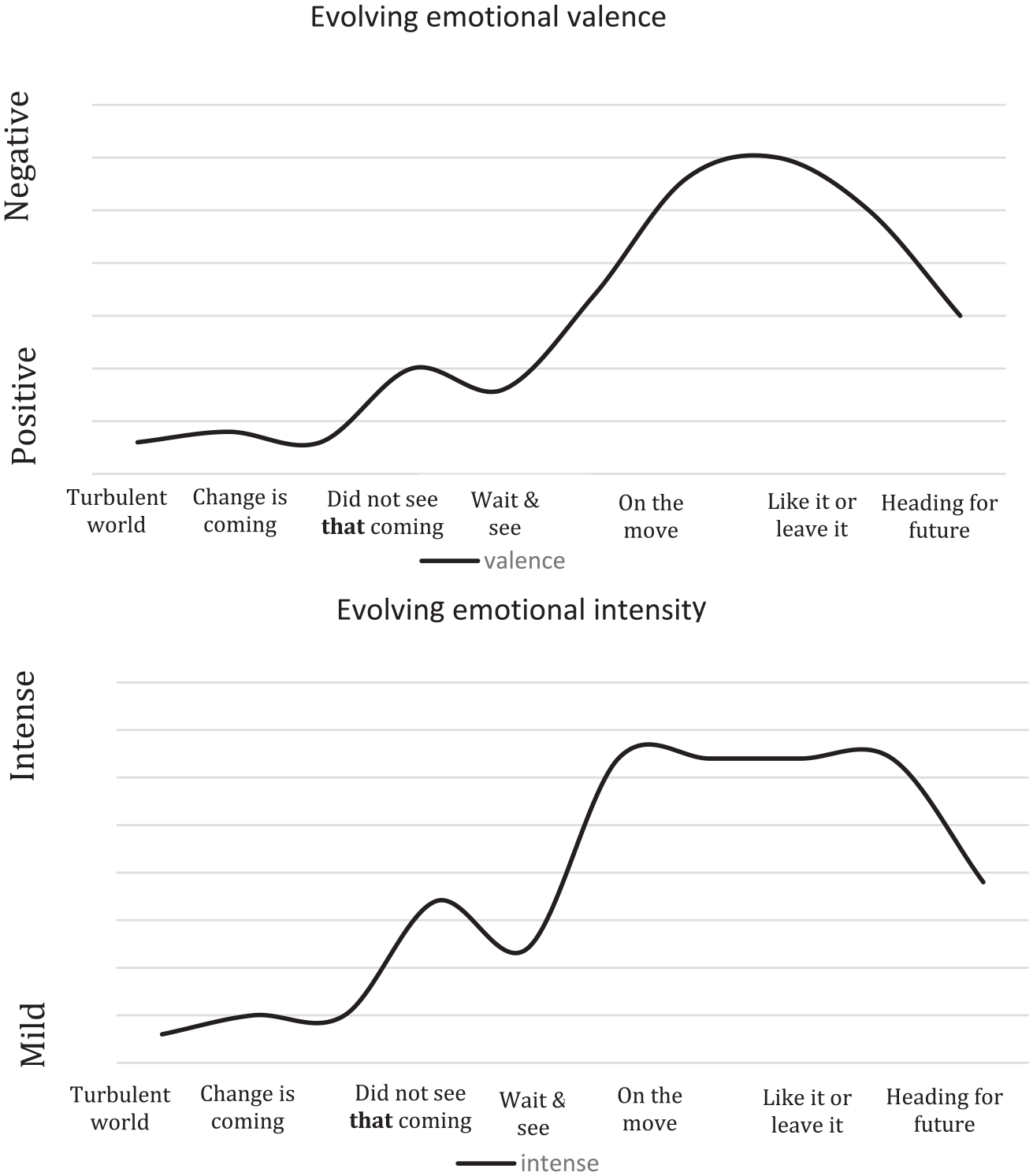
Evolving Emotional Valence and Intensity Throughout the Employee Change Journey.
Discussion
The objective of this work was to contribute to the digital transformation literature in the hospitality and tourism industry by revealing employees’ temporal perspectives of digital transformation-related change in a tour operating industry case. We aimed to obtain a better understanding of employees’ dynamic responses to abstract level changes as well as to concrete (here-and-now) organizational changes that would irreversibly impact the nature of their work. The outcomes of this empirical study show employees’ ongoing navigation and reorientation efforts in a changing environment. This lifts the study of employee perspectives from a mere categorization of different outlooks (Schneider & Sting, 2020) or factors that should be taken into account (Trenerry et al., 2021) to an investigation that reveals an event-based journey which can be visualized and which sheds light on situational (based on context and events) and temporal responses. In line with Trittin-Ulbrich and associates (2021), one of the conclusions that can be drawn from our work is that perceptions of digital transformation are nuanced and textured. They are rarely fully negative or fully positive for employees. Our findings are aptly summarized by the following quote from one of our participants, “To change is easy, really. To work and live with others, that’s something completely different” (Participant 15).
Altogether, the outcomes of our study raise several issues that deserve our consideration. First, we shall elaborate on insights that our results provide on dynamic differentiation between construal levels, and discuss employees’ sensemaking of digital transformation-related change. Second, we shall elaborate on the theoretical implications of our work.
Shifting Perceptions Over Time: Different Construal Levels
Based on our results, we argue that employee perceptions of digital transformation should be regarded as dynamic and multi-layered sensemaking efforts that shift over time. In particular, our empirical work indicates that employees’ higher construal-level beliefs and expectations about digital transformation do not seem to frighten or worry them. The emotional valence is positive and emotional intensity is low. This is not a surprise as, in society at large (Trittin-Ulbrich et al., 2021), the tour operating industry narrative focuses on the commercially-favorable implications of digital transformation whilst ignoring possible dark sides (Trittin-Ulbrich et al., 2021). While considering the future of the tour operating industry, employees are aware of the idea (and convinced of the need) to work in a modern, transforming industry, with competitors that raise excitement and fuel curiosity. To illustrate the point: industry newcomer SPRS.me was perceived as an attractive brand to work for by young people in the industry. This creates an abstract collective desirability that would seem to be a good starting point for change (Rousseau & Ten Have, 2022).
However, as time moves on, a latent and often overlooked risk related to this positive image of digital transformation (Trittin-Ulbrich et al., 2021) becomes apparent. Our data show that in the everyday reality of change (shifting from a higher to a lower construal level), most participants felt confronted with unexpected and unpleasant experiences that they had neither thought of or been informed about upfront. The results of our empirical work indicate that the moments of first formal communication and the start of implementations triggered strong shifts in the emotional valence and intensity of perceptions. Over the course of change, the positively perceived macro-level discourse led to unjustified overconfidence and induced a false sense of being in control (Guiette & Vandenbempt, 2017).
Social Complexity in Digital Transformation
The temporal shift from higher to lower construal-level sensemaking revealed insights on covert social and psychological dimensions (e.g., power conflicts, informal hierarchies; Trittin-Ulbrich et al., 2021) of digital transformation. Our data indicate that, in a non-change setting, employees experience a strong shared sense of community of which membership is very important (cf. Social Identity Theory; Tajfel & Turner, 1979). Digital transformation interrupts this sense of community as people face internal competition from newcomers and frontrunners (Solberg et al., 2020) and taps into the social/collective identity of organizations (Westerman, 2016). This ultimately leads to different perceived fairness of the situation, in turn potentially harming change motivation (perceptions of unfairness reduce change motivation; Bataille & Vough, 2022). Under these circumstances, employees find themselves in a battle for a new distribution of power once the rules are changed (Wagner & Newell, 2006). On top of technological advancements, this social concern contrasts with the desire for equality and community, and our research indicates that it is, in fact, the disruption of social order that might form the real change for employees.
Theoretical Implications
Construal-level considerations in digital transformation theory
Our data show that construal-level differentiation (Berson et al., 2021) should be considered as an additional temporal factor because it affects emotional shifts in employee perceptions in digital transformation processes (George, 2021). Our study also provides further empirical backup for CLT and explains that higher-construal levels enable people to orient themselves to a somewhat undefined future, which, in turn, enables them to think of a new reality without feeling threatened. This level of sensemaking is extremely useful to “broaden one’s horizon” (Berson et al., 2021; Trope & Liberman, 2010).
Additionally, our findings on employee perceptions on lower-construal level bring forward insights on social exchange and group dynamics (Blau, 1968) that are considered crucial to the success of digital transformation. Although social structures have been addressed in prior literature (Trenerry et al., 2021), we add a more thorough consideration of the psychological and social effects of employees’ deprived knowledge, relations, and status. This includes the consideration of polarization between groups of employees and its impact on the success and pace of transformation, as this phenomenon seems to be more intense than was previously recognized. We have seen that digital transformation triggers a renegotiation of the often-implicit expectations related to vertical (leader–employee) as well as horizontal (employee–employee) reciprocity. In other words, it triggers potential breaches of the psychological contracts (Rousseau et al., 2018). This is risky as dynamic, reciprocal relationships are crucial for cooperation and fundamental enablers of change (Van der Schaft et al., 2020). They need careful repair in case of breach (Wiechers et al., 2022) if the common goal—digital transformation—is to be reached. We challenge traditional digital transformation frames (such as Theory of Acceptance and Use of Technology [UTAUT]; Venkatesh et al., 2003) to shift from technology adoption approaches to the consideration of social systems in the work environment.
Dynamic approach to the study of perspectives
Developing digital transformation insights by adopting the perspective of the employee journey seems an admissible approach for mapping different events and their temporal effect on employees’ responses. This temporal perspective complements the oftentimes static treatments of interpretations reported in the literature to date (e.g., Schneider & Sting, 2020). Furthermore, this approach accounts for the idea that employees do not perceive change events as isolated units for sensemaking (Nikolava & De Jong, 2020); rather, they are more likely to view change as a sequence of events. For example, an employee who gained “hope” from early conversations will respond with initial positive expectations to affective events that follow. Moreover, distinct responses arise (e.g., strong disappointment) when new events do not match with their expectations, leading to significant “shocks effects” (Frijda, 2008). Accumulation effects of experiences over time are brought forward as a systematic element in understanding employee perceptions in digital transformation.
Furthermore, digital transformation-related change can be considered an emotional episode (Oreg et al., 2018). In modeling the evolving employee emotions (intensity and valance) over the course of events, our data included several trend breaks indicating that emotional engagement has its own course of action throughout change processes. This idea is confirmed by emotion literature explaining that emotions, by nature, occur, peak, and change over time (Frijda, 2008). Interestingly, the temporal pattern of emotional engagement presented in our results (Figure 2) seemed coherent with changes in the degree of abstraction at which change was represented (its level of construal; Trope & Liberman, 2010). A contribution to the literature on employee perceptions of digital transformation is provided by (a) adopting an inherently dynamic approach, that (b) accounts for differences in how abstractly or concretely employees perceive change as events occur and organizational members interact over time.
The changing nature of work
Digital transformation as a phenomenon triggers further thinking on the future of work in hospitality and tourism. Our results confirm the idea that digital transformation-related change can elicit psychological harm because of potential job losses or degrading work quality (Selenko, 2022). As explained earlier, the intrinsic motivation stemming from travel craftsmanship is under pressure in the wake of a more rationalized, e-commerce-driven business model. Following such impoverishment, important satisfiers for employees—such as autonomy, competence, and connectedness (Meske & Junglas, 2021)—are at risk, especially in the tour operating context where the workforce is mainly represented by experienced travelers. As we think of the future, this development might be seen as a step towards contemporary, highly digitally transformed workplaces. An extreme example is Uber, whose platform workers are independent subcontractors who are subject to algorithmic control when receiving work assignments. This phenomenon is now also known as the “Uberization” (Davis, 2016) of work. Another example, closer to home for the tour operating sector, is the digitally native, technology-focused travel agencies such as the Dutch company Booking.com.
However, while the shift to e-commerce is profound, we argue that the tour operating sector first and foremost remains a service industry. This industry is still characterized by delivering emotionally-laden (often personalized) experiences that require collaborative efforts in customer interaction, interactions within the organization itself as well as between the organization and travel destination services (Schmidt et al., 2017). The available industry-specific craftsmanship is an asset that differentiates tour operators from other digital businesses. Therefore, not unexpectedly, successful tour operators are the ones to find a balance between tech-centered and human-centered services. With this outlook, we underline the need to balance “high-tech and high-touch” as brought forward in hospitality and tourism literature (Brochado et al., 2016; Zeng et al., 2020).
Limitations and Future Research
As is the case for all empirical work, this study has some limitations. Although the use of Critical Incident Technique (CIT) is known to be a valid approach for reconstructing sequences of past events (Langley, 1999), the employees’ responses might still suffer from recollection bias and social interaction effects. Furthermore, although we checked all transcripts together with our participants and used memoing techniques (Bhattacherjee, 2012) as well as textual and non-textual cues to complete labeling, the outcome is still interpretive and subjective in nature. This process could be enhanced in future work by involving participants in focus group discussions. Second, we know that not all change processes follow a linear route (By, 2005), and therefore our work could be further enhanced by including iterations in our depictions of the change processes, as employees go back and forth in their interpretations. The same holds for including more variations that might lead to different or multiple journeys. In the current investigation, we combined all experiences to create a unified journey, but exploring interpersonal and organizational differences could lead to additional insights.
The journey presented in this study could be a starting point for further research. One specific suggestion for future work is to use additional methods for capturing employees’ temporal emotions as both our data and the literature confirm digital transformation to encompass emotional episodes. For example, future research could include measuring real-time emotional responses through experience sampling (Csikszentmihalyi & Hunter, 2003) and collecting data with the help of emotional response measures (Bastiaansen et al., 2020; Oreg et al., 2018). Moreover, it would be wise to replicate this study in different cultural settings as Sun and colleagues (2020) pointed out that this is an important factor in technology-related studies in the hospitality and tourism industry. Overall, we believe that we are still in the early days of understanding employees’ experiences in digital transformation contexts; more work is needed to create new normative theory in hospitality and tourism that incorporates the perspectives discussed in this work.
Practical Implications
Digital transformation has become crucial to virtually every type of hospitality or tourism organization (Ma et al., 2021; Personen, 2020; Vlachopoulou & Fouskas, 2022). We advise managers who strive to involve employees in this process to focus their practices on two concepts—Agile approaches and job crafting—as driving forces for change management (Al Nuaimi et al., 2022; Reiswerk, 2018). First, Agile change practices balance higher and lower construal goals by reaping early benefits while moving quickly in short “sprints” (Franklin, 2021). With these practices, challenges as well as opportunities become clear to employees much sooner, employees do not have to go through lengthy trajectories, and they do not have to engage in ongoing discussions taking place in a boardroom that can be perceived as a big black box. Investing in an Agile industry workforce not only benefits the heavily challenged employee sense of well-being and resilience (Senbeto & Hon, 2021; Trenerry et al., 2021), but it is also known to enhance motivation and to stimulate the internal exchange of ideas (Franco & Landini, 2022). Furthermore, Agile approaches are expected to diminish polarization between the traditionally-minded and digitally-minded employees as it stimulates teams to integrate the complementary use of all available expertise. Instead of developing top-level digital skills on the part of each individual, task agility stimulates the switching of tasks among co-workers in response to organizational changes and transition (Franco & Landini, 2022).
Second, we suggest making use of job crafting: enabling employees to shape their role in the change process is one of the tools that can be used to create an agile industry workforce. Job crafting means that employees actively design their jobs by negotiating tasks, building new relationships, and assigning (new) meaning to their activities (Wrzesniewski & Dutton, 2001). This can help employees to redefine their work identity in a changed situation and to assert control over their jobs with the aim of avoiding alienation in a changing environment. In the new jobs that will be crafted by employees, tacit industry knowledge that is often tied to individuals and difficult to codify (Personen, 2020) will blend with digital skills. Allowing and coaching employees to do so will likely lead to enhanced feelings of change engagement.
Conclusion
Employees’ buy-in is a crucial condition for successful digital transformation in thetour operating industry. Digital transformation is positively perceived at an abstract and impersonal (higher construal) level. However, employee perceptions are dynamic and shift over the course of evolving change. Optimistic perspectives concerning new horizons become challenged when change causes unforeseen here-and-now (lower construal level) implications. At this level, change becomes an emotional episode as employees experience disruption of the social order, something which represents a deep structure change that is difficult to deal with. We hope the insights gained from this work will challenge and stimulate managers to develop new, timely, and targeted change interventions accordingly.
Footnotes
Data Availability
The data that support the findings of this study are available on request from the corresponding author, A. v.d. Schaft. The data are not publicly available due to their containing information that could compromise the privacy of research participants.
Declaration of Conflicting Interests
The authors declared no potential conflicts of interest with respect to the research, authorship, and/or publication of this article.
Funding
The authors disclosed receipt of the following financial support for the research, authorship, and/or publication of this article: This research is part of a PhD trajectory that is financially supported by Breda University of Applied Sciences, Reiswerk and CELTH (Centre of Expertise Leisure, Tourism, Hospitality).
