




Abstract
Research on tourists’ eudaimonic and hedonic wellbeing has grown exponentially in the tourism literature. The paper re-examines the conceptualization of psychological tourist wellbeing. While there is agreement that tourist wellbeing is multidimensional in nature, it is unclear what specific dimensions, or psychological domains, underpin tourists’ hedonic and eudaimonic wellbeing. Models that summarize these domains seemingly overlap, notably the PERMA and DRAMMA models. Ideas on re-conceptualizing tourist wellbeing are proposed. A new conceptual model re-organizing hedonic and eudaimonic dimensions of tourists’ psychological wellbeing is presented for consideration in future research. This new model is termed DREAMA. It consists of the following dimensions: detachment-recovery (DR); engagement (E); affiliation (A); meaning (M); and achievement (A). The new affiliation dimension now includes both social connections and tourists’ connections with the natural environments, thus reframing tourist wellbeing conceptualization beyond human-to-human contact.
Highlights
Re-examines the conceptualization of psychological tourist wellbeing
Critically assesses the psychological domains which underpin hedonic and eudaimonic wellbeing
Conceptual synthesis of dimensions underlying psychological tourist wellbeing in existing DRAMMA and PERMA models
Integrates social connections and relationship with the natural environment to reframe conceptualizations of psychological tourist wellbeing
Contributes DREAMA model for testing and evaluation in future studies
Introduction
Tourists’ psychological wellbeing is a hot topic in tourism studies (Nikjoo et al., 2021). Beyond the well-established fact that tourist wellbeing is a powerful theme in promotional materials geared toward attracting tourists (Vada et al., 2020), wellbeing perception is critical to customer satisfaction with products and services in tourism (Hwang & Lee, 2019; Sirgy et al., 2007). A recent thorough review of 82 peer-reviewed articles in English-language tourism journals shows that tourist wellbeing research has grown exponentially in recent years (Vada et al., 2020).
This exponential rise is a product of an increasing interest in slower, more mindful tourist experiences (Farkic et al., 2020) and the development of the global wellness tourism industry in the last few decades (Smith & Puczkó, 2009). Discourses on wellbeing in tourism and conceptually related fields are also experiencing rapid growth due to the COVID-19 pandemic (Yang & Wong, 2020) and the aging populations across the globe. Despite the popularity of the topic, it is still unclear what distinct psychological domains or dimensions (e.g., achievement, autonomy, meaning, positive emotions) comprise multidimensional tourist wellbeing. This paper aims to re-examine hedonic and eudaimonic dimensions of wellbeing, proposing a new conceptual model of tourist wellbeing.
In particular, the paper will deepen knowledge on tourist wellbeing through the conceptual synthesis of existing well known models of tourist wellbeing. A new model is then conceptualized, re-organizing the dimensions embedded in the existing models. Before the alternative conceptual model is presented, the paper defines wellbeing and examines two fundamental aspects of wellbeing (social connections and the connection with the natural environment). Each has been singled out here as they are fundamental in the construction of the new conceptual model.
Interpreting Wellbeing
Despite the exponential growth on this topic, Goodman et al. (2018) convincingly demonstrated that researchers tend to disagree on what constitutes wellbeing. In their latest discussion of leisure and wellbeing, Mansfield et al. similarly point out: “while most contemporary research claims wellbeing is multidimensional in character and associated with how well we feel we are doing as individuals, communities and societies, there is no single agreed definition” (2020, p. 1).
For Carlisle & Hanlon (2008) psychological wellbeing is vague and poorly defined. It is linked, according to the authors, to questionable, morally laden ideals of the good life and happiness (Carlisle & Hanlon, 2008). There is, however, some broad agreement about tourist wellbeing conceptualization in the tourism literature (Nawijn & Filep, 2016). The concept of wellbeing is grounded in philosophical distinctions between pleasure (hedonia) and meaning or greater purpose in life (eudaimonia; McCabe & Johnson, 2013). Hedonia is seen as happiness, generally defined as the presence of positive affect and the absence of negative affect (Deci & Ryan, 2008). Eudaimonia has been interpreted as a deeper state of wellbeing, one in which an individual flourishes. Eudaimonia is therefore about self-realization or self-actualization (Ryff & Singer 2008). Ryff and Singer see it as a state “of striving toward excellence based on one’s unique potential” (2008, p. 14). Hedonic wellbeing has subsequently been interpreted as subjective wellbeing (Deci & Ryan, 2008), while the eudaimonic interpretation is at least partially objective in its conception of wellbeing—it is about one’s meaning and sense of purpose as opposed to positive or negative affect (Deci & Ryan, 2008).
Tourist wellbeing has therefore been defined as the hedonic wellbeing and eudaimonic wellbeing of tourists (Smith & Diekmann, 2017). Subsequently, there has been an adoption of measures of meaning to capture the eudaimonic wellbeing of tourists (Lengieza et al., 2019). In addition, there has been a proliferation of subjective wellbeing measures (SWB), including satisfaction with life scales designed to capture hedonic wellbeing or pleasure (Rahmani et al., 2018). Tourism researchers initially adopted the hedonic conceptualization and subsequent measures (Nawijn, 2010); later on, however, tourist wellbeing measures were expanded to incorporate both hedonic elements (e.g., measures of affect), and eudaimonic measures (Rahmani et al., 2018). Researchers in tourism studies now know much more about the nature and intensity of eudaimonic tourist experiences than previously. Studies demonstrate that eudaimonia, compared to hedonia, has a lower change intensity in tourist experiences and a delayed effect on wellbeing (Su et al., 2020). However, what remains unknown are the dimensions that explain multidimensional tourists’ hedonic and eudaimonic wellbeing.
It has been established that emotions and meanings represent hedonic and eudaimonic tourist wellbeing (Filep, 2014a; Vada et al., 2020). These two dimensions are normally measured in empirical research (Nawijn & Filep, 2016). However, should a key dimension, like relationships (social connections and connections with the natural environment), also explain tourist wellbeing and hence be appraised separately? In psychology, relationships are treated as distinct, mutually exclusive dimensions of wellbeing and, as such, they represent an independent pillar of wellbeing as opposed to meaning and positive emotions (Butler & Kern, 2016; Seligman, 2011). Intuitively one can understand how this distinction may apply to tourist behavior. For example, in visiting friends and relatives (VFR) tourism (Backer, 2019), physical contact with family or friends, or the love for the physical features of the destination (i.e., connection with nature) could be important to psychological wellbeing independent of whether this form of tourism may be perceived as meaningful, or whether it creates negative emotions (such as sadness) or positive emotions (like joy). With some notable exceptions, however (Laing & Frost, 2017; McCabe & Johnson, 2013; Medeiros et al., 2020), the role of relationships (both social connections and connection with nature), is typically not assessed in studies which measure tourist wellbeing.
The Role of Social Connections
Butler and Kern (2016) argue for adoption of multidimensional models of wellbeing as there is seemingly meaningful variation amongst wellbeing dimensions. They single out human relationships as one of the core dimensions of psychological wellbeing which they regard as separate from emotions and meanings. They argue that: “if a person scores particularly low on relationships, interventions might target strategies for building social connections” (2016, p. 22). So, there are practical benefits of the multidimensional conceptions of wellbeing that incorporate human relationships. Although social connections are rarely assessed in tourist wellbeing research (McCabe & Johnson, 2013), shared tourist experiences generate eudaimonic rewards as vacations which enhance couples’ cohesion and flexibility (Shahvali et al., 2021) and research also confirms that shared vacationing is hedonically rewarding and can be a powerful vehicle for experiencing love (de Bloom et al., 2017; Matteucci et al., 2019). Ascertaining (and then measuring) the major underlying dimensions of tourist wellbeing is therefore clearly required, and the social connection dimension is highly relevant, potentially overlooked, and thus conceptually underdeveloped. However, beyond the social connections, the connections with the natural environment are arguably an equally important dimension to consider.
Connections With the Natural Environment
Research has long established the critical importance of connection with the natural environment for physical and mental health (Thomsen et al., 2018). Indeed, studies on nature-based tourism and mental health are growing in prominence, with recent empirical work focused on casual relationships between national parks and happiness (Buckley, 2020). Yet, in the tourism field, connection with the natural environment is not normally part of tourist wellbeing conceptualization or subsequent measurement (Nawijn & Filep, 2016). Recent discourse has focused on the critical importance of utilizing the restorative power of nature to recover from the COVID-19 pandemic, outlining the critical role of travel in hedonic and eudaimonic wellbeing (Geary et al., 2021). However, existing studies on human-nature relationships have a tendency to apply the term wellbeing synonymously with related concepts such as resilience, mental health, and self-esteem (Richardson et al., 2021). Such definitional contests have led to conceptual ambiguity surrounding connection with nature as an explicit dimension of wellbeing measured in existing studies on tourist wellbeing. In addition, diverse disciplinary perspectives, combined with an evolving theoretical landscape, have led to a range of tools and approaches for measuring the nature-wellbeing relationship (Richardson et al., 2021), with empirical work dominated by scales which seek to examine specific parts of the multi-dimensional conceptual model (Pritchard, et al., 2020). Consequently, clarifying (and then measuring) the major underlying dimensions of tourist wellbeing is clearly required, and the connection to nature dimension seems crucial but neglected.
Permasa, dramma or dreama?
An Alternative Conceptual Model
By and large, the conceptualization of tourist wellbeing is complicated by the fact that currently accepted hedonic and eudaimonic summative models that summarize psychological wellbeing dimensions in tourist experiences seemingly overlap (Filep, 2014b). A few researchers have adopted the PERMA (positive emotions, engagement, relationships, meaning, and achievement) summative model to conceptualize wellbeing, using a survey measure of PERMA Profiler (Butler & Kern, 2016; Dillette et al., 2018; Pourfakhimi et al., 2020). Positive emotions represent an entirely hedonic dimension while the rest are at least partially eudaimonic dimensions (Butler & Kern, 2016). Positive emotions (P) include emotions of joy, interest, and contentment; engagement (E) refers to heightened feeling of absorption and a sense of greater awareness in an activity; relationships (R) in PERMA is the perception of quality and quantity of social connections; meaning (M) is a sense of purpose in life; and achievement (A) is a state of accomplishment (Seligman, 2011). Despite PERMA being a generic lifestyle model that was not initially designed for tourism research, it remains popular in conceptualizing tourist wellbeing (Dillette et al., 2018; Pourfakhimi et al, 2020). There is nevertheless another well-established summative model that proposes five wellbeing dimensions of leisure experiences (including tourist experiences): detachment-recovery, autonomy, mastery, meaning, and affiliation (DRAMMA; Newman et al., 2014). According to the creators of DRAMMA (Newman et al., 2014), detachment recovery (DR) is a hedonic sense of separation from work and relaxation. As with PERMA, the remaining pillars of wellbeing are at least partially eudaimonic. Autonomy (A) is a sense of willing engagement in an activity; mastery (M) is about honing one’s skills to achieve success; meaning (M) is a sense of purpose; while affiliation (A), as in PERMA, is defined as social connection.
However, critical assessment suggests that DRAMMA dimensions overlap with PERMA dimensions. The R (relationships) dimension in PERMA resembles the last A (affiliation) of DRAMMA; the M (meaning) of PERMA resembles the M (meaning) in DRAMMA. Achievement in PERMA (A) appears to include mastery (M) of DRAMMA. Pleasure is identified in the detachment-recovery (DR) category (Newman et al., 2014), which would make this dimension similar to P of PERMA. Further, as Laing & Frost (2017) highlight, the DRAMMA element of autonomy (A) could be understood as an aspect of engagement (E) in PERMA considering “the engagement in new leisure activities requires independence and self-direction” (Newman et al., 2014, p. 565). Once the possibly duplicate dimensions are deleted, another acronym can be devised: DREAMA, as presented in Figure 1.
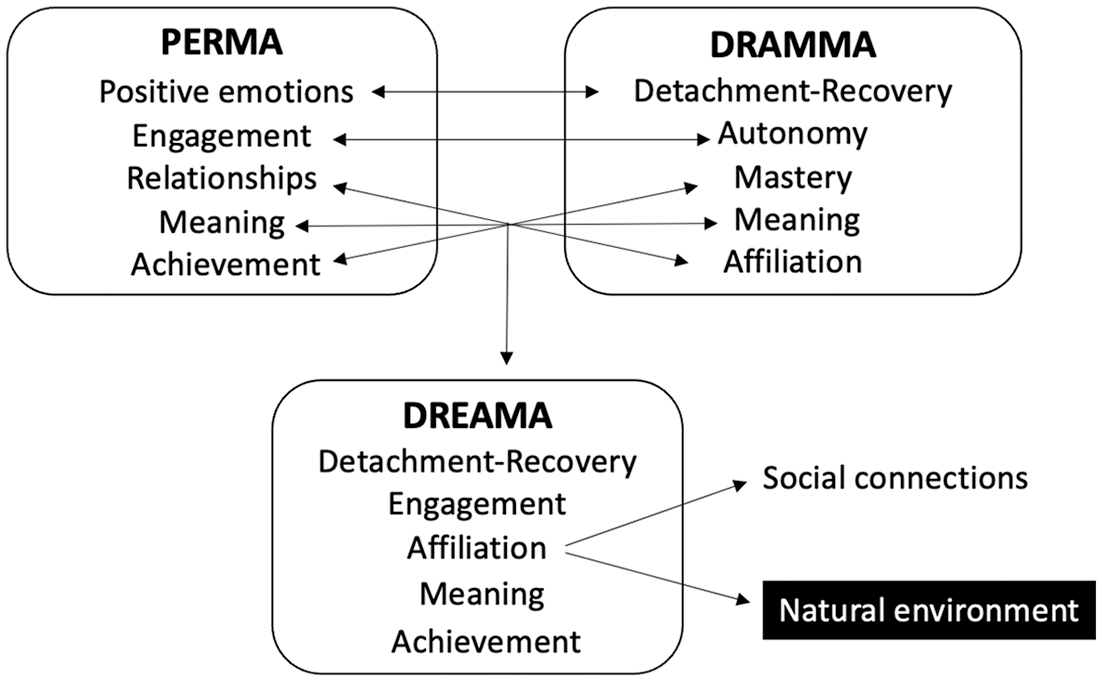
DREAMA: A Hedonic-Eudaimonic Conceptual Model of Tourists’ Psychological Wellbeing
Figure 1 presents the hedonic and eudaimonic dimensions of tourist psychological wellbeing by summarizing the overlapping dimensions in PERMA and DRAMMA models, proposing a new DREAMA conceptual model of tourist wellbeing. According to DREAMA, tourist wellbeing may actually be comprised of the hedonic dimensions of detachment-recovery (DR) including positive emotions; and at least partially eudaimonic dimensions of: engagement (E) including autonomy; affiliation (A) including relationships; meaning (M); and achievement (A), including mastery. If so, a measure of DREAMA would now be required.
Conclusion
Beyond integrating different dimensions of PERMA and DRAMMA, the contribution of DREAMA is twofold. First, DREAMA singles out social connections as part of affiliation (A) and, in so doing, puts emphasis on the social nature of most tourist experiences. This singling out is important as social connections include fundamental human emotions of love and kindness (Singh, 2019) and experiences of friendship (Matteucci, 2019). These emotions and experiences help build wellbeing and are widely prevalent in tourist experiences (Berdychevsky et al., 2013). Yet, they are not typically assessed in tourist wellbeing research, for instance, measures of love do not typically feature in tourist wellbeing surveys.
Second, the proposed model suggests the relationships with other people are equally as important to tourist wellbeing as the affiliation with the natural environment (another singled out aspect of DREAMA). The basis for this point is the well-established positive link between tourists and the natural environment (Huang et al., 2019). Tourism takes place in natural settings (forests, mountains, seaside) and connection to nature (a sense of positive attachment to the ecosystem) is well established (Whitten et al., 2018). Research has repeatedly shown that connection to nature is positively associated with both higher hedonic and higher eudaimonic wellbeing (Cervinka et al., 2011; Mayer et al., 2009; White et al., 2013). Hence the novelty of DREAMA is in the expansion of tourist wellbeing conceptualization, beyond human-to-human contact. In particular, the affiliation dimension in both DRAMMA and PERMA has been understood too narrowly as a human relationship with other people (Newman et al., 2014; Seligman, 2011). DREAMA better identifies the central elements for tourists’ psychological wellbeing by acknowledging that the relationships with then natural environment are equally important to tourists’ wellbeing.
Positive tourism literature is characterized by studies of wellbeing (Mackenzie & Raymond, 2020; Mkono, 2019) so it is imperative to better understand tourist wellbeing. The psychological wellbeing dimensions are crucial in redefining and reappraising tourist wellbeing. A future perspective that puts emphasis on the role of the body and senses (Matteucci, 2021) in experiencing wellbeing (i.e., not exclusively relying on cognitive appraisals) may enhance these analyses of multidimensional tourist wellbeing dimensions. Furthermore, future research should not only focus on the underlying dimensions of wellbeing in the DREAMA model, but should direct attention towards the different prerequisites for hedonic and eudaimonic tourist wellbeing. New studies will benefit from investigating the impact of duration, frequency, and intensity of relationships with natural environment on wellbeing (Hunter et al., 2019), through the utilization of DREAMA. Application of core concepts to emerging areas, such as digital wellbeing in tourism, would also be beneficial. Overall, an exploration of the underlying dimensions of tourist wellbeing, potentially through case scenarios approaches, is required to advance discourses on the DREAMA model. One limitation of this analysis is that it provides a broad conceptual overview of the underlying dimensions of wellbeing. In-depth conceptual work is now required to enhance understanding and measurement of each of the underlying DREAMA dimensions of tourist wellbeing, and we encourage considered discourse on this subject in the future.
