



Abstract
Social media plays an important role in disaster risk reduction and management. This study brings text, emotion, and timeline analyses together to increase our understanding of online travel community members’ emotional dynamics and meaningful themes of concerns during the early months of the COVID-19 pandemic. Qualitative data was collected from three online travel communities on Reddit. We found that, as the pandemic continued, Redditors’ concerns shifted from context-related external issues to daily-life-related internal issues. Furthermore, group-based emotions formed by the virtual community evolved positively, which can be beneficial for restoring confidence in travel after the pandemic. After presenting the results, we discuss their theoretical and practical implications.
Keywords
Highlights
Social media plays an important role in disaster risk reduction and management.
The text, emotion, and timeline analyses were brought together to capture Redditors’ emotional dynamics and meaningful themes of concerns during the early months of the COVID-19 pandemic.
Redditors’ concerns shifted from context-related external issues to daily-life-related internal issues.
Group-based emotions formed by the virtual community evolved positively, which can be beneficial for restoring confidence in travel after the pandemic.
Introduction
While the pandemic has had a disastrous impact on the tourism industry (World Tourism Organization [UNWTO], 2020), it has also provided opportunities for industrial transformation and upgrades (Hao et al., 2020). During the pandemic, social media played an important role in disaster risk reduction and management (DRRM). Social media coverage influences public perception of pandemics and other disastrous events (Hjorth & Kim, 2011), and shapes travelers’ risk perception, attitude towards travel, and travel behavior (Bhati et al., 2021; Rather, 2021). It has thus become an effective tool for understanding tourists’ travel planning and decision-making against current health risks (Carvache-Franco et al., 2021; Pasquinelli et al., 2021). For instance, Yu et al. (2020) analyzed pandemic-related online comments and identified major themes, including tourists’ risk perception, tourism enterprises’ service quality, quarantine, the trustworthiness of media coverage, and racial discrimination. Similarly, Park et al. (2020) identified major topics of hospitality employees’ perceptions of the pandemic, including racism, compassion, employment issues, and sanitation. Rather (2021) discovered that social media positively influenced customer brand engagement during the pandemic. This study aims to understand how tourists have experienced the COVID-19 pandemic by capturing major themes and emotions from User-Generated Contents (UGC) on social media.
It must be noted that most related studies on social media and DRRM have focused only on identifying themes and/or emotions at a particular moment, and there is scant research tracking emotion dynamics and themes of concerns at different stages of catastrophic events. The COVID-19 pandemic is one of the most unpredictable and devastating crises that challenged the operational routine, structure, and survival of the hospitality and tourism industry (Hao et al., 2020). Tourists’ themes of concern and emotions are closely associated with the ever-changing conditions of the pandemic. Thus, in order to understand how tourists experienced the pandemic through social media, it is important to understand the changes in themes and emotional dynamics at different stages. In addition, emotion is dynamic by nature. As Bringmann et al. (2018, p. 293) explained, “emotions are not stable entities, but states that fluctuate over time.” The ever-changing themes of concerns and emotions of UGC centered on the pandemic require longitudinal analysis at multiple time sections.
Since the COVID-19 pandemic is a rapidly evolving and unprecedented crisis, much COVID-19 research has been conducted in an exploratory manner, utilizing real-time data, such as news articles (Chen, Huang et al., 2020; Le & Phi, 2021), online reviews (Chen, Cheng et al., 2020; Luo & Xu, 2021), and social media (Carvache-Franco et al., 2021; Park et al., 2020; Yang & Han, 2021). Le and Phi (2021) analyzed 219 news articles to identify how hotels respond to the pandemic, and Chen, Huang et al. (2020) studied 794 tourism- and hospitality-related news items. While news can rapidly capture the industries’ responses to the pandemic, it may not be optimal for studying the responses of stakeholders, particularly tourists, towards industry fluctuations. Another set of research on COVID-19 using real-time data was on online reviews. Chen, Cheng et al. (2020) utilized the numerical metadata of Airbnb reviews—such as the number of active hosts, length of stay, and review rates—to examine the impact of the pandemic on the sharing economy in Sydney. Luo and Xu (2021) also explored 112,412 restaurant reviews from Yelp.com. Online reviews provide a rich trove of information on the opinions and emotions of customers about a particular service or business. However, they may not be optimal to comprehend intentions or risk perceptions during the pandemic, when travel bans and social distancing have limited travel. Finally, another set of COVID-19 research with real-time data was performed on UGC on social media. Carvache-Franco et al. (2021) and Yang and Han (2021) applied rigorous text mining methods on Twitter data. Twitter allows for the rapid sharing of a vast amount of real-time information. However, character limits and user-based sharing, rather than topic-based, makes in-depth discussions with like-minded people difficult. Compared to Twitter, Reddit facilitates comprehensive and concurrent discussions through a broad range of topic-based virtual communities that guarantee anonymity. Park et al. (2020) explored discussions on the COVID-19 pandemic in a Reddit community for tourism and hospitality employees. However, no study has been conducted with Reddit communities that consist of actual or potential travelers, or people who have special interests in tourism, to capture how information and emotions are shared by the members, and how their key interests and emotions have evolved over time during the pandemic.
In addition to targeting Reddit a community of travelers, this study differs from previous COVID-19 research that uses real-time data, as it combines the text and timeline analysis with emotional analysis to trace meaningful themes of concern and their associated emotions that emerged at different stages of the pandemic. Chen, Huang et al. (2020) and Carvache-Franco et al. (2021) performed text analyses and discovered representative keywords using news coverage and Tweets during COVID-19, respectively. Yang and Han (2021) implemented topic modeling with hospitality-related tweets and demonstrated the changes in topic popularity over time. However, these studies did not demonstrate the latent sentiments associated with these keywords or the major topics. Luo and Xu (2021) utilized an innovative approach to discover features and classify sentiments in online reviews, but failed to examine the general emotions associated with these features. Park et al. (2020) discovered the key topics and the changes in emotional states associated with them over time, using UGC of hospitality and tourism employees. Yet, the associations among these key topics or keywords were not examined to draw the conceptual map that was emphasized in each period of the pandemic. This study highlights the importance of the emotions associated with each topic and tracks how these emotional states have evolved by integrating word co-occurrence analysis, the NRC Emotion Lexicon-enabled emotion analysis, and timeline analysis. The next section illustrates the theoretical grounds of this study in detail.
Literature Review
Social Media and DRRM
Social media is an effective tool for DRRM. Drawing from a review of the most cited studies on social media and DRRM from Scopus, this study reviews the disaster context, theory, methods, social media platforms, research focus, and the role of social media in DRRM (Table 1). The disaster context includes natural hazards (Acar & Muraki, 2011; Kaewkitipong et al., 2012; Kim & Hastak, 2018; Möller et al., 2018; Qu et al., 2011; Sano & Sano, 2019), technical disasters (Sutton, 2010), terrorism and crime (Griswold, 2013), and human-induced crises in tourist destinations (Zhai et al., 2019, 2020). The COVID-19 pandemic is a human-induced crisis that has had disastrous impacts on the tourism industry and tourists worldwide (Hao et al., 2020); therefore, analyzing the UGC from social media can be an effective tool to understand tourists’ major themes of concerns and emotions (Park et al., 2020).
A Review of Social Media and DRRM
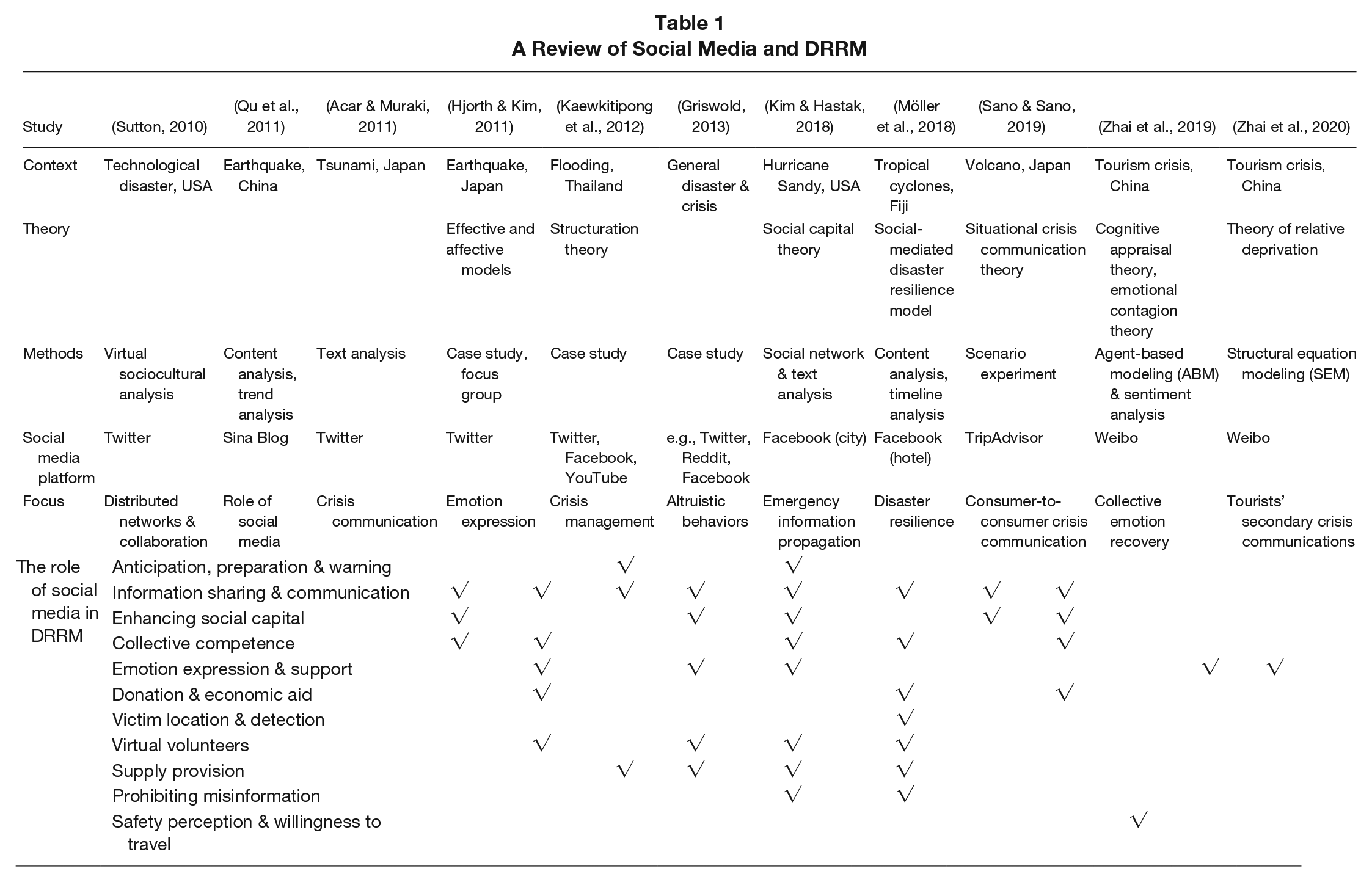
Various psychological and sociological theories are included as a theoretical lens to understand the role of social media in DRRM. Psychological theories such as effective and affective models (Hjorth & Kim, 2011), cognitive appraisal and emotional contagion theory (Zhai et al., 2019), and the theory of relative deprivation are applied to understand online community members’ emotional expression, emotional recovery, and emotional deterioration. Sociological theories such as structuration theory (Kaewkitipong et al., 2012), social capital theory (Kim & Hastak, 2018), the social-mediated disaster resilience model (Möller et al., 2018), and situational crisis communication theory (Sano & Sano, 2019) have been adopted to explore the interaction and communication between online community members. Inspired by the literature, this study draws from the emotional contagion theory in psychology to investigate the emotion dynamics of online community members during the early months of the pandemic.
Most studies have analyzed data via text analysis (Acar & Muraki, 2011; Kim & Hastak, 2018; Möller et al., 2018; Qu et al., 2011), case study (Griswold, 2013; Hjorth & Kim, 2011; Kaewkitipong et al., 2012), network analysis (Kim & Hastak, 2018; Sutton, 2010), emotion analysis (Zhai et al., 2019), timeline analysis (Möller et al., 2018), scenario experiment (Sano & Sano, 2019), and SEM (Zhai et al., 2020). Notably, Möller et al. (2018) combined content analysis and timeline analysis to understand the changes of major themes of concern at pre-, during-, and post-disaster stages, yet the subjects’ emotions were beyond their research scope. Zhai et al.’s (2019) study is the only one focused on the subjects’ emotions; nonetheless, this study failed to explore the linkage between emotions and contextual themes, and ignored the dynamic nature of emotions that changes as the crisis evolves. Therefore, in the same vein as Park et al. (2020), this study innovatively brought text analysis, emotion analysis, and timeline analysis together, to understand the changes in themes and associated emotion dynamics at multiple time sections.
Data were collected through a variety of social network platforms, such as Twitter (Acar & Muraki, 2011; Griswold, 2013; Kaewkitipong et al., 2012; Sutton, 2010), Facebook (Griswold, 2013; Kaewkitipong et al., 2012; Kim & Hastak, 2018; Möller et al., 2018), and mainland China-based Weibo (Qu et al., 2011; Zhai et al., 2019, 2020). Notably, Griswold (2013) called attention to emerging social networks, such as Reddit, which has not been explored from the perspective of hospitality and tourism. Consequently, this study adopts Reddit as the data collection platform given its focus on situation-sensitive dialog, rich information, and an anonymous environment. The merits of Reddit are discussed in the Methods section.
The role of social media in DRRM includes: 1) anticipation, preparation, and warning of the disaster or crisis (Acar & Muraki, 2011; Kaewkitipong et al., 2012); 2) information sharing and communication (Acar & Muraki, 2011; Griswold, 2013; Hjorth & Kim, 2011; Kaewkitipong et al., 2012; Kim & Hastak, 2018; Möller et al., 2018; Qu et al., 2011; Sutton, 2010); 3) enhancing social capital (Hjorth & Kim, 2011; Kaewkitipong et al., 2012; Kim & Hastak, 2018; Möller et al., 2018; Sutton, 2010); 4) improving collective competence (Griswold, 2013; Kaewkitipong et al., 2012; Möller et al., 2018; Qu et al., 2011; Sutton, 2010); 5) emotion expression and support (Hjorth & Kim, 2011; Kaewkitipong et al., 2012; Qu et al., 2011; Zhai et al., 2019, 2020); 6) donation and economic aid (Griswold, 2013; Möller et al., 2018; Qu et al., 2011); 7) locating and detecting missing population (Griswold, 2013); 8) virtual volunteering (Griswold, 2013; Hjorth & Kim, 2011; Kaewkitipong et al., 2012; Qu et al., 2011); 9) providing supplies (Acar & Muraki, 2011; Griswold, 2013; Hjorth & Kim, 2011; Kaewkitipong et al., 2012); 10) prohibiting misinformation (Griswold, 2013; Kaewkitipong et al., 2012); and 11) enhancing safety perception and willingness to travel (Sano & Sano, 2019).
Social Media and Emotion Dynamic
Prevalent public opinions on social media convey the emotional currents running underneath the online network. These emotional flows play an important role in influencing netizens’ decision-making and behavioral outcomes (Luo & Zhai, 2017; Naskar et al., 2020). Social media becomes a powerful platform for netizens to express their emotions in crises, and provides support in terms of mourning, blessing, comforting, encouraging, and expressing concern for victims (Qu et al., 2011). Social media cultivates new affection, intimacy, and co-presence in the digital era (Hjorth, 2005). It offers alternative channels for psychological counseling, and thus helps the disaster-affected population to ease post-traumatic stress (Hjorth & Kim, 2011). Nevertheless, ineffective DRRM on social media can create negative emotions that escalate the impact (Zhai et al., 2019) and eventually induce collective irritation, suspicion of the destination, online group-based action, and reduced willingness to travel (Luo & Zhai, 2017; Zhai et al., 2020).
Emotions are fundamental human feelings and thoughts that have been broadly explored in psychology, philosophy, and sociology (Fan et al., 2018), and more recently in artificial intelligence and social media analytics (Chung & Zeng, 2020). Emotions are embodied with a dynamic nature that “continuously evolve, unfold, fluctuate, (de-)synchronize, linger, merge, and spillover across time” (Kuppens & Verduyn, 2017, p. 22). However, the dynamic nature of emotions has been ignored for long due to limitations of research methods in the past. Traditional methods to measure emotion dynamics through the survey or controlled experiments have limitations such as a relatively small sample size, high costs, and limited spatiotemporal span (Chung & Zeng, 2020; Fan et al., 2018). With the availability of new technologies and methods in recent years, there is a growing tendency to emphasize the dynamic nature of emotion, and perceive it as a study of “the trajectories, patterns, and regularities with which emotions, or one or more of their subcomponents fluctuate across time, their underlying processes, and downstream consequences” (Kuppens & Verduyn, 2015, p. 71).
It is worth noting that the unobtrusive access to time-sensitive and emotion-loaded information on social media brings up new opportunities for emotional analysis with an emphasis on the dynamic nature of human sentiments (Naskar et al., 2019; Seabrook et al., 2018). In recent years, there is an increasing interest in developing innovative analytical tools to discover the mechanisms of netizens’ emotion dynamics towards social events (Naskar et al., 2019). For instance, Seabrook et al. (2018) conducted a longitudinal analysis of the language-based emotion dynamics of UGC to predict depression risks in netizens. Krone et al. (2018) developed a vector autoregressive Bayesian Dynamic Model to capture and analyze netizens’ emotions longitudinally. With a focus on the diffusion process, Fan et al. (2018) developed an agent-based model to simulate emotion contagion and competition in the social media environment. Naskar et al. (2019) adopted the Hidden Markov Model to explore the emotion dynamics unfolding in a consecutive sequence of tweets. Naskar et al. (2020) adopted Russell’s Model of Affect to examine the social dynamics of emotions present in netizens’ opinions, and thus to understand the changing features of emotions on a specific social event over a period of time. Chung and Zeng (2020) employed interaction modeling to dissect emotions in social computing environments.
However, emotion’s dynamic patterns are predominantly examined within an individual (Krone et al., 2018). Albeit on social media, emotions often emerge and escalate in an interpersonal context (Bringmann et al., 2018; Fan et al., 2018). According to the emotional contagion theory, people tend to “automatically mimic and synchronize expressions, vocalizations, postures, and movements with those of another person’s and, consequently, to converge emotionally” (Hatfield et al., 1993, p. 96). In the context of social media, netizens often synchronize their emotions with those expressed by their networks (e.g., friends, key opinion leaders), either consciously or unconsciously (Farrell & Twining-Ward, 2005; Xiong et al., 2018). Through this, individual emotions can escalate to group-based emotions—felt, expressed, or communicated on behalf of one’s group membership (Smith et al., 2007). Group-based emotions constantly shape and reshape public perception and experience of social events (Perelló-Sobrepere, 2017). Close-knit online communities were thus found to demonstrate similar perceptions, experiences, and emotions toward the same social event (Hu et al., 2013). Therefore, emotion dynamics in social media can be understood as temporal and interpersonal emotion systems (instead of individual emotion; Bringmann et al., 2018).
In line with Bringmann et al. (2018), this study emphasizes the dynamic and interpersonal nature of emotions on social media. The social dynamics of emotion, embodied in UGC, were explored to understand the changing features of the emotions of online travel community members towards the pandemic over time, and their relationship with social factors. Additionally, previous studies simply categorized emotions into either positive or negative, ignoring the detailed attributes of human sentiments. This study, however, employed the NRC Emotion Lexicon-enabled emotional analysis in R to identify eight basic, fine-grained emotions (anger, fear, anticipation, trust, surprise, sadness, joy, and disgust) and two types of sentiments (negative and positive) proposed by Plutchik (2001), which play essential roles in crises (Fan et al., 2018). The NRC is a lexicon-based emotion analysis tool that has been broadly adopted in social science studies to identify psychological and emotional states from texts (Park, 2020). The NRC Emotion Lexicon is programmed with more than 14,000 unigrams (words) and 25,000-word senses in English, corresponding to the eight basic emotions and two types of sentiments. Every document was assigned to the most closely related topic, for computing topic-level emotion. The emotion scores of each document and the detailed mechanisms of each emotion were systematically investigated and modeled using the topic assignments of the document. Results were aggregated by month to estimate the emotion dynamics associated with the different stages of the pandemic (Zhang & Fesenmaier, 2018).
Methods
Web 2.0 applications that enable virtual social interaction have given birth to various web-based mega services such as Facebook, Twitter, and Reddit (Subrahmanyam et al., 2008). Reddit is a U.S. social, news aggregation, web content rating, and discussion website. It is divided into smaller communities called subreddits, wherein a few eligible Redditors voluntarily act as moderators to oversee the communities (Spinks, 2014). Other Redditors can join subreddits to post personal opinions, rate, and comment on other posts. Reddit is one of the fastest-growing social websites, especially among Gen Z users in the United States (Clement, 2020a). In May 2020, more than 64.8% of Redditors in the United States were 10–30 years old (Clement, 2020a). Notably, in 2018 Reddit surpassed Facebook to become the third most popular website in the United States, with 330 million monthly active users (Garg & Kim, 2019). However, the utilization of Reddit for academic research and marketing is often overlooked (Hutchinson, 2017; Park et al., 2020).
Reddit was selected as the data collection platform for this study for the following reasons. First, Reddit’s primary function is to disseminate opinions and encourage discussions among Redditors, which generates more situation-sensitive dialog than websites that focus on social network building (such as Facebook). Second, Reddit enables information exchange in various forms (including photos, videos, links, and text-based posts), which can provide a rich dataset for detecting perceptions and emotions. In comparison, Twitter’s character limit hinders such analysis, despite its massive user base and convenience of data collection. Third, the anonymous environment of Reddit facilitates more neutral and authentic conversation, making it an effective channel to understand the experience of online community members. As Reddit’s co-founder and CEO Steve Huffman explained, “When people detach from their real-world identities, they can be more authentic, more true to themselves” (Gutman, 2018). Therefore, there is an increasing interest in using Reddit to study members’ perceptions and emotions (Park et al., 2020).
Data Collection and Purification
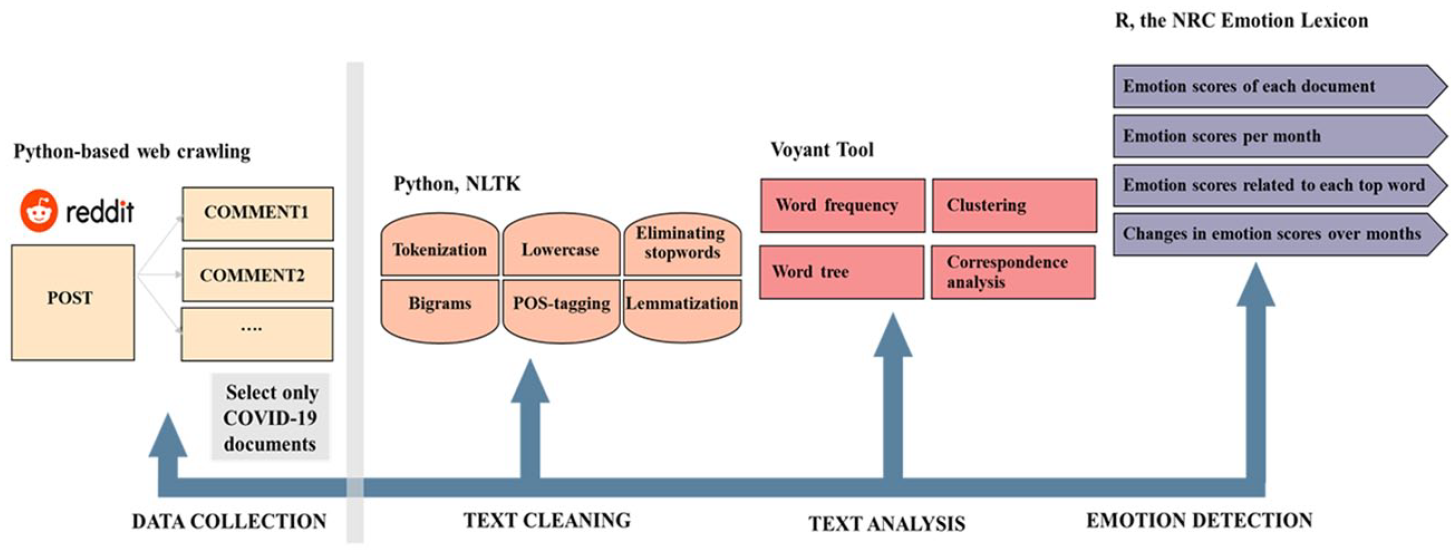
Reddit can be an effective channel to facilitate disaster resilience and mitigation, and understand community members’ experiences of a disaster (Griswold, 2013). Thus, we selected three travel-based subreddits with the largest member bases to retrieve COVID-19-related themes and emotions: r/travel (5.5 million members, https://www.reddit.com/r/travel/), r/solotravel (1.8 million members, https://www.reddit.com/r/solotravel/), and r/tourism (4.2 thousand members, https://www.reddit.com/r/tourism/). As shown in Figure 1, a Python script was developed to collect online posts and comments from these online travel communities. Since very few COVID-19-related posts were found in January, posts created from February to May 2020 were included in the dataset. Initially, 3,422 posts and all associated comments were collected. Moreover, the date, score (representing popularity), and URL links of each post were retrieved.
Process of Text Analysis and Emotion Detection
Multiple data filtering processes were performed to purify the dataset and select posts and comments related to COVID-19. First, we identified all posts related to COVID-19 using various keywords. However, several irrelevant posts and comments, regarding other viruses or diseases, were also detected. After a series of trials, posts that contained one of the three keywords “COVID,” “corona,” or “pandemic” were selected, yielding 342 posts related to the current pandemic. Second, we selected all the comments attached to each post, as they are a continuation of the conversation. The same purification process was then applied to the comments that were not relevant to the COVID-19 posts. Finally, documents containing fewer than 10 characters were dropped because they provided insufficient information for further analysis. Overall, 16,365 documents (342 posts and 16,023 comments) were included in the final dataset.
Text Cleaning and Analysis
Text cleaning procedures were performed with Python, including tokenization, lowercasing, and eliminating non-English characters, NLTK stop words, and custom stop words (e.g., “also,” “another,” “without”). Moreover, bigrams (e.g., “south_korea” and “mexico_city”) were included in the corpus, part-of-speech tagging was conducted, and nouns, verbs, adjectives, and adverbs were lemmatized. The cleaned texts were used for further analysis. Additionally, to see the changes in people’s perceptions over time, the date of creation of each post was converted into a monthly system. Of the 16,365 documents, 1,099 documents were created in February; 9,934 in March; 3,708 in April; and 1,624 in May 2020.
Text, emotion, and timeline analyses were innovatively integrated to explore COVID-19-related themes and emotions. First, a web-based text analytic software, Voyant Tools, 1 was used to process a large amount of text data. The most frequent words were identified through this tool to discover influential events or opinions. Moreover, words that appeared more distinctively in each month were detected to identify the unique events prevalent during these months. Second, words co-appearing with top words were discovered using Voyant, which helped detect the contexts and interests related to each top word. For example, the high frequency of the co-occurrence of two terms, “travel” and “risk,” revealed that many people associated “travel” with “risky.” Co-appearing words can help track individual thoughts to stimulus. Finally, correspondence analysis identified similarities among keywords and found terms highly associated with each month. Thus, a perceptual map was used to visualize correlations among the keywords. The distance between keywords indicates the degree of closeness in the relationship between them. By integrating text analysis, emotion analysis, and timeline analysis, this study identified the main themes and emotions of online travel community members’ responses to the pandemic, studied the relationship between the themes, and explored changes in themes and emotions over time.
Results
Word Frequency Analysis and Word Co-Occurrence
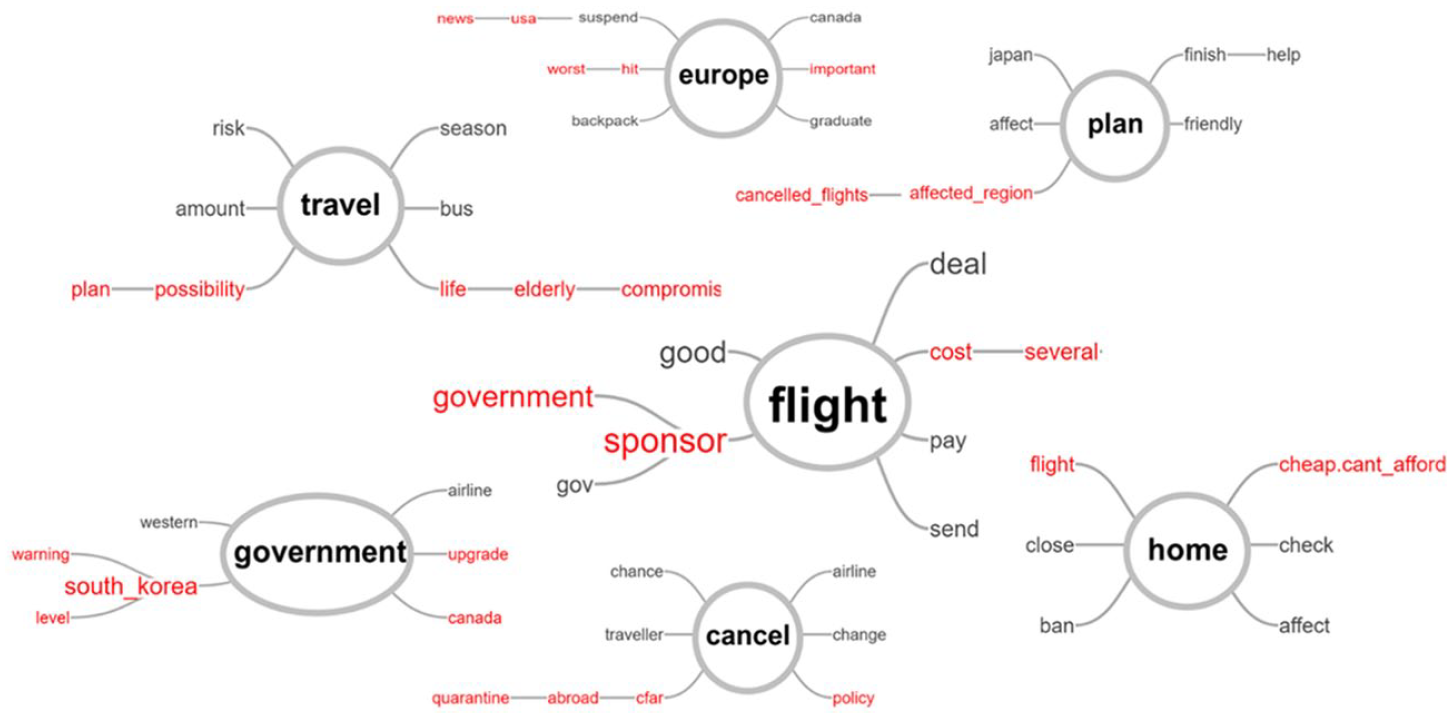
A word frequency test was performed to capture latent topics related to COVID-19 in the three travel-related subreddits. The most frequent words included “flight,” “travel,” “home,” “government,” “Europe,” “plan,” and “cancel.” Word frequency indicates the main focus and concern of each of the three subreddits, but does not further elucidate their meaning (Dickinger et al., 2017). Therefore, the terms co-appearing with these top words were examined to understand the specific background relevant to each top word (Figure 2).
Top Words Frequently Appearing in the Dataset and Co-Appearing Terms
Specifically, the most frequent topic, “flight,” was repeatedly mentioned together with terms regarding economic transactions (e.g., “deal,” “cost,” “pay,” and “send”) and institutional actors (e.g., “government” and “sponsor”). “Travel” co-appeared with terms such as “risk,” “life,” “elderly,” and “cancel,” which indicates that the three travel-related subreddits associated travel with threats of COVID-19. “Home” frequently co-occurred with terms such as “ban,” “close,” and “cant_afford,” which implies challenges for stranded travelers in returning home. “Government” is associated with “south_korea,” “Canada,” “Western,” “airline,” “warning,” and “upgrading,” which presents the three subreddits’ expectations from the governments. “Europe” is closely related to “suspend,” “worst,” “hit,” and “graduate,” which shows the Western-oriented Reddit community’s perception of the pandemic in Europe. “Plan” is co-present with “cancelled_flights,” “affected_regions,” “finish,” and “help,” which reflect the subreddits’ impeded travel plans. Additionally, “cancel” is most related to “change,” “policy,” “airline,” “guarantee,” and “cancel-for-any-reason (CFAR),” which suggests the main reasons for cancellation and concerns regarding company policy or insurance coverage.
Timeline Analysis
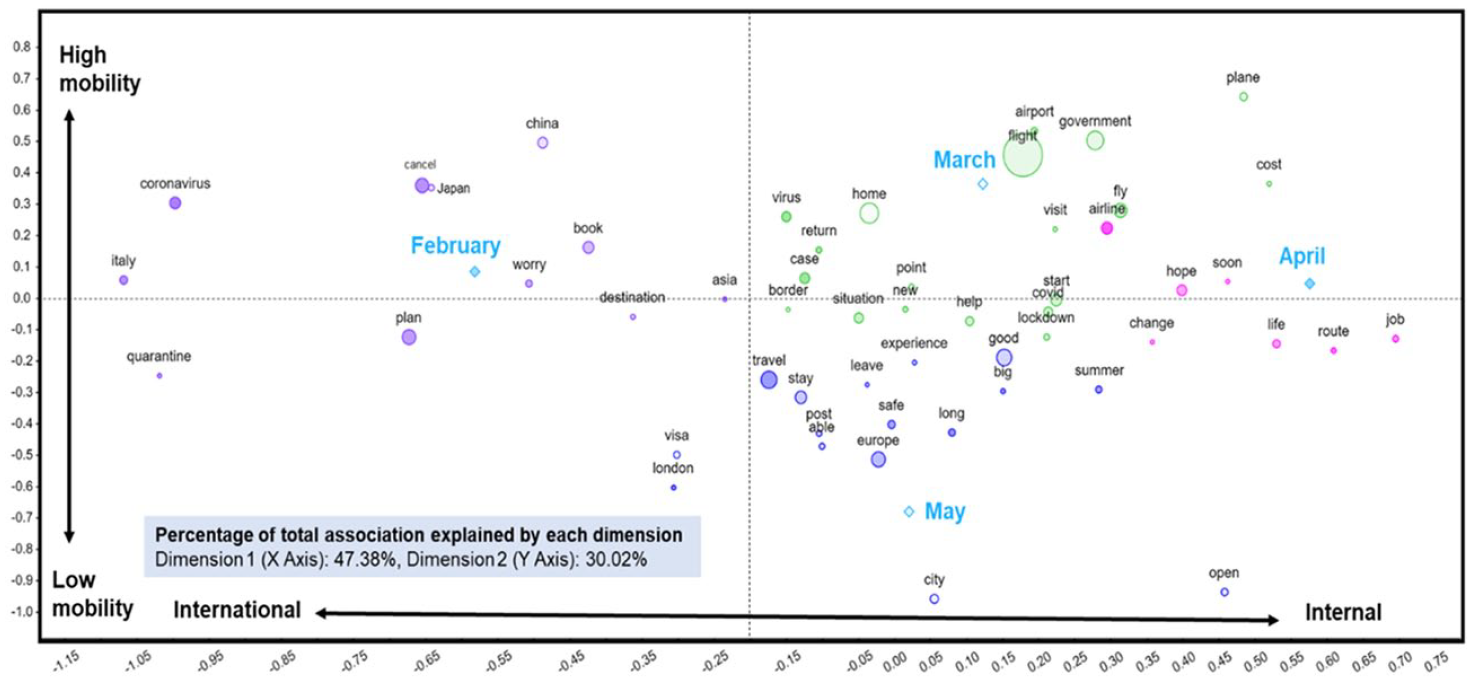
Two types of analyses—correspondence and content analysis—were employed to enhance the robustness of the findings. Correspondence analysis was performed to map the keywords that shared similarities (Figure 3). The perceptual map displays keyword similarities and differences among months. We selected two dimensions (X- and Y-axis), accounting for 47.5% and 30.0% of the total variance respectively, and together explained 77.5% of the data. Subsequently, keywords with high absolute values on the coordinates (at the end of the continuum) were found to be most critical in interpreting each dimension because they were unique keywords representing each dimension. For dimension 1 (X-axis), keywords on the left side of the centroid were mainly related to international issues related to COVID-19 (e.g., Italy, China, Japan, and Asia), while keywords close to the right regarded country-internal issues (e.g., job and life). Regarding Dimension 2 (Y-axis), keywords plotted on the upper side likely represented high mobility, such as trips (e.g., airport, flight), while keywords close to the bottom regarded low mobility, lockdown, and travel restrictions (e.g., city, stay).
Perceptual Map for Keywords and Months
From the centroid, February was located on the left side (i.e., the international issues) on the horizontal axis and the upper side on the vertical axis (i.e., cross-border or inter-state travels with high mobility). Except for February, the rest of the months were more positively associated with Dimension 1 on the X-axis, which implies that members began to discuss COVID-19-related internal issues within their own countries more as compared to February. However, May appeared along the bottom side of the vertical axis, signaling that issues regarding travel restrictions or lockdown were more frequently shared among travel community members.
Based on the insights from the correspondence analysis, an additional manual content analysis was performed on the actual posts or comments. We reviewed the documents containing the keywords for each month to obtain a more in-depth understanding of the issues that were popularly discussed. Table 2 presents the major topics from the actual quotes found in the Reddit travel communities from February to May. Based on the locations mentioned in the posts, topics are categorized as either international (e.g., what is going on in other countries) or internal (e.g., employment, living) issues. According to the extent of mobility, topics are identified as either high (e.g., travel plan, flight arrangement, evacuation) or low (e.g., lockdown, isolation) mobility.
The Major Topics From Actual Quotes Found in the Reddit Travel Communities From February to May 2020
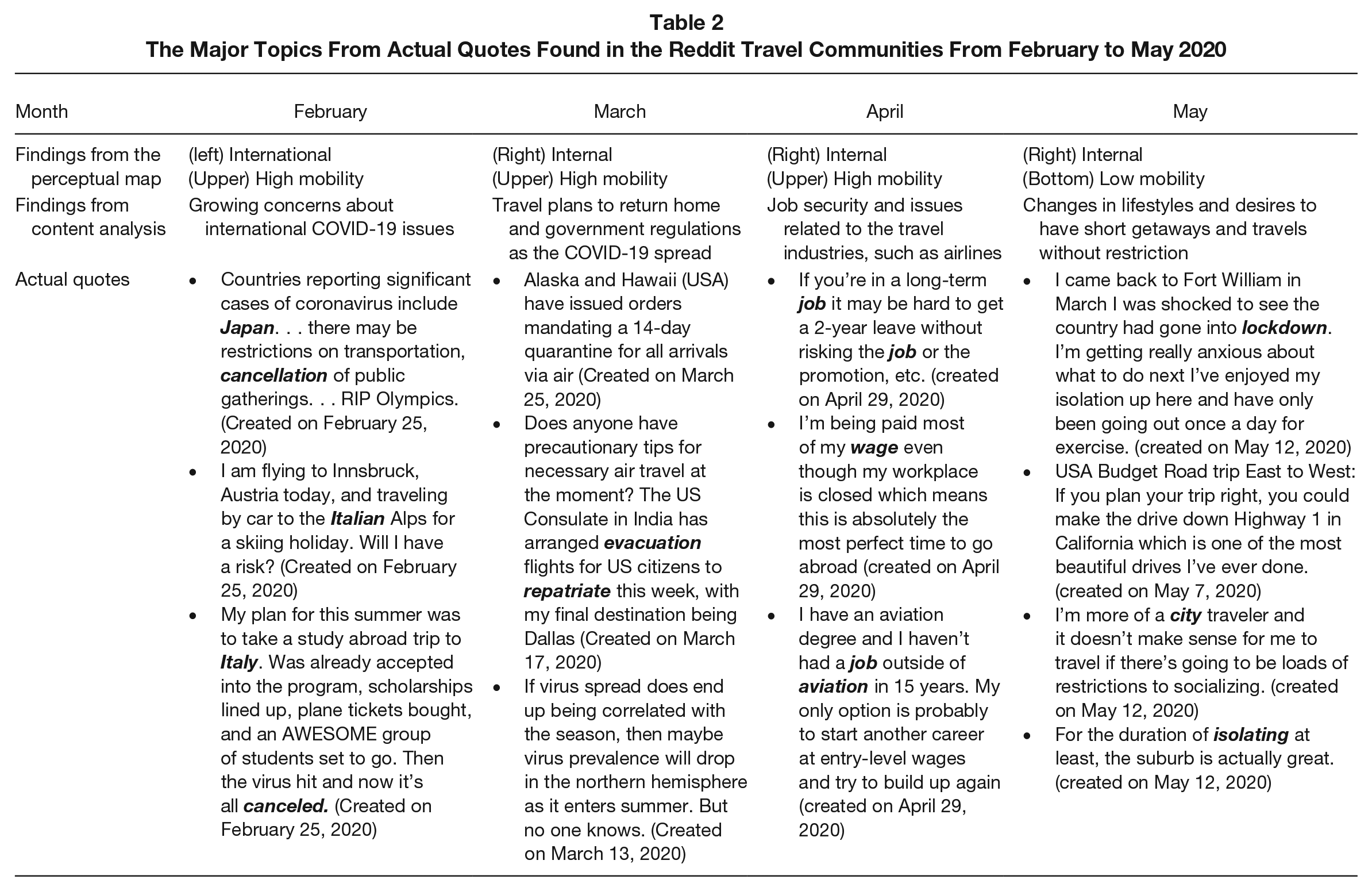
In February 2020, the subreddit members often talked about COVID-19 issues in the most affected countries, such as Italy, Japan, and China. The outbreak first hit Asian countries and spread to Italy in February 2020 (Schoenwalder, 2020). Accordingly, we found several posts on trip changes to Asian countries. Moreover, many people paid close attention to changes in mega-events, such as the Olympics in Japan. As European countries began to report COVID-19 cases, many started seeking others’ opinions on their original travel plans to Europe or necessary reactions to the pandemic.
While many paid close attention to pandemic issues in foreign countries in February–March 2020, interests were mainly centered on COVID-19-related issues in their own countries. In March 2020, COVID-19 was officially declared a pandemic, which prompted much discussion on returning home and regulations on flights and lockdowns. Although not reported in Figure 3, the terms that distinctively appeared in March were “repatriate,” “military,” “embassy,” and “evacuation,” indicating that there was an interest in news about people returning to their homes.
In April 2020, community members continued to focus on pandemic issues in their own countries, such as job security. People anticipated changes in the workplace. Those who experienced such changes shared their experiences. Many people expressed a strong desire for travel. More so, terms related to the airlines and oil (e.g., “Norwegian,” “Finnair,” and “oil”) distinctively appeared in April, representing people’s escalated concerns about the troubling issues surrounding airline and other tourism companies. In summary, the major theme in April was the detrimental impact of the pandemic on the travel industry and related stakeholders, and its spillover effects on citizens.
Finally, in May 2020, many posts and comments noted the changes in people’s lifestyles during the lockdown. As the desire to travel remained high (or even grew), people shared their getaway plans and leisure activities during the lockdown (e.g., walking down the street in their neighborhood or taking a road trip). Some shared their plans in anticipation of lifted government regulations, which garnered many comments. Naturally, people were also concerned about “safety” issues, since COVID-19 cases were still growing in the United States. Notably, some members talked about their experiences or opinions of “city” and “suburb” life. Accordingly, “suburb,” “downtown,” and “city” appear prominently in May.
To summarize, the major topics in the three travel-related subreddits varied over months. The subreddits shared their thoughts on external issues more actively in February but talked about routine, internal issues in the other months. As travel-related regulations became stringent, issues with lower spatial mobility were shared more among the three subreddits in the later periods.
Emotion Analysis
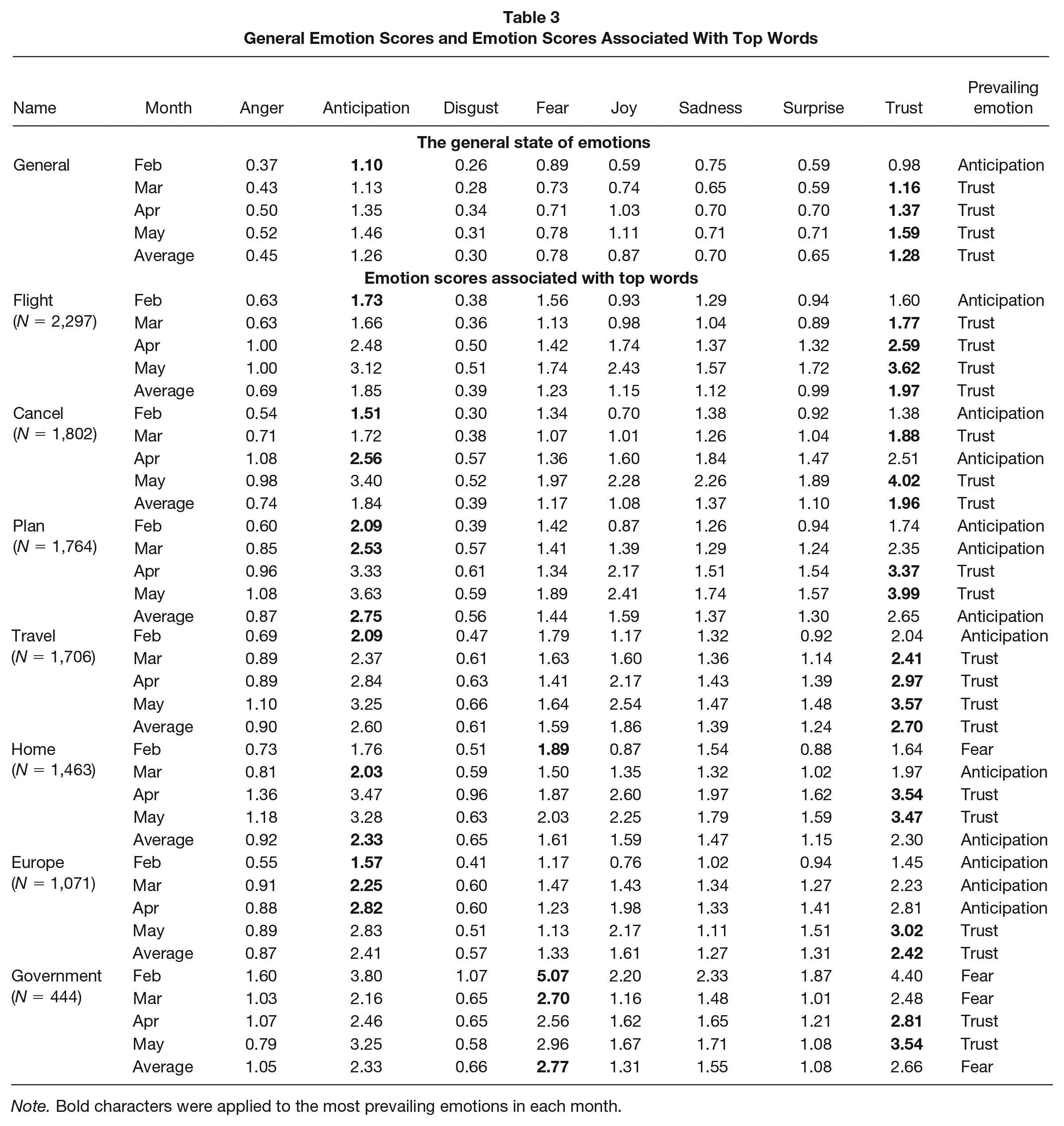
We applied the NRC Emotion Lexicon to identify general group-based emotions prevalent in each month. Thus, both the prevalent emotions and changes over time were visualized. Moreover, we found the emotions associated with top words representing major topics during the pandemic (Table 3).
General Emotion Scores and Emotion Scores Associated With Top Words
Note. Bold characters were applied to the most prevailing emotions in each month.
Our findings show that most members of the travel-related subreddits remained positive rather than negative, as anticipation and trust were the most prevalent emotional responses to COVID-19. As for the negative emotions, the patterns of sentiment polarity varied over time. For instance, anger and disgust tended to increase over time, while fear and sadness dropped in March and April and re-intensified in May. Some Redditors had extremely negative emotional reactions to several events. Interestingly, these negative emotions became positive in the later stages. Negative emotions did not simply fade away; rather, other positive emotions prevailed over them. For example, many people expressed their concerns and sadness about the “new normal” after the pandemic, and one subreddit had the following post: “Am I going to be too old to do world travel once the coronavirus issues [are] over? After 15 years of working hard, I saved to travel the world in 2020, but now it may not be possible, and I am conscious my [life] is ticking [away].”
Members left many comments to provide emotional support, saying: “It’s never too late bro. You’re only as old as you feel” and “There are people in their 80s who travel around the world. You might need to put it off for a bit, but you have more than enough time left.’
Consistent with general emotions, anticipation and trust were most prevalent in the posts and comments related to each top word, except for “home” and “government.” Moreover, similar patterns of negative emotions (i.e., decreasing and increasing again) were found with the top words. For example, from 2,297 posts and comments related to “flight,” anticipation was the most salient in March, and trust was most prominent in March, April, and May 2020. This implies that people felt less fearful, sad, and disgusted in March than in February. However, negative emotions escalated again in April and May. The emotional changes over time demonstrated that public opinion related to events could evolve.
Although positive emotions were the most common with most top words, negative emotions (i.e., fear) were the most salient in the documents associated with two top words, “home” and “government,” especially in the early stages of the pandemic. In later stages, however, the negative emotions turned positive. Regarding the documents associated with “home,” it is worth noting that the related negative emotions did not disappear, but continued to grow in April and May. However, other positive emotions, such as anticipation and trust, grew more prominently than the negative ones. Discussions on “government” had a similar pattern to those on “home.” While people remained fearful, trust grew stronger in the later months.
Discussion and Conclusion
Theoretical and Methodological Implications
This study aimed to understand tourists’ experience of the pandemic during the early months of the COVID-19 pandemic. Text, emotion, and timeline analyses were integrated to capture and scrutinize meaningful themes of concern and the emotional dynamics in the UGC from three travel-related virtual communities on Reddit. This study contributes to DRRM literature by highlighting the role of social media as a powerful complementary tool for information sharing, opinion expression, and emotional coping. Social media shapes netizens’ experience, perception, and emotions during a disaster. As Hjorth and Kim (2011, p. 199) revealed, “while new media don’t make revolutions happen, they do frame how they are conceptualized and experienced in different ways.” Social media provides real-time information about netizens’ major themes of concerns and how they evolve in response to dynamic social events. The word frequency analysis and word co-occurrence analysis show that Redditors’ major concerns are centered on returning home safely, dealing with pre-arranged travel plans, and the role of the government in supporting their mobility. Moreover, the timeline analysis reflects that Redditors’ major concerns transformed as the pandemic evolved, from context-related external issues to more routine internal issues. Meanwhile, concerns about access to spatial mobility declined with diminishing travel possibilities.
The findings of this study also contribute to the understanding of emotion dynamics in DRRM. The growing volume, velocity, and variety of social media have provided an illustration of human emotions on a large scale (Chung & Zeng, 2020). Emotions fluctuate and change over time, and social media can be a powerful tool to trace the ebb and flow of people’s emotions. It enhances insights into emotion dynamics over time and the interaction between emotions and major themes of concerns. This study focused on the dynamic nature of netizens’ collective emotions and discovered that social media plays a positive role in DRRM, serving as an emotional coping mechanism for people impacted by disasters (Hjorth & Kim, 2011). Findings from the emotion analysis and timeline analysis generally suggest that Redditors engaged more in positive emotions than negative ones. Anticipation and trust were the most prevalent emotions related to COVID-19. In line with Kaewkitipong et al. (2012) and Hjorth and Kim (2011), this study further verified that social media can be not only an effective and prompt channel for communication and information-sharing but also an important channel for emotional expression and mutual support. Thus, it simultaneously expands on traditional forms of intimacy and co-presence.
In addition, this study makes key methodological contributions. Although previous studies analyzed emotions in social media longitudinally, most studies either ignored the dynamic nature of emotion or failed to consider the interactions between the ever-changing themes and the emotion dynamics. This study innovatively integrated text, emotion, and timeline analyses to understand the interaction between major themes of concerns, the emotions associated with the themes, and the changes of themes and associated emotion dynamics at multiple time sections in the pandemic’s early stages. Moreover, this study is one of the few studies to collect data from Reddit, which has merits in terms of situation-sensitive dialog, rich forms of information, and an anonymous environment. The study’s proposed approach can be applied in the future to understand netizens’ reactions to major social events in real-time and in a broader context.
Practical Implications
From a managerial perspective, social media can be a powerful tool for DRRM. On the one hand, social media can help capture and monitor the themes of concerns and prevalent emotions about tourism-related social events in real-time. Tourism practitioners, policymakers, and scholars can use this to develop effective strategies to shorten response times, alleviate the devastating impact, reassure tourists, and forecast industrial transformations promptly and effectively. For instance, when the pandemic hit Western societies in February 2020, Redditors had high expectations from policymakers to propose timely solutions regarding compensation or rescheduling of flights, hotels, and travel cancellation. Industry practitioners can actively work with policymakers and leverage social media to understand traveler concerns and emotions. Effective solutions can be developed to protect travelers from economic loss and reduce non-essential travel and the risk of cross-infection.
On the other hand, social media can be leveraged to create more positive group-based emotions. Tourism practitioners, policymakers, and scholars should utilize the platform appropriately to cultivate positive emotions and reduce negative ones. According to the emotional contagion theory (Hatfield et al., 1993, p. 96), online community members who saw more positive posts published more positive posts and fewer negative ones. Analyzing the interaction between themes and emotions can reveal the themes with the strongest correlations with both negative and positive emotions. Policymakers can strategically solve themes that trigger negative emotions and make policies transparent via their official accounts. Meanwhile, they should deliberately increase the publicity of themes highly associated with positive emotions. Moreover, as Yang et al. (2020) suggested, relevant parties should actively share timely, precise, and positive pandemic-relevant information, decrease excessive discussions on the pandemic, and create caring online engagement and interactions, to enhance the general public’s psychological well-being. Additionally, hospitality and tourism industry practitioners are encouraged to post photos, videos, and live streams about tourist destinations, hotels, safety measures, service innovations, and to motivate netizens’ willingness to travel and restore their confidence in hospitality and tourism industry.
In addition, the COVID-19 pandemic offers an opportunity for the tourism and hospitality industry to integrate social media into standard operating procedures for DRRM (Hao et al. (2020). As Griswold (2013) suggested, virtual operations support teams should be established to support DRRM via social media tools and high-tech communication channels. DRRM professionals are encouraged to adopt state-of-the-art technologies to develop a system that integrates real-time analysis, event detection, emotion analysis, and visualization recommendations (Chair et al., 2019). The DRRM team can understand public opinions and group-based emotions, ascertain the most discussed events and streamline information, facilitate mutual help, and propose suggestions to ensure the public’s well-being (Qu et al., 2011).
Limitations and Future Research
This study has a few limitations. First, although approximate information on Reddit users is identified, detailed demographic information on the targeted members is unknown, as Reddit guarantees complete anonymity. Second, according to the distribution of traffic in 2020 issued by Statista.com, the United States has the largest Reddit user base (49.76%), followed by the United Kingdom (8.21%), Canada (7.59%), and Australia (3.74%; Clement, 2020b). This implies that Reddit discussions are predominantly from the Anglosphere, and perspectives from other cultural contexts are not captured. Future studies can combine various cultural perspectives to compare different opinions or emotions toward the pandemic. Third, even though Reddit has the advantage of capturing the discussions of potential entrepreneurs, who are major stakeholders in the tourism industry, the opinions of other stakeholders, such as the government, DMOs, or travel companies, were not explored. Fourth, this study employs an exploratory approach to ascertain natural perceptions and emotions regarding the pandemic. Despite this, the influence of public opinion and emotional response to the pandemic on the tourism industry, such as tourist arrival and willingness to travel, were not tested. Future studies may adopt the findings of this study to advance these theories. They may also adopt secondary data as a proxy for tourism industry performance, which can be integrated to test the influence of public opinion on tourism. Finally, this study only analyzed text-based posts. However, several other posts included videos and pictures that may be used to express perceptions and emotions. Future studies may analyze various media forms on social media posts and comments to better comprehend their role in shaping opinions and emotions. Finally, this study only analyzed data from February to May 2020, and future studies are suggested to investigate this topic over a longer duration
Footnotes
Authors’ Note:
This study is funded by the Walter & Wendy Kwok Family Foundation Professorship in International Hospitality Management.
