




Abstract
Analyzing residents’ support for events has become popular in sports tourism research. Based on the social exchange theory and the theory of reasoned action, this study tests a model of support for the 2018 UCI Road World Championships (N = 2,265). The findings show that the perceived image fit between an event and a place significantly influences residents’ overall attitude and event support. Furthermore, overall attitude mediates the relationship between the perceived fit and event support. This study supplements the literature (a) by testing the fit between event image and place image and its influence on residents’ attitude and support, (b) by analyzing the image fit of a summer sports event held in a well-known designated winter sports region, and (c) by providing recommendations for policy makers to achieve higher support from residents when bidding for and hosting sports events.
Introduction
As a segment of the tourism and leisure industry, sports tourism in particular is experiencing rapid growth and development, with sports events contributing significantly to this progress (Ritchie et al., 2002). Sports-related events are considered as sporadic recreational occasions that attract global audiences and have the power to change people’s lives in a number of different ways. Overall, cities and countries expect benefits for the community when hosting a major sports event (Gratton et al., 2005).
The endorsement of local residents is critical as they are often directly affected by these events and can therefore be seen as key stakeholders in the planning and execution of the event (Sautter & Leisen, 1999). While inhabitants and their attitude toward tourism have been studied extensively (Andereck et al., 2005; Brida et al., 2014; Jurowski & Gursoy, 2004), researching residents’ attitudes toward and support for sports events is an emerging trend (e.g., Gursoy et al., 2017; Li & Penny Wan, 2017; Vetitnev & Bobina, 2015). This relatively new field of research delineates the influence of event impacts—mostly economic, sociocultural, and environmental impacts—on residents’ support (Al-Emadi et al., 2017; Prayag et al., 2013). Researchers have investigated the role of residents in event support in combination with various impact factors, including the role of media, politics, and involvement in event decision making (Ritchie et al., 2009), community attachment (Gursoy et al., 2017; Li & Penny Wan, 2017), locals’ environmental attitudes and community concerns (e.g., Gursoy & Kendall, 2006), trust in government (Gursoy et al., 2017), and the anticipated influence of the event on quality of life (Andereck & Nyaupane, 2011).
From the existing literature, it remains unclear if the type of sports event has an impact on the locals’ attitude and the likelihood of their support; neither does it declare how the perceived fit between a sports event and its host region influences residents’ opinion. Academics throughout different social disciplines have become increasingly interested in this research field (Florek & Insch, 2011; Hallmann & Breuer, 2010a, 2010b; Kaplanidou & Vogt, 2007). By now, only a couple of scholars investigating this field have tried to identify and analyze a fit component. These researchers base their results on the image perception of tourists, sports event visitors, or active participants (Hallmann & Breuer, 2010a; Kaplanidou & Vogt, 2007). So far, the image perceptions local residents have of sports events and the host region have not been examined. Due to this gap in research and the fact that relationships between sports events and event places as well as their potential impacts on residents’ attitude and event support have been neglected, this study goes beyond the existing research.
Thus, the first objective of the present survey is to examine empirically the constructs place image and sports event image. Second, the study will shed light on the fit between place and sports event image and its potential influence on residents’ attitude on and support for the sports event (SUP). Third, the subsequent linkage between residents’ attitude and event support will be explored. Finally, implications for local policy makers are provided in order to increase residents’ support for hosting sports events. To respond to the research questions, the 2018 UCI Road World Championships in Innsbruck–Tyrol 1 (RWC) were selected for examination. The selected case is very interesting for studies in this field of research, because the region of Innsbruck–Tyrol has hosted a disproportionately high number of major events (Schnitzer et al., 2017), is confronted with an above-average tourism intensity, and the population has already voted against hosting the Winter Olympics several times, most recently in autumn 2017 (Schnitzer & Haizinger, 2019). In addition, in recent years, local decision makers have increasingly been trying to direct the focus from winter sports (tourism) toward year-round offers for locals and tourists; a development that is also due to climate change (Schlemmer et al., 2019).
Literature Review
Theoretical Framework
Studies examining locals’ attitudes and event support often use the social exchange theory (SET) and the theory of reasoned action (TRA) as guiding theories. The SET represents a sociological theory, which is widely used in resident attitude studies (e.g., Nunkoo & Ramkissoon, 2011; Prayag et al., 2013) and studies analyzing the support of residents for events and tourism development (Gursoy et al., 2017; Gursoy & Kendall, 2006; Nunkoo & Gursoy, 2012; Zhou & Ap, 2009). The theory proposes that “all human relationships are formed by the use of a subjective cost-benefit analysis and the comparison of alternatives” (Kang et al., 2008, p. 683). The willingness of individuals or groups to participate in a transaction with another partaker is higher if it is believed that such an exchange will bring benefits (Nunkoo & Gursoy, 2012; Nunkoo & Ramkissoon, 2011). The individual evaluation of an event is primarily based on the perceived personal advantages and disadvantages caused by the event (Li & Penny Wan, 2017). As this premise simultaneously considers both positive and negative impacts, the SET is suitable for studying the support of residents (Ap, 1992).
In tourism and leisure research, several studies have applied the TRA (Y. H. Kim et al., 2011; Prayag et al., 2013). This theory is primarily used to explain the connection between attitudes and behavioral intentions. The TRA is a hierarchical model claiming that behavioral intent, which is affected by subjective norms and attitudes, influences behavior, while both behavior and behavioral intent are influenced by beliefs (Lepp, 2007). In addition, it suggests that human beings, who have the power of rational thought, are able to use and order information so as to adopt reasonable behavior or make reasonable decisions (Ajzen & Fishbein, 1980).
Determinants Influencing Residents’ Attitudes and Event Support
Attitude as a psychological disposition is seen as an evaluation of a specific matter with a certain degree of approval or disapproval, enabling the overall capturing of feelings and thoughts (Eagly & Chaiken, 1993). It can be examined in numerous different contexts, including sports and sports events. Accordingly, attitude has been studied in connection with the Olympic Games, whereby hosting the Games appears to have positive effects on residents’ attitude toward the event and event support (Hiller, 2012). The study by Vetitnev and Bobina (2015) showed that residents, who are more familiar with the Olympic Games, have more positive perceptions of the event. Hence, insights into residents’ attitudes seem to be a fundamental outcome of sports event research.
Furthermore, residents’ support for projects, such as events and festivals, has been widely discussed (Gursoy et al., 2017; Nunkoo & Gursoy, 2012). Literature states that the expected and experienced positive and negative effects an event generates are critical when it comes to gaining the residents’ support for mega events in their vicinity (Gursoy et al., 2011). There is strong evidence that perceived positive impacts have a significant positive influence on the support of residents, whereas negative perceptions significantly affect resident’s support in a negative way (Zhou & Ap, 2009). According to Jurowski and Gursoy (2004), there are several factors—for example, expected personal benefits, distance from the event, community attachment, and sociodemographic variables—that can affect levels of support.
According to Gursoy and Kendall (2006), residents’ willingness to support and be involved in the staging of mega events is crucial for three important reasons. First, locals are frequently exposed to an increase in taxation in order to provide sufficient financing for event-related facilities and infrastructure. This has led to the recent trend among host cities and regions to hold official referenda to question residents on their support for the bid (Lutz, 2015). Literature in this field has become more important in the last few years (Schnitzer & Haizinger, 2019). Second, hospitable and event-friendly residents are essential if the aim is to develop from a mega event to a more inclusive “urban festival” that is positively experienced by locals and guests alike (Hiller, 1990). Third, if residents support and are involved in the mega events, the positive impacts those events may have on the residential community are likely to last longer and resident’s quality of life may be positively affected (Gursoy & Kendall, 2006).
Gursoy and Kendall (2006) underlined that the apprehended advantages or impacts positively affect the residents’ support of the event; accordingly, Balduck et al. (2011) revealed that community-related benefits (e.g., cultural initiative and embellishment of the host destination) influence the host community’s consent to host the event. Furthermore, results of retrospective studies (e.g., Schnitzer et al., 2019) indicate that event support is significantly influenced by how former sports events have been perceived by the host regions’ residents. Finally, studies (e.g., Prayag et al., 2013) found a positive correlation between the support for the 2012 London Olympic Games and the general attitude toward the effects of the event. Even though literature provides several examples on the influence attitude has on event support, this particular case—a combination of high event density and residents’ skepticism toward these events—seems to be a solid basis for this study. Hence, the first hypothesis is proposed as follows:
Image Fit Between Sports Events and Destination/Place Image
Given that tourism and event literature have discussed the matching of the images of (sports) events and their hosting regions mainly from the guests’ viewpoint, the term “destination image” (cf., Stylidis et al., 2014) is commonly used; however, the term “place image” may be more appropriate when discussing the topic from a residents’ perspective. While a destination image can be seen as the individual construct of ideas, beliefs, and impressions about attributes of and/or activities provided at a specific destination (Echtner & Ritchie, 1991; Lin et al., 2007; Wang & Hsu, 2010), a place image may rather be described as a mental construct deriving from the information available about a destination (Kotler et al., 1993). Regarding place images and their potential impacts on tourism projects, only a few studies have been conducted; the study of Stylidis et al. (2014) seems to be the most relevant. It revealed that the locals’ place image influences their attitude toward the impacts of tourism and therefore their support for tourism development. Consequently, the determinants constituting a place image may be applied to a destination image and vice versa.
The central determinants of a destination image are expressed by affective, cognitive, and conative components (Gartner, 1996), which may also be transferred to the concept of place image. The factual knowledge and beliefs about a destination or a place, which encompass all we know about it, refer to the cognitive component. The cognitive component is a mental response, which includes understanding, interpreting, evaluating, and thinking about the attributes of a place (Baloglu & McCleary, 1999; Lin et al., 2007; Tasci & Gartner, 2007). The affective component refers to the emotions and feelings an individual has toward a place. It involves negative, positive, or neutral feelings, such as pleasure, relaxation, and frustration (e.g., Beerli & Martin, 2004). Examining a tourism context, Baloglu and McCleary (1999) revealed that the cognitive image tourists have of four visited countries positively influences the affective evaluations of these countries. Finally, the conative stage comprises the behavioral intention, for example, a guest’s decision to visit/revisit a destination or event (Baloglu & McCleary, 1999; Gartner, 1996).
The expectation that sports events positively influence the image of a destination and a place, respectively, is supported by various studies (Hallmann & Breuer, 2010a, 2010b; Kaplanidou & Gibson, 2010; Kaplanidou & Vogt, 2007), whereas other studies question this prevailing assumption and report inconsistent findings on the impact of staging an event (Y. H. Kim et al., 2011).
There is no unified consensus regarding the definition of sports event image (Deng et al., 2013; Hallmann & Breuer, 2010a, 2010b; Kaplanidou & Vogt, 2007). Nonetheless, according to Deng et al. (2013) as well as Hallmann and Breuer (2010a), it is assumed that the concept of sports event images as well as destination/place image consists of affective, cognitive, and conative components. According to authors such as Lee and Cho (2009), event images can be evaluated similarly to brands, namely rationally and emotionally. Due to the lack of frameworks measuring sports event images (Deng et al., 2013; Hallmann & Breuer, 2010a, 2010b; Kaplanidou & Vogt, 2007), the study in hand assumes that the destination image framework can serve as a reference for conceptualizing place images as well as sports event images. Furthermore, cognitive and affective components—that is, the underlying basis for place image formation—may also be used to measure sports event images. Some studies proposed that a destination concept, as well as place and sports event images could have similar image associations, otherwise referred to as image fit (Hallmann & Breuer, 2010a, 2010b; Kaplanidou & Vogt, 2007).
The image fit concept is a component of the so-called process of image transfer. This process states that images of a specific object are transferable to other objects and vice versa, leading to favorable, strong, unique associations (e.g., Deng et al., 2013). According to Hallmann and Breuer (2010a), image fit is understood as the assessment of the correlation between a destination/place image and a sports event image. Hallmann and Breuer (2010a, 2010b) were the first to quantify the image fit using a formula to index the different variables measuring the affective and cognitive components.
Hosting an event can be considered as a fundamental component of a tourist destination value chain and may offer benefits for the local population. Deng et al. (2013) focused their research on tourism, stating that the host destination and a sports event will be associated with each other in the consumers’ mind and influence their attitudes toward the destination. Hence, it can be inferred that the perception of the sports event and its hosting destination will influence the attitude toward the sports event and the destination (Deng et al., 2013). As explained above, these findings can also be transferred to the place/resident context applied in the present study. Thus, the following hypotheses are proposed:
The Mediating Effect of Overall Attitude on Sports Event Support
Although the antecedents of residents’ attitude toward (Gursoy et al., 2002) and support for tourism projects (Nunkoo & Ramkissoon, 2011) are well researched, the constructs of residents’ OA and support have been applied differently in previous studies. While some authors use the perceived positive and negative impacts as effect factors driving event support (Gursoy & Kendall, 2006; Li & Penny Wan, 2017), others make no distinction between OA and support (Ko & Stewart, 2002). Literature (e.g., Al-Emadi et al., 2017; Prayag et al., 2013) highlighted the importance of distinguishing between attitudes and support. The study at hand goes along with these authors and postulates attitude toward and support for mega events as different constructs. Previous studies (e.g., Al-Emadi et al., 2017; Gursoy et al., 2017) operationalized residents’ support as the overall support for hosting and bidding on future sports events. Kwon and Vogt (2010) found that local populations’ OA and place marketing as well as the support for marketing activities and future tourism development are positively correlated. More recently, Prayag et al. (2013) noted the mediating role of the OA toward and event support for the 2012 London Olympic Games.
The SET and TRA posit that locals’ perceptions of event effects influence their OA and that event support is the outcome of attitudes, equivalent to factual intentional behavior (Prayag et al., 2013). Several studies investigating residents’ attitudes (Prayag et al., 2013; Yoon et al., 2001) have postulated that OA mediates the correlation of the perceived impacts and event support. Research streams examining the image fit between a destination and a sports event noted that the fit predicts the behavioral intention for revisiting a destination (Hallmann & Breuer, 2010a, 2010b). However, as the image fit between a place image and a sports event image has not been analyzed yet, we assume that also this image fit is a predictor of future intentional behavior. Again, the contextual background of the study seems to be quite relevant here as the image fit between a place—mainly known for winter sports but shifting its focus to year-around offers—and its image is exposed to a very critical population. Therefore, the last hypotheses are the following:
Material and Method
Proposed Model, Sample, and Survey
To examine the suggested hypotheses, a theoretical model was developed. The theoretical model is shown in Figure 1, summarizing the previous discussion based on the SET and TRA.
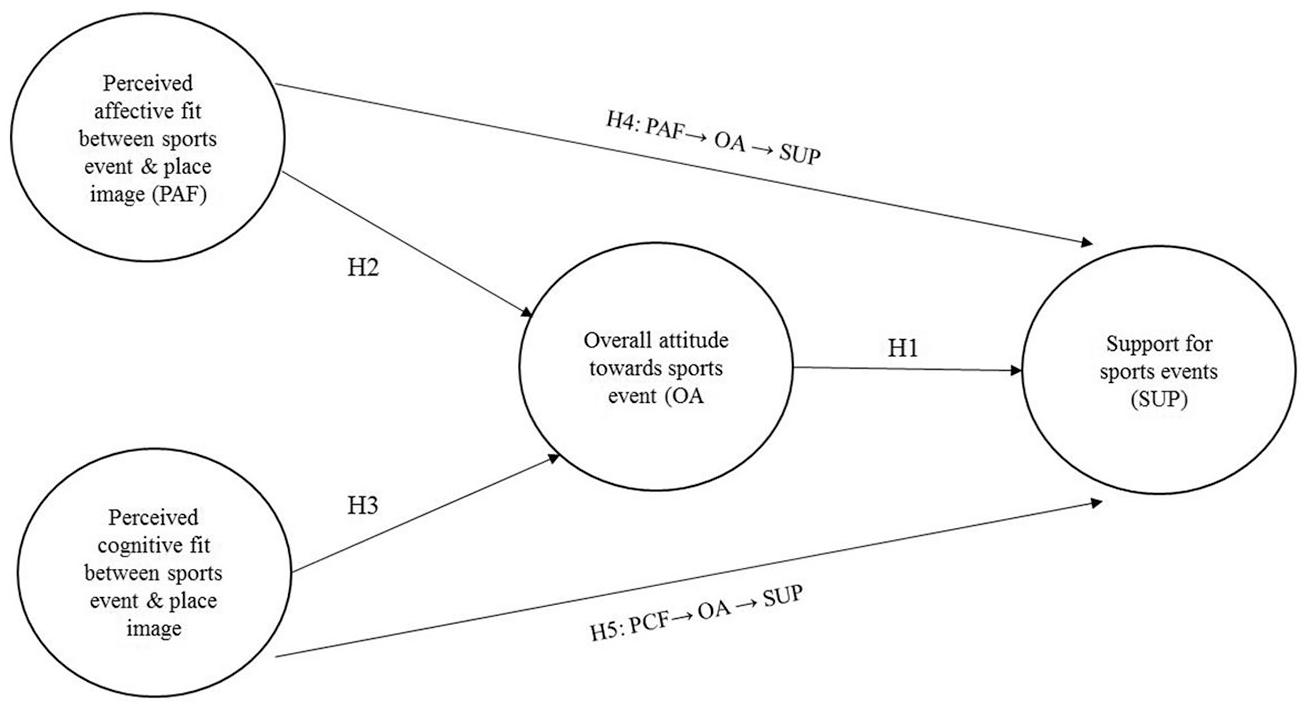
Proposed Model
To analyze the preceding model, an empirical study was conducted among residents of the RWC host region Innsbruck–Tyrol. To ensure that the sample of Tyroleans would be representative, university students were instructed to approach residents based on a quota sampling according to the official statistical data issued by the State of Tyrol (Amt der Tiroler Landesregierung, 2017). Data collection was conducted via an online questionnaire; it started on March 26, 2018 and ended on April 30, 2018. After eliminating invalid or incomplete records, we used a total of 2,265 questionnaires for the analysis. Out of 2,265 respondents, 51.4% (n = 1,156) and thus slightly more than a half were male, while 48.6% (n = 1,093) of them were female. The average age was 40.33 (SD = 18.826) years with the youngest respondent being 12 years and the oldest being 92 years old. Comparing the groups participating in the study with the inhabitant age structure of Tyrol showed that almost all age groups were represented (Amt der Tiroler Landesregierung, 2017).
Questionnaire Development
Research on image fit discusses different models: The measurement can either be done directly or indirectly. Furthermore, the image fit items can be based on multiattributive or on a global measurement scale (Hallmann & Breuer, 2010a, 2010b). For the purpose of this research, a multiattributive approach was chosen. According to Hallmann and Breuer (2010a, 2010b), the same measures for destination and sports event image are required when analyzing the image fit. They used indirect measures to assess place and sports event images and chose variables from earlier research (e.g., Ferrand & Pages, 1996). Those variables are also the underlying basis for this study and the foundation for the theoretical model. Indirect measures were used and operationalized for both place image and sports event image.
The cognitive image factors were measured by means of three 5-point semantic differentials using the vectors artificial–natural and regional–international, which have already been applied in earlier research (Ferrand & Pages, 1996; Hallmann & Breuer, 2010a, 2010b), as well as the vector modern–traditional, introduced by Hallmann and Breuer (2010a, 2010b). The affective image components were measured with four 5-point semantic differentials: gloomy–cheerful, dull–exciting, unpleasant–pleasant, and distressing–relaxing. These semantic differentials were adopted from Russell and Pratt (1980) and have already been successfully applied by previous authors (Baloglu & McCleary, 1999; Hallmann & Breuer, 2010a, 2010b; Kaplanidou, 2007). To measure the perceived image fit directly, the respondents were asked to express their level of agreement on the fit between the place and the sports event image on a 5-point Likert-type scale.
To measure the residents’ attitude and support, this study used the approach of Prayag et al. (2013) and operationalized the residents’ attitude toward and support for the event as additive overall measures. Two statements, already used in the previous research (cf. Prayag et al., 2013; Yoon et al., 2001), were scored on a 5-point rating scale and were used to capture the locals’ OA: “Overall, I am excited about Innsbruck–Tyrol hosting the RWC”; and “Overall, the positive impacts of the RWC will outweigh the negative ones.” To evaluate the general attitude, the level of (dis)agreement to the statement “I personally like that Innsbruck–Tyrol will host the RWC” had to be rated on a 5-point Likert-type scale.
Finally, a 5-point Likert-type scale was used to measure general event support. The respondents were asked to indicate their level of agreement/disagreement with statements adapted from Prayag et al. (2013) as well as Ko and Stewart (2002): “As a resident, I support the RWC”; and “Innsbruck–Tyrol should bid for other major sports events.” The additional item “I am going to watch the RWC live and on-site” was used to measure the conative factors—that is, the intent to visit the sports event—with a 5-point Likert-type scale similar to Hallmann and Breuer (2010a, 2010b). The measurements did not go through a scale development procedure and thus cannot be considered as validated; nevertheless, the respective items have commonly been used to measure event support (cf. Ko & Stewart, 2002; Prayag et al., 2013).
Results
Data Analysis and Measurement Model
The items sports event and place image as well as other constructs measuring OA and event support were factor analyzed with a confirmatory factor analysis (CFA). Additionally, prior research has applied an explorative factor analysis (EFA) to test the underlying structures proposed in the literature (e.g., Deng et al., 2013; Hallmann & Breuer, 2010a, 2010b; Prayag et al., 2013). The results of the CFA are shown in Table 1. The results of the EFA are not presented in detail but may be obtained by request from the authors.
Confirmatory Factor Analysis
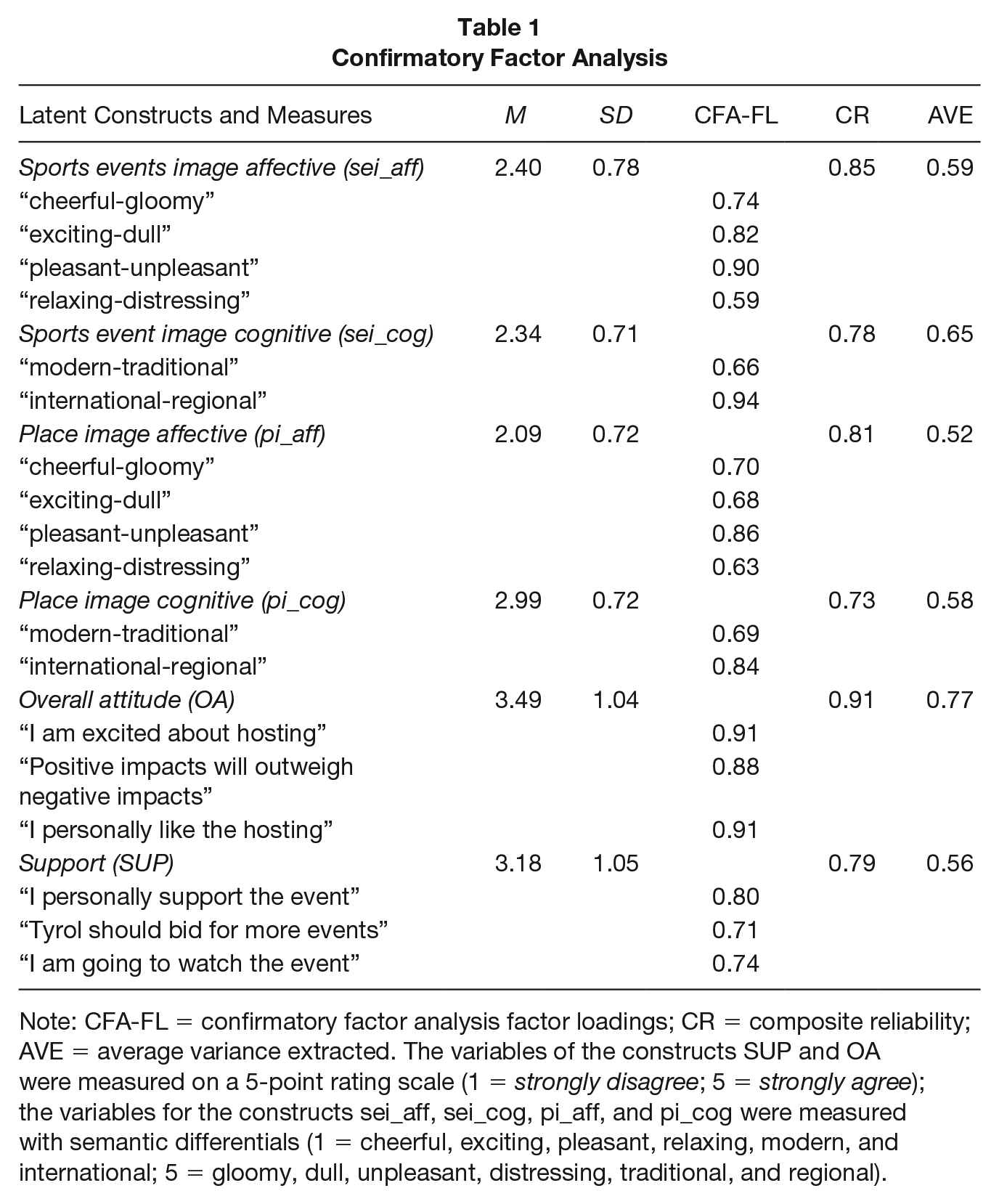
Note: CFA-FL = confirmatory factor analysis factor loadings; CR = composite reliability; AVE = average variance extracted. The variables of the constructs SUP and OA were measured on a 5-point rating scale (1 = strongly disagree; 5 = strongly agree); the variables for the constructs sei_aff, sei_cog, pi_aff, and pi_cog were measured with semantic differentials (1 = cheerful, exciting, pleasant, relaxing, modern, and international; 5 = gloomy, dull, unpleasant, distressing, traditional, and regional).
As the measurement model did not confirm all constructs as proposed in the literature and the CFA results showed insufficient fit indices, two items (“place image cognitive natural–artificial” and “sports event cognitive natural–artificial”) were excluded from the analysis. Thus, the model fit was improved. After this modification, the final measurement model was applied and met the recommended threshold values for the following fit measures (Hu & Bentler, 1999): Tucker–Lewis index (TLI ≥ .90), comparative fit index (CFI ≥ .90), and root mean square error of approximation (RMSEA ≤ .08). Furthermore, other indices measuring the model fit of the measurement model were satisfactory, too (χ2 = 2445.46, degrees of freedom [df] = 155, p < .00, χ2/df = 20.04).
All remaining items were tested in the same model and restricted to load on their respective factors. The factor loadings of the latent constructs were significant (p < .01) and ranged from .59 to .94, suggesting acceptable construct validity. Next, the validity of the proposed multi-item constructs and internal consistency were tested by computing the composite reliability (CR) as well as the average variance extracted (AVE). The CR ranged from .73 to .91, which indicates a good reliability (Hair et al., 2010). The AVE was higher than the recommended minimum value of .50 (Bagozzi & Yi, 1988).
Table 1 presents the measured items of the multi-item constructs including their factor loadings, AVE, and CR. The Fornell–Larcker criterion (Fornell & Larcker, 1981) was used for assessing the discriminant validity. Due to the positivity of the difference between all AVE values and the highest squared interconstruct correlations, discriminant validity according to the Fornell–Larcker criterion can be assumed.
To estimate the sports event image and place image fit, two new variables—PAF and PCF—were created by taking the factors sei_aff, sei_cog, di_aff, and di_cog and using the following formulae (Equations 1 and 2), which have already been discussed in the literature (e.g., Gwinner & Eaton, 1999) and applied by Hallmann and Breuer (2010b); sei_affi and sei_cogi indicate the sports event image on an affective (Equation 1) and a cognitive (Equation 2) dimension i; pi_affi and pi_cogi portray the place image on dimension i:


The index was developed by subtracting the sports event image items from the matching place image items. As the formula uses the absolute value character (| |), the results of the newly calculated variables—PAF and PCF—were between 0 (indicating a perfect fit between the sports event dimension and the place image dimension) and 4 (indicating absolutely no fit between the sports event dimension and the place image dimension).
Structural Model
For testing the full model, we used structural equation modeling (SEM; Amos, 25. Chicago, IBM). To evaluate the structural model, R2 estimates were used. Furthermore, standardized coefficients (β) and the significance level (p) were measured. While the R2 values measure the predictive power of the model, the path loadings, interpreted as standardized regression coefficients, express the strength between independent and dependent variables (Prayag et al., 2013). Falk and Miller (1992) recommend an R2 value greater than .10. The adjusted R2 for measuring event support (SUP) was .89, which corresponds to an explained variance of the dependent variable “support for the sports event” of 89%, while the adjusted R2 for measuring the OA was .13. Satisfactory results (CFI/TFI ≥ .90, RMSEA/SRMR ≤ .08) were obtained for the overall model fit of the SEM. Other measurements testing the model fit of the SEM (χ2 = 544.75, df = 16, p <.00, χ2/df = 34.04) reported results that may still be considered as permissible.
Due to the significance of the path coefficients from OA to SUP (β = .875, p < .00), Hypothesis 1 can be confirmed. To find out how the perceived fit variables (Hypotheses 2 and 3) affect the OA toward the sports event, a SEM was performed; it revealed that the path coefficients from the PAF (β = −.437, p < .00) and the PCF (β = −.106, p < .00) to the OA toward the event are significant. The results show: if the difference between the perceived sports event image and the place image is large, the OA toward the sports event is low, thus confirming Hypotheses 2 and 3. For Hypothesis 4, the PAF served as the independent variable, the OA as the mediating variable, and the SUP as the dependent variable. The findings suggest that the PAF has and effect (β = −.330, p < .00) on the SUP mediated by the OA. While the direct effect between the PAF and the SUP is not significant, the total effect (β = −.335, p < .00) is significant again. For Hypothesis 5, the PCF fit served as the independent variable, the OA as the mediating variable, and the SUP as the dependent variable. The findings indicate that the total (β = −.112, p < .00) and indirect effects (β = −.093, p < .00) are significant, whereas the direct effect is not significant (p =.205). Thus, it is legitimate to conclude that the OA mediates the effect of the PCF on event support, confirming Hypothesis 5. As the direct effect was not significant, an indirect-only mediation is indicated in this case (Zhao et al., 2010). The results of the SEM are provided in Figure 2, showing the standardized path coefficients of the full study model.
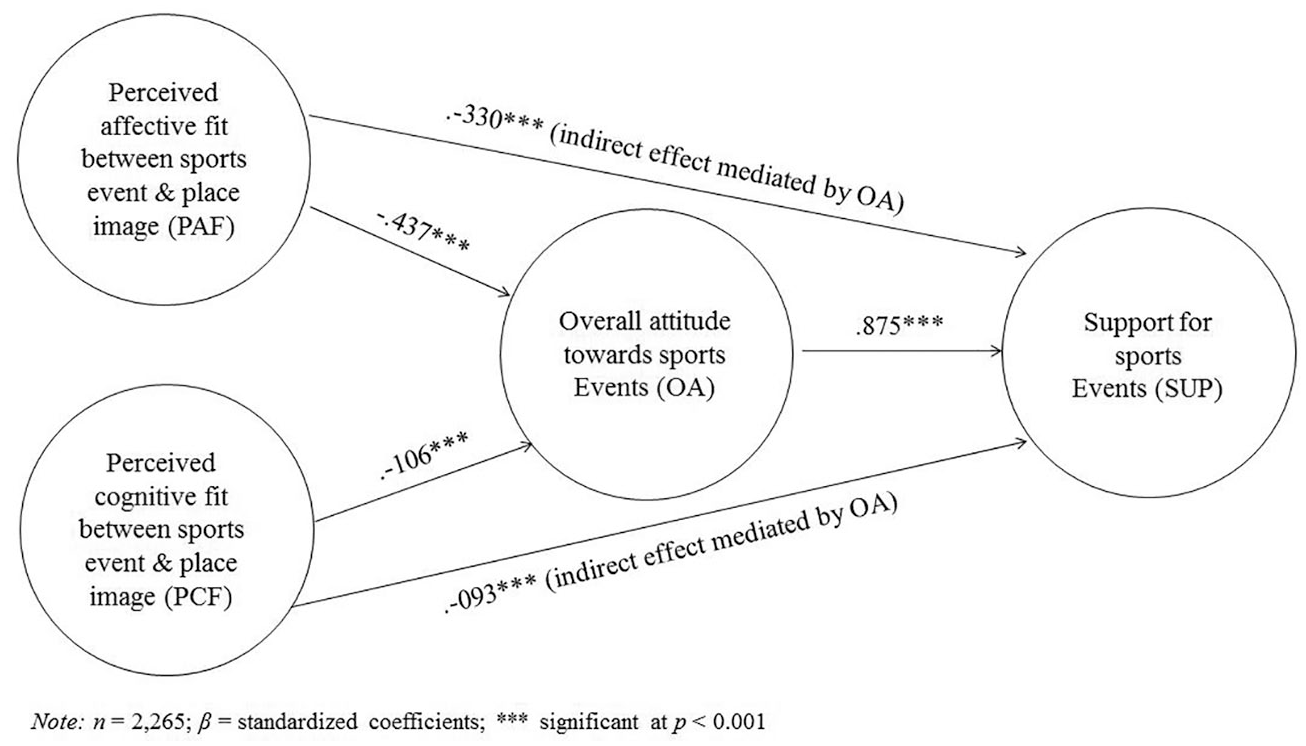
Study Results
Discussion
This is the first study measuring the perceived fit between a sports event image and a place image using the variables OA and sports event support. The results reveal that both the PCF and the PAF have a significant influence on residents’ attitude and, consequently, on their support for sports events.
Generally, it can be stated that treating images as a multidimensional concept is useful for determining a place image and sports event image (Baloglu & McCleary, 1999; Hallmann & Breuer, 2010a, 2010b; Kaplanidou & Vogt, 2007). The constructs measuring the fit showed a high reliability and can thus be regarded as satisfactory. The major finding of this study was that both the PAF (−.437***) and the PCF (−.106***) between the sports event image and the place image significantly and directly affect the residents’ OA. Items exposing a greater gap and therefore a lower fit between the images display a negative impact on the attitude construct. It can be stated that the higher the fit between the images, the lower the “net effect” between the images and thus the more positive the attitude. This further supports the utility of the SET and TRA when it comes to discussing locals’ attitude to and their support for sports events.
This study revealed a higher fit between event and place image, resulting in a more supportive attitude toward the sports event. This result may partly be justified by the circumstance that residents indicating a high fit are more optimistic about the total costs of the event than those with a low fit; they expect lower total expenditures, believing that already existing infrastructure and venues will be used for the event. Another explanation might be that the residents see the event as a chance to promote Tyrol as a cycling destination throughout the world, hence increasing summer tourism and economic development; moreover, residents might expect benefits for themselves in terms of improved cycling infrastructure.
This is in line with Deccio and Baloglu (2002), who stated that the main benefits of the sports events for the host regions are enhanced awareness of the region and business development. In line with the study of Hallmann and Breuer (2010a) revealing that the image fit is an indicator of future behavior, this study indicates that there is an indirect effect of the fit on the event support; this equates to the behavioral component. The aforementioned studies primarily use the same construct; whereas the perceived image fit was not part of the study of Deng et al. (2013) and the index measuring the image fit was different in the study of Hallmann and Breuer (2010a). Therefore, comparisons should be made cautiously. Additionally, it has been shown that the OA is more strongly influenced by the perceived affective image than by the cognitive image perception. This indicates that the emotional component plays a more important role than the factual knowledge in evaluating attitude and support. Baloglu and McCleary (1999) supported this explanation with their findings suggesting that affective evaluations are more likely to influence the overall image than cognitive evaluations. As opposed to this, researchers such as Kwon and Vogt (2010) revealed that cognitive components have a stronger effect on the attitude toward place marketing. However, these results could be contrary because of their marketing context. Cognitive components may have a stronger influence when attitudes toward marketing development are the fundamental aspect of interest, whereas attitudes toward sports events may rather be affected by individual emotions and feelings—hence, the affective components.
Consistent with the TRA and following the recommendations of the literature (e.g., Prayag et al., 2013), this research project treats the OA toward and support for events as conceptually different constructs. It confirms that residents’ attitudes toward an event have a positive relationship with residents’ event support (+.875***). Consequently, these results support precedent research in the tourism literature, such as that of Yoon et al. (2001) and Kwon and Vogt (2010), who investigated residents’ attitudes toward place marketing. Additionally, the results are similar to Prayag et al. (2013) and support the imperative to treat OA and support as different constructs.
Furthermore, the survey analyzes the mediating role of the OA with respect to the link between the perceived cognitive and/or affective fit and residents’ support. The results indicate that the OA acts as a mediator between event support and the PAF and cognitive fit, respectively. The direct effect between the PAF as well as PCF and event support proved not to be significant from a statistical point of view. However, the findings certainly appear to be in agreement with Yoon et al. (2001), who revealed that locals’ attitudes have a mediating effect on the link between perceived effects and support. There is likewise agreement with Prayag et al. (2013), who showed a mediation effect of OA, positive and negative perceived triple bottom line effects, and endorsement of the Olympics. Under the supposition that endorsement of the event constitutes the residents’ behavioral component, the present findings confirm Hallmann and Breuer (2010a), who noted that the image fit predicts the behavioral intention. Nevertheless, in the last-named study the revisiting of a destination was the behavioral outcome; therefore, comparisons with this study should be treated carefully.
The current study reinforces findings that have already been discussed in a more general resident–tourism–support context. Stylidis et al. (2014) revealed that the locals’ place image has an influence on their perceptions regarding the environmental, sociocultural, and economic impacts of tourism projects and that, subsequently, these perceptions influence tourism support. The study in hand shows that this support-chain works also for sports events as specific tourism projects; in this context residents’ attitude toward a sports event plays a crucial role in mediating the image dimension. By analyzing the image fit between a place and an event, this study finally underlines how important it is that sports events are part of a comprehensive hosting policy of cities and regions (Schnitzer et al., 2019).
Implications and Conclusion
Limitations
Some limitations of this research need to be addressed. First, it must be considered that image is a dynamic perception that is subject to temporal variability (Deng et al., 2013). The perception of an event can vary before, during, and after an event (Echtner & Ritchie, 1991). Due to this fact, another limitation of this survey is that it was implemented 5 months before the actual event was held. Thus, measuring the attitude toward the event and the event support was based on a description-based and not on an experienced-based approach (Hertwig et al., 2004). Therefore, generalizations and findings of this study should be interpreted with caution as residents did not have any actual experience of the event at the time of the study.
Another limitation is that cognitive image perceptions were measured using only two items. However, while some researchers recommend using three or more items to provide minimum coverage for a construct (Hair et al., 2010), others state that, if the variables show a high correlation with each other and are rather uncorrelated with other variables, two variables can be sufficiently reliable (Yong & Pearce, 2013). However, the item “natural–artificial” is important in the framework of outdoor events, particularly if the idea of the event is to promote the landscape and beauty of a place not only among tourists but also among residents.
Theoretical Implications and Research Recommendations
The results emerging from this research add to the scholarly literature by revealing that image congruence is a crucial factor which has a significant bearing on residents’ attitudes toward and support for events. Furthermore, this study suggests separating cognitive and affective image perceptions. Researchers such as Kaplanidou (2007) used affective images deconstructed to individual affective components and investigated their potential influence. Therefore, further research streams should investigate in greater detail the influence of affective and cognitive image perceptions as well as their relationship with each other. To do so, they should either apply discrete components or, if applicable, include new appropriate measures.
The data for this study was gathered from the local population 5 months before the event was staged. However, impacts and attitudes can vary over time. During or after the event, they may change; this has already been explored by several authors (Y. H. Kim et al., 2011; S. S. Kim & Petrick, 2005). Consequently, this study encourages further research to use the findings for a longitudinal study with a pre–post design to compare residents’ attitudes and support over time.
Since only the images perceived by local residents were measured in this research, further studies could also investigate tourists’ perceptions. Therefore, the applied model could provide the underlying basis. Especially for destination marketers such studies could provide a more comprehensive insight into how cognitive and affective images of destinations and sports events are seen from various perspectives. This may reveal additional salient metrics for further exploration and analysis. Finally, due to the fact that previous research has used the construct of destination image but not yet tested place image as a dimension, the specificity of the place image dimension may not have be considered enough. Hence, further investigations may develop specific place image constructs.
Managerial Implications
The findings have practical implications for various event stakeholders. First, understanding that favorable and unfavorable matches or mismatches between a host place and sports events exist, is vital for the organizers, urban regimes or city brand managers. Furthermore, place branding is crucial for destination marketing organizations to differentiate their destination in cluttered markets (Pike, 2009). In general, the results of this study indicate that a more favorable match between the host place and the sports event results in a higher support for the event among local residents; this is also important for communication campaigns in- and outside the home market.
An analysis and measurement tool such as the one applied in this study might provide in-depth information about the kind of events that might be effective in the destination branding process. Event managers and policy makers should therefore focus on hosting sports events that match the place’s existing affective and cognitive characteristics. This could create an even more positive sports event image and strengthen the residents’ attitude toward and SUP. Furthermore, the matching characteristics could be emphasized in marketing campaigns throughout the event to promote the place’s attractiveness for leisure activities.
The study results demonstrate that the PAF between the host place and the event has a stronger influence on residents’ attitude and support than cognitive fit perceptions. Therefore, it is important for policy makers to strive for a fit targeting the emotional component of an individual. Event organizers and city managers should emphasize and market the favorable match through emotional social marketing campaigns. Within these campaigns, the fit between the event and the place should be promoted. Moreover, media coverage plays an important role in shaping attitudes (Mihalik & Simonetta, 1999). Consequently, media inputs should highlight the commonalities between the sports event and the place. Sports event associations should be aligned with respective promotional material explicitly addressing social needs and thus showing how hosting the event can enhance them. Furthermore, it is important for policy makers and managers to recognize that the antecedent of support is attitude. To foster positive attitudes, residents should be involved in the decision-making process; in turn, this involvement influences and increases the support for the event.
When comparing the means of place image and sports event image, one could argue that residents tend to feel slightly distressed about hosting a sports event and generally rate the sports event image more negatively. Hence, the focus should lie on establishing a strong positive sports event image linked to the host region when planning an integrated image marketing strategy (Schnitzer et al., 2019).
Since perceptions toward sports events, places, and attitudes in general can vary over time, it is crucial for organizers to constantly monitor locals. Thus, they should conduct periodic surveys to identify the local populations’ expectations and concerns related to the event. During or after the event they should develop performance measures to evaluate the degree to which the event meets/has met the expectations of the local population or the extent to which their concerns were justified.
Conclusion
The study shows that the perceived image fit between an event and a place significantly influences residents’ OA and event support. The OA mediates the relationship between the perceived fit and event support. The case selected for this study may be considered as a relevant piece in the puzzle of (event) support research. Policy makers of places with high tourism density see that their decisions may influences residents’ attitude and support. In this case, shifting from winter tourism to year-around tourism has implications for deciding whether an event matches the place. What if the event–place image fit does not work out?
Footnotes
Authors’ Note:
This work was supported by the Tyrolean Tourism Research Fund of the State of Tyrol [DB Number 266713].
