




Abstract
Stand-alone virtual reality (VR) headsets such as Meta's Quest series enable highly immersive social experiences. As part of a trend toward a trillion-dollar “metaverse,” a virtual social environment for which headsets constitute the major access device, these headsets have been predicted to grow the market for VR hardware substantially. Despite huge investments from companies, adoption of headsets has not reached the mass market yet. While some see the reason in the limited value that accessing the metaverse via VR headsets offers consumers, others blame the experience character of headsets as an adoption barrier. To shed light on this market-shaping issue, this research introduces the concept of metaverse trials as a special case of consumer product trials in which consumers test VR headsets for engaging in direct experiences in virtual worlds together with others, and it explores how such a trial affects headset adoption. Using a sample of almost 100 participants of an extensive metaverse trial and a matched sample of nontrialists, the authors find trialists’ intention to use VR headsets in the future to be higher, while their intention to purchase VR headsets is lower. They also study determinants and outcomes of key facets of the metaverse experience.
Access to virtual worlds has been a tantalizing vision for many people for quite a while, as evidenced by the popularity of novels (e.g., Ready Player One) and blockbuster movies (e.g., The Matrix) with virtual reality (VR) themes, as well as by the huge success of video games such as Minecraft in which hundreds of millions of consumers act as avatars in virtual, computer-simulated environments. While VR headsets 1 have been widely envisioned as major access devices for virtual experiences, such experiences have traditionally been accessed via the 2D interfaces of PCs and smartphones, as a result of headsets’ limited technological capabilities and their high prices.
New stand-alone VR headsets like Meta's Quest series now constitute “a massive step-up from its predecessors” (Roettgers 2023), as they enable high-fidelity 3D social experiences in virtual environments at a dollar price that is no longer in the thousands, but in the hundreds. As part of a trend toward a trillion-dollar “metaverse” (Statista Market Insights 2023), a virtual social environment where people can interact and communicate with each other via avatars and for which VR headsets are considered to serve as the main access technology (Hennig-Thurau et al. 2023), this new generation of VR headsets has been expected to grow the market for VR hardware and software substantially.
Although VR headset sales have increased for the new hardware generation, with a global cumulative installed base of actively used VR headsets estimated at 26 million by the end of 2023 (AR Insider 2021), compared with just 250,000 Oculus Rift and 400,000 HTC VIVE headsets sold until 2016 (IHS and Statista 2017), consumer adoption has not yet reached the mass market, and in 2023 Meta even reported declining sales, despite investing huge amounts for marketing its latest headset generation (Meta 2023).
The reasons why VR headsets have not yet become mainstream devices remain unclear. While some see the reason in the limited value consumers can get from using the metaverse and its applications, others blame the dominance of the experience character of headsets, which may prevent consumers from realizing the value that can be created by using the products (Ball 2023). Scholarly insights on value creation with VR headsets are sparse. Initial empirical investigations suggest that highly immersive social metaverse experiences offer advantages for users over 2D interfaces (e.g., videoconferencing) in terms of higher social presence and mobility, but also find that higher exhaustion levels (Hennig-Thurau et al. 2023) and avatar use (Miao et al. 2022) limit their value potential. Even less is known about headset adoption, except for explorative work on continued use and adoption barriers.
Against this background, our research aims to shed light on VR headset adoption after consumers have experienced the technology, with a particular focus on social metaverse usage. We focus on the approach of consumer product trials in which potential customers are equipped with a new product for a certain test period, giving them a direct experience with the innovation (Smith and Swinyard 1983). 2 The idea behind such product trials is the notion that when potential customers lack a well-defined perception of the value potential of a new product and perceive a substantial level of adoption risk, test consuming the product can solidify their comprehension of its attributes and help them recognize the value it can provide.
Consumer product trials are thus most promising for products that possess an experiential core value which is unclear due to their newness. This applies to VR headsets, whose “technology is uniquely hard to demonstrate: watching someone use VR on TV doesn’t sell it, nor does seeing video footage of what's coming through the headset on a normal monitor. Even sitting next to someone with a VR headset on will leave you with a sense of missing out, but not really a full understanding of what, exactly, you’re missing out on” (Hern 2016).
In this research, we study the effect of a particular type of consumer product trial, which we refer to as a “metaverse trial.” We define metaverse trials as the test use of VR headsets to engage in one or more direct experiences in virtual worlds together with others, as social interactions are considered an essential element of the metaverse (e.g., Hennig-Thurau et al. 2023). In the metaverse trial we report on, almost 100 students participated in several group activities over the course of three months, with every group member using a high-fidelity VR headset (i.e., Meta Quest 2), which enables us to assess participants’ usage response in terms of headset adoption. To isolate the effect of the trial, we match the trial data with nontrial data stemming from a sample of a nationwide representative panel of German consumers. We also investigate individual- and group-level determinants of key facets of participants’ trial experience that could help VR headset providers create targeted metaverse trials. Our findings can serve as a guideline for targeting participants for such trials, contributing to their effectiveness and justifying investments.
Extant Literature on VR Headset Adoption and Consumer Product Trials
Consumer Adoption of VR Headsets
VR headset technology computes a synthetic, 3D (“virtual”) environment that surrounds the user, who experiences the environment via multiple senses (Blascovich 2002). Marketing research's interest in such virtual environments dates back several decades; initial studies explored virtuality in contexts such as “virtual shopping” (Burke 1997), “virtual fashion” (Nantel 2004), and “virtual social worlds” (Kaplan and Haenlein 2009), which were accessed by users via computers instead of VR headsets.
The recent and much more powerful headset generation, which enables users to interact not only with the simulated environment itself but also with other (human) users within it who are represented digitally via avatars (Miao et al. 2022), has stimulated a growing body of work in marketing and other scholarly disciplines (e.g., Hadi, Melumad, and Park 2024; Harz, Hohenberg, and Homburg 2022; Yoo et al. 2023). Regarding the state of knowledge on the adoption of VR headsets, Peukert et al.'s (2019, p. 756) observation that “a minimal amount is known about why and whether customers will adopt such fully immersive environments” has, however, remained largely true. The exceptions are studies that deal with continued use of VR headsets and broader adoption barriers for headsets, respectively.
Findings include that deriving utility from task-related activities as well as joy and pleasure from hedonic experiences facilitates continued headset use (Yang and Han 2021), that experienced “presence” (the feeling of being in the virtual environment; Nowak and Biocca 2003) relative to alternative access technologies contributes to continued headset use (Jang and Park 2019), and that users derive functional benefits from headsets, particularly when tasks are considered important, while discomfort and perceived health tend to be associated with lower future use (Dehghani et al. 2022). In addition, Laurell et al. (2019, p. 470), scraping social media, find that besides headsets’ “stand-alone value” (which they find to be linked with headset price perceptions) their “network-externalities value” plays a significant role, highlighting the importance of social interactions for adoption. They also identify that a lack of “trialability” constitutes an adoption barrier, a finding that provides the link to consumer product trials as the core marketing concept of this research.
Consumer Product Trials and Trialability of New Technologies
The scholarly analysis of consumer product trials in marketing dates back to Everett Rogers's seminal work on the diffusion of innovations (Rogers [1962, 1995] 2003). His work introduces the concept of “trialability” of an innovation as the “degree to which an innovation may be experimented with on a limited basis” (Rogers [1962, 1995] 2003, p. 16), which he highlights as one of five major obstacles (“attributes of innovation”; Rogers [1962, 1995] 2003, p. 36) to the widespread adoption of a new offering.
Marketers have developed consumer product trials, which “provide fully interactive, hands-on experience with products and give the user direct product experience” (Hamilton and Thompson 2007, p. 547), as an approach to overcoming the “trialability obstacle.” Specifically, consumer product trials have been argued to reduce prospect customers’ uncertainty and risk perception regarding a new product (Rogers [1962, 1995] 2003), making them a “critical step” (Bitner, Ostrom, and Meuter 2002, p. 103) in the adoption process. Enabling consumers to try out an innovation enables learning by doing, increasing the probability that the consumer will reach the persuasion step of adoption and contributing to positive attitudes about the product (Rogers [1962, 1995] 2003).
Consistent with this logic, Cooper and Kleinschmidt (1986) provide empirical evidence that product trials can positively affect the success rate of innovation projects in the context of industrial products. The effect of a trial is, however, not necessarily positive, as the prospective customer's attitudes formed during the trial about an innovation (and, consequently, the impact of a trial on adoption) can also be negative. Foubert and Gijsbrechts (2016) thus argue that free product trials “constitute a double-edged sword” (p. 810), as “a disappointing trial experience might alienate potential customers, when they decide not to adopt the system and are lost for good” (p. 810).
Innovation research also offers some indications of when a product's trialability (or lack thereof) is of particular importance for potential adopters. Among the product characteristics that contribute to a high salience of product trialability are perceived risk, which is particularly influential for products that offer novel experiences instead of search qualities (Nelson 1974), as well as the product's societal diffusion, as early adopters are more influenced by it than later adopters for whom word of mouth from earlier adopters is more widely available (Rogers [1962, 1995] 2003).
In summary, research offers little empirical evidence regarding adoption drivers and barriers of state-of-the-art VR headsets. Innovation research suggests that consumer product trials, tailored to the specifics of VR headsets, could be an effective means to stimulate adoption of headsets, whose inherent trialability should be low as a result of their experience nature and the adoption risk that stems from it. Building on these insights, we report how overcoming the “trialability barrier” of VR headsets with a particular kind of consumer product trial we refer to as metaverse trials affects headset adoption.
The Role of Metaverse Trials for VR Headset Adoption
Our research links the concept of a metaverse trial, as the test use of VR headsets for engaging in direct experiences in virtual worlds together with others, with two important adoption facets, namely usage and purchase intention (Figure 1). Usage intention focuses on the gross utility of a VR headset (i.e., the overall satisfaction or benefit of using it; Varian 2010), which might be accessed by other means than purchasing one (such as using a friend's device or getting one at work), with cost being of limited or even no concern. Purchase intention differs from that, as it requires the consumer to subtract the cost of headset acquisition and use (e.g., apps) from the headset's gross utility, putting the net utility of VR headsets at the center.
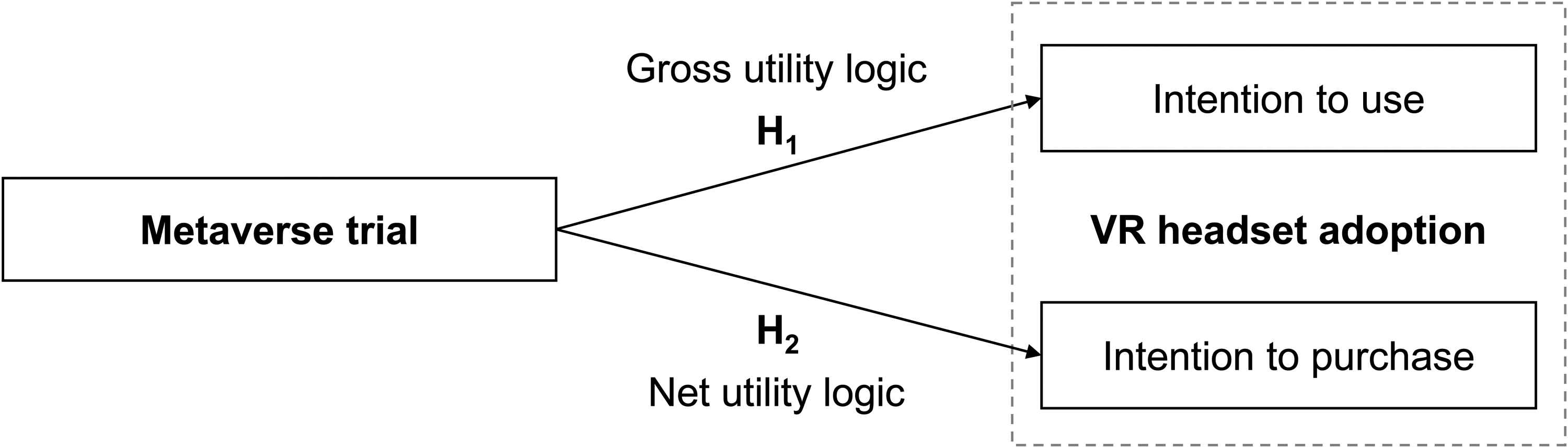
Main Research Model: Metaverse Trial as Determinant of VR Headset Adoption.
We argue that a metaverse trial positively influences consumers’ intention to use and purchase VR headsets. Consumer product trials can facilitate product adoption by reducing the consumer's uncertainty about the product's performance and by demonstrating the utility the consumer can derive from that performance (Rogers [1962, 1995] 2003). As most consumers are yet unfamiliar with the use of VR headsets, as well as with virtual metaverse worlds as the content/software accessed through them, consumer uncertainty should be rather high (e.g., Leswing 2023; Voyer 2022). In addition, the trialability of VR headsets can yet be considered inherently low, as testing them, especially together with other users, is not possible in most physical retail stores and not at all in digital retail stores.
By providing consumers with a good sense of the utility the metaverse offers when accessed via a VR headset, engaging in the experiential and social activities of a metaverse trial should overcome the trialability barrier and reduce the resulting uncertainty about VR headset use. We further assume that the higher trialability of VR headsets resulting from a consumer's participation in a metaverse trial will result in a positive gross utility of VR headsets for consumers, as research has shown that state-of-the-art VR headsets can create unprecedented immersion (Yoo et al. 2023) and social presence (Hennig-Thurau et al. 2023), which we expect to be transformed into consumer utility during a metaverse trial, including social utility (see also Iyengar, Van Den Bulte, and Lee 2015). We expect the gross utility of headsets to be positive, although initial studies of metaverse usage via VR headsets show no clear pattern of the technology's superiority over widely used nonvirtual alternatives (Hennig-Thurau et al. 2023) and some reports point at low usage rates of VR headsets (Richter 2023), a possible indicator of a somewhat limited utility potential for headset owners.
Furthermore, because VR headset prices are now in the range of those for other technological devices such as gaming consoles, we assume that trial participants will also rate the net utility of VR headsets for consumers as positive, that is, when accounting for costs. Thus, we expect that participation in a metaverse trial will result in a higher interest in VR headset use because of a positive gross utility and also a higher interest in purchasing a headset because of a positive net utility:
Toward a Better Understanding of Consumers’ Metaverse Trial Experience
In addition to the impact of a metaverse trial on headset adoption, we augment our main research model depicted in Figure 1 by also shedding light on consumers’ evaluation of the trial experience and on the level of the individual consumer and the social group characteristics as potential determinants of that experience. In doing so, we refrain from offering formal hypotheses regarding causal effects of metaverse experience variables, but instead draw on the logic of “effects research” as an alternative paradigm for exploring theoretical mechanisms and processes (Calder, Phillips, and Tybout 1981). While also striving for generalizability, effects research aims to generate interesting findings about issues that are of practical value, rather than focusing on theoretical explanations of such issues.
Given the novelty of metaverse experiences and the early stage of theory development on the topic that comes with it, we apply effects logic for our model augmentation, namely when exploring the links between three key facets of metaverse experiences (i.e., perceived fun, social presence, and exhaustion) and a number of potential individual- and group-level determinants of these experience facets, but also VR headset adoption (see Figure 2). Our model augmentation can help target participants for trials more effectively and help assign them to trial groups in a promising way. We encourage further research to delve deeper into the theories underlying the effects we establish (as well as those we do not find in our data).
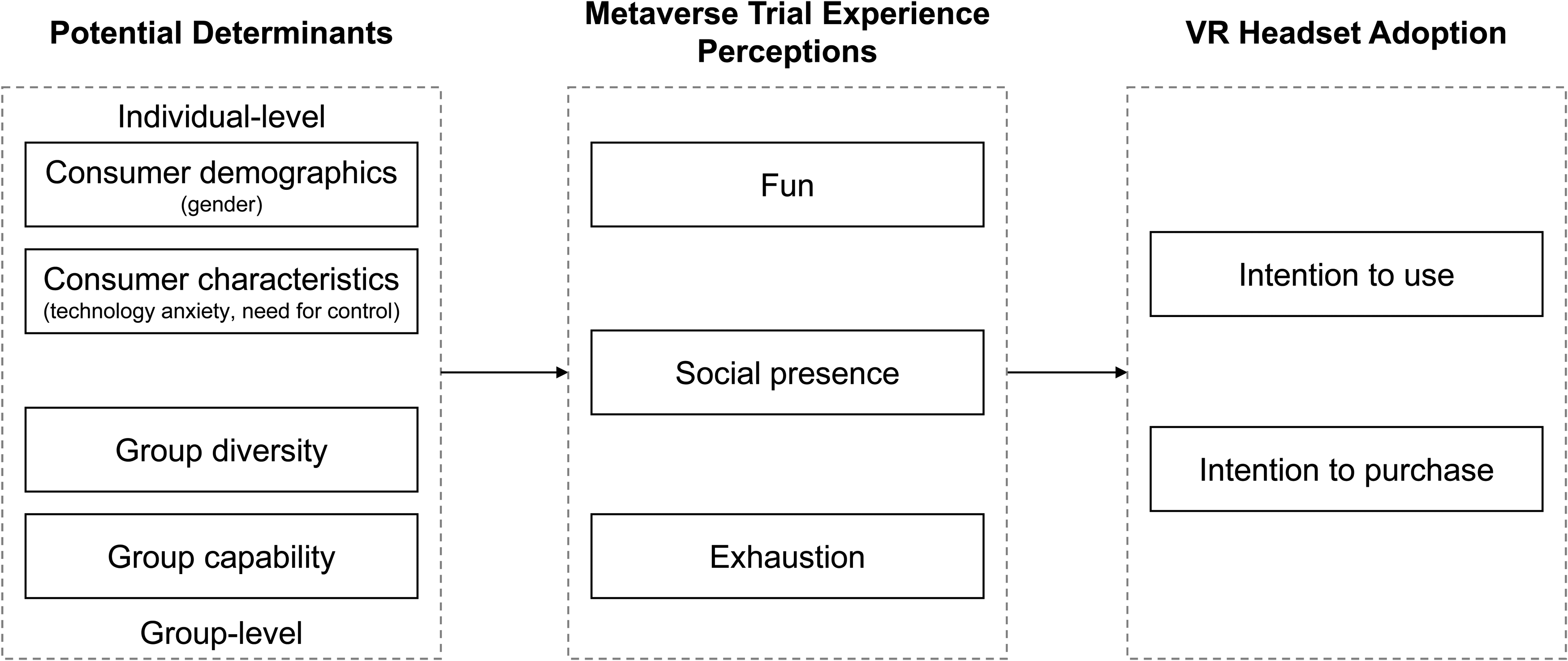
Model Augmentation: Links Between Trial Experience Facets, Determinants, and Adoption.
Key facets of metaverse trial experience
We study emotional, cognitive, and physiological facets of consumers’ perception of the trial experience. Our emotional metaverse trial experience variable is the fun consumers perceive during the metaverse trial. This draws from empirical evidence from innovation research, showing that positive emotions experienced during new product trials are crucial for adoption. Wood and Moreau (2006) find the positive emotions participants experienced in a trial of the then-new personal digital assistant Palm Zire to be the primary predictor of product evaluations, with the impact increasing even further in a second trial study. The positive emotion of fun reflects “the enjoyment that [a product] offers and the resulting feeling of pleasure that it evokes” (Holbrook and Hirschman 1982, p. 138, based on Klinger 1971). Fun has been shown to impact adoption outcomes in the domain of web-based new technologies (e.g., Childers et al. 2001; Pagani 2004) along with all kinds of entertainment products (Holbrook and Hirschman 1982).
Regarding cognitive responses to the trial, we study social presence, as a consumer's perception of “being (somewhere) together” with other people (Biocca, Harms, and Burgoon 2003). Social presence is widely considered an important construct when it comes to understanding consumer behavior in virtual environments with multiple users, as definitional for the metaverse. It adds a social component to the general concept of (spatial) presence, which captures the state of “being there,” such as being in a computer-simulated location instead of just looking at it. The foundational nature of presence for virtual environments is reflected by the existence of a scholarly journal of the same name (Presence, now in its 33rd year). Media and communication studies have shown that social presence is associated with various positive communication outcomes (e.g., persuasion; Oh, Bailenson, and Welch 2018), and in marketing Hennig-Thurau et al. (2023) find that social presence is the dominant source of user value across several metaverse activities. Thus, we expect social presence to also shape adoption of VR headsets as metaverse access devices.
We capture the physiological response to the trial with consumers’ perceived exhaustion, as a broad concept that describes consumers’ drain (Wright and Cropanzano 1998). Hennig-Thurau et al. (2023) show that VR headset use in metaverse settings triggers higher levels of physiological exhaustion among users than similar activities carried out via “flat” computer interfaces. They associate such exhaustion with the inherent technological features of VR headsets, such as their “relative heaviness and tightness” (Hennig-Thurau et al. 2023, p. 894). While they only find partial evidence of negative consequences of such exhaustion resulting from VR headset usage, and do not study VR adoption directly, we still envision the negative state of exhaustion during a metaverse trial to hamper consumers’ willingness to adopt the technology.
Determinants of the metaverse trial experience
To shed light on potential determinants of the metaverse trial experience, we study both individual consumer-level and social group-level variables. At the individual level, we use the demographic variable of consumers’ gender and the psychological characteristics of consumers’ technology anxiety and need for control as potential forces influencing how consumers experience a metaverse trial. We include group-level variables because of the essential role of social interactions between different users in the metaverse concept. At the social group level, we focus on how both the diversity of a metaverse group and its capability shape the experience.
For gender, differences have been reported regarding the use of metaverse apps such as Roblox (Roblox 2023) and Fortnite (Verto Analytics 2023), but also gaming consoles in general (e.g., Entertainment Software Association 2020), each of which is used more intensely by male consumers. Along with findings of varying responses of male and female consumers to uncertain and novel situations (e.g., Meyers-Levy and Loken 2015; Robichaud, Dugas, and Conway 2003) and potential differences in social role perceptions (Eagly 1987), male and female consumers could experience a metaverse trial differently in terms of emotional, cognitive, and physiological responses.
We further assume that a consumer's metaverse experience will differ with their level of technology anxiety, a generalization of the more specific concept of computer anxiety, which describes people's concerns about using computer technology (e.g., Cambre and Cook 1985; Igbaria and Parasuraman 1989). Technological anxiety expresses consumers’ general fear of technology-related tools and applications, based on their “state of mind regarding their ability and willingness to use [technology]” (Meuter et al. 2003, p. 900). When confronted with new and innovative VR technology as part of a metaverse trial, consumers could feel afraid or even threatened and might “become motivated to avoid or escape the threat” (Smith and Lazarus 1990, p. 615). Such reactions should influence their response to the trial in negative ways.
Consumers’ need for control (Rijk et al. 1998) could also influence the metaverse trial experience. The concept draws on autonomy as a fundamental human need (Deci and Ryan 2008) and the gratification humans derive from controlling their environment, which White (1959, p. 307) names a source of “primary pleasures.” Metaverse experiences might appeal to people with high levels of need for control when they can exhibit control of the virtual environment (in gaming, satisfying the closely related construct of need for autonomy has been shown to positively influence enjoyment; Kim, Chen, and Zhang 2016; Ryan, Rigby, and Przybylski 2006). Wearing a VR headset, however, also blocks out the physical environment, which might negatively affect the metaverse experience for people with a high need for control.
At the group level, we assume that the metaverse trial experience might be affected by the diversity of the group of people a consumer interacts with during the metaverse trial. In the context of metaverse use, diversity might be another double-edged sword: While group diversity has been shown to lead to better performance outcomes for a group (e.g., better work task solutions; Pelled, Eisenhardt, and Xin 1999), it also requires consumers to step outside their comfort zone of “equal others,” which might negatively influence their experience (Mannix and Neale 2005), particularly the emotional facet.
Finally, a consumer's experience of a metaverse trial might also vary with the capabilities of those others the consumer interacts with during the trial. It seems plausible to assume that social experiences with more capable others should result in more gratifying outcomes; they should also require less coordination and effort from the consumer during the experience. Thus, higher group capabilities might be linked to more positive metaverse experiences in terms of emotions but also with regard to physical responses such as exhaustion.
We next report on an empirical metaverse trial and corresponding data collection. It enables us to test H1 and H2, and helps shed light on the effects of key facets of the metaverse experience as drivers of adoption and consumer- and group-level determinants.
An Empirical Metaverse Trial: Testing Hypotheses and Exploring Effects
We report two different analyses. Analysis 1 tests the hypotheses of this research (H1 and H2), while Analysis 2 explores the effects related to the metaverse experience facets and their links to adoption and potential determinants. For both analyses, we make use of a unique setting in which 96 German consumers engaged in a series of metaverse activities via Meta Quest 2 VR headsets, which together constitute our metaverse trial. To test our hypotheses in Analysis 1, we combine the setting with an online survey of 2,295 respondents who have not engaged in a metaverse trial, forming our control group as a nontrial sample.
The Metaverse Trial
As part of a study on metaverse value creation (Hennig-Thurau et al. 2023), 96 consumers participated in four subsequent metaverse activities over a period of three months. The participants were third-year bachelor students at a large German university. Their participation in the trial activities was mandatory, but their performance in the activities was not graded. Ninety out of the 96 consumers participated in all metaverse activities and filled out follow-up questionnaires regarding their experiences within the activities; we use them and their answers as our metaverse trial sample. None of these 90 consumers in the final sample had experienced VR headsets prior to the trial.
The trial activities took place over the course of three months during the 2021 summer term. Each activity was followed by a questionnaire that included our metaverse trial experience variables (i.e., fun, social presence, exhaustion). In line with our definition of a metaverse trial, students met in groups of three or four participants for all activities to reflect the social nature of metaverse activities. The activities were preceded by a pretrial survey in which we measured variables that we use either as controls in our analyses (gender, age) or to create group-level variables (i.e., participants’ capabilities). All activities were carried out by participants using a Meta Quest 2 headset, the world's bestselling VR headset as of November 2023 (AR Insider 2021).
The trial activities ranged across the fundamental life contexts that have been argued to be affected by the metaverse, namely work, consumption, and the customer–employee interface (Hennig-Thurau and Ognibeni 2022). The first two activities were work tasks dealing with innovation. In the first trial activity, participants developed a name, design, slogan, and launch strategy for a new (fictitious) ice cream. The activity lasted about 90 minutes and took place in the VR app Glue. The second trial activity was another innovation-related work activity in which the participants rated the business potential of a new product concept, based on information given to them in the form of a scoring matrix. The activity also ran for about 90 minutes and was once more placed in the Glue VR app. The third trial activity was a moviegoing activity in a virtual movie theater. Participants watched two short films (Purl and Two Strangers Who Meet Five Times) with their fellow group members. They watched the films via the VR app Bigscreen; the experience duration was about 45 minutes. The fourth activity took place at the customer–employee interface (educational service). Participants were asked to use their role as student customers to provide feedback and suggestions for improvement for the education program they were enrolled in (the service employee was an actual teacher). For this activity, participants assembled in larger groups of between 25 and 35 people in the VR app Altspace, where sessions lasted about 30 minutes.
A third of the sample also participated in a fifth study, again situated at the customer–employee interface (ticket sale for physical theatrical movie screening). The student with the highest movie involvement of each group met a service employee in a specifically designed room in the VR app Glue and was invited to bid for a movie ticket for a then forthcoming film. A doctoral student acted as service employee. In this case, the trial activity lasted only about five minutes. For further details about the activities, see Hennig-Thurau et al. (2023).
The questions regarding VR headset adoption, which serve as the dependent variables of this research, were part of a postactivity survey sent out one week after the last trial activity. In addition to the adoption-related questions, the postactivity survey contained general assessment questions. In contrast, we collected the answers to questions related to the trial activities (i.e., the participants’ rating of perceived fun, social presence, and exhaustion of each activity) immediately after each trial activity. We used a participant's average across all trial activities in which they participated in the estimations. As we assumed consumer characteristics to be stable over the course of the trial, we allocated questions about them across postactivity surveys. 3
The Nontrial Sample
The nontrial sample is representative of the German online population age 18 to 65 (52% male, 48% female, 0% nonbinary). We excluded all respondents who stated that they already owned or tested a VR headset to be able to exclude any trial-like previous activities of the control group, which resulted in a nontrial sample of 2,095 respondents. To be able to draw powerful comparisons between the relatively smaller metaverse trial sample and the larger nontrial control group, we extracted an equal number of nontrialists into the final sample, following Rosenbaum and Rubin's (1985) well-established matching procedure, which produced a nontrial sample similar to our metaverse trial sample. We also ran a number of alternative matching approaches to demonstrate the robustness of our Rosenbaum and Rubin–based matching results.
We collected the nontrial sample data, which we use in Analysis 1 to compare the trialists’ intention to use and to purchase VR headsets with consumers who had not participated in a metaverse trial, via an instant access panel operated by the professional market research company Bilendi & Respondi SA. Participants got compensation of one euro for completing the survey, which was carried out in April 2022. This survey also featured questions on a number of other topics not related to VR headsets.
Measures
We measured the adoption variables we use in Analysis 1 and Analysis 2 with a single item in the trial as well as the nontrial survey (Web Appendix A features detailed descriptive statistics of the dependent variables). We specifically measured consumers’ intention to use VR headsets with the item “I can envision spending time with virtual reality in the future” and their intention to purchase VR headsets with the item “I can envision myself acquiring a VR headset.” We employed single items due to length restrictions for the representative nontrial survey, but research also demonstrates the validity of single items as evidenced by their application in assessing the constructs of interest in prior studies. This is particularly the case when a construct is unidimensional and captures stated behavior, as is the case for the intention to use and purchase (e.g., Homburg, Schwemmle, and Kuehnl 2015). For intention to use, see Lin, MacInnis, and Eisingerich (2020); for intention to purchase, see Chang and Wildt (1994) and Cronin and Taylor (1992).
In the trial sample, we did not measure the adoption questions prior to the experiment to avoid introducing any kind of bias. Asking participating students in advance about VR headset adoption intentions could have raised awareness regarding the objective of the research and could have caused biased results. In our data, trial participants were not aware of the VR headset adoption focus before being debriefed once the postactivity survey had been completed.
The three experience concepts of perceived fun (adapted from Dabholkar 1994), social presence (adapted from Nowak and Biocca 2003), and exhaustion (adapted from McNair, Lorr, and Droppleman 1971) that capture the consumer response to the metaverse trial experience in Analysis 2 were obtained only from the trial participants. We surveyed the concepts immediately after each metaverse trial activity, measuring fun with three reflective items, exhaustion with five items, and social presence with four items on seven-point Likert scales, with endpoints ranging from strongly disagree to strongly agree. Cronbach's alphas of .84, .92, and .90, respectively, indicate good reliability (Web Appendix B contains detailed information on the scales).
We then computed the respective means for each of the three constructs across the series of four trial activities (five for those who had also participated in the final trial activity), which we used in Analysis 2. This approach ensures a separation of the time of data collection for these variables from the assessment of our two dependent variables (i.e., intention to use and intention to purchase VR headsets). The temporal separation of measurements counters a potential common method bias that can arise from measuring predictor and criterion variables at the same point in time in the same questionnaire (Podsakoff et al. 2003).
For the metaverse trial experience determinants, we employed single items derived from established scales. We did so as we not only study these variables’ effects in Analysis 2 but also include them as controls in Analysis 1, and using a single item acknowledges the space restrictions we faced for the representative survey. In terms of consumer characteristics, we measured technology anxiety with the item “I tend to avoid technology when it is unfamiliar to me,” adapted from Meuter et al. (2003). For need for control, we used the item “I set great store by having control over what I do and the way that I do it” by Rijk et al. (1998). With respect to consumer demographics, we asked survey respondents to self-assess their gender (male = 1; female = 0). We also asked them to indicate their level of education (ordinal, with 1 = lower-level secondary school and less; 2 = medium-level secondary school/apprenticeship; 3 = high school/university) and age (continuous, in years); we used gender, education, and age as covariates for the matching procedure.
Finally, as a measure of the group-level determinants of the metaverse trial experience, we coded the groups of trial participants in terms of diversity and capabilities. We restricted ourselves to gender diversity and coded a trial group as diverse if the members had different genders (score of 1) and as nondiverse otherwise (score of 0). Similarly, we coded groups of trial participants as having high capabilities if all group members had an average grade of A+ or A (on the U.S. grading scale) from their previous university performance (score of 1) and as not having such high capabilities otherwise (score of 0).
Analysis 1: Testing Hypotheses
Matching Procedure
We apply propensity score matching to find a “statistical twin” for each participant of the metaverse trial from the sample of nontrialists that serve as control group. Propensity score matching selects “units from a large reservoir of potential controls to produce a control group of modest size that is similar to a treated group with respect to the distribution of observed covariates” (Rosenbaum and Rubin 1985, p. 33). Specifically, we apply 1:1 nearest neighbor matching as a well-established kind of distance matching (Rosenbaum and Rubin 1985). This method addresses trial participants as treated subjects who are assigned a control subject by selecting the respective nontrialist with the minimal difference from the treated subject's propensity scores of selected covariates (Stuart 2010). While 1:1 nearest neighbor matching is widely considered a powerful matching approach (e.g., Wangenheim and Bayón 2007; Gu and Kannan 2021), we also report results for alternative matching algorithms to demonstrate the results’ robustness.
For the 1:1 nearest neighbor matching procedure to be able to identify a statistical twin for each of the 90 trialists, we estimate the likelihood of participation for all trial and nontrial members in a first step using binary logistic regression (with trial participation as dependent variable, coded 1 if a subject participated in the trial and 0 otherwise). Although none of the nontrial members actually participated in the metaverse trial, their likelihood of doing so can be modeled by taking into account different covariates also measured for all trial members (Eggert, Steinhoff, and Witte 2019).
As covariates, we select demographic variables (age, gender, and level of education) as well as VR-contextual consumer characteristics (technology anxiety and need for control) to estimate the metaverse trial propensity. We opt for demographics as matching covariates due to their ability to balance the observed homogeneous demographic characteristics the trial participants possess, namely similar age and education levels and a similar share of female and male consumers. This approach facilitates the identification of control subjects with equivalent demographics, addressing the fact that the nontrial sample comprises a more heterogeneous population with characteristics not present in the trial sample, such as a broader age range. In contrast, we add the consumer characteristics to retrieve propensity scores to account for context-relevant individual differences between subjects above and beyond demographic similarities (De Haan et al. 2018).
Our approach enables the matching algorithm to pair each treated subject with a control subject who has a similar propensity score; in other words, it pairs the subjects whose propensity scores are closest to each other. Consequently, this algorithmically created control group can be regarded as achieving an equivalent level of randomization akin to that observed in experiments (Rubin 2006), thereby transforming the data into a quasi-experimental design (Huang et al. 2012) and simultaneously mitigating selection bias (e.g., Kumar et al. 2016; Li and Xie 2020). To further ensure a close distance between treated and control subjects and overall matching quality (Warren and Sorescu 2017), we use a caliper of .05, indicating the maximal distance we tolerate for matched pairs.
As a result, we obtain a matched sample comprising 180 consumers, consisting of the 90 participants of the metaverse trial and an additional 90 matched nontrial control subjects. To assess the efficacy of the matching process, we examine balance statistics prior to and subsequent to matching. We present those statistics in Table 1.
Balance Statistics Before and After Propensity Score Matching (Analysis 1).
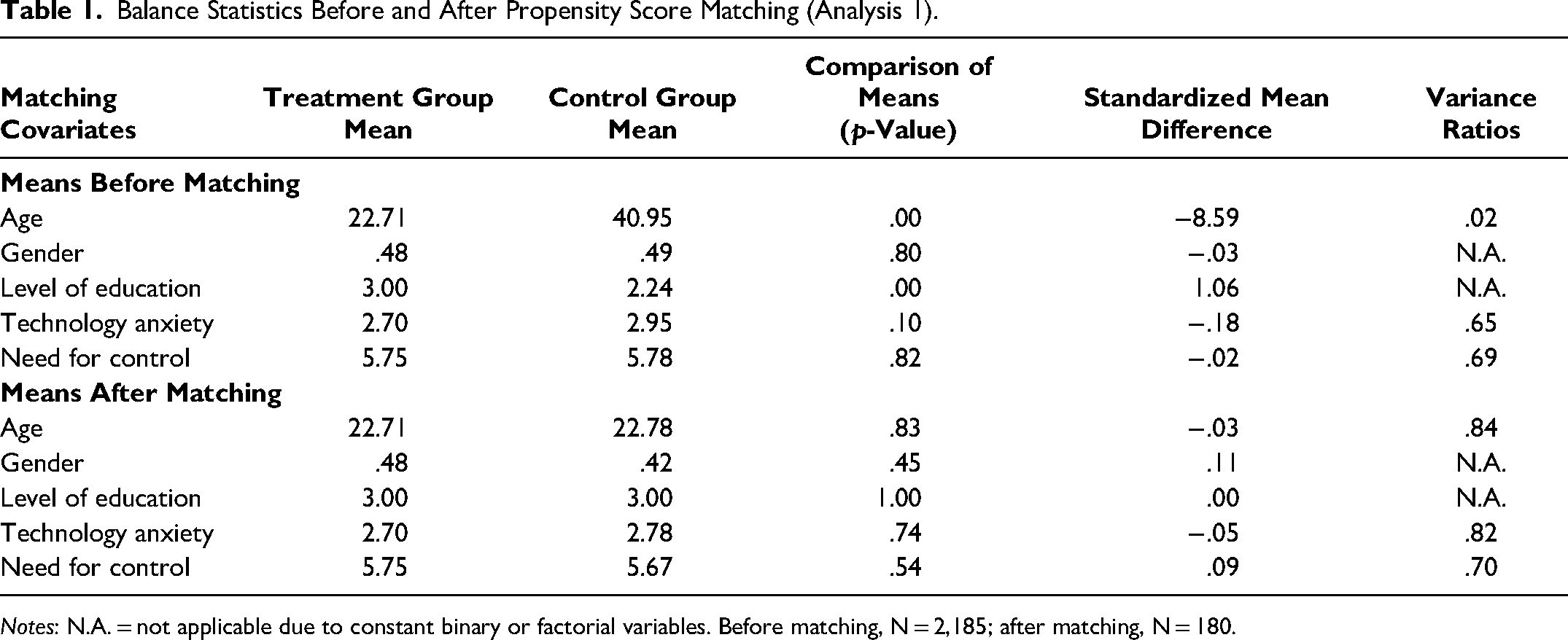
Notes: N.A. = not applicable due to constant binary or factorial variables. Before matching, N = 2,185; after matching, N = 180.
The results demonstrate the effectiveness of the matching procedure. First, all standardized mean differences after matching fall below the threshold of .25, signifying a balanced matched sample as per Rubin (2001). Second, the variance ratios indicate a valid matching procedure, as variance ratios close to one demonstrate a balanced sample (Austin 2009). Last, t-tests on the used covariates reveal no significant differences remaining between the trial subjects and the control subjects, addressing the method's requirements.
An additional potential bias stems from the time when we collected the data, as we surveyed the control group of nontrialists later than the subjects who participated in the metaverse trial. To rule out the possibility that the responses might have been biased by events that occurred during this time frame (such as the renaming of Facebook as Meta), we also ran a second 1:1 nearest neighbor matching procedure. This time we only considered those respondents in the nontrialist sample who were not aware of the term “metaverse” at the time of the survey, which was the case for 42.4% of the nontrial sample. All prematching differences are once more insignificant after the matching in this case (for details see Web Appendix C). We use this restricted matching sample to demonstrate the robustness of our results, while relying on the full matching sample for testing the hypotheses, as leaving out a part of the potential matching partners reduces the matching efficiency. Moreover, we also employ several alternative matching approaches to the 1:1 nearest neighbor matching to further corroborate the robustness of our hypothesis testing results.
Results of Analysis 1
Drawing on the full matched sample, we use separate ordinary least squares (OLS) regression models to test the hypothesized effect of the metaverse trial on each of the two independent adoption variables. In addition to the metaverse trial variable, we integrate several control variables in the analysis to isolate the impact of the metaverse trial on adoption and to avoid misattribution. We specifically control for the variables for which we discuss an effect on the previous metaverse trial experience, namely consumers’ gender, technology anxiety, and need for control. In addition, we control for the consumers’ age. As all these variables also served as covariates in the matching procedure, including them in the regressions helps account for potentially remaining differences between the treatment and control group, which further reduces the potential for bias in estimating treatment effects (Rosenbaum and Rubin 1983). We include marginally significant results (i.e., an error probability of up to 10%) in our reporting in response to the limited size of the matched sample of 180 consumers. With variance inflation factors below 2 for all included variables, both OLS models do not indicate multicollinearity issues.
Table 2 shows the results of both OLS regressions. We find support for our expectation that the metaverse trial increases consumers’ intention to use VR headsets (H1), with usage intentions being clearly higher for those consumers who participated in the metaverse trial. At the same time, we do not find such support for consumers’ intention to purchase a VR headset (H2). Instead, we find the trial participants to be less, not more prone to purchase a VR headset.
Overview of Regression Results on the Intention to Use VR Headsets and the Intention to Purchase VR Headsets (Analysis 1).
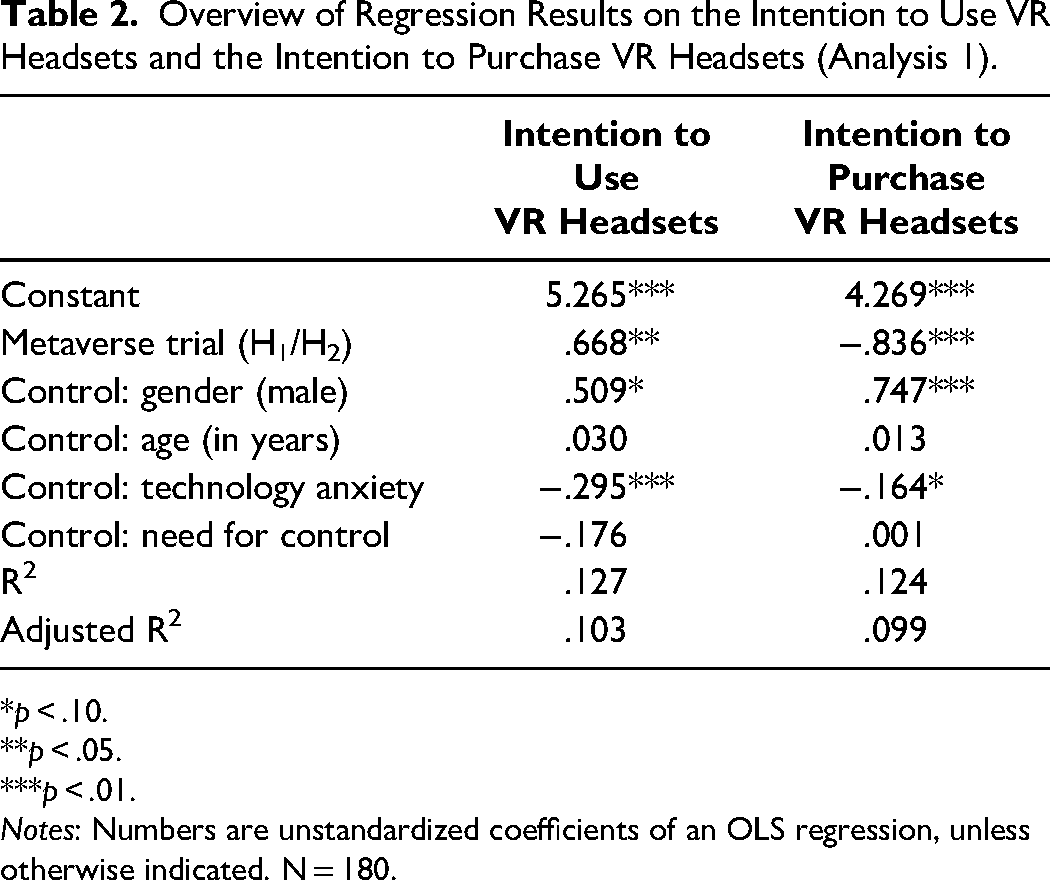
*p < .10. **p < .05. ***p < .01.
Notes: Numbers are unstandardized coefficients of an OLS regression, unless otherwise indicated. N = 180.
When we rerun the analysis with the restricted matched sample considering only nontrialists who had not heard of the metaverse when being surveyed (and thus could not have been subject to any information regarding the metaverse after we conducted the trial), we find the same pattern of results. Once again, the effect of the metaverse trial on the intention to use VR headsets is positive for this sample, while the effect on the intention to purchase VR headsets remains negative (see Table 3 and Web Appendix D). We can therefore rule out the possibility that our results for this hypothesis are due to events that happened between the metaverse trial and the nontrialist survey. Furthermore, when reanalyzing the regression models using datasets generated with alternative matching approaches and also an unmatched full sample, the results for the metaverse trial variable do not change, which we consider further support for the robustness of the results (see Table 3).
Regression Results for Metaverse Trial Variable on Adoption When Using Alternative Matching Approaches (Analysis 1).
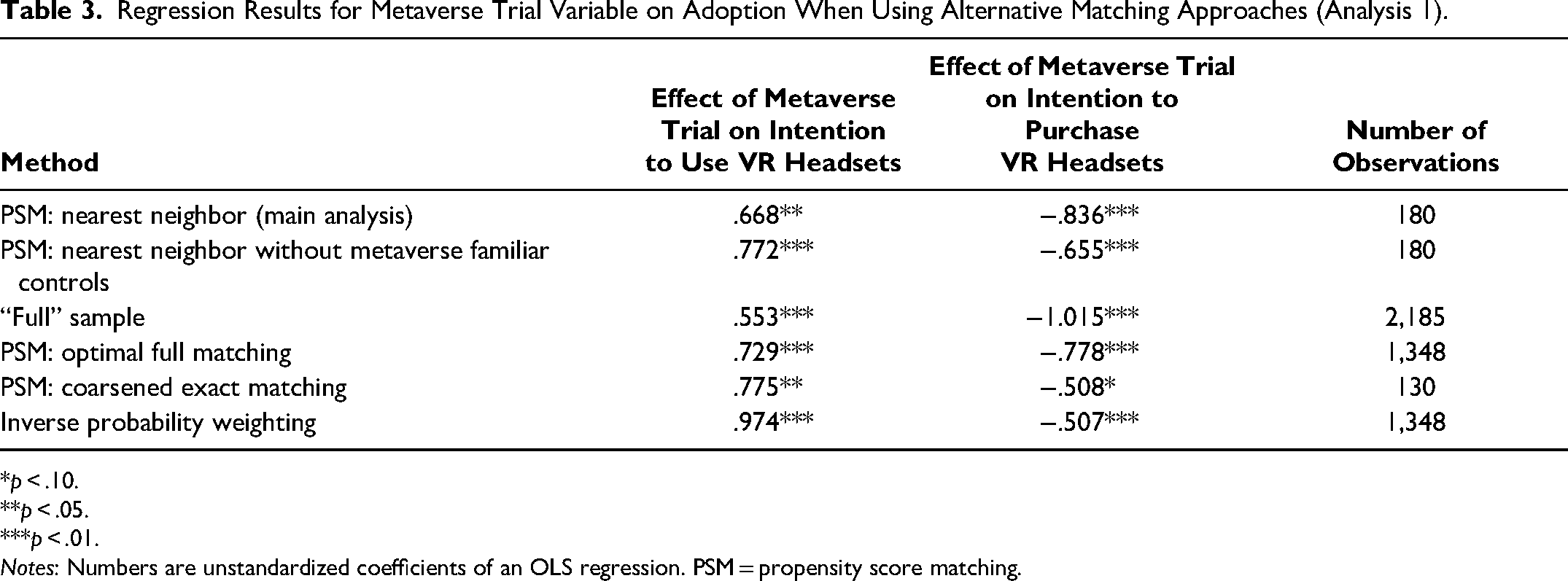
*p < .10. **p < .05. ***p < .01.
Notes: Numbers are unstandardized coefficients of an OLS regression. PSM = propensity score matching.
We additionally find significant effects on VR headset adoption stemming from the control variables included in the regression models. Overall, the results for the controls indicate that male participants have a higher intention to use as well as purchase VR headsets. Further, consumers with higher technology anxiety are less prone to use and to purchase VR headsets. The remaining controls (consumers’ age and need for control) are not significantly related to headset adoption. To shed additional light on the responses of nontrialist consumers, we report the results of complementary OLS regressions for which we exclusively use the sample of 2.095 nontrialists (see Web Appendix E) as well as the sample of 90 trialists (see Web Appendix F).
Analysis 2: Exploring Effects
In Analysis 2, we examine the consumer perceptions of fun, social presence, and exhaustion as responses to the metaverse trial experience and link these variables to headset adoption as well as potential determinants. Here, we focus exclusively on the trial sample of 90 trialists who participated in the series of metaverse activities. To estimate effects simultaneously, we use partial least squares structural equation modeling (PLS-SEM) with a bootstrap of 10,000 replications for this analysis. Doing so acknowledges the newness and little-researched nature of the field and is particularly appropriate when there is “no or only little prior knowledge on how the variables are related” (Hair et al. 2021, p. 3). Considering the limited sample size, we focus on the mediating role of the metaverse trial experience, while leaving out direct links between determinants and adoption variables. Again, we include marginally significant results in our reporting. Table 4 shows the results of the PLS-SEM analysis.
Overview of PLS-SEM Results on Metaverse Trial Experience Determinants and Adoption Consequences (Analysis 2).
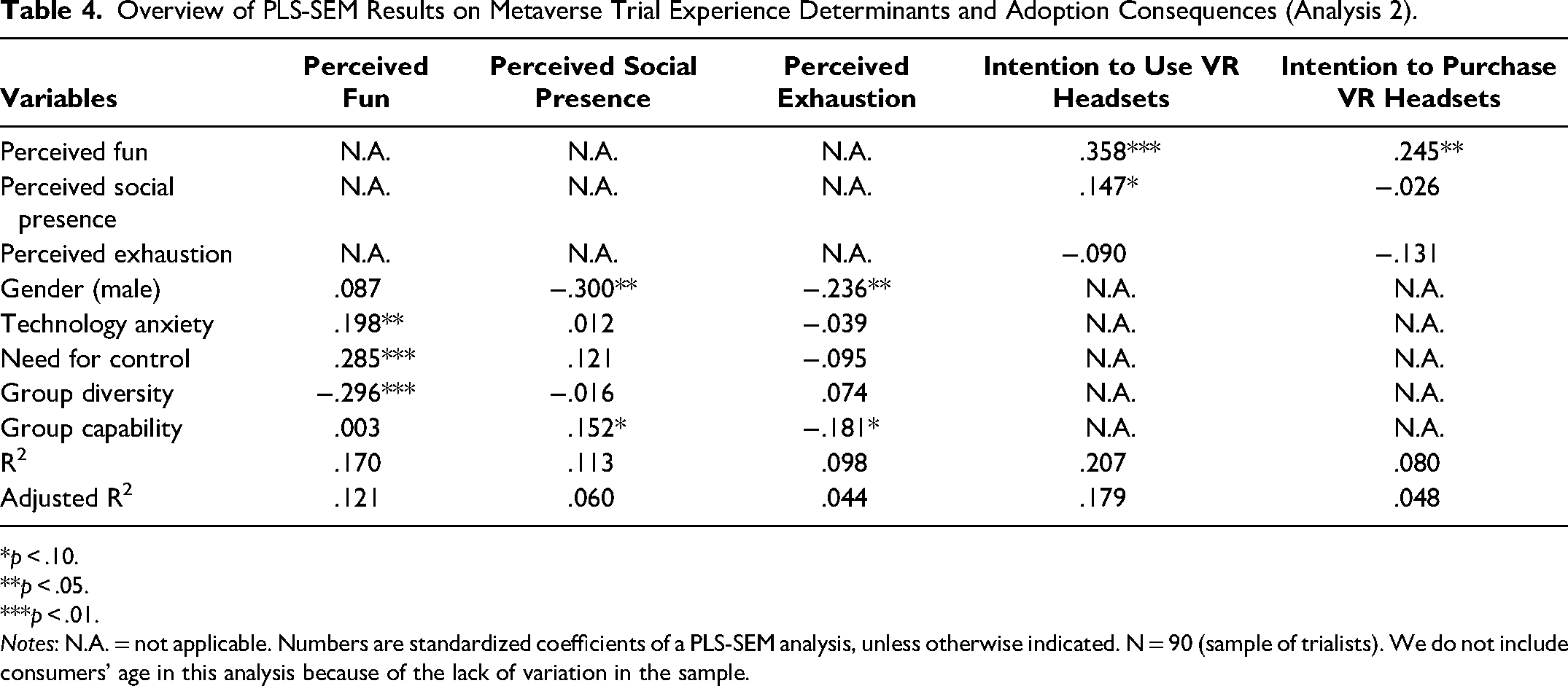
*p < .10. **p < .05. ***p < .01.
Notes: N.A. = not applicable. Numbers are standardized coefficients of a PLS-SEM analysis, unless otherwise indicated. N = 90 (sample of trialists). We do not include consumers’ age in this analysis because of the lack of variation in the sample.
Regarding the links between experience variables and adoption outcomes, we find that the fun the trialists perceive predicts their intention to use a VR headset and also to purchase one. Those among the trialists who perceive higher levels of social presence have significantly higher intentions to use VR headsets in the future, while we do not find perceived social presence to be linked with trialists’ VR headset purchase intentions. Furthermore, although the coefficients of perceived exhaustion on both adoption variables are negative, as could be expected, neither of them reaches significance.
When it comes to explaining participants’ trial experience, we find that male and female participants do not differ in terms of the fun they perceive during the trial. However, we find male participants to perceive a lower level of social presence than female participants, as well as less exhaustion.
With regard to consumer characteristics, we find that perceived fun varies significantly with the level of technology anxiety, while we find that social presence and exhaustion are not related to participants’ technology anxiety. The coefficient of technology anxiety on fun is positive—consumers with higher levels of technology anxiety perceived higher levels of fun during the metaverse trial, which is surprising. For need for control, we find the same pattern of results as for technology anxiety: Need for control is significantly linked to the level of fun a trialist perceived, but its direction is also positive, indicating that those with higher levels of need for control had more fun during the trial. Similar to technology anxiety, need for control is not significantly related to perceived social presence and exhaustion.
For the group-level variable of group diversity, we find a negative effect on trial fun—consumers who participated in the metaverse trial as part of a diverse group draw less fun from the trial experience. In our analysis, group diversity is not related to either social presence or exhaustion. Finally, the capabilities of a trial group are not significantly related to the fun trialists perceive, but they do increase the social presence of the group members and reduce the level of exhaustion perceived during the metaverse trial.
Discussion and Implications: Toward a Virtual Reality?
The implications of our metaverse trial, in which 90 consumers participated in a series of virtual group activities over the course of three months, are multifaceted. They facilitate predictions of future adoption patterns as well as assessments of marketing approaches (trials and segmentation) that aim to spread the technology among consumers. Our results are based on consumers’ actual use of the state-of-the-art VR headset at the time of data collection (i.e., Meta Quest 2), which continues to dominate the headset market even after the release of newer models (Lang 2023). The metaverse trial reported here encompasses a variety of metaverse applications and contexts, each of which contained a social component (vs. being carried out in isolation), in line with the social nature being a core element of metaverse and VR headset usage.
How the Metaverse Trial Affects VR Headset Adoption
Our results support the hypothesis that exposure to VR headsets as part of the metaverse trial can indeed increase consumers’ intentions to use headsets in the future. This is a key requirement for any adoption decision and an indicator of our logic that VR headsets provide a positive gross utility. At the same time, however, we had to reject our hypothesis that such an effect would also exist for trialists’ purchase intentions: Our metaverse trialists expressed a lower intention to purchase a headset than a matched sample of consumers who have not engaged in a metaverse trial. This finding, which we corroborate with alternative samples and alternative matching algorithms, runs against our expectations and raises important questions about the growth of VR technologies.
As this finding points to a negative net utility when weighing the cost of VR headsets and the user benefits they provide, we see two potential explanations. First, while consumers enjoyed the VR headsets in the trial (as evidenced in their increased intention to use them in the future), they might consider their benefits for personal use too limited, given the actual cost of the headsets. One of the factors that could contribute to such a judgment is the currently sparse diffusion of headsets among consumers’ peers. The lack of a strong installed base for headsets limits the social benefits that trialists experienced in the metaverse trial (where all group members had access to a headset) to the trial context, whereas such benefits would not (or hardly) exist when using the headset outside the trial. This logic would be consistent with research findings that consumer product trials can increase consumers’ salience of negative attributes such as network externalities (Laurell et al. 2019).
An alternative explanation would be that the trialists developed inflated price perceptions as a result of the trial and their personal experience of the high-fidelity technology; they might assume that VR headsets would be more expensive than they actually are. While the first explanation constitutes a fundamental challenge, the second explanation would offer headset providers a relatively straightforward solution: Informing consumers about the actual price of headsets would recalibrate their price-related perception, which should solve the problem.
Whether the consumers’ lack of willingness to purchase VR headsets after the extensive trial is mainly due to a lack of benefit or miscalibrated price perceptions deserves future research. While we do not measure trialists’ price perceptions in this research, we see ad hoc evidence for limited willingness to pay. First, participants could have easily looked up the freely accessible pricing information during the three-month trial period, making miscalibrated price perceptions somewhat less likely. Second, a majority of consumers preferred the cheaper Quest 2 over the more expensive Quest 3 when the latter device was released in the fall of 2023 (Lang 2023). Similarly, in 2015, when a Time magazine journalist who was excited about the then-new HoloLens headset by Microsoft was asked how much he would be willing to pay for the headset after his trial, he said $350 (“assuming there are apps I want”; Time 2015), while the actual market price was about ten times higher.
For VR headset providers, resolving this value-for-money issue is intertwined with the challenge of justifying enormous investments in headset technology. Meta alone is reported to have invested about $50 billion in its “Reality Labs” division since 2019 (Snyder 2022). Relatedly, lowering the devices’ price point would be a challenge, as the Meta Quest 2 used in our trial setting is said to have been subsidized for the sake of building an installed base of users (Baker 2021). Thus, to limit losses, the next iteration of the product (Meta Quest 3) was sold at a higher, not lower price than its predecessor (Vanian 2023).
Navigating this situation necessitates ongoing efforts to recoup investments, while at the same time lowering costs for consumers to address the crucial role of the installed base, a core requirement for the growth of new network markets like the one for VR headsets. Efforts to facilitate cross-headset usage would help; while all headset providers currently restrict interoperability to maximize market share (e.g., by exclusive apps), joint usage opportunities would help grow the installed base of users and thus the product category in general by providing consumers with higher net utility from headset usage.
Headset providers are also advised to find new revenue streams for the metaverse environment, instead of making their financial profit dependent on hardware sales. A successful example of this transformation is Epic Games's multiplayer game Fortnite, which relies entirely on microtransactions and advertising revenue in the game. Such an approach effectively eliminates entry costs and barriers for consumers while increasing profitability (Thomas 2022). At the same time, Fortnite promotes the integration of content from independent creators, transforming the game into an attractive and highly adopted ecosystem (Peters 2023). Roblox, another massively popular metaverse application that is also largely accessed via PC (i.e., without the need for users to purchase additional hardware), uses a similar approach (Goel 2022). Meta has made similar attempts, trying to build its own metaverse apps as well as taking commission from apps purchased via its VR app store, but with limited success so far.
Further, our research shows that metaverse trials provide a way for headset producers to stimulate usage interest and thus to overcome some of the adoption challenges that result from headsets’ experiential nature. Considering the nontrivial costs associated with such trial designs, headset producers must develop effective ways to provide interested consumers access to their products. For its Vision Pro headset, Apple is actively harvesting its brand store infrastructure to enable consumers with such trials, though on a shorter and less social scale than in the trial used in this research. As Meta lacks such infrastructure, the firm needs to find alternative approaches; pop-up stores or low-cost rental services might offer a remedy.
Metaverse Trial Experience Facets: Insights on Adoption Consequences and Determinants
This research also offers insights beyond the effect of the metaverse trial on headset adoption. Specifically, our effects research (Analysis 2) indicates that the fun trialists perceive strongly drives their intention to use a VR headset, but also facilitates its purchase. In line with prior research (e.g., Wood and Moreau 2006), our findings demonstrate that perceived fun plays a crucial role in encouraging consumers to have an initial positive experience with a VR headset, thereby fostering its adoption. The relevance of fun may further indicate that VR headset providers need to design their metaverse trials in ways that will produce enjoyable experiences.
Furthermore, our results show that the degree of perceived social presence during the trial activities increases headset usage intention (though not purchase intention). This finding is in line with the importance that VR research has dedicated to the role of user presence, in both spatial and social terms, as reflected by the existence of the journal Presence and the focus of its 33rd volume on the phenomenon. Research has also highlighted the positive link between (social) presence and several desired outcomes (e.g., Hennig-Thurau et al. 2023). While extant studies often compare the presence perception experienced by headset users with those of users of “flat” devices (such as PCs), our sample only considers differences in the perception of social presence among the cohort of VR headset users, which might explain the less pronounced effect on adoption we find.
Finally, while the path coefficients between the exhaustion trialists perceive and the two adoption variables are negative, as expected, they do not reach significance. This finding is in line with previous studies that find headset usage to be more exhausting than the use of flat devices, but fail to link such headset-induced exhaustion with negative impacts on desirable outcomes (Hennig-Thurau et al. 2023). Let us note that while fun, social presence, and exhaustion are established as central facets of VR experiences, other, more fine-grained experience constructs might help shed even more light on the link between consumers’ VR experiences and headset adoption. Thus, we encourage their inclusion in future research.
For the determinant effects, we find that all our individual-level and group-level variables influence at least some of the trial experience facets. Male participants perceived less exhaustion as well as a lower degree of social presence. We were surprised to find that consumers with higher technology anxiety and a higher need for control enjoyed the metaverse trial in terms of experiencing higher fun. These results might express a surprise effect in which negative expectations regarding the technology were not confirmed by the virtual and highly immersive experiences, but rather triggered a positive response. Regarding control, it seems that consumers consider virtual experiences not as the expected interference with their physical sovereignty, but assign control to the virtual environment instead (and expect it to be high). Consistent with this logic, Yoo et al. (2023, p. 180) state that “high immersion, usually achieved by VR and AR technologies, allows consumers exceptionally high levels of control over their interactions with and within the environment.” 4
Finally, we find that diverse groups (in terms of gender) perceived less fun than homogeneous groups when it comes to the metaverse trial, and participants with higher capabilities feel (marginally) less exhaustion, but higher levels of social presence. We consider these findings important for designing configurations of metaverse trials. Hence, Meta and other firms aiming to build a virtual infrastructure should pay particular attention to the way they recruit and assemble trial groups.
Future Research and Limitations
Some aspects deserve particular notice when it comes to drawing inferences from our findings. Regarding the effectiveness of metaverse trials, our results are restricted to effects that result directly from a change in the behavior of trial participants. As Foubert and Gijsbrechts (2016, p. 815) point out, a trial can, however, also influence adoption because of word of mouth. Consequently, our results might underestimate the positive effects of trials on VR adoption, as we do not consider potential spillover effects initiated by those who have tried the product. While we do not measure word of mouth itself, we believe that it will be influenced more by trialists’ increased intention to use VR headsets than by their decreased intention to purchase headsets.
Moreover, while the metaverse trial we employed in this research is certainly a thoughtfully executed one, it is also specific in nature. All its multiple usage scenarios are of a social nature in that they are carried out in groups instead of in single-player mode, in line with social interactions being a core element of the metaverse. We can only speculate how other trial formats and configurations, involving more or fewer experiences, different experiences, or single-player activities as well would affect trialists’ behavior and experience.
To better understand the roles of the respective trial activities, we ran an additional post hoc analysis in which we calculated the residuals in fun, social presence, and exhaustion for each trial activity that are not explained by the other trial activities, and then used these activity-specific residuals in regressions with the adoption facets as dependent variables. The results suggest that some of the trial activities indeed exerted an effect on adoption beyond the composite effect of all activities. 5
While we used the most popular consumer headset at the time of collecting our data and at the time of writing (i.e., Meta's Quest 2), we acknowledge that results might be different for other headsets and also future generations of headsets. While we have discussed how fundamental characteristics such as hardware and usage costs and installed user base could impact our results, we refrain from further speculation on how results would differ for alternate headset prices and specifications, as the technological evolution of headset properties is notoriously difficult to predict (e.g., Marr 2016; Time 2015).
Also, while our analyses focus on metaverse trials, we acknowledge that other conventional marketing and distribution methods VR headset providers employ are not accounted for. Although we anticipate limited impacts from such conventional marketing activities, given that their current implementation by providers like Meta has not resulted in large-scale mass market adoption, they might help or hurt metaverse trials’ effect on future VR headset adoption.
Further, the participants of our metaverse trial are of a distinct age and educational group, which raises the question of the extent to which the reported results can be generalized to other demographic segments. Related, while our sample of trialists enables us to explore determinants of consumers’ metaverse trial experience, we acknowledge that differences in consumer expectations about VR experiences, beyond those based on a general tendency to avoid technology and lose control over the environment, might influence participation in trials and adoption tendencies. We did not measure such VR-specific predispositions, as doing so might have biased the results, but we consider understanding their potential impact a promising research avenue. In all these areas, future research is warranted to refine our understanding of the impact metaverse trials have on VR headset adoption.
In sum, our findings indicate that providing consumers access to VR headsets as part of a metaverse trial carries the potential to increase intention to use a VR headset. But the lack of a positive net utility when taking into account acquisition costs and usage barriers, such as the lack of a strong installed base (i.e., friends, relatives, and colleagues who also use the system), appears to limit the growth rate of VR headset use as well as the benefits a metaverse trial can create in the foreseeable future, as long as no fundamental changes take place.
Supplemental Material
sj-pdf-1-jnm-10.1177_10949968241263353 - Supplemental material for Adoption of Virtual Reality Headsets: The Role of Metaverse Trials for Consumers’ Usage and Purchase Intentions
Supplemental material, sj-pdf-1-jnm-10.1177_10949968241263353 for Adoption of Virtual Reality Headsets: The Role of Metaverse Trials for Consumers’ Usage and Purchase Intentions by Thorsten Hennig-Thurau, Alina M. Herting, and David Jütte in Journal of Interactive Marketing
Footnotes
Acknowledgments
The authors thank Gerrit Cziehso for his input during the early stages of this manuscript's preparation and Nilusha Aliman, along with other members of the eXperimental Reality Lab at Marketing Center Münster, for supervising the metaverse trial used in this research.
Editor
Arvind Rangaswamy
Declaration of Conflicting Interests
The authors declared no potential conflicts of interest with respect to the research, authorship, and/or publication of this article.
Funding
The authors received no financial support for the research, authorship, and/or publication of this article.

Notes
References
Supplementary Material
Please find the following supplemental material available below.
For Open Access articles published under a Creative Commons License, all supplemental material carries the same license as the article it is associated with.
For non-Open Access articles published, all supplemental material carries a non-exclusive license, and permission requests for re-use of supplemental material or any part of supplemental material shall be sent directly to the copyright owner as specified in the copyright notice associated with the article.
