



Abstract
Motivating customers’ engagement can be a crucial differentiating factor for the dynamically changing landscape of online retailing. This study draws on service-dominant (S-D) logic and behavioral literature to propose a conceptual model that depicts how a firm's S-D orientation and strategic capabilities stimulate customer engagement, leading to enhanced performance. The model captures the underlying mechanism of value cocreation in an online retailing context. The authors test the model using an experimental research design: 872 participants navigated a quest toward a hypothetical purchase in nine versions of a mock e-commerce website specializing in cycling equipment, and which contained various cues representing different S-D orientations. Findings suggest that S-D orientation has a positive impact on customers’ brand attitudes, affecting their engagement dispositions, purchase intentions, and ultimately (dis)engagement behaviors. In addition, relational, individuated, and developmental strategic capabilities appear to have a stronger impact on customer engagement in online retailing.
Keywords
Over the past two decades, online retailing demonstrates a booming trend, which has been amplified further by the COVID-19 pandemic. Online marketplaces are transforming at a rapid speed, and e-retailers face many challenges, such as difficulty creating and sustaining long-term customer relationships due to the lack of physical contact, frequent changes in both technology and customers’ preferences, and fierce competition from existing firms and new online players. In such a dynamic environment, retailers need to contemplate how to strategically position themselves to survive and prosper. In light of these developments, Lusch, Vargo, and O’Brien (2007) emphasize the key role of service in driving competitive advantage in retailing. They point out that retailing is a service-integration function and that a competitive advantage can be attained for an organization by adopting a service-dominant (S-D) strategic orientation that places service at the epicenter. S-D orientation (Karpen, Bove, and Lukas 2012; Karpen et al. 2015) comprises the essential strategic capabilities that firms should develop to facilitate value cocreation with their customers and other stakeholders to successfully compete on service within a market. Value cocreation is a central concept in S-D logic (Vargo and Lusch 2004, 2016). In online retailing, it includes all interactions among online actors aiming to jointly create some kind of value. The relevant literature presents, however, a rather fragmented view of the value cocreation process. Specifically, some studies identify the conceptual relation of value cocreation and customer engagement (CE), where CE is considered the microfoundation of value cocreation (Jaakkola and Alexander 2014; Storbacka et al. 2016). In other words, it is through the engagement of actors that cocreation happens. Other scholars consider S-D orientation as a firm's cocreation capability, and they identify the distinct strategic capabilities necessary for effective cocreation to happen (Karpen et al. 2015). Finally, more recent contributions have identified S-D orientation as an antecedent of CE (Leckie, Nyadzayo, and Johnson 2019). To the best of our knowledge, a holistic approach in studying the different aspects of the value cocreation process has yet to emerge. Although “it is important to understand how value propositions invite engagement” (Chandler and Lusch 2015, p. 9), we still have a limited understanding regarding how a firm's S-D logic strategic orientations can stimulate actors’ engagement and lead to increased performance. Furthermore, no guidelines exist on how to successfully apply an S-D orientation strategy, and which combinations of related capabilities can engage customers, especially in complex market structures like e-retailing. In light of this, a core contribution of this study is to develop a comprehensive theoretical model of the value cocreation mechanism adapted to the e-retailing context and provide an empirical test using appropriate methodological procedures.
The conceptual model we develop draws on the paradigms of the S-D logic (Vargo and Lusch 2004, 2016) and stimulus–organism–response (S-O-R; Baker, Grewal, and Parasuraman 1994; Mehrabian and Russell 1974), as well as the theory of reasoned action (TRA; Fishbein and Ajzen 1975). We propose that CE is the vital link of the underlying mechanism by which a firm's S-D orientation leads to enhanced performance, highlighting its strategic role in e-commerce (Connell et al. 2019; Eigenraam et al. 2018). We test our model through an experimental design mimicking the online sales of cycling equipment, which allow us to effectively accommodate all distinct S-D orientation capabilities. Results indicate that an e-retailer's S-D orientation positively affects CE by strengthening the customer's attitude toward the retailer, 1 leading to positive customer outcomes, manifested as electronic word of mouth (eWOM). We further identify the combinations of S-D orientation capabilities that may affect CE effectively, so that e-retailers can form an appealing S-D orientation profile to engage customers. A follow-up study using alternative customer engagement behaviors (CEBs) confirms the validity and robustness of our model.
Our work extends the literature in three main directions. First, we synthesize different aspects of value cocreation between the e-retailer and the customer into a holistic mechanism, which demonstrates how external stimuli (i.e., a firm's S-D orientation capabilities) affect the customer's (dis)engagement behavior. We therefore contribute toward the development of a mid-range theory for the S-D logic meta-theoretical framework advocated by Vargo and Lusch (2017), emphasizing further the firm-related factors that affect CE (Van Doorn et al. 2010) and the equally important role of disengagement in the context of online retailing. Second, we contribute to an S-D logic–oriented strategy development and explore further the nomological network of S-D orientation suggested by Vargo and Lusch (2017) and Karpen et al. (2015) respectively, by investigating the effect of a firm's strategic capabilities on key engagement and performance metrics. Third, there is a lack of studies on the effective combinations of S-D orientation capabilities that may urge customers to make favorable purchase decisions. As a result, no road map exists to guide practitioners in successfully applying the S-D orientation framework, as the relative importance of the distinct S-D orientation capabilities has not been thoroughly studied. Thus, our work extends the e-retailing literature in this respect as well.
Conceptual Background
S-D Logic, CE, and S-D Orientation
The primal conceptual lens employed in this work is the S-D logic view of Vargo and Lusch (2004, 2016), which has evolved from an emerging paradigm to a unifying meta-theoretical framework for understanding economic exchange and value creation. Its main premise is that value is always cocreated within a broader interconnected market context (i.e., a service ecosystem) by several actors, who make value propositions to each other and integrate resources to engage in collaborative activities (Vargo and Lusch 2004, 2016). Cocreation taking place within ecosystems is the cornerstone of the S-D logic, materialized through the engagement of actors, which can be easily observed and reported (Prahalad and Ramaswamy 2004; Storbacka et al. 2016), and is considered a strategic imperative for retailing organizations (Grewal, Roggeveen, and Nordfält 2017). Therefore, empirical research on value cocreation has turned its focus to engagement.
In the service and marketing literatures, CE is conceptualized as a customer's psychological state of mind related to their experienced value with a firm or a brand, comprising multiple dimensions (i.e., cognitive, emotional, and behavioral) (Brodie et al. 2011). In terms of behavioral manifestations, CE involves resource contributions that go beyond what is fundamental to transactions, such as engaging in eWOM, making referrals, sharing information with other customers, providing product/service ratings, participating in online communities, and codesigning products (Van Doorn et al. 2010). The extant literature (e.g., Sim et al. 2022; Storbacka et al. 2016) identifies customer engagement disposition (CED; i.e., the actor's state of readiness or tendency to act) and CEB (i.e., the observable activity of engaging beyond purchase) as integral conceptual elements of CE. CED is a key antecedent of CEB, operationalized in organizational studies and social psychology on the basis of vigor, absorption, and dedication (Brodie et al. 2011; Fehrer et al. 2018). Most importantly, CEB emphasizes the behavioral dimension of CE, whereas CED emphasizes the cognitive and emotional CE dimensions. CE is considered a strategic imperative for organizations to achieve a competitive advantage and superior sales (Bijmolt et al. 2010). Customers may, however, enact positive engagement behaviors in favor of the firm (e.g., by liking the firm's social media page) as well as negative engagement behaviors that may damage the organization (e.g., through negative eWOM). Disengagement is another related concept, in which customers choose to withhold particular resources and consciously abstain from enacting engagement behavior, distancing themselves behaviorally, emotionally, and cognitively from the exchange (Alexander, Jaakkola, and Hollebeek 2018). For example, customers’ unwillingness to provide their email address or to rate the quality of the service received when requested by a retailer are forms of disengagement. Disengagement may signal mediocre customer satisfaction that can actually prove detrimental for a firm's performance (Katsifaraki and Theodosiou 2020); thus, organizations should not ignore such behaviors and consider only positive or negative engagement behaviors.
It is noteworthy that researchers largely embrace S-D logic as the core meta-theoretical framework for engagement (Storbacka et al. 2016). S-D scholars further describe how organizations use their strategic cocreation capability to form value propositions to engage customers and other stakeholders and initiate cocreation (Karpen, Bove, and Lukas 2012; Lusch, Vargo, and O’Brien 2007). In S-D logic, an organization's S-D orientation encompasses the strategic principles that guide its cocreation-related activities (Karpen, Bove, and Lukas 2012). According to Wilden and Gudergan (2017) and Sharma and Conduit (2016), a firm's S-D orientation constitutes its culture-centered business philosophy, which orients the firm toward achieving superior performance while emphasizing cocreation. Karpen et al. (2015, p. 91) argue that S-D orientation is the “organization's ability to facilitate and enhance mutually beneficial interaction … with individual actors within the service system.” S-D orientation is conceptualized as a higher-order formative construct consisting of a set of distinct strategic capabilities that enable an organization to cocreate value with other actors of the ecosystem. These are relational, ethical, empowered, developmental, individuated, and concerted capabilities, described in Karpen, Bove, and Lukas (2012) as interaction capabilities to emphasize their relation to service exchanges (Web Appendix B, Figure W1).
Research Model
Our study aims to delineate the underlying mechanism of value cocreation within an online market, which describes how a firm’s S-D orientation stimulates actors’ engagement. We draw on the behavioral literature, specifically the S–O–R paradigm (Mehrabian and Russell 1974) and the TRA (Fishbein and Ajzen 1975), to explain how external stimuli generated by an e-retailer’s S-D orientation capabilities affect customers’ attitudes toward the e-retailer, shape their intentions, and ultimately guide their behaviors. 2 S-O-R aims to explain how various environmental attributes and events can act as stimuli (S) that affect an individual's internal state (O) (like feelings, perceptions, and thinking), which subsequently guides their behavioral response (R). It has been applied both to retail environments (Baker, Grewal, and Parasuraman 1994) and to online environments, exploring customer behavior and engagement (e.g., Mollen and Wilson 2010). TRA posits that behavioral intentions are direct antecedents to behavior and a consequence of attitudes and subjective norms on behavior, where norms are significant in specific contexts (Fassnacht and Köse 2007). Exogenous variables affect intentions and behavior only insofar as they impact attitudes or norms. TRA has been widely used in information technology research (e.g., Zhang and Benyoucef 2016).
Drawing on the S-D logic principles and the S-O-R and TRA mechanisms, we posit that S-D orientation strategic capabilities lead to performance by forming customer attitudes and driving CE. More specifically, firms develop value propositions of concrete practices on the basis of the S-D orientation capabilities they possess. Corresponding cues portray these practices and reflect the firm’s S-D orientation capabilities. To customers, these cues constitute external stimuli, shaping their perceptions about the e-retailer's strategic capabilities. Customers’ perceptions form their attitudes toward the e-retailer's brand and drive engagement intentions, generating engagement behaviors and ultimately leading to performance. The proposed conceptual framework (see Figure 1) indicates that engagement and customer behaviors are consequences of a firm’s S-D orientation capabilities, reflected by specific cues. S-D orientation is a firm-based antecedent of CE (Leckie, Nyadzayo, and Johnson 2019) and is used in its consolidated form. We follow Karpen, Bove, and Lukas (2012), who propose that the S-D integrating capability of the organization is best approached through an all-encompassing S-D orientation formative composite of six conceptual dimensions (relational, ethical, empowered, individuated, developmental, and concerted), rather than six distinct capabilities. According to Karpen et al. (2015), for a firm to derive maximum benefits and attain a sustainable competitive advantage, all S-D orientation capabilities should be emphasized, as they complement each other in a holistic composite. Each capability is unique and cannot be substituted, deleted, or merged. Furthermore, capabilities do not necessarily correlate or have the same nomological network in terms of antecedents and consequences. Along this line of reasoning, we combine the different S-D orientation capabilities to a single construct rather than treat them as six independent dimensions.
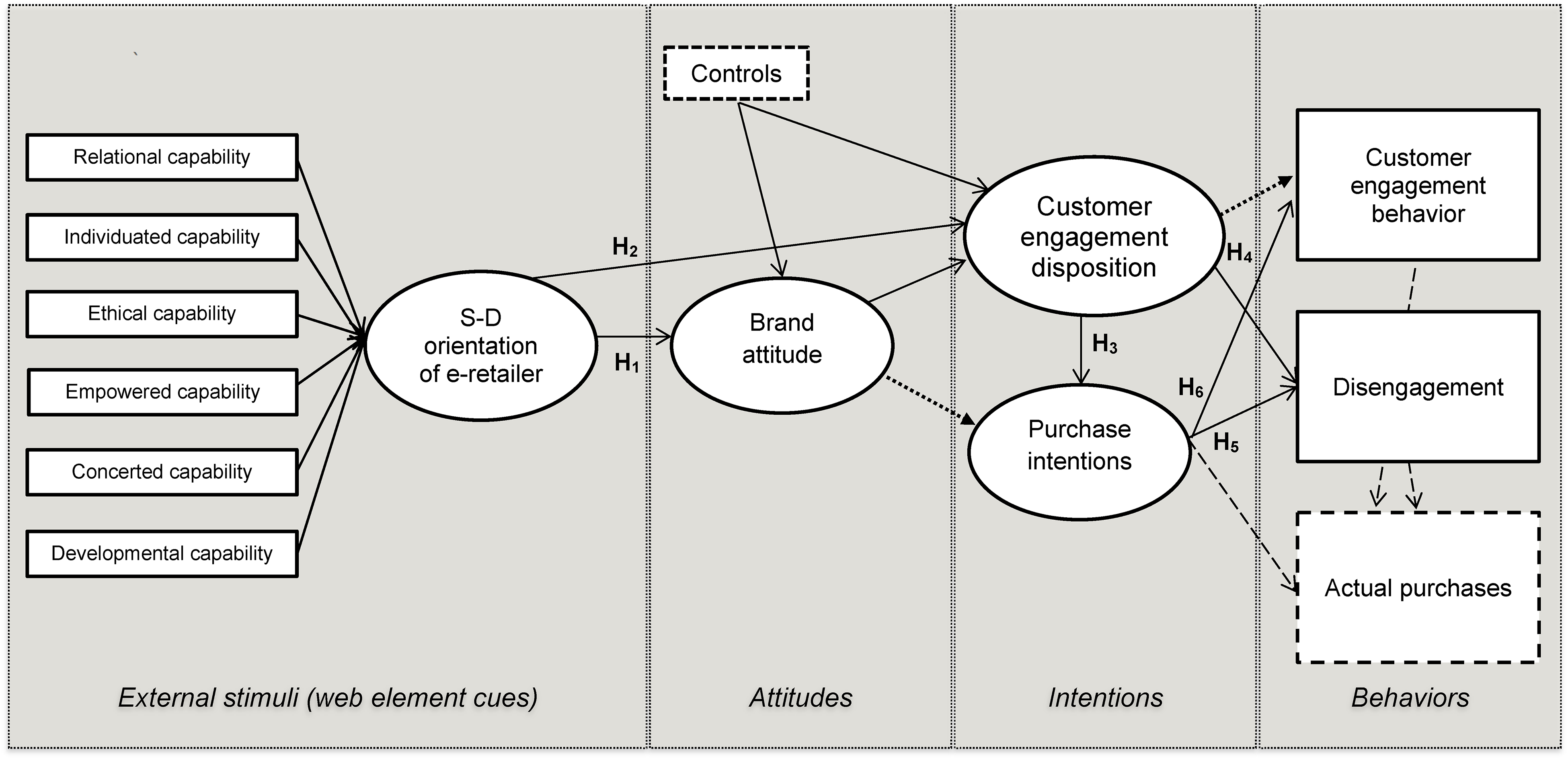
A Proposed Conceptual Model of How S-D Orientation Capabilities Affect CE.
Figure 1 also uses dotted lines to depict some relationships that have been previously investigated in the literature: brand attitude is found to positively relate to purchase intentions (e.g., Kudeshia and Kumar 2017) and, in some contexts, CED results in CEB, which is the actual manifestation of engagement (Brodie et al. 2011; Fehrer et al. 2018). We therefore develop no specific hypotheses for these relationships (although we test them). Moreover, the dashed lines depict hypothetical relationships of purchase intentions and (dis)engagement with actual purchases. We do not examine these relationships, as they have already been investigated in previous studies (e.g., Armstrong et al. 2000; Katsifaraki and Theodosiou 2020; Morwitz, Steckel, and Gupta 2007).
Research Hypotheses
Direct Effects
Brand attitude refers to customers’ internal evaluation of a brand, which can be affected by their experiences with the brand (Borghini et al. 2009). It manifests customers’ “psychological tendency that is expressed by evaluating an entity (e.g., a brand) with some degree of (dis)favor” (Eagly and Chaiken 1993, p. 1). In an online environment, in which an e-retailer is considered a brand in itself, 3 brand attitudes are of great importance for the organization's success (Rubinstein and Griffiths 2001). In environments where physical interaction is rare, intangible assets may be critical to building a strong brand identity, which stakeholders can use to “tangibilize” the organization (Merrilees and Fry 2002). A solid brand identity then acts as a guarantee with regard to important issues for online customers, such as the offering's quality, transaction’s reliability, and delivery efficiency (Merrilees and Fry 2002). Developing a positive brand attitude is thus crucial.
Several studies that investigate the effect of distinct S-D orientation dimensions in isolation have found an impact on customer attitudes and perceptions in various contexts. Blasco-Arcas, Hernandez-Ortega, and Jimenez-Martinez (2016) show that customer empowerment cues that provide information about the firm, as well as personalization-related cues, positively influence brand image on engagement platforms. Vernuccio et al. (2012) further show that personalization (individuated cues) and interactivity (relational cues) affect user attitudes toward e-brands. Finally, Van Noort, Kerkhof, and Fennis (2008) find that online safety/transactional integrity cues stimulate more favorable attitudes toward a brand. The literature therefore suggests that distinct S-D orientation capabilities in the form of cues have a positive effect on brand attitude; accordingly, the firm's overall S-D orientation is expected to have a similar effect. Drawing further on S-O-R and TRA, we expect that external stimuli emanating from a firm’s S-D orientation will directly affect customers’ internal state (i.e., attitudes and dispositions toward the firm). Extending these contemplations in an online retailing context, we argue:
S-D orientation is a firm-based antecedent of CE (Leckie, Nyadzayo, and Johnson 2019). The extent to which firms enact S-D orientation is highly correlated with the level of engagement with their partners (Marcos-Cuevas et al. 2016). Many studies provide further evidence of the effect of distinct S-D orientation capabilities on CE. Fehrer et al. (2018) find that social proof and connectedness trigger CE in online commerce, and Blasco-Arcas, Hernandez-Ortega, and Jimenez-Martinez (2016) indicate that customer-to-customer interaction and personalization-related cues have a positive effect on CE on engagement platforms. Füller et al. (2009) find that perceived empowerment positively affects future participation intentions, and Demangeot and Broderick (2016) demonstrate that perceptions of experiential and informational exploration capability positively influence engagement with an online retailer. In addition, online transactional integrity and corporate social responsibility cues evoke engagement toward a brand (Jarvis et al. 2017; Van Noort, Kerkhof, and Fennis 2008). On the basis of this discussion, we expect that S-D orientation has a significant positive effect on CE overall, constituting an external stimulus that triggers CED, which subsequently leads to CEB:
The TRA posits that external stimuli drive intentions and actions through attitudes. Mollen and Wilson (2010) explain how external cues of an online retailer affect customers’ perceptions during their navigation and, ultimately, engagement. Thus, we expect customers’ attitudes toward the e-retailer to further mediate the S-D orientation–CE relationship. Drawing on the TRA, we propose that users first form an attitude toward the e-retailer on the basis of external stimuli (S-D orientation capability cues) and then transform this attitude into CED (intention) and CEB. Thus,
Research has extensively used purchase intention as a proxy for purchase behavior (Chandon, Morwitz, and Reinartz 2005). Purchase intention captures an individual's purchase action tendency toward a brand (Ostrom 1969). Intentions differ from attitudes in that they represent a person's “conscious plan to exert effort to carry out a behavior” (Eagly and Chaiken 1993, p. 168), whereas attitudes are synoptic evaluations. In practice, firms consider purchase intentions when making managerial decisions. Prentice et al. (2019) and Blasco-Arcas, Hernandez-Ortega, and Jimenez-Martinez (2016) find that CE can lead to purchase intentions. Based on the TRA, however, we argue that CED rather than CEB relates directly to purchase intentions (as behavior cannot precede intentions). In other words, customers who are more willing to engage with a brand are more likely to consider buying. Thus,
Recently, Hulland and Houston (2021) called attention to the importance of observing actual behavior—especially as managers are primarily interested in actual responses—and not only intentions in empirical research to invest in interventions. With reference to disengagement, we expect that when customers’ disposition to engage is low, they disengage to a greater extent by detaching themselves from the transaction, and vice versa. To this end, Bowden, Gabbott, and Naumann (2015) suggest that engagement and disengagement are dynamically intertwined and that customers’ predisposition to engage affects their possibility to disengage. Thus,
As customers are exposed to the S-D orientation capability of an e-retailer, a point is reached at which they form an internal (cognitive and emotional) brand evaluation, which contributes to the formation of their dispositions (Chandler and Lusch 2015) and purchase intentions. This internal evaluation, in accordance with S-O-R and TRA, subsequently drives CEB and actual purchases. We therefore expect that as customers develop purchase intentions toward an e-retailer, they may engage in various behaviors while “Trying to Consume” (Bagozzi and Warshaw 1990); that is, they may go through a series of trial actions, immersing themselves in engagement. We then expect that purchase intentions will have a reverse impact on disengagement:
Indirect Effects
In addition to the direct effects reflected in H1–H6, we investigate the indirect effects of the distinct S-D orientation capabilities on brand attitude and CED, as prior research reports that such effects can be significant (e.g., Blasco-Arcas, Hernandez-Ortega, and Jimenez-Martinez 2016; Demangeot and Broderick 2016). Thus, we advance the following additional hypotheses:
Research Methodology
We employed an experimental research design in an online retail context, as this was the most effective approach for investigating the role of all S-D orientation capabilities in a balanced manner. Organizations may lack the physical, intellectual, or cultural capital required to develop all S-D orientation capabilities and associated practices to a satisfactory level. 4 In addition, individual practices often reflect more than one S-D orientation capability (Marcos-Cuevas et al. 2016). Overlapping effects can generally be better controlled in an experimental setting, where specific practices can be designed or many practices of a capability can be used to reinforce its presence relative to others.
The experimental environment and scenario closely resemble a realistic case of an online navigation in search of a purchase: participants navigate in the experimental e-shops from the convenience of their place, as they commonly do when they buy online. Participants are also likely to be already familiar with such online transactions. Since customers can easily navigate away to another e-shop selling the same product, an e-retailer should try to influence customers’ perceptions of the overall service provided mainly through the available web design practices’ cues. Demangeot and Broderick (2016) argue that e-commerce sites are critical service touchpoints that can greatly affect customers’ disposition toward the e-retailer and the customer experience in just a single navigation. They note that “commitment at the end of a single navigation represents the customer's behavioral engagement with the site in the future” (p. 821).
Measurement
We first conducted a pilot study to assess the face validity of our experimental environment; we then ran the main experiment, as described later in the “Experimental Design and Procedure” section.
5
We obtained several measures from the extant literature and adapted them to the e-retailing context. In particular, we obtained brand attitude from Grohmann (2009), CED from Fehrer et al. (2018), and purchase intentions from Oliver and Swan (1989) (Web Appendix B, Table W1). Furthermore, Karpen, Bove, and Lukas (2012) and Karpen et al. (2015) provided a theoretical framework of a firm's S-D orientation and measured it as a formative, second-order construct, consisting of six first-order reflective constructs (i.e., S-D orientation capabilities). We employed this measurement specification for the S-D orientation construct in the pilot study (Web Appendix B, Table W1). In the main experimental study, we employed an adapted version of the reflective S-D orientation construct proposed by Wilden and Gudergan (2017) (Web Appendix B, Table W1). The addition of reflective indicators to a formative construct is the preferred approach for resolving the identification problem, which is a major limitation of these kinds of constructs (Jarvis, MacKenzie, and Podsakoff 2003).
6
We also included two observed variables in our model: CEB, measured as providing a review, and disengagement behavior, measured as declining to provide a review. CEB is scalable in terms of the customer's contribution and can be positive or negative (Katsifaraki and Theodosiou 2020). It was measured using a four-level ordinal variable, following Fehrer et al. (2018):
7

Reliability and Validity Assessment
We employed confirmatory factor analysis (CFA) and the Stata, EQS, and Mplus software to estimate our measurement model and assess the validity and reliability of our latent constructs. Both maximum likelihood estimation with robust standard errors (MLR) and elliptical reweighted least squares (ERLS) estimators were used. Our data are nonnormal with Mardia's kappa of .66, so both these estimation methods are suitable (Sharma, Durvasula, and Dillon 1989). We present MLR results and ERLS results where feasible for robustness check.
CFA Model 1 focuses on the pilot study (described in the “Experimental Design and Procedure” section) and includes the six S-D orientation capabilities as first-order factors. The results reveal a good model fit (χ2(237) = 326.307, comparative fit index [CFI] = .987, Tucker–Lewis index [TLI] = .984, root mean square error of approximation [RMSEA] = .022, standardized root mean residual [SRMR] = .030). Standardized loadings of all items are large and significant, providing evidence of convergent validity (Web Appendix B, Table W1). Average variance extracted (AVE), composite reliability (CR), and Cronbach's alpha also indicate that our constructs possess adequate levels of reliability (Fornell and Larcker 1981). Panel A of Table 1 presents the descriptive statistics and intercorrelations for the CFA Model 1.
Descriptive Statistics, Intercorrelations, and Reliabilities.
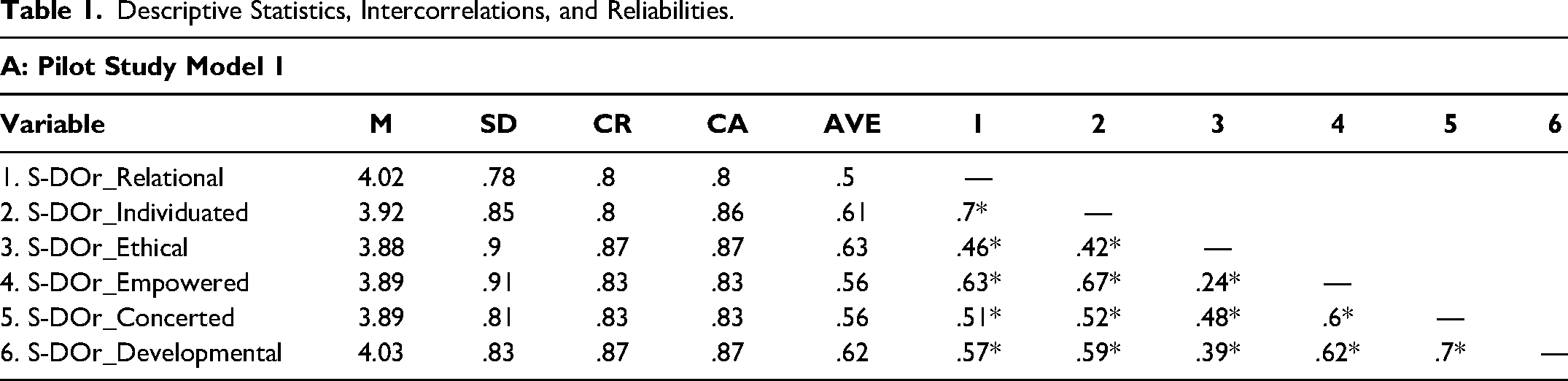
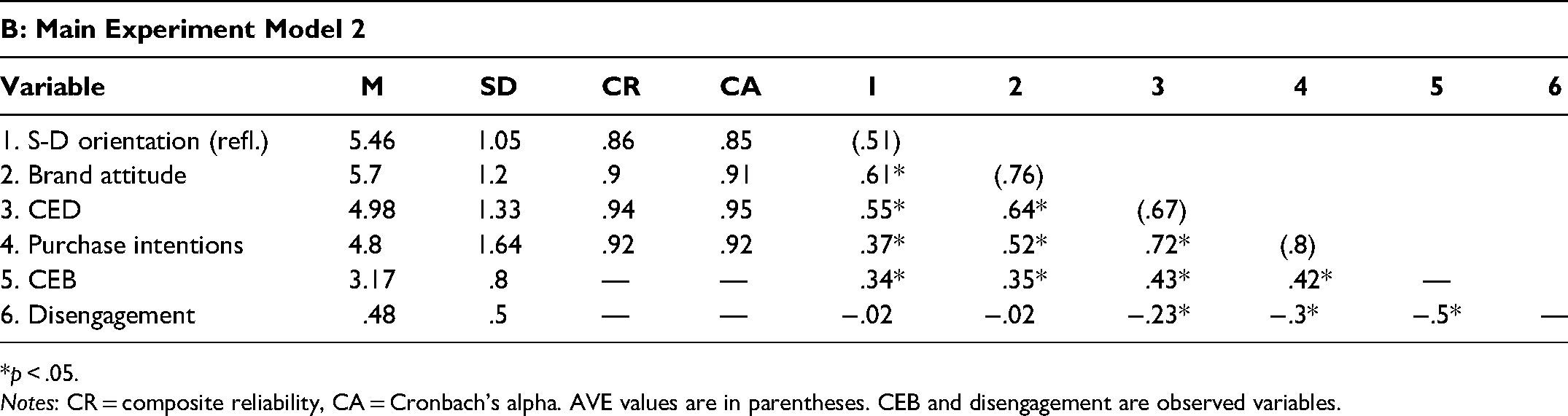
*p < .05.
Notes: CR = composite reliability, CA = Cronbach's alpha. AVE values are in parentheses. CEB and disengagement are observed variables.
CFA Model 2 of the final experiment includes the reflective S-D orientation items (labeled “S-D orientation check” in Web Appendix B, Table W1), as well as brand attitude, CED, and purchase intentions. The CFA results indicate a good model fit (χ2(164) = 534.6, CFI = .95, TLI = .94, RMSEA = .05, SRMR = .05). 8 Web Appendix B, Table W1, contains the standardized loadings of all items. Convergent validity is evident, as all standardized loadings are large and significant. All AVEs are greater than .5, and all CRs and Cronbach's alpha coefficients are above .7, indicating strong reliability. Discriminant validity is also evident, because, for all pairs of constructs, the squared intercorrelation is lower than the AVE of individual constructs (Fornell and Larcker 1981). Panel B of Table 1 presents results for the CFA Model 2.
Experimental Design and Procedure
Experimental Design
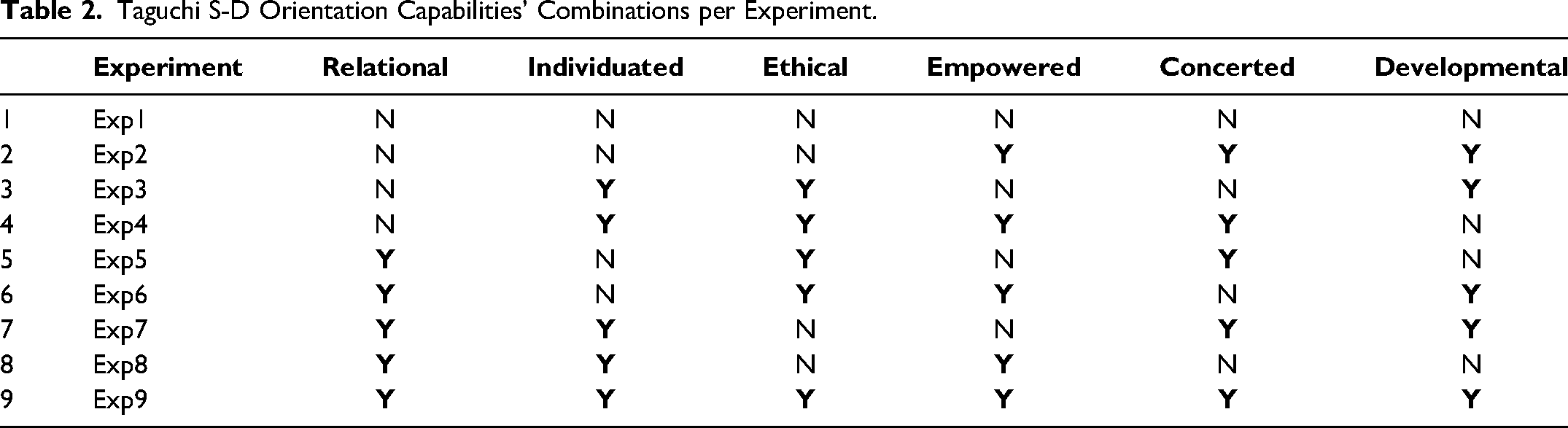
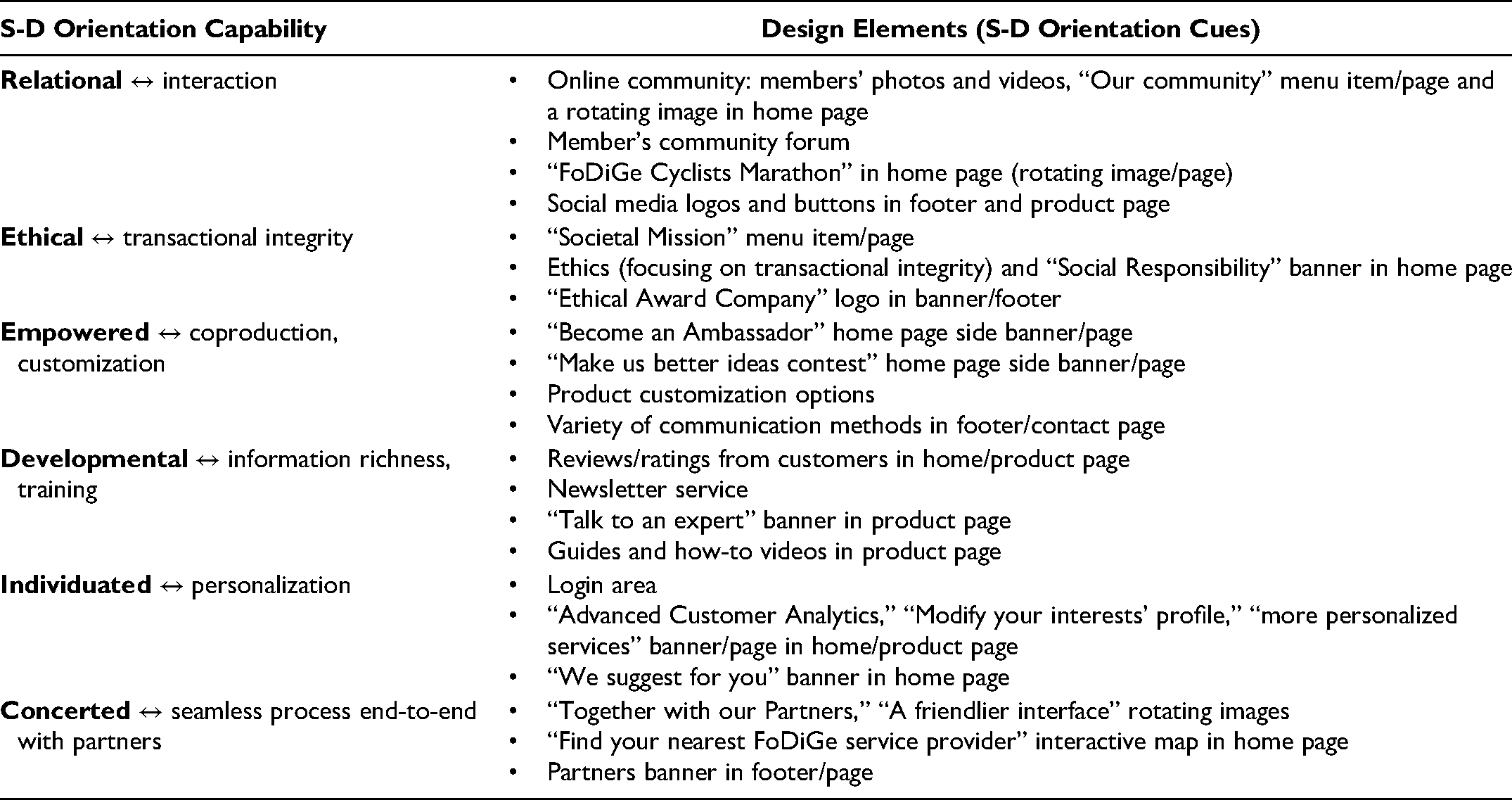
We created (using Joomla! 3.9, with Mysql and Apache) nine different versions of a mock e-commerce website specializing in cycling equipment, with the brand name “FoDiGe.” We paid special attention to maintaining a similar user interface and content quality for all versions. Each version was quasi-functional and consisted of 23–31 web pages in total, to mimic the environment of a real e-commerce website and offer an online user experience as close to real as possible. Moreover, several distinct S-D orientation capabilities’ cues (e.g., banners, a community forum, a newsletter service) were incorporated, as presented in the Appendix. Each website version differed in the combination of the six S-D orientation capabilities’ cues on two levels: present (absent) cues represented a high (low) level of the respective capability. These represent the experiment's manipulation treatments. A full-factorial experimental design, however, would have required 26 = 64 combinations of S-D orientation capabilities, thus 64 different e-shops, resulting in an unmanageable project in terms of availability of resources and complexity. Therefore, we followed Bleier, Harmeling, and Palmatier (2019) and adopted a Taguchi (1986) orthogonal array design, 9 reducing the required number of combinations to eight or more; we specifically used the nine combinations of capabilities presented in Table 2, resulting in nine measurement invariant groups. 10
Taguchi S-D Orientation Capabilities’ Combinations per Experiment.
We also used the Moodle learning management system (version 3.7) to create the initial login and guiding platform for participants. Snapshots from some experimental environments and Moodle pages are available in Web Appendix A.
Face Validity and Experiments’ Validation
To ensure that our nine experimental websites measured what they were actually supposed to, we identified proper organizational practices and respective design cues (e.g., banners) that would successfully represent the respective S-D orientation capabilities. Marcos-Cuevas et al. (2016) argue that practices and capabilities are inextricably linked, conceptualizing capabilities as the integrative foundation on which practices blend into value creation. To ensure face validity and a successful mapping of cues with S-D orientation capabilities for our manipulations, we took three steps.
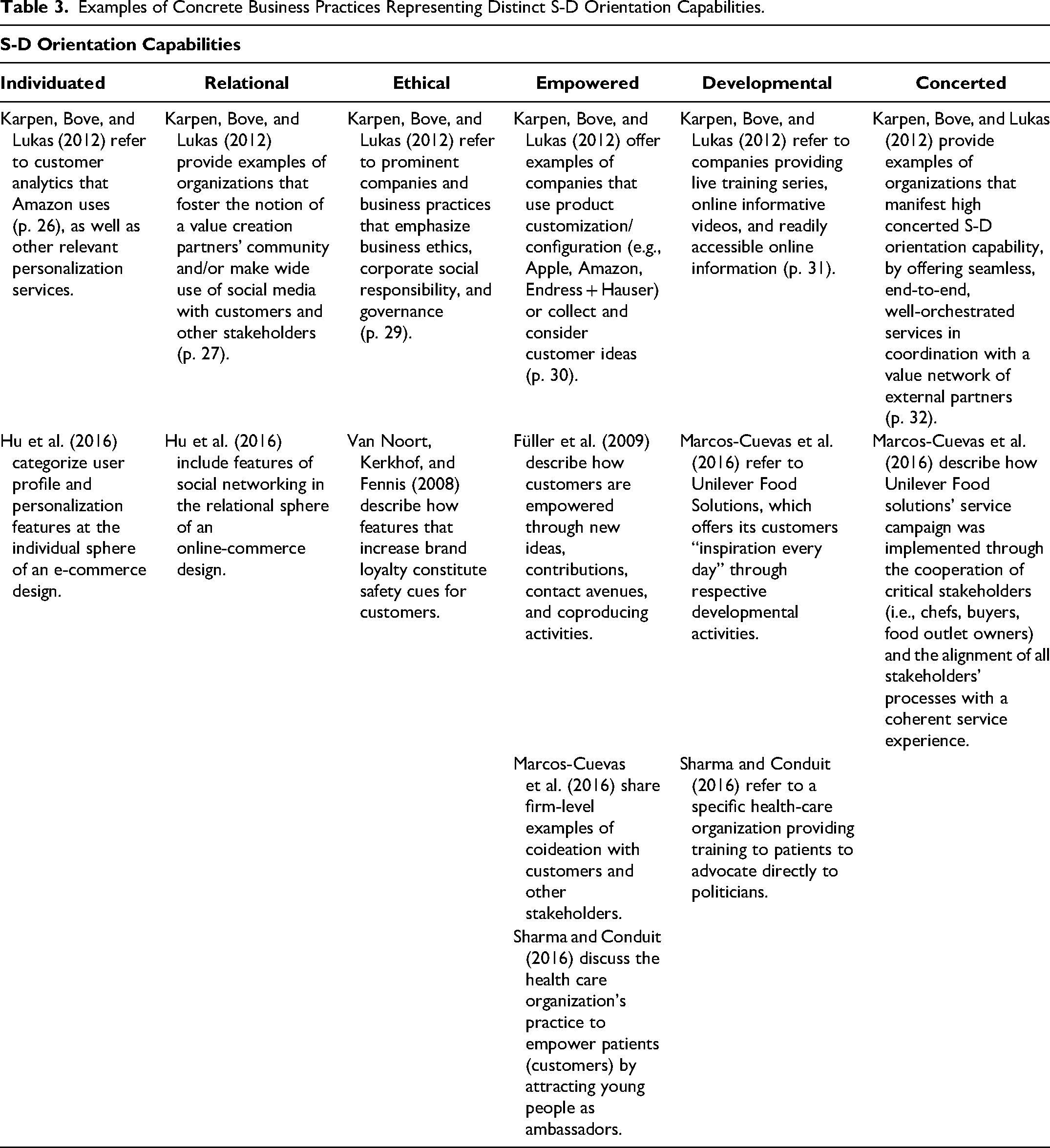
First, we reviewed the relevant literature for examples of how the distinct S-D orientation capabilities are practically expressed in concrete business practices. Karpen, Bove, and Lukas (2012) and others offer several such examples (see Table 3). On the basis of these, we designed several S-D orientation capability cues and subsequently developed the nine experimental platforms. These cues are described in the Appendix and depicted in Web Appendix A. To tackle the issue of overlapping capabilities, we used several cues (3–5) of practices representing a distinct capability, aiming to clearly reinforce its presence against other capabilities that potentially relate to these practices. The absence (presence) of these defining cues means that the firm manifests a low (high) level of the associated capability.
Examples of Concrete Business Practices Representing Distinct S-D Orientation Capabilities.
Second, we organized a panel group of nine academic experts, whose aim was to test the face validity of our experimental design. After introducing them to the concept of S-D orientation, we instructed them to navigate to each of the online experimental websites and to identify the distinct combination of capabilities they believed were prominent in each one. Results revealed satisfactory face validity of our experimental design (Mright = 48.8/54, or 90.37% accuracy of results). The experts also proposed some enhancement amendments, which we subsequently implemented.
Third, we conducted a large-scale pilot study to validate the experimental design prior to the main experiment. In the pilot, potential customers evaluated whether the incorporated defining cues capture the capabilities they are supposed to. We recruited 778 participants from Amazon Mechanical Turk (MTurk) and randomly assigned them to one of the nine experimental platforms. They first navigated to the website for three to four minutes and then filled out a questionnaire consisting of the formative S-D orientation items (shown in Web Appendix B, Table W1). Overall, the presence or absence of S-D orientation capabilities was verified with 93.75% agreement rate. 11
Main Experiment
For the final run of our experimental project, we again recruited U.S. participants from MTurk, on the basis of recent evidence that the use of MTurk for experimental studies on attitudes and/or behaviors produces reliable and sound results (Hulland and Miller 2018). Participants entered the starting web page and were randomly assigned to one of the nine online experimental environments on the basis of a random number–generating process. They were then given clear instructions to implement the following scenario: they wanted to buy a bicycle online and therefore visited the FoDiGe e-shop, which specializes in cycling equipment. They were instructed to navigate to the e-shop for at least three to four minutes in total, especially the “Home” and “Mission” pages. They next visited a particular product web page of a bicycle they wished to buy and were instructed to go through its functionalities and content (Web Appendix A provides snapshots of these web pages). Overall, the scenario simulated an actual user experience in the search for a potential online purchase. Participants finally had to complete a series of successional activities: a quiz of manipulations checks; a reviewing activity that was used to define CEB and disengagement; and a questionnaire consisting of preexisting scales, reality checks, and demographic questions (Web Appendix B, Table W1). Participants replied to questions about their brand attitude, engagement disposition, and purchase intentions, as well as the S-D orientation (reflective scale) of the website versions. In line with Darley and Lim (1993), participants also assessed the realism of the e-shop versions; results confirmed their adequate realism (Mcomposite = 5.59, SD = 1.25). Manipulation checks included simple questions about the presence (absence) of specific cues of the e-shop. We also used time navigation checks, such as an adequate completion time of each distinct activity and an adequate overall experiment completion time, which are automatically recorded by Moodle and MTurk. The final sample of the main experiment consisted of 872 valid participants (53.8% female, 46.2% male; 55.3% were <34 years old, 44.8% were 25–34 years old; 51% had received postsecondary education 12 ) out of 1,237 workers who participated overall. Accepted attempts had adequate navigation time and scored well in the quiz of manipulation checks (Mcomposite = over 75%, SD = 18).
Analysis and Results
Structural Model Estimation
For the analysis, the manipulation treatments of our experiment were represented as follows: in each of the nine experimental website versions, a binary sequence was used to correspond to the six capabilities of the formative S-D orientation construct, where 1 represents a high level and 0 a low level of the respective capability (as presented in Table 2). Following Bleier, Harmeling, and Palmatier (2019), we then combined data derived from the nine experiments into a pooled data set 13 and used structural equation modeling (SEM) for the data analysis. 14 As in the CFA, we used both MLR and ERLS estimators, though when categorical dependent variables exist along with nonnormal continuous variables, MLR is the most appropriate estimator. 15 For consistency among alternative models, we present MLR results and report ERLS results when feasible. A structural equation model ran a complex system of regressions that statistically describe our conceptual model (Figure 1). Our data (questionnaire-based items or behavior-recorded) are interval. Our four-level dependent variable CEB may be treated as either continuous or categorical (Rhemtulla, Brosseau-Liard, and Savalei 2012). As a robustness check, we ran models for continuous-only (CEB treated as continuous) and categorical-included (CEB and disengagement as categorical) data, using MLR and logistic regression in the case of categorical dependent variables. The fit of our model (for continuous-only data) is satisfactory (χ2(417) = 1,194.1, CFI = .93, TLI = .92, RMSEA = .046, SRMR = .053). 16 Note that although the categorical MLR estimator does not produce absolute fit statistics (Sanjoy 2005), Rhemtulla, Brosseau-Liard, and Savalei (2012) prove that models fit equivalently when interval variables are treated as either continuous or categorical.
Table 4 presents the SEM results based on continuous data with continuous CEB included (Model 1), categorical CEB included (Model 2), and categorical CEB and disengagement included (Model 3). The three models are statistical variations of the same conceptual model, differing only in CEB used as categorical or continuous and whether disengagement is included or not, and they present equivalent fitting, according to Rhemtulla, Brosseau-Liard, and Savalei (2012). Furthermore, results in all models are similar in terms of direction and significance. Table 5 presents the results of a further analysis conducted as part of the main experiment, pertaining to the indirect effects of distinct S-D orientation capabilities on both CED and brand attitude through S-D orientation.
Standardized Path Coefficients and Standard Errors for the Structural Model (Direct Effects).
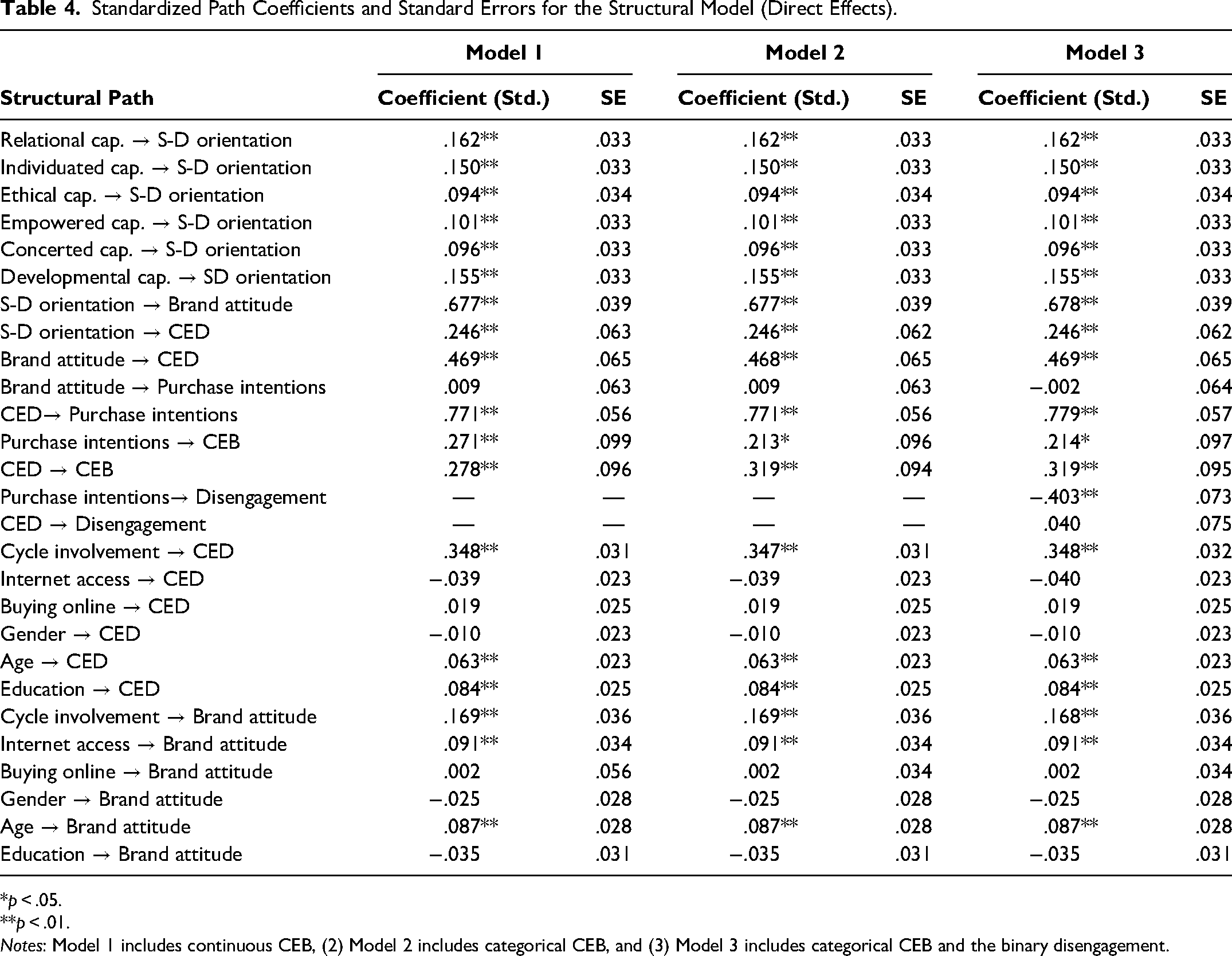
*p < .05. **p < .01.
Notes: Model 1 includes continuous CEB, (2) Model 2 includes categorical CEB, and (3) Model 3 includes categorical CEB and the binary disengagement.
Indirect Effects of Distinct S-D Orientation Capabilities on CED and Brand Attitude.
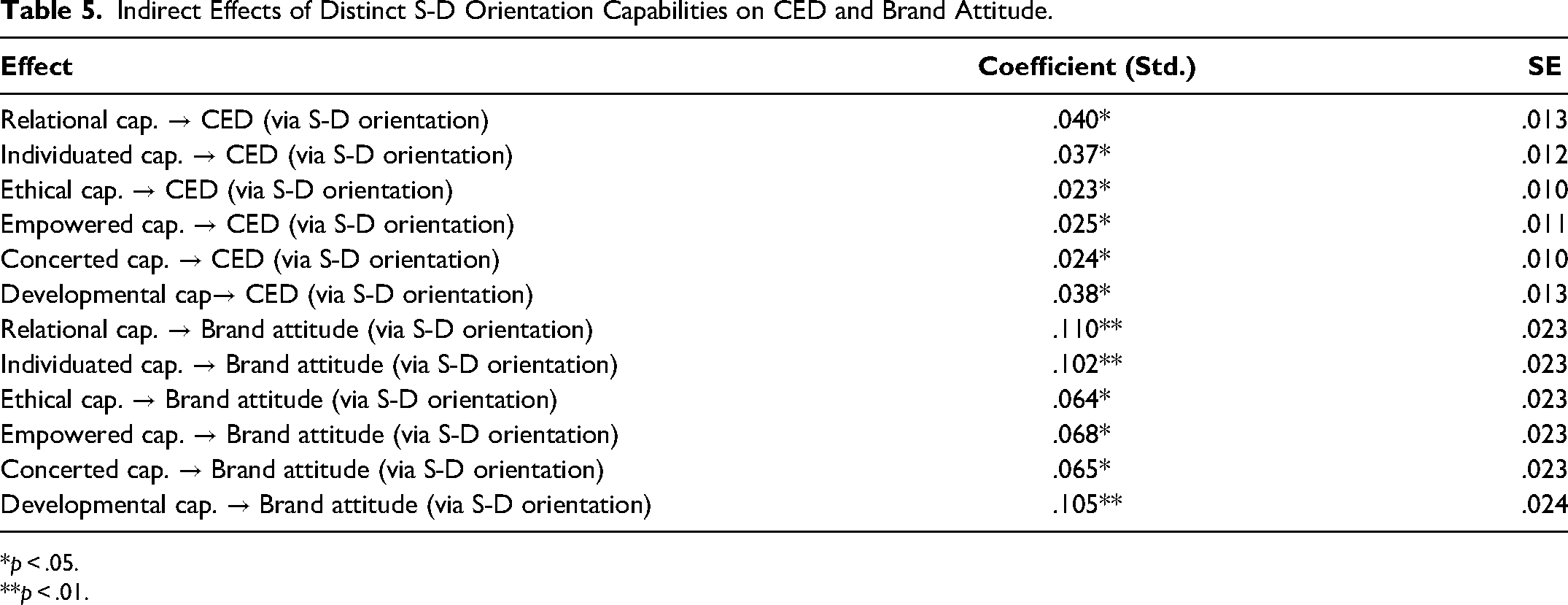
*p < .05. **p < .01.
As Table 4 shows, H1 and H2a regarding the effect of S-D orientation on customers’ brand attitude and engagement disposition respectively are supported (H1: β = .678, t = 17.39; H2a: β = .246, t = 3.94). In support of H2b, we find that brand attitude has a significant positive effect on customers’ engagement disposition (β = .469, t = 7.21) and partially mediates the relationship between an online retailer's S-D orientation and customers’ engagement disposition. 17 Following Eggert and Garnefeld (2009), to measure the magnitude of the indirect effect, we further found the variance accounted for to be .56. This clearly demonstrates the significance of the mediation effect of brand attitude in our model, because 56% of the total effect of S-D orientation on CED is explained through this. Furthermore, in support of H7a and H7b regarding the indirect effects of S-D orientation capabilities (Table 5), all six capabilities have a positive effect on brand attitude through S-D orientation (H7a: βR = .110, tR = 4.74; βEt = .064, tEt = 2.76; βEm = .068, tEm = 3.01; βI = .102, tI = 4.39; βD = .105, tD = 4.35; βC = .065, tC = 2.87); and CED (H7b: βR = .04, tR = 3.05; βEt = .023, tEt = 2.3; βEm = .025, tEm = 2.33; βD = .038, tD = 2.96; βI = .037, tI = 2.95; βC = .024, tC = 2.38). A closer assessment of these results reveals that although all six S-D orientation capabilities have significant direct and indirect effects, relational, developmental, and individuated capabilities have stronger effects compared with ethical, empowered, and concerted capabilities. H3, regarding the positive effect of customers’ engagement disposition on their purchase intentions, is supported (β = .779, t = 13.65). Furthermore, in support of H5, customers’ purchase intentions negatively affect their disengagement behavior (β = −.403, t = −5.54). In addition, customers’ purchase intentions positively affect their actual engagement behavior, in accordance with S-O-R and TRA; thus, H6 is supported (β = .214, t = 2.2). However, the effect of customers’ engagement disposition on their disengagement behavior turns out to be insignificant (β = .04, t = .53), and thus H4 is not supported. This unexpected result requires further investigation. We created three groups of participants: those exhibiting (1) negative engagement behavior (i.e., having provided negative reviews), (2) disengagement behavior (declining to provide reviews), and (3) positive engagement behavior (i.e., having provided positive reviews). We then ran an ANOVA comparing their CED means (F = 65.809, p < .01). Our results indicate that Group 1 has the lowest CED (M = 4.0112), Group 2 the second highest (M = 4.6403), and Group 3 the highest CED (M = 5.4775), and all mean scores are pairwise statistically different (p < .05). Thus, we find that very low CED may actually lead to engagement (albeit negative engagement) and not disengagement, as hypothesized. Medium CED leads to disengagement, and only high CED leads to positive engagement. We elaborate on this new finding in the “Discussion” section. Finally, regarding control variables, customers’ age, prior involvement with cycling, and education positively affect their CED. In addition, customers’ age, prior involvement with cycling, and internet use frequency positively affect their brand attitude.
Alternative Models
In addition to the proposed conceptual model, we ran alternative models for comparison purposes (Web Appendix B, Figure W2; Web Appendix B, Table W2 presents the fit indices of each alternative model, as well as chi-square difference tests). Alt_model 1 is a variation of the basic model, which examines the direct impact of brand attitude on CEB. Alt_model 2 is a partial mediation model where capabilities have a direct effect on brand attitude and CED. Finally, in Alt_model 3, the S-D orientation construct is removed, and the six capabilities have a direct effect on brand attitude and CED. 18 Results reveal that our proposed model has the best fit.
Follow-Up Study
To check the robustness of our model with different CEBs, we ran an additional survey research study in actual e-retailing settings. Using the data collection services provided by Qualtrics, we asked survey participants to recall a recent online experience (visit, or visit with a buy) they had with an existing (“bricks and clicks” or “clicks-only”) online retailer that sells electronics. We used a similar survey instrument as in our experimental research, but participants were further asked whether they had enacted three additional CEBs toward the online retailer, which are considered typical CEBs in online retailing. These are (1) having downloaded the online retailer’s smartphone app, (2) following the online retailer on social media, and (3) providing a personal email and receiving email news/offers by the online retailer. The final sample of the study consisted of 508 U.K. participants reporting their experience with 36 different electronics e-retailers. CFA MLR results of the measurement model indicate a good model fit (χ2(164) = 412.14, CFI = .94, TLI = .93, RMSEA = .055, SRMR = .045), 19 and convergent and discriminant validity is confirmed. Table W1 in Web Appendix B includes standardized loadings for measurement items; Table W3 presents the descriptives, correlations, AVEs, CRs and Cronbach's alpha coefficients.
The fit of our structural model (with SEM MLR for continuous data) is satisfactory (χ2(348) = 780.2, CFI = .92, TLI = .91, RMSEA = .05, SRMR = .05). 20 Table W4 in Web Appendix B presents results with all categorical CEBs included, demonstrating that our conceptual model is largely verified in this additional study. Specifically, the positive effects of S-D orientation on customers’ brand attitude (β = .558, t = 13.23) and CED (β = .569, t = 11.44), brand attitude on CED (β = .3, t = 5.713), CED on purchase intentions (β = .154, t = 2.316), and customers’ brand attitude on purchase intentions (β = .446, t = 5.995) are all supported. In respect to the different CEBs, CED is positively related with CEB-AppDownload (β = .103, t = 1.727), CEB-Following (β = .251, t = 3.639), and CEB-Email (β = .157, t = 2.633). In addition, purchase intentions positively relate to CEB-AppDownload (β = .206, t = 3.392) and CEB-Email (β = .141, t = 2.286). 21 Note that in the follow-up study, we measure behavior as reported by the participants (i.e., not observed behavior). We are also unable to measure disengagement or distinct S-D orientation capabilities’ effects using a survey research setup. Nevertheless, this study complements our experimental study because it demonstrates the appropriateness of the conceptual model in real settings, verifying the effect of a customer's engagement disposition and purchase intentions on a rich variety of typical e-retailing CEBs.
Discussion
The main objective of this study was to investigate the internal mechanism through which CE is stimulated when customers are exposed to an e-retailer's S-D orientation. Findings of both the experimental study and the follow-up study provide strong support for most of the hypothesized relationships. Our results further indicate that an e-retailer's S-D orientation is best represented by a composite of six strategic capabilities. Thus, to truly reap the benefits that S-D orientation has to offer in terms of motivating engagement and increasing performance, a holistic approach is vital for the organization, as suggested by Karpen, Bove, and Lukas (2012). At the same time, however, the S-D orientation strategy should be adapted to the idiosyncrasies of the business context at hand. Different service contexts demand different strategic capability combinations. In online retailing, our study revealed that relational, individuated, and developmental capability practices have a stronger effect on the formation of a firm's S-D orientation, as well as on driving positive customer outcomes. Thus, customers seem to principally value the practices that (1) encourage direct communication with the e-retailer and other customers, (2) provide them with all necessary information to use their offerings successfully, and (3) customize the firm’s offerings according to their individual needs.
We also find that customers’ brand attitude partially mediates the relationship between an online retailer's S-D orientation and customers’ engagement disposition. This indirect effect of brand attitude is significant, illustrating the important role that customers’ formed attitudes play in driving CE in an e-retailing context. Another interesting finding of this study is that customers’ purchase intentions positively affect their actual engagement behavior. Hulland and Houston (2021) call attention to the ongoing debate regarding the relationship between purchase intentions and sales, which is not found to be consistently strong. Our findings contribute to this discussion. Notably, we show that customers who have developed positive purchase intentions toward a brand/offering may not ultimately buy (corroborating Hulland and Houston [2021]), but may contribute to the e-retailer's long-term viability through other constructive engagement behaviors. This is an important finding that contributes further to the nomological network of purchase intentions. Finally, although we find the proposed direct effect of customers’ engagement disposition on their disengagement behavior to be nonsignificant, 22 the additional ANOVA revealed that very low CED may actually lead to engagement, though negative. We find that low CED does not lead to disengagement behavior as hypothesized but, rather, to negative engagement, which explains the nonsignificant H4 result. In other words, customers exhibiting very low CED will engage in negative activities toward the organization. Customers with medium CED will disengage, and only those with high CED will enact positive engagement behaviors.
Managerial Implications
Several implications for managers emerge from this study. Notably, nurturing an integrative S-D orientation culture and investing in respective practices in online retailing is critical to drive a customer's engagement and purchase intentions and, ultimately, firm performance. Applying a wide range of S-D orientation capabilities’ practices can, however, prove quite challenging in practice, as Karpen, Bove, and Lukas (2012) also argue, and may even be unadvisable in terms of a cost–benefit analysis. Our results show that online retailers should still pursue a general S-D orientation strategy; however, they need to invest more in cultivating specific practices related to relational, individuated, and developmental capabilities that are perceived as more important to customers in online retailing, while maintaining an adequate level for all other capabilities. E-retailers should therefore promote social interaction and networking practices among users, such as supporting and sustaining online communities, applying a social media–focused strategy, and organizing online and offline social events (Hu et al. 2016). E-retailers should further focus on fostering personalization by utilizing customer analytics that drive personalized content adjusted to a user’s profile and preferences (Karpen, Bove, and Lukas 2012). Finally, promoting knowledge sharing across their network is vital, such as providing online training and videos, readily accessible online information, and other developmental activities to users (Sharma and Conduit 2016).
Nonetheless, a last but important point for managers is that cultivating an S-D orientation capability that is not typical for the specific industry may constitute a source of differentiation. Managers should therefore identify and develop the core S-D orientation capabilities that are critical for the longevity of their organization, exploring further alternative capabilities that may constitute a competitive advantage if properly developed.
Implications for Researchers
Our work also has important implications for researchers. First, we assist in the further understanding of the cocreation process by shedding light on its mechanism in online retailing. We propose an experimental research design for the investigation of the S-D conceptual narrative, and provide empirical evidence within e-retailing regarding the underresearched relationship of customer (dis)engagement with a firm's S-D orientation strategy. Second, this study verifies that there are six important S-D orientation capabilities that contribute to a firm's prosperity in an online context and may constitute the basis for future research that will further expand our knowledge regarding the development of critical e-retailing capabilities. Third, we emphasize the importance of cues representing distinct organizational strategic capabilities and related practices, especially in online contexts where actors’ physical presence is missing.
Limitations and Future Research
No study comes without limitations; these should be thoroughly discussed and our findings critically interpreted. We cannot claim generalizability of our results. Our conceptual model may actually apply in contexts where firm cues are most important, like online environments. However, our follow-up study indicates that there seems to be a broader application sphere for our model, especially now that most firms maintain both online and physical presences, and physical and/or online cues are important for all firms. Nevertheless, in the cases where contact points are mostly physical, other features become highly important for customers’ perceived service quality, like personal relationships, employee competences, and convenience of the firm's branch network (Gounaris, Stathakopoulos, and Athanassopoulos 2003). In such mixed online/physical environments, our model needs to be extended and tested further. An additional key limitation of this research is that it utilizes an experimental design procedure that cannot imitate the real environment completely, although it can fully represent all S-D orientation capabilities and tackle issues of overlapping capabilities that emerge in real contexts. Nevertheless, customers of actual online brands accumulate some experience over time and form attitudes toward a brand, which cannot be replicated in an experimental study. We attempted to compensate for this through a follow-up study that, however, could not include disengagement. We further acknowledge that the S-D orientation capabilities’ practices we chose to incorporate in our experimental design are not exhaustive, though we tried to include the most representative ones, context-wise. Moreover, choosing MTurk participants for our experiments may be considered a limitation. Finally, although concerns about omitted variable bias are minimized due to the experimental design, the use of SEM does not eliminate concerns about reverse causality (Duncan 1975).
In terms of future research, investigating moderating effects could enhance our conceptual model and provide deeper insights regarding the nature of the relationships examined. 23 Moreover, the execution of similar studies in different empirical contexts will help model the value cocreation mechanism in an all-embracing manner and decipher S-D orientation and its effects holistically. Another interesting avenue would be to examine how a firm's S-D orientation and customers’ engagement may ultimately affect activities other than buying (e.g., customer lifestyles). In addition, the study of the dynamic effect of firms’ S-D orientation on customer loyalty over time is promising, as is considering firms’ relationship with other actors of the ecosystem, such as suppliers, intermediaries, and other critical stakeholders. Finally, the literature would certainly benefit from a concept refinement study and measurement instrument development of CE specifically for online retailing.
Supplemental Material
sj-pdf-1-jnm-10.1177_10949968231180497 - Supplemental material for The Role of Service-Dominant Logic Strategic Orientations in Driving Customer Engagement in Online Retailing
Supplemental material, sj-pdf-1-jnm-10.1177_10949968231180497 for The Role of Service-Dominant Logic Strategic Orientations in Driving Customer Engagement in Online Retailing by Georgia D. Katsifaraki and Marios Theodosiou in Journal of Interactive Marketing
Footnotes
Appendix: S-D Orientation Cues: Design Elements Associated with Specific S-D Orientation Capabilities.
|
|
|
|---|---|
|
Online community: members’ photos and videos, “Our community” menu item/page and a rotating image in home page Member's community forum “FoDiGe Cyclists Marathon” in home page (rotating image/page) Social media logos and buttons in footer and product page |
|
|
“Societal Mission” menu item/page Ethics (focusing on transactional integrity) and “Social Responsibility” banner in home page “Ethical Award Company” logo in banner/footer |
|
|
“Become an Ambassador” home page side banner/page “Make us better ideas contest” home page side banner/page Product customization options Variety of communication methods in footer/contact page |
|
|
Reviews/ratings from customers in home/product page Newsletter service “Talk to an expert” banner in product page Guides and how-to videos in product page |
|
|
Login area “Advanced Customer Analytics,” “Modify your interests’ profile,” “more personalized services” banner/page in home/product page “We suggest for you” banner in home page |
|
|
“Together with our Partners,” “A friendlier interface” rotating images “Find your nearest FoDiGe service provider” interactive map in home page Partners banner in footer/page |
Acknowledgments
The authors thank the JNM review team for their insightful comments and constructive suggestions.
Authors Contributions
Georgia D. Katsifaraki conducted this work as a doctoral candidate of the Department of Business and Public Administration, University of Cyprus.
Editor
Arvind Rangaswamy
Declaration of Conflicting Interests
The author(s) declared no potential conflicts of interest with respect to the research, authorship, and/or publication of this article.
Funding
The author(s) received no financial support for the research, authorship, and/or publication of this article.
Notes
References
Supplementary Material
Please find the following supplemental material available below.
For Open Access articles published under a Creative Commons License, all supplemental material carries the same license as the article it is associated with.
For non-Open Access articles published, all supplemental material carries a non-exclusive license, and permission requests for re-use of supplemental material or any part of supplemental material shall be sent directly to the copyright owner as specified in the copyright notice associated with the article.
