



Abstract
During the COVID-19 pandemic, older consumers have increased their usage of social networking services (SNSs) to avoid social isolation, yet this behavior remains unexplored. Through selective optimization with compensation theory, the authors combine concepts from gerontology and marketing to investigate the following research question: How does older consumers’ usage of SNSs during the pandemic interrelate with the constructs of social well-being? The research draws on qualitative data collated during lockdown in the United Kingdom, including 14 semistructured interviews from participants age 65–80 and six months of netnographic data from an online forum geared toward older people. The findings reveal how older consumers leverage three strategies—selection, optimization, and compensation—to improve their use of SNSs and social interactions during lockdowns. Such behaviors in turn interrelate with the dimensions of social well-being: social acceptance, social integration, social contribution, social actualization, and social coherence. This research contributes to the marketing literature by (1) introducing a framework for transformative SNSs into transformative service research, (2) utilizing theory from gerontology studies to further understand the older consumer, and (3) enhancing the sparse understanding of older consumers’ use of SNSs. Future research directions and managerial implication are suggested for both marketers and developers of SNSs for aging consumers.
In March 2020, the World Health Organization announced that the spread of COVID-19 had become a global pandemic (World Health Organization 2020). Many governments across the world set about instigating regulations to reduce the spread and devastation of the disease. As a result, by April 2020, over 100 countries were in either national or local lockdowns, impacting billions of people globally (Dunford et al. 2020). As expected, having the resources to interact both economically and socially through digital technology became imperative as retail, essential services, and communication with friends and family were essentially limited to online environments, resulting in a surge of digital technology usage and consumption of online services such as social networking services (SNSs; Office for National Statistics 2020; Pandey and Pal 2020). SNSs are defined as “web-based services that allow individuals to connect with each other” (Langaro, Rita, and de Fátima Salgueiro 2018, p. 147), which includes social media-based applications and websites encouraging users to create, circulate, and annotate content (Kozinets 2019).
Issues arose, however, as consumers with different levels of digital experience, cultures, financial situations, and health statuses faced challenges regarding their accessibility to digital technology. In particular, older consumers (defined here as those over age 55) are traditionally assumed to be laggards or nonadopters of technology, with 3.7 of the 4 million people who had never used the internet as of 2019 in the United Kingdom in that age bracket (Office for National Statistics 2019). During the pandemic, however, internet usage frequency increased, and by 2020, 60% of people age 65–74 in the United Kingdom possessed a social media profile (AgeUK 2021). Subsequently, the most popular SNSs for consumers age 55 and older are Facebook (72%), WhatsApp (63%), and YouTube (52%) (AudienceProject 2020). Not only are older consumers increasingly using mainstream social media platforms, but they are also engaging with SNSs that directly target their age group, resulting in an influx of platforms such as Silversurfers (https://www.silversurfers.com), Fifty Plus Forum (https://fiftyplusforum.co.uk), Olderiswiser (https://www.olderiswiser.com), and Gransnet (https://gransnet.com/). Even with such an influx of new users, however, limited understanding exists regarding how older adults have reacted to this online transition, and how such increased technology affects their well-being, especially when using nuanced services such as SNSs.
This research adopts a transformative service research (TSR) perspective to address the following research question: How does older consumers’ usage of SNSs during the pandemic interrelate with the constructs of social well-being? Thus, it seeks to solve practical issues pertaining to the development and marketing of mainstream and directed SNS, to consider and enhance the well-being of older consumers (Anderson et al. 2013; Anderson and Ostrom 2015). We use a two-phased qualitative approach involving 14 interviews and a six-month netnography. The research combines knowledge from the field of gerontology with TSR literature by using the theory of selective optimization with compensation (SOC), originally coined by Baltes and Baltes (1990), as a lens to understand how older consumers use SNSs to improve their social well-being.
The research makes three important contributions to the extant literature on older consumers’ experiences with SNSs. The first contribution is to the area of TSR, as we explore how use of SNSs by aging consumers interrelates with social well-being, in order to create an understanding of transformative internet services for this age group. Moreover, social well-being is a welfare-based construct that is currently underused in services marketing, especially within the context of SNS use by older consumers (Keyes 1998). The study focuses on social well-being, as it has previously been found that customer-to-customer interactions within the hospitality industry positively influence the social well-being of older consumers (Altinay et al. 2019). In light of the social isolation caused by the COVID-19 pandemic lockdowns, it is imperative to explore whether the same is true for customer-to-customer interactions in internet services.
Second, we contribute to the literature on aging consumers. The majority of theories and frameworks within interactive marketing (e.g., technology acceptance model) are developed on the basis of empirical data from younger consumers, without recognizing the changes that occur when we age. We therefore use SOC as a theoretical lens to explain, within the context of SNS consumption, how individuals respond to the challenges of aging by altering their life goals and aspirations (Baltes and Baltes 1990). It is a flexible theory that has been applied to a variety of contexts, including social interactions (e.g., Rohr and Lang 2009), but it is underutilized within the marketing field.
Third, we add to the understanding of older consumers’ SNS usage, a topic that has not received in-depth treatment within the marketing field. In addition to contributing to the academic literature, we also discuss practical implications for marketers, developers, and designers of SNSs, both when these networks are aimed primarily at older adults and when they are produced for audiences with broader demographics. Thus, we answer recent calls for enhancing marketing-based knowledge on aging consumers’ lived experiences of technology usage (Lee and Coughlin 2015; Nunan and Di Domenico 2019; Wilson-Nash and Tinson 2021) and the influence of specific consumer behaviors on older people’s well-being (Moschis 2012).
To achieve these objectives, the remainder of the article is arranged as follows. First, we review the literature on older consumers of SNSs within the marketing field, marketing conceptualizations of well-being, and the theory of SOC. Second, we discuss the data collection and analysis methods before presenting the findings and theoretical framework. Finally, we conclude with a discussion of the theoretical and managerial implications of the findings, and how these relate to the respective contributions.
Conceptual Background
Older Consumers of Social Media
Despite the increase in usage of SNSs by older consumers, little research addresses this topic, especially within marketing; in fact, our research review yielded only nine articles on this topic within the marketing literature. Table 1 unpacks key dimensions of these studies, such as the research topics and context, utilized theories, methodologies, key metrics, and findings. The topics of these studies vary, including how older consumers use SNSs in general (Bae et al. 2021; Su and Tong 2021), their smartphone usage (Busch et al. 2021), and how they access branded social media platforms (e.g., Facebook; Jung and Sundar 2016; Kim and Shen 2020). Furthermore, consumers in the extant research represent cultures from countries in Europe, Asia, and North America (Busch et al. 2021; Khoo and Yang 2020; Su and Tong 2021). In addition, the research explores multiple explicit reasons for using SNSs, such as processing information and misinformation (Choudrie et al. 2021), sharing photos (Pera, Quinton, and Baima 2020), and finding health-related information (Parida, Mostaghel, and Oghazi 2016). Thus, there is a need for further marketing research that explores the holistic usage of SNSs by older consumers.
Review of the Marketing Literature on Older Consumers of SNS.
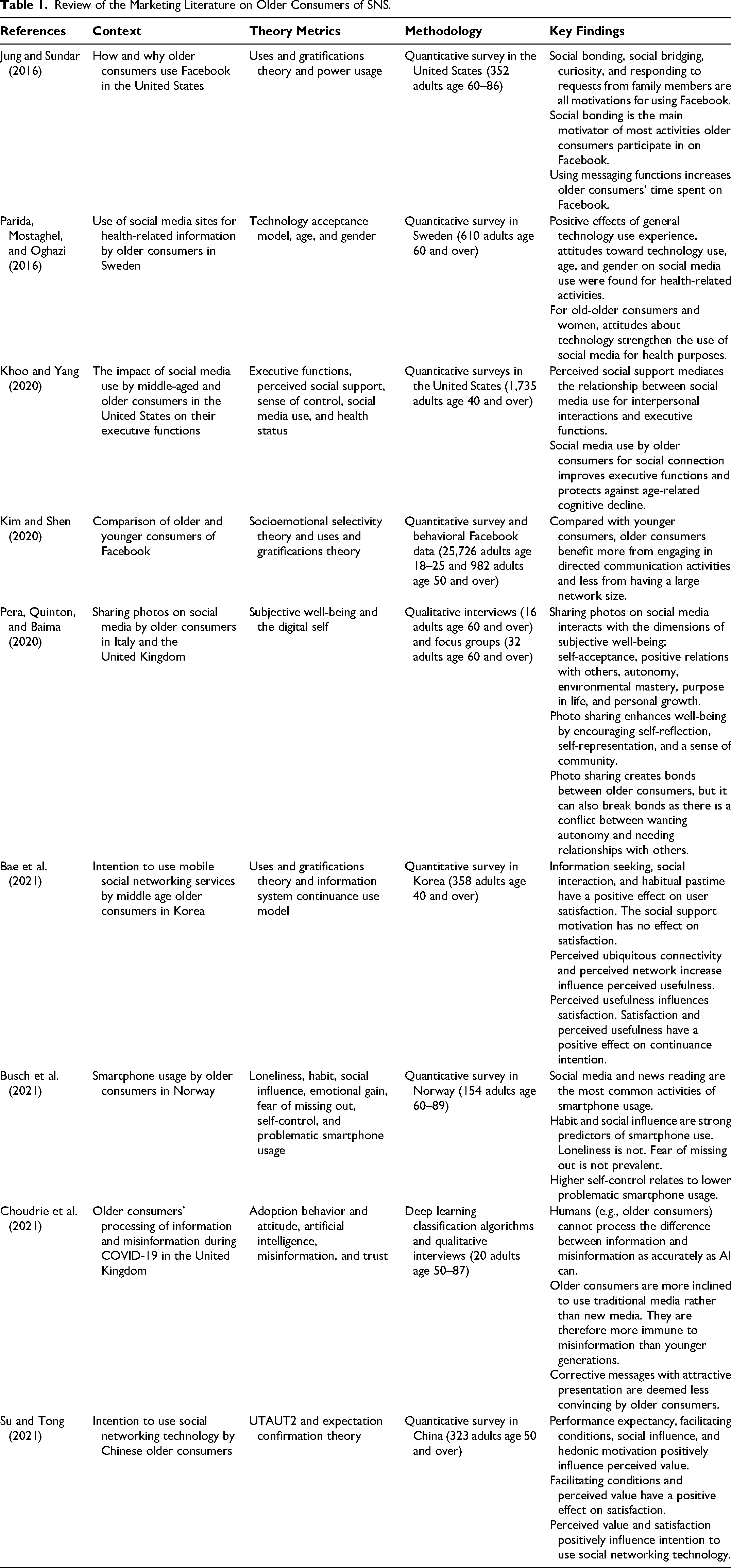
Importantly, the studies also vary widely with respect to theories leveraged or generated. For example, uses and gratifications theory is employed to understand SNS usage, whereas the technology acceptance model and the extended unified theory of acceptance and use of technology (UTAUT2) are utilized to capture intention to use SNSs (Bae et al. 2021; Jung and Sundar 2016; Parida, Mostaghel, and Oghazi 2016; Su and Tong 2021). The primary focus from the extant literature is therefore on what variables influence the intention to use or actual usage of SNSs. The issue with this approach is the intention to develop recommendations encouraging social media usage by older consumers, without fully understanding the impact of SNSs on their welfare. Only a handful of studies explore older consumers of SNSs in relation to health, functioning, well-being, and security (Choudrie et al. 2021; Khoo and Yang 2020; Parida, Mostaghel, and Oghazi 2016; Pera, Quinton, and Baima 2020). For example, sharing images on social media enhances the well-being of older consumers by encouraging self-reflection, self-representation, and a sense of community (Pera, Quinton, and Baima 2020). The present research builds on this work to explore the influence of SNS usage on older consumers’ well-being, during a time when people's well-being was continuously being challenged.
A running theme throughout the literature is investigating how social connectedness influences older consumers’ propensity to use SNSs. Measures such as social interaction, social influence, social bonding, and social bridging have a positive effect on older consumers’ satisfaction with, perceived value of, and level of social media usage (Bae et al. 2021; Busch et al. 2021; Jung and Sundar 2016; Su and Tong 2021). Kim and Shen (2020) reveal that compared with younger adults, older consumers benefit more from engaging in direct communication activities and less from attempting to develop a large network. These directed communication activities can improve executive functions and protect against age-related cognitive decline, especially when friends and family provide social support (Khoo and Yang 2020). Interestingly, Pera, Quinton, and Baima (2020) indicate the complexity of social connectedness by revealing that sharing images creates and breaks bonds between older consumers, as there is a conflict between needing relationships but striving for autonomy.
Extant research on aging consumers’ SNS usage (see Table 1) has primarily taken a quantitative survey-based approach, measuring the usage of or intention to use SNSs (Bae et al. 2021; Busch et al. 2021; Jung and Sundar 2016; Khoo and Yang 2020; Kim and Shen 2020; Parida, Mostaghel, and Oghazi 2016; Su and Tong 2021). Only a few studies use a qualitative data collection process with interviews and focus groups to explore older people’s consumption of social media in depth (Choudrie et al. 2021; Pera, Quinton, and Baima 2020). For instance, Pera, Quinton, and Baima (2020) explore how sharing photos on social media influences the subjective well-being and digital self of older consumers. A study by Choudrie et al. (2021) is the only investigation of older consumers’ SNS engagement during the COVID-19 pandemic. Their qualitative study investigates how aging consumers process information and misinformation compared with artificial intelligence (AI) technology. The present research builds on this qualitative in-depth understanding by taking a holistic approach and exploring the overarching SNS usage of older consumers during periods of lockdown, and the influence of this behavior on their well-being. As being in lockdown during a pandemic is a new experience for most, there is a need for in-depth exploratory research on this topic.
Marketing Conceptualizations of Well-Being
Consumer well-being is understood as how content a person feels with their possessions, services, acquisition of goods, retail establishments in the community, and ability to repair and dispose of goods (Day 1978, 1987; Lee et al. 2002; Leelanuithanit, Day, and Walters 1991; Sirgy and Lee 2008). This material-based definition determines how products and services influence consumers’ satisfaction and consequent happiness. Since the emergence of transformative consumer research and subsequently TSR, which both strive to positively influence the welfare of consumers, the marketing discipline has begun developing new approaches to understanding well-being (Anderson et al. 2013; Mick 2006). The most widely utilized constructs are hedonic well-being, which consists of pleasure and enjoyment, and eudaimonic well-being, in which individuals realize the potential or significance of life (Tikkanen 2020).
From a TSR perspective, and within the context of older consumers’ use of internet-based services, some studies combine measures of both hedonic and eudaimonic well-being. For instance, Bianchi (2021) investigates how using internet services can influence these components in a study of older consumers and develops five dimensions: social connectedness, personal growth, enjoyment, autonomy, and mastery. Several studies focus primarily on eudaimonic well-being, using either Ryff's (1989) construct of psychological well-being or Keyes’s (1998) theory of social well-being, which is the self-evaluation of one's situation and functioning within society. Scholars have leveraged psychological well-being, which Ryff dimensionalizes as including self-acceptance, relationships, autonomy, environmental mastery, purpose in life, and personal growth, to explore older consumers’ photo sharing on social media (Pera, Quinton, and Baima 2020) and use of SNS (Kim and Shen 2020). Tikkanen (2020) seems to be the sole researcher to use social well-being, combining both psychological well-being and social well-being to explore the influence of self-tracking services (e.g., wearables) on consumer welfare.
Social well-being is valuable in exploring the influence of social media on consumer well-being. For example, Chou, Leo, and Chen (2021) demonstrate that two dimensions—social integration and social contribution—enhance the propensity of both customers and moderators to offer help in virtual communities. Furthermore, researchers have successfully investigated the social well-being of consumers in customer-to-customer contexts involving older people (Meneses Fernández et al. 2017). For instance, for older consumers of commercial senior living services, interactions with employees, peers, and outsiders are essential to achieve social well-being (Feng et al. 2019). Similarly, social interactions between older consumers within the hospitality industry have a direct influence on social well-being and satisfaction (Altinay et al. 2019). To the authors’ knowledge, however, Keyes’s (1998) theoretical construct of social well-being is yet to be applied to a combination of these contexts, amalgamating customer-to-customer interaction between older people with the examination of SNS usage as a consumption behavior.
Selection, Optimization, and Compensation
Within the discipline of gerontology, Baltes and Baltes (1990) describe the SOC process. It is a model of successful aging that focuses on how individuals maximize gains and reduce losses in response to everyday challenges and the changes associated with aging (e.g., experiencing vulnerability, reduced adaptability to environmental changes, and reduced reserve capacity). The model is therefore useful for aging individuals who are managing changes to their functioning and environment, as they can use their strengths and abilities (e.g., wisdom and perspective; Wilson-Nash and Tinson 2021) to adjust their goals. It is a flexible process that accounts for the heterogeneity and many trajectories of aging, within a multitude of contexts. For instance, Rohr and Lang (2009) implement SOC to answer the question of how older people adopt the valuable influence of social relationships to face the challenges and demands of life.
The key components of the SOC theory are as follows. Within a social context, “selection” indicates how older people choose their preferred situation, on the basis of opportunities within their social settings. In other words, aging individuals preserve resources and reserves and strive for more meaningful relationships by regulating contact with certain salient people and social groups (Rohr and Lang 2009). In addition, “optimization” refers to older people maintaining or augmenting their social contexts, which involves spending their time, energy, and resources on improving relationships with existing contacts or on building new relationships (Kamin, Lang, and Kamber 2017). These interactions in turn help improve the cognitive, mental, and physical functioning of the aging individual (Rohr and Lang 2009). Finally, “compensation” refers to how older people adjust to losses and burdens, such as conflicts, social isolation, loneliness, loss of a loved one, and health deterioration. Often, these situations can lead to the purchasing and usage of technology; alternatively, technology also can encourage compensation. Kamin, Lang, and Kamber (2017) suggest that technology within a social context can be useful for aiding successful aging through SOC; however, there is currently little empirical literature applying Baltes and Baltes’s (1990) theoretical model to this context.
Combining theoretical approaches and empirical findings from both the gerontology and marketing disciplines has been essential in consumer studies to reevaluate concepts such as cognitive age (Mathur et al. 2017), explore preventative health care behaviors (Mathur et al. 2020), and understand older consumers’ experience of vulnerability (Moschis, Mosteller, and Fatt 2011). More specifically, the concept of successful aging that originates in gerontology has been—and should continue to be—applied to the study of older consumers’ experiences in market- and servicescapes (LaBarge and Pyle 2020; Plaud and Guillemot 2015). For example, LaBarge and Pyle (2020) develop a framework that combines the marketing knowledge of vulnerable consumers with the theory of successful aging. They discover that older consumers perceive aging to be an evolution rather than a decline, and that older consumers can accept and adapt to situations they cannot change. In addition, older consumers are heterogeneous, with a plethora of lived experiences. Blanket applications of purely marketing-based approaches (e.g., categorizing the entire community as “vulnerable”) results in oversimplifications and limited knowledge gain with respect to how older people engage with the marketplace and influence their well-being (LaBarge and Pyle 2020).
There is consequently scope to combine gerontology concepts with knowledge from the marketing discipline to make meaningful knowledge gains with respect to the experiences of older consumers. Thus, taking a TSR stance, we leverage the theory of SOC as a lens to explore how older consumers used SNSs to influence their social well-being during the COVID-19 pandemic (see Figure 1). Within the extant marketing literature, the theory has only previously been applied to older consumers’ selection and usage of brands (Sikkel 2013), and not to their use and adoption of services, including SNSs. We therefore explore (1) how older consumers implemented SOC when consuming SNSs during the COVID-19 pandemic, (2) how this SNS consumption impacts the SOC of social contacts, and (3) how the SOC of SNSs and social contacts interrelates with the constructs of social well-being.
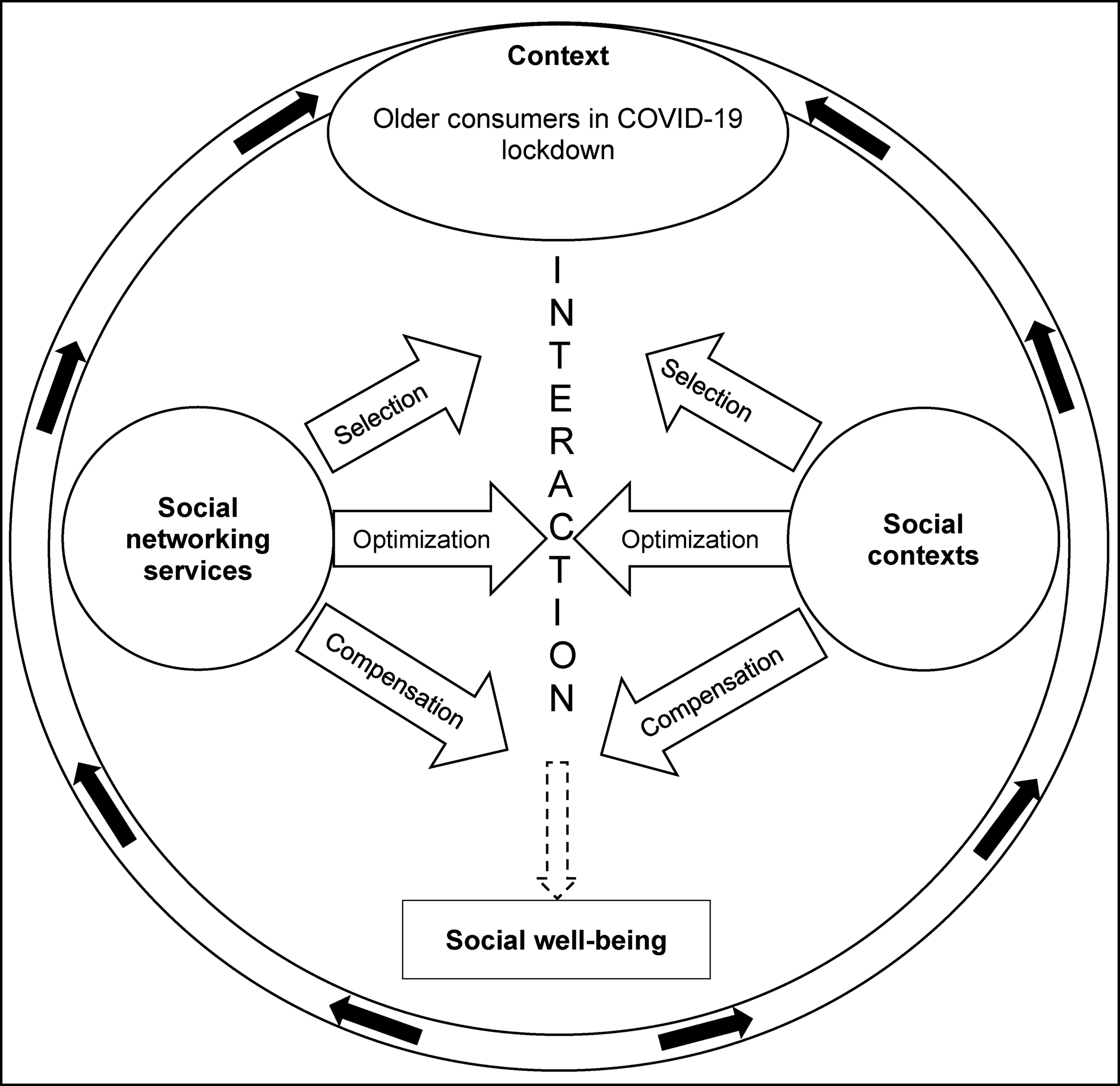
Proposed Framework for Aging Consumers’ Interactions with SNSs.
Methodology
We believe our research aims require in-depth exploration of older consumers’ lived experiences on SNSs because this study explores an underresearched topic in a novel context (i.e., the COVID-19 pandemic). We collected primary data in two phases. In the first phase, semistructured, in-depth interviews were conducted via online video conferencing software to explore consumption of mainstream SNSs by aging consumers. The second phase involved an observational netnographic study of a public forum directed at older consumers, which hosted an online community.
Phase 1: Semistructured Interviews
Semistructured, in-depth interviews offer reasonable freedom for research participants to recount their experiences and voice their thoughts, emotions, and reflections while adhering to the objectives of a study, thus enabling a comprehensive analysis and understanding of the meaning behind a phenomenon (Brinkmann and Kvale 2018; Roulston and Choi 2018). Previous studies on older consumers have often used this method for analogous reasons (Rosenthal, Cardoso, and Abdalla 2021; Westberg, Reid, and Kopanidis 2020). Online video conferencing is now an established alternative to in-person interviews (Edwards and Holland 2013; Hanna 2012), and we used this technique to minimize health risks while complying with regulations in force during the COVID-19 pandemic.
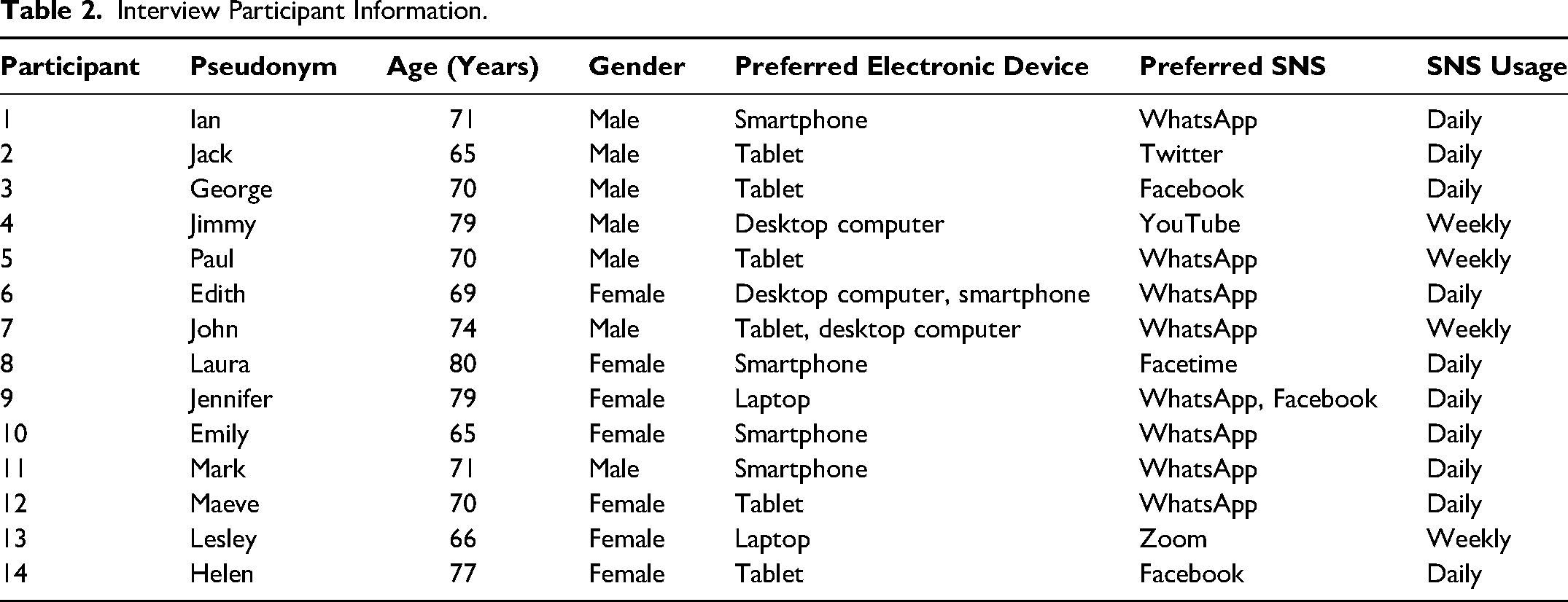
Following purposive and snowball sampling, we recruited consumers age 65 and over who had been residents in the United Kingdom for at least 20 years, owned at least one electronic device (e.g., smartphone, tablet, computer, laptop), and had previous social media usage experience. We approached potential informants through SNS channels, such as Facebook, and more traditional channels, such as emails. Participants who agreed to be interviewed were asked to invite their friends, acquaintances, or relatives. Overall, we recruited 14 participants for online video calls, which lasted between 45 and 75 minutes. Interviews with 14 participants were sufficient to address the research question, as the interviews were supplemented by the observational data collated in the second phase. Table 2 contains participant profiles of the interviewees.
Interview Participant Information.
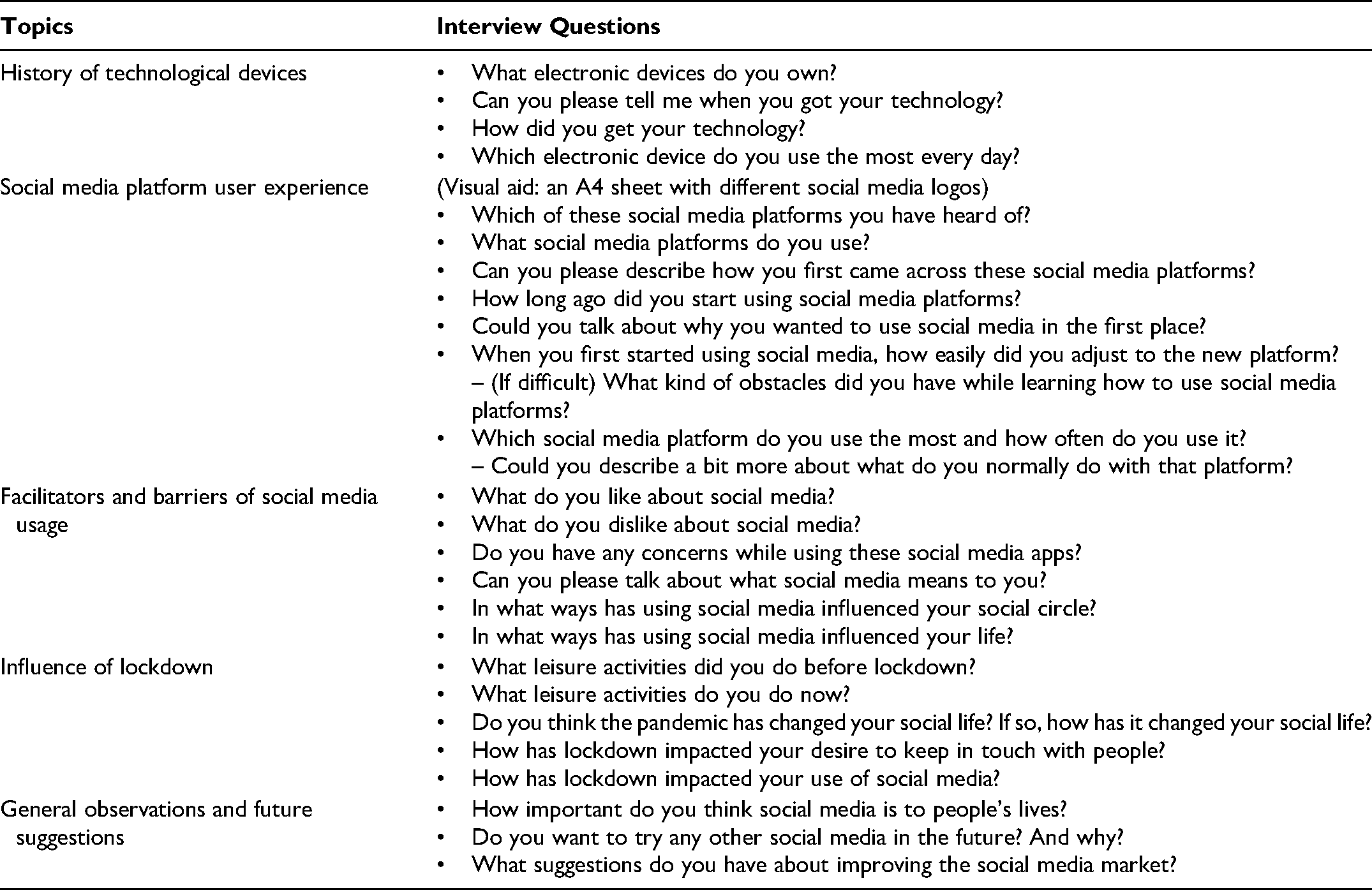
We based our conversations on a semistructured interview guide (see Appendix) with set questions, while allowing participants to follow diverse paths within given topics (Brinkmann and Kvale 2018). We encouraged participants to elaborate on key issues through probing questions and prompting when necessary. Each interview began with questions regarding the general use of digital devices. Questions were then focused on the use of social media, use of specific platforms, frequency and ways of engagement, perceived ease of use, and obstacles faced, as well as online social interactions during the pandemic. Interviewees were then asked to reflect on the impact of such experiences in their lives and to raise possible concerns about their SNS usage. We concluded the interviews by asking the participants to make predictions about their social media engagement in the future and to provide suggestions for how designers might enhance the preferred platforms our informants had discussed.
Phase 2: Covert Netnography
Netnography is a method that encompasses traditional ethnographic research practices while continually adapting to the current digital landscape (Kozinets 2019). As it involves gathering data from naturally occurring online conversations, it is a valuable tool for understanding consumers and gaining insights regarding their experiences on SNSs (Waqas, Salleh, and Hamzah 2021). In our study, netnography took the form of nonparticipant observation, in which we downloaded archived data without engaging with the informants (Lee and Broderick 2007; Xun and Reynolds 2010). A covert, versus overt, netnography was deemed more appropriate in studies of consumers during vulnerable times (e.g., a pandemic; Fletcher-Brown et al. 2021; Parkinson et al. 2017).
Following Kozinets’s (2019) criteria of selecting online research sites that are relevant, active, interactive, diverse, and rich, we selected an online forum involving frequent customer-to-customer interactions between older consumers on various topics, many of which were relevant to our research questions. The forum is accessible to the public, and members’ anonymity is assured by their use of nicknames. Of the 52 topics in the forum, we chose to scrape the posts from 11 topics due to their clear relevance to the research. Discussions ranged from technology to culture, arts, entertainment, and recreational activities, with reference to social media on several occasions. By using NCapture (an NVivo scraping tool) we downloaded 622 archived threads and 42,318 posts, dated between September 2020 and March 2021. From the downloaded data, we retained 346 threads and 21,895 posts for analysis, on the basis of their potential to inform the findings. The forum name was anonymized, usernames were given synonyms, and all reported data were paraphrased to avoid being reverse-searchable and revealing the identity of participants.
Data Analysis
We anonymized all interview transcripts and netnographic data and imported it to NVivo for analysis. Following a reflexive thematic analysis procedure (Braun and Clarke 2021), two researchers created preliminary codes. Braun and Clarke (2021) suggest that if researchers notice strong connections between the data and theoretical concepts early in the coding process, they can commence coding by leveraging a theoretical lens. In the preliminary coding process, it was evident that codes emerging from the data were aligning with Baltes and Baltes’s (1990) SOC theory and that participants were demonstrating an influence of SNSs on social well-being (Keyes 1998). The data analysis therefore transformed into a hybrid approach of inductive and deductive thematic analysis (Fereday and Muir-Cochrane 2006), used previously to position SOC as a theoretical lens to understand older people's well-being (e.g., Joly-Burra, Gallerne, et al. 2020; Joly-Burra, Van der Linden, and Ghisletta 2020; Nimrod 2020). Following recommendations from Braun and Clarke (2021), we continued the coding process from a curious, opening, and questioning position. Instead of merely identifying the theory, we also intended to explore how SOC (Baltes and Baltes 1990) was evidenced in the data.
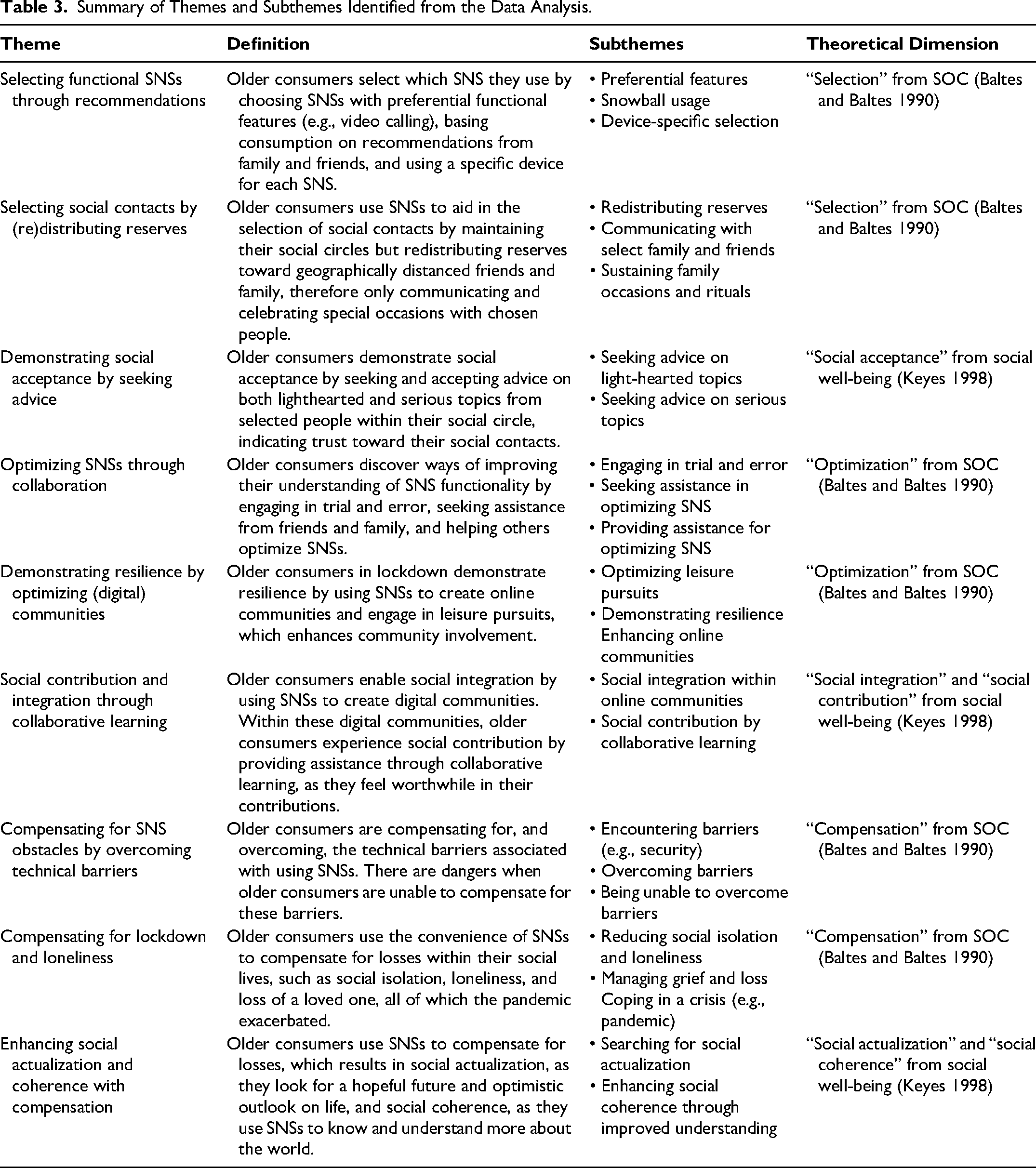
Following Braun and Clarke's (2021) well-articulated coding procedure, we developed 307 preliminary codes, which were categorized into nine clearly defined themes and 25 subthemes through a comprehensive and iterative coding process. We used tools such as memos and mind maps to ensure that the themes were representative of the data, and there was evidentiary support for a clear narrative relating to the theoretical concepts. We relied on a third researcher, who had not coded the data, to cross-check the coding and themes for reliability, sense, and relation to theory. Table 3 summarizes the key themes and subthemes and indicates how they relate to the dimensions of SOC and social well-being (Baltes and Baltes 1990; Keyes 1998).
Summary of Themes and Subthemes Identified from the Data Analysis.
Findings
In analyzing the data, a framework of transformative SNSs for the aging consumer emerged (see Figure 2). It uses SOC (Baltes and Baltes 1990) as a theoretical lens to explain the interaction of older people’s SNS consumption on their social contexts, and the influence of this interaction on social well-being. The following analysis presents the findings from the nine primary themes and how they relate to the dimensions of SOC, as indicated in Table 3. The themes provide a holistic perspective of SNS usage during the pandemic, presenting broader themes than have been presented in prior qualitative research (e.g., Choudrie et al. 2021; Pera, Quinton, and Baima 2020) and creating an overview of the aging consumer of SNSs.
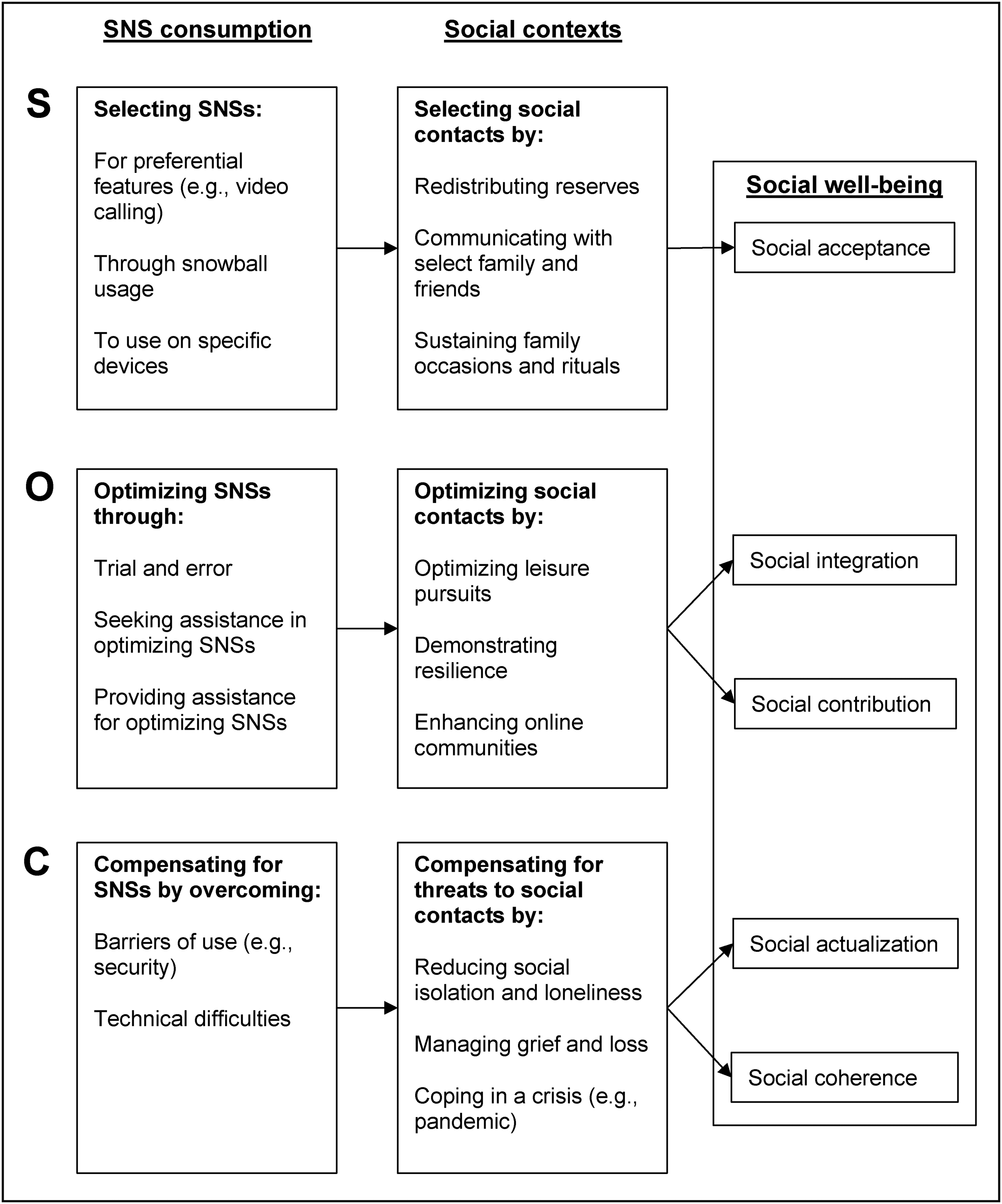
Transformative SNS for the Aging Consumer.
Selection
Older consumers in lockdown select SNSs by choosing platforms with preferential features (e.g., video calling), basing their consumption on recommendations from family and friends, and employing device-specific selection. As a result, they use SNSs to aid in the selection of their social connections by carefully redistributing their social reserves, communicating with chosen people, and sustaining family occasions and rituals (see Figure 2), which in turn enhance their social acceptance. The following analysis further unpacks these elements of selection.
Selecting functional SNSs through recommendations
In lockdown, SNSs enable regular and important communication with social contacts and are consequently chosen for their convenience and functionality, such as free communication, instant messaging, and visuality. For example, Mark (age 71), like many other older consumers, selects SNSs with video calling functions “to keep in touch with family and friends, mainly family.” His daughter lives abroad with her husband and children, so during the travel restrictions, he thought that “WhatsApp is a fantastic way of talking to them and also it's cheap, it's cheaper than making a phone call.” Mark also uses Zoom to connect with trusted contacts: And we’ve done an awful lot of Zoom. Communications with family and with friends. And in fact, we’ve got into a routine with two other couples that every Wednesday night we have dinner together. It started as a one-off, and it's turned into a weekly thing, and it's kind of really helpful to everybody.
Generally, as certain SNSs are chosen to fulfill a particular purpose or function, older consumers choose a select number of SNSs to use. For instance, Facebook is used to stay connected with people and follow their lives, and YouTube is chosen for information searching. Other social media, such as WhatsApp and Zoom, are selected for their video call functions, replacing Skype as being useful to contact relatives and friends living geographically far away (Neustaedter et al. 2015). This approach differs from that of younger consumers, who predominantly use a higher number of platforms (Boczkowski, Matassi, and Mitchelstein 2018).
In most cases, the different SNSs are introduced through recommendations from trusted family and friends within the user's inner circle (Pera, Quinton, and Baima 2020), which creates snowball usage. In some cases, support is required for installation. Laura (age 80), for instance, uses SNSs to talk to “family members and close friends.” Her grandson helps with the setup: Because of my age, I haven't actually been brought up with online media. So it was like a different language … so he had to explain everything.
Generally, however, older consumers are messaged through a particular SNS (e.g., WhatsApp) or sent an invitation (e.g., Facebook) by family members, and this consequently spurs SNS usage, indicating that older consumers are just as influential in the product-led growth of SNSs as younger consumers are (Widlund 2021).
Furthermore, SNS selection is intertwined with technology selection. Older consumers choose a preferred device for each of their selected SNSs, instead of having a multitude of SNSs across all digital devices or relying primarily on a smartphone as younger consumers do (Dunaway and Soroka 2021). For example, Maeve (age 70) selects her iPad for Facebook and Skype, but her smartphone for WhatsApp: I have Facebook and WhatsApp, I have Skype … and they’re all on my iPad, not necessarily on my phone. I don't use Facebook on my phone. No. I use WhatsApp on my phone. I don't use the others on my phone at all.
Consequently, older consumers of SNSs select the platform they use on the basis of functionality and through recommendations, but they also select the device they consume each SNS on, an understanding not gleaned from previous studies focusing on a single platform (e.g., Jung and Sundar 2016; Kim and Shen 2020). This advances the SOC theory by demonstrating that older consumers select not just their social contacts (Kamin, Lang, and Kamber 2017; Rohr and Lang 2009) but also the technology and SNSs that they plan to use.
Selecting social contacts by (re)distributing reserves
The data demonstrate how older consumers, through the use of SNSs, put time and energy into maintaining relationships with trusted (and select) family and friends (Baltes and Baltes 1990). During periods of lockdown, most respondents reported no changes to the structure of their social circles, but only changes to the ways they communicate with people. For example, George (age 70), finds that staying in contact through SNS is easier than meeting face-to-face, but he still “stay[s] in contact with the same people that [he] stayed in contact [with] beforehand,” which is indicative of selective behavior (Rohr and Lang 2009). Emily (age 65) reiterates this point, noting, “I don't think it [SNS use] necessarily widens your [social] circle. … I think after a while you tend to fall back on the people who really are your friends.”
Interestingly, however, although lockdown does not change older consumers’ choices of whom to communicate with, in some cases it alters how our informants distribute their “reserves” for relationships (Rohr and Lang 2009). For instance, before the lockdown, Emily (age 65) held strong relationships with friends who lived near her (e.g., within her village). But in lockdown, Emily distributes her social resources and social acceptance toward friends who are more geographically dispersed. In other words, lockdown affords Emily the time and opportunity to reconnect with trusted but physically distanced friends: It's made me want to contact friends that I don't see very often, and I probably have more contact with friends that I don't see very often. Which is a positive. People that I maybe only speak to a couple of times a year, I’m probably checking in with them every 3 or 4 weeks now. Some more often … particularly if I know they’re on their own.
The redistribution of reserves is not just present in day-to-day communication with select, and geographically diverse, socially accepted contacts. Rather, time is also spent on sustaining cherished family occasions and rituals, such as birthdays, religious holidays, and anniversaries (Abel, Machin, and Brownlow 2021), thus strengthening family bonds (Crespo et al. 2011). Respondents use SNSs to develop creative and innovative ways of staying connected during these special occasions, despite the physical distance of family members. Jennifer (age 79), whose family usually holds a large event for Christmas, reports having “the strangest Christmas” over lockdown. She says jovially, “I mean we were even taking photographs of our food and sending the children photographs of what we’re eating [laughs out loud] and I had a glass of wine [chuckles].” Furthermore, John (age 74) and his family use Zoom to celebrate special occasions and cheer themselves up with collective, fun, and innovative games: So we had a good session on Sunday, so it was Valentine's Day, but we weren't able to celebrate that properly. So the family, the six of us, set up a game of Cluedo on the Zoom. And my daughter spread the board out on her floor of the living room and so we’ve pinned that to the screen … quite liberating I thought. It was the general idea to come to the conclusion between us. It wasn't one person who suggested it, but it worked really well. Also, we also dressed up. We dressed up in the costume of the characters that we were playing. It's really good. We’re going to do that again [smile].
Not only is selection of social contacts occurring as established in the SOC framework (Rohr and Lang 2009), but our findings demonstrate that pandemic-related social isolation, as a contextual issue, creates a redistribution of social reserves from the selection of localized personal contacts to the selection of more physically distanced contacts. In this situation, older consumers do not just use SNSs to expand their networks as younger consumers do (Wolny and Mueller 2013), but they redistribute their reserves within their already established network of friends and family, creating more time for family rituals and communication with distanced friends.
Demonstrating social acceptance by seeking advice
The data indicate how selection, a construct from Baltes and Baltes’s (1990) SOC theory, interacts with social acceptance, a construct from Keyes’s (1998) theory of social well-being. By selecting social contacts with their selected SNS, the participants demonstrate social acceptance of others, as they trust others within their social circles and believe that they can be kind during difficult times (Keyes 1998).
This is also evidenced on the forum, as choosing to participate in the forum is a form of selection: the user selects the forum, the forum topic, and the form of engagement by either creating a thread or posting a response. Selection further indicates enhanced social acceptance, as forum members, even though they do not know one another, increasingly trust others enough to ask for and follow various forms of advice. For instance, Deary63 asks forum members to suggest how to furnish her home, which is a decision of great importance: I am soon having my kitchen, living room and hallway laid with wooden style Karndean Laminate. I will have to buy a lovely rug to go between my couch, comfy chairs and TV. Looking for something 120 × 170 cm in size. I’ve seen some really great ones, however, one is wool, some are polyester, and a few are acrylic. I’m a bit clueless about the pros and cons of these various materials. So, I would be very thankful for any advice you might have.
Other forum members ask for advice on a range of topics with varying importance. Some are interested in mundane decisions relating to what books to read, what television shows to watch, and what radio stations or programs to tune into; others share serious and pertinent topics relating to caring for a loved one, difficult relationships, and grief. Consequently, SNS selection can help older consumers engage with their salient and selected networks and communicate about difficult topics with trusted contacts, demonstrating social acceptance and subsequent social well-being (Keyes 1998). This not only reveals that services for older consumers can be transformative and enhance social well-being (Feng, Altinay, and Olya 2019) but also shows that digital services, such as SNSs, can have a similar effect, rather than being detrimental to health and well-being (Schünemeyer and Walsh 2020).
Optimization
Alongside demonstrating selective behavior, the data reveal how older consumers practice optimization (Baltes and Baltes 1990) during lockdown. Figure 2 indicates that finding ways to optimize SNSs and helping others optimize SNSs are essential in enhancing online community involvement and engaging in leisure pursuits. Not only do aging consumers strive to optimize their social relationships (Kamin, Lang, and Kamber 2017), but they also optimize the use of SNSs, which in turn optimizes relationships and improves social contribution and integration. The following analysis further explores these interactions.
Optimizing SNSs through collaboration
Older consumers in lockdown strive to optimize the SNSs that they consume by learning to use a multitude of functions in an effective and efficient manner. Many find using digital devices and social media easy, due to previous experiences of consuming technology in the workplace, whereas others learn through continuous trial and error. Laura (age 80), for example, reports learning new skills while organizing activities for others within her community. Her success in optimizing Zoom gives her tremendous feelings of pride and self-worth: I think I’ve grown in the last year to a level of competence. For example, last Saturday, I had organized for my village to do a village virtual quiz. I just organized it. Somebody else hosted it. But during that quiz, there were two friends who were in different places. I learned how to do a dual screen which I have never done before (feel so proud). I learned how to do that last week, which was wonderful.
Part of the optimization process often involves collaboration with others, either asking for assistance with using SNS or helping people use SNS. Edith (age 69), like many other older consumers, helps her friends use social media, as “a lot people found it very challenging to connect with this technology,” so she makes “a lot of effort to actually help people to do it [use SNSs] without being physically present.” Equally, forum members regularly leverage the forum to ask questions about how to optimize SNSs. A user called Shelly52 begins a forum thread with this question: We have been using video for communicating with family and friends since the start of lockdown, but I keep hearing about Zoom. I’m feeling really silly because I don't even know what Zoom is. Can somebody help?
Notably, we observe 24 responses to this question, with many people willing to socially contribute by helping Shelly52 with information, stories, and experiences of using Zoom. Within digital communities that are instigated and attended by older consumers, there is a sense of collaboratively helping other people learn how to use SNSs, which optimizes the use of SNSs. Previous literature ascertains that older consumers receive technical assistance from relatives (e.g., grandchildren; Pera, Quinton, and Baima 2020); however, we discover that collaboratively helping each other optimize SNSs is equally as effective. This subsequently indicates that SOC theory is applicable to older consumers’ optimization of SNSs, not just to the process of optimizing social contacts (Rohr and Lang 2009).
Demonstrating resilience by optimizing (digital) communities
During stages of lockdown, people are required to stay at home and avoid contact with others, leading to dramatic changes in the many hobbies, activities, and communities that engaged people. With leisure activities and hobbies being imperative for older people's quality of life (Gabriel and Bowling 2004), many of our participants report partaking in hobbies, such as music, photography, and sports, and going to the cinema, theater, art exhibitions, museums, restaurants, and pubs before the pandemic. But suddenly, during lockdown, many of these activities either ceased or moved onto SNSs. The innovative and creative use of SNSs by older consumers to continue these activities is impressive and demonstrates their resilience and optimization of both social contact and technology.
For example, John (age 74) was active before the pandemic and visited the gym three times a week; he also enjoyed playing snooker and bowling, and he sat on numerous committees that involved interacting with various social contacts. In lockdown, many of his activities moved onto SNSs, so he maintains relationships that benefit his cognitive, mental, and physical functioning (Rohr and Lang 2009): Exercising at home, I do two Zoom exercise sessions on the Tuesday and Wednesday … and the art society, we have a monthly lecture. Oh yes—I’m also on the committee of the Huckleworth Music Society and we have a series of Zoom concerts. So the last one was last Friday. I have quite a lot of interaction with my drinking friends on Zoom weekly. Well … normally of course I would have gone out to the pub and have a drink with them every Tuesday night.
Likewise, the innovative use of SNSs for the optimization of community activities is evident in the forum data. On a thread about how to use Zoom, two older consumers, who enjoy playing music and singing, mention the mute function as an improvement on regular rehearsals. CuppaSoup14 writes that they “belong to a choir” and they are “taught new songs line by line and then all sing together but on mute!!” They can all see one another but only hear themselves. Similarly, GreenEmerald expresses that they are also part of a music group and “the individual leading the tune/song is the only one that has their sound on; everyone else is on mute and sings or plays along. It works excellently and no one worries about wrong notes!”
Participating in social activities often leads to a sense of community felt by the participants. As personal community involvement can enhance health and well-being (Joe, Perkins, and Subramanian 2019), many participants report prepandemic community participation, with an interest in local societies and groups related to business and leisure. However, in lockdown, older consumers further demonstrate resilience and optimize their community involvement by using SNSs. For Laura (age 80), being in the community is a lifeline from social isolation, as she uses SNSs to continue communicating with people: It's changed dramatically. … I am a widow, so I live on my own. So my whole social life was outside, in the community. I’m quite a busy person. I was a very busy person. And all of those things stopped. My life is now my home and my little bit of garden. I’m using social media to be part of the bigger wide world.
Furthermore, before the pandemic Jack (age 65) was heavily involved in his village community, and so he reports that “at the beginning of lockdown, a group of neighbors set up a village WhatsApp group, and we communicate through WhatsApp.” This narrative resonated with several participants, as groups were set up in Facebook, Microsoft Teams, and Yahoo, all with the intention to optimize social contact with specific communities of people. Online communities offer benefits for older adults, such as social support, self-empowerment, and enhanced well-being, which create resilience (Kamalpour, Watson, and Buys 2020); however, what is interesting here is the preexisting resilience that enables older consumers to move nondigital communities to online communities with SNSs consumption. Younger consumers often use technology as a means of cultivating resilience, such as by engaging in e-commerce during lockdown (Guthrie, Fosso-Wamba, and Arnaud 2021), but we find that older consumers’ subjective views of themselves and psychological mechanisms are proficiently developed (Baltes and Baltes 1990), with an extreme and preestablished propensity for resilience.
Social contribution and integration through collaborative learning
As indicated in Figure 2, the analysis reveals how using SNSs effectively and being part of an online community through optimization, a construct described by Baltes and Baltes (1990), interact with both social contribution and social integration, which are constructs of social well-being (Keyes 1998). Social contribution represents a person's perception of feeling worthwhile when they contribute to society, and social integration relates to feeling part of society, sharing interests with others, and belonging to a community (Keyes 1998). By optimizing digital communities through SNSs, older consumers enable their social integration during times when their social well-being is challenged. Moreover, by optimizing their use of SNSs through collaborative learning, older consumers experience social contribution as they feel worthwhile in their contributions on online communities.
The following example demonstrates the importance of SNS optimization to social integration in society and how, without it, people become further isolated. Ian (age 71) has a group of friends accustomed to meeting up for drinks in the pub. Unfortunately, the pandemic thwarted this activity, and his community moved onto SNSs. He talks about how a couple of the members need support in using Zoom from other companions, through social contribution: I organize a regular zoom meeting with one group of friends. There's about seven or eight people. And um … seven of them are now fully capable of using Zoom. One of them took quite a lot of coaching and, and technical support [smile]. But he got that in the end. But number eight of the group did not want to have anything to do with it at all, and so I’ve hardly been in touch with him at all. I, I haven't seen him for a year.
A failure to optimize SNSs can result in the inability to remain a part of the community, as in the case of Ian's friend, who is excluded because of a lack of interest or ability to use SNSs. With this exclusion comes a lack of social integration and consequently a reduced level of social well-being (Keyes 1998). The danger here is that as more people move online (Guthrie, Fosso-Wamba, and Arnaud 2021), others with limited access to SNSs and the internet will become further socially isolated. Whereas the use of SNSs helps with a positive cycle of optimization, improving the social integration and social contribution aspects of the participants’ social well-being (Keyes 1998) and consequently advancing their cognitive, mental, and physical functioning (Rohr and Lang 2009), not having access to SNSs develops a negative cycle of social isolation.
Compensation
As well as demonstrating selection and optimization, the data indicate how older consumers of SNS practice compensation during lockdown (Baltes and Baltes 1990). Figure 2 shows that older consumers compensate for, and overcome, the technical barriers associated with a quick transformation onto SNSs. Figure 2 also indicates how older consumers used the convenience of SNSs to compensate for losses and troubles within their social lives, such as social isolation, loneliness, and loss of a loved one, all of which the pandemic exacerbated. In most cases, this compensation enhances social actualization and social coherence, but in other cases, where compensation does not occur, there can be serious negative outcomes with regard to social well-being. The following analysis examines the components of compensation.
Compensating for SNS obstacles by overcoming technical barriers
Despite the obvious benefits that SNS use provides, a number of barriers still prevent older consumers from adopting technology. These include a lack of confidence, understanding, support, experience, internet connection, and money, alongside concerns about privacy, manipulation, cyberbullying, and offensive material (Choudrie et al. 2021; Leist 2013). For instance, Edith (age 69) expresses concerns relating to safety and security: And I think the whole issue of cyber bullying and I think there are issues about financial, identity theft and all that kind of thing, which again, I suppose I just try and stay reasonably up to date with things [chuckles]. But I again, as you’re getting older, I can imagine a situation where my memory isn't so good. My focus isn't so good. And I’m likely to be much more vulnerable in that situation. And I don't know what will happen.
She overcomes these concerns by being careful with personal information and cautious on SNSs, reporting that this “is why I don't put stuff up on Facebook. Only in exceptional circumstances, so I’m quite careful about security aspects.” For most, these barriers are merely obstacles to overcome, but for others, they can lead to a rejection of SNSs or technology. Jennifer (age 79) recalls how her friend's digital exclusion led to a dangerous situation of social isolation: I did have a friend, sadly, she died a couple of weeks ago, who didn't use any technology. She didn't know how to watch or listen to a CD or she had never ever, she was 80, she had never ever used a machine. … I just couldn't understand. She was missing out on so much. Scared, she was scared of, she had this fear that if she used these things, everybody would know everything about her. So, anyway she was lonely. The lockdown essentially killed her because she just got more and more depressed. And, but she's in a better place now. Not so unhappy.
In addition to identifying the SNS obstacles older consumers experience (Braun 2013), this example demonstrates the dangers associated with not being able to overcome, or compensate for, the barriers. Previous work from Kamin, Lang, and Kamber (2017) suggests that people compensate for losses and burdens by purchasing and using technology. Our findings establish that older adults do not just compensate for the challenges of life but also compensate for the challenges (or barriers) that come with the rapid adoption of using SNSs. Our findings also highlight the dangers associated with not being able to overcome and compensate for these barriers.
Compensating for lockdown and loneliness
For aging consumers who typically enjoy face-to-face interactions and rely on face-to-face retailing services (Meneely, Burns, and Strugnel 2009), the lockdown had a huge negative impact on their lives. Many interview participants report feeling socially isolated and lonely while missing nonvirtual interactions. John (age 74) indicates how the enforced social isolation had a negative effect on his health, as he started to consume more alcohol: I have to try and control my drinking habits. I’m not drinking excessively, but I’m certainly drinking more than I would have done before the pandemic because I would be out and about. So normally after a session at the gym I would go to a local golf club that I’m also a social member of, just go for a coffee and a chat and some like lunch. Well, I can't do that now, because the golf club is shut. So I’ll drink wine.
All participants report increasing their SNS usage to compensate for the loss of face-to-face interaction. This compensation comes in many forms and involves video calls, community groups, information searching, content sharing, and instant messaging. Laura (age 80), for example, discusses the convenience and benefits of instant messages, compared with using a traditional telephone. These messages prevent Laura, who is widowed and lives alone, from feeling completely isolated: It's most important that I keep in touch with people. It used to always be by telephone in the “olden days” [makes quotation marks with fingers in the air]. Now, I don't instantly speak to people, but have them know that I’ve contacted them, so they can get back to me. For example, on WhatsApp, I can send the message, they “ping” and oh yes, they’ve received the message, even though they might not get back to me immediately. Without it, I would feel very isolated.
Kamin, Lang, and Kamber (2017) express that technology could be used to compensate for losses and burdens, such as loneliness and isolation, but until now there is limited empirical evidence to support this. Our data are from a context in which many losses and burdens were experienced (i.e., COVID-19 lockdown), and in support of the work of Kamin, Lang, and Kamber, most older consumers did turn to SNSs for compensation, creating empirical evidence of this assumption. Moreover, our research implies that it is not just technological devices that can provide compensation, but that digital services, such as SNSs, are equally as important.
Enhancing social actualization and coherence with compensation
The data indicate how overcoming losses, burdens, and technical barriers through compensation (Baltes and Baltes 1990) interacts with social actualization and social coherence, both of which are constructs of social well-being (Keyes 1998). Social actualization occurs when older consumers of SNSs believe that society has the potential for an optimistic outlook, and social coherence involves older consumers wanting to understand more about the social and digital world and making sense of life (Keyes 1998).
The following example demonstrates how older consumers who are experiencing grief from the loss of a loved one use SNSs as compensation to improve their social well-being (Keyes 1998). One forum topic, entitled “Bereavement,” experiences frequent activity, especially during lockdown. In one thread, user Bourbon73 talks about how listening to music triggers feelings of grief ever since the loss of a loved one: How long will it be until I can listen to music again? It's been 3 years since my husband died but I still can't listen to classical music. This is such a sorrow to me as music was such a big part of both mine and my husband's lives. Before Covid, I do think I was coping quite well with the support of my family. I was also out and about more and travelling to foreign countries.
Social actualization is improved through SNSs in this example, as Bourbon73 looks for a hopeful future that would include listening to classical music again; this user asks other forum members to help provide an optimistic outlook on life. Social coherence is enhanced through Bourbon73’s attempt to know and understand more about the world by asking forum members for advice. This quote expresses the pandemic’s interference with older people's relational grief (Kumar 2021) processes; therefore, they use SNSs as a form of compensation for that grief. By asking for responses and reassurance on the forum, Bourbon73 attempts to compensate for the loss of a loved one by enhancing social actualization and social coherence, which influence overall social well-being (Keyes 1998).
Discussion
Academic Contributions
Our primary contribution involves advancing TSR by developing a framework of transformative SNSs for aging consumers (see Figure 2). The theory of SOC (Baltes and Baltes 1990) reveals how SNS use is transformative for aging consumers experiencing social isolation in lockdown, by influencing the components of social well-being (Keyes 1998). TSR frameworks for aging consumers are generally focused on physical and assistive services, such as socially supportive services (e.g., Feng, Altinay, and Olya 2019); our study is the first to develop a TSR framework for aging consumers of digital services (e.g., SNSs). To do this we combine two underused concepts in the marketing field: SOC theory from gerontology (Baltes and Baltes 1990) and Keyes’s (1998) social well-being.
The framework in Figure 2 indicates that selection of specific SNSs and social contacts leads to social acceptance, as older consumers develop trust in the technology that they are using and trust in the individuals within their chosen social circle. Optimization of SNSs creates social integration as older consumers develop quality relationships through communities, and it creates social contribution as they participate in these communities by sharing information, helping with technical issues, and responding to queries. Finally, compensating for losses and burdens (e.g., death, lockdown) by using SNSs results in older consumers’ improving their social actualization, by searching for a hopeful future, and creating social coherence, by wanting to know and understand more about the digital world. If older consumers, however, are unable to optimize SNSs or compensate for technical barriers, this results in a negative impact on their social well-being.
The second contribution is to marketing research through the application of SOC theory, which was originally coined within gerontology (Baltes and Baltes 1990), to further understand the consumption of SNSs by aging consumers. Despite previous research combining marketing with gerontology literature, few consumer behavior studies utilize Baltes and Baltes’s (1990) theory (except, as mentioned, for Sikkel [2013], in a different context). By doing so we advance the gerontology research of Kamin, Lang, and Kamber (2017), who propose that older people use technology to select, optimize, and compensate for social contexts and that challenges and opportunities in social contexts motivate technology use. Our research is the first marketing study to empirically test this assumption and discover that older consumers do not only use SNSs to select and optimize social contexts, but similarly they select and optimize the SNSs they consume. Moreover, older people compensate not only for losses and burdens (e.g., death) but also for the challenges technology poses, by overcoming technical barriers (e.g., security) through collaborative support of one another.
Consequently, we demonstrate that SOC theory is a valuable framework to apply to the context of older consumers of SNSs and can provide insightful understanding for marketers, developers, and designers. For example, when older consumers select SNSs to communicate with their peers, they maintain the same social circle, which differs from younger consumers’ use of SNSs to widen their social network (Wolny and Mueller 2013). Furthermore, younger consumers often turn to digital services, such as e-commerce, to cope with environmentally imposed constraints (Guthrie, Fosso-Wamba, and Arnaud 2021). Older consumers, however, demonstrate a preestablished resilience, which is used to optimize online digital communities and subsequent relationships. Older consumers tend to have more privacy concerns than younger consumers, even in an offline environment (D’Acunto, Volo, and Filieri 2021), resulting in further barriers to SNS consumption. Our study illustrates older consumers’ ability to compensate for these barriers by accessing an online space for seeking and providing advice.
The final contribution is to the sparse marketing literature on older consumers’ usage and understanding of SNSs, by providing in-depth qualitative insights on their lived experiences of using social media during the pandemic. We enhance the work of Choudrie et al. (2021) and Pera, Quinton, and Baima (2020) by providing a detailed qualitative narrative of older consumers’ use of SNSs. However, the present study moves beyond focusing on a particular function of SNSs, such as photo sharing or processing information (Choudrie et al. 2021; Pera, Quinton, and Baima 2020), to provide a more holistic view of SNS experiences. By looking at the consumption of multiple SNSs, we find that older consumers do not just select which SNS they use but also select a preferred digital device for each platform (e.g., tablet for Skype, smartphone for WhatsApp). This use is different from that of younger consumers who either access SNSs across all devices or primarily access SNSs on their smartphones (Dunaway and Soroka 2021).
Moreover, the study provides perspectives from older consumers living through a pandemic, and how they adapt and alter their SNS-related behavior to compensate for a lack of social interaction. This topic is absent from the extant marketing literature. Indeed, Choudrie et al. (2021) is the only known study to explore older adults’ SNS use during COVID-19, yet it focuses largely on how successfully older consumers process information and misinformation. Interestingly, we demonstrate how older consumers use SNSs to maintain their selected social circle, but in lockdown they redistribute reserves within their social circle to more geographically distanced friends and family, a finding only gleaned from conducting research during the pandemic.
Managerial Implications
Marketers, developers, and designers of SNSs can use the proposed TSR framework (see Figure 2) to improve the social well-being of older consumers. It indicates, for instance, how being able to optimize SNSs with trial and error and technical support from peers allows older consumers to optimize leisure pursuits and online communities, which are imperative for social integration and social contribution. However, if it is difficult to optimize SNSs or if technical barriers are not compensated for, then there are negative consequences for the social integration, contribution, actualization, and coherence of aging consumers. Practitioners therefore need to improve the inclusivity and accessibility of SNSs for older people to create a transformative service.
Previous studies specify how family members (e.g., grandchildren) help older adults with technical issues (Pera, Quinton, and Baima 2020); however, we indicate that collaborative technical support between aging peers is imperative in the optimization of SNSs. SNSs that directly target older consumers (e.g., Silver Surfers, Gransnet) already demonstrate good practices for fostering collaborative technology support. For example, they host forums for older consumers with discussion boards on technology, in which registered users can exchange experiences and ideas and become more knowledgeable in using social media, alternative digital platforms, and devices. For mainstream SNS platforms, however, further improvements could be made.
Many mainstream SNS platforms place emphasis on improving accessibility, which is vital for consumers with cognitive, mobility, hearing, and visual impairments and other related accessibility needs, which can amplify with age (Botelho 2021). For example, Facebook ensures linting and flow, contextual headings and keyboard commands, and scalable font sizes to ensure accessibility (Iskandar et al. 2020), and Twitter publicizes text, image, emoji, and video accessibility guidelines (Dorney 2021). They therefore focus on the accessibility of the content but lack accessible training materials on how to use SNSs and how to overcome technical barriers. Following this idea, larger social media platforms should focus on improving their help and support pages by providing coproduced step-by-step video tutorials, designed by older people, and facilitating community-based support forums. Collaborative peer-based learning and coproduction is important as the design of digital resources is influenced by homophilic tendencies, whereby developers understand themselves, their peers, and people with similar characteristics but disregard diverse user groups, including older consumers, and the distinct ways in which they interact with SNSs (Rosales and Fernández-Ardèvol 2020). The recommended changes will make these platforms more welcoming to beginner-level users and, therefore, to older consumers who may have less prior exposure to such systems.
Limitations and Directions for Future Research
Our study enhances in-depth understanding of older consumers’ lived experiences of using SNSs during the pandemic. It is based on a select group of individuals and those engaging with one chosen SNS forum. Consequently, future research should extend our qualitative approach by undertaking additional netnographic work to account for a range of heterogeneous SNSs that older consumers are using. Furthermore, introverted consumers of SNSs may be underrepresented in our sample, as they might fail to come forward for interviews and contribute less to online forum discussions (Alarcón-Del-Amo, Gomez-Borja, and Lorenzo-Romero 2015). Capturing their perspectives is important because these older consumers might also be the ones prone to isolation, and understanding their perspectives could make accessible SNS design and function even more imperative. Future research should therefore focus on isolated older consumers, who are not as prevalent on social media due to factors such as financial status, personality, low technical experience, a lack of informal technical support, and limited internet access.
Finally, the present study is based on experiences of older consumers living in the United Kingdom. It is unclear whether their experiences mirror those of older consumers in other countries and cultures and whether the same theoretical underpinnings can be applied. Further research should consequently expand the study toward different countries with varying socioeconomic and cultural factors, to explore whether Baltes and Baltes’s (1990) theory is transferable and whether the same dimensions of Keyes’s (1998) social well-being are identified. As SNSs increasingly provide global services and enable communication despite geographical proximity, future multinational research is imperative when creating relevant and rigorous recommendations for marketers and developers of SNSs. This approach would help ensure that the internet services provide older consumers throughout the world with opportunities for SOC and subsequent improved social well-being.
Footnotes
Appendix: Topic Guide for Interviews
|
|
|
|---|---|
| History of technological devices |
What electronic devices do you own? Can you please tell me when you got your technology? How did you get your technology? Which electronic device do you use the most every day? |
| Social media platform user experience | (Visual aid: an A4 sheet with different social media logos)
Which of these social media platforms you have heard of? What social media platforms do you use? Can you please describe how you first came across these social media platforms? How long ago did you start using social media platforms? Could you talk about why you wanted to use social media in the first place? When you first started using social media, how easily did you adjust to the new platform?
– (If difficult) What kind of obstacles did you have while learning how to use social media platforms? Which social media platform do you use the most and how often do you use it?
– Could you describe a bit more about what do you normally do with that platform? |
| Facilitators and barriers of social media usage |
What do you like about social media? What do you dislike about social media? Do you have any concerns while using these social media apps? Can you please talk about what social media means to you? In what ways has using social media influenced your social circle? In what ways has using social media influenced your life? |
| Influence of lockdown |
What leisure activities did you do before lockdown? What leisure activities do you do now? Do you think the pandemic has changed your social life? If so, how has it changed your social life? How has lockdown impacted your desire to keep in touch with people? How has lockdown impacted your use of social media? |
| General observations and future suggestions |
How important do you think social media is to people’s lives? Do you want to try any other social media in the future? And why? What suggestions do you have about improving the social media market? |
Acknowledgments
The authors would like to thank Cele Otnes for her unwavering support and invaluable comments on previous versions of this article. The authors would also like to extend gratitude to all participants who were involved in the research for providing fascinating insights that helped shape the findings of this study and future directions for marketers, developers, and designers of social networking services.
Special Issue Editors
Daniele Scarpi, Martina Benvenuti, and Lia Zarantonello
Declaration of Conflicting Interests
The author(s) declared no potential conflicts of interest with respect to the research, authorship, and/or publication of this article.
Funding
The author(s) received no financial support for the research, authorship, and/or publication of this article.