




Abstract
Consumer-to-consumer (C2C) online reviews are important sources of information that help consumers decide which products and services to buy. Although C2C reviews in video format (e.g., on YouTube) have become increasingly popular, research remains focused primarily on textual reviews. This article emphasizes the importance of C2C video reviews in influencing consumer outcomes through parasocial interaction, a special—albeit one-sided—connection with reviewers. Interactivity and self-disclosure are suggested as online communication techniques reviewers can use to foster parasocial interaction with their viewers in a single encounter. Parasocial interaction is further established as a psychological mechanism that underlines the impacts of interactivity and self-disclosure on source credibility, leading to improved consumer purchase intentions. The authors also propose that strong parasocial interaction with reviewers exerts a particularly powerful influence on the purchase decisions of consumers who experience low levels of decision confidence, while arguing for the importance of C2C video reviews in guiding the decisions of various consumer groups. Research recommendations reveal how managers can encourage consumers to create and share video reviews on different platforms and offer guidance on the ways companies can foster parasocial interaction through firm-related marketing communications.
When consumers seek advice about products and services, they are likely to turn to electronic word of mouth (eWOM) in the form of consumer-to-consumer (C2C) reviews (Pan and Chiou 2011; Verma and Yadav 2021) as sources of information that are not directly influenced by firms (Floyd et al. 2014; Wu, Jin, and Xu 2020). To illustrate, 93% of consumers search for C2C reviews prior to making purchase decisions (Kaemingk 2020) and 79% trust such reviews as much as they trust personal recommendations (Pitman 2022). Increasingly, consumers use video content to support their purchase decisions: 90% of consumers claim that watching videos helps them make purchase decisions (Collins and Conley 2019), 87% say they can make purchase decisions faster when watching videos (Lanzi 2021), and 72% prefer to learn about firms’ offerings by watching videos rather than by reading textual descriptions (Hayes 2021). The popularity of video content has also influenced consumers’ choices of search engines; online video sharing and social media platform YouTube has become the second most popular search engine after Google (Davies 2021).
Therefore, it is not surprising that video reviews shared on social media platforms (e.g., YouTube, Instagram) and retailer websites (e.g., Amazon, Nike) have become increasingly popular (Kumar 2019; Wise 2022). Yet, previous studies primarily focus on textual rather than video reviews (for notable exceptions, see Diwanji and Cortese [2020] and Xu, Chen, and Santhanam [2015]). Although video and textual C2C reviews share some similarities, they differ in two important ways. First, compared with textual reviews that may include some visual information (e.g., product photos), video reviews provide consumers with dynamic audio and visual cues, such as how products sound and look in use (Jiang and Benbasat 2007). Second, consumers usually receive limited, if any, information about reviewers from textual reviews (Siering, Muntermann, and Rajagopalan 2018; Xu 2014), whereas authors of video reviews generally reveal some information about themselves, such as their physical appearance and/or voice.
We argue that it is particularly important to attend to personal information that reviewers disclose in video reviews, because consumers consider not only review characteristics, such as helpfulness (Chen and Xie 2008; Siering, Muntermann, and Rajagopalan 2018), argument quality (Srivastava and Kalro 2019; Xie et al. 2011), length, and valence (Maslowska, Malthouse, and Viswanathan 2017; Racherla and Friske 2012), but also reviewer characteristics, such as expertise and trustworthiness (Gottschalk and Mafael 2017; Ordabayeva, Cavanaugh, and Dahl 2022), when they search for C2C reviews. Together, expertise and trustworthiness inform consumers’ perceptions of “source credibility,” which is defined as “a communicator's positive characteristics that affect the receiver's acceptance of a message” (Ohanian 1990, p. 41). Generally, consumers are inclined to rely on reviews with greater perceived source credibility (Berger and Calabrese 1975; Zhang et al. 2014). Because C2C video reviews are more likely to contain reviewer-related cues that can establish source credibility, consumers may rely on video reviews more than textual reviews.
When consumers search for C2C video reviews, they tend to experience different levels of decision confidence in their purchases (Keh and Sun 2018). That is, some consumers look for such reviews to confirm established decisions, but others seek quality recommendations from credible sources of information to increase decision confidence (Mudambi and Schuff 2010; Pavlou, Liang, and Xue 2007). Despite evidence that the influence of C2C reviews on decision confidence is relevant to both consumers and firms (Andrews 2013), previous studies have not investigated how or why C2C reviews influence consumers according to their levels of decision confidence. For example, confident consumers are more likely to purchase (Dimoka, Hong, and Pavlou 2012) and tend to be more satisfied with their choices (Hong and Pavlou 2014; Robertson, Hamilton, and Jap 2020).
To extend current knowledge on the role of C2C video reviews in influencing consumer decision making, we turn to parasocial interaction theory (Hartmann and Goldhoorn 2011; Horton and Wohl 1956), which suggests that consumers who are searching for reviews are prone to developing special—albeit one-sided—connections with reviewers. Although previous studies highlight the positive impact of such connections on source credibility and the acceptance of recommendations provided (Munnukka et al. 2019; Reinikainen et al. 2020) they have focused on building parasocial relationships over time (Choi and Lee 2019; Hwang and Zhang 2018) rather than on fostering parasocial interactions through single encounters. Moreover, most studies on parasocial interaction focus on communications with celebrities and online influencers (Lee and Watkins 2016; Tsai and Men 2017) rather than complete strangers. Nevertheless, consumers who need additional information to support their purchase decisions likely search for C2C reviews shared by strangers (Banerjee, Bhattacharyya, and Bose 2017; Mudambi and Schuff 2010). Therefore, it is important to understand how reviewers can foster parasocial interactions in their communications and influence consumers’ perceptions and behaviors.
To address the lack of knowledge about parasocial interaction in the context of C2C video reviews, we conduct two studies. In Study 1, we examine how reviewers communicate information to their audiences and employ interactivity and self-disclosure techniques that establish strong parasocial interaction. We develop our own video review manipulations to examine how the absence or presence of interactivity and self-disclosure influence consumer purchase intentions through the formation of parasocial interactions and source credibility. Building on the outcomes of Study 1, Study 2 focuses on how parasocial interaction influences the behaviors of consumers who experience low (vs. high) levels of decision confidence prior to watching C2C video reviews.
Our research thus offers three main theoretical contributions to interactive marketing research. First, it enriches the literature on eWOM (Jiménez and Mendoza 2013; Verma and Yadav 2021) by examining the positive impact of interactivity and self-disclosure on the source credibility of C2C video reviews (Banerjee, Bhattacharyya, and Bose 2017; Zhang et al. 2014) through parasocial interaction. Second, it contributes to the research on parasocial interaction (Labrecque 2014; Sokolova and Kefi 2020) by defining parasocial interaction and source credibility (Chung and Cho 2017; De Jans, Cauberghe, and Hudders 2018) as the mechanisms through which interactivity and self-disclosure influence the purchase intentions of consumers (Hu, Liu, and Zhang 2008; Kim and Krishnan 2015) after a single encounter with reviewers. Third, it complements the extant literature on consumer decision making (Desender, Boldt, and Yeung 2018; Wang, Yu, and Wei 2012) by showing that parasocial interaction with reviewers has a particularly strong impact on the purchase decisions of consumers with low (vs. high) levels of decision confidence (Langan, Besharat, and Varki 2017). Altogether, the outcomes of this research suggest that C2C video reviews that foster parasocial interaction through interactivity and self-disclosure are more likely to help consumers make purchase decisions and, consequently, benefit firms.
For managers, our results stress the importance of C2C video reviews in influencing consumer purchase decisions and suggest how firms can gain the most benefits from such reviews. To extend our findings beyond the eWOM context, we provide examples of interactivity and self-disclosure techniques that can be leveraged to enhance the effectiveness of firm-related communications, such as messages shared by a firm's representatives (e.g., employees) and third parties (e.g., social media influencers).
Conceptual Background
Parasocial Interaction in the Online Environment
Parasocial interactions (Horton and Wohl 1956) or parasocial relationships (Rubin and McHugh 1987) are one-sided, imaginary connections that consumers experience with media personalities such as artists, online influencers, or even fictional characters (Hartmann and Goldhoorn 2011; Rubin and McHugh 1987). Extant research often uses the two terms interchangeably, although they have important differences (Dibble, Hartmann, and Rosaen 2016). Parasocial interactions imply a temporary sense of connection related to an encounter or communication with a media personality, whereas parasocial relationships involve similar feelings that develop over time through multiple encounters (Boerman and Van Reijmersdal 2020; Dibble, Hartmann, and Rosaen 2016). Some researchers, however, use the term “parasocial interaction” to address parasocial relationships (Gong and Li 2017; Lee and Lee 2017).
Although parasocial interaction theory was originally employed in the context of traditional media (e.g., television and radio), recent studies have also applied it to online media. Table 1 presents an overview of relevant studies that offer insights on both drivers and outcomes of such one-sided connections in the online environment. In particular, the research in Table 1 establishes the importance of parasocial interactions and relationships with different media personalities. One-sided connections formed in an online environment positively influence the perceived source credibility of media personalities (Reinikainen et al. 2020; Yuan, Kim, and Kim 2016) and the effectiveness of their endorsements (Chung and Cho 2017; Gong and Li 2017), leading to more favorable brand attitudes (Labrecque 2014; Lee and Watkins 2016) and consumption-related behaviors (Chung and Cho 2017; Hwang and Zhang 2018). However, previous research focuses primarily on relationships consumers experience with online media personalities such as traditional celebrities (e.g., actors, musicians), online influencers (e.g., bloggers, vloggers), or brands (e.g., hotel chains, consumer goods brands). These parasocial relationships are one-sided, imaginary relationships with well-known media personalities, not with other consumers who share their product experiences online.
Studies of Parasocial Interaction (PSI) and Parasocial Relationship (PSR) in the Online Environment
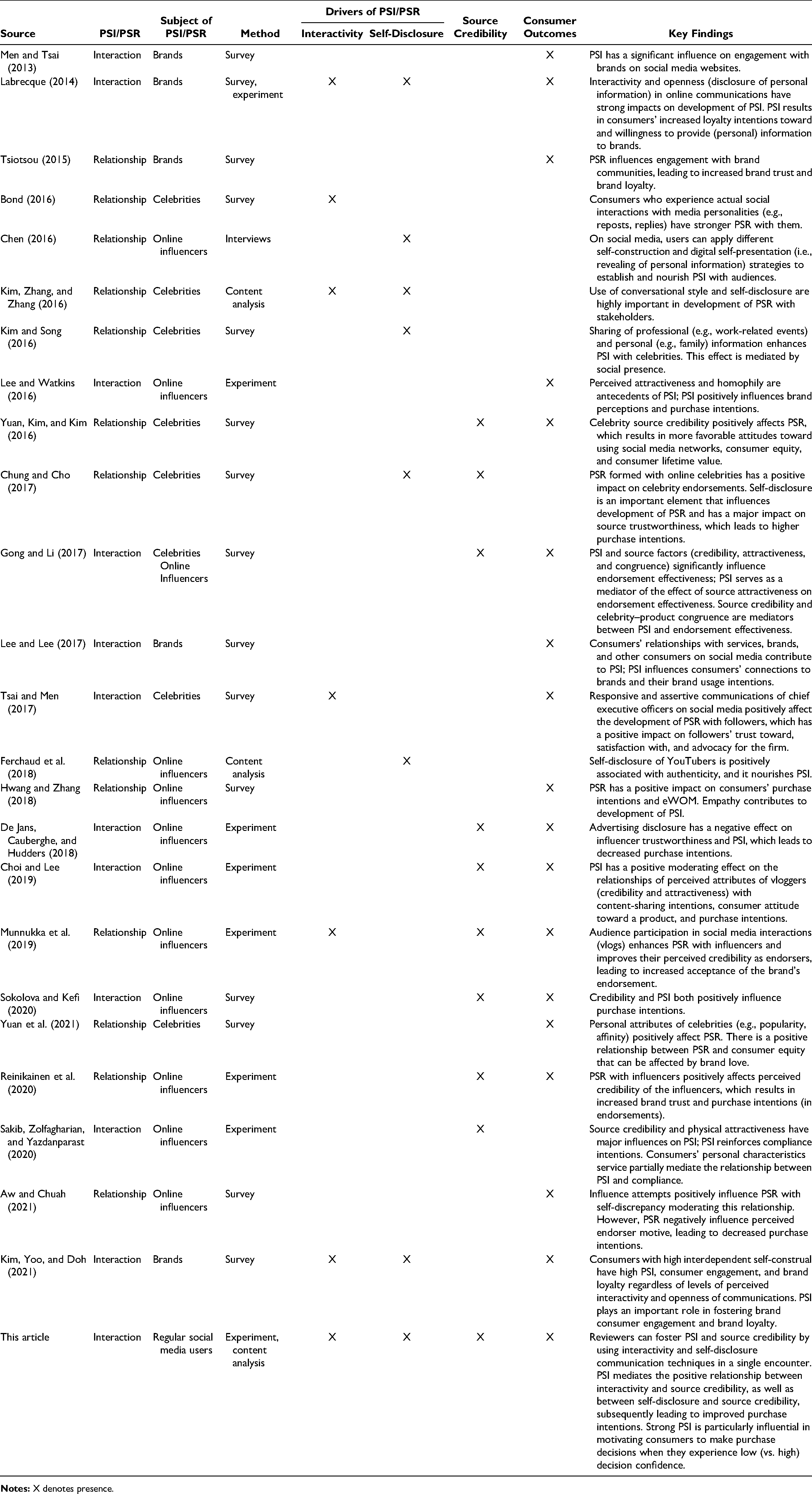
In this article, we concentrate on parasocial interactions because we consider situations in which consumers get to know reviewers through single encounters (i.e., single online reviews). That is, we examine the development and outcomes of personal connections with strangers that are based on specific instances, as opposed to connections developed over time with familiar media personalities. Nevertheless, we use extant research that addresses both parasocial interaction and parasocial relationship as a foundation to derive predictions about how parasocial interaction may be fostered in C2C video reviews and how it can impact consumers.
Interactivity and Self-Disclosure in Communications
Prior literature suggests that the development of parasocial interaction in both traditional and online media settings depends on three attributes: (1) the personal characteristics of consumers, such as feelings of loneliness or motivations to use media (Chiu and Huang 2015; Hwang and Zhang 2018), (2) the personal characteristics of media personalities, such as physical attractiveness or likability (Lee and Watkins 2016; Sokolova and Kefi 2020), and (3) communication styles adopted by media personalities (Chung and Cho 2017; Ferchaud et al. 2018), such as the presence or absence of interactivity and self-disclosure. In this article, we focus on reviewers’ use of different communication cues.
“Interactivity” suggests that consumers perceive communications as two-sided. It can be fostered by using a conversational style (e.g., using the pronoun “you,” as in “you can share your suggestions in the comments section”; Beege et al. 2019; Chung and Cho 2017), creating a sense of responsiveness and active listening (e.g., responding to consumers’ questions; Beukeboom, Kerkhof, and De Vries 2015; Munnukka et al. 2019), referring to previous communication with social media followers (Song and Zinkhan 2008), and addressing the audience directly (e.g., by looking straight at the camera; Beege et al. 2019; Hartmann and Goldhoorn 2011). Interactivity in online communications that makes consumers believe they are having real conversations with social media personalities positively affects the formation of parasocial interaction (Labrecque 2014; Song and Zinkhan 2008).
“Self-disclosure” involves revealing personal information, including providing basic personal information (e.g., real names, geographical locations Filieri, Raguseo, and Vitari 2019; Forman, Ghose, and Wiesenfeld 2008), revealing intimate personal information (e.g., family details, personal preferences Chen 2016; Ferchaud et al. 2018), sharing professional (work-related) information (e.g., current occupation; Kim and Song 2016; Kim, Zhang, and Zhang 2016), expressing emotions (e.g., crying, laughing; Chung and Cho 2017), sharing (negative) experiences (e.g., issues with using new products; Ferchaud et al. 2018; Reich and Maglio 2020), or demonstrating products (e.g., unboxing them on camera; Berger and Calabrese 1975). These forms of self-disclosure enable consumers to get to know social media personalities on a more intimate level, thereby strengthening parasocial interactions (Chung and Cho 2017; Filieri, Raguseo, and Vitari 2019).
Researchers (see Table 1) have recognized that the presence (vs. absence) of interactivity (Bond 2016; Munnukka et al. 2019) or self-disclosure (Chen 2016; Ferchaud et al. 2018) can foster strong (vs. weak) parasocial interactions. Some studies have considered both interactivity and self-disclosure in fostering parasocial interactions in brand (Labrecque 2014) or celebrity (Kim, Zhang, and Zhang 2016) communications. However, research has not yet established whether and how C2C reviewers (i.e., complete strangers) can use these techniques to foster strong parasocial interactions.
Source Credibility in C2C Reviews
Whereas consumers strive to obtain high-quality information when searching for C2C reviews, they are also interested in receiving product- and service-related insights from sources they can trust (Liu and Park 2015; Racherla and Friske 2012). That is, in addition to the content of online reviews, consumers consider source credibility, which they gauge using the characteristics of the reviewers (Banerjee, Bhattacharyya, and Bose 2017; Xu 2014). Consumers are more likely to support their decisions with C2C reviews that have higher levels of perceived source credibility (Banerjee, Bhattacharyya, and Bose 2017; Srivastava and Kalro 2019). This positive influence of source credibility occurs because it helps consumers develop a better understanding of the degree to which they can rely on information shared by reviewers (Cheung and Lee 2012). Accordingly, source credibility has a strong impact on whether recommendations provided in C2C reviews influence consumer purchase behaviors (Jiménez and Mendoza 2013; Zhang et al. 2014).
Generally, evaluations of source credibility build on perceived expertise (i.e., a source's knowledge and ability to provide accurate information) and trustworthiness (i.e., a source's motivations to provide truthful information) (Ohanian 1990; Xie et al. 2011). To determine source credibility in online reviews, consumers may rely on heuristics (e.g., review “likes” or helpfulness votes; Chua and Banerjee 2015; Liu and Park 2015), prior contributions (Wu, Jin, and Xu 2020), and reviewers’ personal information (e.g., names, locations, personal preferences; Filieri, Raguseo, and Vitari 2019; Forman, Ghose, and Wiesenfeld 2008; Xie et al. 2011; Xu 2014). Availability of reviewers’ personal information helps consumers decide whether and to what degree they can rely on reviews, and it may also lead to more personal connections with the reviewers (Kim and Song 2016; Lee and Watkins 2016).
Hypothesis Development
Impact of Interactivity and Self-Disclosure on Source Credibility
When media personalities share information through video content, they can strengthen parasocial interactions with viewers (Kim, Zhang, and Zhang 2016; Labrecque 2014) by improving interactivity and self-disclosure in various ways (Munnukka et al. 2019; Tsai and Men 2017). As previously stated, interactivity in online communications creates the illusion that consumers are engaged in two-sided (personal) communications with media personalities (Song and Zinkhan 2008). In particular, if media personalities use interactivity in their communications, they likely indicate interest in receiving feedback from their audience (Kim, Zhang, and Zhang 2016). Consumers then believe they can communicate directly with these media personalities by writing comments and potentially receiving personal responses (Bond 2016). The willingness of information providers to engage in further conversation about products (e.g., by answering product-related questions) should signal their competence on the topic. Moreover, the presence of interactivity in communications suggests to consumers that social media personalities care about their audiences (Reinikainen et al. 2020) and do not want to damage relationships with these audiences, which might happen if they share false information (Lee and Watkins 2016; Tsai and Men 2017).
Interpersonal relationship development research (Altman and Taylor 1973; Perse and Rubin 1989) further suggests that the development of parasocial interaction is linked to getting to know media personas on a more intimate level, which, in turn, decreases feelings of uncertainty toward them. Similarly, we propose that the presence of interactive cues will also reduce uncertainties experienced by consumers toward media personalities because they indicate commitment to the relationship (Reinikainen et al. 2020). Considering that interactivity plays an important role in informing parasocial interaction and that parasocial interaction has a strong positive impact on source credibility, we hypothesize:
Self-disclosure reflects the availability of personal information that can help consumers evaluate the overall credibility of C2C reviews (Chen 2016; Ferchaud et al. 2018). Research indicates that personal information about the authors of C2C textual reviews is generally scarce and is usually limited to basic personal information such as names or places of residence (Srivastava and Kalro 2019; Xu 2014). By contrast, authors of C2C video reviews generally provide consumers with additional personal information such as their appearance or voice. This suggests that basic personal information may not be sufficient to improve source credibility in C2C video reviews (cf. Banerjee, Bhattacharyya, and Bose 2017; Xie et al. 2011). Accordingly, in line with parasocial interaction research (Chung and Cho 2017; Ferchaud et al. 2018), we suggest that the presence of more private, rather than basic, information about reviewers—such as their experiences with products, personal preferences, and habits in C2C video reviews—increases consumers’ ability to evaluate the source credibility of these reviews.
Building on the proposition of interpersonal relationship development research (Altman and Taylor 1973; Perse and Rubin 1989), we suggest that the availability of additional personal information enables consumers to better evaluate the degree to which they can rely on recommendations shared by media personalities (Ferchaud et al. 2018). Considering that self-disclosure is one of the key drivers of parasocial interaction (Gong and Li 2017; Munnukka et al. 2019) and source credibility improves as consumers get to know media personalities through their communications (Bhattacharjya et al. 2018; Tsai and Men 2017), we hypothesize:
C2C Video Reviews and Consumer Outcomes
Parasocial interaction positively influences consumer purchase decisions (Choi and Lee 2019; Lee and Watkins 2016) by increasing consumers’ trust in sources of information, such as C2C reviews (Reinikainen et al. 2020; Tsiotsou 2015). In addition, source credibility positively affects consumer outcomes because consumers are more likely to use credible reviews to support their decisions (Banerjee, Bhattacharyya, and Bose 2017; Liu and Park 2015). Such a positive influence arises from a better understanding of the degree to which consumers can rely on information shared by reviewers (Cheung and Lee 2012; Pan and Chiou 2011). Considering that source credibility largely defines whether consumers follow the recommendations provided in C2C reviews (Jiménez and Mendoza 2013; Zhang et al. 2014), we hypothesize:
Parasocial Interaction and Decision Confidence
When searching for C2C video reviews, consumers are likely to encounter at least some information about products and services from, for example, firms’ websites and textual reviews (Ifie 2020; Mudambi and Schuff 2010). Such information tends to affect consumers’ decision confidence (i.e., the degree to which they are certain about purchase decisions) (Andrews 2013; Heitmann, Lehmann, and Herrmann 2007). Depending on the information they receive from such sources, consumers can be more or less confident about their decisions; therefore, they view C2C video reviews with the main goal of confirming their choices or decreasing the uncertainties that stand in the way of their purchase decisions (Langan, Besharat, and Varki 2017). The need for consumers who have low levels of decision confidence to get additional information from reliable sources tends to be greater than the need of consumers with high levels of decision confidence (Desender, Boldt, and Yeung 2018). Because consumers with low levels of decision confidence require more persuasion to make purchase decisions (Keh and Sun 2018), and because parasocial interaction helps convince consumers to follow recommendations (Chung and Cho 2017), we hypothesize:
Research Model and Empirical Studies
We conducted two studies to test our hypotheses (see Figure 1). In Study 1, we started by collecting and coding typical C2C video reviews to determine the interactivity and self-disclosure communication techniques used by reviewers. Then, we developed experimental conditions that reflect the absence or presence of interactivity and self-disclosure techniques to examine their impacts on source credibility, through parasocial interaction, and, consequently, consumers’ purchase intention (H1–H3). Building on the outcomes of Study 1, we conducted Study 2, which focused on the role of parasocial interaction in driving the purchase decisions of consumers with either high or low levels of decision confidence (H3 and H4).
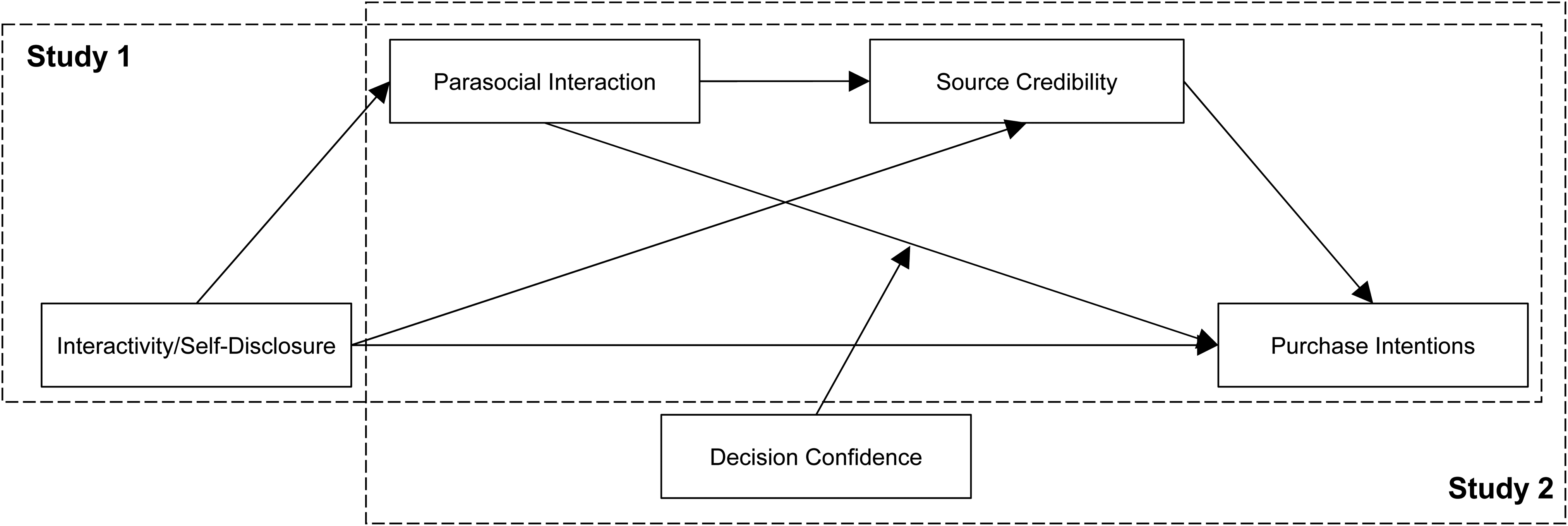
Research model.
Study 1: Fostering Parasocial Interaction in C2C Video Reviews
To determine how parasocial interaction can be fostered in C2C reviews, we conducted a 2 × 2 between-subjects experiment in which we manipulated interactivity (present vs. absent) and self-disclosure (present vs. absent). Prior research on parasocial interactions and relationships offers some insights on interactivity and self-disclosure techniques, but the findings are mixed and relate to communications by media personalities rather than regular consumers. Thus, before developing and filming our experimental conditions, we aimed to determine how the authors of C2C video reviews employ interactivity and self-disclosure in their communications.
Accordingly, we collected and coded typical C2C video reviews to determine what attributes indicate the absence or presence of interactivity and self-disclosure in practice. From these findings, we developed textual scripts for the four experimental conditions that we pretested. Because the manipulation checks for the absence or presence of interactivity and self-disclosure were successful, we recorded video reviews based on the scripts. We employed these recordings as the manipulations in Study 1 and part of the manipulations in Study 2.
Coding C2C video reviews
First, we collected typical C2C video reviews to develop the manipulations for Study 1. To ensure maximum variation and generalizability, we focused on four product categories reflecting high- or low-involvement products (Floyd et al. 2014) that provide hedonic or utilitarian benefits (Hirschman and Holbrook 1982). To determine what categories are particularly meaningful to consumers, we visited Reviewed.com and selected “tech” as hedonic high-involvement, “beauty” as hedonic low-involvement, “kitchen and cooking” as utilitarian high-involvement, and “laundry and cleaning” as utilitarian low-involvement product categories. Next, we searched Amazon for the most purchased products in each category, and we found that Razer Blade 15 gaming laptop (tech), Maybelline SuperStay lipstick (beauty), Keurig K-Mini Single Serve coffee maker (kitchen and cooking), and Tide liquid detergent (laundry and cleaning) were the most popular in their categories. Then, we used an incognito browser window to search for video reviews for each product on YouTube, limiting the results to videos published within a year of search date. The search returned 165 reviews. We did not adjust the order of the search results because consumers tend to watch or read reviews that are easily accessible and do not require much effort (Baek, Ahn, and Choi 2012).
For coding, we included only reviews in English that were shared by regular consumers (and not by professional organizations or experts). After excluding reviews that did not fulfill these criteria, we proceeded to code 106 C2C video reviews. To develop the coding scheme, we defined four interactivity and six self-disclosure approaches on the basis of prior parasocial interaction literature. The identified interactivity approaches pertain to fostering one-sided connection through communications with celebrities, influencers, and brands (Beege et al. 2019; Munnukka et al. 2019), and these approaches include having a conversational style in communications, creating an illusion of responsiveness and listening, referring to previous communications, and addressing the audience directly. The self-disclosure approaches that studies of parasocial relationships with celebrities and influencers (Chung and Cho 2017; Kim, Zhang, and Zhang 2016) discuss include providing basic personal information, revealing more personal information, sharing professional information, expressing emotions, sharing personal (negative) experiences, and performing product- or service-related tasks.
We used the defined interactivity and self-disclosure approaches as the basis for our coding scheme. Table 2 introduces the disparate interactivity and self-disclosure techniques identified in extant literature and provides illustrative examples derived from our coding of typical C2C video reviews. With this coding, we could identify how reviewers foster interactivity and self-disclosure in video reviews, which guided the development of the scripts employed in our experimental studies.
Examples of Interactivity and Self-Disclosure Communication Techniques
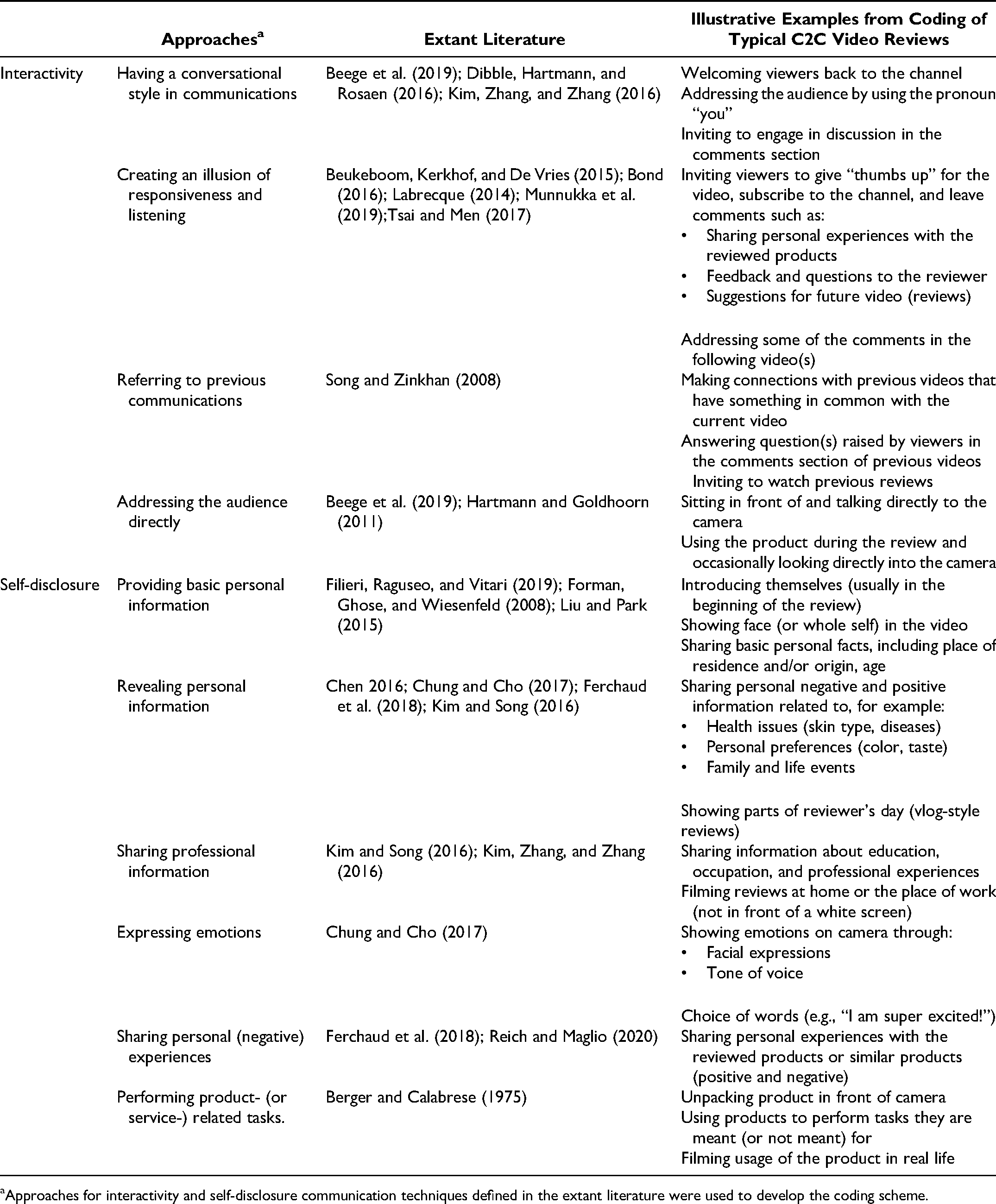
aApproaches for interactivity and self-disclosure communication techniques defined in the extant literature were used to develop the coding scheme.
Interactivity and self-disclosure manipulation pretest
For Study 1, we developed reviews for a backpack, which is a product most consumers can easily imagine buying. Because participants in our study were based in the United States, we chose a Scandinavian brand, Sandqvist, to avoid any preexisting biases about the brand. According to our coding findings, we developed scripts for four reviews that each reflect interactivity (absent or present) and self-disclosure (absent or present). We then pretested these manipulations in text format before filming video reviews.
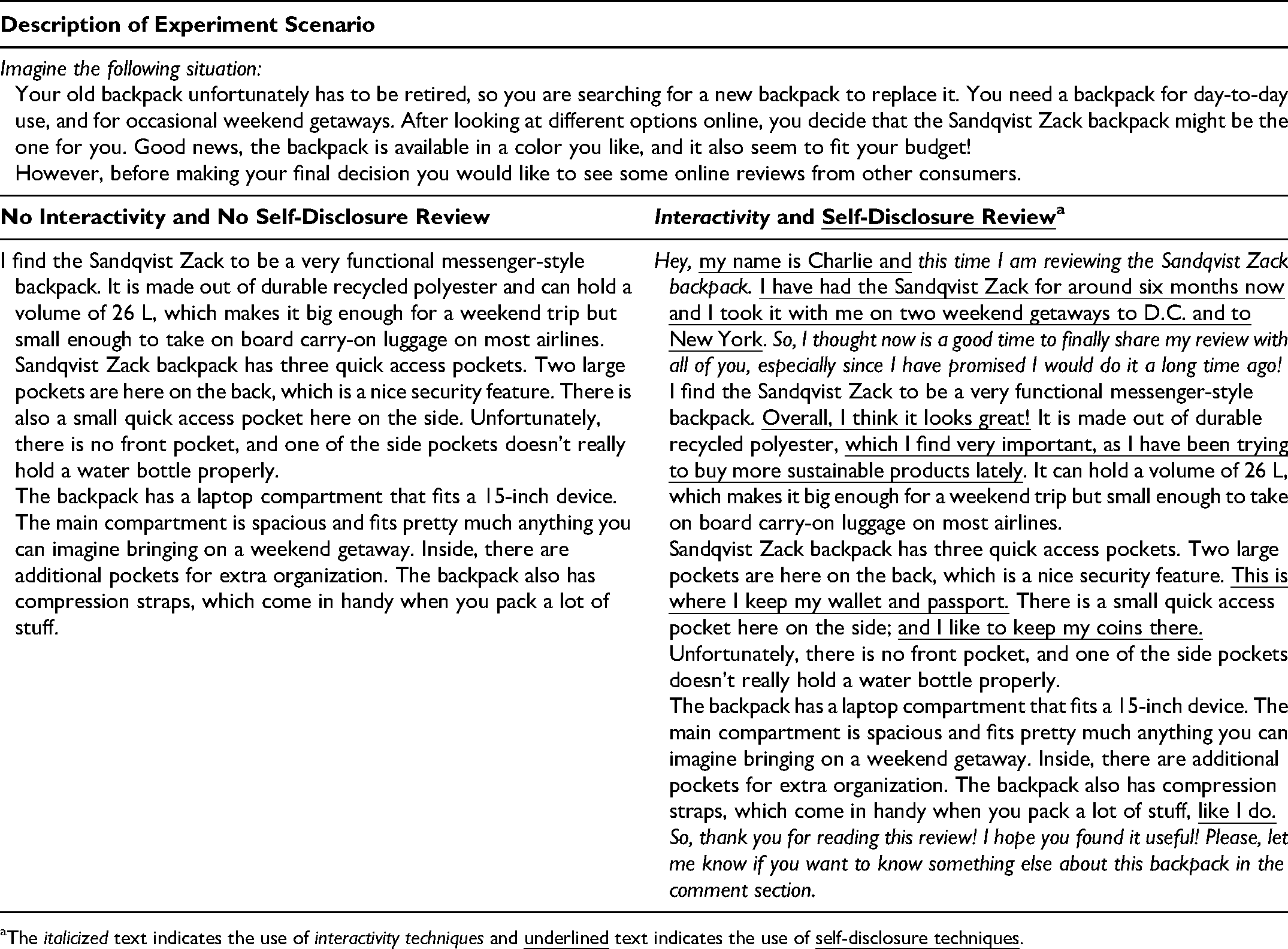
In total, 132 respondents (75% aged 25–44 years, 53% men, and 85% had at least a bachelor's degree) participated in this pretest via Amazon Mechanical Turk (MTurk). First, we instructed participants to imagine they needed a new backpack and were considering whether to purchase the Sandqvist Zack backpack. Next, participants viewed images of the backpack from Sandqvist.com. We then randomly exposed participants to one of the four textual review conditions, after which they completed a brief survey. Appendix A introduces the scenario and examples of reviews used in the experiment.
For manipulation checks, we used interactivity (e.g., “The reviewer encourages me to communicate directly with him,” “The reviewer would listen to what I have to say”) and self-disclosure (e.g., “The reviewer reveals personal information,” “The reviewer shows his emotions”) items on seven-point Likert scales (1 = “strongly disagree,” and 7 = “strongly agree”) adapted from Labrecque (2014) and Chung and Cho (2017). Participants in the interactivity conditions experienced a stronger sense that they were engaged in a two-sided communication (Mno interactivity = 3.96, Minteractivity = 5.16; F(1, 131) = 32.25, p < .01, η2 = .20), and participants in the self-disclosure conditions believed the reviewer shared personal information (Mno self-disclosure = 4.08, Mself-disclosure = 5.17; F(1, 131) = 33.38, p < .01, η2 = .20). The pretest showed that the manipulations of interactivity and self-disclosure worked as expected, so we proceeded with the production of video reviews for each of the four conditions.
Experimental design and procedure
We selected a young man to portray the reviewer in the four C2C video reviews for our experiment. He dressed neutrally and spoke fluent English. The script in each condition was the same as in the pretest, with minor adjustments to reflect the review format (e.g., “thanks for watching” instead of “thanks for reading”). The reviews were recorded against a white background without any identifying objects that could signal additional information about the reviewer. To keep the conditions as consistent as possible, we recorded each stand-alone part separately (i.e., no interactivity, interactivity, no self-disclosure, self-disclosure), then edited the relevant parts to create the four conditions (i.e., no interactivity–no self-disclosure, no interactivity–self-disclosure, interactivity–no self-disclosure, and interactivity–self-disclosure). The review of the backpack was identical in all four reviews, but the interactivity and self-disclosure footage differed according to the presence or absence in each manipulation. 1
Participants
We recruited MTurk workers who had at least 95% approval ratings and were based in the United States. From the 196 MTurk workers who completed the survey, we excluded participants who spent less than four minutes to finalize the survey, as well as those who did not pass all the screening questions (e.g., “Do you typically search for online reviews of products?”) and attention checks (e.g., “What was the review about?”). To ensure participants watched the videos with the sound on, we exposed them to animal sounds (i.e., a cat meowing) prior to the manipulation and excluded any participants who could not correctly identify the animal sound. As a result, we proceeded with 156 usable responses (84% aged 25–44 years, 60% men, and 85% had at least a bachelor's degree) for our data analysis.
Measures
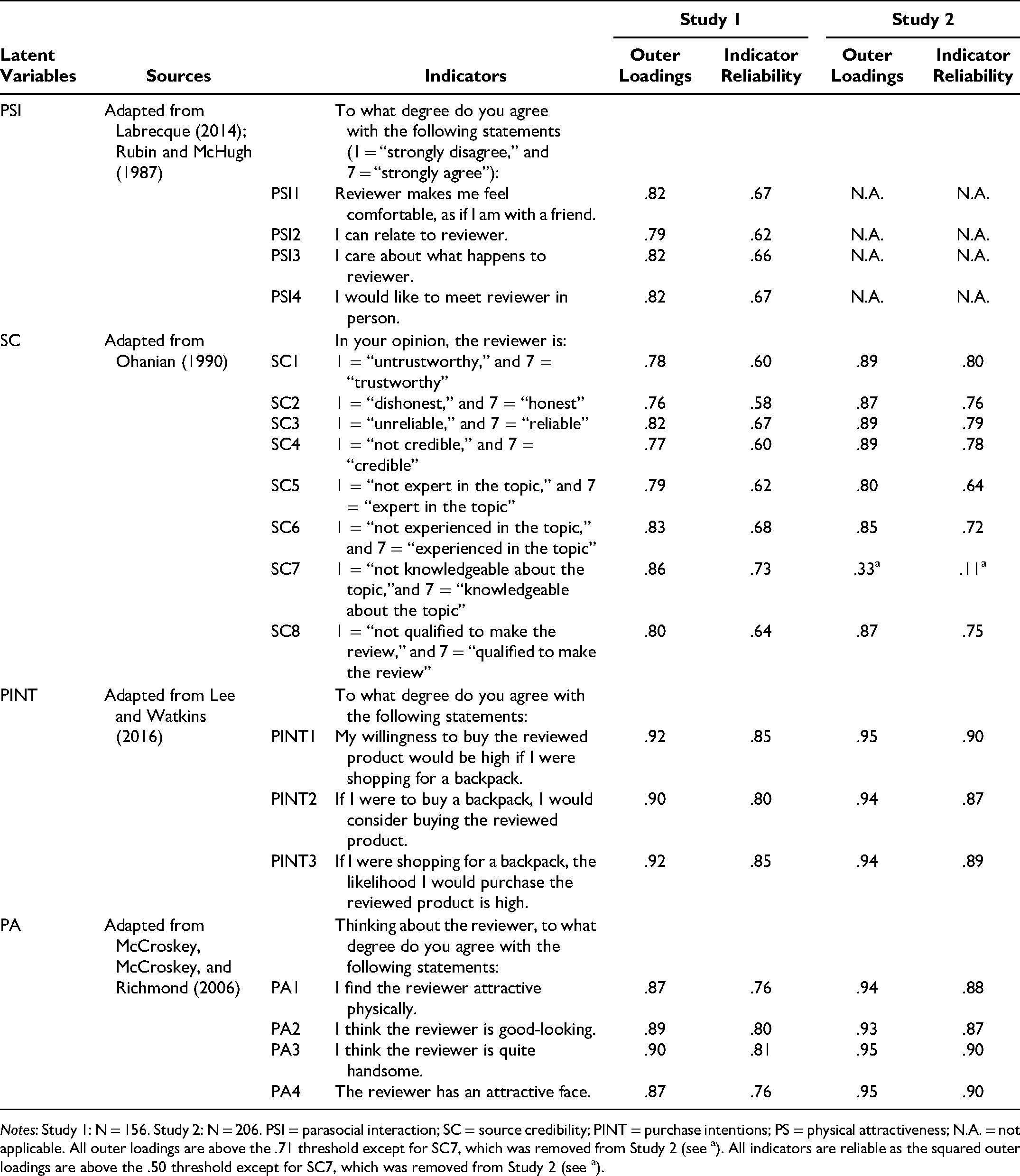
We adapted the measures for parasocial interaction from Labrecque (2014) and Rubin and McHugh (1987). For the interactivity and self-disclosure manipulation checks, we used the same scales as in the pretest. We employed an eight-item scale from Ohanian (1990) to measure source credibility, and we used three items adapted from Lee and Watkins (2016) to measure consumer purchase intentions. Because the reviewer was visible in the video reviews we created, we used physical attractiveness as a control, which was measured with four items from McCroskey, McCroskey, and Richmond (2006). All scales are presented in Appendix B.
Manipulation checks
As expected, participants in the interactivity conditions experienced a stronger feeling of a two-sided communication (Mno interactivity = 4.75, Minteractivity = 5.76; F(1, 155) = 41.00, p < .01, η2 = .22). Participants in the self-disclosure conditions thought the reviewer shared more personal information (Mno self-disclosure = 4.56, Mself-disclosure = 5.64; F(1, 155) = 42,73, p < .01, η2 = .22). Thus, the manipulations in the video format were successful. We also asked participants whether they think the reviewer is a regular consumer (1 = “strongly disagree,” and 7 = “strongly agree”), and on average (M = 5.63, SD = 1.11), the participants believed the reviewer was a regular consumer.
Partial least squares structural equation modeling results
We estimated the Study 1 part of our model (see Figure 1) in SmartPLS 3 using the partial least squares algorithm with 10,000 bootstraps (complete bootstrapping with the percentile method to construct confidence intervals; Hair et al. 2021). From the manipulations, we created dummy variables for interactivity (INT; 0 = absent, 1 = present) and self-disclosure (SD; 0 = absent, 1 = present). Parasocial interaction (PSI), source credibility (SC), and purchase intention (PINT) were measured with scales adapted from extant studies (see Appendix B). We controlled for the impact of age (0 = under age 35, 1 = age 35 and over), gender (0 = female, 1 = male), frequency of searching for video reviews when shopping online (0 = half of the time or less, 1 = most of the time or always), and the reviewer's physical attractiveness (PA; scale adapted from extant studies; see Appendix B) on the PINT outcome.
Measurement model
Convergent validity is established because the outer loadings for each construct are above the threshold of .70, and the average variance extracted (AVE) is above the threshold of .50 (see Table 3; Hair et al. 2021). Internal consistency reliability is also established because the reliability coefficient (ρA), composite reliability (ρC), and Cronbach's Alpha (α) values for each construct are above the threshold of .70 (Hair et al. 2021). Finally, discriminant validity is established on the basis of the Fornell–Larcker criterion (Table 3, left triangle) in which the square root of AVE for each construct is higher than that construct's highest correlation with any other construct in the model. Discriminant validity is also established on the basis of the heterotrait–monotrait (HTMT) criterion because all HTMT ratios (Table 3, right triangle) are lower than the .85 threshold, whereas percentile bootstrapped (10,000 samples) HTMT confidence intervals do not include the threshold value of .85 (Hair et al. 2021). Because reliability and validity criteria have been met, we can proceed to assess the structural model results.
Study 1: Reliability and Validity Criteria
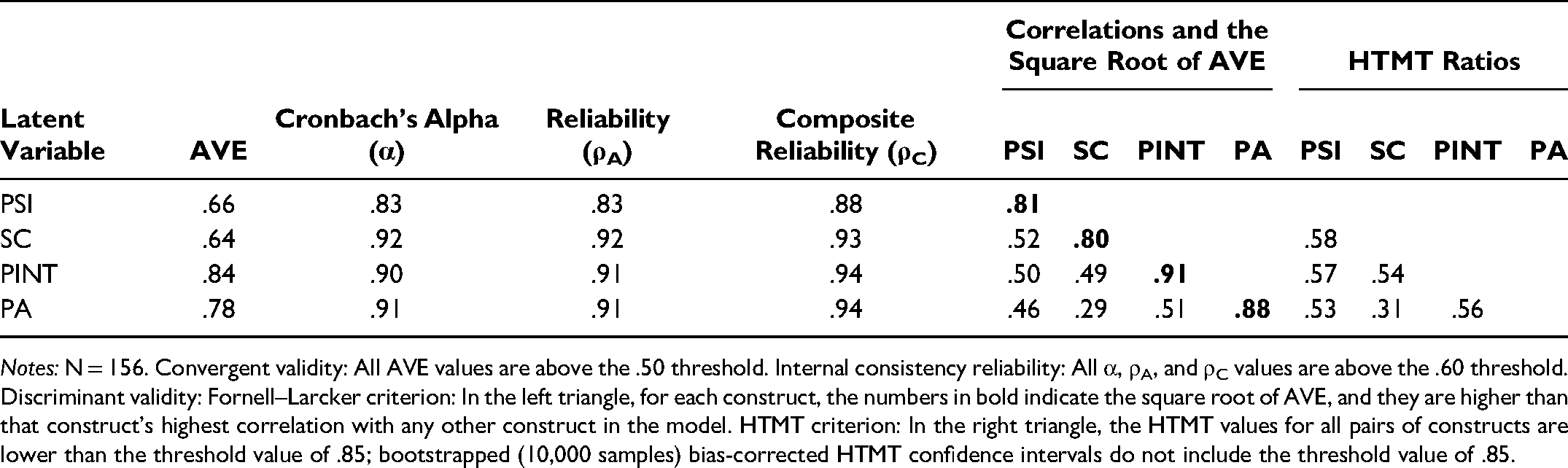
Notes: N = 156. Convergent validity: All AVE values are above the .50 threshold. Internal consistency reliability: All α, ρA, and ρC values are above the .60 threshold. Discriminant validity: Fornell–Larcker criterion: In the left triangle, for each construct, the numbers in bold indicate the square root of AVE, and they are higher than that construct's highest correlation with any other construct in the model. HTMT criterion: In the right triangle, the HTMT values for all pairs of constructs are lower than the threshold value of .85; bootstrapped (10,000 samples) bias-corrected HTMT confidence intervals do not include the threshold value of .85.
Structural model
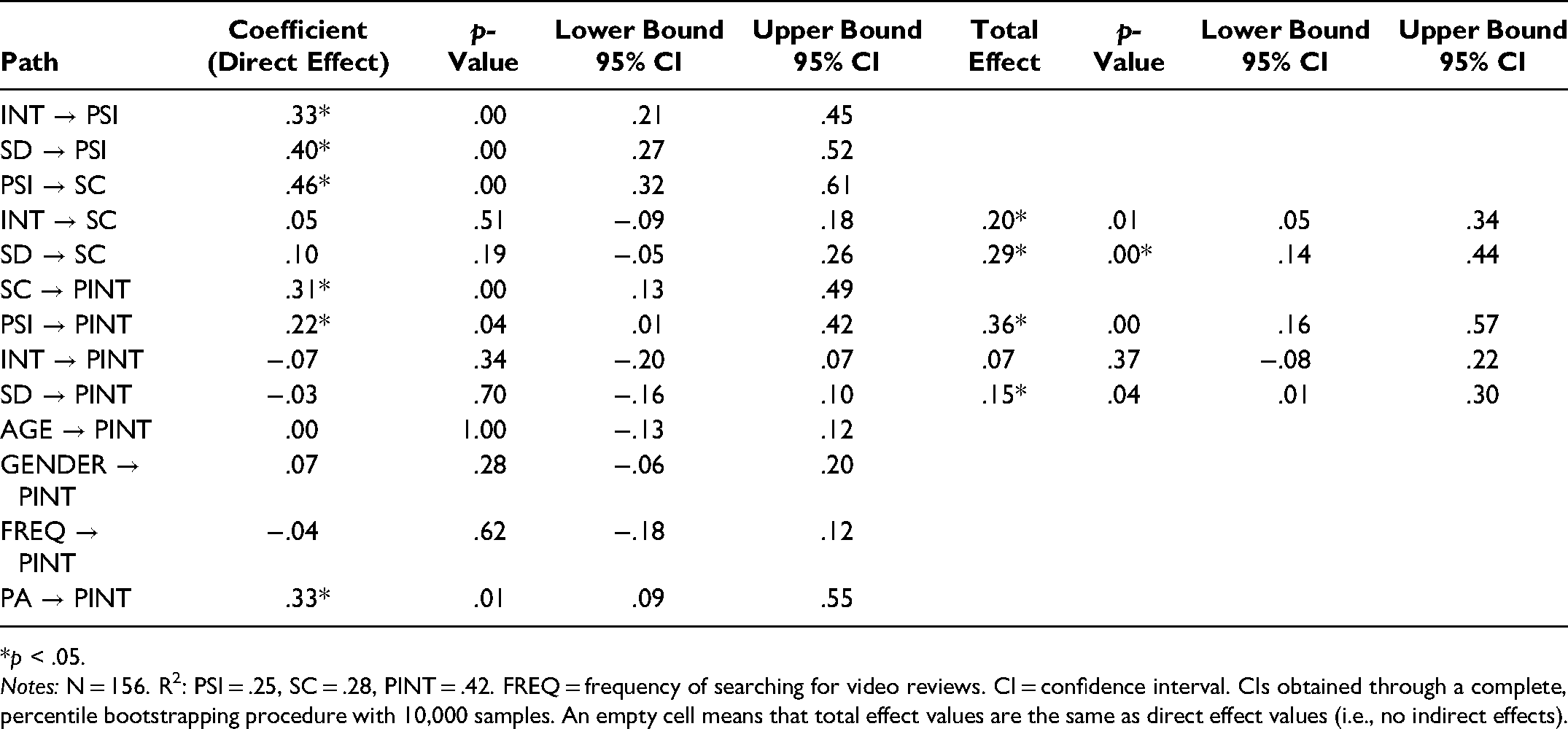
The inner variance inflation factor (VIF) values for all combinations of constructs are below the threshold of 3, whereas the outer VIF values of all indicators are under the threshold of 5. Therefore, collinearity among the predictor constructs is not a critical issue in the structural model (Hair et al. 2021). The R2 values of the latent variables are .25 for PSI, .28 for SC, and .42 for PINT. In Table 4, we present the standardized path coefficients (i.e., the direct effect of one construct on another) and total effects (i.e., the sum of direct and indirect effects of one construct on another). The significance of each effect is assessed with the bootstrapped confidence intervals; if 0 is not included in the confidence interval, the path coefficient is significant at the .05 significance level. To ease interpretation, we also present the p-values. For significant direct effects we present the f2 effect size with values of .02, .15, and .35, indicating small, medium, and large effects (Hair et al. 2021).
Study 1: Direct Effects (Path Coefficients) and Total Effects
*p < .05.
Notes: N = 156. R2: PSI = .25, SC = .28, PINT = .42. FREQ = frequency of searching for video reviews. CI = confidence interval. CIs obtained through a complete, percentile bootstrapping procedure with 10,000 samples. An empty cell means that total effect values are the same as direct effect values (i.e., no indirect effects).
Hypothesis testing
The path coefficients in Table 4 show significant, positive direct effects of INT on PSI (.33, p < .01, f2 = .15) and SD on PSI (.40, p < .01, f2 = .21). 2 PSI, in turn, has a significant, positive direct effect on SC (.46, p < .01, f2 = .22). The direct effects of INT and SD on SC are positive but not significant. Both SC (.31, p < .01, f2 = .12) and PSI (.22, p = .04, f2 = .04) have significant, positive direct effects on PINT. In terms of covariates, we see a significant, positive direct effect of PA on PINT (.33, p = .01, f2 = .13).
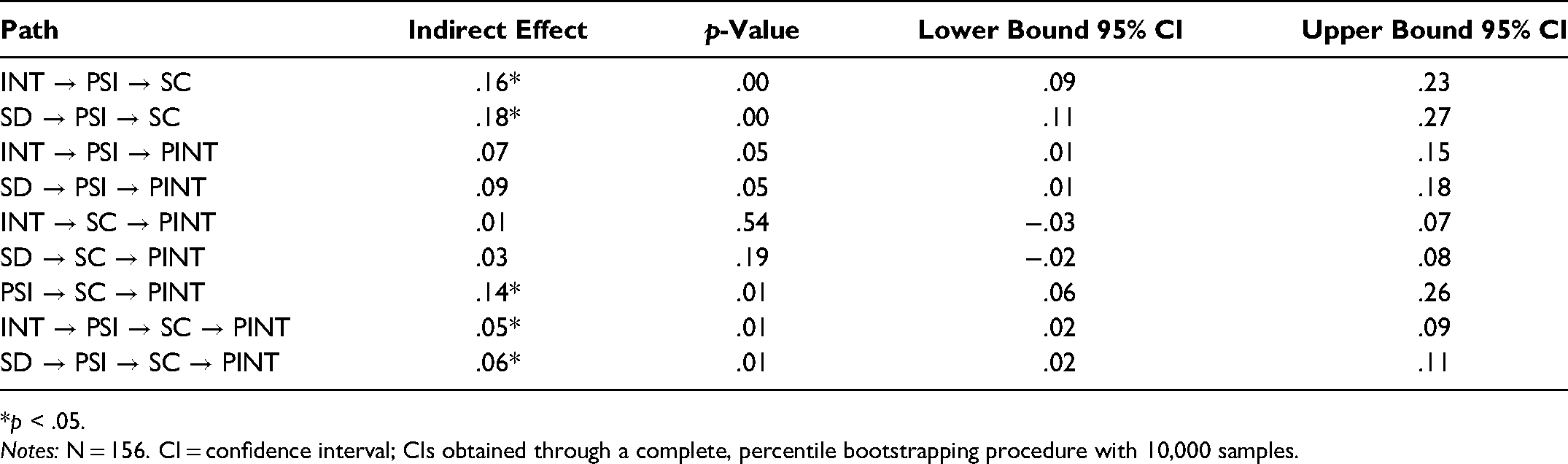
In Table 5 we present the specific indirect effects and their significance. The indirect effects of INT on SC through PSI (.16, p < .01) and SD on SC through PSI (.18, p < .01) are significant. The results therefore indicate indirect-only (i.e., full) mediation (Hair et al. 2021). These results provide support to H1 and H2. As illustrated in Table 5, the indirect effect of PSI on PINT through SC (.14, p = .01) is significant, thus indicating partial mediation. Because all coefficients are positive, the partial mediation is complementary (Hair et al. 2021). These results provide support to H3. Finally, we also find evidence for serial mediation with significant indirect effects INT → PSI → SC → PINT (.05, p = .01) and SD →PSI →SC →PINT (.06, p = .01).
Study 1: Indirect Effects
*p < .05.
Notes: N = 156. CI = confidence interval; CIs obtained through a complete, percentile bootstrapping procedure with 10,000 samples.
Study 2: Decision Confidence and Parasocial Interaction in C2C Video Reviews
To examine the extent to which parasocial interaction influences the purchase intentions of consumers experiencing differing levels of decision confidence, we designed a 2 (decision confidence low vs. high) × 2 (parasocial interaction weak vs. strong) between-subjects experiment with repeated measurement of purchase intentions. In addition to testing H4, the data collected in the experiment enabled us to also address H3.
Decision confidence manipulation pretest
University students taking part in two courses (49 in one course and 40 in the other) volunteered to participate in the pretest. Participants received the same instructions as in Study 1, about wanting to purchase a new backpack, and viewed images of the same backpack. However, this time our instructions included one of two additional pieces of information: During your search, you find a mix of positive and negative reviews across different websites. In particular, you learn that while some people are very satisfied with the backpack, others are quite disappointed with it. (Low level of decision confidence condition)
During your search, you find a lot of positive reviews across different websites. In particular, you learn that most people are very satisfied with the backpack. (High level of decision confidence condition)
For the manipulation check, we used a seven-point Likert decision confidence scale (e.g., “I am confident that this backpack is the best choice for me,” “I am sure that I should choose this backpack”) adapted from Langan, Besharat, and Varki (2017) (1 = “strongly disagree,” and 7 = “strongly agree”). The manipulation check for decision confidence (DC) was successful for participants in the first course (Mlow DC = 3.28, Mhigh DC = 5.49; F(1, 48) = 99.51, p < .01, η2 = .69) and second course (Mlow DC = 3.80, Mhigh DC = 5.25; F(1, 39) = 22.15, p < .01, η2 = .37). Similar to Study 1, we asked participants whether they think the reviewer is a regular consumer (1 = “strongly disagree,” and 7 = “strongly agree”), and, again, on average (M = 5.47; SD = 1.11), the participants believed the reviewer was a regular consumer.
Experimental design and procedure
We randomly assigned participants to one of the four conditions in our 2 (decision confidence low vs. high) × 2 (parasocial interaction weak vs. strong) experimental design. Like the pretest, participants were exposed to low or high decision confidence situations, after which we measured their backpack purchase intentions. Next, they each viewed a video review that fostered either weak or strong parasocial interaction, then provided answers to a brief survey that included purchase intention questions for the second time. We employed the video review without interactivity and without self-disclosure from Study 1 to operationalize the weak parasocial interaction condition and the video review with interactivity and with self-disclosure from Study 1 to operationalize the strong parasocial interaction condition. We operationalized parasocial interaction as weak versus strong (rather than present vs. absent) because Study 1 revealed that even when interactivity and self-disclosure are absent, consumers still experience somewhat neutral interaction with reviewers (M = 4.55), which is likely a result of the dynamic and vivid nature of the video review format.
Participants
We recruited MTurk workers who had at least 95% approval ratings and were based in the United States. From the 219 completed surveys, we excluded 13 responses, following the same procedure as in Study 1. Next, we analyzed the responses of 206 participants (76% aged 25–44 years, 52% men, and 81% had at least a bachelor's degree).
Measures
We used the same measures as in Study 1 for source credibility and consumer purchase intentions. We measured purchase intentions twice: First, after participants were introduced to the scenario with either low or high decision confidence levels, then after participants watched the video review with either weak or strong parasocial interaction. Thus, we could determine the change in consumer outcomes caused by parasocial interaction fostered in video reviews. For manipulation checks, we used the scales for parasocial interaction (Labrecque 2014; Rubin and McHugh 1987) and decision confidence (Langan, Besharat, and Varki 2017). Last, we used the physical attractiveness measures from Study 1 as controls (see Appendix B).
Manipulation checks
Participants in the strong parasocial interaction (PSI) condition experienced a higher level of parasocial interaction: (Mweak PSI = 4.63, Mstrong PSI = 5.59; F(1, 205) = 37.57, p < .01, η2 = .16). Furthermore, participants in the high DC condition were more certain about making their decisions prior to exposure to the video reviews (Mlow DC = 4.03, Mhigh DC = 5.71; F(1, 205) = 99.19, p < .01, η2 = .33). Thus, the manipulations were successful.
Repeated measures results
For the analysis, we created dummy variables for PSI (0 = weak, 1 = strong) and DC (0 = low, 1 = high). Because we measured purchase intention (PINT) before and after the PSI treatment, we were able to perform repeated measures analysis to test H4. The results show a significant increase in PINT in the low DC condition after exposure to C2C video reviews with strong PSI (Mpre = 4.33, Mpost = 5.62; F(1, 53) = 62.12, p < .01, η2 = .54). But we find only a slight, nonsignificant increase after C2C reviews with weak PSI (Mpre = 4.25, Mpost = 4.43; F(1, 56) = 1.89, p = .18, η2 = .03). Furthermore, the PINT of consumers with high levels of DC significantly decreased after exposure to C2C video reviews that fostered weak PSI (Mpre = 5.72, Mpost = 5.20; F(1, 45) = 1,955.07, p < .03, η2 = .98) and only slightly, but nonsignificantly, increased after exposure to reviews that fostered strong PSI (Mpre = 5.95, Mpost = 6.06; F(1, 48) = 1.28, p = .26, η2 = .03). Figure 2 depicts the changes in consumer PINT in each condition. These outcomes confirm H4.
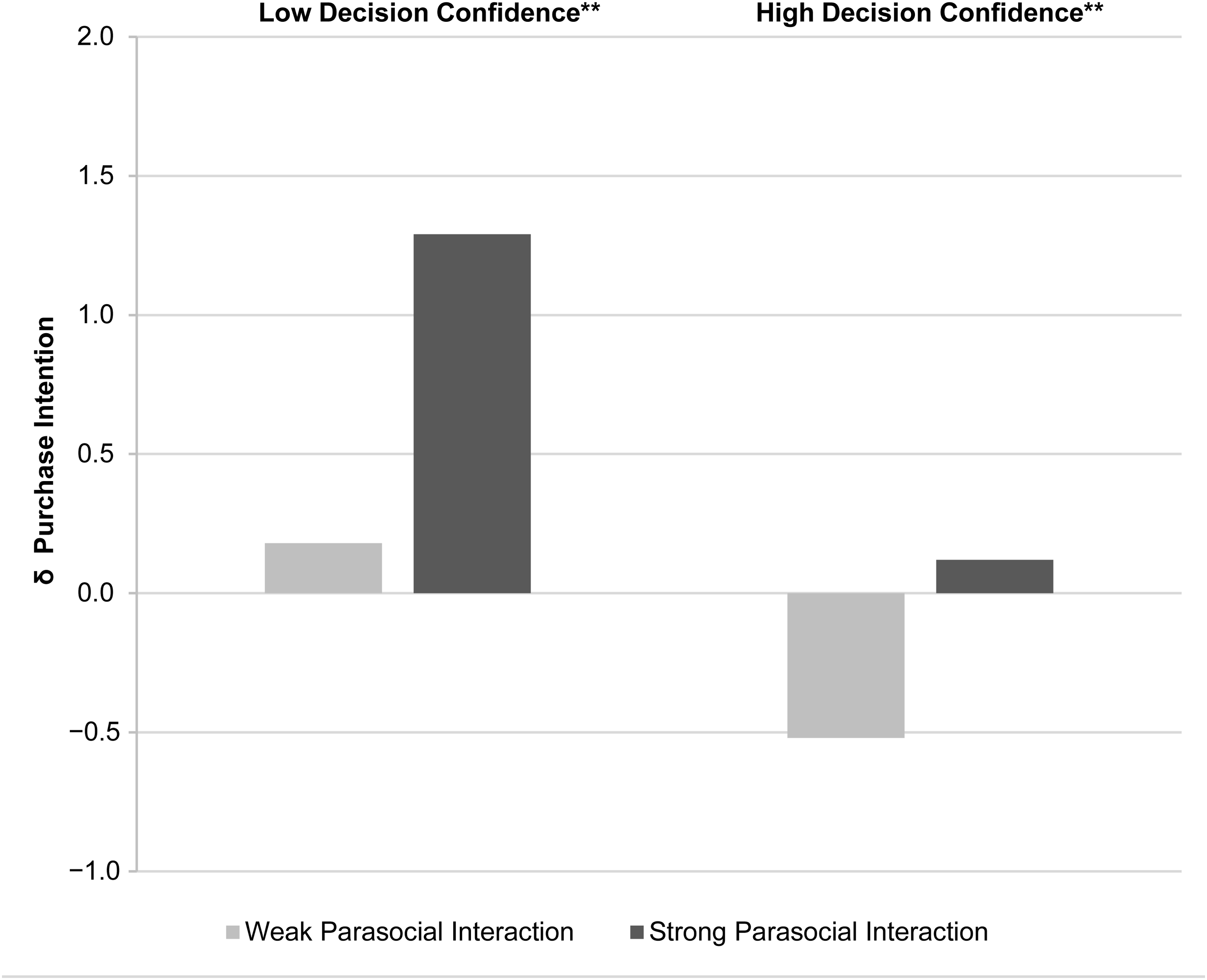
Changes in consumer purchase intentions (Study 2).
Partial least squares structural equation modeling results
To compare our H3 findings, we estimated the Study 2 part of our model (see Figure 1) in SmartPLS 3 using the same settings and procedure as in Study 1. PSI and DC were computed as dummy variables based on the manipulations as previously described. Source credibility (SC) and PINT were measured with the same scales as in Study 1. For this analysis we employed PINT after exposure to the C2C videos as the outcome variable (see Appendix B). We had to remove one SC indicator because of poor outer loadings. We included the same covariates as in Study 1: the dummy variables for age, gender, frequency of looking for reviews prior to purchase, and reviewer’s physical attractiveness (PA).
In terms of the measurement model, the reliability and validity criteria are met (see Table 6). In the structural model, the inner VIF values for all combinations of constructs are below the threshold of 3. However, the outer VIF value of one of the PA indicators was above the threshold of 5, so that indicator was removed. The R2 values of the latent variables are .20 for SC and .38 for PINT. In Table 7, we present the standardized path coefficients and total effects.
Study 2: Reliability and Validity Criteria
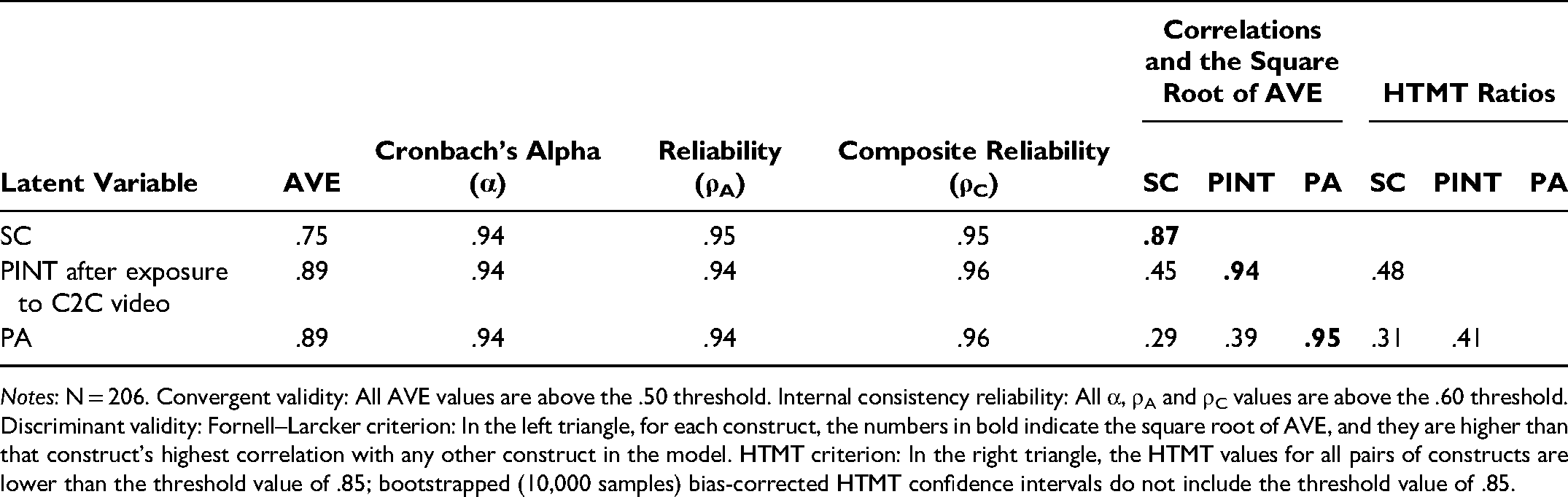
Notes: N = 206. Convergent validity: All AVE values are above the .50 threshold. Internal consistency reliability: All α, ρA and ρC values are above the .60 threshold. Discriminant validity: Fornell–Larcker criterion: In the left triangle, for each construct, the numbers in bold indicate the square root of AVE, and they are higher than that construct's highest correlation with any other construct in the model. HTMT criterion: In the right triangle, the HTMT values for all pairs of constructs are lower than the threshold value of .85; bootstrapped (10,000 samples) bias-corrected HTMT confidence intervals do not include the threshold value of .85.
Study 2: Direct Effects (Path Coefficients) and Total Effects
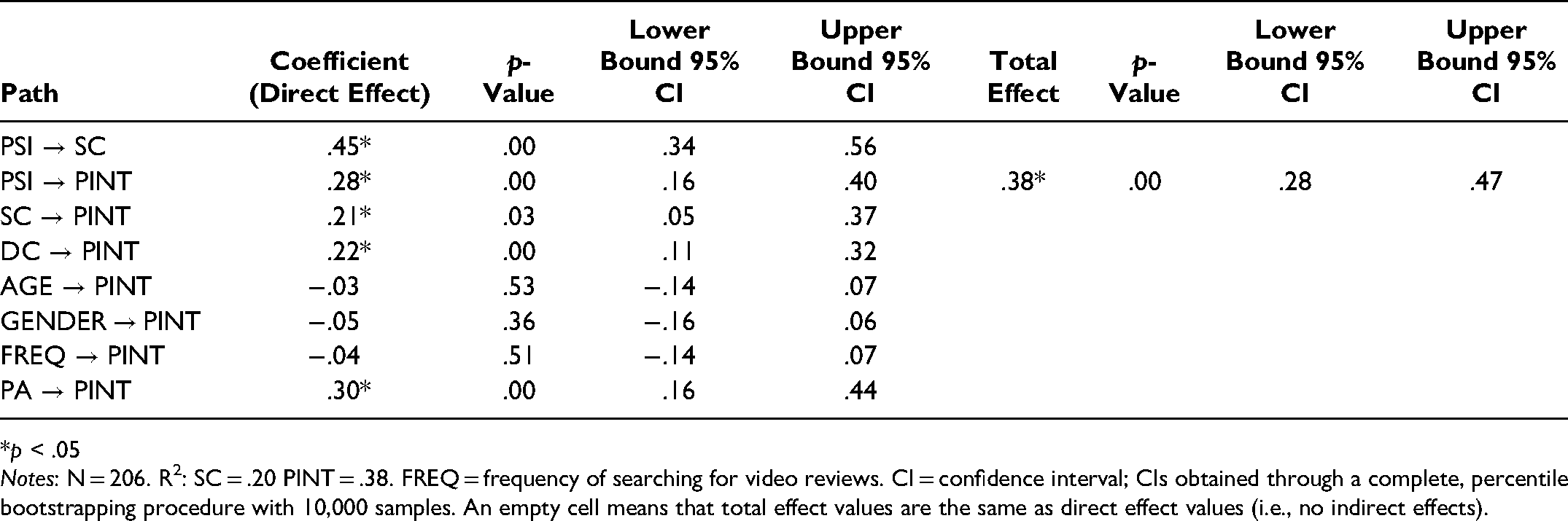
*p < .05
Notes: N = 206. R2: SC = .20 PINT = .38. FREQ = frequency of searching for video reviews. CI = confidence interval; CIs obtained through a complete, percentile bootstrapping procedure with 10,000 samples. An empty cell means that total effect values are the same as direct effect values (i.e., no indirect effects).
The path coefficients in Table 7 show significant, positive direct effects of PSI on SC (.45, p < .01, f2 = .26). SC, in turn, has a significant, positive direct effect on PINT (.21, p = .01, f2 = .05). PSI has a significant, positive direct effect on PINT (.28, p < .01, f2 = .10), whereas DC has a significant, positive direct effect on PINT (.22, p < .01, f2 = .08). In terms of the covariates, we see a significant, positive direct effect of PA on PINT (.30, p < .01, f2 = .13). The only indirect effect in the model PSI → SC → PINT (.10, p = .01, [.02, .17]) is significant. Thus, we find evidence for complementary partial mediation (Hair et al. 2021) of PSI on PINT through SC and replicate the H3 results of Study 1.
Discussion and Conclusions
In this article, we examine the role of C2C video reviews in influencing consumer purchase decisions. According to a review of prior literature and our coding of C2C video reviews, we identify interactivity and self-disclosure as key communication techniques reviewers use to foster parasocial interactions with consumers. Both interactivity and self-disclosure exert strong influences on source credibility, with parasocial interaction as a mediator, such that consumers appear more likely to trust reviewers they establish personal connections with. Furthermore, Study 1 and Study 2 consistently show that source credibility mediates the positive relationship between parasocial interaction and consumer purchase intentions. That is, when consumers establish strong parasocial interactions with reviewers, they are more likely to rely on the information those reviewers share, which subsequently reflects on their purchase behaviors.
The outcomes of Study 2 further emphasize the importance of parasocial interaction in influencing consumer outcomes. Consumers are likely to be convinced by reviews that involve strong parasocial interaction, especially when consumers have low levels of decision confidence. By contrast, reviews that involve weak parasocial interaction may decrease consumers’ willingness to make purchases when they are confident about their decisions. From these results, we suggest that this decrease in purchase intentions occurs because of the significantly lowered perceptions of source credibility.
Theoretical Implications
Despite the increasing prevalence and importance of video reviews in facilitating consumer purchase decisions, previous research (Ifie 2020; Ordabayeva, Cavanaugh, and Dahl 2022) has primarily focused on C2C textual reviews. To address the lack of understanding about the role of C2C video reviews in influencing consumer purchase behaviors, we turn to parasocial interaction theory (Horton and Wohl 1956), which has previously not been applied in the context of C2C reviews. By doing so, we demonstrate that beyond developing relationships with media personalities over time (Chung and Cho 2017; Yuan et al. 2021), consumers can establish parasocial interaction during a single exposure to content shared by strangers. As a result, we offer three main theoretical contributions to interactive marketing research.
First, we contribute to the research on eWOM (Jiménez and Mendoza 2013; Pan and Chiou 2011) by examining how interactivity and self-disclosure influence source credibility in C2C video reviews. This research shows that an illusion of two-sided communication (Beege et al. 2019; Labrecque 2014) and availability of reviewers’ personal information (Chung and Cho 2017; Kim and Song 2016) in C2C video reviews strongly influence the degree to which consumers feel comfortable relying on information shared in these reviews because of strengthened parasocial interaction (Munnukka et al. 2019; Tsai and Men 2017). Furthermore, we suggest that forms of self-disclosure other than sharing of basic information (see Table 2) are likely to play a more central role in influencing the source credibility of C2C video reviews (cf. Baek, Ahn, and Choi 2012; Banerjee, Bhattacharyya, and Bose 2017) because C2C video reviews generally enable consumers to gain at least some basic information about reviewers (e.g., their appearance and voice). That is, source credibility is more likely to be informed by additional self-disclosure that is relevant to the subject of individual reviews. These findings provide novel insights into what can make C2C reviews more credible and, therefore, convincing.
Second, we expand the current understanding of how parasocial interactions with strangers (not celebrities and influencers; Chung and Cho 2017; De Jans, Cauberghe, and Hudders 2018) influence consumer behaviors in online environments (Camilleri 2017, 2020). In particular, we suggest that parasocial interaction (Hartmann and Goldhoorn 2011; Dibble, Hartmann, and Rosaen 2016) and source credibility (Filieri, Raguseo, and Vitari 2019; Racherla and Friske 2012) function together as mechanisms through which interactivity (Tsai and Men 2017) and self-disclosure (Ferchaud et al. 2018) influence consumers’ purchase intentions. That is, unlike other researchers (see Table 1), we focus on the development of parasocial interaction through a single encounter, which is highly common in the context of C2C video reviews. By doing so, we suggest that reviewers can foster parasocial interaction through interactivity and self-disclosure of their communications, which leads to improved source credibility and, consequently, greater purchase intentions.
Third, we contribute to the literature on consumer online decision making (Desender, Boldt, and Yeung 2018; Keh and Sun 2018) by evaluating the impacts of parasocial interaction on consumer outcomes in light of consumer decision confidence (Camilleri 2020; Ifie 2020). If consumers experience low levels of decision confidence, viewing C2C video reviews that foster strong parasocial interactions can lead to positive changes in their purchase intentions (Desender, Boldt, and Yeung 2018; Langan, Besharat, and Varki 2017). That is, we suggest that parasocial interaction from C2C video reviews explains consumers’ reasoning for following the advice received from complete strangers, particularly when consumers have reservations about their purchase decisions (Andrews 2013; Hong and Pavlou 2014). Surprisingly, although C2C video reviews with weak parasocial interaction have limited impact on the purchase intentions of consumers with low levels of decision confidence, they can decrease the purchase intentions of consumers with high levels of decision confidence. These findings point to the importance of parasocial interactions in C2C video reviews for guiding the decisions of various consumer groups.
Managerial Implications
Because video reviews have become increasingly popular, firms cannot ignore their effects on consumer purchasing behaviors. We offer some suggestions for how firms can use video reviews strategically to encourage consumer purchasing by leveraging parasocial interaction in situations in which firms have an opportunity to affect product-related messages and achieve better overall management of consumer purchase experiences (Grewal and Roggeveen 2020). In particular, firms should allow consumers to provide video reviews on their websites. Surprisingly, there are only a few retailers (e.g., Amazon, Nike) that permit consumers to attach videos to their reviews. By enabling this practice, firms can provide other consumers with easy access to additional information sources and help increase their purchase decision confidence (Keh and Sun 2018; Langan, Besharat, and Varki 2017).
Because recording video reviews requires more consumer effort than writing textual reviews, text remains a common format for C2C reviews. To motivate consumers to create video reviews, firms could remind them of opportunities to share product reviews in various formats when they return to retailers’ websites after purchasing. Firms could also consider sharing (e.g., reposting) selected C2C video reviews on their social media pages (and/or other owned media) to express appreciation for reviewers and motivate other consumers to make such reviews. For example, Fenty Beauty, a cosmetics company, actively reposts C2C reviews shared by consumers on its official Instagram page (@fentybeauty), especially when introducing new products. This practice of sharing C2C reviews also promotes positive eWOM and provides easy access to information for consumers seeking additional support for their purchase decisions.
Further, our findings may apply to firm-related communications other than eWOM that function like C2C reviews, such as employee advocacy or collaborations with third parties (e.g., influencers, professional review organizations). We provide guidelines for how to foster parasocial interaction and improve the credibility of messages on social media through interactivity and self-disclosure communication techniques (for practical examples, see Table 2). In turn, firms should share such information when providing briefings on how to communicate product-/service-related information. For example, they could suggest that media personalities include examples of personal experiences with products or ask audiences to share product-related opinions and experiences.
Finally, we propose that our findings can also benefit reviewers, particularly when they are looking to increase their followers/views on social media. C2C reviews provide information that consumers are willing to receive from media personalities with whom they have no existing relationship. Thus, reviewers can leverage C2C video reviews to establish strong parasocial interaction with new viewers (e.g., by using different interactivity and-self-disclosure communication cues), sparking further interest in other content they create.
Limitations and Further Research
Several limitations of our study point to opportunities for further research. Although we find that C2C video reviews can support consumer decision making, our subject was a backpack, a product consumers tend to be familiar with and can imagine purchasing. Nevertheless, while coding C2C video reviews, we noticed that products in high-involvement categories (e.g., gaming laptops) attracted considerably more reviews. Thus, continued research could examine diverse types of products (e.g., hedonic vs. utilitarian, high-involvement vs. low-involvement). Moreover, we focused on C2C reviews about products rather than services. Experiential services (e.g., airline travel, hotel stays) are becoming popular subjects of online reviews, so related video formats might be differentiators. Accordingly, researchers should also investigate whether C2C video reviews exert different influences on consumer purchase decisions in different service contexts. Finally, we aimed to clarify how parasocial interaction in C2C reviews affects consumers after they have been exposed to reviews by strangers. However, consumers may watch several video reviews before making their purchase decisions and each may feature negative or positive opinions. Additional research should examine how consumers experience parasocial interaction with multiple reviewers and determine any effects of the valence of individual reviews.
Footnotes
Experiment Scenario and Examples of Reviews in Pretest (Study 1).
|
|
|
|---|---|
| Imagine the following situation: Your old backpack unfortunately has to be retired, so you are searching for a new backpack to replace it. You need a backpack for day-to-day use, and for occasional weekend getaways. After looking at different options online, you decide that the Sandqvist Zack backpack might be the one for you. Good news, the backpack is available in a color you like, and it also seem to fit your budget! However, before making your final decision you would like to see some online reviews from other consumers. |
|
|
|
|
| I find the Sandqvist Zack to be a very functional messenger-style backpack. It is made out of durable recycled polyester and can hold a volume of 26 L, which makes it big enough for a weekend trip but small enough to take on board carry-on luggage on most airlines. Sandqvist Zack backpack has three quick access pockets. Two large pockets are here on the back, which is a nice security feature. There is also a small quick access pocket here on the side. Unfortunately, there is no front pocket, and one of the side pockets doesn't really hold a water bottle properly. The backpack has a laptop compartment that fits a 15-inch device. The main compartment is spacious and fits pretty much anything you can imagine bringing on a weekend getaway. Inside, there are additional pockets for extra organization. The backpack also has compression straps, which come in handy when you pack a lot of stuff. |
Hey, I find the Sandqvist Zack to be a very functional messenger-style backpack. Sandqvist Zack backpack has three quick access pockets. Two large pockets are here on the back, which is a nice security feature. The backpack has a laptop compartment that fits a 15-inch device. The main compartment is spacious and fits pretty much anything you can imagine bringing on a weekend getaway. Inside, there are additional pockets for extra organization. The backpack also has compression straps, which come in handy when you pack a lot of stuff, So, thank you for reading this review! I hope you found it useful! Please, let me know if you want to know something else about this backpack in the comment section. |
The italicized text indicates the use of interactivity techniques and
Latent Variables, Indicators, and Their Sources.
|
|
|
|
|
|
|||
|---|---|---|---|---|---|---|---|
|
|
|
|
|
||||
| PSI | Adapted from Labrecque (2014); Rubin and McHugh (1987) | To what degree do you agree with the following statements (1 = “strongly disagree,” and 7 = “strongly agree”): | |||||
| PSI1 | Reviewer makes me feel comfortable, as if I am with a friend. | .82 | .67 | N.A. | N.A. | ||
| PSI2 | I can relate to reviewer. | .79 | .62 | N.A. | N.A. | ||
| PSI3 | I care about what happens to reviewer. | .82 | .66 | N.A. | N.A. | ||
| PSI4 | I would like to meet reviewer in person. | .82 | .67 | N.A. | N.A. | ||
| SC | Adapted from Ohanian (1990) | In your opinion, the reviewer is: | |||||
| SC1 | 1 = “untrustworthy,” and 7 = “trustworthy” | .78 | .60 | .89 | .80 | ||
| SC2 | 1 = “dishonest,” and 7 = “honest” | .76 | .58 | .87 | .76 | ||
| SC3 | 1 = “unreliable,” and 7 = “reliable” | .82 | .67 | .89 | .79 | ||
| SC4 | 1 = “not credible,” and 7 = “credible” | .77 | .60 | .89 | .78 | ||
| SC5 | 1 = “not expert in the topic,” and 7 = “expert in the topic” | .79 | .62 | .80 | .64 | ||
| SC6 | 1 = “not experienced in the topic,” and 7 = “experienced in the topic” | .83 | .68 | .85 | .72 | ||
| SC7 | 1 = “not knowledgeable about the topic,”and 7 = “knowledgeable about the topic” | .86 | .73 | .33a | .11a | ||
| SC8 | 1 = “not qualified to make the review,” and 7 = “qualified to make the review” | .80 | .64 | .87 | .75 | ||
| PINT | Adapted from Lee and Watkins (2016) | To what degree do you agree with the following statements: | |||||
| PINT1 | My willingness to buy the reviewed product would be high if I were shopping for a backpack. | .92 | .85 | .95 | .90 | ||
| PINT2 | If I were to buy a backpack, I would consider buying the reviewed product. | .90 | .80 | .94 | .87 | ||
| PINT3 | If I were shopping for a backpack, the likelihood I would purchase the reviewed product is high. | .92 | .85 | .94 | .89 | ||
| PA | Adapted from McCroskey, McCroskey, and Richmond (2006) | Thinking about the reviewer, to what degree do you agree with the following statements: | |||||
| PA1 | I find the reviewer attractive physically. | .87 | .76 | .94 | .88 | ||
| PA2 | I think the reviewer is good-looking. | .89 | .80 | .93 | .87 | ||
| PA3 | I think the reviewer is quite handsome. | .90 | .81 | .95 | .90 | ||
| PA4 | The reviewer has an attractive face. | .87 | .76 | .95 | .90 | ||
Notes: Study 1: N = 156. Study 2: N = 206. PSI = parasocial interaction; SC = source credibility; PINT = purchase intentions; PS = physical attractiveness; N.A. = not applicable. All outer loadings are above the .71 threshold except for SC7, which was removed from Study 2 (see a). All indicators are reliable as the squared outer loadings are above the .50 threshold except for SC7, which was removed from Study 2 (see a).
Acknowledgments
We would like to thank Hannu Tikkanen for his help with data collection.
In loving memory of Veronica Liljander (1960–2022) who brought our team together and supported this research.
Editor
Sonja Gensler
Declaration of Conflicting Interests
The author(s) declared no potential conflicts of interest with respect to the research, authorship, and/or publication of this article.
Funding
The author(s) disclosed receipt of the following financial support for the research, authorship, and/or publication of this article: This research was supported by the Vuorineuvos Tekn. ja Kauppat.tri h.c. Marcus Wallenbergin Liiketaloudellinen Tutkimussäätiö (received by the corresponding author).