




Abstract
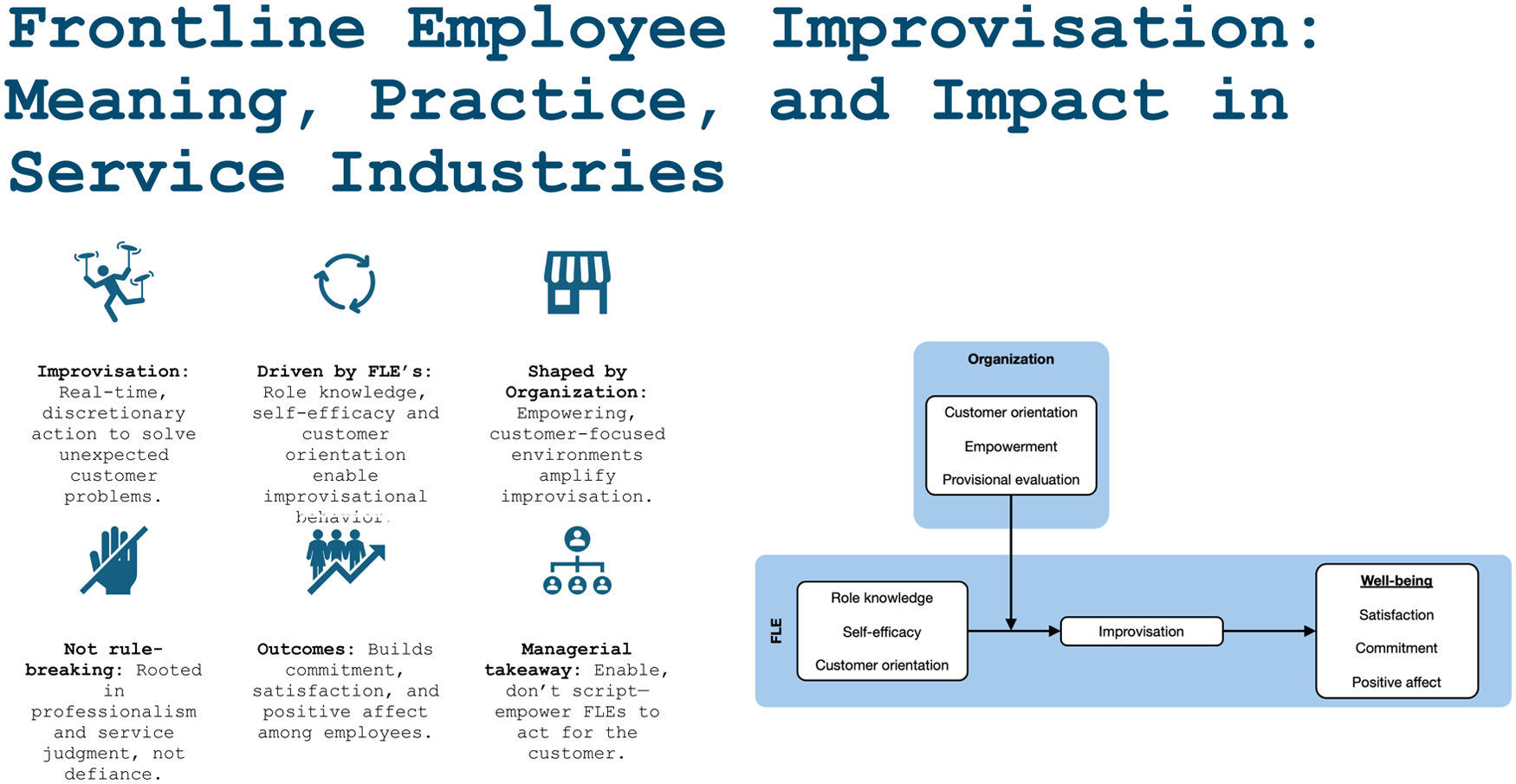
Frontline employees (FLEs) often encounter unpredictable customer requests and operational inconsistencies, forcing them to improvise and deviate from standardized procedures to provide high-quality service. Although the potential benefits of this behavior are well recognized, the understanding and practice of improvisation among FLEs still need to be clarified. This research, comprising two studies and a post hoc analysis, employs mixed methods to qualitatively uncover and quantitatively evaluate a model of FLEs’ interpretation and execution of improvisation. FLEs describe improvisation as a spontaneous, responsive, and discretionary effort to solve unexpected customer problems in real time. A conceptual model is developed based on data from FLEs across diverse service sectors, highlighting the connections between FLEs and organizational characteristics, as well as FLEs’ improvisational practices that remain consistent across their experiences. The model is then empirically examined in a diverse FLE sample. Collectively, the studies identify FLE traits and organizational factors that can be harnessed to enhance FLE improvisation in response to ever-evolving customer demands. Specifically, FLE self-efficacy and customer orientation, when combined with a customer-focused and empowering organizational context, can lead to increased FLE improvisation with customers. In addition, FLEs who display improvisation in their service activities report positive well-being outcomes. This research marks a first attempt to uncover FLEs’ perceptions of improvisation’s meaning and practice and to empirically evaluate a model rooted in their experiences.
Get full access to this article
View all access options for this article.
References
Supplementary Material
Please find the following supplemental material available below.
For Open Access articles published under a Creative Commons License, all supplemental material carries the same license as the article it is associated with.
For non-Open Access articles published, all supplemental material carries a non-exclusive license, and permission requests for re-use of supplemental material or any part of supplemental material shall be sent directly to the copyright owner as specified in the copyright notice associated with the article.
