



Abstract
Over the past 25 years, the service–profit chain (SPC) has become a prominent guidepost for service managers and researchers. In this article, we reflect on and synthesize published research to clarify what researchers have learned about the SPC and what remains less well understood. Based on an in-depth discussion of the field, we present a revised SPC and propose multiple areas in which further research would be worthwhile, such as internal service quality as specific systems of human resource management practices, both employee and customer well-being as additional mediators, different targets of employee and customer loyalty, contingencies, and non-linear and feedback effects. We conclude by reimagining the SPC, and we discuss digital and artificial-intelligence–driven changes to the SPC’s structure. Finally, based on the insights we discuss, we inform scholars of the current state of SPC research and provide a detailed agenda for future research.
Keywords
The service–profit chain (SPC) is one of the most prominent concepts in service research. It emphasizes the importance of internal and external service quality for firms’ long-term financial performance (Heskett et al. 1994). The SPC explicitly bridges between service companies’ internal and external environments; it establishes employee satisfaction, loyalty, and productivity as mediating variables between internal and external service quality, and it cites customer satisfaction and loyalty as mediators between external service quality and firms’ financial performance. Thus, the SPC links three parts: (a) internal marketing, which covers internal service quality, as well as employees’ attitudes and behavior; (b) external marketing, which encompasses external service quality, as well as customers’ attitudes and behavior; and (c) firm performance, which includes revenue growth and profitability. The SPC has gained considerable scholarly attention over the last 25 years, as the nearly 6500 citations (Google Scholar, 31 July 2021) of the seminal article by Heskett et al. (1994) show. Moreover, a growing number of companies are now prioritizing both service employees and customers in order to succeed (Chamberlain and Zhao 2019).
In this paper, we outline the development of SPC research over the past 25 years, reflecting what scholars have learned about the SPC from an empirical, theoretical, and methodological perspective. Further, we identify areas for future research on the original SPC. Moreover, we discuss ideas to revise the SPC, incorporating findings from SPC-related research areas. Finally, we develop suggestions on how to reimagine the SPC in light of services’ digital transformation.
Through this paper, we respond to three recent challenges facing service companies. First, the digital transformation of service work, as well as the implementation of service robots and artificial intelligence (AI), will change service employees’ roles, thereby shifting the meanings of internal service marketing for service provisions (e.g., Huang and Rust 2021a). Simultaneously, the digital transformation’s rise of service robots and artificial intelligence entails significant implications for the design of customer touchpoints and customers’ evaluations of services, and future SPC research must consider these implications (e.g., Hollebeek, Sprott, and Brady 2021). Second, well-being—as the outcome of employee and customer actions—increasingly influences transformative service research initiatives and it is gaining importance in companies’ developing a competitive edge (Krekel et al., 2019). Well-being might substitute or complement the SPC’s traditional satisfaction measures. Third, external market shocks and turbulent times—such as the COVID-19 (coronavirus disease 2019) pandemic—call for innovative coping strategies that enable employees to better handle ongoing transformations (Voorhees, Fombelle, and Bone 2020). These dynamics have not been considered in the SPC context, and the SPC’s ability to adapt to such external changes might need to increase. These challenges indicate the need to further develop the SPC. Accordingly, this article discusses potential refinements and extensions to the SPC. We also present promising avenues for future research to ensure that the important SPC concept is future-ready. Specifically, this article addresses the following research questions: How can scholars revise the SPC in order to advance the understanding of service firm performance, based on SPC research’s evolution over the past 25 years? How must scholars and managers reimagine the SPC so that it better aligns with the service sector’s recent digital transformation?
We enrich the service literature in several ways. First, based on our literature review, we identify research gaps that persist in the SPC literature. This overview will help researchers identify fruitful avenues through which to advance knowledge of the SPC. In particular, we suggest that future research should pinpoint human resource management (HRM) systems that determine internal service quality, consider customers’ and employees’ well-being as important variables alongside customers’ and employees’ satisfaction, differentiate between targets of employees’ and customers’ loyalty, examine the SPC’s contingencies, and consider non-linear and feedback effects between SPC variables. Second, we discuss current trends that may require scholars and managers to reimagine the SPC. Specifically, we discuss how the rise of AI and robotics in the service context might call for rethinking the SPC’s overall structure. Finally, we discuss potential methodological advances, such as the inclusion of non-linear effects, that will increase SPC research’s rigor. With this article, we hope to show that even after 25 years, the SPC remains an important concept for both service researchers and practitioners—and this importance will persist.
Reflecting on 25 Years of SPC Research
The SPC gained prominence as an integrative framework of service management, linking internal marketing (i.e., internal service quality, employee satisfaction, and employee loyalty and performance) to external marketing (i.e., external service quality, customer satisfaction, and loyalty) and, ultimately, firm performance (i.e., revenue and profitability) (see Figure 1). The SPC illustrates how investments in internal service quality translate into external service quality, in turn leading to satisfied and loyal customers—the basis of superior firm performance. Thus, it provides an interdisciplinary management framework. This framework integrates HRM’s and organizational behavior’s focus on service employees with management accounting’s focus on costs and measuring firm performance. Reflecting on 25 years of service–profit chain research.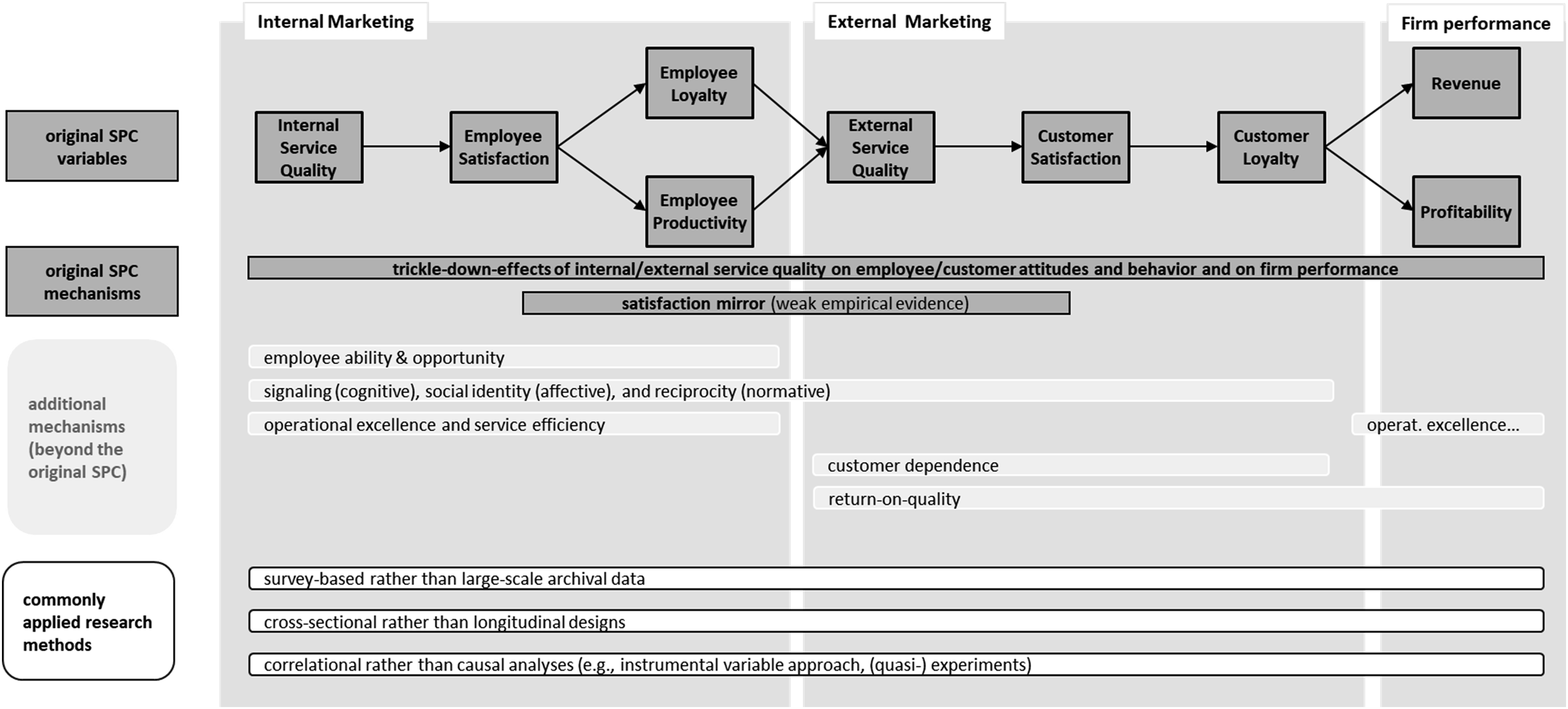
In the following section, we synthesize 25 years of SPC research, reflecting on (a) empirical studies that have tested the SPC, (b) the theoretical mechanisms that explain the links between internal and external marketing and firm performance, and (c) the methods that have been applied in SPC research. Based on these reflections, we identify future research opportunities that will help advance knowledge of the original SPC.
To assess the state of SPC research, we analyzed studies published between 1995 and 2020 that explicitly focused on the SPC. We conducted an elaborate literature search to identify relevant studies (see web appendices W1, W2, and W3). The resultant dataset comprises 153 empirical studies that reference the SPC in their title, abstract, or keywords, as well as studies that use the SPC as an important part of their theory. Moreover, we collected 35 theoretical and conceptual articles and books that (a) reference the SPC and situate it in a broader context, (b) use the SPC as a theoretical frame of reference in their discussions, or (c) develop (parts of) the SPC (see Web Appendix W4 for the full list of articles and books).
Reflections on Empirical Studies that Have Tested the SPC
In this section, we briefly delineate how empirical research on the SPC has evolved from the seminal paper by Heskett et al. (1994). Then, to identify future research opportunities, we review studies that have (a) tested the complete chain or focused on (b) internal marketing, (c) external marketing, or (d) firm performance.
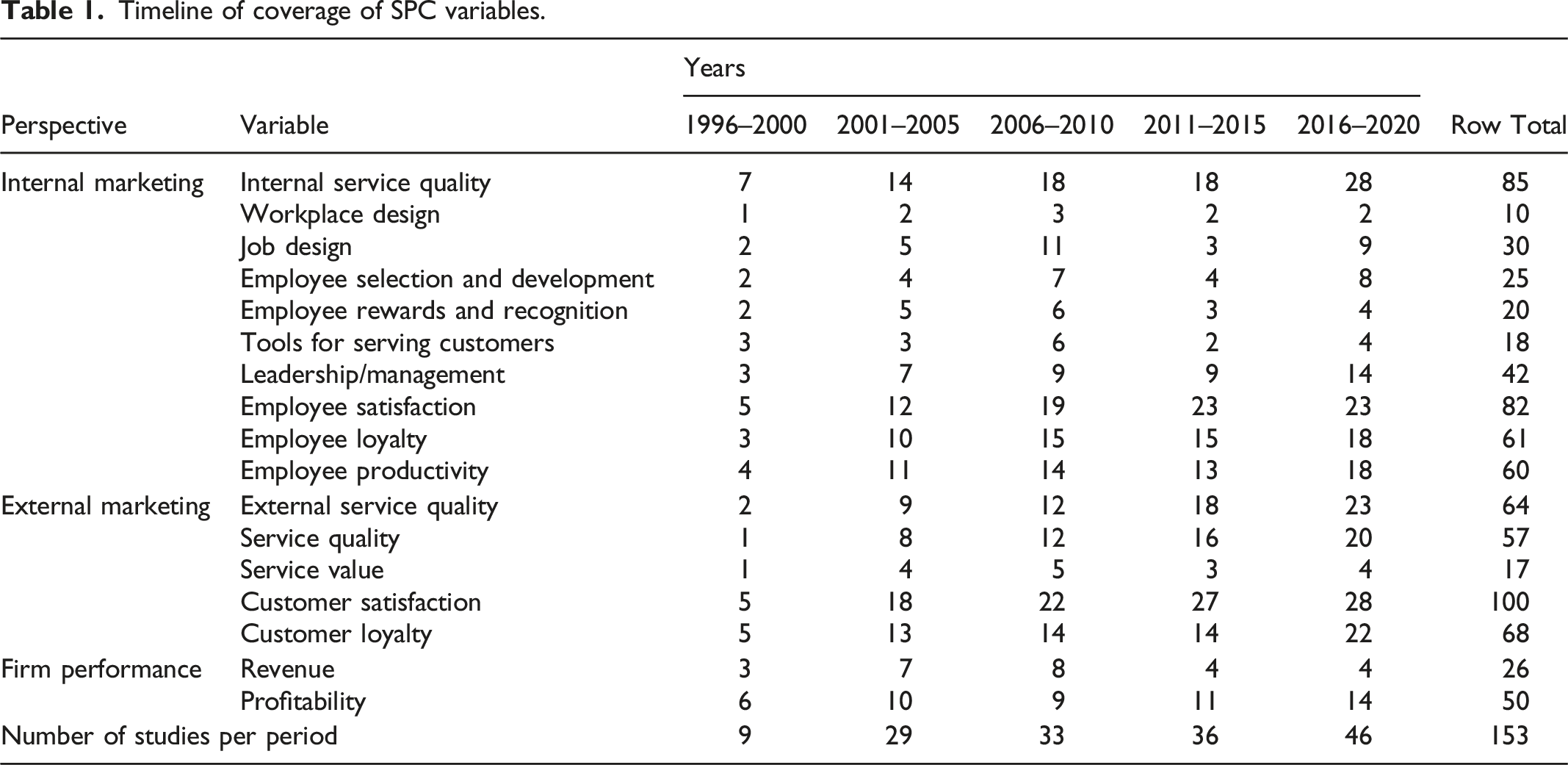
Timeline of coverage of SPC variables.
Research on the SPC mainly appeared in marketing and service outlets. However, the SPC received less attention from related disciplines, such as HRM, organizational behavior, strategic management, or management accounting—despite the SPC’s format as an interdisciplinary framework (Schneider and Bowen 2019). However, SPC research offers insights that are relevant to these related disciplines. In this vein, Heskett, Sasser, and Schlesinger (1997) discuss the SPC as a performance measurement system and, drawing on the SPC literature, Gupta and Zeithaml (2006) review and discuss observable (and unobservable) customer metrics and their relationship with firm performance. Accordingly, these and further studies might inform management accounting research. On the other hand, researchers from disciplines other than service research might fruitfully contribute to the understanding of the SPC. For example, insights from strategic management can improve knowledge on whether and how a firm’s internal service quality—as an intangible, inimitable asset—provides a competitive edge (e.g., Gerhart and Feng 2021).
Overall assessment of the SPC. Given that testing the SPC requires data from various sources, relatively few studies have managed to test the complete chain. Still, many studies have represented the SPC with selected variables pertaining to internal marketing, external marketing, and firm performance (e.g., Piening, Baluch, and Salge 2013). However, early studies provided mixed support for the SPC. For example, Silvestro and Cross (2000) find proof for propositions regarding external marketing and firm performance but not for propositions regarding the internal marketing perspective and its relationships with external marketing. More recent studies covering all parts of the SPC (e.g., Briggs, Deretti, and Kato 2020) not only generally support the concept but also indicate that the SPC might unfold differently in various contexts or cultures.
In synthesizing fragmented evidence on core relationships within the SPC, several meta-analyses have complemented primary studies testing the complete SPC (Brown and Lam 2008; Hong et al. 2013; Hogreve et al. 2017). These studies find overall support for the SPC. However, they also show that effect sizes vary considerably across studies, indicating that the examined effects may be contingent or non-linear, rather than universal and monotonous. Moreover, the original SPC model’s fit is poor, indicating that SPC researchers should consider additional mechanisms that link internal and external marketing with firm performance.
Internal marketing. The SPC has broadened service researchers’ perspective to consider internal service quality and its impact on service employees in order to improve external marketing initiatives and firm performance. Internal service quality is one of the most frequently studied variables in SPC-related research (n = 85; 55.6% of our sample), but studies have measured internal service quality in a wide variety of ways. Some studies conceptualize internal service quality as an aggregate construct (e.g., Piening, Baluch, and Salge 2013). Meanwhile, other studies focus on single HRM practices as indicators of internal service quality—most frequently focusing on leadership (n = 42; 27.5% of our sample) and least often focusing on workplace design (n = 10; 6.5%) (see Table 1). However, research on workplace design is increasingly important; during turbulent times, managers and scholars alike have learned that designing workplaces to promote employees’ safety and well-being is important (Voorhees, Fombelle, and Bone 2020). We, therefore, encourage more research on this central HRM practice. Moreover, future research could improve the understanding of internal service quality by comparing generic HRM practices and specific HRM practices that are oriented toward high-quality service delivery because empirical evidence shows that internal service quality’s effects are stronger for service-oriented than generic HRM practices (e.g., Hong et al. 2013).
According to Heskett et al. (1994), a second key element of the SPC is employee satisfaction (n = 82; 53.6% of our sample) because it promotes employees’ loyalty and productivity. However, the causal relations between employees’ satisfaction, loyalty, and productivity are less clear than the SPC suggests (e.g., Netemeyer, Maxham, and Lichtenstein 2010). Internal marketing relationships appear to be complex, rather than simply predictable as per the traditional SPC. This finding is also reflected in our discussion of additional theoretical mechanisms in the next subsection.
External marketing. One of the SPC’s significant achievements has been building bridges between the internal and external firm environments. A key element of the SPC is the satisfaction mirror, which implies that emotions flow from employees to customers; more than one-third of the SPC studies we reviewed (n = 57; 37.3% of our sample) examined both employee and customer satisfaction while 50 studies (32.7% of our sample) tested the satisfaction mirror (see Table 1 and Figure 1). However, empirical evidence suggests that emotional contagion effects between employees and customers are weaker than employee satisfaction’s indirect effect on customer satisfaction via external service quality (e.g., Brown and Lam 2008). We encourage future research exploring how and under which conditions employees’ attitudes might directly spill over to customers’ evaluations of—and reactions to—external service quality (e.g., Subramony and Holtom 2012). Service firms and scholars alike may use these findings to assess, for example, how more or less remote employee—customer interactions influence customers’ responses and, consequently, firms’ performance.
Another key variable is external service quality or value. Heskett, Sasser, and Schlesinger (2015) confirm that value is the central idea driving successful service delivery. Accordingly, 17 reviewed studies (or 11.1% of our sample; see Table 1) addressed value. Most studies use service quality as a proxy for the value a customer perceives during or after service delivery (n = 57; 37.3% of our sample). Overall, studies confirm the positive relationships between external service quality, customer satisfaction, and customer loyalty. Yet, insights into the sources and outcomes of service value remain incomplete in the literature (Zeithaml et al. 2020).
According to the SPC, customer satisfaction is the central outcome of external service quality and value. Customer satisfaction is the most researched variable (n = 100; 65.4% of our sample), and the link between customers’ satisfaction and their loyalty is well established. However, the strength of the relationship between customer satisfaction and customer loyalty is influenced by multiple contextual factors (e.g., von Wangenheim and Bayón 2007), and more research is needed to better understand the conditions under which customer satisfaction unveils its strongest effects within the SPC. Von Wangenheim and Bayón (2007), among other researchers, provide evidence of non-linear relationships between customer satisfaction and other external marketing variables, indicating the need to better understand the shape of the relationships between the SPC core variables. Finally, recent SPC research shows other paths to customer loyalty than first triggering customer satisfaction. These other paths might include a company’s service orientation or a firm’s employee climate (e.g., Briggs, Deretti, and Kato 2020). These findings suggest that customer loyalty may stem from multiple source targets, which future research should consider (see the section on “Revising the SPC”).
Firm performance. Following the SPC’s call to consider bottom lines, a growing number of studies have analyzed organizational performance variables. We found that 26 studies (or 17.0% of our sample) addressed revenues while 50 studies (or 32.7% of our sample) addressed profitability. These studies indicate that firm performance does not automatically improve through maximizing internal and external service quality (e.g., Kamakura et al. 2002). Importantly, this finding highlights the need to empirically test the extent to which investments in internal and external marketing influence firm performance.
Moreover, several studies have not measured these variables at the firm level, instead using revenues per employee (e.g., Homburg, Wieseke, and Hoyer 2009), revenues per customer (e.g., Netemeyer, Maxham, and Lichtenstein 2010), or profit per customer (e.g., Larivière 2008). We encourage future research using big data and marketing analytics to contrast investments in internal and external marketing, based on a wider range of valid performance metrics.
Concluding remarks. In sum, empirical research on the SPC has provided a more nuanced understanding of internal and external marketing effects. To explain relations between internal and external marketing and firm performance, researchers have referred to multiple theoretical mechanisms, which we summarize next.
Reflections on the Theoretical Mechanisms Linking Internal Marketing, External Marketing, and Firm Performance
The original SPC describes trickle-down effects through which internal service quality investments improve external service quality and, ultimately, enhance firm performance. These effects accompany emotional contagion effects, such that customer satisfaction mirrors employee satisfaction (e.g., Hennig-Thurau et al. 2006). Over time, SPC research has identified several potentially complementary mechanisms regarding (a) internal marketing and (b) external marketing (see Figure 1; Table 4), which we describe.
Internal marketing mechanisms. Drawing on research in HRM and organizational behavior, SPC researchers have identified four additional effects of internal service quality on employees, customers, and financial performance. These effects transcend the impact on employee satisfaction. First, internal service quality not only enhances employee satisfaction but also simultaneously improves external service quality. Investments in HRM practices, such as job design or employee selection and development, directly influence employees’ abilities and opportunities, thereby affecting their productivity (e.g., Jiang et al. 2012). Second, customers’ evaluation of internal service quality can inform their perceptions of external service quality. Chernev and Blair (2015) provide evidence for such a signaling effect, according to which customers evaluate quality more favorably if a company engages in prosocial activities. Third, from a social identity perspective, investments in internal service quality may enhance customer loyalty because customers more strongly identify with service companies that make these investments. Service firms’ investments in internal service quality are an important element of corporate identity that may also encourage customers to identify with companies (e.g., Homburg, Wieseke, and Hoyer 2009). Fourth, HRM practices lead to operational excellence and service efficiency, directly increasing firm performance via positive effects on employees’ citizenship behavior (Podsakoff et al. 2009). Moreover, although well-designed internal service processes are costly, they allow service firms to offer consistent levels of service quality at lower costs (e.g., Rust, Moorman, and Dickson 2002), leading in turn to higher profits. However, the interplay between these service–productivity variables remains poorly understood.
External marketing mechanisms. SPC research suggests that external service quality directly increases customer loyalty—beyond its effect on customer satisfaction. This effect might result from customer dependency because when provided outstanding service, customers can only receive this superior quality if they maintain a relationship with a given firm (Scheer, Miao, and Palmatier 2015). Yet, contrary to the SPC rationale, external service quality might reduce firm profitability beyond its positive impact on profitability through customers’ satisfaction and loyalty (e.g., Wirtz and Zeithaml 2018). In this context, return-on-quality frameworks argue that providing outstanding service quality and investing in customer relationships are costly—and some services do not benefit from these investments (e.g., Rust, Zahorik, and Keiningham 1995).
Most studies follow the SPC and model employee variables as antecedents to customer variables. However, Merlo et al. (2019) discuss the potential negative consequences of customer participation—such as customer feedback or ideas for developing services—on employee rewards, recognition, or satisfaction. The SPC literature has overlooked such influences of customer attitudes and behavior on internal service quality, as well as employee attitudes and behavior. In a rare exception to this oversight, Shepherd, Ployhart, and Kautz (2020) analyze reciprocal effects between the SPC’s variables. Partially reversing the SPC structure by analyzing feedback effects offers important insights.
Concluding remarks. The additional theoretical mechanisms show that, in order to succeed, service firms may proceed in various complementary or contradictory ways. A better understanding of how different internal and external SPC mechanisms work together is important. Therefore, the literature requires more research on these mechanisms and the contingencies that shape their interplay. Service companies can build on the understanding of how different mechanisms link internal and external service marketing with firm performance, optimizing investments in both internal and external service marketing.
Reflections on Research Methods
In order to assess the status quo of empirical SPC research, we also reflect on research methods that are commonly applied in SPC research. We also discuss how methodological advancements may inform future SPC research. In particular, we reflect on data collection and research designs that have been used to test SPC relationships.
Methods and data structure. Single-source data Versus multi-source data.
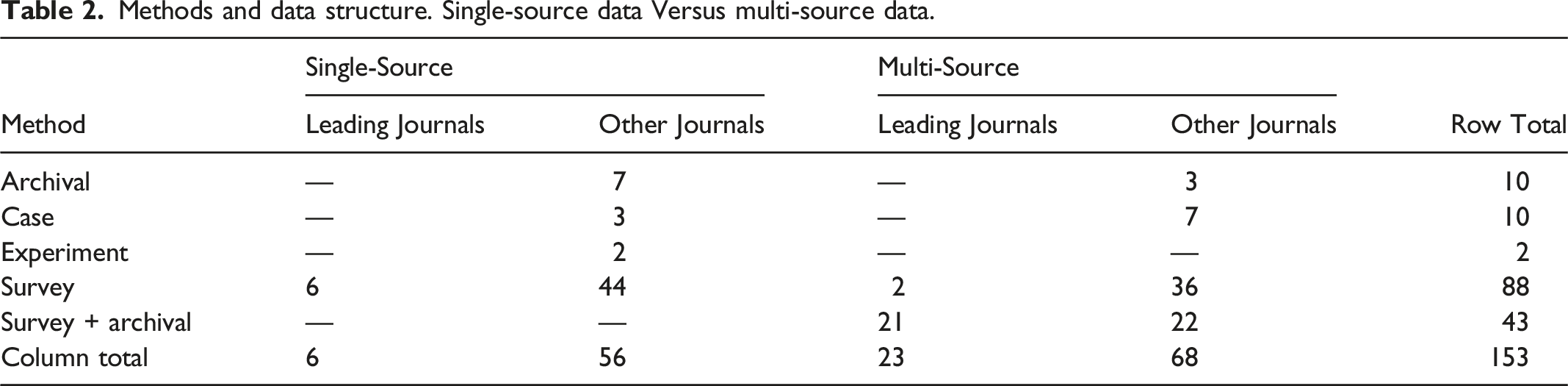
Services’ digital transformation offers new possibilities to collect archival data on variables, such as employee or customer satisfaction, that were previously accessible only through employees’ or customers’ perceptions (Huang and Rust 2021b). For example, Leonardi (2021) argues that mining metadata that were recorded when sending emails or during video conferences offers rich opportunities for research on internal service quality practices, as well as implications for the entire SPC. Moreover, using structured and unstructured data, Symitsi et al. (2021) analyze online employee reviews’ informational value to predict employee loyalty and firm profitability. Marketing analytics, big data, and AI promise to enrich SPC research.
Longitudinal data Versus cross-sectional data.
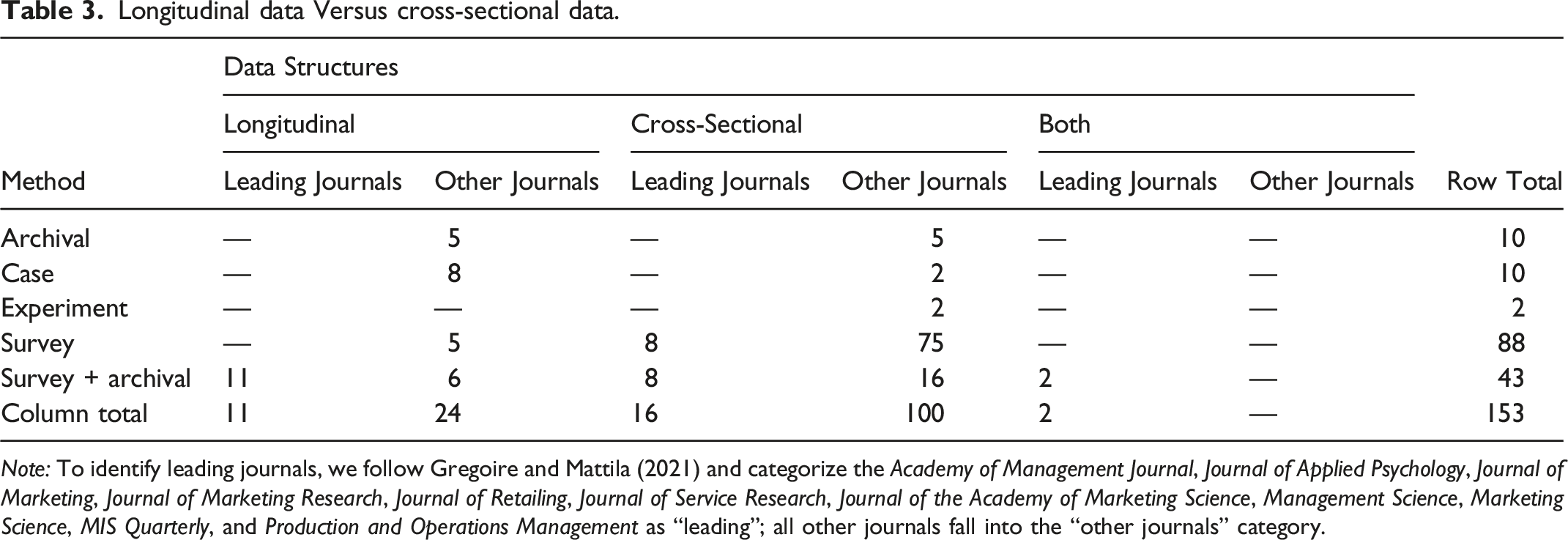
Note: To identify leading journals, we follow Gregoire and Mattila (2021) and categorize the Academy of Management Journal, Journal of Applied Psychology, Journal of Marketing, Journal of Marketing Research, Journal of Retailing, Journal of Service Research, Journal of the Academy of Marketing Science, Management Science, Marketing Science, MIS Quarterly, and Production and Operations Management as “leading”; all other journals fall into the “other journals” category.
To study how SPC effects evolve over time, for example, servitization processes at manufacturing firms that become service providers offer avenues for research. Analyzing newly implemented internal service quality practices’ impact on employee satisfaction, loyalty, and productivity, as well as customer satisfaction and loyalty over time, may show how SPC dynamics unfold. This analysis can provide evidence as to whether internal service quality changes initiate the trickle-down effects that the SPC described. Additionally, longitudinal studies on transforming businesses may provide new insights into the SPC’s temporal effects and potential time lags, better capturing the chain’s long-term focus (e.g., Anderson and Mittal 2000).
However, if gathering longitudinal data is not feasible, researchers may revert to cross-sectional data using an instrumental variable approach to obtain unbiased causal estimates of hypothesized relationships (for an illustration, see Huang and Sudhir 2021). Alternatively, experimental designs may help SPC researchers test causality more rigorously (e.g., Buell, Kim, and Tsai 2017). For example, professional service firms’ shift to remote working (Empson 2021) offers a quasi-experimental setting in which to study changes regarding internal service quality and how they affect employees, customers, and firm performance.
Concluding remarks. Future SPC research might benefit from big data’s multiple opportunities to better understand chain effects. This approach, in line with a stronger test of the SPC’s causality, will enrich SPC research significantly.
Future research opportunities.
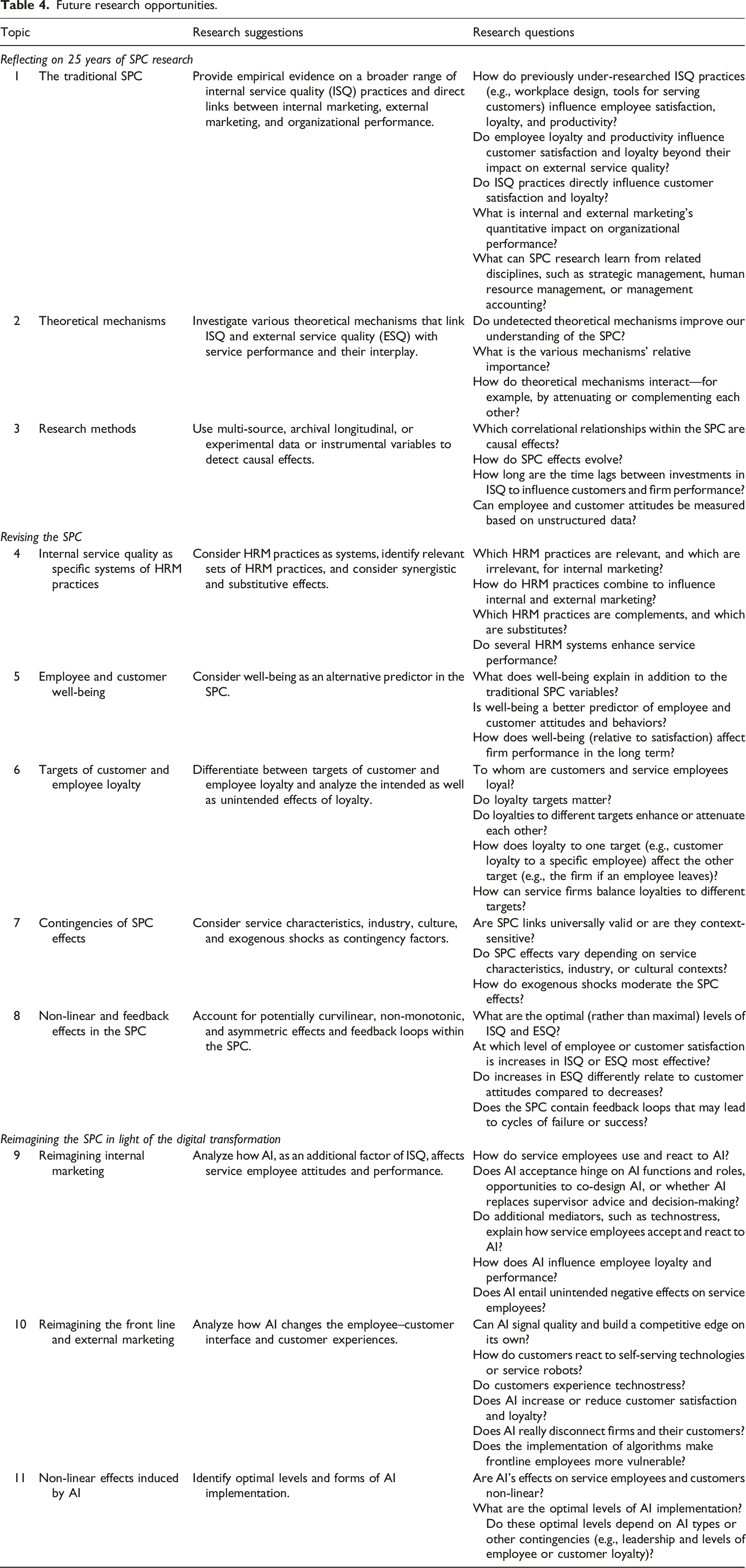
Revising the SPC
Based on our review of prior SPC studies and discussions in related fields, we identify five areas of revisions to the SPC that warrant further attention (see Figure 2 and Table 4 for an overview): (a) conceptualizing internal service quality as systems of HRM practices, (b) considering employee and customer well-being, rather than satisfaction, (c) distinguishing targets of employee and customer loyalty, (d) potential contingencies of SPC effects, and (e) non-linear and feedback effects within the SPC. Revising and reimagining the service–profit chain.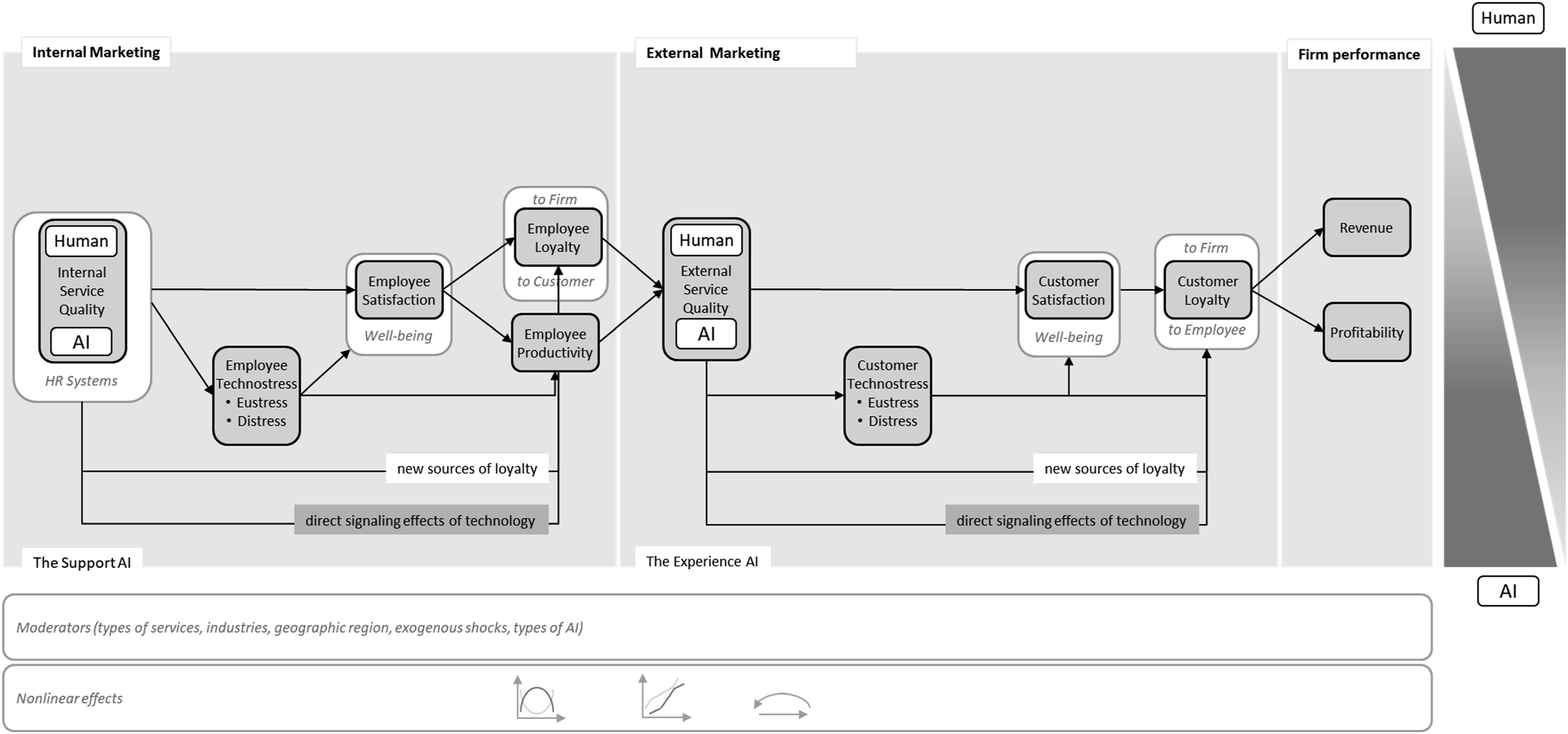
Internal Service Quality as Specific Systems of HRM Practices
Our literature review above stressed that studies tend to measure single and varying HRM practices. Yet, Heskett et al. (1994) have proposed a focus on HRM systems—that is, specific configurations of HRM practices. Theoretically, HRM practices should be analyzed jointly, rather than separately, because they are interdependent and because employees experience an interrelated set of HRM practices, rather than single practices at a time (e.g., Lepak et al. 2006).
The SPC literature remains largely silent on how specific HRM practices combine to enhance performance. The majority of SPC studies measures HRM systems as though various HRM practices’ independent effects add up. However, an HRM practice’s effectiveness depends on the presence or level of other practices. HRM practices may create synergies and reinforce each other if they fit into a coherent system, or alternatively, they may attenuate each other’s effects if they do not fit into a coherent system (e.g., Jiang et al. 2012).
Meuer (2017) shows that five specific configurations of HRM practices lead to superior labor productivity. Four of these configurations are prevalent in the service sector. This finding implies that service firms have no single best way to design HRM systems that enhance service performance. Instead, various equally successful alternatives are available to these firms. Empirical evidence also shows that firms may diminish or even destroy HRM systems’ performance-enhancing effects by implementing more practices without considering synergistic effects (e.g., Jiang, Chuan, and Chiao 2015). Meijerink and Bondarouk (2018) show that the knowledge and skills of both service employees and customers may substitute for one another in achieving high service value for standardized services, indicating that synergistic effects exist not only between HRM practices but also between HRM practices, service employee characteristics, and customer characteristics. Thus, a focus on HRM systems—rather than single HRM practices—could deepen the literature’s understanding of the complex interplay between internal and external marketing and service outcomes. Accordingly, rather than following a single best practice, service companies may learn to design HRM systems that fit their specific service strategy, resources, and external competitive and institutional environments.
Employee and Customer Well-Being
Traditionally, the SPC has focused on employee and customer satisfaction as mediating factors between service quality, employee behavior, and customer behavior. Yet marketing and management researchers increasingly focus on employee and customer well-being, particularly in the context of global shocks and turbulent times (Ostrom et al. 2021). Contrary to satisfaction, analyses of well-being adopt broader perspectives, including not only satisfaction or the general presence of a positive mood but also the absence of negative emotions (e.g., stress) and engagement in activities that foster meaning and accomplishment (Falter and Hadwich 2020).
Research suggests that employee well-being is a critical factor in both individual performance and firms’ long-term success (Grawitch, Ballard, and Erb 2015). While most studies in the service context focus on employee well-being as the main dependent variable in their analyses (e.g., Huettermann and Bruch 2019), few studies refer to this variable’s mediating role that links internal service quality with performance (e.g., Guest 2017). Future research may explore whether employee well-being can complement or even replace employee satisfaction in the SPC structure. In Figure 2, we propose well-being as an additional mediator that builds a complementary or substituting path within the SPC. Considering well-being in addition to or instead of employee satisfaction will enrich the service literature in several ways.
First, considering well-being and traditional employee satisfaction measures will allow researchers to test which of these variables better predicts employee productivity, employee loyalty, and finally firm performance. This approach will deepen the scholarly understanding of service work and service employees’ experiences (Subramony and Groth 2021). Second, the literature’s focus on well-being tends to adopt a long-term perspective, whereas focuses on satisfaction address immediate responses or evaluations. So far, research has not addressed whether investments in internal service quality initiatives focused on employee well-being have any positive long-term effects. Therefore, we call for research addressing employee well-being as an important short- and long-term performance lever.
Third, future research should explore whether employee well-being influences customer well-being. For example, studies should address whether employees’ low stress and good health directly affect customers’ well-being. If so, a well-being mirror might be involved alongside a satisfaction mirror (Heskett et al. 1994). For instance, some research has initially indicated the spill-over effects of smiling (Hennig-Thurau et al. 2006). Thus, a focus on new HRM practices that aim to improve employee well-being—such as a firm’s health initiatives or flexible work arrangements—would be worthwhile, exploring whether higher employee well-being affects customers. A better understanding of well-being’s effects on the SPC could help service managers justify internal service quality investments (see Table 4).
Different Targets of Employee and Customer Loyalty
The SPC highlights the importance of employee and customer loyalty, but it does not explicitly differentiate between various objects of loyalty. Thus, it neglects the potential pitfalls of maximizing loyalty. Service employees may be loyal to different objects, such as the service firm, supervisors, or customers they serve (Coyle-Shapiro and Morrow 2006). Studying sales organizations, Siders, George, and Dharwadkar (2001) show that loyalty to an organization most strongly relates to sales volume while loyalty to a supervisor explains variance in sales growth and sales from new accounts—beyond organizational loyalty. Moreover, loyalty to customers leads to increased market share and broader product use. While service employees’ loyalties to different objects may mutually reinforce each other, they may also have negative effects. Service employees who are more loyal to customers than their service company may engage in customer sweethearting—for example, by giving unauthorized discounts or services to customers—hampering firm performance. Brady, Voorhees, and Brusco (2012) show that customer sweethearting behavior enhances customer satisfaction with individual service employees, strengthening the employee–customer bond but not the customer–firm relationship. In contrast, service employees who are primarily loyal to their firm might strive to benefit their firm but not customers (e.g., Bowen and Schneider 2014). This tendency could harm the service employee–customer relationship, reducing customer loyalty (Hogreve et al. 2017). As Homburg, Müller, and Klarmann (2011) show, customer orientation can achieve an optimal level, and service firms are well advised to balance employees’ customer orientation with their firm orientation.
Customers, instead, may be loyal not only to service firms but to also individual service employees (Yim, Tse, and Chan 2008). Nonetheless, loyalty measures often fail to account for loyalty ownership. Palmatier, Scheer, and Steenkamp (2007) show that service employee–owned customer loyalty affects firms’ performance more positively than customers’ loyalty to firms. However, it also threatens financial damage if service employees leave their company because customers might then also leave, favoring competitors who could hire such employees.
Several factors may explain to whom customers are loyal. Women tend to be more loyal to individual service employees while men tend to be more loyal to service firms (Melnyk, van Osselaer, and Bijmolt 2009). Service characteristics might also determine the objects of loyalty. For instance, the higher the level of co-creation and intangibility, the more important the service employee–customer interaction becomes. Thus, customers are more likely to be loyal to individual service employees if they co-create a service and if the service is highly intangible.
We suggest that SPC research distinguish between different targets of customer and employee loyalty. These studies should analyze whether loyalties to different targets reinforce or attenuate each other. Accounting for different loyalty targets might reveal the potentially harmful effects of maximizing customer and employee loyalty, providing a more nuanced understanding of the SPC. Building on this knowledge, service firms can balance and optimize employee and customer loyalty, rather than seeking to maximize both, thus enhancing firm performance.
Contingencies of SPC Effects
Partly inconsistent and varying effect sizes indicate that SPC effects are not universal; rather, they depend on specific contingency factors (e.g., Yee et al. 2009). Therefore, we suggest that future research explore industry differences, cultural and institutional effects, and the moderating influence of environmental turbulence to refine the knowledge of SPC effects.
Industry differences. The SPC is frequently studied across many service industries, predominantly in financial services (n = 35; 22.9% of our sample) and hospitality (n = 32; 20.9%). But several avenues for future research have opened from applying the SPC to contexts that SPC scholars rarely investigate. For example, given the importance of servitization processes at manufacturing firms, studies focusing on B2B services (e.g., Santos-Vijande, López-Sánchez, and Rudd 2016) are still comparatively rare (n = 18; 11.8% of our sample).
Though the SPC logic holds across various industries and business types, meta-analyses suggest that the core SPC links’ strength varies according to service industries and service characteristics. Brown and Lam (2008) and Hong et al. (2013) show that the SPC links’ strength differs between personal and non-personal services. Similarly, Hogreve et al. (2017) find that intangibility and coproduction moderate several SPC relationships—and that key SPC relationships differ in strength between B2B and B2C services.
These findings indicate that the specific theoretical mechanisms underlying the SPC may be more pronounced in some industries and less important in others. Studying industries that have received little attention from SPC researchers—such as education, health services, social businesses (e.g., Hur, Moon, and Jung 2015), and small service firms generally (e.g., Homburg, Wieseke, and Hoyer 2009)—promises to advance the knowledge of SPC mechanisms. For example, social identity-related mechanisms may dominate in service industries, such as education and social services. For other services, however, social identity may only weakly enhance success, perhaps primarily due to external service quality in their specific contexts.
Cultural differences. Although our sample contains studies from the United States (n = 44; 28.8% of our sample), European countries (n = 50; 32.7%), and Asian countries (n = 28; 18.3%), SPC research has seldom studied culture as a contingency factor. Importantly, however, related research suggests that culture influences both external and internal marketing relationships because it shapes both customers’ and employees’ expectations and behaviors (Posthuma et al. 2013). Samaha, Beck, and Palmatier (2014) show that customer loyalty positively affects firm performance most strongly in China, Africa, and the Middle East. Meanwhile, this effect is weaker in the United States and weakest in Western Europe. Moreover, Rabl et al. (2014) find the relationship between internal service quality—measured as high-performance work systems—and firm performance to vary between countries. This relationship is strongest in the Middle East and the Confucian region and weakest in the Germanic region. A better understanding is needed of how cultural differences in SPC effects help service firms adapt their internal and external marketing investments to cultural settings in order to improve performance.
Environmental turbulence. Future research should also investigate how major exogenous shocks, such as the COVID-19 pandemic, influence the SPC’s effects and mechanisms (e.g., Ostrom et al. 2021). For example, service firms may need to adapt their internal service-quality practices to help employees cope with increased uncertainty and threats (Carnevale and Hatak 2020). Similarly, customers may re-evaluate service quality during major crises, paying more attention to meaningful service encounters and well-being needs (e.g., Barnes et al. 2020). Studying financial customer–seller relationships, Hansen (2014) shows that customer loyalty depends more on satisfaction and less on trust after the 2008 financial crisis.
In conclusion: SPC relationships’ contingencies. Although SPC research has largely neglected contingency factors, evidence suggests that both internal and external marketing effects’ strength depends on service and industry characteristics, as well as cultural aspects. Moreover, this strength may vary in response to exogenous shocks. Therefore, future studies must explore SPC relationships’ contingent nature.
Non-Linear and Feedback Effects in the SPC
One of the SPC’s basic tenets implies that, in order to improve firm profitability, service firms must universally maximize customers’ and employees’ satisfaction and loyalty through superior external and internal service quality (Heskett et al. 1994). Partially at odds with Heskett et al.’ (1994, 1997) work, SPC relationships are usually considered linear—implying, for example, that more internal service quality or customer satisfaction improves firm performance and that this effect’s size remains the same across service quality or customer-satisfaction levels. Accordingly, most SPC studies model linear relationships—for example, via structural equation models. Only 11 studies (7.2% of our sample)—seven published in leading journals and four in other journals—provide initial evidence about non-linear or non-monotonic SPC relationships (e.g., Strydom, Ewing, and Heggen 2020).
Non-linear relationships. Some scholars question SPC relationships’ linearity. For example, return-on-quality frameworks argue that the relationship between service quality and firm profitability is inversely U-shaped because providing outstanding service quality and investing in customer relationships are costly, so some services do not benefit from these investments (Rust, Zahorik, and Keiningham 1995). This inconsistency in benefits may stem from heterogeneous customer preferences. Some customers do not expect higher service quality and, thus, are unwilling to reward these efforts. Therefore, for some customers, investments in external service quality and customer loyalty might not pay off since the costs associated with customer retention may exceed their benefits (e.g., Huang and Rust 2017).
Additionally, the link between employee satisfaction and customer loyalty may be curvilinear, such that employee satisfaction reduces customer loyalty beyond its positive impact through external service quality and customer satisfaction. High satisfaction levels might motivate employees to advance their coworkers’ or organizations’, rather than customers’ interests (Bowen and Schneider 2014). These findings question the universal SPC claim that service firms must maximize internal and external service quality to maximize firm performance.
Non-monotonic relationships. Research also provides evidence for non-monotonic SPC relationships. For example, Strydom, Ewing, and Heggen (2020) find a negative asymmetric relationship between employee productivity and customer satisfaction, indicating decreased employee productivity affects customer satisfaction more than corresponding increases. Heskett et al. (1994) assume that high customer satisfaction levels more strongly influence customer loyalty than average and (especially) low customer satisfaction levels. However, for online retailers, customer satisfaction has a negative cubic effect on customer loyalty, indicating that this impact is highest at average—rather than high—customer satisfaction levels (Finn 2012). Additional knowledge about different forms of non-linearity in specific contexts may help service firms optimize their resource allocation and target their most receptive customer segments.
Feedback effects. Researchers may also better understand service performance by studying potential feedback loops in the SPC. The chain structure might suggest that relationships in the SPC are unidirectional, leading from internal service quality to firm performance via external service quality. However, Heskett et al. (1994) also describe reversed effects, such that companies experiencing poor firm performance refrain from investing in internal service quality, which leads to a cycle of failure. Evanschitzky, von Wangenheim, and Wünderlich (2012) provide empirical support for such a positive but lagged feedback loop from firm performance to investments into internal service quality. Feedback loops may also occur between employees and customers. Buell, Kim, and Tsai (2017) show that employees who observe satisfied customers are more motivated to improve their performance because they feel more appreciated. Similarly, Shepherd, Ployhart, and Kautz (2020) find collective customer perceptions of service quality to influence collective employee satisfaction. This feedback loop appears stronger than employee attitudes’ effect on customer outcomes at an aggregate level.
Altogether, these findings indicate that the frequent assumption of simple linear and unidirectional relationships must likely be revised. A more profound understanding of the SPC links’ non-linear nature would allow optimized investments in internal and external service quality to maximize firm performance. Similarly, a better understanding of feedback effects would highlight the complex interdependencies between internal marketing, external marketing, and organizational performance.
Thus far in this article, we have focused on the more traditional service sector. We have not yet addressed how the digital transformation and AI may require service researchers to reimagine the SPC. Firms increasingly introduce service robots, chatbots, or other technically supported or digital touchpoints that might significantly affect the SPC’s structure as we discuss in the “Reimagining the SPC in light of the digital transformation” section.
Reimagining the SPC in Light of the Digital Transformation
As the digital transformation unfolds and the use of service robots and AI expands, scholars expect a significant reshaping of services (Huang and Rust 2021b). Considering these significant changes, we suggest reimagining the SPC. In order to account for varying degrees of the digital transformation, the future SPC needs to cover not only traditional human-centered service interactions but also a combination of human and AI-supported encounters, as well as encounters in which AI interacts with other AI. Below, we emphasize some of the most pressing research gaps regarding an AI-infused version of the SPC. We also acknowledge that this reshaping may apply to all internal and external service processes. Thus, we extend the revised SPC by reimagining internal marketing, the service frontline, and external marketing. The AI-infused SPC includes AI-based internal and external service quality, and employee and customer technostress as additional mediating factors. It also includes paths that complement the traditional and revised SPC that we described above (see Figure 2).
Reimagining Internal Marketing
The transformation of internal service quality. In the current subsection, we delineate how AI transforms internal service quality by promising to support service employees in new ways (Lam et al. 2017). Therefore, we suggest the support AI as a complementary part of the SPC (see Figure 2). A central question that arises is: Do AI-supported HR practices—such as AI-based selection processes, leadership support, or decision outcomes—enhance service performance? So far, few studies have focused on AI-based mechanisms that aim to support service employees. For example, Luo et al. (2021) find that the combination of a human coach with an AI coach outperforms human or AI coaches alone in improving sales agents’ job skills. Tong et al. (2021) provide experimental evidence showing that AI feedback may enhance service employees’ productivity by improving employee learning. Yet, at the same time, these authors found that AI feedback may hamper employee productivity because it reduces employees’ trust in feedback quality. Experiments on human–robot interaction indicate that feedback through robot interfaces, as well as robots’ adaptability and autonomy (though not their appearance), affects employee satisfaction and productivity (Ötting et al. 2020).
An additional aspect requiring further research attention is whether AI-based initiatives affect employee loyalty and productivity. Interactions with robots that serve the front line might demotivate employees and increase fears of their roles’ diminishing importance (Marinova et al. 2017) or even of job losses. Preliminary evidence indicates that AI may fail to improve employee productivity if it threatens employees’ self-efficacy so that they disregard AI recommendations (Elkins and Nunamaker 2013). Moreover, as Beane (2019) shows, growing reliance on tools such as robotic surgery or AI-based company valuations might interrupt on-the-job learning processes, which could entail serious consequences for employees’ skill development. This impact might affect employees’ productivity over the long term. However, to better understand these potential negative outcomes of AI, as well as their effects within the SPC, more research is needed.
AI’s supporting effect might only occur if service employees accept novel technologies. While research has begun to examine consumers’ acceptance of new technologies, such studies often omit service employees’ perspectives. However, related research indicates that codesign might serve as one lever of technology acceptance. Innovation research finds that co-designing a product or service increases innovation acceptance significantly (Mahr, Lievens, and Blazevic 2014). Allowing employees to codesign digital or AI-supported internal service quality initiatives might have the same effect. However, no empirical research has yet analyzed the possibilities of employees’ co-designing AI-based HRM support to increase acceptance. Another refinement to the SPC is employees’ approval of AI-initiated and AI-supported decision-making processes, which would otherwise fall to human supervisors. Tambe, Cappelli, and Yakubovich (2019) raise the question of whether the relationship quality between service employees and supervisors might deteriorate if employees knew their supervisors based their decisions on AI. Moreover, decision support systems might relieve supervisors’ work routines but demotivate or confuse service employees. These possible effects present avenues for future research.
These findings provide initial evidence that, in order to achieve long-term service success, firms must understand how AI affects service employees. Research must identify the specific triggers of employees’ technology acceptance in a service context, as well as how to address these aspects through communication initiatives and process design. Researchers and managers will then better understand how the digital transformation and AI—which might increase cost efficiency—can affect satisfaction, productivity, and loyalty among frontline employees. In this context, Sampson (2021) raises an important aspect for further research, referring to task automations instead of job automations. His argument and initial empirical analysis suggest that automation might also affect highly skilled service jobs. Accordingly, the discussion of this important topic requires further explorations through future service research initiatives.
The different roles of technostress. The introduction of additional mediation variables might explain AI implementation’s effects on employees. Technostress (Ayyagari, Grover, and Purvis 2011; Tarafdar, Pullins, and Ragu-Nathan 2015) might be among these missing links. The SPC promotes internal service quality investments’ positive effects on employee satisfaction, and multiple studies have supported this perspective. Tarafdar, Cooper, and Stich (2019) emphasize technology implementation’s potential positive effects and introduce techno eustress (i.e., stress that creates a challenge or an opportunity for personal growth). For instance, analytics software might provide employees with new opportunities to analyze large amounts of data, extending their feelings of competence (Wu, Lou, and Hitt 2019). Meanwhile, AI might increase a service provision’s effectiveness by empowering frontline employees (Rafaeli et al. 2017). However, digital features’ implementation might challenge the assumption of a positive relationship between internal service quality and employee-related outcome variables. In this vein, studies show that implementing technology to support employees’ daily work might be overwhelming. Indeed, research finds that technology implementation can have negative effects. Tarafdar, Pullins, and Ragu-Nathan (2015) show that technostress significantly reduces employee productivity, and Ayyagari, Grover, and Purvis (2011) explain the drivers of technostress. However, none of these studies place these variables in the broader context of internal and external service quality. Given technology’s potential detriments (Marinova et al. 2017), including techno-distress and its multiple facets as an additional mediator and explanatory factor between internal service quality and employee satisfaction, as well as performance, offers another fruitful avenue for future research (see Figure 2). Such research could better understand the digital transformation’s potential adverse effects.
AI-based contingency effects. Specific internal service quality initiatives’ importance and outcomes might depend on AI’s function and role in service work. Huang and Rust (2021b) define three AIs that can be used in services. They differentiate between mechanical intelligence (which learns and adapts only minimally and is suitable for routine tasks), thinking intelligence (which is rule-based and offers opportunities for personalization), and feeling intelligence (which can perform emotional and interactive tasks, based on learning from experiences—i.e., machine learning). This AI categorization suggests that further research must examine how the effects we have discussed might vary by AI type. Similarly, AI implementations’ effects on employee attitudes and performance might also depend on whether employees consider AI to be tools or autonomous teammates (Furlough, Stokes, and Gillan 2021).
Reimagining the Front Line and External Marketing
AI’s effects will extend beyond internal marketing. Scholars must also discuss how implementing such a technology that dramatically changes the employee–customer interface will change the SPC’s external marketing perspective. Technology changes customers’ experiences and touchpoints considerably. We refer to this effect as the experience AI (see Figure 2).
AI, digital touchpoints, and customer engagement. Huang and Rust (2021a) argue that, depending on its service task, AI will significantly lever customer engagement. These authors argue that AI may be applied during service delivery, creation, and interaction to gain a competitive edge. Yet, the literature understands how to design digital touchpoints very little (van Doorn et al. 2017) according to consumer needs. The self-service technology literature might offer some indication of digital touchpoint implementations’ effects. Self-service technologies, such as online banking, aim to replace human service workers and standardize services. Research suggests that such technologies produce several negative side effects that employees might mitigate. For example, Campbell and Frei (2010) report increasing costs to serve and reduced short-term profitability for online banking customers—but also higher customer retention rates and increased market shares. Buell, Campbell, and Frei (2010) further suggest that the retention of self-service customers might be driven by switching costs, rather than satisfaction. Likewise, Shell and Buell (2019) find growing customer dissatisfaction with service providers’ decisions and reduced trust after a self-service technology is introduced. These effects could be mitigated by providing customers a human help option. Therefore, AI-based touchpoints’ design must induce customer loyalty and not only increase customers’ switching costs. Moreover, at least during such a transition, providing a human help option might assist service firms in managing the side effects of AI implementation.
The side effects of AI implementation. Figure 2 depicts technology implementations’ potential side effects in the customer sphere. In line with our arguments for AI’s employee outcomes, we expect potential side effects of technology-induced stress in external marketing, too. Mende et al. (2019) discuss some potential side effects on consumers. They show that robots’ implementation at the front line might lead to negative compensatory behaviors, such as increasing caloric intakes. We expect technostress to potentially mediate external service quality’s effect on the subsequent SPC variables. Likely, the positive and negative effects of technostress that we discussed from an employee perspective will also similarly affect customers. Customers dealing with digital touchpoints might experience eustress (such as feeling competent) or distress (such as feeling overwhelmed when using an AI-based touchpoint). Further research must establish how this mediation varies effects within the SPC.
Additionally, technology-enabled touchpoints may complement or substitute employee–customer interactions. On the one hand, if new AI-based touchpoints complement employee–customer interactions, they likely weaken the internal service quality’s direct signaling effect because AI itself draws customers’ attention. On the other hand, if AI-based touchpoints substitute employees (as Figure 2 indicates), technology implemented at the front line might itself form a new signaling effect. This effect could establish a competitive edge, but only if the technology is designed to avoid the negative side effects of technostress. Further research is all the more necessary since scholars do not know enough about how frontline AI implementation affects contagion effects or customers’ attitudes and behaviors (e.g., Mende et al. 2019).
Furthermore, the digital transformation may alter customer loyalty targets. New interfaces might lever customer satisfaction and loyalty as much as traditional frontline employees. Also, if touchpoints in highly interactive services become robots or AI instead of humans, research must identify customers’ emotional reactions to robots and AI (Huang and Rust 2021a). Scholars have somewhat addressed this issue in studies on frontline robots (Mende et al. 2019). However, more research is needed to better understand AI’s performance and financial implications. Accordingly, research must better understand how digitalization and AI implementation change customers’ experience and evaluations, as well as their behavior (Puntoni et al. 2021).
Finally, Kozinets and Gretzel (2021) discuss the challenge in firms’ disconnection from their customers and increasing vulnerability because of AI implementations. These authors argue that due to the implementation of AI and other technology, firms might lose strong bonds to their customers because technology increasingly provides touchpoints that distance service firms from their customers. Technology might thus diminish opportunities for sales, relationship building, and idea generation, which might ultimately impair firms’ performance. Moreover, customer contact employees who rely heavily on AI might become dependent on algorithms. This dependence might, in turn, lead to increased vulnerability for firms because changes to algorithms might devalue employees’ skills, affecting employee–customer interactions. These two possibilities must be considered in future research on the SPC—not least because they might cause the positive relationships discussed in this subsection to worsen. Such a worsening could cause further misalignment within the SPC.
A Methodological Thought
Reimagining the SPC in the light of the digital transformation warrants some methodological thoughts that call for future research. Research on the implementation and use of technology suggests that AI-based SPC effects may not be linear. For instance, Ahearne, Srivasan, and Weinstein (2004) identify inverted U-shaped effects of IT usage on salespeople’s performance, signifying that a medium level of automation might be most effective in supporting the salesforce. This finding, as an initial indicator, suggests that technologies might not succeed automatically. Accordingly, this research stream deserves further attention—especially in the SPC domain. We propose that additional research identify the potential non-linear effects of innovative, AI-based support structures on employee satisfaction and performance. Based on these outcomes, researchers might rethink technology’s role within the SPC’s internal service quality dimensions, as well as its effects on employee attitudes and behaviors. In developing this new framework, research will present guidelines for the optimal level of technology implementation, again calling for research on potential non-linear effects. This need for additional research might be even more pronounced, given that companies all over the world are currently struggling to implement high-quality technology that actually supports employees and to effectively apply AI to HRM initiatives (Tambe, Cappelli, and Yakubovich 2019). Moreover, we propose that such non-linear effects might affect both internal and external marketing. Thus, similar optimality concerns might also influence digital touchpoints and their effects on customers’ attitudes and behavior.
What Is Next in SPC Research?
Our review of the SPC literature leads us to conclude that although researchers have gained substantial knowledge of the SPC over the past 25 years, much remains unknown. The current research synthesis was intended to describe the state of knowledge about the SPC while highlighting some suggestions for further research. Our analysis has revealed a significant scope for further research on the traditional SPC. Furthermore, revising the SPC based on ongoing discussions in service research and related fields may improve researchers’ understanding of the links between internal marketing, external marketing, and firm performance. We have also shown that SPC scholars must account for the digital transformation, which may change employees’ and customers’ roles, experiences, and expectations. Particularly, we have proposed a reimagining of the SPC that considers more traditional services, based on human interactions, as well as AI-supported internal and external marketing mechanisms. We hope to have encouraged researchers to continue expanding the literature’s SPC knowledge in order to reveal the SPC’s potential as an interdisciplinary and integrative service management framework.
Supplemental Material
sj-pdf-1-jsr-10.1177_10946705211052410 – Supplemental Material for The Service-Profit Chain: Reflections, Revisions, and Reimaginations
Supplemental Material, sj-pdf-1-jsr-10.1177_10946705211052410 for The Service-Profit Chain: Reflections, Revisions, and Reimaginations by Jens Hogreve, Anja Iseke and Klaus Derfuss in Journal of Service Research
Supplemental Material
sj-pdf-2-jsr-10.1177_10946705211052410 – Supplemental Material for The Service-Profit Chain: Reflections, Revisions, and Reimaginations
Supplemental Material, sj-pdf-2-jsr-10.1177_10946705211052410 for The Service-Profit Chain: Reflections, Revisions, and Reimaginations by Jens Hogreve, Anja Iseke and Klaus Derfuss in Journal of Service Research
Footnotes
Declaration of Conflicting Interests
The author(s) declared no potential conflicts of interest with respect to the research, authorship, and/or publication of this article.
Funding
The author(s) received no financial support for the research, authorship, and/or publication of this article.

Supplementary Material
Supplementary material for this article is available online.
Author Biographies
References
Supplementary Material
Please find the following supplemental material available below.
For Open Access articles published under a Creative Commons License, all supplemental material carries the same license as the article it is associated with.
For non-Open Access articles published, all supplemental material carries a non-exclusive license, and permission requests for re-use of supplemental material or any part of supplemental material shall be sent directly to the copyright owner as specified in the copyright notice associated with the article.
